



Abstract
This article reveals the extent to which western-driven neo-liberal policies have influenced and shaped the current state of the national welfare policies, and consequent socio-economic conditions, in Lithuania. It looks at different stages of welfare state development following the independence of Lithuania before providing an overview of the current national institutional settings and policies. First, it discusses policy reforms that occurred during the transformation from planned to market economy. This part deliberates ideological changes characteristic to that period along with socio-economic impacts of the transformation. Then, it evaluates the more recent welfare state developments that began after Lithuania’s accession to the European Union (EU). The article concludes with an assessment of the key features of contemporary welfare policies and their wider socio-economic outcomes.
Introduction
Lithuania is not one of the countries that are likely to dominate the European political agenda. Nor is it a country that has sparked any particular interest among the international academic community. Nonetheless, Lithuania is one of the few countries that has been praised for its aggressive austerity measures and presented as a role model to the rest of the European community by one of the most influential institutions overseeing the regional monetary policies, the European Central Bank (Draghi, 2014). At the same time, Lithuania remains one of the poorest countries in Europe. In 2013 around 30% of the population (over 900 thousands people or every third person) in the country was experiencing risk of poverty and social exclusion (Eurostat, 2013). In the heat of the Greek bailout turmoil, it was brought to the public attention that Lithuania was significantly ‘Poorer than Greece’ (Rerniauskas and Raudseps, 2015). Indeed, even during the best times people in Lithuania were poorer than their Greek, and many other European, counterparts. The residents of the country have been receiving astonishingly low levels of employment-related earnings. In fact, Lithuania has some of the lowest wages and pensions in the whole of the EU, which only exceed the rates of the younger European members, namely Romania and Bulgaria (Figure 1). To make matters worse, Lithuania also has one of the highest proportions of low-wage earners in the EU. Such socio-economic conditions largely reflect the dominating ideological discourse and policies implemented in the country during the last two decades.
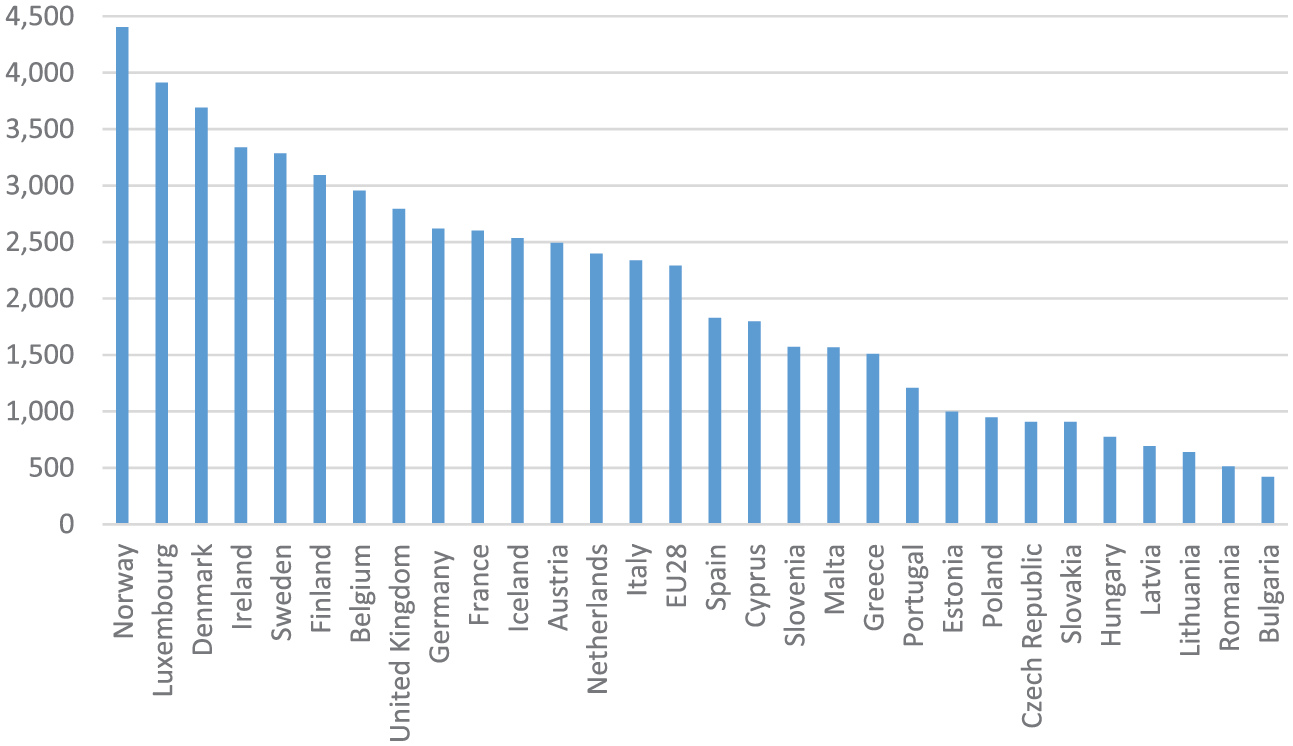
Average monthly earnings in euros.
The critical longitudinal analysis of national settings provided in the following sections will reveal that, over the years, the welfare policy design in Lithuania has been greatly influenced by neo-liberal policies that shift responsibility for provision of the welfare from state to individual by creating only a minimal safety network for its residents. It will demonstrate that such policies have not only had a major role to play in shaping patterns of the national policy-making process but also significantly influenced policy outcomes that manifest through the alarming state of current affairs.
The analytical baseline
After the collapse of the Soviet Union Lithuania regained its independence and encountered the hard task of pursuing unprecedented pathways of post-communist policy development. The country undertook wide-reaching reforms affecting and reshaping all areas of its political system, economy and society. The majority of authors who have analysed the policy developments in the region agree that the current designs of the post-socialist welfare states are built upon different layers that were formed as a consequence of a variety of political influences to which these countries were exposed over the years (Cerami, 2006; Fenger, 2007; Ingolt, 2008; Adascalitei, 2012; Aidukaite et al., 2012). Although there is no consensus among researchers regarding which western-driven ideological stand had the greatest impact on the current state of domestic policies, the academic debate mainly emphasises Bismarckian and liberal influences (Cerami, 2006; Orenstein, 2008; Cerami and Vanhuysse, 2009; Szikra and Tomka, 2009; Aspalter et al., 2009; Aidukaite et al., 2012). Such assessments are principally made in the light of Esping-Andersen’s ideal welfare regime typology. A welfare regime is understood as a system of specific arrangements and relationships emerging between state, market and individual. Esping-Andersen argues (1990) that there are systematic (clustered) variations among welfare states. He distinguishes three ideal types of welfare regimes: the social- democratic, the conservative (often referred to as Bismarckian) and liberal. The liberal welfare system has a high belief in market efficiency and its role in individual welfare provision (e.g. the UK). Therefore, it supports the market, both directly and indirectly. Indirect support manifests itself through provision of only a minimum maintenance system and, therefore, low levels of de-commodification (a high degree of individual market dependency). Consequently, this type of regime is characterised by modest universal transfer and social insurance plans and means-tested assistance. These policies deliver restricted social rights, creating stratification among state-welfare recipients and those who rely on the market for their welfare. These types of welfare arrangements reproduced the stratification system that is characterised by higher levels of poverty and unequal income distribution. The second welfare regime, the Bismarckian, was built upon principles of preservation of status differentials (e.g. Germany). The state may increase levels of de-commodification, but it has limited redistributive capacity. The state is only ready to provide assistance when the family’s support capacity is exhausted. The third, social democratic welfare, regime is based on universalism and aspires to high levels of de-commodification that extend to middle-class standards (e.g. Denmark). This approach helps to maintain high standards and levels of equality. Although social democratic states provide universal insurance, benefits are designed to meet specific needs and expectations (Esping-Andersen 1990: 23). Esping-Andersen’s typology, however, has been widely criticised because of a number of shortcomings. To begin with, welfare structures in the majority of states are not homogenous, but rather hybrid in their nature. For instance, a study conducted by Bazant and Schubert (2009: 533) concluded that none of the 27 Member States actually fits into the existing welfare typology, neither could they identify any alternative clear-cut clusters. The absence of a gender perspective and exclusion of some regimes from the typology raised further concerns and criticism among scientists (Ferrera 1996; Bonoli 1997; Kwon 1997; Lewis 1997). Despite these limitations, the typology is still widely used as an analytical tool in the welfare state analysis. Consequentially, it is used as the reference point within this article.
In regards to the context of Lithuania, the elements of Bismarckian welfare arrangements can be traced as far back as pre-communist times and later on to the communist period. Subsequently, the current social security system, through its implementation principles, has continued to feature typical elements of the conservative corporatist welfare model, the fundamentals of which were reaffirmed at the beginning of the 1990s (Deacon, 2000; Aidukaite, 2009). For instance, social insurance systems in Lithuania mainly function on pay-as-you-go principles, and targeted welfare budgets are organised by means of tripartite social insurance funds (Ingolt, 2008; Aidukaite, 2014). On the other hand, many of the reforms that were implemented during the last two decades were neo-liberal in their nature as they have been driven by neo-liberal forces operating outside the country (Bohle, 2007). Neo-liberal policies, which have been gaining a sweeping influence all around the world during the last few decades, diminish welfare state development, as they emphasise that an individual should become the primary provider of personal well-being (Harvey, 2005). Overall, neo-liberalism strongly prioritises macroeconomic growth and market liberalisation policies at the expense of a social protection system and quality of life, especially for the most vulnerable groups within society.
The international financial organisations, such as the World Bank and International Monetary Fund (IMF), and their affiliates were key advocates and facilitators of the neo-liberal reforms adopted in the time of transition in the Central and Eastern European (CEE) countries (Deacon and Hulse, 1997). These institutions had been systematically influencing design of economic and social policies in these countries through provision of advisory, technical and financial support. Typical features of a liberal welfare state, such as modest means-tested assistance, modest universal transfer and modest social insurance plans were strongly enforced in Lithuania (Pierson et al., 2014: 143). Furthermore, entitlement procedures for benefits in the country became strict and, in many cases, they came with stigma attached (Gedvilaite, 2006; Aidukaite, 2014).
Post-independence pathways of welfare development
Upon the collapse of the Soviet Union, market-oriented reforms were seen as the only approach that could be adopted for the reconstruction of the Eastern European countries. Regional (post-communist) economic and political disintegration and integration of these countries into the western economy arguably entailed these countries adjusting to the global economic system and pursuing rapid development (Gowan, 1995). It was believed that by doing so post-communist countries would prosper and eventually catch up to western living standards. Without a doubt, these countries had to take some extraordinary measures in order to recover after the collapse of the former system. The recession that followed the early stages of the post-communist transition has manifested through a number of severe economic and social problems, such as economic shortage, unemployment, health crises, poverty and malnutrition. Therefore, the market economy was seen as a panacea that could not only help to erase the inferior system of planned market socialism but also lead these countries out of recession. In order to achieve this goal some of the newly formed post-communist countries agreed to implement a set of radical programmes called ‘shock therapy’ or ‘the Washington consensus’, proposed by international stakeholders (Deacon and Hulse, 1997; Bohle and Greskovits, 2006; Bohle, 2007). So-called ‘shock therapy’ refers to sudden and radical top-down reforms aiming to impose a free market economy on centrally planned economic systems (Murrell 1993), whereas, ‘the Washington consensus’ makes reference to a set of policies that the leading International Financial Institutions (the IMF and the World Bank) impose on client countries aiming to receive conditional loans (Marangos 2009). Such reforms and policies are generally perceived as the embodiment of neo-liberalism. Governments in the Baltic States welcomed and reinforced these reforms more strongly than other countries in the post-communist bloc (Aidukaite et al., 2012). The shock therapy programme was built upon four rapidly executed policies: stabilisation, liberalisation, privatisation and institutionalisation. They were manifested through wide-reaching and aggressive liberalisation programmes accompanied by severe cuts in welfare expenditure and other austerity measures, such as wage controls (Deacon and Hulse, 1997; Bohle and Greskovits, 2006; Bohle 2007).
Main development trajectories
The establishment of economic and political structures was considered to be the main priority during the first years of transition; consequently, not enough attention was paid to development of comprehensive social policies. Mainly, welfare reform was seen as a by-product of other structural changes assisting the economic reforms, rather than a key objective in itself. Besides, if the collapse of the planned economy paved the way for the complete reconstruction of the economic system, the radical transformation of social policy was somehow more complex and had to be approached more gradually. Not only could fundamental changes to the welfare structure potentially spark public outrage, but also the country did not have enough resources (financial and in terms of human capital) to carry out such holistic reforms. Therefore, as Adascalitei (2012: 61) emphasised: ‘Soon after regimes collapsed, elites realised that a complete overhaul of social policies would be impossible due to the inherited legacies and patterns of policy making.’ As a result, the preceding system had to be used as an infrastructural base for any forthcoming modifications. Elements of Bismarckian social policy existed in the Soviet system, therefore it is not surprising that it was seen as a good fit for the policy orientation of emerging post-communist countries. Indeed, Deacon (2000: 151) argued that:
The logic of the post-Communist development was towards a conservative, corporatist kind of welfare policy. Workplace entitlements to welfare and existing workplace status differentials inherited from the state socialist days could be readily converted into insurance-based, wage related and differentiated benefit entitlements of the Austro-German, Bismarckian kind.
This meant that the newly emerged states shifted from a universal system of welfare provision towards more segregating principles of Bismarckian redistribution. This type of arrangement not only helped to reduce welfare spending, but also to control groups that potentially could resist implementation of punitive neo-liberal fiscal policies. Therefore, redistribution policies were designed in the following ways: the biggest material benefits were provided to groups which had strong capacity to oppose implementation of reforms (e.g. various politically significant actors); and the rest of the population that had previously belonged to similar interest groups (e.g. the working class) were divided into segments that were competing for resources (Vanhuysse, 2009: 10).
However, the transformation of welfare policies did not stop there. Deacon (2000: 152) pointed out that international stakeholders were reluctant to link benefits to work because these types of arrangements were considered to be undesirable relics that served as reminders of the former political order (even though they resembled Bismarckian principles). At the same time, erasing all elements of the Soviet system would mean deleting precedents that would ease the transition to a welfare regime that would be familiar to western states, and that could not be done or justified easily. Therefore, Bismarckian policy design had to be tolerated; however, the real effort was focused on lobbying for alternative welfare arrangements. Furthermore, because of budget pressures and obligation to fulfil conditions of loans provided by the World Bank and IMF, governments were encouraged to adopt a residualist welfare policy characteristic to a liberal state. Consequently, this type of shift meant that the ensuing welfare reforms in Lithuania were characterised by a fundamental ideological shift: the former role of state as primary provider of the welfare was dismissed as newly emerging policies were designed with the emphasis on individual responsibility (Gedvilaite, 2006).
Gains and losses in the first decade of transition
The first decade of regime shift was especially challenging for all transitional countries and somehow resembled a roller-coaster ride in terms of economic downfalls and recovery (Kangas, 1999; Manning, 2004). Nevertheless, during the period from 2000 to 2007 the economies of the Baltic countries stabilised and started to boom. This economic success even gained Lithuania, Latvia and Estonia the title of the Three Baltic Tigers (equivalent to the four Asian Tigers).
This economic success, however, was largely achieved through human cost and deprivation of living standards for a significant bulk of the population (Stiglitz, 1999). Haynes and Husan (2002: 120) argued that one of the aspects of the social programme of market transition was ‘specifically to shift the burden of the transition onto the shoulders of the mass of the population by severely cutting the real wage’ (however, this fact was not made public until ‘the transition was well under way’). Indeed, even though the so-called Washington consensus was widely supported and seen as the only way towards rapid and successful reconstruction of post-socialist markets, it had some serious faults that were especially felt by those at the bottom of the socio-economic pyramid:
What was fundamentally wrong with the concept of shock therapy was its neglect of institution building, efficient corporate governance, the development and implementation of the laws necessary for a market economy, the creation of a modern and effective public administration, the development of appropriate social policies, and other tasks which inevitably take time. These are issues where the neo-liberal approach is weak, typically lacks insight, and is frequently plain wrong (Eatwell et al., 1997: 8).
A capitalist market system was imposed on countries with barely developed institutional settings; therefore, the safety net for those who were affected by the market reforms was minimal if any. Hence, even though the transitional reforms created significant, but temporary, strains on the national economies it had even greater long-term human cost. Gowan (1995: 14) argued that ‘the credit squeeze and tight monetary policies does have a depressive effect, but it is designed above all to ensure that enterprises are forced to restructure by laying off workers rather than borrowing their way out of difficulties’. Therefore, Gowan (1995) continues to argue that shock therapy had a central social dimension, which was mainly ignored in the public and political debate at that time:
A sudden, dramatic weakening of the social power of the industrial working class: the end of state subsidies while wages are controlled involves a large fall in living standards; the removal of control over prices deepens this fall while the onset of unemployment consolidates the shift in the entire balance of social power.
High job and income security provided by the former system was replaced by an increasing level of labour market insecurity. Similarly, segmentation of the labour market into primary and secondary sectors had been triggered by reforms as a result of shock therapy (Juska and Woolfson, 2014). The harsh and sudden neo-liberal reforms had a divisive effect on society by creating distinct categories of reform ‘winners’ and ‘losers’. The ‘winners’ were those who manage to secure employment within the primary sector that is characterised by better employment conditions and higher job security. Meanwhile the ‘losers’ were either pushed into the secondary sector where precarious low-skilled, low-paid jobs have been concentrated or encouraged to leave the formal labour market completely, either through early retirement or by acquisition of disability status (Juska and Woolfson, 2014; Vanhuysse, 2006). Consequently, a large group of early or ‘abnormal’ pensioners were formed, adding to those who were also dependent on welfare state through unemployment benefits. Vanhusysse (2006: 3) argues that from the outset of the transition, social policies in the newly formed democracies were designed in a way that would ‘reduce the capacity of reform losers to mobilise’ and potentially organise any active resistance amid sharply decreased living standards and harsh fiscal measures imposed on the population at that time.
In a relatively short period of time, one part of the population lost their essential life-long security and were pushed into poverty, while the other financially thrived on the ruins of the former system, benefiting from a distorted process of privatisation. Szikra and Tomka (2009: 28) have argued that the high social cost of transition created challenging conditions: while public demand for welfare services rapidly grew, the number of people who were able to pay into the social insurance budget decreased at the same speed, due to prevalence of unemployment, atypical retirement and growth of the shadow economy.
Socio-economic development in the post-EU accession in Lithuania
In 2004, Lithuania, along with Cyprus, the Czech Republic, Estonia, Hungary, Latvia, Malta, Poland, Slovakia and Slovenia, became a full member of the EU. At the time when Lithuania joined the EU its social welfare indicators, such as poverty, inequality, welfare expenditure, levels of public trust in institutions and social cohesion, were among the worst of all Member States, including the new members (Aidukaite et al., 2012: 243). Even though, some studies suggest that the influence of Europeanisation on domestic welfare arrangements is somewhat ambiguous as it is often limited in scope, during the Global Financial Crisis the EU did encourage its Member States to adopt neo-liberal austerity policy measures (Falkner, 2010; Aidukaite et al., 2012). However, since the policy makers of the Republic of Lithuania had persistently followed and sympathised with the neo-liberal policy discourse the harsh austerity measures promoted by the EU seemed to follow a natural (as opposed to imposed) domestic development trajectory. After EU accession, Lithuania continued to pursue a relatively successful economic development path. The gross domestic product (GDP) growth pattern, the most commonly used measure of economic development, shows that during the first few years after the EU enlargement, in the period between 2004 and 2008, the economies in all three Baltic States experienced relatively steady growth (Figure 2). Moreover, despite the economic downturn that caused a decrease in GDP in the period between 2008 and 2010 (from which Lithuania recovered astonishingly quickly), the country succeeded in achieving some all-time high levels of GDP per capita in the following years.
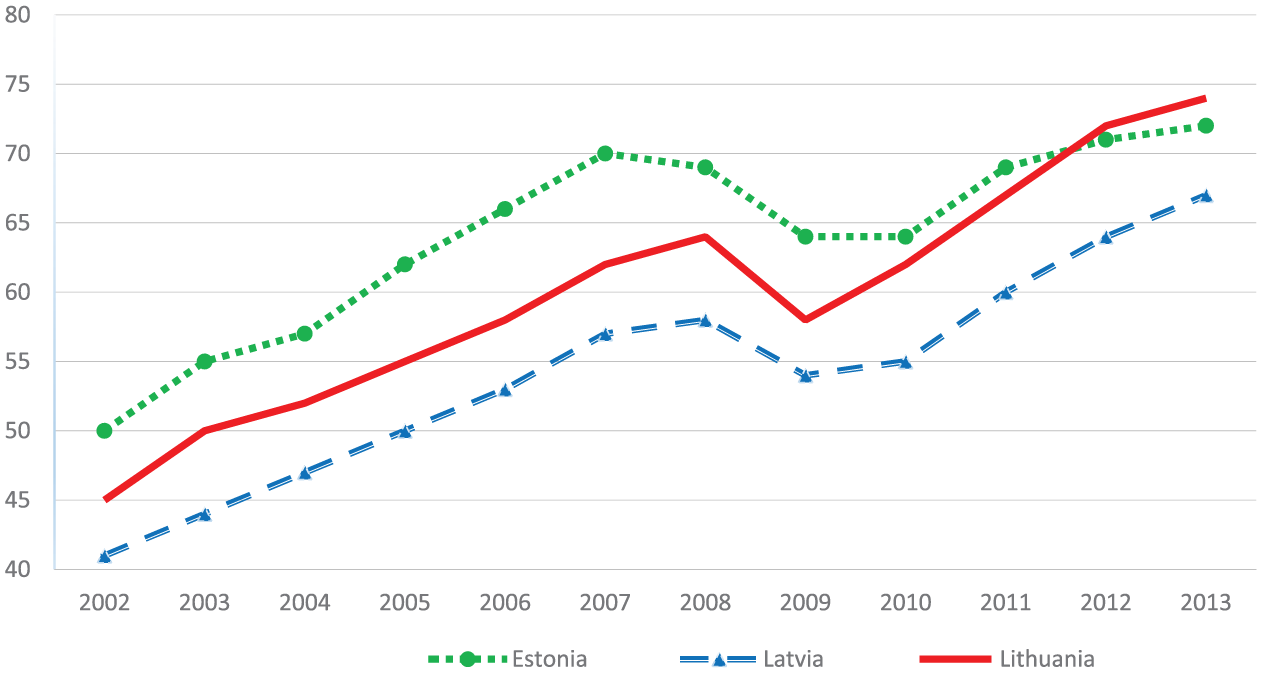
GDP growth in the Baltic States per capita by purchasing power standards (PPS), 2002–13.
Even though, overall, Lithuania has been relatively successful in regard to its post-EU membership economic development path, the proportion of GDP allocated to social protection in the Baltic countries has remained at approximately half the EU average. Indeed, the fact that their allocations did not exceed 20% (with an exception of 2009 in case of Lithuania) placed these countries in the cohort of EU Member States with the lowest levels of expenditure on social protection in relation to GDP. If social protection is measured in euros per inhabitant, in 2011 Lithuania spent around 1,741 euros per inhabitant: this is higher than Latvia (1,504 euros) and lower than Estonia (1,962 euros), however, hardly comparable to the average amount spent in the EU15 (8,871 euros) or EU27 (7,460 euros) (Eurostat, 2012a).
Low welfare expenditure is undoubtedly affecting the extent of coverage and level of generosity of social benefits, which in this region have remained far below Western European standards. This deficiency affects nearly all areas of the social security system: social assistance, family support, unemployment insurance and health care (Lazutka et al., 2012). However, analysis of the longitudinal data shows that Lithuania (similarly to Latvia and Estonia) did increase its expenditure on social protection, expressed as a percentage of GDP, in the period between 2006 (13.3%) and 2009 (21.2%). The increase in social spending can partially be explained by the gradual implementation of certain policy reforms in the country, such as the initiation of universal family benefits from 2004 to 2008 and launch of substantial parental leave in 2006–09 (Aidukaite, 2014). The biggest increase (from 2008 to 2009), however, occurred due to the impact of the Global Financial crisis, which led to all the European countries boosting their spending on welfare. The increase reflects the implementation of austerity packages that seek to foster recovery by utilising social systems in order to stabilise the economy and protect household incomes during times of severe economic downturns. In other words, during times of economic and fiscal meltdown, expenditure on social protection as a percentage of GDP tends to increase, not only because of decline or stagnation in GDP growth, but also ‘because public spending goes up to address the greater need for social support, such as unemployment and housing benefits’ (OECD, 2012: 1).
However, in 2010, just as Lithuania’s economy experienced the first signs of recovery, the level of total social expenditure in the country had already started to fall as sharply as it had increased in the prior year (from 21.2% in 2009 to 16.5% in 2012). A similar drop in total social protection expenditure occurred in the other two Baltic States, while, in contrast, the EU average post-fiscal crisis level of social protection expenditure has not decreased significantly (Figure 3).
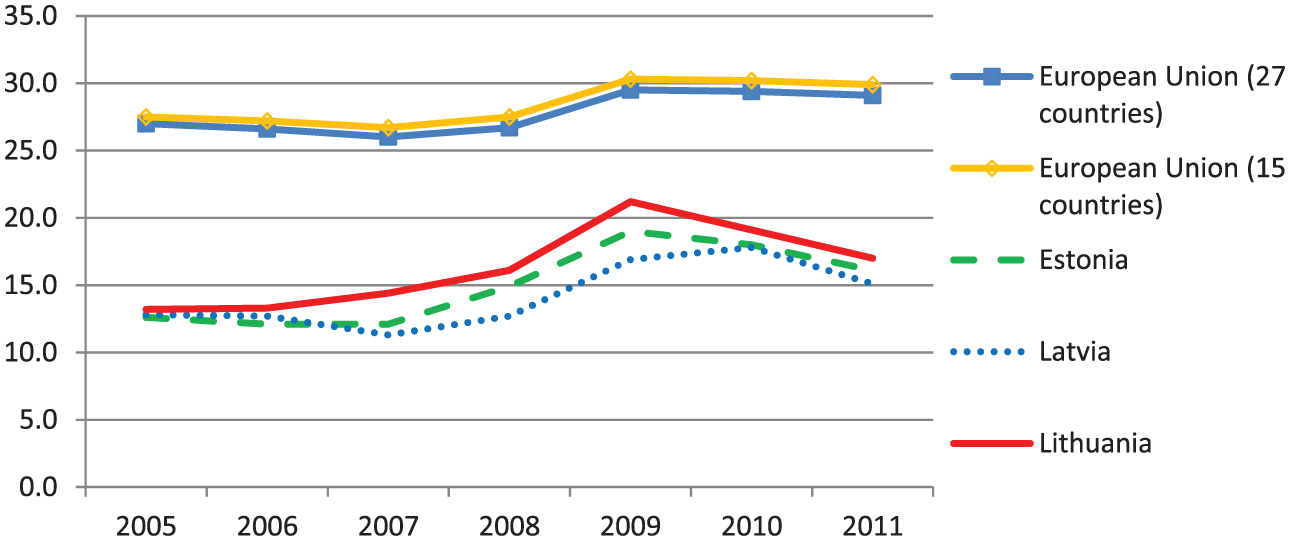
Expenditure on social protection as a percentage of GDP in the Baltic States as compared with the EU27 and EU15 averages, 2005–11.
Stabilisation or austerity programmes (and subsequent adjustments made towards social policy spending) depend on national policy arrangements or, in other words, specific policy mixes. The cut in spending in Lithuania was undoubtedly related to the government’s implementation of austerity policies that cancelled nearly all universal family benefits, and introduced cuts in pensions and unemployment benefits (Lazutka et al., 2012; Aidukaite, 2014). In 2009 and 2010, average old age pensions were cut by 8%; the maximum unemployment insurance benefits were cut by 38% while their eligibility criteria were tightened; civil servants experienced salary cuts from 4% to 12% (Gruzevskis and Blaziene, 2013: 13). Similarly, child cash benefits were not only subjected to additional income testing but they were also significantly cut both in terms of the eligibility duration and generosity. Consequently, Lithuania has joined a few countries (the Czech Republic, Poland, Portugal, Slovenia and Spain) that do not have universal child cash benefits in Europe (Bradshaw, 2011). Furthermore, Lithuania has continued to offer one of the least generous child benefit packages in the EU.
Analysis of nine countries, using EUROMOD data (EU tax-benefit microsimulation model), showed that the termination or substantial reduction of some non-means tested benefits in Lithuania (also implemented in Latvia, Portugal and the UK) contradicted common practice applied in other countries, where expenditure during times of economic downturn on this type of benefit tends to increase (in order to compensate for the loss of other income due to the economic meltdown) (Avram et al., 2012). In Lithuania, cuts in benefits negatively affected households in all income groups because of the ‘combined effects of three types of changes’, namely ‘lower income households being affected the most by cuts in social assistance, middle income groups by child benefit becoming means tested and the upper end of distribution by cuts in contributory family benefits’ (Avram et al., 2012: 13).
The crisis and austerity measures introduced in order to address national budget deficits and stimulate the economy by reducing public spending unavoidably increased the extent of poverty and inequality across the EU. Although, due to the absence of comprehensive data, it is still too early to evaluate the actual extent of the damage caused by the crisis, some of its negative effects are already visible. A number of studies have revealed that austerity measures have influenced household incomes in different Member States to different extents, with some suffering more than others (e.g. Juska and Woolfson, 2014). Austerity packages implemented between 2008 and mid-2012 had an especially strong negative effect on household income in the Baltic Region, as well as in Greece, Spain and Portugal (Avram et al., 2012). Indeed, the austerity measures instigated in Lithuania sparked a civil protest organised by the three trade union confederations in 2009 (a similar protest occurred in Riga). Nearly 7,000 people gathered together at this anti-austerity protest in Vilnius, which was the first incidence of civil unrest on such a large scale since the restoration of independence (Chadasevicius, 2009; Juska and Woolfson, 2012). Such events presented a rare divergence from typically low levels of participation and mobilisation among citizens, including trade unions, in Lithuania and some other post-communist countries. The explanations of the lack of civil activism can be traced back to former communist legacies. Even though the USSR tried to maintain an image of highly vibrant civil engagement, the meaning and functions attached to civil participation that had existed in the Soviet Union were a far cry from democratic standards. In the communist state, special interest groups were mainly represented as an integral part of the state’s structure. For instance, trade unions were seen as administrative sections of the larger bureaucratic apparatus as they were responsible for redistribution of work-related benefits (Vanhuysse, 2009). Therefore, after the collapse of the communist system this image remained as an element of collective memory. What is more, trade unions continued to be passive and therefore barely able to influence policy making during the post-communist transition.
Even though austerity packages in some way affected all segments of society, at the same time, there were variations in the distribution of the fiscal consolidation burden (such as increase in personal taxes, cuts in cash benefits and decline in public sector wages) among different income groups and types of households within society (Avram et al., 2012). In regard to the Baltic countries, the austerity measures triggered both regressive and progressive effects: wealthy sections of society in Latvia experienced a relatively bigger proportional decline in their income in comparison to the poor (with the opposite trend in Estonia); meanwhile, in Lithuania the poor and the wealthy were affected by austerity measures to a relatively greater extent than those in the middle income group (due to cuts in benefits and public wages). Furthermore, in terms of household type, families with children were the biggest losers as a result of the introduction of austerity measures.
Other study showed that people in the ninth decile of the income distribution in Lithuania, as well as in Latvia, Spain, Ireland and Denmark, lost more than 5% of their income per year during the two years of recession (2007–09) (Bontout and Lokajickova, 2013). Decreases in income among those in the lowest decile of income distribution triggered an expansion of income inequality among the Member States. During the time of recession, income inequality affected a significant number of countries in Europe; however, Lithuania, along with Spain, Ireland and Slovakia, experienced the sharpest increase in inequality levels (Bontout and Lokajickova, 2013). Furthermore, worsening conditions in the labour market had a profound impact on the distribution of income. Unemployment and a decline in household work intensity instigated an increase in poverty rates in the EU27, especially among individuals in the age group 25–64 (Ozdemir and Ward, 2012). Since the burden of the financial crisis was not equally shared among different groups within society, it also deepened the already conspicuous problem of labour market segmentation in Lithuania (Juska and Woolfson, 2014). The austerity policies paved the way for a further decline in wage levels, increased unemployment, spread of non-standard and precarious job contracts, which led to greater informalisation of the secondary market and growth of the shadow economy. Consequently, many people decided to pursue the path of emigration. People participating in the first wave of emigration that followed Lithuania’s accession to the EU were often labelled as ‘migrants of opportunity’ in the popular media, whereas those who emigrated after the crisis hit the country were called ‘migrants of need’. In 2010, when the first effects of the austerity policies were manifested, an unprecedented number of people, exceeding 83,000, left the country. According to the data provided by the International Organization for Migration (IOM, 2011), demographic profiles of these people showed that, for the most part, they were young, single, educated people (with a higher rate (52%) of emigration among women). Because of its persistently high emigration levels, Lithuania gained the reputation of a country of emigration. Statistics shows that since independence over 600,000 people have left the country, quite a significant number for a state with a total population of 3 million (IOM, 2011). The core determinants of high levels of emigration in the country are directly related to Lithuania’s labour market conditions. Low wages, shortage of jobs, poor working conditions, limited career opportunities, lack of justice and social security, low self-realisation opportunities and generally difficult living conditions are the key factors explaining the high emigration rates in the country (IMO, 2011; Thaut, 2009; Rakauskiene and Ranceva, 2012).
To summarise, the first few years (2004–08) after Lithuania’s accession to the EU were marked by extraordinary economic achievements. However, the global economic and financial crisis highlighted the fragility of the system and so called ‘Baltic Success’. The effect of the crisis in the Baltics was more devastating than in a number of other Member States. Meanwhile, even during the times of economic growth, Lithuania was characterised by a segmented labour market, low welfare expenditure, and relatively high levels of poverty and inequality. After the crisis of 2008 these problems deepened and continued to escalate.
Evolution of the welfare trajectory in Lithuania
Over two decades have passed since Lithuania regained its independence. This means that the country has had more than 20 years to reshape and establish its welfare system. An analysis of the current state of affairs in Lithuania shows the immense influence of neo-liberal policies, not only in terms of patterns of the policy-making process itself but also in terms of policy outcomes (Bohle, 2007; Guogis and Koht, 2009). This can be illustrated by looking at some core features of national macroeconomic indicators, such as expenditure on social protection, eligibility conditions and benefit generosity, level of de-commodification and stratification system. Lithuania’s welfare state is characterised by low welfare spending, predominant means tested welfare entitlements, modest benefits, low levels of de-commodification and high levels of poverty and income inequality. Bohle and Greskovits (2006) distinguish two forms of neo-liberalism characteristic of post-communist countries, namely ‘straightforward neo-liberalism’ (its aggressive form) and ‘embedded neo-liberalism’ (a softer social-liberal model of economic development). The authors argue that the Baltic States adopted the first type of aggressive neo-liberal policies as they have tended to prioritise liberalisation over social protection. Furthermore, Vanhuysse (2009: 61) concludes that, despite relative economic success in the region, ‘It is now generally agreed that on most of the commonly used indicators of programme coverage, eligibility conditions and benefit generosity, Baltic welfare regimes are significantly less generous and less encompassing than the other new EU member states.’ Indeed, the proportion of GDP allocated to social protection in the Baltic countries has remained lower than in other countries that joined the EU in 2004. As previously mentioned, regarding low expenditure on social protection restricting the magnitude of programme coverage and generosity of social benefits, for instance, the Baltic States are characterised by almost flat rate pensions and low unemployment and sickness benefits (Bohle, 2007). This shows that the state guarantees just the minimum, while limited welfare support increases individual market dependency. The drop in the level of de-commodification in Lithuania was noticed quite early on: according to Bernotas and Guogis (2003) the index of de-commodification in Lithuania decreased from 23.8 in 1997 to 22.3 in 2000. In terms of programme coverage and eligibility conditions, the social system in Lithuania gradually became dominated (even when compared to Estonia or Latvia) by a targeted welfare approach whereby entitlement rules are strict and ‘the eligibility [is] based on labour force participation and earning-related benefits’ (Aidukaite, 2014: 95). Furthermore, Aidukaite (2014: 95) emphasises that ‘means tested benefits in Lithuania are ‘quite wide-ranging, such as social benefits, compensation for heating, cold and hot water, free school meals, lump sum benefits, and benefit for families with children’. In contrast, Estonia has just one mean-tested benefit. In order to access these benefits, in all three Baltic Countries, applicants have to pass income tests; however, in Lithuania they also have to take property and asset tests. Furthermore, as can be seen from the preceding section, the extent of neo-liberal policy prevalence is especially noticeable during times of fiscal crisis and subsequent austerity measures. Cuts in welfare expenditure during times of economic downturn in the Baltics closely resemble austerity measures implemented by neo-liberal orientated parties in the UK. As has been demonstrated in the context of the UK, such neo-liberal austerity policies tend to have a disproportional impact on the poorest households, ethnic minorities and women (Hall et al., 2017).
By only focusing on separate policies or principles and their execution it is easy to miss the big picture. The extent and nature of prevalent social problems reflect the outputs of domestic policies; therefore, particular attention should be paid to this area. The welfare arrangements discussed above reproduced some of the key elements of the stratification system that comes as a by-product of neo-liberal policies. According to the data provided by Eurostat, in 2012 the Baltic countries were among the ten countries with the highest levels of income inequality; in comparison, the UK was eleventh in the list (Eurostat, 2012b). Notably, in 2012, inequality of income distribution in Lithuania and Estonia coincided and figures were just slightly below the EU average, while Latvia had the third highest rate of income inequality in the EU. However, just two years prior, in 2010, the level of income inequality in Lithuania was the highest among all the Member States, while levels in Latvia and Estonia were similar to those recorded in 2012 (third lowest and at the EU average, respectively).
The dynamics of income inequality in the Baltic States reflect socio-economic changes that have been affecting the country from the outset of independence. Masso et al. (2012) note that the current high level of income inequality can be explained by a gradual structural transformation marked by three key milestones. The first years of transition brought an unprecedented rise in income inequality levels. Then, in the mid-2000s, the rapid economic growth widened the income gap between higher and lower income groups in Lithuania and Latvia, while decreasing inequality in Estonia. Lastly, the global economic crisis of 2007–08 prompted further income discrepancy in Lithuania and Latvia, while slightly shrinking the income gap in Estonia. Similarly, in 2012, Lithuania and Latvia were also among the EU Member States with high percentages of population at risk of poverty and social exclusion (having the fifth and third highest rates respectively in the EU) while levels of poverty and social exclusion in Estonia were lower than the EU average (Figure 4). In other words, over 30% of people in Lithuania were facing risk of poverty or social exclusion in 2012 (in comparison to approximately 36% in Latvia and 23% in Estonia). The high rates of poverty in the country may seem even more alarming considering the fact that Lithuania (along with Latvia) has one of the lowest at-risk of poverty thresholds in the EU.
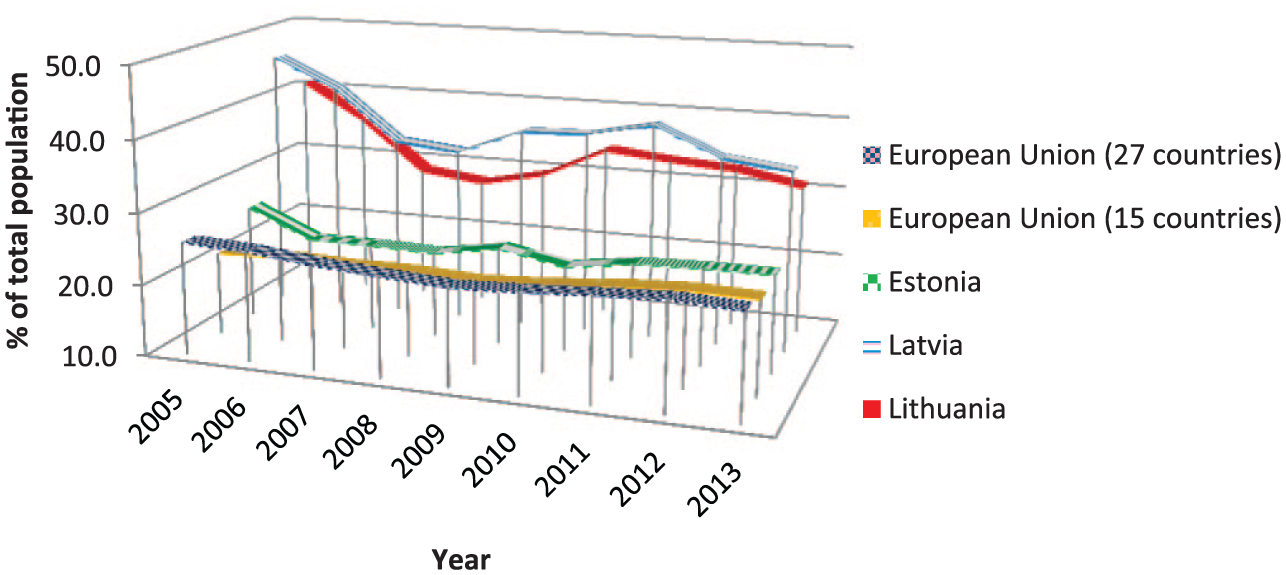
People at risk of poverty or social exclusion in the Baltic States as compared with the EU27 and EU15 averages, 2005–13.
Conclusion
The current policies and socio-economic conditions in Lithuania reflect the outcomes of the transformations that have occurred over the last two decades. The development path of the welfare state of the country was marked by high levels of turbulence shaping the socio-economic fabric of the country. The transformation from planned to market economy was led by shock-therapy reforms that radically reshaped the very essence of the former socialist system. The first decade of regime shift was especially challenging in both economic and social terms. Even though, with support of international stakeholders, Lithuania’s economy recuperated remarkably quickly, the social cost of the transformation has been affecting the lives of people in the subsequent years and is being felt up until this day. One of the key reasons for such developments was prioritisation of economic policies over creation of generous social safety networks that were essential to prevent rapid deterioration of living standards within the population. During the next two decades of independence, socio-political and economic policies in Lithuania were shaped by predominantly neo-liberal discourse that was promoted by both external and internal forces. As a consequence, the welfare state of Lithuania increasingly started to resemble a neo-liberal archetype, where the main responsibility of individual welfare is based on principles of economic self-reliance that depends on market forces. Consequently, the level of de-commodification within the country is low, as state spending on social protection is limited, benefits are modest and, predominantly, mean-tested and often associated with stigma. Strictly speaking, the assistance provided by the state targets the poorest segments of society. In the light of these policies, the country continued to pursue relatively stable economic growth, while maintaining high levels of poverty and inequality. The global financial and economic crisis of 2007–08 and constantly fluctuating levels of some socio-economic indicators (such as growth in GDP, poverty and inequality), however, demonstrated the fragility of the current system. These factors also indicate that even the periodic improvement in social conditions in Lithuania proved to be short-lived.
Footnotes
Funding
This research received no specific grant from any funding agency in the public, commercial, or not-for-profit sectors.