




Abstract
Unemployment is associated with a range of health and social problems, such as poor physical health and wellbeing. Welfare state research has recently considered how social policies can ameliorate the harmful effects of unemployment. This article argues that such policy suggestions disregard the role of the work ethic in shaping the experience of unemployment. In societies that glorify employment as a signifier of identity and status, it is unsurprising that those without employment suffer. Previous research supports this view, showing how subscription to the work ethic is associated with wellbeing amongst unemployed people. Original analysis of the European Values Study confirms the importance of the work ethic, showing how unemployed people with weaker work ethics have significantly higher life satisfaction than those with stronger work ethics. The article concludes that the most effective way of dealing with the deleterious effects of unemployment is to challenge the centrality of employment in contemporary societies.
Introduction
The evidence base on the health and wellbeing impact of unemployment is unequivocal. Unemployment is associated with significant declines in wellbeing and physical health (Paul and Moser, 2009). Such declines often last into the long-term, with unemployed people failing to recover from drops in wellbeing and physical health, and have a ‘scarring effect’, with unemployment more harmful than other distressing life events such as divorce, separation and bereavement (Clark et al., 2001; Lucas et al., 2003).
Whilst evidence has been building for decades, sociologists and social policy researchers have only recently questioned the role that social policies might play in mitigating these negative effects. From this literature, two strategies stand out. The first is a job guarantee, whereby people are offered a job after a period of unemployment. In practice, job guarantees are relatively rare; they are usually reserved for economic crises and targeted at specific groups, like young and disabled people. In the UK for example, policy proposals by influential economists (Layard, 2004; Gregg and Layard, 2009) led to the Future Jobs Fund: a job guarantee for young people introduced by New Labour and then abolished by the coalition government in 2010. Similarly, in 2013 the European Union (2014) advocated a guaranteed job or apprenticeship for unemployed young people across its member states.
The second strategy is to expand active labour market programmes (ALMPs): policies that link social security benefits to participation in labour market schemes, such as training, work experience and intensified employment support. The rationale of using ALMPs to combat the social effects of unemployment is that some ALMPs – especially work experience schemes – mimic the purportedly positive psychological and social environment of paid work. For example, in offering people the chance to utilise skills, work collaboratively and have a routine, ALMPs may produce psychosocial benefits. This is supported empirically, with an expanding evidence base showing positive wellbeing effects of ALMP participation (Strandh, 2001; Andersen, 2008; Wulfgramm, 2011; Sage, 2015).
Despite differences in ambition (job guarantees are far more expensive than ALMPs), both solutions stem from the same logic: that it is the absence of paid work that explains the negative effects of unemployment and, as such, policies should promote work, either through the direct provision of paid work or via work-mimicking environments. On one level this is understandable; unemployment is defined as lacking but seeking paid work, so the absence of employment is its most obvious trait. Further, the most influential theory of unemployment – Jahoda’s (1982) latent deprivation model – conceptualises employment as producing positive psychosocial ‘functions’ or side-effects: time structure, social activity, collective endeavour, regular activity and status/identity. Gheaus and Herzog (2016) make a similar case, arguing that employment enables people to realise four goods that provide meaning to life: excellence, social contribution, community and social recognition. Subsequently, the lack of employment can result in people losing access to these functions or goods. It is this loss, according to Jahoda, that explains the decline in health and wellbeing amongst unemployed people. Paid work, it is implied, is something akin to a human need.
This article challenges this argument: that the best way to ameliorate the health effects of unemployment is to reinforce work, through either job guarantees or ALMPs. First, it argues that a neglected influence on the health of unemployed people is the power of the work ethic. In other words, that unemployed people live in societies where paid work yields status, identity, respect and human worth. The damage of unemployment is thus not the absence of paid work but the failure to conform to a powerful social norm. Second, this is shown through a review of empirical evidence, which shows (a) how ‘exposure’ to the work ethic is associated with the wellbeing of unemployed people and (b) how the day-to-day, lived experience of paid work – what Jahoda called the ‘functions’ of employment – has only a weak association with wellbeing. Third, an original empirical example of the influence of the work ethic is shown. Analysis of the European Values Study shows how unemployed people with a weaker work ethic have higher wellbeing compared to those with a stronger work ethic. Fourth, the article concludes with implications for social policy. It makes the case that the most effective way of dealing with the health and social fallout from unemployment is to weaken the social and moral value of paid work.
The relationship between work and wellbeing
As argued, the evidence on unemployment has led to a strong assumption in policy-making that equates paid work with happiness and good health and, conversely, unemployment with the opposite (Department for Work and Pensions, 2016). Importantly, an implicit basis of this assumption is that the relationship between employment and good health is in some way inevitable or even natural. In other words, work is innate to human flourishing and the experience of a meaningful, worthwhile and healthy life. If this argument is accepted, then the promotion or even enforcement of work (or a work-like environment) on unemployed people is a logical, even benevolent, solution.
An alternative, critical perspective on unemployment casts doubt on this assumption and frames job guarantees and ALMPs less as solutions and more as amplifications of the underlying problem. This perspective is rooted in the argument that the empirically observed determinants of wellbeing – like employment – are reflections of prevailing norms and orthodoxies that impart socially desirable ways of living. As such, the causes of wellbeing are not fixed but change and are reconstructed over time. Employment is not inevitably conducive to human happiness and health. Rather, this relationship is driven by the social, moral and political importance societies attach to paid work. It is no surprise that employed people state they are happy in societies that glorify employment.
Edwards and Imrie (2008: 338) develop this point, arguing that wellbeing is correlated with “idealized forms of behaviour or ways of being”. People, for example, might not find work innately pleasurable but are content in that they subscribe to powerful social norms. This echoes Nussbaum’s (2012: 345) critique that forms of happiness can be “negative, inasmuch as they are based on false beliefs about value”. This notion – that happiness is socially conditioned – is central to Sen’s critique of subjective wellbeing as a barometer of social progress: Consider a very deprived person who is poor, exploited, overworked and ill but who has been made satisfied with his lot by social conditioning (through, say, religion, political propaganda, or cultural pressure). Can we possibly believe that he is doing well just because he is happy and satisfied? (Sen, cited in Kroll and Delhey, 2013: 21)
Rojas and Veenhoven (2013: 418) describe this as the cognitive theory of happiness, in that “happiness is the product of human thinking and as such has its roots in social constructions”. The significance of social construction is also put forward by Diener (1984), who uses the examples of how certain personality types – such as being extroverted – are associated with wellbeing because of “particular cultural milieus” that are biased towards them. Thus, whilst evidence shows extroversion is associated with high wellbeing (Costa and McCrae, 1980), extroverts are not innately happier than introverts; rather, social practices, institutions and norms favour those with extroverted personality traits.
The influence of the social environment on happiness is further supported by the impact of social comparisons on wellbeing, whereby happiness relates to how people evaluate their lives compared to others: ‘keeping up with the Joneses’ (Diener et al., 1999). Sets of standards – such as income, occupation, consumer goods, property and foreign holidays – inform these comparisons, yet such standards are not fixed: they change over time and between societies. As what is desirable and enviable evolves, social standards change, social comparisons change and the determinants of wellbeing change too.
Related to work, this suggests that the wellbeing associated with employment is rooted in conformity to social norms and feelings of high social status relative to, and at the expense of, unemployed people. Cole (2007) argues this view, critiquing the notion that employment is inherently good for wellbeing. Rather, Cole contends that employment has positive effects because of the centrality paid work commands in societies dependent on waged labour. There is, Cole (2007: 1135) argues, a conviction that “paid work is in some way central to human, especially adult male, experience”. It is this conviction – reinforced by social, cultural and ideological forces equating employment with human identity – that accounts for the robust association between paid work and wellbeing. Alternatively, it is the denigration, revulsion and fear of unemployment that makes those without work feel so unhappy or unwell. This is supported by qualitative research, with both Frayne (2015) and Sage (2017) describing how unemployed people often dread being asked ‘what do you do?’ for fear of negative social judgement.
Through this perspective, the wellbeing associated with employment is explained by the significance of paid work to perceptions of social status, identity, worth and contribution. Ideologically, this is maintained and reproduced through the ideal of the work ethic: the belief that the moral way to live one’s life is through paid work. In the UK, political parties and the media aggressively promulgate this ideology. From ‘hardworking people’ to ‘strivers’, the explicit inference from much political messaging is that paid work is essential to living a worthwhile life. Whilst politicians laud the work ethic, in popular culture a range of ‘poverty porn’ (Jensen, 2014) television programmes invite viewers to condemn the lives of those who purportedly resist the work ethic. The culmination of these trends is that unemployment is viewed as Janlert (1997: 79) describes: as a “deviation from the norm, a defect in character, a type of ‘disease’”.
Unemployment, wellbeing and the work ethic: Two premises
If the relationship between wellbeing and unemployment is in part derived from the centrality of the work ethic, the negative effects of unemployment can be seen as a socially forged, historically contingent phenomenon of industrial societies. As Frayne (2015) shows, the glorification of work, and the acceptance of this by the population, is a relatively recent phenomenon: work was tolerated rather than celebrated in pre- and early-industrial societies. Importantly, two premises follow from this theory. First, the degree and intensity of individual exposure to the work ethic should explain the severity of unemployment’s effects. Some people for example are less exposed or committed to the work ethic and, as such, their health and wellbeing should be less affected by job loss. Second, there should be little in the day-to-day, lived experience of both employment and unemployment that explains their relationships with wellbeing. In other words, it is not the actual activity of working, or the absence of this activity, that explains the wellbeing effects of employment and unemployment. Rather, it is how people interpret and attach meaning to their labour market status that matters. Both of these premises challenge Jahoda’s influential theory, which states it is the loss of the ‘latent functions’ of employment, such as routine and structure, that explains why unemployed people are so unhappy compared to those in paid work.
Differential exposure to the work ethic
Empirical evidence from across the social sciences tends to support both these premises. First, the influence of the work ethic on wellbeing has been demonstrated in studies that compare individuals with varying levels of commitment to the work ethic norm. Strandh et al. (2013) for example found that unemployment was more detrimental for Swedish women compared to Irish women. Their explanation was that the personal identity of Irish women is less strongly tied to the psychological need and social pressure to work compared to Swedish women. In 2016, 79.2 per cent of Swedish women were employed compared to just 64.2 per cent of Irish women (Eurostat, 2017). In Sweden, this is the consequence of a long-term strategy of promoting female labour force participation, via policies like shared parental leave and subsidised childcare (Duvander et al., 2005). Subsequently, Swedish women are strongly integrated into the labour market and the loss of employment appears to affect their wellbeing more than less well-integrated Irish women. A broader but comparable finding was reported by Eichhorn (2013), whose cross-national study found unemployment had a larger wellbeing effect in countries where work had a higher normative value (see also Fleche et al., 2011). Collectively, these studies demonstrate how the commitment to work varies, producing observable differences in the wellbeing effects of unemployment.
Additionally, recent studies into retirement and wellbeing show how reducing exposure to the work ethic can have positive effects for wellbeing. Hetschko et al. (2014) showed how the wellbeing of long-term unemployed people increased significantly after they retired, despite controlling for other changes in circumstances such as income gains. The observed change in wellbeing was linked to the qualitative change in social category: retired people were no longer subjected to the work ethic and, as such, the identity of ‘being unemployed’ disappeared. This can be explained by how retirement frees people from the demands of labour market participation; there is no expectation to work and thus no shame in not working. For retirees, the link between social status and waged labour is broken by the transition into a new social category where the expectation of employment disappears.
The daily experience of work and unemployment
Second, there is a body of evidence showing how the objective, day-to-day experiences of employment and unemployment do not explain some observed wellbeing differences. Dolan and Metcalfe (2012) discuss this by comparing evidence from two different measurements of wellbeing: (a) evaluative measures, whereby people rate their life satisfaction and (b) experience measures, which quantify emotions in real time. Whilst a strong association exists between wellbeing and employment status using evaluative measures of wellbeing, empirical findings are more ambiguous vis-à-vis experience measures. These diverging results suggest that whilst employed people are more satisfied with their lives than unemployed people, a comparison of experienced, daily emotions shows minimal differences between the two groups.
There are numerous studies supporting this claim regarding the differences between evaluative and experience measures. First, Knabe et al. (2010) compare the wellbeing of unemployed and employed people using evaluative life satisfaction and the Day Reconstruction Method (DRM), which asks respondents to complete a daily diary and describe their emotions whilst engaged in particular activities. Whilst Knabe et al. (2010) find large and significant differences in life satisfaction by labour market status, they find no differences when comparing day-to-day experiences using the DRM. This is largely because the activity of working is generally disliked by employed people, whilst unemployed people are able to devote more time to highly valued activities like socialising. Although unemployed people enjoy leisure slightly less than those in paid work, the extra time they can devote to leisure cancels out any differences in experienced wellbeing. Knabe et al. (2010: 869) argue that wellbeing differences between employed and unemployed people are less related to day-to-day experiences and more related to conformity with social norms: “people usually see being employed as a desirable aspect of life because it gives their lives meaning and helps them obey a cultural work ethic”.
The low value people attribute to the practice of paid work is further demonstrated by Bryson and MacKerron’s (2017) study using daily, immediately recorded wellbeing data captured via smartphone data. Their findings show that engaging in work is one of the least pleasurable activities respondents experience; being sick was the only activity that recorded a less pleasurable response. Bryson and MacKerron’s (2017: 109) findings go against dominant understandings of employment and wellbeing, inherent to the political statements, psychological theories and policy proposals described above: that “human beings gain pleasure from working because it is an essential ingredient in human flourishing”.
As Knabe et al. (2010) argue, measures of life satisfaction are more strongly determined by a sense of life purpose and social comparison, both of which can be used to understand why unemployed people record such lower life satisfaction scores compared to those in paid work. Owing to the pervasiveness of the work ethic, unemployed people feel their lives lack purpose and contrast poorly compared to those in employment. Collectively, these studies lead to the conclusion that it is not the actual activity of paid work that is good for wellbeing but the relatively high social status having a job provides. Conversely, it is not the lack of paid work, in the sense of the objective day-to-day experience of unemployment, which is psychologically damaging. Rather, unemployment provokes a profoundly negative evaluation of life worth, based on an interpretation of low social position and non-compliance with the social norm of the work ethic.
Are unemployed people with a weak work ethic happier? An empirical example
Data and methods
Drawing upon an analysis of the 2008 European Values Study (EVS), this section examines whether unemployed people with a weaker attachment to the work ethic have higher wellbeing than those with a stronger attachment. Based on the above discussion, the hypothesis is as follows: Unemployed people demonstrating a weaker commitment to the work ethic will have significantly higher subjective wellbeing than those who demonstrate a stronger commitment.
The EVS is a long-running cross-national survey examining values in a wide range of European countries. The following analysis draws upon the 2008 wave that includes data from around 66,000 individuals in 47 countries. 1 As the analysis is concerned with differences within unemployed people, the sample is reduced to unemployed people only. 18–65-year-olds are included in multiple linear regression models and missing cases are deleted through listwise deletion. The final sample of unemployed people is 5,792.
The dependent variable of interest is individual life satisfaction. This is measured by asking participants “All things considered, how satisfied are you with your life these days?” The answers range from 1 (“Dissatisfied”) to 10 (“Satisfied”).
There are three main independent variables of interest that measure individual commitment to the work ethic. For each independent variable, unemployed participants are recoded into two groups: (a) those who express a strong commitment to the work ethic and (b) those who express a weak commitment to the work ethic. More information on the independent variables is provided in Table 1. In the first stage of analysis, three separate regression models are estimated for each independent variable using the full country sample. In the second stage, the same models are estimated but with the sample restricted to EU/EFTA countries. 2
Work ethic independent variables.

Source: 2008 European Values Study.
In addition to the work ethic, other variables are controlled for that are well-established determinants of subjective wellbeing (see Diener et al., 1999). These include sex, age, educational level, self-rated health, marital status, religious belief and whether the participant has children living at home. As previous research has shown that the relationship between wellbeing and age is curvilinear – in that wellbeing tends to be high when people are younger, drop in middle age and rise in older age – a control of age-squared is also used.
All estimates are weighted using the EVS general weight factor and analysed in Stata 11. Each model presents both unstandardised and standardised coefficients, with the latter enabling a more direct comparison of the strength of the independent variables. Standard errors are presented in parentheses.
Descriptive statistics
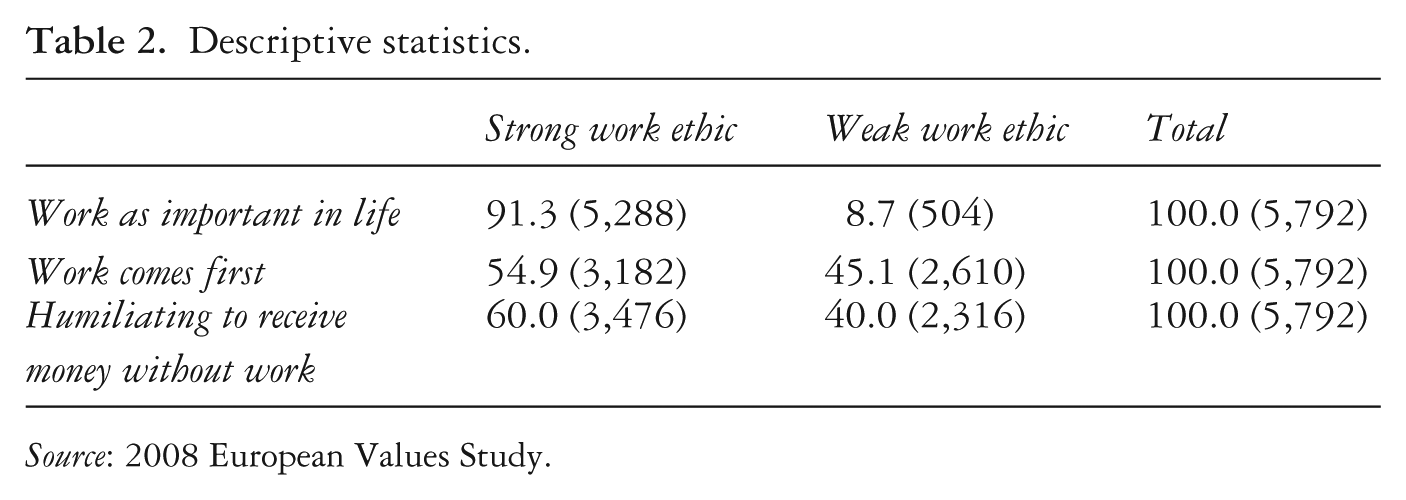
Table 2 shows the proportion of unemployed individuals that fall into the strong and weak work ethic categories by the three independent variables. As Table 2 shows, unemployed people with a strong work ethic are in a majority for all three indicators; this is especially true for the variable ‘work as important in life’, where over 90 per cent of unemployed respondents believe work is very or quite important in life. This appears contrary to recent arguments that unemployed people possess a weak work ethic (Dunn, 2014), supporting earlier research that those without work have many of the same values as those who are employed (Shildrick et al., 2012).
Descriptive statistics.
Source: 2008 European Values Study.
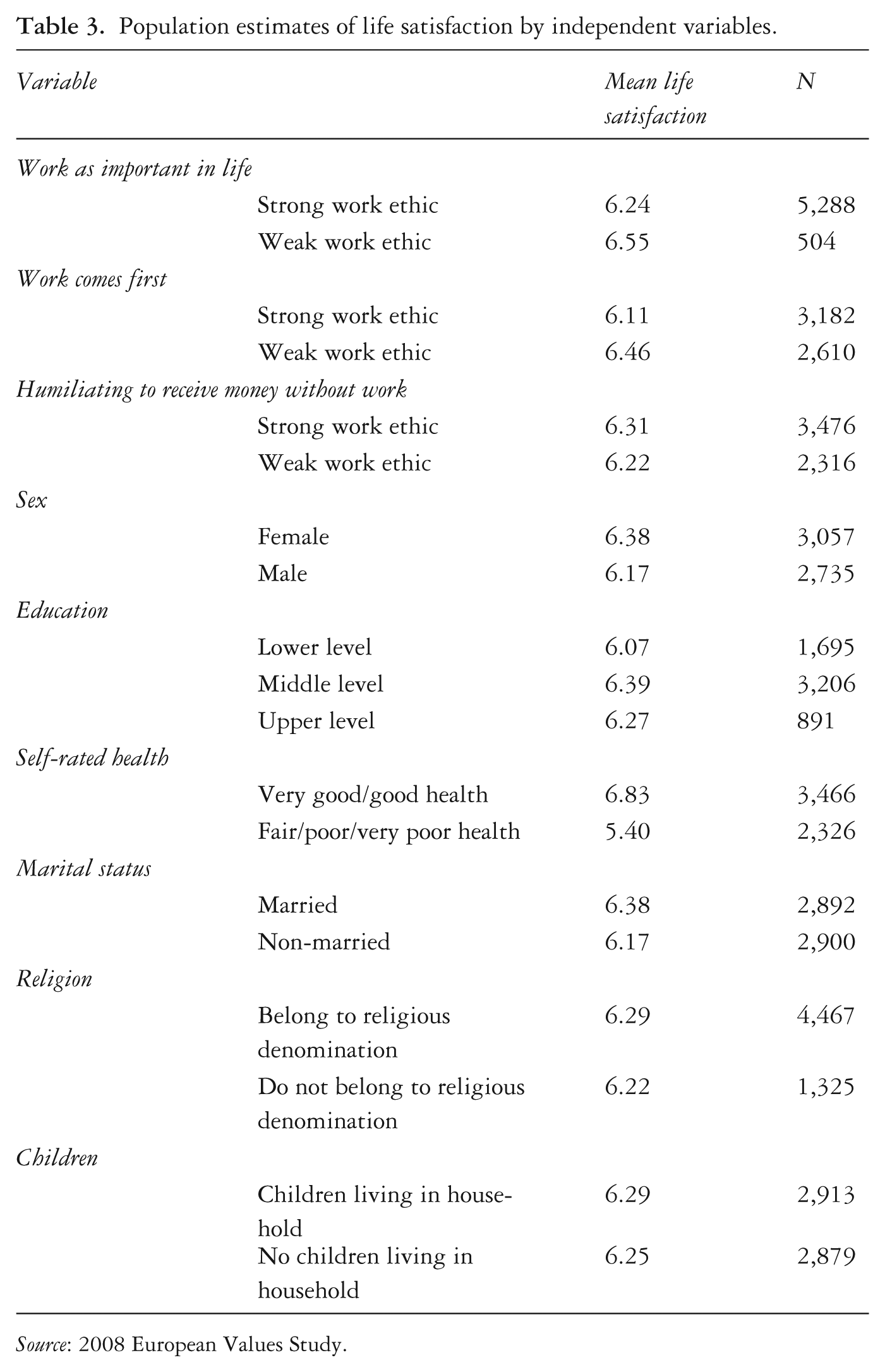
Table 3 shows weighted population estimates for life satisfaction by the full list of independent variables included in the models. For two of the work ethic independent variables (‘work as important in life’ and ‘work comes first’), unemployed people who attach a weaker commitment to these principles have higher life satisfaction than those who attach a stronger commitment. This would support the hypothesis set out above. The reverse is the case, however, for the third work ethic variable: that it is ‘humiliating to receive money without work’. Regarding the control variables, women have higher mean life satisfaction than men; those with good health are more satisfied with life than those with fair or poor health; and married people are more satisfied than non-married people. There are ambiguous or minimal differences in life satisfaction by education level, religion and whether children live in the household.
Population estimates of life satisfaction by independent variables.
Source: 2008 European Values Study.
Linear regression estimates
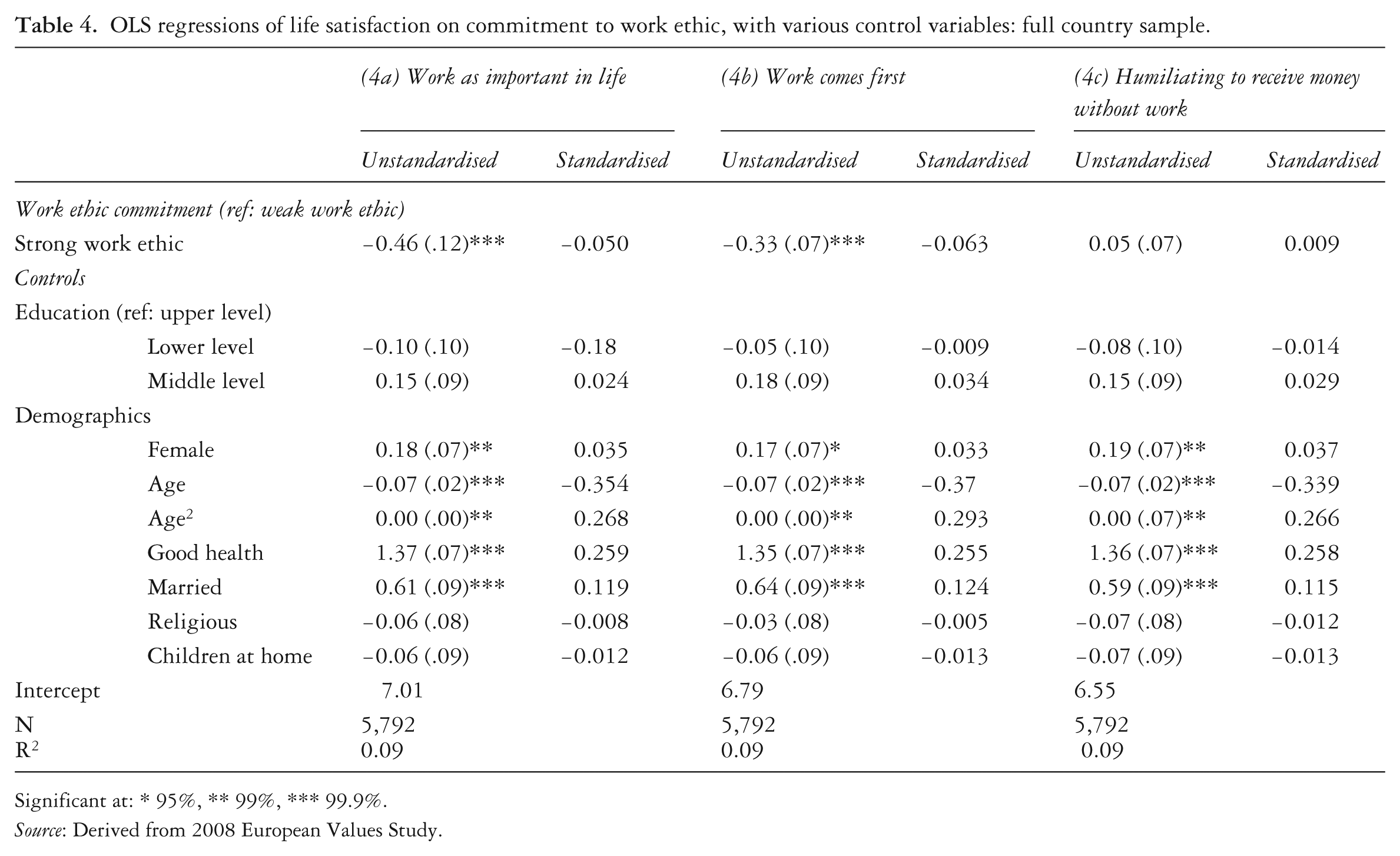
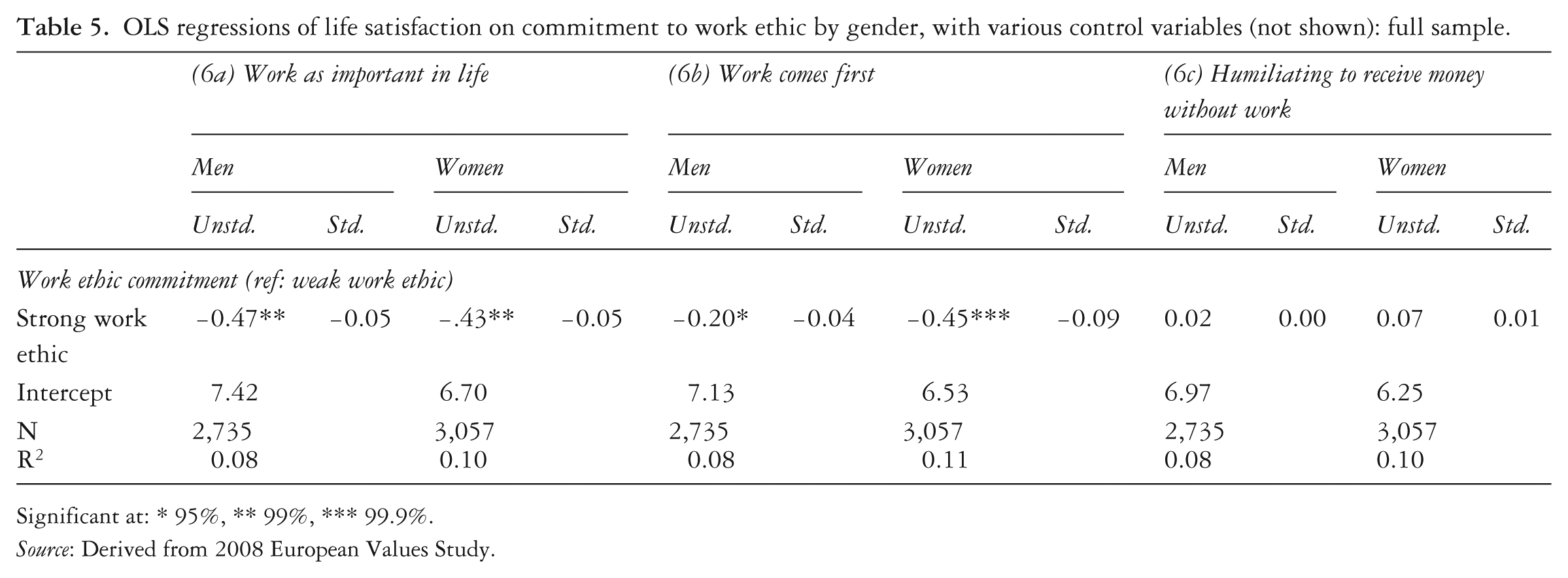
Table 4 shows estimation results of three models with the three work ethic independent variables, using the full sample of countries and with the full range of control variables. To reiterate, the principle hypothesis is that unemployed people with a weaker work ethic have significantly higher life satisfaction than those with a stronger work ethic. The estimates in Table 4 broadly support this hypothesis. In models 4a and 4b, having a stronger work ethic is associated with lower life satisfaction amongst unemployed people. Both effects are significant at the 99.9 per cent level. There is, however, no relationship between the work ethic and the third independent variable in model 4c: believing it is ‘humiliating to receive money without work’. Table 5 repeats the analyses in Table 4 but estimates separate models by gender; the objective being to see whether the broader findings from Table 4 apply to both men and women. The results in Table 5 show this to be the case; models 5a and 5b show unemployed men and unemployed women with stronger work ethics have significantly weaker life satisfaction.
OLS regressions of life satisfaction on commitment to work ethic, with various control variables: full country sample.
Significant at: * 95%, ** 99%, *** 99.9%.
Source: Derived from 2008 European Values Study.
OLS regressions of life satisfaction on commitment to work ethic by gender, with various control variables (not shown): full sample.
Significant at: * 95%, ** 99%, *** 99.9%.
Source: Derived from 2008 European Values Study.
Models 6a–6c in Table 6 repeat the analyses in Table 4 but use the smaller sample of EU/EFTA countries with more advanced welfare states. Again, the estimates support the hypothesis. Having a stronger work ethic is associated with significantly lower life satisfaction amongst unemployed people. Importantly, when the sample is restricted to EU/EFTA countries this is also the case for the third independent variable (model 5c). Thus, in the smaller country sample, having a stronger work ethic has a significant negative relationship with life satisfaction for all three independent variables.
OLS regressions of life satisfaction on commitment to work ethic, with various control variables: EU/EFTA sample.
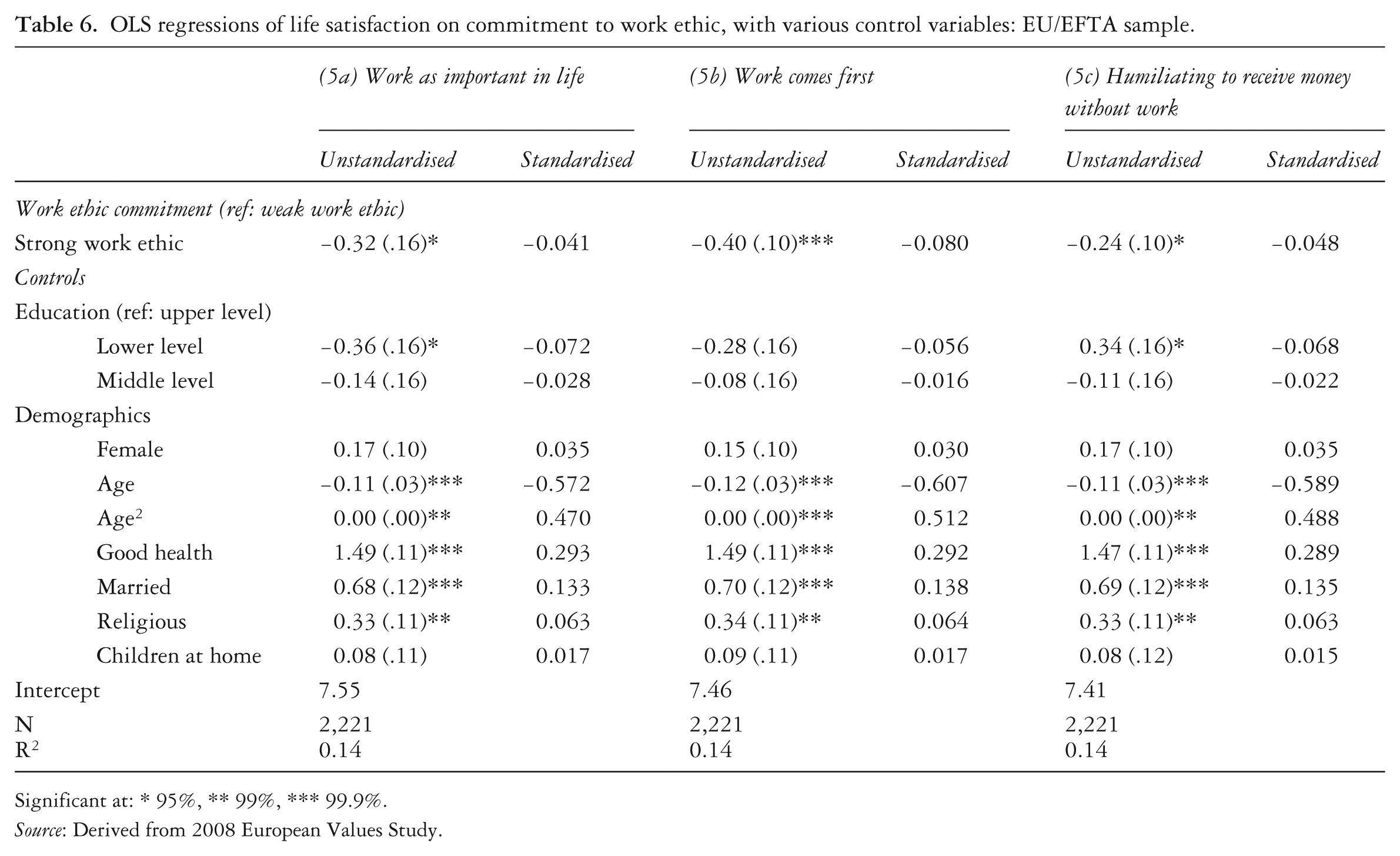
Significant at: * 95%, ** 99%, *** 99.9%.
Source: Derived from 2008 European Values Study.
Discussion: Challenging the work ethic
The results in Tables 4, 5 and 6 suggest that a powerful way of confronting the negative health and social effects of unemployment is to challenge the power of the work ethic. Unemployed people who believe work is important, that it should come first over other aspects of life or that it is humiliating to receive money without work have significantly lower levels of life satisfaction compared to unemployed people who do not share these values around paid work. It is important, however, to note the limitations to this analysis. In particular, cross-sectional data are only able to explore associations between variables rather than attribute causation and there may be important variables omitted from the analysis. For example, unemployed people with weaker work ethics may also have higher incomes and higher incomes may be correlated with life satisfaction. Future research on unemployment, wellbeing and the work ethic should attempt to exploit longitudinal data to overcome some of these limitations. Nevertheless, these findings are consistent with the evidence discussed at the start of this article: that unemployed people with a relatively weak exposure to the work ethic seem to suffer less from a lack of paid work.
In this light, and for those interested in combating the negative health effects of unemployment, job guarantee programmes and ALMPs are likely to be counter-productive in the long-term. Whilst evidence suggests these policies can have positive health effects (Koopman et al., 2017), it is arguable, based on the above evidence, that such policies achieve these effects by, at least in part, encouraging conformity with the work ethic. Wulfgramm (2014: 261) makes this point, arguing that labour market policies are far from value-free but rather a “statement policy-makers implicitly or explicitly make about the status and identity of the unemployed in society”. In relation to existing policy responses to unemployment – such as ALMPs, job guarantees and broader systems of welfare conditionality – the underlying assumption is of the profound moral value of employment and the need to enforce an appreciation of its value on non-conforming unemployed people. As Frayne (2015) argues, sociological perspectives on unemployment like Jahoda’s have often supported this idea: that there is something uniquely valuable, even restorative, about paid work. The end consequence is that sociology has “unwittingly reinforced the work ethic” through consorting with the idea that work is a “natural state from which the unemployed person deviates” (Frayne, 2015: 106).
Like Frayne, Wright (2012: 322) takes a more critical view than more traditional sociological perspectives on work, arguing that labour market policies impose an identity on unemployed people and offer a single route to salvation: they “constrain and punish recipients by imposing a spoiled identity of ‘welfare dependent’, prescribing only one viable alternative: worker”. Thus, job creation programmes and ALMPs may well boost the wellbeing of unemployed people in the short-term; yet, this comes at the long-term cost of reinforcing and imposing the very norms that lead to the deleterious effects of unemployment in the first place. Social policy interventions that prioritise paid work, or work-mimicking environments, can be seen as a self-reinforcing process, whereby unemployed people are expected to conform or coerced into conforming to the very norms that promote their shame in the first place. The work ethic is both the cause of unemployed people’s unhappiness and the route to escape it.
To combat the health and social effects of unemployment more effectively and enduringly, it will be necessary in the long-term to think beyond measures like ALMPs and to reconsider, challenge and ultimately weaken the importance paid work has to human identity: to transform how employment is a signifier of status and unemployment a signifier of shame. This would involve the gradual reconstruction of what ‘work’ means to people and is a radical transformation to contemplate. As Srnicek and Williams (2016: 125) eloquently put it: “With work tied so tightly into our identities, overcoming the work ethic will require us overcoming ourselves”. The starting point for this strategy is to consider social policy reforms that change people’s relationship with work: including the value we attach to work, the time we devote to work and how work frames our judgements of other people.
A transition to a less work-centred society could benefit not only those classified as ‘unemployed’ but the many millions of people whose experiences of work fail to live up to the promises of the work ethic. Employment is increasingly insecure, as in the UK where for example almost a million workers are on zero-hours contracts (ONS, 2017) and many more in low-paid self-employment (ONS, 2016). With the rise of the service sector new forms of ‘alienation’ and control are rife (Hochschild, 1983), whilst technological advances enable work to encroach ever more into leisure time (to the extent that the last socialist French government gave employees the ‘right to disconnect’ from smartphones whilst out-of-office). Additionally, the pressure of ‘employability’ demands more and more of our attention (Frayne, 2015) both in- and out-of-work. Given the changing nature of employment, it is clear that a less work-focused society could benefit both employed and unemployed people alike.
Such challenges to the practice and ideology of work have a long history. Marx and Engels (1970: 53) famously saw the reduction in wage labour as central to the expansion of human freedom, where people would be free to “hunt in the morning, fish in the afternoon, rear cattle in the evening and criticise after dinner”. Similar opposition to long working hours was an early tactic of labour movements, with the aim of gradually reducing the working week and increasing workers’ leisure time (Rybczynski, 1991). At certain points in the twentieth century, the decline in paid work seemed almost inevitable, with Keynes (1932) famously predicting a 15-hour week by the middle of the twenty-first century.
In the post-war decades the demand for less work largely retreated to the margins of both academic and political attention. Where once social democratic parties campaigned for less work, the explicit focus since at least the 1990s has been firmly on ‘activating’ unemployed people. Whilst there has been a focus on using government programmes to encourage, or compel, re-employment since the advent of welfare states, compulsory job-search requirements on unemployed people have expanded significantly since the 1990s (Lødemel and Trickey, 2000). Labour market activation is commonly associated with the perceived need to address ‘new social risks’ (Esping-Andersen, 2002), including globalisation, job insecurity and rising social security claims, yet also reflects a range of ideological currents. In the UK, the focus on ‘activating’ out-of-work groups has been especially profound. Beginning with the introduction of Jobseeker’s Allowance and followed by a staggering range of interventions, including the New Deals and the Work Programme, unemployed people, disabled people and lone parents have all experienced mounting pressures to find and secure paid work. The UK is far from alone in intensifying work-related demands, as various forms of activation have been implemented across most advanced welfare states (Lødemel and Moreira, 2014). The end result is a political climate in which parties of both the Left and the Right have pushed paid work as the solution to all manner of social, economic and moral problems.
Yet in the past two decades there has been a growing critique against the mantra of ‘more jobs’ and, more broadly, the work ethic itself (see Gorz, 1999; Weeks, 2011). This is exemplified by Srnicek and Williams (2016), who describe numerous policies that hold the radical objective of reconstructing work, and simultaneously reconstructing unemployment, and that are viable within current political, economic and welfare state structures: policies Srnicek and Williams (2016: 108) call “non-reformist reforms”. These kinds of policies mostly involve ways of enabling people to work less, such as through lower retirement ages, shorter working weeks, a stronger economic recognition of care and, perhaps most radically, universal basic income (UBI).
The proposal of UBI – an unconditional, regular payment to all citizens – is an old idea cutting across the political divide, but one that has recently gained momentum in many advanced welfare states. At the start of 2017, the Finnish government launched a basic income pilot with a sample of 2,000 unemployed benefit recipients (Ministry of Social Affairs and Health, 2016), whilst similar trials are operating in parts of Canada, Italy and the Netherlands and numerous UK think-tanks have published influential reports (Painter and Thoung, 2015; Reed and Lansley, 2016; Sage and Diamond, 2017). The recent interest in UBI owes much to concerns that automation will displace many workers and produce mass technological unemployment (Frey and Osborne, 2013). UBI, in this scenario, is a means of maintaining social cohesion and ensuring a fair redistribution from technological progress.
There are, however, more radical arguments for UBI that centre upon the recasting of what works means to societies and individuals (see Srnicek and Williams, 2016). Some advocates of UBI argue that a consequence would be to dilute the work ethic by making it easier for people to opt out of the labour market: to take time out between jobs, retrain, gain more education, care, create or simply to enjoy more leisure. As such, the boundaries between employment and unemployment would blur and our understanding of what ‘work’ means would widen. This would weaken the central notion of the work ethic: that specifically ‘paid’ work has a superior moral value to other activities. If employment assumed a weaker normative, as well as practical, value then it would increasingly be unclear who was and was not ‘unemployed’. As the social category of ‘unemployed’ became more ambiguous, then there would be much less shame, and fewer deleterious effects, of not participating in paid work. As Kagan (2017) summarises: “UBI would change the social norms around work and break the link between social status (being socially valued) and paid employment”.
Whilst diluting the work ethic could be a consequence of UBI, there are convincing arguments that basic income is not the most effective way of achieving this. First, there are parallel arguments for UBI that predict the promotion of paid work via the abolition of means-testing and the enhancement of work incentives. Thus, there is a plausible alternative scenario in which a UBI, especially of modest proportions, would (a) increase the number of people in employment (especially low-paid jobs) and (b) do little to reduce dependence on paid work for income. Second, UBI would require a significant increase in public spending, with Martinelli (2017) estimating tax rises of 8 per cent across all income bands. This raises the question of whether more efficient ways of reducing the social value of employment could be found. Third, it is doubtful that at present there is sufficient public will for UBI in countries where basic income goes against many dominant social norms around welfare deservingness (Sage and Diamond, 2017), such as contribution and need.
Alternative, less immediately radical and arguably more politically viable possibilities for challenging the work ethic are available. These include expanding parental leave for both mothers and fathers, incentivising people to work fewer hours (Coote et al., 2010), enabling people to take periods of leave from employment (Bell and Gaffney, 2012) or even guaranteed income schemes targeted at specific groups, such as young adults and the over-50s (see Martinelli, 2017). In particular, enabling and encouraging more people – especially men – to fulfil caring responsibilities without significant economic penalties may prove effective in reducing the power of the work ethic. As Strandh et al.’s (2013) study showed, where personal identity is more strongly tied to non-labour market roles, such as caring, there is a weaker effect of unemployment on wellbeing. This could be especially effective for men; due to the powerful conflation between male identity and employment, men tend to have a more negative experience of unemployment compared to women (Longhi et al., 2017). Redistributing caring responsibilities could lead to the diversification of male identity, beyond an overwhelming association with employment.
Additionally, Frayne (2015: 220) advocates shorter working weeks in particular, principally as a means of sharing employment more equitably so that “each of us would work less, so that more of us could work”: what Frayne describes as a “politics of time”. Some of these ideas have already been implemented, if albeit tentatively in some cases. The Netherlands has the highest proportion of part-time workers in Europe; in 2016, 46.6 per cent of Dutch employees worked part-time, compared to an EU average of 18.1 per cent (Eurostat, 2017). Similarly, Swedish employers have recently piloted shorter working weeks (Bernmar, 2017). Ultimately, the objective of all these strategies would be to obscure the division between ‘work’ and ‘non-work’ by enabling people to participate less in the labour market, thus expanding our common understanding of what ‘work’ means beyond its current form as a purely economic relation. In this light, people would be empowered to find value, identity, status and reward in forms of ‘work’ that do not involve wage-labour.
Conclusion
Thousands of studies from across the social sciences demonstrate the harmful impact that unemployment has on health and wellbeing. In recent years this growing body of evidence has led to calls for policy responses that deal with the harmful social fallout from unemployment, including job guarantee schemes and active labour market programmes. However, this article has argued that the root of this phenomenon is a binary categorisation of most people into two groups – employed or unemployed – in which the former is respected and the latter stigmatised. The identity of ‘being unemployed’ is a relatively recent construction and thus so are the feelings of shame, stigma and helplessness that those defined as unemployed experience. The power of the work ethic in shaping people’s experience of unemployment has been shown in studies that compare the wellbeing of people exposed to different expectations of work, whilst the lived experience of employment suggests there is little that is intrinsically valuable about engaging in many paid work activities. This article adds to this literature by showing how unemployed people in Europe with less commitment to the work ethic have higher life satisfaction than unemployed people with more conventional values around paid work.
The final conclusion of this article is that to genuinely challenge and transform the impact that unemployment has on wellbeing, it is likely necessary that the very notion of what it means to ‘work’ must change. This is a difficult future to imagine; it requires conceiving a different society, where the meaning of ‘work’ is far broader and non-waged forms of work and leisure are more highly valued than they are today. Job guarantees and ALMPs may improve the subjective wellbeing of unemployed people in the short-term. However, to fundamentally challenge the negative effects of unemployment in the long-term, policy strategies should have the objective of reducing the association between employment and social status. Whilst such a strategy is ambitious, it is plausible to imagine policies that work within the existing boundaries of political viability and public opinion, such as shorter working hours, expanded rights of leave and guaranteed income schemes. These policies would be politically plausible yet, simultaneously, in possession of the capacity to produce radical social change.
Footnotes
Funding
This research received no specific grant from any funding agency in the public, commercial, or not-for-profit sectors.