




Abstract
This article examines everyday effects of austerity in Kingshurst – a disadvantaged urban neighbourhood in the West Midlands. It draws on qualitative data gathered from local families with children, and public and third sector professionals working in the area in family support services. While some of the issues raised are common to other disadvantaged communities across the UK, we recognise that austerity is experienced in specific socio-spatial contexts: in this case, Kingshurst’s circumstance of deprivation within a local authority borough that (as a whole) is above averagely affluent. This shaped the ways that residents and professionals framed the disadvantage they encountered in their everyday lives and work, in particular strengthening understandings of austerity as unfairly and unevenly experienced on the bases of geography and social class, and highlighting territorial stigma towards the neighbourhood by professionals and decision-makers which impeded residents’ engagement with the family support services available to them locally.
Introduction
Austerity refers to the programmes of fiscal tightening adopted by most Western governments after the global financial crisis of 2007–08. In the UK context, while the New Labour government adopted limited austerity measures in the immediate aftermath of the crisis, it was following the 2010 general election and the formation of the Conservative–Liberal Democrat coalition that austerity emerged as a central policy project – extended and deepened under subsequent Conservative governments since 2015. If realised, the Conservative’s economic plans up to 2019–20 will take UK government spending to its lowest level as a proportion of national income since before the Second World War, representing ‘a fundamental reimagining of the role of the state’ (Institute for Fiscal Studies (IFS), 2014: 5). The IFS (2015) highlights unevenness in cuts across areas of government – with grants to local authorities hit particularly hard, and consequent impacts on third sector organisations which rely on local authority grant funding or which deliver services locally under ‘compact’ arrangements (Clifford, 2017: 18–22; National Council of Voluntary Organisations (NCVO), 2011). Research by the Local Government Information Unit (2017) found that nearly 80% of councils ‘hav[e] little or no confidence in the sustainability of local government finances’, and services such as youth clubs and libraries have absorbed cuts disproportionate to their share of budgets to enable ‘protection’ of social care and services for vulnerable children and adults. Nonetheless, these core services face severe pressures. An estimated 24% fewer elderly people receive care than in 2011 (Cooper and Whyte, 2017: 21); reductions in family support services have increased demand for emergency child protection (Association of Directors of Children’s Services (ADCS), 2017); while cuts to domestic abuse services have left victims at increased risk (Sanders-McDonagh et al., 2016). Meanwhile, significant changes to the welfare system have seen the removal or reorganisation of key benefits, and intensified welfare conditionalities with harsh sanctions for non-compliance (Fletcher and Wright, 2017; Hamnett, 2013).
Austerity as institutional violence
Critical commentary has identified the disproportionate impact of austerity on poorer families and children (Jupp, 2016; Ridge, 2013), and other disadvantaged groups including women, ethnic minorities and disabled people (Hall et al., 2017; Hamnett, 2013; Pring, 2017; Saffer et al., 2018). The exacerbation of poverty and removal of social protections under austerity has worsened health and mortality inequalities (Bambra and Garthwaite, 2015; Dorling, 2017), while campaigners highlight untimely deaths of sick and disabled people found ‘fit-to-work’, or the tragedies of those driven to suicide by inhumane treatment from the state and the private sector enforcers of its punitive welfare regime (Mills, 2018; Saffer et al., 2018). As such, austerity may be understood as ‘institutional violence’ (Cooper and Whyte, 2017), an idea with antecedents in Engel’s (2001[1845]: 8) description of the treatment of factory workers in Victorian Manchester as ‘social murder’ – the knowing placement of workers ‘under conditions in which they can neither retain health nor live long’ – and elaborated in recent work by Grover (2018), who highlights how the physical and mental ‘diswelfares’ created by the current austerity project are both ‘known and avoidable’.
In its 21st-century iteration, austerity is inseparable from neoliberalism. The 2007–08 financial crisis and subsequent fiscal tightening has allowed the pursuit of an ‘elite-driven, capital-centric, shrunken welfare state project founded on ideology disguised as pragmatism and objective “truths”’ (Farnsworth and Irving, 2018). In the UK, these ‘truths’ include the proposition that a crisis in state finance has resulted not from a global economic crash but profligate public spending, and that austerity is not only necessary but ‘fair’ in its retrenchment of a welfare state which, supposedly, dis-incentivises work and self-reliance (Atkinson et al., 2013: 4–5). Within this individualised neoliberal ethic, behavioural explanations for poverty dominate policy debates. This tendency has a long history, but has intensified under austerity through political and media discourses of ‘benefit fraud’, inter-generational worklessness, chaotic families and welfare dependency as a ‘lifestyle choice’, with the outcome that ‘empathy for those experiencing poverty has been steadily eroded’ (Pemberton et al., 2016: 25). This reframing of poverty as a consequence of ‘anti-social choices made by individuals’ (Wiggan, 2012: 387) is highly stigmatising, and is a central tactic of the neoliberal austerity project’s amplification and activation of stigma ‘to procure consent for punitive policies directed at those living at the bottom of the class structure’ (Slater, 2018: 891). Austerity, then, may be understood as institutional violence, not only in terms of diminished health, increased mortality and the removal of social protections against physical harm (Sanders-McDonagh et al., 2016), but through its influence on the ‘psychic life’ (Mills, 2018: 302) of those whom its legitimising narratives construct as abject: ‘the ordinary and mundane violence that make up the lived experience of austerity; the lived experience of feeling humiliated, anxious and vilified’ (Cooper and Whyte, 2017: 23).
As Atkinson et al., (2013) highlight, a ‘critical sociology of the age of austerity’ must function as ‘a means of defence against symbolic domination (which, among other things, sustains material domination) and the tropes mobilised … of “fairness” and compulsory austerity’ (3, emphasis in original). In troubling these tropes, it is essential to foreground the experiences of those far, geographically and/or experientially, from the Palace of Westminster and the ‘the effects of public-service cutbacks, job losses and increased exposure to socioeconomic risks … in [their] daily life’ (Peck, 2012: 632). As such, this article focuses on everyday experiences of austerity in Kingshurst – a disadvantaged urban neighbourhood in the Metropolitan Borough of Solihull in the West Midlands. The article considers impacts of austerity across three interconnected domains of local life – the urban environment; the everyday circumstances of families’ low income and housing need; and public and third sector family support provision. While much recounted in this article echoes in other disadvantaged communities across the UK, we also recognise that austerity and its accompanying violence is experienced in relation to a specific socio-spatial context: in this case, Kingshurst’s circumstance of deprivation within a borough that (as a whole) enjoys above average affluence. This shaped the ways that families framed the disadvantage they encountered in their everyday lives. In particular, it strengthened local understandings of austerity as unfairly and unevenly experienced on the bases of geography and (highly territorialised) class divisions; exacerbated a sense of being demeaned by those in power; and sharpened perceptions of stigma towards the neighbourhood by professionals and decision-makers, which impeded families’ engagements with the (reduced) support services available to them locally.
The research
The research was commissioned by The Children’s Society to inform their provision in Kingshurst, and was conducted in the summer of 2014. The funder specified the research method, which combined interviews and observation with local families, and public and third sector professionals who either worked in the neighbourhood or held responsibility for provision there. We met 21 professionals from 15 organisations, including Solihull Metropolitan Borough Council (SMBC) and related agencies such as the housing association, as well as Children’s Centres, third sector organisations, the police and schools. Organisations were recruited via invitation from the research team following a mapping of local provision, through the funder’s existing relationships, and through snowball sampling. We also carried out semi-structured interviews with 13 local families, and had briefer conversations with 14. Families were recruited by advertising the project locally and approaching people at community spaces and events – with snowball sampling following. The sample contained a mixture of one and two-parent households (including blended families) with between one and six children, and most lived in social housing or private rental properties. Around two-thirds had roots in the area and had lived locally all their lives, and the vast majority were white British - reflecting the local demographic which is over 90% white British (Solihull Observatory, 2013b: 8). In most cases, in-depth contact occurred with adult female family members (mothers, and a few grandmothers) whereas interactions with fathers and children were briefer. Some interviews took place in families’ homes, while others employed the ‘go-along’ method of mobile interviewing; moving around the area with our informants – ‘asking questions, listening and observing’ (Kusenbach, 2003: 463) – as they went about their normal activities. Given our interest in austerity’s local emplacement, this method offered opportunity to understand residents’ spatial practices as a component of everyday life in the neighbourhood. The research followed the British Sociological Association’s ethical guidelines and received approval from Aston University’s research ethics committee. Written informed consent was secured from all adult participants and, for child participants, written informed consent was secured from a parent or guardian while assent was sought from the child following an age-appropriate explanation of the project. As a piece of research commissioned to inform the funder’s work in this specific location, there was not an option for neighbourhood anonymity. This was explained to all potential participants, and confidentiality is preserved by altering demographic details – for example, gender and age of child(ren) – in a way that does not affect the analysis.
The neighbourhood
Kingshurst lies 7 miles east of Birmingham city centre and was developed as post-war over-spill housing for the city. In locally defined geographies it comprises an area of just over half a square mile bounded by the Chester Road from the north to east, and by Babbs Mill and Yorks Wood – nature reserves – to the south and west, and is densely populated by approximately 13,000 people (Solihull Observatory, 2013a: 4). Administratively, Kingshurst has been part of Solihull since 1974 (prior to this it was controlled by Birmingham City Council), and Solihull town centre lies 6.5 miles to its south (Figure 1). The majority of Kingshurst (as locally defined) is situated within Kingshurst and Fordbridge ward, with a slightly smaller area located within Smith’s Wood ward (Figure 2).
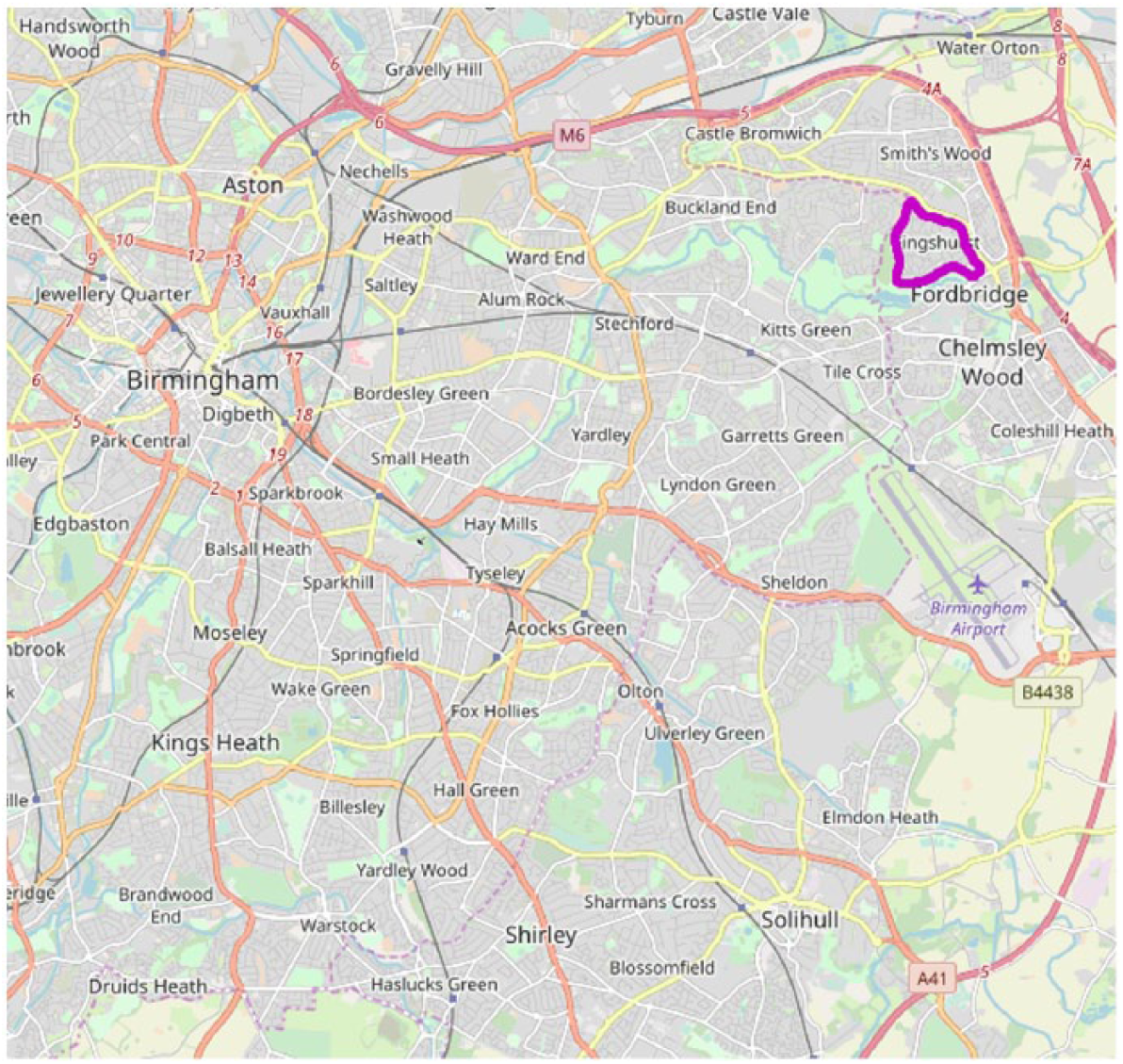
Location of Kingshurst 7 miles to the east of Birmingham city centre and 6.5 miles north of Solihull town centre (OpenStreetMap, 2018; © OpenStreetMap contributors).
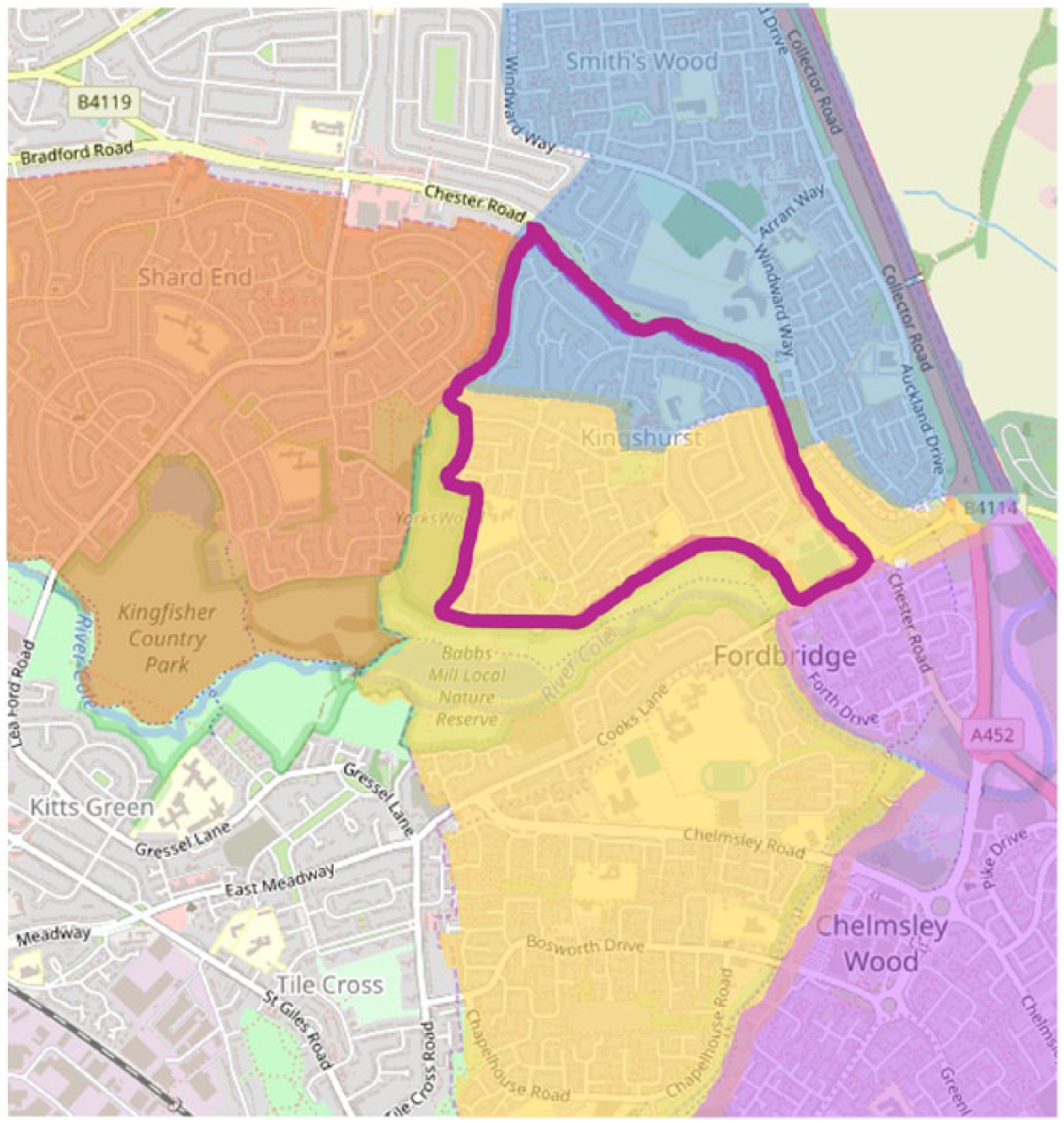
Locally defined boundaries of Kingshurst; incorporating parts of Kingshurst and Fordbridge ward (yellow), and Smith’s Wood ward (blue). Also shown are parts of Kingshurst’s neighbouring North Solihull ward of Chelmsley Wood (pink) and the Birmingham ward of Shard End (orange), which, while experiencing comparable levels of deprivation to Kingshurst, had all been sites of urban regeneration initiatives (OpenStreetMap, 2018; © OpenStreetMap contributors).
At the time of research, both Kingshurst and Fordbridge and Smith’s Wood wards had similar statistical profiles, being more densely populated than the Solihull average and having higher numbers of children and young people (Solihull Observatory, 2013a: 8). Overall, the borough of Solihull is affluent in relation to both regional and national indicators. However, Kingshurst and Fordbridge and Smith’s Wood, along with a third ward of Chelmsley Wood (collectively known as North Solihull or ‘the North’), have significantly higher deprivation levels than southern parts of the Borough and Solihull town (collectively – ‘the South’), which has the seventh highest proportion of least deprived Lower Super Output Areas (LSOAs) in England (Office for National Statistics (ONS) 2016). At the time of research, two thirds of the LSOAs which make up Kingshurst and Fordbridge measured among the 10% most deprived in England (Solihull Observatory, 2013a: 12), while child poverty rates in some LSOAs were as high as 50%, compared to an overall average of 16% for Solihull, and an England-wide average of 23% (2013a: 34). This ‘prosperity gap’ between North and South Solihull (2013a: 3) had resulted in the designation of the north of the borough as a priority regeneration area, with a 15-year partnership (known locally as ‘Regen’) agreed in 2005 between SMBC, two housing providers and a private sector company (Investing in North Solihull, 2017). The impacts of austerity on planned regeneration and the local urban environment will be discussed in the first empirical section of this article, followed by consideration of families’ everyday circumstances of low income and housing need, and public and third sector family support provision.
The local urban environment
The circuitous bus journeys connecting central Birmingham and Solihull to Kingshurst take at least 50 minutes and an hour respectively. Leaving Birmingham city centre by bus, you pass through the (still semi-industrial) inner city into the ethnically diverse neighbourhood of Ward End where South Asian stores pepper the high street. Moving further east, you travel through a succession of post-war residential neighbourhoods (some neat in appearance, others more ‘run-down’), before passing the centre of Shard End with its architecturally striking public library – the centre-piece of a £27 million regeneration scheme led by Birmingham City Council between 2010 and 2013. More housing estates, a weather-beaten ‘Welcome to Solihull’ sign, and you arrive in Kingshurst, where, disembarking in the centre of the neighbourhood, you find yourself facing a large metal gate topped with anti-climb spikes – one of several entry points to The Parade – a 1960s-built pedestrianised shopping precinct. Behind you is an area of open ground that in the summer months of the research resembled a wildflower meadow, but is the former site of a pub demolished under regeneration plans. As the commercial focal point of the neighbourhood, The Parade was traversed often with families during ‘go-alongs’, when it was described as ‘grotty’ (or similar adjectives) and resembling a ‘prison camp’ – a reference to the many anti-crime measures. Along with local parks and play areas, The Parade was compared unfavourably to facilities elsewhere in Solihull, with this, taken with complaints about litter, dog fouling and vandalism, emblematic of a perception amongst families and some professionals that Kingshurst (and in some accounts ‘the North’ more generally) was neglected in comparison to ‘the South’: You have got [South] Solihull. That is where people get services. That is where people get street cleaners. That is where you get the grass cut … Whereas people in North Solihull are given the raw end of the deal.
It is important to note that these accounts differ from those of some SMBC employees, who told us that significant investment was going into the area. As stated above, Kingshurst is within the North Solihull regeneration zone, but while Smith’s Wood and Chelmsley Wood (as well as the neighbouring Birmingham area of Shard End) had received new ‘village centres’, at the time of research the planned work in Kingshurst had stalled. As a discretionary division of local government, regeneration has absorbed heavy cuts. In the neighbouring authority of Birmingham, Planning and Regeneration was cut by 40% in 2010–11 (Fuller and West, 2017: 2096), and as one professional told us, in Solihull, ‘[the] Council bankrolled the “Regen” programme, and then maxed out its credit card’. Local commentary around the delayed regeneration scheme fed into a wider narrative around under-investment and urban decline, and exacerbated feelings among residents (and some professionals) that Kingshurst was Solihull’s ‘poor relation’: ‘if you have seen the Christmas lights at Touchwood [shopping centre in Solihull town], and then you see Christmas in Kingshurst, it is a joke … You would not think we were in the same borough.’ The scarring of the local landscape by the stalled regeneration – most noticeably the wasteland in the centre of the neighbourhood where the pub once stood – were a visual reminder to residents of Kingshurst’s perceived neglect by the local authority, engendering distrust and a sense of being forgotten and demeaned by those in power: They put in these grand plans of what they were going to do … They were going to do the parks, new community buildings, new shops. They have knocked down the pub. They were going to build all these new houses, and knocked down all these flats … Then it just went undercover … We get these promises; then we are just left.
Families’ everyday circumstances
Housing
The stalled regeneration had also led to delays in improvements to social housing stock. Demand for social housing in Kingshurst (and across the north of the borough generally) was significantly higher than the Solihull average (Solihull Observatory, 2013a: 24-25). A particular shortage of larger homes meant that many families suffered overcrowding and, in both social housing and private rentals, it was common to meet families with four or more children in two-bedroom flats. As one mother explained: [siblings] are supposed to share a bedroom, but I have to pull out [child] and she sleeps with me because they just won’t sleep together … The baby is in with us as well. We have [stepchild] staying … It is just finding room for them all.
Families complained of damp and mould in their homes, and professionals told us they met children with respiratory conditions worsened by this, while families who rented their homes privately were often reluctant to report problems because of fears of eviction and the high outlay of moving.
As with other challenges facing Kingshurst’s residents, a long-term structural issue – a shortage of quality affordable homes – was intensified by austerity policies: in some cases directly harming families’ health as well as diminishing more holistic forms of wellbeing. Among the raft of changes to state benefits in the 2012 Welfare Reform Act was the ‘bedroom tax’ (or ‘under-occupancy penalty’), which cut the housing benefit of social housing tenants deemed to have a ‘spare room’. The policy has the stated aim of dis-incentivising ‘under-occupation’ (thereby freeing up larger properties for those who need them), but has been condemned as ill-conceived and unfair; particularly in its narrow definition of who can legitimately occupy a bedroom and its disregard for the shortfall of smaller properties in some areas. Critical commentary around the policy focuses on families ‘under-occupying’ and pushed further into poverty through benefit cuts (Gibb, 2015; Greenstein et al., 2016), but for families we met in Kingshurst the policy caused a different problem of prolonging over-crowding – despite this being the very social ill it claimed to address. Under the policy, children up to the age of ten must share a bedroom regardless of their sex, meaning that families who would previously have qualified for a larger home no longer did: ‘I was eligible for a three-bedroom house, but I waited for a year and nothing came available. Then they changed the rules so they can share until ten.’ For other families, even when their children qualified for their own bedroom, the lack of larger properties in the area meant they remained on the waiting list, placing families in a situation which they felt demeaned their children: ‘an eleven-year-old girl and a nine-year-old boy have to share … She is going through puberty and it is not right.’ A related theme in parents’ narratives was the difficulty of living in a flat without access to a garden: ‘I feel like my kids haven’t got a childhood … You know when we was [sic] kids, we had a garden and we could put a pool out. Whereas these are stuck in the flat.’ Once social housing tenants met the criteria for rehousing they were invited to ‘bid’ online for available properties, but we were told that this system did not take account of room size as well as room number. One family recounted how they were delighted to have bid successfully for a three-bedroom house, only to be told the property was too small as two children would be sharing a single bedroom. The family lived in an overcrowded flat, and while moving to the house might not have fully eased overcrowding inside it would have given them a much longed-for garden. However, they were denied this choice.
Income and work
With housing, as with other issues influencing everyday family life, ‘choice’ was severely constrained by low household income. Changes to benefits had adversely affected families’ finances and wellbeing, and we heard about sanctions exacerbating existing health issues: ‘they keep stopping [relative’s] money for no reason … She is ill with depression and it is making it worse.’ We were told that around half of referrals to the local food bank were due to benefit delays or sanctions, and of parents in these circumstances ‘feed[ing] the kids and not themselves’. Other families we met could afford essentials but had little capacity to save, meaning that unexpected expenses could tip them ‘over the edge’. Relatives and friends helped each other with loans where possible and, as in other disadvantaged neighbourhoods, local networks were an essential resource in mitigating hardship and the gap left by the retrenchment of state support (Shildrick and MacDonald, 2013: 288). However, this resource was unavailable to some of the most vulnerable families who had moved into the area through crisis rehousing and lacked local connections. Those who could not turn to family and friends (either because they lacked such networks or because relatives and friends were themselves struggling) commonly used ‘rent to own’ schemes to acquire household goods, or took out payday or ‘doorstep’ loans. This could lead to a debt-trap as ‘if you miss one payment, it rockets’, and we heard reports of families in these circumstances resorting to illegal loan sharks.
At the time of the research, 28% of households in Kingshurst with dependent children had no adult in employment, compared to 12% across Solihull (Solihull Observatory, 2013a: 16–18). In common, though, with other research in disadvantaged communities in the UK (MacDonald et al., 2014; Shildrick et al., 2012), we did not encounter a ‘culture of worklessness’, providing further challenge to the legitimising narratives of austerity which construct the poor as culpable for their unemployment and resultant low income. The unemployed adults we met had worked at some point and were hoping to work again. For mothers in particular, the cost of childcare and the incompatibility of available employment with childcare (for example, evening shifts or zero-hour contracts) were major barriers to work outside the home, and parents who did work usually relied on informal rather than professional childcare to make employment viable. However, access to this type of care was not available to all families – an instance of the shifting of responsibility for care from the state to the individual under neoliberal austerity resulting in unequal ‘caringscapes’ (Jupp, 2016: 5) – both between and within communities. Many parents had tried to re-enter work after their children started school. Some had completed qualifications but found that employers wanted recent experience so were doing voluntary work, while others had worked temporarily (in retail over Christmas, for instance) but found this seldom led to permanent positions. All this indicates that many people in Kingshurst experienced what Shildrick et al. (2012) have described as the ‘low-pay, no-pay cycle’ between insecure employment and unemployment, which ‘rarely features in the public and political debate’ (Shildrick, 2018: 792).
Despite this clear motivation towards work, a perception persisted amongst some residents and professionals that a ‘culture of worklessness’ was a major issue in Kingshurst. As outlined earlier, this narrative functions as a ‘common sense’ (Fuller and West, 2017: 2092) justification for punitive welfare reform by shifting culpability for unemployment (and resultant low income) away from stagnant local economies and barriers to employment, and towards individual fecklessness. As discussed in the opening sections of this article, as austerity was implemented it was ‘ideologically reworked’ from a response to recession to a political remedy to an over-generous welfare state (Lambert and Crossley, 2017: 91): a ‘production of ignorance’ of structural causes of poverty ‘via the activation of class and place stigma’ (Slater, 2016: 23). An accompanying popular culture trope of benefits claimants ‘skiving’ while ‘hard-working families’ ‘strive’ has proliferated through tabloid coverage and television documentaries, with these mutually constitutive policy and popular narratives ‘garner[ing] public consent for the shift from protective liberal forms of welfare to disciplinary workfare regimes’ (Tyler, 2013: 26). Indeed, at the time of research, a television production company had placed posters across North Solihull advertising for ‘larger than life’ participants for the BBC3 series People Like Us (BBC, 2014). Airing in October 2014 and focusing on Kingshurst’s nearby area of Chelmsley Wood, the series angered some residents and local councillors with its exaggerated depictions of unemployment and crime in the area (Richardson, 2014).
As McKenzie (2015: 51) shows in her work in the St Ann’s area of Nottingham, residents of disadvantaged communities are acutely aware of outsider narratives that demean their neighbourhood, while Pemberton et al.’s (2016: 22) data from three disadvantaged areas of the UK finds that poorer people: are neither isolated from these discourses, nor passive subjects; rather they are acutely aware of the ways they might be viewed by others, and in varying circumstances they are required to engage with, respond to, as well as circumnavigate the stigmatising implications of the discourse.
In Kingshurst, this engagement and response took varying forms. Some residents directly challenged negative stereotypes. For example, at a community event where we presented project data, a resident complained that a fieldwork photograph – of a ‘keep out’ sign at the entrance to an empty construction site – reinforced ideas of the area as ‘somewhere people shouldn’t come to’. Our intention had been to illustrate stalled regeneration, but it was clear that concern with a lack of control over how you are ‘known and represented’ (McKenzie, 2015: 51) outside your community informed her reading of the image. Other residents engaged in an alternative form of ‘distancing’ (Pemberton et al., 2016: 33) by themselves deploying negative stereotypes against ‘undeserving others’. A notion that Kingshurst’s small migrant and minority ethnic population received preferential treatment to the majority white British population appeared engrained locally. We heard narratives of East Europeans ‘jumping the queue’ for social housing and receiving cash handouts, as well as some reports of racist incidents in schools and against migrant and minority ethnic families locally. These tensions were perhaps reflected in the election of UKIP (UK Independence Party) councillors in the Kingshurst and Fordbridge ward in 2014 and 2016, and the area’s strong vote to ‘leave’ (72% in Kingshurst and Fordbridge and 69% in Smith’s Wood wards) in the 2016 EU membership referendum (Rosenbaum, 2017). Other respondents deployed stereotypes against fellow members of Kingshurst’s white British community, demonstrating their own ‘social worth’ (Pemberton et al., 2016: 33) by emphasising their ‘work readiness’ and responsible parenting practices, in contrast to the supposed deficiencies of ‘others’. As one parent told us: ‘the children around here end up in a cycle of being with the Job Centre … it’s how you bring them up isn’t it? … I don’t want [child] to be mixing with those sorts of people.’ This ‘othering’ of the poor by the poor is attributed by Shildrick and MacDonald (2013: 301) to closed and homogenous communities ‘diminish[ing] a sense of relative poverty and deprivation’, but also, crucially, to stigmatising discourses of welfare dependency. The pervasive reach of the austerity ideologists’ narratives, which utilise abjection and stigma as technologies of state power (Tyler, 2013), may be understood as violent through their demeaning ‘othering’ of residents of disadvantaged communities in the eyes of outsiders. A consequent violence emerges, though, through the creation of corrosive cleavages within communities as this stigma is displaced onto ‘others’, which, in the case of the abuse experienced by some ethnic minority families in Kingshurst, had more ‘traditionally’ violent outcomes.
Public and third sector provision
Austerity had harmed public and third sector provision in Kingshurst through twin pressures of reduced resourcing and increased local need. Third sector organisations not only faced an increasingly competitive charitable grant-funding environment as local authority grants were reduced, but a decreasing ability for users to pay even nominal fees for services. A playgroup for example, worried about their sustainability if charitable funding ceased: ‘putting the fees up isn’t an option … the children will miss out.’ Young people were particularly under-served locally. A few years prior to the research, grant funding had been secured to install a recording studio for young people in the community centre, but the loss (following cuts to the youth service) of the staff who supervised its use meant it now sat idle. Most significantly, austerity has affected public sector family support services through a move from ‘universal’ provision to narrowly targeted intervention (Jupp, 2016: 2). The construction of the ‘risky’ or ‘chaotic’ family has historical antecedents dating back centuries (Lambert and Crossley, 2017; Welshman, 2013), but the austerity era has loaded the binary of ‘stable’ and ‘unstable’ families with additional significance as a microcosm of the ‘irresponsible’ public spending of New Labour in contrast to the prudent, future-mindedness of deficit reduction (Fuller and West, 2017: 2094). A key policy for example, the Troubled Families programme, aims – in the words of former Minister for Communities, Eric Pickles – to ‘reduce the bills for social failure and get this country living within its means’ (quoted in Jupp, 2016: 3), and in common with the ‘strivers and skivers’ discourse outlined above, individualises responsibility for disadvantage by ‘emphasis[ing] behaviour as the target of action’ (Lambert and Crossley, 2017: 87).
Professionals in Kingshurst described how family support was increasingly rationed towards families ‘in crisis’, and particularly those with a Child Protection Plan (CPP) in place: ‘if [they] are not on a Plan, there is very limited help you can actually give that family’. The dilemma this imposes on families and the professionals who support them is an illustration of the institutional violence of the austerity project. With little support available for families on the edge of (but not quite in) crisis, parent or carers must demonstratively fail their child(ren) in order to access the support that comes with a CPP, in turn bearing the risk of prolonged scrutiny of family life by social services and the ultimate risk that child(ren) will be removed. As Morriss (2018) describes, to be a parent (and more specifically, a mother) whom the state has deemed unfit to care for her child(ren) is to occupy an abject position of extreme shame and stigma. This is true of any context, but perhaps carries an additional layer of significance in disadvantaged communities where caring well for your child(ren) is evoked as an important claim on social worth, in the absence of worth garnered through labour market position or material wealth (Pemberton et al., 2016: 33). Families living in disadvantaged circumstances are significantly more likely to interact with Child Protection agencies (Morris et al., 2018: 364). This is partly due to the interrelated pressures that families in poverty can face (2018: 365–367), but may also be attributed to the development of a ‘good parenting’ model whereby parents are expected to invest time and financial resources to ensure appropriate child development, and ‘parenting [is] not accepted as an interpersonal bond characterised by love and care’ but as a ‘job requiring particular skills and expertise which must be taught’ (Gillies, 2008: 96). Arguably, this privileges middle-class norms; places ‘a rather extraordinary weight of expectation … on poor parents: their own practices should be able to transcend economic realities and should be actively compensatory towards their children’ (Featherstone et al., 2014: 101); and results in parents on low incomes or who live in stigmatised neighbourhoods being subjected to greater scrutiny by child protection agencies (Lowe, 2016: 3). This approach to monitoring parents is a policy-set with origins in the 1980s/1990s Conservative government and the neoliberal tendencies of New Labour, and so pre-dates the current age of austerity. Nevertheless, its adoption and adaptation by post-2010 governments has a ‘new inflection’ whereby ‘bad parenting is presented as the most significant and acute cause of childhood problems’ in a manner which ‘explicitly disaggregates the effects of poverty and parenting on children’ [emphasis in original] (Dermott, 2012: 1–2). In this context, it may be seen as part of the broader, violent tendency of austerity to displace responsibility for social ills (and therefore the blame and shame associated with these ills) away from structural inequalities, and towards the (avoidable) failings of the individual, the family or the local community.
In Kingshurst, territorial stigmatisation – sharpened by comparison to the more affluent ‘South’ – was a key theme in families’ narratives around Children’s Services. Parents told us they had been referred to social services for reasons they did not understand and without any discussion first taking place: I felt they could have spoken to me about [it] rather than phone social services … I wasn’t asked anything about my support structure or family … I had just moved house and I had social services knocking on my door to see if I was a fit mum … I don’t think that would happen if I lived in South Solihull. It was just an assumption about parents in the area.
The distress this caused links to the lack of control residents of stigmatised neighbourhoods hold over how they are perceived by outsiders and the institutional violence of being forced to manage these demeaning outsider perceptions in interactions with agencies. Parents who had experienced these interactions felt that, whatever they did or said, there would be doubt in professionals’ minds about their competence as a parent – an experience akin to McKenzie’s (2015: 73) description of interactions between welfare professionals and women from the St Ann’s estate in Nottingham: ‘you wait for them to think “oh it’s one of them from there”’. As well as carrying the risk of unjustified scrutiny by state agencies, territorialised stigma conversely meant that parents who wanted assistance struggled to access it. We met parents whose children had behavioural disabilities who had faced long, onerous battles to access diagnosis and support. Professionals acknowledged these delays and attributed them to cuts to health services, but parents believed that stigma too played a role, with their knowledge of their own child not being taken seriously by service gatekeepers, or their child’s difficulties in school blamed on ‘bad parenting’. Families felt that some professionals had such low expectations of local children that educational underachievement or challenging behaviour was simply accepted, and not investigated in the way it would be in ‘the South’. We heard reports of children internalising this stigma, with implications for their longer-term educational achievement and aspirations: ‘I have heard young people say … nobody wants us, so we have to get on with life in a jungle.’
It is crucial to stress that we met professionals who worked very hard to support families and who empathised strongly with the structural disadvantage families experienced; and we found evidence of Lambert and Crossley’s (2017: 91) assertion that professionals (including within SMBC’s local iteration of Troubled Families) seek ‘to reinsert the issue of poverty into their local practice, despite the topic being conspicuously absent from the national narrative’. However, despite these efforts, the combination of stigma (or perceived stigma) towards the neighbourhood and the increased targeting of provision towards families in crisis, had a strong effect on families’ engagement with the (reduced) family support services available to them locally. A third sector professional explained, ‘there’s a stigma attached to Children’s Services so we really have to promote our neutrality’, and some families believed that agencies working locally were a ‘front’ for social services or were ‘not for them’. This left families who were struggling with low income and associated disadvantage (but not otherwise ‘in crisis’) feeling under-served by local provision, and alienated from those services which were available to them, as they felt they were overly focused on policing parents’ behaviour. Parents informed us, for example, that they were deterred from accessing children’s play facilities at a local centre, as they felt pressured to sign up for the parenting classes also offered there: ‘I don’t need to do courses … I just want [child] to play.’ This local understanding of services as aimed at those who were ‘troubled’ or ‘deficient’ led to pushback against this ‘spoiled identity’ (Goffman2009[1963]), in some cases through complete disengagement or the refusal of support to which they were entitled. In one illustrative case (which also emphasises the power of the dominant media tropes of poverty discussed earlier), a professional had tried to refer a struggling parent to a foodbank, but was told: ‘no, I’m not on Benefits Street’.
Concluding comments and significance
Through attention to three interconnected domains of local life in Kingshurst, this article has highlighted everyday experiences of austerity among families with children (and the professionals who seek to support them): through attention to the impact of welfare reforms and a stagnant local labour market on families’ finances; to the physical and emotional effects of living in overcrowded, poor-quality housing; to the sense of neglect engendered by a depleted urban environment and stalled regeneration; and to the influence of stigma on interactions between families and service providers. Many of these issues echo in other disadvantaged communities, but we argue that austerity is also experienced in relation to specific socio-spatial contexts: in this case, Kingshurst’s circumstance of deprivation within a borough that (as a whole) enjoys above average affluence. The horrific fire at Grenfell Tower in London in June 2017 ‘thrust violently into the public imagination’ (Shildrick, 2018: 783) the huge disparity between the incomes, lifestyles, and political capital of the surrounding neighbourhood’s wealthiest and poorest residents, and the exacerbation of these inequalities by austerity. The gulf between the richest and poorest in Solihull is neither quite as stark nor as geographically compressed as in the Royal Borough of Kensington and Chelsea. Nevertheless, contrast between the disadvantaged north and the more affluent south of Solihull emerged as highly significant in the ways that residents and professionals in Kingshurst framed the disadvantage they encountered in their everyday lives and work, and the institutional violence this represented – a finding with applicability to other communities which may be characterised as ‘pockets’ of deprivation within otherwise less disadvantaged locales. In particular, this revealed local understandings of austerity as unfairly and unevenly experienced on the bases of geography and (highly territorialised) class divisions, and sharpened stigma (or perceived stigma) towards the neighbourhood and its residents by professionals which often led to disengagement with the public and third sector support services available to families locally.
At the time of writing, the future of austerity as a policy project appears uncertain. Since the 2017 general election – predicted to increase the Conservative’s majority, but instead delivering a hung parliament – key figures within government have indicated that the days of austerity are numbered, with Theresa May declaring the ‘end of austerity’ in her party conference speech of October 2018 (Kentish, 2018). However, it remains unclear if and how these signified shifts will transpose to policy – particularly given the economic uncertainties of ‘Brexit’. Significant to the local-level impacts of austerity addressed in this research, the Local Government Association (2018) reports a further 36% cut to the local government settlement planned in 2019–20 (despite councils already struggling to meet core obligations and some facing effective bankruptcy), suggesting a wide gap between rhetoric and practice. What does appear clear is that the deep cuts of the austerity programme that, particularly in poorer communities like Kingshurst, have exacerbated long-standing structural disadvantage and entrenched existing social inequalities, would take decades of thoughtful investment to reverse. Still harder to remedy will be the effects of the violence perpetrated against people in poorer communities through the neoliberal austerity project’s legitimising work of activating and amplifying stigma (Slater, 2018: 891), and the consequent erosion of public empathy (Pemberton et al., 2016: 25) for people living in poverty and disadvantage.
Footnotes
Acknowledgements
We acknowledge The Children’s Society as funders of this research. Our thanks to all the families and professionals in Kingshurst who participated in the research, to Dr Crispian Fuller and Dr Holly Ryan for their contributions to the project, and to the journal’s reviewers for their helpful comments on an earlier version of the article.