




Abstract
Public services operate increasingly through financialising policy technologies in which governments and other funders ‘invest’ in programmes and interventions that can measure and monetise their social impact. This article investigates this shift towards social investment, focusing on the UK government’s flagship youth programme the National Citizen Service and UK government Treasury guidance, particularly the ‘Green Book’ (HM Treasury, 2018). We argue that policy on social value operates in conjunction with new approaches to impact measurement creating a ‘social investment machine’. The machine operates through innovations in policy alongside ‘evaluation entrepreneurship’ at a programme level to reposition young people as the subjects of investment with imagined futures as economically productive citizens, while their data becomes the currency of investment. This shift towards financialisation in policy also promotes ‘high volume’ services, which in contrast to universal welfare services obscure the structural inequalities that shape young people’s lives.
Introduction
Calculations of social value, social return on investment and impact have become the dominant means of evaluating and shaping social programmes in both national and international contexts. This change is part of wider reforms whereby the distinctive logics and language of finance capital have become central to policy-making and public service management (McGimpsey, 2018). In this article we investigate this shift in relation to young people and their services. We explore how public economic policy works in conjunction with the monitoring and evaluation of services to produce a major shift, not only in the services themselves, who provides them, and how they are governed and evaluated, but also in how young people are perceived, positioned and regulated through data.
To do this, we focus on the UK government’s youth programme, the National Citizen Service (NCS), which has operated in England since 2011 and Northern Ireland since 2012. This programme is worthy of attention not only because of its size as the largest youth programme in the UK, but also because of its high profile status in policy. It was presented as the idea of the then Prime Minister David Cameron, who became Chair of NCS Patrons on leaving public office (Cameron, 2016). It receives significant and growing government investment having been allocated £1.26 billion of public money between 2016 and 2020 (NAO, 2017), in stark contrast to the loss of local youth provision (Unison, 2016). Unusually for a social programme, it has even been written into legislation (through the National Citizen Service Act 2017). The government commissions regular detailed evaluations of the NCS, and in this article we are particularly interested in how these evaluations use novel techniques to make monetised claims for the social value of the NCS, claims which are then circulated through marketing and policy texts.
In analysing the NCS, we follow in the tradition of education policy sociological analysis that conceives of policy as an ongoing process of enactment in government, institutions, networks and local professional practices (Ball, 2017). To explore this further we draw on assemblage theory, viewing policy as an influential element of “social formations [understood] as contingent but productive conjunctions of parts” (Lapping and Glynos, 2018: 27). The concept of assemblage has a growing history of use in policy analysis as a means to explore complex dynamics of change whereby emergent, extemporaneous qualities exist within and alongside a persistent neoliberal regulatory logic (Gorur, 2011; Gulson et al., 2017; Rizvi and Lingard, 2011). By identifying and mapping the relations among heterogeneous elements of various policy assemblages, the concept has been used to explore, for example, the effects of new technologies of data production and processing, and the evolving heterarchical networks among public and private agencies (Hartong, 2018; Lupton and Williamson, 2017; Perrotta and Williamson, 2018). Here, we use this approach to explore a youth service assemblage, charting change that emerged in relations between youth service policy, evaluation techniques and the languages, logics and technologies of finance capital that have been recontextualised from other settings.
The concept of assemblage emphasises the mobility of the social field and the dynamic nature of its formations. It reminds us that even as the NCS is an effect of certain policy reforms, reform does not culminate in the NCS; instead, the NCS itself simultaneously constitutes a force of reform, a dynamic in the public service assemblage. In other words, rather than seeing policy on social investment as being implemented through the NCS and its evaluations, we understand the NCS as the moment and means of the development of financialising policy technologies that have their own productivity in wider public services. Our critique is therefore concerned with both how investment-based technologies work within the NCS, and the role of the NCS in the financialisation of policy and public services. The NCS in the first sense relies on ideas, language and techniques of measurement associated with finance capital, but it also normalises representations of young people as sites of investment in outcomes, circulates the idea that social investment is central to progress, and develops technologies of measurement that come to be used more widely.
Our findings are based on analysis of an ensemble of policy texts that concern social return on investment, and were produced through the National Citizen Service apparatus directly or formed part of cross-departmental government guidance on decision-making. This enabled us to investigate the conjunction of central governmental guidance on evaluation with the design and use of evaluation at the level of provision, and the effects of this conjunction. The following fourteen texts were selected for analysis because of their detailed engagement with notions of evaluation and ‘value for money’:
The Green Book: Appraisal and Evaluation in Central Government (HM Treasury, 2003 and 2018 editions)
Government-commissioned evaluations of NCS (see Table 1)
Reports on NCS by the National Audit Office (NAO, 2017) and Public Accounts Committee (PAC, 2017)
Analytically we explored their content and intertextual relations, paying attention to meaning and signification within texts, as well as networks of citation and authorship. Exploring meaning and signification involved a discursive analysis of the evolving textual means of signifying value including the comparison of different editions of texts, while networks of citation and authorship explored the connections among texts produced in different policy contexts. From an assemblage perspective, this allowed us to explore the emergence of a ‘machine’ – a conjunction of policy ‘parts’ that has its own productive effects. While research on the NCS to date has focused on the process of its formation (de St Croix, 2011) and gathered the perspectives of young people, practitioners and policy-makers (Mills and Waite, 2017; Murphy, 2017), our documentary analysis approach enables us to focus closely on the conjunction of policy on social value and evaluations of the NCS.
National Citizen Service evaluations and methodologies.
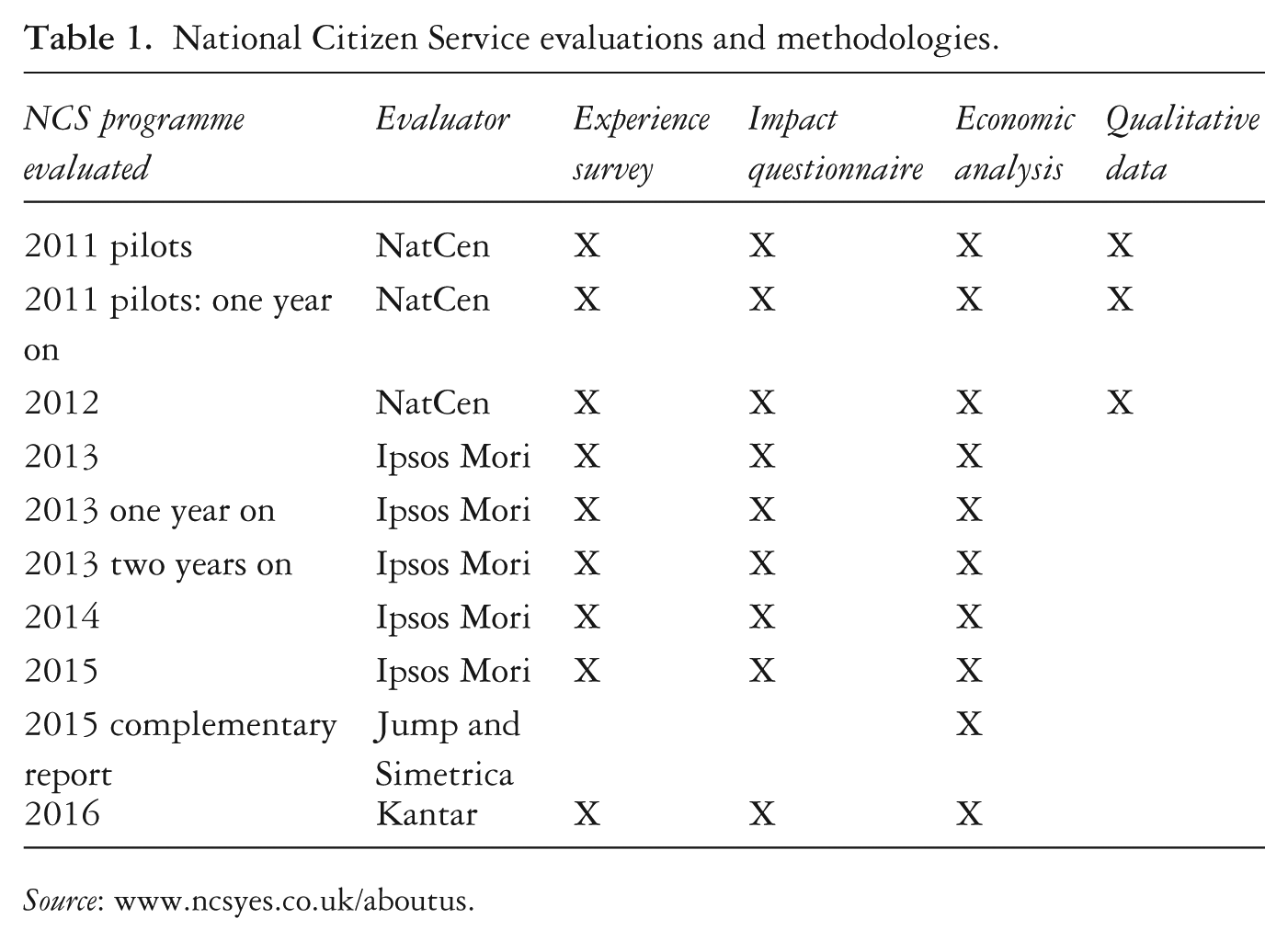
Source: www.ncsyes.co.uk/aboutus.
We want to show that social investment, as a particular idea of how services generate public value, is being used to legitimate state spending in a prominent public service area. However, we also suggest that the National Citizen Service’s operation and evaluation tells us something about how the financialisation of public services is progressed, whereby this high profile programme is not only responding but also contributing to trends in wider policy reform. Thus, our analysis starts in two places at once: the influence of social investment and finance capital in policy; and representations of the National Citizen Service as a public investment.
Our argument is that this conjunction forms a kind of ‘social investment machine’ that is reforming youth services in the UK, changing the sense in which services are understood to create value, redistributing capital, and re-positioning young people as certain kinds of policy subjects. The function of the social investment machine is not limited to UK youth services: it is emerging as a wider force of policy reform affecting service provision across public, charity and private sectors. The NCS not only normalises financialised public service operation and evaluation, but through its emphasis on particular social outcomes and value it is also a means for the government to pursue a broader political-economic and socio-cultural agenda promoting neoliberal aspiration, personal responsibility and individualised notions of social mobility.
The concept of the machine enables us to emphasise the mutually productive conjunction of government policy on social value and the specific approaches to ‘value for money’ developed through NCS evaluations. The first half of this article discusses these two components of the machine, and how they operate in a mutually reinforcing way to develop, normalise and legitimate this economistic approach to government decision-making. In the second half of the article, we discuss the machine’s ‘reforming’ effects on and for policy-making, young people and youth services. We conclude by discussing the implications of this analysis for social policy in general, and for youth policy and practice in particular.
The making of a social investment machine
In this section, we critically discuss: i) national and global policy on social value, and ii) the evaluation of the UK National Citizen Service, and the connections between them. From an assemblage perspective, such connections between different parts can have distinctive productive effects, and be understood in this sense to form a ‘machine’. It is our argument that in conjunction, these components make up a social investment machine which has redistributed capital to services and had consequences for how those using those services are perceived and understood. Our aim here is to set out how social value reforms are taking place, and to do that we first describe these two components and how they interrelate.
Social value and the Treasury ‘Green Book’
‘Social investment’ emerged as a conception of the role of the state in the late 1990s associated with the development of third-way politics in liberal states, notably the UK (Lister, 2003). Initially, social investment referred to macro-level strategy for the redesign of welfare and public services as a means of investment in human capital (Giddens, 1998). The use of concepts of investment to legitimate state activity within the constraints of a (neo)liberal political consensus has been subject to important critiques for their instrumentalism and limited effectiveness (Lister, 2003), and as functioning to draw voluntary and private sectors into governance through mechanisms such as partnership and commissioning (Newman, 2001). Third-way politics was associated with policy-making underpinned by economistic ‘evidence-based’ decision-making procedures, targeting and audit, and the expanded power of the Treasury and the Cabinet Office across government (O’Brien, 2012).
Since the financial crisis of 2008, the development and use of investment-based evaluation technologies has accelerated markedly in the public and voluntary sectors, and the logics and language of finance capital have become the means of public policy-making (McGimpsey, 2018). A key aspect of this change has been the promotion and normalisation of ‘impact’ measurement characterised by: a conceptualisation of change that identifies outcomes and the means by which these outcomes might be influenced; ‘before and after’ tests and in some cases randomised controlled trials; and value for money analyses, in which outcomes are expressed in monetary terms. Prior research has indicated important effects of the reconstitution of funding for services as ‘investments’ seeking a return and the related emergence of investment-focused monitoring and evaluation technologies. These effects have included changes to who provides services, the devaluation of some educational practices, and the production of individualising and responsibilising representations of service users (de St Croix, 2018; McGimpsey, 2018; Moeller, 2013).
An important means of the extension of economistic policy-making is HM Treasury’s ‘Green Book’ which provides a cross-departmental framework for decision-making. Through a new edition of the Green Book in 2003, New Labour set out “a vision of policy making guided by an evaluation and appraisal system dominated by the language of economics and the decision making framework of cost–benefit analysis” (O’Brien, 2012: 74, our emphasis). By the mid-2000s, the ‘social investment state’ was proposed as a potential modality for the day-to-day administration of public services, replacing New Public Management (Newman and McKee, 2005). In the late 2000s, the UK government’s Office of the Third Sector released a guide to calculating ‘Social Return on Investment’ (SROI, later referred to as ‘social value’), and funded the SROI Network (renamed the Social Value Network). Social value is a policy technology whereby processes of commissioning, evaluation, service design and management are re-articulated through the logic, language and imaginary of social investment (McGimpsey, 2018). HM Treasury updated the Green Book guidance in 2011 in an attempt to reflect the value of wellbeing in decision-making, and to provide a means to express the value of such non-market goods in monetary terms. In 2018, HM Treasury issued a full new edition of its ‘Green Book’ in which social value, not mentioned directly in either the 2003 edition or its 2011 update, is foregrounded as the central basis of policy decision-making: Appraisal is the process of assessing the costs, benefits and risks of alternative ways to meet government objectives. It helps decision makers to understand the potential effects, trade-offs and overall impact of options by providing an objective evidence base for decision making. Economic appraisal is based on the principles of welfare economics – that is, how the government can improve social welfare or wellbeing, referred to in the Green Book as social value. (HM Treasury, 2018: 5)
This indicates a significant shift in the role of the state. By 2018 the state has moved from purchaser to investor, and accepted new mechanisms of policy decision-making. Investment is no longer just a legitimising vision that policy-makers aspire towards, it has become their functional modality. The adoption of social value in the UK Treasury’s cross-governmental guidance demonstrates the extent to which financialised investment is now embedded in the administration of the state, and in its efforts to address the fundamental policy problem of deciding how to spend limited resources.
Social value is used as a systematic means of allocating resources to a programme of activity. It draws on concepts of cost-benefit analysis from the private sector, particularly the comparison of options in order to secure the most valuable ‘outputs’ for the least cost. A cost-benefit analysis ratio of inputs to outputs establishes an effective unit price per output, so a direct comparison can be made among options in a ‘marketplace’ of service providers. Social value develops this by defining the value of an action (the benefit of state spending) in the broader terms of ‘outcomes’. To be clear, ‘outputs’ refer narrowly to those goods that directly and immediately result from an intervention, whereas ‘outcomes’ denote the consequences deriving from public policy-making decisions. For example, outputs in the context of the NCS include numbers of young people joining and completing the programme, whereas its outcomes are far more numerous – including intended outcomes such as leadership skills, which may link to wider outcomes such as improved employment prospects, as well as unintended outcomes such as reduced smoking.
If decision-making is limited to a narrow consideration of the costs of outputs, the policy-maker is limited to the role of ‘purchaser’ and cannot consider the full range of possible benefits. In such cases evaluation of these options is restricted to a narrow economic comparison of the input required for the delivery of a targeted level of output, with indirect or non-monetary outcomes left unaccounted for. Decisions based on social value may be thought to be preferable because they consider the broader value of expected investment outcomes which include any goods that predictably result from an allocation of resources. While some of these outcomes can be priced and exchanged in markets, it will also include outcomes that are less easily quantified and monetised; for example, feelings of confidence and pleasure, or public goods such as reduced noise pollution.
The broader scope of social value calculations therefore presents decision-makers with problems of comparison not associated with traditional cost-benefit analysis in which all inputs and outputs are assigned monetary values. Social value seeks to solve this problem by assigning monetary values to outcomes: SROI [Social Return on Investment] measures change in ways that are relevant to the people or organisations that experience or contribute to it. It tells the story of how change is being created by measuring social, environmental and economic outcomes and uses monetary values to represent them. This enables a ratio of benefits to costs to be calculated. For example, a ratio of 3:1 indicates that an investment of £1 delivers £3 of social value. (SROI Network, 2012: 7)
Social value therefore sets up a linear relation between i) the costs of the provision, ii) the outputs resulting from provision, iii) the ‘impact’ of the outputs on measurable outcomes, and iv) the assigned monetary value of the outcomes.
In the UK under Conservative and New Labour administrations in the 1990s and 2000s, we saw the extension of economistic, ‘evidence-based’ decision-making processes, targeting and audit. These systematic means of decision-making, including the forms of cost-benefit analysis referred to above were allied to the extension of power of the Treasury and the Cabinet Office (O’Brien, 2012). The Green Book is both a means and evidence of the extension of an economistic imaginary of and mechanisms for policy-making.
This new form of cost-benefit analysis is a calculus that “allows identification of the best option for the delivery of social value”, expressed in terms of “the Net Present Social Value (NPSV) of an intervention … and Benefit Cost Ratio” (BCR) (HM Treasury, 2018: 7). This technology of calculation involves a different imagination of value for money, whereby spending limited resources is not a means of meeting targets efficiently but of creating maximum social value. The policy-maker is re-cast as the investor of their portfolio of resources seeking the maximum social return: [In a constrained spending environment] the BCR can be constructed as a measure of social value divided by the relevant public spending constraint (e.g. NPSV/£ or the Present Value of Benefits/£). This assesses the benefits bought per £ of public spending. It can be used to allocate across a portfolio of spending to maximise Value for Money. (HM Treasury, 2018: 32)
The financialising techniques behind social value provide policy-makers with an evaluative apparatus with which to compare options and base decisions on ‘investment’ in services. This apparatus provides impetus in policy-making for the development, refinement and acceptance of technologies for the measurement of non-market goods; for the evaluation of impact on these specific ‘measurables’; and for the expression of goods in monetary terms. However, policy-making is not a straightforward process from text to implementation: to understand how social value techniques are becoming prominent in policy and practice we need also to investigate how they are operationalised at the level of programmes such as the NCS in furthering the social value policy agenda.
Monetising the National Citizen Service
Introduced in the early days of the 2010–2015 UK Coalition government as a flagship programme of the ‘Big Society’, NCS is described as a “rite of passage” for young people aged 15–17, which aims to lead to “a more cohesive, responsible and engaged society” (PAC, 2017: 4). It lasts around four weeks, and consists of an activity-based residential phase, a ‘life skills’ programme, and a social action project in the community. The scheme was managed by the UK government’s Office for Civil Society until 2013 when the NCS Trust (a community interest company) was set up to run it, and constituted 95% of government spending on youth services between 2014/15 and 2017/18 (LGA, 2018). As a large, high profile investment, NCS acts as a mechanism for policy development in the youth sector, for example through its delivery model, in which companies and charities compete for contracts as regional providers, often subcontracting to smaller local organisations, partly on a ‘payment by results’ basis (de St Croix, 2017). Here, we focus on the significant role of the NCS in implementing, legitimating and normalising social value approaches to policy evaluation.
To date, ten substantial government-commissioned evaluation reports have been written by social research organisations, covering the first six years of the programme (see Table 1). As an indication of their length and complexity, the most recent runs to 117 pages, and is accompanied by an additional 118-page technical report. While the methodology has evolved over time, each evaluation generally involves the following elements:
Questionnaires given to participants and a control group before and after the programme, to assess the impact of NCS on a large array of outcomes.
Economic analyses of the change measured by these pre- and post-NCS questionnaires, in which some outcomes are converted into a monetary expression of social value.
An ‘experience’ survey, asking NCS participants to rate their experience of NCS and their subjective perception of its impact.
Qualitative case studies and interviews with practitioners and participants (first three reports only).
Our main concern in this article (and the main focus in the reports themselves) is the first and second of these elements: the impact data and (in particular) their conversion into social value. Notions of social value are prominent throughout these documents, appearing with increasing intensity; for example, the phrase ‘value for money’ occurs nine times in the first of the evaluations and 48 times in the most recent. From the 2013 evaluation onwards, the Treasury’s Green Book is explicitly cited as underpinning calculations in the value for money analyses: The value for money analysis has been undertaken in accordance with the principles of the HM Treasury Green Book, and seeks to monetise (as far as is practicable) the resource costs and benefits associated with the programme. (Ipsos Mori, 2017: 39)
The evaluations claim to “have consistently shown the positive impact the programme has on young people, and [that] the programme delivers good value for money” (Kantar, 2017: 1). We will now examine two reports commissioned to evaluate the same 2015 programme (Ipsos Mori, 2017; Jump and Simetrica, 2017), which use contrasting methodologies to make different value for money claims.
Ipsos Mori was commissioned to evaluate the NCS from 2013 to 2015. They collected data on numerous indicators, comparing participants’ outcomes in these areas to those of a control group, and used economic analysis on a small proportion of these (related to volunteering and leadership skills) to assess the ‘monetisable benefits’ of NCS. The economic methodologies are set out in the reports themselves and accompanying technical reports. To summarise, volunteering was monetised by adding the total number of hours of volunteering completed during NCS itself to notional or intended future volunteering hours, and multiplying this figure by the National Minimum Wage. Leadership skills were valued through a calculation that estimates the effects of such skills on lifetime earnings. Adding these together, for the 2015 scheme it was estimated that there are between £0.70 and £2.30 of ‘benefits per £1 expenditure’ (Ipsos Mori, 2017).
Referring to the same year’s programme, however, NCS Trust Chief Executive Michael Lynas (a former Cabinet Office civil servant) claimed the NCS creates “a big social return for our country, up to over £8 for every £1 invested” (Lepper, 2017). This bolder claim rests on further economic analysis of the Ipsos Mori (2017) impact data by ‘social impact’ firms Jump and Simetrica (2017). While using the same questionnaire data, Jump and Simetrica (2017) use innovative methodologies and ‘big data’: 1) an emerging methodology for monetising subjective wellbeing, and 2) a new government dataset on higher education participation, which includes data on NCS participation. While Ipsos Mori’s value for money evaluations use methodologies recommended in the Treasury’s Green Book, Jump and Simetrica (2017: 2) explicitly engage in novel approaches, aiming to “understand and quantify the short-term, wellbeing impacts for the NCS programme and how this could be monetised in line with the latest economic thinking”. This “latest economic thinking” is also based on the Green Book, and quotes a supplementary guidance paper which outlines emerging methodologies for monetising wellbeing: “subjective wellbeing measurement may soon provide a complement to the more traditional economic approaches” (Fujiwara and Campbell, 2011: 5).
Jump and Simetrica (2017) go on to acknowledge that Treasury guidance emphasises that investment in monetary evaluations should be proportionate to the size of the scheme; as NCS is a relatively modest programme, the evaluators justify their use of a complex resource-intensive methodology by emphasising the symbolic influence of NCS in the youth sector: Given the scale of the UK Government’s commitment to NCS, and with the implications across the wider Youth Social Action sector, we believe application of the WV [Wellbeing Valuation] approach is both appropriate and relevant in this case. It is also consistent with the advice in the HM Treasury 2011 report on Social Cost-Benefit analysis. (Jump and Simetrica, 2017: 9)
Thus, the NCS is explicitly harnessed as an opportunity for policy development through evaluation entrepreneurship, a process in which evaluators promote innovative evaluation techniques by using those techniques to make increased claims for the financial value of government investment in a service. The entrepreneurial spirit is reflected in the appearance of new players in social policy evaluation. While Ipsos Mori’s history can be traced back to 1946, Jump was incorporated in 2011 and Simetrica in 2014. 1 Moreover, Simetrica’s founding director is Daniel Fujiwara, a former government economist and lead author of the Green Book supplementary guidance on subjective wellbeing valuation. 2 Fujiwara’s research is cited 12 times in the Jump and Simetrica (2017) report, and operationalised to enable subjective and non-monetary ‘goods’ to be assigned a monetary value.
This complex methodology is not a means of straightforwardly calculating how the impact of the NCS might reduce government spending elsewhere. Rather, the programme’s impact on life satisfaction measures is monetised using a set of statistical processes that estimate the amount of money that would otherwise need to be spent to produce the same effect on wellbeing as is produced by the NCS. This is explained in detail in both the Green Book supplementary guidance, and in the NCS evaluation report itself: Performing the unconstructed VfM [Value for Money] requires an estimate of the impact of the NCS programme on life satisfaction … and an impact of money on life satisfaction for the same sample group (this allows us to measure the amount of money that has the equivalent impact on life satisfaction as the NCS programme in order to derive the money metric value) … Lottery wins enable us to derive a robust causal estimate of the impact of money on life satisfaction… (Jump and Simetrica, 2017: 11)
In other words, wellbeing valuation is based on a calculation of the amount of money it would cost (based on studies of the wellbeing effects of lottery wins) to produce the same improvement in feelings of wellbeing as is produced by the NCS. This novel approach is used alongside a new University and College Admissions Service dataset, Strobe, to estimate the earnings premium that may result from NCS participants’ higher than average entrance into higher education. The combined results of these analyses underpin the evaluators’ claims that the NCS delivers a “social benefit-to-cost ratio of between 5.93 and 8.36” (Jump and Simetrica, 2017: 1).
Below the simple headline claims of ‘value for money’ written on the basis of the NCS evaluation documents lie lengthy and complex technical explanations of the analysis. Expressions of social value are highly assertive, seductive in their explanatory power, partly because they rely on specialised, novel and controversial methodology. There are various controversial elements of these methodologies that might be taken up for further critique, such as ‘valuing’ volunteering as if it were a paid job, assigning a monetary value to subjective feelings of wellbeing, and attributing a higher education ‘earnings premium’ to the effects of a youth programme. However, below we elaborate on the reforming work of the social investment machine, and explore how the calculation of social value drives the datafication of young lives and the creation of high volume youth services.
A reforming machine
So far, we have discussed how economic policy on social value has developed alongside the rapid growth of the National Citizen Service. This simultaneity has enabled the NCS to become a means by which new ‘value for money’ methodologies are operationalised, tested out and further developed in the youth sector. Trading on its ‘flagship’ status, the NCS constitutes and legitimises the taken-for-granted financialised logic of youth and social programmes in the twenty-first century. Together, policy on social value and the evaluation of the NCS constitute a reforming process of evaluation entrepreneurship in which social investment is established as a logic and refined as a technique in policy and practice. Considering this conjunction as a social investment machine, the second half of this article now discusses the machine’s powerful effects on the ways in which young people and youth services are constituted in current policy.
In their machinic productivity, social value and programme evaluation share a trajectory towards ‘return on investment’. The reforming work of the machine is not narrowly deterministic; services could be designed differently from the NCS and still ‘work’ in terms of social investment. There are multiple technologies for the production of ‘impact data’ that assign non-market goods a monetary value. What is consistent and predictable is the shared direction of these movements. ‘Return on investment’ acts as an attractor, providing momentum for the social investment machine’s ‘movement’, and these reforms share a logic of finance capital and curve towards return on investment expressed in monetary terms. The National Citizen Service articulates itself in precisely this way.
The ‘social investment machine’, then, refers to how the conjunction of these components accelerates movement towards social investment, embedding it as a modality of government as it does so. This conjunction incorporates various parts including:
social research identifying outcome variables and predicting impact;
evaluation and economic analysis methodologies;
the symbolism of financial markets and investment;
subjective experiences of young people;
personal relationships as networks; and,
the authority of government to define goods.
Clearly, Treasury guidance and the NCS is not the only such conjunction between policy-making apparatuses and services. It is one point from which this reforming dynamic is visible, albeit an important one. Indeed, this is a decentred process not reducible to the political strategy of the Conservative Party in the UK or specific policy-makers. The social investment machine more broadly appears bound up in a cross-governmental and international trend whose functioning and reforming effects spread as new policy technologies emerge. While finance capital imagery is characteristically neoliberal, the evidence-based policy movement cross-cuts different ideological positions, and economists interested in measuring ‘social good’ sometimes come from progressive standpoints. This reform is ‘machinic’ in that it is not guided from a centre or delineable set of interests or beliefs, but constitutes its own momentum and trajectory. Rather than being an effect of policy implementation, the social investment machine emerges, embedding itself in procedures in widely distributed sites.
In this final section we consider what the effects of this machine might be, and suggest two ways that policy and youth services are emerging differently under the influence of the social investment machine. First, the theorisation of complex social change as simple, linear causative processes drives the ‘datafication’ of young people. Second, the calculus of social value promotes ‘high volume’ (rather than universal) services that, through marketing and promotion, feed young people into short-term processes run by a casualised labour force to convert young people’s attitudes and behaviours into impact data for financial return.
Datafication of young lives
The young people who participate in the NCS are subjected to the extensive measurement and monetisation of their attitudes, feelings and behaviours. The social investment machine seeks to constitute a future return through data on young people in the present; intervening in measurable aspects of young lives and calculating the economic impact on the future. Such forms of predictive order are not unique to social investment – indeed they are emerging everywhere, quietly suffusing our social relations. They are familiar in the automatic reasoning of the algorithms we see in retail (if you bought x then you might buy y) and media consumption (if you watched x then you might watch y). Increasingly these have developed into identitarian concerns – if you liked x then you are a y kind of person.
The social investment machine has incorporated and developed its own kind of algorithmic reasoning in the form of logic models that are widely used in programme planning. Logic models, often expressed as ‘theories of change’, are a means of ‘theorising’ how desired future outcomes can result from interventions. They include an intervention or activity, the production of outputs, and the articulation of a causal mechanism of change by which these outputs are predicted to have impacts on outcomes related to the overall aim. They function as a form of automated reasoning into which data can be fed and correlated to specified predicted future outcomes. We can see the construction of these predictive linear relations to future outcomes in the NCS evaluations discussed above. Predictive models of impact establish an exchange rate for data – data on indicators associated with outcomes establishes a degree of impact from an intervention, and the monetary value of that impact becomes calculable.
The acceptance of this means of calculating social returns has driven evaluation entrepreneurship in the social investment machine, elaborating theories of change to proliferate the outcomes, and therefore the impacts, associated with an intervention. As such, evaluation entrepreneurship uses these predictive technologies to first establish and then improve the exchange rate for each unit of impact produced. In this process, it is young people’s data, rather than their experiences and feelings, that becomes valuable; the same dataset can be used to produce a higher exchange rate as novel methods of economic analysis enable more of the data to be monetised according to new innovative methodologies.
The NCS has seen a consistent effort of evaluation entrepreneurship to monetise all its impacts: NCS Trust is constantly evaluating the structures, delivery and impacts of the NCS programme on graduates. As part of this ongoing process, NCS wants to fully explore all NCS impacts … and how these can be monetised as part of the Value for Money (VfM) analysis of the programme. (Jump and Simetrica, 2017: 3)
The regulatory effects of this evaluation entrepreneurship are compounded both by the sheer numbers of measured indicators, and by the content and implications of these indicators. Taken together, the 87 agree-disagree statements included in the Ipsos Mori (2017) evaluation discussed earlier portray the ‘ideal’ young person as resilient and positive, detached from social context or structural barriers, as in the following examples:
I feel positive about my chances of getting a job in the future
I can pretty much decide what will happen in my life
Working hard now will help me get on later in life
I can usually handle what comes my way (Ipsos Mori, 2017: 52)
Such indicators construct a responsible future citizen who will succeed if they work hard and think positively. It calls up an individualistic and meritocratic context, in which young people’s lives are decontextualised from power relations and structural inequalities including those of class, gender, race, income and dis/ability. Clearly, such inequalities affect how far a young person can decide what will happen in their life, or how much they can achieve through hard work. A neglect of unequal power relations extends to the questionnaire items related to active citizenship, such as:
I would know how to deal with a problem in my local area if I wanted to
I understand the organisations and people that have influence in my local area
I feel able to have an impact on the world around me (Ipsos Mori, 2017: 24)
These statements represent a depoliticised and individualistic understanding of agency, which again neglects unequal power relations. Complex problems such as a council closing down its youth club as budgets fall and demands elsewhere are rising, or the effects of global problems such as climate change, cannot be reduced to a ‘local’ problem. Understanding who has ‘influence’ does not reference, for example, existing structures of exclusion affecting women or the minoritisation of ethnic communities. Having ‘an impact on the world around me’ does not suggest collective processes of democratic citizenship. Yet social and political complexity is subsumed into seemingly common-sense evaluation statements, converted to claims of (for example) ‘£8 social return for £1 spent’.
The production of data that feeds the automatic reasoning of the social impact machine involves little concern for the actual outcomes of young people, their agency, or the structural inequalities they are affected by. The data-gathering required by social value mechanisms subordinates young people to the impact indicator, flattening the psychosocial complexity of their lives and obscuring the politics of social change. The constrained, arguably repressive, representation of young people’s emotional lives via the fixed responses of a Likert scale produces data in the form demanded by the logic model in order to position young lives in relation to future public service expenditure or prospective value as human capital. As well as being reductive representations of young people, such statements are not even measures of change in actual competence or skill, emotional capacity, employability or future chances, but rather in young people’s perceptions of these things – social value indicators are improved if young people see themselves as resilient, entrepreneurial subjects. At the same time, social change is reduced to a set of simple linear causal relations, masking the complexity of social processes over time or the space for politics and agency. ‘Change’ is rendered calculable as a rate of financial return, the cost of an intervention in relation to the value of its outcomes.
High volume services
If one way for a social investment machine to maximise returns is by elaborating the outcomes and therefore impact of an intervention, another is to feed in more data. It is notable that the NCS has sought to move to scale as rapidly as possible. This ‘high volume’ model contrasts with universal models of youth service provision that developed under a welfarist policy regime, in which need was identified locally (leading, for example, to open access youth clubs based over decades in areas of disadvantage). It is also distinct from the emphasis on targeted services during the late 1990s and 2000s which focused on service delivery for groups of young people categorised in terms of social or economic exclusion. In contrast, the NCS is predicated on attracting very large numbers of young people, based on a form of monetisation that focuses not on who they are but on the data produced of them.
In this way, the NCS targets a high volume ‘middle’; the ‘ideal’ investment prospect might be a young person who does little voluntary work, is not (yet) a confident leader, feels somewhat insecure or anxious, and lives in a district with relatively low levels of university entrance; and yet aspires to overcome these barriers. Large numbers of such young people are likely to produce an ‘impact’ and thus the extraction of returns on investment; whereas young people with intensive support needs or irregular engagement (the kind of young people who may have been particularly attracted to open access youth work) could be seen as unlikely to ‘change’ through participation in a short-term project, and thus be seen as a poor prospect for future returns.
To reach this ‘high volume middle’, the NCS programme is designed as a short, consumable ‘experience’ for 15–17 year olds, and marketed through social media using the language characteristic of advertising discourse in today’s experience economy: “This summer explore an experience that will change your life!” (Vimeo, 2015). Spending on sales and advertising accounted for a substantial £100 per NCS place filled in 2016, including £2.7 million on television advertising (PAC, 2017: 12). Young people’s evaluation data is channelled back into marketing to present NCS as both an ‘experience’ and an ‘investment’ in a young person’s future. The NCS Trust (2018) web page aimed at parents states that “NCS is proven to have a massive impact on young people’s lives” and flashes up a changing array of claims based on evaluation data:
NCS increases confidence in meeting new people
7 in 10 are more confident about getting a job as a result of NCS
NCS lowers anxiety and boosts resilience
In the social investment machine it is volumes of impact data that matter, and in this shift there is an abstraction from young people and their lives. Competitive commissioning and target setting in the 1990s and 2000s resulted in an emphasis on the categorisation and labelling of young people. The move away from such an approach occurs because such factors are not part of the logic models by which impact and financial returns are calculated. It is rarely taken into account in the methodology or calculations of social value that, for example, ‘earnings premiums’ from leadership skills or higher education are highly differentiated by social class, gender and race. In a sufficiently high volume middle, such differentiations lose their significance in data terms, homogenising young people and obscuring social inequalities.
In the drive to high volume and large-scale data production young people are fed to the social investment machine. In the process the knowledge made of them and their participation is decontextualised, and represented as abstract data on attitudes and behaviours that can be converted into financial return.
Conclusion
In this article we have argued that UK government policy on social value works in conjunction with the evaluation technologies of their flagship youth programme, the National Citizen Service, to form a ‘social investment machine’. This machine functions to promote, experiment with and normalise a social investment approach to evaluating public services, with youth programmes used as a key site and means of evaluation entrepreneurship. The machine is not deterministic of outcomes, but it provides a trajectory to reform and accelerates change along these lines. In doing so, the social investment machine normalises the notion of young people as a site of investment, and of service providers working with high volumes of young people and aiming to change measures of young people’s behaviours, attitudes and feelings. In this process, young people’s lives, agency and subjective experiences are subordinated to the impact indicators.
The social investment machine has had regulatory effects on young people in the abstraction of the individual young person into data. The mechanisms that drive the production of data points are set in floating exchange rates of value according to logic models, the cost of inputs and the calculation of returns. These point to a process of datafication that reductively describes attitudes, behaviours and subjective feelings. In this context, young people exist both as policy subjects – responsibly investing in their individual future outcomes by buying their place on the NCS and ‘graduating’ as ‘socially responsible’ citizens – and as a collection of data points (on attitudes, feelings and behaviours) to be converted into monetary returns on investment. Young people are made human capital in the particular, narrow sense of the measurable incidence of good behaviours and reporting of desirable attitudes, rather than being seen as an individual who develops skills, knowledge and capacities through engagement with educational and social institutions. This representation of the value of young lives is a means of securing further policy investment, and feeds into the marketing that attracts and retains more young consumers of the NCS experience.
In this way, young people are fed into the social investment machine. Young people are made a site of financial speculation, their behaviours and emotions a means of evidencing the impact of interventions and claiming returns. By this abstraction and the linear logic models that are used to predict the value of that data, the young people themselves are effaced, and the economic inequalities and the differential experiences associated with class, gender, race, sexuality and disability are obscured.
Footnotes
Acknowledgements
The authors would like to thank Sharon Gewirtz, Alan Cribb, David Gillborn, the ECS Writing Group at KCL, and the Critical Social Policy Editorial Collective for their helpful comments on prior versions of this paper.
Funding
This research received no specific grant from any funding agency in the public, commercial, or not-for-profit sectors.