




Abstract
This article critically engages with the voices of South Asian, Muslim women living in Rotherham to provide an emic gaze (Pike, 1967) of the intersectional lived experience of the ‘cultural others’. Everyday voices of South Asian, Muslim women activists living in the UK are marginalised based on prejudicial cultural assumptions. We demonstrate our challenge of negative discourses of the ‘passive and culturally oppressed female’. Our activism confronts racism predicated on cultural stereotypes embedded in state structures in contemporary Britain. This article explores the actions and tensions of confronting racism by South Asian, Muslim women living in Rotherham.
Introduction
Our article brings our multiple voices as South Asian, Muslim women living in Rotherham to the surface to address our lived experience of intersectional racist oppression. Our words are based on our activism as South Asian Muslim women of Apna Haq (Rotherham based BME support service for women and girls from black and minority ethnic communities to escape violence: http://www.apnahaq.org.uk/). Apna Haq (means ‘our rights’ in Urdu). We are activists working in Rotherham, which has seen decades of social and economic decline, and in recent years numerous Far-Right marches and the rise in hate crime against us. The report ‘Gendered anti-Muslim hatred and Islamophobia’ (Faith Matters, 2018) mentions the ‘gendered nature of anti-Muslim incidents with over half of the victims, where data was available, where Muslim women (Faith Matters, 2018: 2).
As Muslim women of South Asian heritage in the UK, we refuse dominant political narratives that our culture is violent and oppressive. We show how our activist workshops, poetry, and art, enables us to speak out and name the sources of our experiences of intersectional oppression.
The words of Cherrie Moraga resonate with us: ‘The danger lies in failing to acknowledge the specificity of the oppression. The danger lies in attempting to deal with oppression purely from a theoretical lens. Without an emotional heartfelt grappling with the source of our own oppression, without naming the enemy within ourselves and outside of us, no authentic, non-hierarchical connection among oppressed groups can take place’ (Moraga and Anzaldua, 1983: 29).
As ‘cultural knowers’ we have ‘situated’ knowledge (Hill Collins, 2000: 19) of the ‘specificity’ of the oppressions because, as Audre Lorde states, our ‘survival isn’t theoretical, we live it every day. We live it on the streets, we live it in the banks, we live it with our children’ (Greene, 1989: 183). In Apna Haq we use methods such as our ‘cycle of power' wheel and art to express our ‘emotional heartfelt grappling with the source of our own oppression’, which goes beyond ‘a theoretical lens’ (Mathews and Ross, 2010). In our experience, racism is not only about race but is configured through the denigration of our culture. Particular public narratives by those in power create moral panics (Cohen, 1972), which function to fragment community cohesion and promote the idea that our communities are places of danger. This moral panic cascades down to the ordinary person on the street the effect of positioning blame for the divisions caused by racism. In our experience, as women of South Asian heritage, the language of policy-making bureaucrats is divisive.
Apna Haq campaigns on issues that impact on our lives as women of South Asian Muslim heritage. Our activism challenges harmful views and practices of professionals through campaigns, and training delivered to professionals, research and publications.
Our standpoint is that ‘our marginality gives us and make use of this perspective to criticise the dominant racist, classist, sexist hegemony and create a counter-hegemony’ (hooks, 1984: 2). The co-production of this article is based on our workshops organised with South Asian Muslim women where we shared our understandings of our intersectional experiences of oppressive cultural racism. As women of Apna Haq our shared understanding of cultural racism is that it is emotional, intuitive and almost invisible; it is the imperialistic, Eurocentric attitudes of the dominant West towards other cultures. Our activist workshops aimed to create a safe space of consciousness-raising, which enabled us as women to collectively speak out about how we feel that cultural racism functions as if it is in the very air we breathe. We shared our experiences of being spaces, such as meetings, where we sense cultural racism blowing like a toxic breeze around the room in professional conversations, at board level wafting a cultural ‘Othering’, where we tell ourselves we are wrong, we are being oversensitive and that we are just misunderstood.
The workshops were attended by Apna Haq women who have lived in England between five to ten years; aged 20 to 30. We had two women over 55 who came here as young brides and have seen many cultural changes. Apna Haq women are often single mothers with limited English language skills. Apna Haq women face oppressive government policies and discrimination from service providers; language was a common theme that women said held them back. For example, not being able to understand how to bid for a council house online, without the support and being told to go on a computer course and learn is not helpful to a woman in an immediate housing crisis.
Hall argues that cultural identity is ‘a sort of collective “one true self” hiding inside the many others, more superficial or artificially imposed ‘selves’ which people with a shared history and ancestry hold in common’ (Hall, 1990: 223). At Apna Haq we placed emphasis on unity, friendship, and strong social and cultural networks. One Apna Haq woman stated: We are aware people see our culture as backward and make fun of our culture and think we don’t know anything about literature and the arts and that we are not culturally articulate because we don’t have the English language. As women, we defend our culture and comments like culturally oppressed women or culturally voiceless women are unkind and hurtful. Public narratives of the ‘savage culture’ causes immeasurable injustice to women like us, but also energize us to challenge such language since we refuse to think, feel and see the world through the eyes of our colonizers. Our activism can be at board level or challenging such damaging comments outside the school gate. What we will not do is to remain silent as our daughters and granddaughters will ask us one day why we did not speak up for them?
The voice of this South Asian, Muslim woman demonstrates her lived experience of racism functioning through the mechanism of damaging stereotypes. The point is that, as South Asian, Muslim women in the UK we face daily micro-aggressions that include assumptions about our culture, for example, that we are all locked up in our houses. We hear comments like ‘what is the point of giving her a job she will get married and never work, so why invest in her?’ Or ‘Because of their culture, these girls are forced to get married and parents make the decision’. However, as second and third-generation South Asian, Muslim women in the UK, our lives are far more complex, contingent on hybrid or in-between spaces of multiple influences. South Asian, young Muslim women make their own decisions about who they marry and their career choices, what they wear and the direction of their lives.
There is a need for an increased understanding of culture and faith, particularly for professional decision-makers in positions of power. For example, there is a need to address, re-frame and raise consciousness regarding the lack of understanding of the importance of Islamic divorce for South Asian Muslim women who have been victims of domestic abuse. There is a need for service providers to understand that South Asian Muslim women do not feel that their marriage has legitimately ended and therefore are unable to move on with their lives until they have obtained an Islamic divorce under the Shariah Council. Predominantly White, generic domestic violence projects often fail to understand the complex nuances of the significance of an Islamic divorce for South Asian Muslim women; this situation presents an added burden to South Asian Muslim women survivors of domestic abuse, as it is a constant battle with white services to try to convince them that a British civil court divorce is not adequate for most women of Muslim Faith. Zlakha points out that ‘it has been a constant struggle with a section of secular feminists who are openly anti-Islamic Shariah Council and make statements such as "we are living in the 21st century, why does your organisation support women to seek a divorce from the Shariah Council?"'. This Eurocentrism, according to Kassimeris and Jackson (2011: 19) is a ‘mode of thinking that privileges the European (or Western) experience above all others’. As South Asian Muslim activists working within Apna Haq, we experience the racism of ‘ethnocentric universalism’ (Mohanty, 1984: 21) in professional discussions about cultures and religions.
Zanib has worked in partnership with Apna Haq for a number of years, and gives an example of how power functions performatively through dominant discourse, legitimised by authority positions of professionals through racist stereotypes: 'my cousin and her daughter went to see their GP practice nurse to have injections to go on a holiday to Pakistan. The nurse said to my cousin “Are you taking her to get married?" My cousin was absolutely speechless and had to say "you have my daughter’s date of birth; she is only 15 and is going to college and university. How many mothers of white girls going on holiday would be asked the same question?"' Here, Zanib’s testimony demonstrates how ‘the yardstick by which to encode and represent cultural others’ (Mohanty, 1984: 21) works within the daily micro-aggressions of simply visiting a GP practice. These cultural prejudices are exhausting and at Apna Haq we provide a safe space as we can to enable South Asian, Muslim women living in Rotherham to give a collective voice to their experiences of racism. The space we create between us at Apna Haq forms the backbone of our resistance and sustenance as activists. Our starting point is that every South Asian, Muslim woman living in Rotherham and the UK, who survives and challenges their lived experience of intersectional racism is an activist in her own right.
It was very important to the women who attended the Apna Haq workshops that their children knew their own heritage and faith. In our experience, as South Asian, Muslim women living in Rotherham and as mothers, we acknowledged that most of the responsibility fell on us as mothers to support our children to develop strong identities and roots. Bhabha refers to the cultures-in-between the ‘migratory, partial nature of culture’ (1996: 54). At Apna Haq, women commonly reported feeling like they were in between cultures in a space where they felt they are not accepted by either. Apna Haq women talked of the challenges faced by their children in negotiating ‘borderline negotiations of cultural difference’ (Bhabha, 1996: 54) and not sure where they fit in. The challenge for us, as women together at Apna Haq, is of not replicating, between each other and in our space at Apna Haq, any sense of ‘not fitting in’. We must be continually mindful of how we negotiate the borderlands of our differences between us; South Asian Muslim women in Britain are not a homogeneous group.
Apna Haq women felt disappointed that schools tended to focus on the dominant culture and language of English. Apna Haq mothers said that their children could not speak the mother language anymore and some blamed themselves for not putting more effort in. It is not right that schools don’t look at other cultures so our children are growing up thinking only White British people have a culture. It is difficult sometimes to get more than one day off from school or work to celebrate Eid.
Amrit Wilson (whose book Zlakha contributed to) points to the ethnocentric curriculum in schools, which builds in attitudes that the Western culture is the only culture and other cultures are mocked. Wilson argues; It is a system a reasonably educated person would have heard of Homer but never of Kalidas, of Ibsen but rarely of Tagore, of Joan of arc but not of Rani of Jhansi (another women who took arms to try and drive the British army out of her country, of Goethe but not of his contemporary the great Urdu poet Mirza Ghalib (Wilson, 2018: 115)
When we reject systemic racist institutional practices, we have been accused of ‘playing the race card’. We are working under a terrain of everyday racism, Islamophobia, state oppression, funding cuts, and dangerous political and media discourses. Our cause is best championed by women who share our intersectionality (Crenshaw, 1989) of gendered, racialised, ethnic, cultural oppression.
The cycle of power wheel
We have produced an activist tool that we called the 'cycle of power wheel’. The idea of the cycle of power was created in collaboration during workshop discussions with Apna Haq staff and service users, and discussions with female friends, family members, late-night phone conversations with friends who work as teachers, social workers, solicitors, nurses who have experienced intersectional cultural racism in the workplace. Some of the professional women we consulted with who are working in predominately white organisations asked for anonymity, for fear of reprisal. Our living activist struggles to end the social injustice of racism reminds us, again and again, that there is always a tension and risk in speaking out about and challenging structures of white supremacy. We have found that challenging racist hierarchies can lead to ostracisation with detrimental consequences for our careers and commissioned funding for BAME grass-root organisations.
The cycle of power wheel
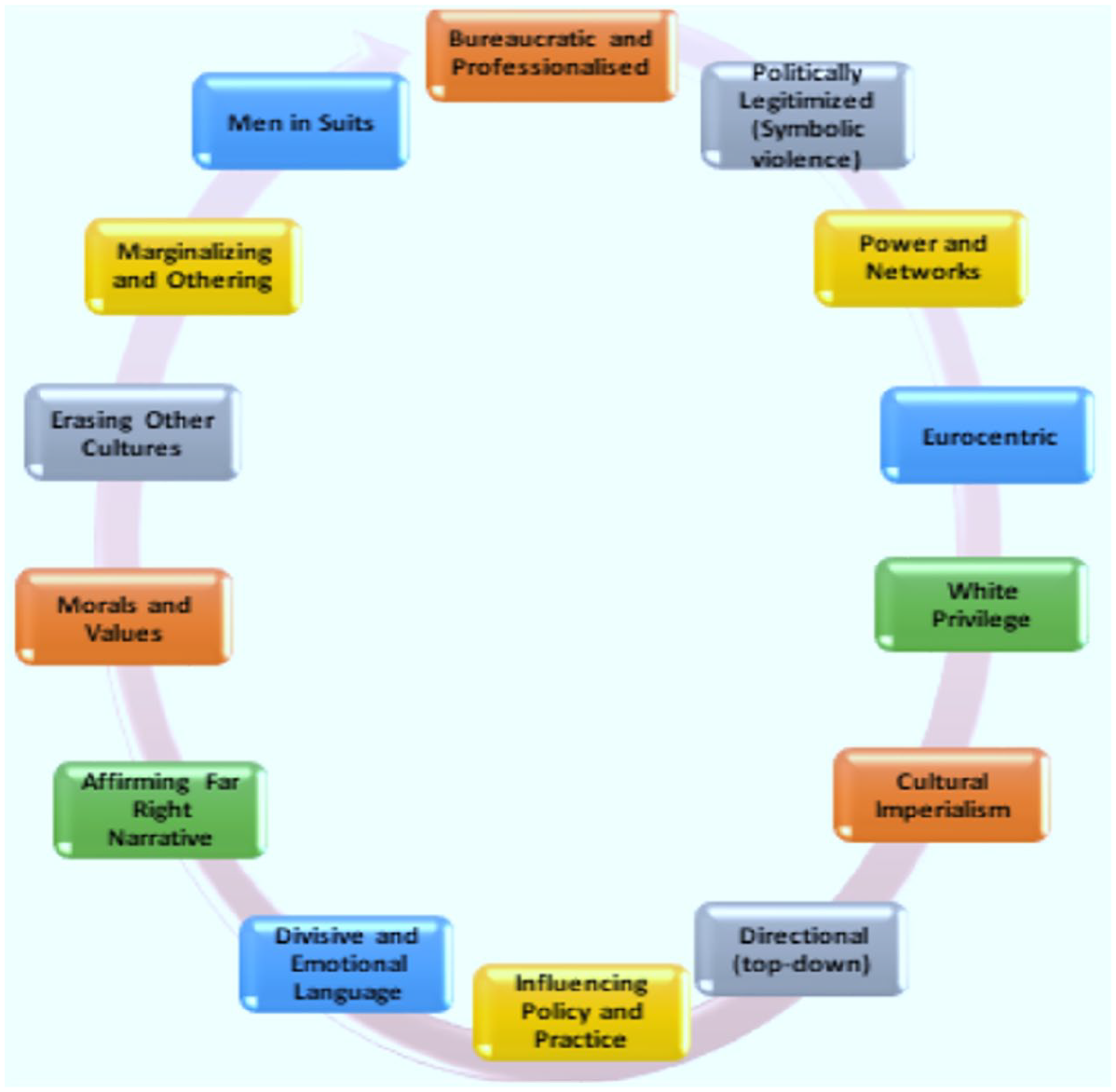
Our cycle of power wheel, born out of our lived experience of South Asian women at Apna Haq deconstructs the inter-connections between the various methodologies of racism and white privilege (Gillborn, 2005). The linkage of the strategies, values, and ideologies function to produce forms of hegemony (Gramsci, 2007) that legitimise ‘the anonymous pin-stripe indifference of those who may not profess their commitment to race hierarchy in public after dark but whose disinterested actions institutionalised it nevertheless’ (2002: xxxv).
Our cycle of power wheel depicts the ways in which our ‘intersectional experience is greater than the sum of racism and sexism’ (Crenshaw, 1989: 140; 1991). Similar to the ‘Duluth power and control wheel’ (Duluth, 2017) used to empower women, survivors of sexual and domestic violence, we found that our co-production and use of the cycle of power wheel is an invaluable tool for revealing the psycho- social mechanisms of regulation and control we face as South Asian Muslim women in Britain. Our cycle of power wheel is one of our methods of anti-racist, anti-imperialist activism shines a light on the powerful mix of mechanisms or ingredients used to subjugate, silence, denigrate and degrade South Asian Muslim women in Britain. The importance of understanding how the mix of these racist mechanisms functions, is that it gives us an idea of what we are up against, and informs our activist objectives for social justice. Our cycle of power wheel assists us in shifting our internalised
inadequacies and self-blame, lack of self-esteem away from ourselves to the source of the problem.
In our activist analysis, top-down directional, bureaucratic and professionalized racism is deeply embedded in the ‘ordinary business’ of socio-political routines, practices, and institutions that we rely on (Delgado and Stefancic, 2001: 22). An example of politically legitimatised ‘symbolic violence’ (Bourdieu, 1990), where the dominant group imposes its ideology on subordinate groups can be seen in the vilification of Muslim women’s religious garments, including the burkini ban. In our lives, we know this vilification of what we wear, and the insistence by the state to go through citizenship ceremonies, to be ‘the imposition of systems of symbolism and meaning (i.e. culture) upon groups or classes in such a way that they are experienced as legitimate' (Jenkins, 1992: 104).
Our activist work at Apna Haq confronts silence, isolation, and fragmentation between ourselves as south Asian women and within our communities. We recognise that power ‘is employed and exercised through a net-like organization’ (Foucault, 1980: 98; Lukes, 1995). However, rather than resting with a theoretical Foucauldian analysis of power exercised ‘over us’; we use our anti-racist feminist activism logic and methodology of ‘power to’ and with each other (Yoder and Khan, 1992). Our method is to create a ‘net-like’ association between each other and those we reach out to, in order to create spaces where our common her-stories can be told. Our activist consciousness-raising gatherings and workshops seek to establish and sustain our networks and connections with each other. Establishing a network or group can be relatively easy in comparison with the task of sustaining our connections with each other across our differences. In our experience, the tension is that as South Asian Muslim women, we are not immune to the emotional and divisive language of Islamophobia, which shapes public opinion (Olsen and Marger, 1993), and although we hate such destructive racist language, there are times when the impact of our anger, disappointment, and exhaustion spills out and is projected onto each other.
In the context of Eurocentric cultural imperialism, we as South Asian Muslim women are constructed as a ‘problem to be solved or confined’ (Said, 1978: 207). Our daily experiences of islamophobia confirm that the legacy of the British Empire’s imperialist ideology is alive and firmly rooted (Cannadine, 2001). It can, literally, feel
as if our bodies are, ‘totally imprinted by history and the processes of history’s destruction of the body’ (Foucault, 1984: 83). In our work with women at Apna Haq, we hear how the English language functions as a driver and stick for nation-building policies. In name of protection of the state, policies, and practices such as, ‘The life in the UK Test’, and increasing regulation of ESOL pedagogies, function to inter-link immigration, integration, and counter-extremism policies, which propagate seeds of right-wing discourse (Van Dijk, 2004). South Asian Muslim women in Britain (the colonial others) are become targeted by the state as not integrating due to how we speak and write in the English language. Apna Haq member, Zanib reported that ‘my sister born here was teaching her son Urdu and was in a shop when she got abuse from an elderly white woman “speak English, bloody foreigners”’. Our analysis of the juxta- positioning of spoken language with being foreign is summed up in the following words: ‘Again and again, I find foreignness used in familiar ways, as a device that gives shape to or threatens existing political communities by marking negatively what “we” are not. (Honig, 2001: 2–3; Blommaert et al., 2012). Thus, the logic of ‘what “we” are not’ becomes the basis on which we are represented as ‘threatening’. We ask why the discursive practices of blame and accusations of segregation and ghettoization that are South Asian Muslim women are subjected to; fail to take into account our intersectional experiences of racism (Cantle, 2001). Certain cultural groups are seen as outsiders and political representations have the power to select, arrange and prioritize public representations so that, ‘certain assumptions and ideas about different kinds of people’ (Pickering, 2001: xiii) casting some in to the social margins.
The cycle of power wheel represents our experiences, our exclusion, our marginality, and the unequal relationships within our professional and personal lives. There is always tension when we feel we are not taken seriously and that our experiences and knowledge count for nothing, it does make us angry and then we get labelled difficult women; difficult South Asian, Muslim women! The cycle of power wheel captures our lived reality as South Asian Muslim women activists in the UK struggling for equality. The cycle of power wheel reflects our activist work in Apna Haq to confront and transform oppressive racist practices. Sometimes we do get emotional and think why bother but we have to bother; the choice to fight intersectional racism is one of doing nothing, which is tantamount to colluding with oppression or to stand up and be counted on the side of social justice. We are not just housewives we are South Asian Muslim women activists who refuse to stay silent and subjugated. We take courage from our collectivism and we will advocate on behalf of anti-racist social justice until our last breath.
The activist work of Apna Haq directly challenges the inter-connected mechanisms of intersectional racism named in the Circle of Power wheel through training to professionals, publications, conferences, and media awareness; our work particularly targets and canvasing state apparatus decision-makers, service providers and gate-keepers and practitioners. Awareness-raising is a vital part of our activist work, it can be very challenging and psychologically draining having to repeat the same messages you did 30 years or so ago. We work with front line staff across a spectrum of service providers, including social workers, teachers, police officers, medical professionals and commissioners to challenge, taboos, silence, ‘women blaming male excusing’, shame, stigma, double standards, and professional bias that leave women in positions of vulnerability and risk. We refuse to be silent, hidden and humiliated.
The importance of building alliances
At Apna Haq, we recognise the necessity of building alliances with other BAME women activists. Creating connections, building bridges and coalitions with other grass-roots activist groups is a vital tool and strategy of our activism and is a refusal of the racist capitalist strategies of disconnection and division. An example is our work with the ‘Sisters for Change Network’ (an international non-profit organisation around policy and law to make justice work better for marginalised women and girls) on the report ‘Unequal Regard, Unequal protection’: Public authorities’ response to violence against BME women in England’ (2017). The report intended for professionals, the decision-makers and agencies that work with BAME women. The report mentions cultural and racial stereotyping of BME women affects how services respond. The report highlights issues such as, how racist cultural stereotypes contribute to failures in identifying controlling and coercive behaviour. ‘A Kurdish Muslim woman forced to wear hot pants by her coercive and controlling husband as part of a deliberate plan to isolate her from her family and ostracise her from her community. Police and the Independent Domestic Violence Advocate (DVA) response was “how can she be oppressed if she wears hot pants” (Sisters for Change, 2017: 24). The report is critical of government strategies for combatting violence against BAME women, which are based on racist cultural stereotyping both of the types of violence BAME women suffer and their response to it. The report raises concerns about the tension where the increased focus on cultural forms of violence, such as female genital mutilation often means a decreased focus on other types of violence (2017: 4).
Activism to raise consciousness about hidden state violence
Apna Haq has been running for 25 years, and within a few years of setting up the organisation realised that the violence suffered by South Asian Muslim women living in Rotherham was multiple forms including family, the state and society. As activists of Apna Haq we caused tensions locally with our funders and our sister organisations who did not hold these same views. Our method of surviving these tensions, is to keep our bonds of connection strong between ourselves, this includes checking in with each other regularly, creating safe inclusive spaces for collective sharing of Apna Haq: mutual emotional and practical support, keeping our objectives of the emancipation of all women as our focus, drawing on the work of ‘Radical women of colour’ including the poetry in ‘This bridge called my back’ (Moraga and Anzaldu, 1983)
From the start, we have been clear that our work is political. We started to work with local South Asian Muslim women to enable understanding that many women in our communities and families have little protection from the state due to their immigration status. We began to create awareness and take part in lobbies and marches to London. We held banner-making workshops were women could learn about the function and production of violence in the fabric of their day to day lives. Apna Haq women came out in numbers to become vocal and take part in the local, regional and national marches. As women, we have had to fight internally within our own communities as there are fears of backlash if women protest in public and fear of upsetting those in power who hold the purse strings. Activism is part and parcel of Apna Haq’s work, whether it is taking part in marches, creative writing, and art, or signing petitions. All women need to reorganise their potential as activists. We have used the medium of drama and role-play to give voice to our intersectional experiences of racism, which gives us the confidence to challenge oppression within the home. Some of us at Apna Haq are on the management board and are role models for other South Asian Muslim women.
Apna Haq hosted an exhibition of the work of the British/South Asian artist, activist, Sarbjit Johal’s in our home town of Rotherham. Sarbjit painted a number of pictures of women’s experiences of violence in the home and state violence as a result of some government policies. Sarbjit first met Apna Haq’s staff and service users during the million women rise rallies held yearly in London, protesting against male violence against women and girls. At Apna Haq part of our activism work, represents the rise of the subaltern in order to challenge our marginality through different forms of activism (Spivak, 1988). South Asian Muslim women are moving from the margins to the centre and we are seeing younger community women in Rotherham becoming politically active, but we recognize the power of coming together as a collective voice. A lone voice is isolated and vulnerable. We refuse to let male members of our community or white women be the dominant mouthpiece for our experiences. Due to funding cuts, many women’s capacity-building projects have finished and the opportunity to meet like-minded activists is decreasing. There is a desperate need for investment in women beyond the learning of the English language.
The activist women of Apna Haq, many of whom are women victims of violence have campaigned to save our vital service and marched in central London in November 2015, their slogan ’Nothing about us, without us’. South Asian Muslim women of Apna Haq knew it was important to support Apna Haq; our collective and individual experiences of support and solidarity motivated us. Nothing is more inspiring and powerful than having our lives turned around and we wanted the service of Apna Haq to continue so it can continue to help other women. We wanted to be visible and be seen and heard; no longer wanting to be hidden away behind closed doors as victims. Our empowerment demonstrates our lived journeys of liberation and our re-positioning of shame based on our consciousness of patriarchy and racism. Sadly, policy-makers don’t want to see this, which is reflected by the fact that Apna Haq, like many of its sister projects across the country, does not receive any local authority funding.
Sarbjit was there on the march and produced this painting of Rotherham campaigners which challenges the narrative that Muslim women are passive bystanders.
November 2015 march in London to save Apna Haq, ‘Nothing about us, Without Us’.
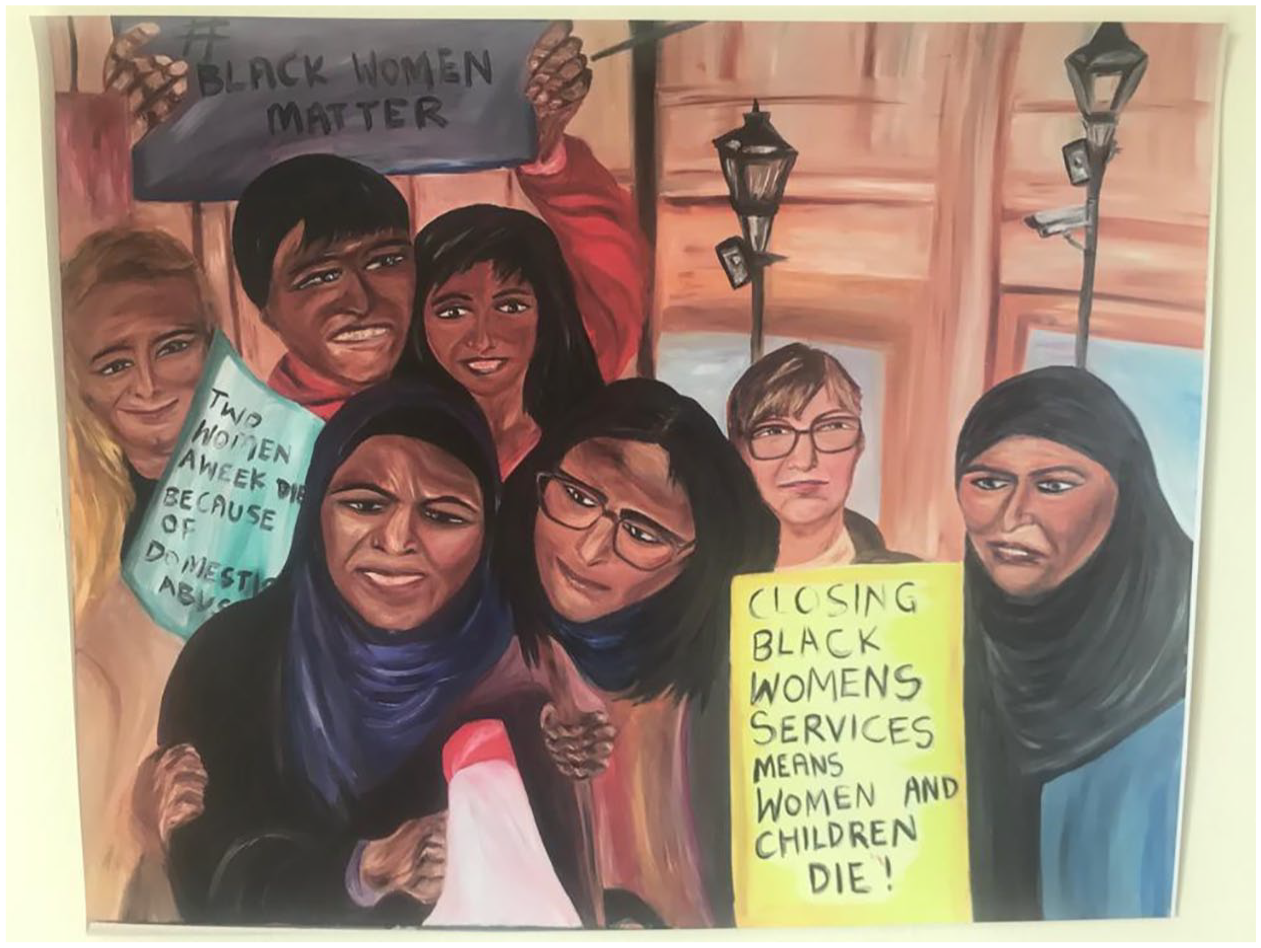
BME services were hit hard by the recent public funding cuts; there are now only 34 services across the U.K which took an average loss of 47% of funds between 2011–2012 (Sisters for Change, 2017). Since 2012, 50 percent of shelters across the UK for BAME women have been forced to close due to government funding cuts (Siddiqui, 2019). Apna Haq’s provision has been reduced significantly with staff now working part-time hours. Staff refused the opportunity for secondment to other services and remained loyal to Apna Haq; we are a family.
Apna Haq managed to secure funding at the last hour; otherwise, the organisation would have had to close, with the potential loss of our collective knowledge and expertise. What we find out there is that when we challenge as hard as Apna Haq does, we ruffle feathers and in the wings wait those you have annoyed for you downfall but by the grace of Allah we have been going for 25 years and the work of the organisation will continue long after we are gone.
The assumption that generic women’s services can replace BME women’s services is a myth; as ‘black women need black services, the practitioners bring knowledge and leaning from their experience and ‘draw from their daily life’ (Moor, 2009: 29).
The second Sarbjit painting we have selected is of the Yarl’s Wood immigration removal centre, situated near Bedfordshire and currently operated by Serco and is Europe’s largest Immigration Removal Centre (IRC) which opened in November 2001. Yarl’s Wood has been criticised for its inhumane treatment of women. In 2018 around 100 detainees went on hunger strike over their humane treatment demanding end of indefinite detention, shorter bail requests period, and amnesty for women who lived here for 10 years or more, and women complaint about lack of privacy with half of the staff being male, disregarding cultural sensitivity. The paintings visualise state violence and inspire us that even in the situation of incarceration women have the courage to fight back the oppressive state that curbs their freedom.
Amrit Wilson writes the shocking stories of women’s experience of detention centres, the humiliation from these ‘violent broader regimes which are criminalising and oppressing all migrants’ (Wilson, 2018: 212). The book resonates with us; it brings to surface unheard voices ordinary women’s activism and women’s solidarity as ‘sisters in struggle’ (see Wilson, 2018: 143–181).
Sarbjit through her painting captures the state violence against vulnerable women.
Protest outside Yarl’s Wood Immigration Detention Centre, 2017.
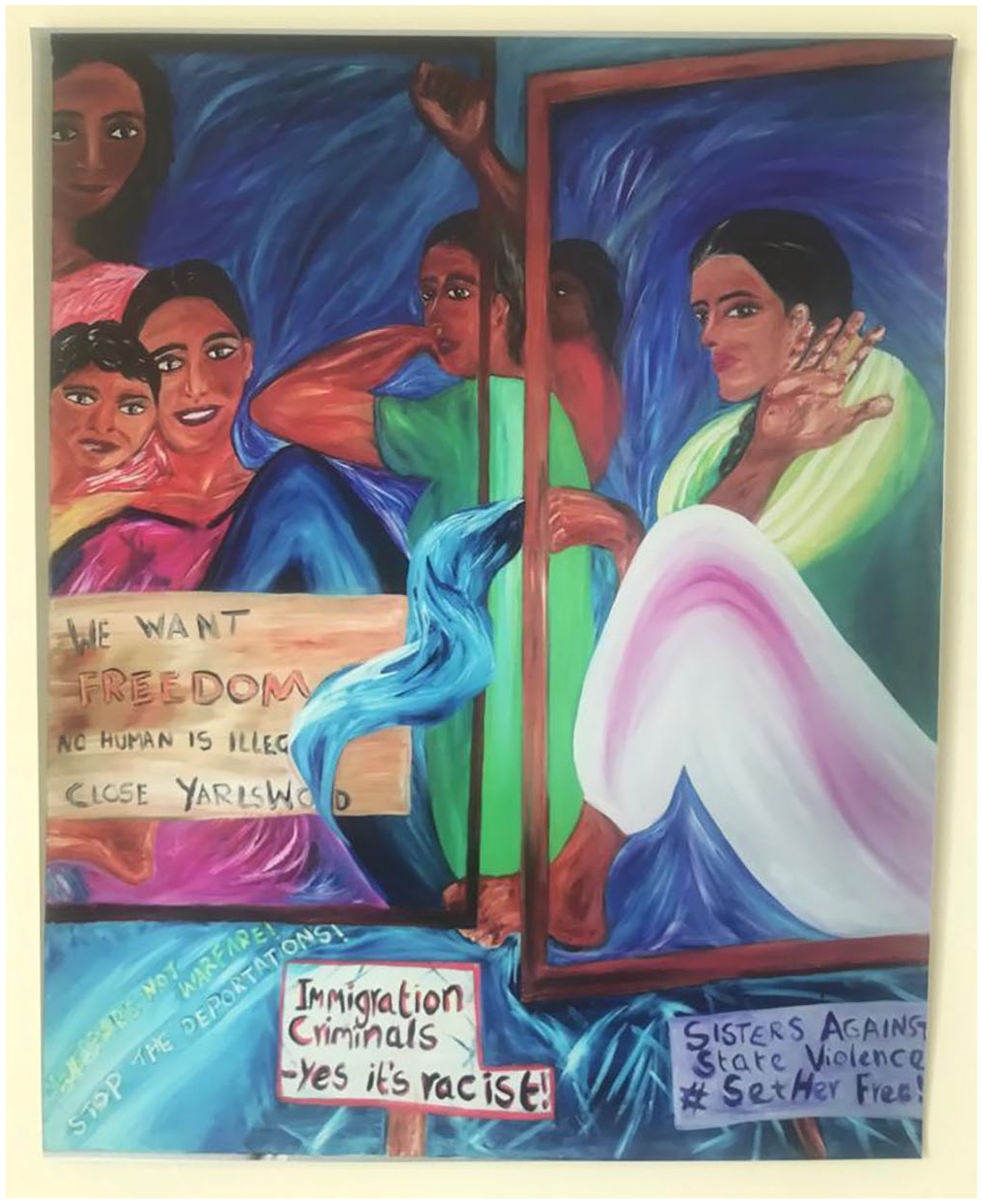
We feel there is an intense focus on the so-called violence of our culture, of the traditions and beliefs of Islam and of the day to day living practices of our lives and identities as South Asian Muslim women here in Britain. In stark contrast, there is little focus on the violence of the state towards marginalised cultures: there is little focus by the state on its own violent racism, and we include here policies and legislation such as section 115 of the Immigration and Asylum Act (Legislation.go.uk, 1999) ‘no recourse to public funds’. Apna Haq has seen women putting their lives on hold waiting for a decision from the Home Office and having no access to public funds and relying on charities. The recent House of Commons, Home Office Committee on Immigration Detention Centres (2017–2019) found serious problems with almost every aspect of the immigration detention centres with people being wrongly detained, kept too long in the detention centre.
Our work in challenging cultural racism
We write from a particular epistemological perspective, which challenges Islamophobic dominant discourses of South Asian Muslim women in the UK. This article has given us the opportunity to represent ourselves, and our community women, rather being represented by white scholars who write about Asian women. We argue that political language can be used to ‘foster group strength and cohesion’ but often does the opposite and ‘spreads confusion and disunity’ (Burgest, 1973: 44).
Conclusion
We refuse to be written about through ‘colonial eyes’ (Smith, 1999). Accordingly Rowbotham (2015: 27) argues that the oppressed group in order to create an alternative ‘must shatter the self-reflection world which encircles it, and at the same time, project its own image onto history, in order to discover its own identity as distinct from that of the oppressor it has to become visible to itself’ and to do that we must keep challenging the powerful through our activism work.
Footnotes
Funding
The author(s) received no financial support for the research, authorship, and/or publication of this article.