




Abstract
The authors of the article run Bisexual+ Community Perth, a grassroots collective that works to increase bisexual+ visibility and community connection in Western Australia. This article begins by providing an evidence-base for bisexual+ activism, much of it based on the poorer mental health outcomes of bisexual+ people and the pervasive invisibility of bisexual+ people in both LGBTIQ+ communities and activism. Drawing on the work of Bisexual+ Community Perth, the article then offers a practical example of community-building as activism. It explores how collective mobilisation, bridge building, and alliances can be leveraged to make a difference in a local context, and discusses some of the challenges faced in sustaining this work. Throughout the article, the lived experiences of Bisexual+ Community Perth members are included to bring a richness to our account of the work, and to increase empathy towards bisexual+ people in general.
Introduction
There is a nuance to our love that gets buried in all of the arguments and explanations and metaphors. I love being this way. I love that there are things I see in people that others seem not to. (Bisexual+ Community Perth member)
In December 2017, marriage equality legislation finally passed through the Australian federal parliament following years of tireless campaigning to increase social recognition of same-sex attracted people. Despite this, those of us who are attracted to more than one gender have not reached the same level of recognition. Although many bisexuals are comfortable with, if not proud of their identity, research from around the world tells us that bisexual+ people are more vulnerable to systemic and individual victimisation than lesbians and gays, and mental health outcomes are particularly poor as a result (Barker et al., 2012; Fredriksen-Goldsen et al., 2010; Leonard et al., 2012; Movement Advancement Project, 2016). Bisexuals may face these issues even within LGBTIQ+ (lesbian, gay, bisexual, transgender, intersex, queer, and other identities) communities (Barker et al., 2012; McLean, 2008; Palotta-Chiarolli, 2011; Ulrich, 2011). In this article, our aim is to explore bisexual+ invisibility and erasure, the need for bisexual+ activism, and to discuss the work that Bisexual+ Community Perth, which we run, is doing to address these issues.
There are many labels that can be used to describe attractions to more than one gender, such as bisexual, pansexual, fluid, queer, and hetero-flexible. Among activists, the most commonly-used umbrella term is ‘bisexuality’ because of its long history of activism (Eisner, 2013). Activist Robyn Ochs’ definition of bisexuality is most often used in these circles: I call myself bisexual because I acknowledge that I have in myself the potential to be attracted – romantically and/or sexually – to people of more than one sex and / or gender, not necessarily at the same time, not necessarily in the same way, and not necessarily to the same degree (Ochs and Rowley, 2009: 9).
In this article, we have chosen to use ‘bisexual+’ as a term that includes all attractions under the bisexual umbrella. As illustrated by Ochs and Rowley (2009), bisexuality broadly describes attractions to more than one gender, but there can be many nuances within this definition. For example, the authors both identify as bisexual but experience and describe their attractions quite differently. Gender is not an important consideration for Misty; they may be attracted to people of any gender. Duc, on the other hand, is attracted to different genders and physical presentations in different ways.
Bisexual+ people are thought to be the largest group in the LGBTIQ+ population (Dahlgreen and Shakespeare, 2015; Movement Advancement Project, 2016), yet we are commonly misunderstood by mainstream society (Kuezenkamp and Kuyper, 2013) and are often invisible in the broader LGBTIQ+ discourse (Smalley et al., 2016; Ulrich, 2011). For example, on all sides of the recent marriage equality debate in Australia, reference was often only made to how legislative changes would benefit lesbians and gays. This ‘double discrimination’ contributes significantly to higher rates of physical and mental health disparities experienced by bisexuals (McLean, 2008) and may also lead to unhealthy coping mechanisms, such as substance abuse and sexual risk-taking (Smalley et al., 2016). These problems often become exacerbated as we feel less able to access medical and psychological support due to a lack of awareness or understanding of our particular issues (Ulrich, 2011). As a member of Bisexual+ Community Perth has noted: It feels like there is this enormous pressure from everyone to ‘pick a side’, which causes me to double-think my identity on a regular basis. It would just be easier to say I’m gay or straight depending on my partner, wouldn’t it? But then I am invisible. Just think about what that constant questioning can do to a person.
Issues faced by bisexuals are assumed to be addressed by existing protections for same-sex attracted people, but unique experiences of discrimination and biphobia remain neglected without being specifically mentioned. Bisexuals are more likely than our lesbian and gay peers to experience unsafe educational environments, workplace discrimination, and intimate partner violence (Movement Advancement Project, 2016; Office for National Statistics, 2018; Walters et al., 2013). One result is that mental health outcomes are particularly poor for bisexuals. Figure 1 highlights the greater psychological distress experienced by bisexuals in comparison to lesbians/gays, and the general population (Leonard et al., 2012). Results from the largest survey of bisexuals in Australia (n=2651) have confirmed this; one quarter had attempted suicide, nearly 80% had considered self-harm or thought about suicide, and over 60% currently had high or very high psychological distress (Taylor et al., 2019).
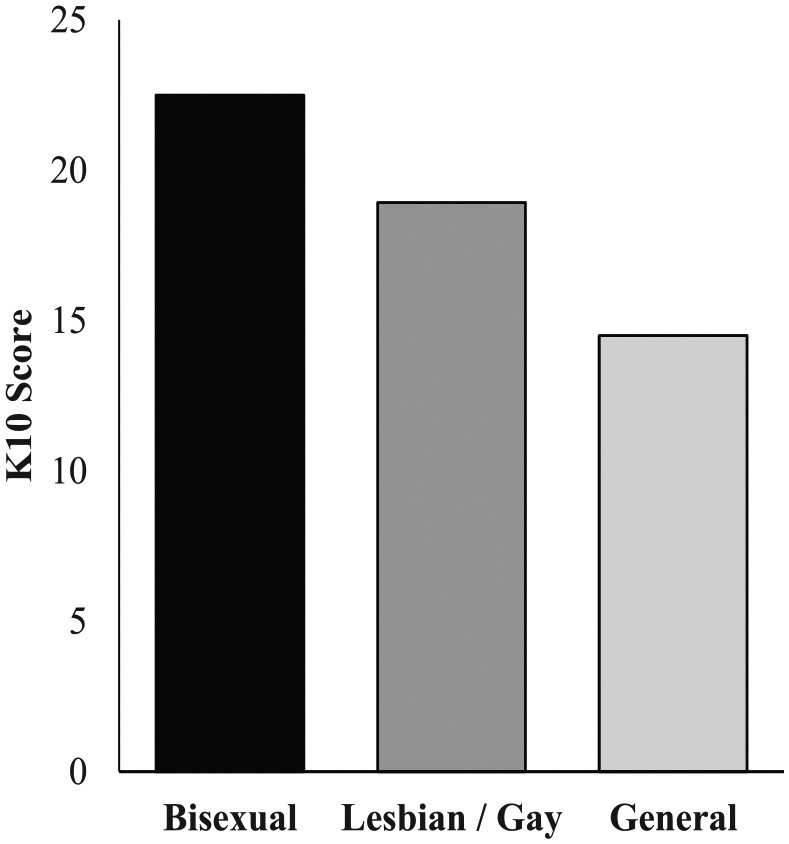
Psychological distress levels for bisexuals, lesbians/gays, and the general population based on the Kessler Psychological Distress Scale (K10). Higher scores denote greater levels of distress (Leonard et al., 2012).
The interconnection of particular social categories such as ethnicity, culture, religion, gender, age, relationship styles, sexual practices, ability, class, and geography may compound discrimination or disadvantage, further exacerbating these mental health statistics (Barker et al., 2012). This section will focus on the intersection of bisexuality with ethnicity and trans identities because of the lived experiences of the authors. Misty is a non-binary first-generation Australian of Anglo-Indian ethnicity. Duc is a Vietnamese-Australian who as a toddler arrived in Australia with her family under a refugee program. Duc’s allyship of trans people led her to advocate for and develop her university’s Transgender Policy, and to write for news outlet The Conversion about the Australian media’s representation of trans women. Both have lived experience of mental health problems. Therefore, as activistswith multiple intersecting identities, we agree with Holthaus’ (2014) argument that bisexual+ activists need to prioritise cultural competency, which requires individuals and groups to interrogate white privilege, class discrimination, ableism, and male privilege, in order to properly progress their work for all community members (Holthaus, 2014).
Bisexuals are more likely than heterosexuals, lesbians, and gays to be ethnic minorities (Gates, 2010). A study from the US found that LGBT adults who are non-white are more likely to view their LGBT identity as very or extremely important to their overall identity: 44% of non-white adults (including Hispanics) compared with 34% of white LGBT adults (Kiley and Patten, 2013). Yet for people of diverse cultures, the intersection of sexuality and culture is often complex. In Australia, LGBTIQ+ people from culturally and linguistically diverse backgrounds are less likely to ‘come out’ and more likely to experience social isolation due to incompatible belief systems or a lack of social acceptance (Murray, 2011). In the US, Friedman et al. (2014) found that, compared to white individuals, ethnic minorities (black, Latinx, and biracial or multiracial individuals) had more negative attitudes towards bisexual women, while Dodge et al. (2016) found that black individuals had more negative attitudes towards bisexual men and women. These cultural attitudes could influence the behaviour of bisexual+ people within minority communities.
For bisexual teenage and adult Latino men, familism (defined by familial support, emotional interconnectedness, and familial honour) shapes their sexual decisions, potentially leading them to compartmentalise their sexual practices with male and female partners (Muñoz-Laboy, 2008) or even hide their same-sex relationships and behaviours from their families and in social spaces (Mason et al., 1995). Internal conflicts between identities and cultural ideas are likely to contribute to even poorer mental health and social outcomes for ethnically diverse populations (Barker et al., 2012). More research is needed to explore the experiences of ethnically diverse and Indigenous bisexual+ people and to determine the community supports available to them (Mosley et al., 2019), especially in an Australian context. Hailing from a family-centred culture, Duc would like to see intergenerational support systems and information tailored to Vietnamese communities in Australia because while her father understands bisexuality, her mother does not, and language barriers often prevent deep conversations between generations.
Trans people suffer the highest rates of mental health disparities in the LGBTIQ+ community (Leonard et al., 2012), which is a concern for bisexual+ activists given that sexual fluidity is the norm within this group (Kuper et al., 2012). A study of 452 trans and non-binary people found that only 12.2% were straight and 10.4% were lesbian/gay (Katz-Wise et al., 2016). Misty’s own identity as a bisexual+ non-binary person was part of the motivation behind their doctoral research exploring experiences of social recognition of bisexual / non-binary Australians. Preliminary analysis from this research found a significant intersection between bisexual+ and non-binary experiences; of 800 respondents, 94% said they were attracted to more than one gender and 60% said they were not cisgender. This crossover between bisexuality and gender diversity was also found in the Trans Pathways report, a mental health survey of 859 trans/gender diverse people aged 14–25, with 45% of respondents identifying as bisexual+ (Strauss, et al., 2017). In a society firmly attached to binary sexualities and genders, trans bisexual people actively subvert them by exploring their authentic self without considering these oppressive rules (Barker et. al., 2012; Stachowiak, 2016). As such, we are compelled to continue the close association that the bisexual+ and trans communities have historically held (Eisner, 2013; Ulrich, 2011).
Despite the evidence presented, many LGBTIQ+ activists and mental health educators are unaware of the issues faced by bisexual+ people. This lack of awareness exists because most general survey research combines ‘LGBTIQ+’ as a single data point, thereby obscuring the differing experiences of each identity (Holthaus, 2014; Ulrich, 2011). In addition to bisexual+ erasure, which we discuss in more detail in the next section, the nescience of the needs of bisexuals is one of the reasons there are very few targeted responses. Those that exist tend to be driven from within the bisexual+ community, with very little outside support. In Australia, recommendations put forward by the recent National LGBTI Mental Health and Suicide Prevention Strategy (Jacobs and Morris, 2016) include the provision of clinical and non-clinical mental health services appropriate for bisexuals, as well as support and resourcing to establish, develop, and grow ‘peer-led bisexual programmes, services organisations and support groups’ (2016: 23) such as Bisexual+ Community Perth. Yet worldwide, funding for bisexual-specific programs is astonishingly low. While trans-specific program funding increased by over 40% to $32 million in 2017 (17% of all LGBTIQ+ funding), bisexual-specific equivalents received only $210,776 with 95% of that funding awarded by the American Institute of Bisexuality (Wallace et al., 2019).
Driven by the relative lack of visibility and resources for bisexual+ people, our group, Bisexual+ Community Perth, aims to increase bisexual+ visibility at a local level, while offering a safe place for bisexuals to engage in discussion and form community.
The silent ‘B’
I feel like my identity is erased unless I scream it, and I’m doubted even when I do. It’s not a stage, it’s not for attention, it’s me. (Bisexual+ Community Perth member)
Addressing bisexual+ erasure or invisibility is one of the key aims of bisexual+ activism. Monosexism, or biphobia, is a leading contributor to bisexual+ erasure/invisibility (Corey, 2017). Instead of viewing bisexuality as a legitimate identity, monosexism relegates bisexual+ people to stereotypes of indecision, confusion, and promiscuity, and bisexuality to a phase that individuals go through on their way to accepting their apparently ‘true’ orientation as gay/lesbian or straight (Roberts et al., 2015). Eisner (2013) defines bisexual+ erasure as ‘the widespread social phenomenon of erasing bisexuality from any discussion in which it is relevant or is otherwise invoked (with or without being named)’ (2013: 66). Holthaus (2014) defines this erasure as what happens when a person’s bisexual+ identity is ignored or explained away, often by using the person’s current or most recent partner as the definitive indicator of the person’s sexual orientation. This erasure has serious consequences for the health and economic wellbeing of bisexual+ people, as well as funding (or lack thereof) for bisexual+ organisations and programs (Ulrich, 2011). Thus, with the consequences of bisexual+ erasure in mind, a gathering of Australian bisexual+ activists, including Misty, noted at the 2018 Better Together Conference in Melbourne that visibility was an overarching priority for the community.
In the written histories of LGBTIQ+ activism, the ‘B’ has often been forgotten, mislabelled, or erased. Bisexual+ activists were part of the gay liberation movement of the 1960s and 1970s, but were assumed to be gay, lesbian or straight allies; that is, they were not acknowledged as bisexual+ (Holthaus, 2014; McLean, 2015; Ulrich, 2011). Indeed, some bisexuals silenced their own bisexuality or only participated if they were in same-sex relationships (McLean, 2015). Yet it was an openly bisexual+ woman, Brenda Howard, who was responsible for organising the one-month anniversary rally in honour of the Stonewall uprising and then a year later organised a march and celebration that became New York’s annual pride parade, which inspired countless other pride celebrations around the world (Ulrich, 2011). Even so, the place of bisexual+ people in the LGBTIQ+ community has been, and remains, highly contested, as we have historically been marginalised in LGBTIQ+ communities (Richardson and Monro, 2012). For instance, in the days of the gay liberation movement, conflicts commonly arose over the ‘purity’ of the movement and the role of ‘non-homosexuals’ (McLean, 2015). It was believed that those without the shared experiences of homosexual oppression i.e., heterosexuals and bisexuals, could never understand what it meant to be gay (Angelides, 2001).
Despite the successful campaigning in the 1990s for gay and lesbian groups and organisations to include the ‘B’ in their acronym, many bisexuals still did not feel completely accepted in the LGBTIQ+ community (McLean, 2015). This struggle for acceptance is a major theme throughout the history of bisexual+ activism, and indeed it is one of the reasons why many bisexual+ activists eventually chose to create a separate movement from that of LGBTIQ+ activism. Bisexual+ activism gained momentum from the late 1980s, with the 1990s seeing an increase in groups specifically organised for the bisexual+ community and allies, along with a greater number of books written by bisexual+ people for bisexual+ audiences (Holthaus, 2014). Ultimately, bisexual+ activism is focused on effecting change to benefit the bisexual+ community (Holthaus, 2014). In 1990, a bisexual+ magazine called Anything that Moves published its ‘Bisexual Manifesto’, which still rings true with activists today. The authors of the manifesto declared, ‘We are angered by those who refuse to accept our existence; our issues; our contributions; our alliances; our voice. It is time for the bisexual voice to be heard’ (Anything that Moves, 1990).
The erasure of bisexual+ history in activism is merely a mirror of the erasure of bisexual+ representation in other important areas of concern to activists, including policy development (Elia, 2014; Jones, 2014; Jones and Hillier, 2014). When book titles include the word bisexual, such as Sean Cahill and Sarah Tobias’s Policy Issues Affecting Lesbian, Gay, Bisexual, and Transgender Families (2007), the focus is still very much on people in same-sex relationships and their families, which excludes the majority of bisexuals given that most bisexuals in relationships have different-gender partners (Patten, 2013). Yet evidence challenges the notion of ‘heterosexual privilege’ among bisexual+ people. In their survey of bisexuals in Australia, Taylor et al. (2019) found that those in different-gender relationships had significantly poorer mental health than those in same-sex relationships; Misty is part of a research team exploring these findings further. In Cahill and Tobias’s study, the heterogenous experiences of bisexuals are not teased out from the generalised studies of gays and lesbians and bisexuals who are in same-sex relationships.
The pattern of erasure and stigmatisation of bisexuality contrasts with the processes of normalisation concerning lesbians and gay men that have taken place in equalities-positive countries (Monro, 2015; Richardson and Monro, 2012). Contemporary western gay and lesbian communities are ‘homonormative’ (Cover, 2012), a term adopted by Lisa Duggan (2002) to refer to the ways by which gay and lesbian communities have acquired a conservative, assimilationist, and depoliticised strategy aimed at securing full citizenship. Thus, gay and lesbian identities are now normalised compared to other diverse sexualities, such that bisexuality is erased in the process. Accordingly, the mirror of ‘(straight) marriage’ is ‘gay marriage,’ with both terms erasing bisexual identities. Hence, when one monosexual identity references another monosexual identity as its complementary other, it leaves bisexuality open to monosexism.
Negative attitudes towards bisexuality go hand in hand with the fact that bisexuals are less likely to be out compared to gays and lesbians. In 2018, Australian radio station, Triple J, conducted a ‘census for young people’ called What’s Up in Your World, believed by the station to be one of the largest surveys of young people in Australia. The survey of 11,000 people aged 18–29 found that young bisexual+ men were the least likely to be out, with gay men more than twice as likely to be out (40% compared to 83%); only 48% of bisexual+ women were out compared to 86% of lesbians (Dias, 2018). These Australian statistics reflect existing studies elsewhere on bisexuals in the workplace. For example, a study in the US noted that in order to avoid discrimination, biphobia, and stereotypes, bisexuals (especially men), were far less likely to be out in the workplace than their lesbian and gay peers (Gates, 2010).
Bisexual+ people are dispersed amongst a variety of communities, commonly blending into either the heterosexual or LGBTIQ+ worlds, with some not feeling the need for a separate bisexual+ community (McLean, 2015), and others not feeling either gay or straight enough (Roberts et al., 2015). Eisner (2013) reports that many bisexuals would even deny that a separate bisexual+ struggle is needed or that unique bisexual+ issues exist. Thus, for reasons that are entirely understandable, bisexual+ people are partly responsible for our own invisibility within LGBTIQ+, heterosexual, and bisexual+ communities – and to ourselves. As a result, bisexual+ activism is important in order to mollify self-erasure.
Community building in Western Australia and beyond
Visibility is important to me because I spent too long not knowing whether I was allowed to be myself and stand up in my identity. Everything gets easier when you can see other people standing proudly in theirs. (Bisexual+ Community Perth member)
Connection with others is fundamental to our mental wellbeing; it fulfils our need for social recognition and allows us to feel a sense of belonging (Burn, 2004). However, bisexuals often feel guilt and shame about our identities due to persistent invalidation and disapproval, leading to low rates of bisexual+ people being out. While attempting to mask one’s identity may increase broad acceptance in the short-term, such sustained inauthenticity can result in social isolation and mental health problems (McLean, 2008). As a result, the sense of a bisexual+ community can seem lacking whereas lesbians and gays are more likely to feel there is a community to support them with both the coming out process and the problems they face based on their sexuality. In Western Australia, no formalised bisexual+ community groups previously existed, and no special focus has been given to the bisexual+ community by broader LGBTIQ+ organisations in recent history. This lack of visibility and role models is one of the reasons why communities such as Bisexual+ Community Perth are so vital for bisexual+ activism. As one member said, ‘I needed to feel a sense of community, which I had never felt and was craving. It’s an amazing experience to feel part of something bigger than me and to be with people who don’t question my sexual orientation.’
Duc’s activism started in 2014 within the university setting as a postdoc who was becoming increasingly aware of the extent of mental health struggles and invisibility faced by bisexual+ people. After hearing from The University of Western Australia’s (UWA) Equity and Diversity Office that no bisexual groups existed on campus, she decided to launch UWA BTW (Bi the Way) with two other coordinators. It became a social group with monthly events for bisexual+ staff, students, and alumni, with an associated page on Facebook which helped to bring in new members and encourage online bisexual+ activism. As Nutter-pridgen (2015) observes, the Internet affords bisexual+ people ‘anonymity, freedom, accessibility, and voice’ (2015: 387). From our observation, it also enables disabled people and those with chronic anxiety the possibility of easily accessing a community. To be inclusive, Duc chose a Facebook cover image that had the bisexual and pansexual flags side by side. The group page was launched shortly before the first event, which was held on Bi Visibility Day in 2014 at a local café. The event attracted ten people, a larger turnout than expected given the high proportion of members with social anxiety.
Misty’s bisexual+ activism also had roots in a university setting, but quickly expanded from there. While managing a regional support service for young LGBTIQ+ people as part of their full-time job with a local community organisation, Misty became aware of a bisexual+ discussion group being run by Curtin University’s counselling services. This was the first service specifically for bisexuals they had ever come across. As a part-time Masters student, Misty became involved and met other bisexuals for the very first time. While many members were part of the group predominantly to explore their own identities, for Misty it fulfilled a deep need for connection and encouraged them to develop an online community that expanded beyond the university setting so that others could experience the same. During this time, Misty also became aware of UWA BTW and subsequently connected with Duc.
Following their experiences in the university setting, Misty founded the group now known as Bisexual+ Community Perth (originally just ‘Bisexual+ Community’) in 2015 as a Facebook group available to people all over the world. The original intent was to create a safe space for bisexual+ people to engage in discussions, build identity, and connect with other bisexuals online, without any sexually suggestive content. However, it became clear after the first year that it was necessary to specifically target the issue of invisibility in our local community when the 2016 bisexual+ Pride Parade entry was cancelled because only six people had committed to join. Misty joined forces with Duc and another local bisexual advocate and relaunched the group to include more local content and regular face-to-face gatherings with aims to:
Create opportunities for local bisexuals to become more connected to each other and to their community to enhance wellbeing and resilience,
Increase the visibility of bisexual+ people within the broader local community,
Build awareness of the issues faced by bisexual+ people.
Being bisexual has caused me to be shunned by heterosexuals and homosexuals alike. For those who are finding themselves in this obstacle course – others may not see you, but we do. Keep on shining and don’t let either side dull that sparkle. (Bisexual+ Community Perth member)
The online community has grown rapidly since then and continues to do so, with almost 1,000 members at the time of writing. Clear membership spikes occur with bisexual+ specific media coverage, LGBTIQ+ celebrations (US Pride month and local festivities), and traumatic LGBTIQ+ events such as the Australian marriage equality survey. We believe that this is because feeling a sense of belonging becomes more important at times like these. Data from the Facebook group insights functionality shows that our membership consists of approximately 600 Western Australians, with the remainder from other areas within Australia (n=60) or overseas (n=240). The age of members ranges from 13–65+ with the majority aged 18–44. 64% of members identify as female, 27% as male, and 9% other genders. Data on other identity intersections are unavailable through Facebook insights, but based on group posts and comments, we know that members have a diverse range of gender identities, ethnicities, abilities, socioeconomic status, and relationship styles. The diversity of the bisexual+ community in Australia is reflected in the research by Taylor et al. (2019) and preliminary analysis of data sourced during Misty’s doctoral research. Members typically post several times a day, with content including articles/videos, memes, events, and discussion points or questions. Most posts are directly related to bisexuality, but some are more broadly LGBTIQ+ focused.
In addition to having a strong and active online presence, Bisexual+ Community Perth holds at least one face-to-face gathering every month. Originally, these were arranged by the coordinators only, but the group has become more self-organising with members hosting events as well. The events, which have included café/bar gatherings, crafts, physical activities, LGBTIQ+ events, and festival shows, usually attract around 10–20 attendees. We also host two big events each year for Bi Visibility Day and the Pride Parade, inviting members of UWA BTW and a bisexual+ Meetup group. Our Bi Visibility Day picnic in the park is predominantly for bisexual+ people and their family/friends, complete with themed decorations, snacks, and games. There were 20 attendees at the first picnic in 2017, which doubled the following year. In 2019, the picnic event was advertised publicly for the first time and had over 60 attendees of all ages (see Figure 2). Most of our fundraising efforts go towards the annual Pride Parade entry, for which we pay the entry fee and provide themed decorations and outfit accessories. The bisexual+ contingent in 2017 numbered 40, with over 100 marching together in 2018 (see Figure 3) – one of the biggest bisexual+ pride contingents in the world! These public events are particularly important for visibility, as personal contact can reduce discomfort and result in an increase in perceived humanity (Herek, 2008; Pedersen et al., 2011).
The feeling of being in the street with 100 or more bisexual+ people, including friends and people I have come to look up to, was easily one of my best experiences. I was part of a change in finally being counted visibly, something bisexual+ people have struggled with for years, and hopefully for people like my younger self who never even knew this was happening. (Bisexual+ Community Perth member) I marched completely at the last minute, and I was proud of beating my anxiety to do so. I felt so happy looking at the crowd. Everyone was so inviting and beautiful, it made me cry. (Bisexual+ Community Perth member) I finally realised why it’s called ‘Pride.’ (Bisexual+ Community Perth member)
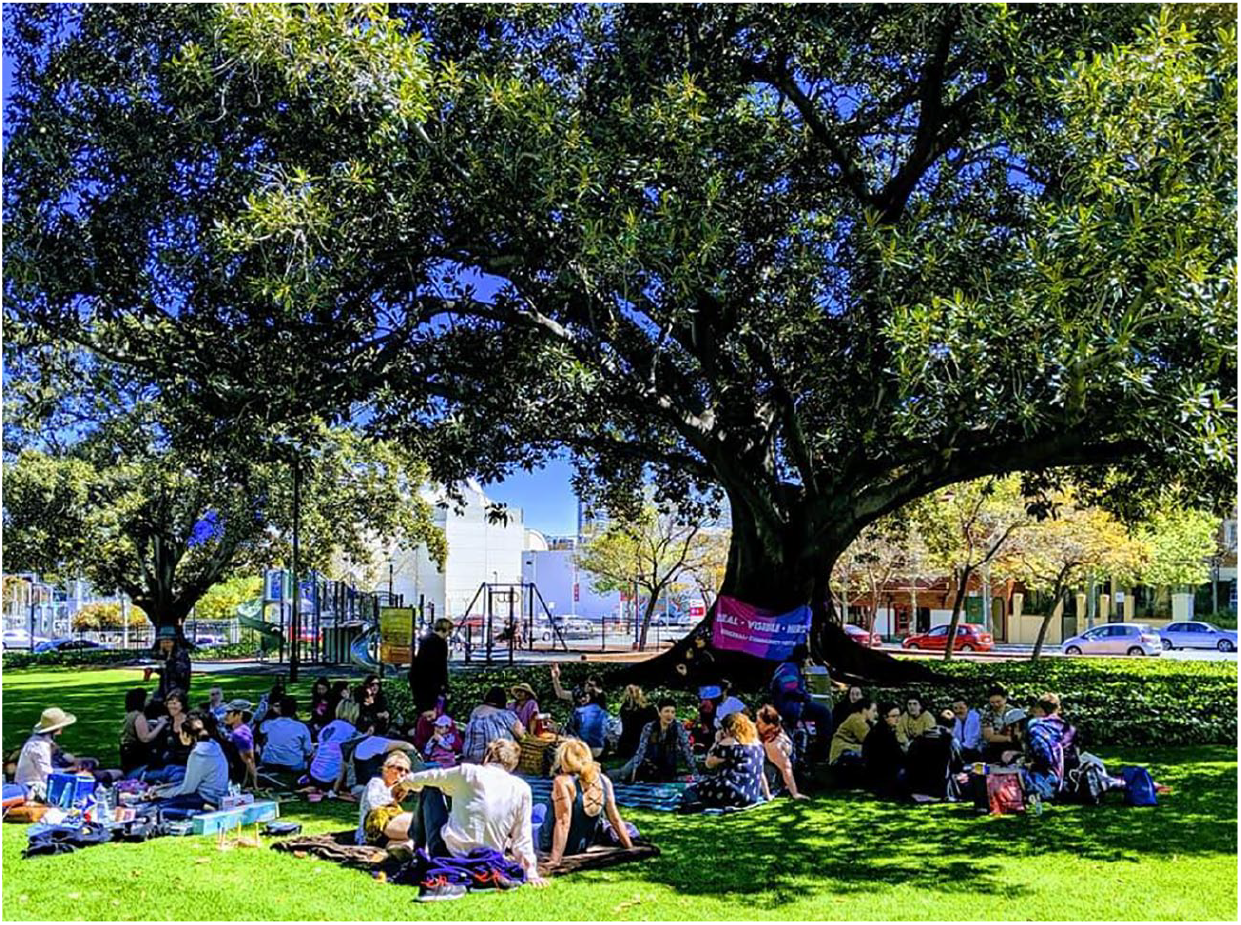
Bisexual+ Community Perth celebrates 2019 Bi Visibility Day with a picnic (photo by Misty Farquhar).
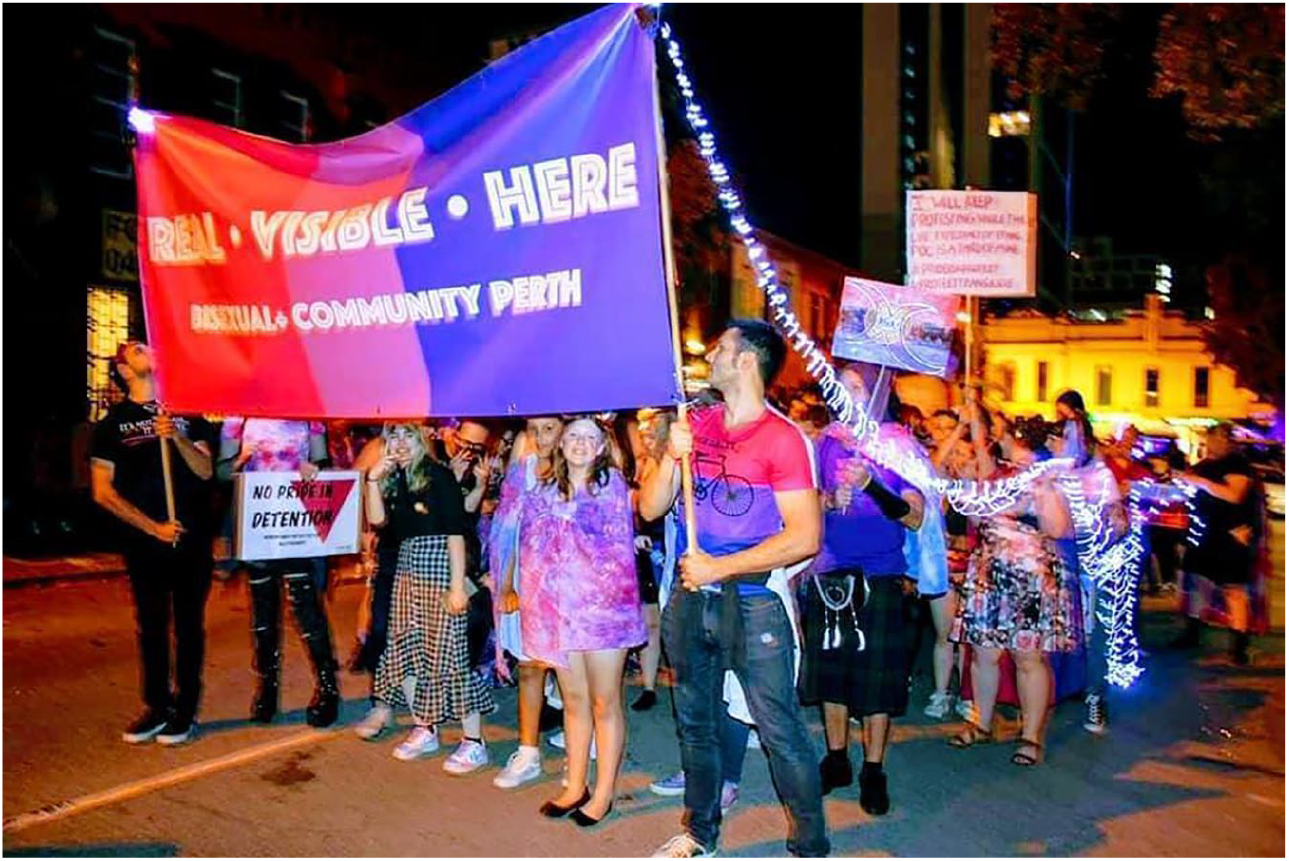
Bisexual+ Community Perth marches in the 2018 Pride Parade (photo by Lisa Max).
As the group name indicates, we are a community for bisexuals. As coordinators, we have formed genuine friendships with each other and various group members. Several members have expressed gratitude for the existence of the group in helping them to better accept their bisexuality and, in some cases, be more comfortable about being out to family and in the workplace. At the very least, members have found the group to be a safe space in order to seek advice or to vent and explore difficult situations.
This is the first year I’ve been comfortable identifying as bisexual and that is because of this group. I’ve never felt comfortable identifying the way I do, but I’ve come to see many bi people feel this way, and from external forces that we internalise. (Bisexual+ Community Perth member) Bisexual visibility is important for our mental health. We need to know there is a community of people with the same sexuality where we can find support. (Bisexual+ Community Perth member) I feel so welcome, like I have this family that I didn’t know I had. (Bisexual+ Community Perth member)
In running the group, we knew that we had to feel comfortable enough to be open about our bisexuality to everyone in our lives. In this way, as activists and group coordinators, we had to be prepared to be leaders and role models to members of the bisexual+ community. The role entails speaking out when bisexuals are being erased, especially in public settings. For instance, Duc attended a LGBTIQ+ mental health workshop run by an LGBTIQ+ agency several years ago, where a slide showing the most at-risk groups did not include bisexuals. Duc publicly noted the omission and promised to send the organisers a selection of peer-reviewed studies. To their credit, the organisers followed up to request the studies. Ultimately, the goal of bisexual+ activism is to ensure that one day, LGBTIQ+ groups such as this will genuinely acknowledge the existence and needs of bisexual+ people, and not simply pay lip service to the “B” in their name and mission statement.
When people chant, ‘we’re here, we’re queer,’ it shouldn’t be a synonym for gay and lesbian. Bisexual+ people are part of the community and we should feel part of the community too. (Bisexual+ Community Perth member)
With the addition of another local bisexual+ advocate, the coordinating team of four has mobilised to increase bisexual+ representation locally, nationally, and internationally. One coordinator has secured a regular spot on the local LGBTIQ+ radio show and another regularly writes for the local LGBTIQ+ press. We are often asked to speak on local panels and partner on LGBTIQ+ events, such as International Day Against Homophobia, Biphobia, and Transphobia (IDAHOBIT). We have successfully secured a grant to develop and deliver “binary busting” workshops to mental health professionals, focusing on awareness of bisexuality and non-binary genders. Most notably, Misty recently contributed to a United Nations report on bisexuality on behalf of Bisexual+ Community Perth (ILGA Bisexual Secretariat, 2018). As researchers, community developers, and policy makers, both authors are members of various LGBTIQ+ advisory groups to which they can bring a bisexual+ perspective. Misty’s doctoral research directly intersects with their activism, and they have been invited to speak in international media and at a number of national forums. As such, bisexual+ advocates across the country are celebrating our work and replicating it in their own cities, with new groups now growing in Melbourne, Sydney, and Brisbane. Over time, our work has had a prominent role in changing the discourse and increasing the visibility of bisexuality in Australia.
Challenges
In this article, we have outlined the far-reaching positive impacts of Bisexual+ Community Perth for individuals and the broader community. However, as with any form of activism, there are also challenges in sustaining this work. These challenges range from administration of the group to managing resource capacity. While the group’s maturity has afforded us the time and experience to develop processes for addressing many of our administrative challenges, capacity issues remain an ongoing risk.
Managing and operating a group is a learning process that we have become more comfortable with over time; challenges can offer opportunities for greater confidence and improved decision-making. For example, we now ask potential members three screening questions to gauge their motivation for joining the group (Do you agree to engage respectfully? Are you attracted to more than one gender? What do you hope to get out of this group?). The coordinators often consult with each other about potential members’ answers, questionable profiles, and problematic posts to the group. We have occasionally had posts – often late at night – by people looking for sexual interactions, which we delete (along with blocking the member) as soon as we discover them. Some members have also received unsolicited messages of a sexual nature from strangers in the group. Ignoring our group rules and our aim for the page to be a ‘safe space,’ such people behave as they would in a ‘hook up’ group, reinforcing the commonly-held belief that bisexuals are hypersexual and promiscuous (Alarie and Gaudet, 2013; Obradors-Campos, 2011). The frequency of these types of interactions has diminished over time, likely due to increased clarity about the group’s purpose. Sometimes decision-making is trickier, especially when posts are soliciting between the lines, but we stand by our decisions to protect members who have expressed discomfort at sexually suggestive posts.
Similarly, challenges can be opportunities for members to learn from each other. Members have diverse experiences and opinions about gender, sexuality, and other social issues, occasionally creating tension. One example is the assertion that ‘bisexual’ is inherently transphobic because ‘bi’ means two. ‘Pansexual’ has become popular recently in response to this assertion, suggesting that it is more inclusive because ‘pan’ means all. However, as understandings of gender have become more nuanced over time to include more than two, so has the definition of bisexuality. As such, it is unlikely that any activist who identifies as bisexual+ nowadays would subscribe to a definition of desire that focuses only on two genders. Regardless, there are those who prefer to identify as bisexual and those who prefer to identify as pansexual for various reasons, and we acknowledge that self-categorisation can play a role in the experiences of individuals (Flanders, 2016). While the debate about the appropriateness of each label continues in the LGBTIQ+ community (and sometimes within the bisexual+ community), we have made a concerted effort to promote respectful dialogue in the group by focusing on common ways of being in order to encourage the inclusion of a broader cross-section of age, culture, and experience (Callis, 2014; Offord and Cantrell, 1999). It is much better to emphasise the concept of the bisexual+ community as one that can and does contain multitudes (to reference the bisexual poet Walt Whitman’s ‘Song of Myself’) and that all bisexual+ identities ultimately need to work together to bring about meaningful change. After all, bisexuality is an overarching term for an ever-increasing range of identities that do not fit within the categories of ‘straight’ or ‘gay’.
It would be disingenuous, however, to imply that the group is free of conflict. Some members have felt targeted for making unpopular statements, which almost always fall within the category of contested notions of gender. One example was when a member posted about transitioning being simply a movement from one gender to another for trans people taking hormones. In this instance, some members voiced their disagreement and others attempted to correct or educate them. Despite the largely respectful tone (notwithstanding an understandable undercurrent of exasperation from some members), the person making the statement felt distressed and attacked, especially since it was clear that it was not their intention to offend. Though these occurrences are rare, they can still occasion anxiety for coordinators and sometimes result in members leaving the group. Moreover, the coordinators might not always agree on how to intervene.
Despite the learning experiences and rewards of running a community that has benefited many members, our capacity in time, money, and emotional resolve, is not boundless. Due to our increased exposure locally, nationally, and internationally, we have experienced an increase in requests for support and collaboration. While an increasing awareness of the monetary value of this type of work has occasionally resulted in income for the group, the majority is done on a voluntary basis in addition to our work with the group. Any other funding to run our special events such as Bi Visibility Day and the Pride Parade entry is raised via fundraising, crowdfunding, or small grants from funding bodies such as Pride Foundation Australia (formerly GALFA). Accessing funding is made more difficult by our decision not to incorporate, to limit the imposition on our time and energy, and so grants are often not an option. Articles about bisexuality and the group, written for the local LGBTQ+ newspaper by one of the coordinators, have helped to increase membership and donations but this kind of work takes time, which is often a luxury when we are engaged in other activities fulltime.
Volunteer-run groups tend to centre around one or two dedicated individuals, and this group is no different. It is not ideal, however, as such a structure is prone to faltering if the individuals concerned are less or no longer available. Duc is finding this with UWA BTW; the group has begun to stagnate as her attention had turned increasingly away from university-based activism. Yet teamwork is necessary when coordinating and sustaining a large and expanding group like Bisexual+ Community Perth, and it is why we encourage members to host their own events of interest to themselves and other members. We have even come to rely on some of these members to be informal volunteers who have willingly taken ownership and an active role, allowing us to earmark potential future coordinators. Coordinators try to attend as many events as possible, but it is not compulsory for all four of us to be at each event. Someone might be away as a result of work, family events or illness, but sometimes we simply need to have time alone. Occasionally, we may need to take a break to look after our own mental health. The need to minimise potential burnout is one of the reasons why Misty originally brought on additional coordinators, including Duc.
As bisexual+ peers who are subject to the mental health issues discussed in this article, we realise that self-care is also important for ourselves. While most members are shielded from the stress involved in managing the group on top of other life stresses, we have each developed ways of maintaining good mental health. These include taking time out, enjoying hobbies like crocheting, meditating, spending time at the gym, having holidays, volunteering or taking part in other groups that aren’t bi-related, and spending time with friends, partners, and families. In other words, while the group might be an important part of our lives, it is not necessarily the main priority. Groups come and go, but the best way to promote longevity is to ensure that the coordinators remain healthy in body and mind. As a result, the coordinators make an effort to look out for each other and send encouraging messages when we bring up personal issues in group messages. Fortunately, we consider each other friends which means that we are happy to readily offer mutual support.
Conclusion
We know about all the shades of grey much more than the black and white. People seem to be so much more comfortable with certainty and absolutes. I think when you’re bi you’re not an absolutist at all. You’re really encompassing. (Bisexual+ Community Perth member)
In this article, we have briefly outlined the issues facing the bisexual+ community, with a particular focus on the mental health impacts of invisibility, erasure, and intersectionality. We have outlined the work that we are doing through Bisexual+ Community Perth to create a sense of belonging for bisexuals where there are few other places of belonging for us. We have also discussed some of the other activism we are engaged in beyond this to increase bisexual+ visibility and awareness in our local community, nationally, and internationally. Our stories, and those of our members, highlight the importance of visible community for this population. We have faced challenges along the way, but we have used these as opportunities for learning and we hope that our candid discussion will help others to do the same.
Visible community is pivotal to good mental health for bisexuals and it is important that this work is supported by the broader community. We are proud of who we are; we are visible so others like us can know that they are not alone. We want the whole community to see us and to celebrate along with us. We are not going anywhere. We are real. We are visible. And we are here.
Footnotes
Acknowledgements
We would like to acknowledge the other coordinators of Bisexual+ Community Perth, whose unwavering support makes this important work possible. We would also like to thank the group members – your solidarity is more vital to us than you know. Thanks also to Richard Palmer for his invaluable support and feedback.
Funding
The author(s) received no financial support for the research, authorship, and/or publication of this article.