




Abstract
The concept of spirituality is influenced by culture and the values and mores of Brazil, and though not directly linked to religion it actually grows from the same roots. This paper examines spirituality in education from the perspective of a humanistic psychology framework expressed as an ideal of the adequate personality or healthy personality. An exploratory study conducted by the Potential and Talent Devenlopment Center (CEDET) is discussed in which students responded to two major themes: idea of God; and where is the Soul? The idea-units of the students were grouped as themes and sub-themes around the definition of spiritual intelligence of Sisk and Torrance and humanistic psychology.
Introduction
The concept of spirituality can be understood from the most diversified angles, and it is often underpinned by cultural influences. From this point of view, Latin America, as part of the great 15th century discoveries credited to Portugal and Spain, inherited from these discoverers and settlers most of its traditions, including religious orientation, so in Brazil spirituality is stressed from its historical conditions. The Portuguese colonizers were less ardent in their orthodoxy than the Spanish, and less strict than the British toward color prejudices and Christian morality (Freyre, 1998). Such a conjunction of factors gave birth to an ethnically and culturally mixed society, whose plasticity was influenced by religion, and it strongly helped to legitimize more open behavior regarding native Indians and Africans than the English and Spanish colonizers (Souza, 2012). However, the slave culture, subjected and viewed as inferior, was forced to adapt its beliefs and rituals to mirror the dominant practices imposed by its masters; yet, its natural cultural resilience provided a means to keep alive the roots of its African culture and subcultures, mainly regarding worship and religious rituals. The native people’s traditions are captured in the classical novels inspired by Brazilian Indian themes (such as O Guarani, Ubirajara, Iracema by writer José de Alencar), worship of the stars (Sun and Moon), and real or imagined entities from the forest (animals, birds, and fish), which establish relations between people and animal behavior to natural phenomena, or to the stars’ position in the sky.
Generally speaking, values, morals, and spiritually related concepts viewed through the lens of the Judeo-Christian mores and beliefs matrix prevail within the Brazilian cultural milieu. So it seems prudent to make the assumption that, under such a framework, the concept of spirituality in the Brazilian Culture, although not directly linked to religion actually grows from the same roots.
Spirituality and education
The presence of spirituality in education can be viewed under a conception close to the theoretical frame of reference expressed by humanistic psychology when describing the essence of human nature expressed as an ideal, in terms of the adequate personality or healthy personality (Combs et al., 1976; Jourard, 1974). People who attain such a high level discover deeper and broader relationships between themselves, other human beings, and the world; they are more open to their own and other people’s experiences, and to the environment around them. Their behavior is not guided by what would be right or approved, in the sense of a conventional morality, but because such behavior is natural as an expression of their own personality, that is how they are. They move into deep consideration of their selves (self-awareness), identification, and togetherness with others, and toward a broad and well-informed world reference framework. The feeling of infiniteness, as a human dimension, is understood within the concept of world started at birth with data taken in by the sensorial apparatus, and gradually advancing in time and space in a movement toward far-reaching cosmic influences which is noted in several definitions of spirituality (Amram, 2007; Emmons, 2000; Hay and Nye, 2006; King, 2008; Sisk and Torrance, 2001; Sisk, 2008; Zohar and Marshall, 2000).
The intrinsic motivation driving such a movement is rooted in the basic human needs, as suggested by Maslow (1962, 1976), reorganized into two hierarchic levels by Goble (1970) including maintenance and growth:
Paulo Freire (1975) describes Man as an active being who modifies and exerts influence on the environment where he is born, raised, and lives his life, and at the same time he is influenced and modified by this same environment; but such a continuous inter-relationship between Man and his environment is not always nor necessarily in the condition of subject or object. This close relationship is part of a dynamic process by which changes follow in both actors and agents, within one of the basic life conditions: each one living and interacting in terms of me with others and with the world (Freire, 1975).
Humanistic thinking defines education as a process of promoting and broadening the perceptual field which for the individual extends and improves their reality—in other words, education’s major goal implies raising the pupil’s awareness level (Guenther, 1997).
Spirituality in education
There are not many empirical studies dealing with spirituality in education. However, in a recent exploratory research, Carvalho (2014) verified that the conceptions of students and teachers regarding the spiritual qualities of teachers reflect moral values such as understanding, respect for others, authenticity, lightness, kindness, and religion, which are attributes of an adequate personality according to Combs et al. (1976); from the point of view of students, most of their teachers did not show these qualities in the classroom (Carvalho, 2014).
The concept of spirituality as spiritual intelligence or SQ includes the capacity to use a multi-sensory approach including intuition, mediation, and visualization to tap inner knowledge to solve problems of a global nature (Sisk and Torrance, 2001). Spiritual intelligence development can be viewed as perceiving ample connections among all things to all things, moving the authority and perception focus from external to internal reference, and acknowledging a relationship between the self and the world (Combs, 1952).
In this concept of spiritual intelligence, common roots can be perceived with the humanistic thinking in education upon which the foundation for the educational work with gifted and high-ability children in CEDET was established in 1993 (Guenther, 2011). CEDET is a special education center in Lavras, Minas Gerais with the main goal of cultivating the proper physical and social environment for complementing and supplementing educational support for gifted and talented students. CEDET is run by the Lavras School System with technical and civil responsibility delegated to the Association of Parents and Friends for Supporting Talent (ASPAT). At present, there are close to 500 gifted students aged 7 to 17 enrolled at CEDET from thirteen municipal schools, eight state schools and two private schools, plus a group of students from nearby communities brought in by their families. CEDET has an emphasis on action for the common good as stressed by Antipoff (1992). This view is similar to Sternberg’s concept of: “Wisdom as a balance between the various self-interests (intrapersonal) with the interests of others (interpersonal) and other aspects of the context in which the person lives (extra-personal)…” (Sternberg, 2003: 123).
The self-concept is formed by the perceptions individuals have about themselves as a result of interactions with the social and physical environment; therefore, it is a product of experience. At the same time it is a process that generates experience, since there are perceptions which are not allowed and some that are incorporated within the perceptual field, according to a selection process filtered through the self-concept; perceptions differentiated in living with others are also internalized into a comprehensive concept of the other; and finally the internal framework from which a concept of the world is figured comprises a set of abstractions from personal experience and interactions within the physical and social environment (Combs and Snygg, 1959; Guenther, 1977). Factors affecting perceptions, such as an individual’s body, sensory apparatus, exposure to the stimuli, opportunity, and internal motivation based on different levels of acknowledged needs, all provide support to the process of understanding and interpreting the world (Combs, 1952). Spiritually gifted individuals establish a purpose in life, analyze the meaning of personal experiences, and have a desire to make a difference (Sisk and Torrance, 2001).
What do the gifted and talented say about spirituality?
An exploratory study was conducted to ascertain the ideas of spirituality and spiritual intelligence held by students from CEDET, a potential and talent development center in Minas Gerais. A second group of students were included who had previously attended CEDET for at least five years. The participants were asked to express their thoughts around two themes: (1) the Idea of God; and (2) where is the Soul? There were a total of 69 participants, 45 former students of CEDET aged 16 to 28 (65%), and 24 students involved in the educational intervention at CEDET, aged 9 to 15 (35%). The responses of the student participants were submitted to a thematic content analysis using the concept of idea-units, developed by Helena Antipoff who defined an idea-unit as a phrase expressing an idea in such a way that by suppressing or adding one word the meaning is changed (Antipoff, 1970). A similar procedure was used by Schlosser (2001) who said meaning-units consist of units of data, phrases, sentences, or paragraphs that can be identified as a basis of analysis.
The idea-units were grouped as themes and sub-themes according to two conceptions: (1) spirituality as spiritual intelligence based on the concept of spiritual intelligence (Sisk and Torrance, 2001) that included (a) multisensory approach, intuition, meditation, and visualization, (b) relationship to Earth/Universe, and Earth-centered reverence, and (c) perception external to internal (not materialistic); and (2) spirituality within the humanistic education dimension of spirituality to Self, spirituality to others and spirituality to the world (See Table 1).
Themes from spiritual intelligence.

n = 69; Y = 45 (65%); S =24 (35%).
In a total of 71 idea-units, young adults aged 16–28 (Y) had 44 ideas; CEDET students aged 9–15 (S) had 27 ideas; the mean was 1.02 ideas. A major proportion of the ideas (58%) referred to multi-sensory approach/intuition/meditation and visualization in both groups. (Y) had 25 ideas for 57%; and (S) had 16 ideas for 59%. The idea-units included: a higher being; the ultimate intelligence; a primary cause; energy; a reference for life; governs all that exists and happens; involves self-knowledge; is everywhere, in the heart, the brain, the five senses, in every living body and in nature; and is in the teachings of Buddha, Hinduism, Kabbalah, Kardecism, Catholicism, Osho, indigenous beliefs, shamans, and chakras. The smallest proportion of ideas (10 ideas or 21%) responded to perception of external to internal (not materialistic). Responses were slightly more pronounced in young people, (Y) with seven ideas for 16%; than (S) with three ideas or 11%. Examples of idea-units included: an abstract creation; culturally embedded idea; consciousness; it moves the existence; transcends human definition; and it cannot be explained, but felt. In response to relationship to Earth/universe, Earth-centered reverence there were 15 idea-units (21%) and the responses were proportionally higher in the group of CEDET students than the young adults. (S) had seven ideas or 26%; and (Y) had eight ideas for 18%. Examples of idea-units included: it is energy and not matter; essence of all that is; the universe itself with its natural living organism, conductor of all things; and is on the rocks, rivers, air, and people.
A small proportion of five ideas or 7% of the participants included ideas apart from the themes being considered. This was higher in (Y) with four ideas or 9% and (S) had one idea for 4%. The idea-units included: is bossy and demanding; does not exist; not having a well-formed idea; and doesn’t care about who he is.
The humanistic education frame of reference responses are depicted in Table 2.
Themes from humanistic psychology.
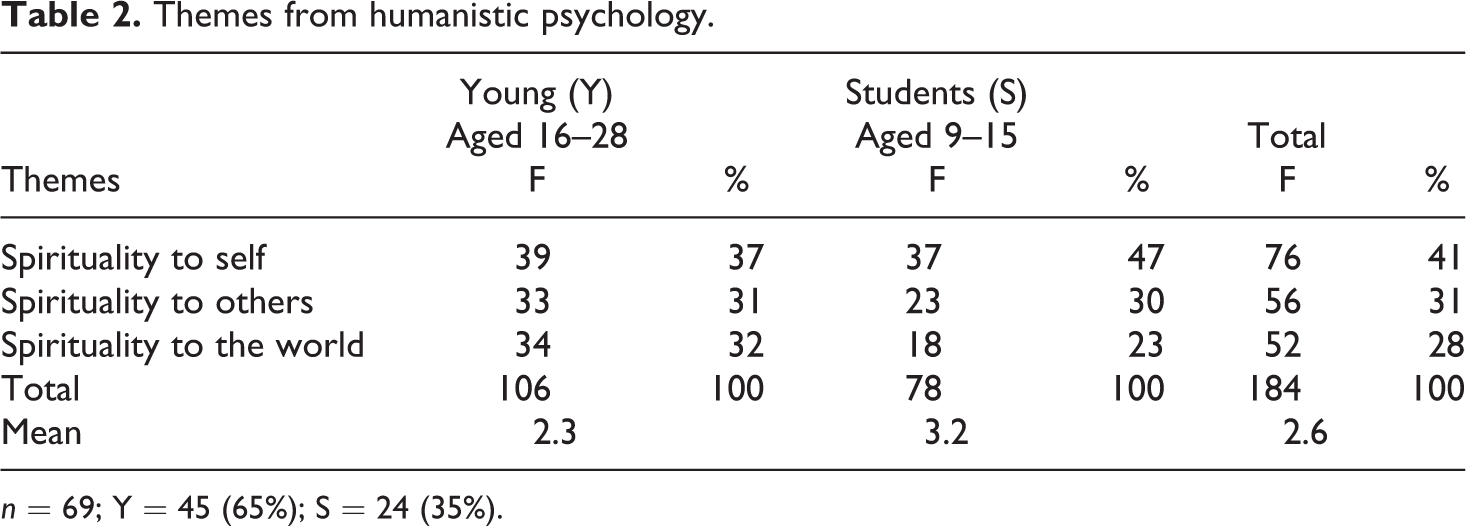
n = 69; Y = 45 (65%); S = 24 (35%).
In a total of 184 idea-units (Y) provided 106 ideas and (S) provided 78 ideas with a mean of 2.6. Ideas responding to spirituality to self-included were 76 idea-units or 41% of the total. There were a slightly larger proportion of idea-units in the student group (S) with 37 ideas for 47%; (Y) idea-units were 39 for 37%. Idea-units included: part of me, in me, related to me; a personal feeling, love, faith; a personal internal reference for action; and takes care of me, help supply faults. Responding to spirituality to others, there were 56 idea-units or 31% of the total responses. There was nearly the same proportion of responses in both groups with (Y) providing 33 ideas for 31%, and (S) providing 23 idea-units for 30%. Examples of idea-units included: external entity; a hidden being, father, friend, savior, is in me and in others; important man, owns everything, is powerful, great; and bossy, demanding. Responding to spirituality to the world, there were 52 idea-units or a total of 28%. There were noticeably more idea-units in the (Y) group with 34 ideas or 32% compared with 18 idea-units in the (S) group for 23%. Examples of idea-units included: universe, everything; energy, force, motion, order, opposite to chaos; and principle, aura, origin, sustains and goes beyond life.
Conclusion
The theoretical approach employed using the Sisk and Torrance (2001) definition of spiritual intelligence and the humanistic framework of Combs (1952) to interpret gifted students’ responses was appropriate to capture their ideas on spirituality that revealed some differences between the two age groups. The production of ideas was proportionally higher in the (S) group of students (aged 9–15), perhaps reflecting their school experience at CEDET; however, there was more readiness to respond in the young adults (Y) aged 16–28, who were somewhat removed from the daily living at CEDET than among the current students. Regarding the content, there were more references to a multi-sensory approach in both groups, but the young adults (Y) showed more indications of transition from an external to an internal non-materialistic frame of reference, and acknowledged relations of self, to other, and to the world. Both Piaget (1958) and Kohlberg (1983) suggested that there is gradual change in the self-centeredness state, common in childhood, to the altruistic position found in adults.
On the other hand, there was some balance between the dimensions Self, other, and world in the young adult (Y) group, providing room to question whether or not this configuration would effectively be permanent, or if it were favored by their experiences in CEDET, and would it change with increasing age and life experience, as indicated by Eric Erikson (1983). In any event, given that this was an exploratory study, much more research is needed, including the involvement of different age groups from other populations, and gifted and talented groups outside of CEDET, or in other types of educational intervention. The concept of spirituality as reflected by these Brazilian students reflects the values, morals, and spiritually related concepts viewed through the Judeo-Christian mores and beliefs that prevail within the Brazilian culture.
Footnotes
Declaration of Conflicting Interests
The author(s) declared no potential conflicts of interest with respect to the research, authorship, and/or publication of this paper.
Funding
The author(s) received no financial support for the research, authorship, and/or publication of this paper.