




Abstract
This article examines spiritual giftedness and the spiritual development of a recent high school graduate. The framework of the investigation was to explore teachers’ perspectives on spiritual giftedness and what traits students display in the classroom. The concept of spiritual giftedness has gained increasing attention over the years and is evolving in the field of gifted education. These findings may be useful for practitioners in understanding spiritually gifted students and for professors as they prepare teachers to serve the needs of the whole child.
Introduction
For the purposes of this article, spirituality and religion are not equated. A person can practice Buddhism, Catholicism, Judaism, or any other religion; he or she can also be agnostic or atheist (Pargament, 1999; Tirri et al., 2006). Certain religious traditions or practices may foster the spirituality one finds in the world, but spirituality is also found through a connection with nature, communication with or love expressed to others, by understanding the world in a new way, or through meditation and yoga (Boone et al., 2010). When people question their role in the world, they are reaching out in a spiritual way. They want to uncover how their daily actions connect to a larger universe (Love, 2002; Mayhew, 2004; Palmer, 2003; Zinnbauer et al., 1997). The individual experience of spirituality is a journey taken alone within the community of humanity.
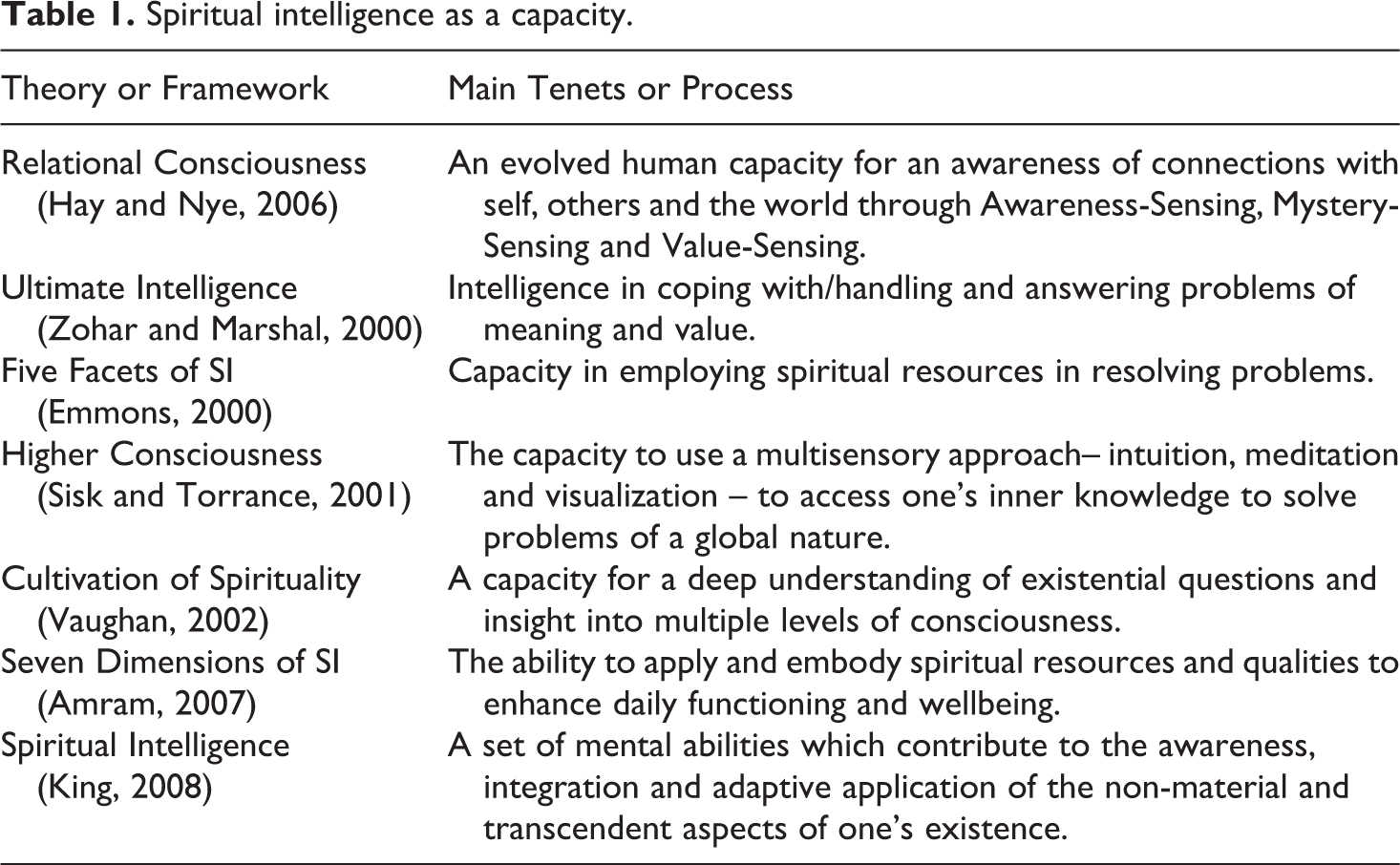
Spiritual intelligence as a capacity.
Review of the literature
There is no agreed-upon definition of spiritual giftedness (Vaughan, 2002). Debates among researchers focus on the classification of spiritual giftedness as an intelligence, its development throughout life, and in the terminology of each definition. For this study, several current definitions were explored in order to illuminate the participant’s spiritual giftedness, although these are by no means conclusive of all definitions of spiritual giftedness.
Although these definitions vary to some degree, similar concepts exist among them. Spiritually gifted individuals possess self-awareness and live with intention (Amram, 2007; Hay and Nye, 2006; King, 2008; Sisk and Torrance, 2001; Zohar and Marshall, 2000). They pursue existential ideas, have a sense of curiosity and an active imagination, and are sensitive to societal issues, equity and justice (Hay and Nye, 2006; King, 2008; Sisk and Torrance, 2001; Zohar and Marshall, 2000). Many of the definitions delve into the ability to be mindful, follow intuition, reach states of flow, meditate, or use prayer or silence (Amram, 2007; Emmons, 2000; Hay and Nye, 2006; King, 2008; Sisk and Torrance, 2001; Zohar and Marshall, 2000).
In addition, spiritually gifted individuals establish purpose in life, analyze the meaning of personal experiences, and have a desire to make a difference (Amram, 2007; Emmons, 2000; Hay and Nye, 2006; King, 2008; Sisk and Torrance, 2001; Zohar and Marshall, 2000). Flexibility, inner-freedom, balance, and inner-peace in times of crisis appear in several descriptions (Amram, 2007; Emmons, 2000; Sisk and Torrance, 2001; Vaughan, 2002; Zohar and Marshall, 2000).
Traits include forgiveness, gratitude, tolerance, empathy, compassion, hope, optimism, and wisdom (Amram, 2007; Emmons, 2000; Sisk and Torrance, 2001; Vaughan, 2002). Individuals are aware of the transcendent and spiritual aspects of existence on a regular basis (Amram, 2007; Emmons, 2000, King, 2008). Other factors include a connection to nature, using visualization and mental imaging, using metaphors and parables to communicate, and working against convention (Sisk and Torrance, 2001; Zohar and Marshall, 2000).
Over the years, leaders in the field of psychology and gifted education have described the importance of nurturing the spiritual development of students (Coles, 1990; Lovecky, 1998; Navan, 2012; Piechowski, 2000, 2010; Roeper, 2008; Sisk and Torrance, 2001; Tolan, 2000). Research in this field has focused primarily on defining spiritual giftedness and designing spiritual intelligence self-assessments. Several research studies have investigated spirituality in children and in adults. This investigation serves to fill the gap in literature by fleshing out the traits of a spiritually gifted student as described by teachers in the classroom. The overarching research question guiding this study was: ‘What traits does a spiritually gifted student possess?’
Method
Research design
A holistic, single-case study approach was used in this investigation. Using a global approach, holistic designs examine a single unit such as an individual, in this case, a gifted individual. Ary et al. (2006) described the characteristics as being anchored in real life, focusing on a single unit. At its core, the basic question to be addressed is: ‘What are the characteristics of this particular entity, phenomenon, person or setting?’
Data collection and analysis
Three hour-long interviews were conducted with Olivia. During interviews, Olivia described four teachers who nurtured her spirituality. Interviews were conducted with the teachers. Interviews were recorded, transcribed, coded, and synthesized into relevant themes (Patton, 2002). Data were gathered from several sources including written documents, notably Olivia’s manifesto, a paper she wrote for a college Humanities class. In this assignment, she described her philosophy about life. The second was a letter Olivia wrote thanking her scholarship program for sending her on an outdoor leadership experience. These sources provided details about Olivia’s personal philosophy and reflections on life.
Participants
This study used purposeful sampling (Patton, 2002). Preliminary discussions with Olivia ensured that the participant could offer in-depth, rich material pertaining to the subject. Olivia was selected because of her recognition as a spiritually gifted student based on teacher anecdotes and observations stemming from Sisk and Torrance’s (2001) description of likely traits of spiritually gifted students. Based on data gathered from interviews with Olivia, teachers that were recognized as being spiritually nurturing were interviewed. Karen was her fifth grade elementary school teacher; Leslie was her eighth grade honors language arts teacher; Jamie was her high school drama teacher; and Lane was her high school AP United States history teacher. As the gifted specialist at the middle school Olivia attended, I was her primary instructor for sixth grade language arts and a co-teacher for her seventh and eighth grade language arts classes. I identified her for the school’s gifted program when she was in sixth grade.
Description of research context and participant
Olivia attended a charter school for elementary school and a public school for middle and high school, in a small town nestled in the mountains of western North Carolina. She is slender and carries herself with grace. Olivia has medium-length brown hair and inquiring blue eyes. Her older sister is part of the Teach for America program. Her mother is a hospice nurse, and her father passed away last year after a long struggle with ALS – Lou Gehrig’s disease. Olivia was a leader in her class, serving as student council president in middle and high school. She excelled in her classes and participated in the theater program, performing yearly in the school musicals. Olivia received a prestigious scholarship and is a sophomore at a state university. Although Olivia has not narrowed her focus on one specific major, she is interested in environmental studies, religious studies, and medical anthropology. Currently, she attends an Anglican church located near the campus of her university.
Olivia views spirituality in terms of her relationship with the universe and her connections to other people, the environment and a greater being. Although she does not equate religion to spirituality, she acknowledges that her religion feeds her spirituality. She sees the two as different entities, where they work in tandem to shape each other. Olivia has grappled with her religious beliefs over the years and her current religious affiliation did not come without careful thought. In eighth grade, she became very frustrated with what she described as hypocrisy and judgment in the church. She grappled with her Christian faith and began to look into other religions such as Buddhism and Hinduism. This period in her life left her uncertain with how her parents would respond to her and how she would negotiate her personal identity.
Olivia’s parents encouraged her to work through the process of questioning her religion. Her mother, a Methodist, grew up as the daughter of a preacher, and her father, an Episcopalian, dropped out of college to study in the seminary. Together, they provided a setting where Olivia had ownership over her religious decisions. They encouraged her to question and to develop her own beliefs about the world in general and in the nature of God. Through this support, Olivia developed her own understanding, independent of what she was taught, although it did incorporate certain family beliefs. Her father described faith as only being real and flourishing when it is questioned and tested. Maintaining traditions proved to be important to Olivia’s decision to remain a Christian. Her family attended church services on Sundays, but on vacation or during snow storms, her family would have a service at home in which the family sang hymns and discussed passages from the Bible.
Olivia’s current religious philosophy is that faith is not a static thing that you achieve, but instead, that it is malleable, capable of being molded by her beliefs over and over again throughout the course of her life. She compared these beliefs with that of her spirituality where it is a continual process of ups and downs and growing and changing.
Olivia’s parents both worked in careers that focused on taking care of others. Olivia’s father worked at several non-denominational churches, as a missionary, a counselor, a substitute teacher, and a hospice chaplain, and her mother served as a hospice nurse in several communities over the past 16 years before becoming director of her current facility. Because death and dying had been common household topics of discussion, Olivia realized that death was a part of life, and she felt she could live life more fully with the knowledge that it will not last forever.
Results
Results have been organized into three main sections about Olivia: relationship with herself, relationship with others, and relationship with the world. The first section offers information about how spirituality guides Olivia’s personality and experiences. The second section provides details about how spirituality influences Olivia’s interactions with other individuals. The third provides details about Olivia’s perceptions of and interactions with the world.
Relationship with herself
Olivia has a clear understanding about her purpose in life as being a caretaker and serving others. Olivia found that her sense of purpose stemmed directly from her spiritual beliefs. She stated, ‘I feel that most simply, my purpose in life is to love God and to love others, and particularly to love God by loving others.’ The following excerpt from Olivia’s manifesto: Leave No Trace for the ‘Other World’ demonstrates this passion for taking care of others: Be considerate of other visitors – whether we’re taking a short backpacking trip or building a career and family in our ancestors’ home, we’re all just visiting. During your time here, work hard, carry your weight, take pictures, cook good food with your friends, and sleep soundly under the stars. But most importantly, take good care of your expedition mates; tend their wounds, share their load when they’re struggling, and respect the way they celebrate and enjoy the wonders of your journey.
All of the teachers in the study described Olivia as being determined and showing perseverance. Jamie described Olivia as being, ‘one of the most dedicated students I have had in a long time. Natural leader since her freshman year… She has a force. She’s full of passion.’ She was noted for having a deep sense of compassion, self-awareness, wisdom, and insight. Lane explained how she had a beautiful heart and was full of compassion, but beyond that, she was also highly aware of the environment around her, who she was as an individual, and how she fit into that environment. He emphasized how extraordinary it was to find this type of awareness in adults, let alone in students. She also demonstrated this awareness through her writing: Plan ahead and prepare – in the wilderness, everyone must know at all times where their rain gear is and what to do if someone doesn’t make it back to camp at night. The dangers of our everyday lives are far more numerous and stealthy. Know what to do when you come across the obstacles you expect, and learn to recognize telltale signs of the ones you might not see coming. Stress, hate, and dishonesty will hurt you just as badly as ice, hot sun and strong wind. Prepare to find shelter from the elements in the form of loved ones and quiet moments with a hot drink.
Olivia demonstrated a great deal of resilience. At the time of the interviews, Olivia’s father had only recently passed away. Olivia delved into the lessons that she had learned from dealing with his ailment and consequent death. The grieving process was lengthy, beginning with his initial diagnosis six years prior to his passing. As her parents were divorced, she and her sister played pivotal roles in being caretakers as the disease slowly robbed him of his abilities. She described that after his death, life became a bit easier to handle because she could take moments to grieve, move on with her day and grieve again when necessary. She felt that she was moving through the mourning process rather than pushing the pain away. Olivia shared how she was able to endure her father’s illness: I think most of my anger happened a long time ago. I think most of it was directed partially at God, but mostly toward the disease. I think I have always, for the most part, accepted that bad things happen. And I think I have never believed that God chooses these things to happen to us.
Olivia spoke of her ability to visualize events in her life. This form of mental imaging has allowed her to work through difficult issues, particularly with her father’s death. She described her experience during the final stages of his life where he was struggling with the decision of going on a ventilator or going through a natural death. She credited her visual images of the scenarios as being very powerful in understanding his struggles during the process they went through. Olivia also spoke about the process of visualization during the writing process and as she listened to music. When writing, Olivia described how she enjoyed using metaphors and stories. She explained how she used these in daily conversations to communicate her thoughts. Olivia used extended metaphors and parables throughout the manifesto she wrote.
Relationship with others
Olivia has a strong sense of compassion and capacity to care. Karen, Olivia’s elementary teacher, described her caring nature as starting from a young age. As part of Karen’s classroom philosophy, she felt it was important to promote a warm and inviting learning environment by having students participate in a variety of cooperative learning activities. She described how she could pair Olivia with the most challenging students, and Olivia would treat him or her with care and compassion and bring out the best. Her desire to care for others can be seen through her writing. From Olivia’s manifesto: Leave No Trace for the ‘Other World’: Minimize campfire impacts – fire provides necessities like heat and good food. Don’t be afraid to take what you need, but never walk away from a helping hand without saying thank you and giving a little back in return. And always remember, heat and good food are always best when shared. Sometimes the stories and songs we share when we gather around a campfire are more essential to our wellbeing than anything else. To be caring, you have to have a lot of compassion, and I think that varies in people, and I think experience is one of the best things that can influence someone’s level of compassion, but also I think you need to have an ability to listen and watch what other people need instead of just giving them what you think they need. She has just set the caliber very high for all of my students. You know, she thanked me. That’s big. She thanked me for what she got, and what she did. She had the empathy and the maturity to thank me and not to just leave. The best thing was that I was able to give her a reference for the scholarship she got. That was amazing, and she was so thankful. As much as it is disappointing to not be able to connect with people because they are discussing something I don’t feel is right or talking about something in a way I don’t feel is right, instead of feeling less valuable because I don’t fit in, I find more value because I had the integrity to know that I am doing what I believe in.
Although Olivia took pride in acting with integrity, she also recognized that a dark side can accompany this through self-righteousness behavior. Olivia demonstrated humility in the classroom and through her writing. Leslie, her middle school teacher, described her ability to be humble in serious discussions or debates. Leslie stated, She was able to ask other students why they felt a certain way. So, instead of just saying, ‘Your reasoning is illogical or you are prejudiced…’ She would ask, ‘Why do you feel this way?’
In addition to acting with humility with other students, Olivia also demonstrated this character trait when facing other obstacles at school. Jamie described conversations with Olivia where Olivia expressed her desire to avoid being self-righteous with other students in class and with teachers at the high school where her expectations were not being met. Olivia was cognizant of not wanting to appear to be someone who thinks she knows everything. As she grew older in middle school and high school, she did not rebel against her teachers or her schools. She remained invested in her experiences throughout the process.
Olivia was described as a leader by all of the educators in the study. Karen described Olivia’s leadership while participating in Odyssey of the Mind. Leslie spoke of Olivia’s leadership in classroom discussions and projects. Jamie described her leadership in the student government, in classes, and in the school musicals. In response to a backpacking expedition offered through Olivia’s college scholarship program, Olivia wrote a final report. The program defined and taught about four leadership roles (self, peer, and designated leadership, as well as active followership) and seven leadership skills, enabling Olivia to understand that leadership was both natural and teachable. Understanding her personal leadership style and the other group members’ leadership styles made interactions smoother and conflicts easier to resolve. Her insight into leadership can be seen in the following excerpt from the final report: Before long, I found my stride. As my body strengthened, so did my leadership ability and my ability to live comfortably and efficiently in the wild. I was proud of the progress I’d made, but still had a long way to go before I was as competent as some of my fellow travelers. I was therefore completely floored when I was nominated and chosen as one of the two Independent Student Group Expedition leaders. I led a group of six for the final four days of the course, miles away from instructors and all other humans and through a path we’d chosen ourselves. Olivia was one of the best leaders I have taught by far, probably the best leader I have taught. She led in a way that was very truthful, by the book, with a natural-born talent to attract others and make them go along with her in a very mature, positive way for everyone, not just for herself. Each semester they have a fantastical masquerade ball at the end of the semester where they get to celebrate their uniqueness and their beauty and their love for one another.
Olivia’s desire to be a leader was not based on pleasing her peers or adults. She explained how her values guide her: And, I think as far as resisting peer pressure or marching to my own drum, having my own spirituality has helped me find my own value and worth in something other than what other people think of me. I find my value in knowing that I am part of this greater being, that I was created by this all-powerful being. Following the values I associate with my own faith and spirituality is what defines me and gives me value rather than what other people think of me.
As part of Olivia’s leadership skills, she promoted others’ accomplishments and successes. As student council president, Olivia was described as being different from other presidents because her intention involved helping other students. Jamie stated: She really stood out from other student council presidents because she really tried to make her class shine. They were the smallest class to come through in a long time. And they were an outstanding class, and I think that was because they had a lot of really great leaders. She’s going to shine, and she’s going to make everyone else around her shine. I guess that’s what you mean by spirituality.
When addressing intuition, Olivia described her ability to see beyond the surface of daily interactions. She described having a good sense of understanding how people are thinking and feeling in tense or stressful situations even when people are not expressing their emotions. She explained how these experiences occur when it is not obvious to others.
Relationship with the world
Olivia’s concern with world issues and human suffering began at an early age and continues today. She explained how her friends describe her as having a bleeding heart. She is affected by events that may not have a strong personal connection because of her belief that all individuals are affected by pain and suffering. Her acute awareness of suffering started as a child, affected by the treatment of insects by her peers. She described: Before I had much exposure to world events, it started with animals and even insects. Like I used to get really upset and have serious, serious discussions with kids on the playground in preschool when they would be stomping on anthills because I would be like, “This is not okay. How would you feel if someone was doing this to you?” I wish I had a bigger capacity to feel all of those things and to sympathize or empathize with everyone. I especially wish I had a bigger capacity to do something about it. I think that’s where I plan to go with my life, in some way to respond. I think a lot of people do a good job in being aware of these injustices when they are being serious, but in day-to-day language, they still perpetuate these sorts of ideas. Maybe that’s not so dangerous for them. Maybe that’s not going to shape the way that they think about it, but I think that it shapes the way other people think about it, maybe other people who don’t take these things seriously. And I think that perpetuates the idea that it’s okay to talk about things like this, and it’s okay to have these imbalances.
Olivia explained how being in nature is rewarding. She shared grand moments where she was overwhelmed by God’s presence such as standing on the North Rim of the Grand Canyon, but she also connected in smaller ways such as walking to class, seeing a tree blooming, visiting the Arboretum on campus, or taking a breath of fresh air. Olivia described her ability to connect with God through interactions in nature. She stated: If I am already happy and I go outside, it reminds me of what God has created, and it makes me so much more grateful for everything he has given me. If I am sad and I am outside, I feel surrounded by God’s presence and I feel small, and I love going to church, and I think it is very important to me, but the most intense moments I’ve had, and the most spiritual moments I’ve had, have been outdoors. Being around people is very important to me, especially when I am needing something, but being in nature is probably the most essential thing to my wellbeing, and I find that both, when I am both sad or upset or angry and when I am happy, it allows me to somehow feel what I need to feel.
Discussion and implications
Olivia has determined that her purpose in life is to serve others. Her instructors described her acute awareness of the people and the mood of the environment and her depth of compassion towards those who suffer. In addition, the instructors repeatedly used the terms wise and insightful to describe Olivia. The instructors described Olivia’s selflessness by saying she was gracious, a humble leader and liked to make others shine. Knowing oneself, understanding others, and being compassionate are characteristics of spiritual giftedness (Amram, 2007; Emmons, 2000; Hay and Nye, 2006; King, 2008; Sisk and Torrance, 2001; Zohar and Marshall, 2000). Amram (2007) described this component as a dimension of knowing where an individual has developed refined awareness and self-knowledge. Sisk and Torrance (2001) included having a sensitivity to purpose in life, compassion and concern for others, using inner knowing, seeking to understand self and being self-observing in their list of traits. Hay and Nye (2006) describe the acute perception of self and others within the awareness-sensing realm of their definition.
The instructors described Olivia as determined, ambitious, persevering, and courageous. Several gave anecdotes about her optimistic spirit. These characteristics potentially play a factor in her being resilient. Vaughan (2002) described spiritual intelligence as contributing to the ability to make beneficial choices for mental and physical wellbeing. Zohar and Marshall (2000) include facing suffering and using the experience in their list of traits of spiritual intelligence. Olivia spoke about her religious beliefs throughout the interviews. With this support in place, her resilience also aligns with Amram’s (2007) description of having a hopeful or optimistic outlook based on faith or trust as a facet under the dimension about grace and with Emmons’ (2000) description of the ability to utilize spiritual resources to solve problems in living.
The instructors described Olivia as having integrity. She described personal experiences with concern for equity and justice and described specific environmental issues, social issues, and world issues. With her goal of pursuing degrees in environmental studies, world religions and medical anthropology, she hopes to impact these areas in the future. Amram (2007) described spiritually gifted individuals as having integrity or being/acting authentically, responsibly, and with alignment to one’s values. Sisk and Torrance (2001) included having a sensitivity to social problems, sensing the gestalt or bigger picture, being a peacemaker, having concern with human suffering and feeling connected with others, the earth and the world. King (2008) included the contemplation of existence and reality within the realm of critical existential thinking. Zohar and Marshall (2000) described spiritually intelligent individuals as having a tendency to investigate existential ideas and the facility to work against convention.
Directions for future study
One of the most endearing quality traits in Olivia was that she wanted other people to receive recognition for what they did and for everyone to reach their fullest potential. This is an important trait for a student to possess and it would be advantageous for researchers to delve into how this manifests in an individual. Olivia’s recognition as a spiritually gifted individual began at a young age. Future research could further uncover characteristics of spiritual giftedness in young children. Finally, it is important to evaluate what actually compels an individual to take action. Students may learn about ethics and wisdom, but may not apply these to their personal lives. Research studies focused on why and how individuals pursue real-world actions in order to address society’s problems would be beneficial.
Limitations
With case studies, this investigation is limited in that it may not represent the larger population. Additional research is necessary to understand characteristics of spiritually gifted students in the classroom. In this case, Olivia’s leadership traits may have influenced her identification as a spiritually gifted student.
Conclusion
Based on this study, a list of characteristics of spiritually gifted students with leadership potential can be surmised. These traits could be used to develop a teacher checklist of characteristics of spiritually gifted students with leadership potential. The following traits would be on the list: creativity, compassion, concern for others, perseverance, concern with worldly issues, integrity, humility, gratitude, visionary, making others shine, inclusiveness of others, awareness of self, resilience, concern with equity and justice, desire to make a difference, and impact on group dynamics.
Footnotes
Declaration of Conflicting Interests
The author(s) declared no potential conflicts of interest with respect to the research, authorship, and/or publication of this article.
Funding
The author(s) received no financial support for the research, authorship, and/or publication of this article.