




Abstract
In order to reach gender equity in the gifted population, an affirmative action policy was instituted in Israel to increase the number of girls identified as gifted. The purpose of this study was to compare the self-efficacy beliefs of girls in the top 1.5% (gifted girls (GG)) with those of girls in the top 3% (GG in affirmative action). It was found that girls in the top 3% have higher social and mathematical self-efficacy beliefs than girls in the top 1.5% do. The findings support the literature regarding the level of giftedness as a risk factor for the social adjustment of GG. The surprising finding in the mathematical field is explained by a stronger conflict that exists among GG concerning excellence in a traditional male field. The current study contributes new insights into the emotional aspects accompanying giftedness.
Introduction
In Israel, gifted boys and girls continue to differ significantly in realizing their intellectual potential. Evidence shows that the achievements of girls are lower than the achievements of boys on “high-stake tests” (Mevarech and Lieberman, 2001; Zohar and Sela, 2002). One such high-stake test is the gifted screening test. Most studies in Israel (e.g. Ariel, 1993; Peyser, 2005) and around the world (Benbow and Stanley, 1982; Feldhusen and Jarvan, 2000; Fox and Cohn, 1980; Lubinski et al., 2006; Preckel et al., 2008) indicate that the percentage of boys detected as gifted is consistently and significantly greater than the percentage of girls detected as gifted. Due to this and other findings, gender has become one of the most prominent topics in the field of gifted education research (Bianco et al., 2011; Jolly and Kettler, 2008; Peterson, 2013).
In view of these gender gaps, the Israeli Ministry of Education decided to increase the number of girls identified as gifted by instituting an affirmative action policy. Implementation of this policy has created two female groups called “gifted”: those who passed the test (top 1.5%) and those who entered through affirmative action (top 3%). Since emotional aspects that accompany giftedness are of great significance to the well-being and sense of self-realization of gifted individuals, as well as to the realization of their intellectual potential, it is important to test the emotional as well as cognitive functioning of gifted girls (GG) who attend special gifted programs. The aim of the present study is to test the differences in the psychological profiles of both groups of girls, specifically the differences in self-efficacy, in order to shed light on the emotional aspects and implications of the affirmative action policy.
Definition and identification of giftedness
The literature does not offer a uniform definition of giftedness. Nevertheless, it is agreed that this concept refers to exceptional abilities to perform various cognitive tasks (Carrol, 1997; Gagné, 2009; Gallagher, 2000). For the last 100 years, psychometricians and psychologists have equated giftedness with high intelligence quotient (IQ) (e.g. Borland, 2003; Gagne, 2005; Shephard, 2000; Terman, 1925), usually referring to the top percentile of the population.
Traditionally, schools have used intelligence tests extensively for placement and programming decisions in special education and gifted education (Ford and Whiting, 2006). Consequently, gifted children are generally identified on the basis of a cutoff score on an intelligence test. Such an identification strategy arguably promotes an absolutist view of giftedness (Brown et al., 2005). Various psychologists have proposed their own theories of giftedness (Gagné, 2005; Gardner, 1999; Renzulli, 1986; Sternberg, 1985) emphasizing the need to address additional personal traits that play an important role in the realization of gifted individuals’ cognitive potential. In Israel, Peyser (2005) described the nationwide process of selection for gifted programs. The process is funded by the Ministry of Education using a uniform set of rules and standard instruments. The selection process involves two stages: the initial screening test and the identification test. All students are tested in the first stage, which evaluates scholastic ability, and only the top 15% who have the highest scores in their class proceed to stage two. The identification stage consists of intelligence tests (general cognitive ability (GCA)) and eventually only 1–1.5% of the brightest candidates are referred to special gifted programs. In Israel, gifted boys and girls show significant differences in achieving their intellectual potential. Despite the recent meta-analysis findings by Peterson (2013), who found that boys and girls are equally likely to be identified as gifted, studies in Israel (e.g. Ariel, 1993; Peyser, 2005) and around the world (Benbow and Stanley, 1982; Feldhusen and Jarvan, 2000; Fox and Cohn, 1980; Lubinski et al., 2006; Preckel et al., 2008) indicate that a higher percentage of boys than girls are consistently detected as gifted. As a result, girls tend to be the minority in many programs for the gifted (Zeidner and Schleyer 1999). Several explanations of this situation have been suggested: Boys may perform better than girls on standardized achievements tests, so boys are also more likely to be identified than girls when standardized/achievement tests are used, such as IQ scores (Kerr and Nicpon, 2003; Peterson, 2013). Second, teacher nominations may suffer from gender bias (Busse et al., 1986; Gagne, 1993); GG may conceal their intellectual abilities in order to avoid the social costs of being different (Campbell and Clewell, 1999; Freeman, 1996; Kerr and Nicpon, 2003; Leder, 2004; Reis, 1998); and families may be more protective of their daughters and therefore tend to waive participation in competitive settings such as gifted programs for their daughters (Carter and Wojtkiewicz, 2000; Muller, 1998), which might decrease the probability that parents choose competitive settings such as special gifted classes for their daughters.
Self-efficacy beliefs, academic performance and gender
Performance differences on gifted screening tests reflect cognitive abilities as well as other factors such as self-perceptions of ability (Lubinski et al., 2001). Self-efficacy is a concept that reflects one’s beliefs and cognitions about oneself. According to social cognitive theory, self-efficacy reflects individuals’ innermost thoughts on whether they have the abilities perceived as important for task performance, as well as the belief that they will be able to effectively convert those skills into a desired outcome (Bandura, 1989, 1997). It has been shown that beliefs may be better predictors of individual behavior than actual abilities (Bandura, 1986; Preckel and Brüll, 2008).
A more specific aspect of self-efficacy is academic self-efficacy and this reflects a student’s perceived competence with respect to tasks in the academic domain (Schunk and Pajares, 2002). Researchers have established academic self-efficacy as a significant predictor of academic performance, beyond cognitive ability (Brown et al., 2008; Dahl et al., 2005; Kornilova et al., 2009).
Studies (e.g. Pajares and Miller, 1994) have shown that gender differences in performance may be due to differences in self-efficacy.
Evidence of the relationship between academic self-efficacy and the gap in the representation of gifted boys and GG in special programs has also been offered by Kerr and Robinson-Kurpius (2004). Girls’ dropout rates in math and science declined following a program that, among other components, focused on building a sense of self-efficacy and self-assessment in mathematics. That is, self-image was found to mediate the learning achievements of gifted children and the gap between boys and girls in gifted programs.
Affirmative action for GG
Because the tendency is for more boys than girls to appear in the highest scoring group, an experimental scheme has been introduced, whereby candidates for half the programs are screened using different norms for boys and for girls (Peyser, 2005).
As part of the Ministry of Education’s efforts to achieve gender equity, an affirmative action program was developed to encourage girls to participate in gifted programs. In 2001, the Division of Gifted and Outstanding Students implemented a policy of affirmative action in favor of girls. The inclusion criterion for gifted programs were defined as “one and a half percent of the general population who received the highest scores on the identification tests,” but under the affirmative action program, the 3% of the general population of girls who received the highest scores on the identification test would be included in gifted programs.
The identified children are assigned to one of the special gifted program—a self-contained classroom or a pullout program—according to local availability. In the pullout (or enrichment) program, children study one morning a week and attend regular classrooms the other 5 days, while self-contained classrooms are relatively small classes that exist within regular schools where gifted children study the entire week. The affirmative action policy in the gifted programs offered an opportunity to measure the self-efficacy differences between the top 1.5% (GG) and the top 3% (GG in affirmative action (GGAA)) in GCA among the different programs.
The present study
The current study compares the self-efficacy beliefs of two groups of GG: GG and GGAA. Since the affirmative action girls were officially defined as being as equally gifted as the non-affirmative action girls’ population, the social labeling effect of being “gifted” or “not gifted” was controlled. A comparison of the GG and the GGAA population is based on the assumption that the difference between being defined as gifted or affirmative action in girls not merely reflects a difference in cognitive abilities (performance on the gifted screening test) but also a difference in psychological attributes.
The relevant questions to be addressed are the following: Can we measure self-efficacy in gifted students? Is there a difference between the top 1.5% (GG) and the top 3% (GGAA) in self-efficacy beliefs? Is there a preference for a gifted program for a girl? Does participation in the program have an adverse impact on GGAA? Does higher GCA imply higher self-efficacy beliefs?
Most studies in the relevant literature (e.g. Brown et al., 2008; Kerr and Nicpon, 2003; Kerr and Robinson-Kurpius, 2004; Kornilova et al., 2009; Lubinski et al., 2001; Pajares and Miller, 1994; White, 2000; Zimmerman, 2000; Zorman and David, 2000) examined self-efficacy differences between gifted boys and GG. The current study offers a unique perspective on self-efficacy differences by comparing self-efficacy beliefs of two different groups of girls identified as gifted.
Method
Participants
The participants of this study were pupils in grades three to six in five self-contained programs and three pullout programs, selected according to their geographical location to represent various demographical groups: one program operating in a major metropolitan, one rural-setting school, and one school in a small town at the periphery of the country. In what follows, third and fourth graders will be referred to as younger students, while fifth and sixth graders will be referred to as older students. Each age-group consisted of two subgroups of students: GG and GGAA. The study sample comprises 119 GG (64.6%) and 65 GGAA (35.4%).
Instruments: Self-efficacy beliefs of gifted children
According to the relevant literature (Harter, 1982; Michael et al., 1984; Midgley et al., 1993; Spielberger et al., 1980), self-efficacy comprises eight elements of psychological beliefs: general, academic, and social self-esteem; mathematical and verbal self-capability; test anxiety; initiative; and leadership. The instrument used to collect data in this study was the self-efficacy among gifted children (SEGC), a self-report questionnaire that was validated and adapted for the gifted children population. The SEGC instrument is a 4-point Likert-type scale of 45 items. The instrument was assembled for the purpose of this study using items adapted from the following four self-efficacy scales for use with gifted children: (a) Perceived Competence Scale for Children (PCS; Harter, 1982), (b) Manual Patterns of Adaptive Learning Survey (Midgley et al., 1993), (c) Dimensions of Self Concept (Michael et al., 1984), and (d) Test Anxiety Inventory (TAI, Spielberger et al., 1980).
Following Harter’s PCS (1982), the instrument uses an indirect method of self-reporting that helps children to respond freely because the items are formulated in a general rather than a personal way. This form of report is particularly effective when considering aspects of self that are perceived by children as negative, such as the item: “There are children who are a bit hard to love.” This reporting method increases the internal validity of the questionnaire and eliminates social desirability of subjects.
Each item is scored from 1 to 4, where a score of 1 indicates low perceived competence and a score of 4 reflects high perceived competence. The instrument was developed through a lengthy process, including a selection of suitable items from several sources identified in a comprehensive survey of the literature, adaptation of the selected items to young gifted children, testing preliminary versions with two pilot gifted populations (not included in the main research population sample; n = 91 and n = 57).
The internal reliability of the instrument was measured by Cronbach’s α: Pilot study 1: General reliability (Cronbach’s α) of the questionnaire in this study (35 items) was α = 0.88. Changes were made in accordance with subscale values. Pilot study 2: General reliability of the questionnaire in this study (45 items) was α = 0.83. Again, changes were made in accordance with subscale values.
Main research population: After testing the reliability in two pilot studies, the instrument was transferred to the research sample. The general reliability of the questionnaire in this study (42 items) was α = 0.85.
Finally, the items were adapted according to the outcomes of the pilot studies in order to establish adequate internal reliability.
The final instrument consisted of seven subscales with acceptable reliability values (α Cronbach): academic self-efficacy (11 items, α = 0.73), social self-efficacy (7 items, α = 0.86), general self-efficacy (7 items, α = 0.73), leadership and initiative (7 items, α = 0.76), academic anxiety (7 items, α = 0.86), mathematical self-efficacy (3 items, α = .85), and verbal self-efficacy (3 items, α = 0.84). The Cronbach α value for the entire instrument was 0.85.
In the initial stage of the analysis, we measured general self-efficacy that combines all seven subscales. The combined measure allocates equal weight to each subscale regardless of the number of items representing each subscale. The test anxiety subscale was reversed, so that low test anxiety was considered high self-efficacy and vice versa.
Findings
The present study examined differences in self-efficacy between GG and GGAA. In addition to inclusion by affirmative action, which is the main independent variable, the database consisted of two additional independent variables: age (younger vs. older group) and type of gifted program (self-contained vs. pullout program).
Differences in the general measure of self-efficacy
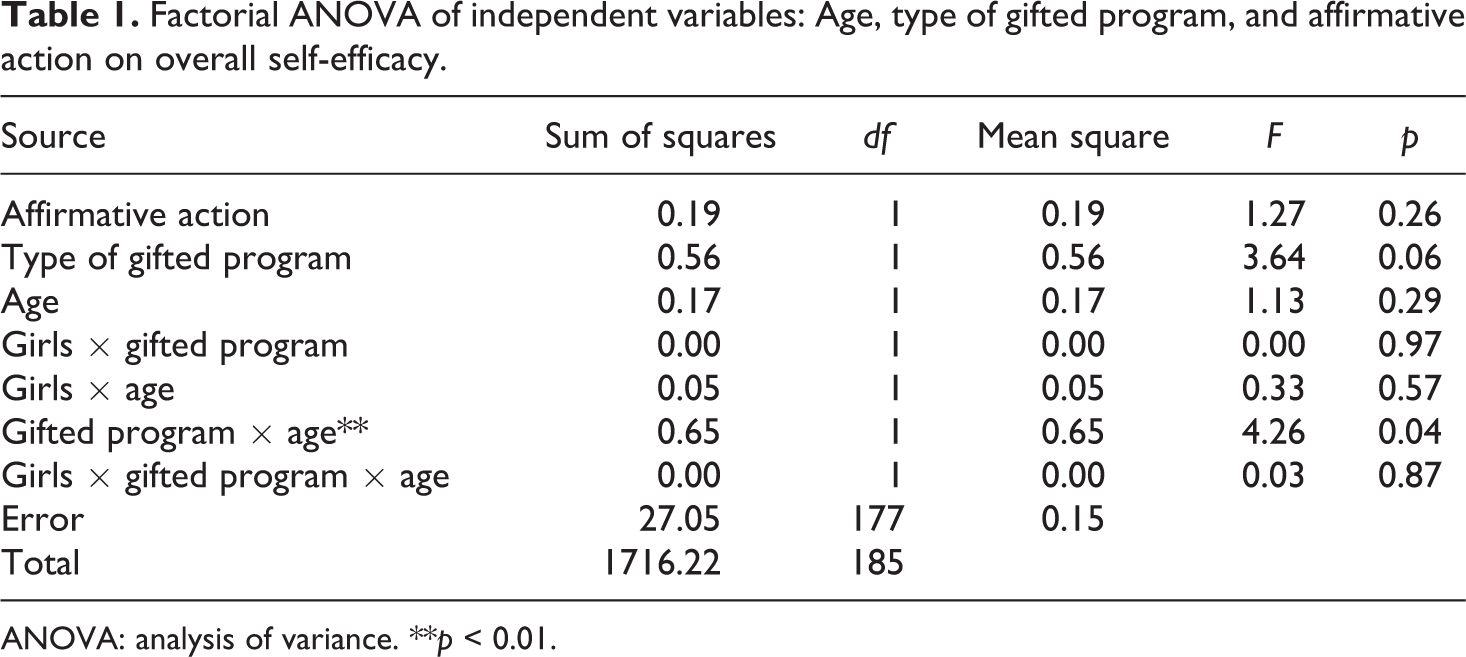
A factorial analysis of variance (ANOVA) tested the effect of the independent variable general measure of self-efficacy with regards to the independent variables affirmative action, school type, and age. The results are presented in Table 1.
Factorial ANOVA of independent variables: Age, type of gifted program, and affirmative action on overall self-efficacy.
ANOVA: analysis of variance.
**p < 0.01.
The analysis revealed a single significant interaction effect between the two independent variables school type and age (p = 0.04). An examination of the interaction effect indicated that in the younger age-group there was no difference between the two types of programs (M = 3.04 and M = 3.05), but in the older age-group, girls who attend pullout programs have a higher score than girls who attend self-contained programs (M = 3.12 and M = 2.86, respectively). This interaction is presented in Figure 1, which indicates that in the pullout programs, the general self-efficacy score is higher in the older age-group than in the younger age-group (M = 3.12 and M = 3.05, respectively), while in the self-contained programs, general self-efficacy score is lower in the older age-group than in the younger age-group (M = 2.86 and M = 3.04, respectively).

Interaction between type of gifted program and age in the sample (GG and GGAA). GG: gifted girls; GGAA: gifted girls in affirmative action.
Figure 1 shows that all the girls in the present sample (GG and GGAA) in all gifted programs show a similar level of self-efficacy at the beginning of the gifted program. Fifth- and sixth-grade girls in self-contained programs show lower self-efficacy, while fifth- and sixth-grade girls in pullout programs show higher self-efficacy.
Differences in self-efficacy subscales
To compare self-efficacy in GG and GGAA groups in greater detail, we conducted an multivariate analysis of variance (MANOVA) with affirmative action (GG/GGAA) and school type (pullout program/full week) as independent variables and the seven subscales as dependent variables. Results show no main effect for affirmative action, F(7, 174) = 2.02, ns, but a significant main effect was found for program type, F(7, 174) = 2.73, p < 0.05. The interaction between affirmative action and program type was not significant, F(7, 174) = 0.82, ns. Since the interaction between the two independent variables was not significant, the results for affirmative action alone are presented in Table 2.
Mean, SD, and F ratios comparing self-efficacy subscales in GG and GGAA.

GG: gifted girls; GGAA: gifted girls in affirmative action.
**p < 0.01.
The data in Table 2 show that the self-efficacy scores of GGAA were higher than those of GG for six of the seven subscales, but those differences were significant for only two subscales: social self-efficacy and mathematical self-efficacy. In the social subscale, the scores of GG and GGAA were M = 2.96 and M = 3.21, respectively, F(1, 180) = 4.32, p < 0.039. In the mathematics subscale, the mean scores of GG was and GGAA were 2.94 and 3.25, respectively, F(1, 180) = 4.84, p < 0.029.
Differences in self-efficacy by age
To compare self-efficacy scores between the two age-groups of GG and GGAA, we conducted a further series of MANOVAs, dividing our sample into two subgroups: the younger age-group (third and fourth graders) and the older age-group (fifth and sixth graders). In this analysis, the independent variables were affirmative action (GG vs. GGAA) and program type (self-contained/pullout program), while the dependent variables were the scores of the seven subscales.
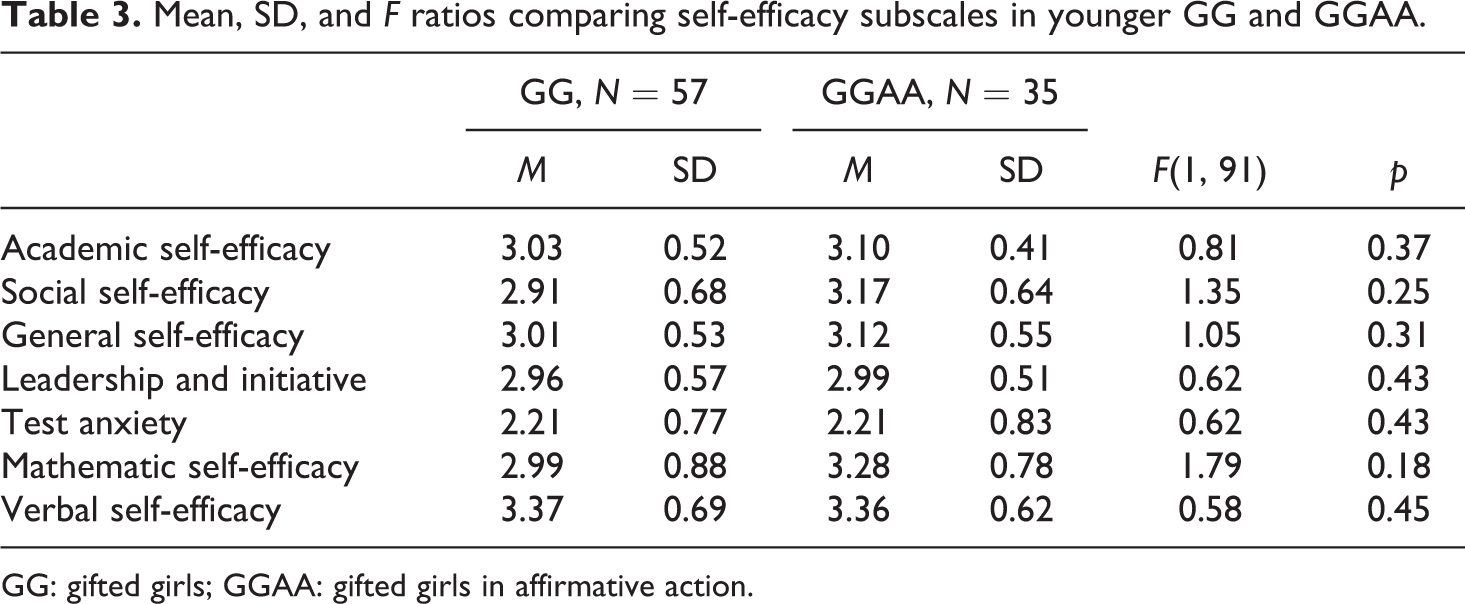
The findings show that no significant main effect was found for affirmative action, F (7, 82) = 0.63, ns, or program type, F(7, 82) = 1.45, ns, in the younger age-group. The interaction between affirmative action and school type was also not significant, F(7, 82) = 1.80. The scores of the seven subscales in the younger age-group are presented in Table 3, showing that no significant differences on any subscale were found between GG and GGAA.
Mean, SD, and F ratios comparing self-efficacy subscales in younger GG and GGAA.
GG: gifted girls; GGAA: gifted girls in affirmative action.
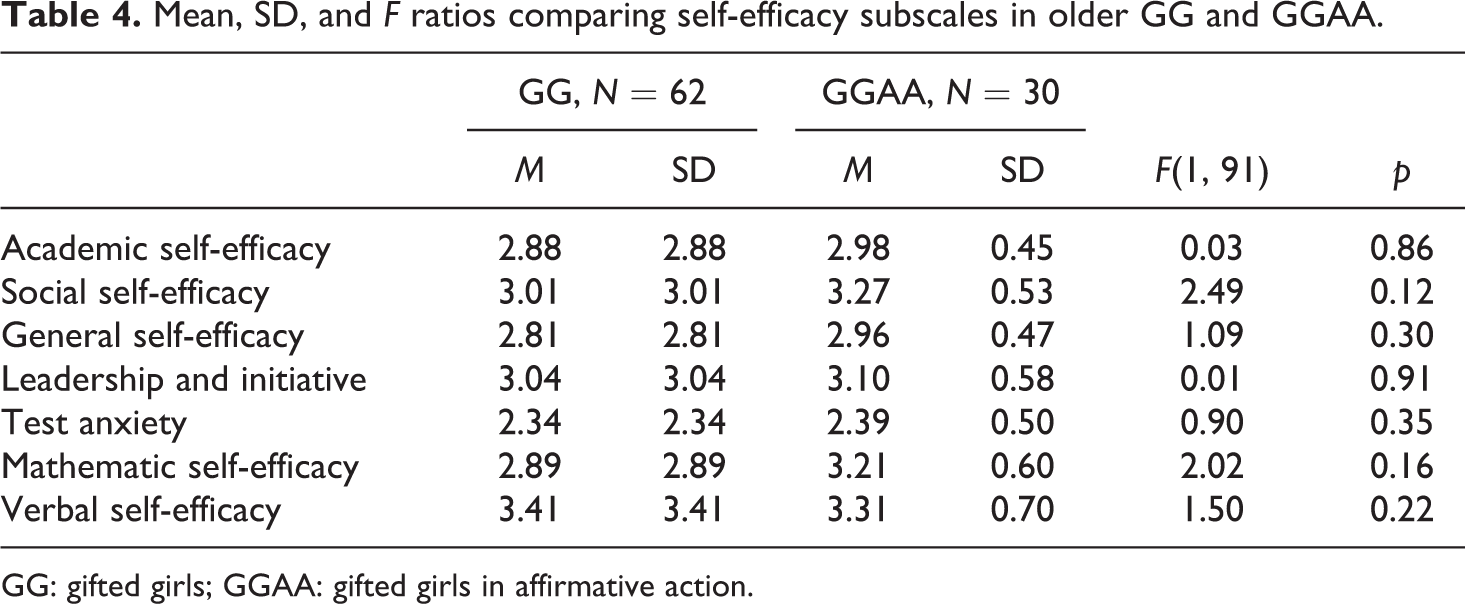
In the older age-group, a significant main effect was found for program type, F(7, 82) = 2.44, p < 0.05, but no significant difference was found for affirmative action, F(7, 82) = 1.40, ns. The interaction between school type and affirmative action was also not significant, F(7, 82) = 2.00, ns. The scores of the seven subscales in the older age-group are presented in Table 4, showing that no significant differences on any subscale were found between GG and GGAA. In summary, the data show no differences in self-efficacy scores between the older girls in the GG and GGAA groups.
Mean, SD, and F ratios comparing self-efficacy subscales in older GG and GGAA.
GG: gifted girls; GGAA: gifted girls in affirmative action.
Discussion
A large number of studies support the existence of significant differences, including differences in motivation, areas of interest, creative thinking, and scholastic achievements (Dai and Feldhusen, 1999; Hong and Aqui, 2004; Preckel and Brüll, 2008; Renzulli, 1986; Simonton, 1996) between gifted and outstanding students. The present study represents a preliminary effort to shed light on the differences between girls in the top 1.5% and the top 3% in GCA and explores the effects of participation in a gifted program for girls in affirmative action. The findings of this study contribute to our knowledge on the following questions.
Can we measure self-efficacy beliefs in gifted students?
The SEGC instrument was developed, evaluated, and validated in two pilot studies before examining the research questions, in order to ensure that the findings objectively reflect the self-efficacy beliefs of the GG. The questionnaire was constructed from four research instruments (Harter, 1982; Michael et al., 1984; Midgley et al., 1993; Spielberger et. al., 1980), and items were adapted, added, or composed especially for the gifted population. This research instrument examines the psychological components of self-efficacy. This questionnaire is used to study the emotional world of the gifted population in general, and GG in particular. The main contribution of the instrument is its focus on the emotional world of the gifted, highlighting the significance of both the cognitive and the emotional sensibilities of the gifted for the realization of their potential.
Does higher GCA imply higher self-efficacy beliefs?
Although the general cognitive abilities of girls in affirmative action are not as high as those of GG (according to their test scores), both groups of girls showed similar self-efficacy levels on all self-efficacy subscales. On two subscales, self-efficacy of girls in affirmative action was higher (social and mathematical). This finding is especially interesting, since GG are more cognitively capable in math than GGAA according to the gifted screening test. This finding points to a disparity between objective cognitive competency, measured by psychometric tests, and the girls’ emotional self-efficacy beliefs.
The finding that GG scored significantly lower than GGAA on social self-efficacy is consistent with the literature that offers evidence of the social and emotional difficulties of GG compared to non-GG (Zorman and David, 2000). This finding is favorably surprising and suggests that GGAA have better emotional adjustment ability than GG and is meaningful and even crucial for the assessment of the affirmative action policy.
Does participation in the program have an adverse impact on GGAA?
An important consideration in evaluating a policy such as affirmative action is the potential adverse effects caused by participation in the program for GGAA. Since GGAA have less strong cognitive capabilities than GG, according to their scores on the gifted screening test, GGAA might experience a decline in academic or emotional self-efficacy belief as a result of attending a program with pupils with superior cognitive abilities. The findings in the present study dispel such concerns, as no psychological differences were found between the two GGAA groups (younger and older) in terms of self-efficacy. In contrast to Preckel and Brüll’s (2008) study that showed a decline in academic, math, and verbal self-efficacy beliefs over time in gifted classes, the present study found no evidence of such a decline: Although GGAA’s self-efficacy beliefs were expected to decline due to social comparison (as the GGAA’s comparison group was the GG, a group with superior cognitive abilities), no decline in GGAA’s self-efficacy beliefs was evident. Hence, it can be argued that the current cross-sectional study shows no evidence of an adverse impact on the self-efficacy beliefs of GGAA.
What is the preferred gifted program for a girl?
Significant differences were found between the types of the gifted programs: Although the younger girls in the two types of programs were initially similar in terms of their self-efficacy score, older girls in these programs demonstrated different patterns of self-efficacy: older girls’ self-efficacy was higher in the pullout program and lower in the self-contained class program. The findings indicate that the self-efficacy of GG differs depending on the type of gifted program. One possible explanation for this finding is the Big Fish in a Large Pond Effect (BFLPE), which posits that it is better to be a good student in a reference group of individuals of average ability than to be a good student in a high-ability reference group. The BFLPE has been confirmed for academic self-concept (Precker et al., 2008). Marsh and colleagues have shown for more than 20 years that students with the same ability (as measured by standardized tests) typically have lower academic self-concepts when they attend higher ability schools than when they attend lower ability schools (Marsh, 1987; for recent reviews, see Marsh et al., 2008). Findings of the present study also support the BFLPE, by showing that gifted students in pullout programs, who spend the major part of the week studying in a reference group of regular students, have higher self-efficacy than gifted students who study in self-contained programs in which they study with similar gifted students (Zeidner and Schleyer, 1998).
Do GG have lower self-efficacy beliefs?
There is a consensus among researchers in the field that socialization that requires girls to comply with and submit to typical gender roles contributes to low self-esteem (Luscombe and Riley, 2001), diminishes the aspirations, and self-confidence of girls and women, and the implications of these effects on functioning and achievements are expressed predominantly in the field of gifted education (Maitra and Kumari, 1996; Silverman, 1994). One common stereotype that affects girls’ self-beliefs and performance is that males have greater talent for math and the sciences than do females. Stereotype threat theory (Aronson and Steele, 2005; Keller, 2007; Steele, 1997) refers to the way in which stereotypes influence intellectual identity and performance and is highly relevant for understanding the processes leading to diminished feelings of mathematical self-efficacy of GG (Inzlicht and Ben- Zeev, 2000; Keller, 2002; Quinn and Spencer, 2001; Smith and White, 2002; Walsh et al., 1999). Stereotype threat is the experience of anxiety or fear that occurs in a situation where one has the potential to confirm a negative stereotype about one’s social group. Stereotype threat has been proven to reduce the performance of individuals who belongs to negative stereotyped groups and is often discussed as a potential long-standing source of race and gender gaps in academic performance.
More specifically, stereotype threat theory emphasizes the importance of the changing characteristics of a given situation. The damaging effect of a stereotype on test performance is realized in cases of particularly difficult tests, where examinees are performing at the limit of their ability, and when students’ self-efficacy depends on their level of identification with the field. Hence, task difficulty and identification with the field of study are important factors that affect stereotype threat. The more strongly a student identifies with the field of the test, the greater the student’s vulnerability to the effects of stereotypes and vice versa (Inzlicht and Ben- Zeev, 2000; Walsh et al., 1999).
As a result, in the present study, GG who identify with academic excellence in general and with mathematics in particular will necessarily be more vulnerable to stereotype threat. Thus, due to their greater identification with the field of mathematics, GG experience a stronger stereotypical threat than do GGAA: They are more affected emotionally in relation to GGAA because they have potentially higher cognitive competencies and therefore more strongly identify with the field of mathematics.
Stereotype threat not only affects GG performance in the short run but also has more serious and destructive long-term effects: In the short term, emotional responses to the stereotype threat directly affects performance, especially during tests or evaluation. In the long run, when the stereotype threat becomes a constant threat, the student may cease to identify with the target domain (e.g. GG cease to identify with success in mathematics in a competitive male environment). Stereotype threats thus may affect self-identity, and potentially affect the student’s motivation and ultimately harm long-term academic achievements.
Social factors play a crucial role in creating the gender stereotype that shapes self-concept at an early age. As part of the gender identity development process that begins in infancy, boys and girls learn the roles and features that belong to each gender (Halpern, 2013). It was found that GG adopted gender appropriate behavior during adolescence, showing conformity in order to avoid social rejection (Lea-Wood and Clunies-Ross, 1995). The need and desire to be socially acceptable were associated with concealing their abilities and achievements in order to comply with social demands (Fiebig, 2008; Pepperell and Rubel, 2009). Social environmental demands of GG eventually lower their self-perceived social competence and social self-esteem, and these contribute to underachievement among GG (White, 2000). Therefore, the experience of the threat is damaging both to their mathematical self-efficacy and their social self-efficacy.
Understanding the emotional processes that diminish self-efficacy beliefs of GG as a minority within a minority (Zorman and David, 2000) is crucial if educators are to help them realize their cognitive potential, as such interventions have been shown to have a positive impact. For example, women who understood that helplessness during the test may be associated with a gender stereotype threat stopped manifesting a stereotype threat response (Steele, 1997).
Conclusion
Despite the large investment in research on giftedness, few research efforts have focused on the psychological factors that affect gifted students and the realization of their potential (Marsh and Craven, 1997). By comparing self-efficacy among two groups of GG, of varying levels of cognitive competence, the present study sheds light on the emotional world of GG and emphasizes the effect of self-efficacy beliefs on the realization of their intellectual potential.
Previous research on motivation and self-concept (Preckel et al., 2008) found that gender differences were greater in the sample of gifted students than in the sample of average-ability students. Such findings may be explained by the Eccles (1983) model of achievement-related socialization, which is also applicable to the present findings. It might be the case that gifted students are more intensely affected by gender-linked socialization practices relating to academic domains, compared to average-ability students, possibly due to gifted children’s heightened awareness of their own aptitudes, and of social expectations that accompany them. As a result, gender-role stereotypes and the gender-linked development of academic motivation are more pronounced in the gifted population. One possible result is that GG may achieve their potential only where their ability type is congruent with gender-linked social expectations. This may also help explain why there is such a dramatic loss of female talent in the domains of mathematics, the inorganic sciences, and engineering. According to the present findings, it can be assumed that socialization is more important than cognitive ability, since the self-efficacy beliefs strongly interact with cognitive performance. Therefore, early identification of abilities as well as early intervention is crucial to reduce the likelihood that girls develop disadvantageous self-perceptions and negative attitudes toward their own cognitive abilities.
It is recommended that practical targeted psychosocial educational strategies are adopted that eliminate or alleviate stereotype threats, in order to improve GG achievements in gifted programs and even on gifted screening tests. Interventions may include delivering an optimistic message in relation to the potential of students from marginalized groups; feedback from teachers that emphasize teacher’s confidence in students’ potential; strengthening students’ sense of belonging to a field/area based on the students’ true intellectual potential; presenting examples of women (members of the same group) who succeeded in the same area, proving that it is possible to overcome the stereotype threat; and building students’ sense of self-control and self-efficacy in the field of study. For example, women who understood that helplessness during the test could be associated with a gender stereotype threat, stop showing signs of the effects of the stereotype threat (Steele, 1997).
Finally, few studies have empirically evaluated the effects of programs for gifted children (Jolly and Kettler, 2008; Van Tassel-Baska, 2006). The present study contributes not only to the literature and empirical evaluation of the gifted education program but also to the evaluation of the educational policy of affirmative action that is used as a tool for achieving gender equity.
Footnotes
Declaration of Conflicting Interests
The author(s) declared no potential conflicts of interest with respect to the research, authorship, and/or publication of this article.
Funding
The author(s) received no financial support for the research, authorship, and/or publication of this article.