




Abstract
The Bright Mind Project, sponsored by Morgan Stanley Taiwan and Chinese Association of Gifted Education, was launched in 2004 and ended in 2018. With scholarships, living subsidies, enrichment courses, and counseling provided, this project was tailored for gifted senior high students of socioeconomically disadvantaged families in Taiwan. After the project ended in 2018, a retrospective tracking study was conducted to understand the students’ feedback on the project. The findings suggest that students hold a positive attitude toward the project and think it is of great help to their academic performances at school and future careers. They also believe that, with the resources obtained from the project, they have broadened their horizons, enriched their life experiences, and adopted a positive attitude toward life. Finally, students also provided suggestions for the future project like this based on their personal experiences.
Introduction
The Gifted Education White Book in Taiwan and in Taipei both make it a priority to counsel gifted students with special needs and socioeconomic disadvantages. Based on the 29th article of the Special Education Act revised in 1997, schools at all levels should reinforce the identification and counseling of gifted students with special needs and economic/social disadvantages. The 41st article of the Special Education Act revised in 2009 further mentions that local authorities and schools should reinforce diagnosis procedures and counseling services for gifted students with special needs and socioeconomic disadvantages. With the development and progress of gifted education in Taiwan, we have put more emphasis on the discovery of each student’s strengths and provided fair and suitable learning opportunities. However, due to the early deprivation of early experiences, the limitation of language development, socioeconomic difficulties, racial discrimination, or living in a remote area and in turn, socioeconomically disadvantaged students can hardly pass the gifted education evaluation. The occurrence rate showed that only few of them could receive the appropriate learning services from gifted education (Borland et al., 2000; Kuo, 2011a).
Enrichment programs engaged on socioeconomically disadvantaged students supported by Chinese Association of Gifted Education, Taiwan
Although quite a few laws or concepts remind us to strive for the discovery and cultivation of socioeconomically disadvantaged students, more often than not, our efforts on the evaluation, placement, education, or counseling for the students are limited in real situation. This educational problem also draws the attention of academic and folk groups, which in turn work on encouraging related research or projects, in the hope of providing pragmatic assistance (Cheng, 2009). At the Forum of Multicultural Gifted Education of New Era 2014 held by the Chinese Association of Gifted Education (CAGE), three projects related to local gifted act were included: the Bright Mind Project, the Lull After Storm Project (financial support and educational assistance for the students suffering from Typhoon Morakot), and the Youth Investment Project (financial support and educational assistance for the gifted students with socioeconomic disadvantages). All of them collaborated the folk resources and provided counseling projects for the low socioeconomic status (SES) students with learning potentials (Chau, 2014; Li, 2014; Yu, 2014). Among them, the Bright Mind Project launched in 2004 and ended in 2018 with the collaboration among Morgan Stanley, CAGE, National Taiwan Normal University, National Taipei University of Education, and National Pingtung University. Lots of efforts and endeavor were enrolled in identification, camps, and mentorship programs. So far, this program has cultivated students of six sessions, all of whom have entered college. The students of the first four sessions have graduated from their colleges and joined the workforce. The project has assisted many low SES senior high gifted students and notable achievements and considerable experiences have been accumulated.
Follow-up study on evaluating gifted program
Follow-up research on gifted education helps educators to understand the development of giftedness, and then review the effectiveness of education from the growth and development of students; find better ways to effectively discover giftedness; cultivate giftedness, and assist the development of gifted education. At the same time, education workers, with their education experience, can find a learning environment suitable for the successful development of gifted individuals to assist students’ optimal development (Kuo, 2003). The Bright Mind Project has been invested with manpower, material resources, and helped numerous low SES students with the assistance and cooperation of experts and practitioner of gifted education. The effect of this project is supposed to be realized through a thorough survey and search. Apart from realizing the development and the current situations of the students involved in this project, we also hope to use it as a reference for the design of future projects. Therefore, this study aims to understand how these students who have participated in the program, whether they are now studying or have been working, think of the project.
Research focused on SES disadvantaged gifted students in Taiwan
Research related to SES disadvantaged gifted students is rarely seen in Taiwan. For the Bright Mind Project, Chan (2014) analyzed the life experience of five students; Tsai (2011) reported the characteristics of SES disadvantaged gifted students and the social support for the co-cognitive traits. Li (2013) made a narrative research on the community of SES disadvantaged gifted students. But enrichment programs regarding SES disadvantaged gifted students are quite insufficient. It indeed requires more research and studies of related fields to figure out the needs of SES disadvantaged gifted students and thus create an appropriate approach to counsel them. Olszewski-Kubilius and Corwith (2018) reviewed literatures with topics related to poverty, academic performances, and giftedness. They found that there is a growing literature on how poverty affects giftedness, much of it is narrow in focus, concentrating mainly on issue of identification. Thus they suggested that a more systematic framework should be adopted to inquire into the impact of poverty on giftedness. As for the counseling program for the SES disadvantaged gifted students, it needs more studies and research to clarify the features of the programs and figure out which is the most effective and important, so as to tailor the suitable programs for students of different situations. Chen et al. (2016) suggested conducting a long-term analysis on the students participating in the gifted education program for the economically disadvantaged students to find out if the program is beneficial or causes any positive effects on their education, career, social relationships, and so on. Only by checking the effectiveness of these programs can more institutions be attracted to invest and finance the talent development programs for those SES disadvantaged students.
Low SES and giftedness
For those conducting research on the development of children, SES has been the interesting topic. Due to the insufficiency of resources and experiences, SES disadvantaged gifted students usually confront risks in their development (Brooks-Gunn and Duncan, 1997; Callahan, 2005). So far, research has been conducted about the relations between low SES and cognitive ability, intelligence quotient, academic achievement, and level of aspiration (Alexander et al., 1993; Bracey, 1996; Bradley and Corwyn, 2002; Cho and Lee, 2006; Duncan et al., 1998; Milne and Plourde, 2006; Sirin, 2005). Much research shows that low SES students’ cognitive development is limited and the chance of benefiting from the learning environment decreases due to the lack of the resources and experiences of cognitive stimulation (Bradley and Corwyn, 2002). Engle and Black (2008) reported the impact of poverty on child development and educational achievements and concluded that poverty would influence the child’s health and learning ability. The interaction among family members and the parents’ ways of treating can also contribute to the insufficient stimulation in the environment. Davis et al. (2010) also pointed out that students of low SES are seldom encouraged to develop their intelligence and creativity and thus they need more assistance in learning. Snellman et al. (2015) indicated that students of low SES lack learning resources outside the schools and the chances of contacting role models and experts, which lead to their insufficiency of further studies and prospects of career in the future.
Within the school system, many SES disadvantaged gifted students are ignored because of cultural difference or insufficient family functions. They are referred to as the invisible gifted. These students are hard to find or understand due to the discrepancy in language and culture and the lack of experience of the mainstream culture (Davis et al., 2010). Reis (2009) concluded that the gifted education programs and teaching strategies are helpful to students of different socioeconomic situations and racial backgrounds. But SES disadvantaged students are generally not involved in the gifted programs (Chen et al., 2013, 2016; Cheng, 2009; Huang et al., 2010; Patton et al., 1990). Enrichment projects are provided for SES disadvantaged gifted students in different countries, such as Project Synergy by Columbia University in the US and KEDI (Korean Educational Development Institute) in Korea. The enrichment program for SES disadvantaged gifted students provided by the Korean Educational Development Institute in Korea in the hope of discovering socioeconomically disadvantaged gifted students through unconventional identification method and adaptive enrichment activities and help parents and teachers to enhance the students' academic capability and enforce their positive social behavior (Borland et al., 2000; Cho and Lee, 2006).
The programs for SES disadvantaged gifted students
Olszewski-Kubilius and Corwith (2018) found that the long-term effective studies on the programs for gifted students of low-income family are rare. They selected the following programs to introduce and evaluate their effectiveness based on the standards of (1) long-term intervention of diverse aspects, (2) programs designed for high-potential gifted students, (3) long-term counseling goals, and (4) descriptive data or empirical studies provided for the evaluation of effectiveness or goal achievements.
(a) Young Scholars
The objective of this program was to identify underrepresentative gifted students, in the hope of developing students’ talents and providing learning opportunities. According to Horn (2015), this program increased the number of the students receiving gifted education and exerted a significant impact on students’ learning achievement and participation in further academic activities.
(b) Project Promise
This program provided gifted students of low-income family scholarships and enrichment programs organized by universities. Many longitudinal studies on this program pointed out that this program had caused a positive result on their academic performance, career, social relations, individual, and generations. Students participating in this program mentioned that this program provided them with more career options and helped prepare them with further learning. Positive effects were exerted on the relations between them and their peers, mentors, and teachers. They benefited academically, socially, and emotionally.
(c) Project STREAM
The objective of this program was to identify more gifted students from the underrepresentative group and provide more enrichment opportunities. The content included accelerated curricula, Saturday classes, college visits, and access to advanced and honors classes. Clasen (2006) found a positive correlation between participation in the project and students’ academic achievement.
(d) Project EXCITE
This program was not designed only for students of low-income family. Its purpose was to close the achievement gap between the minority of high-achievement and nonminority groups. In the follow-up studies, students indicated that they benefited from this program in two aspects: being ahead of others in math classes and better preparation for schoolwork in high school (Lee et al., 2009). They also mentioned that they liked participating in the program and thought that these activities provided them with challenging courses which their schools didn’t offer and helped them significantly improve their performances of math and science achievement.
The programs mentioned above successfully enhanced students’ achievement performance and helped them to be included in the advanced courses or gifted programs. The common features of these programs were early intervention, providing continuous, long-term, and multiple supports, and increasing learning time and opportunities (Olszewski-Kubilius and Corwith, 2018).
Li and Kuo (2017) also reviewed the research projects on underrepresentative gifted students in the United States and in Taiwan and found that in the 2015 subsidized research project in the United States, it was especially emphasized to bridge the gap among the outstanding performances of the high-ability students. In the research projects conducted in Taiwan from 2010 to 2016 by the Ministry of Science and Technology, there were 12 studies related to underrepresentative gifted groups, including the issues of giftedness and twice-exceptional students in remote areas and the issue of new immigrants. In the United States, the economically disadvantaged students, the SES disadvantaged students, students of low-income family, and English learners were mainly focused on, while in Taiwan twice-exceptional students were mostly emphasized.
Today, laws and policies in Taiwan are framed in the hope of discovering and cultivating SES disadvantaged students. However, in reality, due to the insufficiency of evaluation tools, teachers’ concepts, and educational resources, providing appropriate educational service for SES disadvantaged students is still a challenge. But it is also an aspect for us to wholly enhance the quality of education (Wu and Kuo, 2016).
Bright Mind Project, Taiwan
The Bright Mind Project launched in 2004, sponsored by Morgan Stanley Taiwan and CAGE. This unique project in Taiwan provided scholarships, living subsidies, enrichment courses, and counseling mainly for gifted senior high students of low-income family (Cheng, 2009; Kuo, 2011b). Kuo (2008) proposed some key elements of this program: (1) discover students’ interests and strengths, (2) cultivate social and affective development, (3) increase higher thinking skills, (4) teach learning strategies and improve self-efficacy, (5) confront challenges by making use of creativity and problem-solving ability, (6) enhance the ability to manage stress, and (7) provide leadership experience.
The Bright Mind Program was mainly to help cultivate the gifted students under the poverty line in Taiwan and encourage them to combat poverty and continue with their schooling (Yu, 2015).
Every 2 years, 20–30 students were selected from the outstanding 9th grade students who were under the poverty line to participate in this project.
Selected students could get the subsidies, learning counseling, living care, and other assistance. The following are the details.
The topics of the lesson plans
For students participating in this program, the CAGE organized four camps during the summer and winter vacation for the first 2 years in senior high school. Each camp offered enrichment courses for three days and two nights. The topics of the camps and the lesson plan are illustrated in Table 1.
The topics of the lesson plans.

Mentoring
In addition to organizing student camps in the winter and summer vacations, the Bright Mind Project provided counselors to offer daily life care and study guidance. The purpose of mentoring includes: (1) provide support and encouragement; (2) provide adult role models and opportunities for social interaction; (3) develop students’ interests and broaden the outlook and prospects of career; (4) provide students with access to adulthood and real-life experiences; (5) share personal values, special interests, knowledge, experiences, talents, and skills with students. In order to achieve the above objectives, experienced gifted education teachers were invited to serve as counselors. Each teacher was responsible for counseling five to six students. In addition to communicating with students, the counselors understood the students’ lives and learning problems through telephone, social media, and so on to provide advice and assistance related to their life and learning. In addition, family visits were arranged to understand the actual family status of the students.
Hands-on activities
Since the second session, the program arranged “Yes, We Can” activities in the hope that the students could apply what they have learned and exert the team spirit to fulfill their active tasks which lasted for one semester to one year.
Research methods
The Bright Mind Project promoted six sessions of counseling activities from 2004 to 2018. Most of the students have entered higher education or the workplace. In order to promote the exchange and interaction among students of different sessions and understand the current situation of them, the CAGE and Morgan Stanley organized the “Come Back Home Activity” on May 25, 2019, in which all students and previous counselors were invited to participate in the exchange. This study is based on a questionnaire survey to understand the participants’ feedback on the project.
Participants
In addition to the questionnaire survey conducted on the participants who participated in the “Come Back Home Activity,” the questionnaire was sent through e-mail and 43 questionnaires were collected.
Research tools
The questionnaire was compiled by the researchers according to the purpose of the research. This questionnaire consisted of three parts: (1) basic information and current status; (2) feedback on the Bright Mind Project, including the satisfaction with the content of the project, the management of the team, the effectiveness of the project, the content of the course, and the style of the course as well as a survey of career benefits; (3) open questions were designed to understand the participants’ feedback on the future promotion of related projects.
The researchers first organized the previous camp curriculum and prepared the first draft of the questionnaire based on the project content, the camp curriculum, and the activity form. Later, six professors and counselors who had participated in the project were invited to conduct content evaluation and provide suggestions for revising the questionnaire. After the adjustment and revision, researchers discussed with the second author and revised based on the feedback to complete a formal questionnaire. The formal questionnaires were used to obtain the opinions of the students who participated in the Bright Mind Project.
Data processing
After the questionnaires were collected, they were coded first. The first digit was the session of the students and the second digit was the serial number. Afterward, the data were processed with the SPSS statistical software version 22. For the open-ended questions, the researchers invited two teachers with research experience and gifted education background to coordinate coding. The content of the student’s answers was organized first, and then the coding principle was negotiated with the co-encoder. Then, the content of the student’s answers was openly coded, respectively. For the inconsistency of the code, the correction was discussed one by one until the consensus was reached. Finally, the result was classified and analysis was made.
Research results
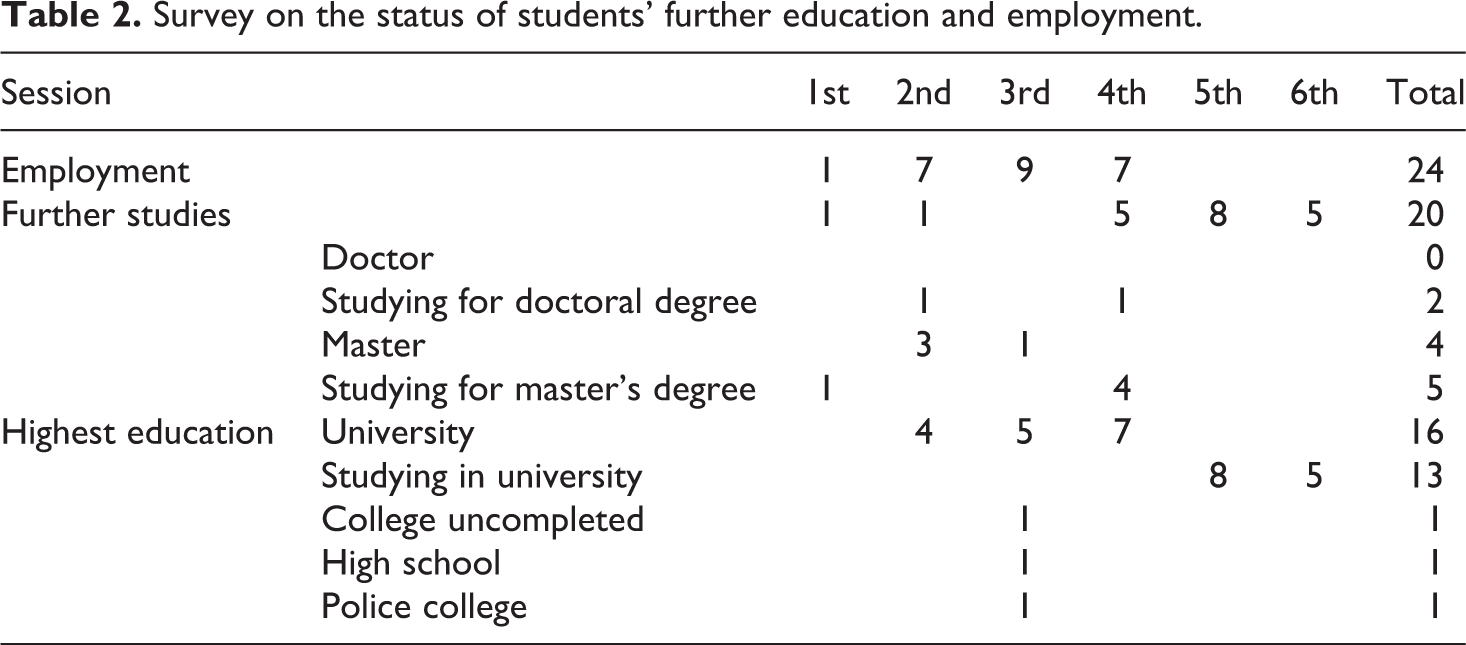
According to the results of the current survey (Table 2), the students of the fifth and sixth sessions are still studying in universities. Among the students of the first four sessions, only two of them haven’t finished university degrees, and the remaining students have obtained university or graduate degrees, and most of them have entered the workplace.
Survey on the status of students’ further education and employment.
Feedback on the camp content of Bright Mind Project
The content of the Bright Mind Project was evaluated on a five-point scale. The results are summarized in Table 3.
Participants’ satisfaction and their views on learning and career assistance.

Satisfaction with the content of the Bright Mind Project and views on learning and career assistances
It can be seen from Table 3 that the students’ satisfaction with the content of the project and their assistance to learning and career are mostly above 4.5 points. In terms of content satisfaction, financial aid received the highest score, showing the financial need of these students. “Yes, We Can” activity had a lower satisfaction score, probably because the participants had to complete the “Yes, We Can” task, which took them too much time.
Satisfaction with curriculum and activity content and views on learning and career assistance
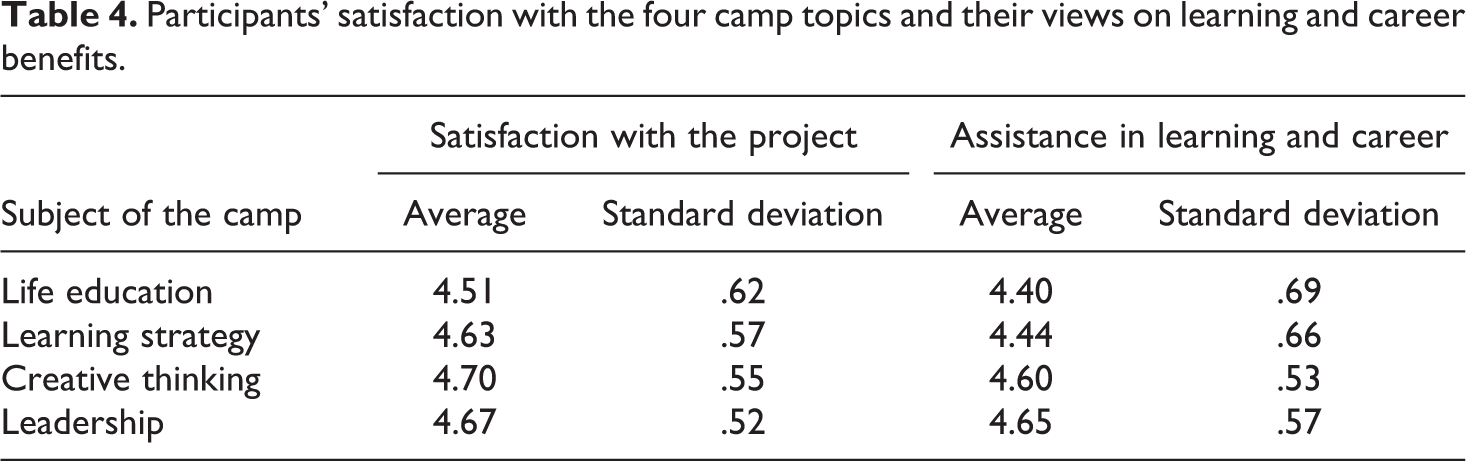
For the four camp courses, the results are summarized in Table 4. It can be seen from Table 4 that the topic of creativity and leadership for the four camps receive the highest scores in both satisfaction and their learning and career assistance. But life education scores the lowest in both learning and career support. It can be seen that students have a higher interest in and demand for creative thinking, leadership, and learning strategies.
Participants’ satisfaction with the four camp topics and their views on learning and career benefits.
Feedback on the effectiveness of the Bright Mind Project for students
Aiming at the overall content of the program for students’ help and gains, the results are summarized in Table 5. The results show that the order of help and benefit they received is: (1) expand horizons and areas of life; (2) establish a positive outlook on life and values; (3) have richer learning and economic resources; (4) enhance self-identity and understanding; (5) develop good learning methods and attitudes; (6) gain care and support from adults; (7) establish interpersonal relationships, make friends with peers; (8) develop learning and work skills; and (9) have role models and learning targets.
The help and gains of the Bright Mind Project for students.
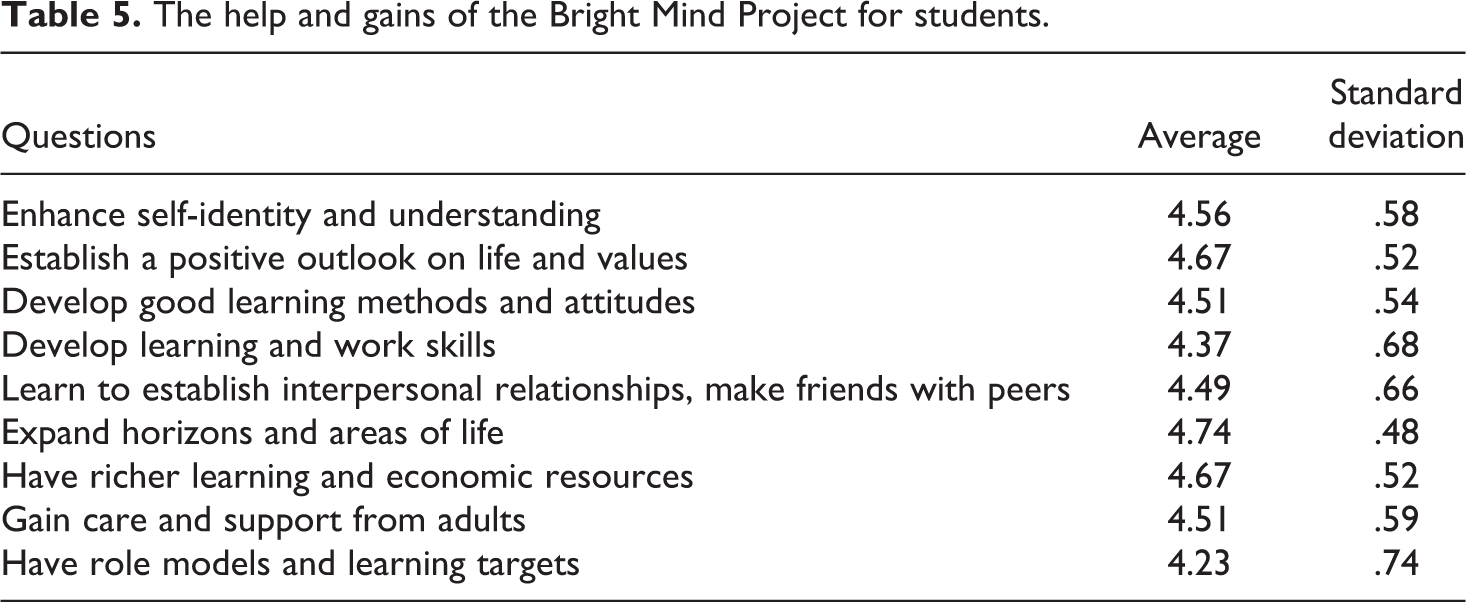
In addition to the camp, the Bright Mind Project also includes a variety of content such as mentoring and practical activities. According to the feedback, it can be seen that through this project, SES disadvantaged students can break through the restrictions and have more opportunities and resources to expand the field of life and vision and then establish a positive outlook on life and values.
In addition to the above options, through the open questions, students could sort out and summarize the following points as regards the help and gains brought by the overall project:
Learning outside of school
Although they scored low on the development of learning and work skills, students also reflected that through this project, they learned not only the subject knowledge taught by ordinary schools but also affective attitudes and practical ability to use and cooperative attitude. I think that courses different from the general education system help me think and grow. I thought I had to compete again when I took the course for the first time, but what the course taught me was that the strength of unity is greater than the individual, and that I don’t have to compete, but enjoy the fresh and interesting lessons and feel open-minded. I really liked the feeling of taking classes in the camp. (3-9)
Meet peers from the same background
Through this project, students with similar backgrounds had the opportunity to know each other, built precious friendship, and became important friends for each other in life. I think the best thing is to get a relationship. This treasure is hard to come by and cannot be replaced. (3-5) Get people who don’t know each other together and get to know partners in different situations. (3-7) Establish a network of students with similar backgrounds, and some classmates become important friends in life. (4-9)
Get the power of emotional support
A 3-year project in which students had the opportunity to build firm friendship with teachers and peers, so that students looked forward to every meeting, and encouraged each other. The description mentioned increased the courage to face difficulties in the future. When we work together, we get more power. (2-7) Every time I look forward to participating in the camp, I feel fully-charged after participating. (3-4) With the support of my peers, the company of my teachers, the encouragement of the team leaders, the activities and learning can help me experience and learn in college. (5-6) I have the courage not to hold back when faced with a big decision. (5-1) What’s most rewarding is the courage to face the unknown challenges. I don’t think the so-called bravery is not being afraid of anything, but the big step to stride forward, regardless of the fear inside. (5-3)
Obtaining university resources
SES disadvantaged students have fewer resources. Through the experience of camps and activities, students broadened their learning experience and obtained university resources. We high school students could participate in this project organized by universities, which is a unique experience we have gained. (5-6)
The degree of preference of the type of the courses in the camp
According to the different activity types of the camp courses, the five-degree scale is used for evaluation. The results are summarized in Table 6.
Participants’ preferences for the battalion course type.

Each camp course had different types of activities, provided students with multiple learning opportunities and suitable learning methods. Summarizing the previous camp courses, the following different types of activities are concluded. It can be seen from Table 6 that the degree of preference of the students for the activity type is in order of team time, evening party activities and intimate group time, practical activities, experience sharing, special lectures, and visit activities. The first three types of activities are more oriented toward interpersonal interaction and emotional communication. It can be seen that trainees have a high degree of preference for interpersonal and emotional communication in camp activities, and the visits may be in line with the theme of the course, and may not meet the students’ preferences.
In addition to the above options, through the open questions, do students have other preferred course types? Some students mentioned special activity experiences or opportunities in the camp. During the graduation ceremony, I thank the society for arranging me to give a speech of appreciation in English. In retrospect, it could be the last time I used English to make a speech and it has become an unforgettable memory. (2-5) I liked the teacher to give me a goal and gave me a little time to complete it. There would be a lot of great feedback when I finish it. (3-5) No matter what kind of event, I may feel the intention of the organizers and the dedication of the team, and I have also learned a lot. (3-4) If I can, I would like to listen to the class again, which is really great. (2-7)
Qualitative feedback from the participants
The Bright Mind Project provides long-term and multifaceted assistance to SES disadvantaged students. Based on the students’ answers, the students’ views on the importance of the project and suggestions for future related activities are compiled. Participants believe that the importance of this project can be divided into assisting internal empowerment and growth and providing external support and resources.
Assist the empowerment and growth of the inner self
Improve courage and self-confidence
Many students mentioned that the challenge activities in the camp and a tolerant and safe environment had greatly helped their courage and self-confidence, making them more confident to face challenges, and changed the attitude they hold when faced with difficulty. After several challenges of the camp, students could know that they in fact have the ability to do so many things. (5-4) I used to be more introverted and dared not take the initiative to participate in such large-scale activities. Since the first camp, I have started to change myself, become confident, more willing to talk to people, and dare to express myself. (5-7) The Bright Mind Project gave students who were afraid of the world due to the lack of an original family, a completely tolerant, dare-to-try, and speak-out-loud environment, in which they could slowly believe in themselves and others in the process. Many times I despised myself because I didn’t perform well, and even felt inferior because of insufficiency of cultural capital resulting from environmental problems caused by my original family. But by participating in the Bright Mind Project, I could forget all the deficiency and restore my self-esteem and build up my hard and soft power in a safe way. (5-8)
Improve self-understanding
Through the Bright Mind Project, participants had the opportunity to examine themselves and get to know themselves better. Whenever necessary, counselors were ready to assist and guide. It is not easy for people to live in the world. We do need a stage. Facing the society, we need to be able to gain a standing point. We need to know ourselves better in order to survive in adversity. (3-5) I think it’s very important. This project helped me re-examine myself and find out the details that I ignored. I could better myself by making up for the shortcomings. The counselors gave us good guidance and dispelled our confusion. (5-5)
Cultivate a feedback attitude
The students participating in the project are from disadvantaged families, but they can maintain the mentality of giving back to the society or helping the more disadvantaged, and let the good will pass on, which is also an important achievement and meaning of the Bright Mind Project. Cultivate excellent citizens, and plant a seed in the minds of students. When they grow up, what is strengthened is the will to give back to society. (3-4) Many people have learned how to give warmth to others. In this cycle, the chain of love can last longer and longer. (4-5) Children who receive such help will reach out and help more people when they grow up. This is a legacy. (6-1)
Assist in breaking through restrictions and realizing potential
Children from economically disadvantaged families have restrictions in fulfilling their potential or even dare not pursue their dreams, because of the limit of external conditions. The Bright Mind Project helps them break through restrictions and exert their potential. I think it is a chance to give some relatively disadvantaged students from an early age, especially for those who have potential but are not able to exert it due to the limit of environment. (4-10) Give everyone a chance to live up to their dreams. (5-8)
Promote career development and change
Students also mentioned that this project is an important opportunity and change for their lives. In the process, they have seen their progress and even changed their lives. At that time, life was very tight, because I wanted to improve the situation of my family, I just wanted to excel in academics, forget about social life, entertainment, and other things to integrate myself into the society—I sought nothing but profit. I saw something in the camp that was not taught in school. I am grateful that I was fortunate enough to be selected into the program, and received education and help. This was an impressive process in my life. (3-9) At first I thought that I had to step out of the comfort zone to participate in this camp every winter and summer vacation. It was a “forced” feeling. Later, I felt that every time I went to the camp, it was like charging electricity and I enjoyed it. Now I look back. It’s like “sacred secret training.” It is the companionship and training of this program for three years that enable me to be more outstanding, innovative, and fearless from high school to the present. (5-8) It was what the teacher and team leaders told us, the planned activities, and getting along with my partners that changed my personality, thinking, and creativity. (6-3)
Provide external support and resources
Provide resources, opportunities, and learning
The Bright Mind Project combined different professions and resources to expand learning opportunities for SES disadvantaged students. Many students mentioned the resources, opportunities, and learning content provided by this project, including economic, learning, environmental, and interpersonal aspects. This project provided necessary financial assistance to those who were economically deficient, and provided necessary incentives to those who were culturally deficient. (4-1) This project supported young students from disadvantaged families from an advantageous point of view. It is not only an economic resource, but also positive support in subject learning, creative thinking, and career development. (4-2) In addition to providing students with financial support, it is more important to give students a learning environment. (4-6) The Bright Mind Project provided a lot of help for disadvantaged students, not only financially, but also organized many activities, which provided a lot of learning resources, so that disadvantaged students could learn more, and gave a lot of care, so that students participating in the program could not only get resources but also make a lot of friends. (6-4) In my opinion, the Bright Mind Project is important because it “offers children with relatively weak resources a chance to enrich their abilities.” (5-6)
Expanding the life circle and horizons
The Bright Mind Project aimed to allow students to have access to teachers, role models, and peers from different fields and backgrounds through different visits and curriculum planning, and lead them out of the conventional learning environment at school to study and observe, which had expanded their life circle and horizons. For high school students, it was a learning place free from the traditional school education. In addition, it also enabled students to open up new horizons and meet many different people. (2-1) In addition to providing substantial help to students who were not in good financial or family conditions, the project also carefully organized activities on many different topics, giving students more opportunities to experience and broaden their horizons and also made some friends of the same age outside the school at that time and saw the life and appearance of different people outside the life circle. (2-2) Because students in the countryside seldom have such opportunities (or resources), they can communicate with peers from different living backgrounds all over Taiwan and stir up. I think this is an important time in my life that affects my vision. (5-3) This project helped poor students to broaden their horizons, increase their life experiences, know peers with similar backgrounds and have models to learn from, and create successful experiences. (2-8)
Assistance in removing difficulties
SES disadvantaged students lack resources and support. They came across more difficulties in life and in learning. The Bright Mind Project provided financial support and professional assistance to help students remove difficulties and realize their dreams. This project helped those who were willing to improve to change the difficulties that may be encountered in their studies. (3-3) Don’t let talented students be limited by poverty, which smothers the imagination of themselves and their surroundings. Without imagination, they cannot innovate, because it is not life but survival. (5-2)
Provide emotional support
Students with similar backgrounds supported each other, and counselors were arranged to assist and care, so that students could get emotional support. This projects allowed loneliness to have new and different partners. (3-7) This project let students from all over Taiwan gathered together and allowed us to understand each other’s life stories during the activity, and also learn from each other and encourage and accompany each other’s growth. (2-5) This project provided students with similar backgrounds from different regions of Taiwan as friends, as well as counselors who cared for students, and gave the students appropriate guidance and protection during the growth process. (4-9) I haven’t thought of what can be added or subtracted at the moment, and I think it’s great in terms of management of time or arrangement of activities. (5-7) I haven’t thought of any less suitable activities that can be reduced. I think they are all great! The added part is that I think the theme of this series of activities is very good. If I extend this concept, I think it will be very good content. (5-6)
Strengthen communication and interaction
Some students mentioned that their personality is relatively introverted. If they can increase the opportunities for communication and interaction among students of different sessions, or between the counselors and the students, they can be more courageous to express themselves and increase their opportunities for cooperation between different students. Intimate group time can be increased, as smaller groups allow shy people to express themselves more and help individuals explore. (4-6) I feel I have learned a lot from group activities! Whether it is to present a certain performance together or compete with other groups, apart from learning how to work in groups, what’s more important is how to brainstorm and complete a task. Therefore, it is believed that there can be more group activities, and it is suggested that different combinations can be made each time so that different people have opportunities for cooperation and collision. (4-7)
Provide study and career guidance
For many students, they have less experience and resources. Therefore, more information or guidance is needed for future studies and selection of departments. Many people don’t know exactly what they want when they go to high school. Even more people go to college only to find that they are not interested in what they are studying, and then they suspend or retake the exam. It is a waste of resources and time, and it is not necessarily the only way to go to college. It is important to find your own direction and interest. (3-9) You can add some counseling resources for future development, because many high school students don’t know much about many colleges and universities, and they are not even sure about whether to continue their studies. After entering the university, they are confused—what they learn is not what they want, whether they should transfer to other department, or should they drop out of school. Or leave school. If there are more counseling courses, high school students will waste less time exploring themselves and have more time to do more meaningful things. (6-4) Experience sharing from outstanding people from all walks of life, etc. will help students expand their horizons. (1-1) Adding business visits or can help to find employment or understand society in the future. See if different types of work can trigger personal interest or awareness. (3-9) The sharing of career development, one-day experience or a workshop of a career can be increased, so that students can understand the actual scope of work, and may be intrigued in the process. (2-7)
Capacity cultivating
In response to future career development, the cultivation of different abilities can be increased. Add moral education and legal knowledge. (2-8) Morgan Stanley is a well-known multinational company. The employed seniors who came to share their experience had strong foreign language skills. Strengthening language skills can effectively improve the opportunities for students to study and find jobs, thereby improving the inadequate economic environment. (2-5)
Strengthening records
Various activities and technological methods helped students record their participation in the project, giving students the opportunity to review and reflect. Maybe I didn’t understand what happened during each winter and summer vacation, and the details of the event were a bit fuzzy. But the joy and positive feelings are still very clear, and the inspirational feelings for life at that time are still profound. It may be possible for students to record their feelings at the moment of the activity, save for the students, allow them to ferment for a period of time, and then give this record to the students. (2-2) Improve the website and make sure to record every camp activity and the meaning behind it. In this way, more people will know the philosophy behind the Bright Mind Project. (6-3)
Strengthen counseling function
Increase the function of counselors, whether caring during the camp or home visits during school semester or parenting counseling. They helped students and families clear confusion and solve problems. Make observation in the group, if the problem of peer exclusion is found, intervention of counseling and communication is needed to solve the problem. (3-5) Nowadays, network equipment provides video tutoring. Using social media or telephone to visit and care for students during non-camping time can avoid a vacant time of nearly 4 months. (4-9) Regular home visits every semester, or a meal with parents to see if there is anything that needs improvement in the family’s ways of upbringing children. Take me for example. I am not very good at social behavior, and I didn’t even know how to interact. Organize trips for some groups accompanied by counselors may be able to better sharpen students’ social skills and provide assistance. (4-10)
Course form and content adjustment
According to the actual learning experience, students provided some suggestions for additions and deletions in the course type.
(a) It is recommended to delete:
The form of the learning strategy camp can be more lively, rather than a simple speech form. It may be integrated with hands-on activities, or it may be stiff. (4-4) Reduce the number of presentations that require a lot of slides. High school students who lack sleep will fall asleep more easily during presentations. (6-1)
(b) It is recommended to add:
Provide the opportunity for self-study, because what you learn by yourself can be remembered longer and can help you how to apply. (5-2) Add tailor-made plans for each student. (6-5) Increase the two-way interaction mode, such as practice, discussion, thinking, and teacher guidance time, so that students have enough time to increase familiarity and speak their minds.…Many difficulties, such as peer relationship, family relationship, emotional relationship, lack of self-confidence, how to budget existing money (financial concept), lack of certain life experience, choice of university department, how to weigh the advantages and disadvantages, etc. It doesn’t have to be consistent with the theme set by each camp, and each student needs different guidance resources. All in all, a better way is to save more time for “individuals” and for “groups.” (4-9)
Results and discussion
To analyze the impact of the program on the long-term performance of gifted students, tracking research is a very effective method. In terms of time, researchers can keep tracking as the students grow, or use a retrospective method to ask the students to report their experience in a reminiscent manner at a certain stage. In view of the economic assistance and education counseling of underrepresented gifted groups, it has been a topic of concern in the gifted field. However, in Taiwan, the issues and research of underrepresented gifted groups are still more focused on the issues of twice-exceptional students, and there is not much counseling for SES disadvantaged students. The Bright Mind Project is one of the few multifaceted projects in Taiwan to provide education and counseling for SES disadvantaged students. Its structure includes financial support, enrichment courses, and mentoring services. But what is the long-term impact of the Bright Mind Project on students? What aspects need special attention to provide the programs for the SES disadvantaged gifted students? Therefore, this study adopts a retrospective tracking method to understand the long-term impact of the Bright Mind Project on the development of gifted students with low socioeconomic background.
In terms of financial support, the questionnaire result shows that the financial assistance project has the highest satisfaction and that financial support is indeed the top issue for SES disadvantaged gifted students in life and education counseling. For example, students stated that “for the students who are not well-off regarding the family’s economy, the Bright Mind Project is an important part of their career development.” In addition, some students pointed out that this program could provide the necessary funds for those who lacked financial aid. Therefore, the economic situation would affect the students’ willingness to attend university and the current stability of schooling. Armstrong et al. (2019) analyzed the problems and difficulties of student loans in Japan and found that students from low-income families might give up university education to avoid the debt problem of student loans. Kariya (2011) also pointed out that the proportion of top high schools was affected by the socioeconomic background, which in turn affects the probability of subsequent attendance at top universities.
In addition to economic factors, students and parents of low socioeconomic background often have insufficient understanding and participation in education. Therefore, it is difficult to provide assistance in career development and further studies. As a result, students with low SES but high achievements were likely to self-exclude when choosing a university. It is more likely for them to apply for a university or choose a less competitive university due to geography (Avery, 2010; Scull and Cuthill, 2010; Smith et al., 2013). Students may not even know the application information or application procedures for bursaries, and worry about the debt of school loans, and thus choose not to go to college (Armstrong et al., 2019; Mangan et al., 2010; Murphy et al., 2019). Of the 43 students surveyed in this project, only 1 did not attend a university, and 1 dropped out of college, and a significant percentage of students went on to advanced degrees such as graduate schools. It shows that these SES disadvantaged gifted students have good learning potential, and the need for higher education, if appropriate financial assistance is provided, can not only maintain the stability of low-income gifted students in school but also assist students in participating in higher education.
In the camp course survey, it was found that students scored higher on practical topics such as creative thinking, leadership, and learning strategy. The result is in line with what Reading (2016) pointed out—students with a low SES background have a need to improve library skills and learning strategies—as well as consistent with the research findings by Jagannathan et al. (2019)—underrepresented students are in need of cognitive skills and high-level thinking skills and strategies. It suggests that when planning for students with low socioeconomic backgrounds, courses relevant to cultivating practical skills can be arranged.
In addition, in terms of the overall gains from the program, students stated that they could broaden their horizons of life, establish a positive outlook on life, obtain richer learning and economic resources, and enhance self-identity and understanding. Snellman et al. (2015) reviewed the literature and pointed out that participating in off-campus learning activities can develop supported social networks, increase social capital, and obtain the opportunity to get along with experts or academically oriented peers. For SES disadvantaged students, they are in a disadvantaged position in terms of learning resources, environment, cultural capital, learning models, career development, and off-school learning opportunities. Therefore, through the assistance of the program, various resources are provided to assist students in the aspects of affective development, self-awareness, professional ability, career development, and cultural literacy and vision.
In terms of life care and emotional support, students believed that through the project, they could get to know their peers who were also economically disadvantaged, build precious friendships in camp activities, and become important friends in life. Counselors’ care and counseling in helping their life could provide positive support for subject learning and career development, so that students have more confidence and courage to face challenges. Gifted students with low socioeconomic background have more difficulties in establishing friendship and emotional exchange. Through the assistance of the project, they could get appropriate support and development.
From the perspective of student questionnaire analysis and qualitative feedback, the Bright Mind Project can provide good support and assistance in terms of students’ financial assistance, expanding their horizons, establishing a positive outlook on life and values, and the emotions and exchange of counselors. However, students think they gain less in terms of providing role models and learning objects. The possible reason is that this program is emotionally supported by the counselors for life care and emotional support. It does not adopt the mentoring model to target specific areas or expertise and provide long-term guidance. In terms of courses, the preference for visits is also low. The possible reason is that the visits were conducted in accordance with the theme of the course, and it was difficult to meet everyone’s interests and preferences. Therefore, in the future, in the design of the scheme, for students who have demonstrated special expertise or preferences in a certain field, a model of mentoring can be adopted. Outstanding experts or researchers in the field can be provided with additional guidance, which will help students even more in planning and choosing their careers and majors in college.
Conclusions and recommendations
The Bright Mind Project has been conducted for 15 years. Many SES disadvantaged gifted students could get assistance and psychological support in life and in learning during the high school learning process. The results of this study found that students held a positive attitude toward the project and thought it would be of great help to their careers and studies. The importance of the Bright Mind Project for SES disadvantaged students, in addition to assisting students’ internal self-enhancement and growth, it also provides external support and resources. In the camp course, creative thinking and leadership were highly recognized; as regards the form of activities, students preferred activities of interpersonal interaction and emotional communication. Through this project, students believed that the main benefits they gained were expanding their fields of life and broadening their horizons, establishing a positive outlook on life and values, and obtaining richer learning and economic resources. Regarding suggestions for future promotion, students believed that the functions of communication and interaction could be further strengthened, learning and career counseling could be provided, ability development could be assisted, records and counseling could be strengthened, and the form and content of the curriculum could be adjusted in response to students’ responses.
Empirical research on the long-term effects of low-income students, especially gifted students programs is still insufficient, so a more systematic research framework is needed to explore the impact of poverty on giftedness (Olszewski-Kubilius and Corwith, 2018; Subotnik et al., 2011). Through the research method of education tracking, we can understand the current situation of students, help students evaluate the function of education for them, evaluate the effectiveness of school curriculum, collect curriculum improvement ideas, and interpret the effectiveness of counseling work (Ministry of Education, 2011). Therefore, after the project was completed in 2018, a retrospective tracking study has been conducted to understand the students’ growth experience and views on the project in a reminiscence manner, which helps us understand the effectiveness of the project and the direction of improvement. However, after a period of time, some students may have ambiguity about the content of the program or the differences between the courses, more systematic and long-term research is needed to explore.
Cultivating students’ talents in accordance with their aptitude is our educational expectation. It is also the responsibility of educators to help gifted students break through environmental constraints and fully realize their potential. The Bright Mind Project is a long-term, multifaceted counseling program for gifted students from low socioeconomic families. Through this survey, the importance and effectiveness of this type of program for SES disadvantaged gifted students can be understood better, and more institutions participating in the promotion of counseling program for low SES gifted students can be expected.
Footnotes
Declaration of Conflicting Interests
The author(s) declared no potential conflicts of interest with respect to the research, authorship, and/or publication of this article.
Funding
The author(s) received no financial support for the research, authorship, and/or publication of this article.
