



Abstract
This article introduces the construct of personal talent curation. Personal talent curation is one’s assessment of one’s talents—of one’s strengths and weaknesses—but also the building of an adaptive match in life between those talents and both one’s career pursuits and one’s personal lifestyle. Sometimes, this match means pursuing a lifelong passion, but other times, it means giving up that passion or transforming it into a passion that works in the broader context of the life one seeks for oneself. For example, one may be an exceptionally talented musician, scientist, or artist, but the concomitants of a life building relentlessly on those talents—competition, professional jealousy, and continual critiques—just do not fit the kind of life one wishes to lead. In such cases, it may turn out that what in a profession or in society is viewed as a “failure” or a “derailment” may represent a personal adaptive success.
When gifted and talented individuals seem not to live up to their potential, commentators sometimes seek to find what it was in their pattern of abilities, personality, or background that led them seemingly to “flame out.” Another way of looking at such incidences, however, is in terms of what adaptation and success mean for those individuals.
On the one hand, there are some actions that are adaptive for everyone, such as not contributing to the plastic waste circulating in the oceans or to the community spread of disease (Sternberg, 2021b). But adaptive intelligence occurs as an interaction among person, task, and situation (R. J. Sternberg, 2021a). Whereas conventional intelligence tests have “right” and “wrong” answers, adaptive-intelligence problems in real life do not. In many instances, individuals, and especially gifted and talented ones, find that they do not adapt well to one particular kind of environment. Then they use their skills to select an environment that is a better fit to who they are, as a person and as a member of society (R. J. Sternberg, 2020a). Thus, what appears to be a “failure” in terms of a professional or societal trajectory may have been a success, or at least, an adaptation in terms of what the individual seeks in their life.
If there is an overriding message in this article, it is that success is best defined individually in terms of people meeting their own (prosocial) goals, and those goals may or may not correspond to what others might have set out for them. Thus, some of the “less successful” in correlational studies looking at abilities as predictive of later achievement may have succeeded amply, just not in terms of the criteria the authors of predictive studies more or less arbitrarily set out for them. Indeed, one person’s societally derived criterion of success may be another person’s individually derived criterion of failure, and vice versa. (Antisocial and destructive personal or other goals, such as have been set by Vladimir Putin in his attacks on Ukraine, do not figure into the scope of this essay on personal talent curation.)
This article was inspired by the story of British–Israeli cellist Marius May (1958–2020), a child prodigy and gifted professional cellist who was on track to become the next Jacqueline Du Pré (1945–1987) and, in a sense, did, but not in a way anyone anticipated. Du Pré was, by almost any standard, one of the most extraordinary talents the cello (and music) world ever has produced. Her performance of Edward Elgar’s Cello Concerto in E Minor (Opus 85), with Sir John Barbirolli conducting (Du Pré with Sir John Barbirolli, 1965), is legendary and perhaps has never been equaled. But Du Pré’s career as a breathtaking cellist was cut short when she contracted multiple sclerosis, a diagnosis that became clear at about age 28 (she died at age 42). A question, then, in the British cello world was, “Who will become the next Jacqueline Du Pré?” (S. May, 2021, with commentaries).
Marius May seemed to be a likely contender to be the next Jacqueline Du Pré. He was a child prodigy and, in his early mature professional career, an adult phenomenon. Thus, he was not like so many other child prodigies who crash and burn when they cross the border from childhood to adulthood. At least some of the reasons for their crashing and burning are well known, for example, they perhaps do not reach a mature level of expertise, or they are tired of being pushed, or they lack the dedication (Feldman, 1991; PT Staff, 2005; Wallace, 1986). Often, the talents of child prodigies do not translate well into adult life, because their skills of mastery are not equaled by creative skills that lead to their own unique stamp on whatever talent world they inhabit.
May is not so easily characterized because his career as an adult performer was on track to greatness among the pantheon of legendary cellists. But he dropped out of the elite circles of the performing world and found a life in Israel that apparently gave him satisfaction. So, by his own standards, he found whatever it was that he was seeking, which was not a position in the pantheon of top performers.
May is only one example of the many professionals for whom advisors and fans have great hopes, only to see those hopes flicker out. Some become “one-hit wonders” because the creative inspiration just never strikes them again. Or they may work in a genre that does not reliably lead to hits. Kozbelt (2008) studied one-hit wonders in musical composition. He found that the one-hit wonders tended to start later, peak earlier, and be remembered for simpler works, such as the Canon in D of Pachelbel or the Adagio of Albinoni (probably actually composed largely by Remo Giazotto, also a one-hit wonder). These hypotheses are reasonable and consistent with Kozbelt’s data. But one-hit wonders exist in many fields, and some of them (mentioned by Kozbelt) are not remembered for particularly simple works written at an early age. Examples are Engelbert Humperdinck, who is remembered for his opera Hansel and Gretel, which premiered when Humperdinck was 39, and Harper Lee, remembered for To Kill a Mockingbird, published when Lee was 34. Perhaps there is something more worth examining.
Redefining Success
In our society as in many other societies, giftedness is often viewed as being transactional in nature (R. J. Sternberg, 2020b, 2020c; R. J. Sternberg et al., 2021). In exchange for producing outstanding performance in school—perhaps on standardized assessments or in grades in classes—one is labeled as “gifted.” In exchange, one is expected to give something back. When scholars of intelligence such as Lewis Terman (1925) and Herrnstein and Murray (1994), or of creativity, such as Dean Simonton (1994) or E. Paul Torrance (1969) study the success of highly gifted individuals, they tend to focus on observable, societally valued accomplishments, such as published works, awards, and other forms of societal and professional recognition. These accomplishments are the “give-back” for the gifted identification. Sometimes, identification is limited in scope, with an IQ test being used to predict academic performance and not much more.
Some gifted individuals go beyond transaction to transformation—somehow making the world a better place—but the implicit compact in most identification of the gifted is a tit-for-tat—societal success in exchange for identification. Societal criteria make sense in that they are responsive to societal conceptions of success, not just of academic success. Certainly, these life span-based criteria are much more impressive than the perennial criteria of school grades and graduation rates, neither of which is informative about success of gifted individuals as adults.
In the theory of successful intelligence (Sternberg, 2020), success is defined not in terms of such societal accomplishments, but rather in terms of individuals accomplishing what they sought to accomplish (that is prosocial) with their lives. Some of those who seem to flame out after their first hit may seem like failures in terms of societal criteria, and others may well be failures in terms of their own personal criteria. But then there is another, in some ways more interesting group. This is the group of people who seemingly “underachieve” not because of lack of talent or lack of motivation, but rather because, in terms of what they seek for their own lives, they are not underachieving at all. What is adaptive for them is not success in the sense that societal may have defined as “success.” They may have tried the standard career paths of high-achievers and high performers in terms of societal approbation and found that the challenges those careers posed were not ones that were compatible with their life goals.
Personal talent curation
The term “talent curation” is usually used in the personnel literature to refer to the building of a relevant talent pool by an employer. It refers to finding the talent needed for present and future needs so that one is prepared for both expected and unexpected challenges in the workforce (e.g., https://www.people20.com/blog/talent-curation-how-recruiters-can-get-ahead-of-the-competition/). But let us consider a related but different construct, personal talent curation.
Personal talent curation refers here to one’s own assessment of one’s talents—one’s strengths and weaknesses—and of finding an adaptive match in life between those talents and one’s career and personal pursuits. Such curation requires personal wisdom (Ferrari & Weststrate, 2013; Staudinger, 2019; R. J. Sternberg, 2013), including the realistic appraisal of one’s prospects in life—what is going well, what is not going well, and how things could be made better.
Such personal talent curation may lead one to conclude that a path one had thought one wished to take, or a path that one had started taking, is not as good a fit to oneself as one originally had thought. Or the prospects for the career may change over time, leading one to adjust one’s expectations or to find a new life path altogether. Perhaps programs for the gifted and talented need better to prepare gifted and talented young people for the challenges they will face growing up gifted and transitioning into careers. That is, such programs may need to focus more on personal talent curation, not just on the development of talent in its own right.
After programs for students with gifts and talents identify their talent pool, they often stress the development of those gifts and talents so that they can translate, at the very least, into superior academic or other early performance, and hopefully, later adult performance. But perhaps such programs need more to emphasize conveying to students the challenges that the gifted will face in their careers, and the decisions that may lead young people eventually to strive in those careers, or alternatively, to find other things to do with their time and their lives.
Challenges of adult gifted performance
The challenges of life for the adult gifted bear little, if any resemblance to the life for which many gifted and talented students prepare. In that early life, they may come to think that their gifts and talents will be determinative of, or at least crucially important in the kinds and qualities of the future outcomes that await them—that, in some large measure, they will construct for themselves. The cellist, such as Marius May, may come to believe that his incredible natural and developed talent for the cello will be the deciding factor in how his professional life ends up. Similarly, gifted and talented athletes, artists, writers, scientists, doctors, entrepreneurs, and others might see the success of their early life in training as highly predictive of what will happen later. There are, of course, countless studies showing how early gifts as measured by test scores are predictive of later success (see, e.g., Lubinski, 2016). There is something of a cottage industry of psychologists and others who spend much of their careers correlating test scores with later outcomes and finding they correlate. Several books have provided examples of the manifestation of such a mindset (Deary et al., 2009; Herrnstein & Murray, 1994; Terman, 1925). In each case, the conclusion would be that IQ or other related measures are causally related to later success, which they may well be.
At the same time, there are other volumes that have suggested the importance of other factors (Duckworth, 2018; Dweck, 2007; Goleman, 2005; R. J. Sternberg, 1997). But perhaps, in the end, adaptive intelligence as a person x task x situation interaction—defined in terms of finding and occupying a niche (Cole et al., 1978; Plomin et al., 1977; Scarr & McCartney, 1983)—provides a particularly satisfactory account. In some accounts, such as those of Plomin and colleagues and of Scarr and McCartney, genotype x environment interaction underlies such finding of a place. But one can be non-committal about the role of genetics and focus instead on gifted persons’ finding that the challenges of careers for gifted adults are a poor match to what they prepared for. Indeed, many of us, as adults, find that our careers are little like what we expected. Books have even been written for bridging the transition between the career for which one was prepared and the career that one encounters (e.g., Beeching. 2020; Prinstein, 2013; R. J. Sternberg, 2016; Young, 2019).
Personal Talent Curation: The Role of Adaptive Intelligence.
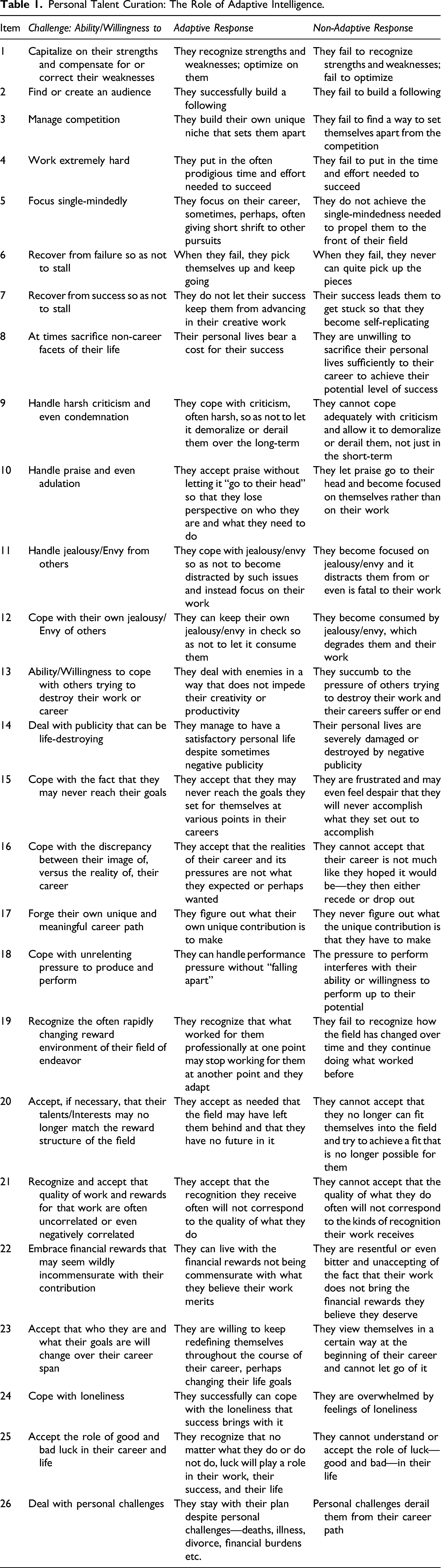
For each challenge presented in Table 1, the challenge is presented, as well as more and less adaptive responses. To be sure, there are many gradations between the responses listed, and so “adaptive” versus “maladaptive” should be viewed as on a continuum rather than as mutually exclusive. Because they are relatively self-explanatory, no attempt is made to go over each and every one here. The challenges pertain to issues such as handling success, failure, jealousy, life challenges such as divorce or ill-health, changes in what is rewarded in one’s career, changes in one’s own life goals, and so on.
What are some generalizations that can come from the kinds of challenges presented in Table 1?
First, the challenges are potentially relevant in almost any career that gifted and talented individuals are likely to enter. For example, in almost any career, there always potentially is competition and one always needs to strive to create an audience or multiple audiences, as tastes change and audiences ultimately age out.
Second, the challenges can change as a function of time of career and time at which one is in the career. For example, one’s strengths and weaknesses may change as one advances through one’s career and finding the right balance between capitalizing on strengths and compensating for or correcting weaknesses also may change. Vocalists’ voices change; string players' arm and finger agility may decrease; athletes' strength and coordination may change; scientists may find that their fluid thinking skills are not what they once were, even as their expertise (crystallized knowledge base) increases.
Third, the challenges are only slightly related, if at all, to traditionally defined “gifts” and “talents.” Traditional talents are not what enable you to cope with either failure or success. No matter how talented one is, if one is at all creative, one will have failures in one’s career as one’s defiance of the crowd and of traditional ways of doing things rubs traditional thinkers the wrong way (R. J. Sternberg, 2018). Coping with success might seem like a non-challenge, but it is not, as the early deaths of so many singers of popular music should have taught us (Kenny & Asher, 2016). The pressures of success can lead people to alcohol, drugs, suicide, or to becoming stuck with a given type of work or performance because one is afraid that if one changes how one does things, one’s success will prove to be fleeting (R. J. Sternberg & Lubart, 1995).
Fourth, to the extent that one meets the challenges in terms of one’s own goals, needs, and desires, one may be adaptively intelligent, overall, either in meeting them or not. If they are not the kinds of challenges one wishes to live with, one might do better finding a different career. One may not wish to focus as single-mindedly on a career as one needs to in order to reach the top, or one may not wish to work as hard as one would need to in order to be a top musician, or novelist, or scientist, or whatever. Most jobs do not require the kind of single-minded focus and the sheer hours that are required by jobs that enable gifted and talented individuals to reach national and international levels of eminence. Some people just do not care enough about the eminence, or even about the work, to put in that kind of effort. In that case, the adaptively intelligent thing for them to do is to match their levels of focus and effort to jobs that require less from them.
Fifth, some of the challenges are somewhat chronic—one can encounter them at any given time—while others come and go. For example, harsh criticism, on the one hand, and praise and adulation, often come and go, whereas focus and hard work may be chronic. Demands of high-performance jobs like concertmaster of an orchestra or chief scientist in the research wing of a corporation are never-ending. Praise and criticism tend to come in waves. Sometimes, those waves build on each other. Once the criticism starts, it piles on; or once the praise starts, it grows. But neither is typically there forever. Some high-achievers may be able to handle the criticism, but others may find it wears them down—they would prefer a life pursuit that puts them less under the spotlight. It is not that they lack gifts or talents—they just do not want what goes with them in some high-pressure jobs.
Sixth, while no life pursuit is going to be entirely free of these challenges, some life pursuits will have more of them, and ones presenting more intensely, than will other pursuits. Often, there are jobs for the gifted and talented that reduce the stress but that nevertheless enable them to make an outstanding contribution. For example, Aldo Parisot was a distinguished performer on the cello but decided instead to become a professor of cello (at Yale), a demanding job but one with fewer of the extreme ups and downs of being a soloist. Ivan Galamian became a legendary teacher of violin without having to perform for audiences ready to pounce. Similarly, many scientists, including ones of distinction, decide to emphasize teaching in their careers. David Myers has been a distinguished researcher, but he will be remembered far more probably for his contributions to the pedagogy of psychology.
Seventh, it is quite possible that one’s tolerance for various challenges will change as one goes through one’s career, so that what was tolerable at one point no longer will be later. For example, those who follow an academic track almost must put aside many non-career aspects of their lives in order to get to the point where they can be awarded tenure. Many might have found another career if the kind of pressure they felt to get tenure persisted throughout their careers. But some distinguished performers find the opposite. They might, say, start off as scientists, but then go into administration or academic or corporate leadership positions, only to wish that they had stayed with the research career that had been so satisfying to them. It sometimes is possible to go back, but often, it is not, because they have not kept up with the field in a way that would make it feasible for them to start their labs again.
Eighth, one may meet the challenges, but in a non-adaptive way, as when sometimes one meets the challenge of jealousy they experience—whether emanating from themselves or from others—by staying in a career but actively sabotaging rivals. They become maladaptively intelligent, using their intelligence to undermine others instead of to realize that, metaphorically, a rising tide raises all ships.
Ninth, what one person views as an insurmountable challenge, another might view as an opportunity, and some individuals turn challenges into opportunities so that what is a stumbling block for someone else becomes a growth experience for them. For example, it is common in many fields of endeavor to get frequent negative reviews—of musical compositions or performance, or artistic compositions, of scientific research, or poetry. Some gifted individuals find that the continual criticism wears them down. They do not want to deal with it. No matter how much they try to improve their work, it never seems to stop. Other gifted individuals might, in contrast, view each negative review as a new challenge, one they can overcome and use to better their work and enhance their contribution.
Tenth, whether one wishes to meet these challenges is, in the end, a decision. That is, people differ in their tolerance for challenges of different kinds—we all do—and there is no one correct response. The decision requires adaptive intelligence in terms both of one’s goals in life and one’s tolerance for various aspects of the process of reaching those goals. One may never even reach the goals: Often, the process of getting toward the goals is much more important than the attainment of the goals.
Finally, the challenges point out the extent to which conventional “success” in a career is much more than a matter of gifts and talents—to the point that one wonders why there is so much emphasis in identification on narrower bands of skills needed for coping with the adult world of the gifted. Being an exceptional musician, artist, scientist, entrepreneur, or whatever, is always impressive. But so much of what a gifted individual will contribute will depend not only upon their talent, but also upon their adaptive intelligence in curating that talent—in making it work for them.
I have summarized only some of the challenges here. Others are listed in the table, such as the possibility that one will never reach one’s goals, the possibility that the financial returns of one’s career will be much less than one expected, the possibility that one’s work will never achieve the recognition one perhaps rightfully expects, or the possibility that the goal will turn out to be a goal that one later decides one does not wish to reach (see Table 1).
Marius May had the potential to be one of the most exceptional professional performers of the 20th century, into the 21st He chose otherwise. His personal talent curation led him to a path that probably neither he nor anyone else originally expected he would follow. Like Jacqueline Du Pré, his career in a galaxy of musical stars ended early. But he chose to end that career. He moved to Israel, and according to this brother, led a life with a marriage and children that was happy and meaningful to him. He stayed with the cello, just not in the way that he might originally have intended, and certainly not in the way that others intended for him. In the story of the field, he may go down as one who did not make it. In the story of a correlational study of some kind, he might look like the outlier at the top of the talent distribution but near the bottom of the achievement distribution. But in the story of his own life, he likely went down as one who made of his life pretty much what he wanted to make of it.
Those who choose a life different from that their mentors and public might have expected may be in violation of the usual expectations of “transactional giftedness” and they may not, at least in the position for which they trained, make a transformationally gifted contribution. But they make a transformationally gifted contribution in a different way; or they may make a self-transformationally gifted contribution (R. J. Sternberg et al., 2021), whereby they transform themselves into a person who is self-actualized (Maslow, 2014) and has attained their own personally meaningful and sometimes ambitious goals in life. And for some gifted individuals, that may be the contribution that, in terms of their own intelligent adaptation to the environment, is the very best contribution for them to make.
Footnotes
Declaration of conflicting interests
The author(s) declared no potential conflicts of interest with respect to the research, authorship, and/or publication of this article.
Funding
The author(s) received no financial support for the research, authorship, and/or publication of this article.
