




Abstract
The number of students with ASD also identified as academically talented has been increasing over the last few decades. Unfortunately, little empirical research exists about this population of students. In this qualitative study, 40 college and university students with ASD who were identified as academically advanced and talented and enrolled in competitive colleges and universities were interviewed about academic experiences and teaching strategies that contributed to their success. Several findings related to specific strength-based teaching and support strategies perceived by participants as contributing to their academic success. These included identifying their academic talents; interest-based extracurricular activities based; specific challenge based honors and advanced classes in areas of interest and strength; opportunities for advanced, interest-based academic experiences; participation in residential programs during high school; strong and positive relationships with teachers and counselors; developing compensation strategies that can be applied to all of these areas; and overcoming anxiety while building social connections.
Keywords
Elementary and secondary school educators, especially those working in special education, are increasingly aware that some students with autism spectrum disorder (ASD) also demonstrate advanced cognitive abilities including academic gifts and talents (Charman et al., 2011; Happe, 2018; Reis et al., 2014). This increasing awareness coincides with increasing numbers of students being identified with ASD. According to the Centers for Disease Control and Prevention, 1 in 44 children in the United States were identified with ASD, an increase from 1 in 150 in the year 2000 (Centers for Disease Control and Prevention, 2022). These increases are reflected in the number of students with ASD who receive special education services nationally, increasing from 1.5% of the total percentage of students in 2000–2001 to 11% in 2019–2020 (National Center for Education Statistics, 2021). Gelbar et al. (2021) recently published a research synthesis on this population, finding that although a wide range of definitions are utilized in the literature, little empirical research has been published about this group of students.
Students identified with both autism and giftedness are often labeled twice exceptional (2e), representing those who are identified both as having both academic talents and gifts, as well as one or more disabilities (Reis et al., 2014). Some previous research has found that 2e students with ASD (2eASD) may not be receiving the educational support necessary for them to succeed in elementary and secondary school, as well as in college (Assouline et al., 2012; Cain et al., 2019). Other research has found that individuals with ASD are significantly less likely to attend postsecondary education than those with other types of disabilities and the general population (Anderson et al., 2018; Gelbar et al. 2014, 2015; Shattuck et al., 2012). Some young adults and college students with ASD experience social and mental health challenges such as depression, anxiety, and pervasive loneliness that may negatively impact their success in college and employment (Billstedt et al., 2005; Foley Nicpon et al., 2010; Howlin et al., 2004). Similar challenges exist for other academically talented students with disabilities. Beckmann and Minnaert (2018) examined non-cognitive characteristics of gifted students with learning disabilities in several published studies. They identified several that may also exist in gifted students with ASD, including low confidence and negative attitudes toward school, and frustrations experienced from the discrepancy between their high potential and low school performance.
No research has been found regarding evidence-based best practices for supporting 2eASD students in high school when they may be enrolled in challenging academic courses. Due to this absence of research-based teaching strategies, educators know little about how to teach various learning strategies and skills necessary for academic success for this population (Anderson et al., 2018; Gelbar et al., 2015; Shattuck et al., 2012; Wei et al., 2016). Additionally, limited research has focused on how to engage and help 2eASD students achieve and thrive in school (Foley-Nicpon et al., 2012; Reis et al., 2014). According to some preliminary suggestions (Baum et al., 2014; Foley Nicpon et al., 2011; Reis et al., 2014) effective teaching strategies for this population should focus on finding a balance between fostering and developing students’ academic strengths and interests and enabling them to compensate for the learning difficulties that accompany their disabilities. The use of strength-base strategies can actually serve as the catalyst to learning how to actively apply compensation and learning strategies that address these deficits. But which specific teaching and learning strategies work well or best for these students? Are they all individually applied or so do some patterns exist across the 40 participants? And what activities can prepare 2eASD students for competitive colleges, if this is their postsecondary transition goal?
The Research
The primary purpose of this study was to investigate the perceptions of successful twice exceptional students with autism regarding the factors and experiences that promoted their academic success in high school, enabling them to gain admission and succeed academically in a competitive university. The theoretical background was to study whether strength and interest-based experiences (Renzulli, 1977; Renzulli & Reis, 2014) were helpful to their academic success.
Research Methodology
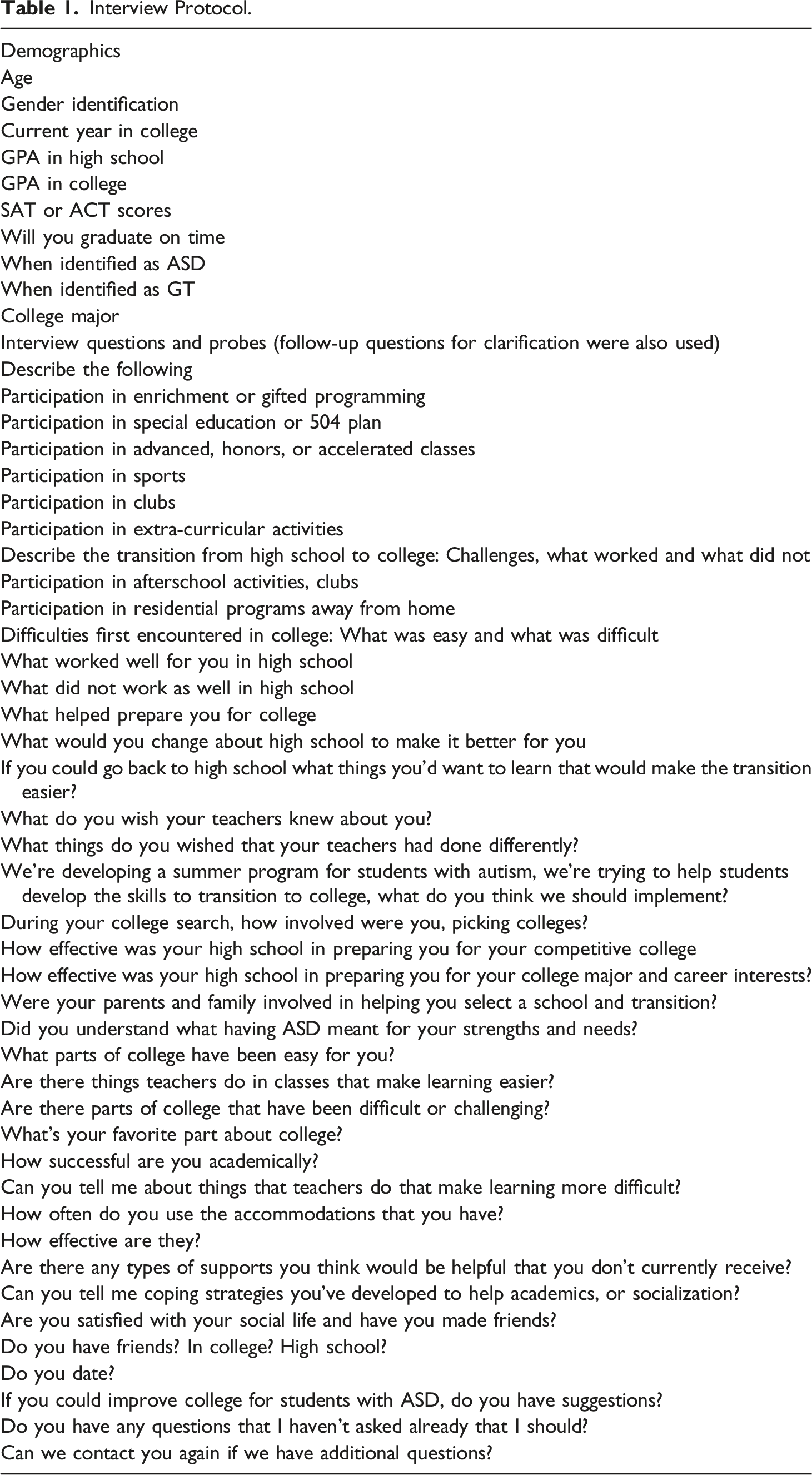
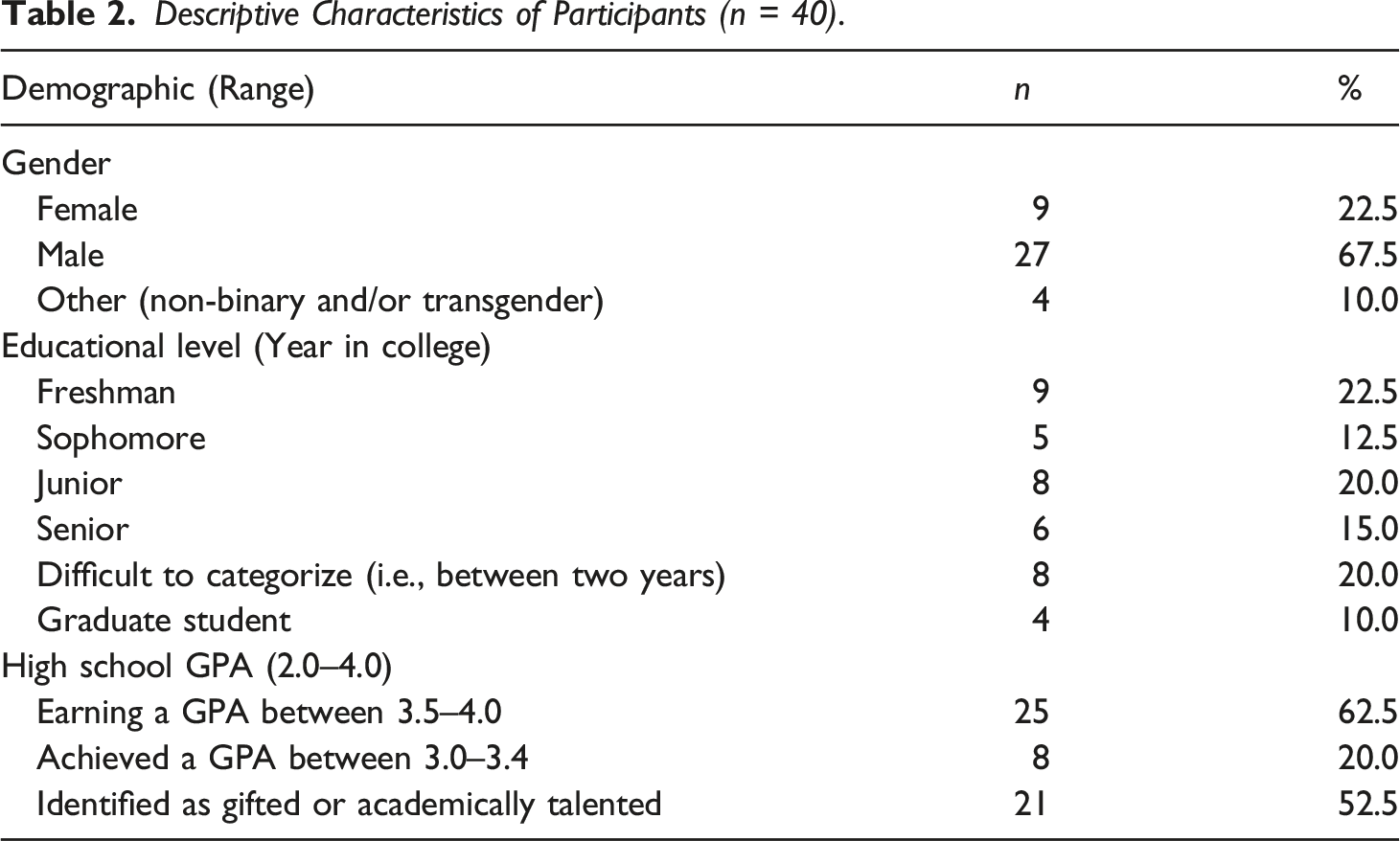
A qualitative study was conducted with 40 college and university students with ASD who are academically advanced and talented (Reis et al., 2021). Institutional Research Board permission was sought and granted and the interview protocol was examined by experts in protection of human subjects. As this was considered a study about strength-based experiences, ethical concerns were closely examined and found not to pose a risk. Educational and medical records provided by parents and students to their colleges and universities were used by disability offices to determine that previous evaluations concluded that they met the diagnostic criteria for ASD, as well as being identified as talented and gifted. In-person, phone, and virtual interviews were conducted, lasting about an hour, with follow-up questions used to probe additional areas of inquiry. Qualitative methods were used to analyze over 300 pages of participant interview transcripts to gain insights about the data. Two phases occurred in the data analysis phase, described below.
Research Questions, Participants, Interview Protocol, Coding Paradigm
Interview Protocol.
Descriptive Characteristics of Participants (n = 40).
Data Analysis, Identification of Codes and Findings, and Trustworthiness
The researchers individually coded responses to areas related to high school academic experiences that contributed to the academic success of this group and categorized responses to identify new and emerging themes. Using directed content analysis (Elo & Kyngäs, 2008), the research team considered earlier but sparse research findings and also discussed and evaluated new codes in a careful analysis and selection of final codes (Potter & Levine-Donnerstein, 1999).
Two phases occurred in the data analysis phase. In phase one, coding from the data of the transcripts of the 40 2e/ASD participants were coded. This process resulted in the identification of high school academic experiences that contributed to their academic success (Reis et al., 2021). For example, under coding of the extra-curricular activities, sports, and clubs that the participants experienced, several pages of responses were listed. The findings included their participation in challenging secondary classes and enrichment opportunities, extra-curricular activities, residential summer programs, dealing with social anxiety and making connections with others, as well as other advanced and engaging academic experiences that enabled them to apply compensation strategies such as time management.
In phase two, coding enabled the identification of several specific strength-based teaching and instructional opportunities within these broad categories of activities. In this phase, we focused on identifying the learning and support strategies, that led to the development of the participants’ talents and interests as opposed to their deficits, ultimately contributing to their academic success during high school.
The authors created data tables with frequency about each finding. The creation of data tables enabled us to identify how many participants were involved in all different types of clubs, sports, and extra-curricular activities and to analyze the frequencies of how these clustered together. For more open ended responses, we coded in a similar way. The researchers independently, and then collectively, inductively coded for new themes that represented a different high school success factor, and when identified, coded these as a new theme. Once the initial coding scheme was completed, the selected new codes were discussed and evaluated by the research team, as a group, and a final consensus was reached across codes (Potter & Levine-Donnerstein, 1999).
Triangulation and the inclusion of all research team members in the coding process supported dependability and trustworthiness, as did an audit trail to establish the dependability of this research (Anney, 2014; Merriam & Tisdell, 2016). Using a multi-case approach supported the transferability of the findings due to the richness of multiple cases (Merriam & Tisdell, 2016). In summary, an audit trail, data tables member checks, and all senior researchers’ involvement in coding data contributed to confirmability (Anney, 2014).
Findings
These strategies and opportunities are the focus of this research and included: (a) dual identification as having academic talents and strengths as well as ASD; (b) participation in specific extracurricular activities based on interests after multiple attempts to find the right fit; (c) enrollment in challenging and advanced classes in areas of interest and strength and dealing with challenge and enrichment opportunities in those classes; (d) other advanced, interest-based academic experiences, such as challenging independent studies; (e) participation in residential programs during high school; (f) creating connections with teachers and counselors; and (g) developing compensation strategies using strength-based learning opportunities; and (h) making positive social connections and reducing anxiety.
Across all strategies, the participants discussed their acquisition of skills helping them learn to interact appropriately with adults and other peers, sometimes as a direct result of having these varied enrichment opportunities. They also discussed the development of compensation strategies, such as improving their interpretation of social cues, beginning new social relationships, and implementing various time management strategies within the use of independent study options based on interests. Each strategy is described in greater detail below using representative quotes to illustrate both student experiences and perspectives.
Dual Identification as 2e—Academically Talented with ASD
It was particularly important for these participants to be aware of and understand that their teachers and counselors believed that they had strong academic abilities and talents and could successfully participate in advanced learning opportunities. Participants consistently explained that their teachers had recognized their academic talents in one or more content areas. As approximately half had been formally identified as gifted and talented in school, it was especially important for these students to know that they had been formally or informally identified as being academically talented in their school setting, often as early as elementary school, but also later, in middle and high school. For those who were not formally identified as gifted and talented in their schools, the recognition of specific academic strengths in certain areas of content was considered important. As several participants explained, they began to better understand their academic profiles in high school by experiencing both strengths and deficits. Knowing and identifying their talents and strengths was especially important. One student’s comment was representative: “I understood and I knew that I had academic strengths as high school was easy for me.” For this group of students, the acknowledgement and identification of their academic talents, either formally or informally, was a crucial step in both their personal and academic development, contributing to their increased confidence, over time, in their ability to be academically successful. Several explained that their teachers nurtured their strengths and let them explore these strengths to better develop their interests and talents. As one succinctly summarized, “They let me explore my strengths and interests.” And another concurred, stating, “Yes, I had many different opportunities to learn my strengths.”
Interest-based Extracurricular Activities
Almost all participants (90%) were involved in various extracurricular activities, including sports, clubs, or competitions. They engaged in activities that most often related to their strongest areas of interest, such as robotics and computer clubs, or arts activities such as band or choir. Most preferred extracurricular experiences for individual versus team-based activities. Almost every participant tried multiple clubs and sports, and usually discontinued or dropped out of some before finding the right fit for their talents and interests. One student explained, I participated in cross-country in middle and high school. I also did spring track. I was a thrower. Discus was my favorite thing to do—things are better when you like them. I was in the video game club for four years in high school—I actually started this club and at one point, it had 60 members.
Students tried various extra-curricular experiences and learned about themselves in the process. One student explained that she learned to focus on “extracurriculars that are academic based, like tutoring and research work—for example, study groups and getting together to talk about research.” Another student stated that she “did track for a while but stopped as I did not like the competition. I did debate, and drama club in my last year which was fun. I did radio club. I was the director of that club.” Several students were encouraged to start their own clubs or extra-curricular groups, when other activities had not worked out as well. As one explained: I first started a club in seventh grade, the twilight zone club that I started. Yes, I was involved in so many volunteer activities, and the key club, that showed other kids around. I also volunteered in every way I could. I also joined a rock band and also did keyboard. I did vocal as well. I ran cross country, basketball and another sport, track and field. Another student also experimented with several different activities, explaining that while she did not participate in sports, she Did do marching band, then I did orchestra all four years, then I was president of the GSA for two years and VP for a year. I was also president of the anime club. I did band stuff outside of class as well.
She credited her earlier extracurricular activities with helping her understand how to better structure her time. She stated “building my schedule is wonderful so I can build it around my work schedule. I’m also part of clubs on campus, so I can fit things into my time. I can plan free time and academic time.” Most of the students described the significant role that carefully selected extracurricular activities played in their academic success in high school. They learned from the selection process to make decisions about participating primarily in activities that helped them develop their interests, develop strong social connections, and help them with the time management and organizational skills that transferred into their subsequent college success.
Challenging and Advanced Classes
The majority of the participants (73%) believed that the advanced, challenging classes they completed in areas of interest during high school were one of the most important reasons that they succeeded academically. Of those who attended schools with Advanced Placement or honors classes, students generally enrolled in one or more advanced classes in their areas of strength or interest. About a third of the participants attended smaller charter or independent high schools that did not offer these opportunities. These students were encouraged to complete challenging interest-based independent studies, were assigned additional advanced work in their classes, or participated in dual-enrollment at nearby community colleges, either on-line or in person. Many participants believed that the advanced classes taken in high school were important contributors to their academic success, and in particular, that in these classes, they learned how to deal with advanced content. Some of them also acknowledged the importance of small independent high schools as facilitating advanced classes for college-bound students. These participants believed that the rigor and challenge of these advanced classes helped them learn to study diligently and succeed academically, preparing them for post-secondary learning. One explained: The academics were not super difficult for me. My high school prepared me well. Some of the other stuff was hard but academically, my high school got me ready. A lot of the advanced classes were fast-paced and [my teachers] also had high expectations. My high school did a good job. The content [in college] is different but I had the learning skills I needed.
When asked what might also have been helpful, some participants identified the need for even more challenge and advanced work and also, opportunities to learn additional skills, such as critical thinking. One participant explained, that “high schools should focus on critical thinking—teachers should be asking: how did you reach that point of view, how did you get to that answer?” Students also expressed their gratitude for the opportunity to interact with advanced content and challenge they encountered that enabled them to learn how to deal with this type of work in their competitive college environments. One explained, If I was bored in class, they would give me higher grade level work to do. I took honors global studies and civ, honors geometry, honors algebra two with trig, then AP US history, AP language and comp for English, and then another one.
Another credited the development of his perseverance due to these advanced opportunities: I am very strong in my content areas. I have grit and perseverance. I learned to make it. Some of my peers are not good in reading but very strong in math—I am good in both and in engineering, that gives me a distinct advantage. I can excel because I read well and can do advanced math, too.
Not all participants, however, believed they experienced sufficient challenge in their traditional academic classes, as some discussed the need for more engagement and challenge in their high school classes. Others recommended providing high school students with varied learning opportunities that address more in-depth thinking. Most participants, however, discussed the importance of being exposed to advanced content for their future academic success in competitive colleges and universities.
Strength-based Learning Strategies including Projects and Interest-based Work
Several different strength-based learning strategies were identified as being important for academic success. As noted, about a third of the students attended small high schools or independent schools that did not offer specific honors or advanced class opportunities. Of this group of participants, most stated that their high school teachers provided them with advanced content even though honors or Advanced Placement classes were not offered. Being exposed to advanced content and areas of personal interest led to the development of strong study skills and perseverance. Many students were given opportunities to pursue interest-based advanced reading and/or given time in school to complete projects in which they had some choice of topic. As one explained, “I am so thankful that my high school had a mission to encourage and foster the interests of its students.” They also credited the teachers who helped them develop the confidence and creativity to do advanced project work. Another credited “passionate teachers who made learning fun.”
Several students also discussed various advanced independent and small group projects that they completed, usually based on their interests. As one explained in a representative comment, “I was really happy there. I made good friends and the teachers supported my interests.” They explained that the projects assigned in advanced classes helped them to better understand their strengths and interests. The benefits of these long-term projects were noted by many participants, as the projects helped with their time management strategies, as well as their ability to complete work and develop their perseverance. One student described how these important projects helped to develop his tenacity, stating: Perhaps the greatest contributor to my academic success is a great knack for perseverance. That’s not to say I never give up, but on the occasions where I do, there’ll be ample evidence of the notes I’ve perused, available sources I’ve reached out to, and all the subsequent trial-and-error. I’ll give just about any endeavor a fair amount of effort, maybe more if it involves learning something potentially important.
The advanced learning opportunities that some participants experienced in high school enabled them to develop more advanced learning strategies, such as time management. One student explained, I developed my perseverance. I am really good at time management, for example. I taught myself how to manage my time and schedule. I developed a lot of these skills through my experiences at school. So, I developed my own time management strategies.
Another agreed, stating simply, “I think more long-term projects that would help with time management for me.”
Participants were also asked, if they could go back to high school, what academic experiences would they want to have to make the transition to college easier for them. Several discussed the importance of learning to work either alone or with others on projects. As one explained, “I think more long-term projects that would help with time management for me.” And another, when asked his favorite part of college, responded, “The freedom to choose to do things on my own. The freedom to choose projects on my own.” Some students also offered a note of caution about intense, interest-based work, as one explained, “I had intense interests and when that happened, my grades dipped. At one point I created a family tree that took me months and then my grades dipped. I did a capstone in high school in the neuroscience of music.”
Having intense interests was mentioned by several participants, as one explained: I was fixated by fans and solar panels. I had intense interests in strange things—history of logos, the titanic. My dad first bought me a Smithsonian book in American history when I was very little and I read it cover to cover. I had an amazing appreciation for history and the analytical ability to appreciate history. One year after middle school, American history became a passion.
In summary, their high schools provided the opportunities for many of these young people to pursue their interests as well as complete projects that helped to prepare them for competitive colleges. When asked about their favorite part of college, several explained that they were with others that shared their interests. “I’ve met a lot of people who are academically at the same level as me and have common interests like all enjoy calculus.” And another explained that how interest-based extra-curricular activities like clubs let him make friends, “I used the clubs and things with similar interests, I found it easy to make friends.”
Residential Programs
Of particular interest was the finding about various ‘sleep-over’ camps and residence academic enrichment programs that half of the participants describe attending in middle and high school that helped prepare them for the dormitory experiences they would have in college. Half of these young women and men participated in various types of residential programs in both middle and/or high school, throughout summer and school breaks during the academic year. Often these were various types of academic theme camps, including coding, filmmaking, and outdoor programs. One stated that his parents encouraged him to attend these types of programs, which were often located on college campuses. He explained that the programs helped him to be both independent and to become used to being on a college campus: “[My parents] got me to camps for a few weeks so they helped me learn how to be independent. They sent me [to] camps on college campus to get me used to being on this campus.” Another explained that he attended camp in which, “I stayed over and lived in a bunkroom with 8 other guys. I took radio club. We did rockets.” Living with others in a bunkroom seemed to help prepare this and other students to living in a dorm.
Another student believed, as did others, that the residential programs he attended helped him decide which college to attend and gave him confidence in his ability to succeed. He described that the “summer college program, game design at Tech, and one here [at his current university] helped cement my decision to come here. I also did sleep away camps.”
Some students whose families had resources and could afford these opportunities participated in several different residential programs. As one explained, “I did a few summer programs and a lot of enrichment. I did talent programs at other colleges. I also did forensic science, screenwriting, playwriting and I was both a commuter and attended several overnight programs.” She subsequently described that being in a dorm when she went to college was not difficult for her and that the change from high school “was not super hard for me.” Participants credited these residential experiences as preparing them for both college life and for social situations that required them to adapt to a new environment. One stated: I did stay away at an overnight preparatory program—we went in middle school and did astronomy club. I also attended a summer camp every summer for 3 weeks that helped me learn to live on my own a little. I went from seventh grade to my junior year of high school. I also attended a two week meteorology camp. I did that in high school. That really helped as it helped my ability to communicate with others and helped me to understand how to explain what I need to explain to others, especially in my area of science.
Connections with Teachers
Although forging and building relationships with others is not always easy for students with ASD (American Psychiatric Association, 2013), the majority of the participants studies evolved, over time, an understanding that the development of these relationships was both critically important and necessary. The majority of the participants were successful in developing a thoughtful relationship with at least one teacher. In fact, the participating students often credited a specific teacher, even if the teacher did not teach an advanced class. For example, one remarked “I had an amazing teacher in history. I read history avidly. I never stopped.” Another described that the teachers were the best part of high school saying “They taught me what I wanted to learn.”
Several students admitted that they developed a strong relationship with only one or two teachers over their four years in high school, but for them, that was sufficient. One explained, “the greatest contributor to my academic success in high school and college has been good teachers that are approachable.” The word approachable was used often, with explanations of how relationships with teachers in high school enabled professors to seem more approachable in college. Another described that she had benefited from learning through experience—the toughest moments in school where I struggled with communication were the ones that helped me the most. Having to communicate with professors during high school helped me to ask more questions and do better in college.
It was not always easy, however, and some students believed that their professors did not really care about them or their learning potential. But again, these young people persevered, despite this perception. One student described the challenge this way: For people with autism and people who have social anxiety, sometimes having to ask for help-that makes me anxious. Sometimes I know that the professor just doesn’t care about me or whether I am learning. Sometimes the professors just don’t care about you and what you need. Sometimes you need to be taught differently and professors just don’t care about you at all and it is obvious.
High school counselors were also described as being important to this group. In some cases, these counselors provided students with a safe space to retreat from noise and difficult social interactions. As one explained, his guidance counselor helped him in many ways, including often providing him a space to calm down. He would go to her office and just sit either inside or outside for a few minutes to help him if he felt stressed, nervous, or as if he was about to have a melt-down. He elaborated in the following way: I would run out of class often. They just let me sit there and take a break for a minute. I did not want to go to the cafeteria—I had no friends to sit with. Guidance helped me de-stress and apply to college. They knew that I was autistic and helped me handle stuff well... The guidance counselor helped me so much. I had friends but all outside of school.
These positive experiences with teachers and counselors translated into an emerging and clear understanding about the importance of developing relationships but the process was easier for the participants if they believed that their counselor cared about them and was invested in their success. The participants consistently discussed how they learned to develop relationships with their teachers and counselors through the lessons learned from successful experiences in high school. And as one explained, this resulted in benefits during college such as learning how to build relationships that contributed to academic success: I became more stable in social relationships in high school because I could be more open about being autistic and mental illness. Surprisingly, my undergrad had a lot of autistic students, and it was easy to become more active and engaged in the community. I was on the Dean’s list every semester, I never dipped below a 3.9, I earned an NIH grant, I was in a Research Grant and could present research. Straight out of college I was waitlisted for a PhD program.
Developing Compensation Strategies Using Strength-Based Learning
When participants were asked about facing academic challenges, specific compensation strategies were consistently mentioned, including time management and the need to develop social awareness and create interpersonal connections with teachers and peers. These strategies proved important across participants’ academic and social challenges, especially as the participants’ academic content became more challenging and participants strove for success in increasingly competitive environments.
Time management and executive functioning skills were also needed for the advanced academic content in high school, and subsequently for college. Some participants defined executive functioning as needing time management and self-regulation skills. They explained that these strategies are especially important for students with ASD, whose intense focus on certain areas of interest has the potential to distract from academic work. These participants expressed the need to learn how to filter distractions, prioritize tasks and goals, stop procrastinating and control their impulses to pursue other interests until they finish their academic work. In fact, learning how to set priorities, shift their focus from preferred activities and interests to their academic work, and focus was a priority for them, as participants explained when asked for advice for other students like them: What helped me build my skills was the coaching I received. I could prioritize the academic skills I was struggling with and then not focus on the stuff that was too easy for me. I did make the Dean’s list 6/7 times. I also graduated magna cum laude.
Another student concurred, explaining the need for students with 2e/ASD to stop procrastinating and focus on positive action and using the tools and help available: If time management skills still aren’t there, then think about working with coaches and prioritizing and save the rest for professor office hours. Then take advantage of tutoring and writing centers. If parents are spending the money, use the most of the tutoring centers. Do save the material when you’re meeting a professor for their office hours for that course. Get out of the procrastination habit.
Many participants also discussed the ways in which they applied the compensation strategies learned in high school to succeed in college. One stated “having learned better time management and responsibility and organization, I didn’t have to figure out how to study or learn what was expected. I kept doing what I had been doing.” Another explained, I spent much of high school very overwhelmed with more classes and extra-curricular activities than I could handle, but because of that I became very good at managing my time and learning how to prioritize. I also became good at working fast without sacrificing quality. One of my time strategies was staying ahead of deadlines, such as doing Wednesday’s homework on Monday, and Thursday’s Homework on Tuesday, so if I don’t finish things by my self-imposed deadlines, I have an extra day to fall back on. Taking extensive notes also helped me a lot, and helped me stay focused. I also just did my best to absorb all the lessons and critiques I received from my professors on my work and music. I would break down long term assignments into parts, if I could, with self-imposed deadlines, so it doesn’t all happen in a last minute scramble.
More than half of the participants concurred, explaining that their high school activities helped them learn how to prioritize their time management and self-regulation both from advanced classes and also from extra-curricular activities. As another explained, On top of straight A’s and honors history, I also partook in several extra-curricular activities throughout my high school career, including cross country and track, robotics team, for which I was co-president and creative sub-team president, blues band, advanced rock band, world percussion ensemble, executive board of the key club, and music composition lessons (outside of school). The downside of this was that I was often overwhelmed and spread too thin. The upside is I became really good at working fast and managing my time.
Even though they had excelled in high school, others experienced challenges with the increased demand of college. Some participants coupled their increasing need for time management with their expanding understanding of its importance and relationship to executive functioning. As one explained, One of my big strategies for time management is my weekly to do list with a weekly schedule of classes and what I have to do in the calendar. I always try to get homework done at least day in advance.
They also believed that many of their professors had minimal understanding of the academic and social experiences and needs of college bound students with ASD. In considering what to do to be even more successful in college, one participant explained, I would want my professors to be more aware of my ASD and reach out for help more. I would worry less about my social life and more about my academic life even though I still did very well GPA [Grade Point Average] wise my first year.
Overcoming Anxiety and Building Social Connections
The need to develop socially and achieve meaningful social connections was also a theme that emerged across students’ encounters with social and academic challenges. For these academically successful students, the types of experiences described enabled them to develop better social connections. Each participant had various challenges with social relationships, as all encountered difficulty socializing with new acquaintances. Most explained that they were introverted and several mentioned anxiety and depression as negatively affecting their social skills, but also credited some of their high school experiences as helpful in preparing them for the future. One student stated: I don’t know who I am as a baseline, I’m introverted, but due to mania and depression it fluctuated. I became more stable in social relationships in high school because I could be more open about being autistic and mental illness. Surprisingly, my undergrad had a lot of autistic students, and it was easy to become more active and engaged in the community.
Their experiences in high school enabled many of these young people to make and maintain friends that stayed connected with them, increasingly, in online friendships. These friends were sources of social support both in high school and in college. These friendship experiences also helped some of them to reflect more deeply on relationships and better identify true friendships. As one participant explained, “I made an effort to really decipher who’s a friend and who’s not, and not keep trying to win over those who aren’t worth my time.”
Most participants initially struggled to build friendships and social connections when they began college, and their high school social relationships became important to their feelings of having friends and a support system. For example, many chose to eat alone but indicated that they were not unhappy doing so; they just preferred to have time to themselves during the day to eat and think. As being socially engaged required them to focus and work diligently on making and maintaining appropriate social connections, several explained their need for time alone and most preferred to eat alone as they needed the time by themselves to be away from social pressures, as one explained, “If I’m having a good social day I can eat with a group, but I also have a choice of choosing to eat by myself. That was a big issue in high school, people would see me eat alone and they didn’t realize I wanted to.”
Another representative comment follows: “I eat alone a lot of times. I prefer to eat alone. I have always preferred to eat alone.” Another concurred, stating: “Vast majority of the time I eat alone, I go out of my way to eat alone, I do my best to avoid people, I much prefer eating alone. I’ve probably only ate with someone 15 times.” Still another explained one of the reasons for eating along, “I eat alone unless I recognize someone. I have a tough time with recognition and name recognition, if other people know me I can be friendly.” Another elaborated: Sometimes I eat alone, but when it comes to club, usually we have dinner during club, we’ll eat there, sometimes I’ve gotten meals with them. Sometimes I do want to be alone, best I can describe is it’s a social battery and then you’ll need to recharge and fill it up by being alone. It’s something my mom is still getting used to. I don’t feel lonely.
Relying on a high school network of friends was comforting to our participants and provided another way for them to recharge their ‘social battery’. Some worried that it would be hard to make new friends in college but were relieved to find it easier than expected. As one explained, “I had social problems in college initially. Over time I made great friends. Now, I also have on-line friends.” A few reported feelings of isolation and were relieved that they had their high school friends as well to depend on for social networking and support. And others had learned how to make some friends, sometimes due to their extracurricular involvements and other times due to their academic programs or classes. As one explained, My favorite part of college was my Greek group—it was not really a fraternity. We were like a nerd frat but we had great parties and it was a relatively low time commitment but it was a great social group and I loved it. this taught me what real friends were and also how to have a close friend. I learned so much about myself socially being in that group.
It is important to note, however, that other participants did not initially make friends at college and continued to feel alone. One explained that “I’m super isolated on campus. A lot of times I don’t even know what to do and a lot of times I’ll procrastinate.”
Participants described multiple ways that they addressed and tried to better understand and subsequently address or even overcome their feelings of social isolation and loneliness, including making and keeping connections with on-line friends, parents, counselors, and other support systems, such as pets. As one participant explained, I have an emotional support animal, he’s wonderful, he’s a cat. He’s sometimes the reason I get out of bed in the mornings. Especially when I can get up later, I tend to get up right before I have to leave. But having my cat, he makes me get up to feed him and that puts a start to my day and when I come back to my room he’s there as a grounding force. It was nice when I lived in a single, I was concerned I’d get lonely and most people don’t believe me but I’m hyper empathetic. Having my cat was nice because I didn’t feel lonely all the time. Even if my social cup was empty I could always go back to my room and interact with a living thing but not on the same level as with a person.
Discussion and Implications
Our research with these 2eASD students suggest that they have similar yet simultaneously uniquely different profiles of talents and deficits. As noted, very limited research has focused on how to engage and help 2eASD students achieve and thrive in school (Foley Nicpon et al., 2011, 2012; Reis et al., 2014). Some preliminary research has suggested that effective teaching strategies for this population should focus on finding a balance between fostering and developing students’ academic strengths and interests and enabling them to compensate for the learning difficulties that accompany their disabilities (Baum et al., 2014; Foley Nicpon et al., 2011; Reis et al., 2014). This research investigated which support strategies can help to actively apply compensation and learning strategies that address these deficits, and which strategies work best for students who are interested in attending competitive colleges.
This research, therefore, enabled us to identify common strength-based instructional and support strategies that contributed both to their academic success and a positive college transition for students with similar profiles. They should have opportunities to participate in challenging honors or Advanced Placement classes during their secondary school years, especially in their areas of interest and to participate in interest-based extracurricular activities with others students who share their interests. If one exists in their school, they should have the chance to be involved in a gifted and talented program and complete advanced content and project-based learning related to interests. These students should have the opportunity to complete competitive academic options in high school, matriculate, and then graduate, from competitive colleges and universities.
Sample IEP Objectives for Students Identified as 2eASD.
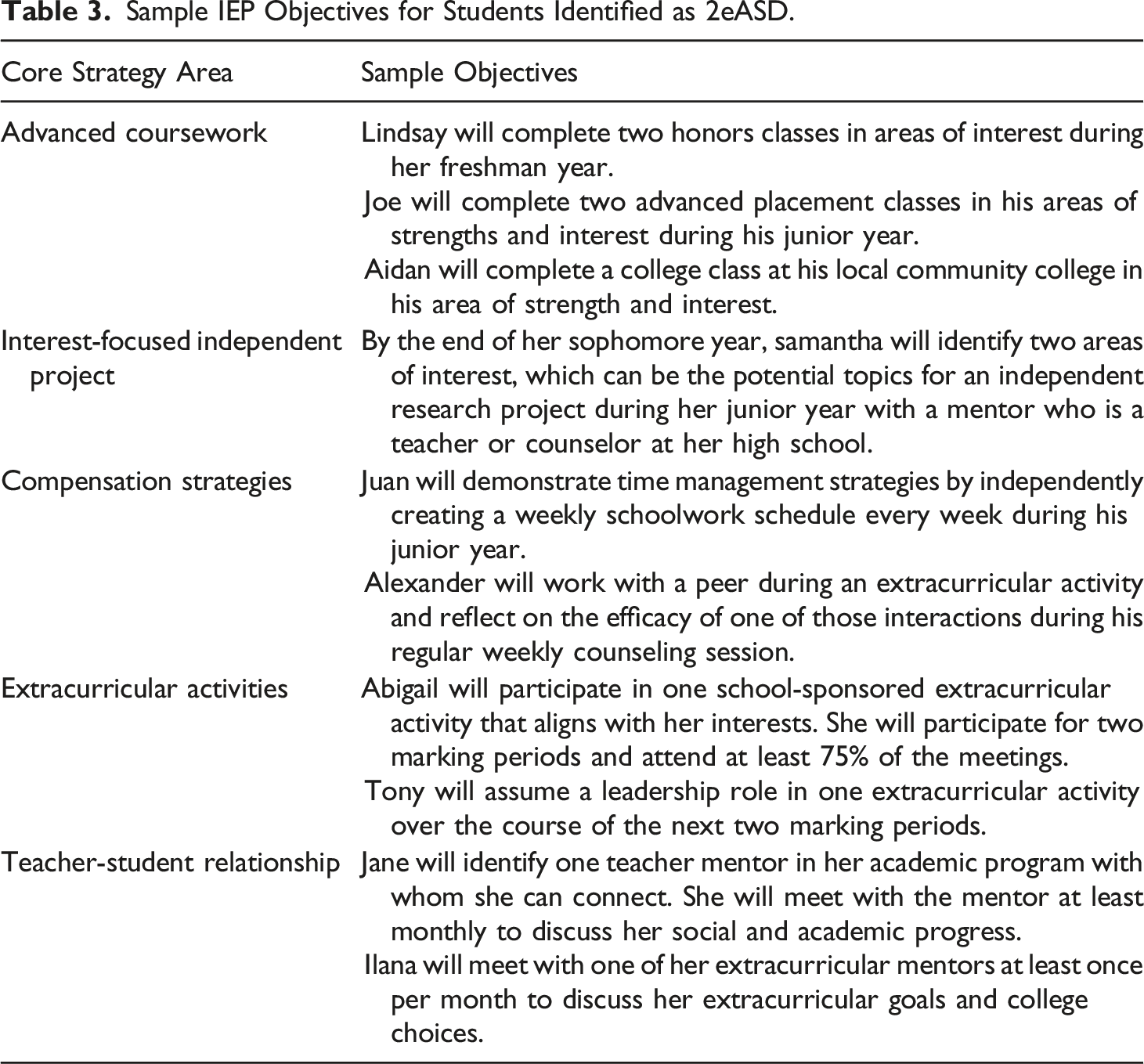
Other implications emerged from our findings. For example, educators should work to establish procedures for identifying talents and strengths, as well as disabilities in students who are 2eASD, formally as well as informally, as the acknowledgement and identification of academic talents was very important to our participants’ personal and academic development. Attempts should be made to encourage participation in extra-curricular activities for this group, as these activities helped to develop interests, social connections, as well as time management and organizational skills, all which were subsequently important in their high school and college success. These young people should also be encouraged to participate in advanced or honors classes to expose them to rigor and challenge and help them learn to study and apply self-regulation strategies that will enable them to succeed in competitive classes and colleges. They should also have opportunities to pursue interest-based advanced projects in areas of interest, as well as reading for pleasure in topics of their own choice. These advanced opportunities also gave these students experience with specific compensation strategies that were critical to their academic success, including time management and self-regulatory skills, such as keeping a schedule, attending class on time, and doing required reading and homework. Students should also have opportunities to develop a social awareness of their strengths and deficits, as they will need to understand strategies to enable them to create interpersonal connections with teachers and peers.
If possible, educators should discuss with parents their ability to provide opportunities for participation in residential programs either in middle school, high school, or both. Overnight residential camps for outdoor activities, as well as theme camps gave these young people the chance to learn how to live away from home, preparing them for dorm life at competitive colleges. In terms of relationships and dealing with social anxiety, these experiences also helped students who are 2eASD understand the importance of developing relationships with adults and other students. Having a social awareness required them to learn how to work actively to create and maintain appropriate social connections in both high school and college, learning from previous mistakes and understanding when it is important to have time alone and when they must have social interactions. For some, relying on a high school network of friends that they accessed on-line provided a safety net at the beginning of college, they worried that it would be hard to make new friends but were relieved to find that it could be done.
Limitations
Limitations exist in this case study research. For example, each of these participants volunteered to participate in this study and all interview data were self-reported and therefore may include inaccuracies. Each participants’ identification as ASD was verified, however, as our primary method for identifying college students was by contacts in highly competitive university disability centers that do require extensive documentation of disabilities to qualify for services. This study also included a large quantity of data, with over 300 pages of interview transcripts, but the use of extensive data tables and frequency counts enabled the researchers to check findings. In addition, all researchers had previous and extensive experience in qualitative research methods, and all participated in conducting interviews, coding data, and identifying findings and themes. We focus our findings on the particular cases studied, acknowledging that this research includes the largest group of interviews of students identified as 2e/ASD reported in the professional literature.
Conclusion
Our research suggests that young adults with both talents and ASD have paths to academic success, guided by strength-based academic and extracurricular activities that support their talents, while simultaneously addressing their disabilities. Successful students get to know themselves and what they do well and enjoy, as explained by one of our participants: I really enjoy my labs. I really enjoy the classes that are more hands on. In one of my classes, we are working with data that asks me to understand what causes these conditions to happen. I enjoy critical thinking—a big work load but this is what enjoy most.
Students who are both high-achieving and have ASD need and deserve the chance to develop both their academic talents and interests. Doing so will increase their opportunities to be successful in high school, further develop their personal and intellectual interests, contribute to their acceptance to and academic success at competitive colleges and perhaps subsequently in graduate school, and increase their chances of living more engaging, productive, rewarding and happy lives.
Footnotes
Declaration of Conflicting Interests
The author(s) declared no potential conflicts of interest with respect to the research, authorship, and/or publication of this article.
Funding
The author(s) disclosed receipt of the following financial support for the research, authorship, and/or publication of this article: This work was supported by Jacob K. Javits Gifted and Talented Students Education Program.
