



Abstract
This study aimed to examine project productions of gifted youths with real-life problems in the STEM domain in the Upper-Lower Groups according to their program evaluations. A mixed research design was used. Education program evaluations of 105 gifted youths, who were attending the Project Production and Management Program at Science and Art Centers in the Republic of Türkiye, were analyzed. It was found that even though they had positive views on the effectiveness of program, there was a significant difference between the lower-27% and upper-27% groups. In the second part, project productions of gifted youths in the Lower-Upper Groups were examined. Even though they were able to produce projects with real-life problems in the STEM domain, differences in favor of the Upper Group were concluded in terms of interdisciplinary connections, complexity of real-life problems, originality of ideas, creative productivity, validation of the solutions, transformation into products, and universality of dissemination.
Introduction
Even though gifted education programs aimed for gifted youth to transform their STEM domain talents, skills, and knowledge into creative solution production of real-life problems and gifted youth had positive views of the effectiveness of their education program, it cannot be assumed that all gifted students will be able to do (Ministry of National Education [MoNE], 2019; National Association for Gifted Children [NAGC], 2021; Reis & Renzulli, 1991; Özbek & Cho, 2022; Özbek & Dağyar, 2022). Considering that gifted youth might have potential to produce original project for real-life problems in the STEM domain, gifted education programs might expect them to produce creative solutions (Ahn & Cho, 2021; Cho, 2007; Neumeister & Burney, 2021; Reis et al., 2021; Sternberg, 1988; Urban, 2003). Although programs expect gifted youths to carry out creative project production with real life problems in the STEM domain, by synthesizing existing literature and producing typical solutions some of them might not be able to do it. Some of them might have ideas but will not able to complete their projects since creative productivity requires perseverance through challenging processes (Bishop, 2000; Özarslan, 2018; Özbek & Cho, 2022). It seems necessary to examine gifted youths’ project productions on interdisciplinary real-life problems from their perspectives on education program.
Gifted program
In the Republic of Türkiye, gifted students are admitted to Science and Art Centers (SACs) through a multi-step identification process of recommendation, and group abilities testing starting from first grade. Gifted students who identified through three-stage process are admitted for education at SACs. In the first stage, candidates who have high protentional are nominated by their teacher by filling out the observation form. In the second stage, the Basic Abilities Test is applied to the students nominated. Candidates who show high performance in this test are taken into individual evaluation at the third stage. Gifted students are provided with five-stage educational programs at the SACs and its last stage program is Project Production and Management Program (PPMP). The principle is progress according to the talent development. Gifted students participate in programs if they are identified in at least one of three different talent areas: general mental, visual arts and music. Advancement in the programs achieved by the completion of five programs; the orientation program, the support training program, the individual talent recognition program, the special talent development program, and the project production and management program. In the orientation program, gifted students are informed about the physical environment of the SACs, the institution, and the education model implemented in the institution. In the support training program, which is the second stage, the aim is to improve the students' skills in solving problems, conducting scientific research, and using scientific research methods to create projects. In the third stage, the individual talent recognition program, students are allowed to discover their talents by doing activities in different fields. In the fourth stage, the special talent development program, the aim is for students to acquire advanced knowledge, skills and behaviour in a discipline by also taking interdisciplinary relations into account. Through the first four programs gifted students develop their knowledge and skills in the STEM domain which will be the foundation of creative productivity in the STEM domain. The last stage program, PPMP, is project-based, interdisciplinary, and is aimed for gifted youth to produce original projects by developing new ideas, and producing utility models or patents (Dağyar et al., 2022; Manuel & Freiman, 2017; MONE, 2019; Redding & Grissom; 2021). PPMP program is grounded on supporting gifted youth to transform their knowledge into creative productivity such as producing a new prototype for a real-life system by merging the knowledge of many disciplines. The knowledge that the gifted youth learned while participating in the first four programs before the PPMP is in the STEM domain. First four SACs programs aim to support gifted students with knowledge of these disciplines and the last program expects them to transform their knowledge into original project products by visualizing interdisciplinary relations (MONE, 2019). Outcome products of the projects might be mathematical models on real-world problems, algorithm designs and coding on challenging problems of disciplines, prototypes and designs of generalized solutions. These products such as utility models might be disseminated by applying national or international project competitions and patent institution (MONE, 2019; Özbek & Dağyar, 2022). Even though gifted education program expects them to complete their projects, not all of them could produce creative solutions and finish up by synthesizing existing literature on a problem or producing typical solutions (Nacaroğlu, & Arslan, 2019; Özarslan & Çetin, 2018; Özbek & Cho, 2022). Some of them might give up the project before its completion with the excuse that completing a project is time consuming and that the project production process is challenging. They might be scaffolded by opportunities to cope with struggles on carrying out projects with real-world problems (Karademir, 2016; Özbek & Cho, 2022).
Motivation, knowledge and skills in the STEM domain are foundational components of creative productivity (Cho, 2003, 2007; Sternberg, 1988; Urban, 2003) and critical predictor of creative productivity of scientifically talented students (Ahn & Cho, 2021; Kim et al., 2021). Gifted youths should be provided with opportunities to create original ideas and products that can be beneficial for solving real-life problems in challenging situations in our society. Gifted education programs can facilitate gifted students to carry out creative projects in the STEM domain (Cho, 2003, 2007; Sternberg, 1988; Urban, 2003). Even gifted youth have positive program evaluation views (Kayişdağ & Melekoğlu, 2019), some of them might not meet expectation of a gifted program by struggling to transform their knowledge into project production with real-life problems in the STEM domain (Çetinkaya, 2020; MONE, 2019; Nacaroğlu & Arslan, 2019). To find out how matching gifted program expectations and realizations on project production in the STEM domain, examination of the project productions according to their views on education program might be needed.
Related studies
There have been studies in which some gifted youth reported struggles with producing projects such as determining their project domain, and processing in the domain even though they found the project production process in SACs original and helpful in terms of improving their problem-solving and cooperative working skills (Nacaroğlu & Arslan, 2019). In the previous studies, it was found that gifted youth might be successful in project production by solving competitional global problems, and integrating into virtual environments (Çetinkaya, 2020). There have been studies on the examination of gifted youth views on the effectiveness of education program, their views were found to be positive, (Kayişdağ & Melekoğlu, 2019) and project productions on how they transformed their talents, skills, knowledge and competencies such as mathematical modelling (Özbek & Köse, 2022) and reflective thinking into creative production. Also, innovative approaches such as mathematical modelling-based PPMP and project-based activities were examined in terms of project qualifications of gifted youth and positive changes resulted in project production (Çetinkaya, 2020; Özbek & Cho, 2022). Few studies examined the relationship between the gifted students’ perception of gifted education program and their project productions (Özbek & Dağyar, 2022). Results were not consistent, very few and differed in terms of examination by using data which was collected with project proposals. This can be regarded as a need to exam long-term project productions of the STEM domain real-life problems, according to their program evaluations. However, previous studies mostly focused on the difference of gifted youth’s math domain project production according to their program evaluations, but not to their project productions of the STEM domain’s real-life problems.
This study aimed to examine project productions of interdisciplinary real-life problems of gifted youth in the Upper and Lower Groups according to their program evaluations. The research questions were as follow: (1) Is there a significant difference between Upper-Lower Groups based on their creative productivity in their evaluations of their gifted education programs? (2) How are the project productions with real-life problems in the STEM domain of gifted youths different in the Upper-Lower Groups according to their program evaluations?
Methods
Research design
A mixed-methods sequential explanatory research design was used by conducting a qualitative study for a more in-depth investigation after a survey study sampling (Creswell & Plano Clark, 2017). In the sampling, a survey was conducted to examine the students’ perception or evaluation of the gifted education program that they participated in at the SACs. In the qualitative study, project productions were analyzed of the STEM domain’s real-life problems that the gifted youths in the lower 27% and upper 27% groups according to scores produced in their program evaluations.
Participants
Demographics: Outlier sampling, Upper & Lower Groups & qualitative data saturation group.
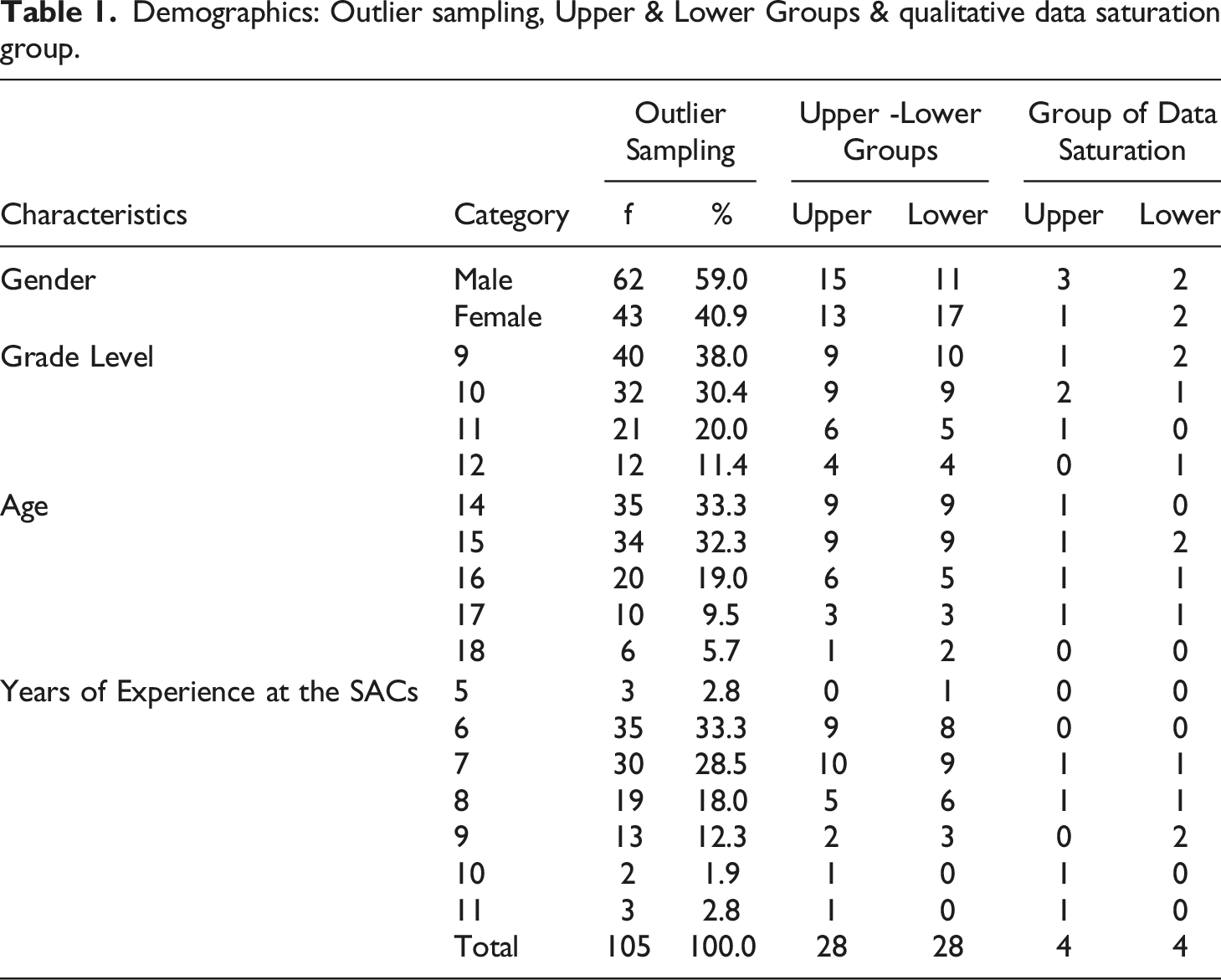
After the investigation, on their project productions, the qualitative data of four participants at the top and the four at the bottom achieved data saturation in reaching the themes. To analyze qualitative data in achieving data saturation describes criteria cut-off scores or the number of participants (Creswell & Plano Clark, 2017). Therefore, top four and bottom four participants, who were extreme in scores were selected for representing the results. (See Table 1). Before achieving data saturation, qualitative data related project productions obtained from participants in the upper-lower groups were examined and analyzed. It was obtained that reached themes on how groups were differ repeated after the eighth participants. It was decided that data saturation was achieved and cut-off criteria was applied by top four and bottom four participants. Data saturation was reached with the findings of four extreme participants.
Instruments
Sampling instruments
Demographic survey
The survey has questions to determine the demographic characteristics of the participants: (1) gender; (2) grade level; (3) age; and (4) years of experience at the SAC.
Gifted education program evaluations-student form (GEPE-SF)
The scale was developed by Sak (2011) and revised by Avcı (2015) to be used for formative and informative program evaluations for gifted students. The revised scale has a single-factor structure with 49 items. The scale consists of 4 negatively worded items which required reverse coding (6, 8, 41 and 49) and 45 positively worded items. The scale was revised with 319 gifted students at the 6th, 7th and 8th grades attending nine (9) different SACs in seven (7) different provinces of Türkiye. The internal consistency coefficients, Cronbach α = 0.958 was found to be excellent. The content of the items is related to the gifted curriculum components and requirements such as project production for real-life problems. The exemplary items are as follows: In the program, I work on the solutions of real-life problems; I create new problems; I can study on the domain that I prefer while developing a product or project; and I combine various information to obtain new products.
The validity, reliability and confirmatory factor analysis of the GEPE-SF was conducted with the participants in this research. The calculated t values were significant at the level p < 0.01 for all items, and the standardized factor loading values ranged from 0.51 to 0.73. The fit indices [χ2 = 3067.82, df = 1098, p = .000, χ2/df = 2.79, GFI = 0.91, IFI = 0.93, NFI = 0.93, NNFI = 0.93, CFI = 0.92, AGFI = 0.90, SRMR = 0.052, RMSR = 0.062, and RMSEA = 0.081] demonstrated that the scale had a valid structure for this sample. The internal consistency coefficient, Cronbach’s Alpha was 0.862 for the scale. It was concluded that the scale was reliable for this sample as well (Kline, 2005; Sümer, 2000; Özdamar, 2004).
Qualitative instruments
Current PPMP forms include PPM form, PPMP observation and an evaluation form, and a PPM Process form. They were prepared considering education principles of the SACs programs. These forms consisted of items and guiding statements to reflect the project production process. For this study, each of three experts on language and measurement were consulted for the questions and guidance statements of the forms. Necessary corrections, indicated by the experts, were made.
Data collection process
Sampling process
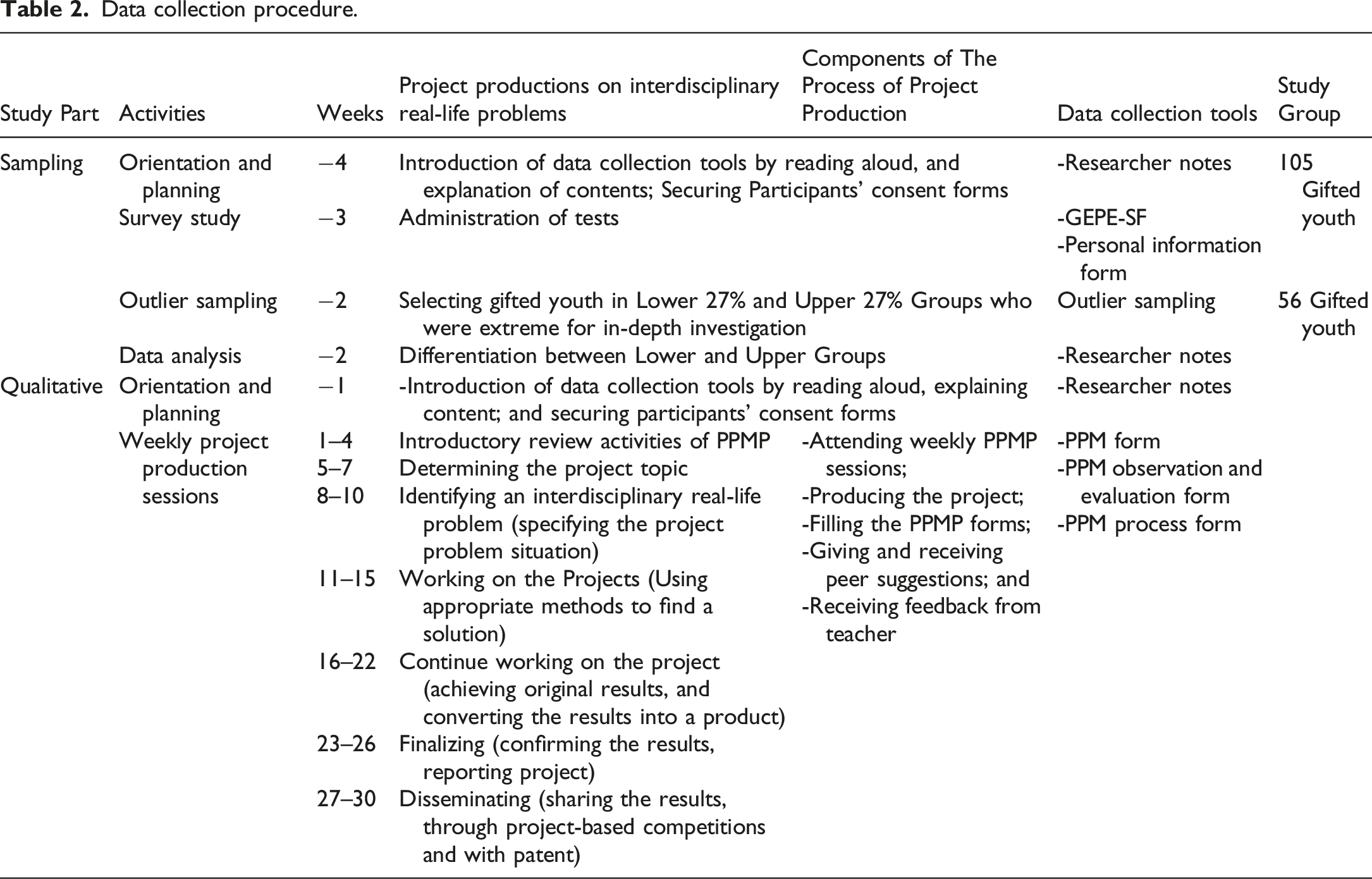
Data collection procedure.
Qualitative data collection process
In the second qualitative part of the study, data were collected during the fall 2021 and spring 2022 academic semesters. Data entries were made using three (3) different qualitative instruments for eight (8) participants when the participants’ completed parts of their project (See Table 2). The main reasons that qualitative data collection time took 30 weeks were as follows: Project production is time consuming; project-based events have annual dates to submit results for dissemination; and gifted youths are expected to carry out project production during an academic year in the PPMP (MONE, 2019).
Gifted youth participated in PPMP of the SACs, in which the students’ goal was to conduct original projects (MONE, 2019). After the introductory review activities of the PPMP, participants identified an interdisciplinary real-life problem by themselves. In every weekly project production session, participants were required to carry out their project rigorously. Each weekly session included activities such as filling out PPMP forms and participants were assisted in using textbooks on mathematics and online resources, collaboratively worked and shared feedbacks with their peers, and received feedbacks from teachers. Also, they were provided with experts whenever needed to produce projects as a requirement of the PPMP’s regular project producing process (see Table 2).
Data analyses
Sampling data analysis
The SPSS 23.0 analysis program was used. The items numbered 6, 8, 41 and 49 of the GEPE-SF were reverse coded. It was concluded that there were no missing values in the data set. The extreme values, five (5) individuals (participant numbers 28, 30, 35, 54 and 97) were removed from the data set. The normality and the homogeneity of the groups (Levene’s Test for equality of variances) were examined for parametric techniques (see Table 4). Descriptive statistics were calculated for the 27%-Upper and 27%-Lower Groups in terms of program evaluation scores were determined. A T-test was used to determine the differences between the scores of the participants in the 27%-Upper and 27%-Lower Groups. It was suggested that the Upper and Lower Groups consisting of 27% from the extremes of the criterion score distribution was optimal for the study of test items (Kelley, 1939).
Qualitative data analysis
Data obtained from (1) PPM form was analysed as the main source, the data obtained from (2) PPM observation and evaluation form and (3) PPM process form were used to confirm and validate the findings obtained from (1).
Sample Qualitative Data Analysis, Excerpts, Coding, Validation and Confirmation.
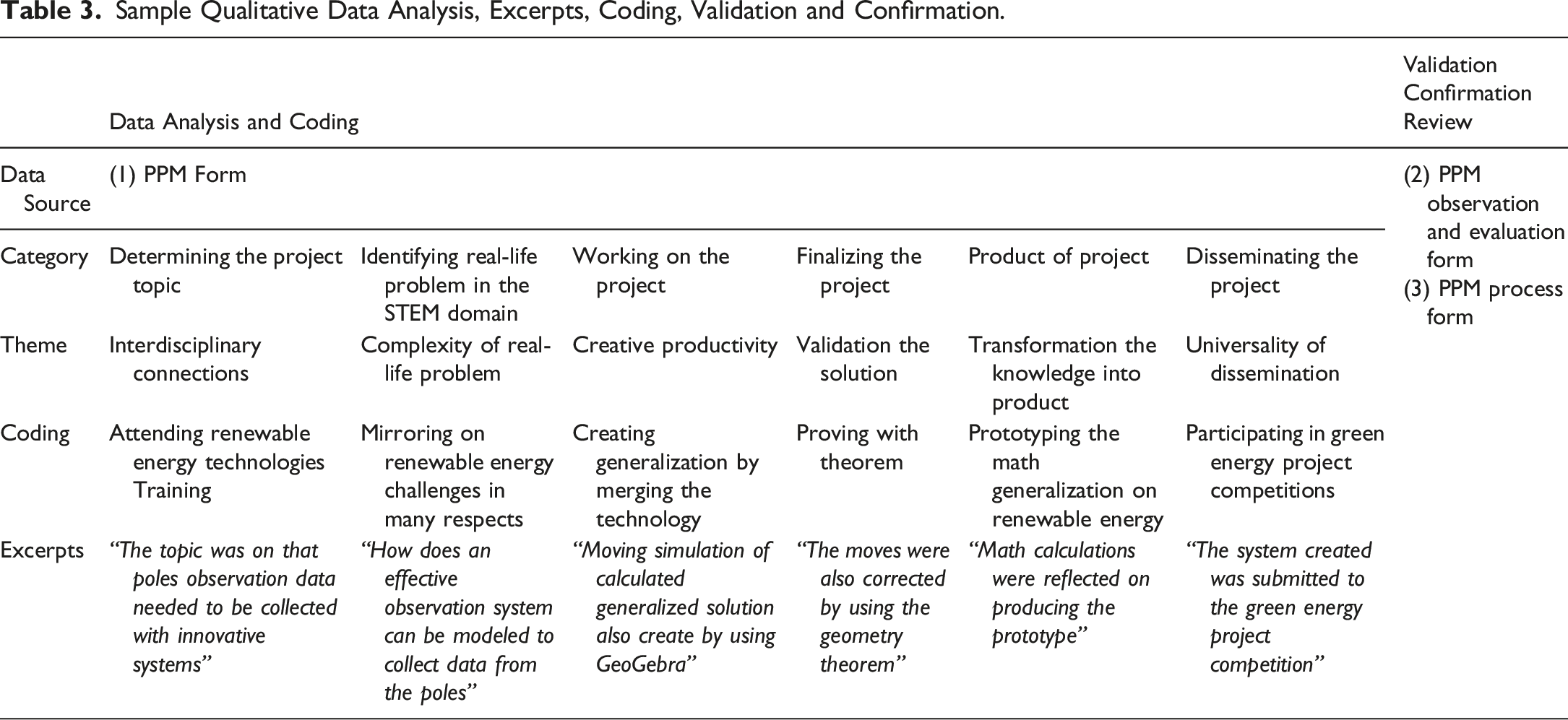
When is examined, excerpt included, “The system created was submitted to the green energy project competition” obtained from the data source (1) which was taken note by gifted student was confirmed with the item, “Participates in project-based competitions”, obtained from data source (2) which was entered for the same participant by PPM program advisor. Excerpt included, “Moving simulation of calculated generalized solution also create by using GeoGebra” obtained from data source (1) which was written by gifted student was confirmed with the item, “Carrying out the project according to the plan”, obtained from data source and (3) which was entered for the same participant by PPM program advisor.
To ensure the validity, expert opinion, external controller, participant confirmation and detailed description were used. Through a long-term as 30 weeks project production process, multiple sources of evidences by qualitative and quantitative instruments were collected. Long-term and multiple sources of evidences were collected. Reliability was ensured through an inter-rater and intra-rater agreement, provision of a detailed description, inclusion of direct excerpt included, and an analysis of data based on a theoretical framework (Creswell & Clark, 2017; Yin, 2017). An interrater reliability analysis using the Kappa statistic was performed and the consistency between the two raters (κ = .84, p < .000) was determined to be substantially strong (Landis & Koch, 1977). An intra-rater reliability was performed and the consistency between the two rates (κ = .92, p < .000) was evident that the reliability of coding was met.
Findings
Findings on sampling: Gifted youth’s views on the effectiveness of their education program
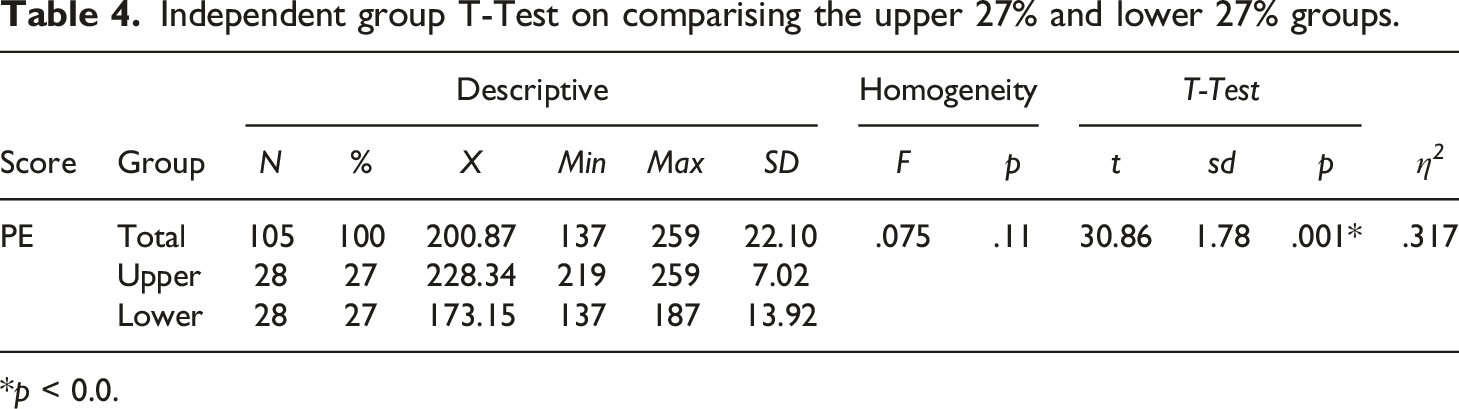
Independent group T-Test on comparising the upper 27% and lower 27% groups.
*p < 0.0.
It was determined that even though participants had positive views on the effectiveness of their gifted program, a significant difference was found between the upper 27% - lower 27% groups on program evaluation, mean scores (p < 0.05). Effect size (η2) was calculated as .317 and result was interpreted as large (Cohen, 1988). As a second qualitative part of the study through a thorough investigation on this significant difference, it was decided to examine the project production data of the participants, the upper 27% and the lower 27% groups.
Findings on project productions with real-life problems in the STEM domain of gifted youths in the lower and upper groups
Project productions with real-life problems in STEM domain of the participants in upper and lower group.
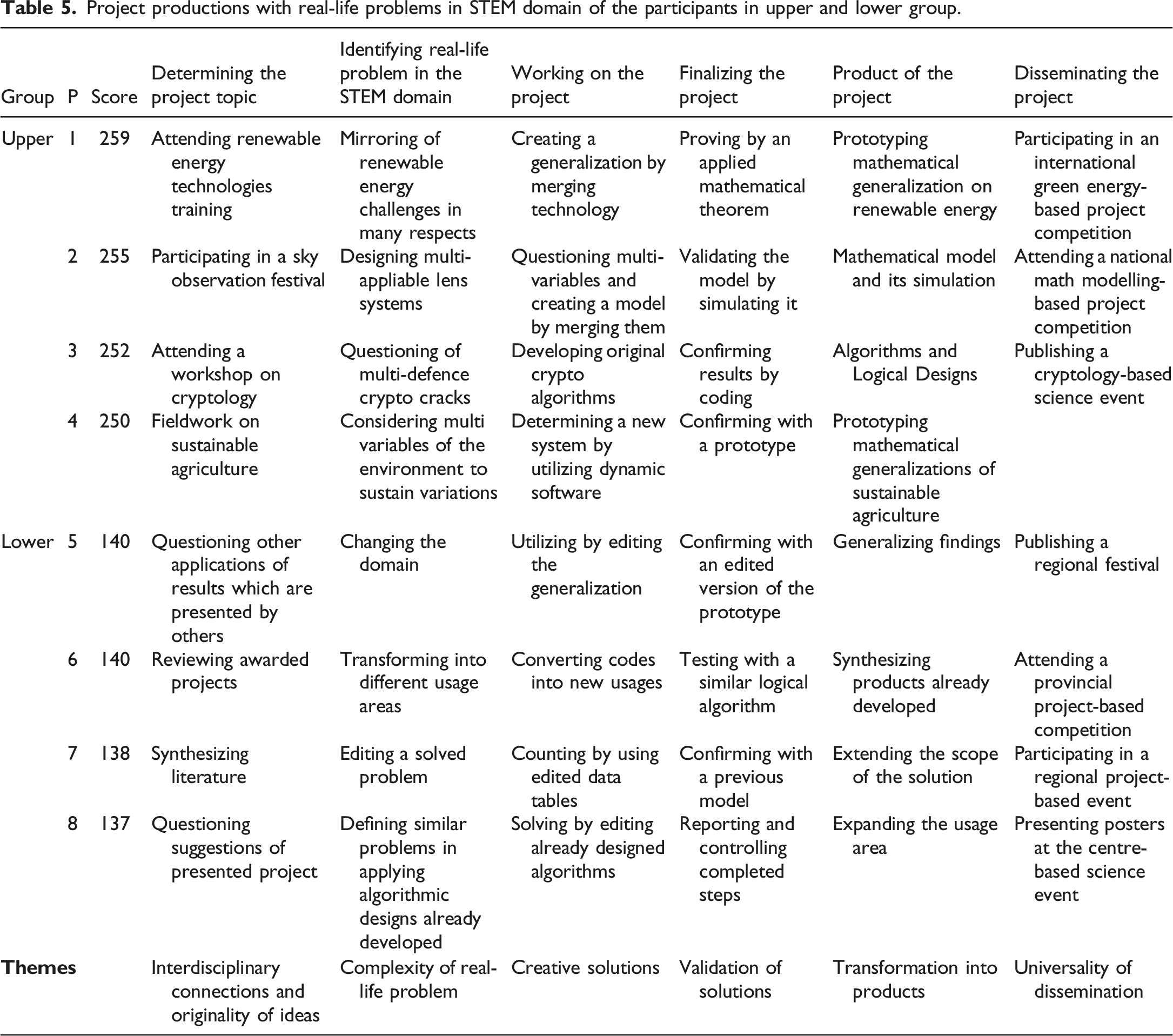
Under the first category, determining the project topic, it was found that participant 1 (P1) in the Upper Group (AG) selected the topic by attending training session on renewable energy technologies. A related excerpt included, “I decided my real-life problem topic on a session of renewable energy training that I attended online. The topic was on poles observation data needed to be collected with innovative systems”. Participant number eight (P8) in the Lower Group (LG) selected the topic by considering suggestions of already presented project results by other gifted youth at the project-based competition. Since in a previous project, which was developed by a peer, it was suggested to apply the result in different fields to see whether it works or not. Therefore, P8 questioned a different application field of results of this project. A related excerpt included, “It was suggested by the project owners who created an algorithm on a wave energy problem would apply their algorithm to other problems in different fields. Applying this algorithm in measuring undersea reserve might be useful to see how wide it is considering their suggestions”. When the codes of both group participants of the first category were examined, project topics were able to be determined by both groups. But in the Lower Group, participants were mostly focused on projects which had already been presented to determine the topic. There was a difference in the selection of project topics between the Upper and Lower Groups: The Upper Group topics showed more interdisciplinary connections and originality of ideas compared to the project topics of Lower Group.
Under the second category, P1 in the UG identified real life problems by mirroring renewable energy challenges in many respects and a related excerpt included, “How does an effective observation system be modelled to collect data from the poles?”. P8 in the LG identified real life problems by defining similar problems in applying an algorithmic design already developed by a gifted peer and a related excerpt included, “To identify my real-life problem, I considered a suggestion of my peer on an algorithm that he designed. Whether the algorithm can be applied to different fields or not…How this algorithmic design is able to be edited in applying to measuring undersea reserve”. Examining all the codes revealed that the UG identified more complex real-life problems by designing, questioning, considering and mirroring the situations in many respects, such as multi-appliances, multi-defences and multi variables. In comparison, the LG mostly transformed, edited and redefined the existing problem.
Under the third category, P1 in the UG worked on the project to generalize a solution merged technologies by using a digital platform, such as GeoGebra and the related excerpt included, “I drew graphs of all possible values of variables and then connected moves of each situation. Simulation of how they moved, created by using the generalized on GeoGebra”. P8 in the LG worked on the project to solve by editing the algorithm which was designed by one of his peers and the related excerpt included, “I added some extra steps to modify the flow chart”. As participants, they indicate some extra steps that were added in order to be able to apply it to the problem which he identified. Examining all codes, it can be stated that both groups were able to work on the project to finalize it, since in the UG participants created generalizations, developed original algorithms and discovered a new system that was a difference in favor of the UG in terms of creative solutions.
Under the fourth category, P1 in the UG finalized the project by verifying the results with an appropriate theorem and the related excerpt included, “The moves were also corrected by using the geometry theorem”. P8 in the LG finalized the project by reporting and controlling the completed steps and the related excerpt included, “After controlled by reviewing the previous steps which already applied by validating one of the completed projects. These steps guided me on how to check and complete my project”. Even though, both groups were able to finalize the project, they differ in favor of the UG on how to validate the solution. While the UG proved, validated, confirmed with the theorem, simulation, codes and prototype, the LG mostly tested by following the existed validations with some edits.
Under the fifth category, P1 in the UG was able to transform the knowledge into a product by prototyping the math generalization on renewable energy and the related excerpt included, “Math calculations were reflected on producing the prototype.”. The product of P8 in the LG consisted of expanding the usage area and the related excerpt included, “The algorithmic design expanded applying the measurement of undersea reserve”. Even both groups were able to produce a product, but they differed in favor of the UG on how they transform skills, competencies and knowledge into creative productivity. While the UG transformed into the original prototype, the math generalization, math model, algorithms, and logical design. The LG mostly generalized, synthesized, and extend the existing products.
Under the sixth category, P1 in the UG disseminated the project by participating in project-based competition on green energy and the related excerpt included, “The system created was submitted to green energy project competition.”. P8 in the LG disseminated by a poster presentation at the science event at the centre and the related excerpt included, “The expanded results (were) shared with peers by poster”. Even though both groups were able to disseminate, the UG disseminated to a wider audience. While the UG disseminated more properly, high ranked, had a good reputation national-international based, the LG disseminated at the regional level.
Discussion and conclusion
It was concluded that even though gifted youth had positive views on the effectiveness of their program, there was a significant difference between the lower 27% and upper 27% groups gifted youth in terms of program evaluation scores. The results of this research support that positive views on the effectiveness of gifted programs (Kayişdağ & Melekoğlu, 2019) and the lower 27% and upper 27% groups of gifted youth’s views differed significantly (Özbek & Dağyar, 2022). On the other hand, by evaluating the impact of gifted program not only gifted youth’s views but also their project productions, differed from previous studies (Hertzog, 2003; Kayişdağ & Melekoğlu, 2019; Mamoud & Rahman, 2015; Redding & Grissom; 2021). These results investigated discovered how the lower 27% and upper 27% groups gifted youth’s project productions with real-life problems in the STEM domain are different, which gifted programs required them to produce (MONE, 2019; NAGC, 2021; Neumeister & Burney, 2021; Reis et al., 2021).
It was concluded that both gifted youths in the lower 27% and upper 27% groups were able to produce projects with real-life problems in the STEM domain. However, the Upper Group demonstrated more interdisciplinary connections, complexity of real-life problem, originality of ideas, creative productivity, validation the solution, transformation into product, and universality of dissemination compared to the Lower Group. It was found that for both groups, that they were able to produce projects that support the results of previous studies in which both group able to do it, but there were differences in favor of the Upper Group. Results of this study varied on themes in which the Upper Group differed from the Lower Group in terms of project production. In previous studies, the themes were listed such as quality, depth, taking the talents into account, acting consciously and in accordance with the plan (Özbek & Dağyar, 2022). It meant that the Upper Group gifted youths carried out more quality and depth in knowledge projects by taking their talents into account and planning their steps (Özbek & Dağyar, 2022). Even the themes reached in this study were different and newly reached it might provide implications on all previous and new themes where gifted youths struggle to produce projects with real-life problems in the STEM domain. It is very important to find out how they need to be supported (Brigandi et al., 2018). Even though gifted youths have the potential to transform knowledge into creative project productivity of real-life problems (Manuel & Freiman, 2017; MONE, 2019; NAGC, 2021; Neumeister & Burney, 2021; Reis & Renzulli, 1991; Özbek & Cho, 2022), the results of this research revealed that not all of them were able to do as expected. Having positive views on the effectiveness of education programs does not predict that all the gifted youth carried out the program requirements at the expected level in terms of creative productivity. Similar to the previous studies (Çetinkaya, 2020; Nacaroğlu, & Arslan, 2019; Özbek & Cho, 2022), it was also found that some gifted youths struggling on producing creative projects. By examining project production with real-life problems in the STEM domain, the results of this study offer a broad perspective of previous results which mostly focused on project production in only one domain (Nacaroğlu, & Arslan, 2019; Özbek & Dağyar, 2022). These results demonstrated that some gifted youths might need support with effective approaches to contribute to their creative project productivity (Fischer & Müller, 2014). As for the Lower Group in this study, gifted youth might have the potential to produce projects of real-life problems in the STEM domain (Ahn & Cho, 2021; Cho, 2007; Sternberg, 1988; Urban, 2003). However, some of them struggle to transform potential into productivity at an expected level (Bishop, 2000; Cho, 2003; Kim et al., 2021; Sternberg, 1988; Özbek & Cho, 2022). Possible supports for the lower-group in terms of their creative project productivity suggested that they might be scaffolded by mathematical modelling on real-life problems-based project production. Weekly sessions on factors of mathematical modelling might guide them to produce step by step such as: identifying the real-life problem, understanding and simplifying the problem, mathematizing, working mathematically and interpretation and validation (Özbek & Dağyar, 2022).
Limitations
The number of gifted youths in the qualitative part was small and this may limit generalizations of the study’s findings. But an in-depth analysis with selected small number of participants to investigate the details was grounded on the difference between the scores of the participants in the upper and lower groups as a second step. It would be necessary to examine upper-middle-lower groups of gifted youth in the future.
Implications
In the future, longitudinal researches on examination the project productions with real-life problems in STEM domain of gifted youths might be conducted to see long term results. Also, it is suggested that researches on how gifted youths’ creative projects productivity in STEM domain might be supported.
Footnotes
Acknowledgments
Special thanks are given to The Scientific and Technological Research Council of Türkiye (TUBITAK) for their support and Republic of Türkiye Ministry of National Education for their permission and support for the research.
Declaration of conflicting interests
The author(s) declared no potential conflicts of interest with respect to the research, authorship, and/or publication of this article.
Funding
The author(s) received no financial support for the research, authorship, and/or publication of this article.
