



Abstract
Politicians have a reputation for deception. Instead of blaming the politicians themselves, equivocation theory directs our attention to the situation in which politicians are asked questions. We draw on recent theories of deception detection—truth-default theory and information manipulation theory 2—to propose that a reason we think politicians are so evasive might be because, ironically, we believe them when they accuse their opponents of evasiveness in equivocal situations. We perform a content analysis of the question–answer sequences (N = 810) in U.S. presidential debates 1996 to 2012. Our results indicate that politicians accuse each other of evasion to a significant degree. Meanwhile, they are not necessarily dodging questions to the extent that their overt allegations suggest. This study demonstrates how the predictions of equivocation theory and deception detection theories apply to the domain of U.S. presidential debates.
Keywords
Politicians have a reputation for being more deceptive than any other class of people in the United States (Gallup, 2014; Serota, Levine, & Boster, 2010). Politicians have been “castigated as slippery or evasive, the sort of people who will never give a straight answer to a straight question” (Bull, 2008, p. 337). Evasiveness is “one of the most prevalent qualities which the public at large attribute to politicians” (Harris, 1991, p. 76). “According to popular wisdom,” politicians do not answer questions (Bull & Mayer, 1993, p. 652) and “come out of the womb equivocating . . . evasive by nature” (Bavelas, Black, Chovil, & Mullett, 1990, p. 235).
Such doubts of politicians’ ability to answer questions would indicate that we tend to process their messages differently than we process other people’s messages. From a cognitive psychological standpoint, our mental systems receive messages as being true (Gilbert, 1991). We have a truth bias (Park & Levine, 2001). We converse with others under the assumption that communicative interactants will cooperate and reciprocate (Grice, 1975, 1989) and typically give them the benefit of the doubt even when they do not (Goffman, 1976; Levine, Park, & McCornack, 1999).
In line with equivocation theory (Bavelas, Black, Bryson, & Mullett, 1988; Bavelas et al., 1990), we explore how the situation inordinately contributes to politicians’ perception of evasiveness. We draw on recent theories of deception and propose that—ironically—a reason we think politicians are so evasive may be because we believe them when they claim honesty for themselves and accuse opponents of evasiveness or worse. Furthermore, we examine whether such allegations contribute to a reinforcing spiral of inflated perceptions of evasion.
We perform a content analysis of question-response sequences in the U.S. presidential debates 1996 to 2012. We extend theories of deception and equivocation by demonstrating how applicable the theories’ predictions are to this domain. We examine (1) the frequency of politicians alleging evasion by each other, (2) how they accuse each other of evasion, and (3) how their allegations perpetuate their evasive reputation.
Explicating Terms
Before our review of the literature, we begin with a short note about our use of terms in this article. The terms equivocation, evasion, and dodge are used interchangeably and synonymously in studies (Bavelas et al., 1990; Bull, 1994; Feldman, Kinoshita, & Bull, 2015; Rasiah, 2010; Rogers & Norton, 2011). All three terms generally refer to a politician’s response that meets the following criteria: (1) someone (likely the opposing party, an interviewer, or a discourse analyst from academia) may express dissatisfaction with the answer, yet (2) the politician and his or her salient ingroup consider the response a satisfactory answer, because the response (3) was truthful, (4) not a lie, and (5) at least addressed the same topic of the question, relative to an overt refusal to answer or a totally different topic response.
Seminal equivocation theory distinguished such messages as distinct from deception because purposefully telling a lie is different from equivocating. Others have more recently included evasions as a form of deception (Levine, 2014). Furthermore, “doublespeak” (Bull, 2015) can be regarded as a form of deceptive equivocation under the seminal rubric of Bavelas et al.’s (1990, p. 35) “content” dimension (see also Bull, 2008, p. 334). A politician’s message “may seem vague or ambiguous” to some, yet carry “clear implicit messages” to others implicated by the politician’s wording choices (Bull & Simon-Vandenbergen, 2014, p. 19). We note that equivocation theory is not a theory of deception, as conceptualized by Bavelas et al. (1990), but the theory’s original authors expressed hope that our understanding of its relation to deception could be fleshed out by future research, to which this article aspires. A politician’s dodge might appear to be intentional deception to one person and a justifiable answer to another.
When a politician is accused of failing to reply satisfactorily to a question, it qualifies as an allegation of evasion (Bull, 2008). Equivocation, evasiveness, “slipperiness,” and other basic forms of “noncommittal political discourse” fall under this umbrella (p. 343). An allegation of evasion can be leveled directly. For example, after a politician’s response, the interviewer might keep pushing for a clearer answer, telling the politician, “You don’t quite answer that question” (Andone, 2013, p. 113). Or an allegation of evasion might be a subtle suggestion that the politician did not answer the question. For example, after an interviewer asked British Prime Minister Tony Blair the same question four times, each time not getting a satisfactory response, the interviewer said, “It’s maybe not a question you need to give a yes or no answer to” and then the interviewer changed the subject to another topic (Bull, 2008, p. 339).
Theoretical Rationale
Equivocation Theory
According to equivocation theory, the individual providing the equivocation is not responsible for the equivocation, but rather the communication situation necessitates equivocation. People equivocate when a response to a question is expected but any direct answer would result in negative consequences. “Avoidance-avoidance conflicts,” as Bavelas et al. (1990) call them, create equivocation. Such conflicts arise when the interviewer asks the politician a question to which there is no good way for the politician to answer without offending sizable portions of the electorate.
A Theory of Political Communication
Equivocation theory applies to political contexts. Politicians’ professional livelihood depends on a majority of people liking them (Jucker, 1986). According to Bavelas et al. (1990), “Political communication is a rich source of equivocation” (p. 15). Politicians “constantly encounter” questions that require equivocation (Bowers, Elliott, & Desmond, 1977, p. 238).
Rather than brushing off politicians’ responses to questions as being intrinsically evasive, the theory encourages inspection of the situations that give rise to equivocation. Equivocation theory departs from deception scholars such as Ekman (2009), who infer that politicians evade questions because they are inherently deceptive.
Theoretical reconceptualizations of equivocation theory have added the implications of face and face management to the analysis of political discourse (Bull, Elliott, Palmer, & Walker, 1996). Cognizance of positive and negative face in political interviews came about through an emphasis on extending equivocation theory to realms of naturally occurring discourse in political Q&As (questions and answers; Bull, 2008). Questions pose “threats to face” when they are formulated so that any direct reply runs the risk of making the politician look bad (Bull, 2008, p. 337). Although seminal equivocation theory research emphasized the prevalence of communicative conflicts arising in political Q&As, understanding “facework” (Goffman, 1955) helps explain why and how politicians evade questions (Bull et al., 1996). Equivocation usually presents “the least face-threatening option” when facing conflictual questions (Bull, 2008, p. 339). Subsequent revisions to equivocation theory have examined face threats in questions (Bull et al., 1996; Bull & Fetzer, 2010). When politicians engage in face-threatening acts against their opponent, such “strategic impoliteness” (Bull & Feldman, 2012, p. 162) may be simultaneously mismanaging their own face. They are casting aspersions on the generic category of politicians. Politicians thus become a class of people who may seem intrinsically evasive.
Sometimes the politician’s response does not need to include equivocation for it to be perceived as such. When an interviewer accuses a politician of not answering a question, audiences perceive equivocation—regardless of whether or not the politician provided an adequate reply to the question (Bull & Mayer, 1988). Instances of politicians unsatisfactorily replying to questions can be due to problems with the interviewer rather than the politician’s answer (Bull & Mayer, 1993). For example, interviewers can interrupt the politician as he or she is answering the question. Also, the question they are attempting to answer is often poorly worded or requires a far more complex answer than time permits (Eveland, McLeod, & Nathanson, 1994).
Perceiving Equivocation in Debates
Seminal explication of equivocation theory used presidential debates to exemplify evasiveness. Bavelas et al.’s (1988) exemplar of a question posing an avoidance–avoidance conflict for a politician was, “Do you favor or oppose federal gun control?” (p. 137). Dan Rather asked that question of the presidential candidates in a 1984 debate of the Democratic contenders. According to Bavelas et al., Walter Mondale’s response was evasive, because although he did specify certain types of guns that he favors banning, his response still left ambiguities. However, Bavelas et al. added that Mondale could not directly answer the question without alienating large swathes of the nation. “When the evoking situation is considered,” Bavelas et al. (1988) explained, “Mondale’s ambiguity and re-interpretation of the question can be seen as a skillful answer to a problematic question” (p. 139).
A Deceptive Situation
Equivocation theory makes a distinction in which politicians’ messages, while evasive, might not qualify as outright deception. Bavelas et al. (1990) ran a series of deception experiments to measure whether there were differences between messages that are true, false, or equivocal. They found that equivocal messages are not lies, or “lies of omission,” or “leakage” of the truth. Equivocal messages are truths, albeit “unclear truths” (p. 207). Equivocation theory was proposed as a means to reconcile conflicting conceptualizations of deception versus evasion/equivocation (Bavelas et al., 1990). Research has supported the assertion that evasion/equivocation falls somewhere “between truth and deceit” (Buller, Burgoon, White, & Ebesu, 1994, p. 370; see also Buller, Burgoon, Buslig, & Roiger, 1994). Most recently, the concept of “doublespeak” combines equivocation and deception in political Q&As (Bull, 2015). For example, in a political debate an extreme ideologue might send supporters implicit signals through seemingly ambiguous responses to questions (Simon-Vandenbergen, 2008). While decades of research have supported and extended the chief tenets of the theory, to the best of our knowledge no subsequent studies have applied the theory to U.S. presidential debates (cf. Galasinski, 1998, applied it to Polish presidential debates). And none have embraced the seminal authors’ challenge to bridge the theory with deception detection in political situations.
Although not a theory of deception, equivocation theory provides a framework for understanding deception detection. Equivocation theory asserts that we have a misplaced perception of politicians’ evasiveness because their situation makes them appear deceptive. Politicians may have this reputation because audiences have a general impression that politicians do not answer questions (Hamilton & Mineo, 1998). Recent theories of deception provide an opportunity to reconcile disparate understandings of deception.
Truth-Default Theory
We begin our coalescence of equivocation and deception in political situations by discussing truth-default theory (TDT; Levine, 2014). Unlike alternative theories of deception detection involving in-the-moment “leakage” cues (e.g., Buller & Burgoon, 1996), TDT starts from the premise that humans typically communicate with each other honestly. People therefore tend to be more prone to errors in suspecting falsehoods under particular conditions. In a setting such as a presidential debate, in which messages appraised for their truthfulness accumulate, an evasion might stand out more.
Demeanor Deception
Rather than allowing deception detection to be clouded by misperceptions of the message sender’s demeanor (e.g., voice inflection, physical appearance), TDT prefers examining the content of the sender’s message. Recent replications of TDT have affirmed that suspicious demeanor cues do not correlate with accurate deception detection (Van Swol & Braun, 2014). Whereas detectors might be thrown off by visual components, such as people’s attire or facial expressions, TDT finds more utility in the message’s substance. These foci on suspicious contexts distinguish TDT from detection theories that rely on demeanor. Perhaps, then, we think politicians are lying if we are observing their necktie color choice or mannerisms, but if we pay attention to contextualized communication content, we might observe more truthfulness.
Salient Deception
When political pollsters ask respondents about their opinions, respondents tend to pull from accessible, top-of-mind memories rather than exhaustively searching mental archives (Zaller, 1992).
In his review of TDT, Harwood (2014) discusses the impact of salient lies. When we think of “big lies told with deceptive intent,” we tend to think of presidents of the United States, namely, Bill Clinton and Richard Nixon, according to Harwood (p. 406). In another analysis of TDT, Verschuere and Shalvi (2014) indicate that examples of politicians lying would fall under the category of “high-stakes lies.” Perhaps such high-stakes lies contribute to our perception that politicians evade the truth incessantly. Ekman’s (2009) Telling Lies has the subtitle “Clues to Deceit in the Marketplace, Politics, and Marriage.” Yet his examples of deceptive politicians are Anwar Sadat, Nixon, Oliver North, and Hitler. A reader might be left to wonder how much deception occurs in politics if we have to reach back to such exemplars for idiosyncratic clues. If we think that politicians are lying whenever their lips are moving—as the old joke goes—then such a stereotype may be overblown, due to salient, top-of-mind examples more than a comprehensive contemplation of truth–lie ratios.
Trigger Event Deception
Suspicion of political leaders is a “central theme of American political thought” (Huntington, 1981, p. 33). According to Kinder (1998), “Suspicion of government occupies an important place in contemporary American politics” (p. 810).
Events that trigger suspicion occur when observers sense a motive for deception, according to TDT. They especially occur when an outside observer warns of potential deception. TDT proposes that “trigger events . . . lead people to abandon the truth-default state” (Levine, 2014, p. 387).
A political debate presents such a trigger event. Opponents vie for high-stakes electoral office, a moderator chimes in occasionally, and the candidates cast aspersions on each other. When an outside observer prompts us toward suspicion, our natural truth bias can dissipate (Kim & Levine, 2011; McCornack & Levine, 1990). TDT warns that trigger events promote inaccurate detection.
Salient Ingroups
Such an effect would particularly be strong among political partisans. Debates rarely change people’s minds, but they reinforce attitudes (Katz & Feldman, 1962; Sears & Chaffee, 1979). TDT speaks of the special role of “important ingroups” (Levine, 2014, p. 385). Ingroup members would be particularly susceptible to reinforced predispositions. For example, if a Republican viewer was already inclined to prefer the party’s candidate and sees the Republican politician accuse the Democratic opponent of dodging a question, the viewer’s distrust of the Democrat would probably increase (Finkel, 1993). Seminal political campaign research by Lazarsfeld, Berelson, and Gaudet (1948) suggested that the most important effect of a presidential campaign is reinforcing voters’ predispositions.
When people watch political debates, they often base their judgments on heuristic cues throughout the debate, as opposed to focusing on every element of the speakers’ arguments and weighing the factual merits thereof (Hamilton & Mineo, 1998). One of those heuristic shortcuts—a basic “negative ad hominem attack”—would be politicians accusing their opponent of dodging the question (Hamilton & Mineo, 1998, p. 29). This would be especially important to a partisan politico, a member of a salient ingroup, who is more inclined to believe what one candidate says and disbelieve the other. Equivocation theory posits that shortcuts such as allegations of evasion in a political debate would trigger perceptions of deception and can cause viewers to ascribe equivocation to politicians (Hamilton & Mineo, 1998).
Information Manipulation Theory 2
Another recent theory of deception aligns with TDT and helps bridge our understanding of perceptions of deception in presidential debates. In addition to the situation appearing more deceptive because of trigger events, suspicion, demeanor, and salient ingroups, a contributing factor may be the messages themselves. Politics presents an occupation in which audiences (often through reporters’ fact checks) can rate the veracity of discursive claims line by line. Information manipulation theory 2 (IMT2; McCornack, Morrison, Paik, Wisner, & Zhu, 2014) points out that our dialogic exchanges can include embedded falsehoods, exaggerations, or lies by omission amid otherwise truthful statements. 1 IMT2 posits that statements that may later be considered intentional deception can unintentionally flow from people’s lips without premeditation in the normal production of discourse. According to McCornack et al. (2014), “Such parsing is guaranteed to leave at least some aspects of situations unattended to” (p. 356).
In a rapid-fire question setting, such as a debate, a politician may retrieve certain memories and not retrieve others. The 60-second answer blocks of a debate situation may exemplify pars pro toto speech production, or “the part from the whole” (Herrmann, 1983, p. 38). In natural discourse production, “people will select the information that is most strongly activated within working memory . . . based on the information that is most salient” (McCornack et al., 2014, p. 359). According to IMT2, message production tends to leave out details or misstate facts. Such discursive deception is a common occurrence by humans. The reason politicians are accused more frequently for alleged deceptions may be because, according to IMT2, we do not notice as many violations that occur elsewhere in our daily lives unless analyzing discourse line by line.
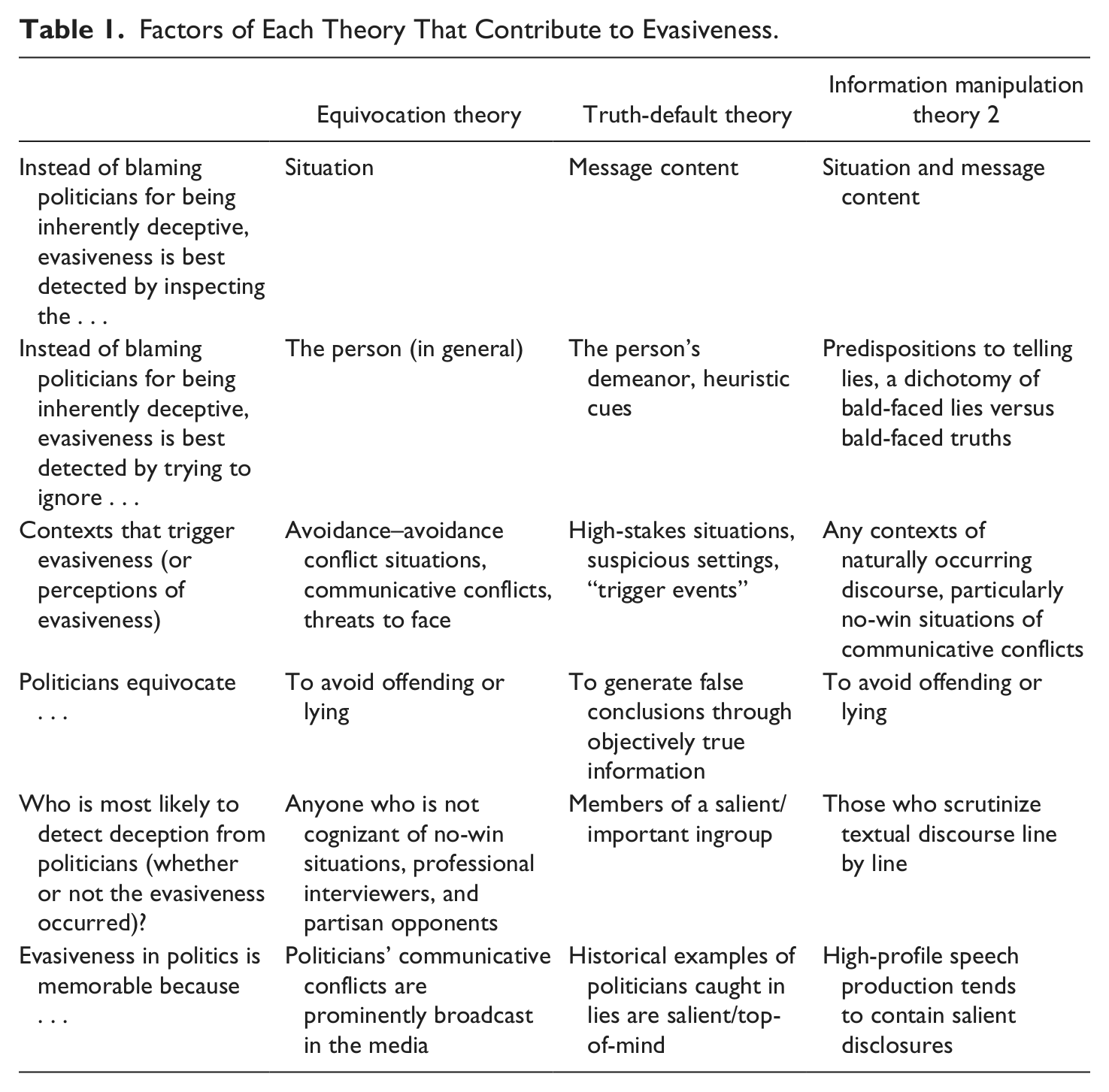
Table 1 summarizes how the different theories collectively contribute to understanding equivocation in political discourse.
Factors of Each Theory That Contribute to Evasiveness.
Hypothesis and Research Questions
As mentioned in our review of the literature, U.S. presidential debates (a) helped inspire equivocation theory, (b) present a multitude of deception detection cues according to TDT, and (c) provide political messages that contribute to our judgments of political evasiveness according to IMT2. Furthermore, presidential debates draw more viewers and influence more voters than any other events (Benoit & Currie, 2001; McKinney & Carlin, 2004).
Because equivocation theory explains that politicians seem to evade questions when they are placed in situations rife with communicative conflict, we predict the following:
To accuse someone of evasiveness is nonnormative in most contexts (Bok, 1999). People rarely, if ever, accuse others of evasiveness in communicative exchanges (Vrij, Granhag, & Porter, 2010). With the exceptions of those who have the professional responsibility of trying to detect deception, such as law enforcement officers or jurists, most people go through their lives hardly ever accusing others of deception (Kalbfleisch, 1994). Such accusations introduce physiological discomfort into discursive transactions and threaten relationships by creating unpleasantness (Healy & Healy, 1915). Calling people liars basically accuses them of violating standards that cut across cultures, religions, and legal ethics—the “most reprehensible, and the core of all human vices” (Karpman, 1949, p. 1). Even police officers feel discomfort when they see their fellow interrogators accuse a criminal suspect of lying, not to mention the tension felt by student participants in studies of mock suspects being accused of lying (Meissner & Kassin, 2002). People consider their own—as well as others’—ratio of lies in social interactions to be minute (DePaulo, Kashy, Kirkendol, Wyer, & Epstein, 1996). If a researcher were to quantify the daily occurrence of allegations of evasion in naturally occurring dialogue, the amount would probably not be significantly different from zero (Olson, 2013). Therefore a statistically significant, nonzero value for allegations of evasion in presidential debate contexts provides a meaningful comparison.
If indeed the candidates frequently engage in allegations of evasion, then that would lead us to wonder if perhaps one side does so more than the other. Every general election U.S. presidential debate since 1996 has pitted a Republican against a Democrat. TDT points to the power of salient ingroups being manipulated by deception in high-stakes suspicious situations. So we ask,
Because studies of equivocation have often examined the discursive strategies employed by politicians to engage in evasions, and the degrees to which they are overt or covert in their tactics, we ask,
To address this question we will adopt a qualitative approach. Major themes might emerge. We may discover that viewers probably think politicians are deceptive because the politicians themselves are accusing each other of such rhetorical malfeasance.
Because equivocation theory explains that politicians will appear to be more evasive through their divisive situation than because of inherent deviousness, in line with TDT and IMT2 we ask whether there is a relationship between accusations of evasiveness and actual occurrences of said alleged evasions. The accuser himself might cloak his own evasiveness within a Q&A in which he alleges that his opponent dodged the question. This can be tested by examining whether the Q&A period that includes an allegation of evasion also includes an off-topic response.
An answer to this question may indicate that when politicians accuse their opponent of dodging questions they are disguising their own desire to change the subject.
Additionally, we can examine the Q&A period in which a politician alleged that his opponent was evasive and see whether the preceding Q&A period did include an off-topic response.
This might indicate whether politicians serve as valid deception detectors of each other, or if their allegations of evasion are rhetorical devices that do not align with off-topic responses by their opponents. As of the latest meta-analysis of debates, 7,202 studies have examined debates from 1976 to 2000 (Jamieson, 2015). Yet one thing that remains “unanswered” is the ways in which “rhetorical cues in debates signal candidate deception or disingenuous promise making” (Jamieson, 2015, p. 92).
Method
We content analyzed the full transcripts of the U.S. presidential debates from 1996 through 2000 and 2012 (n = 14). 2 Our units of analysis were Q&A periods (N = 810).
Coding Topics
As a measure with face validity, for assessing whether the politician was at least minimally correct in alleging evasion by his opponent, we examined the topics of their Q&A periods. Prior research has content analyzed political speech with an emphasis on the topic or issue (Grimmer, 2010). In Bull and Mayer’s (1993) extension of equivocation theory, they posited that sometimes in avoidance–avoidance conflicts politicians do provide direct answers to questions if their response stays within the parameters of the question topic. The underpinnings of equivocation theory were inspired by conversation analysts interested in “topic organization in political interviews” (Bull, 1998, p. 37).
We were coding what Clayman and Heritage (2002) called “the topical focus of inquiry” in Q&A periods (p. 757), as opposed to trying to analyze precise language on a continuum of message clarity or ambiguity, which research of equivocation theory has also attempted in various degrees. Studies of equivocation theory differ substantially in their typologies, settings, and subjects. However, they have in common an interest in how a respondent tries to maintain his or her agenda (or face) in responses to questions, as the interviewer introduces different topics in a situation of communicative conflict (Feldman et al., 2015).
We also delineated Q&A periods by topic because reporters tend to ask complex, multipart questions (Bitzer & Rueter, 1980; Eveland et al., 1994). That is, our study allows for coding of multipart questions by focusing on the topic of the questions rather than a linguistic analysis of the questions themselves. For example, the questions, “Will you attack Syria? Do you disagree with critics about the humanitarian crisis? Or do you think we should not interfere in foreign civil wars?” would be considered one topical question—about the Syria situation—rather than three distinct questions.
Coding Questions
A question was a query or statement proffered for which a response would be expected. If the politician interrupts a questioner once he has an idea what the questioner is asking, we consider the question—so long as enough of the question was asked for us to code its topic.
Coding Answers
We followed Harris (1991) in considering a politician’s response as “whatever follows a question” (p. 82, see also Clayman, 2001). Therefore, responses could be one word, an utterance, a sentence, several paragraphs—or nothing at all (although our data never included an instance of a candidate declining to respond whatsoever to a question). 3 Following Bitzer and Rueter (1980), if the debate’s question asker (i.e., moderator or “undecided voter”) asked a follow-up question in which she or he repeated or rephrased the question, the politician’s subsequent response was coded as another distinct response.
Building on the conceptual distinctions of Bull (2008), Harris (1991), Ekström (2009), and Rogers and Norton (2011) and based on our study’s hypothesis and RQs, we coded each response as to whether it included any combination of the following: Same Topic Response, Different Topic Response, and Allegation of Evasion.
Responses to a question can be answers—“direct” or “indirect” answers (Bowers et al., 1977)—if the audience can make satisfactory assumptions connecting the question to the response (Bavelas et al., 1990). For example, if you ask someone, “Are you attending the party?” and she answers “I wouldn’t miss it for the world,” a “yes” could be implied. So we did not quibble over whether responses provided whole or partial answers nor did we veer into the subjective terrain of what was implied. To discern on- or off-topic responses, we assessed whether the response’s topic linked with the question’s topic.
According to Harris (1991) and Clayman (2001), a response is a direct answer to the question if it (1) answered a “yes” or “no” question, (2) provided a value to a “wh” question (i.e., who, what, where, when, why), or (3) copied/repeated key lexical items from the question. When such a response is coded as pertaining to the same topic as the question, we identify the response as fitting a Same Topic Response. In contrast, if the politician responds to the question by talking about a totally different topic from the one in the question, it would be coded as a Different Topic Response. The Palo Alto group’s categories of equivocal messages included evasions, literal answers, and “sleight of hand” (Sluzki, Beavin, Tarnopolsky, & Verón, 1967), which was “answering a different question than the one asked” (Bavelas et al., 1990, p. 30; see also Rogers & Norton, 2011).
Coding Allegations of Evasion
We operationalized an allegation of evasion as the politician saying that his opponent did not answer the question, dodged the question, or is refusing to answer the question. This was considered distinct from an allegation of dishonesty or lying. (The transcripts did not include any instances when a candidate used the word “deception” or its variations, or “lie” or its variations, to label an opponent’s response. See McGraw, 1998, for some possible reasons why.)
To address RQ4, we created a subset of variables. This was because RQ4 examined whether an off-topic response by a politician actually preceded a Q&A period in which his opponent alleged evasion. So for RQ4 we removed Q&A periods that began debates, because such response blocks did not have a preceding Q&A period. We also manually coded that variable, so that allegations of evasion could be compared with the last Q&A period by the politician’s opponent. For example, in a 2004 debate, Senator Kerry alleged evasion by his opponent, but the preceding Q&A period was Kerry’s. So in such a case we compared that allegation of evasion with Bush’s prior Q&A period that Kerry was addressing. Additionally, in a 2004 debate, President Bush alleged that Kerry had dodged a question in a prior debate, and Kerry accused Bush of mischaracterizing his position outside of the debate setting. Such cases were removed from analysis only for RQ4. Therefore, RQ4 used a subset n = 794.
Coders
Two undergraduate students were trained as coders over the course of 2 weeks. Reliability was assessed via Krippendorff’s alpha (Hayes & Krippendorff, 2007) based on a purposely diverse subset of Q&A periods (Krippendorff, 1980) that comprised 17% of our total sample. 4 Coding for all variables was reliable according to common standards: Same Topic Response: α = .797, Different Topic Response: α = .807, Allegation of Evasion: α = .759, 5 and political party of the candidate: α = 1.0. 6 Data from both of the coders were used in the analyses. Reliability was ascertained in which both coders independently coded the same purposely diverse subset of Q&A periods. As Krippendorff (1980) notes, the reliability subsample “need not be representative of the population characteristics . . . but rather must be representative of all distinctions made within the sample of data at hand” (p. 146, italics in original). Disagreements were handled by reconvening and discussing the marginal differences before proceeding in agreement and splitting the transcripts evenly between the two coders with debates of overlapping years (Krippendorff, 2004).
Results
Equivocation theory explains that we have the impression that politicians are deceptive because of their no-win situation rather than an innate propensity to dodge questions. In this study, we examined a situation that originally inspired the theory—U.S. presidential debates. We took a metacommunication approach to their evasiveness, looking for instances when they accused each other of evasiveness. In line with TDT and IMT2, such an examination of alleged deceptiveness may indicate that politicians have a perception of deception not because we don’t believe them but rather, ironically, because we believe them when they claim honesty for themselves and accuse opponents of evasiveness.
Table 2 presents the percentages of response types (Same Topic Response, Different Topic Response, and Allegations of Evasion) by political party and the year of the debates. Our first hypothesis asserted that the candidates would accuse one another of evasion to a significant degree. In the 14 debates, the candidates accused each other of evasion 51 times. Of the 810 Q&A periods, 6.3% of them had allegations of evasion. A one-sample t test indicated that this amount was significant, t(809) = 7.373, p < .001, 95% CI (confidence interval) [.05, .08].
Percentages of Response Types in Q&A Periods by Year of Debates and Party.

Notes. N = 810 Q&A periods. The percentages are proportions of the total Q&A periods. For example, year 1996 debates featured allegations of evasion 7% of the time, so 93% of the Q&As did not have allegations of evasion. The parenthetical proportions quantify the Democrat on the left and the Republican on the right. For example, in the year 2004 debates, Kerry and Bush evenly gave allegations of evasion 50/50. The Same Topic and Different Topic categories are not mutually exclusive. A Q&A period could include a politician giving both a Same Topic Response and a Different Topic Response.
RQ1 asked if one party accused the other of evasions more. The 51 total allegations of evasion were nearly identical. Democrats hurled 26 and Republicans hurled 25. A chi-square test indicated no difference in the proportions, χ2(1) = .241, p = .623.
Our second RQ asked how the politicians accused each other of evasion. To address this question, a qualitative approach was adopted. Thematic analysis was undertaken to examine how accusations of evasion emerged (Krippendorff, 1980). We divide results for RQ2 into three themes that seemed to give rise to allegations and perceptions of evasion: (1) no-win questions instigating equivocation, (2) overt accusations, and (3) complex questions. No-win questions prompt a politician to equivocate, responding in a way that appears to be evasive (Bavelas et al., 1988). Overt accusations affect perceptions that evasion occurred, which can be unrelated to actual evasiveness, because such allegations are not necessarily founded in an objective reality by the accuser (Levine, 2014). Complex questions include time constraints combined with a complicated issue, making it difficult to reasonably address the question and increase the necessity of equivocation (Bull, 1998; McCornack et al., 2014).
No-Win Questions Instigating Equivocation
In our data set’s first transcript, we see a similar question asked that was the seminal example of equivocation theory. Bavelas et al. (1988) used a presidential debate question about whether the candidates support or oppose gun control as an exemplar of avoidance–avoidance conflict. In the first debate of 1996, moderator Jim Lehrer asked President Clinton and Bob Dole, “Would you seek to repeal the Brady Bill and the ban on assault weapons?” Dole answered basically “yes” and “no.” He said, “I’ve got a better idea” and discussed “the automated check or the instant check.” In Clinton’s retort, he pounced. “Let me say, first of all, Senator Dole has gone back and forth about whether he’d be for repealing the Brady Bill or repealing the assault weapons ban.”
In a 2000 debate, the moderator posed an equivocation-inducing question, asking whether the candidates could keep Social Security solvent without cutting benefits or raising taxes. Gore said that “if we can keep our prosperity going” then yes he could. Bush responded by using the limitations of answer time apportionment—a key trigger for equivocation—against Gore. Bush said, “I thought it was interesting that on the two minutes he spent about a million-and-a-half on my plan, which means he doesn’t want you to know what he’s doing is loading up IOUs for future generations.”
Just as the moderator in 2000 asked the presidential aspirants if they could keep an entitlement program solvent without cutting anything, in the final debate of 2012 the moderator asked the politicians if they could increase military spending without increasing the budget deficit. Romney answered by instead talking about Obamacare. For Obama’s retort, the president said, “He should have answered the first question.”
In their final debate, Bush and Kerry were asked a rather no-win question: “What do you say to someone in this country who has lost his job to someone overseas who’s being paid a fraction of what that job paid here?” Bush answered by talking about his plan to create jobs and strengthen the economy, mentioned some successes in trade, and then said that stronger education standards will improve the workforce. Then Kerry said, “I want you to notice how the president switched away from jobs and started talking about education.”
Overt Accusations
In the first general election debate of 1996, Dole was asked about Cuba, and he answered by talking about Cuba. But then at the end of his response, Dole threw in criticisms of Clinton’s welfare reform, balanced budgets, and tax policy. In his rebuttal, Clinton said, “There were several off-the-subject quaffers in that litany.” (So we can add to our already-overflowing assortment of synonyms for evasions, dodges, equivocations, and slipperiness, another term quaffers.)
Not to be outdone by Clinton’s allegation of Dole being a “quaffer,” Dole later retorted to one of Clinton’s answers by accusing Clinton of spinning a litany of exaggerations. Among his folksy allegation of evasion, Dole provided another synonym for evasiveness, essentially calling Clinton an “exager”: “You know,” Dole said, the President reminds me sometimes of my brother Kenny, who is no longer alive. But Kenny was a great talker. And he used to tell me things that I knew were not quite accurate. So we always had a rule, we divided by six. . . . So it seems to me that we can talk about what we call Kenny, the great exaggerator. He just liked to make it sound exager, a little better, made him feel better.
Dole stuck with the “exager” theme against Clinton. In his final Q&A period of the debate, Dole responded to one of Clinton’s answers by saying, “Well, there he goes again . . . exaggerating all the things that he did.” And in their second debate of 1996, Dole responded to one of Clinton’s answers with, “First, let me say there you go again, Mr. President.”
In their second debate, Gore overtly accused Bush of evasion. After one of Bush’s answers, Gore told the moderator, “He didn’t answer your question directly.” In their third debate, the moderator asked about lowering prescription drug costs. After Bush’s answer, Gore accused Bush of artfully dodging the question: “All right, here we go again. Now look, if you want someone who will spend a lot of words describing a whole convoluted process . . . this is your man.”
In the third Bush/Kerry debate, the moderator asked Bush if he would overturn Roe v. Wade. Bush answered by saying he will not have a litmus test for appointing justices to the Supreme Court. Kerry responded with an overt allegation of evasion: “Well, again, the president didn’t answer the question.”
In the second Obama/Romney debate, Obama told the moderator, “Candy, what Governor Romney said just isn’t true. . . . Governor Romney says he’s got a five-point plan? Governor Romney doesn’t have a five-point plan. He has a one-point plan.” Then again, when talking about gas prices, Obama said, “Very little of what Governor Romney just said is true.” Similarly, in their final debate of 2012, Obama said, “Nothing Governor Romney just said is true.” Romney retorted to one of Obama’s answers by alleging, in part, “Nothing could be further from the truth.”
Complex Questions
Equivocation theory points out that one of the situational causes for equivocation is the near impossibility of providing adequate responses to questions within time limitations. In their second debate, Dole used this against Clinton. An “undecided voter” asked a long-winded and tangential question about whether the candidates’ parties have plans to reduce the capital gains tax. Clinton answered the question by talking about reducing the capital gains tax and contrasted his plan with Dole’s—exactly what the question asked for. As TDT and IMT2 point out, omissions can leave an appearance of deception. In Dole’s response, he exhibited such theories in action. Dole began, “What the president didn’t tell you is . . .” and needled Clinton for details of their plans that differ.
In another example of complex questions and time constraints triggering allegations of evasion, during the first 2012 debate, the moderator asked Romney, “If Obamacare is repealed, how would you replace it?” Romney began his response by saying that his “lengthy description” would exceed the time limits.
In the first 2004 debate, the politicians were asked to describe their plans for world peace. They had 30 seconds to do so and were directed to focus specifically on North Korea, Darfur, and Iran. After Bush gave his 30-second response, Kerry alleged, “Again, he sort of slid by the question.”
Now that we have seen examples of the candidates trading allegations of evasion, our final research questions concerned the Q&A periods in which allegations of evasion appeared. RQ3 asked about a candidate accusing his opponent of evasiveness, and whether he himself exhibited evasiveness by including an off-topic response in his own Q&A period. There was a slight positive correlation of Q&A periods having allegations of evasion and those same Q&A periods also having Different Topic Responses, r = .086, degrees of freedom (df) = 808, p = .014. The allegations of evasion did not correlate with the Q&A period having a Same Topic Response, r = −.024, df = 808, p = .490. So when politicians gave a response in which they alleged evasion by their opponent, that accusation may have been cloaking their own dodging of the question.
RQ4 asked whether a politician’s allegation of evasion was indeed preceded by an off-topic response by his opponent. That is, when a politician accuses his opponent of dodging the question, are claims tied to Same Topic or Different Topic responses? An allegation of evasion may be a rhetorical device to make their opponent appear evasive, or they may be detecting deception accurately. We measured whether accusations of evasion were related to on- or off-topic responses, with chi-square tests. We compared the ratio of accusations of evasion that were linked with Same or Different Topic responses to examine whether the opponent’s preceding Q&A period was indeed on- or off-topic. There was not a significant relationship between allegations of evasion and their opponent’s preceding response being off-topic, χ2(1, 794) = 1.83, p = .177. In fact, of the instances in which politicians accused each other of evasion, their opponent had indeed given an off-topic response in the preceding Q&A period only 35% of the time. And of the instances in which they accused each other of evasion, their opponent’s preceding response had mentioned the same topic of the question 100% of the time. So there were not significant differences between Same Topic Responses aligning with Q&A periods that were next met by an allegation of evasion and those that were not met by an allegation of evasion, χ2(1, 794) = 1.35, p = .245. In other words, politicians were accused of evasion whether or not their answer went off-topic.
Discussion
Recent theorizing about deception focuses less on inherent, purposeful, constant deception than on the opposite occurrence—our human truth-default (Levine, 2014) and naturally occurring speech production (McCornack et al., 2014).
Yet, if truth is our default approach to communication, then why is it that—at least according to popular and academic literature—every time politicians open their mouths we suspect deception? As the old joke goes, “How can you tell when a politician is lying? His lips are moving.” Pervasive perceptions would suggest that this is less a joke than an axiom of deception detection (Harwood, 2014).
Some might argue that politicians present an exception, or boundary condition, to humanity’s truth-default. Perhaps political situations, rather than the people themselves, drive them to appear constantly evasive. Equivocation theory (Bavelas et al., 1988, 1990) asserts that politicians are not intrinsically evasive, but that, rather, the nature of political Q&A situations necessitates evasiveness. For example, interviewers often ask politicians about divisive issues whereby half of the populace would be offended by their answer, and therefore avoiding the controversial issue becomes necessary.
We posit that TDT (Levine, 2014) helps explain our suspicion of politicians and joins helpfully with equivocation theory in its relevance to politicians dodging questions. Furthermore, we suggest that the reason politicians are considered to be the most dishonest people (Gallup, 2014) is not because we do not believe what they tell us. Instead, we suggest the contrary: We believe them when they tell us that their opponents cannot be believed. Plus, we described how IMT2 (McCornack et al., 2014) helps explain how components of political discourse may feed an illusory correlation of pervasive duplicitousness by politicians when in fact politicians are merely engaging in the same message production common to all humans.
From a metacommunication standpoint, one cannot get much more blatant in detecting evasiveness than telling his or her audience that evasiveness occurred. As no-win situations go, one cannot get much deeper in an avoidance–avoidance conflict than political debate settings in which politicians tell their salient ingroup that the opponent dodged the question. Politicians seem to realize that equivocation “in itself can be face-damaging, because it makes the politician look evasive” (Bull & Wells, 2012, p. 38). So perhaps they feel incentivized to preemptively hurl accusations of evasion at their opponents, akin to deliberate “face aggravation” (Bull & Fetzer, 2010; see also Goffman, 1955, 1967). We do not suggest that politicians do not tell lies. We know that politicians have told some whoppers and have been duly caught. When we think of deception in politics, we do not perform a comprehensive, exhaustive search of all Q&A exchanges but are retrieving salient, top-of-mind, accessible events (Zaller, 1992).
In line with equivocation theory, our efforts can be better directed at understanding the situation rather than assuming politicians are intrinsically evasive people. In line with recent theories of deception, our efforts at detection can be more productive by looking at politicians’ metacommunicative messages, particularly messages directed at a believing, salient ingroup. Ironically, our propensity to believe people (i.e., truth-default, truth bias, veracity effect) may be contributing to an exaggerated perception of evasiveness.
Footnotes
Acknowledgements
The author would like to thank William P. Eveland Jr., David C. DeAndrea, the two anonymous referees, and Howie Giles for their insight, encouragement, and valuable comments on this work.
Declaration of Conflicting Interests
The author declared no potential conflicts of interest with respect to the research, authorship, and/or publication of this article.
Funding
The author received no financial support for the research, authorship, and/or publication of this article.