



Abstract
Past research suggested that—from the perspective of perpetrators—animal metaphors are a powerful means to reinforce social exclusion and to foster hostile behaviors against the targets of social exclusion. In the current work, we focus on the consequences of this dehumanizing form of social exclusion from the perspective of victims. In two studies, we manipulated the presence of animal metaphors in a variety of contexts of interpersonal social exclusion. Our results showed that when social exclusion is associated with animal metaphors, its consequences are exacerbated. In particular, labelling targets of social exclusion as animals indirectly caused them to display more aggressive tendencies compared with when they are labelled with corresponding offending, but nondehumanizing, attributes. Crucially, this increased aggressiveness was mediated by higher perceptions of being treated (Study 1) or viewed (Study 2) by others as animal-like. Overall, our research showed the detrimental effects of the interplay between social exclusion and animal metaphors from the perspective of victims.
I am constantly amazed by man’s inhumanity to man.
Social exclusion is an experience that most of us face daily (Nezlek, Wesselmann, Wheeler, & Williams, 2012). Someone may not accept our virtual friendship request, our friends may not add us to a chat group, or they may not tell us about a fun party. Our colleagues may decide not to include us in an important project or not to invite us to an after-work dinner. However, what happens when we are excluded and perceived by others as despicable “worms” or introverted “bears”? What are the consequences of being socially excluded with a denial of one’s own humanity? In the present work, we address these questions by examining the interplay between two relevant processes for social relations, that is, social exclusion and dehumanization.
On the Consequences of Social Exclusion
Being socially excluded is a painful experience, even if it occurs for only a brief time or is enacted by strangers (see, e.g., Williams, Cheung, & Choi, 2000). It indeed frustrates our fundamental need to belong (Baumeister & Leary, 1995). Accordingly, a great deal of research has shown the pervasive consequences of social exclusion for individuals. People who are socially excluded display, for instance, lower self-esteem (Leary, 1990; Leary, Tambor, Terdal, & Downs, 1995), an impairment in self-regulation (Baumeister, DeWall, Ciarrocco, & Twenge, 2006),or an absence of meaningful thoughts (Twenge, Catanese, & Baumeister, 2003). Furthermore, several studies have documented a causal link between social exclusion and increased aggressive tendencies toward the perpetrators of the exclusion (e.g., Schaafsma & Williams, 2012; Twenge, Baumeister, Tice, & Stucke, 2001; Warburton, Williams, & Cairns, 2006).
Of particular relevance to the present work is the growing number of studies (Bastian et al., 2013; Bastian & Haslam, 2010; Bastian, Jetten, & Radke, 2012) that have found a relationship between social exclusion and (self-)dehumanization. In particular, these studies have revealed that episodes of social exclusion lead to a perceived loss of humanness, both for the perpetrators of the exclusion and the victims of social exclusion. For example, Bastian and Haslam (2010) found that people who recall or experience social exclusion view themselves as lacking human nature traits and believe they are perceived as less human with regard to these traits by the perpetrators.
Despite the relevance of these studies, they considered dehumanization as a consequence of social exclusion. In fact, the denial of humanity is not only a consequence of social exclusion but also something that can occur along with the experience of social exclusion itself. Indeed, dehumanization is often associated with instances of social exclusion, thereby allowing perpetrators to reinforce and legitimize their acts against the excluded individuals (Kelman, 1976).
However, little is known about the consequences of these dehumanizing forms of social exclusion from the perspective of the target. To fill this gap, in the present workwe examined the interplay between dehumanization and social exclusion by exploring how people react when facing episodes of social exclusion in association with animal metaphors. We elected to focus on animal metaphors because they represent a means to fuel social exclusion of individuals or whole groups from the human category and to legitimize aggressive behaviors against these individuals or groups.
Animal Metaphors in Social Relationships
Metaphorical language represents a powerful vehicle to describe the world, enabling people to express ideas or concepts in an immediate and vivid manner (Ortony, 1975). Metaphors are also particularly useful in social relationships, because they provide a readily visualized image of a given target and its characteristics (Knowles & Moon, 2006; Kövecses, 2010). Furthermore, metaphors are pervasive as they shape not just our language but also our ways of thinking and acting (Lakoff & Johnson, 1980) in most domains of our life, ranging from everyday interactions to political speeches and media communications. For these reasons, over the past decades, psychology research has shown great interest in understanding the cognitive processes involved in the formation and expression of metaphors (e.g., Allbritton, 1995; Gibbs, 2008) and in analyzing the influence of this linguistic tool on social relationships (Landau, Robinson, & Meier, 2014).
Although there are a great variety of metaphoric labels, the use of animals to describe others is one of the most widespread and relevant usages of metaphors (see Haslam, Loughnan, & Sun, 2011; Maass, Suitner, & Arcuri, 2014). Animal metaphors occur repeatedly in human speech and convey a multiplicity of meanings and feelings that strongly depends on the context and the target of the reference (Kellert, 1997). For example, the metaphorical use of “piglet” assumes a benevolent and funny connotation in a familiar context when referring to our own children, but may become offensive and degrading in a work environment. Regardless of context, recent evidence (Haslam et al., 2011) has suggested that animal metaphors become offensive when they involve animals that conjure up feelings of disgust (e.g., worm) or degradation (e.g., ape). Throughout history, these animal images have been often used in conjunction with social exclusion to prepare the ground for aggression and collective violence. For example, referring to Jews as “rats” or “hyenas” during the Nazi regime greatly contributed to their radical exclusion from German society and to the consequent genocide (Capozza & Volpato, 2004). Similarly, the metaphor that assimilated Tutsis to “cockroaches” was an important antecedent of their moral exclusion from Rwandan society and of the collective violence perpetrated against them (Kellow & Steeves, 1998). In a different and more recent context, Steuter and Wills (2010) reported that the image conveyed by U.S. media portraying enemies as “vermin” contributed to the justification of attacks against them. Supporting these assumptions, Goff, Eberhardt, Williams, and Jackson (2008; Study 5) found that the salience of the image portraying African Americans as “apelike” increased White Americans’ tendencies to morally exclude them and to justify violence against them. Importantly, animalistic–dehumanizing images seem to fuel or promote aggressive behaviors against unknown individuals. In their pioneering work, Bandura, Underwood, and Fromson (1975) revealed that participants administered the most severe electric shock punishments to unknown confederates who were described in animal terms (i.e., “They are an animalistic, rotten bunch”) compared with confederates who were described in human or neutral terms.
Taken together, these studies suggest that—for perpetrators—animal metaphors play a decisive role in exacerbating the consequences of social exclusion and in fostering their aggressive behaviors against victims. Indeed, perceiving (and treating) excluded others as animals allows perpetrators to enact aggressive behaviors against them with less moral restraint (Kelman, 1976; Opotow, 1990). However, it is plausible to predict that these exacerbated aggressive reactions would also pertain to those subjected to dehumanizing experiences of social exclusion. Indeed, we argue that animal metaphors would serve as cues of inhumanity both for perpetrators and victims of social exclusion. In particular, we assume that for the victims the salience of animal metaphors would increase their perceptions of being dehumanized and, consequently, would lead them to feel more legitimized to enact aggressive behaviors against their perpetrators.
The Present Research
We tested these assumptions in two studies. In both studies, we examined the role of animal metaphors within interpersonal settings of social exclusion. In Study 1, we employed a modified version of the popular Cyberball game (Williams et al., 2000; for a meta-analysis of the studies based on this paradigm, see Hartgerink, van Beest, Wicherts, & Williams, 2015). Specifically, participants were socially excluded by two computer-controlled players and, depending on the experimental condition, labelled through animal metaphors (e.g., “You play this game like a dog”) or through corresponding denigrating attributes (e.g., “You are clumsy in playing this game”). Study 2 was designed to test our assumptions in everyday forms of social exclusion. More specifically, we used hypothetical scenarios in which participants were asked to imagine being socially excluded from friendship or working relations through the use of animal metaphors (e.g., “You are excluded because you behaved like a worm”) or through the corresponding attributes endorsed by the metaphors (e.g., “You are excluded because you behaved like a despicable person”).
We predicted that in contexts of social exclusion, the presence of animal metaphors—compared with that of denigrating, but nondehumanizing attributes—would prime the perpetrators’ dehumanizing perspective, thus increasing the victims’ perceptions of being treated (Study 1) or viewed (Study 2) by their perpetrators as animals. In turn, such increased perceptions of animalistic dehumanization would lead victims to more readily enact aggressive behaviors against them. In other words, in both studies, we hypothesized that the victims’ increased perceptions of being dehumanized would mediate the relationship between dehumanizing social exclusion—that is, social exclusion in which the animal metaphors (vs. denigrating attributes) were made salient—and increased aggressive intentions against their perpetrators.
Importantly, in both studies, we hypothesized that the presence of animal metaphors would exacerbate the consequences of social exclusion regardless of the hurt feelings caused by the dehumanizing versus nondehumanizing forms of social exclusion. Indeed, one could argue that the effect of animal metaphors in exacerbating the consequences of social exclusion merely reflects an increase in the targets’ hurt feelings. By contrast, we tested the assumption that it could reflect a specific process linked to the increased awareness of the perpetrators’ dehumanizing perspective that is primed by the salience of animal metaphors.
Study 1
Method
Participants
One hundred and thirty-two (81 females) individuals participated on a voluntary basis. Mean age of participants was 28.85 (SD =12.31). They were randomly assigned to a two-level (social exclusion: dehumanizing vs. denigrating) between-subject design.
Procedure and Materials
Participants were recruited through the social networks of students who participated in a research practicum. Participants received an e-mail containing a link to one of the conditions in our experiment, which was hosted on a departmental research website. To manipulate the different forms of social exclusion (dehumanizing vs. denigrating), we used a modified version of the Cyberball paradigm (Williams et al., 2000). Participants were informed that they were joining others in an online ball toss game with the goal of exercising their mental visualization abilities. They were told that they were playing with two others, who were actually two computer-controlled confederates. Participants were always excluded in the game, receiving the ball once from each computer controlled player at the beginning and then never again. For the purposes of the current study, a chat room was added to the game to manipulate the presence of animal metaphors (dehumanizing social exclusion condition) or denigrating but nondehumanizing attributes (denigrating social exclusion condition). Specifically, participants read the following exchange in the chat room that appeared on their computer screen (the denigrating condition is in brackets—the actual participant was always Player 3):
Hello everyone!
Now I will break you guys in two!
Hey . . . Player 3, you are really a dog [you are really clumsy] at playing this little game!
You are right!!! Player 3 plays like an animal [is incompetent]. . . . You are super slow! You look like a snail [You look like a loser].
Participants were allowed to send a message to the other ostensible players during the first phases of the game. However, after a few seconds, an error message appeared on the screen saying everybody was logged out of the chat due to a technical issue. Thus, the chat was ended.
At the end of the Cyberball game, participants were asked to complete the following measures. First, as a control variable, they were asked to report how hurt they felt during the game (i.e., “I felt hurt”). The participants’ perceptions of being dehumanized were then measured with the item, “During the game I felt I was treated like an animal.” Finally, aggressive intentions toward the other players were measured using 12 items (α = .85) that measured participants’ self-reported temptations to engage in various behaviors (e.g., smiling at the other person [R], humiliating the other person, slapping the other person; Allen & Leary, 2010; Riva, Wirth, &Williams, 2011; adapted from the Straus, 1979; Conflict Tactics Scale) 1 . All responses were made on a 7-point scale (1 = not at all; 7 = very much).
After completing these measures, participants provided demographic information, were thanked for their participation, and debriefed.
Results
We first conducted a series of independent sample t tests on our dependent variables with the experimental condition (social exclusion: dehumanizing vs. denigrating) as the between-subject variable. The first t test revealed that the manipulation did not affect the participants’ feelings of hurt, t(130) = 0.95, p = .34, thus indicating that social exclusion in association with animal metaphors and social exclusion in association with denigrating attributes were perceived as not differently hurting. The same t test revealed that the manipulation had an effect on participants’ perceptions of being dehumanized, t(130) = 2.23, p = .03, d =0.39. That is, participants who were socially excluded through animal metaphors perceived themselves as being treated more like animals (M =3.49, SD =2.34) than participants who were socially excluded through denigrating attributes (M =2.66, SD =1.91). Instead, the t test revealed that the experimental condition did not directly affect aggressive tendencies, t(130) = 1.40, p = .16.
We then conducted a mediation model using a bootstrap analysis (Preacher & Hayes, 2004) to verify our main hypothesis—that the effects of social exclusion with animal metaphors (vs. denigrating attributes) would increase participants’ perceptions of being dehumanized and that, in turn, such perceptions would mediate the relationship between dehumanizing (vs. denigrating) social exclusion and aggressive tendencies. Results showed that the experimental condition (dummy coded as 1 = dehumanizing exclusion, 0 = denigrating exclusion) significantly predicted enhanced perceptions of being dehumanized, b =.84, SE = .38, t(130) = 2.22, p =.03. In turn, such perceptions positively affected the aggressive tendencies against the other two players, b = .17, SE = .05, t(129) = 3.59, p <.001. Crucially, the indirect effect of the experimental condition on aggressive tendencies through perceptions of being dehumanized was significant, a×b = .14, 95% confidence interval (CI) [0.024, 0.325].
Thus, supporting our hypotheses, the findings from Study 1 suggest that the co-occurrence of social exclusion and animal metaphors indirectly exacerbated participants’ aggressive tendencies through an increased perception of being treated as animal-like.
Study 2
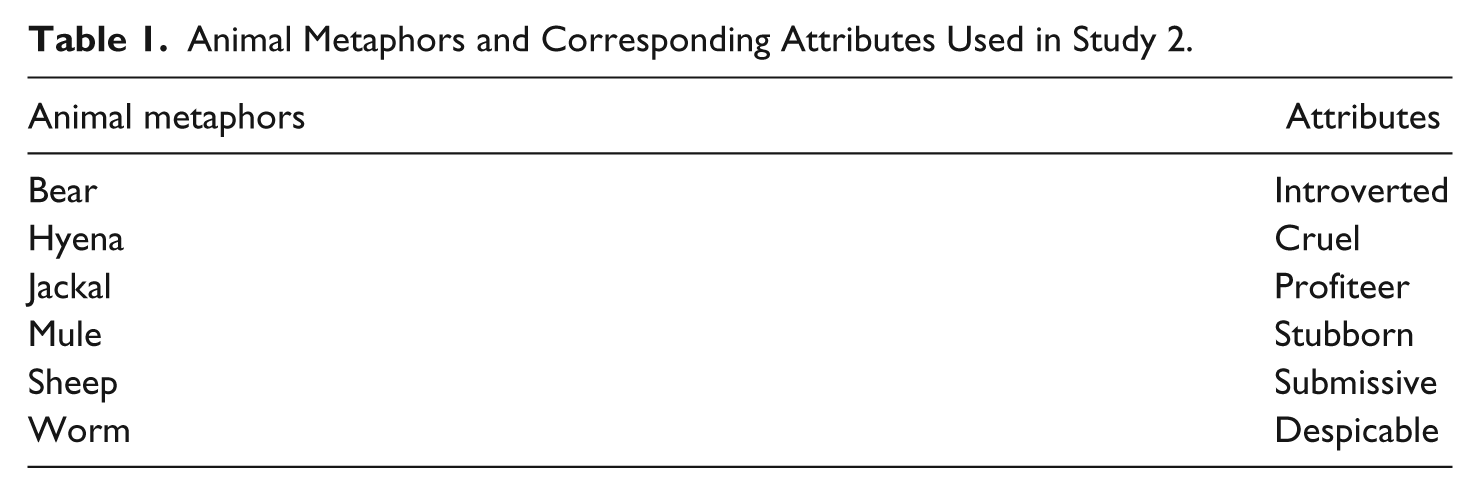
Study 2 was designed to replicate and extend the pattern of results obtained in Study 1. More specifically, in Study 2, we employed a series of hypothetical scenarios in which participants were asked to imagine being excluded from meaningful social groups. In these scenarios, depending on the experimental condition, participants were socially excluded in conjunction with animal metaphors (e.g., worm; dehumanizing social exclusion condition) or with the corresponding denigrating attributes (e.g., a despicable person; denigrating social exclusion condition). To extend the generalizability of our findings, we considered six animal metaphors in common usage in the Italian language with the corresponding six attributes (see Table 1). Similar to Study 1, we hypothesized that the presence of animal metaphors would increase participants’ aggressive tendencies through a perception of being less than human. To further corroborate the mediator role of dehumanizing perceptions, in Study 2, we employed a multi-item measure (Bastian & Haslam, 2011) detecting the extent to which participants believed of being viewed as animals by their perpetrators. By doing so, we aimed at verifying whether people’s perceptions that others view—rather than treat—them as less than human would also mediate the relationship between the dehumanizing (vs. denigrating) forms of social exclusion and increased aggressiveness.
Animal Metaphors and Corresponding Attributes Used in Study 2.
Method
Participants
One hundred and sixteen (84 females) Italian undergraduates participated on a voluntary basis. The mean age of participants was 21.13 (SD =4.06). They were randomly assigned to a two-level (social exclusion: dehumanizing vs. denigrating) between-subject design.
Procedure and Materials
Participants completed a two-part questionnaire. They were presented with two different scenarios, each of which described an episode of social exclusion, one from a group of friends and one from a working group. They were asked to imagine themselves as the socially excluded person in the scenario. Depending on the experimental condition, participants were randomly assigned to read two scenarios of social exclusion with animal metaphors (dehumanizing social exclusion condition) or two scenarios of social exclusion with negative attributes endorsed by animal metaphors (denigrating social exclusion condition). We considered six different animal metaphors and six corresponding denigrating attributes (Table 1). Accordingly, we created a set of 12 scenarios—six for each condition (see the appendix, for example of scenarios)—that were randomly coupled and systematically varied across participants in six different versions of the questionnaire—three for each condition.
After reading each scenario, participants were asked to report how hurt they felt when imagining the scenario (“I felt hurt”). Furthermore, the perceptions of being viewed by others as animal-like were assessed using a 10-item scale (α = .78; e.g., “The other persons in the scenario see me as immature,” “The other persons in the scenario see me as an animal,” “The other persons in the scenario are treating me as if I was a child”) adapted by Bastian and Haslam (2011). Finally, they were asked to rate their aggressive intentions against the other persons in the scenario using the same 12 items (α = .81) used in Study 1. All responses were provided on a scale from 1 (not at all) to 7 (very much so). After completing these measures, participants provided demographic information and were fully debriefed.
Results
As the preliminary analyses revealed that the different versions of the questionnaire did not affect our dependent variables (Fs< 2.19, ps> .11), the data were collapsed across the different versions.
Similar to Study 1, we first verified whether the experimental conditions (dehumanizing vs. denigrating) were perceived as causing different levels of hurt. Unlike Study 1, there was a marginally significant effect of the condition on the reported hurt feelings, t(114) = 1.84, p = .07, d = 0.34. Specifically, hurt feelings were higher in the scenarios with dehumanizing exclusion (M = 5.35, SD = 1.23) than they were in the scenarios with denigrating exclusion (M = 4.87, SD = 1.55). Hence, we conducted a series of analyses of covariance on our main dependent variables in which hurt feelings were considered as the covariate.
Regarding perceptions of being viewed by others as animal-like, results revealed the expected effect of the experimental condition, F(1, 115) = 5.30, p =.02, η p 2 = .05. Specifically, participants who were excluded with animal metaphors believed that others viewed them as animal-like (M = 3.33, SD = 0.75) more often than did participants who were excluded using denigrating but nondehumanizing attributes (M = 2.92, SD = 0.88). Furthermore, the analysis showed that the experimental condition also affected participants’ aggressive tendencies, F(1, 115) = 3.72, p =.05, η p 2 = .03, as participants who were excluded through animal metaphors displayed more aggressive tendencies (M = 4.03, SD = 0.88) than participants who were excluded through corresponding negative attributes (M = 3.58, SD = 1.00).
Finally, we conducted a mediation model using bootstrap analysis (Preacher & Hayes, 2004) to verify whether the effects of social exclusion with animal metaphors (vs. denigrating attributes) on aggressive tendencies were mediated by increased perceptions of being viewed by others as animal-like. Consistent with previous analyses, we found that the experimental condition (1 = dehumanizing exclusion, 0 = denigrating exclusion) positively predicted such perceptions, b =.17, SE = .08, t(113) = 2.30, p = .02, which, in turn, significantly increased participants’ aggressive tendencies against those who socially excluded them, b = .22, SE = .10, t(112) = 2.25, p = .03. Supporting our mediation hypothesis, the indirect path from the experimental condition to aggressiveness through dehumanizing perceptions was significant, a×b = .04, 95% CI [0.006, 0.1006], indicating that animal metaphors exacerbated participants’ aggressive tendencies through an increased perception that others view them as less than human. All of these effects were significant also when controlling for the perceived hurt.
In sum, Study 2 provided further support for our hypotheses by expanding the findings of Study 1. Participants who were asked to imagine hypothetical scenarios in which they were socially excluded and assimilated to animals displayed more aggressive tendencies than did participants who were socially excluded and offended with denigrating (but no dehumanizing) attributes. Crucially, these effects occurred regardless of the hurt feelings caused by each type of message and accounted for the victims’ perception of the dehumanizing image held by the perpetrators.
Post-test
We conducted a post-test to control for possible confounding effects linked to the perceived severity of the animal metaphors versus the denigrating attributes. This post-test involved 66 Italian undergraduates (55 females; Mage = 24.56, SD = 8.29) who were asked their voluntary participation to an online survey. Participants were presented with two lists of words including the nine animal metaphors and the nine attributes that we employed in both studies. In both lists, we also added four fillers (e.g., lion for the animal metaphor list, brave for the attributes). Participants were asked to judge each list of metaphors and adjectives for different dimensions, including valence (“To what extent do you think that the following animals [adjectives] are positive or negative when they are used to describe a person?”), perceived offensiveness for the recipient (“To what extent do you think that the following animals [adjectives] are offensive for the recipient?”), and perceived intention to offend for the speaker (“To what extent do you think that the following animals [adjectives] imply intentions to offend for the speaker?”). For each dimension, the order of presentation of the animal metaphor list and the adjective list was counterbalanced across participants. All items were rated on a 7-point scale which ranged from 1 = very negative to 7 = very positive for the ratings of valence, from 1 = not at all to 7 = very much for the ratings of perceived offensiveness and intentions to offend.
A series of paired t tests revealed that the pool of animal metaphors (M = 2.37, SD = 0.65) was judged as not different in terms of valence from the pool of adjectives (M = 2.49, SD = 0.56), t(65) = 1.76, p = .085, 95% CI [−0.252, 0.016]. Similarly, no significant differences emerged for the two dimensions measuring the offensiveness of the stimulus, ts(65) < 1.40, ps> .19. Thus, the results of the present post-test suggest that, outside the context of social exclusion, animal metaphors and the corresponding adjectives did not differ in terms of valence or offensiveness. However, it is important to note that even when found a marginal greater perceived hurt of the scenarios including animal metaphors (vs. denigrating attributes), the expected effects remained significant when controlling for this variable. In other words, we do not exclude that some animal metaphors may be perceived as more negative or offensive than the corresponding adjectives, but at the same time, we argue that animal metaphors (compared with their corresponding attributes) play a distinctive role in increasing the participants’ aggressiveness, regardless of their possible greater negative valence.
Through the same post-test, we also empirically verified whether the animal metaphors of Study 2 were actually associated with the corresponding attributes. After having judged the metaphors and the attributes for valence and degree of offensiveness (see point above), participants were presented with the six animal metaphors of Study 2 coupled with the corresponding attribute (e.g., bear/introvert). Eight fillers were also included, they consisted in couples of metaphors/adjectives that are not commonly associated (e.g., rabbit/dishonest) in the Italian language or that convey a positive meaning (e.g., fox/astute). Participants were asked the extent to which they perceived each animal as associated with the coupled adjective when used to describe a person (1 = not at all; 7 = very much). Results showed that the six animal metaphors employed in Study 2 were considered as strongly associated with their corresponding adjective (M = 5.75, SD = 0.84), difference from the midpoint of the scale (4), t(65) = 16.83, p< .001.
General Discussion
Dehumanizing representations, particularly animal metaphors, are powerful tools that fulfill a number of functions for individuals or groups, such as the legitimization of aggressive behaviors against others (see Bar-Tal & Hammack, 2012) or the maintenance of a sense of superiority relative to others (e.g., Santa Ana, 2012; Volpato, Durante, Gabbiadini, Andrighetto, & Mari, 2010). In the present work, we focused on the role of animal metaphors as means of reinforcing social exclusion. We explored whether the use of animal metaphors in episodes of social exclusion affects the victims’ psychological reactions. Across two studies that considered diverse scenarios and animal metaphors, we found that the consequences of social exclusion were more severe when victims felt dehumanized by the perpetrators’ use of animal metaphors than when a similar experience was accompanied by denigrating (but no dehumanizing) attributes. More specifically, our findings show that the salience of animal metaphors (vs. corresponding denigrating attributes) amplifies people’s beliefs that others treat (Study 1) and view (Study 2) them as animal-like. In turn, such increased perceptions of being animalistically dehumanized exacerbate people’s aggressive temptations against the source of social exclusion.
Importantly, one could argue that these effects would be due to the presumable more severe content of the animal metaphors. However, the findings of the post-test ruled out this alternative explanation, as they revealed that the animal metaphors that we selected did not differ from their corresponding denigrating attributes in terms of valence and perceived offensiveness. As further confirm of the specific role of the animal metaphors as vehicle of inhumanity, it is noteworthy that the predicted effects occurred regardless of the perceived hurt that the experience of social exclusion conveys.
The latter finding is consistent with earlier works showing that the initial (i.e., reflexive) hurt feelings that social exclusion elicits seem to be immune to moderating factors (Gonsalkorale & Williams, 2007). Indeed, from an evolutionary perspective, something that threatens survival should be initially perceived by the individual as a strong signal irrespective of its ancillary features. Nevertheless, it has been shown that situational variables can moderate the ways in which individuals react and cope with episodes of ostracism and social exclusion, such as conformity versus aggression (for a review, see Williams, 2009). Accordingly, our research suggests that animal metaphors increase the aggressiveness elicited by social exclusion.
Previous research (Bastian et al., 2012; Bastian et al., 2013; Bastian & Haslam, 2010) has demonstrated a causal link between social exclusion and (self-)dehumanization. Our investigation advances this existing literature by providing an integrated view of these two phenomena as concurrent antecedents of aggressive intentions against others. We believe that analyzing the toxic combination between social exclusion and dehumanization is highly relevant as dehumanization discourses often accompany episodes of social exclusion by legitimizing and reinforcing them. Furthermore, our findings extend the current psychological literature on dehumanization as a facilitator of aggressive behaviors against others (see, e.g., Alleyne, Fernandes, & Pritchard, 2014; Bandura et al., 1975; Rudman & Mescher, 2012; Viki, Osgood, & Phillips, 2013). Indeed, while previous work focused on the perpetrators of dehumanizing acts, our work focused on the victims of these acts and showed that cues of dehumanization also affect the victims’ reactions, at least within contexts of social exclusion. More specifically, our studies show that in these contexts being metaphorically assimilated to animals has an indirect effect on increase victims’ aggressive tendencies against their perpetrators through the mediation of increased perceptions of being animalistically dehumanized.
We contend that the above mediational path gains further salience when considered together with the perpetrators’ perspective, as it helps explain the “circle of inhumanity” (Bastian & Haslam, 2010) that seems to characterize contexts of social exclusion. Indeed, such path clarifies that perceptions of being dehumanized are important antecedents of increased aggressiveness toward others for both perpetrators and victims, and that, in both cases, animal metaphors are critical cues shaping such perceptions. Thus, the salience of animal metaphors and the consequent increased perceptions of being dehumanized heighten the risk of mutual and retailed aggressiveness within these contexts. Even before this empirical evidence, the “circle of inhumanity” and the internalization of dehumanizing acts emerged in the analysis (Volpato & Contarello, 1999) of Primo Levi’s (1958) If This is a Man, one of the most important and valuable testimonies of the Holocaust. According to Levi, both oppressors and victims of the Holocaust shared a tragic and often permanent impoverishment of humanness. In Levi’s (1958) eyes,
The personages in these pages are not men. Their humanity is buried, or they themselves have buried it, under an offence received or inflicted on someone else. [ . . .] all the grades of the mad hierarchy created by Germans paradoxically fraternized in a uniform internal desolation. (pp. 127-128)
There are several limitations to be considered when interpreting our findings and when engaging in future research.
First, although we believe that increased perception of being dehumanized is a relevant mechanism underlying our effects, other factors linked with the peculiar properties of animal metaphors could concur to further account for the effects we found. In particular, it is possible that animal metaphors would be more powerful tools than denigrating adjectives in eliciting victims’ aggressive reactions because they provide more essential and visible traits than adjectives do, thus seriously threatening the victims’ individual integrity. For example, being socially excluded and being perceived as a dog could more likely impair something of essential, unchanging, and visible about the self.In contrast, being socially excluded and considered as incompetent could more likely imply a more hidden personal quality that can vary across time and situations. Thus, future research should investigate whether the perceived threat to the personal integrity mediates the relationship between dehumanizing (vs. nondehumanizing) forms of social exclusion and increased aggressiveness. Furthermore, one may argue that in our studies animal metaphors had a greater impact on participants’ reactions than denigrating attributes because the metaphors are commonly expressed by virtue of nouns (e.g., You are a mule), whereas the attributes are commonly expressed by virtue of adjectives (e.g., You are stubborn). Indeed, recent research (Carnaghi et al., 2008) revealed that nouns (e.g., Mark is a schizophrenic) have a greater impact than adjectives (e.g., Mark is schizophrenic) on the perception of a given target, as nouns have a greater potential informative and lead people to draw more (stereotypically congruent) inferences about the target than the adjectives. However, we see this interesting alternative explanation rather unlikely for our findings. First, in our studies the nouns (i.e., the animal metaphors) and the attributes were manipulated to assess perceptions and intentional behaviors regarding the participants themselves, rather than perceptions regarding a target person. Second, it is noteworthy that in Study 2, our scenarios of social exclusion considered denigrating attributes that were not expressed by virtue of adjectives (e.g., You are submissive) but by virtue of nouns (i.e., You are a submissive person). 2
From a methodological point of view, one potential limitation is that in both studies we did not include conditions in which participants were socially included (vs. excluded). That is, we manipulated the salience of animal metaphors (vs. denigrating attributes) only within scenarios of social exclusion. If considering social inclusion conditions would have provided us with a more stringent test for our hypotheses, we decided to not consider them for different reasons. First, being dehumanized and socially included appeared to us as contradiction, especially from a historical and theoretical perspective. Indeed, as we outlined in the introduction, the animal metaphors could signal per se social exclusion, both in interpersonal and intergroup relations. Furthermore, it is possible that such a condition (i.e., being dehumanized and socially included) would have led to a loss of credibility and meaning of our scenarios. In particular, it is plausible to imagine that in contexts of social inclusion the recipients’ interpretations of animal metaphors would be radically different from those in contexts of social exclusion. For example, the animal metaphor “hyena” could even assume a funny or a playful meaning when the social inclusion of the recipients is made salient. Although it will be interesting to examine the co-occurrence of contradictory elements such as social inclusion and animal metaphors, this was outside of the scope of the current work, which considered the occurrence of animal metaphors or denigrating attributes within social exclusion settings. Alternatively, it will be interesting to compare the use of animal metaphors in social exclusion contexts with the use of same metaphors in negative but no excluding contexts (e.g., critiquing someone’s manners). However, although these contexts would not presumably lead to a loss of credibility of the scenarios, we insist that they should be considered with caution. Indeed, as animal metaphors could convey per se social exclusion, it is possible that the recipients of dehumanizing offenses would inevitably interpret them as cues of exclusion, even if they do not explicitly imply it. Thus, it would be particularly difficult to disentangle scenarios in which animal metaphors are used to offend but to not exclude someone from scenarios in which animal metaphors are used to reinforce the social exclusion.
A further limitation concerns the generalization of our findings. Indeed, we do not assert that our findings generalize to all types of animal metaphors. We opted to focus on animal metaphors that are of common parlance in Italy and particularly relevant within contexts of social exclusion. However, the offensiveness of animal metaphors is explained by several contextual factors and by the types of attributes that they ascribe to their targets (Haslam et al., 2011). Thus, it is plausible to expect that noninsulting or benevolent animal metaphors could not worsen the consequences of social exclusion—by contrast, they could even lead to milder effects than the corresponding negative attributes. Therefore, future research should more systematically map the key features that animal metaphors should possess to worsen the effects of social exclusion.
Finally, we verified the detrimental effects of the interplay between social exclusion and dehumanization within virtual (Study 1) and imagined (Study 2) interpersonal interactions. Future studies should investigate whether a similar pattern of results emerges also within intergroup settings and, thus, when the individual faces dehumanizing social exclusion from a group member’s perspective.
Overall, this research provides support for the assumption that animal metaphors are forceful linguistic tools that not only shape perpetrators’ ways of thinking and ways of behaving but also decisively affect the reactions of the recipients of these dehumanizing representations by increasing man’s inhumanity to man.
Footnotes
Appendix
Acknowledgements
The authors would like to thank the editor and two anonymous reviewers for their generous and helpful feedback on earlier versions of the article.
Declaration of Conflicting Interests
The author(s) declared no potential conflicts of interest with respect to the research, authorship, and/or publication of this article.
Funding
The author(s) received no financial support for the research, authorship, and/or publication of this article.