




Abstract
This study examined how six different ethnolinguistic groups in Windhoek, capital of Namibia, adjust their language use during intergroup encounters. Invoking communication accommodation theory, we predicted that relatively low-vitality groups (high-vitality groups) would be inclined towards linguistic convergence (maintenance), but that these general patterns would be moderated by prevailing sociocultural norms and each group’s language proficiency. These hypotheses were largely supported. Relatively low-vitality groups tended to linguistically converge (typically via lingua francas), whereas relatively high-vitality groups tended to engage in linguistic maintenance. This resulted in two distinct patterns of adjustment: (a) symmetrical accommodation in interactions involving groups of relatively equal vitality, typically consisting of mutual convergence to lingua francas or mutual maintenance of a shared heritage language and (b) asymmetrical accommodation in intergroup interactions involving groups of relatively unequal vitality, typically consisting of upward convergence among lower vitality groups, and maintenance among higher vitality groups.
Social encounters between different ethnolinguistic groups are the norm, rather than the exception (Bourhis, Sioufi, & Sachdev, 2012; Sachdev, Giles, & Pauwels, 2013). Such encounters, which frequently involve multilingual individuals who share one or more languages in common, necessarily require a negotiation of language use. Consider, for example, a seemingly mundane interaction between two individuals who belong to different ethnolinguistic groups but know each other’s native languages well. When one poses a question in her own native language to the other, she may receive a reply in (a) her own native language, (b) the other’s native language, (c) an ethnically neutral lingua franca, or (d) a combination of two or more languages (i.e., code-switching: see Gardner-Chloros, 2009; Grosjean, 1982). Different motivations are likely to underlie each of these responses and each is likely to have different relational implications.
One theory that is particularly poised to address and explain the complexities underlying language choice during interethnic and multilingual encounters is communication accommodation theory (CAT; Dragojevic, Gasiorek, & Giles, 2016; Gallois, Ogay, & Giles, 2005). CAT is a sociopsychological theory that explains how, when, and why people adjust, or “accommodate,” their communication during social interaction and what social consequences those adjustments have. It accounts for adjustments that take place during both interpersonal encounters—that is, when people define one another primarily in terms of their personal identity—and intergroup encounters—that is, when people define one another primarily in terms of their social identity (Dragojevic & Giles, 2014; Gallois et al., 2005). Since its inception in the 1970s (Giles, 1973), CAT has been successfully invoked across a wide range of cultures, languages, and contexts, using a diverse array of methodologies (Giles, 2016). Although CAT has also been frequently applied to understand language choice during interethnic and multilingual encounters, past studies in this area have primarily been restricted to bilingual contexts or else on the analysis of the linguistic behaviours of only two different groups at a given time (e.g., Bourhis, 1984, 1991; Bourhis & Sachdev, 1984; Landry & Allard, 1994; Stell, 2012). Although invaluable, such studies may not fully capture the complex dynamics of most multilingual contexts, which often consist of many different ethnolinguistic groups who may adopt quite different, and likely contrastive, accommodative strategies depending on who they are interacting with (cf. Bourhis, El-Geledi, & Sachdev, 2007).
With this in mind, the present study seeks to contribute to the CAT literature, specifically, and the study of multilingual and interethnic communication, more generally, by examining how six different ethnolinguistic groups, who are in daily contact in Windhoek, Namibia, adjust their language use during intergroup encounters. In the sections that follow, we first provide a brief overview of CAT, focusing on the different types of adjustment, the motives for and consequences of adjustment, and the role of macro-level factors in adjustment. Then, we contextualize and describe the present study and report our findings.
Communication Accommodation Theory
Convergence, Divergence, and Maintenance
CAT posits that people can adjust their communicative behaviours relative to one another across a wide range of linguistic (e.g., language), prosodic (e.g., pitch), and nonverbal (e.g., smiling) behaviours in three basic ways (Giles, Coupland, & Coupland, 1991). 1 Convergence refers to a strategy whereby people adjust their communicative behaviours to become more similar to another’s. For example, Bourhis (1984) had a female confederate approach Anglophone and Francophone pedestrians in downtown Montreal (Quebec) to ask for directions in either English or French. When the request was voiced in English, nearly all of the Francophone pedestrians responded in English (i.e., converged to the requestor’s language). Sometimes, however, interactants may not know each other’s native languages. In such situations, convergence can be achieved by shifting to a third language that both speakers share (i.e., a lingua franca). In contrast, divergence refers to a strategy whereby people accentuate speech and nonverbal differences between themselves and others so as to appear more dissimilar. For instance, Bourhis and Giles (1977) found that when an English interviewer threatened their ethnolinguistic identity, Welsh participants broadened their Welsh accent and some even introduced Welsh vocabulary in their responses. Finally, maintenance refers to a strategy whereby people sustain their “default” way of communicating without adjusting for others. For example, in the Bourhis (1984) study cited above, when the confederate voiced her request in French, nearly half of the Anglophone pedestrians nonetheless responded in English (i.e., maintained their default language).
Sometimes accommodation is symmetrical and one person’s communicative shifts are reciprocated by the other. Other times, however, accommodation is asymmetrical and one person’s shifts are not reciprocated by the other. Indeed, convergence is often directed towards those of greater power, without reciprocation from the high-power speaker (Dragojevic et al., 2016). For example, Bourhis (1991) reported that Francophones were much more likely to linguistically converge to Anglophones than vice versa in government offices in New Brunswick, Canada, presumably due to the higher status of English, relative to French, in that context.
Motives and Consequences
CAT posits that communicative adjustment serves two primary functions during social interaction (Dragojevic et al., 2016). The first, termed the affective function, is to manage identity concerns. In line with social identity theory (Tajfel & Turner, 1986), CAT assumes that the self-concept consists of personal (i.e., idiosyncratic characteristics) and social (i.e., social group memberships) identity components and that people want to create and maintain positive personal and social identities. Given that communication conveys not only referential but also social and relational information, CAT posits that speakers can use communication to regulate social distance—that is, to affiliate or disaffiliate with individuals and groups—in the pursuit of positive personal and social identities. The second, termed the cognitive function, is to regulate comprehension.
Convergence is motivated by a desire for social approval from one’s interlocutors, as a means to positively reinforce one’s own personal and/or social identity. In line with the similarity–attraction paradigm (Byrne, 1971), CAT posits that speakers can increase personal and social liking and gain others’ social approval by becoming communicatively more similar to them (i.e., converging). Motivated as such, speakers may converge to their interlocutors’ idiosyncratic (e.g., speech rate, gestures) and/or socially marked (e.g., language, dialect, accent) communicative characteristics so as to appear more similar to them and, thus, secure potential social rewards. Convergence can also be motivated by a desire to increase comprehension (Gasiorek, Van de Poel, & Blockmans, 2015). For instance, members of two different ethnolinguistic groups who have only limited proficiency in each other’s native languages may choose to mutually converge to a lingua franca they both know well in order to maximize communicative efficiency.
Convergence generally elicits favourable evaluations (for an overview, see Dragojevic et al., 2016), especially if it is attributed internally to a speaker’s positive intent, rather than to external pressures (e.g., situational norms; Simard, Taylor, & Giles, 1976). However, convergence can also entail costs as well as benefits. For instance, although linguistic minorities may garner social and economic rewards by converging to the language of dominant groups, such behaviour may also inadvertently invite ridicule and lead to social marginalization within their own linguistic community (see Giles & Marlow, 2011; Hogg, D’Agata, & Abrams, 1989).
Divergence and maintenance are motivated by a desire to emphasize distinctiveness from one’s interlocutors, as a means to positively reinforce one’s own social and/or personal identity (Giles et al., 1991). Divergence and maintenance are especially likely to occur during intergroup encounters. Because language is often a core dimension of social identity (Fishman, 1977; Giles, Taylor, & Bourhis, 1977), divergence and/or maintenance on this dimension may be used as a strategy to positively differentiate oneself from relevant out-groups (cf. Tajfel & Turner, 1986). Accordingly, members of ethnic and social minorities may emphasize features of their own dialects when they become aware and proud of their cultural identity, as a way to dissociate themselves from relevant out-groups (Bourhis, Giles, Leyens, & Tajfel, 1979). Speakers may also diverge from their interlocutors’ idiosyncratic communicative characteristics as a way to signal their disapproval of others as individuals. Like convergence, divergence and maintenance can also be motivated by a desire to regulate comprehension. For instance, speakers may diverge from their interlocutors to encourage the latter to adopt a more effective communication style (Brown, Giles, & Thakerar, 1985) or, in some cases, even to hinder communication.
Divergence and maintenance generally elicit unfavourable evaluations (for an overview, see Dragojevic et al., 2016), especially when they are attributed internally to a speaker’s negative intent, rather than to external pressures (Gasiorek, 2013; Gasiorek & Giles, 2012; Simard et al., 1976). However, divergence and maintenance may sometimes garner positive evaluations from one’s in-group. In this vein, Tong, Hong, Lee, and Chiu (1999) found that 1 year prior to Hong Kong’s handover to the People’s Republic of China, Cantonese speakers who diverged from Mandarin-speaking Chinese by emphasizing their Cantonese linguistic identity were evaluated more positively by members of their in-group than those who converged to Mandarin.
Sociocultural Norms and Ethnolinguistic Vitality
CAT recognizes that interaction does not occur in a social vacuum, but is rather embedded in a larger sociohistorical context. Two macro-level factors, among others, proposed to influence people’s motives and intentions with respect to accommodation are sociocultural norms and ethnolinguistic vitality (see Dragojevic et al., 2016). Sociocultural norms specify with whom, when, and how it is appropriate to communicate (Gallois & Callan, 1991). As such, they can constrain the opportunities for accommodation. For example, it is often expected that speakers will converge to those who speak higher status or prestige language varieties, particularly in status-stressing situations, such as a job interview (Bourhis, 1991; Giles & Marlow, 2011; Marlow & Giles, 2010). Ethnolinguistic vitality is defined as “that which makes a group likely to behave as a distinctive and collective entity in intergroup relations” (Giles, Bourhis, & Taylor, 1977, p. 308). A group’s vitality is determined by three factors: its status (i.e., economic and sociocultural prestige), demography (i.e., number of in-group members and their distribution), and institutional support (i.e., representation in government, media, etc.; see Giles & Johnson, 1987). An ethnolinguistic group’s position on each of these dimensions can be assessed and combined to provide an overall classification of the group as having low, medium, or high vitality. CAT posits that, all else equal, members of low-vitality groups are more likely to converge to members of high-vitality groups than vice versa (see also Sachdev et al., 2013).
Summary
In sum, accommodation serves two primary functions in interaction. First, adjustment helps manage identity concerns: People converge to those they like or want to affiliate with and diverge from those they dislike or want to disaffiliate from. Second, adjustment helps regulate comprehension: People converge when they wish to facilitate communication and diverge when they wish to refocus, or even hinder, communication. People’s motives and intentions with respect to accommodation are influenced by various macro-level factors, including sociocultural norms and group vitality. People are more likely to converge when such behaviour coincides with prevailing norms and when they are members of relatively low-vitality groups. In contrast, they are more likely to engage in maintenance and divergence when such behaviour coincides with prevailing norms and when they are members of relatively high-vitality groups.
The Setting
Guided by the CAT framework outlined above, the present study examined how six different ethnolinguistic groups adjust their language use relative to one another during intergroup encounters in Windhoek, capital and main urban centre of Namibia. Namibia is a multiethnic and multilingual country in Southern Africa, bordered by Zambia and Angola to the north, Botswana to the east, and South Africa to the south. As a former dependency of South Africa, Namibia had until its independence in 1990 experienced a regime of apartheid devised to protect the dominant position of a small, White minority at the expense of a non-White majority. Instrumental in pursuing that aim was the socioeconomic subjugation of the non-White population and its division into distinct population groups defined in a combination of ethnoracial and linguistic terms. First among these was the division of the non-White groups into “Blacks” and “Coloureds,” laying the foundations for a social hierarchy in which Blacks occupied the lowest socioeconomic position, and Coloureds an intermediate one between Blacks and Whites (cf. Giliomee & Schlemmer, 1993). Blacks were further subdivided into distinct ethnic groups, most of them assigned distinct “Homelands,” urban residential areas, and educational amenities. Prior to 1990, Afrikaans, English, and German were all recognized as official languages in Namibia. Despite this, Afrikaans—the heritage language of Whites and Coloureds—was de facto dominant in public settings. Ethnic groups with a native language other than Afrikaans were subject to a regime of bilingual education in which their respective mother tongue and Afrikaans served as the medium of instruction, except in some of the northern districts where English eventually imposed itself as the dominant nonnative medium of instruction towards the end of the South African period (Steyn, 1980). Educational provisions for learning languages other than one’s in-group heritage language and Afrikaans were nonexistent (United Nations Institute for Namibia, 1981). As a result of these language policies, Afrikaans became the primary lingua franca between different ethnic groups and Namibian indigenous languages were hardly known across ethnic boundaries (Prinsloo, 1984).
Independence shaped a new context for interethnic relations in Namibia, with the Black-dominated South West African People’s Organization coming to power, and today still ruling unchallenged. The official abolition of apartheid gave impetus to a wave of Black migration from rural areas to the capital and other urban centres (Peyroux, 2000; Sohn, 2003). A policy of affirmative action was implemented with the aim of redressing socioeconomic inequalities inherited from the past in favour of “historically disadvantaged” groups (Ganaseb, 2008; Schmid, 2002). Also, with a view to reverse the effects of ethnoracial fragmentation previously pursued and to lay the foundations for a “neutral” pan-Namibian identity, English—not historically affiliated with any of Namibia’s population groups—was declared the sole official language of Namibia and has since been systematically promoted in public life and education at the expense of Afrikaans and all indigenous Namibian languages. As a result, English now holds overt prestige, whereas Afrikaans still possesses considerable covert prestige, as it is still widely known (cf. Namibia Statistics Agency, 2003, 2013). Educational provisions for learning languages other than one’s in-group language and Afrikaans and English are still nonexistent (Harlech-Jones, 2001; Tötemeyer, 2010). 2 Consequently, there are no indications that Namibia’s indigenous languages are more known across ethnic boundaries today than they were just before independence.
The present study examined language use among six Namibian ethnic groups: Owambos, Hereros, Namas, Damaras, Coloureds, and Whites. These groups form the historically most represented ethnic groups in Windhoek (Sohn, 2003), and vary markedly in their levels of ethnolinguistic vitality (for a summary of the latter, see Table 1).
Objective Vitality and Language Proficiency of Six Ethnolinguistic Groups in Windhoek, Namibia.
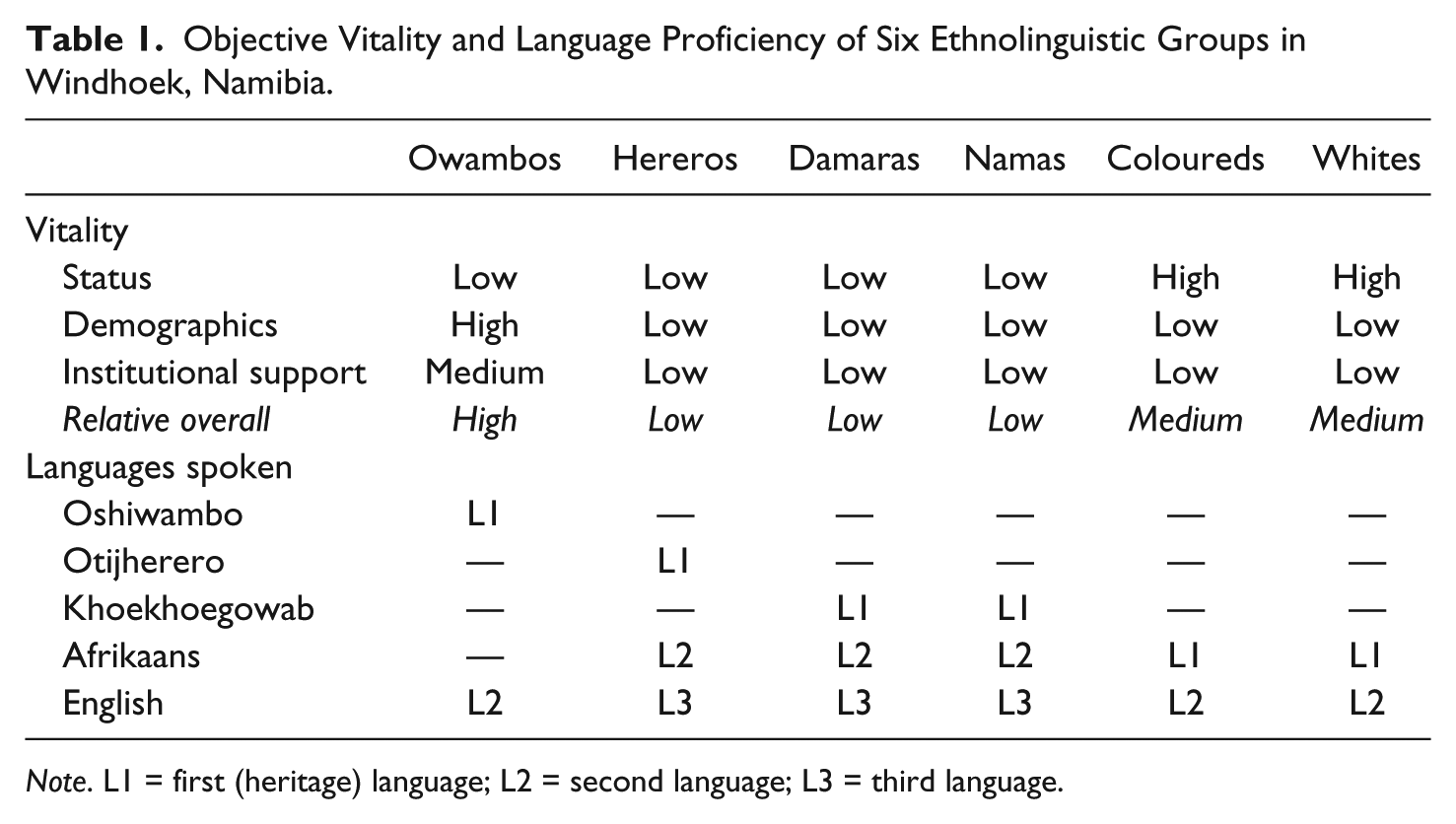
Note. L1 = first (heritage) language; L2 = second language; L3 = third language.
Owambos—considered “Black” under apartheid—are a relatively high-vitality group in Windhoek, primarily on account of their strong demographics and high institutional support. In 2011, Owambos formed Windhoek’s largest (41%) population group 3 (Namibia Statistics Agency, 2013), placing them in a strong demographic position. Owambos also have a high level of institutional support, as they have historically dominated the ruling party (Elischer, 2013) and directly benefit from postapartheid affirmative action policies. However, their status tends to be lower than that of other groups in Windhoek. During apartheid, Owambos in urban areas tended to have migrant worker status, as a result of which they were confined to the lowest socioeconomic position (cf. Pendleton, 1996; Peyroux, 1999). Although the lifting of apartheid restrictions on internal migration has helped improve Owambos’ socioeconomic position somewhat in recent years, they continue to be associated with the low status they held in apartheid Windhoek. Owambo’s heritage language is Oshiwambo, a Bantu language.
Hereros, Damaras, and Namas—also considered “Black” under apartheid—are all relatively low-vitality groups in Windhoek, on account of their low demographics, institutional support, and status. According to the 1981 census, Hereros, Damaras, and Namas formed 11%, 14%, and 5% of Windhoek’s population, respectively (van der Merwe, 1983). Their share in Windhoek’s population has meanwhile decreased—together the three groups accounted for 22% of Windhoek’s population in 2001 (Namibia Statistics Agency, 2013)—placing them in an even weaker demographic position. Although all three groups benefit from postapartheid affirmative action policies, their level of institutional support (e.g., representation in government) is lower than that of Owambos. Hereros, Damaras, and Namas also have relatively low status in Windhoek, but their status is historically higher than that of Owambos due to their longer history of local permanent residence (Pendleton, 1996; Peyroux, 1999). Among the three groups, Hereros historically have the highest status as they were given preferential treatment over the other two groups during apartheid (Peyroux, 2000). Hereros’ heritage language is Otijherero, a Bantu language closely related to Oshiwambo, while the heritage language of the Damaras and Namas is Khoekhoegowab, a Khoi-San language.
Coloureds and Whites are both medium vitality groups in Windhoek, primarily on account of their historically high status inherited from the apartheid. According to the 1981 census, Coloureds and Whites together formed approximately 31% and 15% of Windhoek’s population, respectively (van der Merwe, 1983). Whites’ and Coloureds’ proportion in the population has meanwhile considerably diminished, with the two groups together accounting for only 19% of Windhoek’s population in 2011 (Namibia Statistics Agency, 2013). Whites no longer enjoy the institutional support they had during apartheid and Coloureds are only partially entitled to benefitting from postapartheid affirmative action policies, 4 resulting in relatively low levels of institutional support for both groups. Despite this, Coloureds and Whites both historically have high status in Windhoek and continue to occupy the highest socioeconomic position of all groups. 5 The heritage language of both groups is primarily Afrikaans.
Based on the above, the six groups can be ordered in terms of their relative overall vitality from highest to lowest as follows: Owambos, Whites, Coloureds, Hereros, Damaras, and Namas. The groups’ relative vitality levels, coupled with their proficiency in different languages and prevailing sociohistorical norms, are likely to have bearing on their language choices during intergroup encounters (cf. Dragojevic et al., 2016).
Although Owambos’ relatively high vitality may incline them to maintain their heritage language during intergroup encounters, this is unlikely to be a feasible option due to the fact that no other groups are proficient in Oshiwambo to any significant extent. 6 Moreover, given that Owambos—especially recently urbanized Owambos, 7 who are the focus of the present study—are generally not proficient in Afrikaans, English emerges as the only available lingua franca between them and other groups. Accordingly, recently urbanized Owambos are likely to converge to all other groups by increasing their use of English. Such a move is likely to serve a purely cognitive function (i.e., facilitating comprehension).
Hereros’ relatively low vitality is likely to incline them towards convergence during intergroup encounters, particularly with higher vitality groups. Moreover, given that there is no evidence that other groups speak Otijherero to any significant extent, convergence to a lingua franca seems to be the only viable option for Hereros. With recently urbanized Owambos, the only available lingua franca for Hereros is English. Thus, Hereros are likely to converge to Owambos by increasing their use of English; such a move is likely to primarily serve a cognitive function. With all other groups, Hereros have both English and Afrikaans at their disposal. Given that Afrikaans is the historically established lingua franca between most ethnic groups residing in Windhoek and that it possesses more covert prestige than English (Ohly, 1987; Prinsloo, 1984), Hereros are likely to converge to all other groups by increasing their use of Afrikaans. Such a move is likely to serve a cognitive function—that is, convergence to a lingua franca facilitates comprehension—as well as an affective function—that is, on the ground of its high covert prestige, Afrikaans may allow Hereros to project a more favourably identity.
Damaras and Namas are likely to maintain Khoekhoegowab when mutually interacting, given that it is both groups’ heritage language. Although objectively maintenance, such behaviour may more accurately be described as psychological convergence (Thakerar, Giles, & Cheshire, 1982) because it likely represents an affiliative strategy motivated by a desire to emphasize a shared linguistic identity. With all other groups, Damaras’ and Namas’ relatively low vitality, coupled with the fact that no other groups speak Khoekhoegowab to any significant extent, is likely to incline them towards convergence via lingua francas. Given that English is the only available lingua franca between Damaras/Namas and recently urbanized Owambos, Damaras/Namas are likely to converge to Owambos by increasing their use of English. Such a move is likely to serve a purely cognitive function. With all other groups, Damaras/Namas have two lingua francas as their disposal: English and Afrikaans. Given the higher covert prestige of Afrikaans and prevailing sociocultural norms, Damaras and Namas are likely to converge to all other groups by increasing their use of Afrikaans. Such a move is likely to serve both cognitive and affective functions.
Coloureds’ relatively high vitality, coupled with the high covert prestige of Afrikaans in Windhoek and prevailing sociocultural norms, is likely to incline them to maintain Afrikaans with all groups, except with recently urbanized Owambos to whom they are likely to converge by increasing their use of English (the only available lingua franca). Coloureds’ use of English with Owambos is likely to primarily serve a cognitive function, whereas their maintenance of Afrikaans with all other groups is likely to primarily serve an affective function. Given that Afrikaans is the heritage language of both Coloureds and Whites, Coloureds’ maintenance of Afrikaans with Whites is likely to reflect psychological convergence (Thakerar et al., 1982).
Like Coloureds, Whites’ relatively high vitality, coupled with the high covert prestige of Afrikaans in Windhoek and prevailing sociocultural norms, is likely to incline them to maintain Afrikaans during all intergroup interactions, except those involving recently urbanized Owambos, which are likely to take place in English (the only available lingua franca). Whites’ use of English with Owambos is likely to primarily serve a cognitive function, whereas their maintenance of Afrikaans with all other groups is likely to primarily serve an affective function. As noted above, given that Afrikaans is the heritage language of both Coloureds and Whites, Whites’ maintenance of Afrikaans with Coloureds is likely to reflect psychological convergence.
Method
Sample
The sample consisted of 24 students from the University of Namibia’s Windhoek campus, where the country’s main ethnolinguistic groups are in daily contact. Sets of four students were recruited through the “Friend of a Friend approach” (Milroy, 1987) from each of the following ethnolinguistic groups: Owambos, Hereros, Damaras, Namas, Coloureds, and Whites. The students were between 19 and 24 years of age and comprised roughly equal numbers of males and females within each group. They had generally spent much of their lives in Windhoek, except for the Owambos who had recently arrived from the northern districts. While the participants were generally acquainted with their ethnic peers, they rarely knew their peers from other ethnic groups. Beside their respective heritage languages mentioned above, all participants indicated being proficient in English and, except in the case of Owambos, in Afrikaans.
Procedure
To elicit linguistic data, participants were placed in a position to informally interact with one another. Data collection proceeded in two phases. In Phase 1, participants engaged in intragroup interactions. Each intragroup interaction consisted of all four members of a single ethnolinguistic group interacting with one another (e.g., all four Owambos). Two randomly selected members from each ethnolinguistic group were invited to take part in the second phase of the study. In Phase 2, participants engaged in intergroup interactions. Each intergroup interaction consisted of four individuals, two each from two different ethnolinguistic groups (e.g., two Owambos and two Hereros) interacting in turn in all possible interethnic combinations (e.g., Owambos with Hereros, Owambos with Damaras, etc.). The final corpus thus consisted of 21 four-person interactions: 6 intragroup interactions and 15 intergroup interactions.
All interactions took place in an empty classroom on the university’s campus. For each interaction, participants were asked to informally interact for approximately 60 minutes. They were not given any guidelines as to what topics should be discussed and were reminded before each interaction that they could speak in any language. All interactions were video-recorded.
Coding
All interactions were transcribed by the participants using standard orthographic conventions applicable to each of the languages used during the interactions. The number of words for each interaction ranged from 6,000 to 8,500. Each word was categorized based on its origin language. In the absence of elaborate lexicographic resources for Namibian languages, words with an obviously mixed origin were assigned to the language that provided the stem. For example, the word preacha in the Oshiwambo matrix clause ontu oha preacha (that person preaches) was counted as an English word on account of the stem being English (i.e., preach). For each interaction, the percentage of words in each language used by each group was calculated by dividing the total number of words in a given language by the total number of words produced by that group.
Results
Convergence, divergence, and maintenance were identified by systematically comparing each group’s language use in intergroup interactions with their language use in intragroup interactions. Accordingly, below we first describe each group’s language use during their respective intragroup interaction, which provides baseline data on each groups’ linguistic behaviour. Then, we examine whether and how each group’s language use changed during the various intergroup interactions they were involved in. These results are summarized in Table 2, which displays the percentage of words in each language across intra- and intergroup interactions for each of the six ethnolinguistic groups.
Percentage of Words in Each Language Across Intra- and Intergroup Interactions for Each Ethnolinguistic Group.
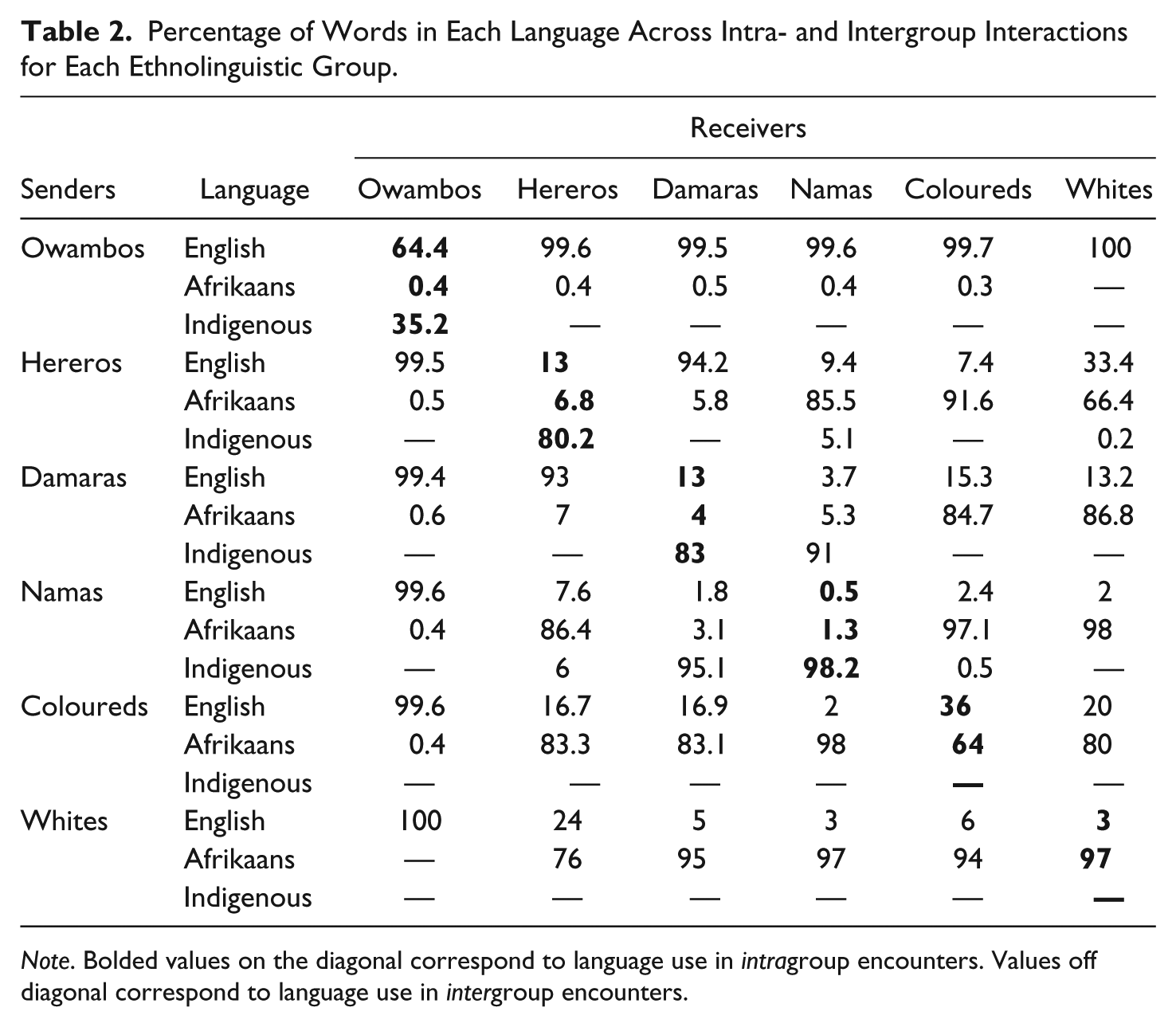
Note. Bolded values on the diagonal correspond to language use in intragroup encounters. Values off diagonal correspond to language use in intergroup encounters.
Intragroup Language Use
Owambos
Owambos’ intragroup interaction was characterized by frequent code-switching between their native language, Oshiwambo (35.2%), and English (64.4%). Afrikaans was almost altogether absent (0.4%).
Hereros
Hereros’ intragroup interaction unfolded primarily in their heritage language, Otijherero (80.2%), with occasional code-switching into English (13%) and Afrikaans (6.8%).
Damaras
Damaras’ intragroup interaction largely mirrored that of the Hereros: Their heritage language, Khoekhoegowab, predominated (83%), with occasional code-switching into English (13%) and Afrikaans (4%).
Namas
Namas’ intragroup interaction transpired almost exclusively in their native language, Khoekhoegowab (95.2%), with negligible code-switching into Afrikaans (3.1%) and English (1.8%).
Coloureds
Coloureds’ intragroup interaction was characterized by frequent code-switching between Afrikaans (64%) and English (36%), though Afrikaans clearly predominated.
Whites
Whites’ intragroup interaction transpired almost exclusively in Afrikaans (97%), with negligible code-switching into English (3%).
Intergroup Language Use
Owambos
Hypotheses 1a to 1e predicted that Owambos would converge to all groups by increasing their use of English. This hypothesis was supported: Owambos converged to all groups by systematically increasing their use of English, using that code almost exclusively with Hereros (99.6%), Damaras (99.5%), Namas (99.6%), Coloureds (99.7%), and Whites (100%).
Hereros
Hypotheses 2a to 2e predicted that Hereros would converge to Owambos by increasing their use of English and converge to all other groups by increasing their use of Afrikaans. This hypothesis was largely supported. As predicted (Hypothesis 2a), Hereros converged to Owambos by increasing their use of English (99.5%). Also consistent with predictions (Hypotheses 2c-2e), Hereros increased their use of Afrikaans during their interaction with Namas (85.5%), Coloureds (91.6%), and, to a lesser extent, Whites (66.4%), all of which amounted to convergence. Contrary to Hypothesis 2b, Hereros spoke almost exclusively in English (94.2%) during their interaction with Damaras. Given that English is a lingua franca between Hereros and Damaras, such behaviour also amounts to convergence.
Damaras
Hypotheses 3a to 3e predicted that Damaras would maintain Khoekhoegowab with Namas, converge to Owambos by increasing their use of English, and converge to all other groups by increasing their use of Afrikaans. This hypothesis was partially supported. Consistent with Hypothesis 3a, Damaras largely maintained their use of Khoekhoegowab (91%) with Namas. Consistent with Hypothesis 3b, Damaras converged to Owambos by systematically increasing their use of English (99.4%). Also as predicted (Hypotheses 3d-3e), Damaras increased their use of Afrikaans during their interaction with Coloureds (84.7%) and with Whites (86.8%), both of which amounted to convergence. Contrary to Hypothesis 3c, Damaras used mostly English (93%) during their interaction with Hereros. As noted above, this behaviour also amounts to convergence given that English is a lingua franca between Damaras and Hereros.
Namas
Hypotheses 4a to 4e predicted that Namas would maintain Khoekhoegowab with Namas, converge to Owambos by increasing their use of English, and converge to all other groups by increasing their use of Afrikaans. This hypothesis was supported. Consistent with Hypothesis 4a, Namas largely maintained their use of Khoekhoegowab (95.1%) during their interaction with Damaras. Consistent with Hypothesis 4b, Namas converged to Owambos by systematically increasing their use of English (99.6%). Also as predicted (Hypotheses 4c-4e), Namas increased their use of Afrikaans during their interaction with Hereros (86.4%), Coloureds (97.1%), and Whites (98%), all of which amounted to convergence.
Coloureds
Hypotheses 5a to 5e predicted that Coloureds would converge to Owambos by increasing their use of English, but would engage in maintenance with all other groups by maintaining Afrikaans. This hypothesis was supported. Consistent with Hypothesis 5a, Coloureds converged to Owambos by switching almost fully to English (99.6%). Also as predicted (Hypotheses 5b-5e), Coloureds maintained Afrikaans dominance during their interactions with Hereros (83.3%), Damaras (83.1%), Namas (98%), and Whites (80%).
Whites
Hypotheses 6a to 6e predicted that Whites would converge to Owambos by increasing their use of English, but would engage in maintenance with all other groups by maintaining Afrikaans. This hypothesis was supported. Consistent with Hypothesis 6a, Whites converged to Owambos by shifting fully to English (100%). Also as predicted (Hypotheses 6b-6e), Whites maintained Afrikaans dominance during their interactions with Damaras (95%), Namas (97%), Coloureds (94%), and, to a somewhat lesser extent, Hereros (76%).
Discussion
The present study examined how six different ethnolinguistic groups in Windhoek, Namibia—Owambos, Hereros, Damaras, Namas, Coloureds, and Whites—adjust their language use during intergroup encounters. Based on CAT (Dragojevic et al., 2016), we predicted that relatively low-vitality groups (i.e., Hereros, Damaras, Namas) would be inclined towards linguistic convergence, whereas relatively high-vitality groups (i.e., Owambos, Coloureds, Whites) would be inclined towards linguistic maintenance, but that these general patterns would be moderated by prevailing sociocultural norms and each groups’ language proficiency. To test these predictions, members of the six different ethnolinguistic groups first engaged in an intragroup interaction—establishing a baseline of their language use—and then in all possible combinations of intergroup interactions. Language adjustment—and specifically convergence, divergence, and maintenance—were identified by systematically comparing each group’s language use in the different intergroup interactions with their language use in their respective intragroup interaction.
During intragroup interactions, each group’s heritage language predominated as the code of choice (see Table 2)—that is, Hereros primarily spoke in Otijherero, Namas and Damaras in Khoekhoegowab, and Coloureds and Whites in Afrikaans. Even so, code-switching occurred in all interactions, though to varying degrees. Code-switching was least prevalent among Namas and Whites, who spoke almost exclusively in their respective heritage languages, Khoekhoegowab (95.1%) and Afrikaans (97%). Whites’ tendency towards Afrikaans monolingualism likely reflects the historically high status of Whites in Windhoek, coupled with the purist traditions characteristic of the White Afrikaans-speaking community (Steyn, 1980). Namas’ tendency towards Khoekhoegowab monolingualism is perhaps more circumstantial: Namas traditions and history formed the main topic of conversation during the interaction, instigated by one of the participants, a student pursuing a major in Khoekhoegowab language studies and inclined towards linguistic purism. In contrast, Coloureds frequently alternated between their heritage language, Afrikaans (80%), and English (20%). The relatively high proportion of English words in Coloureds’ speech may amount to a “compensation strategy.” The use of an Afrikaans monolingual code is—as mentioned above—strongest among the Whites. Accordingly, in postapartheid Namibia, where being perceptually amalgamated with Whites potentially implies more sanctions than rewards, the use of an Afrikaans English mixed code might seem more desirable to Coloureds than an Afrikaans monolingual code, allowing them to establish positive distinctiveness from Whites and thus enhance the postapartheid social status associated with being Coloured. One exception to the general patterns described above was Owambos’ intragroup interaction, which involved the highest degree of code-switching and transpired primarily in English (64.2%), rather than Oshiwambo (35.2%), the group’s heritage language. Owambos’ preference for English during their intragroup interaction may, as in the case of Coloureds, also reflect a compensation strategy: Given Owambos’ relatively low historical status in Windhoek, shifting to English may amount to an attempt to acquire overt linguistic prestige possessed by no other locally represented ethnic group in compensation for not being able to project covert prestige through Afrikaans, in which they lack proficiency.
For most groups, these language patterns changed markedly during their various intergroup interactions (see Table 2). Consistent with CAT (Dragojevic et al., 2016), relatively low-vitality groups tended to linguistically converge, whereas relatively high-vitality groups tended to engage in linguistic maintenance. These tendencies resulted in two main patterns of adjustment, depending on the relative vitality of the groups involved.
In intergroup interactions involving groups of relatively equal vitality, symmetrical accommodation was the dominant pattern. When the groups involved did not know each other’s heritage language, this took the form of mutual convergence to a lingua franca. This was evident in the Herero–Damara interaction, during which both groups converged to English, and the Herero–Nama interaction, during which both groups converged to Afrikaans. In contrast, when the groups shared the same heritage language, this took the form of symmetrical maintenance. This was evident in the Damara–Nama interaction, during which both groups primarily maintained Khoekhoegowab, and in the Coloured–White interaction, during which both groups primarily maintained Afrikaans. Although objectively maintenance, such behaviour likely reflects psychological convergence, motivated by a desire to emphasize a shared linguistic identity (see Thakerar et al., 1982).
In intergroup interactions involving groups of relatively unequal vitality, asymmetrical accommodation was the dominant pattern. This typically involved the relatively lower vitality group converging to the higher vitality group, who maintained its default code. This was evident in the Coloured–Herero, Coloured–Damara, Coloured–Nama, White–Herero, White–Damara, and White–Nama interactions, all of which transpired primarily in Afrikaans, the heritage language of Coloureds and Whites. Such shifts were likely cognitively motivated—that is, Afrikaans is a lingua franca that likely facilitated comprehension—as well as affectively motivated—that is, using Afrikaans instead of English (also an available lingua franca) may have allowed the groups to convey a more favourable identity due to the higher covert prestige of Afrikaans, relative to English, in Windhoek.
Once again, a notable exception to these general patterns were intergroup interactions involving Owambos, all of which transpired almost exclusively in English. Although Owambos’ relatively high vitality in Windhoek may incline them towards maintenance of their heritage language in most intergroup situations, this was not a feasible option due to the fact that no other groups were proficient in Oshiwambo. Moreover, given that English was the only available lingua franca between Owambos and all other groups, symmetrical convergence to English by all groups during these interactions represented the only viable option for communication. Such behaviour was likely purely cognitively motivated and determined primarily by the various groups’ limited language proficiency, rather than their relative vitality or prevailing norms.
Several general conclusions can be drawn from the pattern of results described above. First, English and Afrikaans appear to be the predominant codes used during intergroup interactions between different ethnolinguistic groups in Namibia, reflecting the fact that, in most situations, they represent the only available lingua francas. Second, and relatedly, indigenous Namibian languages—that is, Oshiwambo, Otijherero, and Khoekhoegowab—largely disappear during intergroup encounters, owing to the fact that most groups do not speak each other’s heritage languages. The absence of proficiency in indigenous Namibian languages other than one’s in-group language reflects, at least in part, the influence of structural forces: Proficiency in indigenous languages was not officially promoted during apartheid, nor is it currently promoted. Indeed, it appears that Namibia’s independence has had little effect on the viability of its linguistic diversity.
Third, Afrikaans appears to be preferred over English in most contexts requiring the use of lingua francas. Inspection of Table 2 shows that, of the 15 intergroup interactions, 8 (53.3%) transpired primarily in Afrikaans and 6 (40%) transpired primarily in English. These results are more striking when one takes into account the different groups’ proficiency in English and Afrikaans. In five of the interactions—that is, all those involving Owambos—English was the only available lingua franca. Unsurprisingly, all those interactions transpired almost exclusively in English and such shifts were likely purely cognitively motivated. In the remaining 10 interactions—that is, all those not involving Owambos—English and Afrikaans were both available lingua francas. Despite this, Afrikaans predominated in 8 out of 10 (80%) of those interactions, the only exception being the Herero–Damara interaction, which transpired primarily in English, and the Damara–Nama interaction, which transpired primarily in the groups’ shared heritage language, Khoekhoegowab. Stated differently, English emerged as the preferred lingua franca during intergroup interactions involving Owambos, whereas Afrikaans emerged as the preferred lingua franca during intergroup interactions involving (most) other groups. The fact that—except in the Damara–Nama and the Herero–Damara interactions—Afrikaans was chosen over English even though the latter was available suggests that the use of Afrikaans performs an affective function: Even though English nowadays occupies a higher (overt) position in Namibian society, Afrikaans in Windhoek conveys a legitimate local identity grounded in its historical status as Windhoek’s main lingua franca. Using Afrikaans lays claim to that local identity, symbolically opposed to migrant identities in a societal context where most migrants come from the northern districts and do not know Afrikaans. Indeed, it appears that the recognition of English as the sole official language in postapartheid Namibia and its widespread promotion has done little to usurp Afrikaans’ value as the preferred linguistic currency for many groups in the urban context of Windhoek.
However, and somewhat paradoxically, the clear preference for Afrikaans during (most) intergroup interactions did not translate into the use of a monolingual Afrikaans code. Indeed, and as evident from Table 2, in all intergroup interactions where Afrikaans was the dominant code the interacting groups also used English, sometimes to a significant extent. This pervasiveness of Afrikaans/English code-switching suggests that both varieties have some currency in Windhoek and that their simultaneous use may provide a symbolically neutral balance between overt prestige—associated with English—and covert prestige—associated with Afrikaans. Ultimately, it appears that, at least in the modern context of Windhoek, an (Afrikaans-dominated) Afrikaans/English mixed code may possess more covert prestige than does either variety alone.
Limitations and Future Directions
This study has several limitations. First, our sample consisted of only four individuals from each of the six different ethnolinguistic groups. Future studies should examine whether the pattern of results obtained herein generalizes to a broader sample. Second, and relatedly, the individuals who formed our sample were all relatively young, ranging in age from 19 to 24 years. It is possible that different age groups may display different linguistic preferences. Indeed, the overwhelming preference for Afrikaans in most intergroup interactions that we observed may be even more pronounced among older Namibians for whom Afrikaans has served as the primary lingua franca for most of their lives. Third, data for the present study were elicited during informal interactions without any explicit guidelines as to what topics should be discussed. Although this arguably preserved the external validity of the data, it does not preclude the possibility that different contexts may have elicited different linguistic behaviours. Indeed, it may be that during more formal interactions (e.g., employment), different patterns of adjustment may emerge (cf. Bourhis, 1991). Future research should explore this possibility.
Conclusion
Results of the present study provide broad empirical support for CAT as useful theoretical framework for both predicting and explaining language use in multiethnic and multilingual encounters. Our findings demonstrate that language choice in multilingual contexts is determined by a complex interplay of many factors, including cognitive and affective motivations, ethnolinguistic vitality, language proficiency, and sociocultural norms. With respect to language use in Namibia, specifically, our results suggest that intergroup interactions between different ethnolinguistic groups transpire primarily in English and Afrikaans, which typically represent the only available lingua francas. Interestingly, and despite government efforts to promote English as a neutral, “pan-Namibian” lingua franca in postapartheid Namibia, Afrikaans continues to dominate as the language of choice during most intergroup interactions.
Footnotes
Acknowledgements
The authors would like to thank the anonymous referees and Howie Giles for their encouragement and their comments on the successive versions of this article.
Declaration of Conflicting Interests
The author(s) declared no potential conflicts of interest with respect to the research, authorship, and/or publication of this article.
Funding
The author(s) received no financial support for the research, authorship, and/or publication of this article.