




Abstract
Using a content analytic approach, this study examined young adults’ retrospective written accounts about their perceived communication with family and nonfamily elders in conflict situations to uncover conflict initiating factors and management styles. Results revealed that old-to-young criticism (especially in nonfamily contexts) and competition were the most frequently reported conflict initiating factor and management style in intergenerational relationships. Also, results indicated that family elders’ use of the competing and avoiding styles were reciprocated by young adults.
Keywords
Motivated by the humanistic concern of older adults’ physical and psychological health, research in intergenerational communication flourished in the past few decades (Giles & Williams, 1994; Harwood, McKee, & Lin, 2000; Williams & Giles, 1996). Much of the research is guided by communication accommodation theory (Soliz & Giles, 2014) and its satellite model: the communication predicament of aging model (CPA; Ryan, Giles, Bartolucci, & Henwood, 1986). Findings in general have shown that young adults’ age-based stereotypical and inappropriate accommodations can lead to constrained opportunities of communication, lower self-esteem, emotional and functional decline for older adults, and reinforcement of age stereotypes (Harwood, Ryan, Giles, & Tysoki, 1997). In addition, research has shown that young adults can also be stereotyped and patronized by older adults and are especially dissatisfied with older adults’ nonlistening, complaining, disapproving, and overparenting behaviors (e.g., Giles & Williams, 1994). These problematic young-to-old and old-to-young communicative behaviors are potential factors that could lead to conflict in intergenerational relationships (e.g., Zhang & Lin, 2009), an area that has been understudied.
One specific line of research in intergenerational conflict has examined conflict initiating factors (Zhang & Lin, 2009) and management styles (Bergstrom & Nussbaum, 1996; Zhang, Harwood, & Hummert, 2005). However, scholars have not yet examined intergenerational conflict initiating factors and management styles simultaneously. Using a content analytic approach, the current study examined these variables through analyzing young adults’ retrospective written accounts (see Peterson, 1983; Williams & Giles, 1996; Witteman, 1992; Zhang, 2004, for a similar methodology) of a recent intergenerational conflict. While these conflict scenarios with which the initiating factors and management styles are embedded may primarily represent those that the young adults chose to write about and remembered, or those that were obvious, typical, or easy to recall, they certainly represent what the young adults felt the most significant, uncomfortable with, or salient (see also Zhang & Lin, 2009). From this regard, a systematic analysis of the conflict initiating factors and management styles embedded in these scenarios will enhance our understanding of young adults’ cognitive representations of intergenerational relationships in problematic situations. The conflict initiating factors and styles are essentially young adults’ perceptions, which are subjective and selective by nature, of the communicative moves in intergenerational conflict. Communication plays a central role in our social construction of age, aging, and intergenerational relationships (Giles, Davis, Gasiorek, & Giles, 2013). This study will provide concrete baseline data in explaining what and how communication in conflict situations is manifested in intergenerational relationships, which are characterized by low contact frequency (Fox & Giles, 1993) and negative stigmas in general (Hummert, 1990).
Conflict Initiating Factors and Management Styles
Conflict may arise for a variety of reasons, but verbal or behavioral expressions of incompatible interests must occur for the perceived differences to become an open conflict (Zhang & Lin, 2009). Conflict initiation is thus defined as an initial communicative move of one party that interferes with the activity or interests of another and escalates a situation into conflict (Zhang, 2004). Previous research on conflict initiation has examined marital conflict (Peterson, 1983), peer conflict (Witteman, 1992), and intergenerational conflict (Zhang, 2004; Zhang & Lin, 2009). Peterson (1983) and Witteman (1992) examined written scenarios to uncover themes of conflict initiating factors in interpersonal conflict. Following similar procedures, Zhang (2004) and Zhang and Lin (2009) examined the major conflict initiating factors in intergenerational conflict. Given its systematic nature and the intergenerational context from which it was generated and applied, the conflict initiating factors typology from Zhang and Lin (2009) was used in the current study (see Table 1). While Zhang and Lin (2009) only analyzed communicative moves at the initial stage of intergenerational conflict reported by young adults, the current study further analyzed subsequent intergenerational conflict management styles used by both young and older adults.
Definitions of the Identified Initiating Factors in Intergenerational Conflict.
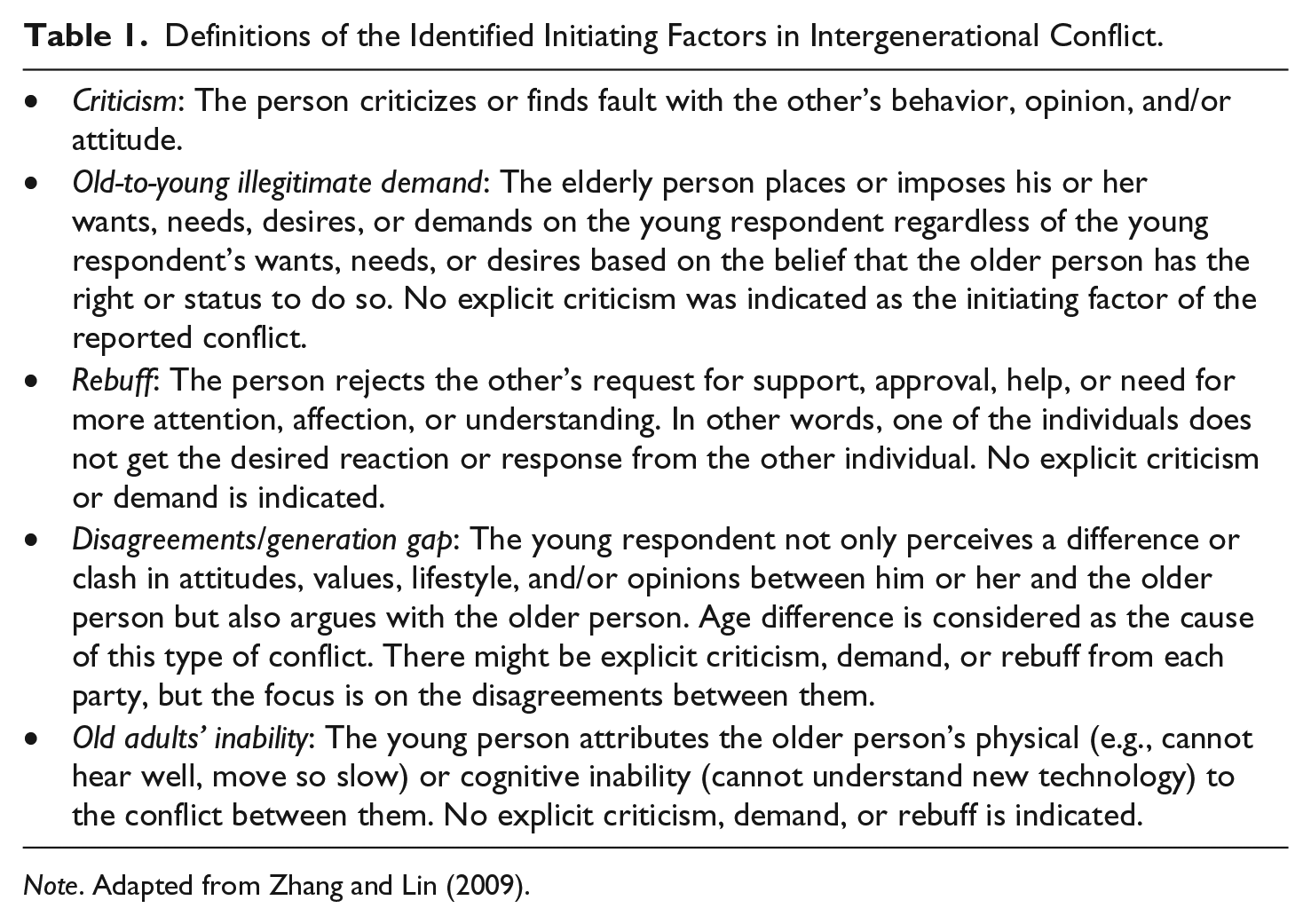
Note. Adapted from Zhang and Lin (2009).
Conflict styles have been examined extensively from the interpersonal perspective. In general, findings indicated across a variety of interpersonal communication contexts that cooperative and integrative tactics produce the most communication satisfaction (Canary & Cupach, 1988) and also feelings of trust and commitment (Canary & Spitzberg, 1990). There has been a general overall view that confrontational and avoidance strategies are not rated as satisfying (e.g., Newton & Burgoon, 1990). Recent research in intergenerational conflict has also enhanced our understanding of conflict management style preference. For example, Zhang et al. (2005) found that older participants rated the accommodating style used by young adults in intergenerational conflict situations more favorable than the problem-solving style, while the young adults preferred the problem-solving and the accommodating styles equally well. Bergstrom and Nussbaum (1996) examined conflict preference in intergenerational conflict from both young and older adult’s perspectives. They found that young adults tended to prefer more control-oriented styles, while older adults preferred solution-oriented styles. Furthermore, they claimed that the use of solution-oriented styles increased with age, which is consistent with previous research (e.g., Cicirelli, 1981). Blanchard-Fields, Mienaltowski, and Seay (2007) suggest that older adults are not only better than young adults at handling conflict but also can effectively use confrontational and avoidance styles in conflict situations. These studies have demonstrated that age makes a difference in the use and evaluations of the conflict styles. It is also important to note that most of the aforementioned studies that have examined intergenerational conflict management styles used survey or experimental design. The current study expands prior literature by using a content analytic approach, which allows for a systematic examination of the reported communicative moves throughout the intergenerational conflict management process. Zhang et al.’s (2005) delineation of the four distinct conflict management styles (see also Cai & Fink, 2002) in intergenerational context were used as the operational definitions for coding the young and older adults’ conflict styles (see Table 2).
Definitions of the Identified Conflict Management Styles in Intergenerational Conflict.
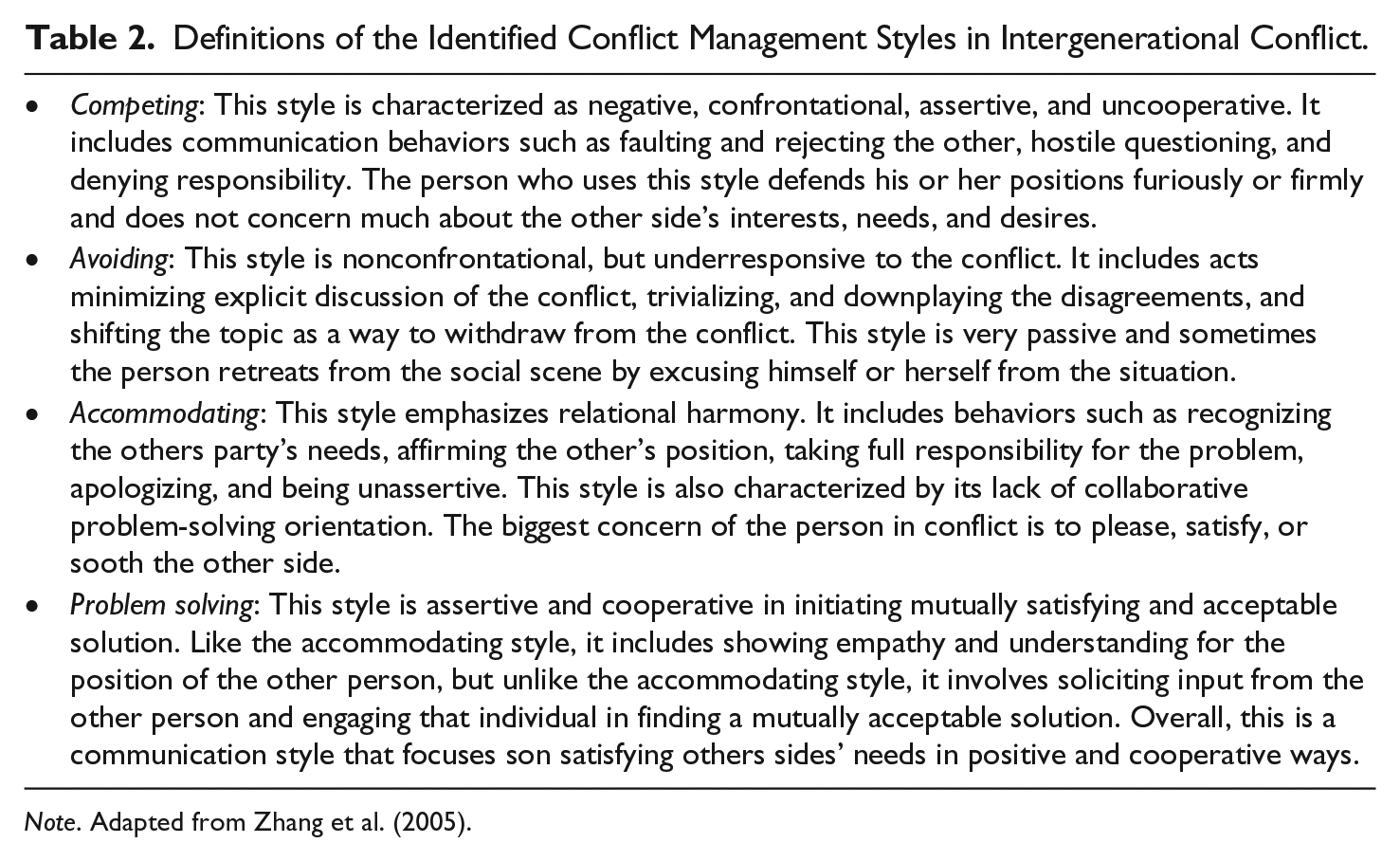
Note. Adapted from Zhang et al. (2005).
Intergenerational Conflict in Family and Nonfamily Contexts
Group memberships affect the way that people interact with each other. When dealing with intergenerational communication between young and older adults, age and family/nonfamily differentiation are important factors influencing communicative and relational processes (Zhang & Lin, 2009). Intergenerational family relationships involve both intergroup (i.e., age) and intragroup (i.e., shared family identity) dynamics (Soliz & Harwood, 2006) and are closer and more interdependent than nonfamily relationships (Giles et al., 2003). In other words, there are different stereotyped perceptions and role exceptions of family versus nonfamily intergenerational relationships. Thus, young adults’ experiences, perceptions, and attributions of conflict might be different in family versus nonfamily intergenerational relationships.
Both family and nonfamily elders have been shown to be a major source of influence and support for young adults (Harwood et al., 2000). However, at times they can also be overbearing by being intrusive, controlling, and overparenting (Giles & Williams, 1994). Thus, scholars have emphasized the importance of making a distinction between family and nonfamily contexts to examine the association among problematic supportive communication, power dynamics, and conflict in intergenerational relationships (Zhang & Lin, 2009). Scholars have used the common in-group identity model (CIIM) to help explain communicative differences between family and nonfamily relationships (Song & Zhang, 2012). Previous research has claimed that shared family identity is relatively easy to establish (Banker & Gaertner, 1998) and once established can enhance interactions (Gaertner & Dovidio, 2000). The next focus of this study, therefore, is to examine the similarities and differences between family and nonfamily conflict initiating factors and management styles.
Prior conflict research has shown that young and older adults use or prefer different management styles (Blanchard-Fields et al., 2007; Zhang et al., 2005). However, research has shown that conflict management styles can be reciprocated as well (Cichy, Lefkowitz, & Fingerman, 2012). Contributing to prior literature in intergenerational conflict management research in this area, the current study examines the associations between the management styles of young and older adults.
Method
Participants and Procedures
After institutional review board approval, voluntary participants (N = 711, M age = 20.15 years, SD = 2.05; 44.1% males and 55.9% females) were recruited from a research pool at a large Midwestern university. Participants received course credit for their participation. There were 590 (83.0%) White/Caucasian participants, 54 (7.6%) Hispanic/Latino participants, 31 (4.4%) Black participants, 21 (2.9%) Asian participants, and 15 (2.1%) other. Nineteen participants were excluded from further analysis due to irrelevant or excessive missing data. Participants completed an in-person questionnaire that first asked them to think about an intergenerational relationship with an older adult (65 or older). They were then asked to write about a most recent conflict in that relationship by focusing on the specific communication exchanges that happened at the beginning of the conflict, during the conflict process, and at the end of the conflict. These written accounts typically ranged from one to two paragraphs (about 150 words) with a few who wrote a full page (about 200 words). In addition to the open-ended questions, participants were then asked to indicate the relationship they had with the older adult, the older person’s age (M = 75.13, SD = 8.17; age range: 65-99 years) and how long they had been in that relationship (M = 11.91 years, SD = 9.58). Participants then rated their perceived relational closeness (1 = not close at all and 7 = very close) with the older adult on a 7-point scale. An independent t test indicated that young adults (who reported a conflict with a family elder) had a closer relationship with family elders (M = 5.60, SD = 1.67) than those (who reported a conflict with nonfamily elders) with nonfamily elders (M = 2.03, SD = 1.70), t(690) = 27.49, r = .72, p < .001.
Overall, participants chose to report family intergenerational conflict scenarios more frequently (n = 406, 58.7%) than with nonfamily elders (n = 286, 41.3%), χ2(1) = 20.81, p < .05. In family relationships, young adults primarily reported scenarios with their grandparents, although there were a few other types of family members such as aunts, uncles, grandaunts, granduncles, parents, and step-grandparents. The nonfamily elders were mostly made up of coworkers, teachers, bosses, and landlords. There were fewer scenarios that included neighbors and grocery store customers.
Coding Scheme and Reliability Check
Each conflict scenario was considered as a unit of analysis, and the dominant conflict initiating factor and conflict management styles were coded in two separate passes with the initiating factors coded first followed by the conflict management styles. If the conflict scenario could not be coded because it did not fit one of the available categories, it was placed in the “other” category. Twenty-two scenarios (3.2%) were placed in the “other” category for the initiating factor variable (e.g., older adults’ off topic verbosity). For each conflict scenario, only one dominant conflict initiating factor and one conflict style for the young and older adult were coded. However, in some written scenarios (<3%), the conflict style used by the young and/or older adult shifted. As the sample that involved a conflict style shift was relatively small, only the primary conflict style (i.e., the most dominant, explicit, and sustained style) was coded.
After coder training, a total of 140 scenarios (20.23%) were used for reliability checks. The overall intercoder reliability for initiating factors, and young and older adults’ management styles was measured using both percent agreement (.84, .88, and .86, respectively) and Cohen’s Kappa (.89, .85, .81, respectively). The disagreements were discussed and resolved based on consensus. The remaining 552 scenarios were split up and individually coded by each coder. Coders performed reliability checks three times spaced throughout the coding process (i.e., at the beginning stage, in the middle, and at the end) to prevent coder drift.
Results
Research Question 1 examined the types of conflict initiating factors and management styles in intergenerational relationships as reported by young adults. Chi-square analysis indicated that young adults provided more conflict scenarios in which older adults used criticism than any other initiating factor, followed by disagreement/generation gap, with old-to-young rebuff, young-to-old criticism, and illegitimate demand as the third most frequent category (see Table 3). As for the conflict styles, young adults reported that young and older adults both used the competing style more than any other conflict management styles (see Table 3).
Frequencies of the Identified Conflict Initiating Factors in Family and Nonfamily Intergenerational Relationships.

Note. Different superscripts in frequency column indicate significant differences according to chi-square analyses. Bonferroni method was used in controlling for Type I error.
p < .05 if adjusted residual >1.96; **p < .01 if adjusted residual >2.58. Overall χ2(7) = 410.22, p < .05.
Research Question 2 examined whether the conflict initiating factors and management styles reported by the young adults were associated with the type of intergenerational relationship. Table 3 presents the frequencies of the seven initiating factors identified in the conflict scenarios in both family and nonfamily contexts. Specifically, cross-tabulation results indicated that young adults reported old-to-young criticism in conflicts with nonfamily elders more than with family elders. On the other hand, young-to-old rebuff and generation gap/disagreement was reported more frequently in conflicts with family elders. As for the conflict management style variable, the intergenerational relationship type was not associated with any of the reported styles (see Table 4).
Frequencies of the Identified Conflict Management Styles Used by Young and Older Adults in Family and Nonfamily Intergenerational Relationships.
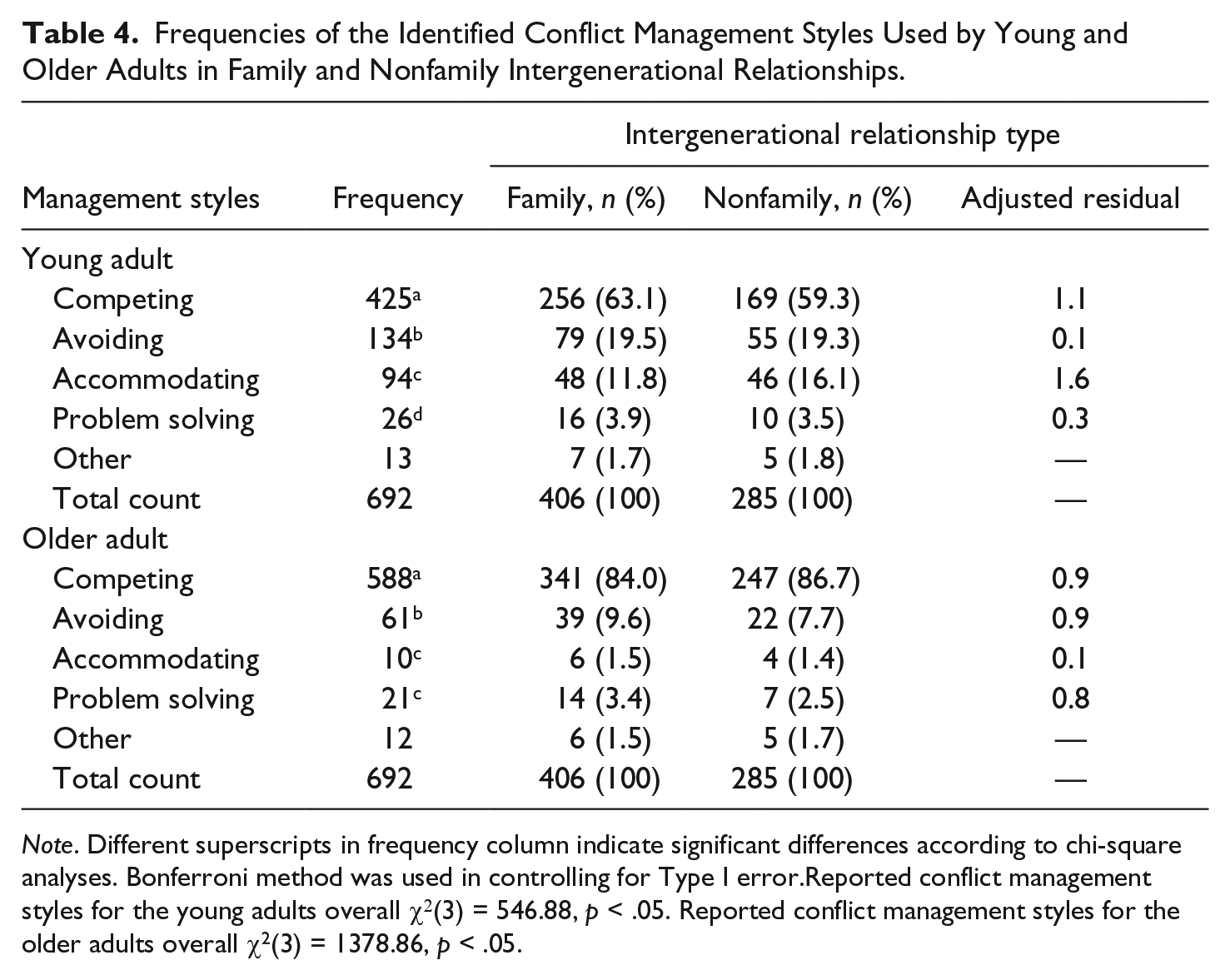
Note. Different superscripts in frequency column indicate significant differences according to chi-square analyses. Bonferroni method was used in controlling for Type I error.
Reported conflict management styles for the young adults overall χ2(3) = 546.88, p < .05. Reported conflict management styles for the older adults overall χ2(3) = 1378.86, p < .05.
Research Question 3 examined whether conflict management styles used by young adults and older adults in these scenarios were associated with each other in family and nonfamily intergenerational relationships. Young adults reported the accommodating and problem-solving styles infrequently (see Table 4). One possible explanation for the low frequencies of the accommodating and problem-solving styles might be due to the fact that young adults do not recognize or remember these instances as conflict situations if the styles are used successfully. Only the competing and the avoiding styles were considered in the chi-square analysis (see Table 5). Young adults reported that when family elders competed or avoided, young adults followed suit. However, in nonfamily relationships, there were no such associations.
Associations Between Competing and Avoiding Styles Used by Young and Older Adults in Family and Nonfamily Intergenerational Relationships.
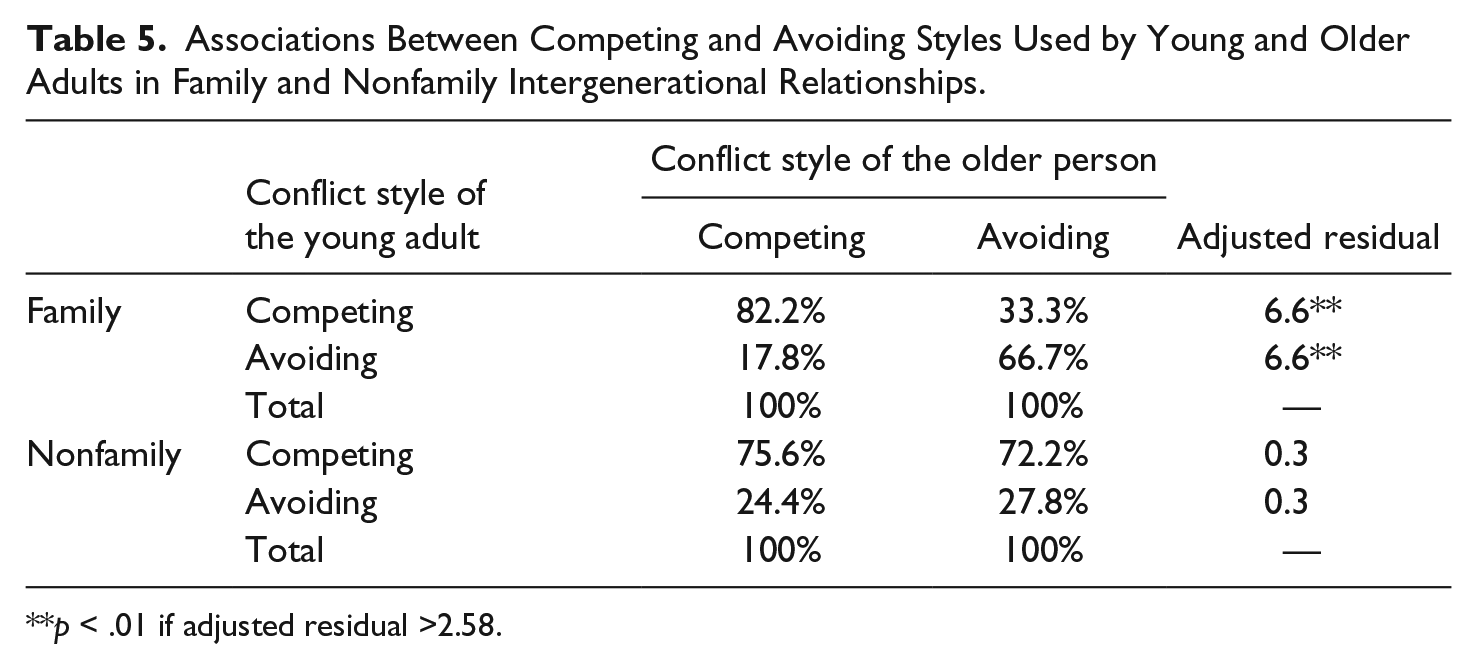
p < .01 if adjusted residual >2.58.
Discussion
Three major themes have emerged in the conflict scenarios from the young adults’ perspective. First, old-to-young criticism was perceived as the driving force behind the initiation of intergenerational conflict in the reported scenarios. Second, family versus nonfamily intergenerational relationships influenced the frequency of certain conflict initiating factors and the association between young and older adults’ conflict management styles in the reported scenarios. Third, the competing style was the dominant management style used by both sides in intergenerational conflict.
The most frequently reported initiating factor was old-to-young criticism, which supports previous findings that suggest older adults can be perceived as critically restrictive, interfering, and meddlesome (Zhang & Lin, 2009). However, nonfamily elders were responsible for significantly more scenarios of criticism than family elders. Considering CIIM, family elders might be perceived to criticize less due to shared family identity, which was positively associated with relational closeness (r = .72, p < .001).
In young adults’ reports of both family and nonfamily relationships, young and older adults were more likely to use the competing style than any other conflict management styles. However, there was an interesting association between young and older adults’ conflict management styles in family intergenerational relationships. When family elders were perceived to compete or avoid, young adults were more likely to compete or avoid as well. This pattern suggests that family members who are involved in intergenerational conflict tend to reciprocate with the same style as the other individual. Family relationships have also been shown to have a norm of reciprocity that can be either harmful (Kim, Conger, Lorenz, & Elder, 2001) or beneficial (Schwarz, 2010) to the relationship. Reciprocity has been studied in family conflict situations before (Cichy et al., 2012) and has shown that negative reciprocity can have a negative effect on certain relationships in families (Carstensen, Gottman, & Levenson, 1995).
As addressed earlier in the article, the assumption that the problem solving and accommodating styles are superior forms of conflict management do not necessarily hold true across generations. Older adults have been shown to select more effective management styles in conflict situations (Blanchard-Fields et al., 2007) and are less likely to avoid and more likely to engage or confront in intergenerational conflict than they are in peer conflict (Fingerman & Charles, 2010). These studies provide an interesting explanation of the reciprocal nature of intergenerational conflict management styles. If older adults are better at selecting effective conflict management styles, it could be beneficial for the family young adults to reciprocate. This phenomenon deserves more attention in the future.
Limitations and Future Research
As the current study used the participants’ retrospective written accounts about intergenerational conflicts, the reported conflict scenarios, in which certain initiating factors and management styles were embedded with certain frequencies, were those that young adults chose to write about for various reasons as mentioned earlier in this article. Hence, the frequencies of the initiating factors and conflict styles may not actually represent how young and older adults handled intergenerational conflicts. This should be taken into account when interpreting the results and should be supplemented with similar accounts from the older adults’ perspective in the future. It is also important to note that the participants in this study were primarily Caucasians from the United States. Thus, results are situated within American culture and potentially bound to a particular ethnicity. Finally, the older adults in nonfamily scenarios tended to have an authority role over the young adults (e.g., bosses and teachers). This could have influenced the types of conflicts experienced and the types of conflict management styles that were used and should be taken into account in the interpretation of these results.
This study adds to previous literature from the young adults’ perspective by examining conflict initiating factors and management styles simultaneously to provide a more complete picture of intergenerational conflict between young and older adults. Specifically, findings in this study echoed prior literature in that young adults reported criticism and competition as the most frequent conflict initiating factor and management style in intergenerational conflict. It also added to the conflict literature by suggesting intergenerational conflict management styles between young and older adults are perceived to be reciprocated within the family context. Overall, in line with the increased attention to study intergenerational relationships, the current study contributes to our understanding of the specific nonaccommodative communication behaviors that are salient for young adults when thinking of conflict with older adults.
Footnotes
Acknowledgements
We thank the anonymous reviewers from the Communication and Aging Division of the National Communication Association for their constructive comments on an earlier version of this article, which won a top paper award in 2015. Our sincere thanks also go to Howard Giles and two anonymous reviewers for their helpful comments on earlier versions of this article as well as Ning Liu for her initial help in the coding process.
Declaration of Conflicting Interests
The author(s) declared no potential conflicts of interest with respect to the research, authorship, and/or publication of this article.
Funding
The author(s) received no financial support for the research, authorship, and/or publication of this article.