



Abstract
Savoring is a well-established construct in positive psychology referring to one’s capacity to recognize and appreciate enjoyable life experiences. Guided by phenomenological inquiry and constructivist grounded theory, I propose communication savoring as a new dimension of social savoring that has theoretical and practical relevance in the fields of positive communication and language and social psychology. Evidence is drawn from young adults’ narrative descriptions of communication moments they savored. From these narratives, I proffer a typology of communication savoring that includes aesthetic communication, communication presence, nonverbal communication, recognition and acknowledgment, relational communication, extraordinary communication, and implicitly shared communication. I also describe the phenomenological experiences of savoring social interactions in the past, present, and future. To advance the communication model of savoring, I offer initial conceptual and operational definitions of communication savoring and recommend future directions for research within interpersonal and intergroup relationships.
Keywords
Savoring is a form of emotional capitalization that occurs when individuals notice positive experiences and then act to prolong or enhance the pleasant sensations. Although scholars have conceptualized savoring primarily as a psychological and sensory phenomenon, savoring is also manifest in social interaction and language behavior. Savoring scholars have thus far only nodded toward this potential by speculating about sharing savored experiences (Bryant & Veroff, 2007) or relational savoring (Borelli, Rasmussen, Burkhart, & Sbarra, 2015; Bryant & Veroff, 2007), but not yet examining the intricacies of language and social behavior surrounding savoring. Examining savoring from a language and social psychology perspective offers insight into communicative dimensions of savoring that can be beneficially enacted to promote individual well-being and positive social relationships.
Drawing on detailed narratives of young adults’ experiences savoring social interaction, I use principles of constructivist grounded theory and phenomenological inquiry to conceptualize and operationalize savoring as a positive language and social psychology construct. The benefits of such an approach are trifold. First, extending savoring, a positive psychology construct, into the fields of communication and language and social psychology facilitates a necessary move toward the bright side. The bright-side movement recognizes the importance of human interaction in fulfilling human potential, generating the good life, and flourishing (Pitts & Socha, 2013; Socha & Beck, 2015; Socha & Pitts, 2012; see also Seligman, 2011). Second, operationalizing the social and communicative dimensions of savoring is the first step in building research designed to measure, test, and define its boundaries. This will offer a new opportunity and direction for language and communication scholars to pursue the “bigger” and “more socially relevant” questions of our time—those pertaining to quality of life (Nussbaum, 2007, p. 1). Third, conceptualizing and operationalizing the social and communicative dimensions of savoring enables its practical application to social contexts where it can make the biggest difference. Specifically, savoring allows individuals to enhance, capitalize, and build on positive social experiences, and it might also help improve the experiences of people engaged in difficult social interactions or life transitions.
Savoring as Positive Psychology
In their model of savoring as a psychological construct, Bryant and Veroff (2007) defined it as “the capacity to attend to, appreciate, and enhance the positive experiences in one’s life” (p. 87). Savoring is a deliberate attempt to “hold onto,” amplify, or prolong an experience. Savoring is not simply responding to pleasure, nor simply recognizing that something is pleasurable, but rather delighting in the pleasure of experiencing pleasure. Because of its meta-cognitive demand, Bryant and Veroff identified three preconditions of savoring; the individual must (1) be free from pressing social or esteem needs, (2) have present-moment awareness, and (3) be able to recognize positive feelings as they occur.
There is a unique temporal element to savoring as well. Savoring requires present moment awareness, but people can also savor phenomena that occur outside of that moment. Thus, one of the benefits of savoring is that it allows people to transcend time and present moment circumstances by offering opportunities to savor future experiences through anticipatory savoring and to savor past experiences through reminiscence (Bryant, 2003; Bryant & Veroff, 2007), a process known as mental time travel (Quoidbach, Wood, & Hansenne, 2009). As examples, people derive positive affect through savoring such things as an upcoming vacation (Nawijn, 2011) or anticipating an experiential purchase (Kumar, Killingsworth, & Gilovich, 2014). Similarly, individuals derive positive affect through savoring past positive experiences (Gadeikis, Bos, Schweizer, Murphy, & Dunn, 2017), especially when the intent of positive reminiscence is not to escape a present moment, but rather to gain a sense of perspective and self-insight in the present moment (Bryant, Smart, & King, 2005). Moreover, reminiscent and anticipatory savoring can augment present-moment positive affect through a process called chaining (Bryant & Veroff, 2007). Chaining tethers a current savoring experience to past or anticipated future pleasant experiences thereby intensifying and prolonging total positive affect.
The temporal dimension of savoring contributes to its broaden-and-build potential (Fredrickson, 2001; Jose, Lim, & Bryant, 2012). The broaden-and-build theory of positive emotions suggests that positive emotions create continuous upward spirals of positive affect (Garland et al., 2010) first by broadening a person’s thought–action repertoire (e.g., feelings of contentment urging a desire to savor) and second by building personal resources stemming from the broadened repertoire that can be used later (e.g., resilience; Fredrickson, 1998, 2001). Specifically, savoring generates positive affect beyond initial pleasant experiences and creates the types of practices and resources that promote future savoring and resilience (see also, Fredrickson & Joiner, 2002). Individuals who habitually savor broaden their capacity to elevate or maintain positive states even in the absence of daily positive events (Jose et al., 2012). Thus, through the mechanisms of the broaden-and-build model, savoring allows individuals to capitalize on positive affect in the moment as well as broaden the scope of cognition and action that build up future intrapersonal (resilience) and interpersonal (support) resources (Livingstone & Srivastava, 2012). Moreover, because savoring elicits and prolongs positive emotions, it may help individuals to compensate for other insufficiencies in resilience, particularly as they age (Geiger, Morey, & Segerstrom, 2017; Smith & Hollinger-Smith, 2015). Thus, savoring has positive consequences across the lifespan. Finally, because the social and interpersonal dimensions of savoring are among those most frequently reported (Bryant & Veroff, 2007), an in-depth look at the language and communicative dimensions of savoring is warranted.
Savoring as Positive Communication
Communication savoring may be a unique form of positive communication that allows people to enhance, prolong, and build positive experiences by attending to the social and relational dimensions of savoring. Previous research has already established several benefits of the social dimension of savoring. Communicating to a partner about a savored intrapersonal or shared interpersonal event can enhance positive affect in the moment (Bryant & Veroff, 2007), enhance life satisfaction (Quoidbach, Berry, Hansenne, & Mikolajczak, 2010) and subjective well-being (Gable, Reis, Impett, & Asher, 2004), and build relational resilience (Borelli et al., 2015). Relatedly, receiving an enthusiastic and positive reply from a partner in response to sharing a savored moment prolongs positive affect and extends it to the partner resulting in several individual (e.g., well-being) and relational (e.g., satisfaction) benefits (Gable et al., 2004; Gable & Reis, 2010). Communicating about savored experiences can also lead to interpersonal chaining wherein sharing one’s savored experience triggers another to share a similar experience thereby extending the savoring sequence (Bryant & Veroff, 2007).
Clearly, savoring plays an important role in enhancing personal and relational well-being and quality of life. Savoring shared moments (i.e., experiencing them together) and sharing savored moments (i.e., communicating about them) are well-represented in the positive psychology literature. What is unknown is (Research Question 1) do individuals savor communication directly, if so (Research Question 2), are there distinct forms of communication savoring, and (Research Question Q3) what is the phenomenological experience of communication savoring?
Method
With regard to methods, the primary data collected for this study were written narratives about communication savoring experiences. More broadly, this study was guided by two methodological approaches—phenomenology and constructivist grounded theory (Charmaz, 2014). Phenomenological inquiry seeks to gain an in-depth understanding of a lived human experience (Gallagher, 2012). At its core, savoring is a sensory or perceptual experience that is arrived at when a person notices something pleasant and then notices that she or he is noticing that experience and finds additional pleasure in that secondary process. Thus, the meta-cognitive and experiential aspects of savoring necessarily implicate a phenomenological approach. Moreover, savoring may be uniquely explored as a language and communication concept from a phenomenological perspective by focusing on the interaction itself. Langsdorf (1994) advocated for a phenomenological approach toward communication arguing that it “commits researchers to staying with the communicative context itself and maintaining a descriptive focus on how those conditions and products function in the genesis of meaningfulness in and for that context” (p. 7). Additionally, constructivist grounded theory allows the researcher to collect and analyze qualitative data in order to develop theories or conceptual models directly from the data while simultaneously being informed by extant theories and conceptual models (Charmaz, 2014).
Recruitment and Participants
Sixty-eight university students enrolled in one of three required courses for the Communication major responded to a request 1 to share a detailed narrative about a communication moment they savored via an open-ended questionnaire online. Although students in these courses were required to participate in social scientific research at some capacity (i.e., by participating as a subject in a study, assisting with a study, or critically reviewing published scholarship), their participation in any singular study was self-selected and voluntary. The small amount of course credit they received for completing their research requirement is not substantial enough to be coercive. The obvious limitation to this procedure is lack of variance in the sample, especially with respect to age, race/ethnicity, and social class. See Table 1 for participant demographics.
Participant Demographics.
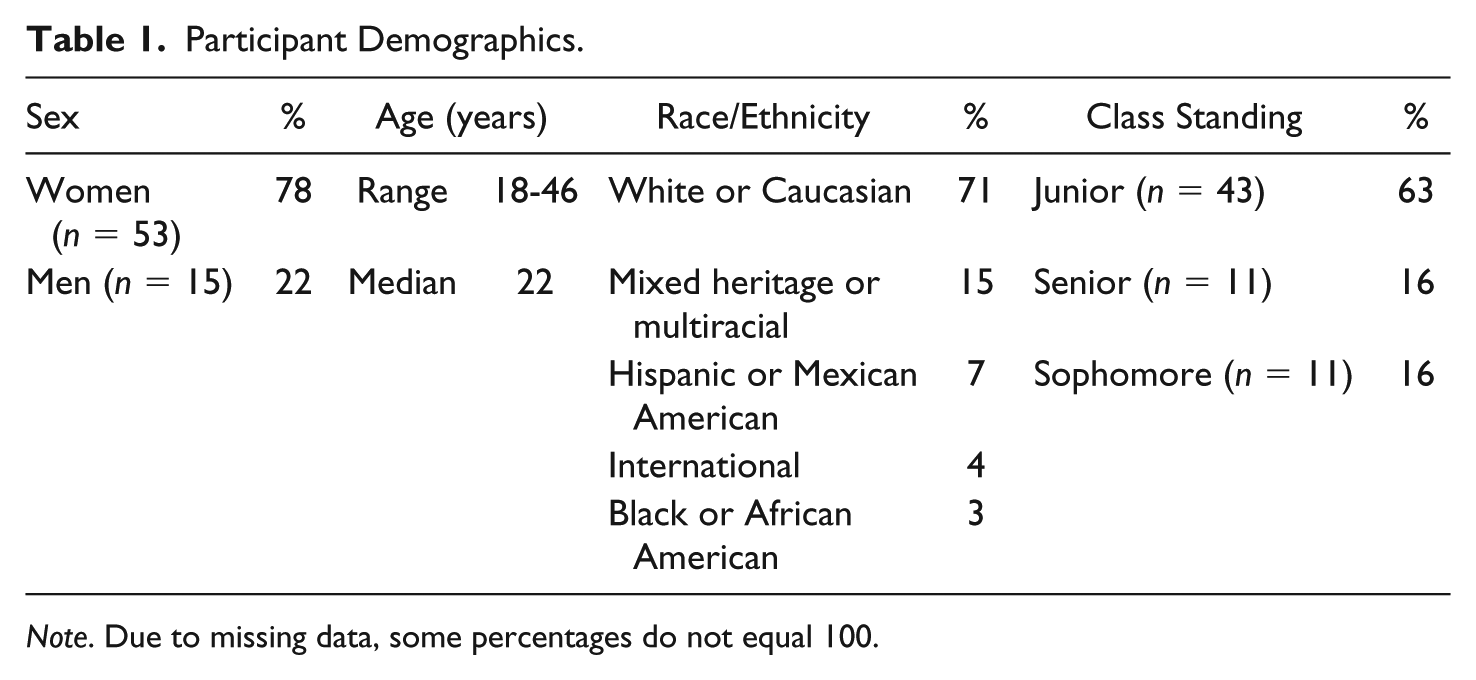
Note. Due to missing data, some percentages do not equal 100.
Materials and Procedure
Participants received an Internet link to access the narrative-style questionnaire and were directed to complete it at a time and place convenient and comfortable for them. Once the link was accessed, participants were instructed to read the informed consent and provide an electronic signature if they were willing to participate. All procedures were approved by an institutional research review board to ensure the protection of human participants.
The first page of the questionnaire informed participants they would be asked to “provide a richly detailed description of a time that you SAVORED a communication episode.” The questionnaire contained one broad writing prompt (e.g., “in as many details as possible, try to capture in words a communication experience/episode that you savored . . .”) with specific prompts to encourage narrative detail. To explore the phenomenological experience of communication savoring, participants also answered two additional open-ended questions: “What was it about this particular communication episode that you savored?” and “What was it about this particular communication episode that let you know that you did savor it (e.g., how did you know you savored it?).” Participants had unlimited space to respond to all the writing prompts. Participants answered demographic questions at the end of the questionnaire.
Data
Of the 68 total entries, three described irrelevant experiences 2 and were removed from the corpus. A total of 65 communication savoring episodes were retained for analysis. See Table 2 for word count and relational contexts in which communication savoring occurred.
Data Corpus: Word Count, Frequencies, and Relational Contexts.

Data Analysis
Data analysis proceeded in three phases guided by the coding and analytic strategies outlined first by Strauss and Corbin (1998) and later by Charmaz (2014). First, I read the corpus several times, and as new data arrived, to gain a holistic sense of the participants’ experiences. I maintained descriptive memos about my on-going assumptions, questions, and observations about the data. Memo-writing begins the first phase of analysis by allowing the researcher to concretize emergent thoughts about the data, to explore those thoughts analytically, and to make new discoveries through the process (Charmaz, 2014; Emerson, Fretz, & Shaw, 2011).
Next, I began open coding (Strauss & Corbin, 1998). During this phase, I closely read participants’ narratives and open-ended responses. Then, I assigned short descriptive labels (codes) to phrases and passages that captured their lived experience with communication savoring. First, I coded for evidence and descriptions of communication savoring. I applied a broad definition of communication that included both verbal (what was said in words) and nonverbal messages (what was expressed through gesture, environmental cues, and touch) within real, remembered, or imagined/anticipated social interactions. Then, I narrowed my coding to identify (1) types of communication savoring, (2) the contexts in which communication savoring occurred (i.e., the scene, setting, and relationships), and (3) participants’ descriptions of the mental or physiological experience of communication savoring (i.e., the phenomenological aspects). During the first cycle of coding, I did not attempt to cluster data or condense codes. By assigning novel codes to each meaningful unit of text, I was able to retain the rich, nuanced details present within each passage before moving into my second cycle of coding—a process Glaser (1978) described as transcending the data to gain a broader, abstract scope of the data.
In grounded theory, open codes become the building blocks of the emergent theory or conceptual model when they are placed together in broader conceptual groupings (Glaser, 1978). Thus, the primary goal of second-cycle coding is to build higher-order conceptual categories from the open codes. To achieve this, I used the constant comparison method advocated by Glaser and Strauss (1967). Constant comparison is the process of examining each unit of data against all other units of data to establish conceptual distinctions and similarities. Codes that are conceptually similar to each other are grouped together and labeled accordingly into categories. This process requires constant refining and development of conceptual definitions for each thematic category. The researcher constructs and connects increasingly abstract conceptual categories, reassembling the findings from the ground up, to account for the whole—in this case a typology.
Findings
The broad purpose of this investigation was to determine first whether people do savor communication. To answer this question, I sought to identify whether participants were able to clearly recount communication moments they savored. With the exception of three cases in which the savoring experience did not involve social interaction, the answer to that question was “yes.” Sixty-five participants described in detail at least one communication experience they savored. Respondents recognized and gave examples of communication savoring in such vivid and varied detail to suggest the phenomenon is relevant and common. Thus, the second and third questions sought to identify its distinctive qualities in terms of form (types) and experience (phenomenology).
Communication Savoring Types
My examination of the narrative data revealed seven distinct types of communication experiences that people savored. Although these forms appear to have unique qualities, people often savored more than one communication element in a given encounter. The presence of multiple communication cues that individuals savored helped to saturate each of the seven types with sufficient evidence, but also suggested that communication savoring is a multidimensional process. Each type is described and defined below (see Table 3). Exemplars are drawn from participants’ narratives to retain their voice in this report. In selecting data to exemplify each category, I prioritized inclusivity to ensure a range of voices were represented and chose passages that were both richly descriptive and central to the concept (i.e., I did not select extreme cases as exemplars).
Communication Savoring Typology.
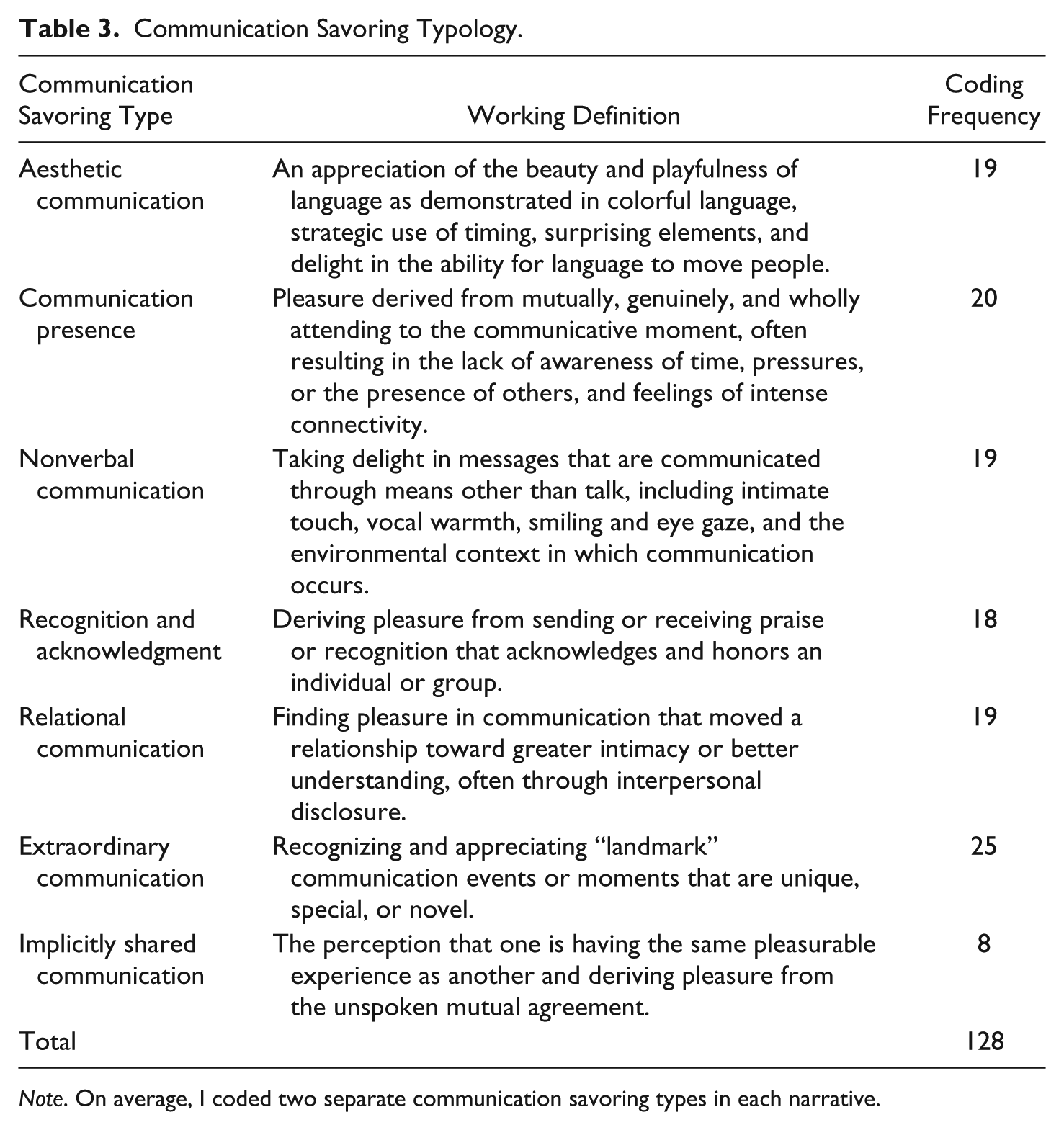
Note. On average, I coded two separate communication savoring types in each narrative.
Aesthetic Communication
In the words of one participant, “savory communication” touches an “unreachable tickled spot inside.” She described this form of communication savoring as appreciating “the choice of words, the way they are strung together, the way they are delivered and the timing associated with [it] combined with an unexpected twist or an image created in my mind.” Examples of aesthetic communication that participants savored include surprise at hearing something unexpected and positive, hearing/delivering a great speech, and “holding in” positive communication and positive emotions to wait for the right time, or aesthetic moment, to express them. For some, this involved delighting in the use of just the right language at the right time. For example, one participant savored her delivery of the maid of honor speech at her sister’s wedding, “The thing that I savored most . . . was how I was able to move everyone at the wedding reception and create an emotional response.” For others, savoring aesthetic communication involved being tickled by everyday communication moments like hearing one’s dad talk passionately about a seemingly mundane topic (in this case bees) or hearing a daughter’s unexpected response to an overheard conversation, “[her] play on words was delicious.”
Participants also savored communication that was suspenseful, surprising, or long awaited. One participant savored the feeling of wanting to disclose personal feelings, yet withholding them in the present moment to find the right time to say them: “I savored everything—especially how I felt. I remember trying to hold back every cell in my body to not tell him how I felt.” Other participants wrote about savoring the suspense created through strategically puzzling communication such as unraveling a family surprise through hinted communication, or keeping a secret and then revealing good news. Other participants savored suspenseful communication, like being the last person to receive an award during a long ceremony.
Communication Presence
Participants savored communication encounters that they described as “real,” “entirely honest,” or where “all acts of kindness towards one another were genuine and not forced.” Participants savored being so deeply engaged in a conversation that “it was as if nobody else in the world mattered” or “like we were the only two people in the world.” Others savored putting their full attention on the conversation in the moment and not being “distracted by events of everyday life.” For some, it was a matter of being the sole focus of an interaction, “He gave me his full attention and seemed genuinely interested in me and what I was saying.” For others, it was the feeling of being attended to as a whole person, “It was one of the only times I could see him as more than just a football coach, as he acknowledged me as more than a football player.” Still others described savoring the mutual recognition of being completely in the moment together, “it felt warm and real and like we were on the exact same page at the same time.” Similarly, participants savored moments in which it became clear through conversation that “we both felt the same way.” In the words of one participant, “it’s in those moments when we see eye to eye that contributes to savoring that moment.”
Nonverbal Communication
Participants described savoring a range of nonverbal cues from the surrounding environment, to gestures, to the way a message was spoken with respect to tone or gravity. For example, although painful, one young woman savored the gentle way her parents disclosed her grandmother’s dementia diagnosis, “They touched my hand to let me know that they were there for me. My dad’s voice was quiet and he spoke very softly letting me know that what he was about to tell me was not good news.” Participants also offered moments of physical intimacy as savored communication, such as a meaningful hug, “It was one of those ‘I haven’t seen you in forever and I really miss you’ hugs, which are long and tight.” Another young woman recalled her last interaction with her dying grandmother who “does not often show emotion.”
It was a really cool moment where I was taking care of a woman who once took care of me . . . When I went to say goodbye to her, I told her that I loved her and leaned into her bed to give her a hug, and she gave me a hug and a kiss on the cheek.
Participants also savored intimate nonverbal expressions with romantic others. One young man recalled savoring his girlfriend’s response when he first asked her to become his girlfriend, “She turned around and smiled put her hand on my arm and said she would love to . . . I savored the smile.” Another described savoring the moment he saw his girlfriend for the first time in 2 months, “Seeing the smile on her face when she saw me that night was incredible. Being able to hold her hand and smell her perfume again was amazing.”
Others savored the “perfect scenes” surrounding the communication encounter. One young woman described arriving at a “sacred space” on a secluded beach after a long walk with her sister, “The aloneness brought out a new space for us to share stories and made us feel very safe . . . we were able to open up so much with each other in one of the most beautiful places in the world.” Another young woman described savoring the perfect setting in which she visited a former boyfriend during the winter holidays. She remembered wishing she “could stay in that room with him for as long as possible and never forget that moment . . . I stayed behind and took a picture of the living room . . . so that I would always have a reminder of that perfect evening.”
Recognition and Acknowledgment
This type of communication savoring emerged, in part, from events where the participants publicly acknowledged or offered appreciation of another. For example, on her child’s birthday one participant savored the moment she was spontaneously moved to shout from atop a chair “let[ting] everyone in the room know how thankful I was and how truly lucky we all are.” Others savored more planned communication like giving a speech honoring an individual, “I couldn’t wait to express how this human being has impacted my life and the funny stories I had with her.”
Many participants also savored receiving praise for their achievements, both publicly and privately. One young woman described savoring the moment her guidance counselor recognized her at graduation, “acknowledging all that I had done for the community. It allowed others including my family and friends to also see my hard work be acknowledged.” This type of public recognition allowed people to savor “the feeling of how proud everyone was of me to win that award. I felt accomplished.” Some participants described savoring the moment their social, academic, or athletic achievements or skills were acknowledged, such as winning a debate tournament, being invited to participate on an elite soccer team, getting a desirable sorority bid, or “the time I won the Student of the Year award.” One student described savoring a conversation with her English professor when he “said he could tell my work apart from others . . . It was really nice to be noticed and to see that my work does stand out.”
Relational Communication
The sentiments of one young woman captures the essence of this theme, “I savored this communication episode because it . . . serves as a day I can pinpoint when we grew closer.” This form of communication savoring centered on communicative events that established, confirmed, or gave insight into relational positioning. For example, many participants described savoring intimate disclosures, especially of love, that moved their relationship closer. Indeed, one participant started her narrative with the phrase, “This is the story of how I told my boyfriend I loved him.” Another prefaced her description with, “I savored [when] my boyfriend first told me he loved me. Although it may sound typical, this is something that I never forgot and was the first thing that came to mind.” One young man savored the power that those three little words held for him, “I savored . . . the emotion that I felt when hearing her say . . . just three words. But they held so much meaning and in the moment, the emotions were overwhelming.” However, not all the relational communication individuals savored moved relationships toward greater intimacy. For example, one participant described savoring a conversation that that resulted in a clearer understanding of the expectations for their friendship (i.e., that it was not going to develop into a romantic relationship).
Others savored messages that revealed relational or future certainty. One young woman recalled when her boyfriend referred to their (future) children, “I felt drawn to him even more after he said ‘our kids.’” Another young woman described savoring “when my boyfriend told me that he loved me.” His disclosure added certainty to her own feelings, “I had known for a while already that I loved him and [his disclosure] made me feel extremely happy and accepted . . . I felt that we could open up with each other even more and express our true feelings.” Participants also savored relational communication because of its power to transform relationships or perspectives. For example, one young woman described savoring one conversation in particular, “because in the midst of this discussion, my whole viewpoints on a lot of things in my life completely changed. For example, my best friend was no longer just my friend, but the one I wanted to be with.” In a few cases, intimate disclosures also served as turning points to move beyond relational hurt. Recall the communication moment savored by the young woman who found sanctuary in the privacy of the natural environment. She described achieving a new “emotional openness” in that walk with her sister.
Without her having to say anything, I said “I know you are sorry, but I love you and I forgive you.” It was a monumental moment for us as sisters because we were getting past something that was literally a barrier for us and stopped all communication for two years.
Extraordinary Communication
Many participants described savoring communication surrounding special moments such as the birth of a child, a wedding, illness, and recovery. One young woman named these types of events “landmark memories.” Some landmark memories centered on specific encounters such as final conversations or conversations surrounding illness and recovery as ones to savor both retrospectively and in the present moment. For example, one participant explained that she savored a particular conversation with a young man “because about a year and a half later he was hit by a car and died . . . I’ve racked my brain endlessly trying to hold onto every detail I have about him . . . to hold onto the communication moments of the past.” Another young man described a communication exchange with his uncle who died when he was very young and added, “He was gone by the time I was seven so every communication instance that I could remember between me and him is very special to me.” Others recalled conversations with dying grandparents, “I remember . . . him telling me how much he loved me and how important it was for me to find a Greek boy to marry . . . I knew the moment I last talked to him was a good one.”
Some recalled the joyful experience of communicating with someone who had recovered from a serious illness. One young woman wrote at length about her sister’s illness and near death, “Then, one day MIRACULOUSLY, my sister’s liver rebooted itself. I witnessed a real-life medical miracle . . . I’ll never forget the drive home from the hospital . . . I didn’t leave her side that whole week.” Another young woman described a communication episode with her father who had been seriously injured in a bicycle accident: He had a broken back, ribs, a collapsed lung, and had contracted sepsis. After months of not walking, he gained the strength to walk 10 miles . . . My dad showed no sign of pain or discomfort, and we shared great conversation. It was just me and him the entire time, walking side by side, and I could tell how happy he was that not only could he walk that far, but that I could join him.
Others simply savored communication experiences that were novel or unexpected, as one participant described, “I savored that the experience was unique, it was probably something I was never going to do again so I paid extra attention and tried to soak it all in.” This included opportunities to talk to family members who live far away or catch up with an old friend. Family was a recurrent theme here, as one participant described, “I rarely get to spend time with them, therefore, the little face-to-face communication I have I try to savor.” Another participant explained that she savors communication with her family “because as you get older, these special moments happen less and less.”
Finally, participants also described unexpected or meaningful chance encounters. One young woman described an interaction with a favorite singer/songwriter. Two young men described chance opportunities to speak with celebrities and appreciating their communication style and professionalism. Not all chance encounters involved a celebrity, however. Some included acquaintances and even strangers. One participant savored a chance interaction with an older man at a restaurant while waiting for assistance with a flat tire, “hearing from an older stranger that I should embrace life and everything will be okay was extremely gratifying to hear . . . I probably will never see that guy again but that conversation meant a lot to me.” She explained that she tended to savor “first conversations” with people because “that first initial conversation has your full and honest attention, which in my opinion is [a] very rare moment since many listen, but are not actually listening.”
Implicitly Shared Communication
Though less common, perhaps because of the difficulty in articulating such an experience, participants also savored the implicit (unspoken) communication transferred during a shared meaningful experience. Participants wrote about mutually recognizing that an entire crowd was sharing the same awe-filled experience, “celebrating with my team and the feeling of the crowd going wild” or witnessing “the excitement in the crowd surrounding me.” One young man explained, “I savored looking at my friend and seeing that his nonverbal cues indicated a very similar feeling, and I savored that we both intuitively knew the feeling was mutual.” One young woman savored the moment when she recognized “my friends around me seemed to have the same reaction because they too were smiling and soaking up the sun.” Another young woman described savoring the moment she looked over at her roommate and knew she was sharing the same experience: I remember the feeling of the grass under my feet, and singing the words of the song and knowing that I absolutely meant every single one, and feeling so thankful to be singing with over 500 fellow Christians on our college campus. My roommate stood next to me singing as well, and although we didn’t talk, it was just refreshing to know she was there sharing this experience with me.
Phenomenology of Communication Savoring
The final question sought to uncover the phenomenological experience of communication savoring. Participants wrote about physical, metaphysical, and temporal experiences related to savoring a communication moment. These findings are captured in three broad themes that reflect the temporal qualities of savoring, present-moment awareness, savoring with future intent, and retrospection.
Present-Moment Awareness
One form of present-moment awareness was being absorbed in the moment. Many described the experience of communication savoring as being completely aware and absorbed in the moment. For some it was like a slow-motion film where one is able to “watch the moment I am living.” Others described feeling “like time was still” or “condensed.” Participants described being so completely immersed in the moment, or “swallowed up with what is happening,” that they were unaware of what was happening outside of their moment. For many this brought an unusual sense of calm. For example, one participant described feeling “completely at peace knowing that I am exactly where I am, doing exactly what I’m doing in that moment.” Others described similar feelings of being “completely at ease. No idea of problems or worries” or “unusually calm and collected.”
Another manifestation of present-moment awareness was an enhanced embodied experience. Participants described experiencing heightened physical and emotional arousal. One person described his communication savoring experience as though it “highlighted the experience and made it more raw and open to nerves, so every emotion was enhanced and memorable.” Another participant wrote, “if I’m savoring a communication moment, it’s like my entire body is full of love. There is nothing I can think of that could possibly take away the joy I feel.” Others simply described communication savoring as “exaggerated with my emotions” or as “experiencing an excited and high frequency state of being . . . I could feel the good energy and vibes radiating from my being.” Many participants attributed their savoring experience to the deep emotional experience they felt at the time of the encounter. For example, one participant explained, “it is the emotion that creates these moments . . . such as love, gratitude, humor, compassion, excitement.” Another explained, “when anything involves so much emotion, you hold onto that memory.”
A final form of present-moment awareness was heightening through intrapersonal communication cues to savor. Participants also described knowing that they savored a moment because of their use of intrapersonal communication cues to capture the moment, “when I am savoring a moment, I kind of think to myself that I will savor this moment and remember it.” Specifically, some participants described thinking or saying aloud a message that helped them focus on and intensify the communication encounter. When asked how she knew she savored a particular communication moment, one participant wrote, “I remember telling myself to never forget this evening and took a second to really soak in my surroundings.” Another participant described, “I literally thought and then said out loud, ‘I want to remember this moment forever . . .’ It sounds silly but the fact that I verbalized it . . . made it so important that I wanted to save it forever in my memory.”
Savoring With Future Intent
Some participants not only savored the present moment, but did so with the intent to savor it again through future recall. This is evident in some of the passages above referring to the desire to be present in the moment to build the experience into memory. Participants described feeling a need to “soak in the moment and save it in my memory,” feeling a desire to “remember it forever,” or knowing that “it was a moment that I could never forget.” A few participants wrote about their future intent to savor explicitly. In one example, a young woman wrote that she savored the communicative events surrounding a relational disclosure from her romantic partner because she anticipated “reflect[ing] on these memories and communication moments in years to come.” Others described anticipating savoring a future moment when they could recall a savored experience to enhance or enlighten a future experience. For example, one participant wrote, “I want to remember this moment forever and bottle it up forever so that on days when I feel sad or discouraged I can shove it back into my soul.” While another participant wrote about attending to a final conversation with future intent to savor: I savored the fact that it could have been my last interaction with my grandmother and that I wanted to make it as perfect of a moment as possible so that I could look back on it years from then and smile.
Retrospection
Participants also reported retrospective communication savoring. In one form, reflection and replay, participants described knowing they had savored a communication moment because of their desire and ability to replay the moment frequently. At the most basic level, participants described knowing they savored communication “because it sticks in my mind after it has occurred,” or because “it was something my thoughts kept drifting back too.” Others described greater intentionality in their desire to replay a savored moment, “I know I was savoring the moment because I kept replaying him saying that he loved me in my head that night.” Several participants described this form of purposive savoring recall as occurring because a moment “means so much to you that you look back on the moment time and time again.” Another participant described the experience as “the same feeling as when you wake up from a dream and play it over and over in your head so that you don’t forget it.” Another significant feature of this theme was participants’ awareness that they recalled a savored experience to broaden and build on the experience, “I realize that I could use that moment to help better my life and gain new perspectives.” Another participant poignantly described this potential writing, “I also know when I have savored a moment when I experience something new and that previous communication moment comes into my mind.”
Participants also savored the past through vivid recall. Nearly every participant wrote about their savoring experience as one that continues to bring pleasant sensations and emotions through their ability to recall the event in vivid detail. One participant explained, “you know you have savored a communication moment when . . . you recall the event so well that even thinking about it makes you feel the same emotions as it did the first time you experienced it.” Participants reported knowing they savored a communication experience because they could recall it easily, “clear as day,” and when they do, they experience the same “rush of positive emotions” that they felt at the time. For example, “I know that I savored this experience because I can close my eyes and visualize the moment and I clearly remember the sights sounds and feelings I felt during this experience.” One participant explained that merely writing about the experience “made me get teary eyed, and so happy at the same time; just like I felt 11 years ago.” Another participant explained, “I often relive it in my head and am taken back to that moment in time. The emotions that I feel when thinking about it now confirm that I did in fact savor this moment.” In other words, one way by which participants knew they had savored an experience was by being able to recall and relive that moment—“when you get chills just thinking back on the experience. Specifically, when you re-live the experience in detail (like through a recorder), you feel the same emotions that you felt when it was happening.” Although many participants wrote about their ability to recall specific details, such as “remember[ing] exactly how I felt,” or “remember[ing] this conversation perfectly,” the details were not always the most salient part of the savoring experience. It was more often the gestalt experience: Like even when you can’t remember details, the feeling of happiness that you had in that moment comes right back to you. The memory almost feels like a dream, in which all the details blend together into one happy or satisfactory feeling that comes from the overall moment, and you feel like you could relive that moment over and over again without getting tired of it.
Discussion
Foremost, this research demonstrates that people do savor communication in ways previously unaccounted for in the literature. These findings deepen Bryant and Veroff’s (2007) well-established, but broad, notions of social savoring (i.e., sharing with others) to account for more complex and nuanced understanding of savoring social interaction, a pillar for quality of life. Specifically, I identified seven types of communication experiences that participants savored: aesthetic communication, communication presence, nonverbal communication, recognition and acknowledgement, relational communication, extraordinary communication, and implicitly shared communication. These findings not only demonstrate that people recognize and are cognizant of communication encounters they savor, but also that they sometimes employ communication strategies to augment savoring, suggesting that communication savoring is both a distinct phenomenon and a practice that can be coached.
While these findings extend knowledge about the social dimensions of savoring, the phenomenological experience of communication savoring appears to be similar to other forms of savoring, but with attention toward social interaction and meaning-making. People delighted in their anticipation of upcoming encounters/messages, experienced pleasure in their heightened state of awareness during communication savoring, and relished in previous interpersonal interactions through embodied recall and pleasurable reminiscence of conversation and disclosures. Thus, the temporal and phenomenological experiences of communication savoring map on to the experience of savoring other positive events (Bryant, 2003; Bryant & Veroff, 2007; Hurley & Kwon, 2012; Quoidbach et al., 2009; Quoidbach et al., 2010) providing validation for the phenomenological experience of communication savoring.
Mapping and Defining Communication Savoring
In its broadest conceptualization, communication savoring is about enhancing positive affect by noticing, relishing in, envisioning, and reliving pleasurable social interactions (i.e., verbal/nonverbal and explicit/implicit messages). The operationalization of communication savoring requires an iterative movement between the inductive (or grounded) conceptualizations of communication savoring and the deductive (or previously established) features of savoring. Toward this end, I offer the following defining features as a working model toward the development of savoring as a communication construct and point out where they overlap with, or are distinct from, established positive psychology or communication constructs.
Like generalized savoring, communication savoring necessitates purposive attention (cognition) but does not occur under conditions of (negative) cognitive overload such as stress and negative emotions (Bryant & Veroff, 2007). Decades ago, Stamp and Knapp (1990) argued that communication scholars “routinely rely on communicators’ recall of their behavior which presumes consciousness” (p. 286). In line with this, I suggest that participants’ ability to identify and descriptively recount communication savoring episodes, as well as their own accounts of increased presence and awareness during savoring encounters, are evidence that communication savoring does involve a heightened state of consciousness (mindful state). Moreover, the phenomenological experience of communication savoring indicated positive affective states. For example, participants described feeling a sense of peace (e.g., within communication presence), greater connectedness with others (e.g., implicitly shared communication), and an appreciation of beauty (e.g., aesthetic communication and nonverbal appreciation), all of which are indicative of positive mood states that facilitate savoring (see Fredrickson, 2004).
Like generalized savoring, communication savoring also necessitates mindfulness, but is distinct from mindfulness. A mindful state brings attention and awareness to the external world, but does so neutrally and momentarily (Bryant & Smith, 2015). That is, mindfulness involves nonjudgmental awareness (Kiken, Lundberg, & Fredrickson, 2017), whereas savoring directs awareness at pleasant affect (Bryant & Smith, 2015; Bryant & Veroff, 2007). Moreover, mindfulness is the practice of attending to, but then letting go of, the present moment; whereas savoring is the practice of holding onto and prolonging the pleasure in the moment. Thus, although mindfulness is necessary for savoring to occur, the focus shifts from neutral present moment awareness to a sharpened focus on positive affect during savoring (Bryant & Smith, 2015; Bryant & Veroff, 2007). Communication savoring, then, is even narrower in scope with its focus on identifying and attending to pleasurable or meaningful social interaction. Participants’ vivid recall and descriptive detail of savored communication moments are evidence of their mindful state in the moment.
Also, like generalized savoring, communication savoring creates pleasure beyond pleasure. Savoring communication is more than just enjoying a conversation, but recognizing that you are enjoying it and then enhancing the experience. The most compelling evidence of this was some participants’ use of intrapersonal communication cues to savor wherein they instructed themselves to relish in a savored moment and capture it in their memory. Participants also described prolonging pleasant affect by deliberately engaging in several of the common savoring strategies identified by Bryant (2003) and Bryant and Veroff (2007). For example, participants engaged in “sensory-perceptual sharpening” by focusing their attention on the sensory experience (e.g., focusing on environmental cues that created “perfect scenes”). Participants also used “absorption” (allowing oneself to be swept away by the moment) and “temporal awareness” (appreciating the fleetingness of positive moments) to prolong positive affect especially within the communication presence and extraordinary communication domains. In the recognition and acknowledgment domain some participants engaged in the “self-congratulation” strategy, a form of basking in one’s accomplishment. Finally, many participants indicated using the “memory building” strategy within relational communication in order to remember a moment forever, while “sharing with others” was prevalent in implicit and relational communication.
Communication savoring is rooted in social interaction. Whereas savoring, broadly conceived, may be experienced at either the social (shared) or individual (psychological or physical) level, the focus of communication savoring is on social interaction and meaning-making. Communication savoring includes real, remembered, and anticipated or imagined interactions that are explicitly verbalized, implicitly shared, and/or nonverbal in nature. That is, when people savor communication, they may relish heightened present-moment awareness of an ongoing interaction, find pleasure in imagining anticipated interactions (see Honeycutt, 2003), or recall a treasured interaction in vivid detail.
Communication savoring is also related to, but distinct from, other forms of positive communication, such as memorable messages. A “memorable message” is one that the individual recalls for a long period of time and the individual perceives as having an important influence on his or her life (Knapp, Stohl, & Reardon, 1981). A memorable message can become savored communication through application and recall. Indeed, several participants described exactly these types of encounters. For example, one young woman savored the moment she realized the advice she was receiving from her father was “literally so right” for her in that moment. The message became memorable and she savored the moment. However, savored communication moments do not necessarily have the same life-long impact or guidance that memorable messages do. For example, individuals may savor communication in the present moment, but not recall it in the future for guidance or direction. Individuals can also savor implicit communication or even communicative events that have not yet occurred, through imagining interactions or anticipatory communication savoring, and are therefore not part of a memorable message repertoire. Finally, the embodied experience of communication savoring distinguishes it from memorable messages in that savoring necessarily involves heightened positive affect. Although memorable messages can produce positive affect, not all memorable messages serve this function. Specifically, participants’ descriptions of communication savoring went beyond reporting memorable message content to include highly descriptive detail of the savored moment as well as their emotional responsiveness to recalling the event.
Communication savoring is also distinct from, though might include, peak communication. Gordon (1985) defined peak communication as the “‘greatest moments’ in interpersonal communication, our moments of highest mutual understanding, happiness and fulfillment deriving from the process of communicating with other human beings” (p. 824). Certainly, peak communication experiences can be savored, but so too can the more mundane, fleeting, and less impactful communication experiences that individuals have. Communication savoring can simply involve delighting in the momentary awareness of a passing pleasure derived through communication and need not be enduring. Communication savoring is also distinct from peak communication because it is not necessarily rooted in actual interaction (i.e., people savor anticipatory and imagined interactions).
As these features demonstrate, communication savoring is a distinctive form of savoring that belongs to the broader category of savoring already established in positive psychology. It also clearly fits within the domain of language and social psychology as a practice that enhances well-being, but is also distinct from other forms of positive communication such as memorable messages and peak communication. Thus, from the features illustrated above, I propose the following as an initial definition of communication savoring: The process of mindfully attending to pleasurable or meaningful social interaction in real, remembered, or anticipated/imagined encounters and enhancing or prolonging the positive affect.
Future Directions for Theory and Practice
Because of its broaden-and-build potential (Fredrickson, 1998, 2001), communication savoring may facilitate personal and relational well-being in the present as well as the future. In the first, savoring positive affect derived through social interactions allows individuals to capitalize on, enhance, and prolong good feelings in the moment creating upward spirals of positive affect (Fredrickson & Joiner, 2002). Moreover, the generation of positive affect as well as the sensory pleasures that are often experienced with savoring, activate approach and continue relationship behaviors (Fredrickson, 2001). Thus, within close relationships, communication savoring may create opportunities for partners to turn toward each other (Gottman & Silver, 2015), to build social bonds and attachment (Fredrickson, 1998), and to foster a sense of “we-ness.” Thus, one direction for future research is to examine the potential for communication savoring to promote relational well-being and resilience by serving as a form of relational maintenance and enhancing a sense of communal orientation through mechanisms of the theory of relational load and resilience (see Afifi, Merrill, & Davis, 2016).
As the participants in this study revealed, present moment communication savoring may also bolster neutral mood states by bringing awareness to what is joyful in mundane encounters (e.g., delighting in someone’s discourse about the life of bees) or buffer against negative affect in difficult interactions (e.g., end of life conversations). Finding joy or meaning in mundane or difficult encounters by focusing on what is going right in an interaction not only elevates positive affect and helps individuals to cope with the stressor at hand, but may also create additional repertoires for finding positive meaning in similar future events (Fredrickson & Joiner, 2002). Therefore, one practical future direction for this research is the development of communication savoring exercises intended to bring individual awareness to the bright or gentle side of communication encounters that do not normally generate pleasant affect.
Recalling and savoring past positive interactions can also generate personal and relational well-being by bringing strength, perspective, and relief to the present moment as well as build psychological resilience over time (Fredrickson, 2001). The mindfulness involved in present-moment communication savoring can create a richly detailed memory map that individuals can recall and relish in in the future (e.g., memory building; Bryant & Veroff, 2007). Recalling positive memories can evoke similar pleasant experiences in the present (Speer, Bhanji, & Delgado, 2014) and using experiential processing (i.e., savoring sensory awareness) when recalling those memories can further strengthen the positive affect (Gadeikis et al., 2017). Calling to mind past positive memories is both a natural and adaptive activity, especially in the face of life stressors (Speer et al., 2014). Therefore, one possible extension of this work is to test whether vivid recall of savored communication within a close relationship can buffer the negative impacts of present-moment relational distress.
Finally, increasing positive emotions through savoring can encourage individuals to expand their comfort zone and extend their acceptance and appreciation to people outside their close personal network (Fredrickson, 2001). In this way, communication savoring may also facilitate positive intergroup relations. At least one study points to this potential. Harrison (2014) found that although directly encouraging Whites to savor previous interactions with Blacks did not increase willingness to develop intergroup friendships, trait savoring was related to both positive intergroup emotions and willingness to develop intergroup friendships. Within the language context, individuals who exhibit a high capacity to savor communication could also be more amenable to linguistic diversity. Thus, another fruitful line of future research could examine the potential for communication savoring to influence language attitudes in intergroup contexts. While we know much about factors leading to negative language attitudes (see Dragojevic, Giles, Beck, & Tatum, 2017), we need a better understanding of factors that contribute to positive language attitudes in order to cultivate the practices that facilitate positive intergroup contact.
These findings are limited by the small and homogenous sample drawn for this study especially with respect to age, social class, and culture. There is some evidence to suggest that age (Geiger et al., 2017; Smith & Hollinger-Smith, 2015) and culture (Lindberg, 2004; Pitts, Kim, Meyerhoffer, & Jiao, 2018) affect the focus and the outcomes of savoring. Indeed, on-going research in this area is beginning to test the transferability and validity of the proposed typology to different age and cultural groups (Pitts, Kim, Jiao, & Meyerhoffer, 2018). Such comparative analyses would give indication to the robustness of the categories suggested here as well as offer opportunities to test, extend, and expand the typology and refine the operational definition. From there, scholars can inductively develop a measure of communication savoring to be used in future research as well as a tool for assessing one’s capacity for communication savoring as a useful self-help guide or relational intervention.
In summary, communication savoring is a distinctive form of savoring that shows potential as a positive language and social psychology construct. The present study demonstrates that people savor communication and social interactions quite naturally and in meaningful ways. Participants described experiencing heightened positive affect while savoring communication in the present moment, anticipating future communication encounters, and reminiscing about past positive social interactions. These findings extend current knowledge on savoring by adding depth and nuance to the broad notion of social savoring. By bringing savoring into the field of language and social psychology, we gain a greater understanding of communicative practices that can enhance social and personal relationships.
Footnotes
Acknowledgements
I offer thanks to Howie Giles for his unwavering support for this project and to my research team, Sara Kim, Jian Jiao, Amanda Cooper, Alice Fanari, and Holman Meyerhoffer for their enthusiasm for this undertaking. Thanks are also due to a very thoughtful anonymous reviewer who gave critical feedback necessary to move this work forward.
Author’s Note
I presented an early version of this article as part of my Presidential Address to the International Association of Language and Social Psychology at the International Conference on Language and Social Psychology (ICLASP15) in Bangkok, Thailand in June 2016.
Declaration of Conflicting Interests
The author(s) declared no potential conflicts of interest with respect to the research, authorship, and/or publication of this article.
Funding
The author(s) received no financial support for the research, authorship, and/or publication of this article.