




Abstract
The fading affect bias (FAB) is a phenomenon of autobiographical memory whereby negative emotions associated with event memories fade in intensity over time more than positive emotions. Social disclosure enhances the FAB and listener responsiveness during social disclosure is an important facet; however, little is known about the nature of listener verbal responses that facilitate an enhanced FAB. In this study, we used discourse analysis to explore listener verbal responses and conversational patterns associated with an enhanced FAB after social disclosure—backchanneling, in which the listener shows they are paying attention to the story underway; displays of understanding whereby the listener shows awareness of the speaker’s emotional state; and positive facilitation, characterized by mutual development of positive interpretations of both pleasant and unpleasant experiences. We suggest that such listener responses are similar to those described in the verbal person-centered framework, and the emotional benefits of social disclosure are in part collaboratively created by conversationalists.
The fading affect bias, or FAB, refers to the differential fading of emotional intensity in memory: Negative emotional intensity fades over time to a greater extent compared with positive emotional intensity. Social disclosure has been associated with an enhanced FAB. When emotional events are disclosed to other people, the intensity of the negative emotions associated with these events can be reduced after the disclosure compared with beforehand (Muir, Brown, & Madill, 2015; Skowronski, Gibbons, Vogl, & Walker, 2004). Although the nature of verbal messages offered by listeners is suggested to be influential in determining the extent of emotional improvements experienced by speakers (Goldsmith, 2004), characteristics of verbal messages offered by listeners associated with an enhanced FAB are yet to be determined.
We performed qualitative analysis of listener responses associated with an enhanced FAB after social disclosure and found three main types of characteristic listener responses, which have parallels to those proposed within the verbal person-centered (VPC) framework: backchanneling, demonstrations of understanding, and facilitation of positive interpretations of both pleasant and unpleasant events. Further, these positive interpretations were often mutually developed by conversationalists, highlighting the collaborative nature of conversation. In this article, we thus identify characteristics of social interaction that result in the FAB and propose that VPC listening could be conceptualized as a collaborative activity. We argue that one of the benefits of social disclosure is through providing opportunities for collaborative, mutual amplification and exploration of positive emotions, facilitating the speaker to engage in emotional regulation activities that then enhance the FAB.
The Fading Affect Bias and Social Disclosure
The FAB is usually measured by asking participants to report a number of personally experienced pleasant and unpleasant events, along with ratings of how emotionally intense each event felt when it originally occurred, and when they recall it in the present day. The usual finding is that unpleasant events exhibit much greater fading in emotional intensity from event occurrence to recall, in comparison with pleasant events. The FAB has been well documented and appears robust and reliable cross-culturally (Ritchie et al., 2015) and in relation to various measurement methods (e.g., Dwyer, Gibbons, & Walker, 2004; Landau & Gunter, 2009). It is also observed irrespective of participants’ beliefs in how emotions change Within the social disclosure condition over time (Ritchie, Skowronski, Hartnett, Wells, & Walker, 2009).
Theoretical accounts of the FAB propose that it exists as a result of self-enhancement and self-protective motivations in action in autobiographical memory (Skowronski et al., 2004). Self-enhancement motivations increase or maintain positivity of event memories to preserve a positive view of the self, and self-protection motives act as damage limitation, marshalling defenses against negative feedback or events. It is suggested that these motives drive individuals to utilize cognitive and social resources upon remembering an unpleasant event to minimize the damage caused to the self (Taylor, 1991). For instance, cognitive resources could include re-appraisal or positive reframing (Lazarus & Folkman, 1984), social resources could involve the ability to reach out to others, and emotional resources might be marshalled from the way in which these others help reduce stress (Lepore, 1995; Lepore, Allen, & Evans, 1993), perhaps through offering comfort and understanding (Zech & Rime, 2005). The FAB, then, may emerge as the result of cognitive, social, and emotional processes driven by self-enhancement and self-protective motivations (Skowronski, 2011; Walker & Skowronski, 2009).
Social disclosure—that is, discussing past emotional events with other people—has been associated with an enhancement of the FAB. Frequently talking to other people about unpleasant events has been associated with an increased fading of negative emotional intensity, both when participants retrospectively recall how frequently they had disclosed events to others in the past (Ritchie et al., 2006; Walker, Skowronski, Gibbons, Vogl, & Ritchie, 2009) and when using an experimental manipulation of social disclosure frequency (Skowronski et al., 2004). In Skowronski et al.’s (2004) study, participants rated pleasant and unpleasant events for the emotional intensity felt upon recall of the events, then disclosed these events to other participants either two or three times or not at all. After a week’s retention interval, participants recalled the events and rerated them for emotional intensity at recall. The FAB was enhanced with rising frequency of disclosure, in that negative emotional intensity was reduced and positive emotional intensity was maintained when participants disclosed events three times compared with not at all.
The role of the listener and their verbal responses has been highlighted as an important part of the effects of social disclosure on the FAB in a study that manipulated the behavior of the listener during social disclosure (Muir et al., 2015). Participants rated unpleasant and pleasant events for their emotional intensity upon recall, and then talked about these events to a listener who either gave verbal responses during the disclosure or did not give any verbal responses. Participants then re-rated the events for their emotional intensity upon recall after the disclosure. Participants who talked to a listener who gave verbal responses exhibited an enhanced FAB—whilst positive emotional intensity associated with the pleasant events was maintained regardless of the behavior of the listener, negative emotional intensity associated with the disclosed unpleasant events was reduced only if the listener provided verbal responses.
Researchers have posited several accounts for this effect. Walker and Skowronksi (2009) suggested that listeners could help the speaker to focus on the emotions associated with the event and provide support and encouragement, which could help negative affect to fade. Expressions of happiness from a listener upon disclosure of a positive event could help maintain positive affect. Muir et al. (2015) also proposed that receiving verbal responses from a listener during social disclosure could encourage speakers to express and acknowledge the emotions associated with the events. This could then facilitate emotional processing and cognitive changes and ultimately result in an enhanced FAB after the disclosure.
We argue that research is now required that explores further the nature of listener responses that are associated with an enhanced FAB. Moving beyond the responsiveness of the listener, we are interested in the form such listener responses might take. If we can further define listener responses that are associated with an enhanced FAB, this will enable us to build a more comprehensive understanding of the process by which social disclosure enhances the FAB. In turn, this will contribute to theoretical accounts of the FAB and how social disclosure may promote self-protective mechanisms in autobiographical memory.
To understand the types of listener responses that may be associated with an enhancement of the FAB, we draw on the concept of person-centered listening as a useful theoretical framework.
Verbal person centeredness (VPC; Burleson, 1994) is described as the process through which a listener expresses empathy and validates the emotions expressed by the speaker in words. Low levels of VPC would be characterized by a listener who denies the feelings of others (Applegate & Delia, 1980) or distracts the speaker from an upsetting situation by changing the subject (Jones & Wirtz, 2006). Messages that recognize implicitly feelings and the other’s perspective would represent moderate levels of VPC, such as simple expressions of sympathy or support, messages of condolence, and statements of interest and concern. Moderate VPC would also include some acknowledgement of the negative nature of the situation (Jones & Wirtz, 2006). High levels of VPC are characterized by acknowledging, elaborating, legitimatizing, and contextualizing emotions expressed by the speaker (Burleson, 1982). Specifically, high VPC is proposed to be characterized by listeners enacting some, or all, of the following verbal behaviors during conversations (Weger, Bell, Minel, & Robinson, 2014): Listeners backchannel throughout the disclosure, defined as giving regular verbal signals such as “yes,” “right,” and “mmm-hmm,” which act to show interest and attention (McNaughton, Hamlin, McCarthy, Head-Reeves, & Schreiner, 2008). Listeners paraphrase the general gist of the discloser’s message to demonstrate understanding (Garland, 1981). Finally, listeners can also ask questions to encourage the discloser to express feelings and thoughts (Paukert, Stagner, & Hope, 2004) and communicate empathy by confirming the validity of the disclosers experience (Lester, 2002).
High levels of VPC exhibited by listeners have been linked to positive outcomes for the speaker, such as participants reporting that they felt understood (Weger et al., 2014) and experienced lower levels of negative emotions after the conversation compared with beforehand (Bodie, Burleson, & Jones, 2012; Bodie, Vickery, Cannava, & Jones, 2015). We suggest that positive outcomes in relation to high VPC could extend to the FAB: The reduction in negative emotional intensity and maintenance or increases in positive emotional intensity after socially disclosing events could be due, at least in part, to the listener giving responses that are, at a minimum, moderate or high in verbal person centeredness. This leads to the first research question in this study:
Collaboration in Conversation
Although we have thus far only discussed the effects of listener responses on the speaker, collaboration between speakers and listeners could also be an important influence upon disclosure outcome. We define collaboration in this context as the mutual creation and understanding of meaning, as constructed by conversationalists during conversation (e.g., Sutherland & Strong, 2011). This term is often used in the context of therapeutic approaches to describe how therapists and clients together build mutual understandings to problems, rather than therapists imparting expert knowledge. Sutherland and Strong (2011) used conversation analysis (a method of qualitative analysis) to examine collaborations between therapists and clients in family therapy. They demonstrated that clients were not passive recipients of the therapist’s knowledge; rather, therapists and clients shaped each other’s responses in therapy sessions.
Outside the therapeutic context, researchers have shown how conversationalists can jointly create meaning by drawing upon and extending one another’s meanings, thus defining conversation as a collaborative activity. For example, if a speaker evaluates an event as “nice,” the listener could acknowledge, accept, and echo this evaluation or upgrade it to a more emphatic evaluation (“brilliant”) or downgrade it (“okay”; Pomerantz, 1984). The speaker can then respond to the listener’s evaluation, and in this way, speakers and listeners can collaboratively shape the ongoing creation of this event’s meaning within the conversation. Relevant to our interest in collaboration in relation to emotions associated with event disclosures, Weeks and Pasupathi (2011) examined interactions between pairs of friends discussing recently experienced unpleasant events, in the context of how elaborative conversations impacts upon integrating the event into the speaker’s sense of self. They found that in conversations defined as elaborate (a rich, detailed, and informative conversation) speakers and listeners together mutually developed an understanding of the event. For example, in Study 1 in this article, one listener suggested that the main issue of concern in the speaker’s disclosed event about lying to a friend was that of the importance of honesty between friends, an interpretation that was picked up and accepted as accurate by the speaker (Weeks & Pasupathi, 2011). Thus, understanding as to the meaning of the speaker’s disclosed event was mutually created by speaker and listener, and this was to the speaker’s benefit: The speaker reported a greater sense that the disclosed event revealed something about themselves after the conversation.
We are interested to see if such collaboration in conversation is evident in conversations in which pleasant and unpleasant events are discussed and how it relates to the FAB. Therefore, rather than looking at listener responses in isolation from the rest of the conversation, we believe that it would also be valuable to examine listener responses in the context of the interaction between speaker and listener. Our second research question thus follows:
The Present Study
We utilize a subset of data collected as part of a larger study into the effects of listener behavior during social disclosure on the FAB (Muir, Brown, & Madill, 2015). In this larger study, participants first recalled three pleasant and three unpleasant event memories and rated each event for emotional intensity felt when the event originally occurred (emotional intensity at event occurrence) and when it is being recalled in the present day (emotional intensity at event recall). These emotional intensity ratings were used to calculate the pre-existing, baseline level of the FAB. Next, in a laboratory session, each of these memories was subjected to a different type of disclosure: no disclosure (control), private verbal disclosure (without a listener), and social disclosure (to a listener). Within the social disclosure condition was nested a between-subjects factor of listener behavior: feedback (listeners were free to respond verbally however they chose) versus no feedback (listeners did not respond verbally to disclosures). After the disclosures, participants provided a second rating of how emotionally intense each event felt when recalling it in the present day (emotional intensity at recall). These ratings were compared against the emotional intensity at recall ratings given prior to the disclosures, to examine the effects of the disclosure manipulations on how emotionally intense the events felt when participants were recalling them. In addition, the social disclosures of both the feedback and the no feedback groups were audio-recorded and transcribed. Note that the full study, measures, and results are reported in Muir, Brown, and Madill (2015).
Here, we are interested in the data pertaining to the feedback group—that is, the participants who socially disclosed events to a listener who provided verbal responses. The data consist of (1) the ratings of emotional intensity at recall, given prior to and after social disclosure and (2) the audio-recordings and transcripts of the social disclosures. We are interested in any listener responses and conversational patterns that may characterize changes in the FAB after social disclosure: listener responses that may be associated with an enhancement of the FAB after social disclosure and listener responses associated with no change in the FAB after social disclosure. Although we are only interested in this particular subset of the data, below we describe the method for the larger study to provide context.
Method
Participants
One hundred and forty participants (117 females, 23 males; mean age 22.5 years, standard deviation [SD] = 5.6 years) took part in the study. As described below, seventy participants (35 dyads) were allocated to the feedback group and 70 participants (35 dyads) to the no-feedback group.
Procedure and Measures
Participants first recalled three recent (within the past year) pleasant and three recent unpleasant events, wrote a brief description of each, and rated the positive (for pleasant events) or negative (for unpleasant events) emotional intensity they felt when each event originally occurred and when recalling each event in the present day on a scale from 1 (not at all emotionally intense) to 7 (very emotionally intense). This type of rating scale is frequently used and typical in FAB research. Moreover, the FAB tends to emerge regardless of the nature of the rating scale used to collect emotional intensity ratings (e.g., Landau & Gunter, 2009; Ritchie et al., 2009).
Two days later, these (previously unacquainted) participants were paired up to take turns disclosing one pleasant and one unpleasant of these events each. The events to be socially disclosed were randomly allocated out of the six events recalled by the participants. The other four events that participants had recalled were allocated to either a private verbal disclosure or no disclosure control condition and are not relevant here (see Muir, Brown, & Madill, 2015 for other details). Dyads sat in the same private experimental cubicle for the disclosures. They were seated in chairs facing each other with a table in between, on which a Dictaphone unobtrusively audio-recorded the conversations. Listener behavior (i.e., the behavior of the participant who was currently not disclosing) was manipulated so that half the participants (70 participants, 35 dyads) were encouraged to behave as they usually would, whilst discussing recent events with a friend or partner, and gave verbal responses during their partner’s disclosures (the feedback group). This is the group of interest here, as the other group of participants (the 70 participants, 35 dyads in the no feedback group) did not provide or receive any verbal responses during disclosure. Order of event disclosure was counterbalanced, with half the participants asked to disclose the pleasant event before the unpleasant. A coin toss determined which participant began disclosing. Conversations lasted approximately 15 minutes. After both partners had disclosed one pleasant and one unpleasant event each, participants were separated into individual cubicles where they re-rated each event for how emotionally intense the event felt upon recall, on the same rating scale as earlier.
Qualitative Analysis of Social Disclosures
We performed qualitative analysis of the conversations of the 35 dyads in the feedback group who provided verbal responses during the disclosures. We were interested in the types of listener responses that characterize conversations in which the speaker exhibits an enhanced FAB after social disclosure. In the analyses, we use the following definitions of an enhanced FAB, based on those used in previous work examining the magnitude of the FAB associated with social disclosure: increases in positive emotional intensity (Ritchie et al., 2006; Walker et al., 2009) or a maintenance of positive emotional intensity (Skowronski et al., 2004) and/or decreases in negative emotional intensity (Ritchie et al., 2006; Skowronski et al., 2004; Walker et al., 2009). By extension, conversations with the following emotional intensity change types were characterized as showing no enhancement in the FAB: decreases in positive emotional intensity and/or a maintenance or increase in negative emotional intensity.
Transcription
The audio-recordings were transcribed using the following “Jefferson-lite” conventions (Jefferson, 2004): The speaker’s text (the participant disclosing an event) is presented in plain script and the listener’s text in
Analytic Procedure
Rather than pre-supposing the form listener responses may take, we used discourse analysis (DA), which allowed us to explore the data without forming a priori hypotheses. We analyzed the transcripts using a form of DA informed by conversation analysis (CA) (Edwards & Potter, 1992). This method identifies interaction practices and analyses their function, by focusing on how people do things with words, such as make requests, offer invitations, and tell stories. Within CA, both members of a dyadic exchange are given equal attention as social interaction is viewed as cocreated by participants in conversations. Thus, using discourse analysis influenced by CA, we explored the transcripts of the social disclosures of the feedback group for actions being performed by listeners in their discourse, which characterized conversations where the speaker exhibited an enhancement in the FAB, in comparison with conversations in which the speaker exhibited no enhancement in the FAB (Research Question 1) We also explored instances of collaboration between conversationalists, in relation to enhancements in the FAB for the speaker after social disclosure (Research Question 2).
The method as outlined by Edwards and Potter (1992) was followed. Transcripts were read carefully alongside listening to the audio-recording for subtle, audible information (e.g., tone of voice), which can influence meaning. Analysis involved “unmotivated looking,” which refers to the practice of identifying patterns grounded in a close examination of the text itself (Schegloff, 1996). Commensurate with DA, patterns of interest involve the social actions performed (i.e., the “how”) with less concern with regard to the specific content of the talk (i.e., the “what”), although it is the content that allows us to identify the actions being performed. Once a seemingly important social action had been observed (e.g., “showing understanding”), the rest of the selected data were examined for examples. We compared across transcripts in which participants reported an enhancement of the FAB (decrease in negative emotions and/or maintenance or increase in positive emotions) and those in which participants reported no enhancement in the FAB (maintenance or an increase in negative emotions, and/or decrease in positive emotions), to determine if this was a pattern of interest in helping us understand what types of listener responses characterize conversations in which the speaker exhibits an enhanced FAB. Good illustrative passages of meaningful patterns were then selected for presentation in this article.
Frequency Analysis
Mixed methods studies in which CA methods are combined with quantitative methods have been increasing in popularity (Stivers, 2015). This approach usually involves the formal coding of interactional practices, which enables associations to be made between interaction behaviors and variables external to the interaction such as socio-demographic variables (e.g., gender) or outcome variables (e.g., receiving antibiotics during a medical visit). In our case, a formal coding approach would enable quantification of interactional practices in relation to the enhancement (or otherwise) of the FAB after social disclosure. Thus, as a final step and to augment our qualitative analysis, we performed a simple content analysis and subsequent chi-square analysis of the presence and absence of the listener responses we identified in the qualitative analysis, to see which listener responses were associated with an enhancement (or not) of the FAB.
Results
Baseline FAB Prior to Social Disclosure
Initially, the baseline, pre-existing level of the FAB in the sample was established, using the ratings of emotional intensity at event occurrence and recall provided by participants prior to social disclosure. Each of the 140 participants retrieved and rated six events (three unpleasant and three pleasant), yielding 840 events in total. The ratings for emotional intensity at event occurrence were subtracted from the ratings for emotional intensity at event recall, to give a fading affect score for each event (i.e., Skowronski et al., 2004). Positive values indicate the intensity of emotion increased from event occurrence to recall, whereas negative values indicate emotion decreased in intensity from event occurrence to recall. The size of the value indicates the extent of change, with greater values indicating greater change in emotional intensity between event occurrence and recall. To control for possible between-subjects effects due to clustering in the data, we included a nominal-level person variable.
The fading affect score for each event memory is predicted from event valence (pleasant vs. unpleasant). The FAB is observed; unpleasant events decreased in emotional intensity between event occurrence and recall to a significantly greater extent (M = −1.61, SD = 1.55) compared with pleasant events (M = −0.74, SD = 1.01; F (1, 839) = 112.36, p < .001). Thus, the FAB is evident in our data prior to any type of manipulation.
Emotional Intensity at Recall After Social Disclosure Compared With Beforehand
We next examined how socially disclosing events had influenced the emotional intensity prompted by recall of the events compared with before the disclosures. We computed a new measure called emotional intensity change, by subtracting the ratings of emotional intensity at recall that participants had provided before the disclosures from the ratings of emotional intensity at recall that participants provided after the disclosures. A positive value (e.g., 1) signifies that emotional intensity at recall has increased (becomes more intense), whereas a negative value (e.g., −1) shows that emotional intensity at recall has decreased (becomes less intense). An emotional intensity change value of zero indicates that the level of emotional intensity prompted by recall of the event has remained the same after social disclosure as beforehand. This measure has been used effectively in previous research into the FAB to yield changes in emotional intensity prompted by recall of events after the events have been socially disclosed (Skowronski et al., 2004). Note that there is an important distinction between this measure of emotional intensity change and the fading affect score used to define the baseline level of the FAB. Fading affect scores measure changes in emotional intensity from when events originally occur to their recall in the present day, yielding the extent to which events have naturally faded in intensity over time. Emotional intensity scores, however, measure any further changes in emotional intensity prompted by recall of events, after this intial fading in intensity has taken place. They thus capture the unique effects of social disclosure upon emotional intensity over and above any natural level of fading affect.
We predicted these emotional intensity change scores from event valence (pleasant vs. unpleasant), type of disclosure (no disclosure vs. private verbal disclosure vs. social disclosure), and feedback group (feedback vs. no feedback). There was a significant three-way interaction (F (2, 828) = 3.34, p = .03). 1 We present the elements of this interaction relevant to the current article in Figure 1, below: We compare the pleasant and unpleasant events that were socially disclosed with feedback to pleasant and unpleasant events that were not disclosed. Socially disclosing events to a responsive listener (e.g., social disclosure with feedback) resulted in an enhanced FAB: On average, positive emotional intensity at recall increased, and negative emotional intensity decreased, in comparison with where events were not disclosed.

Mean change in emotional intensity at recall for pleasant and unpleasant events that were socially disclosed with feedback (social disclosure) versus not disclosed (no disclosure). Positive scores indicate increases in emotional intensity, and negative scores indicate decreases in emotional intensity. Error bars represent ± one standard deviation from the mean.
Results of Qualitative Analysis
The participants for this analysis consisted of the 35 dyads who socially disclosed events whilst providing verbal feedback, which were 24 female–female dyads and 11 female–male dyads. Table 1 gives the details of these participants including their emotional intensity change scores for their socially disclosed pleasant and unpleasant events and the presence of each conversational feature in each of their transcripts.
Transcript Characteristics and Emotional Intensity Scores for Each Conversation for Each Participant.
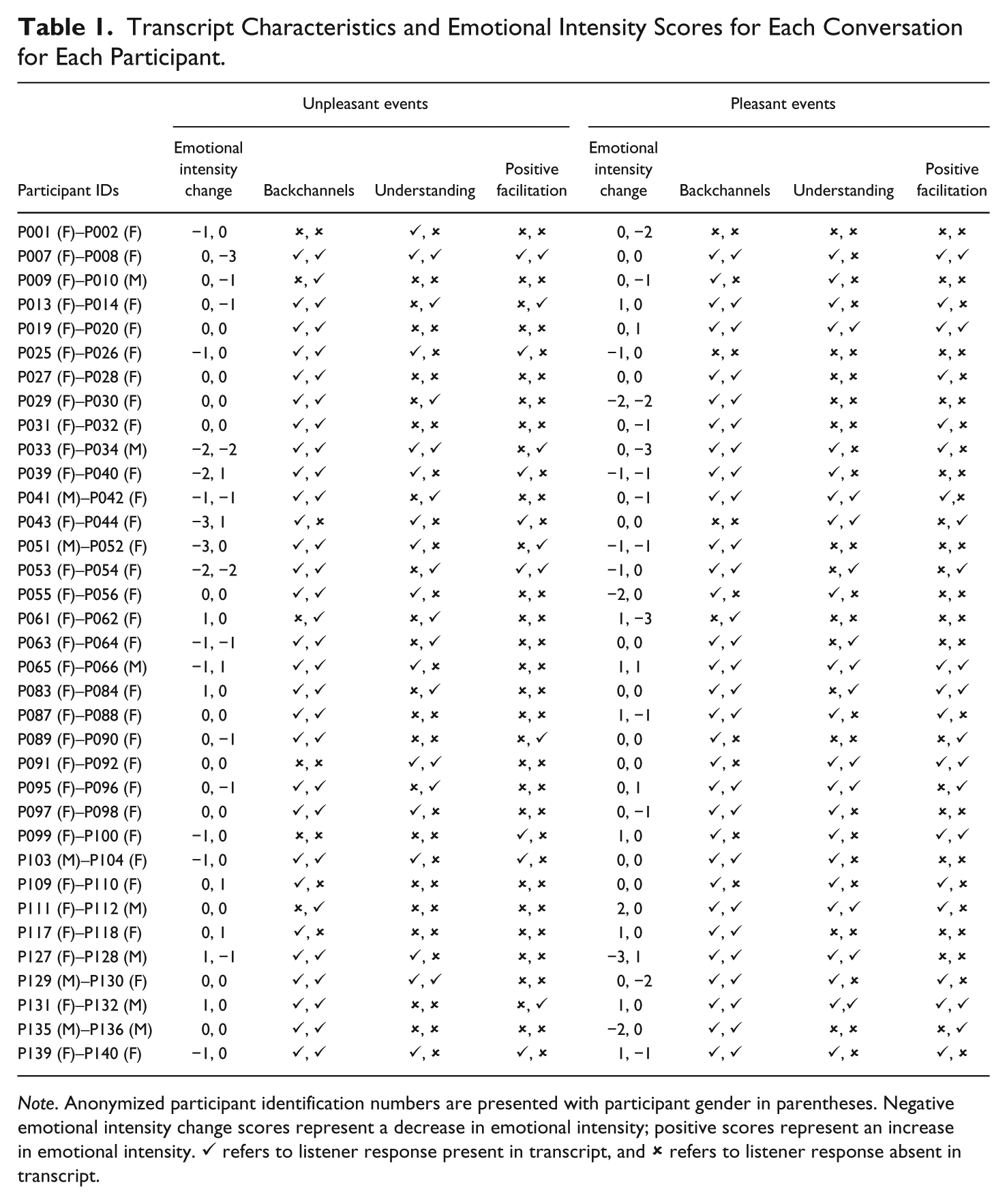
Note. Anonymized participant identification numbers are presented with participant gender in parentheses. Negative emotional intensity change scores represent a decrease in emotional intensity; positive scores represent an increase in emotional intensity. ✓ refers to listener response present in transcript, and ✘ refers to listener response absent in transcript.
In the following section, the results of our analyses are presented as follows. We first describe the characteristics of social disclosures in which the speaker indicated an enhancement of the FAB, in terms of decreases in negative and/or maintenance or increases in positive emotional intensity (RQ1). These conversations were characterized by the following features. The listener provided backchannels to signal interest and attention whilst the speaker was telling their story. The listener demonstrated their understanding of the event’s meaning and significance to the speaker and provided positive facilitation in which the listener helped the speaker savor positive emotions expressed about pleasant events and to pick up on possible positive implications of negative events. Throughout the analysis, although we present these features separately for clarity, we also highlight that these features often did not occur in isolation. Rather, listeners often chained together sequences of features. For instance, listeners backchannelled to show attention during the speaker’s relating of the event, before demonstrating their understanding of the event’s significance by accurately reflecting the speaker’s emotions. We also highlight that the above features could also be considered as a collaborative activity, rather than things that listeners do or do not do (RQ2): During conversations, speakers sometimes “opened up” opportunities for listeners to provide the responses we identified. 2 One example of this is speakers providing subtle positivity in their stories of unpleasant events, which allowed listeners to facilitate the speaker to elaborate and focus on possible positive implications.
We next describe the characteristics of social disclosures in which the speaker indicated no enhancement of the FAB, in terms of maintenance or increase in negative emotional intensity and/or decreases in positive emotional intensity. These conversations were characterized by an absence of the above features: lack of backchannels, in which the listener does not use backchannels to signal interest and attention; failure to demonstrate understanding, in which the listener fails to adequately demonstrate their understanding of the event’s meaning to the speaker, and lack of positive facilitation, with the listener not facilitating the speaker to savor pleasant events or to see positive implications of negative events or the speaker not attending to or accepting such positive interpretations.
Finally, we present the results of a simple frequency analysis, in which we examine if the presence of each of the above features differentiates between conversations in which the FAB was enhanced versus not. We examine the presence of each feature singly and then in combination. This analysis shows that in our sample it was not necessarily any one type of listener response in itself but a combination or sequence of listener responses and collaborative acts by speakers and listeners that was most associated with an enhancement of the FAB.
Conversational Characteristics Associated With Enhancement of the Fading Affect Bias
Backchannels
This feature was very common in our data, appearing in the majority of transcripts of both pleasant and unpleasant events. Listeners signaled that they were happy to yield the floor and pass up their turn at talking through backchanneling whilst the speaker told their story. These tokens, such as “mm-hmm” and “yeah” are designed to convey that the listener was paying attention, understood what the speaker was trying to express, and gave permission to the speaker to keep talking (Schegloff, 1982). The following extract is an example of this process in our data.
(P025: Decrease in negative intensity & P026: Maintenance in negative intensity)
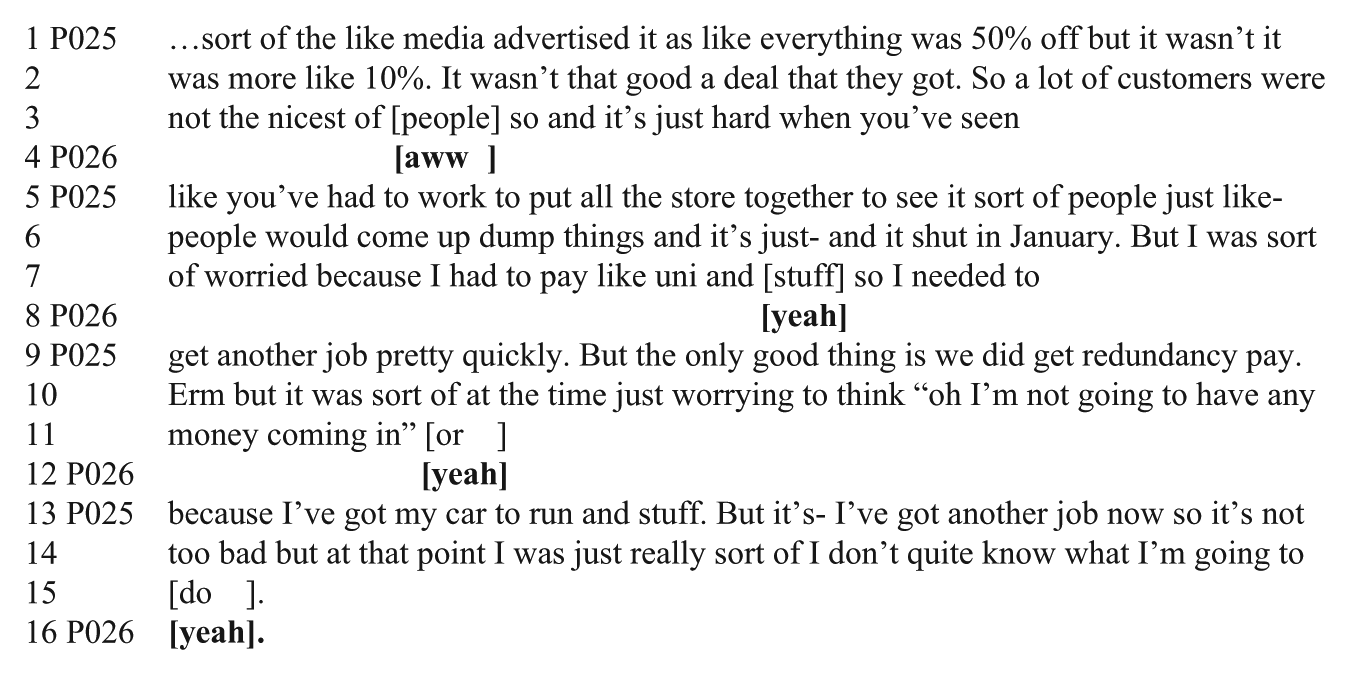
The listener backchannelled throughout the speaker’s description of the unpleasant event, the most used term yeah indicating the listener’s attention (lines 8, 12, and 16). The utterance aww (line 4) served the multifunction of signaling the listener’s continued attention, yielding the floor, and showing empathy for the speaker’s experience. The listener in the following extract, in which participants are discussing a positive event, uses backchannels in a similar manner, to indicate her ongoing willingness to give up her turn at talk to accommodate the speaker telling the story of a pleasant event.
(P095: Maintenance of positive intensity & P096: Increase in positive intensity)
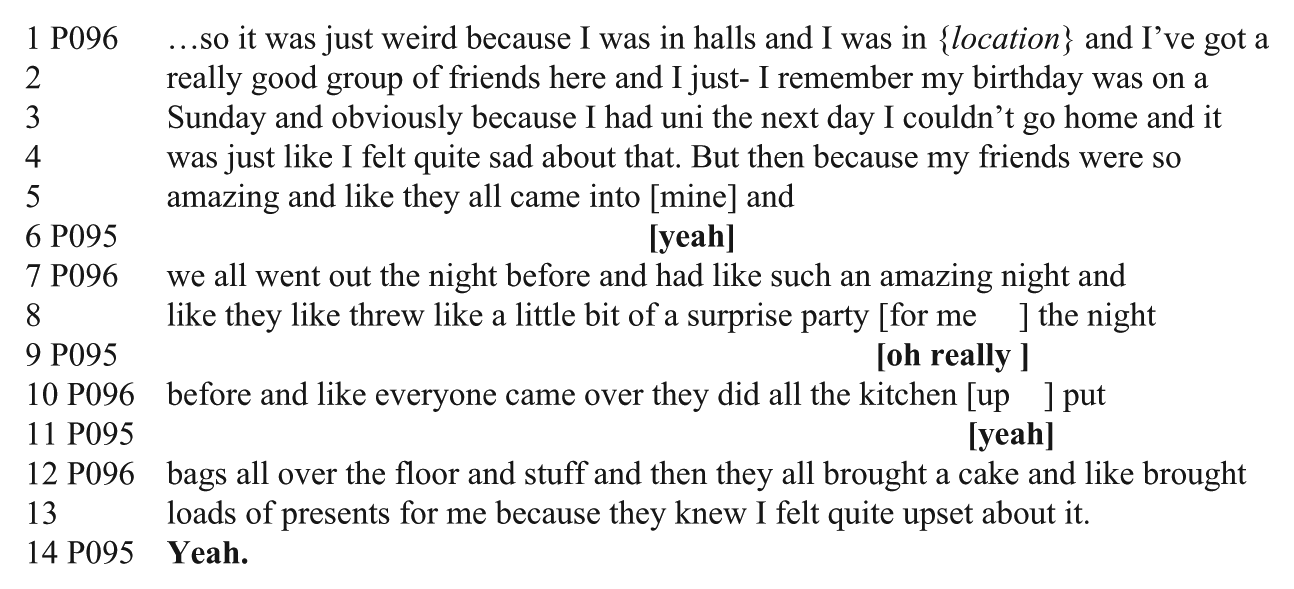
At lines 6, 9, and 11, the listener responds to the speaker’s story with backchannels “yeah” and “oh really.” Although overlapping with the speaker’s talk, these are not interpreted as an attempt to take speakership. Rather, these tokens are understood by the speaker as permission to continue telling the story. At line 9, the listener acknowledges receipt of the climax of the story (the surprise party) as new information; the use of the news receipt token “oh really” acts as a prompt and continuer for expansion on the telling. The speaker then elaborates on the topic, describing the surprise party (lines 10-13).
Demonstrating Understanding
At the end of an event disclosure, listeners often provided an evaluation of the disclosed event, to display their understanding of the story’s meaning. The following extracts also show how listeners chained together their responses. Listeners still used backchannels to signal their attention and interest, before using various strategies to display their understanding of the speaker’s emotional state and the meaning of the event to the speaker.
(P095: Maintenance in negative intensity & P096: Decrease in negative intensity)
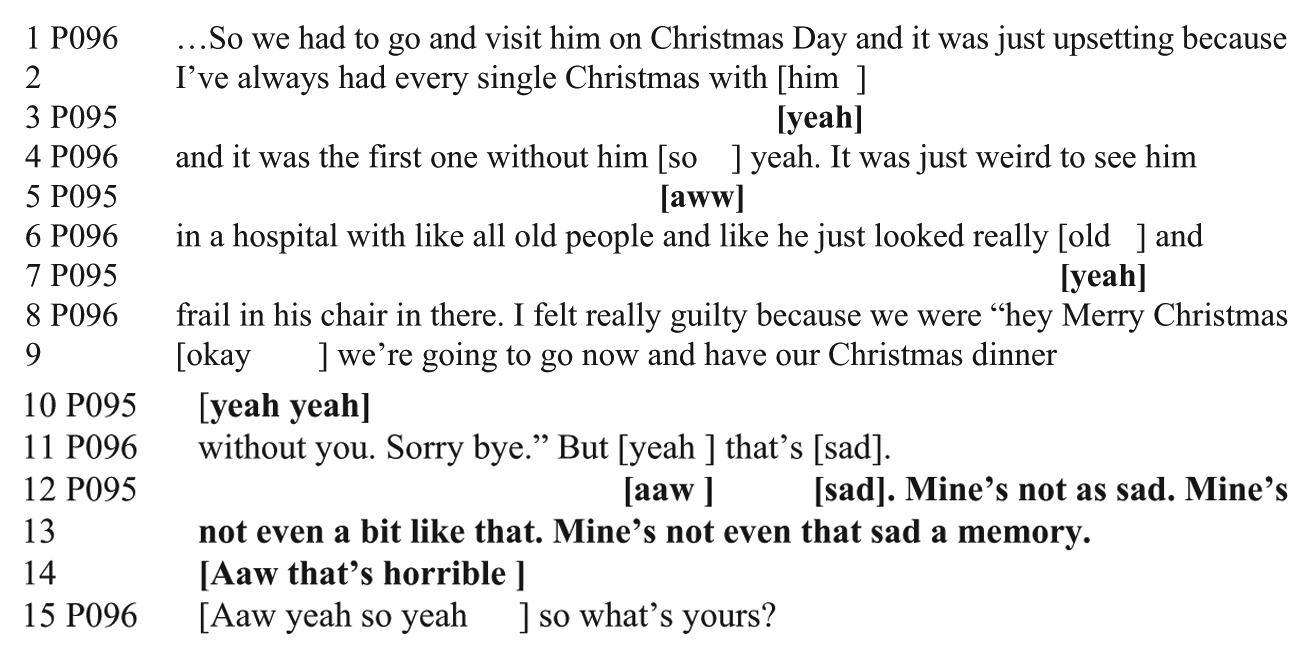
The listener backchanneled throughout the speaker’s story (“yeah”) to show she was paying attention, as well as using “aaw” (lines 5 and 12), which acknowledged the story as a negative one and offered emotional support (Pudlinski, 2005). In addition, the overlapping talk at lines 11/12 produced the effect of listener understanding through the possibility of having anticipated the speaker’s meaning. In her end of story evaluation (lines 12-14), the listener escalated her evaluation of the speaker’s negative event from “sad” to “horrible.” This suggests empathy as it followed multiple utterances implying understanding and sympathy and was prefaced with a further “aaw,” which acknowledged the speaker’s feelings about the negative event as a valid emotional reaction. And the listener’s evaluation was accepted as accurate by the speaker at line 15 (Wynn & Wynn, 2006).
The following extract, in which participants are discussing a pleasant event, shows a similar process: The listener backchannels to signal attention, before demonstrating her understanding of the story’s meaning to the speaker.
(P041: Maintenance of positive intensity & P042: Decrease in positive intensity)
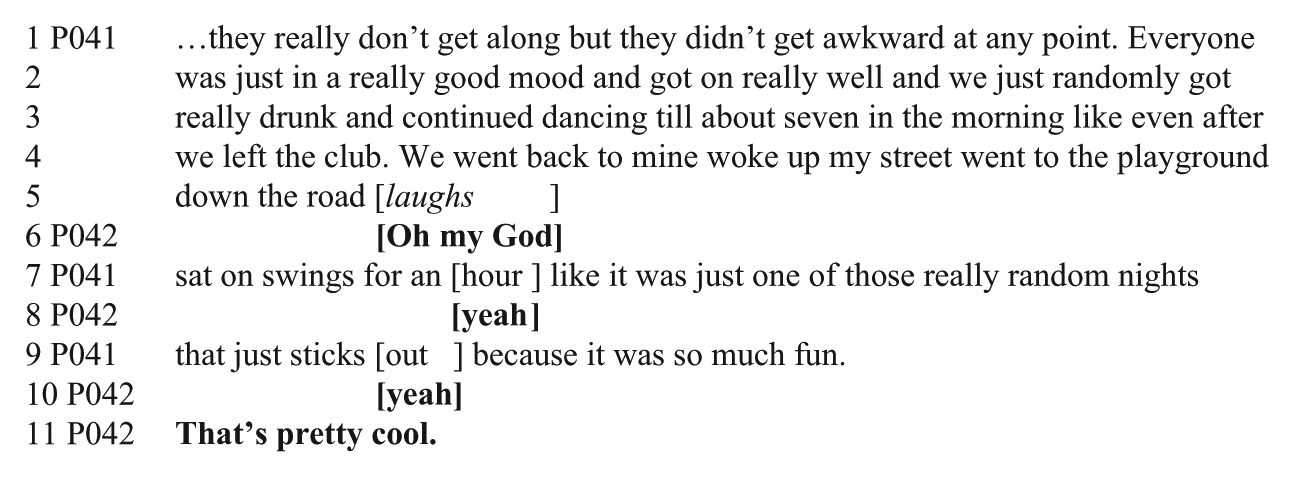
At line 9, the speaker ends the story by providing an evaluation of the event as being “so much fun.” The listener responds with her own evaluation at line 11: “That’s pretty cool.” The listener’s agreement with the speaker’s evaluation of the event as a positive one demonstrates that she understands the story is complete. Further, it shows that the listener comprehended the meaning of the event as the speaker intended.
Positive Facilitation
Listeners encouraged speakers to focus and build upon the positive emotions expressed within their accounts, within both pleasant and unpleasant event disclosures. For pleasant events, this often took the form of listeners providing more emphatically worded agreements to the speaker’s original evaluation of the event. In this way, listeners facilitated speakers to build upon the positive emotions being expressed. Further, this is an example of collaboration in conversation: Although listeners facilitated speakers to focus on the positive emotions being expressed, they were only able to do this when speakers opened up such possibilities by picking up on the upgraded agreements offered by the listener. In the below extract, this process is shown in action: The listener facilitates the speaker to progressively build upon and upgrade the positive emotions being expressed about his mother moving to a house in a new area.
(P129: Maintenance of positive affect & P130: Decrease in positive affect)
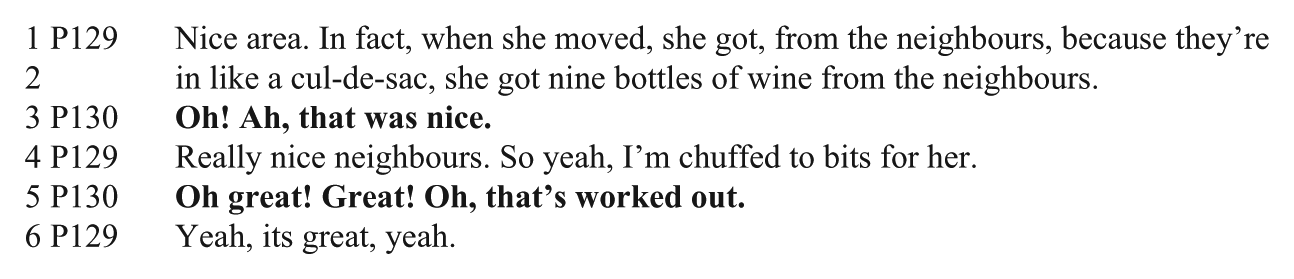
Here, the speaker and the listener build upon each other’s evaluations of the event, successfully elevating it from “nice” (lines 1 and 3) through “really nice” (line 4) before the story is finished by the speaker agreeing with the listener’s evaluation of the house move as “great” (lines 5 and 6). Thus, together speaker and listener collaboratively build upon the positive emotions associated with this pleasant event.
For unpleasant events, listeners sometimes encouraged speakers to focus on the wider context and possible positive implications of the event, when such positive implications were implied within the speaker’s narrative. Our next extract provides an example of the process of mutual positive contextualization during a negative event disclosure. The listener used several positive evaluations of the event to support the speaker’s development of positive consequences. This extract comes a little later in the conversation introduced in Extract 1 in which the speaker (P025) had described losing her job.
(P025: Decrease in negative intensity & P026: Maintenance in negative intensity)
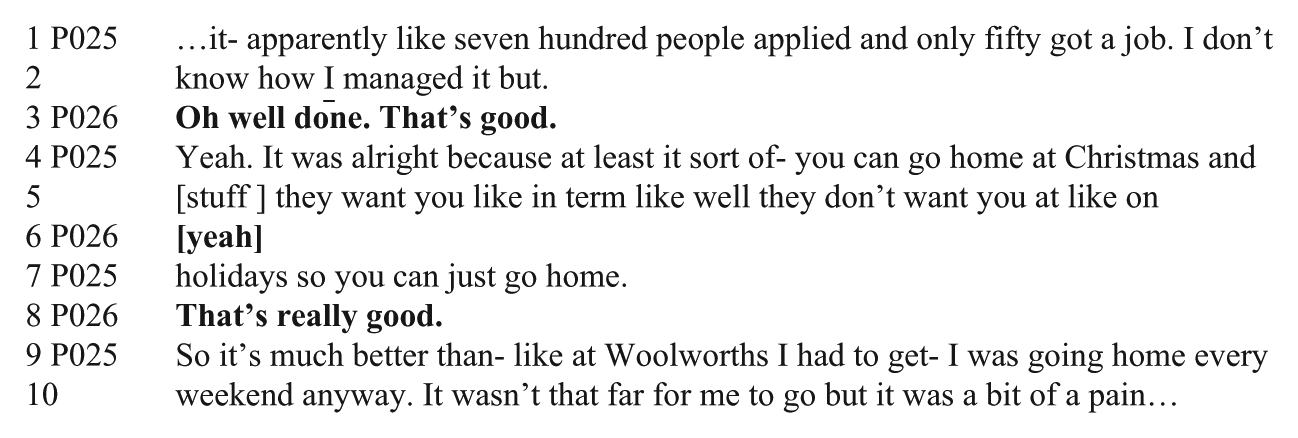
The listener demonstrated her understanding of the speaker having found a new job as worthy of praise: “Oh well done,” and also provided a positive evaluation of the situation: “That’s good.” The speaker went on to elaborate even more benefits such as “you can go home at Christmas and stuff” after which the listener then upgraded her evaluation of the situation from “That’s good” (line 3) to “That’s really good” (line 8). Interestingly, the speaker followed with her own upgrade from “It was alright” (line 4) to “So it’s much better” (line 9). Hence, the effect of the listener’s quite minimal utterances was to support the speaker in moving from telling the story of an unpleasant event to discussing the increasingly positive implications of the event—and this was associated with decreased negative emotional intensity after the conversation.
Conversational Characteristics Associated With No Enhancement of the Fading Affect Bias
Absence of Backchannels
The following extracts illustrate cases in which the listener makes no verbal response indicating her attention and interest in the story underway. In the following extract, the speaker reported no change in her negative emotions regarding the event after disclosure, compared with beforehand.
(P001: Decrease in negative intensity & P002: Maintenance in negative intensity)
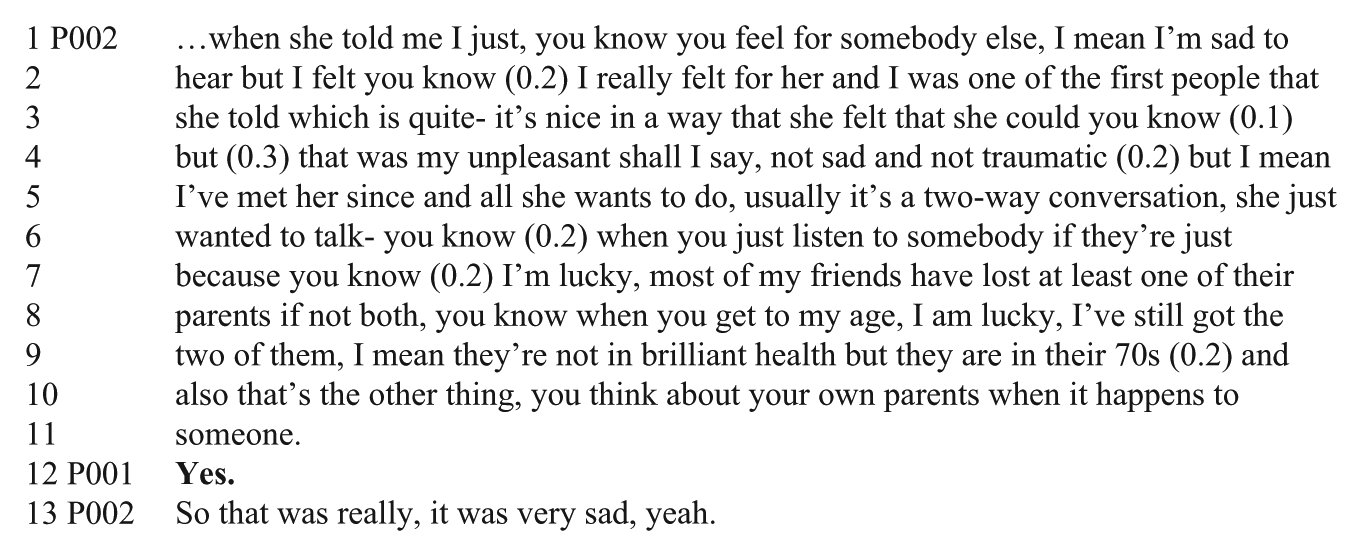
In contrast to previous extracts (Extracts 1 and 2), here the listener does not backchannel during the speaker’s narrative to indicate they are paying attention, even though there are several hearable pauses in the speaker’s speech where a backchannel could have been appropriate. Notably, the pauses commonly occur after the speaker says “you know” (lines 2, 4, 6, and 7): an utterance that can act as an invitation for the listener to display their stance on the talk underway (Asmuß, 2011, p. 210) or to take over the turn (Jefferson, 1972). Here, the listener does not take up the invitation and only provides one verbal response in the form of an affirmative (“Yes”) to the speaker’s closing statement. Thus, although the speaker still tells the story of their unpleasant event, the process of storytelling appears stilted, as opposed to smooth and supported.
These patterns are repeated in the following extract with the same two participants, in which the speaker is at the end of her story about a pleasant event and the listener does not backchannel.
(P001: Maintenance in positive intensity & P002: Decrease in positive intensity)
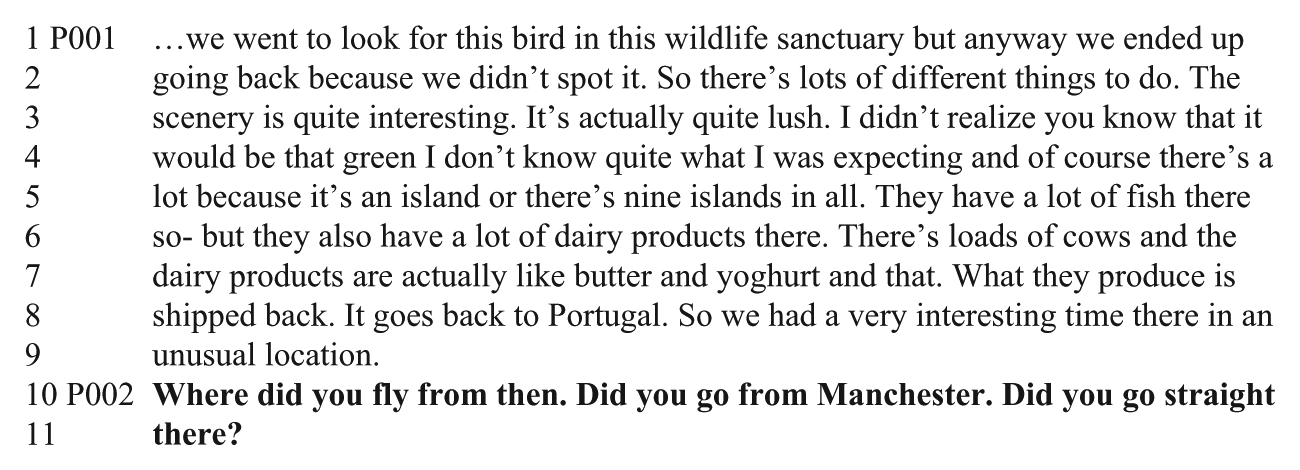
Verbal backchannel responses are not provided by the listener whilst the speaker is describing their pleasant event. However, there are also no noticeable pauses during the speaker’s talk, during which these responses would be appropriate, indicating that the speaker was happy to retain the floor without rapport-building checks with, and encouragement from, the listener. The speaker ends her story with an evaluation: “we had a very interesting time” (lines 9-10). At this point, the relevant next utterance from the listener would usually commence with an evaluation of the event indicating acknowledgement of the story’s end and understanding of the event’s meaning. However, the listener does not provide such an evaluation and, instead, responds with a matter of fact question eliciting further information: “Where did you fly from” (line 10).
Failure to Demonstrate Understanding
Where speakers reported no change in their negative emotions after the event or an increase in negative emotions, or a decrease in positive emotions, conversations were characterized by a lack of end–of-story evaluation displaying understanding of the event’s significance by the listener. Instead, listeners commonly asked questions about the event, as in the extract below in which both participants reported no change in their negative emotions after the disclosure.
(P055: Maintenance in negative emotions & P056: Maintenance in negative emotions)
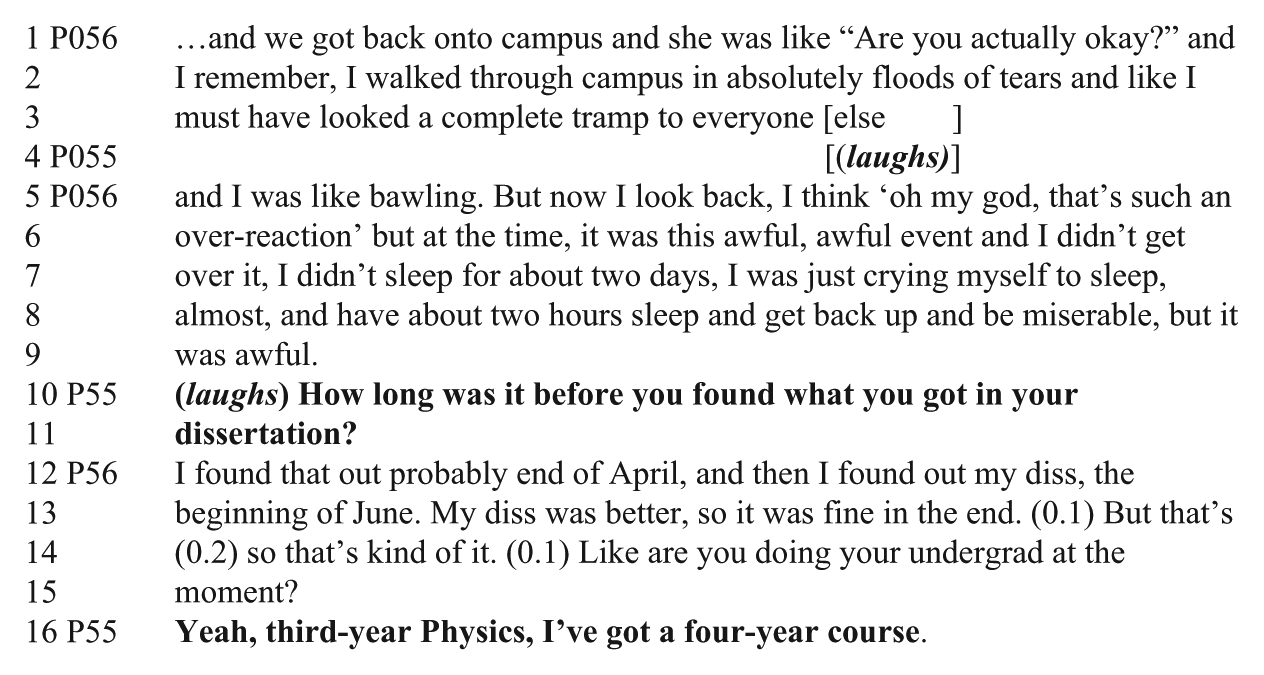
In this extract, the speaker is describing an unpleasant event: getting some unwelcome exam results and worrying about her degree grade. Rather than providing sympathetic backchannel responses such as “aaw,” the listener laughs (lines 4 and 10). Because laughter is not reciprocated by the speaker, it has the effect, at least potentially, of belittling the speaker’s negative feelings about the event. Further, when the speaker culminates her story by describing the event as “awful,” the listener does not provide an aligning end of story evaluation, instead asking a question. After the speaker answers the question, she reaches the end of the story, which did have a happy ending (“it was fine in the end”). Here, there are three hearable pauses (lines 13–14) where the listener again fails to provide an end-of-story evaluation—or indeed any verbal response. The speaker finally asks a question, perhaps in an attempt to encourage the listener to continue talking.
In the extract below, the speaker is at the end of the description of a pleasant event. The listener does not provide many backchannels whilst the speaker is talking and does not provide an end-of-story evaluation.
(P002: Decrease in positive intensity & P001: Maintenance in positive intensity)
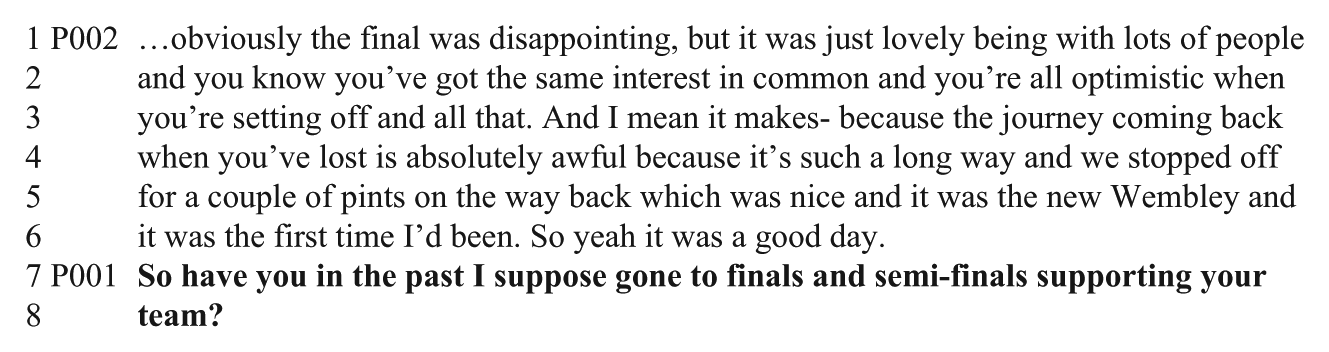
As in Extract 7, the speaker retains her turn whilst telling her story even without receiving verbal backchannels from the listener. The speaker summarizes her pleasant event with a positive evaluation: “it was a good day” (line 6). However, the listener here does not respond with her own end of story evaluation but with a factual enquiry (line 7).
On other occasions, listeners did provide an end of story evaluation, but these demonstrated a misunderstanding of the speaker’s meaning. For example, in the following extract, the speaker and listener had a different understanding of the story’s emotional implications, and the speaker reported increased negative emotional intensity after the conversation.
(P127: Increase in negative intensity & P128: Decrease in negative intensity)

The listener’s first attempt at evaluating the meaning of the disclosed event (line 4) suggested that the speaker might feel angry as a consequence of the event. However, this was rejected by the speaker: “no no no.” The speaker then struggled to re-convey her feelings with several false starts and pauses in the middle of her sentence. The listener then attempted a second end-of-story evaluation, this time acknowledging the negative nature of the event (line 7), but this did not include utterances displaying empathy such as “aaw,” (in contrast to Extracts 1 and 3).
Lack of Positive Facilitation
In these conversations, the listener was unsuccessful in facilitating the speaker to amplify the positive emotions expressed in her event retellings. In the case of pleasant events, the collaborative activity involved in this process was hampered by speakers not picking up on the listener’s attempts to create a more emphatically positive interpretation of the event, as in the extract below in which the speaker is relaying the story of celebrating their birthday.
(P041: Maintenance of positive intensity & P042: Decrease in positive intensity)

Here, the speaker originally describes this event as “pretty good” (line 3), and the listener agrees with this evaluation, showing understanding of the event’s meaning to the speaker (“that’s really nice,” line 4). Following this, the listener upgrades this evaluation to “amazing” following further contextual information given by the speaker about the circumstances surrounding the birthday. However, this upgraded evaluation is not picked up by the speaker, who maintained their original evaluation of the event and the context surrounding it as still “pretty good.” Thus, instead of the emotions surrounding this positive event being mutually and collaboratively amplified as in an earlier extract (Extract 5), here the listener’s attempts to do this go unheeded.
In conversations about unpleasant events, listeners sometimes did not facilitate the speaker to pay attention to positive consequences, even when positive aspects of the event were included in the speaker’s account. Rather, listeners tended to encourage further elaboration of the event and how it made the speaker feel, as in the following extract where both participants reported no change to their negative emotions.
(P129: Maintenance in negative emotions & P130: Maintenance in negative emotions)
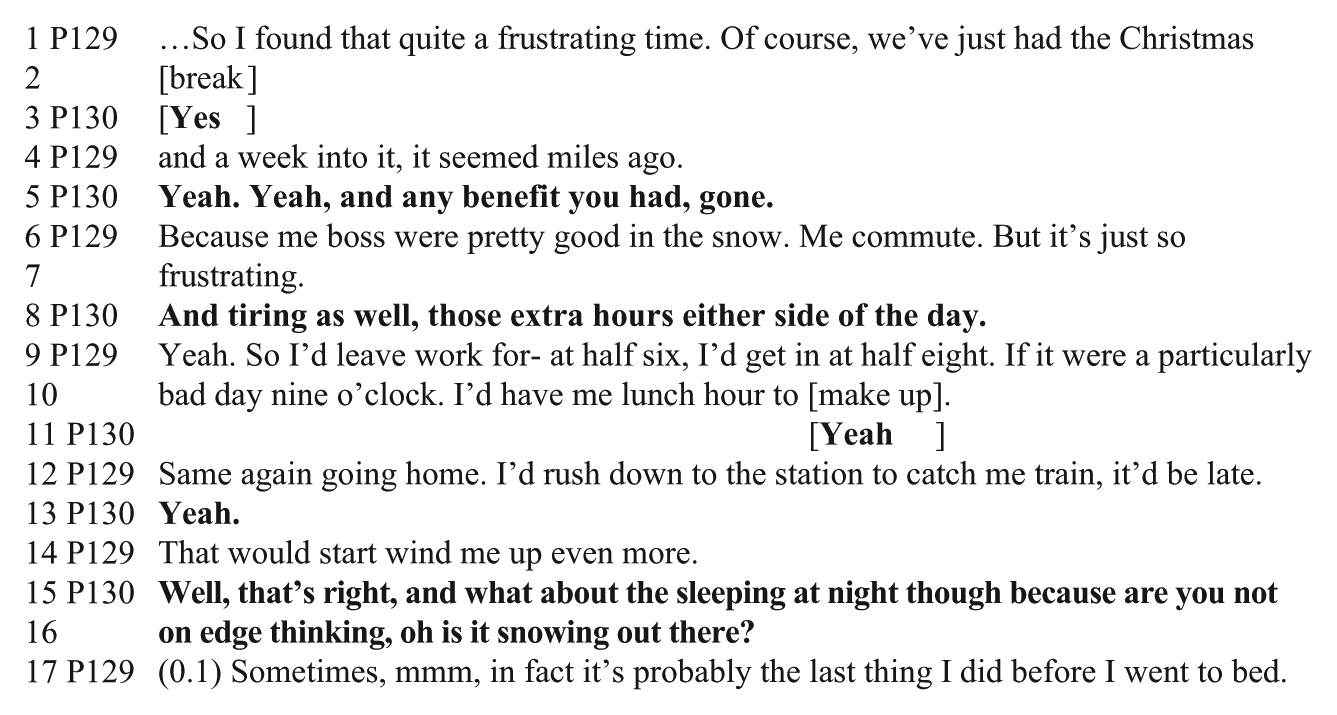
At the culmination of the speaker’s story about frustration with their long commute due to snow, the speaker makes a tangential reference to the Christmas holidays (lines 1-4). Here, rather than picking up on this potential topic change, the listener focusses the speaker’s attention on the negative consequences of the event (“any benefit you had, gone”). The speaker then brings up a subtle positive aspect (“me boss were pretty good in the snow”), which, again, is ignored by the listener who, instead, suggests that the speaker must have been tired as a result of the commute (“And tiring as well”) and not sleeping well at night (“what about the sleeping at night though because are you not on edge”). Thus, rather than a positive facilitation, the listener encourages the speaker to provide an elaborate account of their unpleasant event.
Frequency Analysis
We performed a simple content analysis on each conversation, counting the presence or absence of each feature (backchannels, demonstrations of understanding, and positive facilitation) for the pleasant and unpleasant event disclosures for each participant. For example, if during their pleasant event disclosure, Participant 1’s partner (Participant 2) backchanneled, we recorded the presence of backchanneling for Participant 1. However, if during Participant 2’s pleasant event disclosure, Participant 1 did not backchannel, we would record an absence of backchannels for Participant 2. The first author coded the entire sample (35 transcripts, 70 participants) with a random 20% (7 transcripts, 14 participants) also coded by the third author. Following Lombard, Snyder-Dutch, & Bracken (2002), we calculated Cohen’s Kappa for each of the three conversational features (backchannels, demonstrations of understanding, positive facilitation) for the pleasant and unpleasant event disclosures for each of the 14 participants to examine intercoder reliability. There was moderate to high agreement between the two coder’s judgements about the presence or absence of each feature in the transcripts (pleasant event backchannels κ = 1.00, standard error [SE] = .00, p < .001; unpleasant event backchannels, κ = .63, SE = .33, p < .01; pleasant event understanding κ = .70, SE = .19, p = .008; unpleasant event understanding κ = .55, SE = .22, p = .03; pleasant event positive facilitation κ = .81, SE = .17, p = .002; unpleasant event positive facilitation κ = .63, SE = .33, p = .01), and any disagreements were resolved through discussion.
We performed three separate 4 (emotional intensity change type: negative emotional intensity decreased; positive emotional intensity was maintained or increased; negative emotional intensity was maintained or increased; positive emotional intensity decreased) × 2 (presence or absence of feature) chi-square analyses for each conversational feature (backchannels, demonstrations of understanding, and positive facilitation). These analyses explored if the presence or absence of each conversation differed between conversations in which the FAB was enhanced (where negative emotional intensity decreased or positive emotional intensity was maintained or increased) versus not enhanced (where negative emotional intensity was maintained or increased or positive emotional intensity decreased). Bonferroni corrected z tests examined significant differences in frequency of presence of the features between emotional intensity change types. Table 2 presents the results of this analysis. There were no differences between emotional intensity change types for the presence of backchannels, χ2(3) = 3.71, p = .29, but the presence of demonstrations of understanding and positive facilitation did both differ between emotional intensity change types, χ2(3) = 24.69, p < .001 and χ2(3) = 32.61, p < .001, respectively. Demonstrations of understanding and positive facilitation were more frequently present in conversations in which negative emotional intensity decreased (73.7% and 57.9%) and where positive emotional intensity either remained at the same level or increased (56.9% and 51%), compared with where negative emotional intensity stayed the same or increased (21.6% and 7.8%) and where positive emotional intensity decreased (21.1% and 10.5%), suggesting that the presence of these features in conversations could be involved in the enhancement of the FAB.
Overall Frequency of Presence or Absence of Conversational Features by Emotional Intensity Change Type for the Discloser.
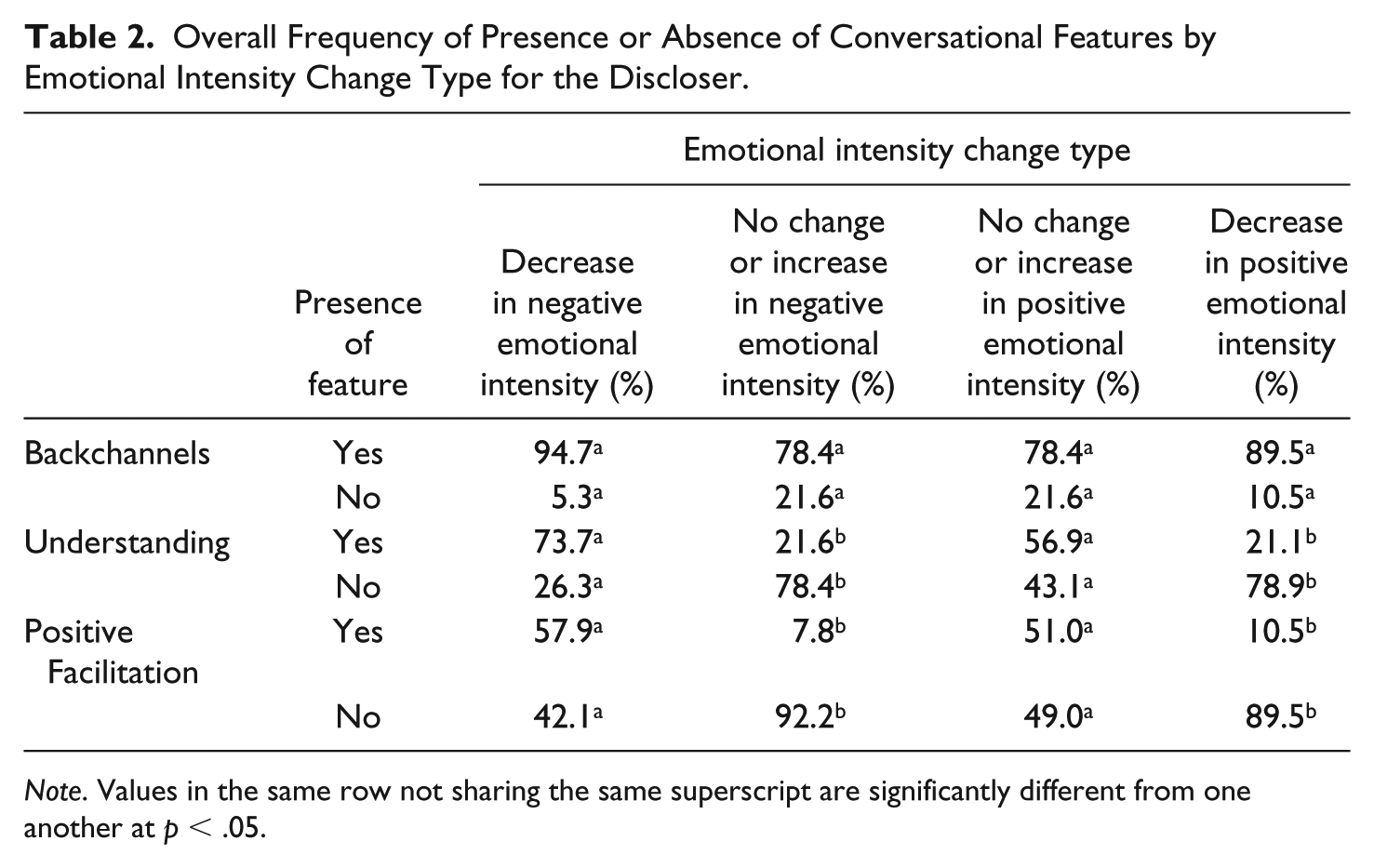
Note. Values in the same row not sharing the same superscript are significantly different from one another at p < .05.
Our qualitative analysis highlighted that these features were often present in combination. Thus, we next explored how the presence of each feature singularly and combinations of these features differed between emotional intensity change types. We performed a 4 (emotional intensity change type: negative emotional intensity decreased; positive emotional intensity was maintained or increased; negative emotional intensity was maintained or increased; positive emotional intensity decreased) × 8 (combinations of features: no features at all; just backchanneling; just demonstrations of understanding; just positive facilitation; backchanneling and demonstrations of understanding; backchanneling and positive facilitations; demonstrations of understanding and positive facilitation; and all three features together) chi-square analysis. The presence of a combination of features differed between emotional intensity change types, χ2(21) = 55.03, p < .001, with Table 3 showing that although backchanneling was common in our data, its presence alone was more frequently found in conversations in which negative emotional intensity was maintained or increased (58.8%) or positive emotional intensity decreased (63.2%) compared with where negative emotional intensity decreased (10.5%) or positive emotional intensity was maintained or increased (15.7%), suggesting that backchanneling alone was not sufficient to enhance the FAB, and it was combinations or sequences of features that was important. Notably, the presence of all three features together was more frequently present where negative emotional intensity decreased (42.1%) compared with where it was maintained or increased (3.9%) and where positive emotional intensity was maintained or increased (31.4%) compared with where it decreased (5.3%). Thus, this analysis confirms what our qualitative analysis suggested: Chains or sequences of the conversational features that we identified are involved in enhancing the FAB.
Frequency of Presence or Absence of Combinations of Conversational Features by Emotional Intensity Change Type for the Discloser.
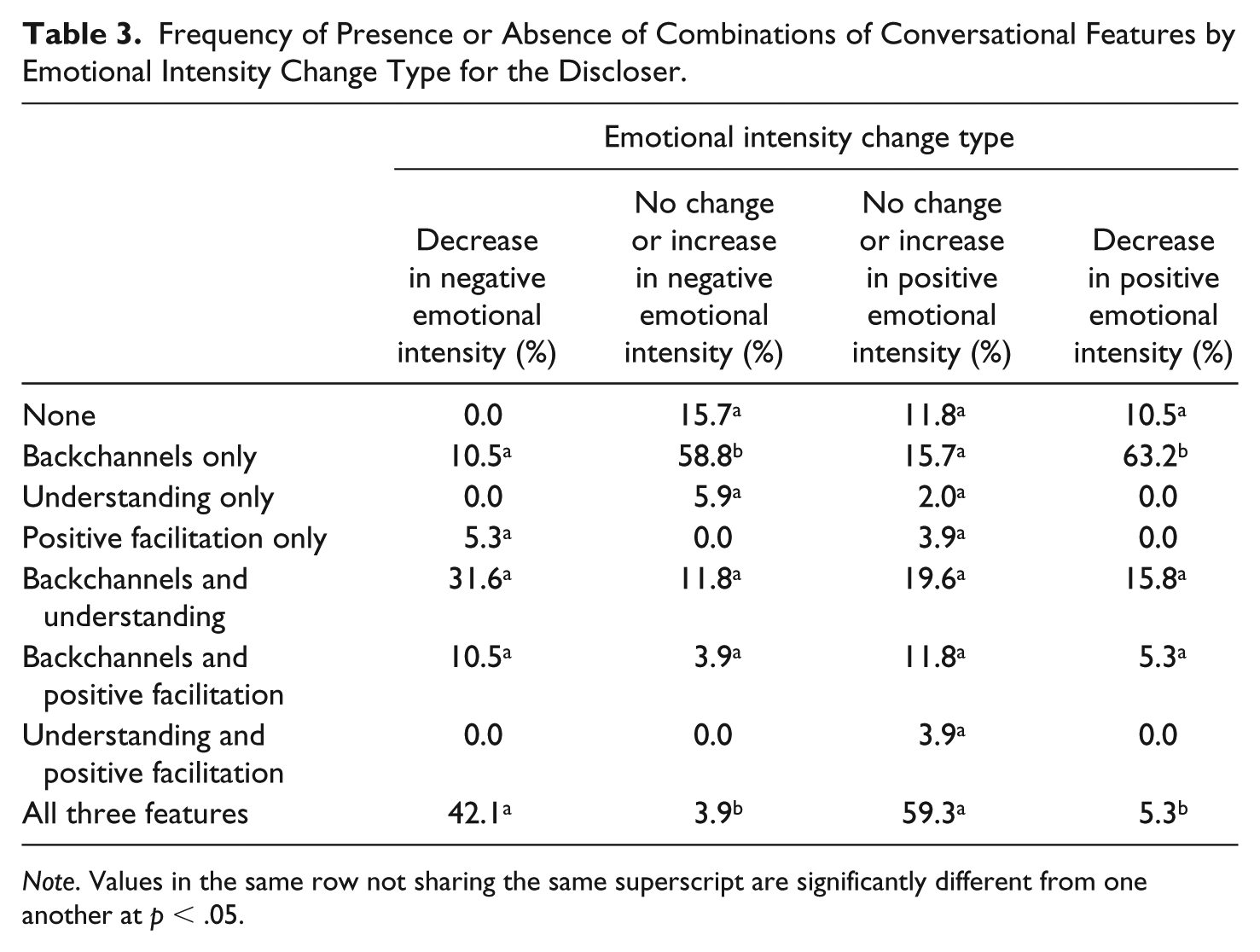
Note. Values in the same row not sharing the same superscript are significantly different from one another at p < .05.
Discussion
We analyzed conversations in which two participants each disclosed a pleasant and an unpleasant event, whilst freely providing verbal responses. We were interested to understand the characteristics of conversations in which the speaker reported an enhancement of the FAB in terms of decreased negative affect intensity and/or a maintenance in or increased positive affect intensity about their disclosed events after the conversation. Our analysis revealed three main features of such conversations, which are similar to those in the VPC framework. First, we observed instances of backchanneling, in which the listener signaled their interest and attention in the story being told. Second, listeners conveyed their understanding of the meaning of the story being told and of the speaker’s feelings. Third, listeners facilitated the speaker to enhance and build upon positive emotions associated with both pleasant and unpleasant events. Interestingly, collaboration was also evident throughout most of the conversations, particularly in the context of what we identified as positive facilitation: This process was only possible if the conversationalists together picked up on and iteratively developed more emphatically positive implications of events. To our knowledge, this is the first attempt in the FAB literature to understand the underlying characteristics of social interactions that contribute to the FAB. Given that the FAB is currently understood to be representative of emotional regulation in action in the autobiographical memory system, our findings have implications for the importance of social interaction for maintaining a sense of positivity in our memories and thus our sense of self. Further, we contribute to the VPC literature by showing that VPC responses can be instrumental not only in helping negative emotional intensity fade but also in maintaining (and sometimes increasing) positive emotional intensity in the autobiographical memory system. We further propose that some aspects of VPC listening could be considered as a collaborative activity in conversation, with both listener and speaker involved in its production and effectiveness.
Listener Responses and Verbal Person-Centeredness
The conversational features we identified bear close similarity to those in the VPC framework. Rather than using experimental methods such as examining retrospective reports of listener messages (e.g., Lehman & Hemphill, 1990) or manipulating listener messages using confederates (e.g., Jones & Wirtz, 2006), in this study we explored the nature of messages listeners produce spontaneously in conversations in which emotional event memories are shared. In this way, we provide novel construct validity of the characteristics of supportive verbal messages.
First, backchanneling, an aspect we identified as present in most conversations, is an aspect of person-centered messages (McNaughton et al., 2008). When backchanneling, listeners demonstrate that they understand what the speaker is saying by providing timely and appropriate verbal continuers. The speaker feels encouraged to tell their story in full and that the story has been heard by a receptive listener. Given its ubiquity in our sample, this could suggest that backchanneling is one of the most commonly observed aspects of VPC listening, or a strategy often utilized by people to indicate active listening. However, we suggest that backchanneling on its own was not sufficient to characterize conversations in which the FAB was enhanced. Instead, we found that conversations in which the speaker reported a decrease in negative emotional intensity (and/or an increase in positive emotional intensity) was also characterized by demonstrations of understanding and/or positive facilitation of both pleasant and unpleasant events.
Where listeners correctly interpreted and reflected the speakers’ feelings about an event, this effectively demonstrated understanding and acknowledgment of the speaker’s feelings and was associated with enhancement of the FAB. Within the VPC framework, confirming the validity of the speaker’s experience is one way in which listeners show empathy (Lester, 2002). Notably, where listeners in our study failed to display an adequate understanding of the speaker’s feelings or even belittled such feelings (i.e., low VPC), the speaker did not report an enhancement of the FAB afterwards. Thus, demonstrating an understanding of the emotions experienced by the speaker could be a method by which listeners assist in the fading of negative emotional intensity and maintaining positive emotional intensity, by reassuring the speaker that the feelings they have expressed are a valid and appropriate emotional response to the disclosed event.
The facilitation of positive emotions was an aspect we also identified within both pleasant and unpleasant disclosures. In pleasant disclosures, listeners played a role in helping the speaker build upon and enhance positive emotions expressed within their narrative. By first acknowledging and then elaborating on the positive emotions expressed by the speaker, listeners are enacting behaviors proposed to be high in verbal person centeredness (Burleson, 1982). Listener agreements to speaker’s positive evaluations could also be compared with an active-constructive responding style. This style of listener responding, described as “enthusiastic or celebratory support,” has been found to elicit greater positive emotions compared with a listener who quashes or ignores good news, or provides only quiet understated support (Lambert et al., 2013; McCullough & Burleson, 2012). Further, such actions from listeners could, potentially, prompt the process of positive event savoring in the speaker. Savoring refers to reminiscing over past pleasant events in order to re-experience the pleasant emotions felt at the time, and therefore retaining their intensity (Bryant & Veroff, 2007). This account fits with our findings: Positive facilitation by listeners was observed in conversations after which speakers reported a maintenance or even increase in positive emotional intensity.
For unpleasant event disclosures, this process of positive facilitation took the form of listeners facilitating speakers to consider wider positive implications of the disclosed unpleasant event. Again, this act of contextualizing the emotions expressed by the speaker could be argued as representing a high level of VPC (Burleson, 1982). One account of how this listener behavior works to decrease negative emotional intensity in the speaker is through facilitating a cognitive reappraisal of the disclosed event, in which individuals seek to make sense of unpleasant events and their associated negative emotions. This process then leads to emotional improvements (Burleson & Goldsmith, 1998; Jones & Wirtz, 2006). In line with this, research has shown that listener messages, which encouraged individuals to focus on the meaning and consequences of negative events, have been associated with greater reductions in negative emotions, compared with listener messages that focused on the individual’s feelings (Batenburg & Das, 2014). Our findings are therefore in line with the idea that listeners facilitating a more positive evaluation of an event may be an instrumental part in reducing the negative emotions associated with unpleasant events.
Collaboration in Conversation
With regard to our second research question, we were interested in collaboration between conversationalists during the disclosures. Backchanneling could arguably be the first example of this. For a speaker to tell a story of an event, two elements are needed—the speaker to form a coherent narrative with a beginning, middle, and an end and for a listener to yield the floor for an extended period. Backchannels serve the latter purpose: They signal that the listener is paying attention and understands what the speaker is trying to convey and, crucially, that they are not intending to take up their turn at speaking until the story is complete. The overall result is the successful telling of the story, achieved collaboratively by both participants: one speaking, the other continuing to yield the floor and pay attention until the story is complete.
Another example of collaboration in conversation is the process of positive facilitation that we observed in our data, as this required actions on the part of both speaker and listener. We observed that listeners were not solely responsible for prompting speakers to either amplify positive emotions associated with pleasant events or contextualize the meaning of unpleasant events. Conversely, where speakers included positivity (either overtly or subtly) in their accounts, listeners targeted and amplified these aspects of the event in subsequent discussion. Where speakers picked up on and accepted these interpretations proposed by listeners, speakers then exhibited an enhanced FAB. Thus, speakers and listeners collaboratively created more positive accounts.
For unpleasant events in particular, such positive contextualization could encourage speakers to continue to reevaluate the event in a more optimistic light. In addition, empathetic statements of concern and insight into the speaker’s feelings could be instrumental in bolstering the self-esteem and self-efficacy of the speaker. This could, in turn, encourage them to utilize their own internal cognitive and emotional resources to come to terms and deal with the negative event. This argument is commensurate with previous research in which emotional support is conceptualized as a process constructed by both the individual providing and the individual receiving the emotional support (Goldsmith, 2004). In this model, rather than emotional support being provided to the speaker in a passive “comforting” way, emotional improvement is an active process achieved by both individuals in the conversation.
Our analyses also highlighted that sequences, or combinations, of these features were characteristic of conversations in which the FAB was enhanced. Furthermore, our frequency analyses showed that all three conversational features (backchanneling, demonstrating understanding, and facilitating positive emotions) were most frequently present when the FAB was enhanced, compared with where it was not. Potentially, this suggests that VPC behaviors act in a cumulative fashion, such as the listener needing to show they are paying attention (by backchanneling) before they can show they understands the nature of the story and its associated emotional impact. Further, the effectiveness of VPC behaviors may act in an all or nothing way—just enacting one or two behaviors may not be sufficient to influence the emotions in the listener in an enhancing way, and high levels of VPC behaviors in conjunction are more effective. We further propose that VPC listening could be conceptualized as a collaborative activity: In our sample, listeners were only able to perform high VPC behaviors when speakers initiated opportunities for the listener to do so in their dialogue, and speakers only benefited from subsequent VPC behaviors when they picked up on them in the listener’s dialogue. We finally propose that the timing of VPC behaviors is important: For instance, although facilitating the speaker to express negative emotions is an aspect of high VPC messages (Burleson, 1982), it is also important for the listener to facilitate the exploration of positive consequence and implications, if and when the speaker introduces these elements into their narrative. In other words, although it is helpful for listeners to perform high VPC behaviors, these behaviors need to correspond to the speaker’s needs—and these needs may change as the story unfolds.
Social Disclosure and Theoretical Accounts of the FAB
The FAB is proposed to exist as a result of self-enhancement and self-protective motivations (Skowronski et al., 2004), which drive individuals to utilize cognitive and social resources in order to maintain the bias towards positivity in autobiographical memory.
Potentially, disclosing and discussing past emotional events with a responsive, supportive listener could be conceived as a form of social resource that encourages or facilitates the use of emotional regulation processes to deal with emotional responses to events. This idea is consistent with a conceptual model of autobiographical memory, which proposes that individuals disclose autobiographical memories for social purposes: to develop or maintain relationships by demonstrating similar experiences or to elicit empathy from others after an unpleasant event (Alea & Bluck, 2003).
We suggest that in the course of fulfilling these social functions, a responsive listener encourages emotional regulation processes in the speaker, which influences the affect intensity associated with the disclosed events and ultimately results in the FAB. Furthermore, if the nature of the listener’s responses and the collaboration between speaker and listener are conceived of as important for enhancing the FAB, this also makes sense from a wider evolutionary view. Humans evolved where social living was important for survival (Brewer, 2004), and social relationships are proposed to be important for various aspects of well-being, including emotional regulation, health, and self-esteem (Baumeister & Leary, 1995). Thus, connecting with others and discussing past emotional events has perhaps emerged as one of the processes by which emotional regulation within the autobiographical memory system is achieved.
Limitations and Future Directions
We join a growing group of researchers combining conversation analytic approaches with quantitative methods to yield insight into how interactional practices are related to a variety of outcome variables (Stivers, 2015). One limitation of this approach is that causal conclusions are limited; we cannot state that the listener responses we observed here actually caused the enhancement in the FAB after social disclosure. However, our in-depth analysis generated ideas about the potential ways in which speakers and listeners interact to produce the effects of social disclosure in enhancing the FAB to be further tested empirically in future research. Furthermore, we acknowledge that disclosing personal events to a stranger in a laboratory is not the usual circumstance in which people usually disclose past emotional events. However, it is noteworthy that, despite the artificial nature of the setting, listeners spontaneously produced verbal responses associated with an enhancement of the FAB, possibly related to the social norm of emphasizing positive topics and interpretations of events during the social disclosures (Taylor & Belgrave, 1986) and the perceived social appropriateness of moderate levels of verbal person centeredness (Jones & Guerrero, 2001). Thus, future research should aim to build upon our work by enhancing the ecological validity of the conversational setting.
Although the present research only recorded and analyzed verbal feedback during social disclosure, of course non-verbal behavior is also a factor within social interactions. Non-verbal immediacy refers to non-verbal behaviors such as smiling, nodding, and eye gaze, which reflect empathy and closeness (Burleson, 1994); so they could feasibly have just as important an influence as verbal feedback on how the speaker feels about the disclosed event afterwards. Future research could utilize videotapes of social disclosures to qualitatively analyze patterns in non-verbal gestures and gaze that are characteristic of an enhanced FAB after social disclosure. We also feel that it would be interesting to further pursue the individual and contextual factors that influence why some dyads engage in collaborative positive interpretations of events whilst others do not. For instance, in our data, why did the speaker in Extract 5 pick up on and accept the listener’s more emphatically positive evaluation to their pleasant event, whilst the speaker in Extract 12 rejected the listener’s interpretation? There are several potential accounts for this disparity: For instance, it could relate to the rapport developed between speaker and listener (and this could also link to nonverbal behavior); it could relate to the motivations of the speaker to readily accept a positive interpretation of the event; or to individual differences in the speaker’s propensity to accept the ideas of others. These possibilities would make interesting directions for future research to further explore the nature of collaboration in conversation, particularly in relation to emotional event disclosures.
Future work would also benefit from deeper exploration into the listener responses associated with a variety of changes in emotional intensity after social disclosure. For instance, inherent in the conceptualization of the FAB is the assumption that a reduction in negative emotions is a desirable outcome of social disclosure. However, we acknowledge that increases in negative emotions can also be beneficial. For instance, emotion-focused therapy sees the expression of negative emotions as critical in promoting lasting psychological change and enhancing well-being (Greenberg, 2011). We also acknowledge that our measure of emotional intensity change was limited to capturing changes in emotional intensity upon recall of the events occurring immediately after the conversation, and some researchers propose that disclosure takes time to have an effect (Donnelly & Murray, 1991). Thus, although some of our observed patterns characterized conversations in which the participants reported no change in negative emotions (for instance, failure to demonstrate understanding), it is possible that reduction in negative emotions did occur later. A useful direction for future work would be to capture changes in the FAB over a longer period in relation to listener responses and conversational patterns during social disclosure.
Conclusions
In this article, we have described the spontaneously produced listener responses and conversational patterns that characterize conversations in which speakers report an enhanced FAB. We found that listener responses with features identified as being high in verbal person centeredness characterize such conversations. Moreover, we suggest that the benefits of social disclosure are not necessarily always in specific types of responses given by listeners. Instead, part of the benefits could result from the active process of conversationalists working together to validate the speaker’s feelings and consider wider positive implications. We highlight the collaborative nature of VPC responses and the importance of conversational collaboration in maintaining emotional regulation in autobiographical memory. We suggest that future research into the effects of social disclosure on the FAB would benefit from further investigating listener responses and highlighting conversational patterns and collaborations between speakers and listeners, which encourage emotional regulation processes after the experience of both pleasant and unpleasant events.
Footnotes
Acknowledgements
We are grateful to the editor and two anonymous reviewers for their helpful comments in revising this article.
Authors’ Note
Portions of this research were presented at the University of Leeds Postgraduate Research Conference (2010), Leeds, UK.
Declaration of Conflicting Interests
The author(s) declared no potential conflicts of interest with respect to the research, authorship, and/or publication of this article.
Funding
The author(s) disclosed receipt of the following financial support for the research, authorship, and/or publication of this article: This research was supported by a PhD scholarship awarded to Kate Muir from the School of Psychology, University of Leeds, UK, under the supervision of Dr. Charity Brown and Prof. Anna Madill and forms part of Kate Muir’s PhD thesis.
