



Abstract
Advice of varying quality can be provided to support seekers online. This study examined whether the type of self-disclosure (demographic vs. self-concept) included in a support-seeking post elicits varying levels of advice quality in support provision. Participants (N = 624) read and responded to an online support-seeking post. Their advice messages were assessed for quality as indexed by the use of reasoning and the sequencing of advice relative to other elements of supportive interactions (emotional support and problem inquiry and analysis). Overall, results suggested that most advice messages were behavior-oriented and did not contain reasoning or additional supportive acts. The type of self-disclosure did not affect advice quality. Theoretical implications and directions for future research are discussed.
With the rapid development of Internet technology, it has become increasingly normative for people to seek support from online support groups, communities, and forums due to factors that include anonymity, asynchronicity, large audiences, and ease of access (Walther & Boyd, 2002; Wright, 2016). Correspondingly, seeking advice online has become commonplace (e.g., Armstrong & Powell, 2009; Kouper, 2010; Kuehn, 2011; Locher, 2006; Mo & Coulson, 2008; Sillence, 2013; Sillence et al., 2007). Receiving advice online can facilitate coping and improve well-being for recipients (Attard & Coulson, 2012; Barak et al., 2008), but these benefits are far from guaranteed. Successfully obtaining advice from unknown others in cyberspace and the quality of the advice received is likely to depend on a variety of factors such as the advisor’s expertise on the topic and personality characteristics such as altruistic orientation (e.g., Bolton et al., 2004; Fredriksen & Moland, 2008; Ruble, 2011; Smithson et al., 2011; Wasko & Faraj, 2000, 2005). We argue that, in anonymous online contexts, features of the advice-seeker’s disclosure predict both whether advice is obtained and the quality of its content.
Support seeking is a typical “first act” in face-to-face (FTF) supportive interactions, and one that influences whether support is received and the quality of that support (Barbee & Cunningham, 1995; Cutrona et al., 1990; Feng & Burleson, 2006). Similarly, advising communication in online forums is typically initiated by the individual who communicates about his or her problem and seeks advice directly or indirectly from others (Ruble, 2011). Therefore, it is reasonable to infer that advice seeking will also play a vital role in the outcomes of online advising episodes. Unlike advice seeking in FTF encounters where the interactants often have some form of personal or professional relationship and prior knowledge of each other, online advice seeking among strangers requires the advice seeker to make perhaps more conscious decisions about self-disclosure. Although past research indicates that greater self-disclosure from advice seekers elicits more social support in FTF interactions (e.g., Lee et al., 2013), empirical work has yet to examine how the type of self-disclosure in online advice seeking affects the provision of advice.
The current study contributes to our understanding of online advising by investigating how different types of self-disclosure (demographic vs. self-concept) in anonymous online support-seeking messages affect the provision of advice and its quality. Although many forms of advice exchange are available online, this study focuses on anonymous, masspersonal advice exchange in public online forums and support groups. In this type of advising, any viewers of an advice-seeking post can potentially take the role of advice giver and engage in “co-advising” (O’Sullivan, 2005). In the sections that follow, we first discuss features of effective advice (reasoning and sequence) identified by advice response theory (Feng & MacGeorge, 2010; MacGeorge, Guntzviller, et al, 2016) and the integrated model of advice (IMA) giving (Feng, 2009, 2014), and then propose research questions grounded in theory and research on self-disclosure.
Features of Effective Advising
Existing theory and research have identified a variety of factors that predict more positive advice outcomes, including features of messages and interactions, and characteristics of sources and recipients (for a review, see MacGeorge, Feng, & Guntzviller, 2016). Advice response theory, in particular, asserts that multiple factors, including features of the message, advisor, and situation, combine, and interact to affect advice outcomes (Feng & Feng, 2013; Feng & MacGeorge, 2010). Research has consistently shown that advice message features tend to exert stronger effects on advice outcomes than advisor characteristics and situational factors (Feng & Feng, 2013; Feng & MacGeorge, 2010; MacGeorge, Feng, & Guntzviller, 2016). In the current study, we focus on two features of messages and interactions identified by theories of effective advice: (a) use of reasoning and (b) sequencing of advice relative to emotional support and problem analysis.
Reasoning
Feng and Burleson (2008) identified argumentation or the articulation of reasoning behind a piece of advice as an important message feature. In particular, advisors can provide reasoning about efficacy (how advised actions, if implemented, can help solve or alleviate recipients’ problems), feasibility (the ease or difficulty with which the advice can be carried out), and lack of limitations (the absence of potential drawbacks that could occur as a result of carrying out the advice). Their study found that (a) advice givers can improve recipients’ perceptions of advice efficacy, feasibility, and lack of limitations by offering explicit reasoning about those characteristics of an advised action, and (b) enhanced perceptions of those qualities of the advised action in turn can lead to more positive responses to advice such as higher evaluation of advice quality and stronger intention to follow the advice. For example, in a failed exam scenario, students viewed the advised action of “study with others” as more efficacious and reported higher intention to follow the advice when an explicit argument for efficacy (“You get different perspectives when preparing for exams with others and you might have missed something during class that other people may have in their notes”) was included rather than omitted (Feng & Burleson, 2008). Accordingly, in this study, the inclusion of reasoning for a piece of advice is used to index the effectiveness of advice messages.
Emotional Support and Problem Inquiry With Advice
Research shows that effective advising also involves appropriate integration of other supportive acts with advice. The IMA giving in supportive interactions (Feng, 2009, 2014) identifies two such moves: (a) emotional support and (b) problem inquiry and analysis. Emotional support has been typically defined as expressions of sympathy, care, concern, affection, or interest that are directed at alleviating the emotional stress experienced by others (Burleson, 2003; Cutrona & Russell, 1990). According to the IMA, the provision of emotional support helps the target overcome negative emotions that typically arise in problematic situations and thereby creates receptivity to subsequent advising (Feng, 2009, 2014). Problem inquiry such as asking what actions the target has already taken to address the problem can also enhance the effectiveness of advising. Past research indicates that even when a distressed individual explicitly solicits advice, advice that is ill-matched with the target’s situation or does not fit well with the target’s preferred course of action tends to be perceived as insensitive, inappropriate, or superfluous (Feng & MacGeorge, 2010; MacGeorge et al., 2008). Problem inquiry enables the adviser to formulate a piece of advice that is better suited to the target’s situation and perspectives (Feng, 2009, 2014). Accordingly, as the IMA proposes, the provision of emotional support and engagement in problem inquiry and analysis should occur prior to the provision of advice for it to be effective.
Both experimental and observational studies have demonstrated that advice offered following emotional support and problem inquiry and analysis tends to be perceived as higher in quality, more facilitative of the recipient’s coping, and leading to stronger implementation intention than advice that does not follow this sequential pattern (Feng, 2009, 2014; MacGeorge, Guntzviller, et al.,2016). Therefore, the extent to which advising adheres to the IMA can be viewed as an index of effective advising as well.
Self-Disclosure in Anonymous Online Advice Seeking
From the perspective of Social Penetration Theory (Altman & Taylor, 1973), self-disclosure can vary along two dimensions: breadth and depth. Breadth refers to the variety of topics disclosed, and depth refers to the intimacy of the information (Altman & Taylor, 1973); depth is of primary interest for the current study. The theory identifies three layers of depth: peripheral (e.g., biographic or demographic data such as name, age, and gender), intermediate (e.g., attitudes, values, and opinions), and core or self-concept (e.g., beliefs, needs, and fears). The current study focuses on peripheral self-disclosure and core self-disclosure as distinctive types of self-disclosure when presented in an advice-seeking post.
Social penetration theory (Altman & Taylor, 1973) suggests that core disclosure conveys greater trust of the recipient and may thus elicit higher quality responses. Information revealed in core self-disclosure is often viewed as more private than demographic information revealed in peripheral self-disclosure (Tidwell & Walther, 2002). Furthermore, recent research on self-disclosure in online support seeking supports the idea that core self-disclosure motivates higher quality support. In a recent study (Pan et al., 2018), viewers of online support-seeking posts that contained self-concept disclosures exhibited greater cognitive and emotional involvement with the posts (e.g., longer replies, more use of emotion and cognitive processing words, more reciprocal self-disclosure) than viewers who were exposed to posts that contained peripheral self-disclosure. Therefore, from the perspective of social penetration theory, core self-disclosure should elicit higher quality advice than peripheral self-disclosure.
However, there is also reason to predict that peripheral self-disclosure could elicit higher quality advice in anonymous online settings compared with core self-disclosure. Peripheral self-disclosure often contains more unique personal identity cues (e.g., Sally is from Boulder, CO and works in Human Resources) compared with core self-disclosure (e.g., she is afraid of failing and has never felt good enough in the eyes of her parents). That is, peripheral self-disclosure provides identifying information that may show more vulnerability or urgency to the advice provider considering the inherent risk of being identified from it. In contrast, core self-disclosure is composed of personal beliefs and fears which are typically more universal in nature and less identifiable than peripheral self-disclosure. Not surprisingly, there is evidence indicating that peripheral self-disclosure containing demographic and biographical information can reduce message recipients’ uncertainty regarding a message source and build trust among communicators (Derlega et al., 1993; Marx, 2004; Rains & Scott, 2007). Therefore, it is reasonable to argue that potential advice givers should be more motivated to produce higher quality advice messages when the advice seeker’s disclosure contains demographic information. Supporting this perspective, one recent study in the context of online support forums (Feng et al., 2016) found that support-seeking posts containing more personal identity cues (first name ID and profile picture) elicited support messages of higher quality compared with support-seeking posts containing fewer personal identity cues (no name ID and no profile picture).
Based on these contradictory positions, and the prior identification of reasoning and sequence as indices of advice quality, the following research question was proposed:
Method
Participants
This study is one part of a larger project that focuses on supportive interactions in online support forums. The following description concentrates on sample and procedure relevant to the analyses in this study. Additional details are available from the authors. The sample for this study included 624 undergraduates from a large West Coast university who participated in the study for a small amount of extra credit. The majority of the sample was female (70%) and mainly Asian (50.6%, n = 316), followed by Caucasian (24.7%, n = 154), Hispanic (14.6%, n = 91), and African American (2.4%, n = 15) students. The majority of participants were majoring in Social Sciences (e.g., Communication, Psychology; 53.1%, n = 332), followed by Biological Sciences (19.5%, n = 122), and Math or Engineering (9.6%, n = 60), with the lowest representation from the Humanities (3%, n = 19) and Physical Sciences (2.2%, n = 14).
Experimental Design
The research employed a 3 (self-disclosure: peripheral self-disclosure vs. core self-disclosure vs. baseline self-disclosure) × 2 (problem type: major vs. boss) factorial design. The first scenario involved the support seeker questioning whether to continue as a Philosophy major (within Humanities) or to switch to a more lucrative Environ-mental Science major (within Physical Science) in order to better prepare for the future. The second scenario involved the boss of the support seeker promising interviews for a managerial position at a cell phone company, and then forgoing interviews and hiring someone else. Participants were randomly assigned to read one of the six support-seeking posts. Because the nature of support seeking inherently requires a certain amount of disclosure (i.e., disclosing the problem, feelings, etc.), a post simply describing the problem was used as a baseline condition. The peripheral self-disclosure condition revealed demographic information (occupation, major) along with the description of the support-seeker’s problem, and the core self-disclosure condition presented self-concept (beliefs, fears) information in the support-seeker’s post. The length of the support-seeking posts (127-130 words) and the amount of self-disclosing information (3 pieces) were kept consistent across conditions (see Table 1).
Example Support-Seeking Messages Containing Different Levels of Depth of Self-Disclosure.
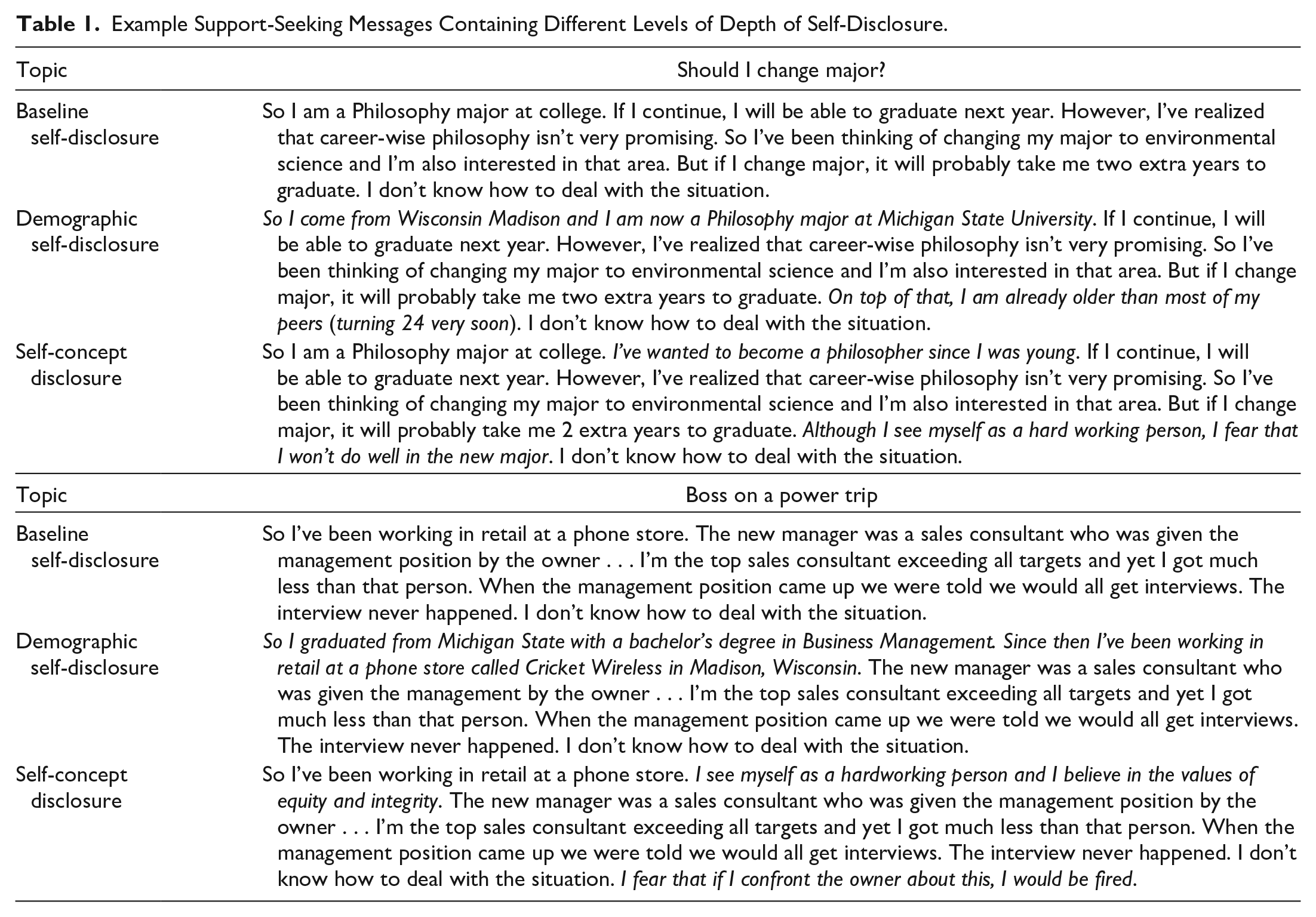
All six posts were pretested with a separate sample of 113 participants to determine if the advice-seeking posts containing self-concept self-disclosure were perceived as more private and intimate (e.g., “How private do you think the message is”) compared with the posts containing demographic self-disclosure. The support-seeking posts containing self-concept self-disclosure (M = 5.25, SD = 3.36) were viewed as more private compared with support-seeking posts containing demographic self-disclosure (M = 4.04, SD = 2.93), t(112) = 5.59, p < .001, and compared with support-seeking posts containing baseline self-disclosure (M = 4.66, SD = 2.96), t(112) = 3.16, p < .001.
Procedure
The experiment was conducted in a laboratory where each participant on arrival was greeted, received informed consent, and seated in a cubicle in front of a computer screen already displaying the randomly selected condition (i.e., a support-seeking post on a support forum ostensibly for college students). Participants were instructed to create a unique username, and then read and reply to the support-seeker’s post. The interactive platform allowed participants to click in the reply box below the support-seeker’s post, click “post a reply,” and see their replies immediately appear underneath. Each participant could only see their own replies. Much of past experimental research on computer-mediated communication has relied on the use of mock-up web pages as experimental stimuli (e.g., Walther et al., 2008). The interactive platform employed in the current experiment facilitated a more naturalistic approach to studying online advice communication than stagnant screenshots with which no interaction with either the online platform or message sender could occur. This methodology thus allows the researcher to examine online advice communication in a much more ecologically appropriate manner, while at the same time keeping the rigor of experimental design. On posting the reply, participants were directed to a survey assessing various perceptions of the support-seeking message and support seeker, along with their own characteristics; these survey items were not utilized in the present study. On completion of the questionnaire, participants were thanked and debriefed.
Coding
Each participant’s response was coded in terms of type of advice offered, use of argumentation/reasoning, and adherence to the integrated model of advice giving. Two coders independently coded the entire set of participant responses. Intercoder reliability was assessed for each measure and coding disagreements were resolved through discussion.
Advice Type
Each participant’s response was coded in terms of the type of advice the participant offered. Consistent with the conceptualization of advice as recommendation about what to do, think, or feel in a problematic situation (MacGeorge et al., 2008), three types of advice were identified: behavior-focused advice (e.g., You should meet with your boss), cognition-focused advice (e.g., try to think about your situation like this), and emotion-focused advice (e.g., Don’t feel bad . . . ). Intercoder reliability was high (Krippendorf’s = .89). A total of 1,965 pieces of advice (1,478 were behavior-focused, 402 were cognition-focused, and 77 were emotion-focused) were identified across all participant responses. On average, participants offered 2.73 pieces of advice in their responses to the support-seeking post, and the average length of participants’ responses was 101.34 words.
Reasoning
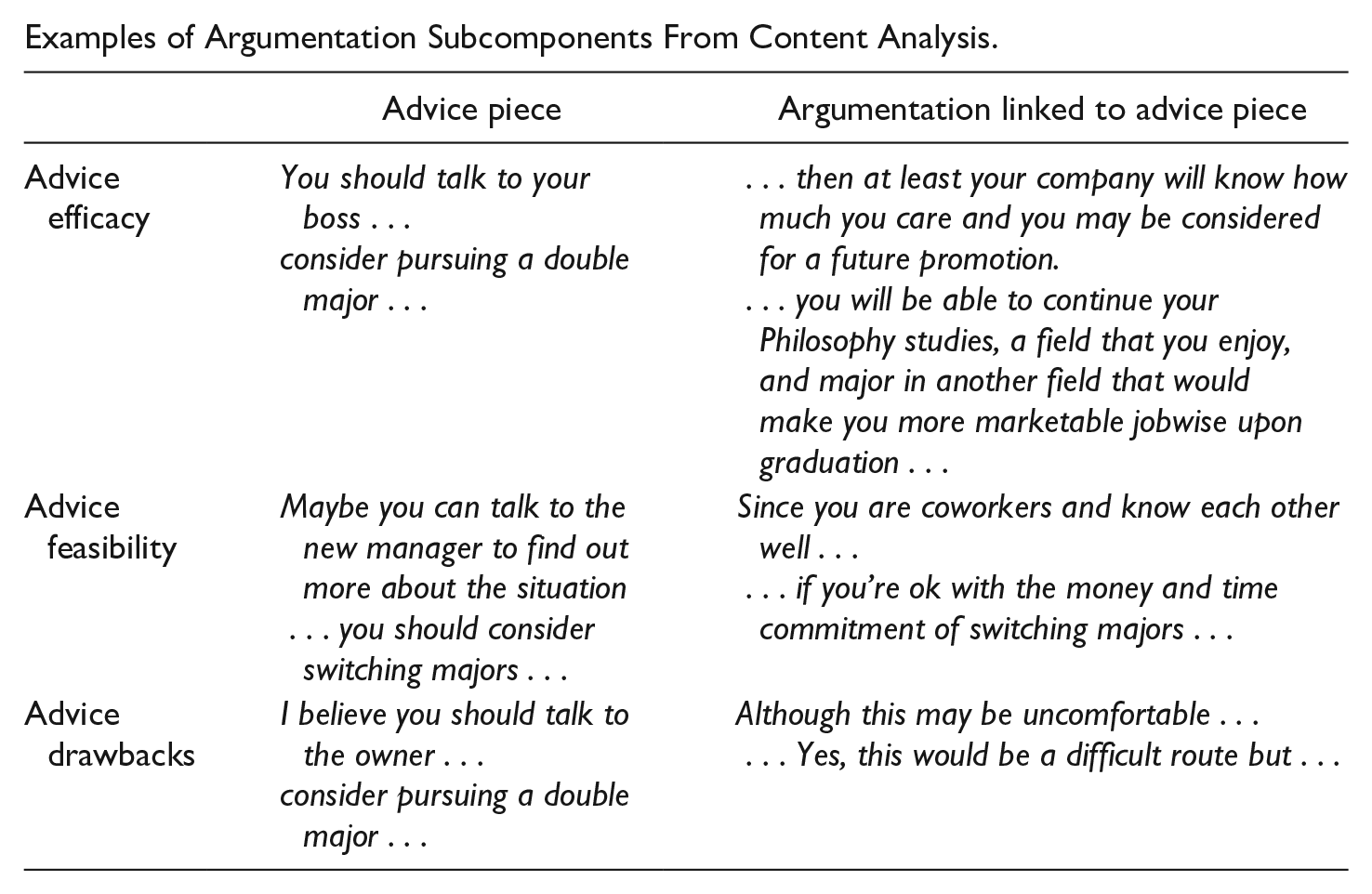
Each piece of advice was also coded to determine whether reasoning was provided with regard to the efficacy of the recommended course of action, the feasibility of implementing it, and lack of drawbacks associated with taking the advice (Feng & Burleson, 2008; see the appendix for argumentation examples). The presence (or absence) of each type of argumentation (efficacy, feasibility, limitations) was coded (1 = yes, 0 = no; Krippendorf’s = .69, .66, and .58, respectively). The type of argumentation most offered by participants was advice efficacy (17%), followed by advice limitations (8%), and advice feasibility (7%; see Table 2 for additional descriptive information). In addition, the coding for the three types of reasoning were summed at the participant level across all pieces of advice per participant to form an overall index of argumentation. A total of 654 pieces of argumentation were provided in these responses (M = 1.05, SD = 1.05). The demographic, self-concept, and baseline self-disclosure conditions elicited 208, 211, and 205 pieces of argumentation, respectively.
Descriptives for Advice Coding Results.
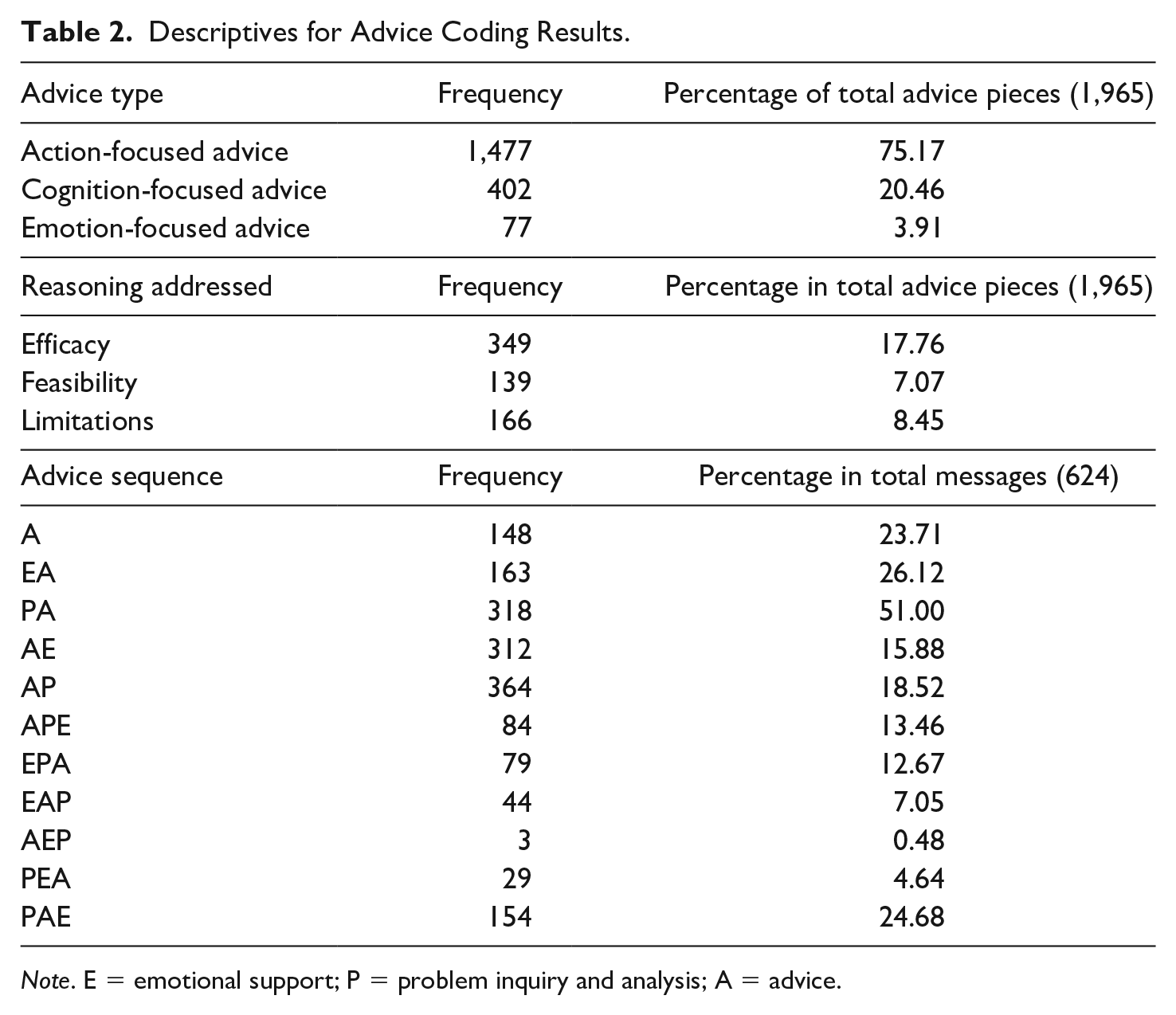
Note. E = emotional support; P = problem inquiry and analysis; A = advice.
EPA Sequence
Each participant’s response was examined for the extent to which it followed the integrated model of advice giving (Feng, 2009, 2014), which proposes that effective advising should follow the emotional support—problem inquiry and analysis—advice sequence. To obtain a more nuanced understanding of participants’ advising behaviors, their responses to the advice-seeking post were coded in terms of (a) whether emotional support was offered and, if yes, the placement of emotional support in relation to advice (before vs. after advice) and (b) whether problem inquiry and analysis was offered and, if yes, the position of problem inquiry and analysis in relation to advice (before vs. after advice). Consistent with IMA, emotional support was operationalized as expressions of understanding, care, concern, affection, and interest. Problem inquiry and analysis was operationalized as asking questions about the target’s problem or situation and/or offering analysis or interpretation of the target’s problem or situation.
To capture the fluid and dynamic nature of naturally occurring supportive interactions, each piece of advice was coded in its original form for the presence and absence of emotional support (E) and problem inquiry and analysis (P), as well as their position in participant response (e.g., EPEAE, PEAE), which was then reduced to a simplified form based on the first appearance of each element (e.g., EPEAE was simplified into EPA; PEAE simplified into PEA). Intercoder reliabilities were assessed for presence of emotional support (1 = yes, 0 = no; Krippendorf’s = .78), presence of problem inquiry and analysis (1 = yes, 0 = no; Krippendorf’s = .67), order of emotional support relative to advice (1 = before advice, 0 = after advice; Krippendorf’s = .77) and order of problem inquiry and analysis relative to advice (1 = before advice, 0 = after advice; Krippendorf’s = .68).
Results
Because preliminary analysis revealed no significant interactions between problem type and disclosure type on any of the outcome measures, problem type was excluded from further analyses.
A series of one-way between subject’s analyses of variance was conducted to evaluate the effect of self-disclosure type on the inclusion of reasoning regarding efficacy, feasibility, and limitations, respectively. There was a moderately significant effect of disclosure type on efficacy, F(2, 623) = .81, p = 05. Post hoc analysis revealed that baseline disclosure was more likely to elicit reasoning about efficacy (M = 0.66, SD = 0.75) than demographic (M = 0.50, SD = 0.70) and self-concept disclosure (M = 0.52, SD = 0.67). There was no significant difference of disclosure type on feasibility reasoning, F(2, 623) = .82, p > .05. Finally, reasoning about limitations differed significantly across disclosure types, F(2, 623) = 6.45, p = .002. Tukey post hoc comparisons revealed that self-concept disclosure was more likely to elicit reasoning regarding limitations (M = 0.36, SD = 0.56) than the baseline (M = 0.24, SD = 0.46) and demographic disclosure (M = 0.20, SD = 0.41).
A one-way between subject’s analysis of variance was also conducted to compare the effect of self-disclosure type on the overall level of argumentation in advice responses. There was a significant effect of disclosure type on argumentation, F(2, 621) = 3.83, p = .03, (η2 = .01). Post hoc comparisons using the Tukey HSD (honestly significant difference) test revealed that support-seeking posts containing the baseline disclosure elicited advice that contained more argumentation (M = 1.15, SD = 1.04) than support-seeking posts containing demographic disclosure (M = 0.89, SD = 1.01). Support-seeking posts containing self-concept disclosure (M = 1.10, SD = 1.08) did not differ significantly from the demographic or the baseline disclosure condition.
Chi-square tests of independence were performed to examine the relationship between self-disclosure type and adherence to the emotional support—problem inquiry and analysis—advice sequence, as well as the inclusion of emotional support or problem inquiry and analysis in participants’ support responses. The analyses did not reveal any statistically significant differences between the experimental conditions.
Discussion
As advice communication in anonymous online settings becomes increasingly common, it is both theoretically and pragmatically important to understand what factors influence people’s likelihood of providing sensitive advice to unknown others. In the current study, we investigated the impact of advice seeker’s disclosure on the quality of received advice. More specifically, our experiment examined whether demographic self-disclosure and self-concept self-disclosure had different effects on the quality of advice provided, as indexed by the use of reasoning and adherence to the EPA sequence.
Most of the advice participants offered was behavior-oriented; smaller quantities of advice were cognition-oriented or emotion-oriented. This finding can be understood from the perspective of the optimal matching model (Cutrona & Russell, 1990), which proposes that potentially controllable stressful events are more likely to elicit problem-focused support, whereas uncontrollable events such as loss of a loved one are more likely to elicit support that facilitates emotional processing. Given that the problems described in the support-seeking posts were both controllable situations, it is not surprising that most participants offered behavior-oriented advice.
We predicted that self-concept disclosure and demographic disclosure would elicit advice of differing quality. However, our data did not reveal any significant differences between disclosure conditions in advisors’ use of reasoning or adherence to the IMA-giving (Feng, 2009). Surprisingly, we instead observed that the baseline self-disclosure condition elicited somewhat higher levels of argumentation than demographic self-disclosure. It is possible that participants were better able to identify with the support seeker who disclosed demographic information and felt less need to engage in elaborate reasoning for their advice due to shared common ground. Taken as a whole, though, our findings did not appear to support either of the competing predictions derived from social penetration theory (Altman & Taylor, 1973), or align with prior research suggesting benefits of engaging in core self-disclosure online (e.g., reciprocation of self-disclosure; Pan et al., 2018). One explanation is that, although the self-concept disclosure employed in the current study was viewed as more private than the peripheral disclosure, it was not perceived as private or “core” enough to elicit a substantial increase in trust of the anonymous advice seeker. Participants who were exposed to the self-concept disclosure condition may have viewed the self-concept disclosure (e.g., having the fear of being fired by the boss if he or she confronts the boss) as a normative psychological state an individual facing the problematic situation would have and therefore not a highly private disclosure. Future research could employ manipulations of self-disclosure that exhibit a greater difference in privacy.
Our findings were also inconsistent with the results of recent research on supportive communication that examined the influence of personal identity cues on support provision (Feng et al., 2016). In the current study, personal identity cues were manipulated through inclusion of demographic information such as name and location, whereas in some previous research, they were manipulated through the presence and absence of profile pictures or user IDs (Feng et al., 2016; Tanis & Postmes, 2007). It is possible that personal identity cues are more salient in nonverbal form (and less salient in verbal form), making the brief verbal identity cues embedded in our demographic self-disclosures insufficiently salient to exert an effect. Alternatively, although sharing basic demographic information such as first name, age, sex, and general location is relatively common in initial dyadic online interactions between strangers (Nguyen et al., 2012) or on social networking sites (Hinduja & Patchin, 2008), disclosing a first name and work location in a public online forum might be viewed as “counternormative” and negatively violate viewers’ expectations in such a way that they offer more circumspect advice. Future research should pursue this possibility by assessing viewers’ norms regarding different types of self-disclosure that accompany advice.
The lack of significant differences between the experimental conditions in our study might also be explained by the finding that, across the experimental conditions, only a small proportion of advice messages contained reasoning or adhered to the IMA sequence. This finding is consistent with findings from a recent study on advice provision on military discussion forums, which revealed that only 1% of all replies to 916 supportive messages included the emotional support—problem inquiry and analysis sequence (McAninch et al., 2018). It is also consistent with general pattern of findings regarding the quality of advice in anonymous online settings: despite the presence of sensitive, high-quality advice provision in online forums, advice offered in those contexts tends to be more straightforward and reflects “expressive” message design logic (Harrison & Barlow, 2009; Ruble, 2011; for a recent review, see Feng et al., 2018). The lack of sensitivity in anonymous online advice giving can be understood from the “cues-filtered-out” perspective (Culnan & Markus, 1987; Short et al., 1976; Sproull & Kiesler, 1991), which suggests that the quality of interpersonal communication is impaired when few identity cues are available. It can also be interpreted from a constructivist perspective, which contends that motivation plays a vital role in provision of high-quality messages (Burleson, 2007). In an anonymous online forum where the users do not share any offline relationship (and in the context of the current study, have no prior history of interaction), there is likely low motivation to spend time and cognitive effort in crafting sensitive advice messages that contain reasoning, emotional support, or problem inquiry and analysis.
This study has its limitations. First, although our experiment employed the design of an interactive platform that resembles real online platforms, its ecological validity was constrained as the design did not allow participants to engage in back and forth interaction with the advice seeker. Compared with face-to-face encounters, it is probably more common for people to engage in “one-shot” response to an anonymous online support seeker’s post, especially given that the encounter is asynchronous. However, there is still the possibility that some people would invest time and effort in carrying on an extended conversation with the poster. Since our method did not permit this to occur, it is less surprising that relatively few participants followed the emotional support—problem inquiry and analysis—advice sequence in their responses. Because the IMA-giving (Feng, 2009) is built on the assumption that supportive communication involves give and take between the support seeker and provider and optimal advising involves obtaining additional input (i.e., through problem inquiry and analysis) from the support seeker, future research should examine the current study’s questions with a design that allows for interaction between the advice seeker and participants. Another limitation with the current study is the use of a college student sample that is arguably relatively homogeneous in its characteristics such as social media usage and social media literacy, familiarity with the topics described in the support-seeking posts, and similarities with the support seeker. Future research should employ a more diverse sample to reexamine the current study’s questions.
Despite its limitations, the current study makes several theoretical and methodological contributions to the existing advice literature. To our knowledge, this is the first study that examined the potential impact of an advice seeker’s self-disclosure type on the quality of received advice. The study also extended research on the integrated model of advice giving (i.e., the emotional support—problem inquiry and analysis—advice sequence) by identifying variations of the model (e.g., EPAE, EPEA) that may appear in naturally occurring advice communication. At the same time, as findings of our study suggest, what we currently know about how advice communication works in face-to-face, personal relationships may not translate directly to anonymous online environments. The dynamics of online advice seeking and advice giving may be more complicated than what current theory and research on advice and computer-mediated communication suggest. Therefore, our study offers only a preliminary glimpse into the complex phenomenon and further work is needed to obtain a more complete and nuanced understanding of online advice communication.
Footnotes
Appendix
Examples of Argumentation Subcomponents From Content Analysis.
| Advice piece | Argumentation linked to advice piece | |
|---|---|---|
| Advice efficacy | You should talk to your boss . . . consider pursuing a double major . . . |
. . . then at least your company will know how much you care and you may be considered for a future promotion.
. . . you will be able to continue your Philosophy studies, a field that you enjoy, and major in another field that would make you more marketable jobwise upon graduation . . . |
| Advice feasibility |
Maybe you can talk to the new manager to find out more about the situation
. . . you should consider switching majors . . . |
Since you are coworkers and know each other well . . .
. . . if you’re ok with the money and time commitment of switching majors . . . |
| Advice drawbacks |
I believe you should talk to the owner . . .
consider pursuing a double major . . . |
Although this may be uncomfortable . . .
. . . Yes, this would be a difficult route but . . . |
Acknowledgements
The authors thank two anonymous referees for their constructive criticism of this work.
Declaration of Conflicting Interests
The author(s) declared no potential conflicts of interest with respect to the research, authorship, and/or publication of this article.
Funding
The author(s) received no financial support for the research, authorship, and/or publication of this article.
