




Abstract
Issues of race, racism, and social justice are under-studied topics in this journal. This Prologue, and our Special Issue (S.I.) more broadly, highlights ways that language and social psychology (LSP) approaches can further our understanding of race, racism, and social justice, while suggesting more inclusive directions for their theoretical development. Acknowledging the inspiration from the Black Lives Matter (BLM) movement, we begin by discussing our deeply-held personal and emotional connections to recent societal events, including police violence against innocent Black civilians and the prevalence of anti-Asian hate. What follows, then, is: a historical analysis of past
The idea for this Special Issue stemmed from our (the Guest Editors’) deeply personal and distressed reactions to the continuing manifestations of anti-Black racism in the USA. On May 25th, 2020, George Floyd was murdered by four Minneapolis police officers, and this murder sparked outrage, in part, because it is part of a larger pattern of anti-Black racism and violence. Floyd's death occurred after a recent string of violence against Black bodies, including the lynching of Ahmaud Arbery (Collins, 2020), the assault against bird watcher, Christian Cooper, by a white woman who weaponized dialing 911 and white women's’ tears by falsely reporting that he threatened her and her dog (Closson, 2020), and the wrongful murder of Breonna Taylor by three police officers in her home—a murder that has yet to receive any justice (Booker & Treisman, 2021). These incidents follow a long line of police murders of innocent Black civilians (such as Trayvon Martin, Sandra Bland, Philando Castile, Eric Garner, Tamir Rice, Michael Brown, Kathryn Johnston, Korryn Gaines, Tanisha Anderson and many others; see O’Kane, 2020). As the year progressed, we watched ongoing police violence against Black people alongside an increase in overt anti-Asian hate that was undoubtedly spurred in no small part by the former U.S. President's comments about the origins of COVID-19. Moreover, this violence took place during the spread of COVID-19 which disproportionately affects Black and Brown lives (Wood, 2020).
In response to the ongoing and widespread racist violence, passionate Black Lives Matter (BLM) protests occurred across the U.S. and internationally (see Buchanan et al., 2020). Compared to previous BLM protests that included mostly (young) Black protestors, these protests were marked by racial diversity, particularly by the presence of many white participants (Harmon & Tavernise, 2020). Protestors made vociferous demands for social justice, significant police reforms, and cultural transformations designed to subvert longstanding, pervasive white supremacy and anti-Black racism. In March 2021, after the series of shootings in Atlanta spas that resulted in the death of six Asian women (Chang, 2021), Asian American activists organized anti-Asian hate rallies in the U.S. and internationally (Martin & Yoon, 2021).
As language and social psychology (LSP) scholars, we noted the multiple, complex, and intersecting discourses that constitute anti-Black racism and movements of resistance, and how these discourses vary in the U.S. (see Acheme & Cionea, and Maguire & Giles, this Special Issue) and internationally (see Sambaraju, and Ladegaard, 2021; also Sorrells, 2022). The purpose of this Special Issue is to highlight distinct contributions of LSP approaches for addressing questions surrounding social justice, particularly as related to race and racism; see Jost and Kay (2010) for a social psychological definition of social justice and its distributive, procedural, and interactional components as well as theories that inform our understanding of these types. We orient to social justice as created and maintained through communicative practices that foreground the humanity of racially marginalized groups and position the people in these groups as deserving of justice and fairness (Johnson, 2017).
The articles in this issue highlight how LSP approaches can be used in ways that reveal the kinds of linguistic practices that maximize equality and the kinds that exacerbate prejudice, suffering, and violence (Jost & Kay, 2010; see Wilkins & Kim, 2021). For example, which forms of language, argument, and information access from whom, and to whom, are likely to successfully enhance equity, respect, and fairness for marginalized social and racial groups? Which forms of language directed at, and sustaining, minority groups’ feelings of a “false consciousness” (that legitimizes hopelessness and insecurity within the groups’ psyches, see Jost 1995), mental ill-being, and justify an objectively unfair social system for its members and historical attributions of self- or group blame? What forms of protest language and advocacy at rallies and marches for civil rights, and when differentially relayed by various media, can awaken cognitive re-appraisals of unjust and illegitimate forms of subjugation by parties on different sides of the social and racial divide, and with what social and communicative outcomes? While the papers in this current Special Issue cannot do justice to answering all the foregoing, wide-ranging questions, the
We also orient to our editing of this Special Issue as a communicative practice in itself that, similar to Special Issues in other fields, attempts to re-shape the LSP field in more inclusive ways through centering work that addresses race and social justice (see, for example, Jackson et al., 2020; Nakayama, 2020; Wanzer-Serrano, 2019). Since this Special Issue is a product of personal and professional commitments of the two Co-Editors, we begin by narrating our personal stories as they relate to experiences of race, discrimination, (anti)racism, and our identities as academics and as LSP scholars. We then critically examine the status of studies on race and racism in the
The Editors’ Positionalities
Natasha Shrikant
My parents migrated from India to the United States as adult, working professionals. I was born in Dallas, Texas, and grew up as an American with an immigrant family and among other Indian immigrant families and white American neighbors and friends. Despite my American birth and upbringing, I, like many Asian Americans, have repeatedly been racialized as an ambiguous foreigner who, in turn, may not know English and/or has an exotic, strange, or threatening secret culture (Ono & Pham, 2009). It is this racialized position that informs my connections to, and emotions surrounding, this Special Issue's focus on dismantling anti-Black racism.
On the one hand, race and racism are omnipresent in my daily life. As someone who fits into the broader U.S. federally-defined “Asian American” category (that includes East Asians and South Asians) and faces similar forms of xenophobic discrimination as other Asian Americans, I am deeply emotionally affected by the ongoing anti-Asian hate throughout the pandemic and the way this escalating violence was ignored until the horrific Atlanta mass shooting (Chang, 2021; Nakayama, 2020). As a person of South Asian descent, I remember the racialized violence following 9/11. People who look like me and my family are often positioned as potential terrorists because of the acts of an extremist group. Therefore, when mass shootings occur (Flaccus, 2021), I am not only filled with grief for the victims, fear about the next shooting, and rage about inadequate gun control laws: I also hope that the race of the shooter does not bring about racially violent repercussions for myself or loved ones.
On the other hand, I am not Black and am rarely racialized as Black. I do empathize with Black Americans’ experiences of pain, struggle, and resilience, but do not experience these things in the same way, nor am I subject to anti-Black racism. Furthermore, anti-Black racism and anti-Blackness are pervasive in Indian and South Asian American communities. This divide is, in many ways, a product of white supremacy where, for example, Asian Americans are purposely positioned as a “model minority” and pitted against other, supposedly less desirable minority groups (Demsas & Ramirez, 2021). Everyday practices among South Asians can serve to uphold or resist these enduring structural inequalities. I participate in the BLM movement as a South Asian who recognizes that many of the rights I have in this country are due to the persistent, resilient struggle of Black Americans and that BLM is a project of solidarity among Black, Indigenous, and People of Color (BIPoC).
As an LSP scholar, I gravitate towards discourse analytic frameworks because they foreground the agency of individuals (like myself) to make thoughtful, goal-oriented discursive choices and to contextualize these discursive choices within broader sociocultural contexts of race and racism. From this perspective, I am committed to constantly interrogating how my everyday practices may serve to perpetuate anti-Black racism or to dismantle it. I see this Special Issue as creating a space that legitimizes LSP work on race and racism and through celebrating the Black, Indigenous, Latinx, and other racially minoritized scholars who do it.
Howie Giles
My experiences are in stark contrast to Natasha's. I started my life and schooling in an area of South Wales (city of Cardiff) which was predominantly white and became higher educated in college institutions of the same racial genre. With that said, I was picked on as a kid, even in my neighborhood - resulting in many fights and brawls - because I was a red-head (then anyway!) - and called a “Welsh wog” on many occasions when studying and visiting England.
My first nationally-funded research program in the 1970s looked at the language patterns of the small, but one of the first, Black immigrant communities in Britain; then called Tiger Bay, and now Cardiff Bay (for a history, see https://www.bbc.com/news/uk-wales-47538946). I was fascinated by the fact that certain West Indians in Cardiff sounded (and were perceived to sound) authentically “white” with their local, distinctive Welsh (but uniquely Cardiff) accent (Coupland, 1988), yet some did not linguistically accommodate to the host community. With the invaluable and ingeniously-creative Richard Bourhis, we produced a number of papers across the disciplines on these phenomena (e.g., Giles and Bourhis, 1975, 1976). Having scratched this surface, albeit with some empirical progress, we felt that much more needed to be done, and cross-nationally so. After submitting a grant proposal for funding follow-up work, I surprisingly received a rejection letter stating that we had accomplished all that was needed to be researched on such issues!
Deflated but girded, I expended the remainder of my career on other matters of Welsh (and other) identities but, especially, intergroup matters in general, intermittently doing work on racial issues (e.g., Dixon et al., 2018). Moving swiftly on, I was fascinated – given family connections to this profession – to study one par excellence setting of intergroup communication, viz., police-community relations. I did this when we emigrated to the USA into a city, Santa Barbara, that had a very, very small Black community; and I qualified to become a Reserve Officer (at the same time as maintaining my faculty role). Not unrelatedly, we could not, in the Department of Communication anyway, attract many Black graduate students or faculty, largely because of the low demographic vitality of the Black community here.
Hence, my policing work was rarely interracial and I had to retire from it in 2011because of a work-related injury – and then, later retired (my preferred title, “graduated”) from UCSB earlier than previously planned, because I had the invited opportunity to set up a new volunteer unit (“Volunteers in Policing”) with the Santa Barbara Police Department. Both passions of my life melded. I co-edited, in 2021, The Rowman & Littlefield handbook of policing, communication and society (Giles, Maguire et al., 2021b) with my police supervisor (an ardent intergroup academic who is, also, now my Ph.D. advisee) with whom we set up a police-community intergroup contact program with those who loathed the police on the one hand, and new probation officers fresh from the police academy who had little experience of dealing with anti-cop individuals on the other (Hill et al., 2021); it was successful and we are elaborating that program elsewhere. But while editing this volume, the George Floyd incident rocked the world. Had we made the Publishers’ deadline before this, we would have missed this event, and the Handbook would essentially have already been out of date! Needless to say, this incident horrified and incensed me. In order to capture the importance of the protests of the BLM movement and others for different constituents, we spent many weeks documenting the day-by-day events in the context of a theoretical model we were crafting; this now appears as a substantive epilogue to the Handbook (Giles, Hill et al., 2021b).
Experiencing this, and mindfully resurrecting slurs against my personal and social identities as a kid as above, I saw (as
This progress is being manifest in a number of differing ways, such as de-certifying officers who engage in misconduct. For example, California Governor Newsom signed this into law (September 30, 2021) as well as other Bills, such as any offending officers’ badges being taken away permanently for excessive force, dishonesty, and racial bias; Governor Cooper of North Carolina had already signed into law similar bills on September 2, 2021. Many commentators attribute this progress as responses to the BLM movement, protests, and the killing of George Floyd (e.g., Witte, 2021); for a broader analysis of the societal consequences of BLM protests, see Taylor (2021). Relatedly, a CNBC TV news video report (September 23, 2021) entitled, “Police departments taking reform into their own hands”, appeared about law enforcement in Washington DC “reforming training to intervene if an officer is using excessive force”. In parallel in Oregon, concrete moves are afoot in establishing mental health units to move into action when encountering those known to be mentally challenged in the field rather than calling upon a response from law enforcement. Most recently, Albuquerque, New Mexico provided 911 dispatchers with options in addition to police to respond to emergency incidents. 911 dispatchers can now connect callers with social workers trained in handling issues of mental health, substance abuse, or homelessness (Witte, 2021). Yet, at the same time, these developments are balanced, discouragingly, by the Federal Bureau of Investigation (FBI) reporting that since the Spring of 2020 when there were, over the prior 12 months, about 1000 domestic terrorism cases, the number had now “exploded” to 2700 in the last 16 months or so. The FBI Director “noted that the ‘biggest chunk’ of racially and ethnically motivated violent extremism the FBI tracks” is due to white supremacy (Miller, 2021).
The
JLSP
, Diversity, and Focus on Racial Issues
The
This lack of race-related research aligns with broader trends in the communication and psychology disciplines within which
As a key journal publishing LSP research, it becomes important for the
Analysis of JLSP Publications on Race, Racism, and Social Justice
In a recent review of four decades of
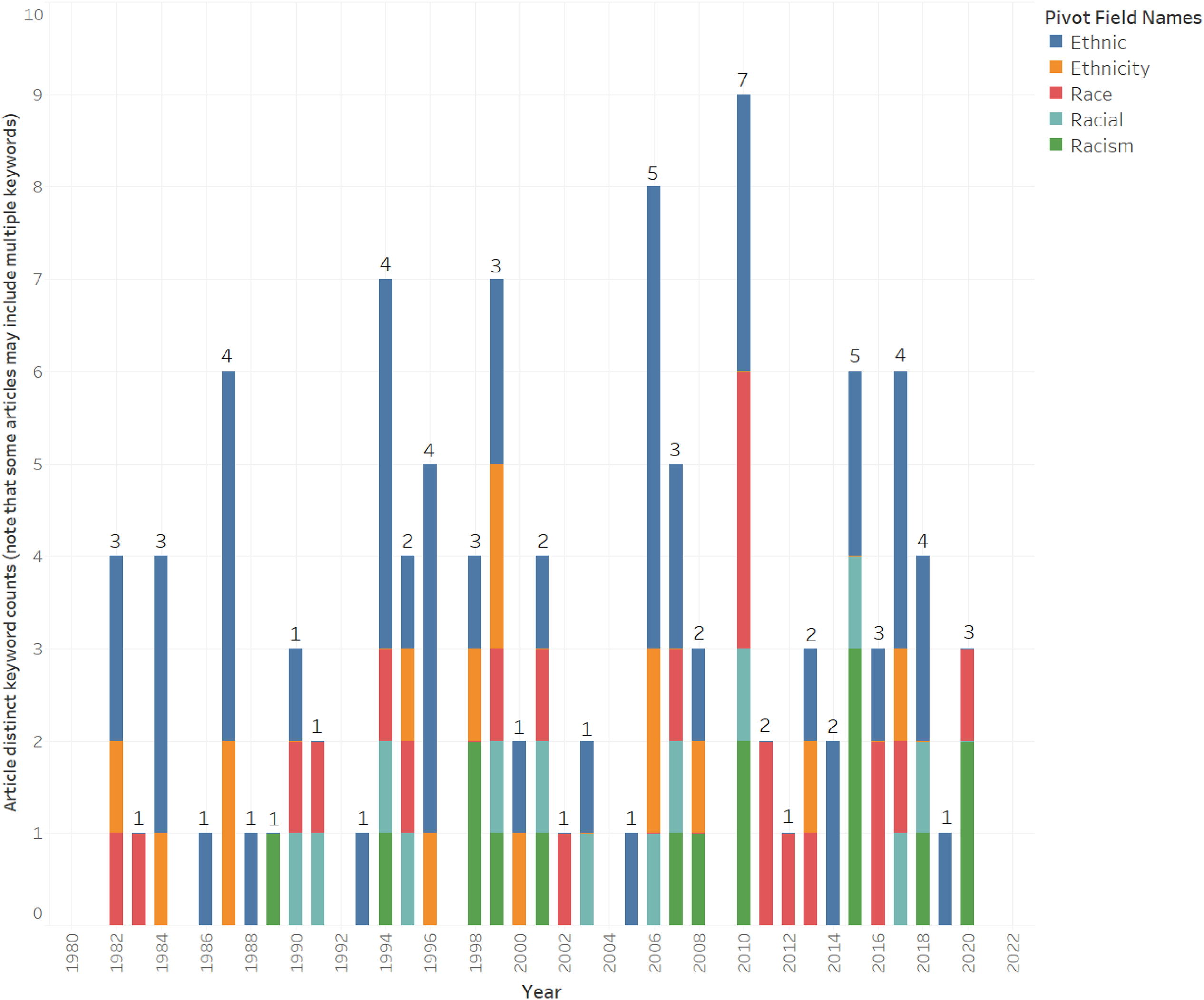
Count of key words appearing at least once in titles/abstracts between 1982-2020. As some articles contain multiple key words, the figures on top of the bars remove double counting by highlighting the total number of articles in each year that contain at least one of the key terms.
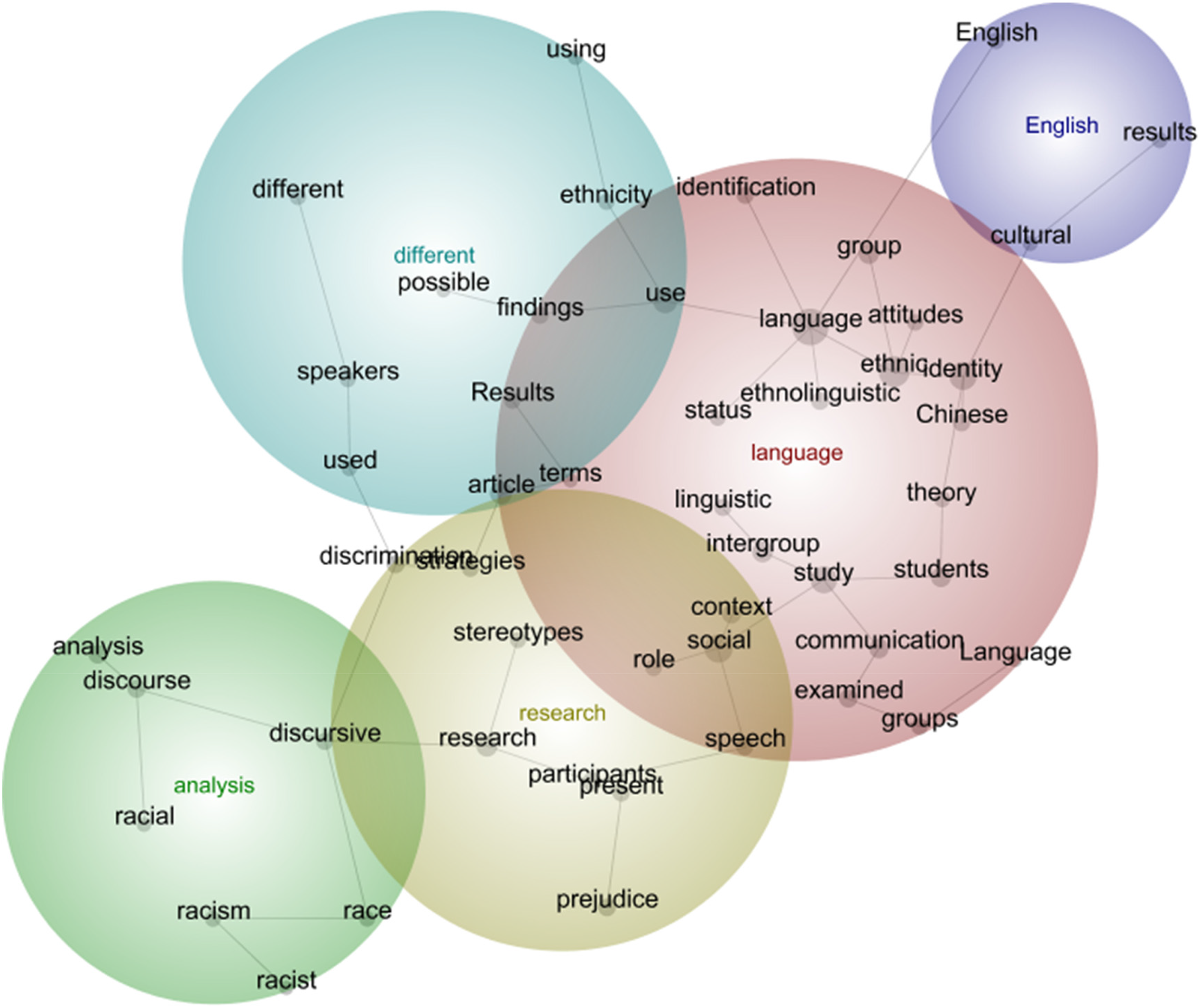
Leximancer concept map race/ethnic research articles. If reading this figure in greyscale the theme/color mapping in order of decreasing thematic prominence follows: language (red), research (yellow), analysis (green), different (blue), English (violet).
The above account of a paucity of attention to race and racism prompted us to conduct a more detailed analysis of ways that race, racism, and ethnicity have been addressed in
Figure 1 provides a breakdown by year of these terms that are included in titles and abstracts combined. 1 As can be observed from this graph, while there is an almost 50–50 split between the ethnic versus race words, there is more of a preponderance across years of the former; there does not appear to be a clear pattern of changes across the years.
As a means of profiling the main topics and themes that have appeared in the 83 articles located above, we conducted a lexicometric analysis to explore any potential changes that have taken place since 1982. Leximancer has been used to support research in many areas, including politics, psychology, health, business, and other domains (see Leximancer web site: https://info.leximancer.com/; also Angus and Gallois, 2017; Cretchley et al., 2010) as well as the social psychology of language (Giles, Hansen et al., 2021a). Leximancer text analytics software was used to conduct an automatic analysis of the conceptual content of the titles and abstracts. This software uses word associations (words appearing close to each other in the text) via a Bayesian statistical process to build emergent concepts and a grounded thesaurus from the text (for more details, see Angus et al., 2013; Smith and Humphreys, 2006). This approach allows the generation of a tailored taxonomy for the data set; the concepts are grounded in the data rather than applied by the researcher. Concepts group families of words that appear with each other, and the system's parameters can be tailored to suit the data. In this case, we eliminated universally common words that carry little meaning in the context (“the”, “and”, “on”, and the like), along with common academic words (“study”, “paper”, “literature”, etc.).
In Figure 2, the concepts that emerged from the titles and abstracts are displayed. Each major theme is color-coded on the map, with the most prominent theme in red, and so on through the heat spectrum from hot to cool colors (red, yellow, green, blue, and violet). Themes are named using the most prominent concept within them (written in the theme color in Figure 1); for example, the most prominent theme is called “language” and is located to the center/right of the map. The light grey network of pathways on the map reveals the highest-ranked conceptual similarities, though other concept-concept interconnections exist. This network helps to locate the most frequent links between concepts (i.e., these concepts are most frequently mentioned together within the input texts).
Interestingly, Figure 2 indicates a close connection between discursive analyses and exploring how racism is conceptualized seemingly in face-to-face interactions (given the recourse to “speech” and “speakers” in the “different” [blue] and “research” [yellow] theme circles). This is in contrast to computer-mediated communication and social media investigations which are becoming a burgeoning forum for
It is worth noting that, apart from discourse studies, language attitudes as a topic area is the only other specified; this, too, relishing a renaissance of submissions to, and publications in, the journal (see Dragojevic et al., 2021). Prominent, too, are the concepts of discrimination, prejudice, and stereotyping which should underscore the value of intergroup communication theories in understanding and attending the relevant dynamics of these constructs in everyday discourse (for details of this perspective, see, for example, Giles, 2012b; Giles and Harwood, 2018; Giles and Mass, 2016; for examples of intergroup theory as applied to interracial contact and relations, see also, Salter et al., 2018; Taylor et al., 2019). Of interest too, is that Chinese is the only language apart from English present in the map, but that identity and identification are conceptually separate from the pivotal race items, as well as “role” and “context” only being minimally highlighted. Notwithstanding the long debate between the conceptual status of “ethnicity” and “race” (see, for example, Kincaid, 2018), separate concordance (word tree) analyses of the data show that the “racial” item subtends the following: socialization, conflict, discourse, ethnic identity, and stereotypes, whilst the “ethnic” item subtends, in contrast, only identity, identification, and self. This suggests that the nature of the ways in which so-called ethnic and racial studies of LSP (constituted in different color coded themes in Figure 2) are examined deserves some timely conceptual and theoretical scrutiny in future studies and theorizing.
Another integral concept missing from the above analyses that fundamentally relates to this Special Issue is “social justice” (see, for example, Hammack, 2018; Hoang et al., 2021; Jost and Kay, 2010). This did not appear once in the analyses outlined above. Thus, when LSP work does address race and ethnicity, it does not overtly engage with “social justice” research and theory. Social justice has been discussed in one theoretical article on intergroup communication in the journal by Dubé-Simard (1983). Nearly 40 years ago, she argued that the perception of social justice or injustice, together with threats to identity, appeared as mediating constructs affecting the breakdown of intergroup communication (see model, p. 188). The author, even then, noted the general lack of LSP engagement with social justice and encourages scholars to further develop theorizing on the relationship between perceptions of social justice and intergroup dynamics. However, this article, while focusing on social psychological processes, did not foreground distinct language phenomena as constituting these processes.
A second article that addresses social justice is Verkuyten's work on “intergroup tolerance”, defined as perceptions by minority groups that they are merely being tolerated (put up with) by members of the majority group (e.g., Verkuyten and Yogeeswaran, 2017; Verkuyten et al., 2019). Verkuyten et al. (2020) presents a schematic model which features
In sum, while according to certain metrics, this journal does not focus sufficiently on race-related and social justice issues, it is far from bereft in that regards. The above analysis highlights LSP theories and paradigms, such as discourse analysis, language attitudes, and intergroup communication, that can explore aspects of racial and ethnic identity, conflict, socialization, racism and other related concepts. However, there is a disconnect between a focus on race and ethnicity and a focus on social justice. Below we review several key problems articulated by communication scholars of social justice and suggest ways that LSP approaches could be used to address these questions.
Bringing Together LSP and Social Justice
Social justice is an inherently social, collaborative project that is constituted via interpersonal, organizational, rhetorical, and other forms of communication (Huffman, 2014; Johnson, 2017). The most general contribution that LSP research can make to projects of social justice, then, is to highlight the role of language in the constitution of social justice and its relationships to communication practices (see Jensen, 2021).
One question focused on by social justice research is to identify “the grammars that oppress or underwrite relationships of domination” and to attempt to reconstruct those grammars (Frey et al., 1996, p. 112). From an LSP perspective, discourse analytic research (arguably more than quantitative work, although see Scharrer and Ramasubramanian, 2021) has documented how people perpetuate racist stances through language use, but in ways that maintain a reasonable, “not-racist” identity for themselves (Augoustinos & Every, 2007; Shrikant, 2020; Shrikant & Sierra, 2021). Making these pervasive strategies visible and identifiable is one step towards social justice aims. Creating change may occur in the classroom, where we teach students about how to identify and respond to racist stances when they hear them in everyday conversation, or through translation of research findings into anti-racism workshops (see, for example, Lawless and Chen, 2021).
Social justice research also focuses on the types of communication that create, support, and constitute a culture of social justice (see Jensen, 2021). Johnson (2017), for example, notes that storytelling by marginalized groups and listening to these stories by dominant groups are important interpersonal communication practices for instituting social justice. This is because storytelling humanizes and highlights the diverse experiences of marginalized individuals and communities (e.g., see Hendrix, 2021 on surviving academia). LSP research can align with these aims through centering voices of non-white, non-Western communities, when developing LSP theorizing. Davis (2015, 2019), for example, extends standpoint theory and theories of social support through centering the linguistic practices of Black Women. Shrikant (2018, 2021) analyzes the linguistic strategy of membership categorization among an ethnically and linguistically diverse Asian American business community in ways that extend discourse analytic theorizing on forms and functions of membership categories.
Third, social justice research encourages focusing on events that lead to social change in ways that benefit minoritized or marginalized BIPOC communities (e.g., Frey et al., 1996). One example of this is a focus on restorative justice, a more community-oriented approach to justice that includes, for example “victim-offender conferences, peace circles, family group conferences, community conferences, and truth and reconciliation commissions” (Paul & Borton, 2021, p. 199). Restorative justice is often seen as an alternative to police involvement, and some communities are calling for funding re-allocations from police to restorative justice projects (e.g., Romo, 2020). Tyler et al. (2015) discuss the role that psychological research plays in legitimizing police conduct, and how psychological science can be used to explore different avenues for policing. LSP approaches could focus on language use in restorative justice projects. Ethnographic and discourse analytic research could, for example, analyze naturally-occurring communication during restorative justice meetings/discussions and identify the kinds of linguistic strategies that are connected to meeting goals and maintaining relationships.
The fourth potential avenue for an LSP contribution to social justice work is on the meaning of the term “social justice” itself, with scholars having noted that it is an essentially contested term (e.g., Johnson, 2017). To date, scholars have drawn from philosophers when defining the multiple approaches to and meanings of social justice (for an overview, see Tiejte, 2015). LSP perspectives can focus on meanings of the word “social justice” (as well as injustice) from the perspectives of everyday people who use that term (for example see Boromisza-Habashi, 2010, on ‘hate speech’ or Pezzullo, 2001, on ‘environmental justice’). What are the ways “social justice” is oriented to in everyday interaction? What are people's perceptions about the meanings of “social justice”? What does it mean to speak in “socially just” ways, or be a “socially just” person?
Of course, these four, relatively broad, suggested directions for research are not the only avenues for connections between LSP and social justice research. These are a few that stood out to us (the authors) as interesting avenues for theoretical and methodological development. We now move to an overview of the BLM movement's agenda and then to introducing the articles in this Special Issue which connect to questions of social justice as they relate to racism, white supremacy, and/or the BLM movement.
Black Lives Matter
Agenda and Articles in This Special Issue
BLM began in 2013 after George Zimmerman was acquitted for killing an unarmed Black teenager, Trayvon Martin (see Edgar and Johnson, 2018; Ransby, 2018; Taylor, 2016). Activist Alicia Garza posted a love letter to Black people on Facebook, ending it with the phrase “Black Lives Matter.” She then worked with activists Opal Tometi and Patrisse Cullors to start the “Black Lives Matter” hashtag on Twitter. The hashtag became popularly used in 2014 after a jury failed to indict the officer who killed unarmed Black teenager, Michael Brown, in Ferguson, Missouri. Black Lives Matter also “migrated from the virtual world of social media to the real politics of the street” (Ransby, 2018, p. 5), when it was chanted by protestors who took to the streets after this failed indictment. The wide televising of these protests and of the brutal police treatment of protestors (Lauer & Beaty, 2021) caused the BLM movement to spread internationally (Maqbool, 2020; for changes in print media coverage of police post-Ferguson, see Tyler & Maguire, 2021).
Black Women are central to the BLM movement, as are Black Feminist approaches to organizing (Androne & Spencer, 2020; Jackson, 2016; Ransby, 2018). First, the movement uses collective, grassroots approaches to leadership that debunks traditional patriarchal, masculine leadership styles. The movement is purposefully decentralized. The names associated with the BLM movement are not the leaders, but the victims whose murders sparked outrage, pain, and sadness (e.g., George Floyd, Breonna Taylor, Eric Garner, Michael Brown, and many others) (Maqbool, 2020). Second, the movement eschews traditional notions of ‘respectability’ valued during the 1960s civil rights movements where individual men (e.g., Martin Luther King, Jr.) were celebrated, while women worked tirelessly and quietly in the background (Richardson, 2019). Instead, BLM centers Black women and Black feminist “womanist” communication styles, encouraging engagement in “outrageous, audacious, courageous, or willful behavior” (Walker, 2004, p. xii), both in person and online (via Twitter and other social media). Third, the movement recognizes the intersectional violence experienced by Black women, LGBTQIA + communities, and/or those of differing ability, social class, or religions (Chatelain & Asoka, 2015; Garza, 2016; Ransby, 2015, 2018), and explicitly affirms and centers these communities in its mission (Black Lives Matter, 2021). Overall, the movement emphasizes “the needs of the most marginal and often-maligned sectors of the Black community: those who bear the brunt of state violence, from police bullets and batons to neoliberal policies of abandonment and incarceration” (Ransby, 2018, p. 3).
The BLM movement is centrally concerned with police violence towards Black people and with the lack of accountability for this violence. The U.S. actively purports a “colorblind” orientation to race: racism is no longer a problem and, therefore, violence towards Black people is not an indicator of racism, but of problems with individual police officers (Taylor, 2016). In addition, U.S. media and a broadly circulating ideology perpetuates stereotypes that Black people are “particularly dangerous, impervious to pain and suffering, careless and carefree, and exempt from empathy, solidarity, or basic humanity” (Taylor, 2016, p. 3). This colorblind orientation and racist ideology about Black people result in the excusing – and at times justification – of police shootings of Black people. The viral videos of police shootings, along with the BLM protests, destabilizes the idea that the U.S. is colorblind and puts pressure on institutions to re-consider anti-discrimination measures. One of the demands of the movement is to significantly reduce funding of police agencies and instead invest in more community-oriented approaches to protection, care, and justice, such as restorative justice (for a communicative perspective, see Paul and Borton, 2021).
Globally (and as is evident in the international heterogeneity of the papers that follow in this Special Issue), the BLM movement focuses on the unfair targeting of Black migrants for detainment and deportation and, more generally, on systemic racism faced by Black people in different countries (Black Lives Matter, 2021). De Genova (2018) points out intersections between migration and race in Europe through discussing how the so-called “migrant crisis” in Europe is actually a racial crisis, where many of the supposedly undesirable migrants featured in news and discussed by politicians are Black and Brown. This connects to postcolonial contexts, where European countries preserve their own wealth and “illegalize” the “mobility of the vast majority of people from formerly colonized countries” (De Genova, 2018, p. 1766). In the Australian context, BLM is a catalyst for attention not only towards police violence, but broader systemic racism (Bond et al., 2020). Mason (2020) discusses how BLM movements in the U.S. sparked more coverage of deaths of Aboriginal and Torres Strait Islander peoples in Australia, with a specific focus on deaths in police custody. This study draws connections between Black American experiences and Indigenous Australian's ongoing experiences of colonial violence, dispossession, and oppression. White (2021) analyzes how Aboriginal Australians construct intersections between ‘Aboriginal’ and ‘Black’ identities and draws connections to conceptualizations of Black identity in the U.S. Additionally, Davis (2016) discusses connections between militarization of police in the United States and the militarization of police around the world, arguing that individual, local incidents need to be understood – and struggled against – as global phenomena.
Thus, BLM is distinct in its communicative styles, its organizing, and its local and global reach. Yet, as a decentralized movement there is variation in the beliefs and values of people involved in it and the kinds of communicative practices that constitute it. Furthermore, the movement is occurring in reaction to the broader sociopolitical context of anti-Black racism and violence and alongside some counter-movements, such as All Lives Matter and Blue Lives Matter, for example. There are also multiple identity categories involved with BLM (i.e., protestors, police, politicians, victims) and multiple platforms on which communication is occurring (i.e., face-to-face, Twitter, online discussion, news reports), all of which occur in different countries with their own histories of racism. LSP approaches are distinct in that they can tease out the complexities of language use across these various contexts and draw connections between LSP processes. The first two articles in this issue illustrate how close linguistic analysis highlights complexities surrounding identities and stances of protestors and the police in U.S. contexts. The second two articles conduct discourse analyses of racist and anti-racist discourses on social media in international contexts. These articles illustrate specific discursive strategies that perpetuate and challenge racism and local, interactionally specific ways of articulating racist and anti-racist stances.
First, Acheme and Cionea conduct an interview study with Nigerian migrants living in the U.S. and highlight tensions surrounding participants’ choices to participate (or not) in BLM protests. These Nigerian participants share a racialized Black identity with African Americans, but view their own identities differently from African Americans: Nigerian migrants come from a country where they are in the majority, are often highly educated, and are viewed as a successful ethnic group in the U.S. The authors group language use among their participants into affective, cognitive, and behavioral responses and, from these findings, develop a “protest structure” process that helps explain social psychological processes surrounding reported choices to participate in protests and social movements. Furthermore, through focusing on the Nigerian diaspora in the United States, the authors highlight complexities of “race” and “ethnicity” as they relate to the identity of being a “protestor”.
Second, Maguire and Giles examine linguistic expressions of sympathy and empathy made in statements made by police executives, police department spokespersons, police union representatives, and prosecutors, immediately following 30 incidents of police shootings of Black people in 2020. They find that, generally, there are very few public statements released at all after these shootings and, in the statements released, very few express empathy or sympathy. Whereas police executives expressed sympathy and empathy more often, perhaps because their institutional role requires maintaining community relations, police union executives expressed sympathy and empathy the least (almost never), as their interests can be heavily skewed and defensively so in favor of protecting police involved in the shooting. The authors discuss how language use by criminal justice representatives is important for ameliorating the tenuous relationships among police officers and African Americans and encourage training for officers on the accommodating value of expressing discourses of sympathy and empathy.
Third, Sambaraju analyzes ways people in Ireland respond to complaints about racism with expressions of so-called allyship. In doing so, this study illustrates how “anti-racism” happens through specific discursive strategies on social media. Many expressions of allyship involve clarifying to Irish racial minorities that they are, indeed, and should be included in the category “Irish”. These discursive strategies include: affirming that the complainant is Irish, creating a divide between “racist Irish” and “anti-racist” Irish people when supporting complaints about racism, or invoking their own or their children's ethnic identities when supporting claims that minorities are also Irish. These interactions are situated within broader sociopolitical contexts in Ireland where citizenship is only granted to people with “Irish” ancestry, thus perpetuating a conflation between nationality and race (Irish people are white). This paper sheds light on ways that anti-Black racism and racism, more generally, are tied to issues of migration (and specifically to the Irish context). It raises (hitherto under-realized) questions about achieving the superordinate benefits of acknowledging and encouraging expressions of shared citizenship (see Munshi and Kurian, 2021).
Fourth, Ladegaard examines racist discourses through analyzing social media posts where Hong Kong employers shame domestic workers. Many domestic workers in Hong Kong are from the Philippines or Indonesia and thus – in addition to class distinctions – are racially distinct from their Chinese Hong Kong employers. The article shows how racist discourse is embedded in mundane discussion about hiring workers, firing workers, or getting recommendations about good workers. For example, employers attribute poor working skills to a worker's nationality, connect a worker's poor character to traits associated with their nationality or culture, or doubt complaints by workers about harsh treatment from employers. Although Hong Kong is relatively isolated from BLM movements in the U.S., this article highlights how similar types of race and class discrimination occur in Hong Kong, and how these are distinct to global labor markets in East Asian contexts.
Conclusions: Ways Forward for LSP Research and Institutional Practices
In this Prologue, we have introduced lexical analyses that show what we have achieved in our LSP history regarding racial issues, and transparently what not. Clearly, the future holds out promise that we can engage in more fine-grained analyses where we go beyond mere abstracts and articles to entire article content to elucidate such histories. Throughout, we have made the argument that LSP scholars should engage with questions of social justice and that LSP approaches are well suited to do so (see Jensen, 2021). The articles in this Special Issue showcase how LSP approaches can shed light on the many facets involved in social justice and do so from perspectives close to the participants’ experiences. By drawing on participants’ own language, these articles highlight social psychological processes distinct to Nigerian diaspora in the U.S. and to different types of criminal justice officers. Furthermore, discourse analysis of social media posts highlights the kinds of identities participants name as being involved in racism (e.g., white Irish racists, white Irish anti-racists, and minority targets of racism; Hong Kong employers and [Filipino, Indonesian] domestic workers). Starting with language use, therefore, allows researchers to better understand how racism and anti-racism operate in day-to-day life, and these findings can, in turn, be used to meet social justice aims.
We encourage future LSP researchers to design studies that use LSP approaches to address social justice questions which, as Frey et al. (1996) note, “has the potential to do good in society while expanding and transforming the theories, methods, and pedagogical practices of those who theorize, research, and teach about it” (p. 110). Hodge’s (2018) work on African American discourse analysis, for example, critiques and extends discourse analytic theories through drawing from African American epistemology. In tandem, we encourage LSP scholars to begin fermenting ideas that constitute a unique language-based theory of social justice whose Principles and/or Propositions embrace not only ethnic and racial identities, but also ways these identities intersect with other socially marginalized identity categories (e.g., gender, sexuality, ability). Indeed, it is possible that social justice is not simply the converse of injustice but, rather, might have its own underlying processes that necessitate a complementary theoretical framework.
More pedagogically, we encourage scholars to incorporate orientations to social justice in graduate and undergraduate courses where LSP approaches are taught. Questions of social justice should be incorporated throughout a class instead of being siloed to one or two weeks in class. For example, discourse analysts can include some examples of race and racism when teaching about different discourse strategies. Interpersonal, health, and organizational scholars teaching theories of social support can incorporate work that highlights ways that race and social support intersect with one another in different social domains. Social justice can also be practiced through mentorship, where more established faculty can support graduate students and junior BIPOC scholars who are interested in conducting (social justice-oriented) LSP work.
On a more institutional level, departments can design social justice tracks or minors so students can easily identify classes that engage with social justice ideas (for example, see St. Louis University's Social Justice Communication Collaborative) 2 . Another way to mentor graduate and undergraduate students in social justice approaches is to design conferences that centrally address ways that LSP approaches can engage in social justice research, teaching, and/or community work. In the field of rhetoric, for example, Phaedra C. Pezzullo 3 , along with colleagues and graduate students in the Department of Communication's Center for Communication and Democratic Engagement at the University of Colorado Boulder, organized the 30th annual Public Address Conference with the theme of Embodying Justice. 4 The conference featured Eric King Watts as the keynote speaker as well as panels that showcased ways that scholars are using rhetorical theories and methods to address questions of (racial, gendered, sexualized, environmental, and health) justice. Other ways of attending to social justice are through creating spaces for scholars of color to share experiences and collaborate. For example, S. M. Davis's @BlackintheIvory 5 Twitter account provides a space for Black academics to connect and share experiences of racism in academia. One of us (NS) is involved with a group named Ethnomethodology/Conversation Analysis for Racial Justice (EMCA4RJ: Sciubba et al., 2021) 6 which is aimed at reshaping EM/CA in ways that are more racially-just.
In sum, individuals and institutions can alter practices in ways that create a more inclusive, supportive space for BIPOC scholars. The
Finally, Jost and Kay (2010, p. 1152) ended their Handbook chapter by stating that: “..the jury is still out on whether the theories and methods of social psychology can offer unique, indispensable insights that – when combined with those gathered from philosophy, law, history, anthropology, economics, political science, and other disciplines – will enable the human race to attain the highest degree of social justice in practice and to permanently overcome its most stubborn, pernicious obstacles. (our italics)
We, like Lewin (e.g., 1951) well over a half a century ago, are optimistic that the prospects for cross-disciplinary work will yield significant academic and societal pay-offs, and especially when the language arts and sciences more explicitly attend to issues of social justice and are added to those “…other disciplines” articulated above. We encourage developing research paradigms and being reflexive of our own individual and institutional practices – through doing so, we can all contribute to projects of social justice within LSP and academia more broadly.
Footnotes
Acknowledgments
We wish to thank our dedicated Guest Editorial Board for their insightful and expedient feedback on articles submitted to this Special Issue. In addition, we are extremely grateful for, and appreciative of, Shardé M. Davis's careful reading and insightful, comprehensive feedback on the last of numerous iterations of this article.