




Abstract
Previous research has shown that gender-inclusive pronouns can facilitate mental representation of nonbinary individuals. However, considering that gender and pronoun use are politicized in many countries, such that individuals with a right-wing political orientation show more skepticism toward nonbinarity, these effects may be compromised. Across four studies (Ntotal = 2,847), we tested whether the gender-inclusive pronouns hen (Swedish) and they (English) evoke mental representations of individuals with stereotypical gender-nonconforming versus gender-conforming appearances, depending on the participants’ political orientation. Studies 1a and 1b showed that a right-wing political orientation was related to a lower likelihood of associating gender-inclusive pronouns with stereotypical gender-nonconforming appearances. Studies 2a and 2b showed that these results were robust both when the function of the pronoun was to anonymize the referent and when the function was to refer to a nonbinary individual. Study 2b further showed that binary gender beliefs contributed to this relationship. These results suggest that the capacity for gender-inclusive pronouns to contribute to mental representation of nonbinary individuals varies in part with the recipient's political orientation and preexisting beliefs about gender. More broadly, the results contribute to the understanding of how political orientation influences the processes of social categorization related to gender.
Introduction
The use of gender-inclusive language aims to promote inclusion and visibility. Traditionally, this research field has focused on making women more visible compared to men, for example, by replacing the generic pronoun he with he/she (Sczesny et al., 2016). Although such balancing/feminization strategies can reduce a male bias in language by reducing the conflation of gender-neutral terms with men and masculinity (Lindqvist et al., 2018; Sczesny et al., 2016), they do not acknowledge individuals outside the gender binary (Renström et al., 2024). Due to increased awareness of gender diversity in society, including nonbinary individuals (i.e., gender and/or sex identities that are not exclusively female or male; Hekanaho, 2022; Schudson & Morgenroth, 2022), several languages that traditionally only had pronouns based on the gender binary have started to implement gender-inclusive pronouns (see Jäggi et al., 2025; Renström, 2025 for reviews). These pronouns generally have two functions in language: a de-gendering function to minimize the salience of gender and a multi-gendering function to refer to nonbinary individuals (Renström et al., 2022).
While awareness of gender diversity and views that gender can exist outside the binary have increased in some parts of the public, as exemplified by the use of gender-inclusive pronouns (Hekanaho, 2020; Morgenroth & Ryan, 2021), these shifts in views on gender have also been met with political resistance and backlash across many Western countries (e.g., Gabriale & Roth, 2020; Kováts, 2017; Morgenroth & Ryan, 2021; Vandello, 2025). In turn, the politicization of gender may affect the ability that gender-inclusive pronouns have for increasing the visibility of nonbinary individuals (Renström, 2025).
In this article, we report the results from four studies, two focusing on Swedish hen and two on English singular they, to examine how the recipient's political orientation influences the effect of gender-inclusive pronouns on conceptual gender. Specifically, we focus on the mental representations of gender that these pronouns evoke, distinguishing between binary, stereotypically gender-conforming representations and more fluid, stereotypically gender-nonconforming, or nonbinary representations.
Conceptual Gender and Gender-Inclusive Pronouns
Conceptual gender (or semantic gender) refers to the gender that a word is associated with based on its meaning rather than its grammatical form (Ackerman, 2019; Jäggi et al., 2025). In other words, conceptual gender is the mental representation of gender that is evoked by a word, which is based on stereotypical assumptions about gender (Jäggi et al., 2025). This can include appearances, behaviors, and traits that are associated with a gender in a given society. Personal pronouns may be one of the most direct examples of this. For example, she/he typically evokes a binary representation of gender based on the biological sexes, female/male, and/or the more socially constructed genders, woman/man, along with corresponding stereotypical expectations associated with these categories, such as appearances. Consequently, the use of binary pronouns may activate gender-conforming representations of gender, that is, individuals who match stereotypical expectations for their gender category.
Many languages have traditionally relied on binary pronoun systems (Renström, 2025), based on the gender binary, or the sex/gender binary, which refers to the traditional Western view that gender exists as a strict woman–man dichotomy corresponding to biological sex (Hyde et al., 2019; Lindqvist et al., 2020). This framework dictates which genders are recognized as legitimate, how individuals are expected to behave, and how genders relate to one another (Morgenroth & Ryan, 2021). By enforcing rigid categories, the gender binary reinforces gender stereotypes and contributes to the marginalization of nonbinary individuals (Thoma et al., 2021).
The Function of De-Gendering and Multi-Gendering Strategies
Given the negative consequences of the gender binary, activists, feminists, and sexual minority groups have challenged it. Morgenroth and Ryan (2021) describe two broad strategies in these challenges: de-gender, which aims to reduce the relevance of gender in a given context, and multi-gender, which aims to expand recognition to explicitly include nonbinary individuals. The implementation and use of gender-inclusive pronouns in recent decades in several languages exemplifies this, such as hen in Swedish and singular they in English (Renström, 2025). The use of these pronouns, as well as many other gender-inclusive pronouns in other languages (e.g., hen/die in Dutch; Decock et al., 2024; iel in French; Wagener, 2022; and hen and singular they/de in Danish; Hjorth-Nebel Miltersen et al., 2022), corresponds to the two types of challenges to the gender binary described by Morgenroth and Ryan (2021). Depending on the context, gender-inclusive pronouns can be used to remove gender cues in language, for example, when the gender of the referent is unknown or irrelevant (de-gendering strategy), or to recognize nonbinary individuals (multi-gendering strategy) (Renström et al., 2022). Hence, the multi-gendering strategy of such pronouns functions to directly challenge the gender binary by recognizing the existence of gender/sex identities beyond the binary, while the de-gendering strategy functions to challenge the gender binary more indirectly by blurring the structure and meaning of gender categories overall.
Gender-Inclusive Pronouns and Mental Representations of Gender
According to linguistic relativity (Lucy, 1992; Whorf, 1956), language influences perceptions and conceptualizations of the world, including gender (DeFranza et al., 2020; Prewitt-Freilino et al., 2012; Tanabe et al., 2025). This suggests that pronouns have the capacity to influence how individuals mentally represent gender. In line with this, Lindqvist et al. (2018) found that the gender-inclusive pronoun hen in Swedish and ze in English eliminated a male bias in language, such that participants were less likely to mentally represent men, whereas other gender-neutral terms (e.g., singular they and the applicant) elicited a male bias. Similarly, Tavits and Pérez (2019) found that when participants were asked to describe an androgynous figure using hen or she rather than he, the mental salience of men decreased, which was associated with more favorable attitudes toward women and LGBT individuals. Wojahn (2013) showed that the use of hen in Swedish evoked mental representations that included female and male individuals as well as individuals with other gender identities. In contrast, he, he or she, she or he, he/she, and it tended to evoke exclusively male and/or female conceptualizations. More recently, van Berlekom et al. (2024) found that when participants were instructed to use hen in a writing task and were subsequently asked to categorize androgynous morphed faces, the likelihood of nonbinary categorizations increased.
To our knowledge, the only study that explicitly tests both a de-gendering function and a multi-gendering function of gender-inclusive pronouns and the mental representations of gender they evoke is Renström et al. (2024). In one of their studies, participants were informed that the English gender-inclusive pronouns singular they and ze were used either to anonymize the referent (de-gender) or because the referent had a nonbinary gender identity (multi-gender). The results showed a tendency for participants to select photos of gender-normative individuals rather than nonnormative individuals when the function of they and ze was unspecified and when the function was to de-gender, but participants were more likely to select photos of gender-nonnormative individuals when the function was to multi-gender. In other words, normative gender bias seems to be the default unless participants are explicitly informed that the pronoun is used in a multi-gendering setting.
However, political orientation may play an important role in how gender-inclusive pronouns are interpreted and how they influence mental representations of gender, considering that attitudes toward gender diversity and challenges to the sex/gender binary are strongly politicized in many Western countries (Renström, 2025).
Politicization of Gender and Gender-Inclusive Pronouns
While activists and feminists, mostly on the left-wing and liberal side of the political spectrum, have argued for a more gender-inclusive language, these initiatives have also been met with resistance. Research is documenting a (re)politicization of gender in Western societies (Abou-Chadi et al., 2021). This politicization of gender has been driven largely by right-wing and conservative parties and movements, which have mobilized in opposition to what tends to be described as a “gender ideology.” This term is used pejoratively and functions as a catch-all for targeting and criticizing progressive gender-related discourses and policies, including the nonbinary view of gender and the sex/gender distinction, gender studies, LGBTQI+ rights, sexual and reproductive health and rights, and sexual and equality education (e.g., Abou-Chadi et al., 2021; Gabriale & Roth, 2020; Graff & Korolczuk, 2022; Kováts, 2017; Kuhar & Paternotte, 2017). At its core, “gender ideology” is often perceived as a conspiracy theory that claims a powerful elite aims to promote homosexuality and indoctrinate children with a dictatorial ideology based on so-called “gender theory” (Salvati et al., 2024).
In light of this broader politicization of gender, the use of gender-inclusive language and pronouns has become politically contentious in Western countries. For example, in France, the inclusion of the gender-inclusive pronoun iel in the Petit Robert dictionary sparked national debate, and in 2023, the French Senate, dominated by conservative lawmakers, voted in favor of banning gender-inclusive language from official government communication (The Guardian, 2021, 2023). In Germany, there has been strong opposition against gender-inclusive language from the right-wing populist party Alternative for Germany (AfD), and several conservative-led states have banned gender-inclusive language in public schools (Associated Press, 2024). In the United States in 2025, the Trump White House administration adopted a policy of ignoring journalists who included their pronouns in email signatures, claiming such reporters were not trustworthy (Herchenroeder, 2024).
More broadly, previous research shows that right-wing individuals are more likely than left-wing individuals to endorse binary gender beliefs, including negativity toward nonbinary individuals; evaluate people who deviate from stereotypical gender norms more negatively and penalize them; resist gender-inclusive language and pronouns; and resist gender-inclusive strategies in general (e.g., Christley, 2022; Molin et al., 2020; Remsö et al., 2026; Renström & Klysing, 2024; Sauteur et al., 2023; Stern et al., 2015; Stern & Rule, 2018). These studies align with the broader psychological foundations of a right-wing political orientation, which includes stronger resistance to change and justification of inequality and social hierarchies (Jost et al., 2003, 2008). While the gender binary and binary pronoun systems support social stability and a hierarchical social order (Hyde et al., 2019; Morgenroth & Ryan, 2021; Renström & Klysing, 2024), challenges to the gender binary, including gender-inclusive pronouns, threaten the stability of the social system (Morgenroth & Ryan, 2021). When such stability is perceived as threatened, some individuals may try to defend and reinforce the system, producing backlash against nonbinary recognition (Jost, 2019; Jost & Banaji, 1994; Vandello, 2025).
Hypotheses on Gender-Inclusive Pronouns and Political Orientation
In the current research, we test whether gender-inclusive pronouns evoke mental representations of individuals with stereotypical gender-nonconforming versus gender-conforming appearances, depending on the participants’ political orientation. Based on the literature review above, we expect that the mental representation of gender evoked by gender-inclusive pronouns is less likely to be gender-nonconforming among right-wing individuals compared to left-wing individuals when the function of the pronoun is unspecified. In other words, gender-inclusive pronouns challenge the gender binary, and right-leaning individuals are more motivated to defend and reinforce it, which is reflected in a stronger binary mental representation of gender in response to gender-inclusive pronouns when there is no specific gender cue. Specifically, we hypothesize that
Individuals with a right-wing political orientation are less likely to mentally represent individuals with stereotypical gender-nonconforming appearances compared to individuals with a left-wing political orientation when the function of the pronoun is unspecified.
As previously discussed, gender-inclusive pronouns tend to have dual functions in language. For the de-gendering function of gender-inclusive pronouns, there is no gender cue, which leaves it up to the recipient to infer a gender for the referent similarly to when the function is unspecified, and we therefore expect that right-wing individuals will be more likely to default to a binary representation and hypothesize that
Individuals with a right-wing political orientation are less likely to mentally represent individuals with stereotypical gender-nonconforming appearances compared to individuals with a left-wing political orientation when the function of the pronoun is to de-gender.
As for the multi-gendering function of gender-inclusive pronouns, that is, when the function of gender-inclusive pronouns is to refer to an individual with a nonbinary gender identity, we expect, in line with previous results (Renström et al., 2024), that participants will be more likely to mentally represent individuals with stereotypical gender-nonconforming appearances. For the multi-gender function, we will also test the effect of political orientation. It may be that right-wing individuals are more likely to disregard the information that the referent is not exclusively female/male and/or woman/man and instead categorize the referent within a binary framework, which could be understood as a form of misgendering and denying the existence of nonbinary individuals (e.g., Vandello, 2025). However, it is also possible that right-wing individuals are more likely to rely on gender stereotypes and social categorizations in general (e.g., Stern, 2022; Stern & Axt, 2021), for example, the assumption that nonbinary individuals should always have gender-nonconforming appearances. Therefore, we do not formulate a directional hypothesis about the role of political orientation in the multi-gendering context.
In the previous hypotheses, we have assumed that a default to a binary representation of gender contributes to individuals with a right-wing political orientation being less likely to mentally represent individuals with gender-nonconforming appearances compared to individuals with a left-wing political orientation.
A small number of studies have examined how binary gender beliefs influence the relationship between pronoun use and mental representation of gender. van Berlekom et al. (2024) found that gender-inclusive pronouns can increase the visibility of nonbinary individuals, but this effect was weaker among those with stronger binary gender beliefs. Similarly, Fasoli et al. (2025) showed that cisgender participants were more likely than transgender and nonbinary participants to assign masculine and feminine pronouns to prototypical male and female faces, respectively, but less likely to use neutral pronouns for androgynous faces, and this difference was mediated by stronger binary gender beliefs. These studies did not consider political orientation as an antecedent of binary gender beliefs, nor did they test whether political orientation indirectly influences mental representations of gender through its association with binary gender beliefs. We suggest that right-wing individuals are more likely to endorse binary gender beliefs, which in turn mediates the relationship with being less likely to mentally represent gender-nonconforming individuals. Specifically, we hypothesize that
Participants with a stronger right-wing political orientation will be more likely to endorse binary gender beliefs, which in turn will be associated with a lower likelihood to mentally represent individuals with gender-nonconforming appearances in response to gender-inclusive pronouns.
Swedish hen and English They
We test our hypotheses across four empirical studies conducted in Sweden/Swedish and the United States/English. Swedish and Sweden present an especially interesting case for studying the politicization of gender-inclusive pronouns since Swedish was the first language to officially implement a gender-inclusive pronoun, hen, in 2015 (SAOL, 2015), although the pronoun was already discussed in 2011. Shortly after this in 2011, one of the largest newspapers in Sweden banned the pronoun (Dagens Nyheter), as the pronoun was considered to be perceived as a “queer political statement” (Gustafsson, 2012). In 2015, when hen was officially implemented in the Swedish dictionary, the language council of Sweden recommended not using the pronoun because of the perceived political connotations. When it comes to the public's attitudes, the majority of Swedes were hesitant to hen in the beginning (Bäck et al., 2018), and a part of this hesitancy was based on the fact that the pronoun was found to be distracting due to the perceived political connotation (Vergoossen et al., 2020). Survey research has shown that individuals with stronger right-wing political orientations report more negative attitudes toward hen and less use of hen compared to left-wing individuals (Bäck et al., 2018; Gustafsson Sendén et al., 2015, 2021; Lindqvist et al., 2016).
Another interesting case for studying the politicization of gender-inclusive pronouns is English and the United States. The most well-known gender-inclusive pronoun in English is singular they (but there are also other initiatives, such as ze and xe; Renström, 2025). Unlike hen in Swedish, they is not a new pronoun, but similarly to hen, Americans’ opinions on gender-inclusive pronouns are politically polarized (Bradley et al., 2019; Hekanaho, 2022). One study found that 63% of Democrats would be comfortable using a gender-inclusive pronoun to address someone if asked, while 34% of Republicans say the same (Ballard, 2022). Another study found that 67% of Democrats would feel somewhat or very comfortable using gender-inclusive pronouns, while 68% of Republicans would feel somewhat or very uncomfortable (Minkin & Brown, 2021). Furthermore, 51% of Democrats think it is extremely or very important to use someone's preferred (nonbinary) pronoun, while 14% of Republicans agree, and 55% of Republicans, compared with 17% of Democrats, say using someone's new pronouns when they have been through a gender transition is not at all important or should not be done (Parker et al., 2022).
Overview of the Current Research
Across four studies (Ntotal = 2847), we test how political orientation influences the effect of gender-inclusive pronouns on mental representations of gender. Specifically, we test whether the use of gender-inclusive pronouns evokes mental representations of individuals with stereotypical gender-nonconforming appearances versus gender-conforming appearances to varying degrees depending on the participants’ political orientation. In the studies, participants read a brief description of an individual referred to with the gender-inclusive pronouns hen (Swedish) or they (English). They were then asked to select a photo of the individual they believed the text was about. The individuals in the photos had either stereotypical gender-nonconforming or gender-conforming appearances (see below for further details).
As discussed above, previous studies have tested the gender that is evoked when either reading about or using gender-inclusive pronouns and whether this differs from the use of other pronouns or non-gendered words, typically by asking participants to select a photo of the person they believed the text was about (Lindqvist et al., 2018; Renström et al., 2024; Tavits & Pérez, 2019; van Berlekom et al., 2024; Wojahn, 2013). In contrast, in the current research we do not compare different pronouns/words but rather focus on the role of political orientation. The design we use is similar to Renström et al. (2024), where participants also read a text using either hen or ze/they and were then asked to select a photo of the individual they believed the text was about, categorized as either gender-nonconforming or gender-conforming appearances. Another difference from previous studies is that we do not use a recruitment scenario as the stimuli text (see Lindqvist et al., 2018; Renström et al., 2024) but instead the stimuli text that we use describes an ordinary person.
Study 1a (N = 602) and Study 2a (N = 1238) focused on the Swedish pronoun hen. Study 1b (N = 335) and Study 2b (N = 672) aimed to test whether the findings could be replicated in another language, English, focusing on the pronoun singular they. Hypothesis 1 is tested in Studies 1a and 1b, Hypothesis 2 is tested in Studies 2a and 2b, and Hypothesis 3 is tested in Study 2b. Ethical approval for all studies was obtained from the Swedish Ethical Review Authority, No. 2024-02926-01.
The data and code are shared on the Open Science Framework: link. In Study 1b, we aimed for a sample of at least 300 participants based on previous similar studies with binary predictors in a logistic regression (Renström et al., 2024; van Berlekom et al., 2024). In Study 2b, we aimed for roughly twice the sample size due to the more complex model in Hypothesis 2 as well as for the expected mediated effect in Hypothesis 3, which requires larger samples (Fritz & MacKinnon, 2007). Finally, in Studies 1a and 2a, we doubled the sample sizes of the corresponding Studies 1b and 2b because of the continuous predictor in the logistic regression and therefore more variability in the data (sensitivity analyses for all studies are reported in the Supplemental Materials).
Studies 1a and 1b
In the first two studies, we test whether political orientation influences the effect of gender-inclusive pronouns on mental representation of gender. Specifically, we test Hypothesis 1, stating that individuals with a right-wing political orientation are less likely to mentally represent individuals with gender-nonconforming appearances compared to individuals with a left-wing political orientation.
Design and Procedure
The studies were created in Qualtrics and conducted in Swedish (1a) and English (1b). Participants were invited to take part in a survey about how people form impressions of other people based on limited information. When starting the survey, participants first answered some demographic questions and were then informed that they would be presented with a short text about an individual and were asked to read the text carefully and try to remember as many details as possible. Participants then read a brief description of an individual referred to using hen/they. The description of the individual aimed to be as gender-neutral as possible (see the Supplemental Materials for the full text).
After reading the description of the individual, participants were asked to select from a set of eight photos who they thought the target individual described in the text was. The photo set (bought from https://www.shutterstock.com) was presented in a randomized order. It included two photos of individuals with stereotypical masculine gender-conforming appearances, two photos of individuals with stereotypical feminine gender-conforming appearances, and four photos of individuals with gender-nonconforming appearances. All individuals in the photos were White and in their 30s to avoid confounding influences from ethnicity and age. We also removed any distinctive features on the individuals, such as eyeglasses, heavy makeup, and facial hair. We first conducted a pilot study 1 on the photos where participants were asked whether the individual in the photo looked like a typical woman/typical man. The mean values for each photo showed that the two individuals with masculine gender-conforming appearances were perceived as looking the most like a typical man, the two individuals with feminine gender-conforming appearances were perceived as looking the most like a typical woman, and the four photos of the individuals with gender-nonconforming appearances were perceived as looking less like a typical man and less like a typical woman (see the Supplemental Materials for all photos and pilot results). The photos were coded as a dichotomous variable, with the gender-nonconforming individuals collapsed into one category and the gender-conforming individuals collapsed into another category.
The predictor variable in both studies was political orientation. In the Swedish study, participants rated their political orientation on a scale from 1 (clearly to the left) to 10 (clearly to the right). In the English study, we used political affiliation instead, as this aligns better with previous research from the United States. Participants were asked about their political affiliation and could choose Republican, Democrat, Independent, or Other as free-text responses. We recoded political affiliation into a dichotomous variable, with 1 = Republicans, 0 = Democrats, and participants who identified as independent or other affiliations were coded as missing. Participants with missing values on political orientation were excluded on an analysis-by-analysis basis.
Participants
For Study 1a, participants were recruited by the Swedish survey company Lysio in the spring of 2025. Lysio uses online panels from Norstat, and the sample that was collected was representative of age, binary legal gender, and area of living. Participants were reimbursed 0.10 €/minute. After excluding the participants who did not respond to the outcome variable (n = 7), the final sample consisted of 602 Swedish-speaking Swedish citizens aged 18 and older (see the Supplemental Materials for further details on all samples).
For Study 1b, participants were recruited by the survey company Prolific in the spring of 2025 and were reimbursed £2.25/hr. The sample consisted of 335 English-speaking American citizens aged 18 and older. The survey took about 10 min. Participants in both studies were informed about ethical considerations, including voluntary participation, the right to withdraw, and data handling. Participants provided informed consent by agreeing to participate based on this information by clicking a box.
Results
We first tested if there was a general tendency to select gender-conforming photos compared to nonconforming ones. In the full sample in Study 1a (Swedish hen), significantly more participants selected gender-conforming photos (n = 424; 70.4%), compared to gender-nonconforming ones (n = 178; 29.6%), χ2(1, n = 602) = 100.53, p < .001, ϕ = 0.41. In Study 1b (English they), we found similar results, such that significantly more participants selected gender-conforming photos (n = 248; 74.0%) compared to gender-nonconforming (n = 87; 26.0%), χ2(1, n = 335) = 77.38, p < .001, ϕ = 0.48. Hence, there was a general tendency for the participants to select photos of individuals with a stereotypical binary gender-conforming appearance, compared to gender-nonconforming appearances.
We present descriptive results of photo selections across both studies and by political orientation in Table 1. Please note in the table that for Study 1a, we have recoded political orientation into a binary left/right variable to ease the interpretation of the results in the table. As can be seen, the percentage of participants selecting gender-nonconforming photos seems slightly lower among those with a right-wing versus left-wing political orientation in both studies, providing initial support for Hypothesis 1.
Selection of Gender-Conforming/Gender-Nonconforming Photos by Political Orientation, Studies 1a and 1b.
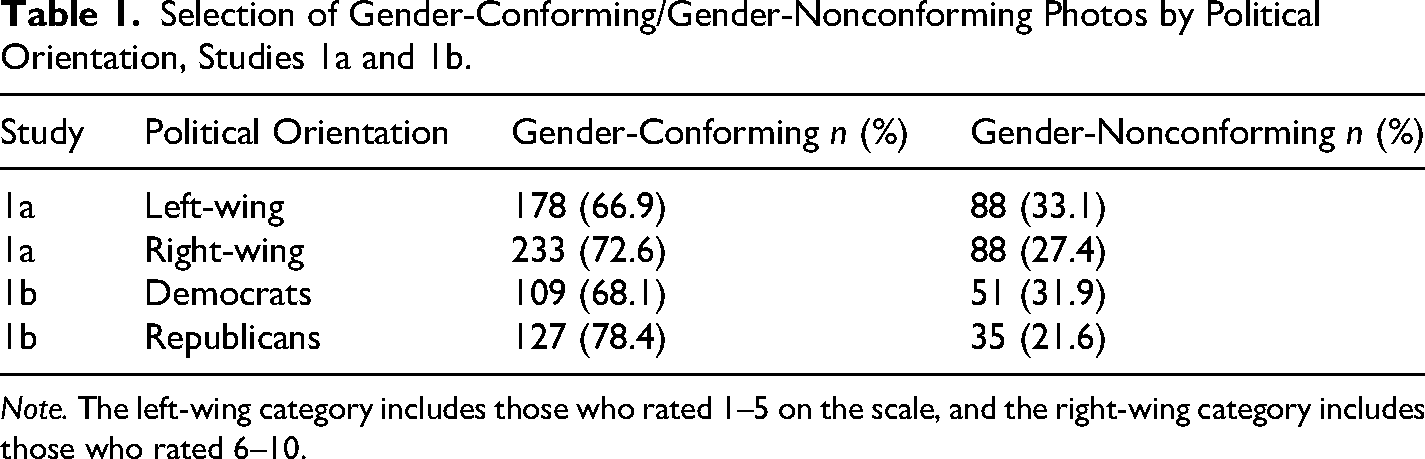
Note. The left-wing category includes those who rated 1–5 on the scale, and the right-wing category includes those who rated 6–10.
Next, we conducted binary logistic regressions to formally test Hypothesis 1. Photo selection (1 = gender-nonconforming, 0 = gender-conforming) was the outcome variable, and political orientation was the predictor variable. In Study 1a, we used the continuous left/right scale (1–10), and when testing for the linearity of the logit using the Box-Tidwell test, it was found that the linearity assumption was violated (p = .020). Hence, we transformed the variable using the natural logarithm. We re-ran the Box-Tidwell test, and the linearity assumption was no longer violated (p = .099).
In Study 1a (Swedish hen), the effect of political orientation was B (SE) = −.20 (.08), OR = 0.82, 95% CI [.70, .95], p = .008, R2N = .049, which indicates that for each logged one-unit increase (i.e., more to the right), the odds of selecting a gender-nonconforming (vs. gender-conforming) photo decrease by ≈ 18%. In Study 1b (English they), the effect of political orientation was B (SE) = −.53 (.26), OR = 0.59, 95% CI [0.36, 0.97], p = .038, R2N = .063, indicating that the odds for Republicans to select a gender-nonconforming photo (vs. gender-conforming) were ≈ 41% lower compared to the odds for Democrats.
Taken together, these results support Hypothesis 1, such that individuals with a right-wing political orientation are less likely to mentally represent individuals with gender-nonconforming appearances compared to individuals with a left-wing political orientation when presented with a gender-inclusive pronoun and the function of the pronoun is unspecified.
Next, we tested the effect of gender-inclusive pronouns in the two different functions: to decrease gender salience (de-gender) or to increase nonbinary visibility (multi-gender). Therefore, explicitly informing participants about why a gender-inclusive pronoun is used more closely mirrors everyday encounters with such pronouns, as the context often reveals the function of the pronoun. While the multi-gender function explicitly acknowledges nonbinary individuals, the de-gender function does not (although the referent may still be nonbinary). Similarly to when the function of gender-inclusive pronouns is unspecified, we expect that when the explicit function of the pronoun is to anonymize the referent (de-gender), right-wing individuals will be more likely than left-wing individuals to default to a binary representation of gender (H2). For the multi-gender function, on the other hand, which explicitly communicates that the referent has a nonbinary identity, we expect that participants, irrespective of political orientation, will be more likely to mentally represent individuals with gender-nonconforming appearances compared to the de-gender function. We do, however, test the effect of political orientation exploratory.
Studies 2a and 2b
In Studies 2a and 2b, we included the two hen/they functions: a de-gendering function of the pronouns and a multi-gendering function of the pronouns. In these studies, we therefore remove the ambiguity present in Studies 1a and 1b, where it was up to the recipient to interpret the function of the pronoun.
Design and Procedure
The design was almost identical to the ones in Studies 1a and 1b, except that we included two different hen/they functions, randomized between participants. Participants were either informed that hen/they was used in the text because the person described in the text had a nonbinary gender identity, “Since the person has a nonbinary gender identity, a gender-inclusive pronoun is used to refer to the person” (multi-gender function), or to anonymize, “Since the person is anonymous, a gender-inclusive pronoun is used to refer to the person” (de-gender function). Participants were informed about the same ethical considerations as in the previous studies. Political orientation was measured the same way as in the previous studies, and participants with missing values on political orientation were excluded on an analysis-by-analysis basis.
In Study 2b, we also included a scale for measuring binary gender beliefs for testing Hypothesis 3. We used four items adapted from the beliefs about gender scale (Tee & Hegarty, 2006), where participants were asked to rate their agreements with the statements on a scale from 1 (strongly disagree) to 7 (strongly agree), for example, “There are only two genders, male or female.” All items were combined into a mean index (α = .95; see the Supplemental Materials for all items).
Participants
Study 2a was conducted in Sweden, and participants were recruited by the same Swedish survey company Lysio in the spring of 2025 and were reimbursed 0.10 €/minute. Participants who did not respond to the outcome variable photo selection were excluded (n = 26), which resulted in a sample of 1,238 Swedish-speaking Swedish citizens aged 18 and older (n = 626 de-gender function; n = 614 multi-gender function). Study 2b was conducted in the United States, and participants were recruited by the survey company Prolific in the spring of 2025, and participants were reimbursed £2.25/hr. The sample consisted of 672 English-speaking American citizens aged 18 and older (n = 338 de-gender function; n = 334 multi-gender function). A precondition for participation in Study 2a or 2b was that the participant had not taken part in Study 1a or 1b. Participants in both studies were informed about ethical considerations, including voluntary participation, the right to withdraw, and data handling. Participants provided informed consent by agreeing to participate based on this information by clicking a box.
Results
We first show results of photo-selection overall, that is, if there is a general tendency within the two functions to select one type of photo over the other. In Study 2a (Swedish hen), for the de-gender function (anonymization), significantly more participants selected gender-conforming photos (n = 439; 70.2%), compared to gender-nonconforming photos (n = 186; 29.8%), χ2(1, n = 625) = 102.41, p < .001, ϕ = 0.41. For the multi-gender function (nonbinary identity), the results were similar but with a weaker effect, such that significantly more participants selected gender-conforming photos (n = 357; 58.2%), compared to gender-nonconforming photos (n = 256; 41.8%), χ2(1, n = 613) = 16.64, p < .001, ϕ = 0.16.
In Study 2b (English they), the results were replicated for the de-gender function, such that significantly more participants selected gender-conforming photos (n = 231; 68.3%), compared to gender-nonconforming photos (n = 107; 31.7%), χ2(1, n = 338) = 45.49, p < .001, ϕ = 0.37. However, for the multi-gender function, the result was in the opposite direction to the results found in Study 2a, although with a fairly small effect size, such that significantly more participants selected gender-nonconforming photos (n = 196; 58.7%) compared to gender-conforming photos (n = 138; 41.3%), χ2(1, n = 334) = 10.07, p = .002, ϕ = 0.17.
Taken together, when the function of hen and they is to de-gender, both pronouns are associated with stronger mental representations of individuals with gender-conforming appearances. When the function of the pronouns is to multi-gender, the results differ: the multi-gender function of hen remains biased, but weakened, toward gender-conforming representations, whereas the multi-gender function of they is associated with stronger mental representations of individuals with gender-nonconforming appearances.
In Figures 1 and 2, we present descriptive results on photo selection split on political orientation and pronoun function. Please note that in Figure 1 for Study 2a, we have recoded political orientation into a binary left/right variable to ease the interpretation of the results in the figure. As can be seen, in both studies, photo selection seems to vary by political orientation and by function.
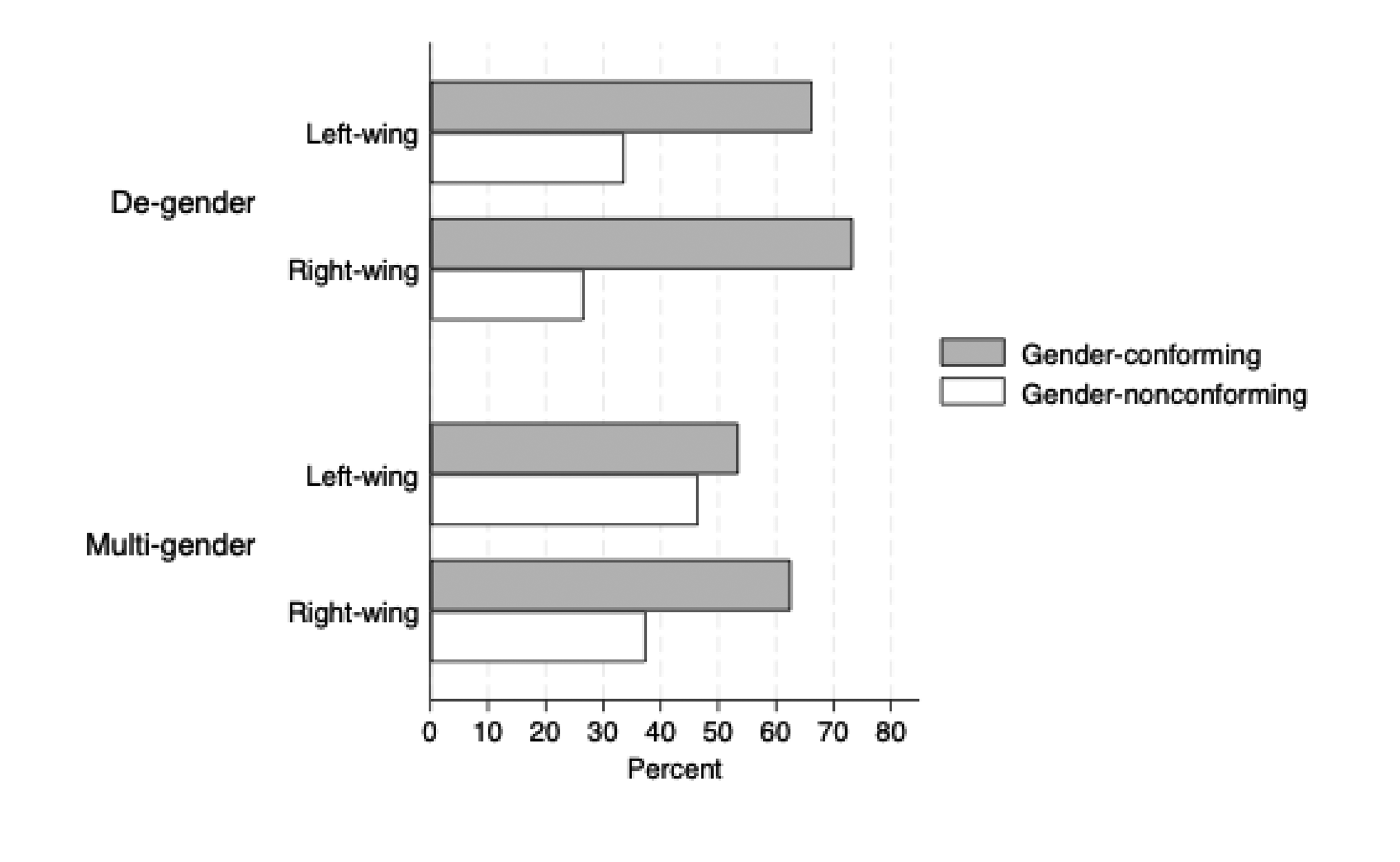
Percentage of participants selecting gender-conforming/gender-nonconforming photos split on pronoun function and political orientation, Study 2a.
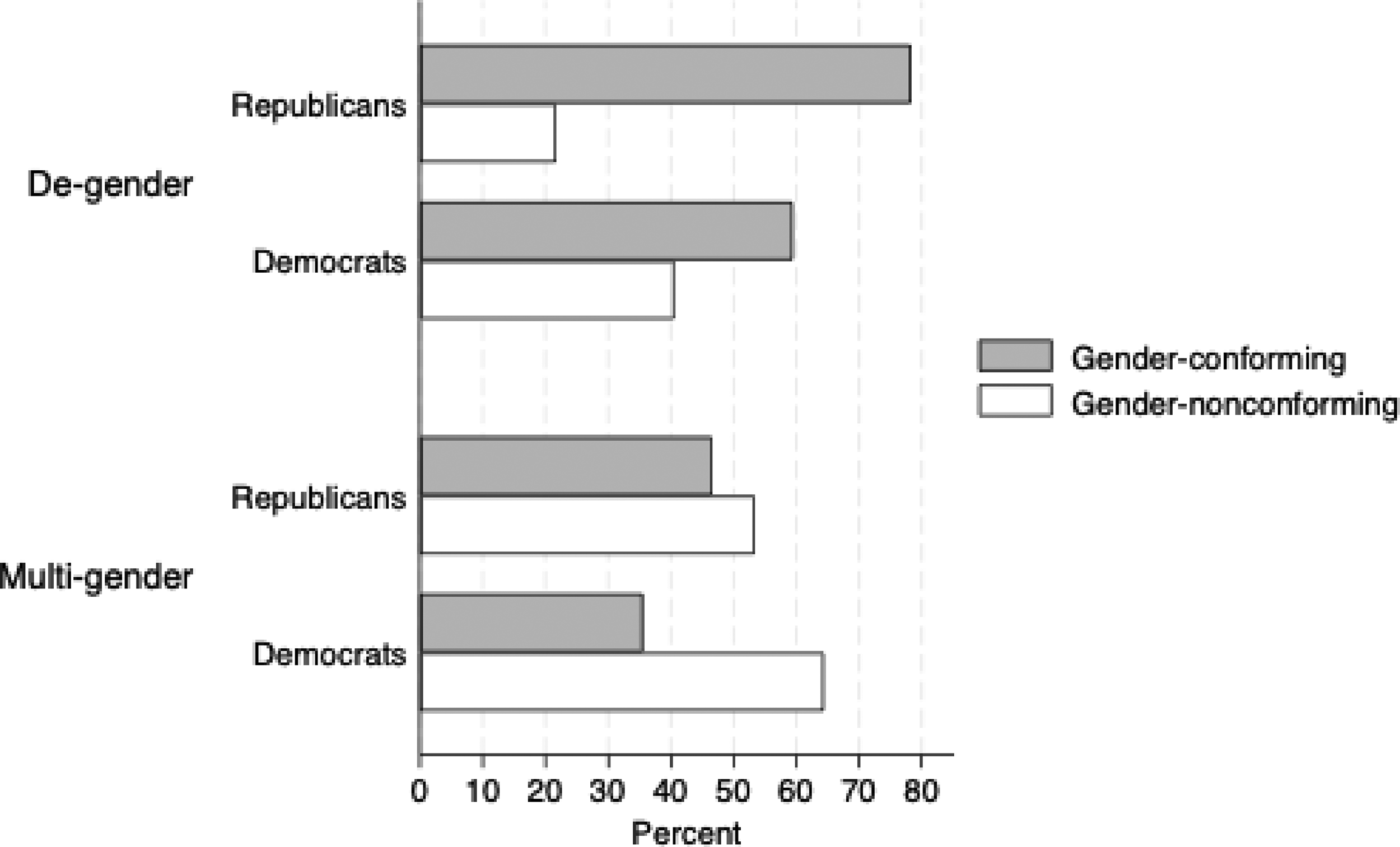
Percentage of participants selecting gender-conforming/gender-nonconforming photos split on political orientation and pronoun function, Study 2b.
We now formally test Hypothesis 2 by conducting hierarchical binary logistic regressions for the de-gender function. Photo selection was the outcome variable (1 = gender-nonconforming, 0 = gender-conforming), and political orientation was the predictor variable. In Study 2a, the linearity assumption for political orientation was met according to the Box-Tidwell tests (p = .422). In Study 2a (Swedish hen), the effect of political orientation was B (SE) = −.09 (.03), OR = 0.92, 95% CI [0.86, 0.98], p = .010, R2N = .025, which indicates that for each one-unit increase (i.e., more to the right), the odds of selecting a gender-nonconforming (vs. gender-conforming) photo decrease ≈ 8%. In Study 2b (English they), the effect of political orientation was B (SE) = −.90 (.25), OR = 0.41, 95% CI [0.25, 0.66], p < .001, R2N = .096, indicating that the odds for Republicans to select a gender-nonconforming photo (vs. gender-conforming) were ≈ 59% lower compared to the odds for Democrats. In sum, Hypothesis 2 was supported in both studies such that individuals with a right-wing political orientation were less likely to mentally represent individuals with stereotypical gender-nonconforming appearances compared to individuals with a left-wing political orientation when the function of the pronoun is to de-gender.
Furthermore, we test the effect of political orientation in the multi-gender function exploratorily by conducting the same regressions specified above but only for the multi-gender function. In Study 2a, the linearity assumption for political orientation was met according to the Box-Tidwell tests (p = .479). In Study 2a (Swedish hen), the effect of political orientation was B (SE) = −.09 (.03), OR = 0.92, 95% CI [0.86, 1.00], p = .010, R2N = .025, which indicates that for each one-unit increase (i.e., more to the right), the odds of selecting a gender-nonconforming (vs. gender-conforming) photo decrease ≈ 8%. In Study 2b (English they), the effect of political orientation was B (SE) = −.46 (.23), OR = 0.63, 95% CI [0.40, 0.98], p = .043, R2N = .062, indicating that the odds for Republicans to select a gender-nonconforming photo (vs. gender-conforming) were ≈ 37% lower compared to the odds for Democrats. Taken together, the results from both studies show that although participants were informed that the referent had a nonbinary identity, right-wing individuals were less likely than left-wing individuals to select gender-nonconforming versus gender-conforming photos.
However, to examine whether participants overall selected more gender-nonconforming photos in the multi-gender versus de-gender function, and whether the effect of political orientation differs by function, we conducted hierarchical binary logistic regressions for both the de-gender and multi-gender function. Photo selection was the outcome variable (1 = gender-nonconforming, 0 = gender-conforming), and the pronoun functions and political orientation were the predictors in Step 1. In Step 2, we add the interaction between function and political orientation. In Study 2a, we standardized political orientation to avoid multicollinearity in Step 2.
The results are presented in Table 2. As can be seen in Step 1 for Study 2a (Swedish hen), the odds of selecting a gender-nonconforming (vs. gender-conforming) photo were more than 1.5 times higher for the multi-gender function compared to the de-gender function. There was also a significant effect of political orientation, suggesting that for each one-unit increase (i.e., more to the right), the odds of selecting a gender-nonconforming photo (vs. gender-conforming) when both functions of hen are combined decrease by 18%. Similarly, in Step 1 for Study 2b (English they), the odds of selecting a gender-nonconforming photo were almost three times higher for the multi-gender function compared to the de-gender function. The effect of political orientation in Step 1 indicates that Republicans versus Democrats are about 50% less likely to select gender-nonconforming photos when both functions are combined. In Step 2, there was no significant interaction between function and political orientation in either study, which means that the effect of political orientation on photo selection did not differ by the function of the pronouns. In other words, regardless of whether participants were presented with gender-inclusive pronouns where the function was to de-gender or to multi-gender, those with a stronger right-wing political orientation were consistently less likely to select a gender-nonconforming photo compared to left-wing individuals.
Hierarchical Binary Logistic Regressions Predicting Photo Selection, Studies 2a and 2b.

Note. The outcome variable photo selection is coded as 1 = gender-nonconforming, 0 = gender-conforming.
De-gender function is the reference category.
In Study 2b, Democrat is the reference category.
Mediation Analyses
So far our results have shown that the effect of gender-inclusive pronouns on mental representation of gender as gender-nonconforming versus gender-conforming varies by the recipients’ political orientation, such that individuals with a right-wing political orientation are less likely than individuals with a left-wing political orientation to mentally represent individuals with gender-nonconforming appearances when presented with gender-inclusive pronouns. These results were robust for both when the function of the pronoun was unspecified (H1) and when the pronoun was used to de-gender (H2) and to multi-gender (exploratory).
Now we test Hypothesis 3 and whether binary gender beliefs contribute to this relationship. Since we did not find an interaction between pronoun function and political orientation in the previous model, we conducted this model in the full sample. 2 Specifically, we expect that a right-wing political orientation predicts stronger endorsement of binary gender beliefs, which in turn contributes to the relationship between political orientation and photo selection. We conducted a binary logistic mediation analysis estimating confidence intervals for the regression coefficients using Monte Carlo simulation with 5,000 iterations. 3 Hence, this model tests whether binary gender beliefs account for some of the statistical relationship between political orientation and photo selection, without claiming a cause-and-effect chain. Yet, the alternative mediation model where binary gender beliefs predict political orientation is theoretically less plausible given that political orientation tends to be quite stable over time and often functions more like a social identity than mere attitudes about certain issues (e.g., Mason, 2018). 4
Photo selection was the outcome variable (1 = gender-nonconforming, 0 = gender-conforming), political orientation was the predictor variable (1 = Republican, 0 = Democrat), and binary gender beliefs was the mediator. The mean value for binary gender beliefs in the full sample was 4.80 (SD = 2.23), on a scale from 1 to 7, where higher values indicate stronger beliefs that gender is binary.
First, we present the regression model predicting binary gender beliefs with political orientation as the predictor. The standardized coefficient suggests that among Republicans, binary gender beliefs are on average 0.58 standard deviations higher compared to Democrats, B (SE) = 2.38 (.15), 95% CI [2.01, 2.67], β = .53, p < .001, AdjR2 = .28.
Next, we conducted a regression model to predict photo selection, with political orientation and binary gender beliefs as predictors. The effect of political orientation was B (SE) = −.40 (.19), OR = 0.67, 95% CI [0.47, 0.97], p = .032, and the effect of binary gender beliefs was B (SE) = −.08 (.04), OR = 0.92, 95% CI [0.85, 1.00], p = .045, R2N = .076. Hence, Republicans were 33% less likely than Democrats to select gender-nonconforming photos, accounting for binary gender beliefs, and for each unit increase in binary gender beliefs, the odds of selecting a gender-nonconforming photo decreased by 8%, accounting for political orientation.
Lastly, the mediation index suggests an indirect effect of political orientation predicting photo selection via binary gender beliefs, B(SE) = −.05 (.02), 95% CI [−0.10, −0.002], p = .045, meaning that Republicans tend to hold stronger binary gender beliefs compared to Democrats, which in turn predicts a lower likelihood for Republicans to select gender-nonconforming photos. That is, these results support Hypothesis 3 such that binary gender beliefs contribute to the relationship between political orientation and photo selection. The results from the mediation model are illustrated in Figure 3.
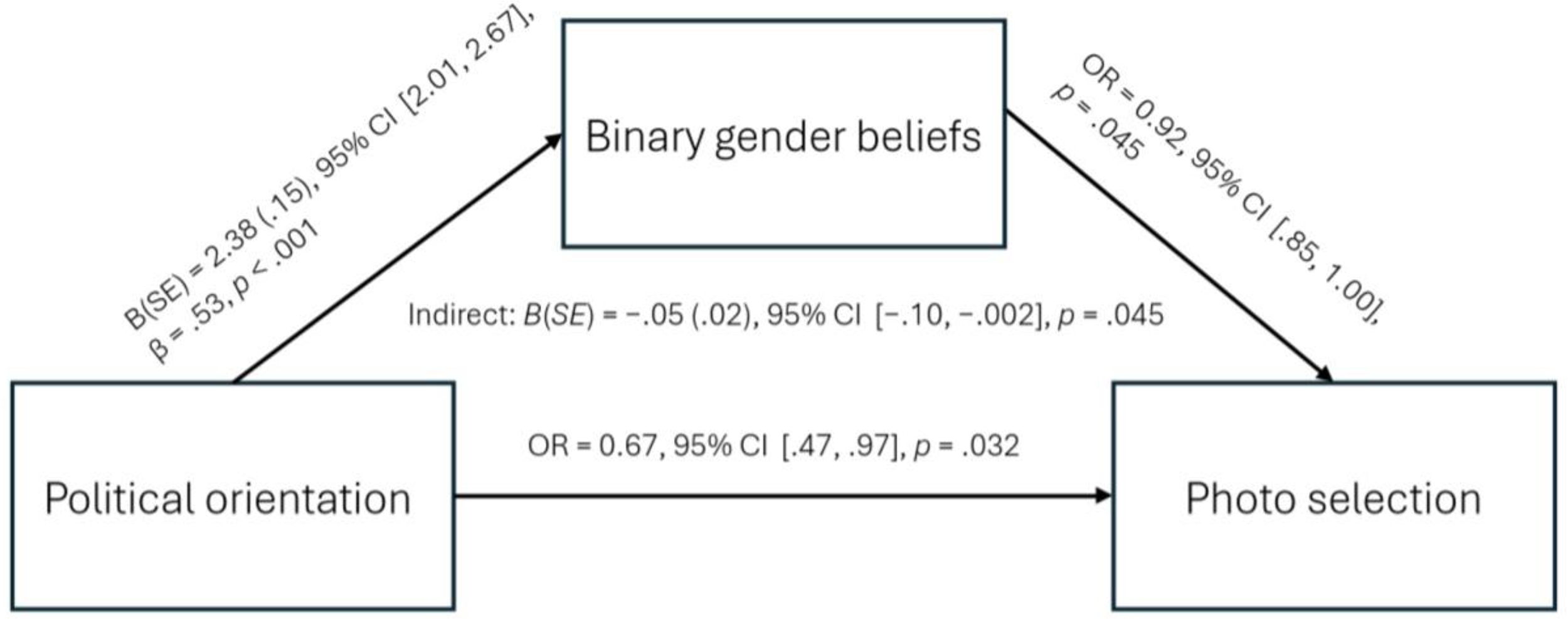
Results of the mediation model, Study 2b.
To summarize the results from Studies 2a and 2b, Hypothesis 2 was supported, as individuals with a right-wing political orientation were less likely to mentally represent individuals with gender-nonconforming appearances compared to individuals with a left-wing political orientation when presented with a gender-inclusive pronoun when the explicit function of the pronouns was to de-gender. When the explicit function of the pronouns was to multi-gender, we found the same results. In fact, we found no interaction between the function of the pronoun and political orientation, suggesting that the role of political orientation for gender representation was not contingent on whether the pronoun was used to anonymize or to refer to a nonbinary individual. Finally, for the English pronoun they, we found that binary gender beliefs statistically contributed to this relationship, supporting Hypothesis 3.
Discussion
This article sought to shed light on the role of political orientation when it comes to the effects of gender-inclusive pronouns on mental representation of gender. Previous research has shown that the use of gender-inclusive pronouns can increase the visibility of nonbinary individuals in language (Renström et al., 2024; Tavits & Pérez, 2019; van Berlekom et al., 2024; Wojahn, 2013). However, amid the politicization of gender and pronoun use in Western countries (e.g., Abou-Chadi et al., 2021; Gabriale & Roth, 2020), we expected that this effect would vary depending on the recipient's political orientation. Overall, our findings supported this expectation such that individuals with a stronger right-wing political orientation, compared to those with a stronger left-wing orientation, were less likely to mentally represent individuals with gender-nonconforming appearances in response to gender-inclusive pronouns.
In Studies 1a and 1b, participants read a brief description of an individual referred to with the gender-inclusive pronouns hen (Swedish) or they (English), and the specific function of the pronouns was unspecified. They were then asked to select a photo of the individual they believed the text was about. Participants with a stronger right-wing political orientation were less likely than participants with a left-wing orientation to select photos of individuals with gender-nonconforming appearances versus gender-conforming appearances. This suggests that, when the function of a gender-inclusive pronoun is ambiguous, that is, when the function of the pronoun is not explicitly stated but instead open to interpretation, right-leaning participants more strongly default to a binary mental representation of gender.
To account for the fact that gender-inclusive pronouns can serve different functions in language—either to remove gender or to affirm nonbinary identities (Renström, 2025; Renström et al., 2022)—we introduced explicit cues about the pronoun's intended function in Studies 2a and 2b. Once again, participants with a right-wing political orientation were less likely than left-wing participants to select photos of individuals with gender-nonconforming appearances versus gender-conforming appearances when the explicit function was to anonymize the referent (de-gender). We also found the same results when the function of the pronouns was to refer to a nonbinary individual (multi-gender). Study 2b further showed that binary gender beliefs statistically contributed to the relationship between a right-wing political orientation and the lower likelihood to select photos of individuals with gender-nonconforming appearances.
It should also be noted that in Studies 1a and 1b, when no explicit function of the pronoun was provided, the majority of participants across the political spectrum selected gender-conforming photos. And the same was true in Studies 2a and 2b when the pronouns were explicitly used for anonymizing. This suggests that when the function of hen and they is unspecified, most people seem to interpret it as a generic or anonymizing pronoun, which activates gender-conforming rather than gender-nonconforming mental representations. This could be due to the fact that the de-gender/generic function of hen and they is more widely accepted and used compared to the multi-gender function (Renström et al., 2022).
What is noteworthy is that Renström et al. (2024) found in a similar study that the gender associations evoked by hen were about equally gender-normative/nonnormative, while they evoked a normative gender bias. The normative gender bias associated with they can probably be explained by its historical use as a generic pronoun (Balhorn, 2004). Conversely, our findings suggest that hen may be shifting toward a more generic default function in Swedish over time since we found that hen was more strongly associated with gender-conforming appearances, which differs from Renström et al. (2024). This could mean that neo-pronouns such as hen, which has now been officially recognized and widely used for over a decade in Sweden, when introduced, may serve as a more inclusive pronoun for nonbinary individuals but gradually become more of a generic pronoun over time, which has also been suggested by Renström et al. (2022). However, current evidence for this is almost nonexistent, and further longitudinal research is needed in other languages.
Interestingly, when it comes to the multi-gender function of gender-inclusive pronouns tested in Studies 2a and 2b, there are notable differences between Swedish hen and English they. For hen, right-wing participants selected fewer gender-nonconforming photos than left-wing individuals, and when looking at the sample as a whole, fewer participants selected gender-nonconforming versus gender-conforming photos. For they, both Democrats and Republicans selected more gender-nonconforming versus gender-conforming photos, though Democrats did so to a greater extent. This seems to suggest that linguistic context also plays a role. We can only speculate, but it is possible that Sweden, compared to the United States, is more politically polarized on gender issues and that the political backlash to gender-progressive values is stronger (e.g., Ahlbom & Karlsson, 2023; Grahn & Holm, 2025; Karlberg et al., 2025; Karlsson & Lindqvist, 2024; Martinsson & Mulinari, 2022; Off, 2022; Renström & Bäck, 2024). Another possible explanation is that hen and they have very different histories. Hen is a new pronoun that was implemented in the language and was used in particular within LGBTQ circles in the early 2000s (Bäck et al., 2018). They, on the other hand, is not a new pronoun and has historically been used generically, although the nonbinary use of the pronoun is increasing (Bradley, 2020). This could mean that hen is in itself a more politically charged word compared to they.
Taken together, our results suggest that the ability for the use of gender-inclusive pronouns to increase the mental representation of nonbinary individuals in part depends on the recipients’ political orientation and preexisting beliefs in the gender binary. We are not aware of any other studies that have specifically focused on political orientation, but in line with our results, van Berlekom et al. (2024) found that gender binary beliefs were associated with a lower likelihood of categorizing individuals as nonbinary when presented with androgynous morphed faces.
Implications
Theoretically, our results contribute to the understanding of the relationship between the use of gender-inclusive pronouns and conceptual gender; when a gender-inclusive pronoun is used, what type of gender information does it convey? While these pronouns’ intended aim is to signal inclusivity and recognize nonbinary identities, they may successfully do so for some but fail to do so for others. Because our studies tested the unspecified function of the pronouns, a de-gendering function, and a multi-gender function, our results also suggest that the tendency among right-wing individuals to select less gender-nonconforming photos is not only about nonbinary individuals being less acknowledged or mentally accessible. It may also reflect a more or less conscious strategy to disregard the nonbinary information conveyed by the pronoun. One possible interpretation is that this reflects a form of denial or misgendering of nonbinary identities. Vandello (2025) describes several backlash strategies against gender minorities, one of which being denial of the existence of these individuals, with misgendering being a clear example. In our case, when the function of the pronouns was to multi-gender, the text explicitly stated that the referent was nonbinary, yet selecting a gender-conforming photo may reflect an effort to refuse to accommodate such information and still categorize the referent within the gender binary.
More broadly, our results contribute to the literature on social categorization, that is, the process by which individuals categorize others into groups based on different characteristics. In our studies, we show that gender-inclusive pronouns are part of the process of categorizing others as gender-conforming versus gender-nonconforming, and that political orientation plays a role in this categorization. This mirrors findings in other areas of social categorization, suggesting that conservatives more so than liberals, tend to prioritize efficient social categorizations (Stern, 2022). This is also consistent with our findings that right-wing individuals were more likely to mentally represent gender-conforming individuals compared to left-wing individuals. The gender/sex binary is the dominant view of gender in the Western world, and it therefore makes sense that mentally representing, or socially categorizing, an individual as a typical woman or man with gender-conforming appearances is the simplest and least effortful form of categorization. Conversely, mentally representing gender-nonconforming individuals, which challenges the dominant view of gender, requires greater flexibility, which has been shown to be more common when it comes to how liberals socially categorize others (Stern, 2022).
From a more practical perspective and the consequences of how individuals mentally represent gender, or socially categorize, third-person pronouns are among the most frequently used words in many languages (e.g., Pennebaker, 2011), which most likely means that the type of gender information that gender-inclusive pronouns convey will have consequences for individuals and for society at large (Lindqvist et al., 2018; Renström et al., 2024). In this way, our findings illustrate both the promise and the limitations of gender-inclusive pronouns as tools for promoting gender inclusivity in societies where gender is politicized.
Limitations and Future Research
Some limitations in our research need to be discussed. First, our outcome variable, mental representation of gender, was operationalized by participants selecting photos of individuals with gender-nonconforming versus gender-conforming appearances (based on pilot results; see the Supplemental Materials). Since gender (how one identifies) and gender expression and appearances (how one appears or presents) are not the same (Lindqvist et al., 2020), this approach that we used does not capture the complexity of gender identity and expression. It is of course possible that a nonbinary individual has a gender-conforming appearance and that a cisgender woman/man has a gender-nonconforming appearance. There may even be a stereotype that nonbinary individuals should appear gender-nonconforming. Hence, the method of asking participants to select images of individuals with gender-nonconforming versus gender-conforming appearances in response to gender-inclusive pronouns may also be an indication that there are stereotypes about how nonbinary individuals are expected to appear. We concur with Jäggi et al. (2025) that future research should try to better understand how participants actually understand the nonbinarity-binarity of gender.
Second, another important consideration is the statistical effect sizes and how confident we can be in them. In our studies, political orientation accounted for a smaller part of the variance in participants’ photo selections. However, what would be considered as “small” effects in a statistical sense do not necessarily mean they are not important. Smaller effect sizes are more likely to have been correctly estimated (Funder & Ozer, 2019), and even small effects can have meaningful real-world consequences, especially when they are aggregated across many people or repeated over time. As mentioned, third-person pronouns are among the most frequently used words in many languages (e.g., Pennebaker, 2011), which makes this especially relevant.
Yet, we do acknowledge that it is possible that there are confounding variables that we did not address, even though our research focused on a theoretically motivated relationship rather than on estimating as much variance as possible. Demographic variables such as age, gender identity, and education may be potential confounders in our models. However, we did not include these potential confounders because the sample sizes in our studies were not sufficiently large to include additional predictors. Future studies with larger samples should test whether the observed associations remain when relevant demographic variables are included.
Future research could also investigate which aspects of a right-wing political orientation are the most important when it comes to the relationship between gender-inclusive pronouns and a stronger tendency to mentally represent gender as conforming. For instance, right-wing authoritarianism seems to be associated with more negative attitudes toward multi-gender strategies, whereas social dominance orientation seems to be associated with more negative attitudes toward de-gender strategies (Remsö et al., 2026; Renström & Klysing, 2024).
Third, in our studies, we chose not to include a control or comparison condition, such as binary pronouns or other gender-neutral words. This decision was made because our primary aim was to examine how political orientation influences mental representations of gender as conforming or nonconforming in response to gender-inclusive pronouns, rather than to compare these pronouns with for example a word such as “the person.” Consequently, based on our studies, we cannot draw conclusions about whether political orientation also influences mental representations of gender as conforming or nonconforming in response to binary pronouns or other gender-neutral words. Based on previous research (Renström et al., 2024; Wojahn, 2013), we would expect most participants to choose gender-conforming representations in conditions involving binary pronouns or other gender-neutral words, and that political orientation would have no effect as these words do not cue gender nonconformity. However, it would be interesting for future research to examine whether political orientation influences mental representations of gender as female or male in response to binary pronouns. Previous research shows that binary pronouns tend to be male biased (Lindqvist et al., 2018), but it is not known whether this applies across the political spectrum.
Finally, to measure political orientation, we used different measures in the Swedish and U.S. studies. In the Swedish studies, we used the left-right scale (1–10), whereas in the U.S. studies, we instead used political affiliation (Republican/Democrat). In Sweden, there are eight major political parties, and some of these parties do not clearly belong to either the left- or right-wing bloc, which would have made it hard to have political affiliation as the predictor, as we would most likely have had to remove participants who did not affiliate with either the right or left block. In a U.S. context, political orientation is more commonly measured using a liberal-conservative scale or political affiliation. The majority of the research that we cite on the political polarization around gender-inclusive pronouns in the United States has been conducted using political affiliation (Democrat/Republican). We therefore decided that this measure was more relevant for the U.S. studies. That said, we acknowledge that mixing measures in this way is not ideal and that a scale measuring political ideology cannot be equated with political affiliation, and vice versa.
Conclusions
Three main conclusions can be drawn from our findings. First and foremost, the potential of gender-inclusive pronouns to increase the visibility of nonbinary individuals depends on the recipient's political orientation, with effects generally weaker among right-wing participants compared to left-wing participants. Second, right-wing individuals appear less receptive to and less willing to accommodate multi-gendering cues in language compared to left-wing individuals. Third, binary gender beliefs contribute to these effects, hence aiding toward a better understanding of why some individuals are less likely to mentally represent gender-nonconforming individuals. All in all, the politicization of gender in recent decades across Western countries may have consequences for the capacity for the use of gender-inclusive pronouns to contribute to nonbinary visibility.
Supplemental Material
sj-docx-1-jls-10.1177_0261927X261430393 - Supplemental material for Gender-Inclusive Pronouns and Mental Representation of Nonbinary Individuals: The Role of Political Orientation
Supplemental material, sj-docx-1-jls-10.1177_0261927X261430393 for Gender-Inclusive Pronouns and Mental Representation of Nonbinary Individuals: The Role of Political Orientation by Amanda Remsö, Hanna Bäck and Emma A. Renström in Journal of Language and Social Psychology
Footnotes
Ethical Considerations
Data collection was reviewed by the Swedish Ethical Review Authority (No. 2024-02926-01). The studies were conducted in accordance with the local legislation and institutional requirements. The participants provided their written informed consent to participate.
Funding
The authors disclosed receipt of the following financial support for the research, authorship, and/or publication of this article: This work was supported by the Swedish Research Council (Grant No. 2023-00731).
Declaration of Conflicting Interests
The authors declared no potential conflicts of interest with respect to the research, authorship, and/or publication of this article.
Data Availability Statement
The data and code are shared on the Open Science Framework: https://osf.io/hsj6r/overview?view_only=c43cb69ebdac48bdae716c2a722445c3
Supplemental Material
Supplemental material for this article is available online.
