



Abstract
The aim of the work is to demonstrate the possibility of using recycled biodegradable material as a cellular material with a reduced weight. An experimental study on the influence of recycling on the properties and foam ability of polylactide (PLA) was carried out. The influence of recycling on the polymer crystallinity, thermal and viscoelastic properties was investigated. During the batch process the cellular structure in PLA and recycled PLA were created. A higher degree of crystallinity, a lower viscosity value and a lower melt strength for recycled PLA, as compared to original material, were observed. For the recycled PLA, a fine cellular structure and low density (0.60 g/cm3) were obtained.
Introduction
Nowadays plastics are still a large portion of the waste deposited in landfills. According to the directives of the European Union [1], the best way to deal with plastic waste is to prevent or reduce the frequency of its occurrence. Material recycling allows the material to be reused by forming the same or other products with modified properties. The concept of microcellular plastic was established in response to the needs of industry for reducing material costs, optimally without loss of mechanical properties, as well as improving thermal insulation and vibration damping capabilities. The polymers with microcellular structure are characterized by high impact strength, flexural strength, rigidity, fatigue resistance, thermal stability, and low coefficient of thermal conductivity. Because of these properties, there are many innovative applications of microcellular plastics, including biomedical materials, food packaging, car parts and aircraft components with high strength and good sound insulation, sports equipment with reduced weight and high energy absorption capacity, as well as in the construction industry due to its good thermal insulation properties [2–6].
A cellular structure is obtained during the foaming process. It is possible to obtain different types of thermoplastics foam, depending on the purpose of the expanded material. There are rigid, soft, closed or open pores, as well as conventional and microcellular foams [7–8]. For conventional foams number of cells is in the range of 102 to 106 in 1 cm3, wherein the size approx. 100 μm, and their distribution may be uneven. The microcellular foams have a large number of very small pores - usually in an amount of ≥ 108 cells/cm3, size approx. 10 μm [9–10]. Due to the unique structure the microcellular materials offer better mechanical properties such as impact resistance, toughness and fatigue strength compared to the non-foamed polymer.
Microcellular materials are prepared for the first time in a batch process where the polymer is saturated with an inert gas (CO2, N2) at high pressure (5–25 MPa) in the pressure chamber [5]. Impregnation time is very long (from several hours to several days, depending on the diffusion coefficient and on sample thickness) [11–12], and lead to dissolution of gas in a polymeric medium. In the next stage reducing the pressure and increasing the temperature of the polymer matrix lead to nucleation of microcells. There are two ways of batch process. The first option is the gas saturation of the polymer at a temperature above the glass transition temperature of gas-polymer mixture [13]. The cellular structure is formed by removing gas from the autoclave usually at a controlled rate. Foaming in the reactor is usually carried out at a temperature below the softening temperature of the polymer. The second variant, described by Krause et al [14] involves impregnation of the polymer at a temperature below the glass transition temperature of the mixture. A saturated material is removed from the autoclave and expansion takes place during rapid heating to a temperature above the glass transition temperature of the mixture. The most commonly used method is based on heating the samples in the bath or between the heating plates. At a temperature exceeding the glass transition temperature of the polymer, it is possible to move the polymer chains that allows nucleation and growth of pores. The main factors that determine the density of cells are: saturation temperature, gas pressure and rate of pressure drop, and in the second case foaming temperature [15].
Composting of bio-based materials such as PLA is a suitable process for contributing to the reduction of landfilled waste, which is of great concern for the industry and to more ecologically aware consumers [16]. However, such straight forward approach has its drawbacks, as polylactide is still a valuable material when compared to other commonly used polymers. Therefore, expanding its life cycle by means of mechanical recycling is preferred before finally disposing it in composting facilities [17–18]. When compared with petroleum-based polymers such as low density polyethylene, the mechanical recycling of PLA is not that straight forward as it is known to be sensitive to thermal degradation and the polymer is also susceptible to hydrolysis. What else needs to be taken into account is that only composting in industrial composting facilities can guarantee a proper disposing since the appropriate degradation conditions cannot be met in the typical ‘backyard’ compost pile [19].
The presented work is focused on a new research regarding the re-use of PLA using the foaming process. The thermal and rheological properties of original and recycled PLA were investigated after 10 injection moulding cycles. The paper compares the morphology of original and recycled PLA obtained under different conditions (saturation temperature and time) using a batch process in order to determine the possibilities of using recycled PLA as a foamed material.
Experimental
Materials
Polylactide (PLA) Ingeo 3052D supplied by Nature Works LCC (USA) was used. PLA was dried at 100°C for 4 h before processing. Nitrogen was used as a physical blowing agent.
Recycling Process
Recycling process of PLA was performed in 10 cycles using the injection moulding machine BOY E35 (Germany) at a temperature range of 150-155-160-165°C. The sample dimensions were 17 mm × 10 mm × 4 mm.
Foaming Process
Autoclave Engineers Parker (USA), an autoclave with a capacity of 300 ml, was used to produce the cellular structure. The samples were saturated with a physical blowing agent at the saturation time of 24, 48, 96, 144 hours at room temperature, gas pressure was 10 MPa. The saturated samples were placed for 5 minutes in a glycerine heating bath of variable temperature: 150, 155, 160, 165, 170°C.
Recycled materials were foamed under the same conditions as original materials.
Thermal Properties
The differential scanning calorimetry (DSC Q20, TA Instruments) was used to investigate the thermal properties. A thermal ramp was from −20°C up to 250°C at the rate of 10°C min−1 under nitrogen flow. The percentage of crystallinity was calculated according to:

Melt Rheology
Rheological measurements were carried out with Haake RheoStress 6000 rotational rheometer (Thermo Scientific) with a plate-plate measuring system of 20 mm diameter and a gap between the plates of 1 mm. Tests were performed in an oscillatory mode with a constant deformation of 0.001 and at fixed frequency of 1Hz with an increasing temperature in the range of 150–190°C. The elongational flow of the molten polymer strand was determined using Rheotens apparatus (Göttfert) at a temperature of 160°C.
Cellular Morphology
The cellular morphology of foamed samples was characterized using scanning electron microscopy (VEGA3 LM, TESCAN). The freeze-fractured surface of PLA samples was observed. Sputtering with gold (Sputter Coater Cressington 108) was performed prior to SEM observations. An accelerating voltage of 5 kV was used. Program VegaTC was employed for image analysis.
Density
The foam density was evaluated by a buoyancy method with the density kit mounted on a balance (Mettler Toledo). All samples were weighed in the air and then in the water. Based on the results, the density of the samples was calculated from the formula:

Results and Discussion
Thermal Properties
An original PLA is an amorphous polymer characterized by degree of crystallinity approx. 2%. The thermograms obtained during the second heating showed a glass transitions temperature (Tg) of PLA at 63°C (Tab. 1), cold crystallization (Tcc) occurs during heating at 133°C and melting temperature (Tm) at 153°C. A 10-fold recycling process greatly affects the thermal properties of PLA. During subsequent processing cycles, the material is exposed to temperature and shear stress resulting in rupture of the polymer chains and promoting the formation of crystallites in the material. The degree of crystallinity of recycled PLA is 30%. Polylactide is very sensitive to hydrolysis and temperature effects, therefore controlling of the temperature, the rate of heating and the cooling can change its structure. For both PLA and recycled PLA cold crystallization temperature occurs during heating, however for recycled PLA it occurs at a reduced temperature (112°C), which also indicates changes in the structure of the polymer. The double melting peak at 149 and 156°C is explained by the melt-recrystallization model [21–22]. According to the model, the occurrence of melting peaks at lower and higher temperatures is associated with the melting of a certain amount of primary crystals and the formation of crystals in the process of recrystallization during heating. Recrystallization occurs between double melting peaks. This means that the melting process in PLA consist of primary crystals melting, recrystallization and recrystallized crystals melting. There was no effect of the recycling process on Tg of PLA.
DSC results

DSC results
Melt Rheology
DSC studies showed that the recycling process considerably affects the structure of PLA, as confirmed by rheological measurements. Original PLA has a high melt viscosity (6735 Pas) at 160°C (Fig. 1). PLA viscosity value decreases with increasing temperature (up to 1.569 Pas at 190°C). PLA has a higher melt viscosity up to approx. 8000 Pas in the entire temperature range compared to recycled PLA.

Viscosity curves of original and recycled PLA
Significant differences between materials have also been found on their melt strength. The PLA stream withstood a strength of 1.7 cN. Original PLA was fractured at a tensile speed of about 42 cm/s and recycled PLA values were 1.4 cN and 39 cm/s respectively (Fig. 2). The recycling process had a significant impact on the structure and the melt viscosity of PLA.

The melt strength of original and recycled PLA
Cellular Morphology
A big impact of foaming parameters on PLA morphology was noted (Fig. 3), with the cellular structure depending on the process conditions. It is possible to obtain the cellular structure of the PLA using the shortest saturation time (24 hours) and the temperature range of 150–170°C. A small number of cells of larger size were created within 24 hours, which indicates that the gas diffusion time was sufficient to obtain the cellular structure, but too short to nucleate a large number of cells. Prolongation of gas saturation time for 48–96 hours and the use of low temperature results in a significant increase in expansion of the pores. It can be explained by the fact that the polymer absorbs a larger amount of gas. Moreover, there is nucleation of more cells during longer time. Lower foaming temperature (150–160°C) tends to reduce pore size, because as DSC has shown it results in reaching a temperature to start PLA melting (Tm = 152°C). The rigid structure before melting of the polymer limited the cell growth. As described in various publications [23–24], reduction of foaming temperature often improves the nucleation of cells and reduces size of cells. The saturation time of 144 hours allows obtaining a similar cellular structure in the whole temperature range. A stable morphology with a large number of cells with bigger dimensions was obtained as compared with those created during 48–96 hours. This can be explained by the high level of gas saturation of the polymer matrix. Obtaining the cellular structure in the entire temperature range may be associated with a low degree of crystallinity of PLA (approx. 2%), as a small number of crystallites promote the formation of pores in the polymer.

Cellular morphology of PLA and recycled PLA
Uniform cellular structure was obtained using a gas saturation time of 24–144 hours and a whole foaming temperature range (150–170°C). There was formation of smaller cells at a lower temperature (150 and 155°C), which can be related to the presence of crystallites which reduce their size during growth. Above the melting point of recycled PLA (Tm2 = 156°C) larger pore sizes were obtained. The largest differences in structure of recycled foamed PLA compared to the original material were observed at a temperature range of 155–165°C, close to the melting temperature (approx. 149 and 156°C) of the polymer. As described above, recycled PLA has a different structure and thermal properties due to the crystallization process caused by recycling. The crystallinities hinder nucleation of cells as reported by different authors for various type of semi-crystalline polymers [25–27]. The saturation time equal to 48–96 hours reduces the risk of coalescence of neighbouring cells allowing the formation of a finer structure.
Density
The density (ρ) results obtained for the PLA are presented in Figure 4. The slight decrease in density (0.90 g/cm3) for PLA foam was achieved after a saturation time equal to 24 hours. Prolongation of gas saturation time for 48–144 hours reduced the density of PLA approx. 50–60% compared to the polymer matrix wherein the density is 1.24 g/cm3. Prolongation of gas saturation time resulted in major changes in the cellular structure in comparison to the change of foaming temperature.

Density of PLA with a cellular structure
The results of the density obtained for recycled polylactide are presented in Figure 5. Reduction of ρ to 0.90 g/cm3 was obtained for recycled PLA with a cellular structure prepared using the saturation time of 24 hours. With a longer duration of gas saturation time, a lower density of recycled PLA was obtained. The density of recycled PLA with cellular structure is higher as compared with that of foamed original polymer, due to the larger pore size of material after the recycling process. Reduction in density down to 50% was achieved for recycled polylactide with a cellular structure compared to unfoamed polymer.

Density of recycled PLA with a cellular structure
Pore Size
The use of nitrogen allowed obtaining the average pore size of approx. 150–310 μm for saturation time of 24 and 144 hours, and 40–150 μm for saturation time of 48 and 96 hours respectively (Fig. 6). A small number of pores are nucleated during saturation for 24 hours, when larger cells are created. Recycled PLA absorbs a greater amount of gas during 144 hours, which results in more cell nucleation and the growth of larger pores. Saturation time of 48–96 hours is most suitable for obtaining small pores for tested PLA samples after recycling with specific thickness. Increasing the foaming temperature affected in increasing size of cells, which is due to changes in rheological properties, as described in other publications [6,28–29], where authors used coupling agents to increase the viscosity. The publication [29] describes the preparation of a fine cellular structure with an increase in the amount of coupling agent (1–3%) at low foaming temperature (T = 110°C). The transition from macrocellular structure (104 cells/cm3) to microcellular structure (1010 cells/cm3) was achieved with the addition of 3% coupling agent.
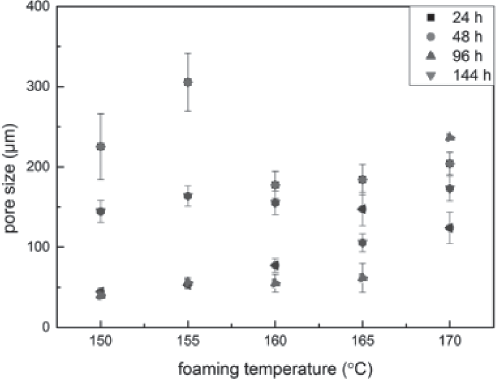
Pore sizes of recycled PLA with a cellular structure
The paper presents the differences in the formation of the cellular structure in PLA and recycled PLA resulting from the batch process. The foaming process was preceded by thermal studies, where it was shown that recycled material has a higher degree of crystallinity (30%) as compared to pure material (2%). Recycled PLA has a lower viscosity value and a lower melt strength. However, SEM images showed that the foaming structure of recycled PLA does not differ significantly from original material, the only difference was regarding the melting temperature of polylactide. Recycled PLA can be foaming under similar conditions as the original material. Small pores in the range of 40–150 μm at the saturation time of 48–96 hours were obtained. Reduction in density of up to 50% was achieved in the cellular structure of recycled PLA, as compared to unfoamed polymer.