




Abstract
In this article, poly (lactic acid) (PLA) was foamed via batch foaming using supercritical nitrogen as a physical blowing agent by two methods, conventional foaming process (CFP) and low-temperature foaming process (LTFP). The fabrication processes, cell morphologies, thermal properties, crystallization behavior, and electrical resistance of resulted foams were studied to investigate the effect of foaming on these properties of PLA. It was found that the foams resulted from CFP method have micrometric cell sizes, while LTFP method led to nanometric cell structure and high cell density. Also scanning electron microscopy showed that the PLA foams have a heterogeneous cellular structure. The results showed that the foaming process increased the melting point and degree of crystallinity of PLA, which led to decrease in the electrical resistance of samples.
Introduction
Poly (lactic acid) (PLA), which is a biodegradable thermoplastic aliphatic polyester, has been recognized as the most commonly used biomaterial due to its outstanding attributes such as processability, biocompatibility, high strength, and modulus. The excellent biocompatibility of PLA has made it suitable for medical applications such as drug delivery systems, sutures, and blood vessels. However, in practice, PLA needs to be modified to improve some of its properties such as low melt strength, stiffness, crystallization ability, and heat deflection temperature. 1,2
Polyesters have found their use as antistatic and electroconductive materials. An increase in electric conductance of polyesters has been obtained to provide an effective dissipation of electrostatic charges and reduce electrostatic discharges. 3 PLA is an inherent electrical insulator material, which limits its utilization in electronic parts and electronic packing and containers. The static charge easily could build upon such insulator parts by contact, so that the electrical insulator materials could produce an electrostatic discharge that may interfere with circuit operation and damage the sensitive semiconductor devices. To solve the problem of electrostatic discharge and conductivity enhancement, a way is foaming of PLA. 4,5
It has been widely found that the foaming process could improve the PLA properties in recent years. It is also resulted that using the environmentally friendly physical blowing agent such as supercritical carbon dioxide and supercritical nitrogen (SC-N2) could lead to microcellular foams and using them is preferred in comparison to the traditional chemical foaming agents. 1,4 Many researchers have reported that foaming PLA using CO2 leads to an increase in the degree of crystallinity which is attributed to the effect of CO2 plasticization and a bidirectional extension in the cell walls caused by the cell growth. 6 -8 CO2 is extensively used as a blowing agent for foaming the PLA.
There exists very little research on using the nitrogen (N2) as a blowing agent in the batch foaming process due to its low solubility in polymers in comparison to CO2. On the other hand, there are some advantages of using N2 instead of CO2. First, using N2 generally results in finer cells due to its high diffusivity and greater nucleation rate. Second, the cell density per weight percentage of the blowing agent is higher for N2. Third, the specific volume of N2 is higher than that of CO2, which, in turn, results in a higher expansion ratio per weight percentage of the blowing agent. 9,10 In this work, the foaming of PLA using N2 as a blowing agent was done and the influence of foaming on the crystallinity, thermal, and electrical properties of PLA were discussed.
Experimental
Materials
PLA (4032D) with 2%
Preparation of foams via batch foaming
PLA samples were placed in a high-pressure vessel. At first, the vessel was flushed with low-pressure N2 and then pressurized to 9 MPa. The samples were saturated under this condition for 5 h to ensure the equilibrium adsorption of N2 to the polymer. The high-pressure vessel was instantaneously depressurized to atmospheric pressure to induce the cell nucleation and growth. At the end of the experiment, the specimens were removed from the vessel and transferred to a water bath. In this study, two saturation temperatures were used in the foaming process. In the conventional foaming process (CFP), the saturation temperature (T s) of 160°C was used, which is near to the melting temperature of PLA, while in the low-temperature foaming process (LTFP), the T s of 130°C was chosen.
Characterizations
Scanning electron microscopy
Morphology of the samples was examined using a scanning electron microscope (SEM) (AIS-2100, Seron Technology, Korea) with an accelerating voltage of 20 kV. SEM specimens were taken from the cross section of the samples which were fractured in liquid nitrogen and then gold-coated prior to observation.
Differential scanning calorimetry
To investigate the thermal properties of samples, a differential scanning calorimetry (DSC) instrument (Mettler Toledo, Switzerland) was used, and the tests were carried out under N2 atmosphere using the heating and cooling rates of 10°C min−1. All samples were first heated to 200°C and kept in this temperature for 5 min to eliminate their thermal history and then were cooled to 25°C and subsequently scanned to 200°C.
Electrochemical impedance spectroscopy
The electrical resistance of the samples was measured using an electrochemical impedance spectroscopy (EIS) instrument (Auto Lab PGSTAT 302 N) in frequencies of 1, 10, and 100 Hz in the alternative current (AC) mode. The dimension of the samples was 1 cm (length) × 1 cm (width) × 1 mm (thickness).
Results and discussion
Morphology of the PLA foams
After dissolving the gas in the PLA, the foams were produced by rapid depressurization. Subsequently, due to the thermodynamic instability that was created, the cell nucleation and growth were observed. Basically, the foaming process includes three stages: cell nucleation, cell growth, and cell stabilization. 11,12 The CFP process led to the formation of microcells with an average cell size of nearly 200 µm (Figure 1), while the LTFP process resulted the formation of nanocells with a mean cell size of almost 200 nm (Figure 2). In the LTFP method, due to the presence of crystals, N2 could not enter the crystalline sections and only the amorphous regions were foamed. The presence of crystalline regions led to an increase in the cell nucleations and higher cell density, but it prevented the more expansion of cells and cell growth. This resulted in the production of nanocells with a very high cell density around the crystalline areas. This phenomenon is consistent with the results of Geng et al. 2 in the preparation of PLA foams using CO2. They reported that the arrangement of these nanopores was like the formation of spherulites. They reported that during LTFP, it was difficult for CO2 to dissolve into the crystal regions so that the most of CO2 was absorbed by the amorphous regions which could foamed. Spindle-like nanopores were formed and arranged from the center of spherulites to their borders because of the restriction of crystal plates.
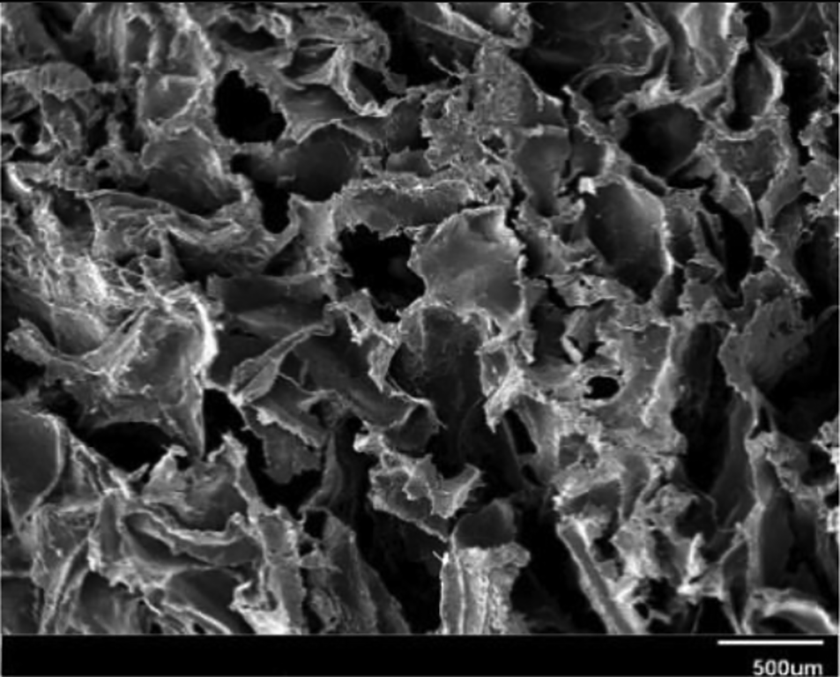
SEM micrograph of PLA for CFP with the scale bar of 500 µm.

SEM micrograph of PLA for LTFP with the scale bar of (a) 300 µm, (b) 50 µm, and (c) 5 µm.
As can be seen in SEM graphs of CFP and LTFP (Figures 1 and 2), the cells are broken and no complete cell structure is formed. So the PLA foams exhibit ununiform and inhomogeneous cellular structures. Li et al. 13 observed that the cell walls of neat PLA were ruptured, and its cellular structure was incomplete, which could be due to the low melt strength of this polymer. So the strength of cell walls was insufficient to support their growth, resulting in cell mergence and rupture. They also professed that it was difficult to measure the cell size and cell density of PLA foams. Chen et al. 14 reported that the foaming of linear PLA did not lead to a relatively complete cellular morphology, because of its poor melt elasticity. Chain extension is extensively used to improve the melt strength and elasticity of linear polymers by generation of branching. As has been reported by Ma et al., 15 here, the generation of heterogeneous cellular structures in PLA foams is mainly ascribed to the coexistence of heterogeneous cell nucleation induced by the crystal structures and homogeneous cell nucleation in amorphous region during the foaming process results in generation of both large and small cells.
The existed crystalline regions not only depress the solubility of gas in the polymer matrix but also dramatically affect the cell nucleation and growth. In the cell nucleation step, the interface between the crystal lamellar and the amorphous domains is a high-energy region resulting from the surface effects. In these regions, the necessary Gibbs free energy for nucleating a stable cell is less than that for homogeneous nucleation, resulting in the preferential nucleation of cells at the interface. While in the cell growth step, because of less mobility of molecule chains in crystalline regions, the formed cells are constrained by the neighboring lamellar. 12,16 Promotion on the cell nucleation and constraint on the cell growth will both reduce the cell size and prohibit the formation of the interconnected structure. 12
According to the report of Garanchera and Fernyhough, 7 the cellular structure of foams was also affected by the PLA grade employed. In particular, using the low D-content grades of PLA with relatively high crystallinity led to a unique perforated surface morphology and a higher open-cell content.
The mean cell diameters (D) were analyzed through using the image analysis software (Image-Pro 10) and the following equation 12 :

where d i is the single-cell diameter and n i is the number of cells.
The cell density (N) of the foamed samples was estimated using the following equation 17 :

where n is the number of cells in the micrograph, M is the magnification factor of SEM micrographs, and A is the area of the micrograph.
The density after foaming, ρ f, was measured using a specific gravity bottle by the water displacement method in accordance with ASTM D792-00 18 and measured by the following equation 16 :

where w 0 is the weight of the foamed sample, w 1 is the weight of the specific gravity bottle filled with water, w 2 is the weight of the specific gravity bottle containing both water and sample, and ρ w is the density of water which is 1 g cm−3.
The expansion ratio (R v) of the foamed samples was calculated by the following equation 12 :

where ρ u is the density of PLA before foaming which is 1.24 g cm−3 in this study, and ρ f is the density after foaming.
The porosity of the samples was measured by the following equation 19 :

Table 1 presents the properties of PLA foams prepared by the CFP and LTFP methods. Figure 3 also shows the SEM micrograph of PLA for the CFP without a fast stabilization and cooling step. This sample was gradually cooled in the autoclave after the foaming. It is observed that the low cooling rate prevents the cellular structure stabilization and leads to the collapse of the cells and running the gas away. According to the report of Shirvan et al., 20 the effect of stabilization on the foam morphology is dependent on the foaming temperature.
Properties of PLA foams.
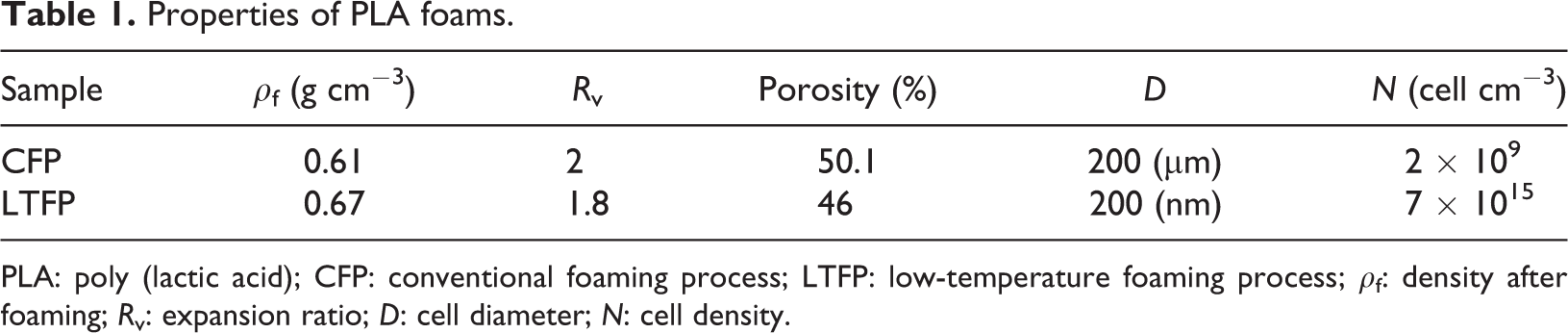
PLA: poly (lactic acid); CFP: conventional foaming process; LTFP: low-temperature foaming process; ρ f: density after foaming; R v: expansion ratio; D: cell diameter; N: cell density.

SEM micrograph of PLA for CFP without fast stabilization, with the scale bar of (a) 1 mm and (b) 300 µm.
It is known that the foaming behavior of a polymer (i.e. cell nucleation and growth) is generally governed by the following thermodynamic properties: solubility, diffusivity, and surface tension. All of these heavily depend on the PVT properties of the polymer/gas mixtures. 11 In general, in the batch foaming of PLA, the operational conditions of the process, including the temperature and pressure in the saturation and foaming steps, 16 as well as the time in the saturation and foaming, 21 the cooling rate in the stabilization stage, 20 the elongational viscosity and melt strength, 8 the PLA grade, 7 the crystallization, 12,22 and also the blowing agent and its concentration, 15 are effected on the cellular structures and morphologies. Ideal morphologies can be achieved by controlling and optimizing these factors. In this study, the high crystallinity made it difficult to control the cell structure. The PLA crystallization has different effects on the foaming process. On the one hand, increasing the crystalline sites leads to the cell nucleation and increasing the cell density. This also improves the melt strength and prevents the cell coalescence and cell collapse during the cell growth. On the other hand, the increase in the thickness of the crystals leads to decreasing the solubility and diffusivity of blowing agent into the polymeric matrix and prevents the expansion of cells. 11,12,22
Thermal properties
DSC curves of the second heating cycle of PLA before and after foaming are shown in Figure 4 and the statistical results are summarized in Table 2. As can be seen, the following phenomenon is observed in the PLA foam thermogram, in comparison to unfoamed sample:
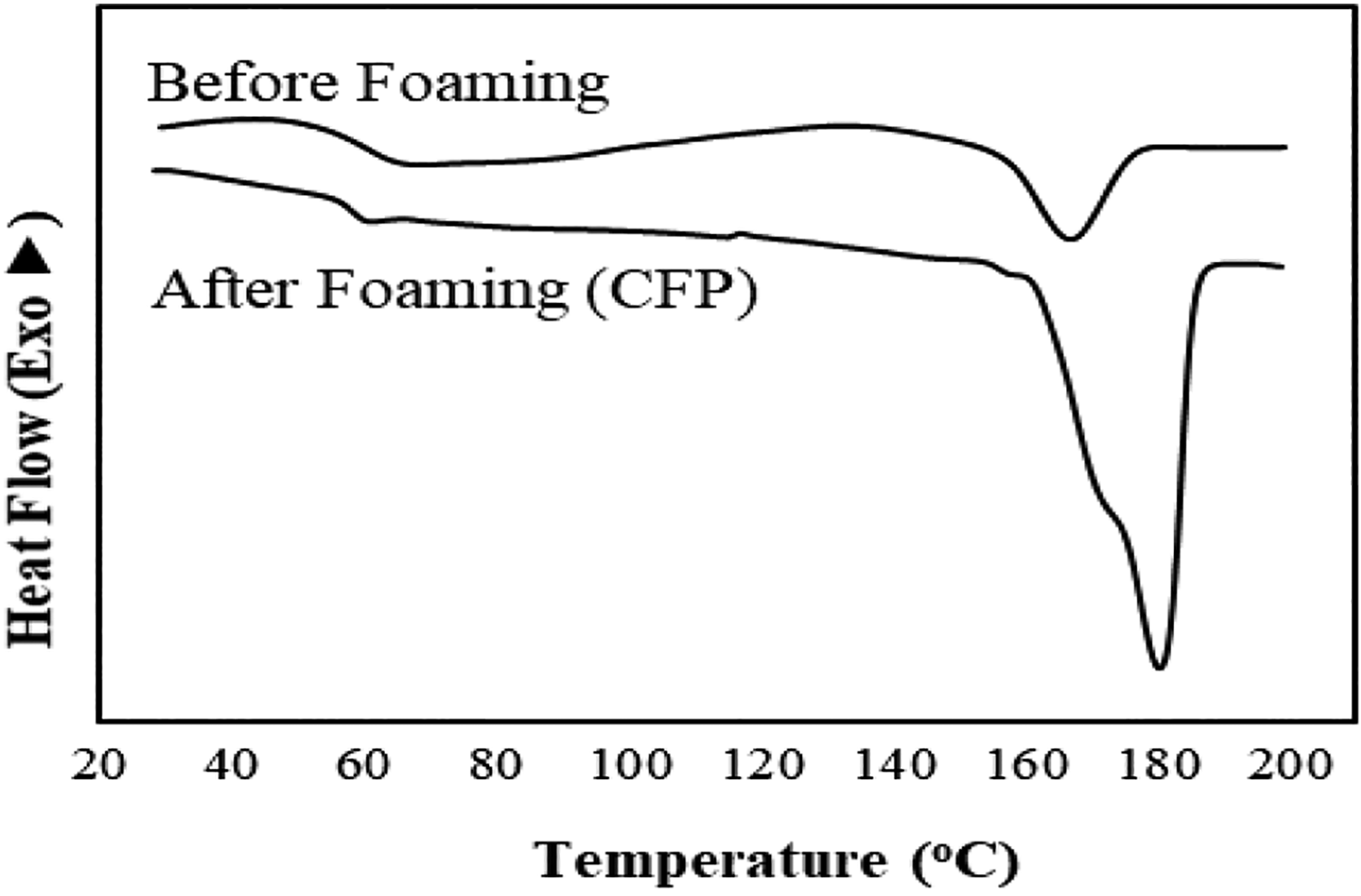
DSC thermograms of PLA, before and after foaming.
Thermal properties of PLA, before and after foaming.
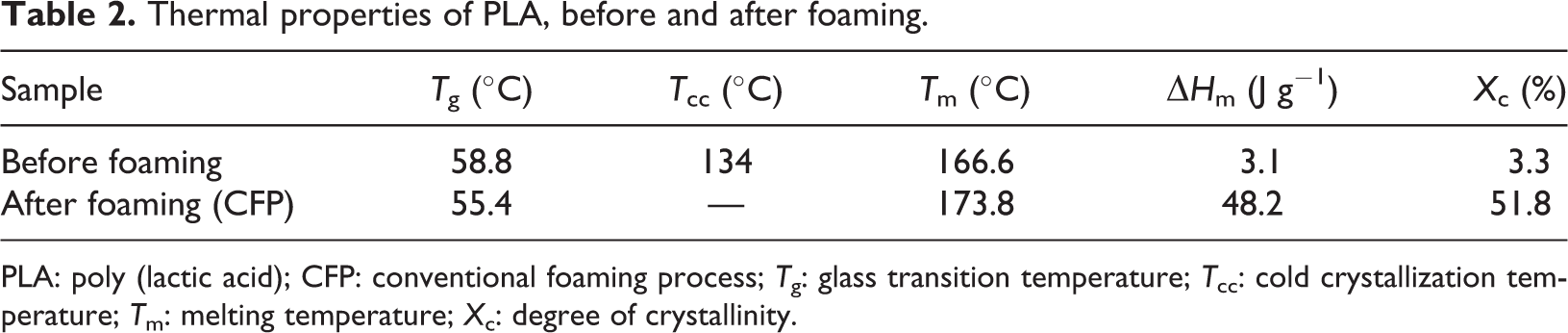
PLA: poly (lactic acid); CFP: conventional foaming process; T g: glass transition temperature; T cc: cold crystallization temperature; T m: melting temperature; X c: degree of crystallinity.
Decrease in the glass transition temperature (T
g). Absence of the cold crystallization temperature (T
cc). Increase in the melting temperature (T
m). Appearance of two melting peaks. Significant increase in the degree of crystallinity (X
c).
The N2 plasticization effect led to decrease in T g, increase in the chain mobility, and the degree of crystallinity of PLA. The disappearance of T cc peak, which is seen in PLA foam, has also been reported by Yu et al. 23 and Zhai et al., 21 in PLA foams prepared using CO2. On the other hand, in neat PLA and its composites, when two melting peaks are observed in the DSC thermograms, the lower melting peak is assumed as a real melting point and another one is ascribed to the melting of the crystallites formed or thickened during DSC scanning. 24 In this study, the unfoamed PLA sample did not show the two melting temperatures, but the existence of two melting peaks in the foamed PLA sample could be due to the formation of cellular structure. It seems that the cell walls are elongated during the cell growth and this process accelerates the crystallization of PLA. As a result, some imperfect crystals are formed that recrystallize after melting and these imperfect crystals had enough time to melt and reorder and form more crystals which melted at higher temperatures. The appearance of two melting peaks in PLA foams produced using CO2 has been reported by He et al. 4 and Liu et al. 25 too.
As previously reported, during the crystal nucleation stage, the existence of perfect crystals depends on thermal motion, whereas imperfect crystals are dependent on tensile stress. Therefore, the phenomenon of the double melting peaks is dependent on the tensile stress derived from the cell growth and the dissolved gas. The imperfect crystals have poor thermal stability. Therefore, the low-temperature peak corresponded to the melting of imperfect crystals, and the higher temperature peak corresponded to the melting of perfect crystals. 26 Small and imperfect crystals change into more stable, more closely packed, and more perfect crystalline structures, which is called crystal perfection, and a higher melting peak appears as a consequence. The double peak of semicrystalline polymers is extensively developed in bead foaming as it contributes to improve moldability and maintain the foam morphology. Additionally, the perfected crystals could act as heterogeneous cell nucleators. 27 Experiments have shown that pressurized CO2 and biaxial stretching can both significantly increase the PLA crystallization rate. It remains difficult to separate the effects of foam expansion and cell growth from those of the dissolved gas. 11,22,28
As a result, after foaming of PLA, a 15.6-fold increase in crystallinity was observed in comparison to unfoamed PLA. The degree of crystallinity (X c) of samples was determined using the following equation:

where ΔH
m is the melting enthalpy and
Electrical resistance
The results of EIS in frequencies of 1, 10, and 100 Hz using the AC mode are presented in Table 3. As can be seen, the electrical resistances of PLA samples are reduced after the foaming process. It should be noticed that the decrease in the electrical resistance of samples at lower frequencies is higher, so that the amount of electrical resistance of the foamed samples compared to the virgin PLA shows approximately 7 times decrease at the frequency of 1 Hz, and about 2.4 times decrease at the frequency of 10 Hz, while the electrical resistance remains almost constant at the frequency of 100 Hz.
Electrical resistance of PLA, before and after foaming.
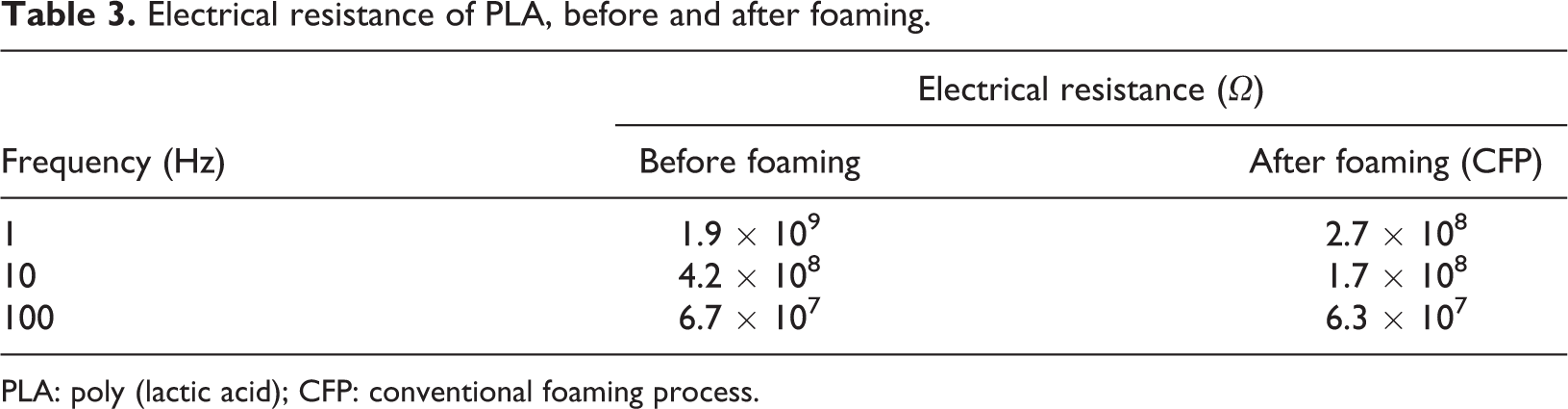
PLA: poly (lactic acid); CFP: conventional foaming process.
Ikezaki et al. 30 revealed that the conduction mechanism in polypropylene is ion hopping. They found that the activation energies for conduction depend both on the crystallinity through the ionic jump distance and on the electric field. These researchers discovered that the ionic jump distance decreases as the crystallinity increases. Electronic conduction occurs at temperatures to T g and ionic conductance at temperatures above T g. 3 As previously reported, the efficiency of electron transfer in an insulating polymer, such as PLA, is dependent on the orientation of the polymer chains, particularly with respect to the direction of applied electric field. Ordered packing of crystalline regions will facilitate the transfer of electrons more favorably than disordered amorphous regions. 31 The ordered packing in the crystalline regions produces a high degree of local chain orientation, which likely results in higher conductivity. The dense packing may also reduce the energy required for interchain charge transport and also contributing to a conductivity increase. 32
To improve electrical conductivity in polymers, a method is compounding polymers with electric conductive fillers. Wu et al. 5 observed that the PLA containing carbon black exhibited a higher electrical conductivity after foaming by CO2 in comparison to the nonfoamed sample. They mentioned that the increasing conductivity in foamed samples is due to the increased network density and enhancement of the filler electric conduction pathways as a result of the formation of cellular structure. He et al. 4 studied the effects of carbon nanotubes on PLA foams and reported that the electrical conductivity of foams was increased by increasing the amounts of nanoparticles. They also mentioned that in PLA/CNT foams produced using CO2, the electrical conductivity is affected by two opposite factors. In one hand, the foaming process decreases the electrical resistance which is due to the reduction of volume content of CNT. On the other hand, the higher crystallinity formed during the foaming process leads to the increase in the electrical conductivity because of the CNT structural change in which the CNT was less curled and more connected.
In our study, the influence of higher crystallinity in foam samples was dominated and the electrical resistances of PLA samples were decreased after the foaming possibly because of the presence of packed crystals and their role in the transmission of electric charges. It has been reported that AC conductivity at low frequency is equal or very close to the direct current conductivity. 33
Conclusions
In the present work, PLA was foamed via batch foaming using SC-N2 as a blowing agent. Two methods of one-step, CFP and LTFP, were used, and the resulted foam morphologies were compared. It was found that using the CFP led to the microcellular structure, while the LTFP resulted in the nanocellular foams. It was found that the distribution of the cells was inhomogenous. The thermal and electrical properties of foams were studied too. The DSC experiments showed that the foaming process improved the degree of crystallinity of PLA. The EIS results detected that the electrical resistance of the samples was decreased after foaming, which could be due to the improvement of crystallinity of PLA during the foaming process. It was found that the foaming of PLA led to 15.6 times increase in the degree of crystallinity and 7 times decrease in the electrical resistance of PLA at the frequency of 1 Hz. Finally, it was shown that the higher decrease in the electrical resistance was achieved using the lower frequencies.
Footnotes
Declaration of conflicting interests
The author(s) declared no potential conflicts of interest with respect to the research, authorship, and/or publication of this article.
Funding
The author(s) received no financial support for the research, authorship, and/or publication of this article.
