



Abstract
This article analyzes articulations among urban enclaves, finance capital, and glass architecture by exploring MGM’s corporate investments in the Las Vegas CityCenter development and the Chinese enclave of Macau. CityCenter is an unsuccessful $9 billion master-planned urban community financed by MGM and Dubai World. Macau is a former Portuguese colony and Special Administrative Region of the People’s Republic of China which has, since its return to the PRC in 1999, replaced Las Vegas as the world’s most lucrative site of casino gaming revenue. Taken together, CityCenter and Macau are illustrative of the political economy and cultural logics of financialization. Foreign investment from Las Vegas entrepreneurs has vitrified Macau, transforming it into a phantasmagoria of glass resorts. Macau in turn plays a crucial functional role in capitalism’s recomposition in East Asia, similar to the autochthonous role of the Italian city-states of Venice and Genoa in the historical origins of capitalism. In order to ‘read’ the cities of Las Vegas and Macau, I explore intertextual legibilities among fictitious capital that relies on glass fiber-optic technology to enable grand architectural projects; expressionist fictional representations of glass architecture and its utopian transformative potential; and glass buildings that themselves dissimulate in a manner not unlike fiction.
It is difficult to exaggerate the relationship between fiction and architecture. (Stuart, 2011)
Despite apocalyptic overtones, the ray was not a product of the ravages of climate change but a direct outcome of a different nexus of nature, culture, and economics: Mojave Desert sunlight refracted off the sleek, curved, glass surface of the new Vdara Hotel-Condominium on the Strip. Due to a design flaw the glass wall of the hotel inadvertently directs the sun above the urban oasis onto the pool area in a condensed, magnified, and potent beam of light, increasing the poolside temperature by 20 degrees at the height of the midday sun. The beam melts plastic drinking cups and scorches guests, moving slowly across the deck expanse as the earth rotates to complete the effect that the hotel management dismisses as a ‘solar convergence phenomenon’.
The Vdara Hotel, designed by Uruguayan ‘starchitect’ Rafael Vinoly, is part of Las Vegas’ dazzling new CityCenter complex. CityCenter is a remarkably ambitious $8.7 billion development, jointly financed by Las Vegas-based MGM Resorts International and Dubai World, the investment company of the emirate (Berzon, 2010; see Figure 1). Construction of the five-year project was completed in 2011. Conceived as a self-contained residential, gambling, and shopping enclave on the Strip, complete with iconic buildings designed by celebrity architects, ‘pocket parks’ and notable public artworks, CityCenter is reportedly the most expensive privately-funded construction project ever built in the USA, and perhaps one of the most audacious attempts in world history to conceive and construct an encapsulated urban neighborhood. It is also arguably a resounding failure. The property’s soft opening in 2009 coincided with the global economic crisis, and no doubt the immense amount of debt incurred in construction of the glass towers of CityCenter contributed in some small way to the crunch. The development’s subsequent underperformance is illustrative of both the political economy and cultural logics of financialization.
The Las Vegas CityCenter development. The angular structure at the forefront is Crystals Shopping Mall, designed by Daniel Liebeskind. Behind Crystals from the left is the Mandarin Oriental Hotel, designed by Kohn Pederson Fox, and the leaning Veer Towers, designed by Helmut Jahn. Just visible on the right edge of the frame is the Norman Foster-designed Harmon Hotel. Behind that hotel and not visible in the photo is the Vdara Hotel. Photo by author.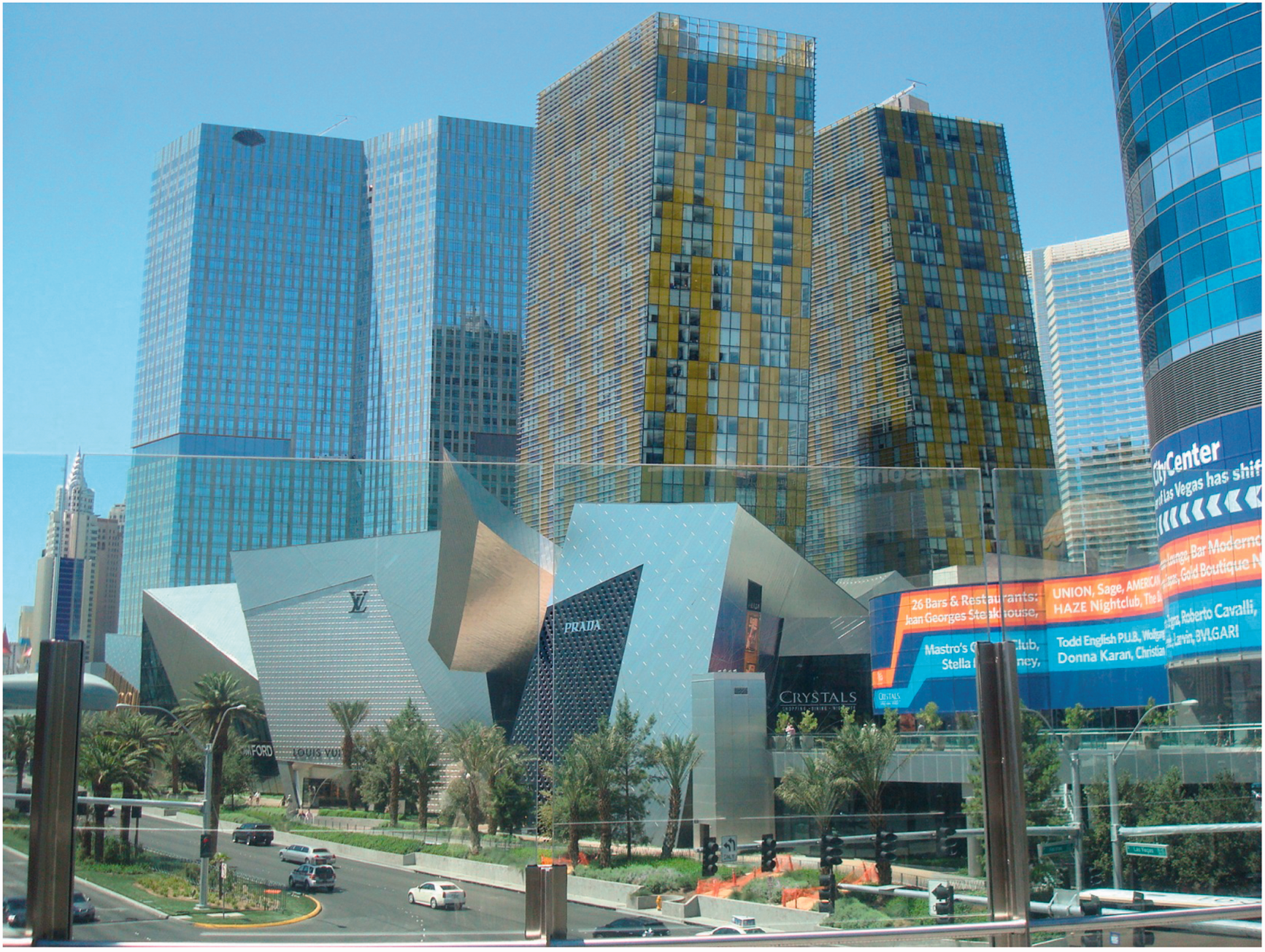
‘Financialization must be understood as a profoundly spatial phenomenon, holding out as it does the promise of a financial, spatial-temporal fix for the crisis tendencies of capitalism’ (French et al., 2011: 814). Both the urban enclave of CityCenter and glass architecture of the Vdara Hotel may be understood as spatial expressions of financialization. While Manuel Castells (2000: 434) claims that the 21st-century mega-city is the ‘new spatial form’ of the global financial economy and information society, I suggest that the enclosed enclave in its many guises, from special economic zones to gated communities, is the locus of capital containment for our age (Easterling, 2005, 2007; Jameson, 1990). Indeed, these claims are not incompatible. For Castells, the defining feature of the mega-city is its discontinuous and disjunctive social geography, the ‘distinctive feature of being globally connected and locally disconnected’ (2000: p. 436); I argue that the enclave is such a ‘locally disconnected’ site. The enclave is a scalar surrogate for both the nation-state that organized and regulated the Fordist economy and the modernist city that was the locus of industrial production and collective consumption. Both the perils and the promise of the contemporary city emanate from such locales. CityCenter’s lackluster performance is indicative of Las Vegas’ downturn in the wake of the global financial crisis, but also of the current vivication of the gaming industry in the Chinese enclave of Macau and the recomposition of capitalism itself in East Asia. As a Special Administrative Region (SAR) of the PRC located within the Pearl River Delta mega-city, Macau is a ‘globally connected and locally disconnected’ locale whose phantasmagoric glass cityscape is now the world’s most lucrative site of casino gaming revenue.
In this article I analyze MGM’s glass projects in Las Vegas and Macau in order to explore the formal relations among financialization, enclave urbanism, and glass architecture, and the importance of each to the contemporary economy of derivative speculation that itself increasingly resembles a global casino. Taken together, CityCenter and Macau are revealing of the state of the city, as well as the importance of the city to the state – indeed, of the city-state – in the current composition of global capitalism. The enclave may be understood as a commodified and derivative urban form. Much like a derivative financial instrument, the enclave’s value is derived from a potent speculative package of assets, indices, and underliers, to form what Keller Easterling (2005: 1) calls a ‘spatial product’ or ‘real estate cocktail’. Like a mortgage-backed security, the disposition of this mixture can be volatile. When the speculation is wrong, as was the case with CityCenter, the scale of lost revenues may be so significant that it has reverberations for the global economy: the entire edifice may eventually implode under the weight of failed financial expectations. However, when the wager pays off like it has in the quasi-state of Macau – with its unique regime of legal exceptionalism and strategic management of cross-border flows of people and capital – the result is an occult explosion of liquid profits.
Glass Architecture as Material Component and Aesthetic Feature of Financialization
Finance capital seeks reproduction in enclaves – Special Administrative Regions, corporate cities, quasi-states, and various other zones of encapsulated urbanity or juridical exception – yet financialization takes its tangible form in glass architecture like the Vdara Hotel. The Vdara Hotel’s façade is not merely application of an architectural aesthetic technique but can be understood as a ‘formal overtone’ (Jameson, 1998: 44) of the finance capitalism used to construct the hotel and the larger project. While the relationship among glass and financialization may not be immediately apparent, I will argue that glass is as important to contemporary post-Fordist capitalism as was the railroad or copper wire to earlier stages. Fiber-optic cables facilitate financialization as instantaneous capital movements rely on transcontinental telecommunications networks, what Stephen Graham (1999) has called ‘global grids of glass’. These cables conjoin glass and light to circulate the digitized information of the network society that appears on our computer screens and mobile devices, forming the ‘space of flows’ (Castells, 2000), the architecture of contemporary social life that is as ubiquitous as it is invisible. Fiber optics are not only a key component of flexible forms of accumulation but enable flexible specialization, flexible time, ‘Toyotist’ supply chain management, locational strategies of production, and essentially all other factors of the post-Fordist economy. As I will discuss later, the glass curtain wall shares homologies with the terminal screen, and the reflective surfaces of post-industrial cities appear increasingly like mediated space (McQuire, 2008). The networked economy is an economy of glass.
However, glass is not only an integral material component of fiber-optic communications, it also embodies the sleek, seductive aesthetic of financialization. In their analysis of contemporary corporate advertising, Goldman and Papson (2011) analyze the discursive Landscapes of Capital that are conjured in these mediated representations of the financial economy. They find ‘the representational equivalent of hyperreal capital’ (p. 51) in images and evocations of speed, flexibility, and technological integration in the advertisements produced by companies like Wachovia, Enron, Cisco, and Merrill Lynch, which are (or were) key players in the financial economy. In these discursive evocations and mediations of capital, economic life enabled by digital telecommunications and deregulation appears smooth, frictionless, and transparent, much like the surface of the glass curtain wall of the Vdara Hotel. ‘The dream of Capital is a friction-free network in which information and commodities flow at unlimited rates’ (Goldman and Papson, 2011: 20). Understood in this way, glass architecture – particularly in relation to the ‘beams of light’ that in corporate advertisements become ‘the most common signifier of the flow of ideas’ (p. 33) – embodies both functional and representational features of financialization.
In short, the immaterial economy of post-Fordism seeks a spatial fix in the enclave, while the dematerialized capital of fiber optics enabled financialization finds its form in glass architecture. French et al. (2011) ‘argue that work on financialization has been insufficiently attentive to: the role of space and place; the geography of money and finance; and earlier work in the Marxist and international political-economy tradition that effectively focused on the problem of financialization before the neologism was coined and mobilized.’ I will bring these very factors – social space, financial geography, political economy – together to explore the form and function of glass architecture in Las Vegas and Macau. I will first trace the importance of glass to historical formations of capitalism and the critical and utopian responses it has provoked from Walter Benjamin, Paul Scheerbart, and Fredric Jameson. Then I will analyze the ‘fictitious capital’ of financialization and its materialization in the glass resorts of Las Vegas and Macau. I hope to address both the functional and representational dimensions of glass architecture. In order to ‘read’ the contemporary cities of Las Vegas and Macau, I seek intertextual legibilities among fictitious capital that enables grand architectural projects in city centers around the world; expressionist fictional representations of glass architecture and its utopian transformative potential; and actual glass buildings that themselves dissimulate in a manner not unlike fiction. I proceed through a series of inter-referential vignettes and parables, ranging from cultural history to political economy to literary criticism to architectural theory to journalistic reportage that, taken together, I hope will illuminate the complex articulations among urban enclaves, glass buildings, and fictitious capital. ‘It is difficult’, I agree, ‘to exaggerate the relationship between fiction and architecture.’
Glass, Glass Architecture, Capital, Capitalism
The new glass resorts of Las Vegas and Macau have a vitreous lineage. The modern glass industry was established principally in the city-state of Venice in the 13th to 16th centuries; the industry developed alongside the historical development of capitalism, and glass itself became a key component of accumulation. The specific role or function of glass has varied in different stages of capitalist development, serving as a commodity itself in Italy to producer of the commodity fetish in France; and from utopian crystalline technology in the expressionist pre-war dreams of Weimar Germany, to the depoliticized architectural form of the International Style.
Venice and Paris
Glass was an early commodity that Venice produced for trade. Fine glassware was an element of European civility and refinement during the Renaissance, one material manner in which people could display new types of distinction enabled by the new wealth generated by capitalism (McCray, 1998). Glassmaking was one of the oldest industries in France as well, though until the 17th century French glass production was generally of a common variety that could not compare with the work of the Venetian artisans. In 1687, however, French glassmaker Bernard Perrot developed an innovative technique of plate glass production that involved casting the glass rather than blowing it, and Paris ultimately became the site of the most pervasive developments in glass architecture (Scoville, 1941, 1942; Fierro, 2003: 9; Richards, 2008).
Notwithstanding the lethal luminosity of Las Vegas, Paris was the original ‘city of light’, center of not only philosophical enlightenment but of fashion, art, and culture; urban planning, banking, and finance; cafes, department stores, and arcades. Glass was crucial to this constellation. Constructed in the early 19th century, the arcades were a triumph of iron and glass architecture, arching over passages between buildings to create interior consumer spaces that were precursors to the department store, shopping mall, and hotel atrium (see Missac, 1995). 1 When Walter Benjamin visited the arcades in the 1920s, they appeared to him like the ur-form or natural history of capitalist modernity, a repository of the utopian dreams of a previous epoch.
Expressionism and Weimar Germany
In the imagination of fin de siècle German expressionist writer Paul Scheerbart as well as his intellectual contemporaries who formed the Crystal Chain, glass had a didactic transformative potential. Scheerbart was fascinated by glass architecture, writing a book on the subject as well as a number of playful utopian stories in which it featured (Scheerbart, 1972, 2001, 2010). Scheerbart saw in glass construction and ornamentation a key to architectural change that he thought would enable wholesale cultural evolution. From Scheerbart’s perspective the largely brick building materials of industrial capitalism led to necessarily ‘closed rooms’ that reflected closed minds and closed relationships (Bletter, 1975, 1981); growth would only be possible to the extent that glass construction opened environments to the elements. ‘Glass opens up a new age’, he suggested prophetically, while ‘Brick building does only harm.’ Thus, the advantage of glass architecture over brick was not simply technical or economic, but moral.
Scheerbart’s best known work is probably Glass Architecture. It is easy to misread this peculiar book, comprised of 111 aphorisms, transparently as a kind of ‘how to’ guide of practical and technical recommendations to integrate glass features into homes, botanical gardens, and public spaces. ‘As air is one of the worst conductors of heat’, he writes, ‘the double glass wall is an essential condition for all glass architecture’ (Scheerbart, 1972: 42). Or: ‘it is clearly advisable to build glass houses only in the temperate zones’ (p. 42). When designing the Vdara Hotel, Rafael Vinoly probably should have paid heed to Scheerbart’s admonition: ‘An occasional mirror-wall close to a pool is worth considering. But not too many’ (p. 42).
Viewed from a more opaque angle, however, and in the context of Scheerbart’s interest in the alchemical properties of crystal (Bletter, 1981) and his experiments with perpetual motion (Scheerbart, 2011), Glass Architecture is no design primer. It is nothing less than a fantastical account of an errant glass addition to a veranda that spontaneously crystallizes and expands across the garden and beyond, eventually growing into a glass cityscape that ultimately covers the entire earth’s surface. Whoever has provided his veranda with colour-ornamented glass on three sides will soon want to have more glass architecture. One thing leads to another, and to stop the process is unthinkable. So the veranda continues to grow; in the end it emancipates itself from the main building, and may become the main building itself. To promote this evolution of the veranda will be the chief task of every glass architect. (Scheerbart, 1972: 44)
Scheerbart and fellow visionaries like his architect friend Bruno Taut imagined this alchemical potential of glass architecture and its crystalline properties; they conceived of glass structures that would transform people who passed through them in the same manner that crystal transforms light. ‘Coloured glass/destroys hatred’, penned Scheerbart, words that were etched on Taut’s Glass Pavilion, a structure built for display at the Cologne Werkbund Exhibition of 1914. The multi-colored glass structure and kaleidoscopic interior lights of the pineapple-shaped pavilion were designed to create an immersive crystalline effect that would serve to uplift the spirit and moral countenance of visitors.
The Transparent Rationalism of the International Style
While Taut’s glass house did not survive the exhibition, his forays into glass design influenced his contemporaries. In the early 20th century, refined glass and steel materials became key components of the architectural movement known as the International Style whose proponents eschewed ornamental facades to emphasize the ‘honest expression of structure’ and the truthful display of the function of materials in the construction of buildings. Glass served to highlight ideals of transparency and verity of architectural design, and such buildings came to define the cities of industrial capitalism.
Glass architecture of the International Style was not simply a container for 20th-century capitalist enterprise, it played a functional role in technological and financial innovation. Reinhold Martin (2003) demonstrates that with the technological and economic changes of the post-war military-industrial complex, a modular and flexible corporate architecture emerged in the United States that enabled the subjection of a new type of technocratic organization man steeped in the dual guises of profit-driven innovation and corporate ‘human relations’. Martin’s account of this ‘organizational complex’ reads like a dystopian application of the transformative possibilities that fascinated Scheerbart and Taut. 2 Architects like Eero Saarinen and the firm of Skidmore, Owens & Merrill covered the corporate offices of such companies as IBM, General Motors, and Bell Telephone – the latter whose labs were the site of important developments in glass fiber-optic technology – with increasingly thin glass curtain walls creating an ‘affect [that] approached the glare of the photographic plate or of the television screen’ (Martin, 2003: 10). The aim was not simply pre-fabricated modular flexibility but crafting an organizational identity befitting a mass consumer culture. 3 The glass surfaces of the buildings reproduced and replicated the more generalized social experience of media distraction. According to Martin, ‘like network television – its historical contemporary – the architecture of the curtain wall is a medium to be watched in passing rather than looked at like an artwork’ (p. 6).
Glass as a ‘Formal Overtone’ of Finance Capital
To understand their relation to capital, the glass resorts of CityCenter and Macau must be situated within the preceding historical context, but their function becomes evident only when examined from a contemporary vantage point. The Vdara Hotel death ray enabled by the glass façade calls to mind Jameson’s (1998) evocative comments about the architecture of late capitalism, structures which are characterized by the immateriality of the glass curtain wall. If Scheerbart saw the transition from brick to glass materials as indicative of moral progress, Jameson investigates the underlying economic logic. Searching for the series of mediations ‘which leads from finance capital through land speculation to aesthetics and cultural production itself’, Jameson finds in the ‘enclosed skin volumes’ of post-modern glass architecture a ‘formal overtone’ of finance capitalism. From this perspective, the glass skin of a building like the Vdara Hotel ‘dematerializes without signifying in any way spirituality’ (Jameson, 1998: 44) in the same manner in which the finance economy creates an abstracted and dematerialized form of capital. This contemporary glass architecture is homologous with both the fiber-optic materials that enable financialization as well as the frictionless form of its discursive representation. In the case of the Vdara Hotel, the errant ray of light refracted off the building’s surface into a ‘death ray’ mimics the play of glass and light in a fiber-optic cable. It is architecture appropriate for a post-Fordist economic regime.
For Marx, fictitious capital was simply credit, capital that was assumed to come from the earnings of future production. Today, fictitious capital presumes profits will accrue without production (see Comaroff and Comaroff, 2000), and may be derived simply by commodifying the credit risk itself in endless aleatory cycles. This is the utopian fantasy of fiber-optic enabled financial capital – ‘that it can surmount its own crisis tendencies and overcome its own limits by generating value through its own pure circulation’ (Goldman and Papson, 2011: 21). This contemporary incarnation of alchemy displaces Scheerbart’s and Taut’s belief in crystal power to the 21st century: both faiths rely on the enabling function of glass. Political commitment to deregulation of financial markets in the 1980s similarly converged with new technical innovations in glass – in this case fiber-optic information technologies – and emerging utopian assumptions about the planetary connectivity of telecommunications (Castells, 2000; Taylor, 2004). With the rapid expansion of the financial economy, exponential salary increases for finance executives lured young mathematicians and physicists away from once-coveted cold-war corporate research jobs in the military-industrial complex and to the finance industry where they now engineer increasingly complex trading algorithms and derivative instruments that colonize fiber-optic networks to monetize the future; the end result is the ‘financialization of everything’ (Harvey, 2007: 33). This hermetic feature of financialization enhanced by incessant neoliberal evangelization has made the global financial system today appear like ‘nothing as much as a vast casino’ (Strange, 1986: 1).
Therefore, if the political economy of 19th-century industrial production required the solid foundations of brick construction that Scheerbart thought created closed cultures, and the modular glass-curtain corporate architecture of IBM and Bell Laboratories communicated flexibility and integration for the cybernetic capitalism of the cold war (Martin, 2003), then the ‘materialist sublimation’ (Jameson, 1998: 44) of the financial economy is best rendered in curving glass walls like those of the Vdara Hotel. It is architecture appropriate for an era in which accumulation seems to have been decoupled from production and financial profits are derived from the opaque perambulations of finance itself. But more than that, it is architecture that is directly produced by financialization and which makes the built environment in its own image: fragile, brittle ‘global grids of glass’.
The mediation of contemporary glass architecture I am proposing is distinct from Jameson’s famous description of the Bonaventure Hotel, where ‘the glass skin achieves a peculiar and placeless disassociation of the Bonventura from its neighborhood’ (1998: 82) and the interior constitutes a delirious and depthless hyperspace which locates the subject experientially in an otherwise ungraspable global economic system. Rather, in a manner homologous with the commodified urban enclave, I am proposing new glass architecture as an intimation of derivative and securitized property. One thing that distinguishes the contemporary phase of finance capital from earlier phases is its reliance on the securitization of mortgages and other forms of real estate, ‘a profound institutional transformation in which the real estate sector has come to resemble an economic sector composed of finance markets and instruments rather than a sector defined by producer markets’ (Gotham, 2009: 357). According to Kevin Fox Gotham (2009), the desire to overcome the time lag between constructing the built environment and realizing accumulation from subsequent production or rent, and to quickly convert capital fixed in the built environment into profit, has led to this wave of real estate securitization that aims to transform ‘opaque and illiquid assets into liquid and transparent securities’: adjustable rate mortgages, mortgage-backed securities, real estate investment trusts, and so on (Gotham, 2009: 357). This breathless impatience for immediate returns from what was formerly treated as a long-term investment in real estate is enabled by the time-space compression that results from fiber-optic technologies and the space of flows. ‘Time is critical to the profit-making of the whole system. It is the speed of the transaction, sometimes automatically preprogrammed in the computer to make quasi-instantaneous decisions, that generates the gain – or the loss’, contends Castells (2000: 466). Furthermore, a significant and growing number of financial transactions are based on making value out of the capture of future time in present transactions, as in the futures, options, and other derivative capital markets. Together these new financial products dramatically increase the mass of nominal capital vis-à-vis bank deposits and assets, so that everybody bets on and with future money anticipated in computer projections. (2000: 466)
The Violence of Finance Capital
If the design of the Vdara Hotel may be understood as a formal representation of an economy dominated by the logic of financialization which dematerializes capital itself and transforms the built environment into a precarious security, then the manner in which the Vdara Hotel’s glass façade fashions sunlight into a lethal ray is an apt metaphor for the very real ‘violence of financial capitalism’. For Christian Marazzi (2010), this violence results from the post-Fordist ‘attempt, in certain ways “parasitic” and “desperate,” to recuperate on the financial markets that which capital could no longer get in the real economy’ (p. 27); this recuperation has ‘devastating effects on employment, wages, and retirement’, writes Marazzi. That is, not only on the bare, unprotected skin of prostrate vacationing attorneys lounging beneath the desert sun, but ‘on the bare life of entire populations’ (p. 10). Glass architecture plays a formal role in this process. Crystallization of both communication networks and glass architecture across global cityscapes mirrors the spread of the derivative fictitious capital of neoliberal financialization. Once unleashed by deregulation in the 1980s global economy steered by Paul Volker, Ronald Reagan, and Margaret Thatcher, financialization has crept beyond insurance actuarial tables into retirement pension funds, junk bonds, currency trading algorithms, securitized mortgages, credit default swaps, collateralized debt obligations, and all manner of derivative instruments and opportunistic rent-seeking regulatory efforts to gamble against the future ‘on the bare life of entire populations’. ‘One thing leads to another’, as Scheerbart says, ‘and to stop the process is unthinkable.’
Las Vegas, Dubai, and the CityCenter
The profits accumulated from the bare life of consumer-citizens, the glass curtain walls that feature in iconic architecture of the Global Style, the violence of dematerialized forms of capital produced by a post-Fordist economic regime – these subjects and spaces converge in the CityCenter of Las Vegas today. CityCenter occupies 67 acres of land on the Las Vegas Strip and comprises 18 million square feet of indoor space. Aside from the Vdara Hotel, the complex has another hotel-condominium, Mandarin Oriental, as well as two 400-room boutique hotels, Aria and Harmon, and a dual-towered condominium construction called the Veer Towers. At the base of the buildings sits Crystals (a name that would have delighted Sheerbart), a 500,000 square-foot luxury shopping mall designed by Daniel Libeskind, the renowned architect behind the Jewish Museum in Berlin and the post-9/11 World Trade Center reconstruction.
The gleaming towers of CityCenter were designed by a who’s who of celebrity architects and architectural firms, including not only Vinoly but Norman Foster, Cesar Pelli, Helmut Jahn, Kohn Pederson Fox, and Gensler, which oversaw the master plan. CityCenter features $40 million of public artworks by Robert Rauschenberg, Claus Oldenberg, Frank Stella and Henry Moore, and pieces commissioned especially for the site by Jenny Holzer, Nancy Rubins, and Maya Lin (Friess, 2009). When Dubai World announced its $2.96 billion purchase of 50 percent of the CityCenter project equity in 2007, the Chairman of the company, His Excellency Sultan Ahmed Bin Sulayem, called it ‘one of the most exciting private sector developments in modern history. CityCenter is the most ambitious real estate project ever undertaken in Las Vegas’, he claimed, ‘and rivals any similar project around the world. Its global significance cannot be underestimated’ (MGM Mirage, 2009).
The decision to build iconic glass towers rather than themed simulations more typical of the resorts on the Strip was not motivated merely by evolving architectural tastes. It was, rather, an attempt to fashion what Castells calls a ‘node’ for accumulation. According to Castells (2000), ‘the nodes of the space of flows include residential and leisure-oriented spaces which, along with the location of headquarters and their ancillary services, tend to cluster dominant functions in carefully segregated spaces, with easy access to cosmopolitan complexes of arts, culture, and entertainment’ (2000: 446–7). MGM Mirage CEO Jim Murren, who conceived of the original plan, described the project as ‘a very ambitious master-planned community’ (quoted in Freiss, 2009) ostensibly constructed for the elites of the information society. ‘They’ve heard of Rafael Vinoly and Cesar Pelli and Norman Foster and Daniel Libeskind, and they’ve stayed at the Mandarin’, he said. ‘They are the multibillionaires, the centimillionaires, some of the wealthiest people in the world, people who are doing business in Abu Dhabi, Cairo, Mumbai’ (Freiss, 2009).
The CityCenter project was plagued by problems long before the death ray. The complex was conceived at the height of Las Vegas visitor arrivals and a booming economy and real estate sector in the city, but over the five year construction process the original $5 billion project ballooned to nearly $9 billion while the severe world economic downturn led to falling rates of tourism and consumption that was particularly detrimental to Las Vegas resort revenues. MGM Mirage flirted with bankruptcy and in 2009 Dubai World sued their partner for mismanagement of the project’s construction, though it eventually dropped the suit and the Sultan of Dubai attended the opening celebration (Benston, 2009). By the time the initial phase of CityCenter was ready to open to the public, Las Vegas suffered the worst housing market in the nation. 5 Dubai World no doubt came to regret its role in the project. By the date of the December 2009 opening of the first phase of CityCenter, Dubai’s economy was in freefall as the Emirate had announced just a month before the inability to meet repayment obligations on nearly $25 billion of loans (Sharif and Hall, 2011). The sultan who had masterminded the territory’s equity purchase of half of the CityCenter venture amassed a staggering $40 billion debt for Dubai World. Within a year he was removed from his post as chairman of the company, proving prescient his own 1997 prediction about CityCenter: ‘Its global significance cannot be underestimated.’ A host of development projects in Dubai either sit partially completed or never got past the drawing board as economic woes have severely tempered the aspirations of Dubai’s sovereign to create his own Ville-Lumiere, complete with rows of glittering glass towers along Sheik Zayad Road and around the Dubai Marina, and brought many of the Emirate’s ambitious projects to a standstill.
If it is correct that finance is a spatial phenomenon, then ‘In order to understand processes of financialization and their complex geographies … it is vital to follow the networks of contemporary financialized capitalism wherever they may lead’ (French et al., 2011: 809). We will see in this case that these networks lead from CityCenter to not only the city-states of Dubai and Macau, but ultimately to sovereign states as far afield as Pyongyang, Beijing, Reykjavik, and Washington, DC.
The Reincarnation of Las Vegas in Macau and Capitalism in East Asia
Crucial to the neoliberal experiment launched in the West by Reagan and Thatcher was Deng Xiaopeng’s transformation of China’s socialist economy (see Harvey, 2007). In 1978 Deng took the first steps in his project to establish a market economy with his Southern Tour to the Special Economic Zone (SEZ) of Shenzhen. According to Deng’s strategy, both Shenzhen and the Zhuhai SEZ, respectively located adjacent to the colonies of Hong Kong and Macau, as well as a string of other SEZs along the south China coast, would function collectively as laboratories of production where the PRC would allow Western companies to establish enterprises in order to study techniques of capitalist production, manufacturing, management, and private property (Chuihua et al., 2001).
This process eventually formed what is for Castells (2000: 436) the prototypical network society mega-city, the ‘Hong Kong-Shenzhen-Canton-Pearl River Delta-Macau-Zhuhai metropolitan regional system’. Deng’s experiment has succeeded beyond anyone’s expectations, and we will see that Macau plays a crucial role in enabling the circulation of capital through this system. Today rural China is urbanizing on a vast scale. China is pursuing urbanism itself as an accumulation strategy (Wu, 2009) and using macroeconomic policy to encourage domestic consumption, resulting in a wholesale transformation of not only the landscape but of the Chinese subject. This transformation is evidenced by the sight of eager Chinese tourists queuing outside of Louis Vuitton, Hermes, and Chanel shops in Macau and Hong Kong. The future of Chinese consumption will depend on these members of the emerging middle class who increasingly visit Macau on tourist visas enabled by new central government policies.
Capitalism’s ongoing recomposition in the market-socialist regime of the PRC involves merging the post-Fordist and post-socialist economies in interstitial sites like Macau and the SEZs and transforming those over-accumulated Chinese workers into consumers; perhaps they will, in turn, help address the over-accumulations of capital in the West. Scheerbart and Benjamin might have pointed to the transformative potential of glass architecture in such a project. If the SEZs were laboratories of production, the city-state of Macau SAR could be understood as a laboratory of post-socialist consumption, a site where the central government of the PRC tests policies to stimulate tourism while Chinese subjects hone habits conducive to consumerism (Simpson, 2009, 2011). The enclave subsumes the functions heretofore managed by the state which often capitalizes off enclaves in the sort of tribute system that has existed in East Asia for several millennia. Such sites are central to capitalist expansion in the region today. Specifically, to use Castell’s (2000: 443) terminology, Macau is both a ‘hub’ and a ‘node’ in the mega-city region. As an interstitial tourist city, paradoxically both inside and outside the PRC, and visited by 28 million people in 2012, it is a communication hub. As the only site of legal casino gambling in the PRC, as well as a destination for select Chinese nationals from relatively affluent cities and provinces to whom the central government grants special travel visas to visit the SARs, Macau’s juridical exceptionalism makes it a strategic node for the circulation of capital and the pedagogy of capitalist enterprise. Macau’s potent ‘spatial cocktail’ includes investment in the built environment from transnational actors; porous borders combined with an interstitial identity; graduated management of mainland Chinese tourist arrivals; and a peculiar gaming regulatory regime that was forged during Portugal’s weak colonial administration.
Macau’s Transformation into a Glass City-State
The first and last European colony in Asia, Macau was returned by Portugal to the PRC in 1999 after nearly half a millennium of Portuguese rule. Gambling has been legal in Macau since 1847, and the modern casino industry dates back 70 years, during which time it has operated as a monopoly concession granted by the local Portuguese administration in exchange for a percentage of the profits. Hong Kong billionaire Stanley Ho controlled that monopoly from 1962 to 2002. When the PRC regained control of Macau, the government dissolved the monopoly and liberalized Macau’s gaming industry, ultimately allowing six companies to operate as concessionaires. Through this process MGM Resorts International, as well as Las Vegas entrepreneurs Steve Wynn and Sheldon Adelson, entered the Macau casino market.
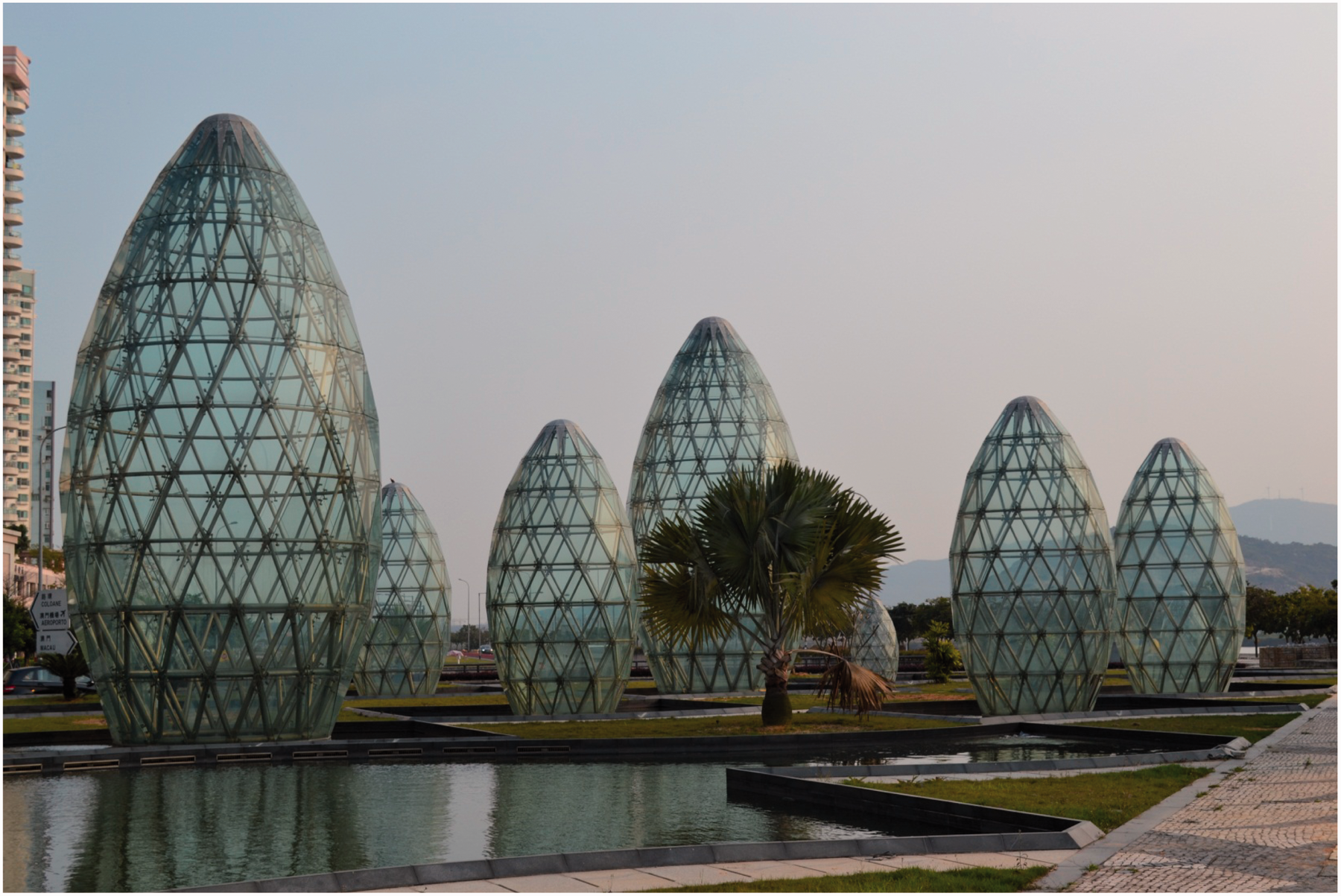
Over the past decade the post-colonial cityscape of Macau, characterized by a combination of quaint pastel-colored Portuguese churches and municipal buildings built in the 17th to 19th centuries, has been transformed into a postmodern phantasmagoria. Scheerbart’s prediction of the inevitable expansion of glass architecture across the globe seems prescient, and indeed financialization has crystallized the territory. Today Macau’s cityscape sparkles with all manner of glass and crystalline amusements which might serve as ‘formal overtones’ of fictitious capital. The dome-shaped base of Ho’s flagship Grand Lisboa Casino, which opened in 2007, is comprised of the world’s largest integrated LED screen, featuring colorful displays of animated roulette wheels and rolling dice (see Figure 2). The mediated screen surface of the building that resembles Taut’s glass pavilion conjoins glass architecture, crystalline ornamentation, fiber optics, and images of gambling in a perfect mimetic representation of financialization. Displayed in the lobby of the casino is the world’s largest cushion diamond, the 218 carat Star of Stanley Ho, bought by its namesake for $100 million. Macau’s Sands Casino, built by rival Adelson and covered in golden glass, features the world’s largest crystal chandelier. Wynn’s eponymous resort as well as his Encore property are covered in a tasteful brown glass curtain wall, and the MGM Macau, Grand Waldo, Star World, Altira, Galaxy, and City of Dreams properties have remade Macau into a glass state. Even strange glass sculptures have begun to appear around the city (see Figures 3 & 4). This glass architecture stands alongside themed resorts like Adelson’s $2.4 billion Venetian Macau; the largest building in Asia, the simulated Venice is a self-contained enclave within the enclave of Macau.
‘The prism is marvelous/That is why the glass house is so great’ (Paul Scheerbart). Macau’s Grand Lisboa Casino; the exterior of the dome-shaped base features the world’s largest integrated LED screen. The world’s largest cushion diamond is displayed in the lobby of the casino inside. Photo by author. ‘Happiness without glass/How crass!’ (Paul Scheerbart). As financialization vitrifies Macau, strange glass sculptures emerge in the city. Photo by author.
Themed environments and glass architecture function in a pedagogical project to transform the socialist proletariat of the People’s Republic into capitalist consumers. Three parables about MGM’s glass resorts and fictitious capital in the casino economy of Macau will demonstrate the articulations of each with global finance.
Capital Fictions in Macau
MGM’s Role in Iceland’s Financial Economy
If MGM made a serious misstep with CityCenter, the company’s decision to seek a concession in Macau has proved enormously successful. The MGM property in Macau is jointly-owned by MGM Grand and Pansy Ho Chiu-king, one of Stanley Ho’s 17 children (by four wives). The company obtained its Macau gaming license by purchasing a sub-concession of Stanley Ho’s own license for $200 million, and subsequently opened the MGM Grand Macau, an undulating 35-storey building featuring a tri-colored glass façade. The hotel and casino are connected to One Central Macau, a residential and retail property developed by Stanley Ho’s company Shun Tak, for which Pansy Ho is managing director. The property includes three apartment buildings, a Mandarin Oriental Hotel, and a luxury shopping mall. The towers were designed by Kohn Pederson Fox, the architectural firm that designed the Mandarin Oriental property at CityCenter. 6
MGM’s One Central Macau became a footnote to the global financial crisis in October 2006 when Iceland’s financial services and insurance company Sjova-Almennar Tryggingar HF purchased one entire tower in the as-yet-not-completed project from Shun Tak for $101 million. The Nordic company was a global trendsetter for the edgy, high-risk investments that came to typify the speculative bubble that preceded the crash in 2008. Within two years Iceland’s economy would be in tatters; deregulated less than a decade earlier, its three banks faced a massive collective collapse which was to prove in real terms the worst national banking disaster in global history, and the country teetered on the edge of bankruptcy. For their part, the people of Iceland felt the full violence of financial capitalism as the value of the krona was in free fall, inflation soared, and the economy plunged into a deep recession. The assets of Iceland’s pension funds fell by up to 25 percent, and individual retirements were plundered to service the debt. The prime minister of Iceland who oversaw the collapse faced criminal charges for malfeasance.
‘Glass makes everything light/So use it on the site’ (Paul Sheerbart). The photo documents the emergent glass cityscape of Macau. On the left is the Wynn Hotel; the L’Arc and Wynn Encore buildings are visible directly behind it (present but not visible is the Star World). In the middle of the frame is the MGM Macau, and to the right is One Central Macau, including the Mandarin Oriental Hotel and three apartment towers; one tower block was purchased by Iceland’s largest insurance company in an ill-fated investment. Each of the buildings in the photo sits on reclaimed land which lay fallow as recently as 2003. Photo by author.
Finance and Organized Crime in Macau’s Gaming Industry
In this context of ethical iniquity the seemingly disorganized capitalism (Lash and Urry, 1987) that propelled the financial crisis might be understood from another vantage point as a form of organized crime, a sophisticated instrument of derivative larceny. Predatory lending practices fueled the sub-prime mortgage crisis in the United States, eventually resulting in hundreds of millions of dollars in fines levied on guilty mortgage companies (see Gotham, 2009: 364). The rampant and often illegal foreclosing on properties in the wake of the crisis is an act of accumulation by dispossession on a scale so massive it was described by a Florida Supreme Court Justice as ‘the largest seizure of private property ever attempted by banks and government entities’ (quoted in Harvey, 2012: 54). Ironically, during the financial crisis the spoils of drug trafficking was the only source of liquidity accessible to some banks, and they did not shy away from these ill-gotten gains (Saviano, 2012). Wachovia admitted its role in laundering Mexican drug war profits, while HSBC handled transactions by not only drug traffickers but Al Qaeda affiliates and Iranian financiers trying to avoid US sanctions; the eventual fines on the two banks totaled more than one billion dollars. The abuses were systemic and systematic. ‘ABN Amro, Barclays, Credit Suisse, Lloyds and ING have reached expensive settlements with regulators after admitting to executing the transactions of clients in disreputable countries like Cuba, Iran, Libya, Myanmar and Sudan’ (Saviano, 2012: 20).
Macau is no exception. In order to hold a casino license in a jurisdiction in the United States operators must be clear of criminal connections in any jurisdiction in which they operate, and the Macau business practices of both Adelson and Wynn are currently under investigation by authorities in the United States. In May 2009 the New Jersey Division of Gaming Enforcement released the results of an investigative report that claimed that Stanley Ho had ties to Chinese criminal concerns. Since Ho is a business associate of his daughter Pansy, herself in partnership with MGM, this allegation threatened the gaming license of MGM’s Borgata Casino in Atlantic City. Given Atlantic City’s poor economy and the pecuniary potential of Macau, MGM made a relatively simple decision to divest its stake in New Jersey and throw the company’s full weight behind the China venture, regardless of the concerns raised about the business practices of the Ho family. When MGM Macau went public on the Hong Kong stock market in May 2011 and Pansy Ho sold a portion of her 50 percent share of the partnership with MGM, the return on her original $5 million investment was $1.5 billion. The deal made her the youngest billionaire in Hong Kong, as well as the city’s wealthiest woman (Gough, 2011; see Figure 5).
‘Colored glass/Destroys hatred’ (Paul Scheerbart). The MGM Macau is a joint partnership of MGM Las Vegas and local businesswoman Pansy Ho, currently the youngest billionaire in Hong Kong thanks to her investment in the property.
New Jersey’s allegations about Ho’s underworld ties were not news to industry insiders. In fact, Ho has long-term business interests with Chinese triads in operating the VIP gambling concerns in his Macau casinos. The triads act essentially as institutional loan sharks, fronting gambling money to high-stakes players from mainland China who cannot otherwise easily move cash across the tightly-regulated borders of the PRC (Siu, 2007). Wealthy individuals from China who want to risk millions of dollars in Macau’s casinos need access to cash loans in the territory on the agreement that they will repay gambling losses to the granter of the loan once they return to the mainland. However, this is complicated by the fact that gambling debts are not legally enforceable on the mainland; therefore anyone who makes loans in Macau must be confident of their ability to coerce re-payment through extra-judicial means. Chinese triads have thus played an instrumental role in Macau casinos since at least the 1980s, and an innovative vernacular ‘rolling chips’ operation funds huge gambling stakes in Macau’s casinos (Leong, 2002).
In 2006 Macau’s casino revenues were the largest in the world, and by 2010 Macau gaming revenues were quadruple the combined casino revenues of the entire state of Nevada. Seventy percent of that revenue came from high-stakes baccarat. The local government tax of nearly 40 percent on gaming revenue generated $15 billion for government coffers in 2012, making the administration complicit in the system based on collusion between an oligarchy of state-sanctioned concessionaires and organized crime. Cash handouts to residents in Macau’s wealth-sharing scheme inaugurated in 2008 take on the appearance of hush money, making the local population complicit. In 2013 each resident received payments of MOP 8000 ($1000). However, it is difficult to escape regular reminders that these profits are derived off the bare life of populations. A [Hong Kong] man took a HK$10,700 government grant meant for the burial of his maternal grandmother and gambled it away in Macau, leaving the woman’s body to languish in a morgue for a year until police and the Social Welfare Department buried her. (Man, 2010)
Fictitious Capital from the DPRK
Ho has alleged ties not only to independent Chinese criminal brotherhoods, but also to North Korea, which the United States claims is a state-run crime syndicate. Ho has operated a casino in a hotel in Pyongyang since 1995 (Lintner, 2007). The older half-brother of North Korean leader Kim Jong-un resides in Macau and often gambles in the city’s casinos. But it is the relationship between the DPRK and another Macau concern that provides an additional nuance to the movements of fictitious capital.
In September 2005 the US State Department used the Patriot Act to designate Macau’s family-owned Banco Delta Asia as a ‘primary money laundering concern’, with allegations that the bank was facilitating North Korea’s criminal actions. The US Treasury Department intoned: ‘Banco Delta Asia has been a willing pawn for the North Korean government to engage in corrupt financial activities through Macau, a region that needs significant improvement in its money laundering controls’ (Gaylord, 2008: 297). The move prompted a run on the bank that resulted in panicked depositors withdrawing $133 million before the Macau Monetary Authority put the bank in receivership. The accusations against North Korea involved allegations of drug trafficking and circulating counterfeit US cigarettes, pharmaceuticals, and currency. The counterfeit currency in question is $100 ‘supernotes’, the holy grail of faux money which can only be manufactured with presses and paper identical to those used by the US Mint. For this reason, there is skepticism about North Korea’s ability to manufacture supernotes. Many participants in a 2006 Interpol conference dedicated to the supernotes concluded that the US government itself must be the source of the counterfeit notes; suspicion lingers that the CIA prints the currency in a facility near Washington, DC in order to fund covert operations outside the oversight of Congress (Gaylord, 2008: 295).
The disturbing possibility that Macau’s glass casino resorts could be laundering counterfeit dollars printed by the CIA and fronted by the Chinese mafia to post-socialist gamblers from the PRC, all the while running afoul of the State Department’s own prosecution of the Patriot Act, provides a new chapter to Marx’s story of fictitious capital. ‘As capital investment sometimes ceases to have a necessarily immediate relationship with material production’, write Goldman and Papson (2011), ‘it becomes an end in itself, chasing its tail through the circuitry of financial instruments where the referent is no longer necessarily the world of infrastructure, labor, production, or commodities, but rather a bond, or a security, or a securitized debt package’ (p. 52). Or in this case, the referent is simply money itself. In the ruse of the counterfeit, even hard currency becomes another type of derivative, its value derived from the money form which it emulates. This game of three-card Monte is reminiscent of Enron’s ‘special purpose vehicles’, the shell companies it created to purchase assets from itself so the revenue could appear on the company’s books while the debt remained hidden (Goldman and Papson, 2011: 57). Enron’s ultimate fortunes may foreshadow this fraudulent financial fable’s denouement.
Global Grids of Glass
I have tried to take seriously the claim that financialization is a spatial phenomenon and analyzed how finance capital is fixed for purposes of accumulation in contemporary enclave spaces which feature glass architecture. Indeed, as I have noted, technologies of glass production were crucial to the historical development of capitalism, from the goblets of the city-state of Venice, to the arcades and display windows of 19th-century Paris and Weimar Germany (Lungstrum, 1999), to the sleek surfaces of the North American corporate buildings that served the post-war cybernetic economy. Glass material has merged with technological innovations to create mediated cityscapes. The networked space of flows on which financialization depends today is enabled by the coupling of glass and light in fiber-optic technology which circulates fictitious and hyperreal forms of capital in what increasingly appears to be a global casino. I have suggested that glass architecture in enclave gaming developments in Las Vegas and Macau is a product of the financial economy which creates these structures in its own image: smooth, transparent, frictionless, fragile, and fictitious. To comprehend the relationship of glass architecture to fictitious capital and consumer subjection we must explore not only the technical features of the buildings themselves but imaginative accounts of the transformative qualities of glass. Alchemical phantasms of crystallization animate the deistic convictions of central bank economists who deregulate financial flows and securities traders who colonize fiber-optic networks to engineer the economy of dematerialized capital. These glass constructions reproduce both the technological function and aesthetic form of financialization.
Influenced by Scheerbart and in the wake of the techno-human brutality of the Second World War, Benjamin (1999) opined that the glass and steel of the International Style had the value of being traceless: ‘they have created rooms where it is hard to leave traces’ (p. 734). Benjamin thought that those who lived through the war would benefit from this detachment from the past, that glass architecture would constitute a generational tabula rasa. ‘Objects made of glass have no “aura”’, he said. ‘Glass is an enemy of secrets. It is also an enemy of possession’ (p. 734). 7 But today, in a typically Benjaminian dialectical reversal, both fiber-optics technology itself and fiber-optics-enabled financialization have ironically transformed glass into a material which accumulates both possessions and secrecy, converting illiquid architectural assets into liquid capital. Glass reproduces capitalism’s endemic violence in the very guise of traceless transparency and the utopian immediacy of universal communications.
The Derivative Cityscape and the Implosion of Value
This returns us, then, to CityCenter, the enclave neighborhood development on the Las Vegas Strip. ‘Utopian space is an imaginary enclave within real social space’, suggests Jameson (2005: 15). For Jameson, in a move that echoes Benjamin’s analysis of the Parisian arcades, the enclave is ‘something like a foreign body within the social’ that may potentially ‘offer a space in which new wish images of the social can be elaborated and experimented on’ (p. 16). 8 Perhaps CityCenter, not to mention the city-state of Macau, operates in this manner, a dialectial image counterposing the utopian dreams of the collective against the neoliberal delusions of fictitious and hyperreal capital. Built on billions of dollars of debt, CityCenter is not only an effort to erect a planned urban community; it also inadvertently embodies the deflationary direction of the derivative-driven global economy, where capital is fixed in space to create self-contained islands of accumulation, and dematerialized financialization finds its physical form in glass architecture.
Next to the Vdara Hotel in CityCenter sits the Norman Foster-designed Harmon Hotel. Foster is the epitome of the starchitect and his buildings define the contemporary Global Style (Foster, 2011). He is responsible for notable glass designs the world over, ranging from futuristic airports in Hong Kong and Beijing, Zayad National Museum in the United Arab Emirates, the UAE Pavilion at the Shanghai Expo, and even another City Center in Washington, DC. But the Harmon Hotel has not fared so well and its failures belie the empty promise of fictitious capital today. Originally designed to have 49 floors, structural problems in the foundation led to the decision in 2009 to eliminate nearly half of the building, rendering a completed edifice of only 26 storeys. However, subsequent problems halted the project prior to completion, and it now sits empty on the Strip. The completed external structure of the building stands intact but the interior has not been finished and it remains unoccupied. 9 Subsequent evaluation led an engineering firm to declare the Harmon unsafe due to its inability to withstand an earthquake, which assessors charged would collapse the tower in what would be yet another perfect storm of nature, culture, and economics (Garcia, 2011). Citing the danger posed by the Harmon tower, MGM Mirage is seeking to implode the building, and is currently engaged in a lawsuit with the construction company; that company claims that the building can be repaired and alleges that MGM Mirage is proffering a fiction in order to cut its financial losses (Glass, 2011; Green, 2011).
The glass façade of the Harmon Hotel today exists only as the world’s most expensive billboard, publicizing the Elvis Review show playing next door– and thus constituting an unhappy convergence of the dual guises of hyperreal capital: advertising and glass architecture. By combining an enticing lambent surface with an empty structure, the Harmon Hotel vitrifies the very fetish quality – not of the Fordist commodity which so fascinated Benjamin, but of the commodified and derivative risk that underpins the post-Fordist financial economy. Effectively a subprime asset located in a volatile spatial derivative, the Harmon Hotel building stands patiently waiting to be imploded, eventually no doubt contributing one more spectacle to the nighttime reveries of the city’s tourists, and one more means of extracting some form of value from the violence of finance capital, the destruction of the city and of the dreams that reside there. ‘With the upheaval of the market economy’, lamented Benjamin (1968: 88), in words even more poignant in an era of finance capital today that takes its form in glass structures, ‘we begin to recognize the monuments of the bourgeoisie as ruins even before they have crumbled’.
Footnotes
Acknowledgements
The original draft of this article was written when the author was a Visiting Senior Research Fellow at the Asia Research Institute (ARI), National University of Singapore. As such, the paper benefitted significantly from the intellectual community at ARI and particularly from conversations with Chua Beng Huat, Tim Bunnell, Michael Feener, and Ola Soderstrom (although they might not realize it). The author is grateful to ARI for this support, and to the editors at TCS for helpful feedback. The paper was presented to a plenary session of the 2012 Lisbon Summer School for the Study of Culture.
Notes
References
Supplementary Material
Please find the following supplemental material available below.
For Open Access articles published under a Creative Commons License, all supplemental material carries the same license as the article it is associated with.
For non-Open Access articles published, all supplemental material carries a non-exclusive license, and permission requests for re-use of supplemental material or any part of supplemental material shall be sent directly to the copyright owner as specified in the copyright notice associated with the article.
