



Abstract
This article, which introduces the special section on The Urban Problematic, takes as its starting point the ways in which categories associated with the ‘urban’ have broken down, such that the once singular and coherent concept ‘city’ has disintegrated in certain ways: the notion has been demythologized, so that representations of the city must now be regarded as partial and invested; and cities themselves have become opaque and unpredictable both to urban scholars and to governments, planners and various kinds of welfare organizations. The indications of crisis, captured for instance by concerns about the slums, favelas and shanty towns of the world’s megacities, also indicate that much of what counts in modern urban life is in some way connected with the marginal, the unofficial, and the supplemental. The article takes a supplemental view of the current state of urban dwelling. This involves at the same time a longer, more patient, historical view in its attempt to understand the current state of the city as part of a shift in the play of heterogeneous forces. With reference to the articles contained in The Urban Problematic, this introductory article finally draws attention to some of the urgent and critical issues of contemporary urbanism.
The Urban Problematic
Moreover, every substance is like a complete world and like a mirror of God or of the whole universe, which each one expresses in its own way, somewhat like the same city is variously represented depending upon the different positions from which it is viewed. (Leibniz, 1991: 9)
With a projected 70 per cent of the world population shortly to be living in some kind of urban settlement, the status of the city has never been more questionable. A condition provoking the often-haphazard concerns of architects, governments, international welfare organizations and urban planners and, concurrently, the topic of ever expanding fields of cross-disciplinary study in the humanities and social sciences, the city represents the hazardous threshold of crisis, the vulnerable cradle of humanity’s future. If on one hand it is a problem of representation, then on the other it is a matter of economic and social survival.
Following writers like Michel Foucault (1986), Henri Lefebvre (1991) and Edward Soja (1989), significant theoretical work in the last decades of the 20th century has cumulatively thrown into doubt the sense that the ‘city’ might present any kind of distinct or legible category. 1 By the turn of the millennium it was clear that the concept city could no longer fulfil conditions of clarity or coherence. In their collection on urban space and representation, Balshaw and Kennedy note that, ‘the city, as a universal object or category of analysis, has been demythologised and positioned as a site of spatial formations produced across diverse discursive regimes and everyday practices’ (Balshaw and Kennedy, 2000: 1). Consequently, they acknowledge, ‘all representations of cities are partial and provisional – short-sighted, interested, parts (impossibly) standing for wholes’ (Balshaw and Kennedy, 2000: 19). These kinds of observation, however, have at best an indirect impact on the work of international missions like the United Nations Human Settlements Program (UN-HABITAT), whose project, especially over the last seven years of world urban forums, has been to educate city management towards ‘a holistic approach to urban development and human settlements’, which includes forms of legislation and planning that reduce risk and that involve the upgrading of slum-style dwellings.
The recent history of the concept of space, if taken seriously, would render the aims of this project far more problematic than it appears from the UN-HABITAT brochure (UN-HABITAT, 2013: 5). The notions of a heterotopia (Foucault, 1986) and of spaces of indeterminacy (Soja, 1996) would seem to play little part here and, even more seriously, the speculative nature of urban prosperity (see Simpson, this section) seems to require both high levels of risk and great wealth disparities in order to exist at all under current socioeconomic conditions. Urban planning often involves apparently Herculean tasks of forgetting, while work on urban memory tends to remain as an, albeit influential, strand of speculative thought. 2 Meanwhile urban development has reached a critical condition, in barely manageable ways, marked not only by hitherto unseen levels of overcrowding and unprecedented scales of urbanized poverty (which is UN-HABITAT’s chief provocation), but also by dynamic and unexpected modes of urban growth by way of economic prosperity.
With this collection of articles we view some of the critically persistent problems of urbanism in ways informed by what may be called a supplementary position. By supplement we understand those apparently inessential or marginal elements of an ensemble (like a city) that figure more necessary conditions, qualities without which the ensemble could not have arisen, but which often appear not only marginal but also threatening in various ways. 3 The seemingly endless scope and productivity of urban studies doesn’t always account sufficiently for current and emerging urban situations. The field can become mired in an artificial oscillation between empirical daily experience and the larger systemic forces that are said to shape urban life. Our concern is with forms of urban necessity that tend to slip out of view between the conventional arrangements.
Critical reformulations of the notion of city have followed some profound changes in its variety of forms: the emergence and deliberate development of what are called megacities, vast agglomerations that often exceed the normal bounds within which cities are traditionally understood; a range of apparently novel patterns of transcultural migration and settlement on a sometimes unprecedented scale; the rapid increase in urbanized poverty and with it criminality, urban warfare and civic violence; and a growing awareness of often barely visible networks of social and economic exchange that participate in but are also separate from the mainstream flows of global capital.
The city has often been understood from a European historical perspective, and globalization from a dominant American one. Yet, according to the standard taxonomies, the emergent megacity phenomenon largely happens in Asia, Africa or South America. 4 And much of what is dynamic about a megacity has to do with historical elements that characteristically belong outside the west. It has been shown, for instance, that under the powerful dynastic states of the South Asian and East Asian continents, civic organization (if compared with western models) was never able to establish itself enough to pose a threat to the dominant order, so alternative historical formations emerge that have since become constitutive in the context of globalization (Balazs, 1964).
If, as Mark Edward Lewis has more recently shown, ‘the earliest Chinese states were networks of settlements linked by royal power’ (Lewis, 2006: 186), then cities that had once been ‘replicas of the royal capital’ became ‘fiefs in their own right’ (Lewis, 2006: 186). Lewis focuses on the marketplace of the imperial city as the site of a commercial/political interface: ‘Walled, laid out in a grid, dominated by a multistory tower from which officials observed and signalled, it was a scene of state authority’ (Lewis, 2006: 186–7). But the marketplace as the site of such intense control and surveillance is also peopled by crowds whose movements are difficult to predict, as well as by various more or less anti-state elements: ‘apart from the merchants themselves, whose wealth menaced both the sumptuary order imposed by the state and the integrity of its officials, the market and environs were a crucial locus for the activities of organized criminals, gangs of wastrel youths, diviners and other practitioners of occult arts, and prostitutes’ (Lewis, 2006: 187). 5 The classical tension between city and state in the Chinese Imperial city is embedded in its urban architecture and functions as the very figure of control and authority.
Without the need for any particular geographical privilege a variety of relatively familiar but unanalysed strategies reveals a resistance to forms of official authority that also anticipates them. This tension resistance/anticipation identifies what may justifiably be understood as a priori conditions for urban organization. In this light it will not be sufficient to oppose to the state elements within it or outside it that might be said to resist it. Rather, certain kinds of force that seem designed to ward off other kinds do so by anticipating them and thus securing their existence as well as its menace (see Deleuze and Guattari, 1987: 435).
Chiaroscuro: Iridescent Forms/Urban Shadows
Unofficial forms of dwelling, which sometimes seem to have been added haphazardly to otherwise well ordered urban infrastructures, often turn out to exemplify obscurely the very conditions on which urban life depends. This kind of observation, for instance, followed the spectacular erection of the North African bidonvilles in the 1930s. These ‘oilcan towns’, built by their inhabitants on the outskirts of French colonial cities, instantiate a chief contradiction of colonialism, which appropriates a finite supply of natural resources (and inexpensive labour) for the perpetual generation of capital growth and material expansion, yet must constantly wage war against the inevitable threat of unrest in the forms of solidarity that large marginal populations pose for authorities concerned with controlling them (see Çelik, 1997). This principle, becoming increasingly obvious throughout the 20th century, has applied more or less invisibly throughout the history of the city: the Parasites of Athens and Sparta, the unofficial itinerant populations camped outside Roman cities, the merchant class pitching up against the external walls of the Chinese Forbidden City, all supplied necessary services – clothing, prepared foods, as well as cheap labour for essential maintenance and construction.
An unexpected lesson to be learned from the bidonvilles, and confirmed in different ways in the shantytowns and favelas of the world’s most rapidly developing cities, demonstrates that under certain apparently dire conditions principles of informality and self-organization can lead to creative as well as cooperative modalities of dwelling. The second unexpected lesson shows that any attempt to apply this celebrated principle is as likely to lead to further social disaster as it is to more desirable but less dynamic forms of urban stability. Incompatible political economies seemingly overdetermine the emergence of these radically supplementary forms. The bidonvilles, for instance, arise under kinds of external influence (French colonialism, migration, industrialization and so on) as well as by indigenous or nomadic practices (spontaneous construction, network economies). The bidonville is a product of contingency as well as solidarity, and far from posing a simple opposition between, say, the colonial state and its pre-modern subjects, it instantiates those conditions that give rise simultaneously to states and to the elements that contribute to their dissolution. The supplement of colonialism marks the obscured conditions on which it could arise but against which it must be tirelessly on guard.
The contradiction gives rise to one of the great iconic images of modern transcultural urbanism. Kowloon’s Walled City (torn down in 1993) is perhaps only the most famous of urban history’s repertoire of informal settlements. Up to 16 storeys high, and with a haphazard and densely interconnected arrangement of stairs, bridges and alleyways housing as many as 34,000 people, the Walled City seems to represent the possibility of settlement in the form of an ad hoc human hive (Girard and Lambot, 1993). Nevertheless, and in spite of the often somewhat decontextualized tendency by urban planners and social theorists towards celebrating the various examples of informal settlement, their conspicuous characteristics remain those of extreme poverty, overcrowding, low sanitation and so on.
As Tania Roy notes (this section), this enduring kind of image, which clings especially to third world cities, presents a spectacle of ‘destitution and endless dying’ that by mythological reversal can also suggest ‘improbable transcendence over material logics of exploitation and abjection’. Roy’s reading of Vivan Sundaram’s Trash identifies a displacement of the modernist ‘sovereign planner onto the waste-picker’. This ensemble of installations meticulously repurposes elements of rubbish collected by the unofficial waste-pickers of New Delhi to produce ‘an apparitional supplement to the global city’. Roy’s commentary on Trash helps to confirm the sense – recurrent throughout this special section – that the way towards understanding contemporary urban conditions might best be through the city’s supplemental forms, including works like Trash, which function on the edges of an always uncertain divide between the aesthetic and the political (see Rancière, 2007). Works of this kind are capable of revealing in their strange arrangements the logic that underlies otherwise obscure divisions of urban life.
If by the 21st century the dominance of global cities has been displaced by the megacity and the mega-region, as current discussions suggest, 6 then the place of supplementary, transient and potential forms has become more basic than ever. But a limitation to understanding their role as an essential (and thus indispensible) element of what we here refer to as the urban problematic lies in the fact that their existence occupies several levels of participation. These simultaneously affect practical aspects of dwelling (and the concerns with viable regulatory frameworks for extraterritorial occupations) and more complex, less visible, relations concerned with network exchange, global economics, and the sustainability of urban infrastructures. Whether they are called ‘slums’ or ‘informal settlements’, they have become as iconic of the urban agglomeration as the towering, brightly-lit skylines are for global cities. They involve not only the material infrastructure and the ways of life – the exchanges and social relations – of urban dwellers, but also the symbolic forms that constitute the basis for an urban imaginary.
AbdouMaliq Simone, in his contribution, focuses on the capacity for urban dwellers, in the exemplary context of Jakarta, to invent the kinds of flexible relations that allow them ‘to access new experiences and networks’. In this context disastrous conditions for urban living belie a potential for ‘widely shared visions, and for moral and religious commitments’. His article demonstrates that the sphere of urban needs is no more driven by relatively wealthy citizens than it is by the marginal and marginalized, whose participation in and engagement with the larger spheres of urban life reveals an underlying commonality between urban residents. The enormous populations of the developing urban agglomerations can therefore be regarded in terms of an increasing potential for interaction and invention rather than as merely the expansion of the material city.
The contemporary truism that celebrates the desires of slum dwellers to remain in squatter settlements, rather than move into purpose-built new apartments, supports at least one perception about urban dwelling (typical of both fictional and documentary reports relating to the famous Mumbai slums). The severe economic divisions symbolized for instance by high-rise apartments (each worth about US$20 million) rising up alongside some of the world’s poorest people are perhaps as striking for the similarities in dwelling idea (tightly bundled box-like structures maximizing space) as they are for the sheer economic disparity. A series of constructions by Arne Quinze, collectively named Bidonville, dramatizes these kinds of living conditions suggestively (see Figure 1). The capacity for flexible relations becomes more restricted, less flexible, under kinds of urban design made in the interests of greater urban respectability (and slum clearance). The so-called ‘shadow cities’ representing by now more than a billion of the world’s population have inspired kinds of ‘shadow urbanism’ that attempt to make flexible living strategies available for greater numbers of the urban population as a whole, not just in Rio, Nairobi, Mumbai, Jakarta and Istanbul but also, for instance, in New York and Paris, whose squatter communities continue to grow (see Neuwirth, 2006; Tunas, 2008).
Arne Quinze, Bidonville View 230 (2008) ©Studio Arne Quinze.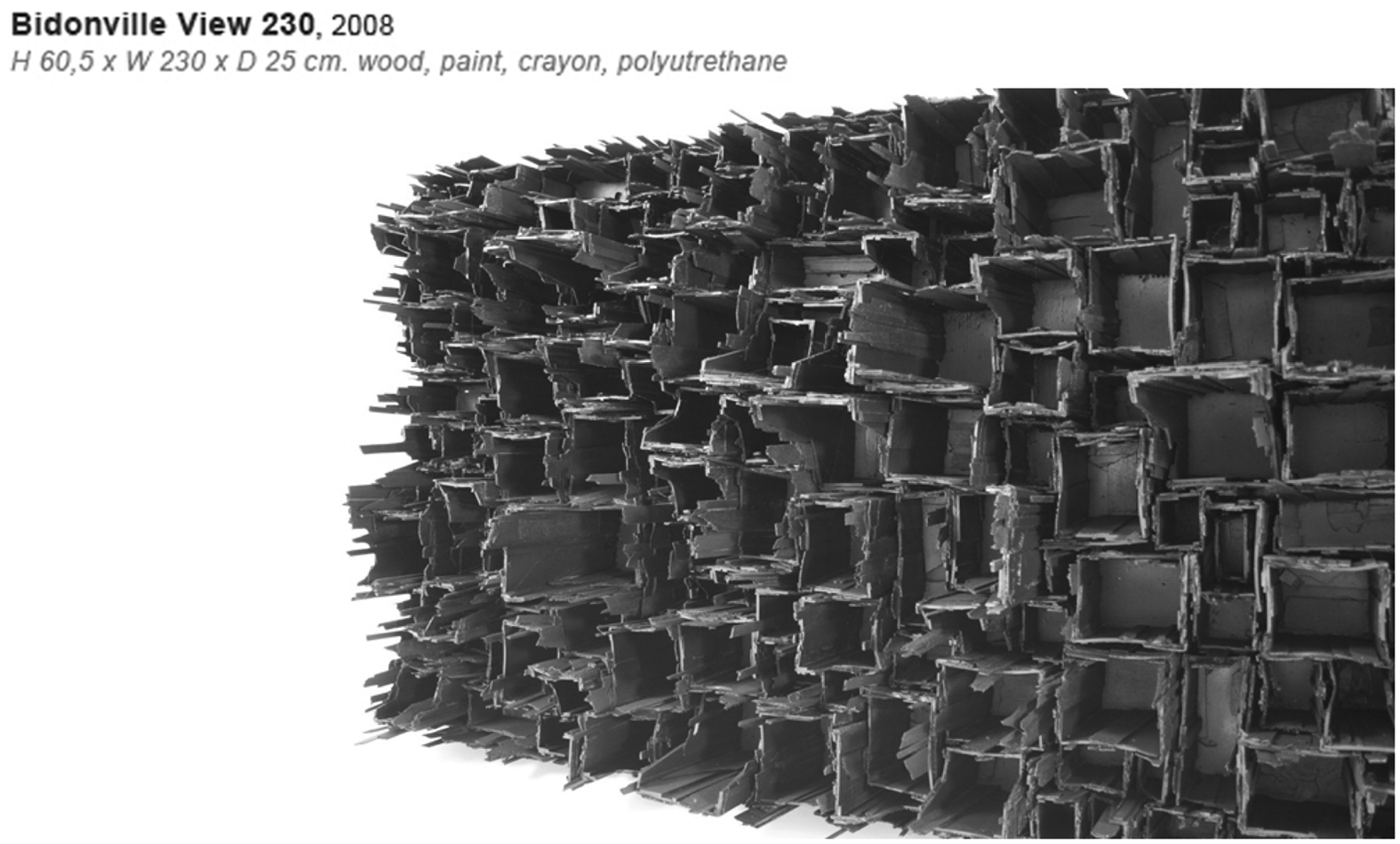
Speculation about shadow cities and shadow urbanism leads to further conjectures of a shadow economy, featuring unprecedented unofficial growth via a diversity of black market and other unofficial networks that thrive in the midst of global economic crisis (Neuwirth, 2011). The question of the character of these unofficial – or ‘informal’ – economies should perhaps lead us to suppose that what they represent, far from being an alternative to what Tim Simpson, in this section, describes, after Christian Marazzi (2011), as the ‘violence of finance capital’, should probably be understood in terms of the ensemble of heterogenic forces that combine to produce the current situation.
Simpson’s ‘Scintillant Cities’ (this section) presents a persuasive analysis of the ways in which ‘dematerialized financialization finds its physical form in glass architecture’. Here he identifies a ground for construing the city-state (and the state of the city) on the basis of ‘the economy of derivative speculation’. The aesthetics of glass architecture contributes to the utopian imaginary of urban space, allowing extravagant structures to be erected on ‘billions of dollars of debt’. The two sites around which Simpson’s analysis turns – the debt-ridden yet spectacular Vdara Hotel (part of the Las Vegas CityCenter development) and the rapidly developing post-colonial cityscape of Macau – allow him to identify some powerful connections between material, financial and fictional forces: glass, as both an imaginary and material component of modern urbanism; the gambling house in its modern incarnation, accommodated in some of the world’s most obtrusive architectural follies; and financialization, a form of speculation on a vast scale driven by an essentially fictional capital. Macau’s ‘postmodern phantasmagoria’ serves to demonstrate the deeper connection between fictional capital and the ‘formal overtones’ of the architecture that symbolizes it in ‘all manner of glass and crystalline amusements’. The visible surface of the city increasingly attracts, onto the glass towers of these contemporary iconic developments, the expressive screens of broadcast media – a constantly changing and iridescent show whose purpose seems each time secondary to its effect. The towering ‘scintillant’ surface of the contemporary city invariably coexists often alongside dense regions of urban slum, like Mumbai’s notorious Dharavi, which houses more than a million people.
Forms of Urban Organization
So the contemporary megacity might best be considered in terms other than the familiar ones associated, for over a century and a half, with predictable cycles of urban development. Remaining rural territories will certainly continue to be urbanized, but the patterns followed by urbanization will turn out to be qualitatively different from those of modern urbanism. The megacity or mega-region breaks down into its particular forms in ways that confound any unity of concept. Attention to the specifics of places, locations and networks allow processes to unfold in terms of limited individual plans, interests, micro-economies and negotiations and across heterogeneous borders. Yet the megacity can be grasped as a new order on a world historical scale. It is worth thinking in terms of stages in order to grasp the latest transition as the culmination of a progressive trend. One can provisionally chart, through existing narratives that must also be investigated and ultimately questioned, at least three dominant stages of the recent history of the city, each stage progressively absorbed and reconfigured by the succeeding one. If this quite flexible schema exceeds the standard narratives of western urban history, then the third stage especially both departs from Eurocentric models and suggests the need for retrospective revision of the currently dominant ways of framing urban history.
In the utopian early modern stage of urbanism, the cities of Europe and the Middle East claim an ideal continuity with the earliest known urban settlements, which established themselves along rivers or in valleys whose climates allowed continuous sustenance if managed systematically. The old story of the construction of irrigation systems and the importance of the surrounding environment dominates the utopian vision if not the practice of the earliest modern cities. The model of civic government is also ancient (the Greek politeia or ‘constitution’), and as it privileges a politics of representation and citizenship; one associates with it the modern ideals of democracy and the public sphere, as well as humanist art and education. The re-establishment of theatre (modelled on Vitruvius and the Roman amphitheatre) as the key order of representation emerges in Europe with this stage of urbanism. Trade routes also contribute to the successful growth of coastal cities as points in a network, like those for instance in China, India and East Africa, connecting continents through civic and mercantile interaction, and spreading forms of science, religion and technology as well as trade.
Indeed, the economic correlative to settlement and civic organization is that of the market and the principle of exchange, which forges powerful bonds across imperial and state territories, thus linking cities to each other as nodes on a network and potentially subverting long established orders of sovereignty. Urbanism operates first of all against two distinct forces. It is a reversal, a settlement, of nomadic impulses, but it is also in defence against centralized state powers, the empire, the feudal lord (Heinrich von Kleist’s 1811 novella Michael Kohlhaas captures both the criminal violence and the righteousness of the 16th-century individual and can be read as a complex and thinly disguised allegory of the struggle for civic justice against outmoded authoritarian styles). Networks grow during this stage of urbanism, rather than agglomerations, and a civic as opposed to imperial form of centralized power becomes dominant, not only in Europe but throughout the navigable world.
The unity of the city concept, especially in the early stages, should not be overestimated. The Greek cities (Athens, Sparta), the ancient cities of China (Kaifeng, Luoyang), the Byzantine cities (Constantinople, Edessa) and Islamic cities of the Middle East (Cairo, Damascus) have perhaps little in common as cities. When one uses a word like ‘Islamic’ to categorize a city one quickly finds that aspects connected perhaps to trade or to history demand the addition, even multiplication, of further categories, like medieval, mercantile, expansionist, cosmopolitan or multi-ethnic, which distinguish cities within one category and connect otherwise very different cities through other categories (see Abu-Lughod, 1989; Ingersoll and Kostof, 2010). Nevertheless, the slow and steady growth of especially Europe’s cities over centuries gives way in the 19th century to a qualitative and quantitative leap in global ‘urbanization’, which multiplies rapidly throughout the following century and a half, and which continues to do so.
This colonial or liberal stage of urban expansion is already implicit in the various tensions that overdetermine civic life (the civic and imperial, the horizontal and vertical, and so on), and which involve the coexistence of heterogeneous tendencies. Such tensions can be grasped in formations that are related by way of a social topology: ‘Primitive societies cannot ward off the formations of an empire or State without anticipating it, and they cannot anticipate it without its already being there, forming part of their horizon’ (Deleuze and Guattari, 1987: 435). This way of thinking about the various forms of urban organization, in terms of the coexistence topologically of heterogeneous tensions between movements of certain kinds, allows us to qualify the sense of urban stages that we are developing here. The passage from one stage to the next would occur as a kind of irruption in which a certain arrangement is shifted radically in its emphasis. The civic tension gives way – uniquely in Europe and spectacularly in North America – to an unprecedented expansion of apparently diverse kinds of material and immaterial ‘territories’: culture, capital, land, people, etc. Seemingly governed by the logic of capital, a daemonic combination of imperial and civic forces allows the simultaneous establishment of states and expansion of networks, but serves predominantly imperial ends disguised as those of enterprise and commonwealth.
Ali Mazrui has shown how three stages are played out in the East African context (Mazrui, 1996). In the case of Mombasa (Kenya’s ‘second city’), a pre-colonial ‘Afro-Oriental phase’ features cultural and commercial interaction. On one hand, routes are opened up with parts of Asia, its trading ships brought by monsoon winds to Mombasa’s ‘natural harbour’. On the other hand, access to the relatively nearby Arabian Peninsula allows Mombasa to become a key ‘entry point’ for Islam into eastern Africa (Mazrui, 1996: 159). But this phase is supplanted at length by the ‘Afro-Occidental phase’, which features the competing forces of westernizing colonialism, from Portugal at first and then more comprehensively by the British (Mazrui, 1996: 161–5). The ubiquitous forces of 20th-century global politics contribute to a third stage, in which civic society and national interests are caught in a paradox: ‘the West embraced Kenya partly because the West valued the Indian Ocean; Kenya embraced the West and turned its back on the Indian Ocean. Mombasa was part and parcel of the paradox’ (Mazrui, 1996: 170). The details of the paradox are worked out in more general terms than the case of Mombasa might suggest. They are those of ‘war, tourism and international politics’. And with the ‘globalization of Mombasa’ comes the ‘disintegration of the East African Community’ (Mazrui, 1996: 174). In Mazrui’s explanation Mombasa therefore represents several determinate heterogeneous forces, which under globalization no longer determine anything beyond local mediated interests.
Modern urbanism in the 20th century had been instituted in the great global cities, agglomerations of about seven or eight million. These are the global hubs of industry and production, the capitals and other political, cultural, educational and economic centres of national and international affairs and their administration. The global city is perhaps the most pronounced moment of the state and the city working in tandem with, despite appearances, little or no resistance between the two. At the level of local politics such tensions can seem great, where the interests of civic community, as in the classical age, come into conflict with those of state government. The promise of democracy and the free market are at their most unified in the form of a middle class antipathetic to aristocracies or sovereignties and on their way to producing the great abstraction of the people. The image of the city remains integral yet urban processes continue to expand in relatively uncontrolled – or at least in decentralized, random, detached – ways. Yet the apparently deregulated space of the megacity is illusory. The dynamism that is generated by the decentralization – or privatization – of urban administration can be regarded in terms of ends whose means are peripheral, contingent or collateral. For the privatized groups that supply the infrastructure to these sprawling urban areas, ‘the poor’ are often no longer considered a social problem in need of solving but rather another manifestation of the megacity’s dynamism. Similarly, the military formation most mobilized and deployed is the informal, neighbourhood-level cell, occasionally organized for hire or for fighting (clandestinely or as terrorist activity) for larger ideological or political agendas.
Accordingly, the mode of representation appropriate to the contemporary city is the interactive media device: the desktop, the notebook, the mobile, the hand-held, the cyber-kiosk (it is quite appropriate that numerous megacity sites in China and India are often dedicated to the manufacture and distribution of these devices). The dominant paradigm in art demands at least a nominal degree of audience participation. Exhibitions become sites of learning. Spaces for public ‘uploading’, of images, film clips, written responses and so on, become mandatory under the sloppy collectivism of people power. The optimistic side of this informal, apparently grass-roots, level of participatory representation should thus be tempered by the negative spectre of the virtual.
New Urban Formations, Information Technologies and Cyber Networks
Just as current hypermodern and megacity forms archive and reconfigure earlier city stages, the technologies deployed for representational purposes also store earlier modes and technologies, including painting, literature, analogue sound recording, radio, television, photography, cinema, and so on. 7 The tele-technologies of digitalized media provide an archive of the technologies they sublate: appropriating, storing, mobilizing, enhancing and modifying their previous powers. Past technologies can become hybridized in current digital IT and tele-technologies. In this respect they serve both as analogues for the effects of contemporary urban processes and also the significant vehicle for these very transformations – an influence of the infosphere on the geosphere. The ways in which we experience and understand urban formations, as Scott McQuire and others argue, results largely from media and IT, providing as they do new means for interpreting urban processes. Theorists of media and networks from McLuhan to Virilio to Baudrillard have similarly argued in detail the long-lasting and complex ramifications of IT on urbanscapes and vice versa.
A medium that is virtually synonymous with the city is electric light. Sean Cubitt, in his article ‘Electric Light and Electricity’ (this section), offers a political economy of this integral element of infrastructure as a marker of urban development through the chaotic marketization of electric grids and electric lights, as well as IT and net access, in sites as diverse as Lagos and Mumbai. The political economy of light adds nuanced shadings to the otherwise chiaroscuro taxonomies of urban sites.
Despite the apparent neatness of fit between cyberspace and contemporary urban processes, the technologies that provide access to virtual space are by no means ubiquitous in many rapidly emergent urban sites, and these maintain an oblique and strategic relationship to the vast global networks that the web – to use a shorthand synecdoche for the many cyber-networks – generates and perpetuates (Bishop et al., 2005 [2004]: 1–36). Global cities and mega-regions are shaped by the increasingly singular and homogeneous shift to information as the basis of a global economy, of the immaterial (or simulated) nature of economic production and capital circulation, and of information technologies themselves. The global cities largely dominate these changes while the mega-regions register their effects without sharing many of the benefits.
It is not solely the material conditions of urbanization that we wish to consider here but the immaterial as well, in so far as the two become inextricably intertwined. Current urban formations find themselves between, or tangentially attached to, the cyberspace networks global cities have constructed to link them in strategic, even if unpredictable and somewhat uncontrollable, ways. Small pockets of elites within these sites often operate as the conduits between the generative hinterland that is the megacity and their global consumers. The vast majority of the population within these megacity sites are exiled from these systems, but nonetheless are unavoidably shaped by them, regulated by them, watched over by them, and to a certain extent dominated by them. As such, megacities are an odd amalgam of co-existing low-tech operations and daily practices coterminous with cutting-edge use of IT and cyberspace technologies. They are rather like the Terry Gilliam film Brazil: a film whose overriding aesthetic produced a snapshot of the entire history of technology in the 20th century with all the technological elements occupying the same static image within a single frame of the film. Or to update the representation and place it within the digital domain, new urban formations appear like a video mash-up: the result of the re-combinatory capacities of digital media and their exploitation of the conversion of images and text into easily transferable and appropriable computer code.
Revelling in the latent powers that these technologies unleash, the video or audio mash-up also inadvertently reproduces the power beneath these digital forces even when attempting to undermine their explicitly commercial and exploitative effects. The relationship, then, is one that metonymically invokes the way current urban sites modify and intensify the urban sphere. The delivery systems for processes that create an environment in which desktop aesthetics emerge are the very tools cultural practitioners deploy in their interventions, regardless of their relationship to the content. The celebratory modes of cultural production share their theatre of activity with more explicitly parodic or satirical modes that are overtly critical of the conditions of communication and experience. However, while the aesthetic and representational practices of cyber-cultural production of megacities largely react to global popular culture, and therefore can be seen as derivative rather than driving the agenda, the urban processes found in megacities have an unpredictable yet nevertheless constitutive role in the future of urban organization.
Just as the status and power of digital technologies and their relations to ubiquitous media in the production, circulation and legitimation of knowledge is increasingly integral to urban studies research, so screen culture in both its digital and analogue forms plays an integral role in this knowledge production and the critiques of it. Such an examination on a grand scale as a kind of civic self-promotion of urbanization in cosmopolitan sites can be found in public ‘big screen’ displays, as discussed by Papastergiadis et al. (this section). Such displays quite literally broadcast the conflation of screen culture and urban space, just as screens as building facades do, and they do so without apparent irony of the monological nature of the communication interface. Furthermore, these displays shift our focus away from other, more complex, urban formations. The digital itself may not have much physical ubiquity in megacity sites, as the paucity of digital technologies compared to broadcast technologies world-wide attests, but the manifest effects of the digital are ubiquitous, even in those sites where its presence is mostly spectral, anticipatory and distanced.
Beyond the Megacity
The term ‘megacity’ is not entirely satisfactory for these rapidly growing and changing urban sites. Standard ways of defining megacities include sheer scale of population, density, and massive spatial expansion. A megacity is either simply one of the larger of the world’s cities or it is measured in terms of a specified degree: it used to be more than five million inhabitants, but some now insist on more than eight million; increasingly, though, the numerical standard for calling an urban agglomeration a megacity suggests that we cannot settle for less than ten million. There are approximately 20 such agglomerations according to the current measurements (which are themselves problematic in several respects); but each time the designation defines little more than a numerical value. Quantitative measurements are useful, but the assumptions with which they operate need questioning. What happens, for example, if we determine overpopulation based on the consumption of non-renewable resources rather than ratios of people to space? Our maps and graphs change considerably.
At any rate, urban planning for these sites tends to be applied post facto, relegating an essential role of civic governance for the control and development of these cities to a less effective level. Accurate forecast, planning and simulation seldom are acceptable options in many current urban areas (to the extent that they have been regarded as viable for global cities). The belief in bureaucratic capacities for guiding or controlling urban processes has long been a part of the rationalist model of city government and is integral to the global city epoch. But it has tipped over the edge of control and capability in at least two ways: one can be found in those sites where such governance never existed and current conditions of rapid expansion on scales not experienced before make such planning impossible; and, perhaps more interestingly, the other is in the intensification of such instrumentalist design and control (housing and building projects apparently controlled down to every square centimetre by the city and developers) which creates a chaos predicated on the models of control and development themselves. This latter scenario is clearly revealed in the analysis of Hong Kong mega-developers by Li Shiqiao (this section), a situation he calls ‘the city of quantities’, in which the drive to maximize space and profits finds instrumentalist and rationalist planning brought to the nth degree. Such a situation results in the exponential explosion of building developments that emphasize and embody ‘maximum quantity’, including the hyper-application of such tools as ‘plot ratio’ and ‘site coverage’ leveraged against environmental and market forces, with the former exerting some curbing influences while the latter encourage the largest returns on each investment unit. This excessive realization of rational goals and principles of land use, development and profit-making results in an unliveable built environment and untenable living conditions.
Health issues have long prompted measures for planning and for legitimating increased control of specific sites and processes. The infrastructure for sewage and water often proves patchwork at best in many urban areas, while still others offer regular access to potable water. But the ways in which health issues emerge and enter public discourse operate in a very different manner in megacities when compared with global cities. In global cities, the operating assumption of civic governance presumes a certain level of unfettered governmental control to achieve baseline health for the general population. The more makeshift dimensions of infrastructure to secure health of the citizenry in megacities mean that the issues can be mobilized for protest and other grassroots organization. Similarly, the same concerns can be used by governmental sectors to exert political control over specific sites in specific ways, as slum clearing the world over exemplifies. And although NGOs and the UN track mortality rates to exert pressures on specific nations, most TNCs that work and operate in megacities pay little attention to these concerns, unless it is in the form of public relations known as ‘corporate global citizenship’.
Issues of health also intervene when problems such as pollution and eco-management collide with national and international drives and demands for development and economic/industrial modernization. Many so-called megacity sites experience rapidly rising and devastating environmental problems owing to their role as the productive industrial hinterland for other more settled urban areas, as well as in their own national shifts and momentum toward market-based consumer economies. The dual pressures to meet external demands for goods no longer produced by post-industrial nations and internal demands for higher standards of living can be found in the ecological damage endemic to megacity sites. Even supposedly ‘clean industries’, such as computer hardware production and recycling, exact a significant toll as is found in those areas that attempt to recycle outmoded computer equipment. The life expectancy of computers now runs from approximately five years for work computers and seven for personal computers (at the high end) to one year, if one wishes to remain current with various systems and hardware developments. For handheld devices, this life cycle is even shorter and the sales for them growing exponentially. The pressure exerted in the sites that produce computer and IT hardware for TNCs and for the recycling and disposal of these products – called ‘e-waste’ – is felt exponentially in many emergent urban locales.
While e-waste is largely terrestrial, Peter Adey, in his contribution to this section, analyses the ways in which atmosphere (in both meteorological and emotional senses) can become a measure of urban quality. Adey’s analysis of air and climates examines the ways the sky influences our understanding of terrestrial dwelling. Atmospheres can be oppressive or liberating through a kind of enforced aesthetic that has consequences for health and longevity as well as economic developments. Adey extends Foucault’s observations on the town’s historical concerns with miasmas, or noxious air, by focusing on the intensification of climate and environmental markers in the air of rapidly developing cities, revealing a mutual influence between ecological and urban connectivity across a range of urban types. In a wider historical framework, the megacity signals potentially devastating atmospheric conditions that relate more to those of the industrial revolution than global cities might care to admit.
Such environmental problems provide yet another indication of the ways in which megacities exert control over their rural hinterlands. Just as many new urban sites are largely controlled at the macro-level by global cities and the economic/technological/political systems they generate, so too do these sites completely overwhelm their rural environs. Much of this overrunning of the rural takes place in its most visible form as pollution and environmental destruction, leading to explicit urban experiments in nations such as China to develop ‘green cities’ with zero environmental impact goals in place as the state attempts to address the problems of an exponentially expanding urban population. Of course there are many other ways that urbanism generally controls rural areas: economics, politics, imaginations, popular culture, broadcast and IT technologies, consumerism, exploitation of raw materials, etc. All of these can provide sites for considering the many material and immaterial ways that the rural has been urbanized.
Where factories are placed in an urban setting and where they are excluded, just as much as where water and sewage exist for homes and where they do not, become indices of what has been labelled ‘urban pathology’. A city’s pathology depends on the degree of harmony or disharmony between its different parts. The almost clichéd image of ostentatious wealth perched next to makeshift tin shacks, separated only by the walls of the wealthy compound (complete with barbed wired or embedded broken glass), provides concrete visualization of just this kind of urban pathology. But other, less obvious, markers do so as well. These would include access to food, housing, electricity, work, mobility, education, and health care, as well as access to individual rather than collective technology use (e.g. mobile phones, computers, IT, broadcast media, print media, and literacy).
The iconic forms of the contemporary city – towering erect glass monuments here and haphazard constructions of corrugated iron there – combine to produce an urban imaginary for a form of life estranged, and thus hidden, from itself in its basic manner. The sheer scale of many new urban formations, as well as their constitutive capacity for evading and yet anticipating control, sets them apart from the global cities that dominated the urban imaginary of the last century. These contemporary forms of urban life, which encompass heterogeneous variations on the city, can lead commentators towards biological metaphors – the self-organizing somatic mutations of DNA, ant populations, immune systems, and so on, at which level one dreams of an obscure mathematics, an algebra or topology, giving rise to auto-generative ideals (see Johnson, 2001). The image of genetic mutation, a further step beyond the ideas found in Mutations (Koolhaas et al., 2001), retains an erotic dimension: the possibility of change, hope within desire, in the midst of intractable social disaster. Cities, as large artificial structures, once seemed to allow a level of freedom in social design and imagination (see , 1995; Lewis, 2006: 135), a progressive utopian dimension that seems all but lost in the context of the shifting and labyrinthine urban landscapes of 21st-century megacities, where residents who lose their way can be missing for days before finding a route home. But with the loss of this utopian dimension comes the loss as well of the city as a figure of political control. The classical tensions that marked the city and the city/state throughout its history have since been displaced in a perplexing variety of paradoxical relations and deceptions. The contributions to this section reveal in different ways how some of these relations operate in the contemporary sphere and how the urban problematic continues to produce sites of contestation and change.