



Abstract
The food-energy-climate change trilemma refers to the stark alternatives presented by the need to feed a world population growing to nine billion, the attendant risks of land conversion and use for global climate change, and the way these are interconnected with the energy crisis arising from the depletion of oil. Theorizing the interactions between political economies and their related natural environments, in terms of both finitudes of resources and generation of greenhouse gases, presents a major challenge to social sciences. Approaches from classical political economy, transition theory, economic geography, and political ecology, are reviewed before elaborating the neo-Polanyian approach adopted here. The case of Brazil, analysed with an `instituted economic process’ framework, demonstrates how the trilemma is a spatial and historical socio-economic phenomenon, varying significantly in its dynamics in different environmental and resource contexts. The paper concludes by highlighting challenges to developing a social scientific theory in this field.
Keywords
Introduction
The principal purpose of this paper is to develop understanding of the interaction between socio-economic and bio-physical systems by focusing on a particularly significant interaction complex. The concept of a ‘food-energy-climate change trilemma’ identifies a strong interdependency between the growth in food demand, the decline and increasing insecurity of fossil energy resources, and the increase in anthropogenic climate change arising from land conversion and use for both food and energy. The trilemma represents an unprecedented challenge to continued economic and social sustainability. Yet the trilemma takes varied forms and dynamics in different regions, with different pathways of growth and development, in the context of varying resource endowments, and differential access or potential access to food and energy, of whatever kind.
As a concept, the trilemma first emerged within the natural and environmental sciences (Tilman et al., 2009), highlighting the evolving dynamics between various kinds of resource finitude (fossil energy, land, water, etc.) and the generation of greenhouse gases from shifting patterns of utilization of these resources in economic development. Central to the trilemma concept, as discussed further below, is the complex interaction between different kinds of resource demand and use, on the one hand, and different kinds of finite resource constraint, on the other, and their combined consequences for climate change. Much of this type of analysis operates in terms of global aggregations (e.g. of oil demand, CO2 emissions, food supply and demand, etc.), and thus talks generically of ‘anthropogenic’ climate change. Understanding these evolving and shifting dynamics – especially resulting in the increasing importance of land use, land use change, and food production – presents an ongoing challenge for natural and environmental science, and at the same time a quite distinctive challenge for social sciences. The core argument of this paper is that analysis of trilemma dynamics in terms of sociogenesis arising from the interaction between diverse political economies and their variously finite natural environmental resources requires significant new theoretical development. Different political economies generate different trilemma challenges as a consequence of their distinctive polity-economy-nature interactions.
The paper first reviews a sample of theoretical approaches from classical political economy, innovation studies, political ecology, economic geography, and economic sociology, arguing in particular for the openness of a neo-Polanyian approach to meet the challenge. The second section outlines the natural science account of the trilemma. Using a neo-Polanyian approach, the third section will analyse the case of Brazil as exemplary of socio-economic trilemma variations and their uneven and emergent historical character. The conclusion draws together the elements that point to the nature of the theoretical challenge to the social sciences, emphasizing that the paper seeks to identify the dimensions of the challenge rather than provide a fully developed theoretical framework adequate to it.
The Theoretical Challenge to Social Science
Reading a 1986 paper of the economist Nikolas Kaldor entitled ‘Limits on Growth’, one is struck by two things: first, he points to the long-standing pre-occupation of political economy to understand the dynamics of interaction between economic growth and finite global resources, between socio-economic and biophysical systems; second, he was still intellectually trapped in a ‘pre-climate change, pre-peak oil’ epoch. The classical political economists of the time of the industrial revolution, Malthus and especially Ricardo, had enunciated a Law of Diminishing Returns with respect to land as a finite resource. In their view, growth would inevitably find a limit as a consequence of the ever increasing economic resources, including notably labour, required to produce food and other products from ever more marginal land. Applied initially to food and land, Kaldor argues that the same principle can equally operate for all other finite resources, such as fossil fuels, metals, and water, which also may draw labour and technology more and more into the primary sector to the detriment of growth in the secondary (industry and services) sector.
Yet, in a period only shortly following Hubbert's prediction of an American, rather than global, peak oil (Defeyes, 2001), this classic historical conception of a dynamic of diminishing returns lacks recognition of the ‘energy cliff’ that confronts industrial capitalism for the first time in its historical experience. The Law of Diminishing Returns conceptualization does not visualize a finite resource disappearing on use: landmass does not shrink progressively to zero as more and more of it is settled and cultivated. The classic political economy fails to distinguish clearly between finite amounts of a resource available for use (such as land area) and finite amounts of resources being used up (such as oil), and the range of intermediate kinds of finitude (such as land temporarily or permanently exhausted through use or pollution). The Law of Diminishing Returns operates within a fairly undifferentiated concept of resource finitude, although tilting, from its origins, to the ‘availability for use’ end of the spectrum. Moreover, with respect to energy resources, until the present epoch, the Law scarcely made an appearance, either in reality or in political economic thought. For, in previous energy transitions, coal energy had been adopted and developed without an exhaustion of wood-, 1 charcoal- and peat-based energy. Likewise, oil and nuclear power were additions to the existing range of energy sources.
From the perspective of this paper, moreover, the Kaldor review of the Law of Diminishing Returns also conspicuously lacks any spatial dimension. Notably, there is no discussion of where finitudes of land use resulted in effects on economic growth or, more generally, of how different geographies of resource finitudes (types of fossil energy, water, etc.) relate to different trajectories of development and/or sustainability crises. However, recent accounts of the ‘great divergence’ between regions of the world from the inception of the industrial revolution argue that, in addition to the accessibility of relatively cheap coal, especially in England (Allen, 2009), Europe and other thriving regions of the world such as the Yangtze river basin, were increasingly faced by crises of land availability – finite resources of land limiting growth (Pomeranz, 2000). Only the new colonization from European countries to the ‘New World’ broke out of that resource constraint, so providing European populations with huge new resources of calories (sugar) and clothing (cotton) as well as the new slave labour forces to cultivate them. 2
The industrial revolution and its accompanying urbanization depended in significant measure on the slave plantations of the New World, and subsequent forced labour regimes stretching into the early decades of the 20th century. It was the unrecognized Great Escape from the Malthusian and Ricardian Law of Diminishing Returns, fixated as this was on implicitly national territorial finitudes of land and labour resources. From 1700 to 1890 the area of cultivated land grew by 466 per cent, historically by far the most rapid expansion, and predominantly outside Europe and China. North America witnessed an expansion of 6,666 per cent over the same period – a rather unreal figure given the low initial base (Meyer and Turner, 1992).
This escape from national finitudes of land resources can now also be understood for its significance for anthropogenic climate change. The conversion of uncultivated to cultivated land, and then the uses of energy, fertilizers and simply the emissions from tillage agronomies releasing the stored carbon in the top soil surface, are now recognized to be major sources of anthropogenic greenhouse gases (Houghton, 2003, 2008). At present, anthropogenic GHG from land conversion and agriculture is 2½ times greater than that from total global transport and its oil consumption (World Resources Institute, 2005). So, at the inception of the industrial revolution, there was a particular dynamic between socio-economic and bio-physical systems, a specific historical and spatial interaction between land resource constraints and energy consumption. The satanic mills burnt coal, certainly, but they also processed cotton and were worked by labour forces in part dependent on the calorific energy of sugar, entailing a rapid expansion of cultivated land in the New World as an additional major source of anthropogenic climate change.
This historical interaction between socio-economic and bio-physical environments can only now be seen as a distinctive ‘food-energy-climate change’ constellation, spatially centred around England and the New World sugar and cotton economies. The constellation was an historically emergent phenomenon, with a specific spatial and temporal scale. The ways in which classic political economy – here represented by Kaldor – conceived the interaction between political economies and finitudes of resource in terms of a generic capitalist economy and despatialized finite resources limits the understanding of those interactions.
Although historically overlapping, yet with no evidence of their ‘speaking’ to each other, the more renowned Limits to Growth (Meadows et al., 2004 [1972]) operated with a very different perspective on the interaction between economic systems and the planet earth, yet one which was in its own way equally despatialized. Indeed, both sides of the debate between the Limits to Growth and innovation studies perspectives (Freeman, 1984, 1996; Cole et al., 1973) share the characteristic of theorizing in universal global terms. The ‘limits to growth’ perspective aggregates total greenhouse gas emissions and projects their growth into the future, on the assumption of projected exponential growth in demand for energy, food, minerals, and global resources of all kinds. It suggests that ‘exponential growth has been a dominant behaviour of the human socioeconomic system since the industrial revolution’. And, of course, greenhouse gases as such do aggregate, and have an aggregate impact on the planet, although, as argued below, not as a consequence of a single ‘human socioeconomic system’: the anthropogen. A counter-argument from innovation studies suggests that the growth of scientific and technological knowledge lacks any discernible limits, suggesting an equally global but ‘infinite’ knowledge resource, potentially enabling, for example, the emergence of renewable energy or sustainable agriculture tapping – again for example – the also relatively infinite resource of solar energy (Freeman, 1984, 1996; Cole et al., 1973). From this standpoint, scientific technical fixes arising from inexhaustible knowledge resources are projected as a global potential for a portfolio of ‘stabilization wedges’ (e.g. wind farms, solar energy, nuclear power using thorium, sustainable intensification of agriculture, etc.) (Pacala and Socolow, 2004; Royal Society, 2009; UK Government Office for Science, 2011). In contrast to the classic political economy treatment of an abstract economy in interaction with spatially unspecified resource availability, the much more empirically driven ‘limits to growth’ view and its innovation studies counterpoint are each propounding an interaction between a global economic system (as characterized by statistical techniques of aggregation) and the earth, and especially its atmosphere, as a global whole.
Transition theory has a much more circumspect view of the capacity for technological innovation and growth of scientific knowledge to transcend limits to growth in its distinctive approach to transitions to sustainability. The approach stresses different levels of economic organization and the interdependency of socio-technical systems, reinforcing the idea of path dependencies constraining radical technical change. Obstacles to radical and rapid decarbonizing of economies can be illustrated by the interlocking of the petro-chemical complex, fossil fuel transport and power generation, its physical infrastructures, and, not least, the associated taxation regimes, as analysed by Unruh (2000; Geels, 2002, 2004). The multi-level perspective (MLP), where different innovation and change processes occur at the ‘ground-level’ of niches, through socio-technical regimes, to the overall landscape of a socio-economy, articulates the complexity of major socio-technological transitions. In developing the MLP approach, historically comparative examples have been drawn from a range of economic fields (land transport, sail to steam ships, sewerage, continuous flow mass production systems in factories, etc.) to provide examples of different types of transition (transformation of landscapes, reconfiguration, technological substitution, and re-alignment and de-alignment) (Geels and Schot, 2007). And finally, more recently, unlike earlier work, issues of economy-nature interactions have been introduced, suggesting that climate change constitutes a novel environment for innovation, requiring some adaptation of the theoretical framework. Transitions to sustainability are contrasted with earlier cases. Notably, the state and public authorities as key agents of innovation achieve much greater recognition than previous accounts, which were characterized by more bottom-up niche novelty and innovation (Geels, 2010). This theoretical shift has further been amplified by the analysis of transitions to renewable energy, where the state is attributed a much greater role (Smith et al., 2005).
However, a lack of comparative analysis of political economies of capitalism – let alone of non-capitalist economies contemporary and historical – is a feature of transition theory. In that sense, the MLP as an analytical framework is presented as a general model, applicable to any political economy in any spatial context. It is striking, for example, that the analysis of the transition from cesspits to sewerage systems in the Netherlands paid so little attention to economy-nature interactions (Geels, 2006). A comparison with a similar transition in the United Kingdom suggests that a major sustainability crisis, the ‘Great Stink’ of London, was a significant and decisive disruptive event in a transition process. The crisis arose from an interaction between particular socio-technical regimes, a polity, and a specific natural environment (Harvey, 2012; Halliday, 2001). Likewise, Evans's analysis of the transition of water and sewerage provision in Hamburg emphasizes the distinctive spatial and historical configuration of a ‘free city’, largely independent of the Prussian state. Hamburg, with its mercantile elite, was a unique point of confluence of migrating people, international trade, rivers and water-borne disease (Evans, 1987). The societal and spatial decontextualization of the MLP representation into three levels, and an implicit assumption of its general applicability, filters out analysis of politico-economic variation and spatio-environmental context in the cases it analyses. So explanation of major variations in transition trajectories and fossil carbon path dependencies are difficult to encompass in MLP representation as it stands, especially given the significance of spatially located resource finitudes and their use in inducing climate change.
Unlike these theoretical limitations in addressing resource finitudes and climate change arising from abstract and unspatialized economies, the aggregate anthropogen, and decontextualized MLP transitions, some political ecology, resources geography and recent economic geography approaches take these issues as central. In part derived from Marxist tenets of O'Connor's (1998) second contradiction (the intensifying tendency of capitalism to undermine the reproduction of the necessary environmental and resource conditions for continued accumulation), and Marxist theories of neoliberalism (Harvey, 2005), a strong theoretical strand takes neoliberal attempts at marketization of the environment as the focus of this perspective on political-economy interactions with natural environments. Supportive evidence of this approach is found in the formation of markets for renewable energy from previously uncommodified natural resources, the use of carbon trading mechanisms favouring large corporations for CO2 emissions reduction (Castree, 2009), and the erosion of common pool resources (Prudham, 2007; Mansfield, 2004; Swyngedouw, 2004, 2007). The most strident version of this view of the ‘neoliberalization of nature’ assumes a single hegemonic form of global capitalism, both ideological and institutional (McCarthy and Prudham, 2004; Heynon et al., 2007). Rather than examining interactions between different political economies and their environments, whether in terms of access to, and use of, finite resources or GHG emissions, this deployment of the concept of neoliberalization emphasizes general worldwide processes such as deregulation, appropriation by dispossession, and marketization.
However, others have stressed both the variety of neoliberalizations (Peck and Tickell, 2002) and the disjunctures between neoliberalist ideology and its instantiations, emphasizing the contradictions between the ideology of spontaneous emergent self-regulating markets and strong state intervention and regulation, often with the state as architect and governor of markets (Mansfield, 2004; Bakker, 2003, 2005). In a recent review of the literature on the neoliberalization of nature, Castree in particular has pointed to definitional weaknesses, but above all to a methodological failure of using singular exemplary cases as instances of general neoliberalizing processes, rather than a comparative and historical method necessary for understanding the kind of variation indicated by Peck and Tickell (Castree, 2010). More recently, Peck (2013) has advocated a Polanyian turn to economic geography, especially the later ‘anthropological’ Polanyi, precisely because of its comparative and historical approach.
The neo-Polanyian ‘instituted economic process’ (IEP) approach adopted here takes historical and spatial variation as central to all its analysis, and to an as yet limited extent has addressed some polity-economy-nature interactions (Harvey, 2007). Building on Polanyi's later work (Polanyi, 1957), economies are analysed in terms of relational configurations of processes of production, distribution, appropriation and consumption. The analytical approach explores how economies – the configurations – are instituted and transformed in space and time, and how spatio-temporal scales of configurational organization are formed, rather than found, within a pre-given multi-level ontology. Economies of food (exemplified by the tomato) (Harvey et al., 2002), knowledge (Harvey and McMeekin, 2007), water (Harvey, 2012), and energy (Harvey and Pilgrim, 2012) have been analysed for their variation and transformation in space and time. In Exploring the Tomato, contrasts were drawn between the Northern European glasshouse and the Southern European polytunnel regimes, related to the availability and use of, respectively, fossil fuel or solar energy. The particular competitive advantage of the Dutch use of their North Sea natural gas resource for heating glasshouses was seen as contributing to the demise of the Guernsey tomato. Moreover, by contrasting the UK supermarket with the Dutch export-oriented small producer economies of tomatoes, these political economy/natural environment interactions pointed to sources of variation within given, similar environmental settings, notably the distinctive forms of hybridization and innovation resulting in Tesco tomato varieties or the Dutch ‘Greenery Tomato’: different hybrids in different socio-economic spaces. A similar type of analysis of political-economy/environment interactions was developed in relation to European, Brazilian, and American biofuels. Continental European biodiesel, with its use of rapeseed as an already established temperate zone crop as its feedstock, interlocked with a tax regime that had established diesel powertrains as the dominant light vehicle type in the previous decade. The European biofuel trajectory contrasted with the Brazilian tropical resource of sugarcane bioethanol, or the USA's lock-in to maize as a feedstock. Different political economies in interaction with different environmental resources and dominant agricultures resulted in different transitions to renewable transport energies.
Further, Polanyi's central concept of the ‘shifting place of the economy in society’ has been expanded by considering different modes of instituting economic configurations, especially the changing relation between polity and economy manifest in responses to peak oil and climate change. Whether for biofuels or wind farms, solar or nuclear energy, nation-states have engaged in highly interventionist, often long-term strategic reconfigurations of economies of energy, entailing new industrial divisions of labour, operating in politically instituted markets. In this respect, diverse political modes of instituting economies of energy have been widely commented on, attracting the somewhat anachronistic label of ‘climate Keynesianism’, for example, in the case of carbon offset markets (Newell and Patterson, 2010). This perspective of varied modes of economic transformation and reconfiguration, with different polity-economy dynamisms, has parallels with Block's conceptualization of the ‘hidden developmental state’, a characterization of strong but unspoken state interventionism in the US economy, which departs sharply from its paradigm reputation as the homeland of neoliberal, free market economic organization (Block, 2007, 2008; Block and Evans, 2005). Moreover, as economic reconfigurations responding to peak oil, food security, or climate change are witnessing new forms of political intervention, so new spaces open up for social and political movements to shape these reconfigurations – notably in the case of NGOs with respect to European renewable transport energy (Pilgrim and Harvey, 2010; Harvey and Pilgrim, 2012).
Yet, although the IEP approach has addressed polity-economy-nature variation, involving dynamics of interaction with natural environmental settings and access to resources, it has done so only to a limited extent. Notably, it lacks analysis of the kind of feedback loop interactions involved in the food-energy-climate change trilemma. It is yet to address variation in sociogenic (as against anthropogenic) climate change. The theoretical challenge is to take the state-of-the-art natural scientific understanding of these complexities – how land use change generates greenhouse gases, what are the biophysical consequences of shifts from fossil energy to bioenergy, what are the diverse energy inputs involved in food production, etc. – in order to develop an analysis of the varied politico-economy/nature interactions generating varied trilemma consequences in different regions of the world. So, rather than attempting to construct a parallel social science ‘materiality’ (Bakker and Bridge, 2006), it is to current state-of-the-art natural and environmental science (including its controversies) of the trilemma that we first turn, before looking to Brazil as an example of a particular trajectory of trilemma evolution.
The Emergence of the Abstract, Natural Science, Concept of the Trilemma
Although scientifically appreciated for many years, the significance of land-use change and agriculture as sources of greenhouse gases came into full focus with the controversies surrounding the competition for land between biofuels and food (Gallagher, 2008). At the height of the food and oil price spikes of 2007–8, Searchinger and Fargione (Searchinger et al., 2008; Fargione et al., 2008) published papers in Science arguing that the carbon footprint of biofuels was far greater than previously calculated and, far from being benevolent for climate change, biofuels were a cure worse than the disease (Doornbosch and Steenblick, 2007). Simplifying the argument, the production of biofuels, particularly from food crops such as maize in the USA, raised the price of food and stimulated agricultural production elsewhere, thus leading to the conversion of more uncultivated to cultivated land. This is termed Indirect Land-Use Change (ILUC), and ILUC was suggested as a significant source of greenhouse gases, which should be included in the carbon footprint of biofuels. The argument has been contested from many angles, and it could just as easily be argued that high oil prices stimulated the production of alternative biofuels, which then led to ILUC, so increasing the carbon footprint of oil (Harvey and Pilgrim, 2011). Nonetheless, once land-use change fell under the floodlights of controversy, attention to the much wider issue of land-use change, especially direct land-use change for food to feed the growing global population, achieved much greater prominence, and led to the articulation of the natural science concept of the ‘food-energy-climate change trilemma’ (Tilman et al., 2009).
In Figure 1, the interactions between socio-economic and bio-physical systems are displayed as an undifferentiated global phenomenon, aggregating all socio-economic activity. As an exercise, it is worthwhile running through the natural/environmental science account of the dynamics, in simplified form.
The ‘food-energy-climate change trilemma’: A natural science representation.
From the top of the diagram, assumptions are made that there will be both an increase in demand for food, with rising standards of nutrition, and a world population growing from 6.5 billion to a projected plateau of 9 billion (IAASTD, 2009; Evans, 2009; Royal Society, 2009; Pretty, 2008), and an increase in demand for energy. Increased demand for food directly increases demand for productive land, and for increased productivity of agriculture. Increased demand for energy, and in particular transport energy, with the transport fleets of China and India either overtaking or having just overtaken that of the USA, will increase demand for oil. Further, plastics derived from oil and other key industrial materials also place increased demands on oil. Yet, oil being a finite resource, with many suggesting that global peak oil has already occurred (Aleklett et al., 2010), or will shortly (IEA, 2013), increasing pressure is placed on finding substitutes for oil, of which biomass is a prime candidate, not only from biofuels but also from biomaterials and industrial biotechnology. Failure to find substitutes for oil, in the view of the International Energy Authority, is likely to result in an economic depression which would make the current economic crisis appear no more than a dimple on the way (IEA, 2011–12). Oil price-induced depression affects the poorest regions far more extremely than the rich, in part from impacts on food prices. Given especially that agriculture is dependent on considerable energy inputs, the choice is not energy or food. Moreover, less intensive agriculture would mean more land for the same amount of food, and it has been argued that the use of chemical fertilizers, in spite of their carbon footprint, has consequently less environmental impact than less intensive agriculture (Burney et al., 2010). But finding biomass alternatives to fossil fuels also increases pressure on land cultivation and conversion. So the pressure for land comes from a double pincer movement, and risks to climate change and biodiversity increase. This then constitutes the trilemma: more food results in more climate change. Burning fossil fuels leads to more climate change. Failure to find alternatives to oil results in unending economic depression. Biomass alternatives increase demand for land-use change, leading to more climate change. More climate change results in less land availability and less productivity of much existing agricultural land, and so undermines food supply. And, indeed, results in major disruptions to life on the planet as we know it.
Trilemma Interactions and Reactions: The Exemplary Case of Brazil
The natural scientific account of the trilemma, necessary for understanding complex biophysical dynamics, assumes generic, unspecified human socio-economic activity. In this section, a preliminary attempt will be made to develop an IEP approach to understanding sociogenic varieties of trilemma generation, the emergence and progression of the trilemma, or, as importantly, the transitions or transformations responding to its varied sustainability crises. Brazil is taken as an exemplary case to explore these interactions: the sources of variation in the dynamics between regions, and the spatially and temporally uneven development of, and responses to, the different horns of the dilemma (energy, food, climate change). To anticipate, Brazil reacted similarly to the USA to the first oil shocks of the 1970s, but then pursued a very different strategic response. And, partly as a consequence of its biofuels strategy, it has been in the forefront of controversies and responses to developing sustainable agriculture regulation. In so doing, for example, its Zero Deforestation Policy (however effective or not in practice) is symbolic of a political redefinition of the finitude of land, by ruling in and out the availability of different types of land for agricultural or other human use. Finitudes are politically modified, thus changing the goal posts of limits to growth.
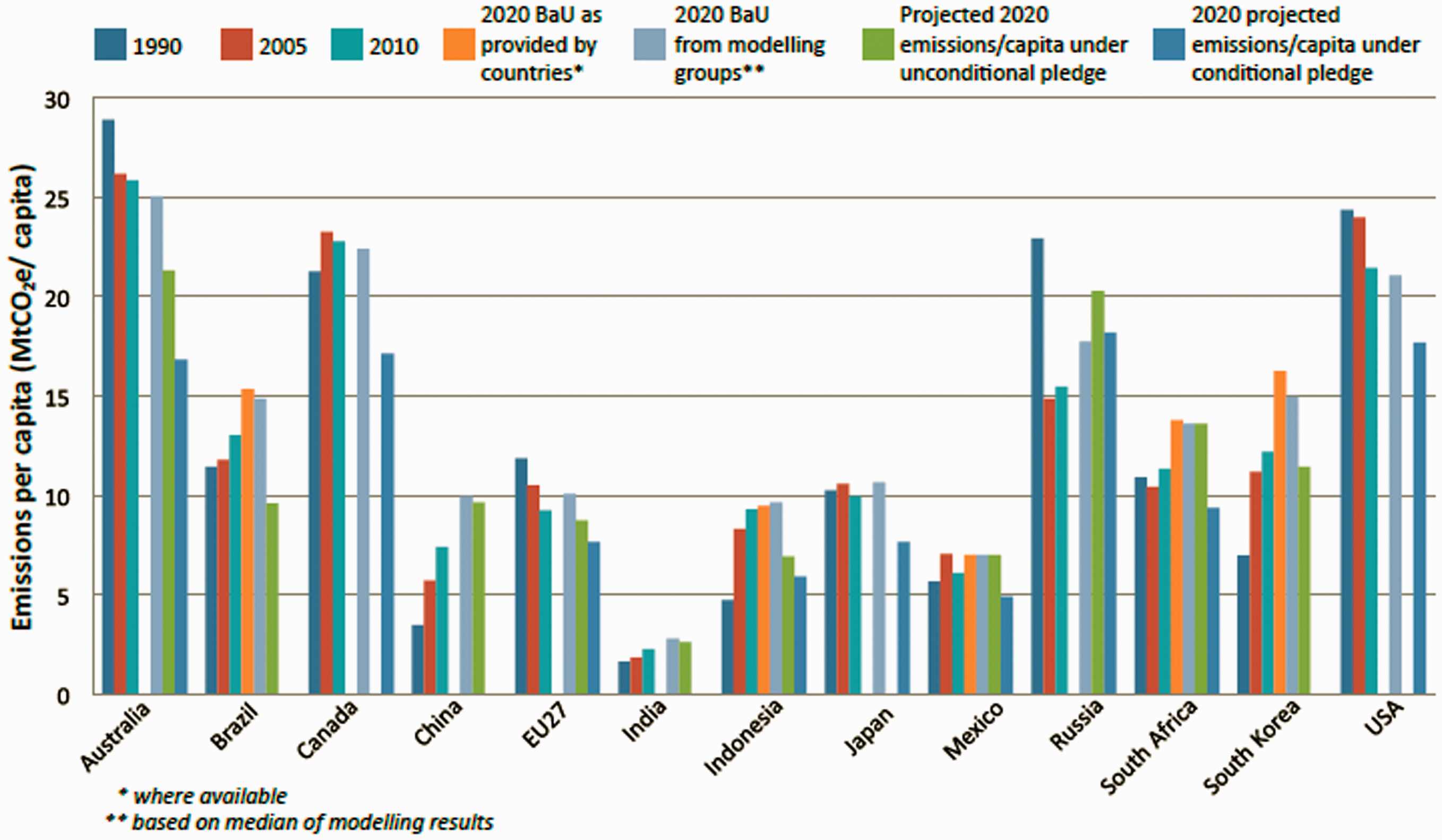
To illustrate the significance of this social scientific focus of trilemma dynamics, a good starting point is the contrast in the actual carbon footprint of Brazil compared with other global economies, as portrayed in the UN Environment Programme's analysis of a prospective failure to adequately respond to the challenge to reduce that footprint. The two figures below, taken from The Emissions Gap Report 2012 (UNEP, 2012), represent, first, the distinctive carbon footprint signatures of different countries and regions; and, second, the better-known summary of the relative per capita carbon footprints of different countries and regions.
Figure 2 demonstrates the starkest contrast between South Korea, Canada, Australia and the USA, at one extreme, and Brazil at the other. As a medium per capita greenhouse gas emitting economy (Figure 3), and one of the most dynamic economies of the BRIC group, Brazil displays a remarkably distinctive carbon footprint. The combined total of emissions from energy conversion, industrial use, and transport is below 30 per cent of their total emissions. In all countries left of Mexico in Figure 2, this energy-industry-transport subtotal is above 80 per cent of total emissions. Conversely, in the case of Brazil, over 60 per cent of its emissions arise from agriculture, especially deforestation and peat destruction. Yet Brazil is not notably less industrialized, energy-consuming, or lacking in transport systems than many of the comparator cases. Rather, Brazil has been engaged in a particular trajectory of political economy-environment interactions, a particular dynamic of development, over several decades. To take two key components of this distinctive trajectory, Brazil has continued to invest heavily both in hydroelectric power and the development of biofuels as an alternative to fossil fuels for transport, discussed more fully below. As a consequence, in 2005, Brazil had the highest level of renewable energy of any world economy – indeed, at 29.1 per cent, almost three times the world average of 11.4 per cent (DIEESE, 2007).
Sectoral shares of national greenhouse gas emissions of G20 countries. Source: UNEP, 2012. Per capita greenhouse gas emissions for 1990, 2005, 2010, and 2020 for G20 countries. Source: Olivier et al., 2012.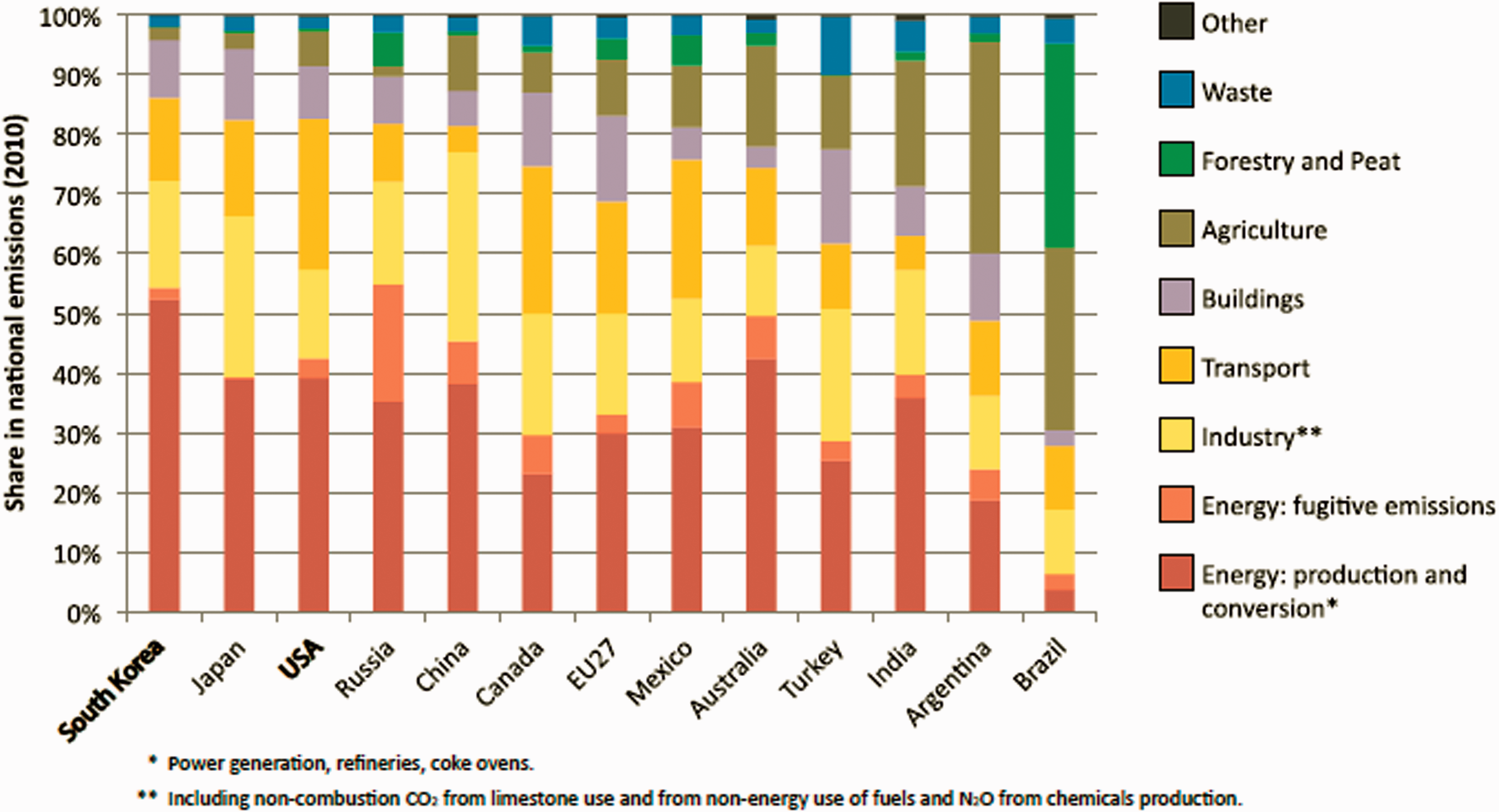
Clearly, both biofuels and hydroelectric power have a land-use related carbon footprint, whether in terms of deforestation or cultivation, so contributing to the contrast with another BRIC economy, Russia, where flaring from gas and oil production combines with the fossil fuel extraction to give that economy its distinctive carbon signature. At the same time, however, Brazil has become a major, and advanced, agricultural export economy: the world's leading exporter of poultry, red meat, coffee and sugar, the second largest exporter of soy beans, soy meal and soy oil, and the third largest exporter of corn (Wilkinson, 2009; FAOSTAT, 2012). In terms of the emergent trilemma, Brazil is contributing to meeting growing global demand for food, and this is manifested in its pattern of GHG emissions from food production and deforestation. The emerging trilemma dynamics of Brazil contrasts with other regions and nations of the world, while interlinked through trade with those regions, with their distinctive dynamics. However, as with other ‘exported’ carbon footprints, these cannot straightforwardly be re-attributed to consumer (importing) nations. As will be seen below, the key issue is how food is produced, and where, in the producer country. On the one hand, much depends on the forms of agriculture and land conversion, with potentially huge variations in carbon footprint (e.g. slash-and-burn versus recovery of degraded land). On the other, Brazil's natural endowments of high rainfall and sub-tropical solar energy in principle permit lower carbon footprints for producing food and biomass than temperate zone regions, so potentially contributing to a global realignment of agriculture as a response to climate change.
In analysing the emergent character of the Brazilian trilemma dynamics, different phases are distinguishable, with different horns of the trilemma developing unevenly: energy security, land finitude, renewable and environmental concerns, first for biofuels, then for food. Energy security and the issue of finite resource constraints was the first ‘horn’ to markedly shift the configuration of the Brazilian economy. There has not been, and will not be, any simple physical ‘peak oil’ created by technologically available means of extracting finite physical resources (Cavallo, 2005; Bridge and Wood, 2010; Bridge and Le Billon, 2013; Sorrel et al., 2009). The 1970s oil price spikes occurred just as the USA passed its Hubbert's peak of domestic conventional oil production, leading to progressively increased dependency on Middle East oil, and its vulnerability to political shocks. These price shocks were hence powerful events which conditioned political perspectives to the geopolitics of oil as a finite, spatially concentrated resource in the decades that followed.
The Energy Security Imperative
Under the dictatorship of the Generals (1964–85), ‘state entrepreneurship’ in Brazil became a major development strategy, notably with a central role for Petrobras, the national petroleum company, and its affiliated petrochemical industrial base (Evans, 1979, 1982). So, when confronted with the 1973 and 1979 oil shocks, although initially resistant, Petrobras was to become a central strategic instrument for the substitution of imported petrol by home grown bioethanol from sugarcane. In terms of the polity-economy-nature interactions, Brazil had already an established path-dependency conditioning this strategic response. The pre-existing concentration and centralization of the sugarcane industry under the Instituto do Açúcar e do Álcool (IAA), established in 1933 by President Vargas, imposed an integrated market price, price stability, and production quotas for different regions (Johnson, 1983; Nurnberg, 1986).
The Generals' successive responses to the first ‘peak oil’ shocks exemplified a shift in trilemma dynamics through politically instituted economies of vehicles and transport energy. The two phases of the strategy, ProAlcool I and ProAlcool II in 1975 and 1979 respectively, established under legal decrees, responded in turn to each of the oil price shocks, described as a ‘politicised market economy’ for energy (Barzelay, 1986). Each phase of the ProAlcool programme entailed novel political instruments within a broad orientation (Lehtonen, 2007; Puppim de Oliveira, 2002; Rosillo-Calle and Cortez, 1998). In the first phase, there was a mandated uptake of 20 per cent anhydrous ethanol, which could be blended with petrol without requiring vehicle engine modification. Petrobras was mandated to purchase the bioethanol from state-subsidized biorefineries at a fixed price. The IAA was funded to develop a national agricultural research programme to develop new varieties of sugarcane, to optimize sugar content for bioethanol conversion. Petrobras, already the dominant distributor of petrol, extended its role as blender and distributor of the fuel.
The response to the second oil shock was more radical, this time including a transition to new vehicles, innovating a fuel-vehicle technology system. Engines developed by the state-controlled Centro Tecnologia Aeronautica to run on 100 per cent hydrous ethanol were manufactured, by negotiated agreement and government-signed contracts, with the major global car manufacturers (Fiat, VW, Mercedes Benz, GM and Toyota) (Goldemberg, 2008). Manufacturers saw this as a market opportunity – albeit politically constructed – and actively sought and promoted the development of an ethanol car fleet (Barzelay, 1986), producing 250,000 cars by 1980, 350,000 by 1982. Using procurement as an instrument, all state cars were obliged to be 100 per cent ethanol, and subsidies were given on vehicle prices. By the early 1980s, 80 per cent of all new vehicles sold were ethanol-only.
The period of military dictatorship manifested strong and authoritarian political direction – symbolized by the effective imposition of the 100 per cent ethanol car – but nonetheless resulted in the emergence of new markets, with both indigenous and foreign capital and market players: the ‘tripod’ (tri-pé) policy of development based on a combination of multinational, national and local enterprises under state tutelage (Evans, 1979, 1982). The fall of the dictatorship, and the establishment of a democratic political regime, saw the dismantlement of some, but by no means all, of this political legacy. The ethanol blending mandate remained, but the pure-ethanol car almost disappeared. Fuel prices were de-regulated between 1997 and 1999, and under the Washington consensus the Cardoso government pursued a policy of stimulating FDI. The IAA was abolished in 1990, but with the result that the primary sugarcane producing region in south-central Brazil effectively eliminated the previously uncompetitive north-east region. Petrobras remained a dominant player, if less of a direct agent of government policy. Oil prices returned to their pre-shock levels – until the progressive rise in the late 1990s – but the relative end-price of ethanol to consumers remained below 60 per cent that of petrol for most of the first decade of this century, only twice briefly going above 70 per cent (De Almeida et al., 2007).
So, in spite of liberalization of the economy, the period from 1985–97 was one of stabilization at the peak levels achieved under the ProAlcool programme. It is worth emphasizing that this renewable transport energy platform had no ecological imperative behind it – a politically anachronistic perspective at that time – and so achieved major ecological benefits accidentally. Following a period of volatility in the late 1990s, a new surge in bioethanol production occurred, with the evolution of both new political orientation and new political instruments. The politically directed development pathway continued to play a major role throughout, with the biofuel industry a significant sector, employing 700,000 directly and a further 200,000 indirectly – 100 times more jobs per unit of energy than the oil industry (De Almeida et al., 2007). But, especially after Brazil's major oil discoveries in the Tupi oilfields, the energy security dimension diminished in significance compared with the growth of the global export market, demand being driven largely by ecological objectives in Europe. During this period, Brazil became the premier world exporter of bioethanol. Nonetheless, given the price trend of fossil fuels, bioethanol was also becoming more competitive in the domestic market, placing Brazil in an enviable position to face ‘peak oil’ or oil shocks.
The Shift to Climate Change Mitigation
Under President Lula, a range of new political directions to innovation occurred, although in a very different mode to that under the dictatorship. Perhaps the most visible and significant development has been the emergence of the fully flex-fuel vehicle (FFV), capable of running on 0–100 per cent of petrol, liquid gas, or bioethanol. Again, the government played a key role in negotiating with car manufacturers for the production of FFVs, guaranteeing subsidies on purchase. As a consequence, by 2006, 80 per cent of new car sales were FFV, presenting the advantage for the consumer of eliminating the risk of relative price shifts between fuels in a period of considerable volatility. The effects of the FFV innovation on domestic market growth of bioethanol production are seen in Figure 4.
Development of the Brazilian ethanol sector: Millions of tons of processed sugarcane. Source: Romanelli (2008).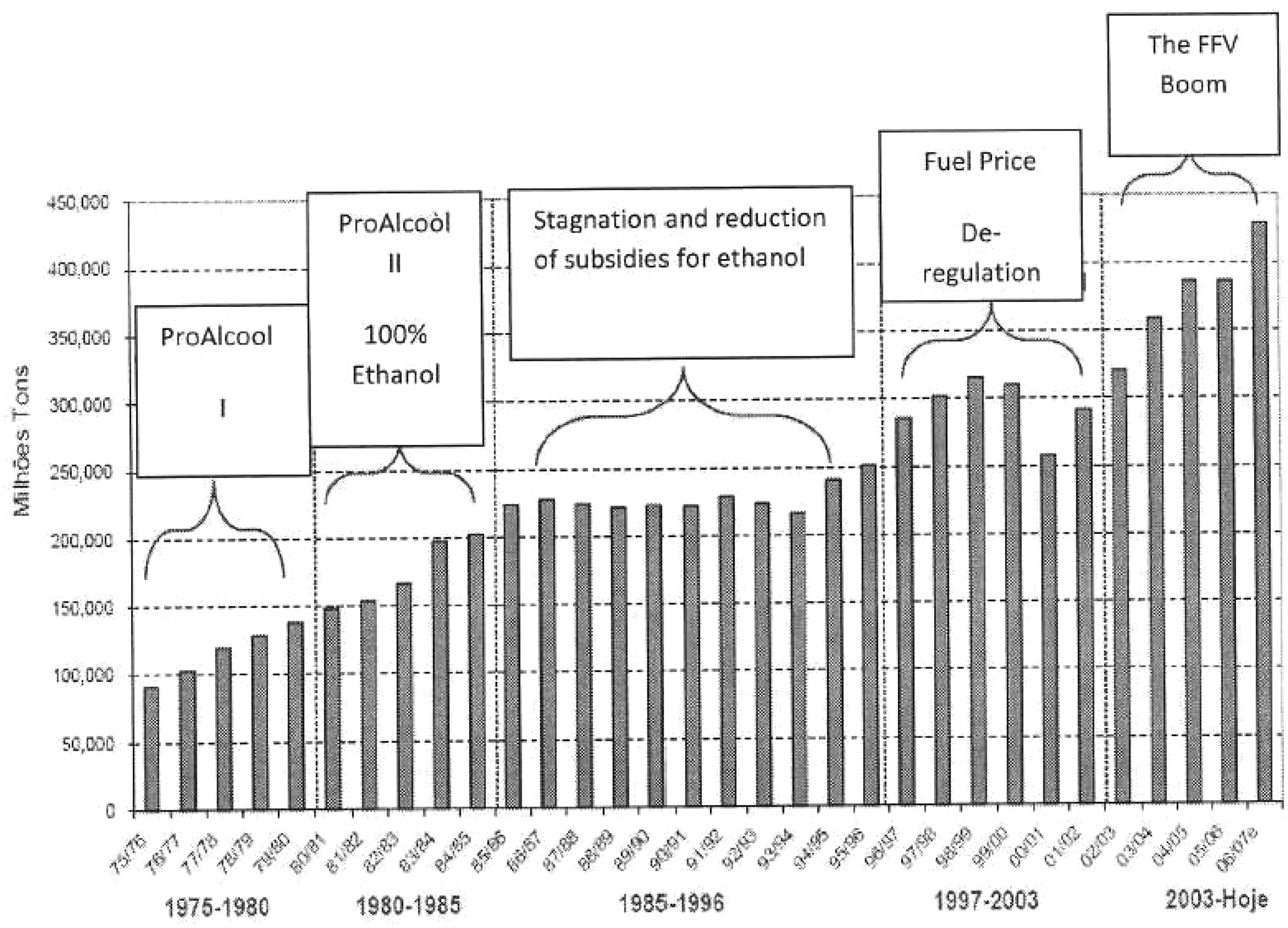
As significant has been the re-orientation of policy goals combining energy security with ecological sustainability. There has been major funding of basic scientific research, often co-ordinated with commercial R&D, with a vision of coordinated innovation from crop, cultivation, biorefinery through to multi-product outcomes. FAPESP, the São Paulo State research funding body, has supported the development of sugarcane genomics (Harvey and McMeekin, 2005), and the development of transgenic and advanced hybridization technology sugarcane in the technology cluster near the University of Campinas (notably Alellyx and Canavialis). Dedini developed world leadership in biorefinery engineering, with advanced operations producing surplus electricity from bagasse, as well as fertilizer from vinasse (previously a pollutant to the water-table). The production of electricity for the grid (bio-electricity) has quadrupled between 1995 and 2005, now yielding 3 per cent of the total electricity supply. Dedini, supported by FAPESP, has been operating a commercial demonstration plant for ligno-cellulosic bioethanol with Copersucar since 2003, producing 5000 litres per day. At the same time, even while retaining sugarcane as a primary feedstock, there has been political stimulation of greater experimentation in crop characteristics, biorefinery outputs, and vehicle manufacture. The guiding political orientation of these initiatives is now strongly governed by both climate change mitigation and renewable energy supply: ecological and economic sustainability for transport energy. As Mathews has pointed out, one of the conditions of developing a biofuels futures market, now established in Brazil, has been quality assurance and standardization, including regulation for sustainability (Mathews, 2008). Biofuel production in Brazil entered firmly into the perspective of greenhouse gas mitigation and biodiversity protection.
Lula then also initiated a biodiesel programme, which had the joint aims of diminishing Brazilian dependence on imported diesel, developing new technologies and crops, and specifically targeting poverty reduction for small farm holders (Wilkinson and Herrera, 2008). Petrobras was assigned the role of guaranteed purchaser in auctions for a variety of crops (jatropha, castor, soy) from small holders, especially in the north-east. In order to develop this market, again with a long-term vision, mandates, now dropped for ethanol, are imposed for biodiesel, with a 2 per cent blend required for 2008, rising to 5 per cent in 2013, under the 2005 National Programme for the Production and Use of Biodiesel (De Sousa and Dall'Oglio, 2008; Pousa et al., 2007). However, to date, this early experimentation with novel crops and technologies for biodiesel remains marginal compared with the dominant technology of biodiesel from soy (Wilkinson and Herrera, 2010).
The Food-Climate Change Imperative
Ironically, this failure of Lula's biodiesel programme for crops other than soy has contributed to the emergence of the third horn of the trilemma, the food-climate change challenge. As a food-energy crop of major global significance, soya has been one of the most significant sources of deforestation in the Matto Grasso, the famous ‘arc of fire’, along with slash-and-burn expansion of cattle farming. As Nepstad et al. (2006, 2008) and Hecht (2005) have indicated, direct land use change, arising in part from the global market demand that has now placed Brazil in the position of a leading soya and meat exporter, has been by far the most significant component of Brazil's agricultural carbon footprint. In the period of the Cardoso government, and under the Washington Consensus, this market-led expansion of food production exemplified the challenge of Brazil's third horn. This was in contrast to the biofuels programme with its strong political direction, innovation and expansion of soya and meat production, involving major multinational companies as well as Brazilian large agribusiness, which for two decades developed in relatively unregulated market conditions.
However, for many of the same political and environmentalist concerns now required by global trading of biofuels, Brazil has also been developing sustainability regulation for food production, in a variety of ways. Although climate change mitigation joins with biodiversity protection and protection of indigenous peoples' rights to land and water use, political direction of market development, especially through sustainability regulation, has marked the last decade. Most notably, the zero deforestation policy, considerably strengthened in May 2011, and reinforced by some quite vigorous enforcement by IBAMA (Instituto Brasileiro do Meio Ambiente e dos Recursos Naturais Renováveis) and the military, has resulted in a remarkable reduction in rates of deforestation in recent years. Many factors may have contributed to this reduction, in addition to the use of carbon offset trading (the Reduced Emissions from Deforestation and Degradation and REDD+ schemes adapted from the Kyoto Protocol) (Hall, 2008; Bellassen et al., 2008). These political strategies for shaping market development have been described as the Brazilian Workers Party's ‘tropical Keynesianism’ (Hecht, 2011). From the standpoint of this paper's analysis, the distinctiveness of this type of regulation is that land resource finitudes are being defined politically, for reasons of climate change mitigation. The availability-to-use finitude of land as a resource may never have been a purely physical characteristic of land mass, but new climate change parameters now inform regulations permitting or restricting land availability for agricultural use. More generally than anti-deforestation measures, which are not only driven by climate change mitigation, sustainability of some key ‘trilemma’ crops, especially those which are multi-purpose food-energy crops, has emerged as a matter of concern. So, in conjunction with biofuels sustainability certification, both major market actors and some environmentalist NGOs, such as WWF, have been promoting sustainability regulation for the food chain, albeit unevenly and without universal or uniform standards, exemplified by the Roundtable on Sustainable Soya, or the Better Sugar Initiative (Wilkinson, 2011). Both government policy and social movements are responding, however partially and marginally, to Brazil's distinctively developing trilemma dynamics. But, to stress again the unevenness of trilemma developments and responses to them, sustainability food regulation and roundtables are yet on the horizon for poultry farming and marginal for cattle production – in spite of their significance for greenhouse gas emissions.
Summarizing the emergent trilemma and responses to it in Brazil, a number of key features stand out. First, there is uneven development of the different horns of the trilemma, as well as the way they conjoin in distinctive ways over time. The dominance of energy security and development, which saved Brazil $69 billion in oil imports for the duration of the ProAlcool programme (De Almeida et al., 2007), became entangled with controversies over land-use change. Eventually, a strongly environmentalist agenda promoted the further development of renewable transport energy. Through a particular linkage, mediated by the soybean, the climate change dimension of its cultivation spilled over into the much wider issue of greenhouse emissions arising from direct land-use change for food and normal practices of agricultural cultivation. So soybeans as food became problematized and subject to sustainability regulation.
Second, in terms of dynamics, there were sharply contrasting instituted forms of economic organization for biofuels (with a leading role of the state in politically-driven innovation), and for global food markets (especially under Cardoso, where unregulated markets placed Brazil in a leading position in world trade). Long-term political strategy for developing renewable transport energy based on sugarcane, spanning dictatorship and democratization, has placed the country in an enviable leadership role in terms of climate change and green road transport energy. Sugarcane is widely recognized as the most environmentally beneficial resource for renewable transport energy (Woods et al., 2009). However, to stress again the relationship between polity, economy and environment, this is a distinctively sub-tropical political option for restructuring economies of energy. At the same time, radical changes and growth of multi-national involvement, with GM soybean crops, and application of leading-edge industrial agronomies, restructured and developed a distinctive market-organized economy in Brazil.
Third, Brazil can be seen as a locus for developing sustainability regulation, whether in redefining availability-for-use land or in certification of some food crops. However, in addressing climate change mitigation, overall there has been a combination of innovation and regulation, neither one sufficient without the other. Again, the specificities of Brazil need to be stressed, both in terms of the intensifying and the mitigating tendencies of trilemma development. Land conversions of the scale occurring in Brazil are not an option in Europe, and in the USA evidence is of fairly stable, even declining, areas of cultivation – including, for example, for soybeans (Harvey and Pilgrim, 2011). Finitudes of land play very differently in different regions. The Zero Deforestation policy, for the many reasons alluded to above, is a Brazilian response to a Brazilian trilemma dynamic.
Having said that, similar analyses could be made for the USA or Europe, where very different socio-economic and bio-physical interactions, with different carbon signatures, are involved. To indicate just one contrast with respect to the energy-climate change dimension of these trilemma interactions, the USA – with a focus on energy security – places a higher premium on energy autarchy, both in its impressive drive for renewables and with its search for new national sources of gas and oil, using hydraulic fracturing or horizontal drilling for tight oil in North Dakota and Texas. In so doing, it locks the USA into fossil fuel dependency, intensifying the oppositions between different horns of the trilemma. For many European countries, energy autarchy, whether by means of renewables or fossil fuels, is not an option.
Finitudes, Transformations and Transitions
The Brazilian example represents an exploratory attempt to develop a neo-Polanyian IEP analysis of the socio-economic and bio-physical environment interactions central to trilemma dynamics. Challenges of ‘peak oil’, food production, land as a resource, and climate change vary importantly from one economy or region to another. To make the very banal but increasingly significant point, it matters greatly how much and where carbon fossil (conventional and unconventional) or land resources are located. There is simply more solar energy available in Brazil than in the temperate North, and that opens possibilities for variation in political-economic trajectories. Moreover, these finitudes are not just physical quanta located in geographical space. As we have seen with land – the original focus of the Law of Diminishing Returns – how much land is available for use has been redefined in certain political spaces by sustainability regulations responding, at least in part, to climate change risks. The 2010 catastrophe of the Deepwater Horizon oil well in the Mexican gulf, or similar events in polar regions, may likewise set political and economic limits to what oil resources may be available to be ‘used-up’. The contrary dynamic of some innovation pathways (fracking, horizontal drilling) opening up resources previously deemed unexploitable may themselves be subject to regulatory limitations of varying rigour in different political contexts. Although the International Energy Agency has significantly revised its view of US energy supply for trilemma dynamics (IEA, 2011–12, 2013), the critical issue is the US political priority of energy security over climate change in determining whether and how much of this resource is exploited. So, again, the critical interaction is between the economy and environmental resources within a political space.
Illustrated by the example of Brazil, a similar argument also applies to food security, and the major trilemma challenge of feeding a global population expected to plateau at approximately 9 billion. Although in purely bio-physical terms, the energy inputs required to produce a given quantity of food are much lower in sub-tropical rain-fed zones (reducing climate change impacts), how and where such food is grown, what lands are converted to what uses, becomes critically important, and increasingly subject to politically strategic responses to climate change. The finitude of land in terms of availability for use is becoming – however tardily and inadequately – politically redefined in terms of what use, what agronomies, rather than use in the abstract. The choice between slash-and-burn and sustainable intensification – to counterpose two extremes – is a political as much as a technological one, as is evident already from the political regulations in different regions for the use of GM technologies. Certain lands are available for certain uses (GM soya, cotton, corn, etc.) in some regions, not in others.
The argument is not that finitudes are politically constructed, let alone discursively construed. There are natural ‘givens’ open to some political circumscription in varied triangular relations of polity-economy-nature in different material environments. The argument in this paper is nonetheless that this conceptualization of resource finitudes significantly changes perspectives on limits to growth by placing them within the varied dynamics of these triangular relations as they develop in different regions and nations across the globe. The dynamics are not uniform and global, however much the planet and its atmosphere are shared by the world's peoples. Although gases and world demand for oil may aggregate, it is critically important to disaggregate the dynamics that generate them.
In closing, the neo-Polanyian approach illustrated here is far from fully developed in relation to the theoretical challenge for understanding interactions between political economies and natural environments. To emphasize this incompleteness, it is useful to point to some key missing dimensions yet to be addressed. First, the analysis needs to address issues of resource depletion in a more fundamentally comparative way, in terms of the located finitudes of resources and the significance of the material rootedness of economies in their natural environments. Second, in abandoning anthropogenic in favour of sociogenic climate change, the IEP framework needs to address the developing dynamisms which produce the markedly varied carbon signatures of different nations and regions. The very different political challenges for climate change mitigation in Brazil, the US, Europe, China, India, Africa … are embedded in these contrasting polity-economy-nature relational spaces and dynamisms. The analysis needs to be complemented by natural scientific analysis of the impacts of these different trajectories as they develop. Third, the Brazilian case is marked by a radical political change of regime, and of politics within a democratic regime. The different political institutions and politics in the USA, Europe, and China, for example, themselves may condition and constrain radical transitions to sustainability, in terms of lock-in or entrapment, in ways that have not been analysed here. Fourth, emergent trilemmas bring to the forefront the nexus of interconnections between food, land, energy and climate change, and the interdependent and antagonistic forces of sustainability transformations and doomed path dependencies. The choice is not to feed the 9 billion or develop renewable energy, to mitigate climate change or develop new directions of economic development. To explore these developments, analysis needs to be undertaken at the geopolitical level, incorporating international trade and supranational political regulation and strategic responses to trilemma dynamics. And this list of further dimensions is certainly itself incomplete.
Footnotes
Notes
References
Supplementary Material
Please find the following supplemental material available below.
For Open Access articles published under a Creative Commons License, all supplemental material carries the same license as the article it is associated with.
For non-Open Access articles published, all supplemental material carries a non-exclusive license, and permission requests for re-use of supplemental material or any part of supplemental material shall be sent directly to the copyright owner as specified in the copyright notice associated with the article.
