



Abstract
‘Definition of Heterology’ illuminates sacred, heterogeneous experiences Bataille never stopped interrogating, in their throbbing movement of emergence. Furthering orthodox disciplines in the sciences of man, Bataille accounts for the ambivalent feelings of ‘attraction and repulsion’ at the heart of inner experiences that constitute the heart of his thought. In this paper, I further a mimetic line of inquiry in Bataille studies and argue that the laws of attraction and repulsion that animate heterology find their polarized foundations in the laws of the socius, which are also the laws of imitation understood in its heterogeneous – anthropological, ontological and psychological – manifestations. Paradoxically, heterology, while being the ‘science’ (logos) of the ‘totally other’ (hetero), may point toward an abyssal experience of a communicative homology that has the power to transform impure matters into pure spirits, angelic souls into material bodies.
Keywords
Dire aussi que l’hétérogène est ce qu’on aime ou dont on a horreur … (Georges Bataille, Dossier ‘Hétérologie’)
Virtually unknown during his life, Georges Bataille started to cast a long shadow after his death. Recuperated from oblivion in the 1970s and 1980s by different thinkers we now conveniently group under the heterogeneous category of ‘poststructuralism’, the name of Bataille soon became synonymous with an untimely thinker whose voluntarily disordered thought slipped through stable linguistic oppositions, transgressed the boundaries dividing the margins and the center, the sane and the insane, life and death, the imaginary and the symbolic, and went as far as anticipating groundbreaking theoretical innovations such as the death of the author, sexual transgressions, the mise en jeu of language, and the death of the subject. Thanks to the international influence of figures such as Roland Barthes, Jacques Derrida, Michel Foucault, Julia Kristeva, Jean Baudrillard, and many others who, from different perspectives, all turned to Bataille as a source of theoretical inspiration to move beyond the horizon of structuralism, this side of Bataille is now well-known, has generated stimulating discussions, and has been anthologized (Botting and Wilson, 1997). Less-known is that in the 1920s and 1930s, well before structuralism arrived on the theoretical scene, the young Bataille was simultaneously engaging not only with philosophy (Friedrich Nietzsche) and avant-garde movements (André Breton), but also with emerging sciences of man, such as anthropology of religion (Émile Durkheim), psychoanalysis (Sigmund Freud), and analytical psychology (Pierre Janet), to give form to his formless thought. This simultaneous engagement with the sciences of man allowed Bataille to develop – with and against them – an alternative ‘science’ of what is ‘totally other’ and cannot be reduced to rational discourse, yet, in his view, could be studied nonetheless from the interdisciplinary angle of what he called, oxymoronically, the ‘science of heterology’.
The recently discovered and newly translated ‘Definition of Heterology’, which is not included in the 12 volumes of the Oeuvres Complètes and was first published in French in Chaiers Bataille 1 (Gallaire, 2011), now appears in English for the first time, giving Anglophone readers a privileged access to the theoretical logoi that provide the theoretical foundations of Bataille’s heterogeneous thought. While difference, in its anthropological, psychological, and ontological manifestations, is clearly one of the defining epistemic characteristics of hetero-logy, I suggest in what follows that ‘Definition’ also encourages readers to dig deeper in the theoretical origins of Bataille’s conceptual economy. In particular, this unpublished document reveals the underlying affective sameness that runs, like an undercurrent, throughout Bataille’s entire corpus, introducing fascinating and disturbing continuities at the heart of discontinuities. Bataille not only as a thinker who anticipates post-structuralist concerns with difference, language, and mediation, then, but, rather, Bataille as a pre-structuralist thinker of sameness, affect, and immediacy, a mimetic sameness which is intimately felt in ek-static instants of communication that reveal the contagious, formless, and palpitating homology of heterology. This is, in a nutshell, the hypothesis that leads me to reopen the ‘Dossier Heterology’
‘Definition of Heterology:’ Reopening the Dossier
Bataille’s ‘Definition of Heterology’ shines, like a precious pearl, retrieved from the formless magma of his unpublished papers. Originally conceived as part of a project titled ‘Dossier Heterology’, collected in Volume II of the Oeuvres Complètes, this short, previously unpublished, and impressively dense theoretical ‘Definition’ supplements the ‘Dossier’ by illuminating sacred, heterogeneous experiences Bataille never stopped interrogating, in their throbbing movement of emergence. Furthering orthodox disciplines in the new sciences of man, Bataille accounts for the ambivalent feelings of ‘attraction and repulsion’ at the heart of transgressive experiences whose syncopated movement generates ‘ecstatic horror’. This double movement is, indeed, the beating heart of Bataille’s heterogeneous thought and animates his major theoretical preoccupations: from the sacred to the formless, eroticism to abjection, sovereign communication to inner experience, Bataille will keep following the currents and undercurrents that irresistibly attract humans toward sacred forms of ecstasy, while at the same time generating horror for ek-stasis. A study of this double movement, Bataille argues in an essay written around the same time, titled ‘The Psychological Structure of Fascism’ (1933/34), is especially relevant in a period dominated by fascist leaders endowed with the will power to horrify and hypnotize individual bodies, as well as the entire body politic. There is thus significant hermeneutical potential in this previously unpublished text insofar as it casts new light on Bataille’s untimely effort to provide a theoretical foundation for the psychology of fascism. That is, a psychology of the ‘mimetic unconscious’ whose genealogy, as I have shown elsewhere, stretches from Bataille – via D.H. Lawrence, Conrad, Tarde, and many others – back to Nietzsche’s diagnostic of the power of hypnotic dispossession that haunts, like a phantom, the modern world (Lawtoo, 2013).
And yet, the implications of ‘Definition of Heterology’ cannot be restricted to Bataille’s well-known political preoccupations with monocephalic leader figures in the 1930s but immediately transgress the boundaries between politics and religion, anthropology and psychology, in order to open up heterogeneous questions that inform the general economy of his communicative thought. For instance, ‘Definition’ makes us wonder: How can what is ‘totally other’ and, thus, ‘heterogeneous’ become the object of a discursive ‘logos’ that, by definition, belongs to the sphere of the ‘homogeneous’? How can we know, or feel, the pathos of an ‘other’ whose distance, Bataille says, is ‘absolute’ yet is intimately experienced nonetheless? Above all, why do heterogeneous matters that are ‘holy and unclean’ (Galletti, 2018) both hypnotically attract us and physically repel us, in a double movement that animates what Bataille calls ‘ecstatic horror’ (2018)? These are, indeed, questions that cut through the heart of Bataille’s heterogeneous thought. They are at the center of his most influential theoretical texts, most notably, Inner Experience, Guilty, Erotism, and the three volumes of The Accursed Share, and directly inform Bataille’s conception of the sovereign subject ‘whose exterior objective aspect is always inseparable from the interior’ (VIII 284), as he puts it in Sovereignty. ‘Definition’ is thus an important document, for it lays the theoretical foundations that will culminate in Bataille’s theory of sovereignty. In particular, it helps us understand the complex interplay between the inside and the outside of the subject which is essential to follow the dynamic of sovereign communication at play in his later texts. Given that this is arguably the central concept that sets Bataille’s thought in movement, there are already ample justifications to reopen the dossier on heterology.
But there are others. In fact, ‘Definition’ reveals, more clearly and succinctly than any other text the theoretical foundations of Bataille’s thought by making visible the continuities and discontinuities between heterology and other emerging sciences of man. Bataille, in fact, relies on the insights of pioneering figures such as Émile Durkheim and Sigmund Freud in order to cast new light on the fundamental ‘ambivalence’ sacred experiences generate. Hetero-logy is thus as much an anthropo-logy (logos on man) as a psycho-logy (logos on the soul). But it is not only that. For Bataille, in fact, these scientific disciplines are, volens nolens, complicit with a long-standing idealizing trend in western philosophy that can be traced back to Plato and whose tendency is to exclude the obscure subject matter it attempts to illuminate, freezing the movement of heterology in unitary, ideal, and transcendental forms. Forced to abandon every ‘possible kind of orthodoxy’ (II, 424), Bataille, intellectual adventurer that he is, sets out to develop a new ‘science’ of man that sails across the Scylla of anthropological taboos and the Charybdis of psychoanalytical transgressions in order to navigate the turbulent currents and undercurrents that keep the heart of the sacred beating.
A careful reading of ‘Definition’, then, will take us very quickly to the bottom of Bataille’s communicative thought, encouraging us to retrace its affective and conceptual emergence from the inside out. It also helps us outline an alternative genealogy of the Bataillean subject attentive to relationality, affective continuities, and polarized movements that animate non-verbal forms of communication. More precisely, I suggest that the key to this palpitating movement of attraction and repulsion lies as much in the heterogeneous objects themselves as in a specific conception of the Bataillean subject, a formless (informe), communicative subject that, far from being contained within a unitary substance, or ideal image, is openly in touch with the contradictory ‘emotional currents’ (forthcoming) the heterogeneous generates. As Bataille will later say in Sovereignty, ‘communication’ takes place ‘from subject to subject through a sensitive emotional contact [contact sensible de l’émotion]’ (VIII 287–8). While Bataille insists on the conceptual polarity that sets sacred and erotic matters apart, rendering them taboo, I argue that the polarized movement of his thought transgresses homogeneous conceptual barriers and suggests that, at a deeper level of communication, this so-called ‘totally other’ (tout autre) – be it mud or blood, a leader or a corpse, a newborn or a lover – is intimately rooted into the self, physically and metaphysically tied to its being, so emotionally in contact with ipse that the distinction between ‘self’ and ‘other’, no longer holds. Furthering an emerging line of inquiry in Bataille studies that recognizes the centrality of mimetic identification, affective contagion, and non-verbal communication in the constitution and dissolution of the Bataillean subject (Borch-Jacobsen, 1997; ffrench, 2007; Lawtoo, 2011, 2013), I argue that the laws of attraction and repulsion that animate heterology find their polarized foundations in the laws of imitation (mimesis) understood in its heterogeneous – anthropological, ontological and psychological – manifestations. Mimesis, for Bataille, can in fact not be restricted to a visual and stabilizing economy of representation. Instead, it entails a destabilizing form of bodily communication he will later call ‘sovereign’, for it introduces a general movement of affective participation with privileged others, a mimetic movement that troubles the boundaries of individuation introducing sameness at the heart of difference. As we turn to see, this (mimetic) other participates in a (magical) relation of (sovereign) communication with ipse so profound that an exterior experience gives way to an inner experience, discontinuity of being to continuity of Being. In his ‘Dossier on Heterology’, Bataille, following the French psychologist and philosopher Pierre Janet, will call this heterogeneous other, who is indistinguishable from the self, a ‘socius’ (II, 287).
Paradoxically, then, heterology, while being the ‘science’ (logos) of the ‘totally other’ (hetero), may actually point toward an abyssal experience of mimetic homology, an ecstatic, horrifying, yet sacred homology that escapes homogeneous definitions but has nonetheless the power to transform pure spirits into impure matters, abject horrors into loving angels, thereby bringing Bataille’s polarized thought into being
Polarized Anthropology: Recharging the Sacred
Bataille’s ‘Definition’ immediately places the movement of his emerging thought in an impossible position, generating a double movement that will animate the entirety of his career. In the opening paragraph, in fact, Bataille defines heterology as ‘the science of the excluded part’, by which he means an ‘accursed’ (maudite) part that includes ‘sacred elements’, ‘objects of disgust’ and ‘erotic life’ (2018). This is, indeed, an oxymoronic definition, if only because ‘excluded’ matters (i.e. the heterogeneous) are, by their very essence, inaccessible to the sphere of objectifying ‘science’ (i.e. the homogeneous). Just as light cannot illuminate a shadow, so science cannot cast light on the heterogeneous. The material objects of Bataille’s project and his scientific objective are thus radically at odds, generating a methodological oscillation toward/away from heterogeneous matters that will continue to in-form (i.e. give form to) Bataille’s account of sacred experiences. Whether his focus is on abject objects in the 1930s, on mystical subjects in the 1940s, or on the experience of sovereign communication in the 1950s, Bataille’s thought follows as much what he calls ‘the path of work’ as ‘the path of transgression’ (1986: 261). Hence, this double-path sets up a tension between intellectual distance (logos) and affective proximity (pathos); it also generates a polarized oscillation that reproduces, shadow-like, the double movement sacred matters themselves produce. As Bataille perfectly knows, this paradoxical methodological position is not specific to heterology alone. It also informs increasingly influential sciences of man, such as the anthropology of religion and psychoanalysis, sciences that are equally concerned with the ambivalence of sacred emotions. Bataille’s heterology is thus not naïvely in search of originality. Rather, it emerges from a mimetic, sometimes agonistic, but always productive relation with these neighboring discourses (logoi), scientific discourses whose conceptual limits Bataille will test first and, eventually, transgress.
Bataille’s general debt to anthropology of religion is well known, and heterology in particular has often been approached from a ‘Durkheimian perspective’ (Richman, 2002) that is attentive to the ‘contagious’ (ffrench, 2007: 38) and, thus, ‘mimetic’ (Lawtoo, 2013: 220–33) experiences the sacred generates. ‘Definition’ not only confirms this debt, but also puts us in a position to see how Durkheim’s anthropological contribution to heterology is at least double, and provides both exterior and interior entries for Bataille to further pursue.
On the one hand, Bataille explicitly relies on Durkheim’s account of the sacred in The Elementary Forms of Religious Life (2001 [1912]) as being ‘totally other’ from the profane in order to define the object of heterology from an exterior perspective. In this sense, the sacred (heterogeneity) is approached extrinsically, from the angle of the profane (homogeneity) simply because, for Bataille, as for Durkheim, the heterogeneous is everything that the homogeneous excludes and, thus, is not. Bataille is most Durkheimian in his insistence that an abyssal discontinuity divides the sacred from the profane and, throughout his career, he will remain faithful to this fundamental conceptual opposition. Thus, as he posits not only heterogeneity against homogeneity, but also transgression against taboo, play against work, chance against project, sovereignty against slavery, etc., Bataille continues to operate within the sacred/profane binary he inherits from Durkheim. And yet, it is worth noticing that it is in a relation of logical continuity with homogeneity that heterogeneity acquires, if not a positive, at least a negative definition – an indication that what is defined in terms of clear-cut opposition and ‘exclusion’ is perhaps, to some degree, already implicitly included in the perspective it sets itself up against. This destabilizing possibility is confirmed if we move from the formal, linguistic level (heterology defined in negative terms) to the semantic, material level (heterology defined in positive terms).
In his opening definition, for instance, Bataille states that heterology ‘must establish the laws which characterize the relationships of polarized development of heterogeneous facts with the continuous development of the forms taken by the practicing [i.e. homogeneous] parts’ (2018; trans. modified; my emphasis). Understanding the laws that not simply oppose but relate heterogeneous to homogeneous parts is thus constitutive of heterology itself. And in order to make it clear that the distinction between the homogeneous and the heterogeneous may not be as abyssal as it initially sounds, he specifies: ‘the homogeneous parties present themselves as an ensemble of weakly polarizing phenomena, and the analysis of their composite forms reveals the existence of heterogeneous constituents in a neutralized state’ (2018; my emphasis). In theory, then, Bataille fundamentally agrees with Durkheim that the distinction between the sacred and the profane is not one of degree but of kind, and is thus not relative but ‘absolute’. Yet in practice we begin to sense that the movement of Bataille’s thought cannot fully be contained within this static formal distinction. Not only does Bataille nuance Durkheim’s dualistic position by speaking in terms of ‘relationships’ (rapports) and degrees of polarization; he also ‘reveals the existence of’ heterogeneous constituents’ that are ‘neutralized’, to be sure, but nonetheless present, and can thus potentially be revitalized within the homogeneous.
On the other hand, Bataille relies on Durkheim’s inclusion within the sphere of the sacred of both ‘pure’ and ‘impure’ elements in order to define the movement heterogeneous matters generate from an intrinsic, interior perspective. This second operation cuts deeper into the affective laws of heterogeneity. It no longer defines it in a relation of opposition to homogeneity but zooms in on the heterogeneous itself, focusing on the internal polarization generated by the circulation of energy from purity to impurity, right to left sacred, and vice versa. As Durkheim had already insisted, ‘the pure and the impure are … not two separate genres, but two varieties of the same genre … . With pure, one finds impure, and vice versa’ (2018). And he importantly adds: ‘It is in the possibility of these transmutations that we find the ambiguity of the sacred’ (2018; my emphasis). This is, for Bataille, Durkheim’s essential contribution to heterology. It not only foregrounds the ‘polarized nature of the elements of the sacred’ (2018) that is heterology’s central object of study; it also sets in motion the oscillating transformations between pure and impure, right and left sacred, generating the subjective currents and undercurrents that polarize heterogeneous matters.
Bataille, then, does not simply map the Durkheimian opposition between the sacred and the profane onto heterology from the outside in but, rather, takes hold of Durkheim’s insight into the polarized movement effervescence produces from the inside out. And what he sees in the early 1930s is that this movement generates electrifying transformations between right and left sacred that animate not only religious rituals in primitive, archaic societies, but also, and more problematically, repolarize the body politic in modern, fascist societies. Thus, if Bataille ends ‘Definition of Heterology’ by invoking the ‘prestige’ or, as he also says, the ‘hypnotic’ ‘force’ of the Brahmin, who is the ‘magnetic center’ (2018) of archaic, religious rituals, we should not forget that he also has more modern, political rituals in mind. As he puts it roughly at the same time, in ‘The Psychological Structure of Fascism’, in such modern rituals it is actually ‘the force of a leader [meneur]’, not the Brahmin, that ‘is analogous to the one exerted in hypnosis’ (I, 348). To be sure, the charge of heterogeneous elements at the heart of Europe might once have been ‘weak’ and ‘neutralized’, but in the 1930s they are strong and repolarized. Hence Bataille’s urgent call for a new discipline that studies the laws governing the dynamic relation of continuity between the homogeneous and the heterogeneous. In sum, on the shoulders of Durkheim, but with a wider hypnotic tradition in mind I have discussed at length elsewhere (Lawtoo, 2013: 213–80), Bataille sets out to study the mimetic laws that have the power to recharge the sacred, transforming the peace of modern (homogeneous) societies into the horrors of fascist (heterogeneous) societies.
That said, it is important to notice that, despite his explicit debts to anthropology of religion, Bataille also marks his distance from his intellectual father figure and the discipline he represents, as he specifies that Durkheim did not go far enough in his exploration of the polarization of the sacred. As he puts it: ‘Although Durkheim did not neglect the polarized nature of the elements of the sacred, he did not feel able to assign them an important role in his theory’ (2018). Consequently, Bataille claims that Durkheim is partially responsible for ‘the classic confusion between unclean and profane’ (2018), a confusion later accentuated by members of Durkheim’s school. As Bataille makes clear, anthropology is a scientific logos in line with ‘purifying developments’ (2018) that exclude impure, magical elements from the sacred, relegating them to the profane. In an emancipatory, anti-mimetic move, then, Bataille outlines a fundamental différend between heterology and anthropology. And he does so to reintroduce a base, material impurity into an idealizing, anthropological tendency that freezes the movement of the sacred in pure, ideal forms.
In a way, Bataille’s heterogeneous thought comes into being precisely in his attempt to regenerate a polarity which, for him, is missing in the science of anthropology but functions as the beating heart of the sacred itself. In the following passage we see the return of unclean, heterogeneous matters on the theoretical scene, emerging from the shadow of a purifying, homogeneous tradition that sought to exclude them. ‘The confusion between the unclean and the profane’, writes Bataille, ‘is one of the fundamental principles of any purifying development, looking to leave behind the religion of the original sewer, in which the sludge itself was sacred. It gradually becomes necessary to devalue the mud and that is why we call it profane’ (2018).
The language here is already characteristically Bataillean; and so is the movement of his thought. Bataille, in fact, counters an idealizing confusion that purges the idea of the sacred from impure, abject matters. As this passage indicates, these excluded, ‘accursed’ (maudite) parts comprise ‘mud’ and ‘sewers’, but he also adds: ‘leftovers, litter, nail clippings and cut hair, faeces, foetus, garbage’ (2018) – the latter being ‘ingredients used by witches’ (2018) in their magical participations.
The reason Bataille wants to include these abject matters and the magic that animates them within the sphere of the heterogeneous is clear. For him, the double movement of attraction and repulsion at the heart of the heterogeneous depends precisely on the systolic and diastolic interplay between right and left sacred, pure and impure matters. Without the experience of rejection heterogeneity generates, there is no polarity within the sacred; and without polarity, there is no possible ‘transmutation’ between high sacred and low sacred or, as he also says, between what is ‘pure and impure, angelic and obscene’ (2018). Bataille’s theoretical operation, which will drive his entire thought, is already present in embryo here. It consists in repolarizing the sacred so as to render it sacer again, that is, both holy and accursed. And by doing so, he sets in motion a palpitating double movement between high and low sacred, generating a circulation of affective energy whereby impure matters turn into pure spirits, beautiful angels into obscene bodies.
Lawtoo, Didon 2016. ©P. Bailly-Maître-Grand, The Flies, 1987 (Galerie Michèle Chomette).

But Bataille’s operation touches deeper. In fact, his recuperation of the impure within the sphere of the sacred entails an immanent move that brings human beings back in touch with the muddy origins from which they stem, introducing a sacred continuity at the heart of profane discontinuities. Paradigmatic examples of heterogeneity such as ‘nail clippings and cut hair, faeces, foetus’, etc., are, indeed, excluded in disgust and subjected to different forms of social taboos in profane periods of homogeneous stability. And yet, at sacred times, these abject elements are nonetheless materially included in heterogeneous, destabilizing ritual practices that recognize them as constitutive of the human subject itself. Notice in fact that these abject products are not only originating from accursed bodily parts; they also include the original material out of which the subject, as foetus, grows. What is excluded, then, is actually already included within the very subject that operates the exclusion. If we peel off the first layer of straightforward formal discontinuity we find a material base of continuity that traces ‘nail clippings’ back to fingers, ‘cut hair’ to heads, ‘faeces’ to bowels, the ‘foetus’ to ipse. It is thus no accident that these taboo elements are also the ingredients witches use in their practices, magical practices whose goal is to generate transgressive forms of ritual participation that break down the boundaries of individuation. As Bataille learned as an ‘apprentice sorcerer’ (I, 523) from Hubert’s and Mauss’s theory of magic (as well as from Frazer and Lévy-Bruhl), ‘magic takes place in a sacred world’ in which figures loaded with the ‘force of mana’ trigger ‘a spiritual action at a distance that is produced between sympathetic beings’ (Mauss and Hubert, 1995: 105). Heterogeneous matters, then, introduce not only unclean (physical) continuities but also sympathetic (spiritual) continuities at the heart of ‘absolute’ discontinuities, generating a sense of what Bataille, following Lévy-Bruhl, also calls ‘mystical’ participation with the world (I, 347). Similarly, as Bataille will later say, in Erotism, at sacred or erotic times taboos are indeed transgressed; and out of this transgression a ‘discontinuity’ of beings turns into what he calls a ‘miraculous continuity between two beings’ (1986: 19) – or, more generally, ‘continuity of being’ (p. 16).
As the language of ‘being’ suggests, and the scope of heterology confirms, this double movement of attraction and repulsion is not without destabilizing ontological effects: if it explicitly reintroduces mystical transformations that, for better and worse, recharge the sacred, it also implicitly throws mud on an entire classic tradition that conceives of being in terms of pure, ideal forms.
Muddy Ontology: Un-forming Idealism
At stake in Bataille’s quarrel with an idealizing tendency in the anthropology of religion that excludes the impure is not only a redefinition of what the sacred ‘is’ or should ‘be’ but also, and more fundamentally, a philosophical interrogation of the ontological foundations of being itself. Bataille’s general anti-idealism is well-known given his genealogical alignment with figures like Nietzsche; but this newly discovered ‘Definition of Heterology’ provides a timely occasion for clarifying the specific ontological implications of Bataille’s longstanding fascination for formless matters that cannot be framed in ‘essentialized fixed terms’ (Krauss, 1996: 98). If we have seen from an anthropological perspective that heterogeneity (the sacred) introduces mimetic continuities between human beings, we now turn to see from a philosophical perspective that it also introduces a mimetic continuity at the very heart of being.
Bataille’s inclusion of impure matters within the sacred overturns a metaphysical tradition that privileges luminous, ideal forms over dark shadows without form. This metaphysical inversion is already at play in his claim that the exclusion of the impure from the sacred is symptomatic of ‘any purifying development, looking to leave behind the religion of the original sewer (cloaque initiale), in which the mud (boue) itself was sacred’ (2018; trans. modified). As these abject images suggest, for Bataille, the origins of our being and, by extension, of being tout court, do not stem from pure, ideal forms but, rather, from impure gaps without form. As he puts it, the ‘need to idealize traditional forms’ (2018) and exclude these accursed parts is symptomatic of a ‘classic confusion between unclean and profane’ (2018) that is endemic to Western thought itself. The exclusion of the fact that inter urinas et faecis nascirum is, indeed, a locus classicus: from Plato to Augustine, and, more recently, Freud to Lacan, different metaphysical systems have set up ideal images, forms, or statues to reflect on where humans originate, who they are (or should be), and where they are going. Heterology shatters these purifying ideas.
It is true that in ‘Definition’ Bataille does not explicitly engage with the philosophical foundations of Western idealism, addressing only its recent ‘scientific’ avatars. But it is equally true that the paradigmatic examples of heterology indicate an underlying dialogue with a much more ancient tradition, a classical, metaphysical tradition whose ideal forms Bataille sets out to deform or, better, un-form. As he puts it, in a much-quoted paragraph on the ‘formless’ (informe) discussed in ‘Dictionnaire critique’ in an issue of Documents: formless is not only an adjective having a given meaning, but a term that serves to bring things down in the world, generally requiring that each thing have its form … . In fact, for academic men [hommes académiques] to be happy, the universe would have to take shape [prenne forme]. All of philosophy has no other goal … On the other hand, affirming that the universe resembles nothing and is only formless amounts to saying that the universe is something like a spider or spit [crachat]. (1929: 382; 1985: 31) Front cover, ©Bois and Krauss, 1997. Untitled. ©Michaela Lawtoo.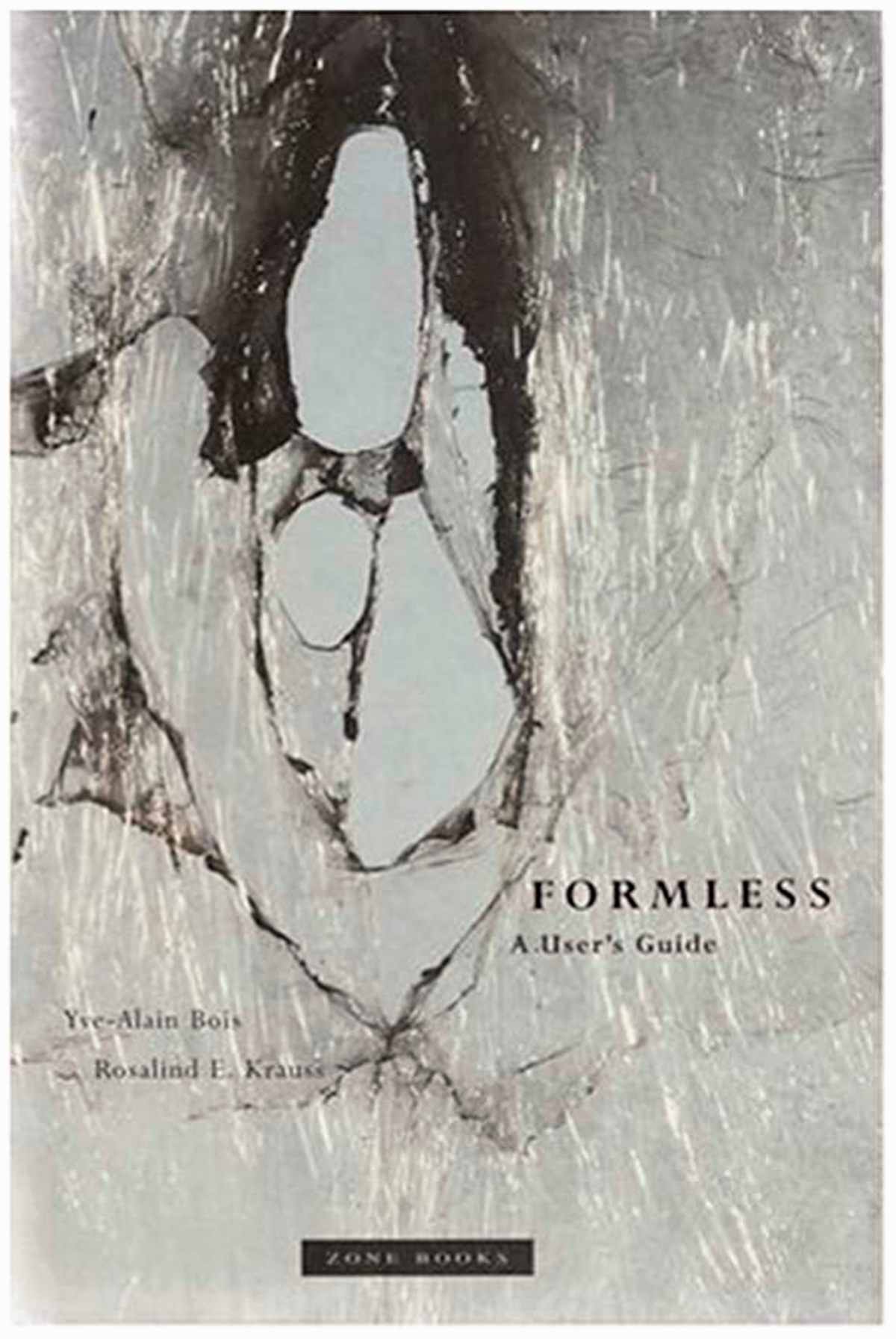

This paragraph has attracted much attention within avant-garde circles, inspiring important exhibitions (Bois and Krauss, 1997) grounded on a ‘gay science of the image’ (Didi-Huberman, 2003). What we can add is that Bataille’s aesthetics of the informe performs a materialist heterology whose ambition is to ‘bring things down into the world’, thereby countering an idealist ontology of pure forms at work in ‘all of philosophy’. Clearly, then, heterology and the formless conception of the universe it entails is tightly linked to a larger critique of metaphysics that thinks of the origins of being – what he calls here ‘the universe’ – in unitary, intellectual forms, rather than muddy, formless matters. And as the anti-academic tone of this paragraph suggests, the origins of this philosophical tradition can be traced back to that homo academicus par excellence who is, of course, Plato. After a confrontation with the father of anthropology of religion, a brief dialogue with the father of philosophy will allow us to see how deep the anti-idealist foundations of the newly born ‘science’ of heterology go.
The base, materialist spirit of Bataille’s definition of heterology is clearly anti-Platonic in conceptual orientation, but when it comes to the movement of his thought, matters are far from being clear-cut, and underlying mimetic continuities emerge between Bataille’s materialist heterology and Plato’s idealist ontology. In Parmenides (1961a), for instance, a notoriously hermetic yet founding dialogue in Western metaphysics, the ancestral father of ontological thought, Parmenides, sets out to interrogate the foundations of Socrates’ (Platonic) theory of forms. Let us briefly recall that in Plato’s transcendental metaphysics, immanent, plural phenomena (phainomena) are modeled on a corresponding, singular form in the transcendental sphere of ideas (eidos), an intelligible sphere in which sensible phenomena are said to ‘participate’ via the medium of imitation (mimesis) – that is, by ‘being made in their image’ (1961a: 927). From the outset, however, Parmenides is not at all convinced that ‘forms themselves’ can be neatly peeled away from the material phenomena that mimetically ‘participate’ in them. Thus, he asks Socrates a series of materialist questions that resonate strikingly with Bataille’s heterogeneous concerns with formless matters. Let us listen to a part of this dialogue: Parmenides: [Is there] a form of man, apart from ourselves and all other men like us – a form of man as something by itself? Or a form of fire or of water? Socrates: I have often been puzzled about those things, Parmenides … Parmenides: Are you also puzzled, Socrates, about cases that might be thought absurd, such as hair or mud or dirt or any other trivial and undignified objects? Are you doubtful whether or not to assert that each of these has a separate form distinct from things like those we handle? Socrates: Not at all. In these cases, the things are just the things we see; it would surely be absurd to suppose that they have a form. All the same, I have sometimes been troubled by a doubt whether what is true in one case may not be true in all. (1961a: 924; my emphasis)
To be sure, more than two millennia later, as Bataille explores the muddy waters of heterogeneous matters, he is certainly not concerned with what the world thinks. On the contrary, he turns precisely to such ‘undignified objects’ in order to subvert a longstanding metaphysical tradition that considers base phenomenal matters as a debased imitation of ideal forms. That Bataille, in ‘Definition’, is implicitly engaging with the same ‘academic’ tradition he denounces in ‘Dictionary’ is confirmed by the shadow of mimetic language that frames his recuperation of impure matters within the sphere of the sacred. For instance, he writes: [T]he role of the heterology consists precisely in taking out from the shadows [ombre] what they had made horrible, and to do that it first had to remove as explicitly as possible a confusion that had resulted from protection from all investigation for the very thing [chose même] that had for humankind immeasurable importance. (2018)
The ‘origin’ of our being, which, for Bataille, is the ‘very thing’ (chose même) – he does not say the ‘thing itself’ (chose en soi) to avoid the idealizing tendency he seeks to overturn, preferring to speak of the ‘original sewer’ (cloaque initial) (2018) instead – has indeed been relegated to the world of mimetic ‘shadows’ by an ontological tradition that privileges dignified, unitary forms over and against undignified, formless phenomena. Thus, in Book VII of the Republic, Socrates famously described phenomena as mere ‘shadows cast from the fire on the wall of the cave’ (1961a: 747). Bataille, on the other hand, like other figures of Nietzschean inspiration, continues to be haunted by illusory ‘shadows’ or ‘phantoms’ whose originary nature has progressively been rendered ‘unintelligible’ by a Western ‘need to idealize traditional forms’ (2018). Thus, he specifies: By moving away from these unpleasant phantoms [phantasmes], a new purpose was realized: the unspeakable sense of ecstatic horror, which is at the root of religion as well as erotic activity, was rendered unintelligible, as were polarization phenomena as their heterogeneity increased …(2018; trans. modified)
Bataille’s concept of ‘phantom’ should not be confused with a psychological phantasm here. As was already the case with his references to ‘shadows’, it stems from the same philosophical tradition that relegates unformed matters into a cavern of darkness. Thus in Book X of the Republic, as the maddening question of mimesis returns to haunt the philosophical scene, Socrates describes the world of phenomena as mere ‘phantoms’ (phantasma) and the world of art as ‘an imitation of a phantasm’ (p. 823) three times removed from reality. In sum, Bataille’s playful relegation of the homo academicus’ ‘need to idealize’ to the illusory world of ‘unintelligible shadows’ or ‘phantoms’, far removed from the ‘original sewer’ out of which we are born, is wrapped up in deep layers of (Socratic) irony. In a deft metaphysical move, Bataille turns mimetic ‘shadows’ into ‘original’ realities, the ‘sewer’ into something ‘originary’, while at the same time relegating the ‘need to idealize’ to what he significantly calls a place of ‘darkness’.
And yet, Bataille does not paint the world in black and white. Despite the violent, idealist exclusion of the low (formless) sacred from the high (formed) sacred, the movement of Bataille’s heterology indicates that there is no simple opposition between light and darkness, pure ideal forms and impure material phenomena, but a mimetic continuity instead. Just as a shadow cannot easily be detached from the form that casts it, so the formless side of the sacred cannot easily be detached from the formal side that rejects it. In fact, it is precisely through this ‘classic’, ‘purifying’ exclusion, Bataille suggests, that the origins of our being are ‘made horrible’. And, conversely, he says that ‘the role of heterology consists precisely in taking out from the shadows [ombre] what they [the idealists] had made horrible’ (2018; my emphasis). For Bataille, then, the purifying movement of exclusion of heterogeneous matters into a cavern of ‘shadows’ is far from remaining unstained. On the contrary, this idealist move is directly responsible for generating the muddy ‘horror’ it seeks to keep at bay, unwittingly contributing to the movement of attraction and repulsion it attempts to freeze.
Paradoxically, then, Bataille finds in Plato’s idealist ontology an inversed, mirroring counterpart of the movement of heterology. That is, a transformative movement in which an originary experience turns into a formless shadow, a pure intention into an impure effect, ideal forms into muddy sewers, angelic spirits into abject bodies. Perhaps, then, at stake in Bataille’s move is not only a metaphysical inversion that posits formless matters over and against ideal forms; nor solely a psychological diagnostic that shows the impure, material consequences of pure, rational reflections (though it is both). It is also a heterological realization that despite their absolute otherness, formless, abject matters are nonetheless intimately connected to the origins of our being – if only because, for Bataille, it is from a formless ‘universe’ in general, and from bleeding ‘wounds’ in particular, that human beings both originate and continue to participate.
We are now in a position to confirm the destabilizing effects of heterology whereby we started. If the rigor of orthodox science Bataille inherits from Durkheim’s anthropology of religion forces him to set up a radical conceptual difference between the sacred and the profane, the ontological undercurrent that animates the movement of Bataille’s heterogeneous thought transgresses the neat positivistic distinctions on which he relies. ‘Definition of Heterology’, in fact, not only cuts through homogeneous disciplinary traditions, spilling over to contaminate the ontological foundations of Western idealism; it also melts the formal boundaries of heterogeneity itself, generating inclusion and continuity at the heart of exclusion and discontinuity. This also means that, for Bataille, the ‘study of human polarity as an autonomous science’ (2018) is predicated on the realization that oppositions, no matter how ‘absolute’, are never static and unmovable, but entail a transformative polarization that turns polar opposites into mimetic polarities. And if this was true for anthropological and ontological polarizations, we now turn to see that it is equally true for psychological communications.
Transgressive Psychology: Communicating with the Socius
Eroticism, phantasms, and the ambivalence generated by sexually oriented bodily matters; Indeed, as Bataille unfolds his definition of heterology, sailing away from the idealism of anthropology, while deftly avoiding the whirlpool of Platonic ontology, he is nearing yet another disciplinary shore that turns sexual taboos into a privileged object of inquiry: i.e. psychoanalysis. Heterology’s proximity to psychoanalysis was already latent in Bataille’s suggestion that rationalist exclusions are responsible for turning heterogeneous matters into something abject and horrible – what psychoanalytic critics will theorize under the rubric of ‘the powers of horrors’ (Kristeva, 1982). But Bataille makes this connection manifest as he says that psychoanalysis ‘reaches directly to eroticism, genitalia and excreta’ (2018), which is the sphere of heterology as well. Like heterology, psychoanalysis focuses on the impure, excluded matters at the ‘root of religion as well as erotic activity’ (2018). And, again like heterology, psychoanalysis is concerned with the contradictory double movements generated by irrational, emotional currents. Thus, Bataille acknowledges that in Chapter 2 of Totem and Taboo (1940 [1913]), titled ‘Taboo and the Ambivalence of Emotions’, ‘Freud speaks of attraction and repulsion’, giving the example of the ‘neurotic fear of touching and the desire to touch at the same time’ as an indication of a type of psychic ambivalence ‘causing nausea and erection, disgust and love at the same time’ (2018; see Freud, 1940: 48–54).
At first sight, the psychoanalytical concept of ‘ambivalence’ seems to offer a privileged door to account for the movements of repulsion and attraction taboo subjects generate. As Freud makes clear, such an ‘ambivalent attitude toward … taboo prohibitions’, characteristic of so-called ‘obsessional neurotics’ and ‘primitive people’ (1940: 54), has ultimately its origin in an unresolved Oedipal conflict. Sexual desire for the parent of the opposite sex, the story goes, generates a rivalrous hostility towards the parent of the same sex who is perceived as an obstacle, and as this conflict between the pleasure principle and the reality principle is internalized into a psychic conflict between the ‘id’ and the ‘superego’, we have what Freud calls ‘the prototype of the ambivalence of human emotions’ (1940: 91–2) – alias the Oedipus complex. From this ‘prototype’, then, Freud extrapolates an anthropological theory that, in illo tempore, the same desire led young ‘savages’ to the actual murder of the ancestral father figure in a sacrificial transgression responsible for the emergence of taboo prohibitions and, by extension, religion and culture as a whole. As Bataille faithfully reports, for Freud, what is at stake in this original transgression is a ‘‘projection of unconscious hostility that the children had nourished against the dead parent during his lifetime” (2018; see Freud, 1940: 77). With psychoanalysis, then, heterology seems to have reached the bottom of the affair. Bataille, in fact, touches a discipline that not only makes the sphere of the impure its privileged object of scientific investigation, but also individuates the very origins of the ambivalent oscillation responsible for the polarization of erotic experiences.
And yet, having travelled so far, Bataille is extremely careful not to frame the movement of heterology within neat, prototypical (i.e. triangular) forms, lest he reproduce the idealist movement he has been deftly averting all along. Bataille’s suspicion of psychoanalysis – what he also calls in Sovereignty ‘la pensée abstraite’ (VIII, 18) – is expressed at different points in his work, but ‘Definition’ shows how deep his anti-Oedipal critique of Freud actually goes, clarifying the fundamental différend that divides heterology from the science of the unconscious. Bataille, in fact, specifies that psychoanalysis is based on a ‘default method (which, besides, is not clean since borrowed from general scientific method)’ (2018), and compares Freud’s homogeneous approach to the one of ‘the chemist or the physiologist working in their laboratories’ (2018). That is, scientific figures that do not follow the flow of blood that animates living organisms but dissect dead bodies instead. For Bataille, this methodological distance is responsible for the fact that ‘Freud did not happen to consider unclean objects as a specific reality’ (2018) and, consequently, missed the very origins of the ambivalence he set out to illuminate. It is thus no accident that Bataille sardonically speaks of ‘psychoanalysis’s impotence (impuissance)’, deriding the castrating methodological effect of applying a homogeneous scientific method to heterogeneous sacred matters. Finally, for Bataille, the perverse effect of framing ‘primitive’ people’s sacred emotions in an Oedipal account of ‘obsessional neurosis’ confined to familial, pathological dramas renders Freud seemingly ‘unaware that [in the 1930s] human life in its totality has become a function of demented reactions’ (2018). We can thus understand why in ‘Dossier Heterology’ Bataille insists that heterological investigations ‘are to be opposed to the theme of Oedipus’ (II, 171). This is a firm and decisive claim. It clarifies, once and for all, that no matter how close to psychoanalysis Bataille might seem at first sight, heterology, and the conception of the unconscious it presupposes, is radically ‘opposed’ to the founding Oedipal theme on which psychoanalysis, in its Freudian, Lacanian, or other derivations, ultimately rests.
In sum, if anthropological idealism struggled to exclude impure subject matters whose polarization generates the very heartbeat of the sacred, psychoanalysis freezes the circulation of blood that animates mimetic and erotic feelings in prototypical forms. Heterology counters both these rationalist traditions as it acknowledges that ‘much of the exterior world is irreducible to rational assimilation’ (2018). Thus, Bataille continues to navigate – via a method of inquiry that implicates the observer – the emotional currents and undercurrents that open up the ego to its erotic and ecstatic outside.
As we have now come to expect, Bataille’s references to the father of psychoanalysis are not simply antagonistic, but serve a double diagnostic operation: symptomatic of a psychoanalytical impotence to account for the ambivalence of heterogeneous objects, the case of Freud also provides a springboard for immanent and material operations into heterogeneous subjects. Here is a Freudian diagnostic that gestures toward a heterological backdoor Freud himself did not actually open, but gives us access to the unconscious sources of the emotional currents we have been following all along: ‘The corpse, the newborn,’ he [Freud] said, ‘women in their state of suffering, attract by their inability to defend themselves, the individual who has reached maturity and sees this as a source of new pleasures. That is why these people and these states are taboo.’ (2018)
The corpse, the newborn, and the suffering woman: what could these heterogeneous subjects possibly have in common? Freud’s explanation is typical: it is their shared vulnerability, their ‘peculiar helplessness’ (1940: 55), their openness to being violated, that generates an ambivalent feeling of attraction and repulsion, opening up transgressive ‘new pleasures’ to be later repressed by social taboos. This is, indeed, a classical psychoanalytical explanation that frames the movement of heterogeneous affects within the Oedipal ‘prototype’ Bataille warns us against. What, then, we may wonder, is the Bataillean alternative to access the labyrinth of the unconscious?
In ‘Definition’, Bataille does not open this door completely, but he offers us a key. In order to capture the unconscious sources of heterological polarization it is necessary to situate these Freudian examples within the mimetic currents and undercurrents that inform the general economy of Bataille’s thought, while at the same time supplementing a definition Bataille left partially incomplete. We have seen so far that what is totally other and discontinuous at the level of science (work) might intimately be the same and continuous at the deeper level of communication (transgression). We have equally seen that the ingredients witches and sorcerers use in their magical rituals (nails, hair, etc.) are not only in a direct physical continuity with the body, but also in a spiritual participation with the soul, going as far as touching the ontological origins of being itself.
Untitled. ©Anick Pillionnel. Untitled. ©Anick Pillionnel.
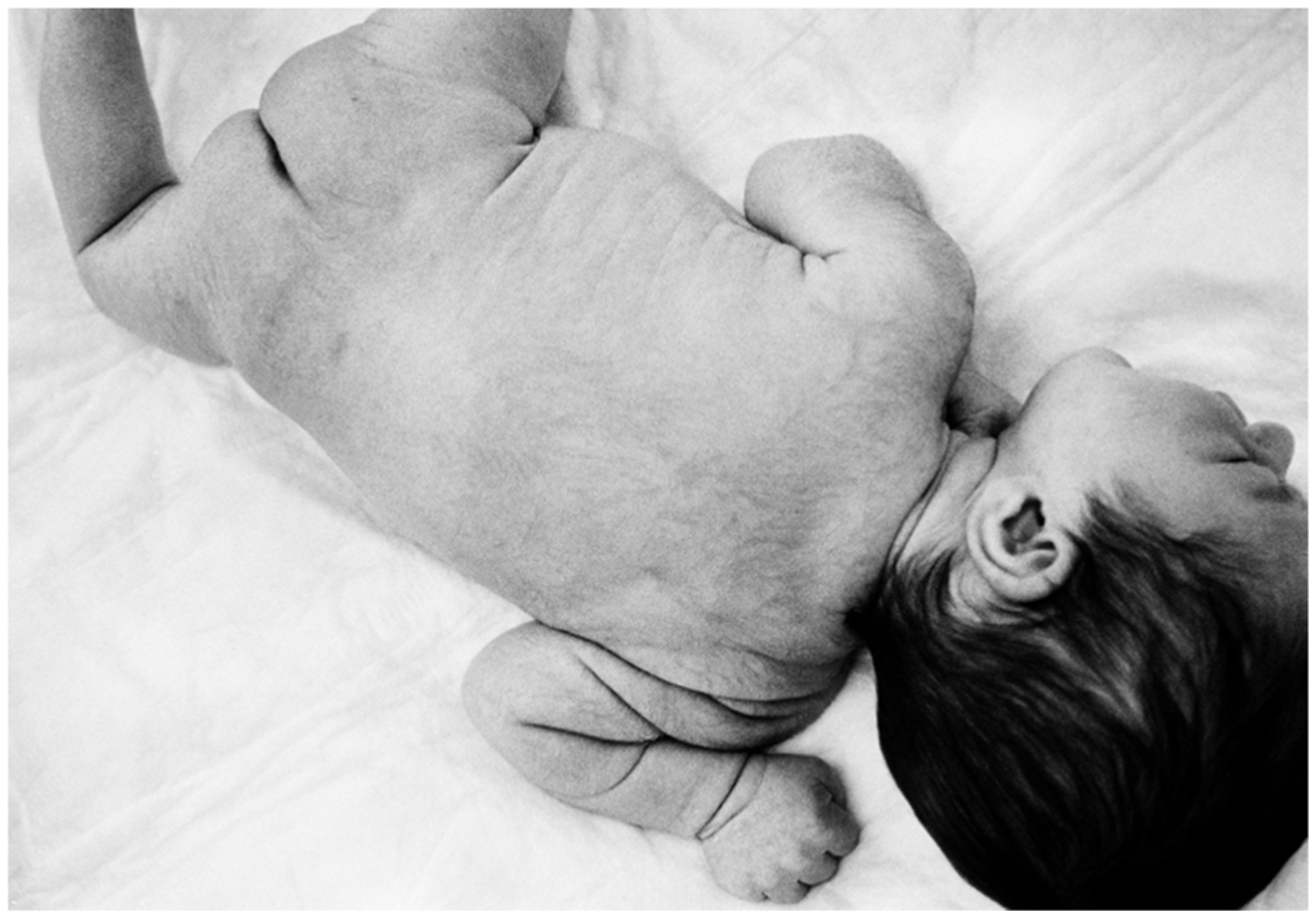
What we must add now is that this mimetic continuity at the heart of human beings is even more intimately experienced with the three taboo cases mentioned above (corpses, newborns, suffering women). The repulsion and attraction they generate should in fact not simply be defined in terms of a ‘peculiar helplessness’ that opens the door to Oedipal pleasures (Freud, 1940: 55). Nor should our emphasis on mimesis lead us to automatically think in terms of a mimetic ‘identification’ with an image (Lacan, 1966: 94); or, alternatively, of a ‘mimetic desire’ in which ‘mimesis’ determines the object of desire (Girard, 1977: 146). Rather, these examples are defined by an intrinsic feeling of mimetic participation generated by the fact that this heterogeneous ‘other’ is not simply ‘totally other’ but is also experienced as being intimately the same – what Bataille, following the French psychologist and philosopher Pierre Janet, also calls a ‘socius’.
Due to the shadow psychoanalysis cast on competing figures, Bataille’s debt to Janet has so far been left largely unexplored. Yet Bataille was well-read in Janet’s analytical psychology and even collaborated with Janet by serving as the vice-president of the Society of Collective Psychology, presided over by Janet. In a lecture for this short-lived society in 1937, for instance, Bataille relies on Janet’s ‘psychology of the socius’ in order to go to the origins of the ambivalent feelings of attraction and repulsion generated by heterogeneous others that trouble the boundaries of individuation. He writes: ‘Janet insisted on the fact that the individual subject’, as he is caught in the movement of sacred communications, ‘is not easily distinguished from the fellow creature with whom he is in rapport, from the socius’ (II, 287; Janet, 1938: 145). The socius, then, as a distinct figure who is ‘not easily distinguished’ from the ‘individual subject’ opens up a mimetic continuity, or better, a ‘rapport’, at the heart of discontinuity. And specifying this opening, Bataille adds a heterogeneous touch to Janet’s definition as he adds: ‘the dead is a socius, which means that he is very difficult to distinguish from oneself’ (II, 287). This is indeed a strange claim to understand, especially in technologized, homogeneous societies where corpses tend to be excluded and confined to profane institutions used to keep the feeling of sacred horror at a distance. Yet, as anyone who has experienced the loss of someone dear intimately knows, the death of the other is very difficult to keep outside – for her pathos is felt inside.
Thinking of death, Bataille will also later speak of a ‘gulf which separates us’ (1986: 12), yet he immediately adds, ‘death is hypnotizing’ (p. 13), suggesting the possibility of a mimetic union. The corpse might thus be excluded in its physical manifestation as corpse, but as socius she is immediately included in a ‘rapport’, a hypnotic rapport generating what Bataille will also call a ‘passage, communication, but not from one to the other insofar as the one and the other have lost their distinct existence’ (1954: 74). This also means that the dead qua socius might indeed be ‘totally other’ from the exterior point of view of homogeneity (science), but from the interior perspective of a transgressive communication (heterology) this other is actually difficult to disentangle from the ego. The socius, then, is a mimetic other who is formative of ipse, but not in the homogeneous sense that she reflects a unitary image in a mirror, or directs desire in yet another structure of rivalry. Rather, she is mimetic in the heterogeneous sense that her hypnotizing effect transgresses neat distinctions between self and other, inside and outside, introducing an affective continuity whereby ‘human unity’ is unformed – or as Bataille figuratively says, is ‘shattered like glass’ (p. 7). In sum, the socius is not the origin of an ideal, representational form, but of a formless bodily communication; she does not freeze the ego in a unitary imago but opens up the boundaries of individuation, allowing the communication of mimetic affects to flow.
I have shown elsewhere that Janet’s ‘psychology of the socius’ informs not only the entirety of Bataille’s heterogeneous thought (Lawtoo, 2011) but also opens up an alternative, mimetic backdoor to the unconscious, I have called the mimetic unconscious (Lawtoo, 2013: 260–80). Following up on this dossier, we should notice that Bataille moves from the figure of the ‘dead’ to the one of the ‘newborn’ as paradigmatic case of communication with a socius. In Collège de Sociologie, for instance, specifying the laws of heterology, Bataille explains that it is because the ego of a newborn is still formless that it is open to sovereign communications with that other/socius, par excellence, that the mother is. Bataille was in fact quick to recognize that from the very first weeks of life, newborns are open to non-linguistic forms of mimetic communication that turn exterior affects originating in the other into inner experiences that animate the self. For instance, speaking of that contagious affect which is laughter, Bataille says: ‘A child, who is a few weeks old, respond[s] to an adult’s laughter’ (in Hollier, 1995: 107). Along similar lines, but thinking about the origins of feelings of disgust, he writes: ‘During the formation of behavioral attitudes in childhood, the act of exclusion is not directly assumed. It is communicated from the mother to the child through the medium of funny faces [grimaces] and expressive exclamations’ (II, 220). And in Erotism, still thinking of children, he specifies that we ‘have to teach them [disgust] by pantomime’ (1986: 58), suggesting that even such visceral affects as disgust do not originate in the subject herself but emerge from a mimetic reproduction of the facial expressions of the other/socius. An unconscious reflex triggered by a external expression of attraction (laughter) or repulsion (disgust) is thus at the source of a polarized emotional experience within the subject; the affect of the other/socius is not only reproduced but also felt, experienced, as the affect of the self/ipse.
This heterogeneous view of pre-verbal, unconscious communication flies in the face of the homogeneous doxa that dominated the 20th century and considered that imitation was a belated, Oedipal phenomenon; yet it anticipates by nearly a century empirical, mimetic discoveries that are now informing educated readers in the 21st century. Recent experiments in developmental psychology have in fact confirmed the presence of mimetic responses in newborns that allow them to reproduce facial expressions less than an hour after birth (Meltzoff and Moore, 1999). And the discovery by a group of Italian neuroscientists in the 1990s of ‘mirror neurons’ (initially found in monkeys and later found at work in humans as well) that fire not only when we enact a movement but also when we observe someone else’s movements or expressions, provides a materialist, neurological ground for such mimetic expressions.
Mirror neurons are, in fact, responsible for unconscious forms of imitation that can communicate basic emotions such as ‘disgust’ via the simple observation of ‘facial expressions’ (Wicker et al., 2003: 655). The most philosophically inclined among these neuroscientists go as far as claiming that mirror neurons ‘may provide a key neural mechanism for understanding the mental states of others’ (Iacoboni, 2008: 33), opening up the realization that unconscious forms of mimesis (i.e. the mimetic unconscious) play a crucial role in the formation of human behavior and, more generally, in the ‘shaping of civilization’ as a whole (Ramachandran, 2011: 117–35). Thanks to the mimetic effect of mass media, these discoveries are now well-known. Less-known, however, is that Bataille’s heterology, while not concerned with homogeneous proofs carried out in laboratories, anticipated some of these mimetic claims by nearly a century. Familiar with a long tradition in mimetic theory – from Plato to Janet – and attentive to the formative power of mimesis in the birth of the ego, Bataille did not make much of what is now hailed as an original, even revolutionary discovery. Instead, he modestly couched his groundbreaking heterological observations in the language of the mimetic unconscious by saying: ‘I have thus only stated in other terms the well-known principle of contagion, or if you still want to call it that, fellow feeling, sympathy’ (in Hollier, 1995: 109).
After this detour via the laws of imitation responsible for affective communications with a socius, we should be in a better position to address the third and last case of heterology: the suffering woman. When Freud speaks of ‘die Frau in ihren Leidenszustanden’ (1920: 44) he might actually be alluding to the pain of menstruation, a bodily production which is traditionally included among taboo, heterogeneous objects. And yet, since the focus is on the suffering subject herself, we should be careful not to objectify our interlocutor and essentialize our mimetic diagnostic, if only because suffering [Leiden] transgresses gender barries in order to open up the self to a suffering that takes place with the other [Mit-Leid]. That this case can be diagnosed from the perspective of the psychology of the socius is clear. In both its physical and psychic manifestation, suffering is a contagious affect that communicates itself mimetically, from self to other, introducing an affective continuity at the heart of discontinuity that is experienced from the inside. Thus, in the experience of Mitleid or sympathy (sym-pathos, feeling with, not feeling for) with a suffering woman, or man – why be biased? – the ego is caught in a relation of communication so profound that the distinction between self and other, inside and outside, my pathos and sym-pathos, no longer holds. As Bataille will specify later in his career, such an other allows me to ‘participate in his emotion from inside myself. This sensation felt inside me communicates itself to me’ (1986: 153). The subject who speaks from ‘inside myself’ is thus not myself, and yet an experience in which the heterogeneity of what is supposedly ‘totally other’ turns into an intimately felt homology of what is experienced as radically the same.
We should now better understand why in the midst of writing what is arguably his most influential work, Inner Experience, Bataille stated: ‘Then I started reading Janet, imagining it necessary to use his subtlety in order to go further’ (V, 430). Indeed, in Janet’s much-neglected (some would say excluded) psychology of a socius who is oneself, while being someone other, he finds a subtle tool to diagnose the laws of imitation that underlie his persistent fascination for sacred forms of sovereign communication. Whether he speaks of the self in terms of a ‘space of communication, of fusion between subject and object’ (p. 21) in Inner Experience, of an ‘interpenetration (contagion)’ that opens up ‘the passage, the fall of one’s being into another [la chute d’un’être de l’un dans l’autre]’ (V, 392) in Guilty, or of ‘our obsession with a primal continuity linking us with everything that is’ (p. 15) in Erotism, he is consistently referring to the experience of mimetic homology generated by heterogeneous and, thus, sovereign communications with the other/socius. This is why, he, Bataille, in a confessional mode, goes as far as saying: ‘I cannot distinguish between myself and those others with whom I desire to communicate’ (1954: 55).
In sum, the corpse, the newborn, and the suffering (wo)man are paradigmatic examples of heterogeneous subjects and should be considered as ‘totally other’ from the mediated perspective of ‘discursive knowledge’ (1954: 11). Yet, as anyone who a lost a loved one, loves a newborn, or has made a lover suffer, intimately knows from the experience of what Bataille calls ‘emotional knowledge’ (p. 11), these others, far from being ‘totally other’, engender what Bataille calls a ‘fusion, precarious yet profound’ (1986: 20). This fusion, Bataille specifies, melts the unity of the ego, dragging it back to a type of muddy and originary, yet ek-static homology in which the ego can no longer be contained in neat, ideal forms and is rendered formless and precarious instead. Hence, the experience of communication with the socius introduces a polarized attraction, a passage, in which self and other are no longer on the boat of individuation but slide (glisse) in the currents and undercurrents of the ocean itself, ‘two waves losing themselves in the neighboring waves’ (1954: 64). Be it at political meetings, at a funeral, in childbirth, or in a lover’s bed, the subject is magnetically, or as Bataille likes to say, ‘hypnotically’, attracted towards an experience with the socius that merges the ego in a ‘primal continuity linking us with everything that is’ (1986: 15). Until the very end, Bataille will continue to insist that we are irresistibly attracted by heterogeneous communications because ‘we yearn for our lost continuity’ (p. 15).
And yet, precisely because of the socius’s fatal attraction toward the ecstatic sphere of communication, ipse also shivers with an originary terror that violently swings her in the opposite direction, lest she lose her identity in a formless experience of self-dissolution. Hence this communicating subject is not only radically pulled toward originary experiences with others qua socii who have the power to open up the channels of the ego to its unbounded outside; it is also pulled away from it, horrified by the possibility of a permanent loss of identity in a muddy pond without form. We can thus better understand why Bataille, at the beginning of his career, as he is about to open his ‘Dossier Heterology’, jots down a reminder for himself on his notes that reads: ‘say also that the heterogeneous is what we love and what horrifies us’ (II: 171). We can also understand why many years later, as the end is nearing, he echoes the following reminder for others: ‘We ought never to forget that in spite of the bliss love promises its first effect is one of turmoil and distress’ (1986: 19).
If heterology generates ambivalent feelings of attraction and repulsion, then, the origins of this double movement do not stem from the vulnerability of the object alone, nor from the openness of the subject alone, but from the irresistible currents and undercurrents of sovereign communication that open up the ego to the sacred ecstasy of eroticism, while making it shiver in front of the terror of death. That this deeply subjective experience touches the heart of the matter is confirmed, one last time, toward the end of ‘Definition’. There Bataille specifies that ‘this ambivalence inherent in the sacred things has not only the effect of tearing apart the feeling of which it is the object, it rips apart as well the sacred itself’ (2018; my emphasis). In this final heterological incision, the sacred is indeed ripped apart – so that its palpitating heart can keep beating.
We were wondering how a ‘science’ of heterology is at all possible; how Bataille manages to access the sphere of what is ‘totally other’; and what are the laws that govern the movement of ‘attraction and repulsion’. We are now in a position to see that Bataille’s heterology may appear impossible from a purely homogeneous, scientific perspective that considers the sacred from without. Yet it is rendered possible by a heterogeneous perspective that adopts anthropological, ontological and psychological lenses to consider the homology of heterology from within. What appears other and excluded from an exterior, scientific perspective actually turns out to be intimate and included from an interior, affective perspective; what is discontinuous in the path of work is continuous in the path of transgression. This is also what Bataille himself suggested, in a truncated footnote whose formless logic it has been this essay’s goal to patiently recompose: [I] expressed the impossibility of a science of the excluded or heterogeneous part, but in practice? It is not necessary to take into account the fundamental difference from the point of view of knowledge, between the excluded part and the mode of exclusion; and it is easier to speak of the science of the heterogeneous: this fiction can only cause inconvenience if one has not indicated it from the outset [The sentence stops here] …(2018)
Indeed, the ‘fiction’ of a science heterology can only ‘cause inconvenience’ if one does not take into consideration what Bataille indicated from the outset: namely, that heterology ‘refers’ to what he classes as ‘lived states [états vécus]’ and its method of investigation rests on ‘lived, affective experience’ (I, 339, 348; Bataille’s emphasis). And as he will continue to emphasize, heterology is not only a science based on discursive ‘knowledge’ of a rational logos; it is also, and above all, a science based on the ‘practice’ of a felt pathos. From this ‘practical’ angle, the absolute otherness of the heterogeneous might actually be less other than ‘the point of view of knowledge’ (or work) thought it to be – if only because from the point of view of ‘lived experience’ (or transgression) this other qua ‘socius’ is in a homologous continuity with the ego qua ‘ipse’.
I have argued that the laws of heterology are tightly intertwined with the laws of imitation, in the sense that mimesis – conceived not as homogeneous representation, but in its heterogeneous anthropological, ontological and psychological manifestations – reveals the underlying homology of being that, at sovereign instants of communication, opens up ipse, for better and worse, to the experience of what is totally other, yet is intimately the same. For Bataille, it is because our muddy origins are in a relation of mimetic continuity with our universal destiny that we remain intimately fearful, yet radically open to the ecstatic and squandering horror these heterogeneous forces generate. This is the beating heart that keeps Bataille’s sacred thought in motion, a communicative, oscillating, and above all palpitating thought that realizes, time and again, that what is most distant and totally other (heterology) may actually be closest and intimately the same (homology).
From the systolic and diastolic interplay between sameness and difference, logos and pathos, work and transgression, the homology of heterology must thus be constantly renewed, in a life-affirming operation that keeps transforming impure bodies into pure angels – the horror of death into the ecstasy of love.
Footnotes
Acknowledgements
I would like to thank the Swiss National Science Foundation for funding my research at Johns Hopkins University, Hent de Vries for inviting me to present a version of this paper in The Humanities Center, and everyone who attended – including Paola Marrati, Michael Fried, Rachel Galvin, Ruth Leys, Yi-Ping Ong, Esa Kirkkopelto, Anne Moss, Richard Macksey, and many others – for their valuable feedback and communal support. Roy Boyne I thank for his (un)timely decision to edit this special section, and Mikkel Borch-Jacobsen for playing the passeur. Last but not least, I am deeply grateful to the artists–Patrick Bailly-Maître-Grand, Michaela Lawtoo, and Anick Pillionnel–for granting me permission to reproduce their work, and for giving aesthetic form to formless, sacred, and quite sovereign experiences.