



Abstract
The theory of numbers, the theory of computation and well-known biological and neurological studies on cognition and consciousness all indicate the concept of recursion as their common denominator. Mathematical recursion owes its meaning and properties to a dual relationship between its results, which always constitute a sequence, and the operator that generated them, which is instead invariant. This article proposes that this duality in recursion originates from the duality between the biological homeostatic equilibrium in living systems and the adaptive physico-chemical changes required to sustain such equilibria. Such duality gives order and meaning to the experiences of a living system. One of the many implications of this innovative perspective is that this duality can decouple computational results from our intuitive order relations, and that this can cause a rarefaction of the capacity of digital systems to convey communication and favour adaptation to the environment.
Introduction
Digital society has made the man-machine relationship a daily and omnipresent reality. Influential analyses (Lash, 2007; Hayles, 1999, 2014) point out that, today, hegemony is no longer disputed or exerted on the grounds of epistemology, categories and discourses, but rather in terms of performativity and direct interaction with technology. The degree of integration between digital systems and human beings is such as to induce a rethinking of concepts like those of man and consciousness. This article aims to find the means of probing in a deeper and more detailed way the relationship between man and machines – in particular digital machines – and does so starting from an element that is common to both biological and algorithmic systems: recursion. Intuitively, it can be said that recursion consists of nesting and variations on nesting. 1 More specifically, the defining characteristic of a recursive process is that it takes its own output as the next input in a loop that can operate as long as one wishes for creating sequences of unbounded complexity (Moore and Mertens, 2011; Odifreddi, 1989).
Although the notion of recursion given above is rather generic, it should be immediately apparent that it is built on two inseparable elements: an operator, which is something that circularly acts upon its own results, and the product of this action, that is, the sequence generated by the repeated operator applications. The duality ‘operator-results’ in recursion is the central theme of this essay. All the arguments developed herein maintain that this duality is indissoluble in biological cognition, but it can decouple and become idiosyncratic when cognition is governed by non-biological systems. Mathematical recursive functions have already been related to biology and digital systems in the so-called ‘second wave of cybernetics’ (Hayles, 1999; Hui, 2019). Yet in this work, the attempt is to go deeper into the concept of recursion, considering the relationship between the operator and its results as an analytical reference. In order to investigate the operator-result duality, the ordinal-cardinal duality of natural numbers will also be frequently used.
Before going further, it is important to note that this theoretical proposal does not admit the possibility of a direct action of digital systems on human cognition. Digital systems cannot simply transmit information into a biological system, but only trigger self-adaptive responses in it. For example, Katherine Hayles (2014, 2017) distinguishes ‘cognitive nonconscious’ from conscious awareness. The first would consist of learning processes only based on bodily perceptions occurring prior to conscious knowledge. She proposes the possibility of an action of digital systems on the cognitive nonconscious. This is coherent with ideas presented in this article, but only considering this action as a trigger for self-adaptive response of a biological system and not as direct transmission of information from digital systems to the human body.
The Centrality of Recursion in Computation
The rigorous definition of a recursive function gives the concept of successor a fundamental role. A recursive function is indeed defined in terms of three ‘initial functions’ (also known as base functions) that are the fundamental ‘blocks’ of which any recursive function is made: these functions are named ‘zero’, ‘projection’ and ‘successor’ (Mendelson, 2010: 171; Moore and Mertens, 2011: 223–84). Their names reflect their role in the actual construction of a recursive function. While the zero and projection functions have the task of initializing the process, it is the successor that generates the recursive sequence. This is particularly evident in the construction of ordinal numbers (Corry, 2015: 249–86). If the initial element offered by zero and/or projection functions is labelled as 0, and the successor function as S, the sequence recursively generated by the repeated applications of S is 0, S(0),
The recursive structure of ordinals is confirmed and reinforced in the definition of ordinal numbers based on set theory. John von Neumann (in Van Heijenoort, 1967: 336) gave the following definition of ordinal numbers: ‘Every ordinal is the set of the ordinals that precedes it.’ Looking at how a sequence is made helps in understanding this definition. The rule is that every new set generated must contain all those generated beforehand. The initial term of the sequence is the empty set, which can be indicated by ∅ at step
A brief digression on the relation between ordinal and cardinal numbers is now necessary. If ordinal numbers give the position of an element in an ordered set, cardinal numbers express its numerosity. But this numerosity is formally defined (Corry, 2015: 259–62) using ordinal numbers once again: the cardinality of set X is the smallest ordinal number equinumerous to X. For example, if set X has a cardinality of
Let us focus again on recursive functions in general and on the concept of algorithm. From the point of view of the theory of computation, there is no formal and unique definition of what an algorithm should be. Nevertheless, it is possible to give an intuitive definition by saying that an algorithm is a finite and ordered sequence of operations. This definition should immediately suggest that a recursive function is nothing more than an algorithm, or more precisely, an instance of an algorithm. It is important to note that the notion of algorithm has a significance which goes well beyond that of a computational procedure where numbers appear explicitly. Manufacturing processes, formal organizations, the simple use of a remote control, the hundreds of clicks on digital devices and many other activities are either algorithmically structured or ruled by algorithms (Totaro and Ninno, 2014, 2016; Totaro, 2009). This leads to the conclusion that recursive functions, as an instance of the intuitive idea of algorithm, occur in everyday life.
The theory of computation shows that recursive functions are not the only formalization of the notion of algorithm. One of the most interesting alternatives is the Turing machine (Turing, 1936; Moore and Mertens, 2011: 258–64), which is an abstract computing device whose primary purpose is to establish what ‘computable’ exactly means, and, secondly, what is computable and what is not. Turing showed that his abstract computing machine is not only able to perform manipulation of symbols but can also simulate any other computing machine. In other words, the Turing machine is the conceptual precursor of a programmable machine exactly as modern computers are. Yet, how does the class of problems that are computable with Turing machines compare with recursive functions? This question is answered by two equivalence theorems: ‘Every recursive function f is Turing machine computable’ (Odifreddi, 1989: 54) and ‘Every Turing machine computable function f is recursive’ (Odifreddi, 1989: 99). In other words, if function f is recursive then a Turing machine can compute it and vice versa.
The same equivalence has been demonstrated for all formal devices (algorithm formalizations) so far proposed and is schematically shown in Figure 1.
4
Therefore, all algorithm formalizations are equivalent among themselves, in the sense that what is computable within one formalization is computable within any other. But what makes the recursive function an ultimate reference, a canonical form of calculability, is the fact that for every pair of formalizations there is a recursive function that can translate one formalization into the other (Odifreddi, 1989: 100–1) as schematically shown by the dashed line in Figure 1. Therefore, recursive functions not only constitute the general reference for all formalizations of the intuitive notion of algorithm, but they are also the tools that allow the transition from one formalization to another. The importance and centrality of recursive functions led Alonso Church to formulate the thesis that every effectively computable function is recursive (in Davis, 1965: 100). If this thesis were true, as many believe, any algorithm the human mind can conceive through any device, abstract or concrete, symbolic or mechanical, would always be equivalent to a recursive function (i.e. the dots ending with an n-th computing device in Figure 1).
Schematic representation of the equivalence between recursive functions and other computing formal devices. Each abstract computing device has been proved equivalent to recursive functions, and this is schematized by the full arrows. The immediate consequence of this set of theorems is the equivalence of all the computing devices among them, as exemplified by the dashed line. The dots ending with an n-th computing device are a pictorial representation of the Church thesis stating that any conceivable computing abstract device should necessarily be equivalent to recursive functions.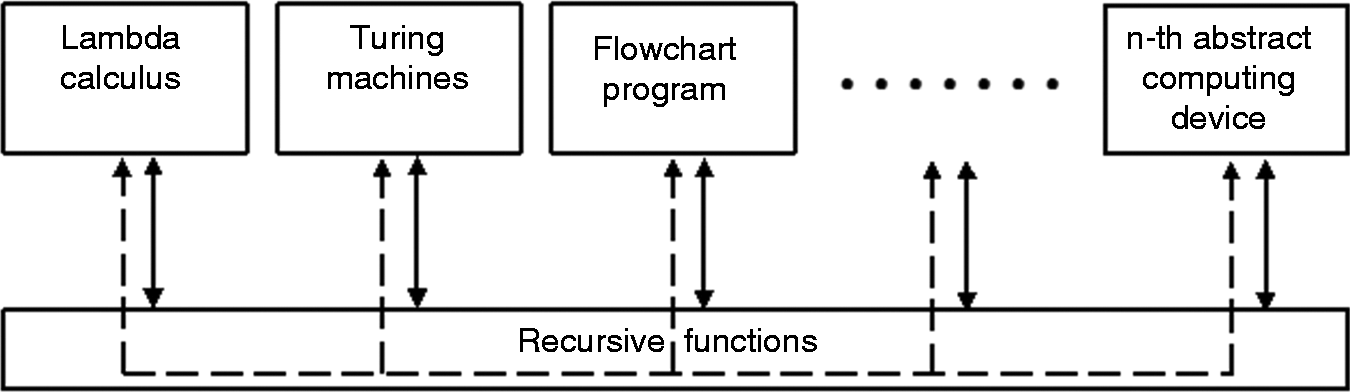
The fact that recursion is the common denominator of all algorithmic devices does not mean that it is a deterministic principle. Contrariwise, recursion is at the basis of the most important problems of insolubility and complexity that contemporary culture has faced. They are generated when a recursive process tries to calculate itself. For example, when a Turing machine calculates itself (self-applied Turing machine), it generates the insolubility represented by the famous halting problem (Turing, 1936). Similarly, Godel’s undecidability theorems can be seen as the result of self-applied recursive processes (Chaitin, 2007). Even the Russell paradox (Russell, 2009) falls into this category, since it is based on the ‘liar paradox’ (does a liar who says ‘I’m lying’ speak the truth or not?). This article does not address this aspect of recursion, which would require a work specifically dedicated to the subject. Here we limit ourselves to effectively executable calculations, to note how their results can be considered both as symbols of the processes that generated them (ordinal view of the data) and as objects taken as they are (cardinal view of the data). Our thesis is that the biological origin of computation is always ordinal, but its results can also be observed in an exclusively cardinal way. It is this difference that can create problems with the growing sophistication of digital devices and the increase in machine-to-machine relationships in computation processes.
Recursion in Biology of Cognition: Maturana
In the introduction to Autopoiesis and Cognition, Maturana (Maturana and Varela, 1980: xix–xx) distinguishes the ‘organization’ from the ‘structure' of a living system: while the organization is circular and invariant, the structure continually and irreversibly changes, precisely to ensure the stability of the organization despite ‘perturbations’ (Maturana and Varela, 1998) from the environment. The structure is made of material components which interact according to the relations specified by the organization. If material interactions within the structure do not take place according to the organization, the living system dies. It is the organization that qualifies the system and identifies it as a unit belonging to a certain type of living system (Maturana and Varela, 1980: xix–xx).
Organization is definitely ‘circular’ and ‘constitutes a homeostatic system whose function is to produce and maintain the same circular organization, determining that the components that specify it be those whose synthesis or maintenance it ensures’ (Maturana and Varela, 1980: 9, emphasis in original). Hence, the living system does not directly experience the environment but its own reactions to environment perturbations, which in turn maintain its equilibrium (Maturana and Varela, 1980: 9–11; 1998). This ‘operational closure’ (Maturana and Varela, 1998: 89, 163–6) of living systems led Maturana (Maturana and Varela, 1980: 8) to state that ‘everything that is said is said by an observer’. Here, he implies that when a living system observes another living system or its own, it maintains and synthesizes the components of its organization, but not the components of the observed system. Hence, the experience is always and only given as a maintenance of the observer’s organization (Maturana and Varela, 1980: 9–12, 26–9).
It is therefore in the organization that one must look for something invariant in cognition (Maturana and Varela, 1980: xx). Yet, an organization is always embodied in a structure and only exists in terms of the material interactions of the structure (Maturana and Varela, 1980: 88–95). The components of the structure are continuously regenerated so that new ones are materially different from old ones, yet functionally invariant. 5
Thus, the material structure varies sequentially and not circularly, as does the organization. Maturana (Maturana and Varela, 1980: 26–7) specifies that the structure changes in neither a circular nor arbitrary fashion, but inductively. If the organization dynamic is circular, its materialization in the structure is ‘historical’. A living system develops (grows) and degenerates (ages) irreversibly even though its organization remains the same. This historicity is specific to recursion. A recursive process produces a sequence in which each term is the result of an identical operation that is reapplied circularly to the result of the previous step in the sequence: Operationally, a recursion occurs only as a historical phenomenon because it is only in reference to a succession of events that the repetition of an operation is a recursion. That is, a recursion is the repetition of a circular process that an observer sees coupled to a historical phenomenon in a manner that he or she can claim that, in the historical flow of that phenomenon, that repetition results in the reapplication of that process on the consequences of its previous occurrences.
6
As we shall see in the next section, Maturana is not the only one placing biological invariance as a crucial reference for cognition and knowledge. The main works in neurosciences dealing with these issues converge on this contribution, although Maturana is rarely mentioned explicitly.
Recursion in the Neurobiology of Consciousness: Damasio and Edelman
Neuroscientist Antonio Damasio (1994, 1999) found a close link between emotion and rationality. The theoretical framework in which he places this association is given by the idea that the reactions of an organism to environmental changes are driven by the need to preserve homeostatic equilibrium (Damasio, 1999: 133–45; 1994: 135). Such reactions are basically emotions which arise involuntarily to induce the body to maintain homeostatic equilibrium in spite of environmental changes. Both in the phylogenetic and ontogenetic sense, these reactions are initially unconscious. Only at a later stage are some of them felt (‘feeling’ of emotion), giving rise to the emergence of consciousness. Simultaneously, mental life emerges in terms of ‘images’ which arise in connection with the feelings of emotions and therefore have implicit positive or negative categorizations according to whether the corresponding emotions constitute responses to favourable or unfavourable changes to the maintenance of vital conditions (Damasio, 1994: 114–64; 1999: 168–94). Thus, images act as ‘somatic markers’ (Damasio, 1994: 165–201) in all decision-making processes. Most of the possible choices presented to the actor are discarded because the images to which these choices are associated constitute negative somatic markers, for they recall negative emotions.
Even rational reflection is conditioned by somatic markers. In abstract rationality ‘they would still act covertly to highlight, in the form of an attentional mechanism, certain components over others’, leading one to choose one reasoning instead of another, or to logically connect some elements and not others (Damasio, 1994: 189–91). Reason is always immersed in feelings and emotions and therefore in the mechanisms of biological regulation (Damasio, particularly 1994: 78–9, 115).
The association of emotion with learning processes has been empirically verified in many cases by Damasio. In this regard we believe it is important to briefly report on a fundamental experiment to which Damasio has dedicated an entire chapter in Descartes’ Error (Damasio, 1994: 205–22). Damasio’s research team put under the following test both a group of patients with lesions to the frontal lobes and a control group composed of ‘normal’ individuals. The test consisted in discovering cards from four decks, called A, B, C and D, from which the patients pick cards. Each of the cards corresponded either to losses or gains of money. Decks A and B were prevalently made of cards with a high pay-out, but also with some of them with very high loss in such a way that the persistent choosing from these decks led to an overall loss. Decks C and D, instead, corresponded to more moderate gains and losses, and overall led to winning the game. Electrodes were applied to the members of the two groups for the measurement of skin electrical conductance which, as the researchers had previously verified, is closely correlated with the emotion aroused by images. While extracting cards from the ‘bad’ A and B decks, the participants of the control group (individuals without brain damage) showed a progressive increase in skin conductance and the persistence of this experience directed them ever more steadily towards decks C and D, eventually closing the game with gains. Contrariwise, the group of patients with damage to the frontal lobes did not show increases in skin conductance and, despite having a clear desire to win, they turned to decks A and B, attracted by the immediate possibility of high gains, which resulted in losing the game. In other words, in subjects without brain damage there was a progressive increase in emotional activity correlated with a decision gradually reinforced by experience and which, in the long term, led to positive results. In patients with lesions to the frontal lobes, instead, there was no increase in emotional activity and long-term orientation changes.
Damasio’s theory suggests that, without emotions, one is unable to look for rules that preserve homeostatic equilibrium. In the described experiment, the ‘normal’ subjects identify the decks of good cards on the basis of a process definable as a calculation, perhaps unconscious. What Damasio shows is that this calculation has as its last reference the body’s reactions tending towards advantageous situations for maintaining homeostasis. Thanks to emotion, something emerges that leads us beyond single experiences in calculating new association rules.
The theories of Maturana and Damasio converge on a crucial point: the stability of functional equilibria within the organism. If in Damasio this component of stability is the concept of homeostasis, in Maturana it is the concept of organization circularity. Neither concept is identified with fixed material elements, but with fixed relationships: stability is found in relationships and not in the terms that they connect. On the contrary, terms are subject to constant modifications that are allowed, provided they foster the stability of vital conditions.
Edelman and Tononi (2000) also converge on this point. Their theory of conscious cognition rests on a neurological phenomenon that they call ‘reentry’. Reentry ‘is the ongoing, recursive interchange of parallel signals between reciprocally connected areas of the brain, an interchange that continually coordinates the activities of these areas’ maps to each other in space and time’ (Edelman and Tononi, 2000: 48).
The integration of brain activities from which consciousness emerges is not coordinated by any particular area of the brain but by a ‘dynamic nucleus’ that is continuously reconstituted through the synchronization of different areas. It is both the result and the cause of reentry (Edelman and Tononi, 2000: 49, 139–54). For each cycle of recursion, the correlations generated between the maps are always new, but the necessity for correlation is constant. Reentry has the stable function of generating synchronization and coordination between maps. It is a biological necessity with circular dynamics that generates a historical sequence. The subsequent forms in which integration occurs between maps constitute such a sequence, while the continuous reconstitution of spatio-temporal correlations between them constitutes the recursion operator.
The next section analyses in detail the relationship between the indissoluble biological link of invariance-historicity and the mathematical link of operator-numbers. This analysis considers historical and psychological research on the origin of numbers and arithmetic calculus. We also present some consequences that can be drawn from our analysis for computer-mediated communication.
Invariance and Change in Numbers
The mathematical definition for the concept of function presents a problem: as an abstract concept, it fails to express the intrinsic generative character of a function. To better understand this point, one must consider this definition: a function is a univocal relation. 7 Now, a relation is any subset of a Cartesian product. A Cartesian product between sets A and B is the set of all ordered pairs that can be formed by associating each element of A with an element of B. Thus, without prejudice to the condition of univocity (i.e. each element of A corresponds to one and only one element of B), a function from A to B is any subset of all these pairs. This definition does not entail a generation from A to B, but any pairing between pre-established terms which are the elements present in A and B.
This definition creates a gap between the general concept of function and a concretely assigned function. 8 Consider the assigned function y = x + 3. It tells us that if x is 2, then y is 5. If we get this result according to the general concept of function, we must know in advance that the pairs (1, 4), (2, 5), (3, 6), (4, 7), etc., belong to the function. Therefore, if x is 2, y is 5 because the pair (2, 5) belongs to the function. In reality, this result is not obtained in this way, but by generating 5 starting from 2 through the operation ‘add 3 to the given number’, where this operation is ultimately based on the successor.
From Galilei (1980: 374–5) onwards, modern scientific thought has avoided asking questions about the ‘essence’ of things to avoid falling back into the tendency towards substantialism of Aristotelian philosophy (Cassirer, 1999). This is probably why researchers have been reluctant to investigate the origin of the concept of function, which in essence seems to be generative. It is never a pairing between given terms, but a rule that generates one term from another. In the case of the function y = x + 3, it is evident that the rule is to add 3 to the value assigned to x. But if we ask what the sum is, we inevitably end up explaining it with the numerical succession and then with the successor operator. Still, the backward process is blocked, since it is impossible to define what the successor operator is, regardless of the numbers it generates. This problem is identical for any other effectively computable function. To continue the reverse search process to investigate what the origin of the successor is, it is necessary to go beyond the disciplinary field of mathematics. In our hypothesis, the successor operator originally relies on the recursiveness of our biological constitution.
Gallistel and Gelman (1992) argue that, even at the preverbal level, the generative operators of numbers underlie the experience of numerosity. They report psychological experiments made on animals and human beings which suggest that quantification is anterior to language and is the result of non-verbal arithmetic operations. They call such preverbal mental entities ‘numerons’. To better explain this idea, they first highlight the distinction between the ‘estimator’ and ‘operator’ processes. The former ‘determines the mapping or reference relations between the numerons and the numerosity to which they refer’. The latter ‘processes one numeron (unary operators) or two numerons (binary operators) to produce another numeron’. In the estimator process, a numeron is a ‘category’ and ‘refers to all sets of given numerosity’. By contrast, in the operator process, numeron is a ‘concept’ and ‘plays a unique role in a system of mental operations isomorphic to at least some arithmetic operations’ (Gallistel and Gelman, 1992: 44).
The reader can see that the distinction between the ‘estimator’ and ‘operator’ preverbal processes corresponds to the distinction we highlighted above between the terms and operator of a function. In one case the numeron is a predetermined category that represents all the sets of a given numerosity; in the other, it is a concept that represents the activity of a generative operator that produces a new term based on previous terms.
The experiments reported by the authors first confirm the existence of entities that represent the preverbal number or what they call the numeron. Secondly, they suggest that the operator process also underlies the estimator process, generating the numeron as a concept, which then represents the reference for the numeron as a category (Gallistel and Gelman, 1992: 47–55). In other words, it seems that even at the preverbal level, the cognition of a quantity must be generated in an ordinal manner and then used in a cardinal way. For the authors, the operator process corresponds to an original neurobiological activity. It would be a result of evolution because of the survival advantages it offers (Gallistel and Gelman, 1992: 46). To use Maturana’s terminology, it would be one of the results of the phylogenetic drift that led to the human biological organization.
The psychological theories proposed as alternatives to that of Gallistel and Gelman favour a ‘cardinal vision’ of the number, as opposed to ‘ordinal’. To use Gallistel and Gelman’s words, they are more oriented towards numeron as a category than as a concept. For example, Stanislas Dehaene (2011: 58) argues that preverbal numerosity is not the result of a generative operator but of direct perception. Certain neurons would specialize in the perception of each concrete numerosity: for example, the numerosity of six items would make a given neuron reach the critical threshold of activity, causing it to produce a discharge that represents the sensation of the numerosity of six (Dehaene, 2011: 17–23). The theoretical hypothesis of Dehaene, like all those oriented towards the cardinality of the number, is hard to reconcile with the view of the living being as a complex system. The idea that numbers are predetermined entities of an external nature, recognized by the nervous system through the specialization of neurons, cannot be reconciled with the concept of cognition based on autopoiesis (Maturana), on self-adaptation of the body (Damasio) or on reentry (Edelman).
The socio-historical development of numbering techniques seems to be consistent with the psychobiological conclusion of Gallistel and Gelman. In his monumental work on the history of numbers, focusing on the relationship between society and the symbolic manipulation of quantities, Georges Ifrah (1998: 20–2) argues that advances in such manipulations always occurred thanks to the concept of order relation. After recalling that numbers have ‘two complementary aspects: cardinal numbering, which only relies on the principle of mapping, and ordinal numeration, which requires both technique of pairing and the idea of succession’, he concludes this quote by stating that arithmetic is based on the concept of ordinality: For whereas in practice we are really interested in the cardinal number, this latter is incapable of creating an arithmetic. The operations of arithmetic are based on the tacit assumption that we can always pass from any number to its successor, and this is the essence of the ordinal concept. (Ifrah, 1998: 22)
Quantitative data is only meaningful if it is ordered, an order that is ultimately due to the recursive trend of the dynamics of our organism. Our experience in general is due to this dynamic, which generates inductive sequences of material changes in the organism to produce our biological balance. Such changes are meaningful; they tie to emotions and feelings only because they represent the way in which the living system keeps the vital equilibria unaltered. This article proposes that the relationship between the successor function and numbers is a variation of the general relationship between the biological operator (Maturana’s organization circularity, Damasio’s vital equilibrium and Edelman and Tononi’s reentry) and its sequential results. Just as an experience would lose meaning without its relationship with the biological operator, mathematical data loses meaning if it is no longer attributable to order relations, which are ultimately based on the successor function. If we have data presented by algorithmic systems without the possibility of inserting it in order relations, it can lose its meaning.
If only ordinal numbers are directly linked to the recursive nature of our biological structure, this could have various consequences on the analysis of digital society. One of these concerns the effectiveness of computer-mediated communication. The basic functions of electronic computation operate according to the logic of cardinal numbers. Electronic operators are defined by pairing predefined terms without using a generative procedure. Improperly but effectively simplified, our biology is ‘ordinally oriented’, while electronic computation is ‘cardinally oriented’. Another way to express the same concept is given by the distinction between syntax and semantics in logic. Syntax is a set of rules for manipulating an assigned set of symbols. Semantics is the meaning a string acquires once it has been assigned an ‘interpretation’ by the symbols (Tarski, 1944). While our biology is based on semantic computation, governed by emotions, feelings and the intuitive meaning resulting from them, electronic devices are based on syntactic computation, obeying pre-established and formally defined rules (truth tables of binary logical operators) independent of the meaning that can be attributed to symbols or their manipulation.
Truth table of logical implication.
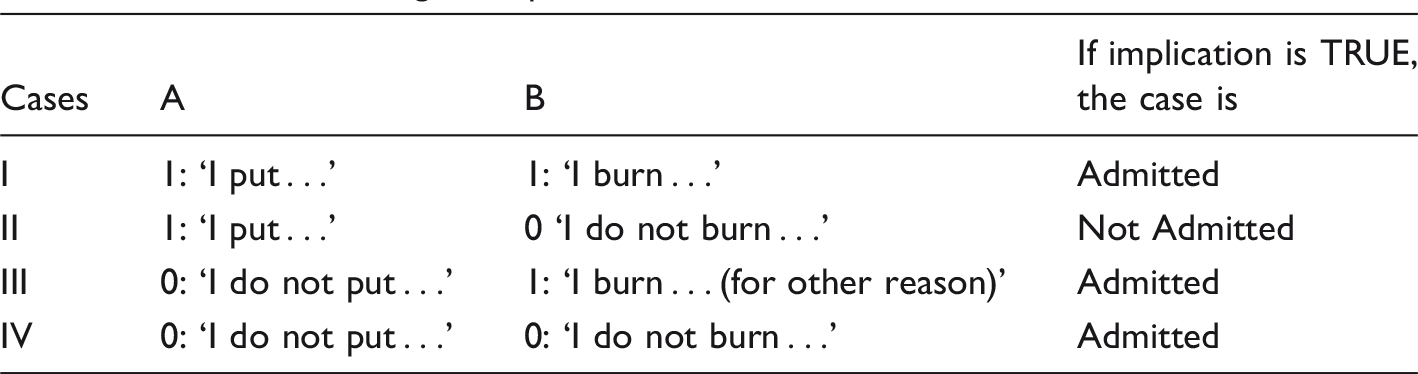
However, it is necessary to specify that in the human-machine relationship, digital calculation can be both cardinal and ordinal. Seen as operations executed by logical blocks, it is a cardinal system, namely a predetermined correspondence between fixed symbols. In fact, by default, only one output represented by ‘1’ or ‘0’ corresponds to each combination of inputs ‘1’ and ‘0’ in each block. But interpreted as a conceptual device (e.g. recursive functions, Turing machine, etc.), digital calculation is ordinal. An example can clarify this point. Let us consider the numerical sequence 1, 2, 3, 5, 8, 13, 21, 34, … Taken as it is, it expresses nothing except the cardinality of its terms. However, if we realize that starting from number 3, each of those numbers is the sum of the previous two (Fibonacci series), the recursive and ordinal nature of the sequence comes to light. When seen as a Fibonacci series, it is clear how those numbers are generated from each other on the basis of the successor concept. However, when we run the program that effectively calculates a Fibonacci series, the computation takes place on a purely cardinal basis, that is, as predetermined combinations of ‘1’ and ‘0’. More generally, we can say that a universal Turing machine (i.e. an operating system) can be considered as an ‘ordinal’ system that is ‘cardinalized’ at the very moment it is effectively executed.
We have therefore clarified how and in what sense automatic information operators work in a different manner than biological ones. Subordination of our lives to computer calculations is not necessarily functional to our biology. Norbert Wiener’s (1954) concern about the fact that human beings must retain their autonomy in regard to these systems cannot be dismissed as ideological, as Katherine Hayles (1999) does. Hayles’ thesis on Wiener’s relationship between human beings and technological products of cybernetics suggests that Wiener had, as an unconscious reference, the typical myth of liberal ideology: an autonomous individual, free in thought and initiative. As a man of his time, Wiener may have experienced this kind of conditioning. However, as our previous analysis indicates, the problem he points out has a real foundation. Hayles (2014: 202–8) cites the theories of Damasio and Edelman as important references and recognizes the centrality of recursion in Maturana’s thesis on living systems, which all focus on the idea that the core of human cognition is our biological homeostatic equilibrium. Therefore, underestimating the need to preserve the natural way to knowledge means underestimating the need to preserve biological vital equilibrium as it is configured in the current state of our species.
Numbers and Communication
The order relation expressed through numbers is an integral part of man’s adaptation to the communicative environment. An anecdote reported by Ifrah (1998: 21) clarifies this statement very well: I once knew someone who heard the bells ring four as he was trying to go to sleep and who counted them out in his head, one, one, one, one. Struck by the absurdity of counting in this way, he sat up and shouted: ‘The clock has gone mad, it’s struck one o’clock four times over!’
The history of modernity has already indicated that this problem exists. The authors (Totaro and Ninno, 2014, 2016; Totaro, 2009, 2016) of this essay argue that, since the late Middle Ages, there has been a progressive penetration of computing logic into practical life, in forms that are in fact algorithmic. This is possible thanks to two different epistemological operations that identified the mediators between the mental world of mathematics and the concrete world of ‘reality’. For the physical and economic world, such mediators are the modern concepts of space, time and exchange value. The role of these mediators is to create a bond between reality and the mental sphere by transforming both physical and economical experiences into mathematical dimensions. For industrial and service organizations, the mediators were instead the formal classifications of people and their actions, according to the typical theoretical systematization called Taylorism (Taylor, 1911). Different from space, time and value, which are pure computational dimensions, namely pure ordinal relations, classifications are ontologically predetermined entities. They have been standardized through operational definitions with the aim of replacing communicative interaction with centralized algorithms, thus applying the logic of computation in this field. Yet the transformation of the workforce into standardized units manipulated by bureaucratic algorithms has separated algorithms from communication. This model, as it is known, generated unsolvable contradictions and is now obsolete (Blau, 1956; Blau and Scott, 1962; Crozier, 1963; Porter, 1985; Johnston and Lawrence, 1988). However, in areas where computation operates as a communication tool, no phenomenon of obsolescence has occurred. On the market, for example, individual actions interact directly with the dynamics of the economy. Market coordination is generated spontaneously as an emerging phenomenon starting from those individual actions. Therefore, individual computations generate a self-organized system that adapts to changes in the same way as living systems (Hayek, 1945, 1952). Unlike bureaucracy, the market does not appear to be in crisis or obsolete, which is due to the fact that, here, computation operates as an instrument of communication.
If in modernity the two opposing actions of recursive systems paradigmatically manifested themselves in two separate areas – market and bureaucracy – today they are converging in the same sphere, that of digital society. The algorithmic systems that mediate social interaction can nowadays drastically reduce and perhaps eliminate the technocratic classification and make the interface open to autonomous user projects (Lanier, 2010), contributing to the development of the open source culture and logic. Instead, we witness the progressive domination of ‘proprietary’ systems – jealously guarded by secrecy – whose purpose is to develop dynamic classifications in which to enclose individuals. The so-called ‘recommendation algorithms’ aim to encapsulate network users in heteronomous interfaces, according to ‘profiles’ that are continually and automatically redefined on the basis of user behaviour. This is the phenomenon that Pariser (2011) called ‘filter bubbles’. In a way similar to bureaucracy, filter bubbles interrupt human-to-human communicative interaction and seek the coordination of human behaviour through subordination to centrally managed algorithms designed by a technocracy.
As Pariser (2011) points out, the consequence is an overall rigidity of the opinions and beliefs of individuals ‘caught’ by the bubble, since their chances of interaction with people of different points of view and attitudes are reduced. In other words: less communicative interaction and greater idiosyncrasy with the environment. The filter bubbles phenomenon potentially affects all search engines and all social networks and therefore a large part of digital society. However, even outside these domains, these characteristics emerge unfailingly when the individual is reduced to an executor in the face of digital processes, as in the case of high-frequency trading.
The event called Flash Crash that occurred on 6 May 2010 has aroused much interest in the role played by high-frequency trading (HFT) on the computerized stock market. Here we have another instance of what can happen when the data is decoupled from its ordinal meaning. The term Flash Crash indicates the following event (Borch, 2016) that upset the American financial market: At 2:40 p.m. on 6 May 2010, the U.S. financial markets went into spasm. In five minutes, overall stock prices fell by over 5 percent, and the prices of many individual stocks fluctuated bizarrely. Shares in the firm Accenture, for example, which had been trading at $40.50, dropped in price almost instantaneously to a single cent. Shares in Sotheby’s leapt from $34 to $99,999.99. Then, almost as suddenly as it had begun, the spasm ended. By 3:00 p.m. overall prices had almost entirely recovered, and something approaching ‘normality’ had returned. (MacKenzie, 2015: 646)
Kirilenko et al. (2014, 2017) have studied in detail the behaviour of HFT during the Flash Crash. In their 2017 article, they have divided the stockbrokers into two types: market-makers and HFT, which are faster and have larger brokerage capacity than the first. They then traced and compared their behaviour in all the movements of the E-mini S&P 500 (the stock that played a central role in the Flash Crash). Their monitoring went from 4 May to 7 May 2010, that is from two days before the Flash Crash until the next day. The result of the study was that in periods of high volatility the volume of HFT movements was statistically correlated with price changes, while that of the market-makers remained stable. The explanation given by the authors for this difference in behaviour was offered in the 2014 article and was reiterated in the more detailed study of 2017. It is based on the theory of limited risk-bearing capacity of intermediaries. Financial intermediaries – which constitute the largest source of market liquidity – buy and sell stocks and then trade them with their customers. This is a risky activity. The principle ruling it is to make a compromise between a) the costs related to the need to always be present on the market to respond as quickly as possible (immediacy) to customer requests and b) the gains that arise from the immediacy given to customers. With the advent of computerized trading, HFTs found themselves benefiting to a significant advantage in giving (but also in asking) immediacy, making the presence on the market for slower traders too risky in periods of volatility, ‘including more traditional intermediaries’. In times of heavy pressure, they no longer reached a compromise between the cost and gain mentioned above: the cost of being always present on the market and the gains that can result from offering immediacy to their customers. They are faced with the prospect of paying high costs for the lack of information on stocks on sale (adverse selection costs) and choose waiting positions. Such wait-and-see can generate liquidity crises like those that led to phenomena similar to that of 6 May 2010.
The HFTs did not cause the Flash Crash and it cannot even be said that they caused price volatility, but they caused both an increase in adverse selection costs for slower or traditional traders and a reduction in the prices of the immediate service offered to customers. This tightens slower traders in the grip of high adverse selection costs – given the lesser information they have on the high-frequency market – and the low profitability of offering immediacy to customers (Kirilenko et al., 2014, 2107). In periods of high pressure, the market no longer operates as a single self-organized system but tends to follow two idiosyncratic trends. The first is generated from high-speed intermediaries which have the ability to follow price changes. The second trend is constituted of slower traders, which are forced to choose waiting positions. High-speed intermediaries do not create liquidity problems in situations of heavy pressure, but they can mechanically follow market manipulations such as the one that triggered the Flash Crash. Slower intermediaries create liquidity crises and, due to a lack of information, do not react in a stabilizing manner to manipulative activities. HFTs end up constituting a screen that hinders the interaction of the slowest traders with the market, complicating their adaptation to changes and their reactions to the external perturbations to which the market can be exposed.
In conclusion, comparing the phenomenon of filter bubbles with that of flash crashes, we can say that they differ in that, for the first, the loss of communicative interaction and flexibility in regard to the environment is induced by a centralized power, while, for the second, it is induced by the speed of HFT processes. This suggests that, in digital systems, neither the centralization of power nor calculation speed are necessary conditions for the loss of communicative interaction and environmental adaptation. However, decoupling between algorithmic systems and human order relations is present in both phenomena, suggesting that the main condition for such loss is the separation of a cardinally-oriented recursion system from biological recursion (ordinally-oriented).
The problem addressed in this section is raised by Yuk Hui (2019: esp. section 37) when he compares mechanical systems (which he calls ‘inorganic mechanicity’) with cybernetic ones (‘inorganic organicity’). He points out that the former requires standardization and cannot allow diversity as much as the latter. However – Yuk Hui continues – even a cybernetic superintelligence could not be able to completely guarantee the diversity that ‘is necessary for an organic technical system to optimize its performativity’. The theoretical hypothesis presented in this article could explain why and under what conditions the statement of Yuk Hui could be valid. The ‘performativity’ to which Yuk Hui refers can only consist of interactions with the milieu. The ‘diversity’ it needs lies in Damasio’s ‘emotions’ or Maturana’s structural modifications for organization maintenance. A technical system may not involve machines and still impose standardization on processes, as in the case of bureaucracy. Involving machines, it can impose a strong standardization, as in the Fordist model, or allow much flexibility, as in digital systems. Whether a ‘right’ diversity is preserved in all these cases depends on the extent to which the indissoluble biological link operator-result is preserved in the organic component. For both an organic component and the entire system, the right diversity depends on whether ‘emotions’ of organic components are beneficial for self-adaptation. Whenever cardinal vision is the only one possible, appropriate self-adaptation in the organic component and the entire system is reduced. It can be said that the man-machine relationship emerges as an integrated system to the extent that the ordinal vision of its results predominates. On the contrary, the machine emerges as something separate from man, as an objective, autonomous and also threatening entity, when the cardinal vision prevails. In other words, the separation between man and machine is a consequence of the cardinal vision of the results of the machine. This separation hinders self-adaptation of both the organic components and the entire system.
Final Considerations
Maturana’s theory (esp. 1980: 26–9) allows us to understand that recursion as a biological operator can only be lived but never observed. 10 When biological recursion is observed, it does not show itself through its operator (the maintenance of the organization of a living organism), but through its results (the states that succeed one another in the structure). Such dualism can be found everywhere; in mathematics and also in cognition in general, when we refer to worldly things as independent and objective entities. We are forced to a ‘realistic’ vision of the world, but we also always feel the need to look for the processes that generated that apparent reality (Maturana, 1997: 20–8). The cardinal viewpoint allows us to transform recursion from a process to a ‘real’ object and therefore to ‘take it out of us’, and this is happening literally with digital devices. But problems can arise in so far as this physical exteriorization of recursive biology (based on ordinal relations) in that of machines (based on cardinal relations) is transformed into a dominion of the second on the first and therefore is decoupled from it.
Footnotes
Acknowledgements
Paolo Totaro wishes to thank the Coordenação de Aperfeiçoamento de Pessoal de Nível Superior (CAPES) – Brazil for financial support.
