



Abstract
Until recently, dance was not considered to warrant copyright protection because it existed only as a live performance that was not fixed in a ‘tangible medium of expression’. Not being an object, it could not be property. But the more we try to fold dance into existing modes of copyright and conventional notions of property, the more it resists, upsetting the core assumptions of Locke's social contract theory. Legal scholars argue that the expansion of copyright protection shrinks the public domain. While copyright has become more important for dancers and choreographers who wish to control the appropriation of their work that is now made available to millions of end-users online, it also potentially restricts them from engaging in a dialog with other dancers or building on inspiring dance moves across communities. This paper investigates notions of property that rely on both the commons and individual personhood in the context of dance.
Dance is often described as haunted by its own ephemerality: by the impossibility to realize a perfect imagined embodiment; by the images of past iconic gestures made by famous choreographers and dancers; by the traces of earlier embodiments, training, and the limitations of those bodies that perform it (Lambert, 1999; Lepecki, 2006). The complexity of movement, and its sudden disappearance, makes dance impossible to capture in its embodied liveness, or even difficult for an audience to see (Rainer, 1968). Dancers too are often unaware of how the many actions, reactions, and memories they have absorbed will affect their movements. As choreographer Meg Stuart points out, ‘[o]ur bodies are constantly shuttling between objects, sounds, lights, voices and unprocessed events from the past. This might awaken a dormant presence, whether we like it or not’ (Stuart, 2018).
The question is, where does this ‘dormant presence’ originate from, and to whom does it belong? Such an enigmatic ‘presence’ seems to resemble what legal scholar Roberta Rosenthal Kwall identifies as the source of inspiration: ‘creative genius’ is a ‘gift’ bestowed on the artist by the divine creator or some personal dæmon, and as such it can only be understood in terms of possession, not ownership. Distancing herself from constructivist critiques of authorship, she argues that the creative soul possesses (contains within itself) the presence of authorship and is simultaneously possessed by it (Kwall, 2006). Stuart, instead, leaves open the possibility that this ‘dormant presence’ may actually belong to an individual author – a choreographer, a dance instructor, a material or immaterial ghost – who takes possession of the dancers unbeknownst to themselves. But this ‘dormant presence’ may also belong in the commons, shared by everyone who dances within a particular community. In either case, possession does not default to ownership. Dance troubles the way we understand the relationship of property to possession, since there is no dance without dancers. Dance must be embodied, but while dancers have a right to their bodies, they do not necessarily have a property right in the dance, even when they possess (embody) or are possessed (inspired) by it.
Once fixed in a medium (in Laban and Benesh notation), dance is decoupled from the body of the dancer and becomes the property of the choreographer (unless the two are one and the same). Reliance on copyright has created tensions in the dance community, where the collaborative process often blurs authorship (in the sense of attribution) and ownership (in terms of copyright) (Waelde and Whatley, 2018). Copyright law makes dancers question the collaborative process and what their community holds in common, making them ask, instead, whether or not their contributions qualify them for legal ownership of the work. That does not depend so much on the extent of the contribution – how much individual dancers have put into this process – but, as we will see, it hinges on the kind of input that they have contributed, and on whether the initial agreement among the collaborators gives them the authority to have their contribution included in the work. Ultimately, the technicalities of the law have reinforced that the choreographer, not the dancer, is vested with property rights, much like the film director whose artistic intent and control over the production of the work is interpreted and valued above all other contributors (see Aalmuhammed v. Lee, 202F. 3d 1227, 9th Cir. 2000).
To circumvent the tensions that the propertization of dance has fostered in the community, some dancers and scholars have turned toward models informed by gift economies to develop a more collective and reciprocal creating of dance (Franko, 2004; Jeeves, 2016; Hyde, 2007). As James Leach explains: ‘the gift form anticipates and establishes the conditions for ongoing relations between the parties, while the commodity form is explicitly a mechanism for separating one party from goods and thus from an ongoing relation to the recipient of those goods’ (Leach, 2014: 3). But while the reciprocity of the gift economy may be attractive to dancers, it rests on the existence of a community that exchanges gifts and counter-gifts. Once we disseminate dance on digital or online platforms, however, we can no longer control the boundary of the community, thus we reach a point where gifts are no longer returned to those who gave them. The commodity form cannot account for multiple and complex reciprocal relations, but the gift economy cannot protect the dance community from outsiders who might use its ‘gifts’ for their own economic advantage, without reciprocation.
Furthermore, the gift is an unstable concept. Kwall defines it as an intimate relation with one's own god, Stuart sees it as a ‘dormant presence’, and Marcel Mauss as something else altogether. As applied to dance, the idiom of the gift leaves us with a series of tensions between what is personal and communal, implicit and explicit, intentional and ‘dormant’, making it difficult to distinguish being possessed by the dance from owning or possessing the dance.
Riffing off Copyrighted Material
Matthias Sperling's Riff (2007) directly engages these questions, demonstrating the intricate negotiations between what belongs to the body and what belongs to the presences that ‘possess’ it. Barefoot with a plain grey T-shirt and black jeans, standing in front of a LCD-banner announcing the name of the choreographer of each move that he interprets, Sperling draws attention to the presence of other dancers’ work within his own, crediting them as he performs. (He also obtained written permissions from all of them.) Sperling samples 30 seconds of three signature phrases from three other choreographers’ works – William Forsythe's Solo, Shobana Jeyasingh's Transtep, and Laila Diallo's Out of Sight in The Direction of My Body (Figure 1). He sculpts his own dance from these recognizable phrases, showing how much his originality is tied to the intimate but self-directed knowledge he has of the material he borrows. The speed at which he moves between borrowed phrases, mixing and blending them into his own physical articulations makes those ‘original’ pieces, increasingly difficult to identify. When the dance begins slowly citing Diallo and Jeyasingh, followed by Forsythe, the credits spool along the LCD-banner, acknowledging each individual choreographer. But about one-third of the way through the performance, the stage suddenly darkens and a yellow rectangle of light is projected on the stage floor where Sperling stands (Figure 2). The color of the light matches the names of the choreographers running on the LCD banner, suggesting that Sperling occupies the space and function of the author. By bathing himself in the same yellow hue, Sperling points to both the absence of his name from the banner and his omni-presence in the dance. He is simultaneously dancer, choreographer, and author, and yet not necessarily the owner of the dance. At this point the dance picks up pace, and the names on the banner come so quickly that they overlap, confusing one with another, struggling to keep up with Sperling's performance. The names are truncated, running together, generating inscriptions of inspiration and attribution that are both accurate and unintelligible in their hybridity: ‘R je SA Sho’ and ‘Lai a Di’. Finally, when the stage lights brighten and the yellow light dissolves, these traces of inspiration do not become clearer but simply fade away, as does any clear sense of his dance's property status.
Matthias Sperling performs Riff. Photo by Neil Wissink, courtesy of the artist. Matthias Sperling performs Riff. Photo by Anna Van Kooij, courtesy of the artist. Matthias Sperling performs Riff. Photo by Neil Wissink, courtesy of the artist.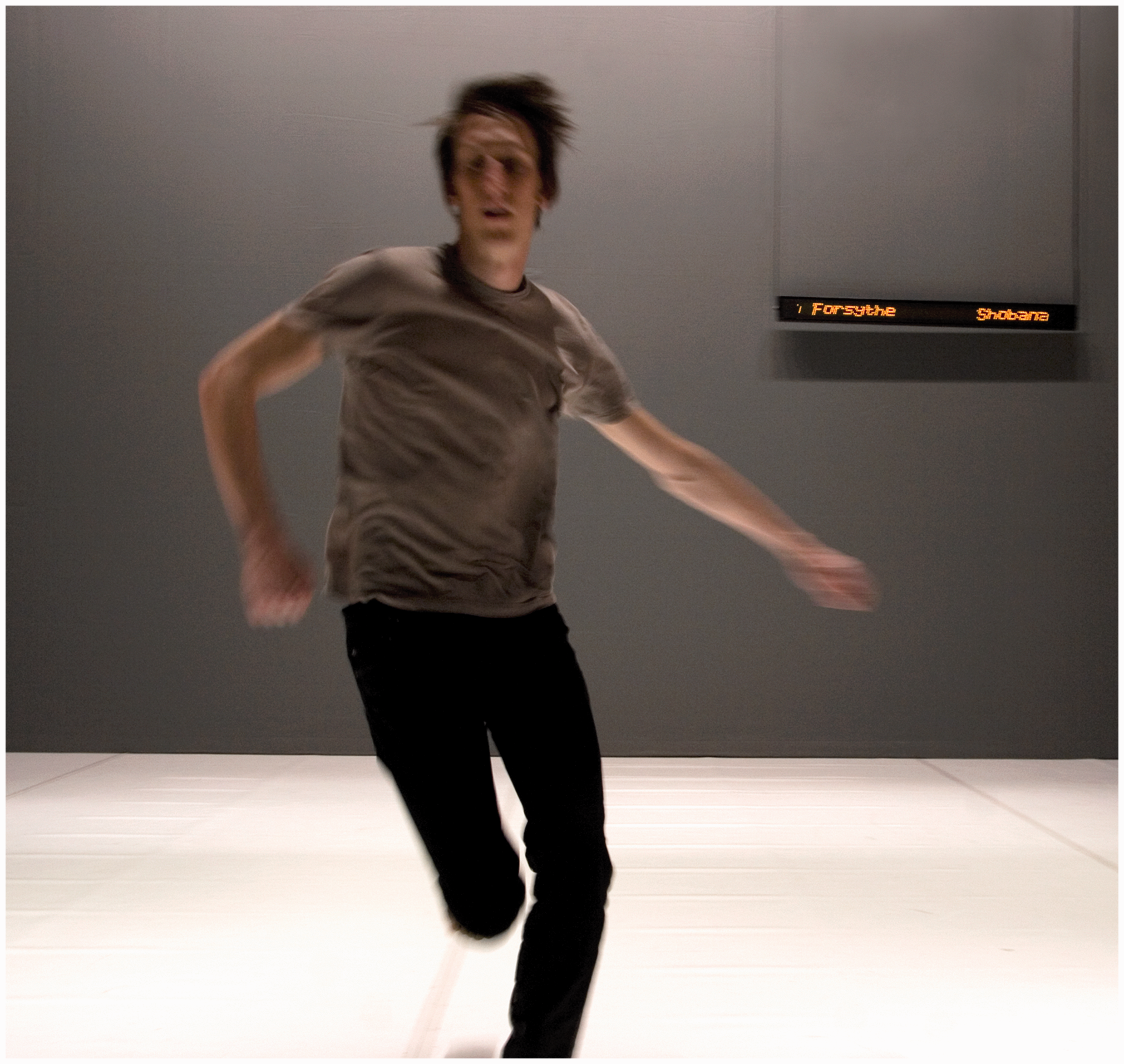


Riff gives presence to dormant gestures (both Sperling's and those of other dancers and choreographers), yet it offers another way of looking at embodiment and its relation to ownership by questioning how we distinguish intent from control, dance from its adaptation. It elucidates the process of dance-making, challenging the view of the choreographic work as an object by showing that it is ‘always altered each time it is embodied by a living person’ while asking: ‘Can the field of choreography have a generative history as opposed to a constant loss?’ (Sperling, 2017: 56). And if we can indeed trace out such a generative history, what kind of authorship can we recognize in the dancers’ individual and collective agency? Must we identify the choreographer as the dance's author when it is the dancer that brings that dance to life?
Specters of Property
Dance was initially considered uncopyrightable because it existed only as a live performance. Not being an object, it could not be property. Fast-forwarding to the present, we have not only film but high definition video and computational media – digital technologies that record and archive dance, but also calculate, analyze, and model it. The emergence of this media environment is behind US law's recognition, in 1976, of the copyrightability of choreography, contingent on being fixed in a tangible medium of expression like written notation, film, or video (Traylor, 1980; Fisk, 2009). Comparable protection and fixation requirements apply to other performative arts like music. The case of dance, however, is rather different because while music is now mostly appreciated in recorded form and often conceived as a performance to be recorded, dance's primary mode of existence and appreciation continues to be performance, which also roots the dancers' sense of self. The steady expansion of copyright protection and the shift toward the mining and monetization of all forms of knowledge and information is a well-studied and much criticized trend, but it has produced particularly ambivalent responses from dancers and choreographers. While copyright has become increasingly more important for dancers and choreographers who wish to control the appropriation of their images and their work that is now made available to millions of end-users online, it also potentially restricts them from engaging in a dialog with other living dancers or building on inspiring dance moves across communities, and their historical contexts.
Works like Riff challenge the copyright protection of dance phrases and gestures by showing that, being inherently connected to the creative and ever-changing movements of the body, they cannot be reduced to clearly identifiable and distinct objects of property. They may be recorded, but they cannot be ‘fixed’. Also, copyright was designed to create property rights for individual authors, composers, or the corporations that hired them. Because legal thinking about authorship has been traditionally framed by the figure of the individual author, it has been possible to conceptualize a corporation as an author (because the corporation is one, with one name), but it has made it difficult to comprehend scenarios where (as in the case of dance) the creative agency can be truly collaborative and distributed. Specifically, that mode of production does not fit well what copyright law calls ‘works of joint authorship’. That notion requires that, first, a work be copyrightable (and thus fixed in a medium) and, second, that ‘the authors must intend their contributions to be merged into inseparable or interdependent parts of a unitary whole’ (Menell et al., 2017), which assumes a planned outcome rather than an emergent production (VerSteeg, 1996). But, more importantly, not all authors are equal. Somebody might make a copyrightable contribution to a work and yet be denied joint author status if she were not ‘in charge’ of the creative choices and direction of the whole work. In sum, despite their acknowledged original contributions, not all collaborators are joint authors of a collaborative work according to US copyright law.
Dance may fall in this category. While Sperling has previously performed with the Shobana Jeyasingh Dance Company whose work he cited (with permission) in his own dance, Riff is not a joint work in the copyright sense of the term. It involves an edited collage of gestures and phrases from other dance companies but, legally speaking, it is Sperling's individual work. (Alternatively, it might perhaps be seen as a ‘composite cover’ of other choreographers’ compositions.) Either way, Riff exposes three specific problems with regard to authorship and ownership: first, it asks us to think about what exactly is an authorial contribution. Second, it points to the inherent problem of attempting to treat bodily gestures and movement phrases as writing with the body. Third, it indicates that the law finds it difficult to conceptualize creative processes involving nonhierarchical collectives that learn and create together to make an emergent work. Its logic framed by the figure of the individual author and its agency, copyright law either assumes that there is a ‘master author’ who chooses and arranges the contributions of other agents, or a ‘federation’ of authors working together toward a shared goal that was defined at the outset.
Furthermore, the US Copyright Office's Compendium of Copyright Practice considers dance crazes, line dances and simple routines performed by members of the public to be ‘participatory social activity’ and thus uncopyrightable [805.1, 55, 2017]. Should that apply to the choreographer's work with the dancers in the studio, the various improvisational games and training routines they develop there? Should their participatory and community-based nature render them uncopyrightable? Copyright law does not clarify the difference between what distinguishes a copyright-protected routine from a simple routine, but suggests that ‘choreographic works are performed by skilled dancers’ for an audience, while ‘social dances are not created for professional dancers; they are intended to be performed by the general public’ for ‘their own personal enjoyment’ [805.2 (F), 805.5 (B) (2)]. Much seems to hinge on whether or not the dancers are considered ‘members of the public’, which may depend on where they are performing, and whether or not the dance was intended to be performed by a dance professional or the general public, or both.
The law tries to distinguish between works like Riff (which result from the participation of the dancer in the dance community, including the citation of other dancers’ signature moves) and nonprofessional social dances, even those that can be attributed to individuals, such as the ‘Carlton Dance’ that was performed by Alfonso Ribeiro who played the character Carlton in the television sitcom Fresh Prince of Belair. The ‘Carlton Dance’ is a signature move Ribeiro's character has recorded on television, recognized and performed by the general public, and recently appropriated in the videogame Fortnite as an emote – a celebratory dance move in gaming and online culture, similar to touchdown or goal celebrations in football and soccer. What is not clear is if Ribeiro (who is not a professional dancer) owns his character's signature move. The assumption is that the work produced by professionally trained dancers can only be ‘enjoyed’ by the general public by watching a performance, but that the general public is incapable of reproducing those dances. However, this is not the case when dances are reproduced within digital environments. Even if Fortnite clearly appropriates ‘Carlton Dance’ and ‘Milly Dance’ (from rapper 2 Milly), it is not clear if these dances can be copyrightable or if they are simply ‘participatory social activity’, easily performed by a general public. While Epic Games’ (the maker of Fortnite) decision to appropriate and profit from hip-hop dance moves is often seen as unethical, it may not violate copyright law. Distinctions between what is a social or participatory dance and what is created by a skilled dance professional ‘allows these [African-American] social dances to be [disproportionately] appropriated and [… monetized] to generate profit’ for people who are not members of those communities (DeFrantz, 2012: 128).
The Compendium of Copyright Practice acknowledges that there may be a lack of clarity in what is considered copyrightable material, in how we distinguish the ‘experience’ of watching dance from the ‘enjoyment’ of dancing, and in how we separate choreography from social dance (Lakes, 2005; Reese, 2014). However, by stipulating that choreographic work protectable by copyright needs to be created by a dance professional and meant to be watched by an audience, the law upholds a conservative view of who is recognized as a professional, thereby reaffirming a strict definition of entitlement that starts by distinguishing the choreographer from the public. But such gaps between the dancers’ multifaceted modes of creation and those comprehended by the law ‘leads to uncertainty and tension not only for the participants, but also for their peers and promoters. In the digital domain these questions become increasingly acute as dance practices are recorded, analyzed and re-interpreted’ (Waelde and Whatley, 2018: 169).
Material Entanglements
Anthea Kraut opens her Choreographing Copyright – a historical account of copyright and intellectual property rights in American dance – by asking, ‘how could anyone possess exclusive rights to a way of moving?’ (Kraut, 2016). She is critical of the commodification of bodies in motion – ‘turning producers into products’ (p. xiv) – while simultaneously calling for the expansion of copyright privileges to dancers and choreographers she identifies as historically underprivileged or plainly exploited. This is primarily because she sees the monetizing of bodies in motion through the history of slavery and wage-labor, which turns the bodies of the disenfranchised into things that can be owned, manipulated, and alienated from their own creativity and productivity. I disagree with some of Kraut's key arguments but find her work important to frame a discussion of the serious tensions between those who have historically been recognized as authors and those who have been disenfranchised, and about the limitations of thinking of property as a means to rectify past injustices.
Haunted by the legacy of slavery, Kraut reads the various attempts of African-American dancers to attain copyright over their dances as a means of challenging white privilege and ‘whiteness as property’ that, as Cheryl Harris argues, was predicated on the institution of chattel slavery and the ‘systematic seizure and appropriation of Native American land by whites’ (Harris, 1993: 1714). The treatment of the body as both a commodity and a producer of value reifies an asymmetrical distribution of power that gives some the title to other people's bodies so as to exploit their labor power. Such asymmetries are inscribed into our legal system. As Kraut points out, copyright is an Enlightenment institution predicated on the Lockean notion of an autonomous individual subject as the bearer of rights, and that choreographers’ demand to be individually protected under copyright law amounts to their ‘collusion with liberal and neoliberal’ economies (p. 7).
According to Locke, the ‘legal’ condition of slavery is the continuation of war (Locke, 1965: 320). It is difficult not to see the contradiction behind construing property as a tool of liberation given that it was precisely this notion of property that allowed Locke to justify slavery in the cases of committing unjust war (a war that gives the conqueror the right to enslave a whole group of people), entering into a contractual agreement like indentured servitude (or as Locke puts it, ‘selling oneself into drudgery’), or amassing debt, which in turn leads to indentured servitude of not only the individual debtor but possibly also her family. Contrary to our contemporary understanding of personhood as an inalienable right, Locke saw it as alienable property, thus enabling slavery and indentured servitude. Rather than questioning a notion of property that affords individual persons the right to own their own bodies as well as those of others, Kraut argues that ‘copyright's value for choreographers lay in the way it enabled them to position themselves as possessive individuals and rights-bearing subjects rather than commodities and objects of exchanges’ (p. xiii). Property saves. Copyright reestablishes the subjectivity of both the dancer and the disenfranchised, even though subjectivity and personhood are reduced to nothing more than holding property, which is identical to the right to alienate it.
In Choreographing Copyright, Kraut turns to the case of Loïe Fuller, a turn-of-the-century American dancer often considered a pioneer of modern dance. Fuller combined dance with elaborate silk costumes and multi-colored theatrical lighting to create what she believed was her signature piece, the Serpentine Dance. As dance was not copyrightable in 1892, Fuller failed to secure intellectual property rights in her dramatic version of the Serpentine Dance [Fuller v. Bemis, 50 F. 926, 929, C.C.S.D.N.Y. 1892], demonstrating the tenuous relation of possessive individualism and ‘property rights in the body’ (Kraut, 2016: 39, emphasis added). Her failure to secure copyright exemplifies what Kraut sees as a ‘crisis of subjecthood’, suggesting that Fuller's subjectivity was contingent on her right as sovereign subject over her own body as personal property.
Kraut, however, is not interested in stabilizing Fuller's ‘rights in the body’ – subjectivity – but instead questions Fuller's right to the dance altogether, implying that Serpentine Dance should have been seen as a derivative work (indebted to both skirt dancing and Asian Indian dance). In Kraut's view, Fuller had no legitimate claim to copyright because her work was the result of appropriation from those other dancers who could not claim legal standing to defend their property. And by extension Fuller's ‘rights in the body’ would also be illegitimate as she has appropriated other people's bodily movement as her own. According to Kraut, one only has the right to what was ‘originally’ created by one's own body, not what has been mimicked or appropriated from other bodies (even though the act of appropriation may be through the body).
The issue here, for Kraut, seems to be one of disentangling legitimate property from cultural appropriation. Copyright needs identifiable authors (physical persons or corporations) to attach property to, while cultural property necessitates an understanding of belonging to a cultural or ethnic group whose collective property is protected against individuals (or corporations) who would claim it for themselves. But how can we attribute authorship to collective or heritage works and how is ownership transmitted? And where does this intangible ‘right in the body’ reside? Is it in the right to one's person as embodied material substance, or in one's right to one's identity as subject that might also extend to those bodies we claim as part of our cultural heritage?
Possessive Individuals or Self-Possessions
Pro-copyright arguments like Kraut's aim at subsuming dance into property, but dance, I argue, tends to destabilize the very foundations of property. Kraut builds off the conventional understanding of Locke's famous passage in the Two Treatises of Government (1965 [1690]) that identifies property as a form of ‘possessive individualism’: one owns one's body and the fruits of one's labor even if the material transformed by that labor is taken from the commons (pp. 328–9). It is important to understand the difference between what Locke means by the subject (a rights-bearing entity), the person (an entity whose name entitles – literarily gives them the title to property), and the self (a sentient being that is capable of being self-conscious), if we want to criticize how or why we come to understand personhood as property or how we can make what is held in common our own.
Each individual is born with the natural right to self-preservation, which Locke defines in terms of subsistence and self-possession. However, self-possession does not clearly connect the self to property because the notion of ‘self’ is different from the legal concept of ‘person’: the ‘Self is that conscious thinking thing that feels or is conscious of pleasure and pain and capable of happiness or misery, and so is concerned for itself as far as that consciousness extends’ (Locke, 1975: 2.xxvii §17). The self is more a sentient being with a memory than a subject with an identity, which Locke attributes, instead, to the juridical subject: ‘Person’ is a forensic term, having to do with actions and their merit; and so it applies only to active thinking beings that are capable of a law, and of happiness and misery. It is only through consciousness that this personality extends itself beyond present existence to what is past, becoming concerned and accountable; the person owns and attributes past actions to itself for the same reason that substances might come and go through the duration of such a consciousness; and for as long as a substance is in a vital union with the thing containing this consciousness it is a part of that same self. (2.xxvii §17)
The self exists in the state of nature, while the subject is a social construct that is given inalienable rights by the state. But it is only the person holding the title (which is both a name and a deed) who has the alienable right to a specific property. In other words, property attaches only in the person, but the definition of personhood rests on the juridical subject (recognized under the law, the social contract), which in turn is derived from an abstract notion of self, which does not necessarily belong to the person. The person, however, is far less autonomous than it seems because it is subjected (or voluntarily subjects herself) to sovereign power. It is a subject performing its own subjection. When people enter into a social contract – that is, when they leave the commons – they essentially subject themselves (as a juridical subject) to that legal authority that will in turn protect their property. There is no protected property prior to society.
The social contract is effectively a quid pro quo: the person subjects herself to sovereign power and, in exchange, gains protection of her property (title) from the sovereign. Discussing Locke, Étienne Balibar asks: ‘why is it that the very name which allows modern philosophy to think and designate the originary freedom of the human being – the name of the “subject” – is precisely the name which historically meant suppression of freedom, or at least intrinsic limitation of freedom, i.e., subjection?’ (Balibar, 2013: 8). The problem for Balibar is that this subject (or citizen) who submits to the social contract is ‘unthinkable as an isolated individual’ precisely because it can become a property-owning subject only by entering into the social contract. This questions what belongs to the person and what can only belong to the self in relation (or in response) to others (as, for instance, the collective creation of dance in the studio). The inherently ‘collaborative’ nature of the social contract makes it difficult to disentangle actions from reactions, expressions from imitations and appropriations, while simultaneously maintaining that universal civil rights can be distinguished from individual property. This is pertinent to dance, where ‘ownership shifts as the dancers imprint their interpretation and individual artistry on the work, and [these acts of personalization] shift again as the work is performed in a public shared environment before an audience’ (Waelde, Whatley, & Pavis, 2014). Dance confuses what is personal expression (authorship) with social interaction (subjectivity) and self-reflection.
Contrary to Kraut's simplified view of Locke's argument about the relation between personhood and property, Locke does not quite espouse possessive individualism. Property is not merely produced by mixing one's labor with natural resources but is predicated on personhood, which is constructed through social relations and codified in the social contract, thereby advantaging those who already hold a property. While the natural commons provide the conditions of possibility for private property, the social commons provide the conditions of possibility for personhood whose property is protected by the state. In order for possessive individualism to function, fellow juridical subjects need to recognize each other's property, not just to produce their own.
In his Essay Concerning Human Understanding, Locke argues that there is a difference between property as embodied labor and personal identity as a product of consciousness and memory that ‘can be extended backwards to any past Action or Thought, so far [as it] reaches the Identity of that Person; it is the same self now it was then; and ‘tis by the same self with this present one that now reflects on it’ (Locke, 1975: 2.xxvii.1, emphasis in original). This ‘personalized self’ is only a collection of remembered experiences and sensations. Unlike the possessive individual who is defined by her embodiment and her labor, the reflective person described by Locke possesses the faculty of value-judgment. As he puts it, ‘the mind compares things’. Value-judgments and the ability to distinguish self from other is key to establishing one's self-consciousness, including one's personal thoughts – what Locke will call ‘the property of the mind’. But the concept of ‘self’, ‘consciousness’ and ‘thinking’ requires a relation to others, to the outside, and therefore creates a kind of property without title. The property of the mind may seem exclusive (it is in one's own mind), but it is created as a collective process, a series of comparisons, judgments and memories.
Balibar writes that in Locke, ‘“consciousness” is the perception of what passes or happens in a man's mind; but also, it is the fact of a man's perceiving what passes or happens in his own mind – in a mind that is his, that properly belongs to him, that is his property’ (Balibar, 2013: 9). One would assume that Locke conflates this cognitive self with the possessive individual. The property of the mind, however, is more than simply the mind comparing things, or the self as the author of its own (interior) thoughts and reflections. It implies, as Balibar points out, an uneasiness, ‘the perpetual differentiation of the mind’ between interiority and an ‘interiority that poses with itself the problem of exteriority’ (Balibar, 2013: 68). It is indeed this outside that questions what demarcates the property of the mind (one's own intellectual or cognitive possessions) and what properly belongs to one's person. For Balibar, this interiority that we call the self cannot be easily disentangled from its reactions to, engagements with and appropriations of various forms of exteriority, whether they are social, individual or environmental, and it is this entanglement that questions the very notion of title or personhood. What seems to interest Locke is more the question of accountability – how we respond or react to that exteriority – than it is a question of ownership.
Returning to Locke's understanding of consciousness as ‘the same self now as it was then’ (an identical person), Balibar suggests that the self is nothing more than a ‘bundle’ of ever-changing thoughts and perceptions. It is only the adherence of a name given to that person, the one on a property title, that allows property to continue unquestioned, no matter how much the self and the person continue to dissemble and reassemble themselves. Being is inseparable from belonging, but both are impervious to capture – they are the fusion of multiple personalities that render the substance of the self as ‘no more than a spectre’ (Balibar, 2013: 122). With Riff, we are reminded that it is the name – William Forsythe, Shobana Jeyasingh, or Laila Diallo – projected during the dance which indicates property. It is not Sperling's reflection on these dances, nor any embodied memory of dancing with these companies or dancers (since he has never danced with Forsythe). But how can his memories and reflections embody someone else's property? While we can attribute these memories, experiences, actions and sensations to his self, this self cannot own them as things. Those memories and reflections are his, but the signature moves, which are in turn associated with famous choreographers, are not his property.
We can only experience the self through perceptions, but the term ‘self’ allows us ‘to confuse similarity – the similarity of our thoughts and feelings from one moment to the next – with identity – the identity of a “thing” to which such mental states belong’ (Hume, 1896). It is this confusion of self-perception with identity as a thing that allows us to make proprietary claims over that identity-thing (a person who is given rights and protected by law). Our emotional responses to others, situations, and environments constitute both a sense of belonging and one of identity as a thing that belongs to us. And in turn we imbue that thing with history (a bundle of memories), an identity (with a cultural heritage), and assign it a value or give it a title.
As Locke suggests, property resides in both the mind and the body, but there is an inconsistency between his understandings of property as related to the body and property as related to the mind (Bowrey, 2016). We can think about this in terms of dance as a tension between what belongs to the dancer and what belongs to the dance (what is the property of the choreographer and what is the property of the body of the dancer, or what belongs to the cultural heritage or legacy of dance and what belongs to the individual). But it is not clear if the later Locke of The Essay would extend property to either dance or even intellectual property, since they seem to evade capture, or fixing in a medium: Questions of identity and diversity don't arise for things whose existence consists in a sequence of events, such as the actions of finite beings, e.g. motion and thought. Because each of these events perishes the moment it begins, they can't exist at different times or in different places, as enduring things can; and therefore no motion or thought can be the same as any earlier motion or thought. (Locke, 1975: 2.xxvii §2)
Ghostly Commons
The concept of possessive-individualism poses a particular problem for dance. Dance requires the dancer to learn the steps, moves, and gestures of the dance (presumably the choreographer's creation or property) by embodying them. Not only do the dancers learn, incarnate, and therefore possess the dance in their bodies, but the very practice of dancing requires labor. Still, unlike what the labor theory of property suggests, labor cannot be simply associated with adding value from the commons, thus establishing property rights. The labor of dance cannot be compared to chopping down a tree on communal land to build a house from it. It requires a much more nuanced understanding of the commons. According to Tatiana Flessas, ‘in general the law valorizes the Lockean formulation of “labour-mixing” as the means by which rights are obtained, [however] there is a second or other reading of “the commons” and what they may mean that arises from the work of John Locke and Garrett Hardin’ (Flessas, 2008: 394). The commons is both ‘in common’ as a natural resource that is there for the taking, and ‘in common’ as a set of relations and shared values that are meant to be protected by some kind of community. Flessas demonstrates how the discourse on the commons has been used to discuss both property and cultural property (including dance). While copyright reduces dance to its fixed representations, the UNESCO and the World Intellectual Property Organization (WIPO) treat dance as a form of intangible cultural heritage to be protected by organizations that aim to safeguard ‘the identification, documentation, research, preservation, protection, promotion, enhancement, transmission, particularly through formal and non-formal education, as well as the revitalization of the various aspects of such heritage’ (see §201 of UNESCO, 2003). Unlike conventional copyright law, WIPO and UNESCO emphasize the need to recognize the ‘commons’ not just as a material there for the taking, but as something shared in common.
But their remit, to protect the commons, opens itself up to criticism by decreeing that the purpose of such organizations is to safeguard dance as property, since members of their organization need to identify just whose heritage dance belongs to. This can be very difficult when there may be many different claimants from different cultural or dance communities. How do such organizations arbitrate which individuals or ethnic groups have exclusive rights to cultural heritage practices, and how do they identify if those claimants are the rightful inheritors of such practices?
Both the WIPO and UNESCO are known to have significant gaps when it comes to protecting the practitioners and custodians of cultural heritage (Jaszi, 1992; Chon, 2012; Fisk, 2003; Posey and Dutfield, 1996). They want to prevent those who are considered outside of the heritage community from capitalizing on a cultural practice or appropriating a cultural identity, while simultaneously promoting the preservation or continuous practice of these heritage dances. Safeguarding property and revitalizing cultural heritage are not synonymous: safeguarding is an act of preservation, as well as one of protection of the rights of those people who identify with cultural practices, and revitalization suggests that culture is a lived experience and, therefore, it is imperative that dance be danced, not protected by a few stakeholders who wish to restrict its practice (safeguarding it from possible cultural appropriation). The question then arises, as Flessas points out: Do we talk about ‘the commons’ not as a means of protecting resources but as a means of legitimating the taking of resources? If so, the arguments about what can and cannot be taken in fact define what we mean by ‘the commons.’ … The commons, as a discourse, thus may function as a strategy in longer-term plans of acquisition. (2008: 398)
It is easy to see how a dance like Riff fits both approaches to cultural heritage – it constitutes an original or authentic form that is built from the shared collective cultural practice of dance that needs to be performed in order to be preserved. It is, however, more difficult to understand how property attaches itself to dance as an original or a shared collective resource when dance is processual, making it difficult to pinpoint the moment of origin, creation or authenticity, and therefore, give proper attribution (Flessas, 2008). Dance is often created with and among dancers, who maybe work for hire, but who also actively create the work. Dance can only be understood as the property of the choreographer if we assume that the dance possesses the dancer, whose body must be temporally dispossessed. But how can the choreographer (who is said to own the dance) possess the embodied dance that the dancer performs? This seems to only further complicate Locke's definition of self as creating the property of the mind, since it is not clear just whose perception of self we can use to arbitrate who owns the dance – is this a perception of self that is based on an identification with a specific community, a notion of possessive-individualism, or a form of self-consciousness? Whose self-perception is more valid: the choreographer's, the dancer's, or the spectator's?
Meg Stuart takes up this problem of possession by telling her dancers that they do not own their bodies, which prompts us to think: who then owns them? Instead of claiming that the choreographer owns the bodies of the dancers because they are considered to be ‘work for hire’ (embodying someone else's creative work), she directly challenges notions of self-possession or ownership of one's body-work altogether by presenting all bodies as ‘containers’ or ‘filters’ that ‘inhabit other sources’ (Stuart, 2008). Like other choreographers, Stuart argues that the choreographer conjures the dance by setting tasks, thus promulgating a disembodied notion of property as a product of self-reflection (the labor of the mind) over a more materialist notion of labor-mixing as an embodied act. The choreographer may not be able to claim that she envisioned what will become the dance but can claim to have set the conditions for whatever emerges.
In order to make proprietary claims, choreographers seem to favor the property of the mind over the labor of the body. William Forsythe (n.d.) writes: ‘Choreography is a curious and deceptive term. The word itself, like the processes it describes, is elusive, agile, and maddeningly unmanageable.’ Nonetheless, he goes on to argue that ‘choreography and dancing are two distinct and very different practices’. But it does not seem feasible that there can be a ‘choreographic object’ that exists without, or outside of, the body. Forsythe envisions this ‘choreographic object’ as autonomously generative, possessing the potential to transmit inspiration (much like a musical score) to anyone at any time. However, because these computer-generated ‘choreographic objects’ are attributed to (owned by) Forsythe, they also possess the counterintuitive potential to restrict movement, and prohibit the reenactment of what has already been learned and embodied. ‘Choreographic objects’ give visibility to the labor and creative work of the choreographer, allowing for a greater transmission of ideas and the preservation of creative work itself; they also establish a proprietary relationship to bodily enactments of such creative ideas.
In contrast to Forsythe's interpretation of the ‘choreographic object’, Wayne McGregor argues that this ‘artificially intelligent choreographic agent … really needs a body’ (2013). The artificially intelligent choreographic agent (created through motion-capture and software designed for the purpose of capturing and mapping dance sequences) may generate new forms of expression, but it also further complicates attempts to distinguish where property attaches to dance, since it places both the choreographer and the dancer in confrontation with another form of mediation, another potential property holder – the videographer, the computer engineer, and the software designer. Such choreographic agents point toward more (not less) collective labor – choreographers, dancers, bodies, coders, software engineers and designers. By placing agency with and within real bodies, it makes it more difficult to distinguish the dancer from the dance.
While aiming to protect forms of creative expression of marginalized people and thereby ‘restoring’ to them a subjectivity that was denied to them, Kraut ends up reaffirming C. B. Macpherson's (1987) famous statement that property is ‘not things but rights’, thus reifying the linkage of property to personhood: ‘embodiment thus provides the link between property and personhood’ (Kraut, 2016: 2). But Marilyn Strathern points out that property concerns relations among people, and only then does ‘proprietorship instantiate an identity between owner and thing owned, between producer and product’ (Strathern, 1990: 157). In other words, property is the recognition of title, not the recognition of an individual subject or subjectivity in general. But there is something more at stake in the equation of personhood with property for Kraut. She draws on a long history of cultural appropriations that amounts to property holders profiting from marginalized people's creativity. Her argument is most clearly made in her discussion of Beyoncé Knowles's ‘re-embodiment’ of Anne Teresa De Keersmaeker's 1983 experimental dance work Rosas danst Rosas and her 1990 dance Achterland, as well as Thierry de Mey's staging and filming of these dances in the music video for the song Countdown (2011). Rosas danst Rosas has often been described as rhythmically repetitive and minimalist in style, consisting of four female dancers (one of which was De Keersmaeker) performing social and domestic gestures imposed on women. These movements scan as both robotic and flirtatious. Achterland, on the other hand, let the dancers exert control, exhibiting their own dynamic virtuosity, and for the first time including male dancers.
For Kraut, this appropriation or plagiarism ‘represents the clash between different types of dance economies – the unhurried reproductive economy of the avant-garde versus the speedup reproductive economy of popular culture – and a corresponding clash between different types of capital – cultural versus economic’ (Kraut, 2016: 276). Such clashes return us to the question of dance's and the dancer's sense of belonging that is defined both in terms of cultural identity and individual ownership. Yet, because this clash is not a simple clash of cultures, but one that involves a long history of cultural appropriation (of what she calls ‘the white avant-garde’ coupled with ‘white appropriative prerogative’ and ‘tacit attenuation of white privilege’), Kraut reads Beyoncé's Countdown as a ‘“fugitive dance,” displaced from the restricted, authorial economy of the avant-garde, stripped of any special protection against capitalist exchange’ (2016: 276). The fugitive dance is likened to the fugitive slave who escapes the system of white male ownership of black bodies. Dance suddenly returns in the form of a ghost, but this is not just any ghost – it is a self-possessed ghost (one that returns to demand its property rights). It is unclear on what grounds these ghosts can stake their claim other than to reclaim their identities, and in this case, it is not clear what claim they would have to an experimental Belgian dance company. In Kraut's account, this ghostly ‘fugitive dance object’ frees itself (or flees) from its white owner to be re-embodied (avenged) by an African American multi-millionaire megastar who ‘reverses the racialized logic of property’ (2016: 264). It is not that this fugitive dance is returned to the commons where it can be ‘enjoyed’ by the disenfranchised in general but is instead reappropriated as Beyoncé's private property (in the form of a copyrighted music video). In this twisted logic of retribution, the avant-garde choreographer (De Keersmaeker) conjures ghosts of former slaves (fugitive dance objects) who escape their enslavement only to be commodified by Beyoncé (who appropriates white privilege for herself).
This kind of alleged retribution, however, does nothing to discredit the logic of alienated labor and the political economy of capital. It exchanges one owner for another, the living artist for the ghost dance, extending the right of property further into a speculative past, and a more restrictive future. By focusing on what she calls the ‘radical inversion of white privilege’ in strictly economic terms, Kraut summarily disavows what Daphne Brooks sees as Beyoncé's ‘troubling materialism’ and ‘ultra-privilege’ (Brooks, 2006), or what black feminist critics like bell hooks argue is nothing but the collusion with the ‘white supremacist capitalist patriarchy’ (hooks, 2014). Similarly, Kraut again acknowledges and dismisses De Keersmaeker's moral rights to maintain the integrity of her work when she incorporates and rejects Brook's observation of popular culture's (and Beyoncé's) trend toward ‘troubling materialism’ by arguing that: Instead of being about material belongings (though she does tell us, ‘Yup, I buy my own, if he deserve it, buy his shit too’), however, the video evidences a different kind of possessiveness: the right to acquire movement from whatever source Beyoncé sees fit. She exercises this right by borrowing whole chunks of movement from De Keersmaeker, and in so doing, corporeally claims a privilege that has historically belonged to whites. Reversing the conventional racial dynamics of borrowing and flouting the ‘no trespassing’ signs around ‘high-culture white forms,’ Beyoncé treats De Keersmaeker's choreographic output as if it is in the public domain and therefore free for the taking. (2016: 269)
The logic of retribution, however, no longer applies if we were to employ Kraut's understanding of cultural appropriation to Pulitzer-winning Kendrick Lamar, who has recently been accused of ‘creative theft’ and copyright infringement by British-Liberian artist Lina Iris Viktor. While this appropriation scenario seems similar to that of Beyoncé and De Keersmaeker, the politics are profoundly different. Written for the block-buster film Black Panther (2018), the artwork and design of the music video for Lamar's ‘All the Stars’ bears a striking resemblance to Viktor's paintings ‘Constellations I’, ‘Constellations II’ and ‘Constellations III’. Similar to De Keersmaeker, Viktor was troubled by the fact that the ‘infringing video and the movie promotes (and profits from) themes of black and female empowerment and the end of racist and gender exploitation, themes particularly topical in the current environment’. Yet, Viktor's suit points out, ‘in a bitter irony, the defendants have ignored the wishes of the Artist, herself a Black African woman, whose life's work is founded on an examination of the political and historical preconceptions of “blackness,” liberation and womanhood’ (Chutal, 2018). Both Viktor and De Keersmaeker have responded to these infringements on the grounds of moral rights (Ginsburg, 1990; Yeoh, 2013a), but more importantly argue for some control over the cultural continuity of their work.
The unauthorized copying of Viktor's work clearly points to the problem with such claims about ‘fugitive dance objects’ that – as Flessas points out – are made on the grounds of ‘not actual but presumed cultural heritage’. This is less a question of inspiration than a problem of disentangling cultural heritage from cultural and actual appropriation. That question might have been circumvented if Beyoncé and Kendrick Lamar had simply acknowledged and credited the authors of those works that inspired them – as we see with film credits where people are acknowledged for their own specific contributions but are not recognized as joint-authors. To her credit, Beyoncé also seems to have eventually come to this conclusion, as evidenced by her inclusion of extensive citations and credits in her 2016 album Lemonade. Without such forms of para-legal crediting, claims to authorship that fall under the rubric of cultural inheritance leave the law to decide who is the rightful inheritor of ghostly property, or who has something in common with ghosts – who can create authorship out of what, as Kraut puts it, ‘is there for the taking’.
Asserting Control?
Rosas danst Rosas emphasizes the gendered corporeality of the four female performers and their bodies' inscription through the very act of performing geometric patterns, movements and gestures associated with hegemonic gender discourse (Laermans, 2015: 105). It was precisely the fact that De Keersmaeker's minimalist dances were designed to explicitly critique the way young women's bodies are sexualized and commodified in the existing patriarchal, heterosexist regime that led her to object to Beyoncé's appropriation of her work. (She was asked by other dancers and artists if she had sold out by licensing her work for commercial interests.) Contrary to Kraut's depiction of the emancipation of dance, De Keersmaeker responded to what she saw as Beyoncé's clear appropriation of her dance with a reflection: why does it take popular culture thirty years to recognize an experimental work of dance? In the 1980s, this was seen as a statement of girl power, based on assuming a feminine stance on sexual expression. I was often asked then if it was feminist. Now that I see Beyoncé dancing it, I find it pleasant but I don't see any edge to it. It's seductive in an entertaining consumerist way. (De Keersmaeker, 2011; Kaufman, 2011)
What is perhaps most troubling about Kraut's attempt to right past cultural injustices by expanding property rights back in time to account for those ghost creators, is her turn toward the viral economy of the internet. She writes: Beyoncé's unauthorized reproduction of the white avant-garde suggests that, in the age of YouTube, a leveling of racialized hierarchies between protectable works of authorship and the unrestricted public domain has taken place. (2016: xviii)
Unsurprisingly, Beyoncé's re-embodiment of Rosas danst Rosas and Achterland gave these dances a new life. In an attempt to reassert her authority over the ‘fugitive dance object’ – the same one that was now reproduced by so many fans of Beyoncé – De Keersmaeker needed to come up with a similar strategy, inviting other dancers to post online commemorative versions of her dance 30 years later. Yet, De Keersmaeker's attempt to ‘go viral’ was only in response to the fact that Beyoncé had already put her dance in the public eye. Going viral does not always mean the same thing. For Beyoncé it means publicity (an investment in future profit), while for De Keersmaeker it means re-capturing her relationship with her work not by asserting a property claim but by reclaiming cultural capital (Burt, 2016; Blades, 2018). In 2013, De Keersmaeker partnered with dancer Samantha van Wissen and fABULEUS to develop Re:Rosas! The web-based platform invited dancers to: ‘Dance your own Rosas danst Rosas, make a video film of it and post it on this site.’ This project begs the question: ‘why is it that these [uploaded versions] have a different relationship to the work than Knowles's version’ (Blades, 2018: 314)? Blades suggests that the difference is that De Keersmaeker had authorized these new versions through her invitation to remix the original work. Authorization can be seen as an attempt to reinstall the work in a gift economy. However, as Blades points out, De Keersmaeker's attempt to reclaim her authorial rights ended up blurring the boundaries between crowdsourced social dance media and stage-based choreography, and therefore exceeding the bounds of the dance community and its implicit rules of appropriation (its ability to return dance to the dance community). These rules clearly do not work when we introduce dance into digital media – not as much the capturing and recording as the possibility of dissemination of unauthorized copies, which opens up the question of what is indeed authorized and who has the right to give such authority when the dance is a collective act.
Like many other scholars, Kraut figures the internet as a new kind of commons – a place for the open exchange of ideas, information, and culture. Allegedly, the internet allows users to judge right from wrong (good and bad use of copyright and authority), to wade through the archive of past performances, events, and collectively participate by embodying fugitive objects. It is described as a virtual archive one can turn to for inspiration and dissemination, but also for the regulation of ownership. What is left out of this picture, however, is that the internet is a proprietary space governed by private contractual relations between platforms (like YouTube or Google) and individuals, reducing us to the role of end-users, that is, consumers. The internet, therefore, reifies property through its own contractual relations. In the so-called online ‘commons’ we are subjected to endless targeting and mining for maximum profit to enable the economic success of big businesses like YouTube and Vimeo. But if this is a ‘commons’, it is one incompatible with the dissemination of a dance that is movement, experience, and exchanges – a dance that cannot be measured, quantified, and understood in terms of data. Rather than declaring the internet as the digital commons, we need to rethink the contractual relations that govern it because they do not reaffirm or extend the social contract to new subjects or historically underprivileged groups, nor do they upset existing relations of property. Instead, they make existing relations into property – our identities as nodal points in a network of friends and acquaintances are sold and exchanged as data. Platforms like YouTube question if users can be considered subjects with inalienable rights. What they make clear is that the alienable person is there for the taking.
Footnotes
Acknowledgements
I would like to thank Mario Biagioli, Siobhan Davis, Scott deLahunta, Tatiana Flessas, James Leach, Alain Pottage, and Matthias Sperling for all of their comments and suggestions.
