




Abstract
This essay presents the experimental subject as a figure of modernity. It addresses notions of control, sensory thresholds, automatism, and human agency through a study of experimental psychology and psychological apparatus from the late 19th century to the First World War, juxtaposing this with notions of experimentation in early 20th-century avant-garde movements. The human subject of experimental psychology, defined by its inexpression as it awaits the stimuli of testing and measurement, is treated as a prototype for the present-day user of technological interfaces.
The prompting of this section’s theme – which traces the echoes of the First World War in postwar and contemporary technoculture as mediated through the critical and avant-gardist techniques of Dadaism – led me to the question of what it means to be experimental, whether in science or cultural practice, and further, to consider how issues of control, agency, and the use of technology are tied to notions of experimentation. I would propose that a condition of experimentality increasingly defines everyday life, as a form of control that is at once socially constructed and technologically mediated, and shaped by its lineage in scientific method even as it passed into society, economy, and polity as a structuring of attention, agency, and how we relate to and through machines. In this sense, experimentality is broader than the experimental method per se, where techniques within a laboratory setting adjudicate truth claims, hypotheses, or models; generalized as a form of sociotechnical organization, experimentality describes a condition of being made available to experimentation, and so to measurement and control. The subject of this control, emerging as a figure of modernity, is the experimental subject, which may be defined as that part of human life that has been made available to experimentation. Here, I am particularly interested in the question of agency with respect to experimentality. For the experimental subject, agency can only be inherently compromised; it describes the condition where one’s actions are defined according to an apparatus of experimentation. What is expressed of the experimental subject is thus external to its agency, authorship, or will; it is the apparatus of experimentation that determines the form by which it expresses and extracts from it the content of that expression. In this way, the experimental subject stands for that part of the user of any sociotechnical apparatus whose agency is at once embodied and externalized, and so alienated from its own means of expression.
This essay addresses a small part of the history of experimentality along two lines of inquiry. First, and treated more briefly here, the essay finds in the experimental subject a way of reading the anxiety of the early 20th-century avant-garde in the face of the progressive mechanization of life and the deprivations of the First World War. The interest of the avant-garde in experimentation as a cultural practice marked and responded to the passage of experimentality from science into more and more aspects of social life. As one is experimented upon, so one might experiment; and so the avant-garde adopted techniques that fragmented, problematized, and reframed agency: automatic writing and drawing, the unconscious, shock, non-sense, ready-mades, collage, and the like. Of these, automatism most clearly demonstrates the attempt to occupy a space of experimentality, notably drawing upon turn-of-the-century experimental psychology and therapeutic techniques used on psychiatric trauma patients during the First World War. Despite the success of these techniques in branding and propelling a new art movement, I maintain that the challenge to agency and authorship represented by automatism – the anxiety of the experimental subject – remained unresolved and so resistant to claims of mastery.
Second, and of more central concern, the essay traces the making of the experimental subject through the evolution of psychological apparatus from the latter half of the 19th century into the First World War. Here, the psychological apparatus stands for a generalized technocultural need to define humanness in terms externalized from introspection and phenomenal experience, and available only through calibration to machines and experimental conditions. Along these lines, experimental psychology sought ever more sophisticated apparatus to identify and measure sensory thresholds, reaction times (at speeds measured to thousands of a second), or phenomena such as involuntary eye movement or the effects of asphyxiation on mental tasks. While at the time such experiments only occasionally found practical application outside the academic laboratory, their apparatus were continually refined by both experimental design and human response. Anticipating what by mid-century would be called human-machine systems, to be studied by new disciplines like human factors and ergonomics, psychological apparatus were early interfaces between the design of machines and the tacit training of human operators. The scientific hothouse of two world wars would play a large role in this evolution; for example, the lineage of psychological apparatus would yield the first complex human-machine simulators over the course of the First World War. What the history of psychological apparatus makes clear is the degree to which machines for human use have substantially evolved to relate to their operators at a pre-conscious, embodied level, so that the use of such machines – precursors of the media and software environments to come – assumes taking on the position of the experimental subject and its alienation in the face of an externalized means of agency and expression. To the extent that such apparatus evolved with and are now embedded within and essential to social, economic, and political systems, the anxiety of externalized agency is inseparable from these realms as well, and there is no communication or action, no utterance, free from apparatus of measurement and control. The experiments of the early 20th-century avant-garde may have in turn contested or sublimated this reality; but any discourse or agency seeking a way out of experimentality would likewise begin with a realization of a lifeworld constructed on an embodied alienation, and a mistrust in given means of expression.
Avant-garde Intention and the Writing of the Eye
Historian Annette Becker describes the First World War as the ‘catalyst’ of Surrealism, suggesting ‘the origins of the surrealist vision of the dismembered body and soul’ in ‘their familiarity with slaughterhouses, both real and symbolic’ (Becker, 2000: 71). Dadaist Hugo Ball, whose opposition to the war began with visits in September 1914 to battlefields in Lorraine (White, 1998: 12), would write in his 1917 lecture on the painter Wassily Kandinsky: A thousand year old culture disintegrates. There are no columns or supports anymore – they have all been blown up. … The world showed itself to be a blind juxtapositioning and opposing of uncontrolled forces. Man lost his divine countenance, became matter, chance, an aggregate, animal, the lunatic product of thoughts quivering abruptly and ineffectually. … A world of abstract demons swallowed the individual utterance, ingested individual faces into masks as tall as towers, swallowed private expression, robbed single things of their names, destroyed the ego, and shook out great colliding seas of chaotic and confused feelings. Psychology became chatter. (Ball, 1974: 223–4, 225) The human organ represents the soul, the individuality in its wonderings with its demonic companions. The noises represent the background – the inarticulate, the disastrous, the decisive. The poem tries to elucidate the fact that man is swallowed up in a mechanistic process. In a typically compressed way it shows the conflict of the vox humana with a world that threatens, ensnares, and destroys it, a world whose rhythm and noise are ineluctable. (Ball, 1974: 57)
The use of the unconscious and automatism could similarly be read as reclamations of lost agency. If the apparatus of mechanized culture encroached upon the pre-consciousness of those it subjected, then the unconscious would become a battleground and focus of resistance. In this conflict, techniques of automatism were employed on both sides: an experimental technique of mechanized culture and avant-garde alike. Likewise, automatism would play a central role in the passage of experimentality between science and cultural practice. With roots in psychology and psychoanalysis as well as spiritualism, automatism promised a means of opening up the repressed unconscious of the war generation, both to physicians and therapists, and to artists and poets. Among the Dadaists and Surrealists Richard Huelsenbeck, Louis Aragon, Théodore Fraenkel, and most influentially André Breton had medical training. Breton studied at several neuro-psychiatric hospitals, both observing and treating soldiers suffering psychological trauma, under the mentorship of physicians including Raoul-Achille Leroy and Joseph Babinski, himself a former student of Jean-Martin Charcot (Haan et al., 2012). Dadaist Tristan Tzara and the painter Francis Picabia first published a collaborative automatic text in the form of a one-page manifesto in February 1919; later that year, Breton and Philippe Soupault would begin composing what is considered the first Surrealist work, Les champs magnétiques, using automatic writing techniques (Hentea, 2014: 115).
Where Ball articulated the plight of the experimental subject, Breton would assume mastery of the experiment. In his 1924 Manifesto of Surrealism, Breton wrote of its composition: Completely occupied by Freud at that time, and familiar as I was with his methods of examination which I had had some slight occasion to use on some patients during the war, I resolved to obtain from myself what we were trying to obtain from them, namely, a monologue spoken as rapidly as possible without any intervention on the part of the critical faculties, a monologue consequently unencumbered by the slightest inhibition and which was, as closely as possible, akin to spoken thought. … It was in this frame of mind that Philippe Soupault and I … decided to blacken some paper, with a praiseworthy disdain for what might result from a literary point of view. The ease of execution did the rest. (Breton, 1969: 22–3, emphasis in original) I have seen the inventor of the cutaneous plantar reflex at work; he manipulated his subjects without respite, it was much more than an ‘examination’ he was employing; it was obvious he was following no set plan. Here and there he formulated a remark, distantly, without nonetheless setting down his needle, while his hammer was never still. He left to others the futile task of curing patients. He was wholly consumed by and devoted to that sacred fever. (Breton, 1969: 47, emphasis in original)
Yet the history of automatism is also a history of apparatus. Gertrude Stein’s first publication, before her well-known experimental writing in stream of consciousness, was as a student in the Harvard Psychological Laboratory under the guidance of Hugo Münsterberg and William James. In this 1898 paper, ‘Cultivated Motor Automatism: A Study of Character in its Relation to Attention’, Stein described attempts to induce automatic movements of the arm using a planchette, suggested by the psychologist E.B. Delabarre. Originally developed for séances, the planchette was a small wooden plank with an attached pencil designed to facilitate automatic writing. Stein wrote: this planchette responded to very slight movements, could be readily adjusted, and allowed the operator to guide the subject without his knowledge. By lightly resting my hand on the board after starting a movement I could deceive the subject, who sat with closed eyes, as to whether he or I was making the movement, and I could also judge how readily he yielded to a newly suggested movement, or if he resisted. (Stein, 1898: 295)
The road to automatic writing passed first through reading, and another apparatus developed by Delabarre in 1898, variation on the planchette, is illustrative here. This apparatus, designed to record the movements of the eye, consisted of a plaster-of-Paris eye-cup cast to cover the cornea with a hole for the pupil; a wire ring was cast within this device with a branch projecting out from the eye, to which was tied a light thread connected to a kymograph. A two to three percent solution of cocaine applied with an eyedropper directly to the eye mitigated discomfort. The device allowed measurements of the speed of eye movements, measured in thousands of a second, along with angle of movement and the location of points of fixation (see Figures 1a, 1b). Delabarre’s interest was in spatial judgments that relied on eye movements and positions, and he first used the device to record the eye reading pictorial illusions. What he found was a gap between intention and actuality in the movements of the eye: ‘the fact that the actual point of fixation of the eye is not the one intended and thought to be fixated. If, for instance, when the endeavor is made to fixate the point of an arrowhead, the actual point of fixation falls within the angle’ (Delabarre, 1898: 573). The problem of eye movements in reading was much studied in turn-of-the century experimental psychology, particularly for its relevance to the debate around psychologism, or whether questions of psychology and physiology defined the range of human thought and logic; this Psychologismus-Streit was centered in Germany, where psychology had gone farthest in defining itself as a discipline separate from philosophy. Data on eye movements did not conform to readers’ subjective experience of smoothly scanning the page, or of spelling out letters to read words (what was called Buchstabierend Lesen); rather, the eye jerked and jumped across the page, fixating at one point before rapidly sweeping to fixate at another. What is revealed here is a gap between the intentional reader and the reader as experimental subject, whose act of reading writes unintended data through the interface of eye-cup and kymograph. One may read wearing the apparatus, but this reading is at the same time read through the apparatus. The unintentional production of data is the automatism of the experimental subject.
E.B. Huey’s improvement of Delabarre’s eye-cup/kymograph apparatus for measuring eye-movements. This diagram shows the molded plaster-of-Paris lens on a cocaine-treated eye, linked to glass pointer writing on a kymograph with an electric time-keeper (1898).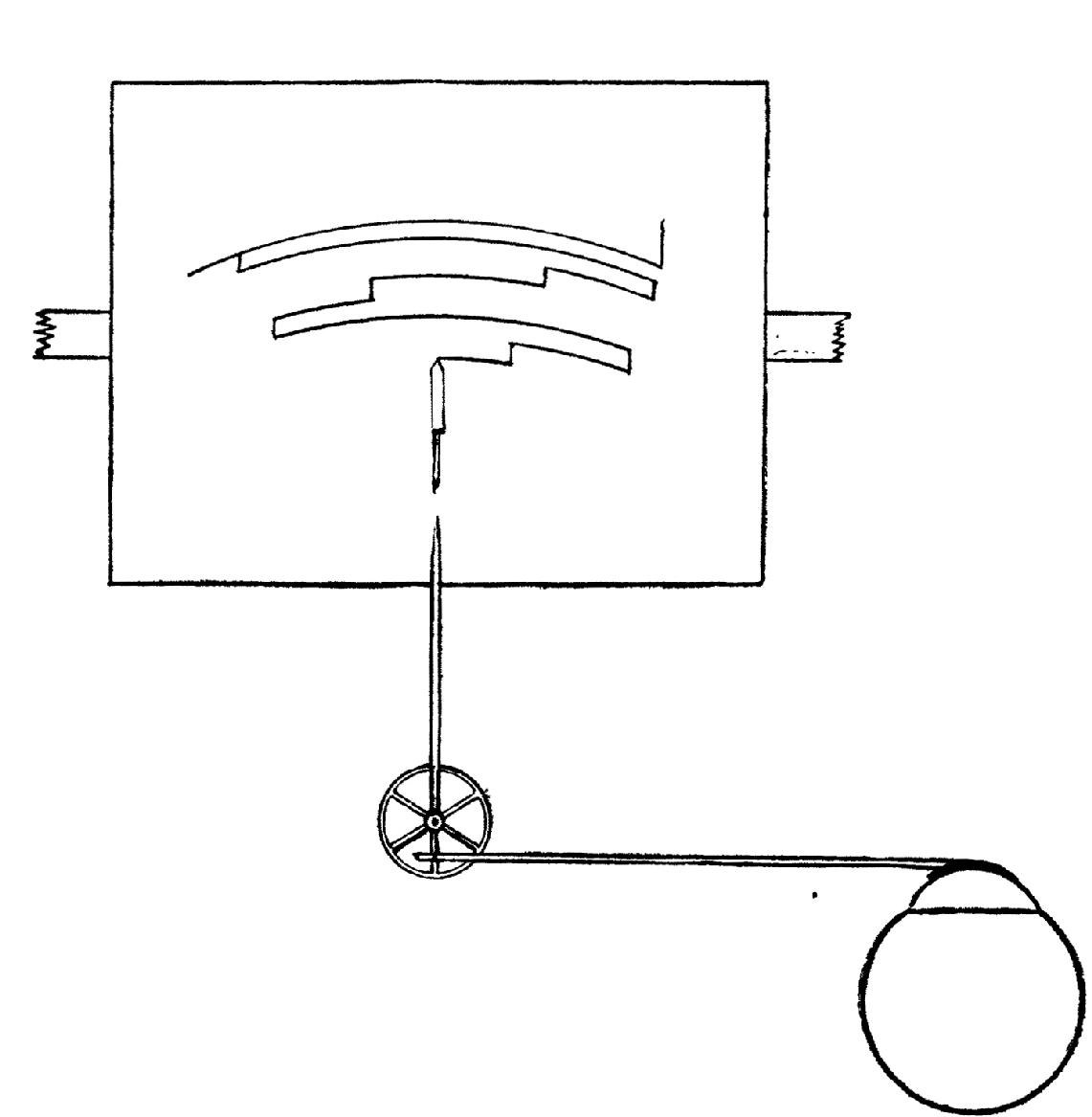
Control, Vexation, and the Sensory Threshold
Control in experimentation may occur as a restraint, in the holding of experimental conditions constant; as guidance, in the sense of manipulating a variable; or as a check or comparison. In each case, control involves an identification and mediation of difference. Citing an entry in a 1913 Standard Dictionary, psychologist and historian of psychology Edwin G. Boring describes control in séances as ‘the intelligence (whatever its nature) which regulates the communication of messages through a medium or psychic’ (Boring, 1954: 577). Moving to experimental psychology, Boring finds the first use of control in experiments by the physician Karl von Vierordt in 1870 on the cutaneous two-point threshold – the point where two distinct and simultaneous impressions on the skin are held at such distance that it is equally likely for the experimental subject to distinguish two separate impressions as to experience a tactile illusion of a single impression. In other words: ‘the separation at which a two would be felt as often as a one’ (Boring, 1954: 579). A control observation would correct for the subject’s anticipation of the doubled impression; Vierordt mixed a number of single impressions among the double impressions, calling them Vexirversuche or puzzle trials. The control trial generated a new set of tactile illusions in turn, where a one was felt to be a two; Vierordt called these Vexirfehler or paradoxical trials.
In this way, the sensory threshold was first found in vexing the experimental subject, whose responses were only meaningful as they approached randomness, as they were equally likely to correctly and incorrectly distinguish illusion from reality. The meaningfulness of data collected here is a condition of control, which links apparatus and subject, and translates the puzzled response of the experimental subject into data legible through the apparatus. The sensory threshold lies in the gap between stimulus and sensation – the first is measurable and repeatable by apparatus while the second is grounded in the subject. This gap, mediated by control, is at the center of experimental psychology; and it is therefore not surprising that experimental psychology should begin with the definition of the threshold as a site of measurement. This is Gustav Fechner’s concept of the limen, itself adopted from Johann Friedrich Herbart’s notion of the limen of consciousness that divides unconscious and conscious thought and sensation. Writing in 1860, Fechner described the limen or sensory threshold as the entryway to ‘an exact science of the functional relations between body and mind’, a science he called psychophysics (Fechner, 1966: 238). Psychophysics began with the assumption that sensation was unavailable to direct measurement and could only be described as either present or absent, or as greater or less than another sensation. Stimuli, however, could be measured, and their measurement could be used to distinguish between sensations. Accordingly, the unit assigned to sensation at the threshold value of stimulus was the ‘just measurable difference’ (Boring, 1929: 277, 284). As a bridging term between stimulus and sensation, Fechner proposed sensitivity; this would be the precursor to what would later be called response.
In perhaps the most influential passage of Elements of Pyschophysics, Fechner described what is now called the Weber-Fechner law, S = k log R, where S refers to sensation as just measurable difference and R to the liminal stimulus needed for sensitivity or response. In making this a logarithmic relationship, where a geometrical progression in stimulus intensity yields an arithmetic progression in intensity of sensation, Fechner sought to account for how stimuli like weight, luminescence, and sound relate to the subjective experience of tactile pressure, brightness, or loudness. The Weber-Fechner law is fully defined by the threshold; if S is at 0, indicating the threshold of sensation, R is at the limen value of the stimulus; if S is positive, a second threshold is approached as R increases where stimulus intensity is no longer distinguishable by sensation; and if S is negative, the stimulus is experienced albeit below the level of sensation – the experience of the stimulus is subliminal. Fechner used the example of stars in daylight; while they still give off light and may even be ‘seen’ subliminally, they are not luminescent enough relative to daylight to cross the limen and be experienced as brightness.
The stimulus-response relationship was in this way founded on the sensory threshold, which in turn only becomes legible through the mediation of control. The experimental subject likewise becomes legible through being subject to control, through the Vexirversuche or puzzle trial that extracts that legibility precisely by remediating the intentional activity of the experimental subject into randomness. At the same time, the sensory threshold represents something new in human potential, a territory opened up to measurement and control. In this way, we may trace the evolution of technological interfaces from early psychological apparatus; the evolution of interfaces is not only responsive to technological development but also, critically, to opening up new forms of interactivity that are ever more tightly tailored to embodied human cognition, whether conscious or subliminal. Today’s eye-tracking interfaces follow in the lineage of the Delabarre eye-cup. As much as experimental psychology relied on apparatus to test the limits of human sensory, cognitive, and physiological processes, these human processes and the apparatus designed to measure them became co-evolutionary. Writing in his seminal Principles of Physiological Psychology (1874), Wilhelm Wundt described two parallel tracks of psychological research: ‘the problem of method, which involves the application of experiment, and the problem of a psychophysical supplement, which involves a knowledge of the bodily substrates of mental life’. For Wundt it is the problem of methodology that is ‘more essential’ to psychology, while the problem of supplementation, the emergence of mental life out of bodily processes, ‘is of importance mainly for the philosophical question of the unitariness of vital processes at large’ (Wundt, 1904: 4). While Wundt’s Principles bears out this focus on methodology, one could argue that problems of supplementation underlie his entire effort. Each point of the experimental process is a continual restatement of the supplement, through which the disciplinary boundaries of experimental psychology are set. Likewise, the method and apparatus are inseparable from the problem of the supplement as they are the means of making the supplement legible. For the ‘unitariness of vital processes at large’ is first written in the control that binds the apparatus to the experimental subject.
Chronometry, Attention, and the Personal Equation
The chronometer was an essential apparatus in the early psychology laboratory, and with the need to measure reaction times at ever-tighter tolerances, the chronometer was the subject of continuous refinement. The standard time unit for reaction times was one-thousandth of a second, or sigma, and early experimental psychology produced an entire discourse around time measurement. Historian of science Jimena Canales has argued the importance of the ‘moment of measurement’ in modernity, proposing ‘to study the tenth of a second as modernity’. She cites Hermann von Helmholtz’s suggestion for this duration as the transit time for nervous transmission: ‘“self-consciousness,” he noted, lagged “behind the present” by an amount equal to “the tenth part of a second”’ (Canales, 2009: 14, 4). The tenth of a second might then be seen as a threshold in the human apprehension of time: a limit to performance as much as an opportunity for study. For Helmholtz, ‘nervous conduction’ had an effective velocity estimated at 60 meters per second; once the signal of sensation has ‘arrived at the brain, an interval of about one-tenth of a second passes before the will, even when attention is strung to the utmost, is able to give the command to the nerves that certain muscles should execute a certain motion’. Without reference to technology, these cognitive, perceptual, and motor delays are inconsequential and ‘we do not observe their influence’ (Helmholtz, 1853: 324, 325). Yet this delay had already become apparent with respect to technology that operated on far tighter temporal frames of reference; for Helmholtz these included the timing of star transits in astronomy and the aiming and firing of artillery. To mitigate this human delay, some kind of augmentation was necessary; for Helmholtz, ‘if intervals of less than one-tenth of a second are to be observed with accuracy, or even measured, we must have recourse to artificial means’ (Helmholtz, 1853: 315).
While chronometers of the era such as the Hipp Chronoscope were capable of registering time to one-thousandths of a second (one sigma), human reaction remained a difficult problem, particularly in marking the beginnings and ends of measurement. This uncertainty at the threshold of human attention, which belonged as well to the problems of mechanical tracking and aiming, was described in 19th-century astronomy as the ‘personal equation’. Developed by astronomer and mathematician Friedrich Bessel, the personal equation addressed the observation of star transits – the elapsed time as a star moves across the reticule of a telescope, measured as a way of determining the position of stars. The prevailing ‘eye and ear’ method was considered accurate to a tenth of a second, with a margin of error of one or two tenths of a second; the observer would pay close attention to the ticking of a second hand of a clock to note the spatial position of the star at the ticks immediately before and after the crossing of the wire (Boring, 1929: 134). Bessel observed that while a given observer tended to produce measurements that were consistent with each other, comparison with another observer often required an adjustment, even at the order of a second in a process meant to be accurate to a tenth of a second, and that this adjustment was relatively constant between the two observers. The personal equation allowed transit times by different observers to be adjusted and compared by averaging the differences in their measurements of the same observations; for example, a comparison between observations by Bessel and astronomer Friedrich Argelander was expressed as B – A = –1.223 seconds.
For historian of science Simon Schaffer, the discipline of astronomy combated the uncertainty of human observation through training and division of labor: ‘a chronometric regime of vigilant surveillance of subordinate observers’ (Schaffer, 1988). Star transits and the personal equation – ‘the remarkable fact discovered by Bessel’, wrote Helmholtz – became a way into the problem of human attention and the sensory threshold. Experimental psychology would become preoccupied with problems of reaction time, testing senses singly and in combination, measuring the effects of anticipation and preparation, and even playing senses against each other, as in Wundt’s complication experiments. The possibility of accurate measurement at even shorter durations was suggested by artillery time tables; Helmholtz’s Myograph, which measured the velocity of nerve signals by measuring muscle contractions after the electrical stimulation of nerve endings, was inspired by Werner von Siemens’ military work on artillery (Helmholtz, 1853). To calculate artillery trajectories accurately, it was necessary to measure both the velocity of the shell and the time of the ignition of the charge. Following work by Louis-François Breguet and Charles Wheatstone, Siemens placed nets of electrically charged wire in the path of the shell so that the shell itself would make a connection as it travelled, producing a spark that marked a rapidly rotating metal cylinder. The method allowed accurate measurement to 1/40,000th of a second. From the firing of shells to the firing of nerves, humanness was measured at increasingly inhuman temporal frames. If, as Wundt would write in 1883, ‘the exact description of the facts of consciousness is the only aim of experimental psychology’, the means of this description required the migration of human consciousness into the electromagnetic spectrum and the realm of communications; Siemens, Breguet, and Whetstone were best known for work on telegraphy. Wundt’s student Edward B. Titchener would describe experimental psychology as a discipline ‘which brings inner perception under the control of experimental appliances’ (Titchener, 1921: 166). Psychological apparatus opened up the human experimental subject using the sensory threshold as a scalpel; its body and sensorium now rendered a site of many thresholds, the experimental subject was a creature of fragments, a partially animated exquisite corpse whose promised coherence was the ideology underpinning experimental psychology.
The ideology of experimental psychology could also be described as control; likewise, control was the medium between the measurement of time and the ontology of consciousness. Wundt’s reaction time experiments established a tenth of a second difference between ‘muscular reaction time’ and the slower ‘sensorial reaction time’. He located apperception, or what might be called attention, in this delay; it distinguished the Blickpunkt or focus of attention from within the Blickfeld or field of consciousness. Wundt’s complication experiments, which studied this delay in the association of senses, had been inspired by the personal equation in astronomy, but with a critical reversal: where the personal equation mitigated a limiting factor in the use of an apparatus of measurement, now apparatus of measurement was a limiting factor in describing the personal equation of human attention. While Wundt objected to control as a method of checking human observation, relying instead on training observers, by 1874 he would use the word ‘control’ to describe an apparatus used to calibrate and check a Hipp Chronoscope (Boring, 1954: 580). Widely considered the best chronometer available at the time, it was designed by watchmaker Mathias Hipp as an improvement over Wheatstone’s apparatus for measuring artillery shell velocity; it was also used in astronomy to minimize the personal equation. Even in 1915, Titchener wrote ‘there is little likelihood that it will be superseded’ (Titchener, 1915: 328).
Nonetheless, the Hipp Chronoscope produced both variable and constant error at short time intervals, on the order of a hundredth of a second or less. Wundt developed an apparatus he called a ‘control hammer’ [Kontrollhammer] as a control check on the chronometer; he referred to its use in the experimental process as a Kontrollversuch or control trial (Boring, 1954: 580). The control apparatus required technical skill and experience to use, and soon became a right of passage that reflected on the skill of the psychologist. For Titchener, writing in 1915 just as experimental psychology began its entry into the First World War, ‘practically every laboratory of any consequence has its own control apparatus. It seems too, that the psychologist who uses a given form of control is apt to become a partisan of that form: doubtless because the apparatus, being an apparatus of precision, requires constant oversight, and everyone prefers to employ the instrument whose difficulties he has overcome himself’. Of the control hammer, Titchener emphasized that it required ‘care in its construction and usage’, and that ‘one works sympathetically with it’ (Titchener, 1915: 340, 343). Like Heidegger’s hammer, Wundt’s control hammer was at its best ready-to-hand; though here, the moment of measurement, or the onset of control, was also a transformation of care into knowledge.
Simulation and System Integration
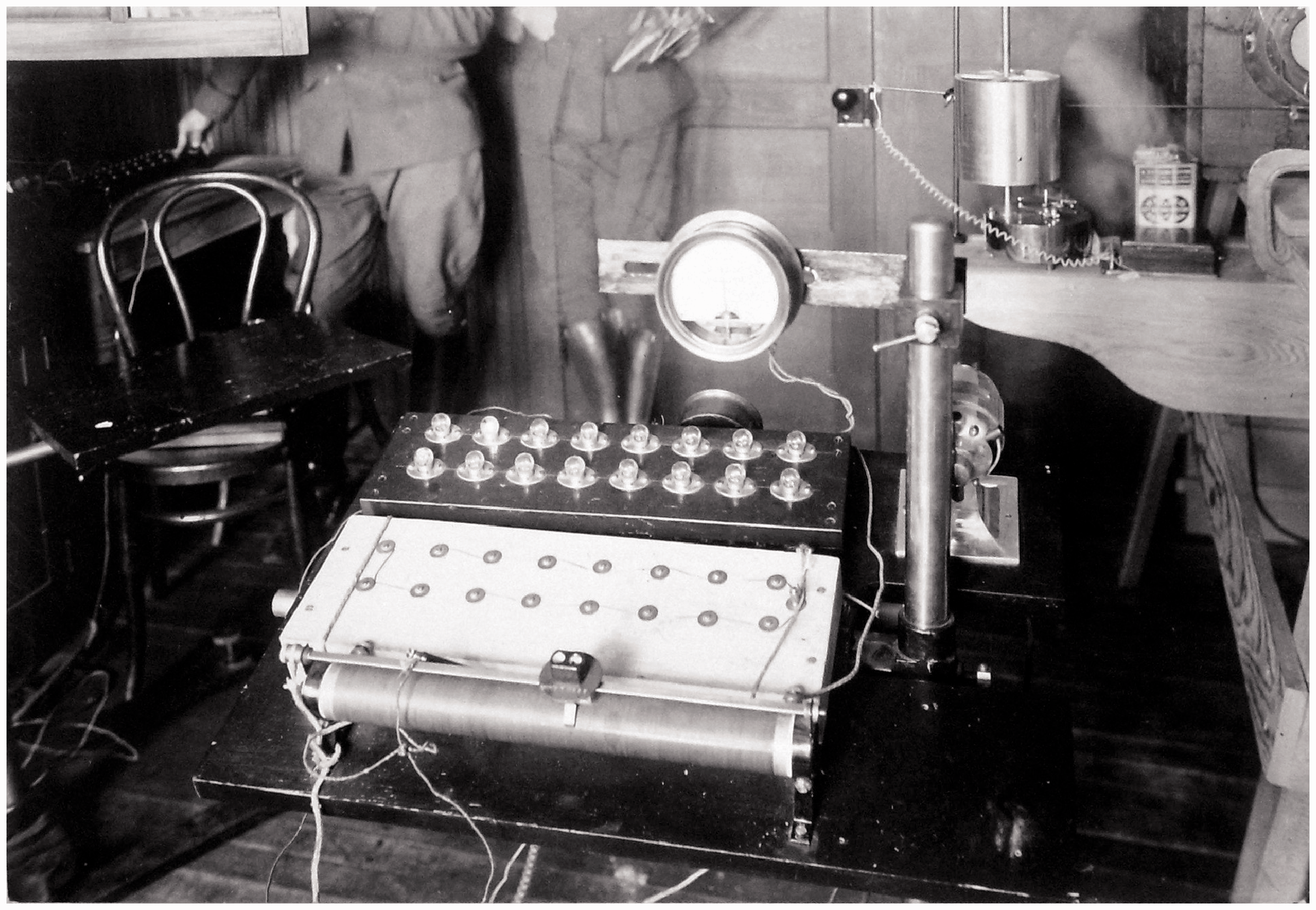
The First World War drove psychological apparatus toward problems of testing and then simulation. This also loosened the bonds of the apparatus to experimental science. No longer fully defined by the purpose of discovering the ‘facts of consciousness’, the psychological apparatus had become a starting point in the lineage of interactive devices. Perhaps the design of psychological apparatus had always been less about scientific ambitions to understand consciousness than about the facts of control and the relations of experimentality. The latter would be retained in the absence of the former; as an interactive device, the apparatus would continue to use control to translate the activity of subjects/users into legible data. Its evolution would continue to follow the development of human sensory and cognitive thresholds as much as it would technological advances. The training of experimental psychologists, their skill and care in the building of apparatus designed to find and exploit sensory thresholds, was likewise well suited to designing interactive devices. Raymond Dodge’s apparatus for selecting and training naval gun pointers was possibly the first complex human-machine simulator; its design accounted for behaviors including the wave motions of a floating gun platform, the distance and movement of the target, and the mechanics of the gun as it is trained to the target. The apparatus produced a real-time graphic record, comprising: ‘1) the latency of beginning the training of the gun to a movement of a target; 2) the accuracy with which the actual movement of the target was followed; 3) the latent time of reacting to a change in the apparent motion of the target; 4) the effect on the aim of pressing the firing key; 5) the accuracy of the aim at the movement of discharge’ (quoted in Yerkes, 1919: 108). The apparatus was found to be ‘of great value, not only for the classification of pointers, but further, for their actual training’, wrote an admiral in review. ‘It further has the most important advantage of being popular with the personnel who are being trained, and it has been found that the enlisted personnel make use of his instrument upon their own volition outside of drill periods’ (quoted in Yerkes, 1919: 114). Knight Dunlap’s apparatus for testing the effects of oxygen deprivation on mental tasks was developed as an aptitude test for high-altitude pilots in an era before pressurized cockpits. The pilot would be tested for coordinated reactions to an apparatus designed as an abstraction of flight controls, attending simultaneously to flashing lights, an ammeter dial, and the speed of a motor using a stylus, a rheostat and a foot pedal as controls, all while wearing a rebreather that steadily lowered oxygen levels. Dunlap argued that the degradation of mental tasks under oxygen deprivation affected ‘the integration of the system’ rather than any particular part of the nervous system, and included the discovery of ‘attention peaks’ where normal integration would be briefly maintained even while registering the effects of partial asphyxia (Dunlap, 1919: 95; see Figures 2 and 3).
The first complex simulator? Dodge’s gun pointing trainer (1917). Dunlap’s apparatus for testing pilot performance in low oxygen conditions (c.1918).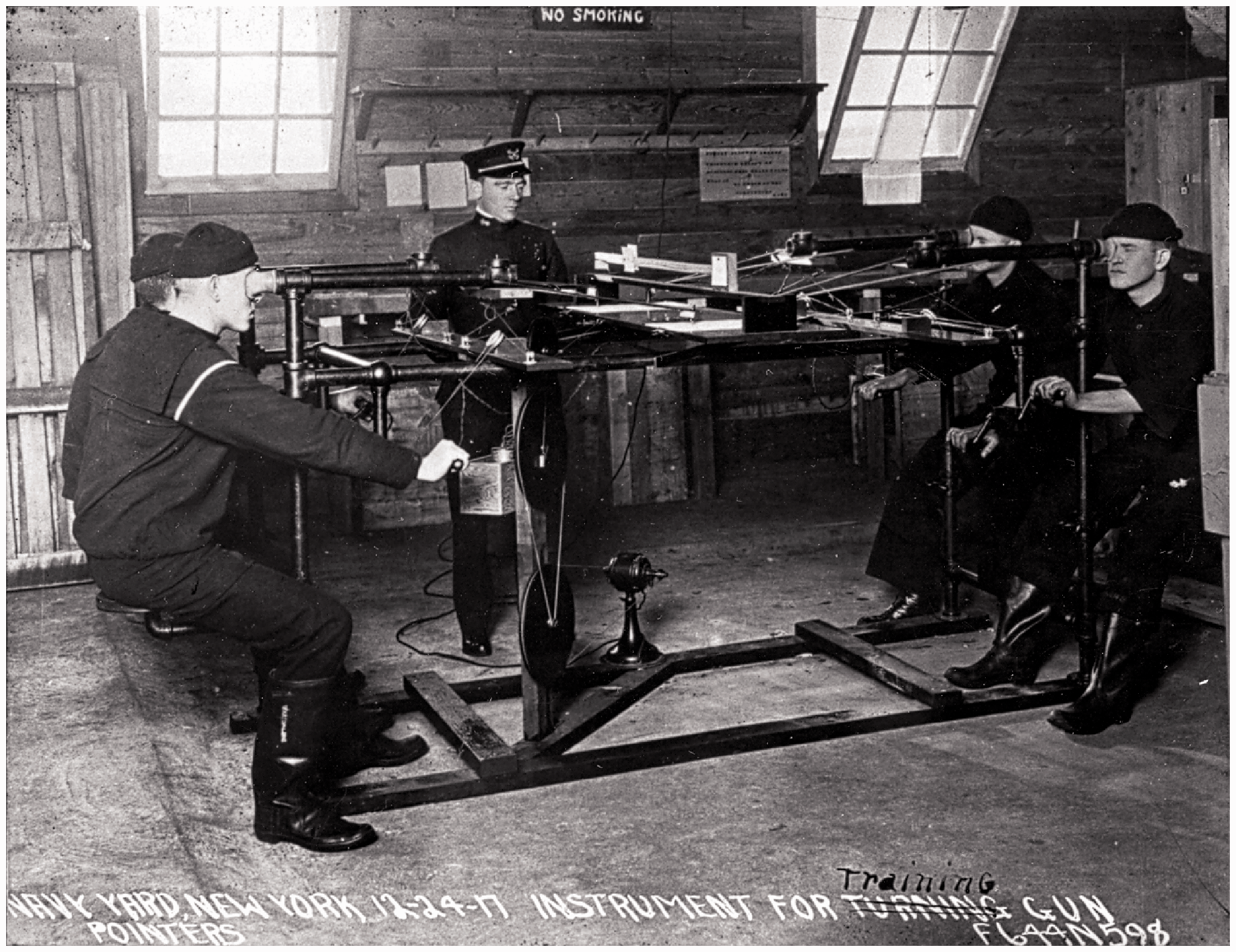
I would like to suggest that one might trace a line from the early psychological apparatus and its experimental subject, through the military simulator, to contemporary mediations of attention, from user interfaces and software environments to gaming and social media, and from ubiquitous computing to augmented reality. This would also be to suggest that the preoccupations of early experimental psychology remain active in the genetic memory of contemporary media, just as these preoccupations prepared psychologists to embark on what now might be called interaction design. For Dodge, this preparation included study at the University of Halle under Benno Erdmann, a prominent voice in the Psychologismus-Streit; Erdmann and Dodge co-wrote what psychologist Edmund B. Huey called ‘by far the best and most extensive work on the Physiology and Psychology of Reading’ in 1898 (Huey, 1899: 325). Teaching at Wesleyan, Dodge developed in 1903 a photographic method of recoding eye-movements that surpassed both in accuracy (and comfort) Delabarre’s eye-cup/kymograph apparatus, and published papers on eye-movements as well as mental work and fatigue. Dunlap had studied under Münsterberg at Harvard and taught at Johns Hopkins University; his pre-war work there included polemics advocating behaviorist approaches over introspection, a study of ‘the shortest perceptible time-interval between two flashes of light’, and the design of apparatus to precisely time word associations. What is common to each of these apparatus is a harnessing of attention through control, a targeting of the thresholds of human sensory and cognitive performance, a precisely calibrated clock time, and the generation of data. These are common as well to the human-machine systems of 50 years later, and human-computer interaction today. If the history of apparatus presented here overstates the role of psychologists, it should be kept in mind that their design control was essentially theoretical, an attempt to treat explicitly what is now mostly hidden in a technological evolution driven by market forces and geopolitics. Here, psychological apparatus reveals the more profound and incomprehensible apparatus that now surround us, illustrating the intimate, embodied, and liminal scale at which we are measured and the inhuman speed of that measurement.
Likewise, the experimental subject stands in relation to the user of technology as a kind of figure of the unconscious. Among simulations and simulacra, the experimental subject is a register of the real: it is the raw material from which data is extracted, the site of the training and testing that is tacit in the use of machines, and the pre-conscious desire that is redirected and externalized in technological augmentation. The anxiety of the experimental subject is a caution when we find ourselves channeled in what we can do and say by the tools and discourses available to us. The techniques of the early 20th-century avant-garde, drawn out agonistically from the mechanizations of a century ago, were made necessary by a similar anxiety. This notion of experimentality provides a corrective to that of Nietzsche, so beloved of the early avant-garde: it is a self-experimentation that does not originate from the self. The experimental subject possesses neither the serenity of Apollo nor the ecstasy of Dionysius. Malcolm Bull, in Anti-Nietzsche, extends Nietzsche’s opposition to include the ‘pre-aesthetic nihilism’ of Silenius and the ‘philistine moralism’ of Socrates, to form a semiotic square (Bull, 2011: 16–18). One might imagine adding an additional opposition, that of the patient/experimental subject and the physician/designer of the experiment. If, for Bull, Dionysius and Selenius would align on a ‘non-ethical’ axis representing the aesthetic and non-aesthetic respectively, the experimental subject would align with Dionysius as a figure of embodiment and active participation, but also be separated along an axis representing a corresponding disembodiment of control. This might say something about what was at stake for the early avant-garde in its enthusiasm and anxiety at becoming-machine; both readings might be found in Antonin Artaud’s aphorism of 1925: ‘no works, no language, no words, no mind, nothing. / Nothing but a fine Nerve Meter’ (Artaud, 1976: 86).
Today’s technoculture of experimentality, with its drive to hold all that it can see as subject to experiment, and so to continually open up new territories to test, model, and exploit, demands critical practice that is both intimately targeted and wary of the trap of assumed mastery that is itself the seduction of interface technologies. The aim of this essay is to suggest the apparatus and the experimental subject as materials to be drawn upon for such a countervailing discourse.
A ‘spark’ record of eye-movements reading six lines of text, produced using Huey’s apparatus. For Huey: ‘the tracing shows clearly the fixation pauses in the course of the line, the general tendency to make the indentation greater at the right than at the left, and the unbroken sweep of the return from right to left’ (Huey, 1900: 290).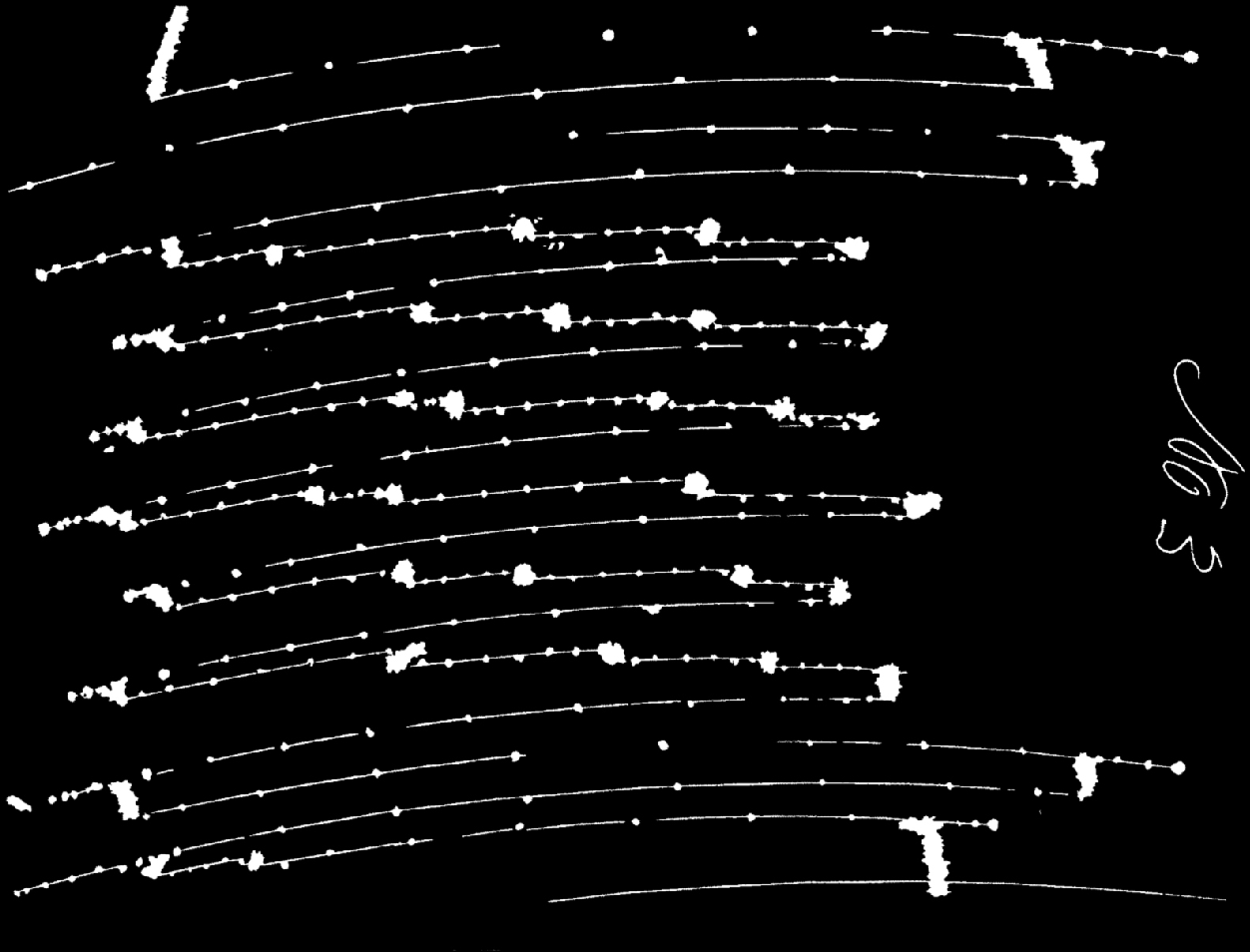
Footnotes