



Abstract
The Confederated Colville Tribes collaborated with DroneSeed, a forestry drone start-up, to use drones to replant their tribal forest after a devastating fire. Using concepts from Bernard Stiegler to interrogate ethnographic data, this article argues that forestry drones are pharmaka: their biopolitics can be therapeutic, that is, negentropic, capable of reversing ecological simplification. Drone forestry is a type of arborescent governmentality, a tree-based computer-coded attempt to control the growth of a forest. For the Colville, this negentropy is also an act of sovereignty that protects culture and honors multispecies relationships. For DroneSeed, it is an experiment in negentropic geoengineering, an attempt to profitably leverage technologies and biological regeneration to sequester carbon and reduce global existential risk. Ultimately the project was not the success desired; the failure of technoliberal projects that blend ecological and economic liberalism shows that a more radical approach might be necessary to root carbon and slow capitalism.
Drone Forestry on Indigenous Land
Fifteen billion trees fall to the chainsaw and flame every year. Many self-propagate, but only half are replanted by humans (Crowther et al., 2015). This is bad news. Trees produce oxygen; reduce erosion and pollution in rivers; and provide habitat for wildlife and shade in a world that is getting hotter because of some humans’ emissions of carbon dioxide, a greenhouse gas that insulates the sun’s heat. The better news is that the three trillion trees currently alive on the earth store 400 gigatons of carbon – if another trillion trees were planted, 10 years of carbon emissions would vanish from the air and materialize in trunks, roots, and branches (Irwin, 2019). Along with other ways of nurturing land and oceans to sink carbon, forestry on this scale is an example of regenerative geoengineering, a ‘natural climate solution’ for how we address global heating. Regenerative geoengineering enables us to perceive the relationship between Indigenous sovereignty and liberalism in technological industries. Addressing the climate crisis requires understanding this dynamic and more.
In its advocacy for the use of unpersoned aerial vehicles, or drones, to quickly and intelligently plant tree seeds, the budding industry of drone forestry has gained notoriety and significant venture capital for formulating a potentially profitable, if largely untested, regenerative geoengineering intervention into the climate crisis. Companies like Dendra in Australia, Flash Forest in Canada, and the open-source Dronecoria in Spain have arisen in the space between the atmosphere and the seed, markets and climate mitigation. Their services are twofold: drones, computer vision, and artificial intelligence first survey burned or cut forests and, working from this model, the drones then drop ‘pucks’ of local tree seeds, fertilizers, fungi, and other ingredients in optimal micro-climates on the land. Offering this service, Dendra works with some of the world’s biggest mineral mining companies including BHP, Glencore, RioTinto, and Yancoal, while making a ‘dent on climate change’, according to CEO Susan Graham (2020).
It is easy to be cynical about such projects. They can be seen as simply exploiting the surveillance capacities of drones, the labor of seeds, access to Indigenous lands, techno-hype, and venture capital to make a profit. 1 This article investigates the politics of drone forestry: the planting of some of the trillion needed carbon-sinking trees on the land of the Confederated Tribes of the Colville Reservation, a consortium of 12 bands that governs 1.4 million acres of lands across the Columbia Plateau in Washington, Idaho, Oregon, and parts of Canada, including their reservation in Washington state. 2 This drone forestry project challenges the assumption that relationships between technology companies and Native Americans are necessarily colonialistic or a ‘redwash’; provides an example of the use of technology in regenerative and decolonial geoengineering to reverse carbon emissions; and enacts Indigenous sovereignty, a rarity in technocentric climate mitigation. Through an analysis of this case, this article develops an appreciation of the flexibility of liberalism to embrace both market forces and climate justice. Ultimately, the project’s blend of technology and capitalism, economic liberalism and social liberalism – as well as of Silicon Valley and Indigenous cultures – does not go far enough to address the climate crisis on the reservation and off.
The Colville Reservation is regularly besieged by wildfire. During the completion of this article in July 2021, the Colville declared a state of emergency. Upon closing the reservation’s borders, Colville Tribal Chairman Andrew ‘Badger’ Joseph Jr. said fire is ‘burning up our life’s blood’ (Francovich, 2021). Fire threatens timber, the primary enterprise for the Colville, and destroys the ecosystems of many nonhumans that are valuable to them, as well as fragile cultural, sacred, and archaeological sites. Forestry drones have the capacity to propagate forest life, contribute to the regeneration of economically valuable timber, help protect forest-based gathering and hunting traditions, and provide habitat for nonhumans. In the process, they enact a code-based control over the geographic distribution of seeds. This control, which I call arborescent governmentality, is constraining, yet also allows for the return of forest refugia, a continuation of Indigenous lifeways, an enactment of sovereignty, and the sinking of carbon – acts that reverse the entropy associated with the Anthropocene.
The Colville Business Council, the elected governing body established to ‘improve the economic conditions’ for the Colville, with ‘minimum negative impacts upon the culture and traditions’, authorized the use of federal funds to hire DroneSeed, a Seattle-based drone forestry company, to reseed the Four Bears forest on their reservation in 2019, after the destructive North Star Fire in 2015 (Colville Business Council, n.d.) (see Figure 1). Regenerative geoengineering of this type could exacerbate colonialism; ‘solutions to climate change, when they do not deal with colonial domination, also inflict harm’ (Whyte, 2018: 297). As I will explain below, in this situation, harmful domination is unlikely.
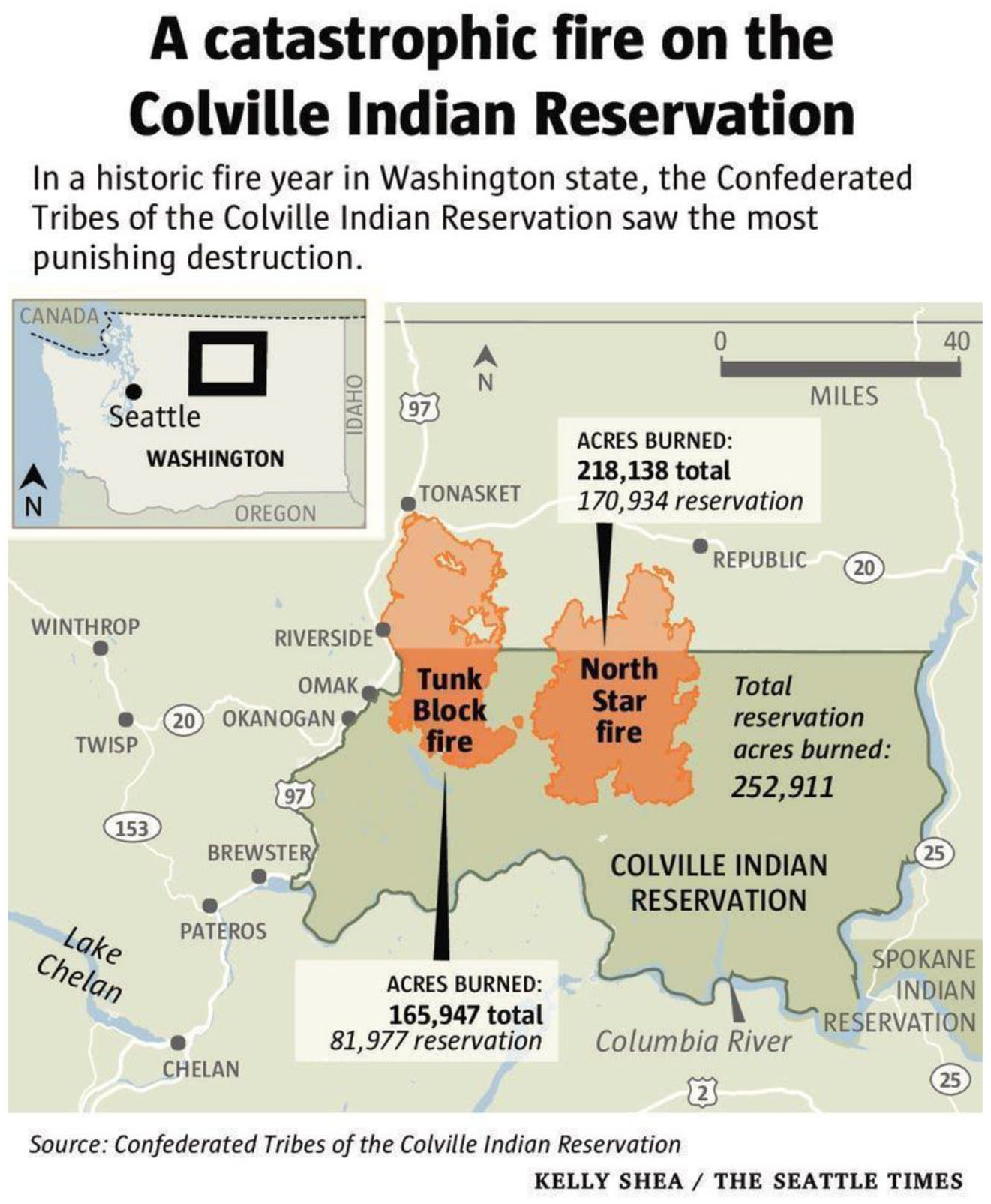
2015 North Star Fire, Colville Reservation, Washington state, Native North America (Mapes, 2015a).
In this project a range of Western scholars and Indigenous voices assist me in exploring the nuances of this issue, as well as my professional experience working as an archaeologist for the Colville (2002–5) and my ethnographic work with DroneSeed (2019–21). Because of his persuasive thinking on technology, entropy, and life, the work of Bernard Stiegler (2017, 2018) provides a philosophical framework for positioning the possibilities of this socio-technical, pan-species, and cross-cultural collaboration. Combining Stiegler’s pharmacology (2017, 2018), a theory of technology as both calamitous and curative, and his work on the Neganthropocene, a hypothetical reversal of the ecological simplification of the Anthropocene, I argue that although it is a mode of ecological control, drone forestry, particularly when authorized on a Native American reservation, is a small restorative and political act in an Anthropocene that is rife with climate despair and depoliticized geoengineering ‘solutions’ (Swyngedouw and Ernstson, 2018). The Four Bears drone reforestry project is an act of regenerative and decolonial geoengineering wherein Native American sovereignty is enacted, not ignored (Whyte, 2018: 290).
At the same time, the climate activism, capitalism, and liberality of the geoengineer, DroneSeed, is at work. For DroneSeed, multiple liberalisms – the economic liberalism of doing well economically and the pro-social liberalism of doing good ecologically – meet climate mitigation in the Indigenous forests of the Columbia Plateau. In the end, with the drone therapy the Four Bears forest only partially recovered; thus while this project did not usher in the Neganthropocene, it did plant a few of its germinated seeds.
Beyond its biological and technological failures, the Four Bears Project can be critiqued for its conservatism. The project was focused on cultural and ecological regeneration – a preservation or a return to a past of cultural practices and timber harvests – instead of a revolution against what Andreas Malm (2016) calls ‘fossil capital’, the concentration of labor, mineral, and economic power. Like other forms of geoengineering, such as stratospheric aerosol injection, tree-based carbon sequestration allows for industrial fossil-fuel emissions and carbon capitalism to continue to rise to dangerous concentrations of CO2. As of July 2021, the global average atmospheric CO2 was 415 parts per million (ppm). At the current rate of emissions, the average will increase to 450 ppm of CO2 by 2050, resulting in a two degree centigrade temperature increase leading to more forest fires, heat waves, crop losses, water shortages, coastal flooding, disease, conflict, and suffering (Freedman and Mooney, 2020). Despite the severity of this threat, geoengineering is criticized for its danger and hubris; technology-based planetary system management is potentially disastrous, after all (Buck, 2019). Regenerative geoengineering alone will not suffice. Immediately shifting energy production from fossil fuels to renewable sources is necessary to produce a livable future.
On a fundamental level, DroneSeed and the Colville tribes are part of the problem, as the carbon-energy powered tools, vehicles, and offices they mobilized for the project contribute to emissions, however small. In this manner, they seek to have it all: carbon capitalism and climate cooling. I do not interpret this as the contradictory antitheses that my Marxist colleagues might. Rather, I interpret this simultaneity of liberalisms as an example of the synthetic work of technoliberalism, a property dualist’s approach that combines social liberalism and economic liberalism as bifurcations from the same liberal source. The grave problem is that capitalism and ecological regeneration may not reverse planetary entropy in their coherence. The Four Bears Project was one small attempt to bring together technocapitalism and Indigenous sovereignty to rehabilitate a climate-induced catastrophe.
Drone Pharmacology
Seen through Stiegler’s general organology, forestry drones and the seed packets they promulgate are extensions of human ‘organs’ – feet, hands, eyes, and minds. Drawing from Leroi-Gourhan’s (1993) theories of ‘hominization’, Stiegler argues that our human physical evolution developed with technological adaptation and is driven towards the ‘urge to conquer space and time’ (1993: 26). Stiegler links Leroi-Gourhan’s ideas regarding hominization with Plato’s and Derrida’s theorization of how the technology of writing both erodes and supports memory. Plato’s concern was that, with writing, memory or anamnesis would be lost and replaced by hypomnesis, simplistic repetition. In this manner, technologies are pharmaka, an ancient Greek term describing things that are both poisons and remedies, such as intoxicants, perfumes, charms, and talismans (Rinella, 2010). They are ‘alternatively or simultaneously beneficial or maleficent’ (Derrida, 1981: 429). Stiegler writes: ‘the pharmakon . . . always produces both entropy and negentropy, and hence it is always also a threat to hominization’ (Stiegler, 2018: 53–4). Technological pharmaka harbor both our generative becoming and potential undoing. Thus while Stiegler’s hominization argues that humans and technologies co-evolve, this co-evolution can ‘bifurcate’ towards one or the other pharmacological potential (Stiegler, 2018: 60). In this article, I have oriented the pharmakon’s ‘strange and invisible pivot’ (Derrida, 1981: 97) towards the talismanic, medicinal, and shamanic. The forest drone is a life-supporting pharmakon with the abilities of speed, mobility, seeing, grasping, and dropping in attempts to control biological regeneration or negentropy.
Entropy or decay is the outcome of the absence of information, heat, or energy arising in ecological simplification, corporeal cooling, or organismic finality. Life, Stiegler writes, is ‘pharmacological, that is, both entropic and negentropic, and hence requires continual arbitration – negotiations that are operations of knowledge as therapies and therapeutics’ (2017: 154). His therapeutic arbitrations are negentropic technologies, exosommaticized organs that generate informational and biological complexity. The Anthropocene, according to Stiegler, is entropic ‘nihilism as computation’ (Stiegler, 2018: 210), dissipative information excess, and energy-wasting networking. The Neganthropocene to emerge, therefore, would entail computation-assisted flourishing and networked anti-entropy informed by sensed data that are RAM-processed and enacted by semi-autonomous robotics. This genetic and computational ‘code-script’ diversifies ecology; it does not simplify it (Schrödinger, 1944). The effort on the Colville Reservation to replant an Indigenous forest with drones is such an experiment in negentropy. 3 Drone forestry focuses explicitly on enhancing life’s probabilities, increasing the likelihood of becoming through ecological-information development, computer-aided seeding, and the cooling of existence through carbon rooting.
I offer drone forestry in the Colville forest as work towards the Negplantationocene. This hideous word, compounding Neganthropocene with Plantationocene (Haraway, 2015; Haraway et al., 2016), harbors a desirable potential. The Negplantationocene is an inversion of the Plantationocene’s simplification, substitution, enslavement, and reordering of generations (Haraway, 2015; Haraway et al., 2016). In it, biologically diverse seed and organism packets are delivered by drone on the Colville Reservation, returning multiple endogamous species to their historical landscapes and contributing negentropically to forest, cultural, and climatic life for the Colville. The Plantationocene is an epoch worthy of undoing through Indigenous sowing and broadcasting. If the plantation defines poisonous planting, drone forestry informed by Indigenous knowledge is its non-toxic vitalization (Casimir, 2020; McKittrick, 2013). The Negplantationocene beckons an epoch of reseeding, rewilding, reforestation, revitalization, regeneration, and re-emplacement – locally reversing the entropic process of colonialism, clear-cutting, climate-induced forest fires, and monocultural agroforestry. It is yet to expand outside of small experiments like the Four Bears Project, but it should.
While a pharmacological approach can be read as equivocating about political tendencies of the technological, I take the affirmative position of my project informants at DroneSeed, advocating for more life and less death (Braidotti, 2019). Despite the power differentials, exacerbated by a legacy of colonialism, between technology companies and Indigenous people, drone forestry can be beneficial for climate mitigation and Indigenous economic, cultural, and ecological revitalization. The Four Bears Project is one small therapy, not a vaccine that eradicates global heating. This therapy is experimental, temporary, site-specific, and involves multiple species. As such, this ‘minor science’ (Deleuze and Guattari, 1987: 109) of negentropic reforestation, coming from a technology start-up and an Indigenous tribe, is humble in terms of its landed, local impact but ambitious in its atmospheric, global consequences.
For others, such projects are not so innocent. For Stiegler (2018), the drone’s sensing and computational abilities grammatize or depict and therefore reduce life to discretely manageable code, enhancing the ability to control. Drone grammatization could render the forest ‘as stores of timber or carbon sinks, but not as sites that sustain cultural narratives or Indigenous cosmologies’ (Gabrys, 2020: 5). Forestry drones may occlude the ‘democratic engagements with environments’ that terrestrial planting requires (Gabrys, 2020: 7). Clare Dubois, founder and CEO of TreeSisters, a British-based feminist tree planting organization, refuses to use drones for similar reasons, saying, ‘It’s the disconnect between people and trees that drives deforestation. We need people connected with forests’ (Barkham, 2019: n.p.). The Colville approach should allay these concerns. Here drone forestry is a pharmakon whose grammatizations contribute to a ‘green governmentality’ that connects indigeneity, biodiversity, carbon containment, and cultural continuity in systems of control that are not hegemonic (Rutherford, 2007). Green governmentality is a theory of ecopower, or the biopolitical governance over organisms, that emphasises the convergences and contingencies of biology and technology (Foucault, 2003).
The COVID-19 pandemic, overlaid as it is on the sixth extinction and the fourth industrial revolution, has provoked several scholars to revisit previous critiques of negative, death-driven, necropolitical governmentality (Braidotti, 2020; Bratton, 2021). Multiple governmentalities – such as the ‘left governmentality’ of Foucault’s later writing – are now apparent and, some argue, necessary (Dean and Zamora, 2021: 37). For Foucault (1996, 1998, 2008), as for the subjects in this article, multiple governmentalities diversify the varieties of controls, opening the possibilities for wild life – human, vegetative, and otherwise – to exist, not through coercion but through environmental conditioning. Out of this thicket comes a life affirmative, zoēpolitical, and ‘positive biogovernmentality’ which, according to Benjamin Bratton, ‘is concerned not only with how life emerges or is made free, but also with how it can be repaired, reproduced, sustained, and preserved’ (Bratton, 2021: 120). This conceptualization of affirmative governmentality has been occurring across disciplines and geographies. Ocean scholars Iris Braverman and Elizabeth Johnson, for example, offer ‘blue legalities’ – the legal, technical, relational, and elemental factors – that make possible ‘a mode of governing with care’ (Braverman and Johnson, 2020: 20). Likewise, my theory of ‘blue governmentality’ (Fish, 2022) positions conservation drones’ exercise of biopolitical care and control over marine flourishing within the contingencies of aqueous fluidity, atmospheric gusts, ecosystem perturbation, legal inaction, and technological slippage.
While these multiple, affirmative governmentalities develop, the critique of necropolitical governmentality needs to also continue. Necropolitical governmentality exacerbates surveillance capitalism and its exploitations, racist technological redlining, digital political tribalism, predictive gender discrimination, and inhumane border policing (Chun, 2021; Srinivasan, 2019; Noble, 2018). But if technological pharmaka can be pushed towards the zoēpolitical, its mission creep checked and its systems deracialized – considerable hurdles to equitable application – then zoēpolitical governmentality might be capable of protecting life’s flourishing during existential crises where few non-surveillance and non-controlling options remain (Hamilton, 2017; Lorimer, 2015; Malm, 2018).
I name this green variant of zoēpolitical governmentality after its primary functionary, the tree. Arborescence is useful here for the very reasons it was so despised by Gilles Deleuze and Félix Guattari (1987: 15): it is top-down, governed by a trunk, and vertically dominating. Arborescent governmentality embraces the control modeled by the tree’s centralized, branching, and ascending structure. Like the towering, pollinating Ponderosa pines (Pinus ponderosa) common on the Colville Reservation, forestry drones cast seeds from an elevated position. Drones direct reforestation through multispectral vision and algorithmically rendered readings of vegetation, soil, shade, and moisture. For a brief broadcasting by drone swarm, a hierarchical and vertical power disciplines biopower, making or breaking life.
Arborescent governmentality, then, gives way to something that Deleuze and Guattari (1987) might have celebrated: a landscape striated by nomadic, techno-ecological becoming. A seed puck embedded with rhizomatic potential and actual fungi mycorrhizal nurturing vegetative and eventually animal vitality. The drone-dropped puck horizontally sediments into soil, where it inverts the downward verticality with upward growth and multispecies synergies. Arborescent governmentality is local genetic control by computers and cultural sovereignty. It is a cross-vectral planting of habitat, seeding of lifeways, and rooting of carbon – until it is logged, burned, and planted again. The rewards are substantial for all actants in this pharmacological entwinement.
Towards a Decolonial Geoengineering
As I mentioned before, from 2002–5, as a settler-colonial archaeologist I helped enact Indigenous principles of land management with the Colville on their reservation (Fish, 2006). During this labor, I worked with tribal members to protect archaeological sites. I spent much time surveying forests for cultural properties in the north half of the reservation, an area densely forested in Ponderosa pine, Lodgepole pine (Pinus contorta), and Western larch (Larix occidentalis). The forests contain these properties and provide the most significant source of revenue for the tribe: timber. I was steeped in tribal history, culture, and ethnobotany but also their timber economics (Turner et al., 1980). Profits from timber support the Colville’s programs, including the cultural preservation program that employed me to investigate Colville heritage in their forest. My job was to survey – on foot or with orderly shovel probes below the ground surface; at my desk, with digital geographic maps of cultural sites; and in the community, in dialogue with tribal elders – all manner of things, be it a particular stand of trees, a visually striking rock outcrop, or a small creek. If something was determined to be of significant cultural value, a discussion would begin between cultural resource managers, tribal elders, and the tribal government (Fish, 2006, 2008, 2011). Many times the presence of cultural sites stopped a timber cut. Often it did not. Columbia Plateau tribes’ ‘optimization of economic return has been purposely compromised to protect a wide array of nontimber values that form the foundation of local Indian culture’ (McCorquodale et al., 1997: 187). Drone forestry on the Colville Reservation is an example of Indigenous economic development that blends and compromises ‘both traditional and Western capitalist values’ (Nikolakis and Grafton, 2015: 641). Forest resources offer a graphic negotiation of these mixed values and an execution of tribal sovereignty.
A decade after I left, the North Star Fire burned 218,000 acres of the Colville Reservation in 2015, destroying nearly 20 per cent of their $10 million timber harvest. I did not return to conduct fieldwork for this project – the Colville’s intellectual and cultural resources have been exploited by scholars, and they now tightly limit what academic or industrial work occurs on the reservation. This point is more important than a methodological aside, as it indicates the extent to which the Colville trusted and managed the work of DroneSeed to replant the Four Bears forest for their benefit.
Thirty million trees will need to be replanted after the North Star Fire, claimed Cody Desautel, natural resource director for the Colville. ‘We do two or three million in our best year,’ he continued (Mapes, 2015a). The blaze harmed not just economic but also cultural ways. Tribal member Del Ostenberg grieved, ‘All our food has been wiped out in a lot of these areas, the bear, the elk, the deer, the moose . . . there is nothing left out there for them to eat’ (Mapes, 2015b). For tribal member and activist Dan Nanamkin, fire threatens intergenerational continuity. ‘The resources we have here, that we want to share with our youth,’ he said, ‘are in danger’ (Francovich, 2021). Global heating compounds this trouble, resulting in diminished snowpack, drier and warmer summers, lower summer streamflows, and more frequent fires on the reservation (Krosby and Morgan, 2018). Lonnie Cawston, lead for the Colville Tribe’s Mount Tolman Fire Center, worries his tribe is the ‘poster child for climate change’ (McDermott, 2020).The Colville are putting into practice a belief that reforestation, aided by technologies such as drones, might help reduce the most threatening aspects of global heating.
With the funds coming from the US federal government, the Colville Business Council agreed unanimously on 19 December 2019 to approve a contract with DroneSeed to reseed a section of the reservation burned by the North Star fire (Colville Confederated Tribes, 2019). The US Department of the Interior (through the Bureau of Indian Affairs) and the US Department of Agriculture (through the US Forest Service) financially support land-based initiatives on reservations like the Colville’s. The US Department of Energy also financially assists the Confederated Tribes of the Colville because the Bonneville and Grand Coulee dams on the Columbia River destroyed their treaty-protected gathering and hunting rights. These sources of support show that this is not a neoliberal project defined by a corporation filling the role played by an absent state. Rather, this project brings together treaty obligations and aspirations for Indigenous sovereignty.
The Colville nearly did not have a reservation, let alone the option of drone forestry. Throughout the 1960s, the Colville sought to terminate their reservation following a federal policy encouraging Native Americans to abandon reservation lands for cash. Addressing the Colville, Vine Deloria Jr., member of the Standing Rock Sioux Tribe, stated: ‘termination is used as a weapon against Indian People in a modern war of conquest’ (1969: 76). Colville elder Lucy Covington opposed the ‘fever and fervor for termination’ (Trahant, 2021). After a tight election in 1971, at the height of the American Indian Movement, termination of the Colville Reservation was defeated and a period of sovereignty over politics and business continued, according to Colville member Laurie Arnold (2012).
In a filmed interview, John Sirois, previously the Chairman of the Colville Business Council and my boss during my tenure, defines sovereignty with a wry smile as ‘the sacred duty you have to the land and to the water, because that is something sovereignty does not necessarily take into account, because it is a French word’ (Sirois and Lamebull, 2013). Without rejecting termination and asserting sovereignty, projects like Four Bears would not happen. Tribally authorized drone forestry is one example of persistent technological adaptability, multispecies care, and what member of the Minnesota Chippewa Tribe Gerald Vizenor (1999) calls ‘survivance’, or active presence despite a legacy of colonial policies like termination. The Four Bears Project is a minor science of survivance, an example of tribes’ drive for ‘collective continuance’ or the ‘capacity to be adaptive in ways sufficient for the livelihoods of its members to flourish in the future’, according to member of the Citizen Potawatomi Nation Kyle Whyte (2013: 518). As such, drone forestry manifests in a small way in Sirois’s sacred duty of sovereignty.
The Colville and DroneSeed collaboration is not race-based technological colonialism (Noble, 2018). Rather, it links Indigenous people and technology engineers in decolonial acts of ecological sovereignty on tribal grounds for local and global, human and nonhuman welfare. This is an example of ‘digital decoloniality’, or to give the term a more material and hardware-centric spin, it is an exhibition of ‘networked decoloniality’, an affirmative application of networked technologies for Native American survivance, online and off, in flourishing multispecies relationships (Deem, 2019). The Four Bears Project is a collaborative, technological, and biological exercise of sacred sovereignty and networked decoloniality over land once occupied and never terminated.
The Four Bears Project embodies the adaptive practices that have allowed the Colville to flourish in technological and multispecies relationships for at least 9,000 years on the Columbia Plateau (Rasmussen et al., 2015). After a disastrous 250 years of colonialism, the Colville today are a sovereign people with a large reservation complete with significant forest resources, including the Four Bears forest. The rigorous checks performed by various cultural and natural resources committees within the Colville Business Council – a body elected to balance cultural revitalization with economic security – ensure that their knowledge and its values are not exploited by DroneSeed. As is true of most other Native Americans, the legacy of colonialism continues to negatively impact tribal members’ health, employment, education, income, child mortality, and life expectancy (Probst and Ajmal, 2019). These painful and pervasive entropies make the negentropies of the Four Bears Project more urgent and vital. For Indigenous peoples (as for all humans), the health of the land and the people are interdependent.
Both economic and climate-mitigating benefits incentivize DroneSeed. They want to grow as a business because that means they are planting more trees – and carbon – faster in the soil. The Colville helped DroneSeed achieve both of these goals, and they share DroneSeed’s objectives to slow global heating and revitalize forests (Krosby and Morgan, 2018). Four Bears is not a project that decouples capitalist growth from ecological and social impact. Rather, it is an experiment in negentropy in which biological and economic growth are paired. This exercise in producing an original, organological act in the Negplantationocene ultimately did not take root, but not without first planting seeds of sacred sovereignty and networked decoloniality and demonstrating a worthy effort of carbon rooting within the context of start-up experimentalism.
From Native America to Start-up Culture
A small team from DroneSeed arrived in Four Bears in the winter of 2019, in a fleet of two diesel trucks pulling trailers that carried a bevy of batteries and six aircraft (Figure 2). Patches of ice and snow glistened in shady patches next to downed, charred trees. Working together, DroneSeed and tribal members flew drones to collect land, vegetative, and soil data for AI-assisted planting optimization. Afterwards, drone swarms dropped pucks containing local tree seeds, fungi mycorrhizal, organic fertilizers, moisture retainers, predation deterrents, and other secret ingredients. The planting operation involved a few weeks and ‘they crushed acres. One tree closer to 1 trillion done. Done in the right way, collaborating with the community,’ claimed one DroneSeed forester (personal communication, 2019). In the future, drones may return to this budding forest and measure its development. The state of these trees’ growth will then cybernetically inform iterative recoding of the computational systems that delivered their birth. DroneSeed takes this machine learning from the project.

DroneSeed at work in Native America. Image: DroneSeed.
Desautel explained that Colville’s forestry ‘is geared towards replicating those historic conditions that would have been here before European contact’ (Washington Policy Center, 2020). When she was 98 years old, his grandmother told him that ‘when she was young there was no place on this reservation that you couldn’t take a horse and buggy through. [Back then the reservation was] much more open, fewer trees, bigger trees, less vegetation in the under stories’ (Washington Policy Center, 2020). DroneSeed’s seeding strategy was to return the reservation to this state by algorithmically programming drone swarms to disperse seed pucks based on memories like Desautel’s grandmother’s. Mohawk and Anishinaabe tribal member Vanessa Watts (2013: 23) points out that many Indigenous people consider nonhumans such as trees as contributors to a multispecies ‘society’ that forms through interspecies communication. To not communicate is to not care, threatening Indigeneity and its multispecies relations. Reforestation through nonhuman collaboration is a form of interspecies care that connects memories and futures through trees and technologies.
Drone sensors surveilled the land, guiding drones to deliver seeds with precision to scientifically optimal planting locations. The goal is to re-create the elder Desautel’s memories, staging a return to pre-colonial forests that is useful for forest ecosystems and Colville sovereignty, and that provides refugia for multispecies societies. In this manner, drone forestry on tribal land is an arborescent governmentality that ‘aims to replace grandiose ideas of planetary management and the hubris implicit in the power/knowledge nexus with an attitude of humility and self-reflection’ (Bäckstrand and Lövbrand, 2006: 55). From an arborescent loft, drone swarms are rhizomatic vehicles that deliver seed pucks of horizontally laboring organisms. As such, ‘rhizomic and arborescent politics work in concert. Rhizomic political movements may take flight from arborescent structures, but they come back to intersect and interact with arborescent assemblages, appropriating parts of the organisation and stimulating change’ (Woods et al., 2013: 441).
After the Four Bears Project, I visited DroneSeed at their offices in 2019 in the Ballard Brewery District, Seattle, Washington, a nondescript space situated between micro-breweries and in sight of the industrial shipyards of the Puget Sound. As I entered, I read an information sheet describing DroneSeed as ‘deliberatively for-profit to scale up and grow forests as fast as possible’, an ecomodernist approach to using capitalism towards ecological goals. I met with CEO Grant Canary and Matthew Aghai, Director of Research at DroneSeed, and we quickly engaged in an organological discussion: ‘Humanity is a product of nature. It’s the universe, in my opinion, creating consciousness and viewing itself. So we have the tools not only to destroy it, but also to harness the natural world. To create things to actually repair it,’ stated Aghai (personal communication, 2019). Canary said trees are the best geoengineering tool: ‘you plant them, they self-propagate, they build themselves and they suck carbon out of the atmosphere . . . that’s the most sci-fi thing you can get. [Imagine] if you had a factory that built itself’ (personal communication, 2019). Drones improve the odds for successful reforestry through a grammatization that ‘gives you greater granularity on probability. Nature works on probability and right now we’ve been operating on a model of “we do this in this way we have this probability.” It’s a lower probability. What we’re doing is boosting that probability so that you can predict in five years where we’d like to be,’ Canary told me (personal communication, 2019).
DroneSeed’s goal is to ‘reduce risk, increase options’, according to Aghai (personal communication, 2021). Options give us more time and strategies to respond to climate crises. Regenerative geoengineering is ‘playing nature’s game’, he said (personal communication, 2021). DroneSeed situates their capitalist orientation as a way of quickly leveraging the market and technology. ‘I was not a capitalist. I come from a long line of communists,’ said Aghai, whose Iranian family supported communism in that country before emigrating, ‘but . . . now, I’m an unabashed capitalist because . . . you’ve got to play the game.’ DroneSeed’s organology naturalizes capitalism, while capitalizing on nature technics. These are not ‘immunological biopolitical fantasies’ (Swyngedouw and Ernstson, 2018: 5). While their aspirations are grand and their technologies futuristic, drone foresters are realistic about the likelihood of planting trillions of trees and reversing entropy. Nature’s game, market rules, Indigenous collaborators, and flying computers are brought together for this improbable task.
I walked down their office stairs and entered a busy hanger of massive drones, dusty desks, and micro-cactus gardens. A distinctly spicy aroma of capsicum burned my nostrils, the result, I learned, of one of many ingredients in DroneSeed’s not-so-secret seed puck. Blessing my sneeze, Aghai explained that with a fine-tuned multispecies puck, ‘the likelihood of succeeding’ increases and the ‘precision game becomes less relevant. It’s more about the numbers game.’ This reminded me of an earlier discussion I had with another drone forester, Jeremie Leonard, Vice President of Engineering at Dendra, who said there is a ‘huge lag in re-creating the forests that we’re destroying. . . . You have to find ways to, you know, be better than human beings’ (2017, personal communication). These drone foresters are playing nature’s game, trying to reverse entropy to increase the likelihood of life. Leonard relished ‘knowing and controlling the exact location of every single tree that we are planting’ (2017, personal communication). This arborescent governmentality is not only about numerical or binary grammatization and extending human intention beyond itself; it also involves the curation of multispecies assemblages.
In the warehouse where the seed pucks and drones are produced, a drone engineer discussed the drones’ pharmacological properties with me. He illustrated drone biopower through a discussion of gun-rights advocates who ‘love to say that a gun is not good or bad. It’s a tool. It’s about what the user decides to do with it that dictates what its morality is. The tool itself is amoral, not immoral. Drones are the same way. They are an empowering technology’ (personal communication, 2019). This point is more than a bromide about guns not killing people, people do. It addresses the pharmacological aspects of ‘empowering technologies’ (personal communication, 2019). In this office and on the reservation, the beginnings of a new drone, not necropolitical but zoēpolitical, was emerging, and along with it the paradox of arborescent governmentality, a ‘native’ forest coded by algorithms and planted by drones. This was a project of rewilding a forest through mechanisms of control. Sacred sovereignty materializes in the process.
Sharing a sour beer and playing fetch with the office German shepherd in their garage, I asked a GIS expert about the colonial heritage of maps and he replied: ‘I don’t think of my maps as being sinister or controlling by any means’ (personal communication, 2019). This particular GIS professional was also the field director for the Four Bears Project. He told me about the long days in the Colville’s forest, the animals sighted, and tribal people he collaborated with. His reflections and his statement about the non-poisonous aspects of GIS maps made by drones – cartographies designed to direct drones and optimize the chance of vegetal regeneration – reminded me of my years on the reservation long ago, when a suite of then new technologies (GIS, GPS, digital videocameras, and the internet, which was still relatively novel on the reservation at that time) provided tools to advocate for the protection of cultural sites. Seventeen years later, those tools’ momentum is firmly sedimented in Colville zoēpolitics and a new technology has emerged, the forestry drone, that the Colville have incorporated as an aspect of their networked decolonialism and sacred sovereignty.
Indigenous Negentropy
The seed pucks consisting of endogamous plant species are precisely drone-dropped by an eco-technology firm with the consent of Indigenous people on tribal lands, with converging ecological, cultural, and economic benefits for all. These drone-planted seeds are not conscripted species, forced into labor by the functionaries of the Plantationocene. Nor is this an example of ‘carbon colonization’, the marketization of trees for a Western technocratic trade in carbon (Lyons and Westoby, 2014). The Four Bears Project is a bold yet unpretentious example of the Negplantationocene following the thinking of Haitian scholar Jean Casimir (2020), who names the ‘counter-plantation system’ as a reversal in which the formerly enslaved, having revolted, worked the land and, in the process, created a post-slavery order geared toward preventing the return of exploitation. From this decolonialism ‘differential modes of survival emerge – creolization, the blues, maroonage, revolution, and more’ (McKittrick, 2013: 3). The Four Bears Project is an example of decolonial gardening situated in the humus between the Plantationocene’s Cartesian control of space and the Black or Indigenous gardens at the postcolonial edge of the plantation.
It could have been otherwise. Bioprospecting – the use of Indigenous communities to identify medical compounds for industrial pharmaceutical production – illustrates how value can be taken and not returned to Indigenous communities (Neimark and Vermeylen, 2017). Replanting trees with drones is one rare act wherein sacred sovereignty – and its negentropic consequences for refugia regrowth – prevails over colonial and capitalist expropriation.
Reversing the Plantationocene means zoēpolitical seeding. Aided by optical assessments, geographical precision, computational preconceptions, and compliant atmospheric regulations, the forestry drone accomplishes this through extending human bodily care in negentropic practices and planting endogamous seeds in multispecies assemblages of fungi and living soils. The drone’s atmospheric mobility and optical vantage are aspects of a therapeutic pharmakon. Such is the art of multispecies and transtechnological living on a damaged planet (Tsing, 2012).
Colville’s burnt forests are being surveilled, disciplined, and re-constructed by drone grammatization, growing as a partially programmed commodity and a compromised cultural landscape – one that provides a lock of carbon, a habitat for other species, and a resource for culture, economics, and memory. None of these is permanent, universalizable, or particularly successful. Aided by ecologically programmed technologies, drone forestry attempts to remake a forest whose arboreal generations have been disordered by fire. In order to optimize the chance of life from the char, tree seeds and their symbionts in the puck are delivered to AI-suggested locations to mimic the understory qualities remembered by tribal elders. The seeds are old but the delivery is new. This is governmentality, but it is not necropolitics. Arborescent governmentality is a mode of control, and drones are organs for tactful and tactical oversight that can be put towards a therapeutic process that supports Indigenous cultural values and other organisms. The forest iterates in symbiosis with the Colville tribes, pivoting locally and humbly with negentropic technologies. This time, the Negplantationocene did not emerge from the land of Four Bears, but the proof-of-concept – that technologies can empower Indigenous sovereignty in cases of proper consent – did appear on the earth from the drone’s arborescent view.
Technoliberalism
DroneSeed comes from a perspective that is different from but complementary to the Colville’s. Their commitment to climate mitigation is not insincere; it is not a ruse to make money. Employees arrive from technology and engineering industries where the pay would be superior. CEO Grant Canary is a successful businessman who has worked in wind energy and producing sustainably grown insects for animal feed. Luc Boltanski and Eve Chiapello (2005) might contend that companies like DroneSeed absorb climate politics into their economic pursuits. My observations do not support this cynicism. This is not to take DroneSeed at face value, but to take seriously the complexities of human drives and their shifting alignments within liberal multiplicities. These are technoliberals, for whom economic and ecological liberalism are bifurcations of classical liberal individualism within a technological milieu (Fish, 2017; Von Bargen and Fish, 2020). For them, this is not a contradiction.
To argue that subjects who carry these mixed motives are hypocrites is to align with a reductive critique of technology. A classic example is the ‘Californian Ideology’ which comments on the ‘contradictory mix . . . of conservative economics and hippie radicalism’ (Barbrook and Cameron, 1995). This is not a contradiction for technoliberals, property dualists who view economic liberalism and social liberalism as different but emerging from the same source, classical liberalism (Malm, 2018). Because of the possibilities and profitabilities their emergence affords, networked technologies offer opportunities for creating social and ecological benefits as well as private capital. These new networks do not promise a revolution that leads to communism or radical change (for that the conflict of contradiction is needed) but rather synthesize the tensions of liberalisms, blending ‘doing well’ economically with ‘doing good’ ecologically. Ultimately, the synthesis does not work in the ways hoped for. Drone reforestry at Four Bears was not the success they desired – some trees flourished, most did not. A more radical dispossession, not of syntheticism but of antitheticism, that mobilizes against the liberal status quo of carbon capitalism might be called for to stop global heating on and off the Colville Reservation.
Upon inspection of Four Bears a year later, some areas were successfully replanted – most were not. That the project did not ultimately succeed should moderate critiques that drones are all-powerful and all-seeing tools that militarize conservation, humanitarianism, and policing (Fish and Richardson, 2021). The grammatization of drones or artificial intelligence is never total. As any drone pilot will tell you, drones, like most other technologies, regularly glitch-out: they fall from the sky, fly away, and fail for unknowable reasons (Fish, 2021). Their promise of enhanced hominization, including mobility, vision, and force from afar, rarely manifests as desired. The same is true with geoengineering; the many proposed serious, sophisticated hacks of earth systems (e.g. injecting aerosol into the stratosphere) may ultimately result in unforeseen and cascading effects that require more technological governmentality. Negentropic geoengineering on a Native American Reservation is one benign if possibly therapeutic intervention in a world either of technosolutionism or eco-nihilism (Lee, 2017). It also suggests that political or social solutionism alone will not be a sufficient response to climate chaos.
Redwashing, Greenwashing, and Techwashing
Working profitably in the forested mountains with Native Americans and new technologies that might help save the world and preserve Indigenous culture is an ideal project for a Western technoliberal. But this was not ‘redwashing’ – capitalism camouflaged in a veneer of indigeneity to obfuscate ‘the harmful impacts of extractive practices and histories of colonialism’ (Millington et al., 2019: 2022). Neither was this a ‘greenwash’ or a ‘techwash’ – that is, a public-relations campaign aimed at boosting a company through association with ecological or technological projects. Having worked as an archaeologist with the Colville and observed the detailed care which they exercise in protecting tribal resources and sovereignty, it is my opinion that they would not allow a project with observable harms or exploitative possibilities to continue on their reservation. After a lengthy, multidimensional deliberation, the Colville consented without coercion to participate in the project. They provided consent, guidance, access, land-use, right-of-way, labor, and geographic and ethnobotanical knowledge. This was not done in ignorance.
The Colville’s benefits in this drone regeneration were substantial. They assisted in the trialing of a technology that could automate reforestation, a serious concern for a tribe with cultural and industrial connections to forest resources. They acquired knowledge capital through working alongside purveyors of emergent technologies. Their tribal commitment to climate mitigation was put into practice (Krosby and Morgan, 2018). In procuring the grant from the federal government they exercised their treaty rights and opened a pathway to future investment. Some acres were indeed replanted, generating economically and ecologically valuable forests. These factors made Four Bear’s a worthwhile experiment with both benign risks and a potential for existential rewards for nonhumans and humans alike, including the technologists at DroneSeed and the Colville Native Americans.
DroneSeed also benefited from access to the tribal forest. They administered the dronework, were paid, expanded their network, gained some cultural capital, and taught their learning machines through the flights over Colville lands. But DroneSeed’s few substantial economic, cultural, and technological benefits were not the result of exploiting tribal identity and resources for off-reservation non-tribal gain. Other technoliberal-Indigenous collaborations may be faulted in other contexts for being extractive, colonialistic, paternalistic, conservative, or naively optimistic (Hayden, 2003). But redwashing this was not.
Cheyenne and Hodulgee Muscogee tribal member Suzan Shown Harjo (1992) has long argued that tribal members have a right that non-tribal members do not – to capitalize on tribal identity and resources. We must accept the Colville as sovereign agents over their identity and what occurs on their reservation. To do less than that is to perpetuate the racist conceptualization of ‘wardship’ by which Native Americans, unable to care for themselves, require the guidance of the US government. The collaboration between these two actors cannot be reduced to the subtle or gross conflicts of identity politics. The lives and resources of both DroneSeed’s technologists and the Colville are constituted from immanent relationships with living and nonliving, human and more-than-human beings and therefore go beyond identity politics and polemic exploitation.
Conclusion
The drone is more than a weapon of war, death, and necropolitics. It is a pharmakon, an existential technology with both poisonous and sanative potentials. This article has analyzed the little explored therapeutic aspects of zoēpolitical control, which I call arborescent governmentality. Turning our attention to the life-supporting therapeutics of drones proves them to be life-supporting tools for negentropic futures, capable of assisting ecological, cultural, and economic revitalization. In the process, a local example of negentropy emerges. Negentropy is a process that is possible on a case-specific level and necessitates a range of human and nonhuman collaborators. While old growth forests should be protected for the carbon and biodiversity they contain, forests planted through technology-facilitated arborescent governmentality are one rare instance of zoēpolitical care enacted through technics by humans. For this reason, drones and the arborescent governmentality they perpetuate, and the systems of care they embody, should not be dismissed but rather appreciated for the unstable multispecies futures they might create.
Drone forestry on native lands under Indigenous authorization is a contribution towards neganthropocentric thinking. More is needed. 4 Regenerative geoengineering, as DroneSeed and the Colville now understand, is but one rough intervention. Agricultural, waste, transportation, and energy industries will need transformation to ‘reduce risk, increase options’. Everything will need to be electrified – transportation, mining, and construction and fertilizer, steel, plastic, and concrete production. Solar, wind, geothermal, and hydro-electricity as well as green hydrogen and nuclear power will have to replace fossil fuels. Soils in addition to forests will need to store carbon. These efforts must be global, scientific, technological, social, and personal (Buck, 2019). A convergence of atmospheric technologies, silviculture science, regenerative intuitions, genomes, and Indigenous knowledge and consent will be necessary for the Negplantationocene to emerge. Top-down technoscientific methodologies will need to collaborate with horizontal ecological methodologies. This article has created a small aperture into one experimental therapy towards that goal.
