



Abstract
This essay examines the role of voice-centred media practices in promoting public engagement and enhancing academic research in a media environment dominated by platform capitalism. It argues that developing academic researchers’ media literacy is essential to their understanding of how communication spaces are created and managed. Through the ‘Let’s Read the “Terms of Service” Out Loud!’ workshop, participants explored the often-overlooked implications of digital media and platform use. This activity raises awareness of the personal data exchange inherent in platform capitalism. The essay also introduces the telephonoscope, an experimental medium that combines digital apps with classic black dial phones, enabling participants to engage in personal storytelling. These media practices offer alternative methods for engaging with media platforms, fostering reflection on their societal impact. Integrating media theory into research and embracing voice-based storytelling practices can bridge the gap between academic researchers and the public, creating more profound insights into digital media.
Introduction
In this essay, I argue that, in a media environment rapidly influenced by platform capitalism, we need to develop literacy concerning our bodies, the spaces surrounding us, and the materials that help create, maintain, and manage communities and public communication spaces. The focus is on media practices related to voice. This argument will primarily draw from the findings of two workshops, illustrating that speaking out, listening to voices, and sharing these experiences are beneficial not only for the public but also for academic researchers.
Let’s Read the ‘Terms of Service’ Out Loud!
To clarify the aims and perspectives of this paper, I will first introduce the ‘Let’s Read the “Terms of Service” Out Loud!’ workshop (Mizukoshi and Katsuno, 2023), developed in collaboration with colleagues (hereafter the Workshop). This ice-breaking mini-workshop aims to explore the mechanisms and characteristics of digital media, such as social networking services (SNS) and search engines, often taken for granted in daily life. I will outline the Workshop’s implementation as an example of the practices introduced in the media literacy course I conducted in the summer of 2024, involving approximately 160 university students.
The media literacy course comprises 15 weekly lectures, intended for first-year undergraduates. In the 13th session, titled ‘Designing Platforms’, I discussed how media platforms are often overlooked because of their pervasiveness. I introduced various attempts at arts activism to help students become aware of platforms, supplemented by YouTube videos. Although arts activism may not be universally accessible, the Workshop provides an approachable means for students to engage with these platforms.
First, I asked the sleepy-faced students in my 9am class if they had checked the terms of use for Instagram, TikTok, or Google. A few enthusiastic students shook their heads, but most were puzzled about what I was talking about. I explained that they had to register an account to use SNS, that they were required to agree to the terms of use at the time, and that they should have ticked the ‘OK’ button. Many students finally looked convinced. However, when I asked them if they had read the terms of use when they started using the service, none nodded. 1
So, I connected my smartphone to a large projector in the classroom (an act that involved more embarrassment and courage than I expected) and went through the process of checking Instagram’s terms of use. To do so as of August 2024, the following steps had to be taken. First, the post screen had to be displayed, and the three lines in the top-right corner had to be tapped. Scrolling all the way down on that screen would lead to a section called ‘Basic Data’ under the category ‘Details and Support’. Tapping on it would show the ‘Terms of Use’ alongside the ‘Privacy Policy’ and so on. Sharing my trial-and-error process of reaching this point with students is also important foreshadowing.
I selected one section from the Terms of Use and had a pre-designated student stand up and read the text loudly and slowly. The students, half asleep until then, looked up in surprise at the unusual classroom situation and listened attentively:
How Our Service is Funded (Meta, 2024) Instead of paying to use Instagram, by using the Service covered by these Terms, you acknowledge that we can show you ads that businesses and organisations pay us to promote on and off the Meta Company Products. We use your personal data, such as information about your activity and interests, to show you ads that are more relevant to you. We show you relevant and useful ads without telling advertisers who you are. We don’t sell your personal data. We allow advertisers to tell us things such as their business goal and the kind of audience they want to see their ads. We then show their ad to people who might be interested. We also provide advertisers with reports about the performance of their ads to help them understand how people are interacting with their content on and off Instagram. For example, we provide general demographic and interest information to advertisers to help them better understand their audience. We don’t share information that directly identifies you (information such as your name or email address that by itself can be used to contact you or identifies who you are) unless you give us specific permission. Learn more about how Instagram ads work here. You may see branded content on Instagram posted by account holders who promote products or services based on a commercial relationship with the business partner mentioned in their content. You can learn more about this here.
Another part of the Privacy Policy was displayed and read in the same way by another student:
Your Activity and Information That You Provide (Meta, 2024) On our Products, you can send messages, take photos and videos, buy or sell things and much more. We call all of the things you can do on our products ‘activity’. We collect your activity across our products and information that you provide, such as: - Content that you create, such as posts, comments or audio - Content you provide through our camera feature or your camera roll settings, or through our voice-enabled features. Learn more about what we collect from these features, and how we use information from the camera for masks, filters, avatars and effects. - Messages you send and receive, including their content, subject to applicable law. We can’t see the content of end-to-end encrypted messages unless users report them to us for review. Learn more. - Metadata about content and messages, subject to applicable law - Types of content, including ads, that you view or interact with, and how you interact with it - Apps and features you use, and what actions you take in them. See examples. - Purchases or other transactions that you make, such as through Meta checkout experiences, including credit card information. Learn more. - Hashtags you use - The time, frequency and duration of your activities on our Products
These texts are rarely, if ever, reviewed by users. Even if they were, individuals would only scroll through on the small display on their smartphones and follow the words with their eyes or read them silently. I had prepared for an extraordinary scene in which such texts would be read aloud in a large classroom as if it were a primary school language class or a theatrical play. I asked the nominated students to read slowly and loudly as if they were reciting a poem. The students were confused and shy at first, but transformed into firm narrators when they followed the words with their eyes and felt their sleeping peers begin to look up at the loud voice. This was probably because they realized that, although these were complicated sentences with legal jargon mixed in, they were talking about Instagram, which they use all the time, and which is also quite problematic. The other students, who were at first chilling with the nominated student and sneaking chats with the student next to them, also gradually became quieter until, at the end, no cough could be heard. Students commented, for example, as follows:
Reading the Instagram terms of use aloud in class made me realize that I had been using SNS somewhat casually, learning information I hadn’t paid much attention to, such as how to handle personal information. I use Instagram a lot, but I’ve never read anything like that. It’s actually scary to think that a lot of information is being taken without your knowledge, but it was interesting to understand. What I realized was that I rarely had the opportunity to recognize the relationship between us and the media. We only become aware of that relationship when we register something new or when we have a problem, and I was surprised at how little we were aware of that connection, even though we live surrounded by so much media. It is not uncommon for a lecturer to explain to students that the increasing prevalence of smartphones and various platform apps in our daily lives means that platform capitalism is taking over our Lebenswelt. In the process, our communication acts are being fragmented and provided to advertisers through artificial intelligence-based analysis, and it is not that difficult to do so. But do students really understand what is happening with such conceptual explanations? I highly doubt it.
As the lecturer connects their smartphone to a large screen and the students wander through the terms of use and privacy policy, they at last realize that they are in control of the issue and that it arises in their daily lives. The unusual act of one of the students reading the terms of use and privacy policy out loud in front of a large group of people can call their attention to the issue and, at the same time, provide them with an opportunity to understand a part of Instagram’s revenue system through their voices. Students can also share this process with their peers and have the opportunity to reconsider its meaning not as individuals but as citizens. Through such an unusual and theatrical process, the Workshop gave students an opportunity, albeit temporary, to see Instagram in a different light.
Literacy Wisdom and Techniques Researchers Also Need
The changes observed among the students participating in the Workshop were significant. The unfamiliar act of reading aloud a rarely scrutinised document – the terms of service – has also proven effective in various other settings, including evening social education and overseas seminars. These instances demonstrate how such workshops can prompt awareness of the otherwise invisible aspects of media. To deepen literacy in media infrastructure and platforms, more serious learning programmes and tools should be prepared after icebreakers, such as the Workshop, but I won’t mention them here. 2
What is essential for this paper is that activities such as these workshops may also be essential for professional researchers (here, I assume mainly researchers in the humanities and social sciences). Do researchers really have a deep understanding of the situation described above? In other words, researchers in today’s media environment also need to do some intellectual preparatory work, such as ‘reading aloud’ the terms of use and privacy policies, before discussing Big Tech as symbolized by GAFAM (Google, Apple, Facebook, Amazon, Microsoft) and its impact on society.
Most researchers today use software such as Word and Excel, cloud services such as Google and Dropbox, and various artificial intelligence services to conduct research, think, and write papers. These software packages and services are juxtaposed within the same internet and digital devices, with no boundaries between them and SNS and entertainment apps used for private purposes. Word, Dropbox, and ChatGPT also have terms of use and privacy policies. Until the early 2000s, when new media and digitalization used to refer to the internet, satellite broadcasting, and so on, researchers’ intellectual production activities could be separated from their daily lives. Today, however, capitalist digital devices and services have penetrated as the platform underpinning all of these. Researchers are, so to speak, surfboards jumping around on the digitally networked ocean. Researchers who study societies penetrated by digital media will not be able to engage in better intellectual production activities unless they take the opportunity to experience that they themselves are entangled in digital media and that this creates biases in their observations of the world.
In a way, it is easy to understand speculatively, following Harold A. Innis, Marshall McLuhan, and Friedrich Kittler, that digital platforms determine our mode of existence and the algorithms that operate on them dictate our behaviour. The world is full of researchers who think they theoretically understand SNS and the internet, borrowing journalistic and convenient terms such as ‘filter bubble’ and ‘echo chamber’ without critical examination, which are lost among academic concepts. However, if digital platforms give rise to phenomena such as filter bubbles and echo chambers, can we really understand them externally or conceptually? In other words, it is only through immersing oneself in the experience of using SNS and other digital platforms and critically examining these experiences that a deep understanding can be reached. This is both an anthropological and a phenomenological task. Even if we think we understand using convenient keywords prepared by journalists and technologists, the mode and style of understanding themselves cannot be anything more than algorithmically produced.
The impossibility of making a clear distinction between researcher and research object has been repeatedly discussed in the humanities and social sciences since the Writing Culture shock in cultural anthropology. 3 However, today, with media platforms penetrating every corner of society, this impossibility has taken on a different aspect. In the era of Web 1.0, that is, until the early 2000s, the media was only part of society. Now, the media has become a platform for society as a whole and is inextricably linked to its operating principles. Media theory has become indispensable in many disciplines. What is the perspective of media theory? Media refers to the objects and systems that serve as communication mediators – everything from gravestones to robots, from pencils to artificial legs can be media. The social form of media determines the nature of communication and the political, economic, cultural, and other human products cultivated by it. Media theory is a way of thinking about people and societies that focuses on the social form of the things and systems that make communication possible. Conventional humanities and social sciences have focused on communicative texts and their semantic content but have not considered the mode of existence of the media that underlies such communication. The literature has examined the text of literary works, but has not studied the material, the books that carry those works. Economics has tried to capture the movement of material and wealth but has not considered the geopolitical arrangement of rail networks and the internet that serve as their vehicles. Media theory, in my view, provides an essential perspective from which to view the subject of study in contemporary society. It may also provide a clue to overcoming the crisis in the humanities and social sciences, which is being called for in many parts of the world.
Under these circumstances, media education is becoming necessary for researchers. In other words, as a prerequisite for conducting any kind of analytical research, researchers should acquire the wisdom and skills to experience the existence of the media, critically examine the situation, and find a desirable way to interact with it. Whether in history, psychology, ethnography, or political science, the various academic systems on which these disciplines have long relied, such as universities, libraries, databases, conferences, academic journals, symposia, and textbooks, are today archipelagos in an internet sea. The sea leads to all social spheres, including central government offices, stock markets, military positions, entertainment, terrorism, medicine, and welfare, where virtually no boundaries exist. To advance scholarship in this context, it is necessary to reskill based on a media-theoretical perspective.
Today, universities mandate faculty development (FD) for researchers. It might be thought that the discussion here should be considered part of that development. But media education in FD, at least in contemporary Japanese universities, is primarily technical and has a practical dimension that aims to improve teaching using media equipment. The media education I highlight here is of a critical and reflective nature that concerns the very existence of researchers. As discussed below, it should be positioned as a participatory learning programme in which researchers and the public collaborate rather than as a learning programme for researchers alone.
In addition, as mentioned at the beginning, simple and essential matters need to be questioned and learned, such as aiming to be literate about our bodies, the various objects that surround us, and the spaces that envelope us. To go a step further, the experimental media practices promoted by researchers and citizens working together, however temporarily, can lead to social practices that create communities and public communication spaces in platform capitalism par excellence. In other words, media education should be positioned as a new field of scholarship. In this case, the medium of ‘voice’, or voice as media, may become one of the fundamental tools.
Telephonoscope: Alternative Social Forms of Voice Media That Could Have Been
The discussion so far has been somewhat visionary. I would like to introduce another voice media practice I have been plotting with my colleagues. It is called a telephonoscope and has been continuously developed in different regions over the past ten years, from 2015 to the present.
A telephonoscope is an experimental medium with digital applications built into a classic dialable black phone. It can be placed throughout a community’s public space. People lift the handset of the telephonoscope and tell first-person-style stories, such as their daily feelings, memories of a place, or a recent tiny incident. These voices are archived in the internet cloud and can be listened to online like a radio programme or performed at community centres for listening parties. In other words, a telephonoscope amalgamates a technological system and a cultural programme (Mizukoshi et al., 2017; Storyplacing Project, 2016a, 2016b).
The telephonoscope was created as part of a research project called Storyplacing. Storyplacing was an interdisciplinary research project launched in the mid-2010s by researchers and practitioners involved in urban engineering, information engineering, and media studies in Finland and Japan. The project involved the development of a new type of digital storytelling system and workshop. The name ‘telephonoscope’ refers to a kind of multimedia that was fantasised in Western societies at the end of the 19th century and was popularised by cartoons and illustrations as something Thomas Edison might develop, such as a punch picture, a vision that refers to ‘alternative social forms of electrical media that could have been’. We were allowed to divert the name to a system that fantastically transforms the telephone, a device for two-way communication, into a micro-storytelling medium for infusing and sharing memories and feelings (Figure 1).
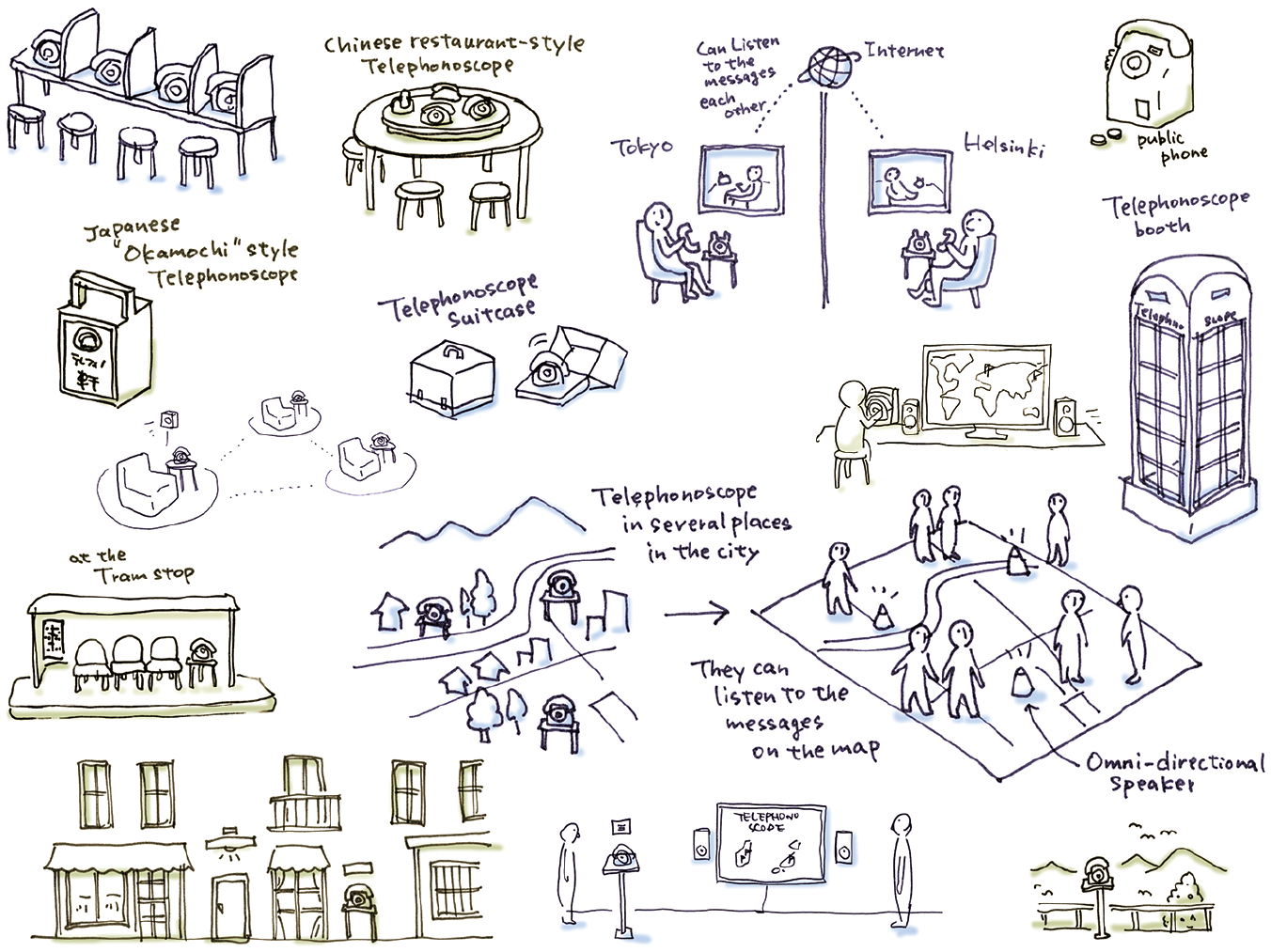
Telephonocope visions (Storyplacing Project, 2016a).
Let me give you a brief introduction to the usage (Figures 2–4). This ‘media that could have been’ consists, broadly speaking, of a combination of two elements: a technological system and a cultural programme. The core of the technological system is an application that automatically records user voices and uploads them to a web server. An iPod with the application installed is stored in a dial-up black phone. From the user’s perspective, they project their voices into the black phone handset. In other words, when the user picks up the black phone handset, the hook goes off and iOS plays back the questioner’s recorded voice.

Classic black dial telephone housing (Storyplacing Project, 2016a).
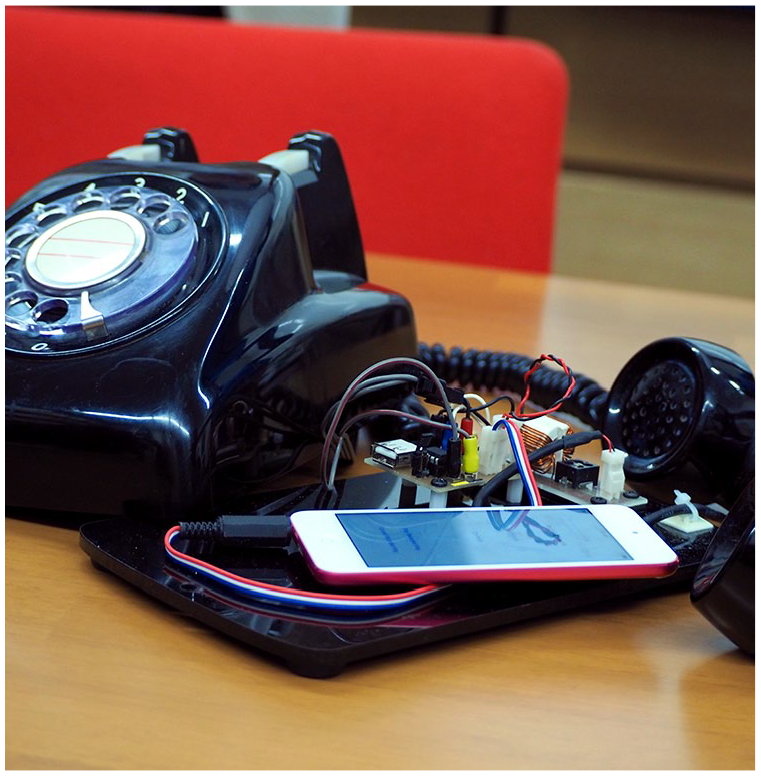
Inside, iPod with an original iOS app (Storyplacing Project, 2016a).
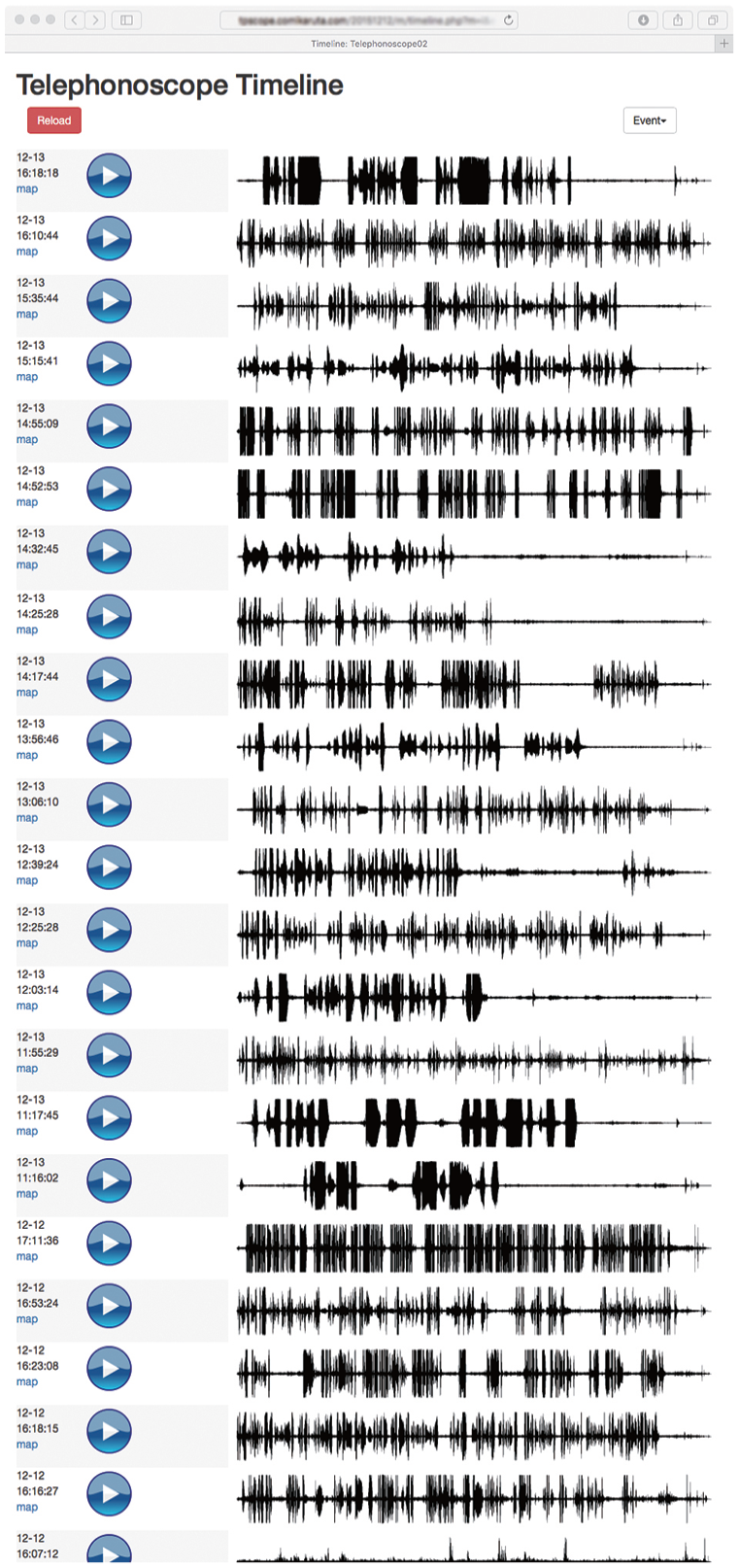
Audio waveforms of people’s storytelling (Storyplacing Project, 2016a).
For example, the telephonoscope speaks in this way. ‘Hello, my name is Telephonoscope. Please tell me about your memories of this town, such as your favourite café, an unforgettable scene, and recent happenings. Your message will be recorded by me and published online. Are you ready? Yes, here you go.’ Users then have approximately three minutes to start talking about their images, memories, and episodes about the town. The momentum and way of speaking become a first person monologue. Unlike when speaking into a microphone, many people tell their stories in a natural, unadorned tone. When the story is finished, the receiver is put back. The hook is switched on, the system terminates, and the speech data are shared in the internet cloud.
However, the use of this technological system is a challenge for the cultural programme. We placed this black phone system in various spots, such as Japanese public baths, Finnish saunas, public libraries, cafés in city centres, local shopping festivals, exhibition booths at academic conferences, and art events, to collect people’s voices and have them heard by people in the local community. The cultural programme includes how the phones are placed in the space, what topics are discussed, how long people are asked to speak, how they are supported, how the listening parties are organized, and how they are publicized.
We can examine two memorable episodes of telephonoscope practice in Finland. One was the behaviour of a boy of middle primary school age, probably an immigrant from South America, who came to the workshop in the public library in Kallio, Helsinki (Figure 5). He came with a Finnish friend to recount a memory, in response to a Finnish question on the receiver, of having been in a car accident right in front of the library, fracturing his skull. However, with the quick help of the people around him, he could receive treatment at the hospital immediately. His friend, who was listening next to the boy, was surprised and said that he had never heard this story, even though he had known the boy for a long time. The boy also said he had never told anyone outside his family this story.
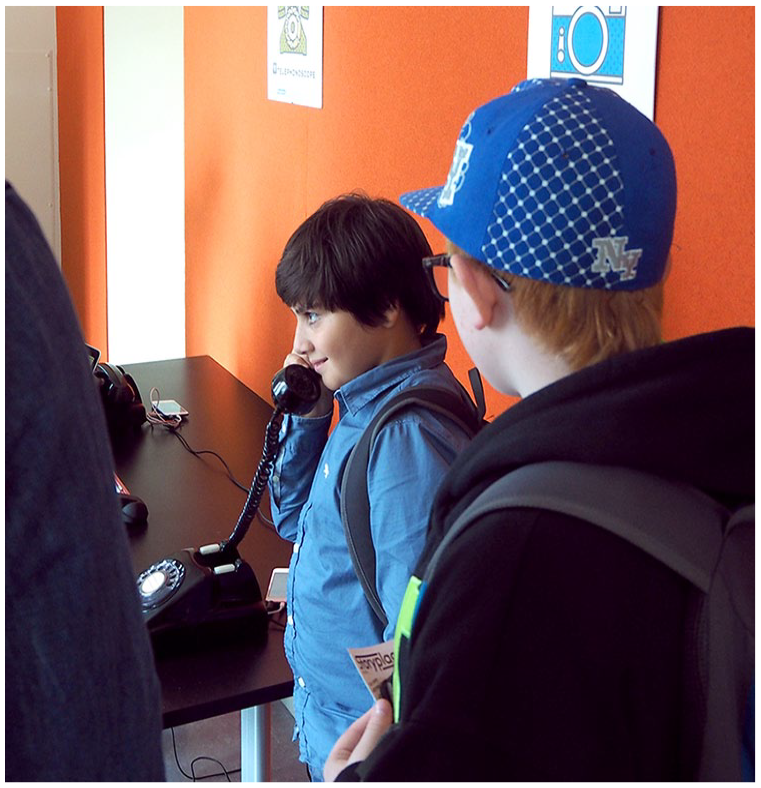
Telephonoscope workshop at Kallio Library, 5 September 2015.
Another was placed in the common space of the public library in the town of Hanko in southern Finland (Figure 6). An old woman picked up the receiver and began to haltingly tell the story of her life. The system was set up to allow her to talk indefinitely, so she continued beyond the limit of three minutes. Eventually, she began to cry and finally had to be helped by the facilitator to put down the receiver.
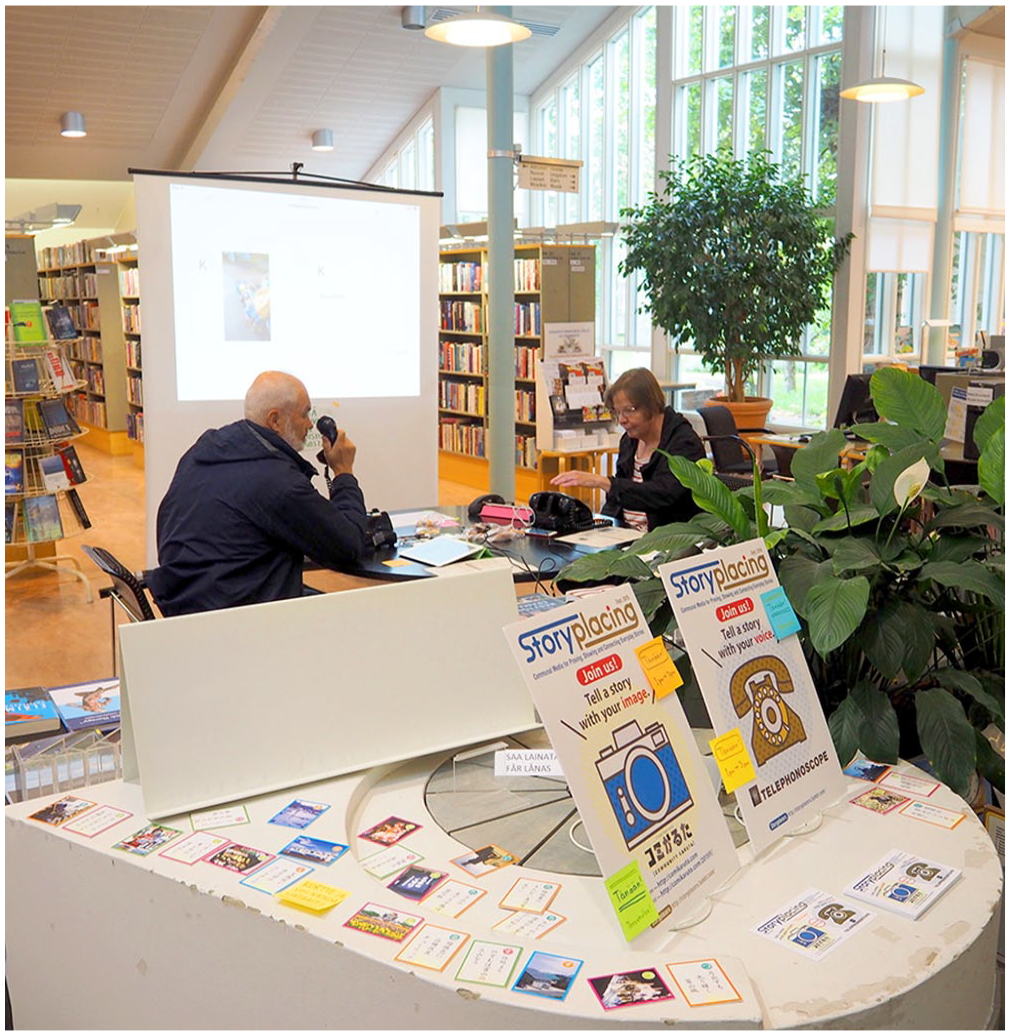
Telephonoscope workshop at Hanko Municipal Library, 8 September 2015.
Black phones are said to be an old medium; however, they are considered a product of ergonomics that are suitable for people to sit back, relax, and have a chat. Smartphones, which are board-shaped, are not suitable for long calls. Not only that, but when placed under a particular cultural programme, a black phone can record various aspects of everyday life, often in fragments, and combine them to start a story. Sometimes the stories are played out in a way that surprises the friends nearby or floods them with a rush of emotions. The telephonoscope is an alternative medium that evokes the pre-narrative episodes that lie deep within our daily lives and encourages us to express them in the most primitive medium of the voice.
Bunkyo Media Biotope
The telephonoscope was, for the most part, used in transient events. In some cases, however, it was used on an ongoing basis. I was at the University of Tokyo when Storyplacing developed this media. The University of Tokyo is in Bunkyo Ward, in the middle of Tokyo. At the time, I was the chairperson of an administrative organization promoting cultural activities and social education in Bunkyo Ward, and I realized that the image that Bunkyo Ward residents have of the University of Tokyo was not positive, according to a questionnaire survey conducted once every few years. The University of Tokyo is an elite institution that only thinks about competing with the world’s top universities and has an entrenched image of looking down on the local population. So, as part of the University of Tokyo’s social collaboration, I decided to promote activities to foster media literacy among ward residents and develop citizens’ media expression activities at the community level by organizing media-related workshops in Bunkyo Ward. The telephonoscope was implemented as one of several media practices (Mizukoshi, 2017). From the mid-2010s onwards, this activity began to have implications as a community design practice with resident participation. Citizens’ media practice using the telephonoscope has continued for almost a decade in collaboration with the small Bunkyo Ward Furusato (Hometown) History Museum.
Storyplacing worked with various organizations and communities, including Bunkyo Ward, junior high and high schools in the ward, shopping streets, community centres, and art spaces, to continuously implement the telephonoscope and other media practices. The resulting works and recordings were uploaded to a website and shown on a programme on local cable television and as events in public spaces. In this way, the project tried to create a kind of ‘media biotope’ in Bunkyo Ward. Media Biotope is a term for a small but networked media ecosystem. It is a concept that uses the biological environment as a metaphor for the media circumstances and refers to the activities of the public to create, operate and link small media autonomously. It was also a strategic vision to foster media literacy and loosely counter mass media and giant media capital. I won’t go into the details here, but I would like to note that storytelling, especially weaving and expressing one’s own stories aloud, was a core activity of the Bunkyo Media Biotope (Mizukoshi et al, 2021: 26–34).
Critical Media Practice
During the ten years of planning, development, and ongoing practice of the telephonoscope, Storyplacing members, who are experts mainly in four fields – media studies, information engineering, information design, and urban engineering – have experienced two significant events.
First, researchers have achieved interdisciplinary collaboration in the process of developing and implementing the telephonoscope. Initially, the idea of the telephonoscope was not to improve or develop existing media but to create novel alternative media. If it were an improved or developed version of what exists today, the focus would be on information engineers familiar with the current system. However, if the idea is to create something that does not exist today, the four fields are relatively equal. The telephonoscope is a system in which Storyplacing members collaborate with each other by reflecting on their own media experiences.
Furthermore, when this system is put into practice, not in university laboratories but in places such as public baths and art event venues in the city, researchers are forced into a position where they have to collaborate beyond their respective specializations and role divisions. Both engineers and designers have to do their part to attract local residents to engage in storytelling. If the black phone system is not working well, media researchers and urban engineers have to deal with it to some extent without the help of information engineers. When the public asks simple but pointed questions about how this media works and what it means, it is impossible to respond in a bureaucratic way, such as being unable to answer the questions because there is no project leader. Under these circumstances, the four area researchers acquired wisdom and skills and trained themselves as facilitators. In other words, by putting the telephonoscope into the real world, researchers from different disciplines were forced to collaborate even if they did not want to and thus succeeded in driving an interdisciplinary project.
Second, in the process of implementing the telephonoscope in various communities, people who understood the intentions of Storyplacing and the system emerged, and began to use the telephonoscope in ways different from the original plans and methods. In other words, ward office employees, university students, and residents have taken what the researchers have prepared as a prototype, so to speak, and applied, localized, and appropriated it. Through such application and appropriation, the telephonoscope has been used in the community for a long time.
The first activity involves researchers collaborating on media practices, and the second involves researchers appropriating and applying these practices to participants. As the two changes occur, expertise is produced for research, while at the same time media practices for the locality and community are established sustainably. I call the activity that encompasses this double collaboration ‘critical media practice’. The Bunkyo Media Biotope was founded with critical media practices as its engine (Storyplacing Project, 2016a: 8–11).
Wisdom and Techniques of Voice
The interdisciplinary collaboration among researchers was generally successful, while the collaboration between researchers and citizens was sometimes not. However, one of the most significant reasons why some types of digital storytelling, such as the telephonoscope, have generally worked well as media practices is that these activities are centred around ‘voice’.
There are several reasons why voice is critical to success. First, there is little experience, at least among Japanese people, of telling personal stories aloud to the public. Such storytelling is a kind of media expression, but this media expression, which lasts only a few minutes, puts people under considerable strain. This tension is also felt by the researchers who support the production process, and their support becomes more serious. When the voiced message or work is completed and published, people have a certain sense of accomplishment shared by those in support roles. In other words, storytellers and supporters can share the depth and difficulty of the act and achievement of telling a story aloud, which at first glance seems like something anyone can do.
Second, although this is relatively unique to our workshops, we neither add any processing to the voice that tells the story in the first person nor do we use the unique phrasing, intonation, and rhythm that is often found on YouTube and TikTok to make it trendy and remove its individuality. The voice of the person is heard as is. Even though it is bare, there are times when a person’s voice is higher in tone or more halting than usual owing to the unique tension of speaking into a black telephone receiver. While listening to the difference between the person’s normal voice and the voice at a listening session or screening, however, everyone pays attention to the person’s voice itself. The opportunity to listen to a person’s voice in this way and to feel something from it is a rare opportunity, even in this age of media overload. We can feel and understand many things from voices.
Marshall McLuhan, who had a knack for bewildering things, warned that there is an inherent sense ratio in humans and that the visual bias brought about by print culture has thrown that ratio out of whack (McLuhan, 1962). In doing so, he brought up television. McLuhan said that television was a tactile medium and that it would disrupt the ‘Gutenberg galaxy’ that had dominated the West for almost 500 years. McLuhan’s praise for television, which has since become the mainstream of visual-centredness, and the fact that the internet is now awash with moving images, is not the subject of discussion here. I will also set aside the problem of the Catholic ideology of the intrinsic proportion of the senses. However, when we look at today’s media environment, which is overwhelmingly visual-centred and neglects the senses of touch, smell, taste, and even hearing, it is understandable to want to say that there should be a healthy sense ratio. Suspending the sophisticated literacy of silent reading and instead examining the meaning of a text by reading it out loud can be said to be an elemental literacy for those of us living in the digital age (Ong, 2012). Researchers should also listen to others and share their thoughts.
The act of micro-storytelling, by picking up and connecting the casual, fragmented narratives of everyday life, is the very activity that constitutes identities and gives meaning to people’s lives from the past into the future. Listening to the stories of voices in public and in the community is a wisdom-filled technique for people to overlap and share their stories. This is another technique that researchers can utilize to engage with the public and interact with other researchers.
We have discussed the importance of voice in social scientific research, using two workshops as examples. In the digital media society, it is crucial for researchers to be familiar with different devices and applications. Without mastery of digital media, we would neither have access to the digital content and fan behaviour under study nor would we be able to conduct better research and analysis. On the contrary, we must not forget the significance of media and media practices that are fundamental to us Homo sapiens, such as voice-to-voice storytelling (Leroi-Gourhan, 2012).
Fostering spaces for learning and research exchange that value voice and body, as well as the significance of objects and spaces, should first be done in traditional higher education. Recent developments in active learning, science, technology and society (STS), ELSI, and art-based research loosely encompass the workshop design discussed here. 4 Considering the critical situation in the humanities and social sciences at universities around the world, which has become more pronounced since the mid-2010s, it is clear that there is an increasing need for programmes that foster basic skills through new types of learning. Those disciplines need intellectual rehabilitation, and we should design specific environments and programmes to achieve this. Failing this rehabilitation, higher education institutions that do not change their traditional methods of education and research, which are mainly based on silent reading of literature and conceptual discussions, will soon face a significant crisis. However, it will not be easy for the humanities and social sciences, which have a long tradition, to adapt flexibly to the situation (cf. Davidson, 2022; Yoshimi, 2021).
At the same time, some developments have led to the establishment of new learning opportunities within society. Phenomena such as the growth of online education programmes, the spread of workplace learning, the focus on reskilling, the development of online fan cultures and decentralized autonomous organizations (DAO), and the generalization of relearning in developed countries because of ageing populations, for example, are often seen as business-like and lower level than higher education at the moment; however, I see them as noteworthy. Furthermore, there are places where new research possibilities are sprouting in public social activities that are considered distant from education and research, such as citizen-participatory design activities to revitalize local communities and community activities to support people affected by war and disaster.
While we try to renovate traditional higher education institutions, we should also nurture new learning spaces emerging in society, and perhaps we can dream up a new communication space that bridges the two. Featherstone et al. advocate a ‘post-university’ (INSTeM Roundtable Discussion, 2023). Sakura et al. launched a foundation, the Inter-field Network for Science, Technology and Media Studies (INSTeM), as an independent nexus that strives to bridge the gap between academia and journalism, between professional knowledge and everyday knowledge, between professionals and non-professionals, between mass media and social networking services, and between countries and regions (see INSTeM Website, 2024). These trends should be discussed at another time. However, when it comes to making these dreams a reality, it is inevitable that the medium of voice and the act of telling stories through voice will become an essential form of wisdom and technique.
Footnotes
Funding
The author disclosed receipt of the following financial support for the research, authorship, and/or publication of this article: The workshop studies presented in this article draw on research funded by JSPS KAKENHI Grant No.18H03343, ‘New Theories of Literacy for Media Infrastructures’, and the Japan Society for the Promotion of Science & Academy of Finland Joint Research Project, ‘Co-Design of Digital Storytelling System with Geographic Information’.
