



Abstract
The global economic crisis presents new challenges for economic voting models. While there is a consensus that economic voting exists, even the most ardent supporters agree that it is a variable force and can only explain a portion of voting behaviour. This article investigates the impact of positive and negative economic performance on voting patterns. The idea that voters are more likely to punish governments for poor economic performance, the grievance asymmetry hypothesis, has found some empirical support, but in their comprehensive review of the economic voting literature, Lewis-Beck and Stegmaier concluded that the evidence of asymmetric economic voting was, at best, mixed. Ireland presents a clear test of the grievance asymmetric economic vote with recent elections taking place against backdrops of some of the highest economic growth rates in the world and then one of the most spectacular economic crashes. We demonstrate that economic shocks matter a great deal; Irish voters like their counterparts elsewhere in crisis hit states are unforgiving. Furthermore, the electoral change at the 2011 election in Ireland was extreme and challenges the consensus that economic voting is a small force.
Introduction
Economic voting is usually a relatively small force, significant only because it moves voters in one direction. The essential idea is that a positive economy will encourage floating voters to support the incumbent government, while the converse should also be true. Accordingly, economic voting can be a decisive force at elections putting parties in and out of government. Some work has suggested that voters are harsher in an economic downturn and more likely to punish the incumbent, indicating that there may be a grievance asymmetry in the economic vote; that is, poor economic performance matters more.
Voters at elections in the Republic of Ireland engage in economic voting, and studies over the years have pointed to the salience of unemployment (Borooah and Borooah, 1990; Harrison and Marsh, 1998). Economic and political developments in Ireland from 2002 to 2011 include extreme economic conditions, of both boom and bust, and mean that it presents a fascinating test of the grievance asymmetry hypothesis. This article begins with the 2002 election when the surge in economic growth in Ireland had earned it the label Celtic Tiger; it includes the intermediate election of 2007 when economic storm clouds were beginning to gather and covers a third election in 2011 which took place against the backdrop of catastrophic economic contraction and deep political turmoil. Few country cases offer such diversity of economic experience and can challenge the explanatory powers of conventional economic voting models. As such, the article provides an opportunity to investigate how economic voting varies under differing economic circumstances. But economic conditions in Ireland also offer an opportunity to assess whether economic voting can be more than a small force driving electoral outcomes.
Economic voting has produced a voluminous literature organised around a series of core questions: Are voters more likely to make economic evaluations based on national economic performance or personal financial circumstances, do voters look backward or forward when they evaluate economic conditions, who specifically is held responsible for economic performance, are all political parties treated equally in the attribution of reward or blame within coalition governments and, indeed, do negative economic conditions matter more than positive ones?
The earliest economic voting models hypothesised that incumbent governments do better at the polls when the economy is performing well and that voters are generally retrospective in their evaluations. Drawing on V.O. Key’s argument that voters attribute responsibility for current economic performance to the government of the day, successive iterations of economic voting models have assessed this relationship (Fiorina, 1978; Fiorina, 1981; Lewis-Beck and Paldam, 2000; Peffley, 1984). In a special volume of Electoral Studies, Lewis-Beck and Paldam (2000: 117) collated the evidence from 13 papers and concluded that retrospective economic voting models perform robustly and were persuasive in explaining voting behaviour at elections. The global economic crisis presented very different economic conditions and new challenges for economic voting models. The deteriorating performance of the economy was at the forefront of discussions which sought to explain electoral changes in many countries (Anderson and Hecht, 2012; LeDuc and Pammett, 2013). In the face of dramatically altered global economic circumstances, Electoral Studies presented a special volume on economic voting in 2013. Lewis-Beck and Whitten (the volume co-editors) summarised the findings of the 26 papers as follows: ‘when the economy prospers voters reward the government, but when the economy falters they punish it’ (Lewis-Beck and Whitten, 2013: 393). The research included in the volume is both extensive and persuasive and, as the co-editors explain, is robust across multiple research design specifications. Economic voting models have retained their explanatory power in times of economic crisis and governments in many countries are being held responsible for deteriorating economic conditions.
Lewis-Beck and Stegmaier (2013) in their review article point to a mixed field of evidence from the research on the asymmetric dynamic in economic voting. Studies which demonstrate that voters are more adept at punishment than reward include Kramer (1971), Erikson (1990) and Soroka (2006). More recently, the political costs of governing at times of economic crisis have been well established in studies of economic voting in Southern European countries impacted by the Euro area crisis. Nezi (2012) in a test of the grievance asymmetry hypothesis at Greek elections demonstrated that voters were more likely to punish incumbents for poor economic performance. Indeed he concluded that when the economy is in deep decline, governing parties should expect that only their core vote will support them, a crucial point when the outcomes of elections in crisis area countries through 2011 are examined. The Spanish Socialist Party PSOE had its worst ever election result in 2011 with its vote share dropping by just over 15 points (Martin and Urquizu-Sancho, 2012). Magalhaes (2012) points out that in Portugal just months after becoming the third euro area country to enter a troika bailout, the Partido Socialista also suffered a significant loss, but in this case it was a drop of eight points, a serious fall but not catastrophic. Collectively, this work bolsters the grievance asymmetry hypothesis, but it also extends its explanatory power. It builds the case that at times of economic crisis, the economic vote can be an overwhelming force, sweeping away partisan allegiances and reputations for competent economic governance and delivering transformational elections.
When it comes to economic voting and reward and punishment, we also know that knowledge matters, and voters with higher levels of knowledge are more likely to punish the government (Bartels, 1996; Tillman, 2011). Soroka (2014) has demonstrated that humans are hardwired to react more to negative economic news. But context also matters. When the economic environment is already very negative, further negative information has a declining marginal impact. Soroka indicates that the negativity bias may be self-correcting over time; indeed, as he argues, we do not live in an endless pit of negativity. Nevertheless, in the short to medium term, there are asymmetric impacts of negative economic news (Soroka, 2014: 51–53). The extent to which voters have negative perceptions of economic performance matters a great deal as we also know that turnout is higher among these types of voters (Arceneaux, 2003; Blais et al., 2017). As a consequence, a strong negative economic vote would be expected in Ireland in 2011. The enormous scale of the economic crisis in Ireland from 2008, a rapid rise in unemployment and the incessant media coverage of the collapse collectively point to high voter consciousness of the crisis. However, the grievance asymmetry hypothesis suggests that bust matters more than boom, so we might expect the scale of the positive economic vote when the economy was expanding in 2002 to be quite modest.
Economic voting is not uniform; it varies across time and countries and is influenced by a wide range of factors. The political and economic variables which influence the way in which voters assign responsibility for economic conditions have been the subject of considerable investigation (Duch and Stevenson, 2008, 2013; Fortunato and Stevenson, 2013; Powell and Whitten, 1993). Arguing that economic voting is a conditional law rather than a universal one, Duch and Stevenson (2008) identified three sets of factors central to understanding variations in economic voting across countries and time: political control of the economy, concentration and distribution of policy-making responsibility over parties and the pattern of contention among parties for future decision making. Specifically relevant to the case study in this article, they argued that in countries with ‘perennial governing parties’, the economic vote is weaker. Their contention was borne out with evidence from Belgium, the Netherlands and Italy (Duch and Stevenson, 2008: 345).
Voters’ ability to identify the source of responsibility for economic decision making is an important requirement for economic voting. Multi-level governance within the European Union (EU) and specifically the shared governance of euro area economies add a complicating dynamic to attributions of responsibility for national economic performance. In a test of their integration hypothesis, Costa Lobo and Lewis-Beck (2012) demonstrated that the national economic vote was lower among those who attributed greater responsibility for economic performance to the EU. Ireland is an EU member state within the euro area.
Coalition politics are identified as a complicating factor when it comes to clarity of responsibility for national economic performance, but Van der Brug et al. (2007) have argued that the focus should be on the party occupying the posts of prime minister and minister for finance/economy. These positions are highlighted as important shortcuts available to voters for attributing political responsibility for economic performance. While several studies caution against assumptions that voters are fully informed about the composition of the cabinet and responsibility for economic performance (Fortunato and Stevenson, 2013; Nannestad and Paldam, 1997), Ireland does provide a potentially interesting test of these points. Ireland had a dominant party of government during the period covered in this article and high clarity of responsibility conditions; both of these features are also identified in Duch and Stevenson (2008). Consistent with Brug et al., it is also the case that there was a single party, Fianna Fáil, with direct control of economic policy-making from 1997 to 2011, albeit within coalition and minority governments. Past concerns about the extent of voter knowledge on the economy have now largely been ameliorated; as Lewis-Beck and Stegmaier (2013) discuss in their review article, there is reasonably conclusive evidence available that voters are quite attuned to changes in economic performance. Indeed, Sanders (2003) demonstrated that although in some cases voters may only have limited precise knowledge about the economy, their perceptions were reasonably attuned to reality.
The economic voting literature on Ireland is relatively slim. A small number of studies have produced evidence of a moderate but variable retrospective economic vote (Borooah and Borooah, 1990; Harrison and Marsh, 1998; Marsh and Tilley, 2010). Unsurprisingly, given the history of economic performance in Ireland, unemployment emerges as the major economic variable influencing the economic vote. Successive studies, up to and including those looking at the most recent economic crisis from 2008 (Marsh and Mikhaylov, 2012, 2014), have pointed out that unemployment is especially salient for Irish voters and a central component of the economic vote. This is consistent with the international literature where unemployment has emerged as a critical litmus test for governments in a range of studies of economic voting (Bengtsson, 2004; Lewis-Beck and Mitchell, 1990; Nannestad and Paldam, 1997; Sanders, 2003).
Ireland experienced protracted economic recession for 20 years from the late 1970s, and indeed as a consequence, an economic vote is to be expected and is evident in the years up to the late 1990s. As the economy improved, a more mixed picture emerged, with Marsh and Tilley (2010) identifying partisanship as an important influencing variable in the attribution of credit and blame. Using data from 2002 to 2007 for Ireland, they report that favoured parties are not blamed for policy failures and less favoured ones are not credited with policy success. Marsh et al. (2008) also point out that during the period of the economic boom from 2002 to 2007, the economic vote was crowded out by quality-of-life issues. As such, the studies provide small evidence of an economic vote. However, it would appear that the economic vote is stronger in recessionary times as evidenced in the earlier studies indicating that voters are more inclined to punish than reward.
The growing focus in the economic voting literature on the impact of economic crisis is especially interesting for the Irish case (Bosco and Verney, 2012; LeDuc and Pammett, 2013; Lewis-Beck and Stegmaier, 2011). The initial findings from the period of the global financial crisis are that economic crises can have wide-ranging consequences. LeDuc and Pammett (2013) point out that governments were defeated in 16 of the 27 EU elections held in EU member states between 2008 and 2011 with an average drop in support of just over eight points for the governing party. The Irish case is one of the most extreme as support for the governing party dropped more than 20 points.
But the long-term electoral impacts of economic crisis remain to be determined. Achen and Bartels (2005) considered the effect of the Great Depression on voting behaviour in a number of countries in the 1930s. In the case of the United States, they argue that voting patterns can be understood most accurately through the use of retrospective models. Essentially, their case is that the political realignment of the 1930s was a consequence of economic voting rather than the result of an ideological shift among the electorate. Their analysis also included Ireland. Departing from the dominant nationalist narrative around the development of the Irish party system, they argue that economic voting was a component in the growth in support for Fianna Fáil in the 1930s and that it contributed to the decline in support for the incumbent Cumann na nGaedheal government which was punished for poor economic performance arising from the 1929 Wall Street Crash and the ensuing global depression. They conclude that in times of crisis, a strong economic vote can have long-lasting impacts in the form of realignment of the party system. Studies from the 1930s are always limited by the availability of poor data and the consequent requirement to make large assumptions, but the idea that economic crisis can lead to substantive electoral realignment is a germane one in the context of the scale of the electoral change in Ireland at the 2011 election.
There are a number of clear messages which can be drawn from the literature. A wide variety of political and institutional factors can condition the economic vote. The evidence is strongest for the retrospective economic voter. Furthermore, voters are more inclined towards punishment in times of poor economic performance than reward in good times and they are willing to turn against a government which they had previously trusted to manage the economy. While there are questions about voters’ knowledge levels, unemployment resonates strongly with voters and it is this economic variable which is most clearly understood by them. Finally, negative information matters more than positive information. Consequently, we hypothesise that a small positive economic vote should be evident at Irish elections in 2002 and 2007, when the economy was growing strongly. However, we argue that the scale of the macroeconomic crisis, and especially the employment collapse, should contribute to a significant and large punishment economic vote in 2011. Furthermore, we argue that although the literature identifies political and institutional factors which can condition and constrain the economic vote in normal times, these factors should be overwhelmed in the face of the economic collapse in Ireland from 2008. The final element of the argument is that, in times of deep economic crisis, we expect economic voting to be closer to a universal law and less conditional, with much larger impacts evident.
Boom and bust in Ireland
Ireland had a dominant party system until 2011 and a history of coalition government. Party attachment is low by international standards (Marsh and Plescia, 2016), and Marsh (2000: 2006) has described the party system as having weak foundations. Ideology has played a limited role in driving electoral outcomes, and in recent decades, a reputation for competent economic management emerged as the mainstay of support for the dominant party, Fianna Fáil. The party acquired a reputation for competence at economic governance during their 1987–1989 period in office, and this is identified as a contributing factor to their success at elections from 1997 to 2007 (Marsh et al., 2008; Marsh and Mikhaylov, 2012). The booming economy in the years from 1997 to 2007 allowed the Fianna Fáil government to significantly increase public expenditure, and Ireland played catch-up at an enormous pace in its provision of social programmes and infrastructure. A measure of the magnitude of the economic boom up to 2007 is that the rapid expansion in public expenditure was achieved at the same time as the government was reducing personal and business taxes and reducing the national debt. It was a period of exceptional economic expansion. However, much of the expansion was built on foundations of sand and the global financial crisis brought the property and banking sectors tumbling down. And indeed, the economic collapse delivered equal levels of political turbulence.
The economic crisis represented a major threat to the support base of Fianna Fáil, in that the party’s reputation for economic management disintegrated. Furthermore, the party has its origins in the foundations of the state and has long held dear its nationalist credentials. Sovereignty, and all that this entails in the complex dynamics of politics in Northern Ireland and the Republic, has been a cornerstone of party identity since its inception. The escalating economic crisis from 2008 to 2010 eventually led Ireland to accept a joint EU and International Monetary Fund (IMF) package of financial support which became known as the ‘Troika bailout’. 1 The chaotic political scenes leading up to the bailout and the final decision to accept its stringent terms were deeply destructive to Fianna Fáil’s reputation for competence at economic management and severely dented its standing as the party of moderate nationalism and Irish sovereignty.
There was mounting political instability through the end of 2010 as the coalition of Fianna Fáil and the Green Party disintegrated. The Green Party called for a general election after the bailout programme was announced and eventually withdrew from government in January following a final act of self-destruction by Fianna Fáil when the Taoiseach (Prime Minister), and leader of Fianna Fáil, attempted a major cabinet reshuffle following a night of co-ordinated resignations. The Green Party refused to agree to the cabinet reorganisation and the empty portfolios were reallocated to the remaining government ministers leaving the cabinet barely constitutional. The Taoiseach, Brian Cowen, stepped aside as leader of Fianna Fáil but remained as Taoiseach until the election which was brought forward from 11 March 2011 to 25 February 2011.
The election campaign was dominated by economic issues, unemployment, terms of the financial bailout and management of the public finances (O’Leary, 2012). The outgoing Taoiseach and several prominent members of the government on the Fianna Fáil side chose not to contest the election. The reputational damage of the economic crisis for Fianna Fáil was severe and its share of the vote plummeted below 20% in the 2011 election, its lowest vote ever. Indeed, Marsh and Mikhaylov (2012) identify two moments when there were sharp drops in Fianna Fáil support: the first of these was in 2008 when the Fianna Fáil led government’s decision to guarantee all of the liabilities of the Irish banks (known as the bank guarantee) and the second occurred when the government entered the Troika bailout. Marsh and Mikhaylov (2014) provide further insights into the longstanding importance of the economic vote at Irish elections which they explain stems in part from the low levels of difference among the main political parties.
The 2011 general election was the third most volatile in Western Europe since 1945, and the transformation of the political landscape is attributed to the fallout from the financial and economic crisis (Marsh et al., 2017). The combination of boom and bust economics provides an unusual backdrop against which economic voting can be considered.
The Irish economy became the subject of international attention in the late 1990s arising from a dramatic surge in economic growth and a particular success in attracting foreign direct investment into the country. Ireland experienced a remarkable reversal of economic fortunes and the foundations for what became known as the ‘good boom’ and the ‘bad boom’ were set. The ‘good boom’ was marked by a period of export-led growth with gross domestic product (GDP) rates in excess of 5%, and it is often known as the Celtic Tiger. The ‘bad boom’ started to evolve from 2002 and refers to the period of domestic construction-led growth, as construction activity began to corrode the real economy and came close to accounting for 10% of GDP. The global financial crisis collapsed the Irish banking system, already imperilled by a domestic property mania (discussed in Breen, 2012). Ireland was the first country to enter recession officially, and growth rates remained in negative territory in 2010, when Ireland accessed the Troika bailout.
There were two components to the economic crisis in Ireland: banking and public finance. The decision by the Irish government to guarantee the liabilities of the Irish banking sector placed an enormous burden on the balance sheet of the state. Furthermore, the state finances were already in a precarious position as the collapse in the property sector led to spiralling unemployment and a sharp reduction in revenue for the government. The property boom had brought a revenue bonanza as taxes flowed in through property-related taxes and charges, consumption taxes and additional income taxes. This revenue evaporated over the course of 2008. Throughout the period from 1997 to 2007, government expenditure had increased sharply as new services were introduced, public sector workers were hired and paid more, and infrastructure was significantly upgraded. The revenue which underpinned these expansions was transient and tied to the property bubble, but much of the spending increases had placed permanent long-term charges on the state balance sheet. The end result was that as the economic crisis took hold, an enormous gap opened up between revenue and public expenditure which needed to be addressed through sharp budgetary contractions at a time when growing unemployment was placing additional pressure on the budget.
Economic growth matters in Ireland, as elsewhere, but a peculiar historical experience of high unemployment and emigration has combined to elevate public sensitivity to changes in the rate of unemployment. Unemployment has consistently emerged as the most salient macroeconomic variable in studies of economic voting in Ireland. Near full employment was achieved during the economic boom years, an unprecedented economic achievement for Ireland, but as Figure 1 indicates, there was a catastrophic rise in unemployment from 2008 onwards. The unemployment rate was just below 15% when the election was called in 2011. It had increased from 4.5% in just 2 years.
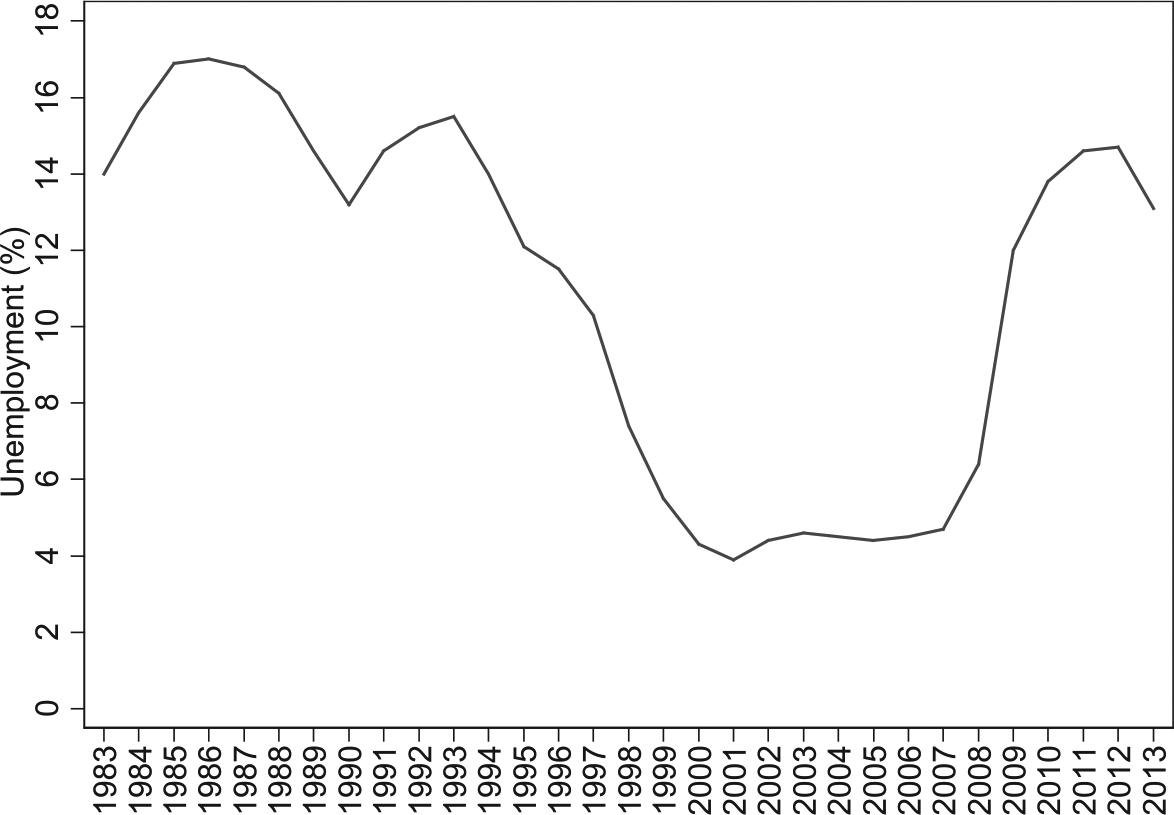
Standardised unemployment rate 1983–2013.
The elections of 2002, 2007 and 2011 took place against the backdrop of enormously diverse economic circumstances. Ireland was in the midst of an unprecedented boom in 2002, but by 2011 economic activity had collapsed, unemployment had rocketed and the state had been saved from bankruptcy by the Troika bailout.
Hypotheses and model
Following the approach used in retrospective economic voting models, we explain Fianna Fáil popularity with sequential additions of individual variables.
The general model is as follows:

This article tests two central hypotheses. Hypothesis 1 considers the retrospective economic voting relationship under different economic conditions. This hypothesis is drawn from the general retrospective macroeconomic voting model and grievance asymmetry hypothesis. Van der Brug et al. (2007) demonstrate that retrospective voting is more prevalent in high-clarity countries, and Ireland falls into this classification, having had the same party in power, through a variety of different coalitions for the duration of this study. In addition, the main economic ministry remained with the Fianna Fáil party for the full period. The independent variable of interest was coded from the following survey question:
Thinking back over the last XXX years – the lifetime of the XXXXX government – would you say that the ECONOMY in Ireland over that period of time got a lot better; a little better; stayed the same; got a little worse; or got a lot worse?
The second hypothesis employs macroeconomic objective variables; however, because of strong multicollinearity and little variation across years, it is not possible to utilise more than one objective macro-variable at a time. For obvious reasons (and also because on testing it proved the most significant), we have chosen the unemployment rate. In other words, we are hypothesising that changes in the unemployment rate will lead directly to changes in vote intention.
Data and methods
This article utilises the 2002–2007 Irish National Election Study, a five-wave panel study extracting the data from the general election years of 2002, 2007 and the election study from 2011. A 3-year cross-sectional database is created. Variables common to both strands are renamed and recoded for consistency to allow the researcher to view changes in overall attitudes over time. Thus, the dataset is, in effect, a time series for 3 years: 2002, 2007 and 2011. However, we are not able to take full advantage of this data structure by tracking changes among specified individuals over time because the 2011 survey questioned a fresh sample of respondents.
The dependent variable tested in this article is recalled vote, as all election studies were taken within a short period of a national election. This obviates the necessity for predicting vote from vote intention. As is standard in economic voting models, this is a dummy variable for government and opposition. This has been found to be problematic in many multi-party systems given that coalition government affects the ability of voters to clearly identify a party’s contribution to policy outcomes. In many countries, coalition government on occasion allows parties to blame each other and obfuscate responsibility, making it difficult for voters to discern who is actually to blame for political and economic outcomes (Anderson, 1995a, 1995b; Anderson and Wlezien, 1997; Anderson and Hecht, 2012). However, in Ireland, the governing party Fianna Fáil was dominant over all periods, with voters readily able to attribute responsibility. The party has also held the central finance portfolio at all times when it was in government.
The independent variables, which may account for the collapse in the dominant party vote share over time, measure both the boom and the bust. In general vote function models, from the United States to the United Kingdom, France and Hungary, there are two separate categories for independent economic variables (vigorously tested in France and Hungary; Lewis-Beck and Nadeau, 2000: 184–188; Lewis-Beck and Stegmaier, 2011). The first concerns objective macroeconomic indicators, such as unemployment, inflation or growth (e.g. Norpoth, 1985). The second concerns subjective indicators, such as subjective indicators of attributions and evaluations pertaining to economic and political performance (see, for example, Anderson and Hecht, 2012; Marsh and Tilley, 2010). This article utilises subjective sentiments available from election studies as well as an objective measure of the unemployment rate (survey-based ratio of the number of persons unemployed to the number of persons in the work force, Central Statistics Office). The subjective measure is a sociotropic retrospective evaluation that asks the individual how they view the performance of the economy over the last year. In terms of the objective indicators, the lack of variation means that we can only run one macro-variable in any single estimation. This of course severely hinders its explanatory power but, nonetheless, we think it is worth doing for exploratory purposes.
For control, we also include standard measures of partisanship, information and vote, namely, education, income and age. In order to allow for error at this macro-level, this article employs a standard multi-level fixed effect model. The objective macro-variables are fixed as are the individual subjective variables. Thus, we argue that the only random effect would be the intercept at individual level, which will be partly explained by the macro-level fixed effects and will allow for any unexplored variation between survey years.
Results
Before delving into the detailed econometric analysis, it is worth visually examining the data in order to observe the broad patterns that exist. As discussed above, we argue that economic voting is asymmetric and that voters are disproportionate in their responses to punishment and to reward. In Figure 2, we can see that economic voting looks to have been in existence to varying extents in the last three Irish general elections in 2002, 2007 and 2011. In all three cases, we see the moderating impact of partisanship, that government supporters are more positive about economic performance over the previous 5 years than opposition supporters. We can also see that these patterns were asymmetric and more extreme in 2011 with very few voters voting for the Government who believed the economy had gotten worse. The difficulty of course for the Government was that most people were now in most negative category: very few voters believed the economy had improved.
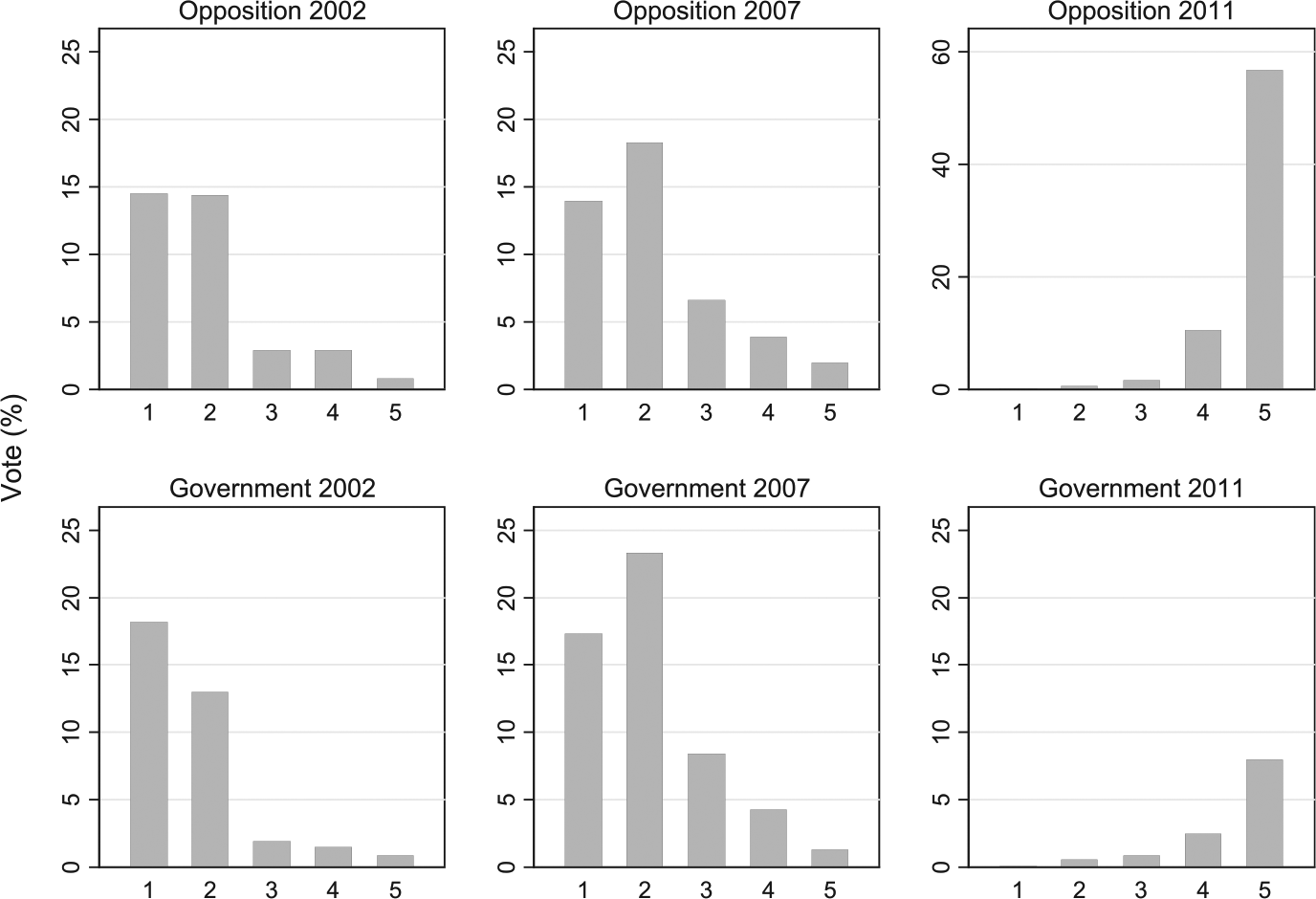
Economic voting: Retrospective evaluations of the economy – 1 = Lot Better, 2 = Little Better, 3 = Same, 4 = Little Worse, 5 = Lot Worse.
We first turn our attention to the extent of economic voting in each of the last three elections. If we examine Table 1, which includes a basic model of economic voting, we can see that there is evidence, as expected, that retrospective evaluations of the economy mattered in both 2002 and in 2011 but not in 2007. A plausible interpretation for the lack of economic voting in 2007 is that as the economy was turning down, Fianna Fáil was trading on its reputation for economic competence to get the state out of the economic difficulties rather than in any sense being rewarded for a well-run booming economy; however, we cannot be certain because the 2007 model does not pass conventional tests of significance.
Economic evaluations over time.
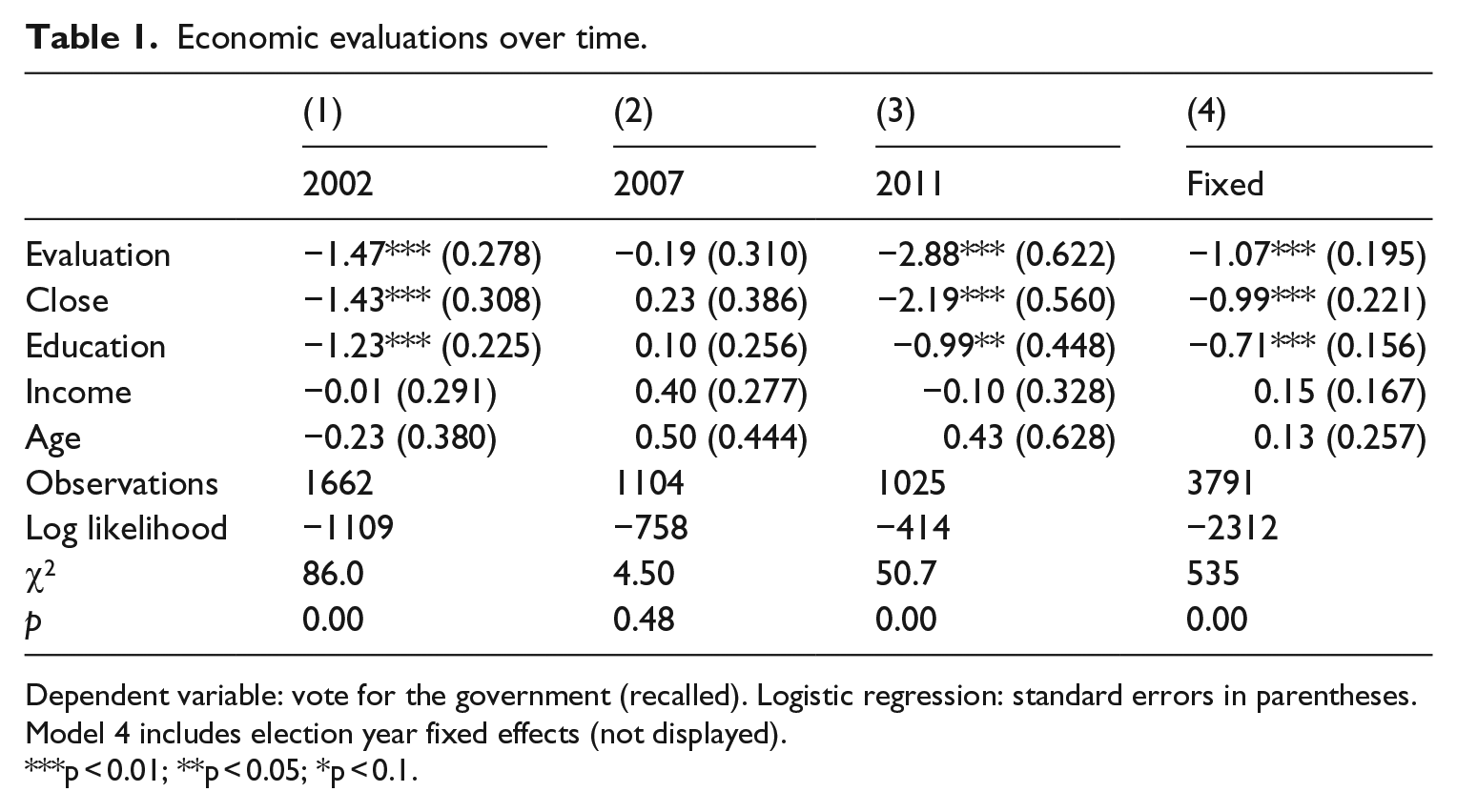
Dependent variable: vote for the government (recalled). Logistic regression: standard errors in parentheses. Model 4 includes election year fixed effects (not displayed).
p < 0.01; **p < 0.05; *p < 0.1.
The coefficients in Table 1 represent a change in the log odds of voting for the government for a one-unit increase in the independent variable, holding other variables constant. All of the variables have been placed on a common scale (0–1) to facilitate comparison. Our main variable of interest – evaluation – has consistently the largest impact on voting behaviour, followed closely by partisanship and education. An increase of one unit from the best to the worst evaluation of the economy reduces the log odds of voting for the government by 1.47 in 2002, 2.88 in 2011 and 1.07 for all three elections. These findings suggest that while economic voting is present at elections during periods of economic growth, it is far more important at elections during periods of economic crisis. By contrast, neither income nor age is a statistically significant predictor of the vote in any time period. We now proceed to interpret our main finding using a more intuitive approach: the change in the predicted probability of voting for the incumbent.
Figure 3 illustrates the marginal effect of retrospective evaluations on voting for the government, holding other variables constant at mean values. We know that these calculations are unrealistic in that the demographic and attitudinal profiles of those with differing evaluations of the economy do vary in reality; but nonetheless we considered this to be an interesting exercise. The first panel illustrates the impact of evaluations during the 2002 election. It shows that a change from the best to the worst evaluation reduces the probability of voting for the government by 0.35, holding other variables constant at mean values. Moreover, the confidence intervals suggest that our estimates of mid-range evaluations (‘Little Better’ and ‘Same’ categories) are the most precise, while the confidence intervals of our estimates of very negative assessments overlap somewhat. The second panel illustrates the impact of evaluations during the 2007 election. The confidence intervals show that the effect of evaluation is not significantly different from zero. By contrast, the panel for the 2011 election shows that evaluations have a substantial effect on voting behaviour. It shows that a change from the best to the worst evaluation reduces the probability of voting for the government by 0.59, a 68% increase in economic voting over the 2002 estimate. The confidence intervals in the 2011 panel suggest that our estimates for individuals who hold negative views (in the ‘Little Worse’ and ‘Lot Worse’ categories) are very precise, at least compared to our other estimates. However, we are less confident about our point estimates for more positive categories, as the confidence intervals overlap considerably. The fourth panel illustrates the impact of evaluation on voting when one pools the data from all three elections. This panel suggests that a move from the best to the worst evaluation reduces the probability of voting for government by 0.25. The confidence intervals suggest that our estimates are more precise, especially for respondents in the middle of the distribution, reflecting the efficiency gains from the larger sample size.
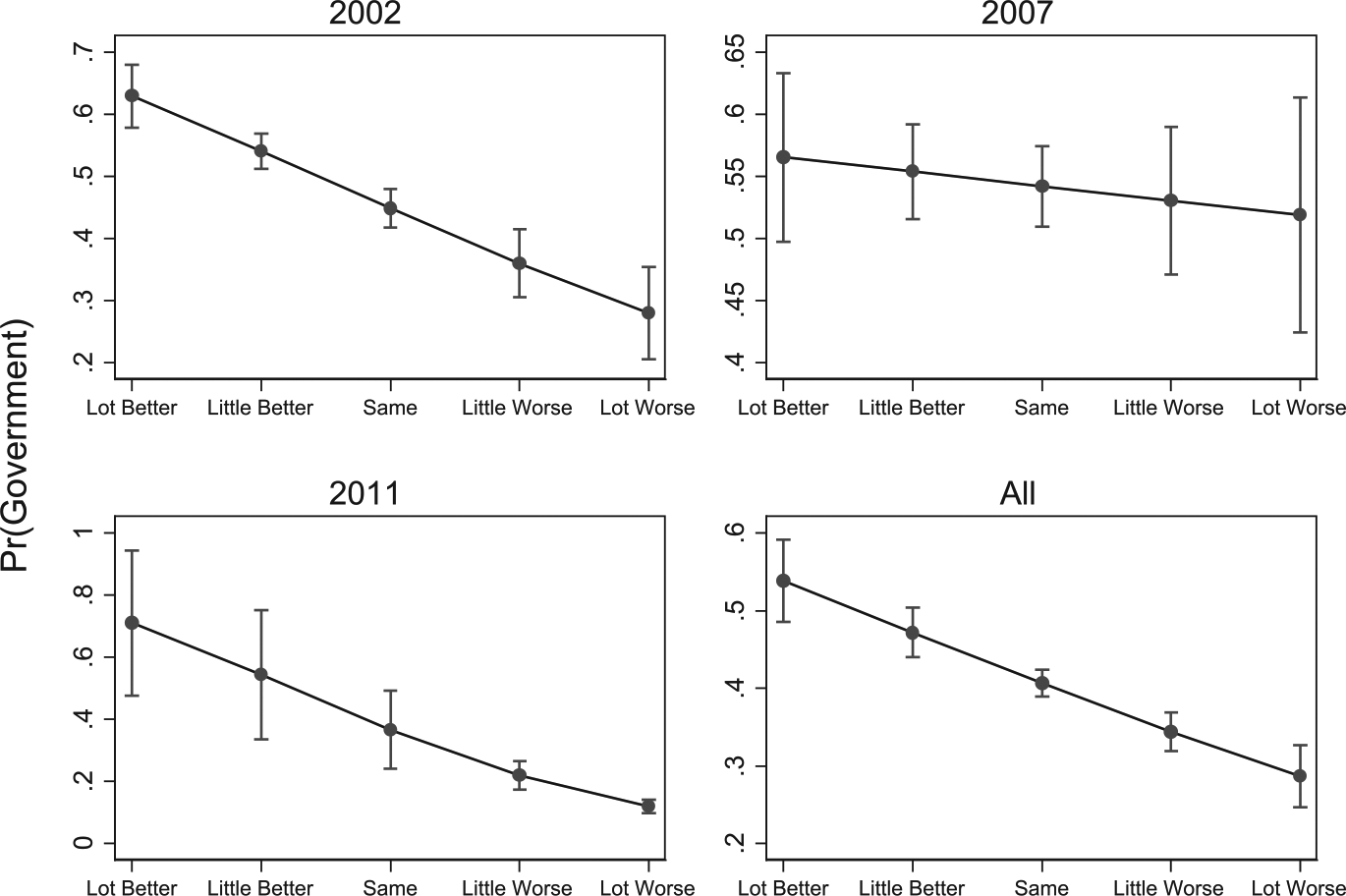
Change in predicted probability of government vote. Figures computed from Models 1 to 4 in Table 1.
Table 2 shows results for the same estimation but with the macro-variable of unemployment being included. It is statistically significant and associated with a reduction in government support. Due to issues with multicollinearity, the dummy variable for 2011 drops from our fixed effects specification. As a consequence, we present additional estimates from pooled observations and random effects. The substantive effect of a change in the macro-rate of unemployment is larger than any other variable, including individuals’ evaluations of the economy. A move to the lowest to the highest level of unemployment reduces the probability of supporting the government by 0.37, whereas retrospective evaluations in the same model predict a 0.23 reduction.
Retrospective unemployment.
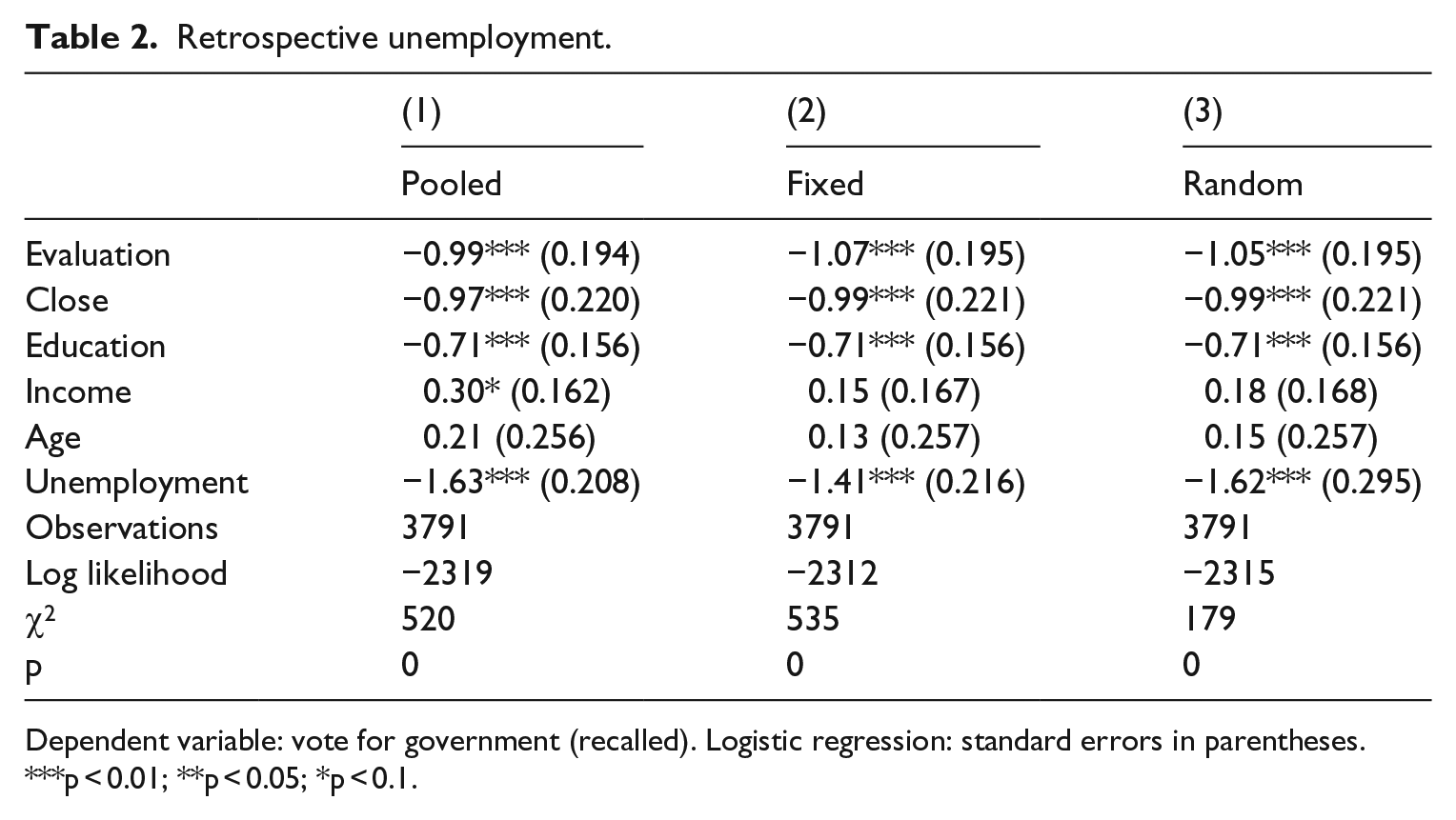
Dependent variable: vote for government (recalled). Logistic regression: standard errors in parentheses.
p < 0.01; **p < 0.05; *p < 0.1.
We also run a number of simulations for 2011 as reported in Table 3, where we can see that under most scenarios the Government parties were likely to do badly. The exception is if all voters had positive evaluations of the economy (a very unlikely scenario given the economic collapse), the Government would have had a far larger share of the vote (50%). However, the retrospective evaluation of the economy does appear to do the heavy lifting. If all had a negative evaluation of the economy, the Government’s vote share would have amounted to just 8%. This again underlines the dominance of the retrospective evaluation variable (Table 3).
Expected vote in 2011 under simulated conditions.
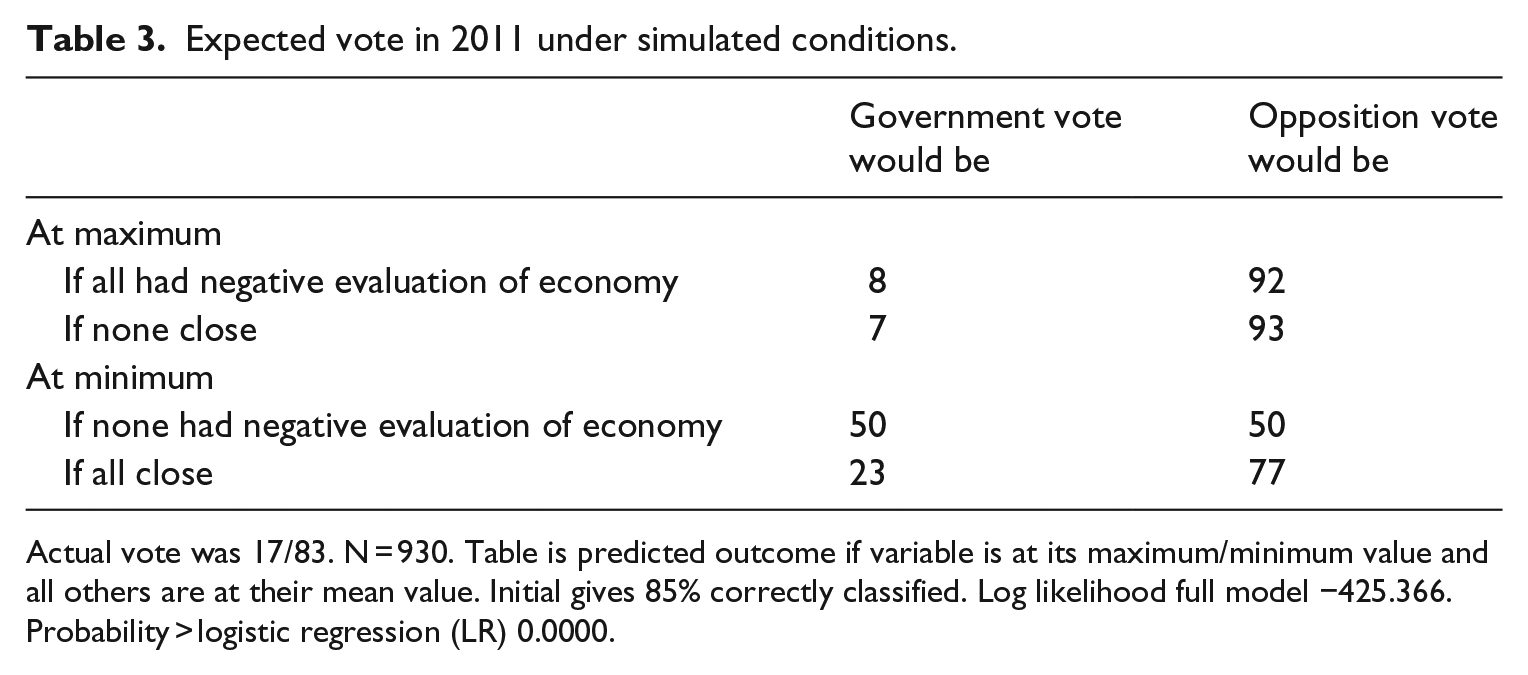
Actual vote was 17/83. N = 930. Table is predicted outcome if variable is at its maximum/minimum value and all others are at their mean value. Initial gives 85% correctly classified. Log likelihood full model −425.366. Probability > logistic regression (LR) 0.0000.
Change in predicted probability of government vote.

Conclusion
Overall, the standard reward-punishment model for understanding the vote stands up well in Ireland, at times of both economic boom and bust. In the introduction, we raised a series of questions which have dominated the economic voting literature. This research confirms many of the central dynamics of economic voting in the Irish context. Irish voters are retrospective in their economic evaluations and unemployment is especially salient. More importantly, the analysis demonstrates that economic shocks matter a great deal, Irish voters like their counterparts elsewhere react more strongly to negative economic news, and this was never as clear as when the economy collapsed in 2011. Voters look back, and punish, in times of economic crisis. The grievance asymmetry hypothesis is supported.
But the evidence presented here goes beyond a normal test of economic voting models. The Irish economic vote was extreme in 2011 and must be placed at the end of the spectrum of punishment for poor economic performance. It demonstrates that economic voting is not just a small force at elections, it can be an overwhelming one. The scale of the desertion of Fianna Fáil by voters in 2011 far exceeds any reward which the party accrued in 2002 when the economy was booming and had been given the Celtic Tiger epitaph. The reward for positive performance is limited and might be best seen as inertia. This point goes someway to explaining the long period in government which Fianna Fáil experienced from 1997 to 2011. It coincided with a decade of economic growth and retrospective voters stayed with the party in power until the economic crisis, reinforcing arguments that reputation for good economic governance can aid a party in power. Conversely, governing through an economic crisis may have the effect of overwhelming existing levels of partisanship as Nezi (2012) predicted. The drop in support for Fianna Fáil was enormous with all but the party’s core supporters deserting them. Elections in Spain, Portugal and Greece all display evidence of punishment of governing parties, but the Irish case is one of the most punitive. The analysis delivers a cautionary tale for governments of small rewards for good economic results and severe punishment for catastrophic economic decline.
Unemployment is the most powerful macroeconomic factor at Irish elections. The surge in unemployment from 2008 drove partisans away from Fianna Fáil in large numbers. However, unemployment mattered at all elections, and those uncertain about their employment prospects were more likely to vote against the government, although these were relatively small groups at the 2002 and 2007 elections. The evidence reported is consistent with the longstanding salience of unemployment in Irish politics.
Overall, this work demonstrates that economic voting models work well in explaining patterns at Irish elections and it presents an especially strong case for the grievance asymmetry hypothesis demonstrating that during an acute economic crisis, the economic vote can override long-held partisan support patterns. The economic crisis brought about the collapse of the dominant party of Irish politics for nearly a century. The party continues to struggle several years after its Waterloo. More than anything else, the Irish example shows that voters attribute responsibility for an economic crisis to the incumbent government and it contributes to a growing body of literature which underscores the utility of economic voting models for explaining sharp changes in support levels of parties. When the scale of the economic crisis is as great as was the case in Ireland, moderating factors such as feeling close to a party, coalition government and shared EU economic governance diminish and a punishment economic vote can become a tsunami. The Irish political system may turn out to be one of the first to experience the consequences of what has been termed the Great Recession. While economic voting has long been considered a small but consistent force at elections, this article demonstrates that in an economic crisis, economic voting can become a powerful and transformative force in a political system. It may be a predictor of widespread political change ahead in many countries which have been heavily impacted by the economic crisis.
Footnotes
Acknowledgements
The authors are particularly grateful for comments and advice received from Michael Marsh, Slava Mikhaylov and Michael S Lewis-Beck on earlier versions of this paper.
Funding
The author(s) received no financial support for the research, authorship and/or publication of this article.
Notes
Author biographies
 and a senior lecturer at Dublin City University. She is currently co-PI on an EPA project on climate change coverage in Irish media and is communications director of a COST project on populist political communication with an emphasis on media and social media.