




Abstract
This article provides a historical materialist critique and response to Bob Jessop’s Strategic-Relational-Approach (SRA) to the structure-agency debate. The critique is developed in four steps and four class-based solutions are given. First, the SRA provides no ontological entry-point to account for historically specific relations of power, while the researcher inescapably finds herself within them (e.g. class relations). Second, the SRA provides no ‘method of articulation’ to understand and explain why particular disruptive agencies exist within the structure-agency dialectic. Instead, Gramsci’s ‘philosophy of praxis’ locates the researcher as a potential ‘organic intellectual’ in the confrontation and transcendence of class relations. Third, for the SRA, power is meaningless because agency can always be ‘redefined’ so that it is explained through structural determinations. In politicising power through historical materialism, this article provides a concrete emancipatory operationalisation of Jessop’s dialectical ontology. Fourth, when studying uneven historical change, adopting a partisan approach may well suggest focusing on contingent action instead of structural necessities. Therefore, acknowledging the ‘politics of power’ may well be social scientists’ first step when contrasting historical change with their own political views.
Silence is so accurate
Introduction
The structure-agency debate revolves around the dual nature of human societies, that is the dialectic between the supra-individual and structural processes vis-à-vis the individually autonomous and agential moments that shape historical change. This article argues that while a thoroughly relativistic answer can be logically provided at a theoretical level (e.g. the Strategic-Relational-Approach (SRA)), any attempt to explain historical change will necessarily be based, either implicitly or explicitly, on political and normative presuppositions; hence, the politics of establishing who has power to do what, when, and where is important.
‘First round’ approaches to the structure-agency debate have been characterised as providing ontological supremacy to either structure or agency. Structuralism emphasises that social structures determine individual conduct, reducing social action to a mere appendix of the former (e.g. Althusser, 2005 [1969]). Voluntarism or methodological-individualism underlines the ultimate autonomy of social actors and the divisibility of social structures into their constitutive parts (e.g. neoclassical or institutional economics). In order to overcome binary explanations for historical change, ‘second round’ theories provide a dialectical account of structure and agency. Originally, Anthony Giddens bridged the binary ontological gap by strictly superimposing structure over agency and vice-versa. Later, Roy Bhaskar and Margaret Archer improved Gidden’s ‘structuration theory’ by bringing time into the analysis so that structural and agential moments could be distinguished appropriately (Archer, 1998; Sayer, 2010).
In considering ‘third round’ approaches, this article focuses, on Bob Jessop’s SRA as an idiosyncratic relational theory of power in the structure-agency debate. Jessop (1996, 2005) claims that SRA transcends ‘second round’ approaches by thoroughly integrating and relativising structure and agency dialectically. This is achieved by mirroring and relating them to each other in a complex and multi-layered ontology, so that appropriate analyses of structurally differentiated actors, within particular structure-conjunctures, may be articulated.
There exist few critiques of SRA from within SRA. Hay (1994) criticised Jessop’s silence on ‘what theory’ or ‘what methods’ the social scientist had to use to make the SRA operational. Hay’s (2001, 2002) solution pointed towards the development of an institutionalist framework in contrast to possible Marxist re-interpretations of SRA. Conversely, those articles that have criticised Jessop’s ontology from critical and Marxist perspectives have only targeted his more historically concrete levels of abstraction, namely capitalist regulation and the production of space from both post-structuralist (Daly, 2004) and Open Marxist perspectives (e.g. Charnock, 2010), the material basis of the capitalist state (Kelly, 1999), or, more recently, the role of semiotics in the study of Cultural Political Economy (Staricco, 2016; Van Heur, 2010). However, none have engaged with Jessop’s SRA from a historical materialist perspective that brings the dialectics of the structure-agency down to a class perspective. 1 The arguments of the article can be summarised as follows.
First, in providing a thoroughly relativistic but logically accurate account of the structure-agency dialectic, SRA obviates that the researcher departs from a particular structure-conjuncture in history, and therefore, she inevitably experiences multiple historically concrete relations of power. Social sciences are immanent to historical struggles from which they cannot detach and, hence, history cannot be thoroughly relativised as it exerts a real force upon the researcher. A historical materialist theory of power foregrounds the importance of class to the investigation of historically specific sets of power relations.
Second, within a complex and heterogeneous reality, SRA suggests a ‘method of articulation’ that leaves open the theorisation of historical power relations. Different theories are useful for different purposes as structures have no meaning outside of their context. However, Jessop remains silent on how and why particular methods provide us with the appropriate means to understand disruptive structure-agency dynamics. He also does not tell us how, and why, particular agencies seek to transform social reality. In contraposition, Gramsci’s ‘philosophy of praxis’ helps us to understand the researcher as a potential ‘organic intellectual’ who may actively theorise and engage politically with historically specific power relations in order to reproduce, transform, or transcend them.
Third, according to Jessop, by thoroughly relativising the interaction between structure and agency, the category of ‘power’ loses its explanatory force and, in opposition, becomes a redundant category that needs to be explained (i.e. in SRA, power becomes the explanandum instead of the explanans). A historical materialist critique of SRA reveals the double-hermeneutics in the process of defining what power is. Put simply, in attributing power to social structures/actors, the researcher is strategically, either implicitly or explicitly, exerting her explanatory power as a potential ‘organic intellectual’ in the understanding of power relations and the possibilities of historical change. In and through a partisan critique of power, the researcher explicitly acknowledges that power is a politically contested category determining what can or cannot be done. A historical materialist theory of power may well frame class power as the interaction of economic, political and ideological relations of domination that result from overdetermined but necessarily contingent strategic class struggles. In seeking to transcend historically specific power relations, the researcher may well attempt to bridge the gap between theory and praxis.
Fourth, according to SRA, historical change that results from the changing ‘balance of power’ is contextualised a posteriori, after the recursive interaction of particular strategies within constraining structures. Jessop, however, stresses the concepts of overdetermination, contingent necessity, and structural coherence in explaining historical change, implicitly providing a structuralist account that downplays agency. This article argues that SRA does not sufficiently problematise the emergence, interaction, and dismissal of structures as the result of contingent and radical action. In that sense, and in contrast to Gramscian theory, SRA misses the politics of understanding and explaining historical change as the dialectics of contingent necessity and necessary contingency. From a Marxist perspective, historical change may well be presented as the uneven and recursive interaction between class strategies and class struggles in the co-production of class power, formation of class fractions, and/or their transcendence.
In and through engaging with the four critiques outlined above, this article provides a historical materialist perspective of SRA from within and the necessary steps to move beyond by grounding the structure-agency debate in a historical context. While there are others that have already done so, either at a more philosophical and abstract level of analysis from Marxist (Ollman, 2003) and Critical Realist perspectives (Bhaskar, 1998; Sayer, 2010), or after engaging with Gramsci’s writings (Bieler and Morton, 2001; Morton, 1999, 2007; Overbeek, 2000; Poulantzas, 2014 [1978]; Thomas, 2009), this article aims to provide a similar perspective by focusing exhaustively on Jessop’s potentially emancipatory approach.
The SRA
SRA departs from the ‘second round’ theories in the structure-agency debate. Jessop criticises Giddens, Bhaskar, and Archer for providing a flat and linear ontology in the structure-agency dialectic (Archer, 1998: 373–378; Jessop, 2005: 45–48). Fundamentally, he charges that theirs is a flat ontology that periodises historical change on a liner basis (i.e. past–present–future) and does not account for the complexity of social structures that places actors in different strategic positions and structure-conjunctures. According to Jessop, this inhibits an account of the complex and relative ontology that, due to the multiple interactions of the structure-agency dialectic, makes history an uneven process of social change (also Bieler and Morton, 2001: 7–10).
For Jessop (2008: 44), the ‘key to resolving the impasse was to emphasise not just that structure and agency were dialectically related but also that each moment in this dialectical relation contained elements from its other’. SRA set itself the problem of developing a theory and methodology in the analysis of power as a thoroughly dialectical relation, namely, as the ‘arts of the possible’ in particular spatio-temporal matrixes (Jessop, 2016: 91–93). SRA relies upon two crucial ontological presuppositions that make history ‘multiply tendential’. First, social actors’ behaviour cannot be predicted from the knowledge of the circumstances themselves; the possibility to act in a certain way should not be identified with its realisation due to the contradictory nature of power relations that constantly place social actors in strategic dilemmas (Jessop, 2016: 91–92). Second, social structures are overdetermined by other contradictory structures due to their complex and incomplete nature; hence, social structures are partial and provisional (Jessop, 2001: 88–115, 2005: 52–53, 2008: 47, 2013: 6–11). From these two propositions, it follows that strategic interests must also be relative to a particular spatio-temporal framework rather than absolute, and analysed ‘in terms of potential outcomes, in particular situations, for specific subjects who have internalised specific identities’ (Jessop, 2016: 94–95). Agential possibilities are not amorphous but socially structured, and the transformative power of strategic action is not autonomous but structurally focused. Moreover, Jessop (1996: 123) argues that in order to develop a truly dialectical account of the structure-agency debate, one must not only acknowledge the contradictoriness of both categories but also move on to consider how this affects their meaningfulness separately and in unity. Structure and agency can only exist through their relational interaction as a complex system of relations among relations; the (only?) methodological problem remaining is how to articulate them in a meaningful way (Jessop, 1990: 10–11, 1996: 125–27, 2005: 53, 2016: 91–92).
According to SRA, power ultimately resides in the capacity to reproduce, reform, or transform aspects of the historical context in which other less powerful groups and individuals are constrained and limited to advance their interests and strategies (Hay, 2002: 184–187; Jessop, 1996: 126–28). Yet, the dialectics between structure-agency have to be posited, a fortiori, in a definite spatio-temporal horizon that provides historical meaning to the strategic selectivity and the dimensions of strategic calculation and action. The relativity of the SRA comes to the fore because what is normally called social actors’ structural power may become a complex and historically overdetermined process if contextualised differently, downplaying the strategic dimension of such particular actors (Jessop, 2008: 38–44).
Initially, SRA departed from a Gramscian historical materialist interpretation of the subjective and objective interests guiding strategic agency (Jessop, 2008: 22, 31–33). Nevertheless, it distanced itself from a Marxist ontology to leave SRA open for its implementation in other strategic-relational paradigms due to the complexity of social life (Jessop, 2002: 22–36, 2008: 53–54, 226). At a very abstract level, objective interests can only be attributed to a specific subjectivity holding a specific location in a given structure-conjuncture. A particular subject or collective, however, can always miscalculate any objective interests since the latter ‘are defined in terms of the conditions actually necessary for its reproduction [and/or transformation] rather than the subject’s own views on these conditions’ (Jessop, 2008: 30). From here derives the importance of hermeneutics and the importance of how we contextualise the framework that determines which agent’s interests are being (dis)advantaged, rather than providing an absolute judgment on any process (Jessop, 2005: 52–53). However for Jessop, in spite of the difficulties in articulating an accurate analysis of any particular structure-conjuncture, power ought not to be used as the explanatory mechanism driving historical change because any particular social relation is ontologically ‘overdetermined’ by other multiple relations due to the complex nature of society (cf. Althusser 2005 [1969]: 99–100). More specifically:
Power is a complex, overdetermined phenomenon that is ill suited to explain social relations. […] Insofar as power is not just a general term for the production of any and all effects within specific structural constraints, the specific effects of specific agents’ exercise of power in specific circumstances constitutes and explanandum rather than an explanans. […] The more detailed the specification of the context of a given action is, the less scope there is to attribute effects to the actions that occur in that context. Thus, when conjunctures are well specified, ‘power’ tends to become a residual category. (Jessop, 2016: 91)
In this way, the SRA argues that power has to be properly contextualised, rather than apprehended to explain the transformations of the context, so that we can better account for the real causes determining strategic action within a given structural framework. Jessop’s trivialisation of the category of power, becoming the object of explanandum rather than of explanans, materialises in the implicit tendency to place greater emphasis on the notion of ‘contingent necessity’ in contraposition to that of ‘necessary contingency’. For Jessop, the complex and multiply tendential nature of social structures that overdetermine strategic agency makes any particular social action a contingent necessity. More precisely, this idea implies the ‘non-necessary interaction of different causal chains to produce a definite outcome whose own necessity originates only in and through the contingent coming together of these causal chains in a definite context’ (Jessop, 1990: 11).
2
Hence, the transforming power of social action is simultaneously overdetermined by the contingent coupling of various structures that make a specific action in a specific context necessary. More explicitly, Jessop assumes:
that everything that happens in the real world must happen, that is, is in some sense ‘necessary’. […] It is the precise meaning of necessity, however, that is at stake in ‘contingent necessity’. For it need not, does not, and cannot mean that whatever happens in the real world is due to a single causal mechanism. Instead the concrete actualization of events results from the interaction of diverse causal tendencies and counter-tendencies. (Jessop, 2008: 232, also 2016: 55; original emphasis)
The task of the researcher is to find the contingent combination of real causes that makes a particular action necessary.
In this chicken or the egg dilemma, unlike others who have preferred to present the problem as insoluble (e.g. Bieler and Morton, 2001: 28), Jessop’s particular articulation of the SRA implicitly places more ontological weight on the moment of agential necessity than on the moment of contingent structural reproduction or transformation. Furthermore, Jessop’s ‘method of articulation’ that insists on the epistemological relativism of social sciences leaves the methodological steps to approach concrete studies indeterminate (Jessop, 1990: 10–11, 2008: 44–45), freeing the researcher to use any amalgamation of theories for an ‘appropriate’ study of the historically concrete. The problem of adopting one particular ontological entry-point in a complex reality is left unresolved, and it has only been problematised when Jessop, for example, brought semiotics into the study of capitalism (e.g. Sum and Jessop 2006a, 2006b, 2013), after he had already adopted a particular (Gramscian) ontological standpoint in the analysis of the structure-agency dialectic. The political implications of this silence are discussed in the following section. The section ‘Towards a Historical Materialist Theory of Power’ provides a solution to the impasse.
A historical materialist critique of the SRA
In spite of the alleged ‘application’ of SRA in the study of capitalist regulation, the state, political economic geography or cultural political economy (Jessop, 1990, 2002, 2008, 2013, 2016; Sum and Jessop, 2006a, 2006b, 2013), the accuracy of its application has been questioned elsewhere (e.g. Hay, 1994; Kelly, 1999; Staricco, 2016; Van Heur, 2010) because Jessop does not define intermediate steps to render the SRA operational for a historical analysis that moves from the abstract to the concrete and from the simple to the complex (Hay, 1994: 331–332). This article argues that Jessop has not been able to provide a thoroughly strategic-relational study of particular structure-conjunctures because the SRA is fundamentally unworkable. The problem resides in two aspects that have direct repercussions on his particular understanding of power and historical change.
First, SRA tells us nothing about the structurally relative position that researchers have within the structure-agency dialectic. On the one hand, Jessop (1996: 125–27, 2008: 43) argues that interests and agential power can be ‘redefined’ according to different structure-conjunctures. On the other hand, he avoids problematising why researchers may prefer to advance a specific structure-conjuncture in contrast to others despite the important consequences it may have in the attribution of real interests and power. However, researchers cannot escape from ontologically given and historically concrete relations of power as they confront the structure-agency dialectic from within and not from outside (Gramsci, 1971: 347–351). The ontological unity between structure and agency that SRA presupposes is not extended to the role of the researcher and the unavoidably structurally influenced nature of research. In parallel, these actively produce knowledge within a historically given framework that provides meaning to historical structures and generates a critical ontology to enable their transcendence (Edgley, 1998 [1976]: 407). Underplaying the researcher’s strategic role obscures the way in which SRA can be operationalised for any particular explanatory and, hence, normative purpose. A historicist method that stresses the importance of engaging with particular relations of power (Bieler and Morton, 2001: 13–15; Morton, 2007: 29–33; Rehmann, 2013: 122–124) may well propose class as an ontologically meaningful category to understand relations of power within capitalism (e.g. Jessop, 2001: 88–115, 2002: 30–36). Thus, the identity between subject and object is generated (see section ‘Towards a historical materialist theory of power’ below).
Second, since SRA presents itself as a ‘general social ontology’ for the structure-agency dialectic, it leaves the theorisation of power thoroughly underdetermined on an ‘abstract-simple level [permitting its] resolution through appropriately detailed conjuncture analysis’ (Jessop, 2008: 44–47: 53, 1990: 11–13; emphasis added). In not stating what the necessary steps are when moving from an abstract-simple to a concrete-complex ontology (Hay, 1994: 352), SRA may provide a logically accurate ontology in which everything can be ‘redefined’, but at the price of remaining silent on what realities researchers may be confronted and with how they should approach such realities. According to Jessop (2008: 226), a Marxist entry-point may not be an adequate entry-point for historical analysis because:
while it might be suitable for cases where the logic of capital accumulation is the dominant mode of societalization (Vergesellschaftungsmodus) and/or the theoretical object under investigation is heavily influenced by this logic, it may be less appropriate for cases where other modes of societalization are dominant and/or have the strongest influence on the relevant theoretical object. (also Jessop, 2002: 22–36)
Jessop (2008: 226–227) concretises his argument on the complexity and the irredeemably historically specific form of social structures a bit further by stating that ‘not everything that is possible is compossible’ (i.e. not all forms of societalisation are compatible). In so doing, Jessop finds himself in a contradictory position here. Although according to the SRA power is thoroughly relative to the strategic field we are analysing, there are historical limitations that undermine a thorough relativisation of the structure-agency dialectic. This forces us to make particular theorisations of the historical concrete forms of power due to, and precisely because of, their material-real basis (Poulantzas, 2014 [1978]: 35–38, 147–151).
Mark Rothko’s aphorism that ‘silence is so accurate’ helps us to understand that in order to achieve theoretical perfection, Jessop absolves himself from making any practical inaccuracy, even though it might be what we have been seeking from the very beginning. According to Andrew Sayer (2010: 9), one of the main problems for contemplative views towards knowledge is:
the assumption that the only function to knowledge and language is ‘propositional’ (to make propositions about the world) or ‘referential’. What is overlooked in this view is that knowledge concerns not only ‘what is the case’ or ‘knowing-that’ but [also] ‘know-how’, that is knowing how to do something. (original emphasis)
At an abstract-simple level of analysis, SRA cannot tell us either why particular transformative strategic agencies may exist, or why scholars may engage in infinite discussions around the ‘redefinition’ of structure-conjunctures to understand and explain historical change. In that sense, SRA’s dialectical relativity does not provide any rigorous guidance on how strategic research may be developed so that theory and praxis meet. Critical theory cannot exist without praxis, as critical theory strives to disentangle unexplored but existing forms of power, ‘enlightening’ the ground for their supersession (Bieler and Morton, 2001: 21; Edgley, 1998 [1976]: 403–407; Gramsci, 1971: 330–335; Morton, 1999: 4–5; Sayer, 2010: 28, 56). Interestingly, these two posited problems have more pervasive effects than just providing us with a theoretical framework that is practically inoperative; they have also permitted Jessop to implicitly advance structuralist accounts of the structure-agency dialectic that underplay the possibilities of transformative contingent action and, possibly, transformative strategic research (Table 1).
From the Strategic-Relational-Approach to a Historical Materialist Theory of Power.

First, Jessop moves the category of power to a residual position in the equation, the explanandum rather than explanans. This implies that any contingent strategic action will always be thoroughly explained through an ‘appropriate’ theorisation of particular structures that render any action necessary (Jessop, 1996: 126, 2008: 43). However, as pointed out above, this proposition obviates the double-hermeneutic role of the researcher in playing down social actors’ power, which reciprocally undermines the potentiality of research to advance transformative strategies (Poulantzas, 2014 [1978]: 149). When researchers engage strategically in understanding and explaining historical change, they will necessarily produce contingent discourses. This is ‘noise’ that is necessary for living history, the ontological presupposition to strategic action that embodies disruptive power in spite of constraining boundaries:
The oppressed, dominated, exploited, repressed, denied have an interest in knowledge [i.e. an explanatory critique] which their oppressors lack, in the straightforward sense that it facilitates the achievement of their wants and the satisfaction of their needs. And their oppressors, or more generally the oppressing agency, inasmuch as their (or its) interests are antagonistic to the oppressed, possess an interest in the ignorance of the oppressed. [Human sciences] cannot be regarded as equally ‘a potential instrument of domination’ or of ‘the expansion of the rational autonomy of action’. The human sciences are not neutral in their consequences in a non-neutral (unjust, asymmetrical) world. And it is just this which explains their liability to periodic or sustained attack by established and oppressive powers. (Bhaskar, 1998: 419)
To present power as a subordinate category in the analysis of historical change underplays the explanatory power of historical analysis and social actors’ capacity to make their own history (Kelly, 1999: 111–112). This inhibits the politics of attributing historical change to specific strategic actions. If we acknowledge the normative consequences of producing particular ontologies and discourses, we may well understand that power is a contested category, a condition that Jessop does not openly consider when discussing the SRA. 3
Second, SRA can be criticised for leveraging structures over agency when accounting for their recursive interaction (i.e. historical change), since the categories of ‘structured coherence’, ‘overdetermination’, and ‘contingent necessity’ have prevailed over those of ‘disruptive agency’ or ‘necessary contingency’. On the one hand, in providing more ontological importance to ‘structured coherence’ than to ‘disruptive agency’, Jessop (2005: 50–51; see Figure 1 above) prioritises the structural over the agential moment with an aprioristic two-tier stratification of social structures, which confuses the dialectical relationship between structure and agency, undermining social actors’ power to reproduce, or transform, their environment strategically. If we apply this to Jessop’s own more concrete theorisations regarding capitalist regulation (e.g. Jessop, 1990, 2001, 2002, 2013; Sum and Jessop 2006a, 2006b), the leadership role of hegemonic classes or class fractions in producing historic blocs becomes secondary, if not redundant. Their power to inscribe their class interests as strategic selections for the subordinate classes is overdetermined by, and subordinated to, sensu stricto, the whole historical structural complex itself. Whether it is the agential or structural moment which contingently produces and reproduces any superstructure remains undetermined, thus, jettisoning any meaningful theory of power that allows for strategic resistance. Within Jessop’s SRA, class power and hegemony are instantiated ex post, never in situ.
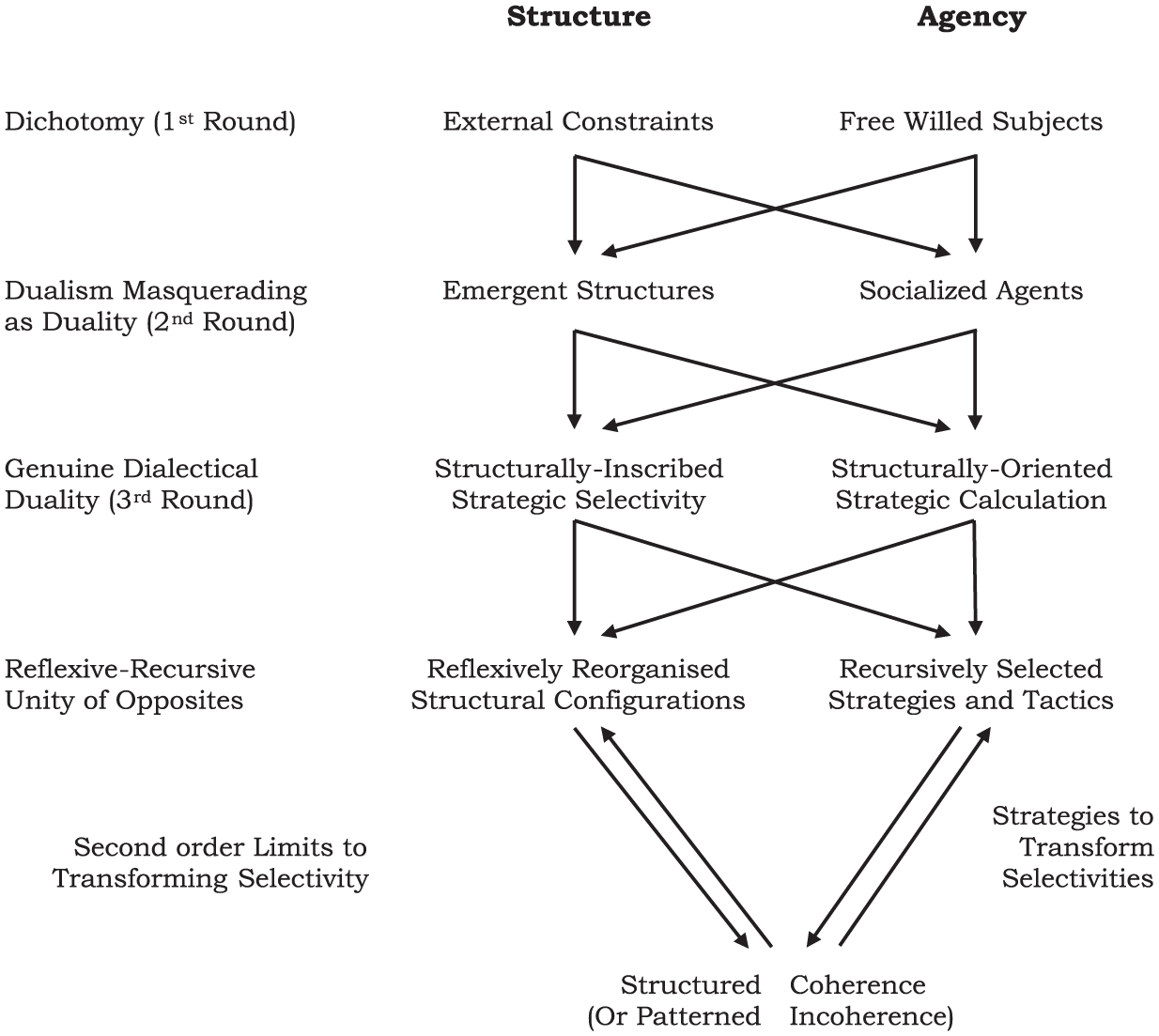
The evolution towards the Strategic-Relational-Approach in the structure-agency debate (Jessop, 2005: 50).
On the other hand, in contrast to radical analyses that seek the ‘rupture within the structure’ (e.g. Poulantzas, 2014 [1978]: 149), Jessop’s conservatism materialises in his systematic trace of the regulatory and overdetermining role of capitalist structures in framing agential power (Charnock, 2010; Daly, 2004; Kelly, 1999; Van Heur, 2010). While these critiques may not be completely justifiable (Hay, 1994; Staricco, 2016), because social actors cannot escape from their subordinate position in overdetermining structures, or from their partial and limited understanding of social reality, Jessop (1990: 10–11, 2008: 232–233) argues that the reflexive action becomes the necessary outcome of the contingent articulation of given structures. Thus, in the recursive interaction of the structure-agency dialectic, strategic action becomes secondary for the transformation of social structures. The SRA guides us confusingly to an ontological standpoint in which the probable (structural reproduction) becomes contingent to the complex interaction of contradictory structures (Jessop, 2005: 50–53). Simultaneously, micro and macro power structures become immanent and undermine any powerful conceptualisation of emancipatory action because these are inherently overdetermined by multiple structures, both known and unknown. As for the category of power, the question of freedom becomes redundant since social action can always be thoroughly relativised in relation to the structures that overdetermine it. This conceptualisation forgets the open nature of power relations that depend on the necessarily contingent strategic response of social actors and the emancipatory power of dialectical thinking which provides ample space for the critique of any particular structure and relation of power. It is precisely in concretely defining the political dimension of social relations that structures also become meaningful and contingent to social action, and not only a historical necessity, namely, seeking through the contingent but radical action to transform a necessarily conservative totality (Bellofiore, 2014: 187–188). One wonders what historical relevance framing power has in and through a thoroughly relativist ontology that transcends its explanatory meaning? According to Gramsci (1971: 34–35), critical consciousness:
provides a basis for the subsequent development of an historical dialectical conception of the world, which understands movement and change, which appreciates the sum of effort and sacrifice which the present has cost the past and which the future is costing the present, and which conceives the contemporary world as a synthesis of the past, of all past generations, which projects itself into the future.
From this historical materialist critique of Jessop’s implicit structuralist tendencies, historical change can then be finally reinterpreted within SRA as the politics of contingent necessity and necessary contingency, namely, that in defining the ‘art of the possible’ within concrete structure-conjunctures, one will necessarily take a contingent side and that this will subsequently be subject to political critique.
Towards a historical materialist theory of power
In order to move forward, this section brings Jessop’s contribution to the structure-agency debate back to its Marxist foundations so that SRA becomes operational for social emancipation and shed its relativist and structuralist assumptions identified in the previous section. Ironically, in producing a limited and partial ontology, we set the foundations for its own resolution since SRA theorises the necessity of articulating contingent strategies towards a historical dilemma in order to transcend it. But before doing so, we first need to locate the self-critical positioning of the social actor/researcher within the structure-agency dialectic in Gramscian terms so that the categories of class power, class strategies, class struggles, and class fractions do not appear deus ex machina. In this sense, the following theoretical framework may be located in the so called ‘third round’ approaches to the structure-agency debate.
The politics of adopting any ‘method of articulation’ points to the importance of ideological and discursive struggles that underpin the historically reflexive moment when concrete (research) strategies are formulated. Locating ourselves critically within history, that is, by adopting a ‘philosophy of praxis’ that ‘secularizes’ thought to the absolute, suggests studying the past history in the present in order to guide and formulate our actions and strategically construct a new history (Gramsci, 1971: 427, 465). Thus, adopting a ‘philosophy of praxis’ that self-reflectively locates the researcher as a potential ‘organic intellectual’ allows us to understand:
how the present [structure-conjuncture] is a criticism of the past, besides [and because of] ‘surpassing’ it. But should the past be discarded for this reason? What should be discarded is that which the present ‘intrinsically’ criticised and that part of ourselves which corresponds to it. What does this mean? That we must have an exact consciousness of this real criticism and express it not only theoretically but politically. In other words, we must stick closer to the present, which we ourselves have helped create, while conscious of the past and its continuation (and revival). (Gramsci, 1992 quoted in Morton, 1999: 4; original emphasis)
A radical interpretation of SRA enables the researcher to potentially become an ‘organic intellectual’ with respect to politically determined complex structure-conjunctures. This encourages the researcher to understand and explain why the past relations made any current social structure of domination a historical necessity, so that we can transcend it in and through a renewed strategy (i.e. when emancipatory ideas gain ‘material force’ and challenge the ‘common sense’; Bieler and Morton, 2001: 19; Bruff, 2008: 55; Gill, 1993: 21–26; Gramsci, 1971: 9–11; Morton, 2007: 92; Thomas, 2009: 163).
Various historical materialist theories exist that, and by departing from Gramsci’s ‘philosophy of praxis’, formulate class relations in a triadic way: as economic, political, and ideological relations of class power (e.g. Shields et al., 2011). More specifically, a historical materialist theory of power that locates class at the centre of historical analysis seeks to study the failures and/or successes of historically contingent class strategies in their necessary co-production of class power and/or the transcendence of class relations. Put differently, class power can be dialectically theorised as the strategic field in and through which class strategies, which synthesise the past to envision an alternative future, guide class struggles and, reciprocally, co-produce new forms of class power or transcend them. Hence, class power comprises a set of historical relations in and through which social actors are mutually constituted and become class (Ollman, 2003: 25–26, 2015: 18–22). As such, an identity between subject and object is theoretically formulated for practical purposes.
In a stylised way, and drawing upon International Political Economy of Labour (IPEL) and Industrial Relations studies, 4 we can strategically locate workers’ class struggles (Table 2) in contemporary capitalism around the following economic, political, and ideological relations of power:
Economic power, (i.e. the position/function that workers hold within the capitalist relations of production) which is determined by (a) negotiating power within the labour market (e.g. possession of abilities and capabilities, employment/unemployment rates within a particular geographical scale, capacity to reproduce their labour force without depending on wage labour, etc.); (b) negotiating power in the labour process or workplace (e.g. autonomy or capabilities to control, organise, design, or interrupt the labour process and the production of commodities); and (c) consumption power (e.g. the capacity to boycott or interrupt commodity sales and/or the realisation of the economic value produced in a given economy);
Political power (i.e. the position/function and representation that workers have within the juridical-legal and executive system) which exclusively belongs to the ‘political society’ or the ‘capitalist state’: (a) power to legislate or promote a series of laws around fiscal, monetary, labour market, or collective bargaining processes (e.g. capacity to implement laws or fiscal policies that improve the economic and social conditions of the population; or reforming the legal structure of collective bargaining in order to promote more decentralised class relations in the labour market); and (b) collective bargaining power within bipartite or tripartite structures (e.g. capacity to negotiate effective and economically beneficial collective agreements);
Ideological power (i.e. the position/function that workers hold in the production, articulation, organisation, and projection of a set of class strategies/discourses) that guides not only workers but multiple social actors in civil society: (a) power to produce a persuasive class identity-consciousness that bestows them with a set of mental schemes/discourses that give meaning to social reality and guides them in their individual/collective action; (b) power to associate and organise with other workers under an identity-consciousness that may be articulated in formal or informal institutions (e.g. a union or political party); (c) infrastructural power that provides workers with the necessary material-financial resources to realise their interests; (d) cognitive power via the capabilities of learning, reflecting, and framing social problems effectively, at the same time that they make use of their resources intelligently; and (e) power to bridge alliances with other collectives, social movements and organisations that share particular interests but also differ in identity, constituency and agenda.
Historical relations determining workers’ class power.

Capitalist history can be presented as the uneven interaction between class strategies and class struggles in the co-production of class power in capitalism or its transcendence (see Figure 2 below). In emphasising the complexity of capitalist ontology, the theory opens the space for analysing the production of class power as fractional and uneven instead of homogeneous and linear. Hence, (working) class fractions emerge as historically concrete social groups who crystallise particular forms of (workers’) class power, which necessarily result from the contingent articulation of (workers’) class strategies and class struggles against other classes (i.e. capitalists) and/or other class fractions (i.e. other workers). The explanatory power in studying the formation, transformation, or transcendence of class fractions resides on the level of abstraction in which we determine the structure-agency dialectic. In other words, the study of class fractions is dependent on how we define specific structure-conjunctures that enable or disable particular strategies and struggles in the exercise and transformation of class power. In contrast to, for example, Van der Pijl (1998: 49–57) who focuses on the economic foundations for the formation of capitalist class fractions, a complex theory on the formation of class fractions allows us to create a multi-layered ontology of class fractions around economic, political, and ideological relations (see Jessop, 1990: 203–205). Nevertheless, the ‘relative autonomy’ that class fractions hold when realising their class strategies can be confronted with their necessary co-production of class power within an ampler dynamic totality. While historical change might be understood and explained as a class fraction exercising its power within a specific structure-conjuncture, it may also be subsumed within a more ample historical plane due to the overdetermination of uncontrolled/unforeseen structural processes; hence, a return to the recursive problem of the politics of ‘contingent necessity’ and ‘necessary contingency’ in explaining uneven capitalist change.
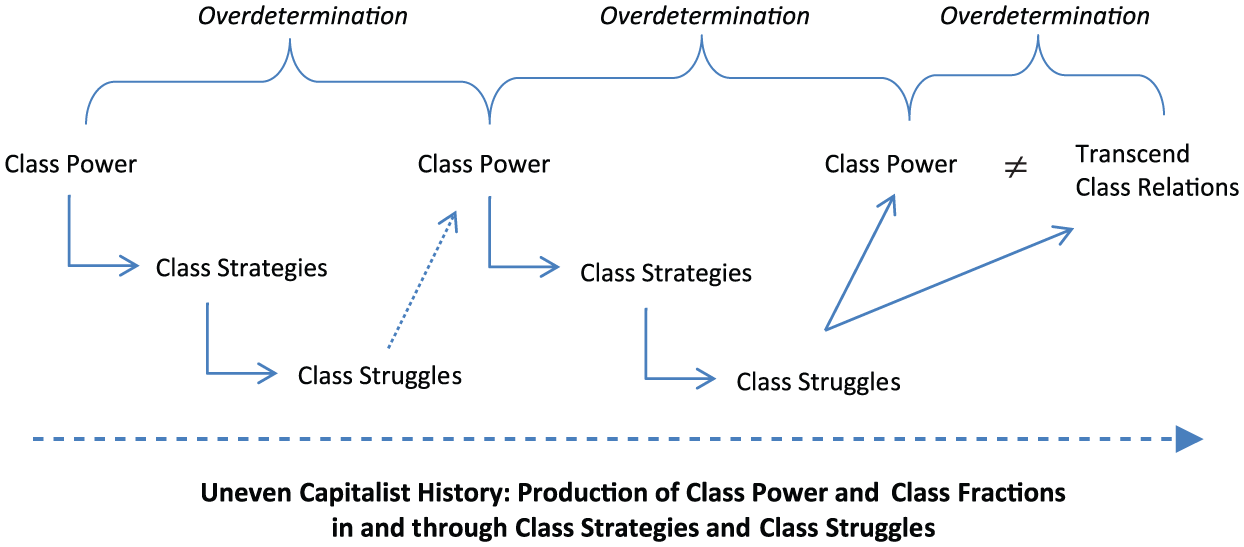
A historical materialist theory of social change.
Jessop (1990, 2001, 2013; also Hall, 1996; Overbeek, 2000) reminds us that when studying capitalist regulation, any class strategy will be contradictory in itself, as it will necessarily respond to some partial interests within a historical totality. Hence, it is important to define historically meaningful contexts when studying the formation of class fractions and their hegemonic or disruptive potentiality. Historically specific relations of class power (e.g. workplace capital-labour collective bargaining dynamics) are always overdetermined by more historically complex class relations (e.g. the constitution of Global Value Chains, national labour regulations or the fluctuations of financial capitalism) and it is up to concrete analyses to produce more complete accounts of the underlying dynamics governing historical change. Furthermore, a complex reality of class relations is also overdetermined by other social relations of domination (e.g. gender, race, culture, religion, ecology, etc.).
These two propositions point us to the complex and overlapping ontology of the subaltern (Gramsci, 1971: 52–53; Green, 2002: 9–10), from which we can derive two other important theoretical consequences. First, the empowerment of some class fractions in contemporary capitalism does not eliminate their contradictory position, but only tells us about the possible future transformations of their class power, which may further disempower and subordinate them with respect to other class fractions in global capitalism. Within capitalism, what may be perceived as a victory in one place, may be a defeat in others; hence, the uneven displacement of contradictions in time and space when class struggles do not transcend capitalist relations (Jessop, 2001, 2006, 2013). Second, the transcendence of class relations does not necessarily eliminate other relevant relations of power. More directly, the articulation of class interests under particular political or civic organisations (e.g. political parties or trade unions), may not tell us anything about how consensual or democratic these institutions are. Focusing on the transcendence of particular relations of power may produce far more oppressive structures, hence, the necessity to discern other interdependent relations of power when engaging with class struggle. What can be taken as positive from a concrete problematisation of the structure-agency dialectic in class terms is the thoroughly political nature of the debate: What relations of domination exist and how we can transcend them? The structure-agency dialectic can be posited as the debate where the realms of the possible and impossible are framed. It is the framework in, and through which, real relations of power are presented and contested. It is the process through which the historically contingent (social emancipation) becomes an absolute necessity (the struggle of the subaltern).
Finally, a historical materialist theory of power may dialectically oppose Jessop’s emphasis on the ‘contingent necessity’ and suggest an understanding and explanation of historical change as the necessity of the improbable: social emancipation. This results from the ‘multiply tendential’ nature of class structures and the very transformative power of class strategies informing class struggles. The latter resorts more to the notion of ‘necessary contingency’ and not to ‘contingent necessity’, as it actively avoids tracing the contingent overdetermination of structures that render some specific agency necessary and focuses on the contingent dismissal of historical structures of domination in and through concrete necessary action. Put simply, the notion of ‘necessary contingency’ stresses the contingent moment of struggle in structures that necessarily produce and reproduce domination as well as historical structures that are contradictory and incomplete in their constitution and which render the struggle for their transformation a historically contingent, albeit necessary, act. Hence, the dialectics between contingent necessity and necessary contingency constitute the political process in which the structure-agency dialectic is historically framed and challenged; this is the political process that problematises what can and/or must be transformed in a definite spatio-temporal framework without resorting to absolutist or teleological argumentations. Jessop’s SRA becomes operational and meaningful (i.e. political) as it is inescapably entrenched into a critical analysis of the real-material ontology of power. However, a class-based solution to Jessop’s silence has required an active and partial engagement with reality to from below; whether the researcher wants to accept such a challenge is another question.
Overall, the approach presented in this section can be located within Jessop’s contribution to the ‘third round’ in the structure-agency dialectic because it posits strategic actors in a complex dialectical reality but, and crucially, it goes beyond the SRA in overcoming its relativist and structrualist tendencies. In so doing, Jessop’s SRA becomes operational and emancipatory, explicitly politicising the relations in, and through which, power unfolds while the social actor acknowledges its structurally inscribed ontological position. Furthermore, it overcomes Jessop’s distinction between power as the explanandum and the explanans, since class power (i.e. the structure) becomes meaningful in and through the strategic formulation of class struggles (i.e. agency). Hence, the explanatory and emancipatory powers of a theory inform strategic action (Sayer, 2010: 56, 73). In that sense, a historical materialist theory of power becomes a research project that seeks to build common ground for the dispossessed so that a historical subordinate collective can challenge the economic, political, and ideological relations that undermine the realisation of politically attributed objective interests (McNally, 2015: 140–141).
Conclusion
This article has provided a critical approach to the structure-agency dialectic from within SRA and beyond. After succinctly presenting the SRA this article has argued that in addition to the silence on how a thoroughly complex ontology can be understood and explained, Jessop’s SRA has implicitly advanced a structuralist and conservative ontology that inhibits emancipatory action. Crucially, the political and normative consequences of theorising and studying particular structure-conjunctures have been underplayed. Arbitrarily, Jessop has reduced the category of power to an explanandum and provided more importance to ‘contingent necessity’ in historical change. A historical materialist standpoint problematises the structurally informed role that social researchers play in defining what is possible or not in a historical framework, presenting them as potential ‘organic intellectuals’ rather than just mere passive observers. This brings to the fore what has been presented as the ‘politics of power’: the ideological struggle between different analyses that give more importance to the processes of either ‘necessary contingency’ or ‘contingent necessity’ when explaining historical change. Bearing those limitations in mind, the article has advanced a historical materialist theory of power that puts workers’ structural position in capitalism (i.e. class) at the centre of contemporary historical analysis. A systemic framework that disentangles the different forms in which workers’ class power unfolds has been presented. This, allows us to provide an uneven and complex account on the co-production of class power and formation of class fractions in, and through, particular class strategies and class struggles in specific structure-conjunctures. It has also been argued that adopting a politically determined ontology may downplay other contemporary forms of social domination. Being aware of the limitations of theory becomes paramount. The ‘politics of power’, however, helps us to understand that it is indispensable to accept that we are necessarily ‘noisy’ when advancing contingent forms of progressive thinking and living.
Footnotes
Acknowledgements
I would like to thank Greig Charnock, Stuart Shields, Ian Bruff, Johannes Bellermann, and Mercé Cortina for their comments on earlier drafts. I am also grateful to the three anonymous referees and to the editors of Politics, especially to Kyle Grayson, for their comments and suggestions. The usual disclaimers apply.
Funding
The author(s) received no financial support for the research, authorship, and/or publication of this article.