




Abstract
During the past 50 years, European public sectors have undergone a profound process of organizational change, where managerial tools and principles from the private sector have permeated through governments and administrations of many countries. A substantial amount of academic literature has now been devoted to public management reforms. Many scholars have associated them with the diffusion of a managerialist ideology. However, the relationship between public management reforms, political ideology, and public expressions of support for these reforms by political parties has been a relatively under-explored topic within the literature and is the gap we address in this article. Using a longitudinal framework of study, our analysis shows how issues surrounding managerialist reforms have evolved across the electoral manifestos of European parties during the past 50 years. Our findings reveal that these reforms have enjoyed a growing political profile over time in many countries within Western and Eastern Europe. Furthermore, we also examine and discuss the differences and similarities of these reforms across countries.
Introduction
In the mid-20th century, Burnham (1941) asserted that, as of the early years of this century, American state agencies came progressively to be dominated by a new ruling class of managerial professionals. This ‘managerial revolution’ occurred in the wave of the opposition against the extension of government ownership and the setting up of new bureaus and governmental bodies. These were subject to a constant stream of propaganda which depicted them as ridden with inefficiencies compared with private businesses (Burnham, 1941; Preston and Post, 1974).
During the past 50 years, European public sector organizations have experienced the same process of change. Private sector managerial tools and principles have spread across both central and local governments, with the aim of improving effectiveness, efficiency, and economy (Aucoin, 1990; Hood, 1995; London, 2002; Walsh, 1997). Many scholars have associated this process of change with the diffusion of managerialism (Clarke and Newman, 2004; Pollitt and Bouckaert, 2011; Saint-Martin, 1998).
Managerialism differs from management. The latter defines a set of practices in organizations involving the definition of objectives and the linking of appropriate resources and work structures to their pursuit. The former, on the other hand, refers to a set of ideas based on the assumption that organizations can only work properly if decision-making is placed in the hands of professionally trained managers (Enteman, 1993; Parker, 2002). In the context of public sector organizations, managerialism is synonym of New Public Management (NPM) (Hood, 1991; Hood and Peters, 2004; Pollitt, 1990) and is based on the belief that the public sector would work better if it takes on private sector management as an organizing principle. Many national governments have implemented managerial reforms using the NPM model as a basis. They have introduced private sector values of efficiency and productivity in the administration of public bodies, on the assumption that the former is superior to the latter (Lynch et al., 2012; Pollitt, 2013).
A substantial amount of academic literature has now been devoted to the topic of managerialist reforms. Ferlie et al. (1996) have focused on the managerial logic behind these reforms in the context of the United Kingdom, a leading NPM jurisdiction. Aucoin (1990) and Hood (1991) suggest that a key declared purpose of NPM reforms is to move from the traditional Weberian/bureaucratic model to a more customer-oriented and flexible management style which is grounded in private sector approaches. Some scholars (Clarke and Newman, 2004; Pollitt, 1990) have rather focused on the normative foundations of NPM reforms and have noticed that these are the outcomes of a neoliberal ideology. They believe that greater efficiency and effectiveness in the delivery of public services could be achieved using management practices derived from the corporate world. Following on from this perspective, Enteman (1993) has investigated the managerialist conception of society and Parker (2002) its core beliefs with regard to the organization of human interactions in society. Other studies have focused on the consequences of managerialism by highlighting its impact not only in the provision of basic public services (i.e. Trowler, 1998) but also in the extent to which public decision-making processes are independent from external private actors (i.e. Saint-Martin, 1998).
NPM reforms to government are led by elected ministers who are themselves leading members of political parties. Ministers are elected on the basis of a party manifesto which contains collective commitments and aspirations and which can be seen as an important document for analysis. The relationship between NPM reforms, political ideology, and public expressions of support for these reforms by political parties has been relatively under-explored in the literature and is the gap we address here.
Recent studies suggest that national parties are key players for the promotion of NPM reforms: they are important to secure voters’ support to managerialist values and – once in power – are crucial to effectively transform values into national reform plans (Esposito et al., 2016). Nevertheless, the primary focus of these studies is party manifestos released in Europe between a relatively short time period (1997–2011). They do not provide any comprehensive historical picture about the spread of NPM across national party manifestos.
This article is the first to systematically map political party commitments to NPM reforms over a much longer time period. The Comparative Manifesto Database (CMD; Budge et al., 2001; Klingemann et al., 2006) is used to collect data on political parties, and more specifically quantitative information on the content of parties’ electoral programs. By studying national parties’ political rhetoric from a longitudinal perspective (Pettigrew, 1990), this article offers a new angle on an old research topic. It explores the evolution of the importance of NPM reforms across national parties’ manifestos in Europe during the past six decades. It answers the following question: Have NPM reforms been construed as a technical, rational analytic, and evidence-based domain, disconnected from party political life, or, conversely, have these reforms been characterized by a growing political profile over time?
The article is structured as follows. Section ‘Managerialism in European party manifestos: insight from the literature’ examines the relevant literature on public-sector managerialism and formulates a number of hypotheses with regard to how NPM reforms have evolved across national parties’ manifestos in Europe during the past six decades. Section ‘Data and analysis’ describes the process of data collection and the methodology used in order to test the theoretical conjectures. Section ‘Results’ presents the findings of our empirical tests, which are then extensively discussed in section ‘Discussion’. Finally, section ‘Conclusion’ provides the overall conclusions.
Managerialism in European party manifestos: Insight from the literature
In the context of public sector organizations, NPM is the best-known and most important manifestation of managerialism (Pollitt, 1990, 2014) As we explore further below, a great amount of scientifically accredited publications have focused on the country-level implementation of NPM reforms. Nevertheless, theory development continues to be insufficient for those who wish to learn more about the importance devoted to this topic by national parties. On the basis of the existing literature, a number of theoretical hypotheses can be formulated with regard to the evolution of these reforms across national party manifestos in Western and Eastern Europe.
Western Europe
In many Western European countries, managerialist values have increasingly dominated the societal discourse of the 21st century and NPM reforms have become increasingly important across many electoral programmes (Klikauer, 2013). Many authors (Aucoin, 1990; Dunsire, 1995; Gruening, 2001) argue that these values coalesced into a homogeneous system of beliefs during the 1950s and 1960s with the rise of new institutional economics and public choice theory (Buchanan, 1972; Downs, 1957; Niskanen, 1971). They came to fruition in the late 1970s and early 1980s when a ‘striking international trend’ (Hood, 1991) of reform initiatives took place in several Western countries. Their aim was to modernize the public sector through the use of private sector techniques and market-based strategies grounded on efficiency and effectiveness (Pollitt, 1990; Ridley, 1996). Throughout the 1990s, NPM was widely accepted as the ‘gold standard for administrative reform’ (Peters, 1997: 71). These theoretical elements suggest that NPM ideas consolidated to form a set of homogeneous reform beliefs during the 1950s and 1960s and became increasingly prominent after the 1980s. The first hypothesis is, thus, formulated as follows:
H1. The 1950s saw an increasing importance of NPM reforms in party manifestos in Western European countries, which have become even more prominent after the 1980s.
An abundant stream of the literature (Goldfinch and Wallis, 2009; Green-Pedersen, 2002; Pollitt et al., 2007) states that NPM reforms were introduced primarily in Anglo-Saxon and Scandinavian economies and subsequently in other Western European countries – that is, France (Cole and Jones, 2005), Germany (Reichard, 2003), Italy (Ongaro, 2009), and Spain (Barzelay and Gallego, 2010). However, Southern European countries were laggards in the adoption of the NPM model because clientelism – instead of managerialism – was the driver for the distribution of resources in the public sector (Ongaro, 2008; Ongaro et al., 2013). Based on these theoretical elements, it could be expected that managerialist reforms were more important in Northern European party manifestos than in Southern European ones. Therefore, the second hypothesis is formulated as follows:
H2. The importance of NPM reforms in party manifestos was higher in Northern European than in Southern European countries.
NPM reforms were pursued by both right-wing and left-wing governments in Westminster democracies (Hood, 1995). However, overt advocacy of NPM ideas was primarily due to a conservative neoliberal economic movement responding to the economic and fiscal problems which damaged many European countries in the 1970s and 1980s (Deakin and Walsh, 1996; Mascarenhas, 1993). These problems led to a rethinking of state-led development. According to Larbi (1999: 13) ‘by the late 1970s there was increasing criticism by the New Right neoliberals of the size, cost and the role of government, and doubts about the capacity of governments to rectify economic problems. The Keynesian welfare state was seen as a monopoly provider of services and as fundamentally inefficient.’
Following the above-mentioned theoretical elements, the third hypothesis is formulated as follows:
H3. The importance of NPM reforms was significantly higher in right-wing than in left-wing party manifestos after the 1970s
Eastern Europe
Eastern European countries embarked on transforming national public administrations following the fall of the Soviet Union. During the 1990s, the World Bank (1996) strategy in this region supported a number of reform measures with a strong emphasis on macroeconomic stabilization, liberalization, and privatization. European integration policies have also played a key role given that the European Union’s (EU) conditionality in public-administration development was particularly emphasized during the two Eastern enlargements in 2004 and 2007 (Drechsler and Randma-Liiv, 2014). However, the EU’s coercive pressures cannot alone explain the transition towards the managerialist model of public administration as their requirements are usually much softer than traditional NPM reforms (Pollitt and Bouckaert, 2011). Toonen (1992) indicates a wider process of acculturation during which the centralized socialist model was discredited in favour of decentralization and privatization. Hughes et al. (2005: 13) argue that ‘the rhetoric surrounding enlargement and EU conditionality was strongly imbued by a mission civilisatrice approach of “Europeanization.”’ As suggested by Breckner et al. (2000), everything that was coming from the West was considered a model to be imitated in order to favour integration into the Western world.
Because of supranational and international pressures on this region, one would expect that since the adoption of democratic institutions in the 1990s, Eastern European parties would devote high importance to NPM reforms. Moreover, one would also expect that ongoing Europeanization processes might have reduced the ideological differences between right-wing and left-wing political positions and have resulted in the homogenization of party supply with regard to NPM. Therefore, the fourth and fifth hypotheses are, respectively, formulated as follows:
H4. Since the 1990s, the importance of NPM reforms in party manifestos of Eastern European countries has grown rapidly
H5. In Eastern European countries, there are no significant differences between right- and left-wing party manifestos in terms of the importance given to NPM reforms.
Data and analysis
This study adopts a longitudinal analytical framework (Pettigrew, 1990) to uncover patterns of change in the way in which NPM ideas have spread across European party manifestos during the past 50 years. We have adopted electoral manifestos as units of analysis and have retrieved data from the CMD database (Budge et al., 2001; Klingemann et al., 2006). The CMD classifies the information included in electoral programs into 56 categories that represent parties’ positions on several policy issues (i.e. external relations, political system, economy, welfare, migration, etc.). It measures to what extent a specific position on a policy issue is salient for parties during a particular election; saliency is measured by looking at the share of quasi-sentences in each electoral programme which are devoted to that specific position. In recent years, CMD data have been extensively used by political scientists and economists (i.e. Cole, 2005; Facchini et al., 2017; Kluver, 2009; Netjes and Binnema, 2007).
One variable in the CMD can be used to empirically investigate the saliency of NPM reforms in national parties’ political agendas. This is the CMD’s Per303 variable which measures the shares of quasi-sentences in party manifestos which are devoted to the following topics: ‘the need for efficiency and economy in government and administration, cutting down civil service, improving governmental procedures or making the process of government and administration cheaper and more effective’ (CMD codebook: 10). This variable adequately describes the core values of NPM. Indeed, according to many scholars (Clay, 1994; Hendriks and Tops, 2003; Hood, 1991; Trowler, 1998), NPM can be described through the three e’s of economy, efficiency, and effectiveness. In addition, academic studies on NPM reforms have already used Per303 to quantify parties’ rhetoric on this topic (Esposito et al., 2016).
During the process of data collection, we have limited our sample to the EU-28 countries – minus Cyprus and Malta which had to be excluded due to the very limited data availability. Table 1 shows the electoral years considered for each country in our sample. For Western European democracies, data are available since the year 1950, whereas for Eastern European countries only the post-communist period was surveyed; restrictions also apply to Spain, Portugal and Greece, for which the CMD only covers the post-dictatorial years (from 1974, 1975, and 1977, respectively).
Elections considered by country (1950–2010).

x indicates the electoral year.
This research provides evidence about Per303’s over-time trend during the past six decades (1950–2010). Using the Per303 variable, we are able to observe the average presence of NPM declarations in parties’ manifestos in each country during the elections held in every decade following the year 1950. Indeed, the CMD Per303 data allow us to measure the share of quasi-sentences devoted to NPM-related topics in the electoral manifestos that were released before every national election. We took the average of these elections per country and per decade. This means that for each decade and country we know the average importance of NPM in the electoral manifestos released by the parties that took part in national elections. Data are organized by decade following Jakobi (2011); this allows for the prevention of fluctuations due to one particular election under observation.
In order to support or reject H3 and H5, this research investigates whether the saliency of public-sector managerial reforms was higher in right-wing party manifestos than in left-wing party manifestos from 1950 until 2010. The CMD original dataset defines the political orientation of parties by considering the following categories: Ecologic, Communist, Social Democratic, Liberal, Christian Democratic, Conservative, Nationalist, Agrarian, Ethnic/Regional, and Special-Issue Parties. Starting from this classification, and following Facchini et al. (2017) and Esposito et al. (2016), we aggregated parties in two broader categories: right-wing and left-wing parties. For each country and decade under inspection, we calculated a variable measuring the difference between the average saliency of managerialist statements in left-wing parties as well as in right-wing parties. Results show that this variable (labelled sxdxgap) has a negative (positive) value when right-wing (left-wing)-oriented parties dedicate more space to NPM reforms than left-wing (right-wing) parties. Finally, in order to verify the statistical significance of the differences between left-wing and right-wing parties in terms of NPM saliency in their manifestos, a one-way analysis of variance (ANOVA) was performed using data for all countries and for every decade.
Results
Western Europe
Figure 1 provides the mean value – and the related standard deviation and coefficient of variation values – of the over-time saliency of NPM reforms in the party manifestos issued in two groups of countries: Western European countries with democratic institutions since the 1950s and Western European countries with democratic institutions since the 1970s (Greece, Portugal and Spain) – for which data are available since the 1970s, as mentioned in Section ‘Data and analysis’.
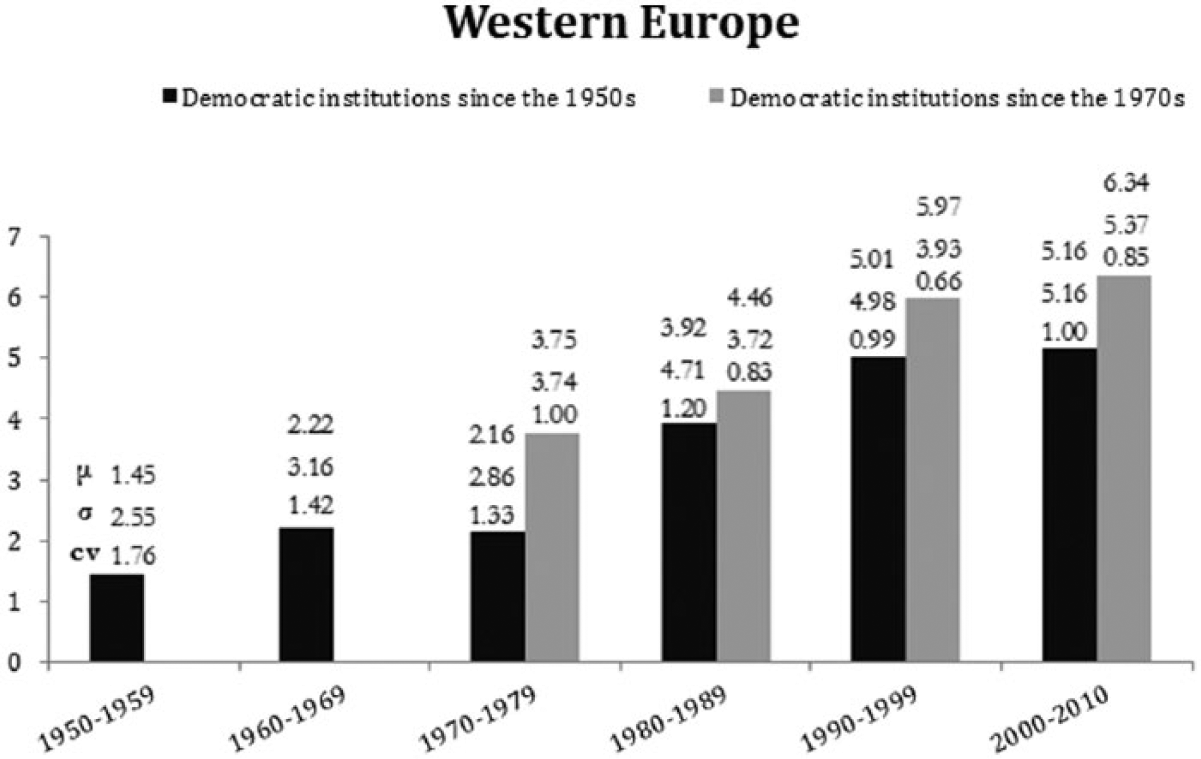
Average saliency of NPM reforms in party manifestos of Western European countries (μ = Mean, σ = Standard Deviation, cv = coefficient of variation).
In Western European countries having democratic institutions since the 1950s, the average saliency of NPM has almost quadrupled over the period under examination. Indeed, in the first decade (1950–1959) it represented only 1.45% of party manifestos, while in the last decade (2000–2010) it reached 5.16%. Saliency of NPM also sharply increased from the 1970s to the 1980s (Figure 1). Indeed, the highest growth rate (83%) was experienced from the third (1970–1979) to the fourth decade (1980–1989). During the last two decades, it grew less dramatically, however: 28% from the fourth (1980–1989) to the fifth decade (1990–1999) and 3% from the fifth to the sixth decade (2000–2010).
When looking at Greece, Portugal and Spain, it can be noticed that, right after the adoption of democratic institutions, the average saliency of NPM reforms (3.75%) was two times higher than that of other Western European countries (2.16%) observed in the same decade (1970–1980). This has then accelerated between 1980 and 1990. Indeed, it rapidly increased (34%) from the fourth (1980–1989) to the fifth decade (1990–1999) and subsequently grew slowly (6%) from the fifth to the sixth decade (2000–2010).
Moreover, variation coefficients decrease over time in both groups of countries. This means that between 1950 and 2010, differences among party manifestos have reduced and national parties have consistently paid increasing attention to NPM in their political agendas.
These findings support H1 according to which Western European countries have, since the 1950s, witnessed an increasing importance of NPM reforms in party manifestos, which has become even more important after the 1980s. Three periods can more specifically be observed. Period 1 (1950–1969), which we term incubation, was characterized by the emergence of party rhetorical support for NPM reforms. Period 2 (1970–1999), which we term growth, was characterized by parties’ fast-growing rhetorical support. Period 3 (2000–2010), which we term maturity, was characterized by a stable rhetorical support of national parties for NPM.
H2 suggests that the importance of NPM reforms in party manifestos was higher in Northern European countries than in other Western European countries, especially when compared with the Southern European region. Figure 2 shows the over-time evolution of the average saliency of these reforms in Scandinavian and Anglo-Saxon party manifestos. The declared support of Scandinavian parties has varied over time within a range that has an upper and lower margin of 2.06% and 0.59%, respectively. As such, in these countries, national parties have consistently devoted little attention to managerialism. On the other hand, the graph shows that the importance of NPM has continuously increased in Anglo-Saxon party manifestos during the period under observation. Moreover, when comparing these party manifestos with those issued from Scandinavian countries, one can easily notice that the former (Great Britain: 2.8% and Ireland: 4.3%) has on average devoted more attention to NPM than the latter (Sweden: 0.8%, Finland: 1% and Denmark: 1.7%).
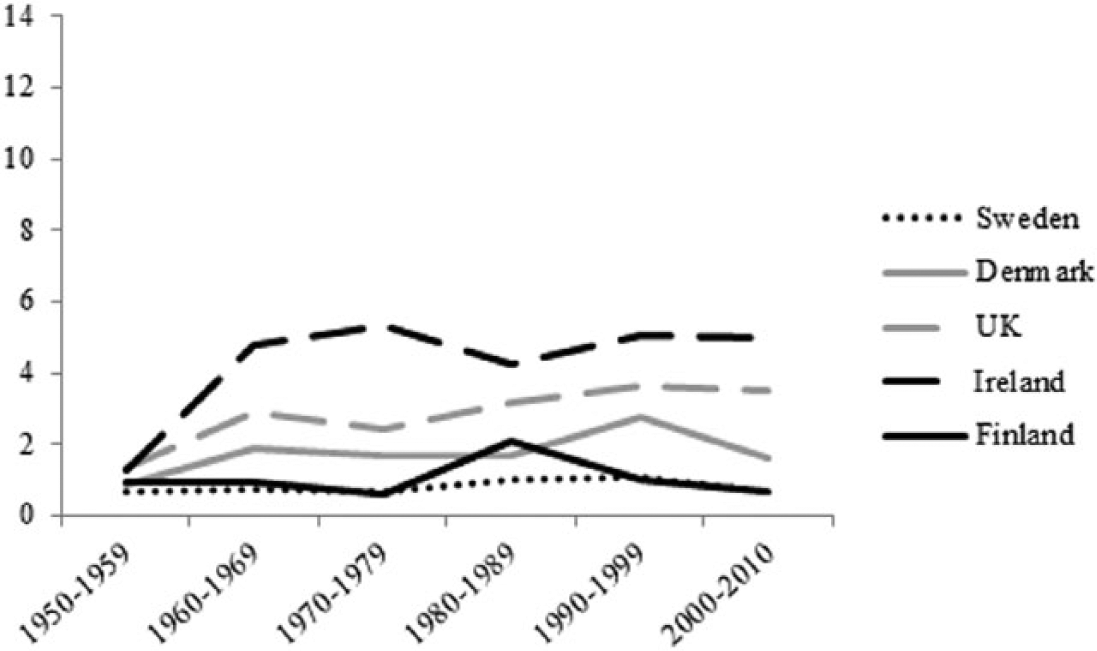
Average saliency of NPM reforms in Anglo-Saxon and Scandinavian countries (1950–2010).
Figure 3(a) and (b) shows that the average saliency of NPM reforms has increased over time in the party manifestos of other Western European countries under examination. With the exception of France (whose trend until the 1990s resembles that of Scandinavian countries), the importance devoted to this topic has seen – at different moments in time – very rapid accelerations in other Western European countries. Moreover, two different patterns can be observed in trend values. On one hand, one group of countries (Italy, France, Portugal, and Germany) experiences a positive trend since the 1980s (see Figure 3a). On the other hand, a second group (see Figure 3b) reveals a trend reversal in the 1980s for some countries (Austria and the Netherlands) and in the 1990s for others (Belgium, Luxembourg, Spain, and Greece).
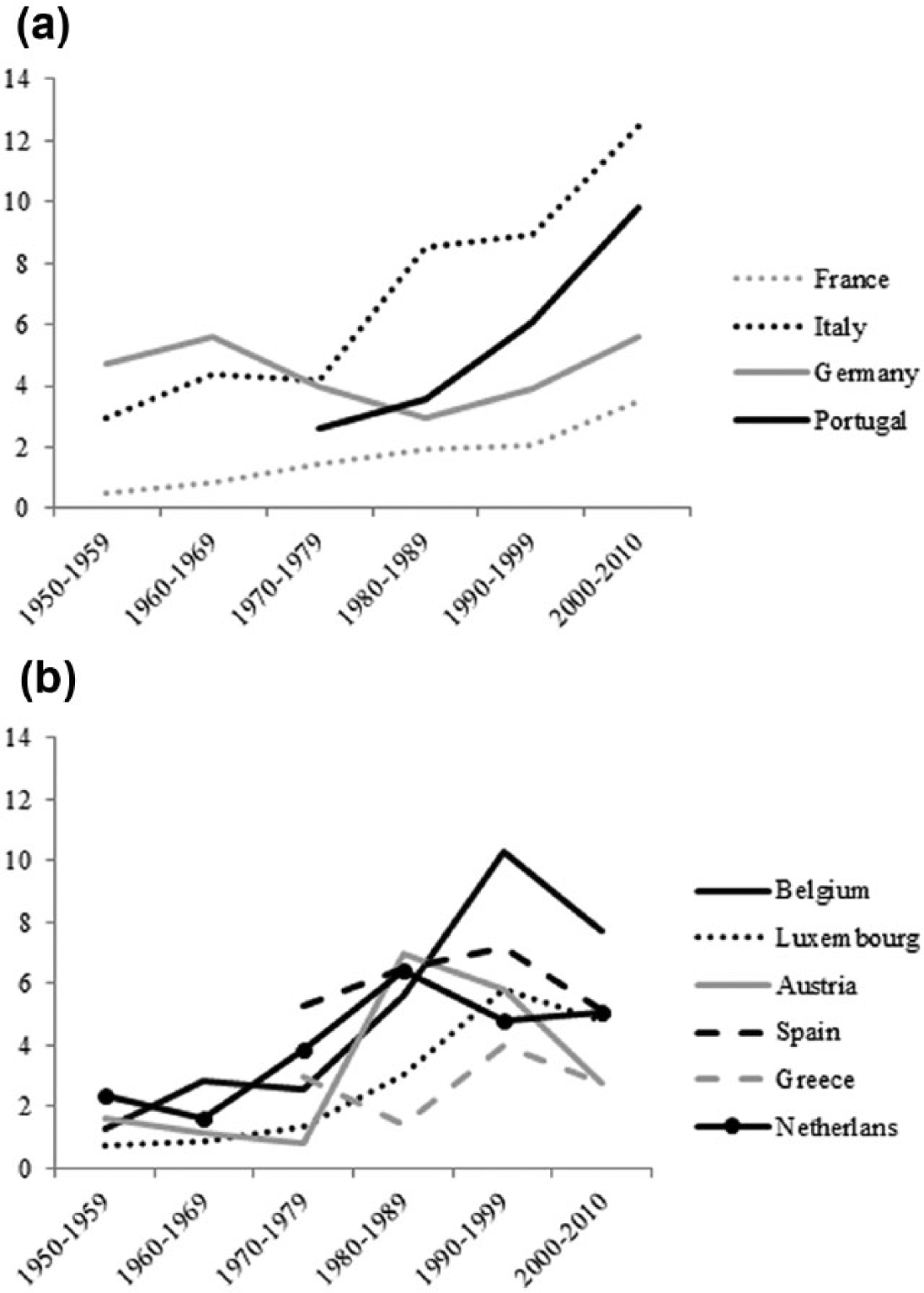
Average saliency of NPM reforms in other Western European countries (1950–2010).
Data clearly show that the average saliency of NPM (5.1%) in party manifestos released in Southern Europe (Italy, Spain, Portugal, and Greece) is higher than the one corresponding to Northern Europe – Anglo-Saxon (3%) and Scandinavian countries (1.6%). These findings therefore do not support H2.
According to H3, since the 1970s the importance of NPM reforms was significantly higher in right-wing than in left-wing party manifestos. Table 2 reports: (1) the difference between the average saliency of these reforms in left-wing and right-wing party manifestos (sxdxgap values) for each country and decade under investigation; and (2) the results of an ANOVA that compares the mean of NPM saliency in left-wing party manifestos with the one calculated for right-wing manifestos. The asterisks in the table highlight those countries/decades for which a statistically significant difference between the mean of NPM saliency in left- and right-wing party manifestos is observed. 1 The analysis reveals that this difference between left- and right-wing party manifestos is statistically significant for most of the countries/decades under scrutiny. More specifically, a higher engagement of right-wing parties than left-wing parties is found, especially from the 1980s. From 1970 to 1990, 13 observations out of 30 (43%) highlight a statistical significant predominance of NPM reforms in right-wing party manifestos. From 1990 to 2010, 16 observations out of 30 (53%) show a statistically significant difference between left- and right-wing party manifestos. Except for Spain, all observations reveal a higher engagement of right-wing parties than left-wing parties. These findings mostly support H3.
sxdxgap values calculated per country and per decade (Western Europe).
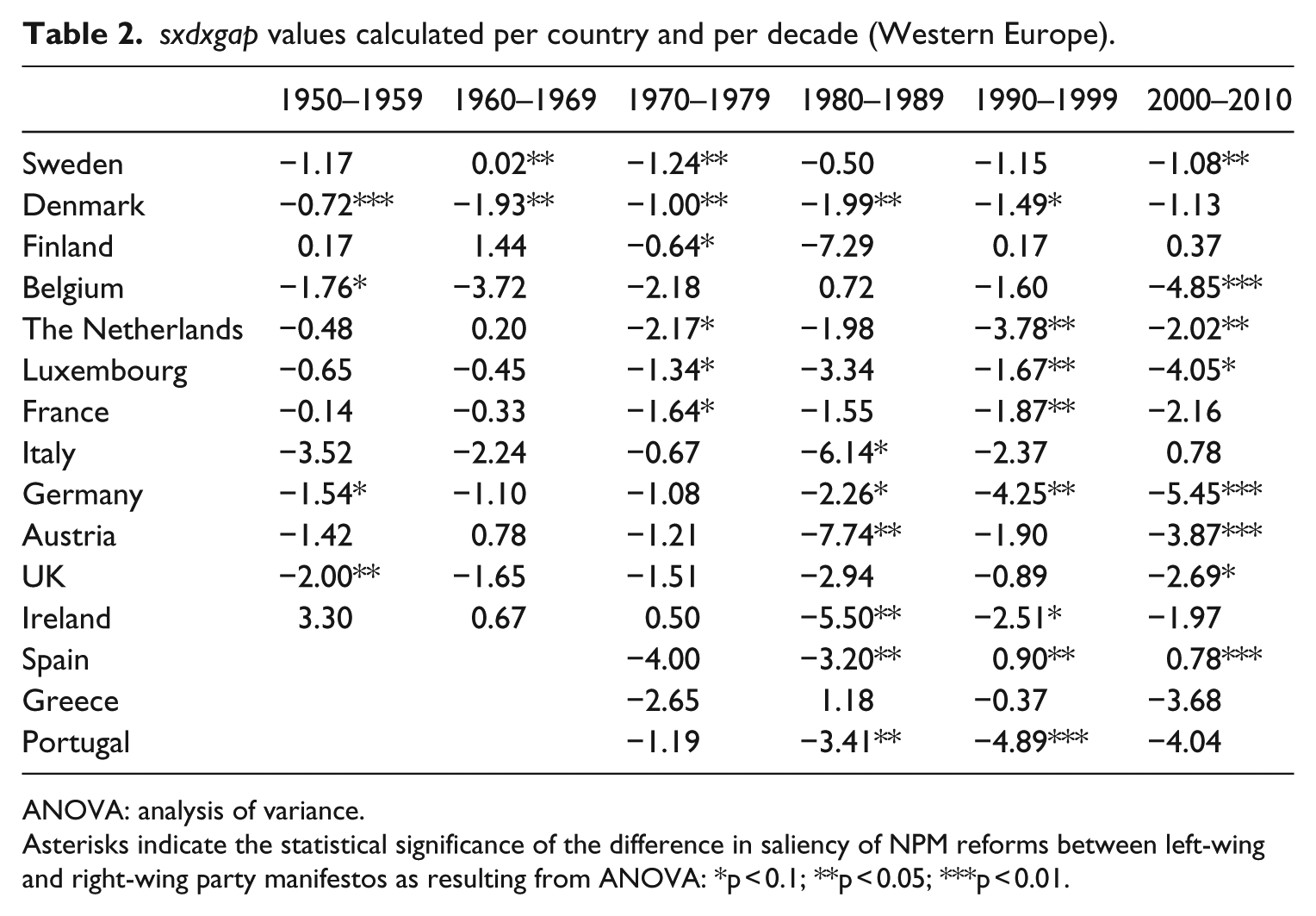
ANOVA: analysis of variance.
Asterisks indicate the statistical significance of the difference in saliency of NPM reforms between left-wing and right-wing party manifestos as resulting from ANOVA: *p < 0.1; **p < 0.05; ***p < 0.01.
Eastern Europe
In the wake of the adoption of democratic institutions in early 1990s, NPM reforms have rapidly spread across Eastern European party manifestos. In fact, the average saliency of this topic has tripled between the 1990s and the 2010s: from 1.70% in the decade 1990–1999 to 4.93% in 2000–2010 (Table 3). Moreover, variation coefficients decrease. This means that from 1990 to 2010 differences between party manifestos reduced and national parties consistently paid increasing attention to NPM reforms in their political agendas.
Saliency of NPM reforms in party manifestos in Eastern European countries.

μ = mean; σ = standard deviation; cv = coefficient of variation.
These findings support H4 as they show that since the 1990s the importance of NPM reforms in party manifestos of Eastern European countries rapidly grew. However, as shown in Figure 4, differences exist among countries. There is one country (Latvia) where party manifestos experienced no relevant increase during the 2000s as the growth rate of the saliency of this topic was equal to −0.002%. Conversely, in a second group of countries – Bulgaria (3.1%) Romania (3.4%), Poland (4%), and Slovenia (5.2%) – the importance of NPM in party manifestos experienced a very positive growth compared to the rest of the countries (where the growth rate was on average 1.3%).
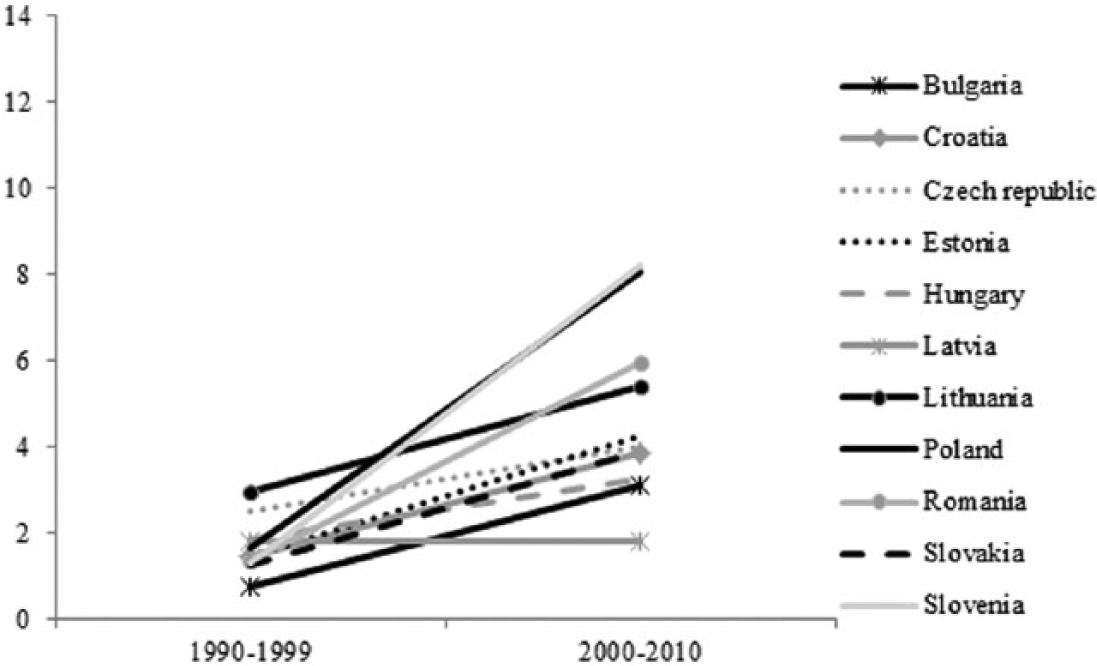
Average saliency of NPM reforms in party manifestos of Eastern European countries (1990–2010).
H5 suggests that in Eastern European countries there are no significant differences between right-wing and left-wing party manifestos in terms of importance devoted to NPM reforms. Table 4 reports sxdxgap values.
sxdxgap values calculated per country and per decade (Eastern Europe).

ANOVA: analysis of variance.
Asterisks indicate the statistical significance of the difference in saliency of NPM reforms between left-wing and right-wing party manifestos as resulting from an ANOVA analysis: *p < 0.1; **p < 0.05; ***p < 0.01.
According to the ANOVA outcomes (Table 4), during the 1990s only Poland shows a statistical significant predominance of right-wing party manifestos in support of NPM initiatives. During the 2000s, 2 countries (Czech Republic, Hungary, and Romania) out of 11 show a statistically significant difference between left-wing and right-wing party manifestos in terms of saliency of NPM reforms. Hungary and Czech Republic are characterized by a higher engagement of right-wing parties than left-wing parties in support of these reforms, whereas left-wing forces prevail in Romania. These findings support H5.
Discussion
The empirical study conducted in the previous sections provides useful empirical evidence to explain the evolution of the importance of NPM reforms across national parties’ manifestos in Europe during the past 50 years. These findings reveal two different stories in Western versus Eastern European countries.
Western Europe
As shown in our findings, from the 1950s onwards managerialist ideas have spread in the political agendas of European parties by following a stage model of incubation (1950–1969), growth (1970–1999), and maturity (2000–2010). During the 1950s and the 1960s, the theoretical contributions of new institutional economics and public choice theory organized these ideas into a homogeneous system of beliefs centred on two key concepts: market and management. Transaction costs theory (Williamson, 1985) played a key role by seeing social institutions ‘as being shaped by efficiency considerations more than as a result of social or political action’ (Ferlie et al., 1996: 70). These ideas had no appeal for political parties’ agendas until the 1970s when Keynes’ economic theory came to be considered outdated as it could not explain stagflation, a combination of inflation and long-term unemployment (De Vries, 2010). This critical economic situation was the starting point to a rethinking of state-led development. Drawing on Hayek’s and Mises’ economic philosophy – ancestors of the Austrian school of thought – ‘a rage of influential new right thinkers’ (Dunleavy, 1986: 15) increasingly advocated the primacy of market institutions over state administrations in the economy of the public sector. They called for the rolling back of bureaucratic coordination in the provision of public services and supported managerial reforms. Ferlie et al. (1996: 6) refer that ‘as the balance of power shifted during the 1980s so a new political economy of the public sector emerged’. The findings of this study confirm that right-wing parties were the main promoters of this new vision of the public sector as the importance of NPM reforms was significantly higher in their manifestos than in left-wing party manifestos.
During the 1990s, with the EU’s Maastricht Treaty functioning as an external pressure for budget restrictions (Pollitt et al., 2007), these reforms were increasingly present in the political programmes of European parties. Subsequently, as shown by our findings, at the end of the 1990s their appeal decreased. This is consistent with the idea that the peak of NPM reforms is in the past and that it is indeed in decline since the late 1990s. This decline is due to the rise of a new logic in public-sector reasoning which takes complexity as its theoretical background (Cilliers, 1998). In fact, criticisms have been directed towards mangerialism because of (1) its inappropriate likening of the public sector to the private sector (DeLeon and Denhardt, 2000; Hefetz and Warner, 2004; McCabe and Vinzant, 1999; Rocha and De Araujo, 2007) and (2) the fact that NPM reforms have led to not only positive outcomes such as gains in effectiveness and efficiency but also to negative outcomes such as losses of equity, citizenship, and accountability (Boyne, 1998; Kettl, 1993; Morgan and England, 1988; Romzek, 2000).
Perhaps the most interesting findings derive from the empirical test of H2 showing that the importance of NPM reforms in party manifestos was higher in Southern Europe compared to Northern Europe, in Scandinavian countries particularly. This is in contrast with the literature on the actual process of reforms according to which managerial concepts and techniques are arguably used more frequently in Northern Europe compared to other European regions (Hansen, 2011). Christensen and Lægreid (2013) help interpreting these outcomes by suggesting that NPM reform rhetoric and actual practice are not always aligned and might be characterized by a controversial relationship. Our findings suggest two relevant situations of misalignment, respectively, in Southern Europe and Scandinavian countries.
In Southern European countries, notwithstanding the high political support declared by national parties in their manifestos, NPM ideas have struggled to find their way in the actual organization of the public sector. In this context, reformers might have followed a decoupling strategy – as emphasized in myth theory (Meyer and Rowan, 1977) or double-talk theory (Brunsson, 1989) – and have composed their electoral manifestos in order to present themselves in a better light without really intending to implement their promises if elected to government. This could be, for example, the case of Italy which is the Southern European country with the highest saliency of NPM ideas in national parties’ manifestos. Even if these ideas feature high in Italian party manifestos since the 1950s, concrete reforms only started in the early 1990s. However, as explained by Ongaro et al. (2013: 10), mixed results were achieved because of a pact of reciprocal self-restraint between top civil servants and politicians: ‘This pact was based on an exchange between job security and political power: public managers renounced an autonomous proactive role in decision-making processes, while political elites refrained from intervening in the management of bureaucratic careers’.
In Scandinavian countries, notwithstanding the weak declared support of national parties, NPM changes were easily implemented. This situation may refer to a pragmatic approach to NPM where specific measures were adopted as specific solutions to technical problems: in other words, reforms were not ideologized but rather were brought about by mechanisms such as ‘rational shopping for reform elements’ (Christensen and Lægreid, 2013). This might be, for example, the case of Sweden which is the Scandinavian country with the lowest saliency of NPM ideas in national party manifestos. Major changes in Sweden have occurred since 1982 when the incumbent Social Democratic government launched a special public administration policy with the purpose of downsizing state bureaucracy and rendering public service delivery more efficient and more responsive to users (Gustafsson, 1987; Pierre, 1993; Premfors, 1991). In this context, reforms were weakly politicized as they were not presented as part of a neoliberal attempt to dismantle the welfare state. Rather, they were supported by left-wing parties as a possibility of offering services of the same quality but at lower cost or better services at the same cost. This is also consistent with Hood (1995) who argues that there is not always a straight right/left split in receptivity to NPM reforms.
The case of Great Britain - a ‘fast-mover’ in the implementation of NPM (Ferlie et al.,1996) - is different given that, according to our findings, since the 1970s parties’ declared support for NPM reforms occurred along with the actual implementation of reform measures. A number of changes had already been introduced in the mid-1970s. According to Andrews et al. (2013: 8), ‘the concerns about the efficiency of the public sector prompted a wide-ranging review of the structure of the local government system that led to a radical reorganization in 1974, when almost a thousand local governments across England and Wales were abolished’. However, the pace of change accelerated with the election of the Conservative government led by Margaret Thatcher in 1979. She launched an administrative revolution aimed at reducing the size of the public sector and opening it to market forces through liberalization and privatization.
Eastern Europe
According to our findings, managerialist reforms have rapidly spread across Eastern European party manifestos after the collapse of Soviet Union. Regardless of their political orientation, national parties have consistently declared increasing support for these reforms. This homogenization of party supply can be explained by two reasons. First, vis-à-vis the uncertainty generated by the transition from socialism to capitalism, political and economic models of the EU’s member states were seen as normatively ‘superior’ and readily transferable to displace ‘inferior’ models in Eastern European countries (Hughes et al., 2005). Second, in the context of EU enlargement policy to the East, a speedy substitution of values by candidates and their compliance with EU norms were equated with the quality of their commitment and ‘Europeanness’ (Hughes et al., 2005). In fact, accession countries from Eastern Europe had to systematically demonstrate their administrative capacity to effectively apply EU regulation in order to obtain their EU membership (Dimitrova, 2002; Meyer-Sahling, 2011). Following Ladrech (2002) and Mair (2000), one can consider managerialism in Eastern Europe as issuing from a Europeanization process given that EU’s accession requirements might have constrained national parties’ positioning on public sector reform and, therefore, may have reduced the scope of proposals that could be offered during election periods.
The only country in this sample which has experienced a reduction in the importance of NPM reforms in national party manifestos is Latvia. Drawing on country-specific literature (Reinholde, 2006), this might have happened because in the mid-1990s the actual implementation of these reforms resulted in numerous scandals related to performance contracts and uncontrolled proliferation of public agencies. In relation to this situation, the national Bureau of Public Administration and the incumbent government decided to invite external experts from the SIGMA programme. Politicians thus withdrew from this field of policy and let external experts reorganize the national public sector.
Conclusion
This article has addressed the relationship between NPM reforms, political ideology, and public expressions of support for these reforms by political parties in Europe. Our analysis is based on a database of texts of party manifestos. We acknowledge that, at least in certain countries, any such commitment may only be loosely coupled with political action and implementation that was undertaken at a later stage. However, there is so much space in a manifesto that various political issues are fighting for attention and for text. If a certain political issue (here public management reform) is given an adequate amount of space in the text of the manifesto, it suggests that this issue won some political priority.
Our research reveals that increased attention was given in the examined texts to public managerial issues in Western Europe in the 1980s (loaded to right-wing parties) and in Eastern Europe in the 1990s (more bi-partisan). It is possible that the first phenomenon was oriented to NPM neoliberal ideas imbued with post-Keynesian economic philosophy, while the second was linked to the decline of socialist ideas and the adoption of EU models. The analysis has revealed a multifaceted process of reform implementation taking place across Western European countries. Furthermore, we have suggested some regional patterns. In the North, NPM reforms might have not been ideologized and have been implemented as mere technical frameworks. In the South, we suggest that national reformers might have followed a decoupling strategy – as emphasized by institutional theorists (Brunsson, 1989; Meyer and Rowan, 1977). A managerialist rhetoric was adopted in order to conform symbolically to external institutional pressures (i.e. European integration, macroeconomic stabilization, liberalization and privatization) without really implementing it if elected to government. More qualitative analysis is needed in the future to investigate these emergent propositions.
What does our analysis have to say more broadly about the saliency of public management reform at the party political level? Public management reform might (in one view) be construed as a technical, rational analytic, or evidence-based domain, disconnected from party political life. Such low-profile reforms to the machinery of government may be difficult to ‘sell’ to electors when compared to more vivid issues such as the economy, security, and immigration. Yet the quantitative analysis of the texts of manifestos suggests that these public management reform issues enjoy a growing political profile over time.
Scholars from a wide range of research domains – political science, management and organization studies – should increasingly think about the politics of public management reform by not only considering it as a technical or managerially dominated activity. Pollitt (2013) suggests that there are ‘narratives’ of public management reforms constructed by ministers and civil servants (among others) who promise citizens better government in the future.
Esposito et al. (2016) delineate a political economy of NPM reform narratives in Europe between 1997 and 2011. They show that right-wing parties operating in national contexts of fiscal stress and ineffective governmental policy actions were the most committed heralds of these narratives. These parties were responding to the demands of a new majority of tax-conscious voters with increasingly high revenues, who urged their governments to decrease public spending and downsize centralized administrations.
Some aspects of the wider political economy of ‘reforming’, together with the variety of actors involved, have been delineated in the context of the UK health care sector by Ferlie et al. (2016). In addition to considering the strategic actions of ministers (e.g. ministers of public administration), there is a need to consider internal party politics and to analyse trajectories of public management reforms together. How are proto-narratives of public management reform constructed and sold to the party before they land at government level? Who are the actors involved in this process? There is much work to do in the future on these questions, but we hope to have made a start here.
Footnotes
Acknowledgements
We would like to thank Silvia Schmidt and Davide Tranzillo who provided insight and expertise that greatly assisted the research. We would also like to show our gratitude to Ateen Patel and Mao Sun from University College London for sharing their pearls of wisdom with us. We thank the anonymous reviewers for comments that greatly improved our original manuscript. All errors that remain are our own.
Funding
The author(s) received no financial support for the research, authorship, and/or publication of this article.