



Abstract
A vigilant subject foregrounds the terrorist event, working immanently to its development and disrupting its realisation. Individuals are tasked with spotting the antecedents of future attacks in the present so as to ward off catastrophe and with being mindful of processes of radicalisation so as to counsel against extremism. A vigilant subject monitors others – as much as himself or herself – according to proscribed conduct, while at the same time he or she co-evolves with uncertainty in order to prevent emergent threats: be they those yet to materialise (signs of an attack) or yet to be even thought of (signs of radicalisation). This vigilant subject is explored through two cases: the British Transport Police campaign to make commuters aware of, and report, terror-related activity and the Prevent duty that asks university staff to limit students being drawn into terrorism.
This article explores how individuals are invited to prevent acts of terrorism. It does so through two cases: the ‘See it. Say it. Sorted.’ campaign run by the British Transport Police (BTP) and the Prevent duty applied to universities throughout England and Wales. The first is diffuse in targeting commuters on rail networks throughout the United Kingdom. The second is more targeted and explored in relation to higher education institutions. Together, these cases reveal a multi-focal approach to how individuals are to combat terror as it emerges. If the first asks passengers to be mindful of potential attacks, then the second calls on university staff to prevent individuals being drawn into terrorism. Although both ask individuals to be weary of the signs of terrorism, they do so in different ways. ‘See it. Say it. Sorted.’ speaks of tangible threats, while Prevent duty focuses on opaque processes of radicalisation. Both operate amid a degree of uncertainty; however, the BTP campaign looks for certain cues – abandoned bags – while Prevent duty centres on an emergent threat – the shift from vulnerability to radicalisation. The former solicits individuals to be attentive to attacks that have not yet taken place, and the latter mandates action on threats in the process of materialising. These two processes are charted in terms of vigilant subjecthood: working amid the immanence of terror to stop attacks from unfolding.
Vigilance overcomes complexity ontologically rather than epistemologically. The uncertainty of terrorism is not overcome, but necessitates constant readiness in identifying problematic activity. The restrictions of knowledge are circumvented by subjects implementing strategies to minimise exposure to harm while maximising attentiveness to others and their surrounds (O’Malley, 2000: 465). These strategies are explored through technologies of vigilance, technologies that collapse self-government into political government. Advertising campaigns and training modules are vehicles for such technologies by operating on the basis of uncertainty and converting it into a ‘modality of governance’ (O’Malley, 2000: 461). To give the future a governable form is to make it actionable in the present. This is done via non-linear imaginaries in which future terrorist threats are immanent to the present. Immanence is not only ‘home-grown’ terrorists emerging from the population but also future attacks with their antecedents in processes apparent today, thereby compelling action over not yet materialised threats. Vigilant subjects work on the basis of this conditioned futurity to emerge as the first line of defence in preventing terrorist attacks. Security governance ‘expects the unexpected’ (Aradau and Van Munster, 2012) to make it governable, works amid ‘unknown unknowns’ (Daase and Kessler, 2007) to condition individual conduct, and productively exploits life’s ‘contingent happenings and effects’ (Dillon, 2015) to imagine such happenings and pre-empt their effects.
Vigilance is explored in three parts. The first outlines technologies of vigilance as the fold between subject and government or, specifically, how individuals govern themselves in relation to monitoring others. Vigilance is positioned amid, yet expands upon, technologies of domination and the self – introduced by Foucault and expanded upon by Deleuze – so as to govern through contingency. The second investigates ‘See it. Say it. Sorted.’ to reveal how it instils vigilance less by educating the public on the objective causes of terrorism than by affectively holding future threats in the present to legitimate the anxieties from which vigilance emerges. The third explores the Prevent duty. If the BTP campaign conditions conduct by securitising the social field from which individuals emerge, then Prevent duty conditions emergence itself. It stipulates how higher education professionals are to be mindful of risks as they move about their workplaces and how to respond to threats that have not only not yet fully formed (signs of radicalisation) but also not yet even emerged (vulnerable individuals).
Vigilance and bio-political security
Vigilance is consistent with bio-political security as one of a plethora of ways in which contingency informs socio-political life (Aradau and Van Munster, 2012; Dillon, 2015; Dillon and Reid, 2009). Within this trajectory, the article speaks from literatures on event preparedness (Anderson and Adey, 2012; De Goede, 2008; Lentzos and Rose, 2009) and critical resilience studies that govern through the catastrophic event (Brassett and Vaughan-Williams, 2015; Chandler, 2014; Coaffee, 2013; Coaffee and Fussey, 2015; Malcolm, 2013). Specifically, the article focuses on the event itself or, better, on how vigilant subjects operate immanently to the event, to not only disrupt how it unfolds but also to rework the processes of emergence amid uncertainty. Indeed, the two exploratory cases reveal different ways of operating in the event: by conditioning emergence (Prevent duty) or conditioning the field of emergence (BTP). Vigilant subjects, like other bio-politicised lives, are made possible through contingency – a contingency that, in turn, is the basis from which one is an entrepreneur of one’s self (Foucault, 2008), from which one is innovative and adaptive (Dillon and Reid, 2009), and from which one governs others (Deleuze, 1988).
So too is vigilance consistent with literatures that recognise how institutions, professions, and individuals are increasingly tasked with preventing catastrophe, rather than state apparatuses (Coaffee, 2013: 248). Vigilance draws on empowerment (Cruikshank, 1994), responsibilisation (Isin, 2002), and participatory and citizen-led security initiatives (Bulley, 2013; Rogers, 2013). Vigilant subjects are informed and responsible members of self-managing communities (Dean, 2010: 196) are activated as security ‘stakeholders’ and are encouraged to monitor themselves, their communities, and others (Jarvis and Lister, 2010: 182). They operate amid an ethos of suspicion, wherein ‘pervasive anxiety’ becomes a ‘valorous act of citizenship’ (Fournier, 2014: 318), where ‘good’ citizens are on the lookout for ‘suspicious’ subjects (Vaughan-Williams, 2008: 64), and in situations where everyone ‘is potentially the police’ (Doty, 2007: 132). Less vigilantes operating outside of the state rationale – Johnston (1996) and Abrahams (1998) – they are subjects central to its continued operation.
Vigilance operates at an emergent level. Commuters are to anticipate the next attack before it happens, and teachers are to spot radicalisation before an attack is conceived. To work within emergence differs from some discourses of resilience that operate after the event to encourage individuals to learn from crisis (Duffield, 2012: 480). Although works on anticipation, pre-emption, and risk have problematised this chronology (Adey and Anderson, 2012; Anderson, 2010; Anderson and Adey, 2011; Aradau and Van Munster, 2007; O’Malley, 2010), vigilance is specifically forward looking in how it informs individual conduct, thereby overlapping with what Coaffee (2013: 242–243) calls a ‘first-wave’ of resilience literature, more proactive than reactive. Yet, vigilance’s future orientation is less overcoming past wrongs than operating presently on the basis of ‘increasingly uncertain and traumatic futures’ (O’Malley, 2010: 488), less emergency planning that rehearses official responses to catastrophe than acting in the event (Anderson, 2015: 61). Like preparedness, vigilance sutures the possibility of future risk onto the present. It does so, however, with the aim of immanently disturbing rather than preparing for the consequences of known attacks. It is less installing bollards in front of parliament to stop cars/car bombs from causing mass casualties, than noticing a suspicious van or taking preventive action during the radicalisation process. Vigilance expands on technologies of preparedness – where the threat is classifiable (car/car bomb) – in that individuals are mindful not only of a full spectrum of possibilities but also of not yet fully determinate potentialities. This is because vigilance operates at an immanent level rather than external to the attack’s emergence. It is entangled with the realisation of the threat so as to disrupt it. By extension, vigilance expands on both preparedness and resilience in monitoring others. To use Vaughan-Williams’ (2008: 64) pithy phrase, a vigilant subject is both object and agent of surveillance. Vigilance is more than a force brought to bear on individuals and more than a force he or she brings to bear on himself or herself; it is also a relation of forces enacted through monitoring others.
Technologies of vigilance
Vigilance operates amid multiplicities of individuals and an unlimited (and often immaterial) space of not yet fully formed threats. As a point of departure, vigilance is positioned between technologies of domination and the self, technologies that Foucault (1988: 19) equates with governmentality. Irreducible to one another, the aim is to chart how technologies of the self interact with those of domination that emphasise monitoring others.
Vigilance works through individuals. Technologies of domination regiment how subjects interact in the world, while those of the self engender a particular disposition towards oneself, others, and the world. The former operate through stratification and strategy. Stratification concerns subjects folding the relation between forces according to established rules, what Deleuze (1988) calls ‘power’. To fold the rule ensures it becomes part of the body, as a ‘snag’ now doubled in how the subject engages with the world (Deleuze, 1988: 98, 104). Moreover, the rule that stratifies these forces concerns already established relations and functions through which subjects are (re)produced (knowledge). Stratification excludes coincidence. It displaces the affective force of power by making it constitute knowledge, by making it actualise, and by redistributing already set relations (Deleuze, 1988: 77). Stratification diagrammatises life, making it unfold on the basis of existing power and knowledge. In contrast, strategy begins by acknowledging the contingency of life. It operates amid uncertainty and necessarily differs from stratification because of the instability of power relations in a non-stratified environment. However, just because power in a non-stratified environment cannot be known in advance does not mean that it escapes the diagram. Strategy captures by (re)configuring relations between forms (knowledge) and by (re)directing the micro in a manner consistent with the macro (power). Think various agencies (the Home Office, Department for Transport), administrative structures (Higher Education Funding Council for England, BTP), and training exercises (Prevent duty) as strategies for realigning life forces, as entertaining an affinity between certain relations or particular points.
Technologies of the self too concern individual conduct. However, individuals are not produced through power/knowledge alone but through relations to an uncertain outside. The fold of being takes a third form (‘self’) wherein the individual folds forces – fixed or otherwise – only insofar as the outside is also folded. The outside becomes a co-extensive inside through the fold of being (Deleuze, 1988: 113–114). Rather than producing subjects on the basis of power/knowledge, technologies of the self recognise a continuous development of form as conduct unfolds in relation to the contingency of life. This is different to strategy, however, because the status of the individual is no longer deciphered in relation to presupposed standards but develops through spatio-temporal modulation that occurs as he or she moves about the world. To fold the outside, however, is not to escape institutional power. The relation to oneself remains in terms of fixed power relations and relations of knowledge as the individual continues to be reintegrated into stratico-strategic systems (Deleuze, 1988: 102–103). However, in contrast to regulation and its attention to transactional properties and capabilities of individuals, technologies of the self condition how the individual emerges amid uncertainty. To repeat, complexity is overcome ontologically rather than epistemologically, as uncertainty is not captured by set relations between forms and forces but through individual conduct (Chandler, 2014: 56).
If this is the ontology of all bio-political subjects, a vigilant individual expands this setting. Begin by shifting the relation between government and self from an analytic prescriptive one to a more normative-dispositional relation. This shift is not equivalent to moves from fact to value, law to norm – moves that do not dismiss the former but relocate it on bodies distributed by curves of normality. Rather, normative–dispositional relations extend relocation. Normativity is no longer plotted against the interplay of actual (albeit differential) normalities, but one that is projected to inform the emergence of life. Extending the confines that Foucault (2007) spoke of in Security, Territory, Population, the individual operates within a milieu that is less mathematically abstracted (predictive calculations), less instrumentalised (probabilistically secured) than it is anticipated by security officials. This anticipated field is the possibility of future terrorist attacks and the dangers of presently doing nothing. It is a milieu not normalised, but asserting ‘its own normality’, a normality ‘of crisis: the anywhere, anytime potential for the emergence of the abnormal’ (Massumi, 2015: 22). This is an immaterial milieu as the surface on which inhabitants respond less to modified variables (Foucault, 2008: 270) than to poly-risk environments in which anything is possible (O’Malley, 2010: 505).
If this immaterial milieu normatively exudes, then how individuals move around and monitor others concerns their disposition. Norms anticipating individual conduct are nothing new to bio-politics. The above-mentioned shift from jurisprudence to normation corresponds with such anticipation. Although norms remain different from the law in their effect – more productive than repressive – they nonetheless reiterate how the law relates to its object, which, in effect, presupposes individual conduct. Life to come is tethered to normative schema, bound to governing rationalities. In contrast, the relation between norm and disposition explored below is less concerned with confirming a model than with establishing tendencies among emergent subjects. Yet, the production of vigilance continues to concern how the subject emerges amid contingency. But, and this is the slight shift, it is (1) to inform how the individual unfolds alongside an encounter with risk rather than presupposing such conduct, and (2) it does so on the basis of what has not yet happened: a future attack. A vigilant disposition unfolds on an emergent terrain governed by two seemingly opposing positions: one that populates this terrain with a (stratifying) risk-laden futurity and another that is the event itself as a field of (non-stratified) forces. Reduced to security governance, it is to appreciate how futurity conditions this field of emergence and how the individual emerges in relation to contingency. These two processes are explored through the BTP campaign and the Prevent duty, respectively.
Vigilance in action: (1) ‘See it. Say it. Sorted.’
The ‘See it. Say it. Sorted.’ campaign was launched on 1 November 2016. Designed by government, police, and the rail industry, it ‘help[s] build a more vigilant network on railways across the country and raise awareness of the vital role the public can play in keeping themselves and others safe’. Furthering this message of attentiveness, Rail Minister Paul Maynard introduced it as ‘want[ing] to send a clear message to anyone threatening the security of the rail network that there are thousands of pairs of eyes and ears ready to report any potential threat’ (BTP, 2016). The campaign consists of posters located throughout rail networks depicting different scenarios in which commuters witness something potentially dangerous. Although the scenarios differ, each features a common headline (‘See it. Say it. Sorted.’) and by-line (‘Speak to staff. For Police text …. We’ll sort it’). The analysis below focuses on two posters, one of which was later removed due to its likeness to Nazi propaganda used for the 1937 Eternal Jew exhibition.
Each poster narrates danger to spur individual conduct. The now-banned poster features a dark-skinned, bearded person wearing a coat in front of a light-skinned female onlooker, asking, ‘are they wearing a big coat to hide something’ (Figure 1). The other shows an unattended bag and a male passer-by with the copy line, ‘have they left a bag unattended’ (Figure 2). Possible future events (bomb/suicide bomber) and persons (‘they’/we the vigilant) place commuters in the position of the represented onlooker facing potential danger. And potential is key. That the coat hides a suicide bomber or that the bag contains a real bomb is not clear, neither is it important. Important is the inferred catastrophic potential. The real or unsubstantiated basis of the threat is secondary to the need to act on possible threats. The campaign is less concerned with preparing the audience for actual threats than with instilling caution about their potential. More than encouraging specific behaviour wherein if I see someone wearing a coat I know what to do, it makes commuters anxious of their surrounds. The man in a coat and an abandoned bag are affectively imbued representations that aim to move and mobilise, rather than educate (Anderson, 2010: 784–785) – a position that helps explain the backlash against the first poster. A gap consequently opens between what is actually depicted and their effects – a gap in which countless other possibilities proliferate that are limited only by individual imagination. More than bags and coats, it is now a glance, accent, telephone, headdress to which I am attentive.
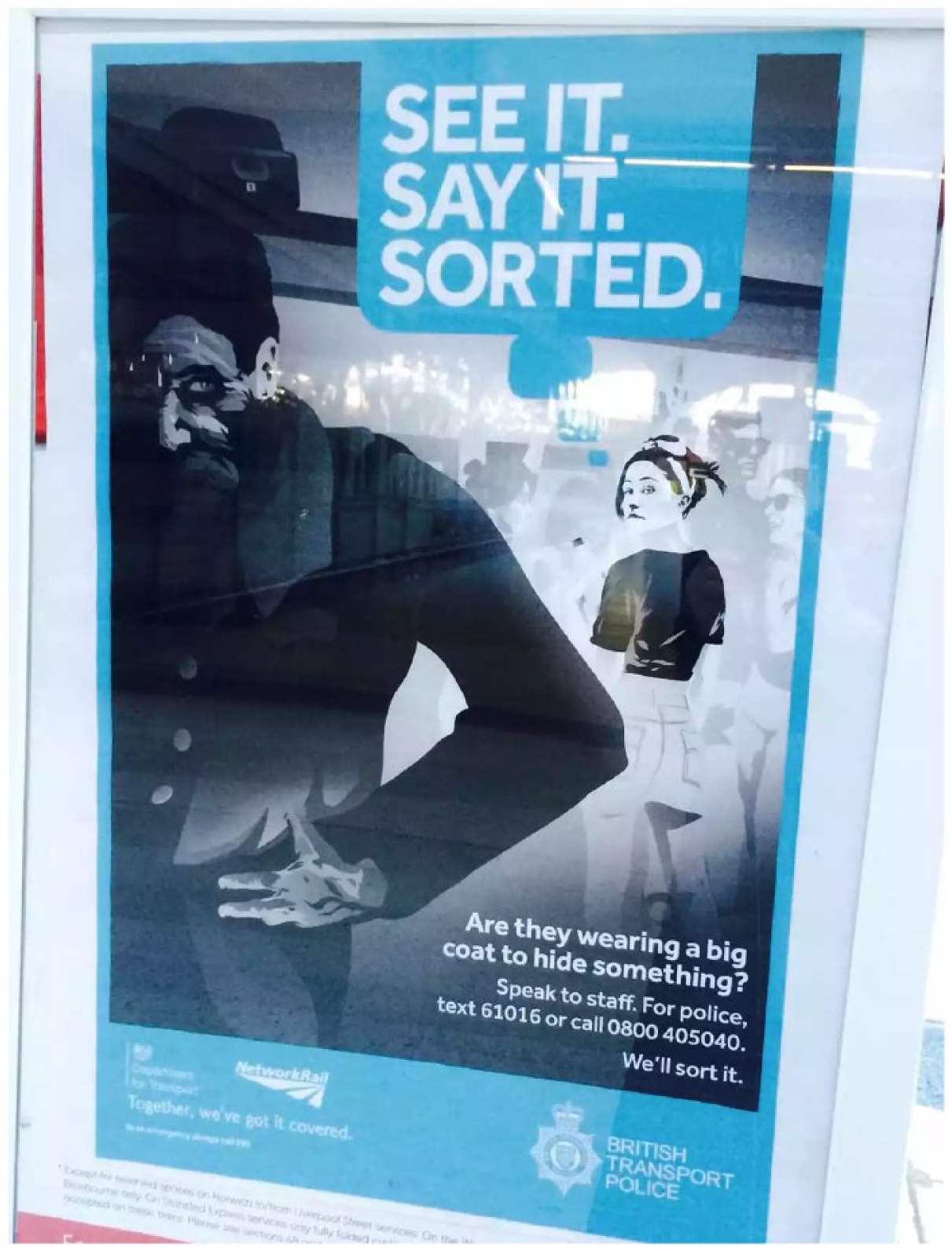

‘See it. Say it. Sorted.’ campaign poster British Transportation Police (2016).
Vigilance is grounded in potentiality. An absent cause – does the abandoned bag have a bomb – is covered over by catastrophic potential. This is both convenient and practical. Convenient in that uncertainty takes actual effect in the present – a vigilant individual – and practical as this effect operates amid potentiality to stop the putative threat. The relation between cause and effect is displaced, as catastrophic potential shifts from the effect of an attack to the reason for vigilance. A future, indeterminate threat becomes the basis for action, as vigilance organises itself around potential rather than actual threats. The cause for vigilance goes virtual – attacks of not yet determined potentialities – and is apprehensively felt and reproduced as individuals move around train stations. This is an affective dynamic wherein actual effects (the uncertainty/anxiety that marks attentiveness) collapse into the virtual cause (that person might … ). These effects not only cover over an indeterminate threat but become their own cause as vigilance reproduces potential threats. The campaign should not be read as educating the public on the objective causes of terrorism but in legitimating this process: it is necessary to be vigilant. The productive value of the poster exceeds what is actually depicted to take on a life of its own within the vigilant subject herself: anything becomes a threat. As Massumi (2015: 190) suggests and De Goede and Randalls (2009: 871) demonstrate with their ‘affective subject’, ‘what is not actually real can be felt into being’.
Vigilance doubles the future, first as catastrophic potential in the BTP campaign – coats, bags – and later among subjects projecting futures – accents, telephones. Rather than formulaic renderings of the future via calculation, vigilance works through imaginaries. This is not operating in the reality of the threat, not indexing an epidemic, nor registering its aleatory outbreaks to distribute cases in the whole-of-population. In contrast to bio-political collectivisation, future imaginaries create their own reality: the poly-threat. It is less empirically apprehended threats than those yet to emerge. This is not a clean break with bio-political risk, but its expansion. Bio-political risk supposes that the future is acted upon through interventions in the present (Hacking, 1990). By reducing a particular variable, the future likelihood of outbreak is decreased. However, threat imaginaries differ insofar as the future envisaged is less calculative. It is a projection of future poly-threats that dovetail – hawktail? – back to inform the present. Accordingly, future imaginaries operate on the individual body rather than the species body. And, if a bio-political subject is an emergent individual co-evolving with an uncertain environment, then by contributing to uncertainty the campaign informs the emergent possibility of vigilant subjects. Security governance goes ontological by enacting a durational yielding wherein future uncertainty informs emergence or, better, the conditions in which individuals emerge. It securitises the field of emergence as the full potential of the threat proliferates – its virtuality – perpetually expanding into new forms (from this to that person), perpetually contaminating all in its wake (this, that, other persons, and the relations between them). This is not a lack of determinacy but its excess: a looming uncertainty that is determinately felt yet inexhaustibly moves into its next iteration. The field of emergence is expectant with danger.
Contingency is the occasion of threat and opportunity. This is a productive/destructive relation – in the words of Anderson (2010: 782) – where life is secured in relation to danger and where uncertainty propagates as the basis of government. A vigilant life tensed on the verge of catastrophe is diagrammatised to enable security governance to competently respond. ‘See it. Say it. Sorted.’ projects imaginaries to inform the social field from which individuals emerge to enact ‘thousands of pairs of eyes and ears ready to report’. More than conditions of emergence, however, so too does security governance doctor emergence itself. This is demonstrated in relation to Prevent duty.
Vigilance in action: (2) The Prevent duty
Prevent duty was launched following the 7 July 2005 attacks in London, with education a central component. In October 2008, the Department for Children, Schools and Families published Learning together to be safe: A toolkit to help schools contribute to the prevention of violent extremism. It equipped ‘young people with the knowledge and skills to challenge extremism’ and requested staff to monitor pupils for ‘warning signs’, while calling on schools to ‘form good links with police and other partners to share information’ (UK Government, 2008: 7). Similarly, following a 2011 review wherein Prevent duty became the Prevent Strategy, another publication, Key Issues for Discussion in Schools, asked students: ‘The new Prevent Strategy focuses on ideology as the central challenge of terrorism. Is this the correct focus? Or should more consideration be given to grievances which may be primary causes of terrorism?’ (UK Government, 2012). More recently, the Counter-Terrorism and Security Act 2015 put formerly voluntary elements of Prevent duty onto a statutory footing. This Prevent duty requires universities to have ‘due regard to the need to prevent people from being drawn into terrorism’ (HEFCE, 2015). The role of educator is thus recalibrated: not only as facilitator of learning but also as locater of students within indicators of radicalisation (O’Donnell, 2016: 4).
How does Prevent duty inform vigilance? Rather than exploring Prevent duty through pre-emptive police intervention (Innes et al., 2017; Monaghan and Molnar, 2016), attention turns to how ordinary subjects are encouraged to be vigilant in their everyday, professional lives (Larsson, 2016: 94). This analysis begins with a bio-political subject: an emergent individual co-evolving with uncertainty. This subject continually moves beyond himself or herself through interaction with a complex world. Behaviour is conditioned not through what is forbidden but is modulated according to the tasks performed. Techniques that prioritise validity do not disappear but are complemented by modes of evaluating how individuals unfold amid contingency (Foucault, 1988: 17). As is demonstrated, Prevent duty training invests in contingency by educating participants on the warning signs of radicalisation and guiding their responses. It is through a constant evaluation of this emergent property that Prevent duty informs how individuals cut into events and thereby condition emergence.
In contrast to the diffuse BTP campaign, Prevent duty is explored in relation to higher education professionals. This focus allows an examination into the productive effects of securitising social policies – see Ragazzi (2017) – rather than the targeting of particular at-risk communities, as per the Prevent ‘Pathfinder’ pilot of 2007/2008 (Heath-Kelly, 2017: 300; Kundnani, 2009). At first glance, this focus seemingly clarifies security governance. The Prevent duty distinguishes those empowered to manage risk from targeted populations that require intervention through counselling (Dean, 2010: 195–197). Complicating this picture, however, is that targeted individuals – like vigilant subjects – are emergent, moving from vulnerability to radicalisation. Staff are consequently asked to be mindful of ‘changes in behaviour and outlook’ (Home Office, 2015: para 15). They are tasked with acting on threats that have not yet emerged as determinate, rather than intervening on the basis of empirically apprehended (albeit highly contentious) ones: man in coat (Anderson, 2010: 789–790).
Operating immanently to an attack consists of two opposing tendencies: one dynamic and the other reductive. The first acknowledges how prescription is counterproductive to an emergent attack. The Prevent duty guidance ‘does not prescribe what appropriate decisions’ are made, insisting that ‘this will be up to institutions to determine, having considered all the factors’ (Home Office, 2015: para 5). Only by operating locally – rather than according to external dictates – can threat emergence be appreciated. This is repeated by the monitoring body, the Higher Education Funding Council for England (HEFCE, 2015: para 10): ‘[r]elevant higher education bodies are responsible for assessing Prevent-related risks in their own context’. However, amid this flexibility, HEFCE stresses a common resolve through external evaluation: ‘we will expect to see the rationale behind particular decisions’ (HEFCE, 2015: para.25). Yes, the Prevent duty operates dynamically but only insofar as it results in intelligible movement. Dynamism slowly gives way to rigidity wherein only certain factors amid contingency are actionable, depending on their correspondence with the HEFCE rationale. This reductive tendency is further explored as Prevent duty situates itself amid violent potential in order to actualise threats it can respond to: spotting certain signs or tendencies that allow for intervention. The Training Site is explored in relation to these dynamic-reductive tendencies and how they instil a vigilant disposition among staff.
The Site begins with the origins of Prevent duty. A series of questions then follow to solidify the Prevent duty’s scope and – following Aradau and Van Munster (2012: 5) – distil correct knowledge. Rather than exploring these questions, however, the next section dedicated to terrorism, radicalisation, and extremism is of greater interest. Having defined terrorism and extremism, a scenario follows in which radicalisation is outlined through the iceberg theory. After explaining that only 10% of an iceberg is above water, the Site maintains that Prevent duty operates in the 90%: the process of radicalisation. Participants are invited to examine this process by clicking on the iceberg. Above the water is titled ‘End’, stating, ‘in the worst scenario, the individual completes the passage to becoming “a terrorist”’. Below the water are two additional sections, one entitled ‘Time’ states, ‘[t]he individual becomes increasingly angry, seeking out other like-minded people who have experienced the same injustice. Association with such individuals could expose them to further radicalisation’. And, the other is entitled ‘Beginning’, noting, ‘to begin with the individual seeks justice for their complaint’. Radicalisation is presented in a clear, teleological fashion whereby individuals move from seeking ‘justice for their complaint’ to becoming ‘a terrorist’, by way of associating with ‘like-minded people’. Through the example of the iceberg, the module brings to life a future attack, thus complementing other epistemic objects such as insights, trends, stories, or models that make the future presently intelligible (Adey, 2009; Anderson, 2007). Becoming a future terrorist is connected to recognisable present-day actions through scenario planning that merges analysis with metaphor.
Participants are then asked to ‘spot the signs of radicalisation’. Two cases are forwarded, with a warning that ‘two of the 7/7 bombers were considered model students’. Rather than ‘imagining the unimaginable’, the actual cases of David Copeland and Roshonara Choudhry are superimposed onto indeterminacy to suggest that future attacks could unfold in similar manners (Adey and Anderson, 2012: 108). So too is there an emphasis on experiential learning, an emphasis already recognised in the government’s resilience agenda (Malcolm, 2013). Not only are participants to learn from past failures, but by drawing on cases with links to the university sector, participants recognise features of their own environment that feed back into prevention. The past pushes forwards, now operationalised as part of the threat formation process, guiding imaginaries of what may be. Prevent duty moves in two directions: (1) towards the past, bringing back missed opportunities and their fatal consequences, and (2) projecting these into the future to make the need presently apparent to ‘spot the signs of radicalisation’.
The following pages turn to ‘identifying someone who is vulnerable to being drawn into terrorism’. This drawing-in process ‘is relatively straightforward if there are overt signs like displaying certain emblems or expressing vocal support for known terrorist acts or proponents of terrorism’. It cautions, however, that students are often radicalised outside university and ‘may not exhibit behaviours that cause a concern’. Given this uncertainty, universities must ‘be aware of the risks, ask staff to look out for any signs and take every step to minimise risk’. If the signs of radicalisation previously held in futurity a threat capable of being realised in a concrete form – two of the 7/7 bombers were ‘model students’ – vulnerability invokes indeterminacy to compel action. A potential attack has expanded from an empirical basis – an abandoned bag – to signs of radicalisation that although complex resonate with previous cases – David Copeland – to a process of emergence – ‘someone who is vulnerable’. And, as indeterminacy increases so too does the need for vigilance: someone to ‘be aware of the risks’, to ‘look out for any signs and take every step to minimise risk’. However, these steps become all the more precarious as staff are asked to recognise ‘causes for concern’ that relate to future attacks which not only have not yet occurred (radicalisation) but are not yet even thought of (vulnerability).
The final section asks, ‘What would you do?’ It contains five scenarios in which participants choose the best option when confronted with particular situations. These situations are as diverse as ‘a student has converted to Islam’ to ‘a student has shown their personal tutor violent videos of beheadings in Syria and seems to be obsessed with them’. Three to five options are then given, asking participants ‘what should you do?’ Upon completing the five scenarios, participants are told that all relate ‘to a single individual who was subsequently convicted of preparing terrorist acts’. However, it advises that ‘no connection was made’ between these warning signs and the individual’s violent intent. While the first scenario is at pains to stress that someone converting to Islam is not a threat (there’s nothing wrong with someone converting to any religion), that the section finishes by connecting each scenario to an actual case seems to dilute this message. Participants are left with five signs of a vulnerable person becoming radicalised: converting to Islam, asking a teacher how to make anthrax, monopolising the prayer room, participating in protests against the Iraq war, and watching beheading videos – signs again placed in a teleological order from vulnerable to radical. The vulnerable radicalisation process is materialised, with different events placed into a narrative that participants work through and are mindful of in the future.
The Training Site calibrates contingency to the contours of security governance. The different signs, tendencies, and forms that come into relation with one another during any process of emergence are isolated, scrutinised, and measured against an official appreciation. This is not reducing each element to a single external logic, but a dynamic process of evaluation. The vigilant subject remains within indeterminacy, open to its observable properties and its felt sensations. He or she is the eyes, ears, and flesh of security governance. Rather than a presiding order that governs the event, the Prevent Training imposes a degree of regularity through how the individual engages with the above-mentioned stimuli. Important, however, is not to separate stimuli from this engagement. How the vigilant individual is trained to interact with contingency undoubtedly informs what he or she looks for, creating a feedback loop between being mindful and the stimuli itself. This loop is a vigilant disposition. It colours how the subject moves about the field and cuts into emergence, and it helps explain existing criticism of Prevent duty as creating conditions in which expressions of anger at social injustice are becoming pathologised into indicators of risk (Choudhury, 2016: 9–10). Prevent duty names certain stimuli as signs of radicalisation to exert its own pressure on the encounter so that it conforms less to its own immanent trajectory than to external dictates. A vigilant disposition becomes a performative enactment wherein it operates immanently to the event to continually produce the conditions that make its own existence necessary. It continually sees signs of radicalisation that conceivably are just someone converting to Islam. Vigilance brings the threat vividly into the present and sustains itself by continually bringing forth insecurity from indeterminacy (Massumi, 2015: 115–122).
If training captures micro-political relations to align them around molar categories (power), then the supplementary material provided by universities to their staff involves establishing relations between forms (knowledge). This material comprises Action Plans that staff follow once radicalisation is recognised. For the University of Cambridge, the procedures for raising concerns outline four scenarios depending on the source of the concern – student, member of university staff, member of college staff – and depending on the reporting individual – Senior Tutor, the University Prevent Contact, the College Prevent Lead. While the recommendations are tailored to the person raising the concern and against whom the concern is raised, the advice involves ‘consider[ing] the circumstances’, ‘lias[ing] informally as necessary with the University Prevent Contact’, ‘pass[ing] the case’ to the appropriate agency, ‘tak[ing] advice’, and ‘provid[ing] the individual’s name and facts of action taken (or not taken) to the College Prevent Lead’ (University of Cambridge, 2016a). Given that the importance of the local context to appreciating threat emergence has already been noted, the interest below is the regimented nature of responding. Indeed, any ambiguity in response is clarified by an accompanying flow chart. It begins, ‘[d]o you have concerns that an individual might be at risk of radicalisation or of being drawn into terrorism?’ The action taken is then divided, depending on the immediacy of risk. If immediate, action depends on whether the ‘risk appears terrorism-related’. If so, it is communicated to authorities, again depending on the at-risk individual’s status – student, university staff, college staff, or non-university member (University of Cambridge, 2016b). This material organises the thoughts and actions of staff. It divides the activities of individuals, ensuring common responses despite specific threats. An encounter with radicalisation is responded to formulaically, thereby instrumentalising the vigilant subject. Knowledge now contributes to the state assemblage, as staff are made co-extensive with a grid of intelligibility that renders them, and the indeterminacy of the threat, governable. Prevent duty enshrines a state-centric orientation in which the horizon of discussion and local knowledge and expertise are constrained (Qurashi, 2017: 1). This regimenting of relations is less the diffusion of power to local actors than it is processes of redirecting relations in a manner consistent with official rationales. The infinite ways in which individuals might respond to radicalisation now oscillate within the bounds of set variables – the status and immediacy of the risk, who is denouncing and against whom.
Cumulatively, Prevent duty integrates power relations by constituting various forms of knowledge that are actualised, modified, and redistributed through vigilant conduct (self). Indeterminacy is conditioned and complexity made intelligible ontologically. This is creative modulation alongside the emergent threat. It is the individual operating immanently to emergence to condition what stimuli are actualised amid indeterminacy, to make certain factors actionable, and to ensure that uncertainty progressively and processually aligns with official protocol. The indeterminate potential of the event is met with counter-agitations associated with vigilance. These counter-agitations may be an over-coding in which catastrophic potential becomes the cause for continually seeing signs of terrorism, as vigilance organises itself around potential rather than objectively determinate threats. Or, counter-agitations may result from infra-coding wherein emergence itself is doctored as the encountered stimuli becomes trained cues of extremism, as observed elements become signs of radicalisation and as felt sensation becomes a recognisable anxiety that legitimates vigilance. Vigilance now unfolds across a number of variations, reproducing itself across time and space through specific iterations that are nonetheless tethered to governing rationalities. An objectively indeterminate event now has an emergent quality consistent with security governance as vigilant subjects see, think, and feel insecurity amid indeterminacy (Massumi, 2015: 111–112).
Conclusion
The BTP campaign and Prevent duty shape how individuals act amid indeterminacy by foregrounding the terror event. This action is irreducible to technologies of domination or the self, but involves both. Conduct cannot be stratified alone because the vigilant subject needs to exhibit openness to emergent processes, nor is it reducible to strategy, as the need to operate immanently to indeterminacy cannot be tethered to stratico-strategic thinking but must necessarily exceed itself. Yet, neither can this be reduced to technologies of the self, wherein an individual undulates along a non-stratified environment. How he or she moves, what he or she sees, and on who he or she reports are only intelligible from the confines of state thinking. Vigilance operates on a combination of technologies, a combination demonstrated through the interconnected categories of power, knowledge, and self. Vigilance as power is fixing relations between forces. It is instilling within a vigilant individual a series of responses to stimuli so that he or she knows to be fearful of a felt sensation and knows to look for specific observable properties amid indeterminacy. Vigilance as knowledge is (re)ascribing the relation between forms. It is the hierarchisation of security governance that links individual staff, higher education institutions, risk professionals, and government agencies together. So too is it repeated in relations between vigilant and targeted individuals and between the intelligible lines of communication that connect observer, reporting officer, and receiver of reports. And finally, vigilance as self is an individual in a constant relation of becoming. It is the individual emerging in an environment that is itself conditioned by violent futurity so as to make intelligible a threat yet to come. It is only through a combination of the three that vigilant subjecthood is possible.
A vigilant subject sits alongside those who are resilient and prepared. They are fellow travellers. They are born of contingency and of bio-politicised life wherein indeterminacy becomes their occasion of emergence. They are opportunities for governance, rendering uncertainty governable through their conduct. Where a vigilant individual goes his or her own way is in relation to monitoring others. This attentiveness to others operates immanently to the event, disrupting and redirecting how it unfolds. It is neither a pre-event preparedness that mitigates the consequences of an attack by operating externally to a knowable threat – installing bollards to block terrorists in cars – nor a post-event resilience that concerns withstanding disruptive challenges – learning from past failures or rebounding after catastrophe. Vigilance operates at an emergent level explored above in two ways: by conditioning emergence (Prevent duty) and the field of emergence (BTP). For the former, a vigilant disposition mindful of the signs of radicalisation cuts into the event and thereby alters emergence, while, for the latter, it is threat imaginaries that cast a shadow over the field of emergence. Both operate immanently to disrupt the threat, be it vigilance to the processes of radicalisation or to future attacks that have their antecedents in presently abandoned bags or coated men. Vigilance consequently reproduces itself in how individuals see threats amid indeterminacy, continually envisaging the conditions that make their existence necessary.
Yet, if the efficacy of both cases is making individuals mindful of potential danger, then (1) they do not operate in isolation, and (2) the collective message of vigilance does not necessarily correlate with individual conduct. Take the BTP campaign. First, it operates less in isolation than as one of multiple ways – official or otherwise – in which individuals are mindful of the signs of terror. More than government initiatives (be it resilience training or, internationally, US Homeland Security’s ‘If You See Something, Say Something’), vigilance also operates beyond traditional governmentality to include popular culture (from Homeland Security to the TV series Homeland) (Larsson, 2016). Vigilance is elicited from multiple angles. Second, and by extension, subjects differentially respond to these calls. While the public outcry at the first BTP poster speaks to these differences, affectively inciting commuters does not result in uniformity of conduct. Individuals are taken into vigilance from their unique histories and move through it following their singular trajectories. This ambivalence is no less apparent in a Prevent duty that informs how subjects emerge amid contingency. The volatility of situation not only elicits sensations beyond those envisaged in training, but the divergent learnt tendencies, habits, and dispositions of educators potentially contradict the logic of vigilance. These differences became manifest in 2016 when the National Union of Teachers backed a motion to abolish Prevent duty. Critics cite the stigmatisation of Muslim students, of universities as ‘big brother’, and that Prevent duty may even promote extremism by creating ‘unease and uncertainty around what can be legitimately discussed in public’ (Gayle, 2016). This is combined with anecdotal remarks that staff participating in training fail to see its utility or rush through the modules more as a forced administrative task, than as an issue of national interest.
Vigilance, then, as an emergent order does not so much positively embody contingency than it reveals an intersectionality to security governance. Governing rationales interact not only with the various identities of individuals (as university staff or commuters) but with their different motives, fixations, and proclivities that pull vigilance in unforeseeable directions. In short, vigilance is as productive of conduct as of counter-conduct. While vigilance is consistent with bio-political security in overcoming uncertainty ontologically, the practical consequences of its implementation are far from regimented. In the short term, this calls for greater attention to the contestability of inciting individuals to act amid the indeterminacy of terrorism. And, in the long term, it suggests limits to a bio-political security project that seeks salvation through forms of government that, by necessity, are open to the contingencies of life whose inherent volatility cannot be absolutely tethered to any external rationale.
Footnotes
Acknowledgements
This article was made possible by the support of the Centre of Latin American Studies at the University of Cambridge.
Funding
The author(s) disclosed receipt of the following financial support for the research, authorship, and/or publication of this article: The author received no financial support for the research and authorship; the Centre of Latin American Studies at the University of Cambridge provided logistical support for the research.