



Abstract
In the 2017 Czech parliamentary election, the Czech Pirate Party (Pirates) gained 10.79% of the votes – an unprecedented success, compared to most of the pirate parties across Europe. However, as their electoral gain varies widely across the Czech Republic’s territory, this article analyses all (more than 6000) Czech municipalities in the elections of 2010, 2013, and 2017 to explain this variation. Overall, the success of the Pirates was driven especially by obtaining much more support in larger municipalities with younger populations (although not only those aged 18–24 but also older ones), lower unemployment, higher turnout, and lower support for leftist parties. Thus, from a spatial perspective, the patterns of Pirate voting largely resembled long-term spatial support for Czech rightist parties and we can conclude that the Pirates made considerable inroads to regions which had historically been strongholds of the Civic Democratic Party, as the former main party of the right, but also strongholds of minor right-wing (‘liberal centre’) parties of the 1990s and early 2000s. Success of the Pirates thus was based especially on votes from municipalities located in more developed areas, where the Pirates received many more votes than in structurally disadvantaged regions.
Keywords
Introduction
In the 2017 Czech parliamentary election, the Czech Pirate Party (Pirates) gained 10.79% of the vote – an unprecedented success, compared to most of the European pirate parties. Indeed, although Otjes (2020) speaks about a ‘remarkable’ growth of the pirate parties in contrast to a slower growth of other new party families, in reality, the rise of Czech Pirates, together with a continuing success of the Pirates in Iceland (9.20% in 2017), or a sudden rise of the Pirates in Luxembourg (6.45% in 2018), were rather exceptions that prove the rule in the context of ‘waning existence’ (Fredriksson Almqvist, 2016) of this party family.
It was perhaps precisely due to the limited success of pirate parties that studies of this party family still remain a relatively undeveloped discipline, although there already exist several studies that have attempted to map the electoral base of pirate parties (Baldini and Bolgerini, 2015; Demker, 2014; Erlingsson and Persson, 2011; Haas and Hilmer, 2013; Neumann, 2013; Niedermayer, 2013; Onken and Schneider, 2012; Otjes, 2020; Zulianello, 2018).
The central questions of this article are as follows: First, what were the spatial patterns of support for the Czech Pirates, especially with regard to voting patterns of other Czech parties? Second, how did the Pirates replace individual established or other new parties territorially? And finally, what were the most important explanatory factors for the spatial variation of the Pirates’ political preferences? We use spatial analysis to expand our understanding of the importance and possible transformation of the geographical patterns of Czech voting behaviour, with primary focus on whether the Pirates were able to succeed more in traditionally leftist or, in contrast, rightist regions – or whether their spatial support transcends the left-right model of political competition which had dominated Czech electoral competition since the 1990s.
In this context, this paper contributes to research about spatial explanation of electoral change. Furthermore, aside from expanding knowledge about the specific empirical case of the Czech Republic, this study is an important contribution to the literature on voting for pirate parties generally. It draws upon a considerably higher number of observations than cross-national studies, which means that we can put research questions to more reliable tests.
Party politics and political geography in the Czech Republic
In contrast to many other Central and Eastern European countries, the Czech party system was relatively stable during the first two post-communist decades, with low levels of volatility and failure of most new political parties (Deegan-Krause and Haughton, 2010; Hanley, 2012; Just and Charvát, 2016). After the fall of the communist regime, Czech politics exhibited a relatively smooth emergence of the left-right axis, which gradually took on the traditional socioeconomic form and became the main structural cleavage of Czech party politics at least until the parliamentary election of 2010 (Chytilek and Eibl, 2011; Hloušek and Kopeček, 2008).
Linek and Lyons’s (2013) individual-level analysis, covering two decades of Czech party politics (from 1990 to 2010) showed that party choice in the Czech Republic was largely based on three cleavages (social class, religion, and generational membership) and on the left-right ideological orientation. The considerable stability of allegiances between different social groups and Czech political parties throughout the 1990–2010 time period then contributed to the stabilization of the classic left-right model of political competition (Deegan-Krause and Haughton, 2010).
The right was dominated by the liberal-conservative Civic Democratic Party (ODS) and the left by the Czech Social Democratic Party (ČSSD). The pair of large parties (a maximum of votes for these two parties was 67.07% in 2006) was accompanied by two medium-sized ones: the Communist Party of Bohemia and Moravia (KSČM) and the Christian Democratic Union – Czechoslovak People’s Party (KDU–ČSL), and support for these four (‘traditional’) parties reached 87.73% in 2006. 1 However, the stability of Czech party system was undermined by the triad of electoral earthquakes in 2010, 2013, and 2017 after which the number of parliamentary parties rose to nine, the same number as after the first election to the lower house of the Czech parliament in 1992. More importantly, the patterns of political support shifted away from previously fairly stable allegiances as the former main parties of the left and the right together achieved less than one-fifth of the vote, compared to over two-thirds in 2006.
To return to determinants of electoral behaviour, an analysis of individual data showed that the ODS was predominantly supported by higher-class right-wing voters, compared to the ČSSD, which was more successful among left-wing voters of lower social classes. Furthermore, the KSČM mobilized voters especially among blue-collar workers, pensioners, and older generations and, in the case of the KDU–ČSL, religious identity was the primary factor of party support (Linek and Lyons, 2013).
Similarly, research of electoral geographers (conducted at the aggregate level) found that socioeconomic factors explained the largest part of inter-regional differences in electoral support, and resulted in the stabilization of the geographical distribution of parties’ constituencies over time (Kostelecký et al., 2015). In short, right-wing parties were more successful in regions that were better off economically, while left-wing parties won more support in regions with structural problems in the economy. In other words, while rightist parties (the ODS, or the parties of the liberal centre) were more successful in areas of high development potential (especially the axis connecting capital city of Prague with the regional capitals of western Bohemia, Pilsen, and north-eastern Bohemia, Liberec), left-wing parties (especially the KSČM) were preferred in regions with low development potential (Bernard et al., 2014; Maškarinec, 2017a). Finally, this division also has its spatial dimension, as electoral support for left-wing parties, as well as areas with low turnout, are traditionally concentrated especially in peripheral borderland areas of western and north-western Bohemia (the formerly German-inhabited Sudetenland) and northern Moravia (Kostelecký et al., 2015; Pink and Voda, 2012; Šimon, 2015).
In contrast to the four traditional parties, analysis of voting patterns of new parties which entered the Czech parliament after the 2010 election showed that, with the exception of the Tradition, Responsibility, Prosperity 09 party (TOP09), which succeeded in the 2010 election and whose electorate considerably overlaps with those of traditional rightist parties, spatial support for other new parties was relatively weakly rooted in geography as its constituency was relatively indistinct (in the case of the Public Affairs party (VV), the Dawn of Direct Democracy (Dawn) or the Freedom and Direct Democracy (SPD)), or significantly changed between elections (the ANO2011) (cf. Havlík and Voda, 2016: 129–135; Maškarinec, 2019: 528–534).
At the same time, support for these new parties was only weakly associated with traditional structural factors (especially the socioeconomic cleavage) that had shaped Czech party politics since the beginning of the 1990. According to Havlík and Voda (2018), especially the electoral success of both the VV and the ANO2011 indicated a shift from class voting to non-ideological voting and perception of politics, bringing forward the competency of centrist populist parties to solve the most important issues, together with general dissatisfaction with established parties (cf. Maškarinec and Bláha, 2014: 717–721).
Czech Pirates in the Czech and international contexts
Generally speaking, the pirates’ highly divergent programmatics and electoral appeals make their voter support difficult to pinpoint. Here, many authors (Bartels, 2009; Demker, 2014; Erlingsson and Persson, 2010; Onken and Schneider, 2012; Otjes, 2020) agreed that it is difficult to place pirate parties on the classical left-right ideological spectrum. Furthermore, while Zulianello (2018) argued that pirate parties are ‘an almost ideal-typical manifestation of the niche party phenomenon’ due to their ‘predominant focus on Internet-related issues’, and also other authors mentioned pirates as single-issues parties (Neumann, 2013), or ‘cyber parties’ (Hartleb, 2013), Otjes emphasized that ‘the core positions that pirate parties have on copyright, privacy, and democratic reform can lead them to positions on other issues’. (Otjes, 2020: 42)
With regard to the two most successful pirate parties, some issues must be mentioned. In the case of the Icelandic Pirates (as the only pirate party with long-term success), Harđarson and Önnudóttir (2018) concluded that their success was not due to the common pirate ideology, but especially due to their ability to use a great distrust in political parties and political institutions and very strong anti-establishment feelings connected to Iceland’s financial and government collapse in the years after 2008.
Similarly, in the case of the Czech Pirates, Brunclík mentioned that shortly after its establishment in 2009, the party included in its programme a number of issues beyond Internet-related issues, or the so-called new socio-political cleavage of the information society (Demker, 2014), and it rejected being labelled as a monothematic political party (Brunclík, 2010). More importantly, in the 2017 parliamentary election, the Czech Pirates presented an extensive programme covering a vast array of issues, whereas Internet-related issues were far from predominant.
In this context, Eibl and Dostálová (2019) showed that the Pirates’ central election issues were shared with most Czech parties (traditional and new ones alike) and reflected the main dimensions of the Czech political contest, namely the economy and social welfare; the Pirates only differed in their added emphasis on issues of the political system and its effective functioning. Furthermore, Charvát (2015) talks about their profiling towards a social-liberal ideology (with occasional detours to left-wing libertarianism), Vachudova (2019) mentioned a strongly liberal and cosmopolitan profile of the party, and similarly, Eibl and Dostálová (2019) placed the Pirates in to the centre of the Czech political spectrum.
How to explain electoral support for pirate parties
Although our analysis uses aggregate data, we also present explanations of the Pirates’ electoral support based on individual data, which can be justified specially by the novelty of the topic. Starting with cross-national studies, Zulianello, in an analysis of the 2009 and 2014 European Parliament elections, found that in Western Europe (Sweden, Luxembourg), macro-economic issues, protest voting against established parties, level of trust in the Internet, and a high level of dealignment of young voters were the main triggers of pirate voting in 2014, while in Central Europe (the Czech Republic, Slovenia), the primary factors of pirate voting included importance of macro-economic issues, protest voting against established parties, together with level of trust in the Internet. Generally, the examples of the Czech Republic and Slovenia showed limited influence of factors associated with young age of voters, in contrast to the prevailing effect of protest voting against established parties motivated by poor economic performance and widespread corruption (Zulianello, 2018).
In contrast to Zulianello, Otjes (2020) used not only data from European Parliament elections but also surveys covering elections to national parliaments. This is important as the European Parliament elections exemplify second-order elections, which are characterized by much lower turnout than national elections, resulting in largely different electorates participating in both types of elections. Otjes identified year of birth, high levels of political distrust and dissatisfaction with democracy as the strongest determinants of voting for pirates, while policy preferences were of secondary importance. In contrast to expectations, Otjes found some effect of the left-right dimension and economic policy preferences, with much support for pirates among leftist voters (with the exception of European Parliament elections), while egalitarian economic policy preferences were more context-dependent and, in some cases, decreased support for the pirates. However, other socio-demographic variables were of little importance, or worked in different directions. Especially, there were no consistent effects of education on pirate voting, in contrast to the expected mostly negative effect of religiosity (Otjes, 2020).
Overall, both cross-national analyses found the importance of political distrust in established political parties and institutions and dissatisfaction with the state of democracy as the main triggers of voting for pirate parties, while policy preferences were important almost exclusively in European Parliament elections. On the other hand, the effect of the left-right divide, significant only in national elections, again brings forward the need to distinguish between first- and second-order election arenas with regard to individual decisions to vote for pirates.
Concerning the Czech Republic, there is also a limited analysis of vote for Pirates, with one study using aggregate data for the parliamentary elections of 2010 and 2013 together with the European Parliament elections of 2014 (Maškarinec, 2017b), and another one using individual data for the parliamentary elections of 2017 (Dostálová and Havlík, 2019).
In this context, Maškarinec (2017b) found some contradictory results, partly maybe due to highly divergent patterns of success of the Czech Pirates between elections, together with different types of elections. 2 First, voting for the Pirates rose with growing urbanization and in younger populations, which was in accordance with theoretical expectations. Second, support for the Pirates was higher among entrepreneurs and conversely lower among the unemployed, and although the effects of these variables, too, were very weak, this suggests that in the Czech case, socioeconomic policy preferences could have some importance for the success of the Pirates. Third, inconsistent effects of education were found, which can be explained by unfinished education of many of the pirate voters (Maškarinec, 2017b), or by the second-order character of European Parliament elections, which may be more attractive for the university-educated population (Linek, 2004), which also explains the positive effect of education on voting for the Czech pirates in the European elections of 2014, as opposed to the national elections of 2010 and 2013.
Furthermore, Dostálová and Havlík (2019) confirmed very strong support for the Czech Pirates among voters with primary education and in the youngest age category (18–24 years). At the same time, the Pirates preserved their relatively strong support in older age groups, too, and their electorate consisted primarily of no-income individuals, but also ones with medium-to-higher incomes, and exhibited limited church attendance. Overall, pirate voters did not exhibit any distinct left-right orientation, although on other issues, they tended to lean towards European integration and post-materialist attitudes (Dostálová and Havlík, 2019).
Similarly, time series on political preferences confirm that the Czech Pirates have the most supporters in the age categories of 18–24, or 25–34 years (almost 30%), followed by almost one-fifth of the age group of 35–44. Their support only decreases under 10% among voters aged 55+ years and under 5% among those aged 65+. At the same time, recent pre-election polls demonstrate the strongest pirate support among college graduates and in cities above 100,000 inhabitants (Median, 2019). Finally, Škop (2018), using an ecological inference method, shows that the success of the Pirates in 2017 was primarily based on defections of former TOP09 voters and, to a much lesser extent, on non-voters and former ODS and ANO2011 voters.
Considering the above-mentioned determinants of Czech political competition and findings about support for pirate parties – together with the municipal level of aggregation (see below), which does not allow for testing hypotheses related to issue voting – we have formulated the following set of hypotheses:
Data and methods
We have used several techniques to analyse the success of Pirates. First, our exploration of spatial support begins with the formal detection of spatial autocorrelation using Moran’s I. However, Moran’s I is an overall measure of linear association, whose single value is valid for the entire study area. Since the aim of this study is to identify potentially different patterns of voting behaviour among Czech municipalities and their transformation between elections, a local indicator of spatial association (LISA) was used to obtain more detailed insight into the ways the Pirates’ electoral support was clustered throughout the Czech Republic’s territory (Anselin, 1995). 3
Bearing in mind that our goal is to compare differences in the geographical clustering of the patterns of party replacement between the Pirates and other parties, we will use both univariate LISA indicators, which can show the clustering of support for the party in one election, and bivariate LISA indicators, which allow us to compare the types of party replacement between pairs of elections (Anselin, 2005).
However, the local Moran’s I statistic is useful especially for descriptive analysis, while detection of spatial autocorrelation in a data set has implications for other statistical techniques. Therefore, there is a reason to use methods which are able to counter the effects of spatial structure in the data set as well as the contamination of the error term with spatial autocorrelation. A spatial interaction thus will be integrated in the regression model specifications by means of two spatial econometric strategies, the so-called spatial lag and spatial error models (Anselin, 2005); a spatial error model was selected as spatial diagnostic tests (unreported) indicated its preferability over a spatial lag model.
We analyse data on Czech parliamentary elections from 2006 to 2017 at the level of all more than 6000 Czech municipalities. 4 Our choice of 2006 as the starting point for comparing votes for the Pirates (in the elections of 2010, 2013, 2017) with votes for established parties in 2006 is based on the fact that it was in that year that the electoral competition between the rightist ODS and the left-wing ČSSD exhibited the strongest tendencies to bipolarity (Balík and Hloušek, 2016), and the concentration of voters with these two parties can serve as a good dividing line between the spatial distribution of leftist and rightist voters.
The reason for our choice of this aggregate level (municipalities) is that previous studies proved that the choice of the district or regional level tends to hide profound intra-regional disparities. Use of aggregate data may be also justified by the theoretic anchoring of the article, given that its objective is not to examine individual causes of voter behaviour, but instead to analyse the success of the party at an aggregate level, that is, territorial (inter-municipal) variation of the factors affecting voter support for the Pirates. Furthermore, Kostelecký et al. (2015) emphasized that spatial differences in Czech election results cannot, most likely, be reduced to the effects of individual-level variables only.
However, use of aggregate data also has some disadvantages, primarily the ecological fallacy problem, that is, the risk of making erroneous inferences about unobserved behaviour of individuals in a population based on observed behaviour of the population as a whole (Robinson, 1950). For this reason, we deem it necessary to emphasize that our findings do not pertain to individual people, but the unit of observation is represented by communities of people living in a given territory (municipalities). Furthermore, despite several methodological innovations, the ecological fallacy problem has not been solved successfully yet. Therefore, the alternative option (in addition to interpreting the results consistently at the municipal level) is to compare the associations found in aggregate data with individual-level results (Bernard et al., 2014). This is because individual data, too, is affected by many (often ignored) problems (e.g. sampling error, sampling procedure), especially when it comes to analysing regional differences in political preferences (Kostelecký and Čermák, 2003).
The data sets used for the spatial regression analysis were retrieved from two basic sources: the decennial population census of 2011, and other statistics of the Czech Statistical Office. 5 Our primary indicator of political preferences is the percentage of votes obtained by the Pirates at the level of all municipalities. Independent variables are in line with the above hypotheses: size (log) – the logarithm of the number of inhabitants; education divided into two groups: primary education – proportion of people with primary education; higher education – proportion of people with tertiary education; unemployment – share of the unemployed population; age divided into three age groups: 18–24, 35–44, 65+; Catholicism – share of the Roman Catholics in the population; and leftist parties – share of votes for left-wing parties; turnout – share of voters on registered voters.
Empirical analysis
Spatial clustering of voter support for the Pirates
Previous analysis (Maškarinec, 2017b), at a higher level of aggregation, found some degree of uniformity of voting patterns between the Pirates (in the 2010 and 2013 parliamentary elections) and the ODS, as the formerly strongest right-wing party, but also the Greens. In contrast, spatial distribution of Pirates’ support was negatively associated with support for left-wing parties, the ČSSD and the KSČM.
Our municipality-level data confirmed, and further expanded on, the previous findings (Table 1). The spatial distribution of support for the Pirates indicated some form of spatial dependence not only with the ODS, but also with minor right-wing parties (the so-called ‘liberal centre’ parties). More importantly, we can see that this association became much stronger with rising Pirate support, along with increasing negative association of the spatial clustering of voting for the Pirates and leftist parties.
Bivariate Moran’s I scores for the Pirates, established parties and parties of the ‘liberal centre’.
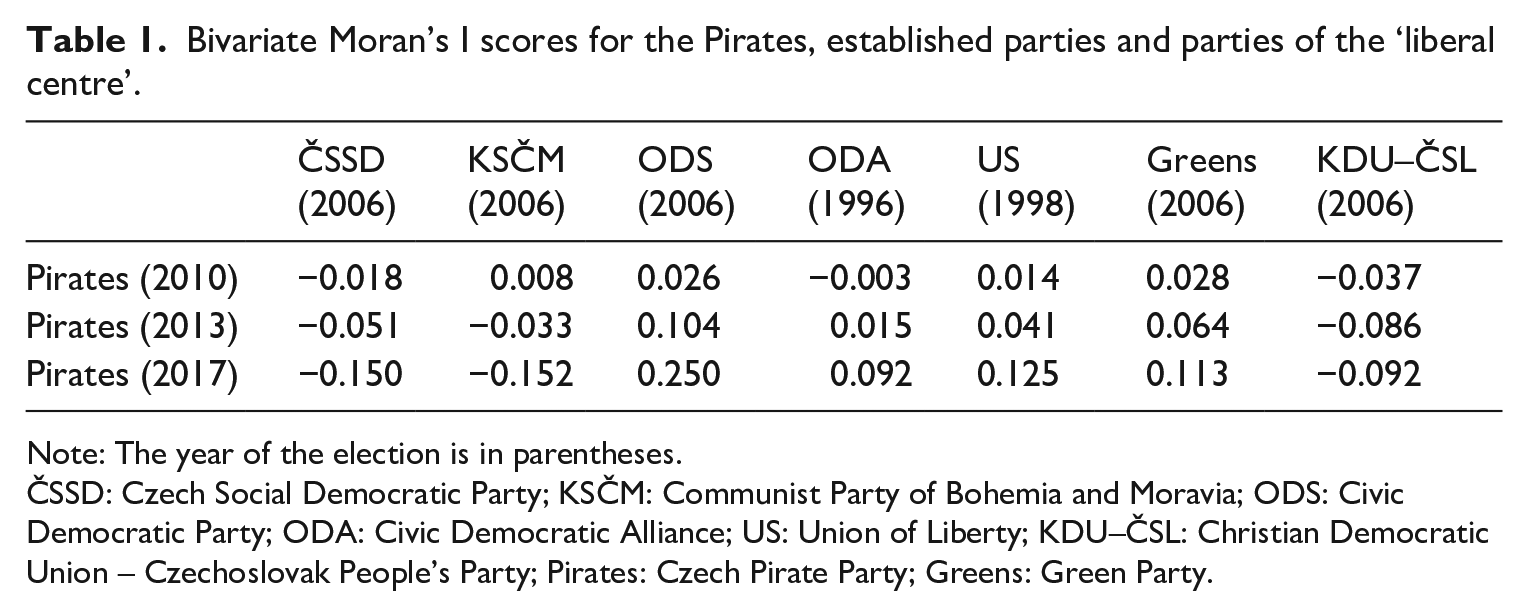
Note: The year of the election is in parentheses.
ČSSD: Czech Social Democratic Party; KSČM: Communist Party of Bohemia and Moravia; ODS: Civic Democratic Party; ODA: Civic Democratic Alliance; US: Union of Liberty; KDU–ČSL: Christian Democratic Union – Czechoslovak People’s Party; Pirates: Czech Pirate Party; Greens: Green Party.
Concerning parties which entered the Czech party system after the 2010 elections (Table 2), there is increasing positive association between the Pirates and the right-wing TOP09, while in the case of political parties classified as ‘centrist populist’ or ‘technocratic populist’ (Havlík, 2019), the VV in 2010 and the ANO2011 in 2013, the positive autocorrelation of clustering existed, at some strength, only between support for these parties and the Pirates in the 2013 elections, whereas the pattern reversed to negative direction when analysing the results of the Pirates and the ANO2011 in 2017. Finally, there was stable negative spatial clustering between voting for the Pirates and populist radical right parties – the Dawn and the SPD.
Bivariate Moran’s I scores for the Pirates and new parties.

Note: The year of the election is in parentheses.
TOP09: Tradition, Responsibility, Prosperity 09 Party; VV: Public Affairs Party; SPD: Freedom and Direct Democracy; Dawn: Dawn of Direct Democracy; ANO2011: Action of Dissatisfied Citizens 2011.
The long-term rise of support for the Pirates has its territorial reflection, too (Figure 1). Whereas there wasn’t any visible pattern of support for the party in the 2010 elections, it was as early as in 2013 that a shift of Pirate support to Bohemia could be observed, and this trend became much stronger after the Pirates entered the parliament in 2017. The main core of support for the party in 2017 was centred in the Prague metropolitan area and contiguous parts of central Bohemia, and from there it stretched to a number of contiguous territorial units in north-eastern Bohemia; this compact area was interrupted only in the central Bohemian microregion of Mladá Boleslav – an important centre of automotive manufacturing and a stronghold of the ANO2011 in 2017. In addition, the party enjoyed some support in parts of eastern and, to a lesser extent, western Bohemia. Furthermore, there was not a single contiguous area of high support for the Pirates in the whole Moravian territory, as even Brno, the country’s second-largest city, offered only average support, as well as other Moravian large cities.
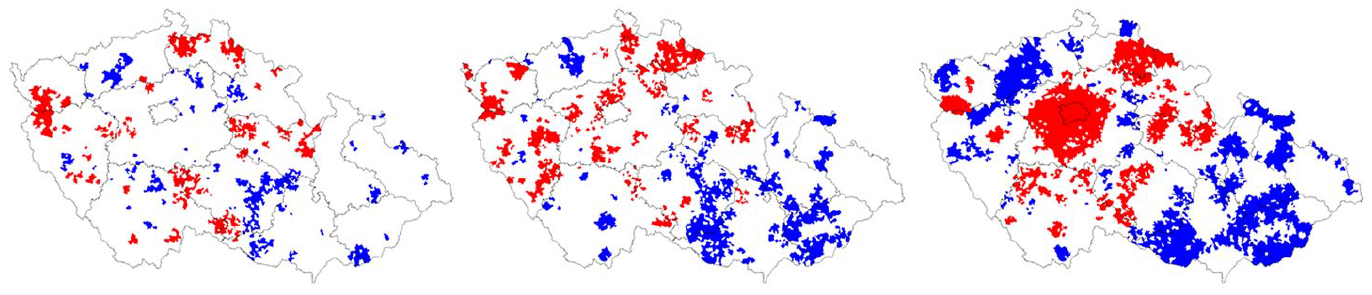
Moran’s I cluster maps of the distribution of support for the Pirates, 2010/2013/2017.
In contrast, the clusters of municipalities with low support for the Pirates were largely concentrated in the north-western Bohemia, but especially in a large part of Moravia. In short, the results of the 2017 elections showed that the Pirates were mostly successful in municipalities belonging to regions that were better off economically, and less successful in regions with structural problems in the economy.
Analysis of global Moran’s I statistics identified that geographical support for the Pirates in 2017 (in contrast to previous elections) was relatively strongly associated with previous local support for the right-wing ODS. Similarly, we found significant overlaps of local spatial clustering with areas where local clusters of high and low support for the ODS were concentrated (Figure 2). Although the territorial patterns of Pirate support were not stable between the elections, these patterns in the parliamentary elections of 2017 were largely identical not only with those of ODS but also with those of minor centre-right parties with short-term parliamentary representation. This suggests, given the long-term high spatial stability of ideological preferences of Czech voters (Kostelecký et al., 2015), that the success of the Pirates in 2017 was largely due to obtaining a large number of votes in territories formerly dominated by the ODS, but also the VV and the TOP09 (see below).
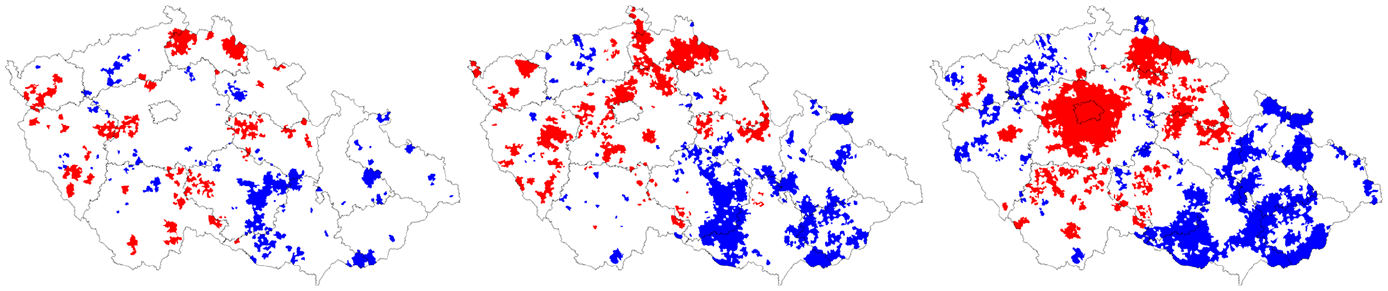
Bivariate Moran’s I cluster maps of the distribution of support for the ODS (2006) with the Pirates (2010/2013/2017).
More precisely, the Pirates’ votes were geographically clustered in former ODS strongholds, specifically the Prague metropolitan area and contiguous areas of central, north-eastern and (to a lesser extent) eastern Bohemia, with significantly high support in major (especially Bohemian) urban centres – Prague, Pilsen, České Budějovice, Liberec, Hradec Králové, Pardubice in Bohemia, or Brno, Olomouc, Opava in Moravia. The Pirates’ successful inroad to the former ODS strongholds can also be compared with the previous elections, in which the Pirates’ spatial clustering was very different.
Overall, the comparison of spatial clustering between the ODS and the Pirates confirmed that the above-mentioned areas, identifying the clusters of municipalities with high electoral success of the Pirates, largely copy the areas where high development potential was identified by previous studies of the spatial patterns of socioeconomic differentiation (Blažek and Netrdová, 2009).
Compared to the rightist ODS, there was no positive spatial clustering among the Pirates and left-wing parties, but also the KDU–ČSL (Appendix 1). On the other hand, also the spatial clustering between electoral support for the Pirates and some of the new parties indicates some form of spatial dependence (Figure 3). Here again, the data confirmed that the Pirates succeed especially in rightist regions, as shown by large clusters of positive autocorrelation between support for the Pirates and the TOP09. In contrast, few municipalities with high levels of support for the VV in 2010 overlap with municipalities of high support for the Pirates in 2017.
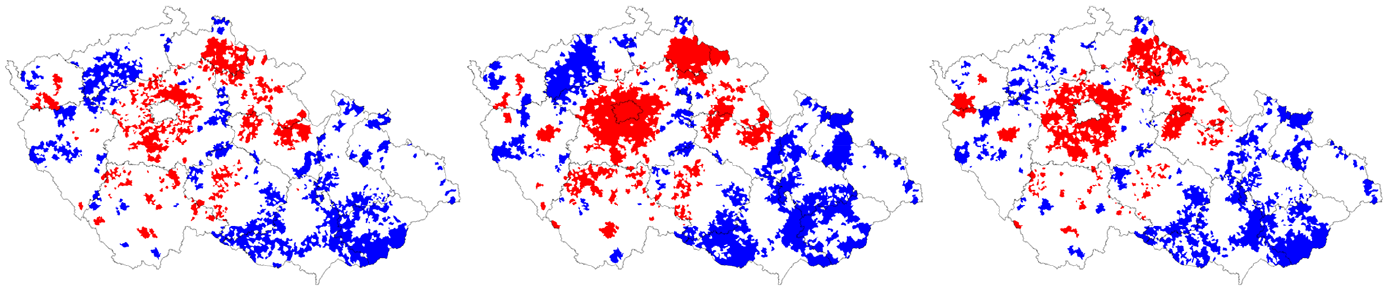
Bivariate Moran’s I cluster maps of the distribution of support for the VV (2010), the TOP09 (2010), and the ANO2011 (2013) with the Pirates (2017).
More importantly, while there were extremely limited links between the electoral geography of the VV and socioeconomic structures, the opposite was true for the TOP09, whose support was concentrated in regions with very similar socioeconomic structures as those voting for the ODS and the ‘liberal centre’ (Maškarinec, 2017a), and this finding is, to a large extent, valid for the Pirates, too. Finally, the level of local spatial clustering between votes for the Pirates in 2017 and the ANO2011 in 2013 ranged between the two previous parties. This was especially due to higher support for the ANO2011 (than the VV) in the Prague metropolitan area, suggesting that the success of the ANO2011 of Andrej Babiš, one of the country’s wealthiest entrepreneurs, in 2013 was largely caused by its stronger support in regions traditionally dominated by right-wing and centre-right parties (see Havlík and Voda, 2016).
Finally, the electoral bases of the Pirates and parties of the populist radical right were almost completely different (Figure 4). This was especially due to low support for the SPD in 2017, as well as the Dawn in 2013, in central, north-eastern and eastern Bohemia (traditionally strong base of rightist parties) and, vice versa, low Pirate support in a large part of Moravia, where the SPD was stronger.

Bivariate Moran’s I cluster maps of the distribution of support for the ANO (2017) and the Dawn (2013) with the Pirates (2017).
Another interesting finding is transformation of spatial clustering between the Pirates and the ANO2011 in the 2017 elections. The main reason was especially considerable change in the geographical patterns of support for the ANO2011 between the elections. In 2013, the ANO2011 made an inroad to north-eastern and eastern Bohemia (only much less so to central or north-western Bohemia), but in 2017, this compact area almost completely disappeared and ANO2011 support moved to north-western Bohemia and the Moravian-Silesian region (i.e. leftist regions), with much more continuity in areas of the lowest support, especially in South Moravia (see Maškarinec, 2019). This change resulted in an almost complete disappearance of the spatial clustering of high as well as low support between the Pirates and the ANO2011 in the elections of 2017.
Determinants of voter support for the Pirates
Table 3 presents results from spatial regression models estimating influences on voting for the Pirates. A basic comparison of the regression models indicates that the models explain different amounts of total variance. Here, especially the regression models for the parliamentary elections of 2010 and 2013 (Models 1 and 2) were not too successful in explaining inter-municipality support for the Pirates. In both models, the effect of most variables was relatively weak and, in many cases, inconsistent in terms of direction. Furthermore, while the results of Models 1 and 2 identified some inconsistencies with regard to theoretical expectations, the rise of Pirates’ support from 0.80% to 10.64% between the elections of 2010 and 2017 resulted in a clearer relationship between Pirate support and theoretical expectations.
Effects on voting for the Pirates, 2010–2017 (spatial error model).
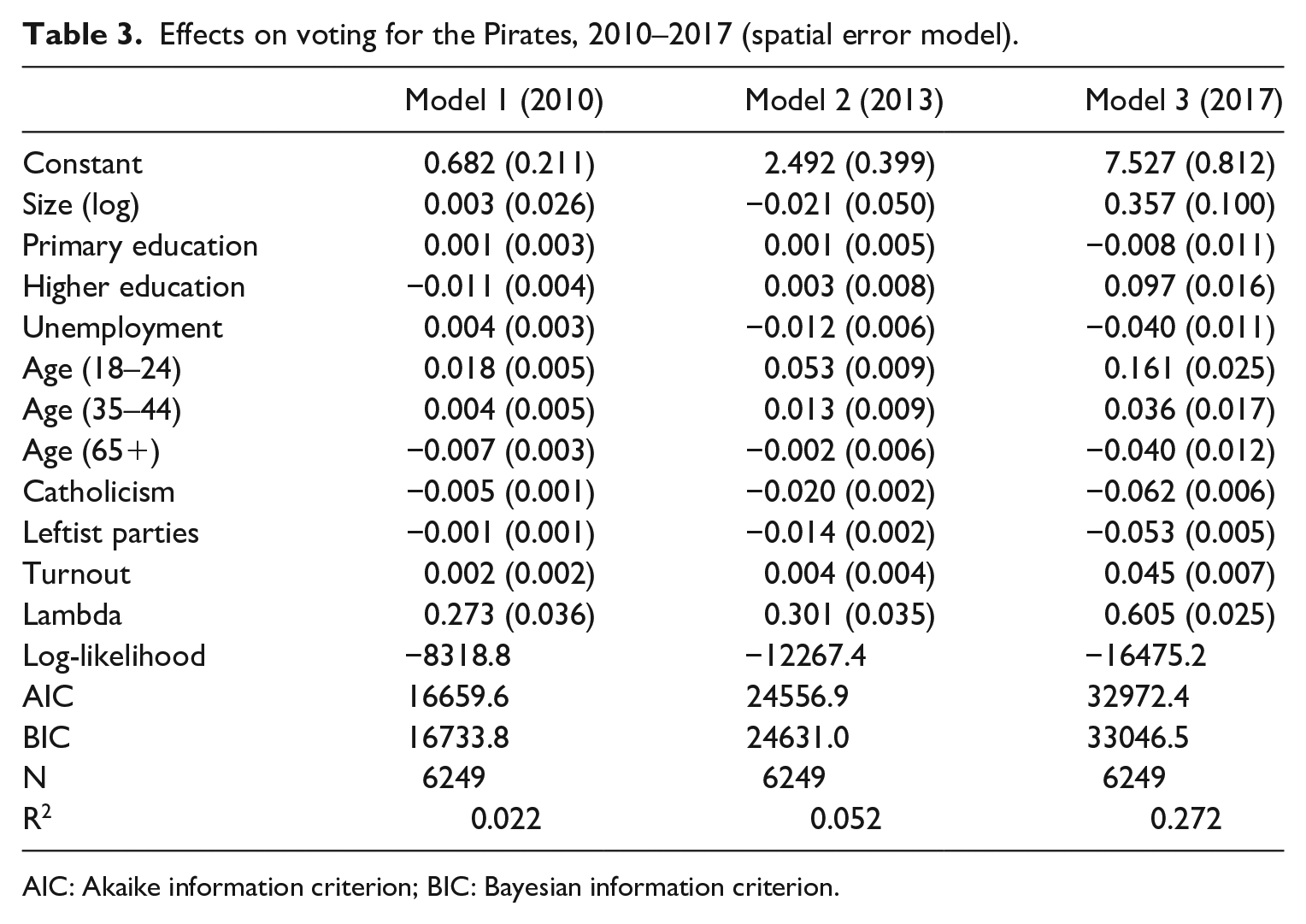
AIC: Akaike information criterion; BIC: Bayesian information criterion.
A detailed inspection of Model 3 gives rise to several conclusions. As expected, there is a positive size effect (H1). The probability of voting for the Pirates grows significantly with increasing population of individual municipalities, a finding which is in stark contrast with the previous election, when there were only limited (positive as well as negative) effects of size on Pirate support.
Furthermore, in the case of education, most studies (Erlingsson and Persson, 2011; Otjes, 2020) did not find a consistent pattern of pirate voting. Niedermayer (2013) demonstrated on the case of German Landtag elections that this may be because a large part of Pirate voters, given their age, had only just commenced their college education. Also our results show a changing pattern. While the effect of primary education changed from trivial positive (Models 1 and 2) to low negative (Model 3), the change in the case of tertiary education occurred in the opposite direction. However, we can attempt to explain this change in the following ways. First, the Pirates enjoyed considerable success in regions and municipalities where the right wing has traditionally been more successful and the local populations are mostly more educated. Second, since 2011 (the year our education level data was collected), sufficient time has elapsed for some voters to complete their education. Therefore, based on our data, H2 that Pirate support decreases with growing education can only be confirmed for the 2010 election (although the effect of the variable was very weak). With growing time since the census, this hypothesis can no longer be tested on census data reliably; yet in spite of that, pre-election polls demonstrate high support for the Czech Pirates among college graduates (Median, 2019).
Similarly, the effect of unemployment was not constant. However, as there is a simultaneous increase in the negative effect of unemployment, we must reject the assumption that success of the Pirates, as a new party distancing itself from established parties, was based on mobilization of support in areas affected by higher unemployment (H4), where higher Pirate support would be associated with local poor economic performance and economic grievances.
In contrast to the above-mentioned variables, the remaining factors have constant direction. While most studies confirmed age as a very strong predictor of pirate voting, with generally strongest support for Pirate parties among youngest voters (18–24) and little to no support outside of this age range, our results provide a partly different picture which, however, is in line with Czech individual data (Dostálová and Havlík, 2019). Although the Pirates enjoyed the strongest support in municipalities with the highest shares of the 18–24 age category and their success declined with growing 65+ populations, which supported H3, we also found a positive (although much weaker than in the case of the youngest population) correlation between increasing proportion of local population aged 35–44 and electoral support for the Pirates.
Religiosity proved as a reliable predictor as well. In all models, increasing number of Catholics in municipality’s populations decreased the share of votes for the Pirates (H5). More importantly, the effect of religiosity increased over time, so we can conclude that the party’s programmatic libertarianism resulted in its worse performance in municipalities with stronger dominance of Catholicism. Furthermore, this finding, too, has its spatial dimension. As we showed above, much support for the Pirates was concentrated in Bohemia and this trend reached its peak in the 2017 elections, when the Pirates succeeded especially in areas with traditionally strong support for right-wing parties (central, north-eastern and eastern Bohemia), most of which are inhabited by limited numbers of Catholics, who are mostly concentrated in southern and south-eastern Moravia.
The above-mentioned inroad of the Pirates to former long-term strongholds of the right-wing ODS and other right parties can explain, from comparative perspective, one important anomaly. While many studies confirmed the Pirates’ position in the left part of the political spectrum (Haas and Hilmer, 2013), especially on the cultural cleavage between progressivism and conservatism, or left-wing economic policy preferences among pirate voters (Otjes, 2020), our results show a contradictory picture, resulting in rejecting H6. We found a constant negative correlation between areas with a high concentration of leftist voting and electoral support for the Pirates, which strengthens with the overall rise of support for the party.
Furthermore, when looking at the influence of electoral participation, there were no effects of this variable in the elections of 2010 and 2013, but the latest parliamentary elections changed the trend and, in line with the expectation (H7), municipalities with higher turnout were those with higher share of Pirate votes. Here, the explanation has a similar basis as the previous variable. Like the core of electoral support for left-wing parties, also most of the municipalities with low turnout are traditionally concentrated especially in peripheral borderland areas of western and north-western Bohemia and northern Moravia (Šimon, 2015), that is, the traditional strongholds of the left wing, reaffirming that in the 2017 elections, the Pirates succeeded predominantly in regions which were historically associated with support for rightist parties.
Discussion and conclusion
Since its establishment in 2009, the Czech Pirate Party has continually grown stronger and in 2017, it won seats in the lower house of the Czech parliament, ranking as the third strongest party. However, as its electoral support varies widely across the Czech Republic’s territory, in this paper, we analysed all Czech municipalities in the elections of 2010–2017 to explain this variation. Aside from expanding knowledge about the specific empirical case of the Czech Republic, this study is an important contribution to the literature on voting for pirate parties generally. It draws upon a considerably higher number of observations than cross-national studies, which means that we can put research questions to more reliable tests. At the same time, Czech Pirates’ success may serve as a ‘model’ for other pirate parties in how (where) they chose to mobilize their preferred type of voters or how they identified the ideological space in which they found their voters.
Our study conclusively showed that increasing support for the Pirates largely transformed the patterns of their spatial support, which exhibited only sporadic spatiotemporal stability. The key finding of this study is that the determinants of the success of the Czech Pirates were not completely consistent with voting for pirate parties all over Europe. First, we confirmed the expected strong effect of the youngest population (18–24) on success of the Pirates but, at the same time, we also found a positive (although weaker) association between pirate voting and population aged 35–44. As such, our results indicate that the success of the Czech Pirates was not limited to municipalities with the youngest populations and the negative effect of age only existed for the age of 65+. This result suggests that a stronger and long-term success of Pirates requires appealing to a broader age base beyond the youngest voters.
Second, higher Pirate vote shares in larger municipalities can be linked to the fact that in contrast to Western Europe, larger (and especially the largest) Czech cities comprise long-term strongholds of rightist parties and simultaneously exhibit characteristically high education and low unemployment levels (Kostelecký et al., 2015). Furthermore, the negative effect of the left-right dimension, or more specifically the negative effects of more leftist electorates on voting for the Pirates, together with higher support in municipalities with more educated populations and lower unemployment (although with the above-mentioned problems of the census-based indicator of education) suggest an increasing influence of socio-economic indicators on the party’s success. Similarly, further research (based on individual data) could verify whether the Pirates’ success in major cities is based on structural factors only or is also caused by the more liberal opinions and attitudes of their local populations. This assumption is partly indicated by our results concerning the effect of Catholicism, as the Pirates received much fewer votes in areas with stronger Catholic populations, which can be associated with the more liberal views of the Pirates on a number of traditional issues.
Furthermore, an important conclusion with regard to structural factors was stated by Kostelecký et al. (2015), who found that in the Czech Republic, education also works as a contextual variable: with growing numbers of college graduates, the right wing is more frequently voted for by people of all education categories. Similarly, according to the same authors (Kostelecký et al., 2015), turnout is significantly associated with social capital. In this context, we can hypothesize that the positive effect of turnout on Pirate voting can be associated with more developed areas (or areas of high development potential) in which the Pirates received many more votes than in structurally disadvantaged regions, which are contrarily characterized by lower turnout, as well as higher unemployment, lower share of the college-educated population and stronger support for leftist parties.
To complement these findings with a look at the pattern of party replacement, we found that geographical support for the Pirates in 2017 was relatively strongly associated with regions and municipalities with previously high support for the right-wing ODS, in contrast to negative spatial autocorrelation of the Pirates’ support with a block of left-wing parties. This suggests that the success of the party largely stemmed from the constituencies where the Czech right historically has their strongholds, both the ODS, as the former main party of the right, and the minor right-wing (‘liberal centre’) parties. However, with regard to the large share of young people among Pirate voters, together with the high long-term spatial stability of Czech voters’ ideological preferences, future research should elicit the motives that led a large part of young voters to turn away from the right-wing parties supported by their parents, that is, also the failed transfer of party identification that was traditionally strong precisely among family members. Eight years have passed since the establishment of the Pirates, which would suggest that, as new ‘digital’ generations enter the electoral market, the success of the party would be strongly shaped by the information society cleavage or the conflict about knowledge, respectively (Demker, 2014). However, our results provide a rather pessimistic outlook for pirate parties that build their offer around this single issue. The Czech example demonstrates that it is rather the specific situation in a country, namely general dissatisfaction with established parties, that motivates voters to look for alternatives. However, the Pirates can only become that alternative if their programme rises above the ‘ghetto’ of cyber parties.
However, as aggregate-level analysis is not able to correctly answer the question whether the success of the Czech Pirates depends on issue or rather on protest voting connected to continuing general dissatisfaction with established parties, future research might benefit from applying individual-level survey data and a theoretical framework based on issue voting or other attitudes closely associated with voters’ political alienation from traditional parties. Especially, as the Czech Pirates responded to continuing dissatisfaction of Czech voters with established parties by adopting anti-corruption and anti-political positions (rhetoric) as an election success strategy against established parties (Naxera, 2018). This is somewhat consistent with Zulianello’s (2018) finding that the factor primarily related to pirate voting was importance of macro-economic issues and protest voting against established parties, based on poor economic performance and widespread corruption. These were precisely the reasons behind the fall of the ODS, the strongest right-wing party since 1990: many corruption scandals but also austerity measures adopted under ODS governments in 2006–2009 (together with KDU–ČSL and the Greens) and subsequently in 2010–2013 (together with the TOP09 and the VV).
This, too, is attested by the case of the Czech Pirates, who assigned only a minor role to typical ‘pirate’ topics in their broadly conceived programme, which elaborated specific policies in ways similar to traditional established parties, whereas their focus on large cities, mostly strongholds of right-wing parties in the post-1990 Czech context, explains why they differ from most of their foreign colleagues on the right-left axis as well.
At the same time, as we are witnessing not only the highest degree of parliamentary fragmentation of the centre-right part of the party spectrum in Czech history, but also inability of the ČSSD, as the former strongest leftist party, to recover its electorate, the question remains open whether it is conceivable for the Pirates to try to appeal to leftist voters, that is, follow the path taken successfully by the ANO2011 between the 2013 and 2017 elections. These important issues have a potential of significantly transforming Czech party politics in the future, a process in which the spatial-analytical approach to understanding how and where political change occurs will be very useful.
Footnotes
Appendix
Funding
The author(s) disclosed receipt of the following financial support for the research, authorship, and/or publication of this article: This study was prepared as part of a grant project supported by the Internal Grant Agency of the Jan Evangelista Purkyně University in Ústí nad Labem, Grant No. UJEP-IGA-TC-2019-63-03-2, ‘Euroscepticism and populism in the 2019 European Parliament elections’.
