



Abstract
This article seeks to shine a light on the diversity of populist discourses about Europe and the European Union (EU). It is built upon the existing literature on populist Euroscepticism to elaborate on two underexplored aspects of the relationship between populist discourses and EU contestation. First, it explores the variable and even ambivalent representations of the EU and its main political processes exhibited by populist actors. Second, it focuses on the precise relationship between populism and the representations of the EU to determine whether there is a hierarchical relation, reciprocal influence, or they function as separated ideational ensembles. This research takes a corpus-assisted approach to discourse analysis that is based on the exploration of manifestos and party leadership speeches between 2013 and 2017 of Podemos in Spain, a left-wing populist party, and the Alternative für Deutschland in Germany, a right-wing populist party. The findings reveal that the populist discourse has variable effects on the forms of EU contestation depending on its centrality and that ambivalence is a crucial feature to capture the forms of EU contestation of populist parties. Finally, the article draws several theoretical implications for the research on populism and EU contestation.
Introduction
The long-lasting problems of legitimacy and governance of the European Union (EU) have become increasingly politicised by several actors since the 1990s (Hooghe and Marks, 2009). Among these actors, populist parties have been considered as naturally Eurosceptic in the EU literature, albeit to varying degrees (see Pirro and Taggart, 2018; Taggart and Szczerbiak, 2002). This association between populism and Euroscepticism is not unjustified. Populist parties exhibit an antagonistic discourse that represents ‘the people’ in opposition to political or economic elites. Bearing in mind that the EU is generally considered an elite-driven project (Bulmer and Joseph, 2016: 739; Beeson and Diez, 2018: 119; Hobolt, 2018: 243), it seems conceivable that these parties show a certain degree of EU opposition.
Notwithstanding this ‘elective affinity’ between populism and Euroscepticism, this article argues that there are still unclear features in the relationship between populist discourses and EU contestation. The diversity of the populist phenomenon and the normative discussion concerning the topic jeopardise the accuracy of general arguments about populism in toto (Katsambekis, 2016). Moreover, the depth and complexity of EU politics require a clear-cut delineation of the various types of EU contestation for the case of populist parties (see Pirro et al., 2018).
Building upon the existing research on populism and Euroscepticism, this article seeks to uncover the specific ideational effects of populist discourses on the forms of EU contestation and vice versa. This study evaluates to what extent populism determines or influences the forms of EU contestation and examines the centrality and interplay of populism and EU contestation in right-wing and left-wing populist parties. Departing from the notion of articulation (Torfing, 1999), it explores the various forms of EU contestation and its relation with populist discourses. Articulation, within the field of discourse studies, refers to the combination of various discursive elements in novel forms to create arrangements of meaning (De Cleen and Stavrakakis, 2017: 5).
This study relies on corpus linguistics (CL) techniques to explore speeches and manifestos of Podemos in Spain and the Alternative für Deutschland (AfD) in Germany between 2013 and 2017. Although it does not exhaust the complexity of the populist phenomenon, it certainly has implications, on the one hand, for the theories on populism and its subtypes and, on the other hand, for the forms of EU contestation of populist parties. The ultimate goal of this study is to unearth the relations between populism and EU contestation and posit new theoretical arguments in regard to this question.
The article is divided into four main parts. The first two sections are devoted to the theoretical discussion about populism, democracy, and EU contestation. The analytical strategy of this research is presented in a subsequent section. The next two sections concentrate on the results and the textual and discursive analysis. Finally, the article discusses the findings and the implications for the literature on populism and EU contestation.
Populism and democracy
There are various approaches to the study of populism and not all of them focus on the ideational or discursive aspects of the phenomenon. Other scholars have primarily explored populism as a political strategy (Weyland, 2001), as a form of organisation (Jansen, 2011; Roberts, 2015), or as a policy approach (Acemoglu et al., 2013; Lutz, 2019). However, the ideational approach to populism has certainly gained centrality in recent times. Scholars within this tradition agree that populism should be primarily conceived of as a type of discourse, thin-ideology, or communication style that divides the symbolic field into two antagonistic blocs: the people and the elites (Hawkins and Rovira Kaltwasser, 2017; Laclau, 2005; Moffitt, 2016; Stavrakakis and Katsambekis, 2018). Furthermore, two additional elements are considered essential in the formation of a populist discourse: the positive representation of the people in opposition to the elites and the claim to represent the popular interests (Mudde, 2017; Salgado and Stavrakakis, 2019; Stavrakakis and Katsambekis, 2018; Van Kessel, 2014). This article relies on this consensual definition of populism and explores the topic from a particular discursive angle.
There is less agreement on the role that populism plays in contemporary liberal democracies and in relation to the EU. Several students of populism have considered the potential of the latter to undermine or improve democracy, reflecting upon the political locus of populism: the people and the popular sovereignty. Abts and Rummens (2007) argue that populism is essentially opposed to democracy or constitutional democracy. The logic of populism implies the systematic and ideology-based denial of individual rights and the opposition to a pluralist view of the political community which becomes ‘a dangerous threat to democracy’ (Abts and Rummens, 2007: 407; see also Müller, 2016; Pappas, 2016). Following this line of reasoning, it appears conceivable that populism is also inherently opposed to the pluralist and supranational political project of European integration and to the EU as a complex system of supranational governance.
Other approaches to this question, however, contend that the relation between democracy and populism should be empirically determined and cannot be theoretically established a priori (Katsambekis, 2016; Mudde and Rovira Kaltwasser, 2012). In fact, the diversity of populist actors constructing an antagonistic discourse between the people and the elites makes highly problematic the theoretical arguments about populism in toto. To empirically substantiate such diversity, Mudde and Rovira Kaltwasser (2013) and especially March (2007, 2017) examine the implications for populism to be attached to left-wing or right-wing ideologies. They conclude that there are at least two subtypes of populism, exclusionary and inclusionary, which can be mainly distinguished by the demarcation of outside groups in the case of the former and the promotion and incorporation of out-groups in the case of the latter (March, 2017: 285; Mudde and Rovira Kaltwasser, 2013: 159−160). In an analogous way, other authors distinguish between left-wing and right-wing (Katsambekis, 2016; Mouffe, 2018) or progressive and regressive populism (Della Porta, 2017; Fraser, 2017). This diverse range of cases casts some doubt on the essential opposition established between populism and certain foundations of democracy: a pluralist definition of the political community and the promotion of individual rights. Furthermore, in line with several scholars, the defining element of populism is its antagonism with the elites and not the homogeneity of the people which is not a necessary feature of the anti-elitist construction of the popular identity (Katsambekis, 2016; Moffitt, 2018; Stavrakakis and Katsambekis, 2018).
Drawing upon the latter scholars, this article conceives of populism as an open-ended process by which the political discourse about the people in antagonism with the elites is articulated in variable ways with several dimensions of the political processes: the dynamics and composition of the people, its political demands and rights, its transnational dimension, or the role of the state. These contingent articulations must be empirically substantiated to entirely capture the logic of populism and its complexity.
EU contestation and the populist discourse
The research on populism and EU contestation is also marked by the definition of the logic of populism as opposed to individual rights and pluralism. In the literature, Euroscepticism is associated with notions attached to an alleged populist ideology: the defence of the heartland, anti-institutionalism, and anti-mainstream politics (Taggart, 1997; Taggart and Szczerbiak, 2002). More generally, De Vries and Edwards (2009) build on this perspective to examine EU contestation as the party-based Euroscepticism which is located at the extremes of the political spectrum (see also Halikiopoulou et al., 2012). Thus, Euroscepticism is defined as the degree of opposition, principled or qualified, to the EU (De Vries and Edwards, 2009: 10; Taggart and Szczerbiak, 2002: 7−8). Following De Vries and Edwards (2009: 22), radical right and radical left parties converge in their opposition to the EU although they exhibit different reasons for this opposition: the right-wing parties concentrate on cultural issues to criticise the EU, whereas the left-wing parties are primarily focussed on economic matters.
Reflecting upon this conventional wisdom, Harmsen highlights the limitations to confine populism and EU contestation to a fixed and predefined category and evaluate the latter only in terms of a qualified degree of opposition essentially linked to populism (2010: 338; see also Stavrakakis and Katsambekis, 2014). These scholars claim for a more detailed and relational exploration of EU contestation and populism.
More recently, research on populism and Euroscepticism has turned a particular eye on the diverse responses of populist parties to the EU crises. According to this research, ‘populist parties’ responses were unlikely to be uniform, not least in view of their varying ideological profiles, as well as dissimilarities in the way the crises affected their specific national contexts’ (Pirro and Van Kessel, 2018: 338). In the same vein, Plaza-Colodro et al. (2018: 11−12) have empirically qualified the criticism of left-wing populist parties distinguishing these parties from the principled Euroscepticism promoted by right-wing populist contenders. As these scholars observe, the position of populist parties on EU issues depends on the ideological background of the parties and the political conjunctures in which they operate, not only on their populist appeal (Harmsen, 2010; Pirro and Van Kessel, 2018; Plaza-Colodro et al., 2018). The forms of EU contestation mobilised by populist parties are multiply determined and consequently, it is conceivable that these parties exhibit ambivalent representations of the EU.
Hence, there is a need to move beyond the analysis of the type of EU opposition exhibited by left and right populist parties and investigate the articulations of positive and negative dimensions of the EU. In other words, it is necessary to deeply explore the problematisations about the EU to more fully capture EU contestation. In doing so, this article seeks to illuminate the complexity and ambivalence of EU contestation shown by new populist parties beyond the categories of soft and hard opposition to the EU. Moreover, this qualitative exploration of the interplay between populism and EU contestation aims at determining the relevance and centrality of the populist discourse and its power to shape EU contestation in leftist and rightist contenders. Finally, it is the goal of this contribution to stimulate further theoretical reflection on the precise role of populism and EU contestation in the formation of parties’ identities and, consequentially, in parties’ main ideational and political orientations.
Case selection and comparison
As a point of departure, this article argues that Podemos and the AfD share a common populist discourse which appeals to the people in opposition to certain elites. Following Brubaker (2017: 360), ‘what ties substantively different forms of populist politics together – what makes it possible to characterize them all as populist – is the discursive and stylistic repertoire on which they draw’. This common ground, which can also be discussed in the light of the empirical results of this study, has been empirically substantiated by several scholars in the case of Podemos and the AfD (Kioupkiolis, 2016; Salgado and Stavrakakis, 2019; Sola and Rendueles, 2017; Grimm, 2015; Schmitt-Beck, 2016).
Furthermore, the parallel rise and consolidation of these two parties make them exceptional cases in point to be compared. They emerged in the aftermath of the euro crisis (the AfD in 2013 and Podemos in 2014) and evolved throughout different stages and party leadership shifts until the general election in Spain in 2016 and the federal election in Germany in 2017. Podemos gathered 21.1% of the votes and 71 deputies in the Spanish parliament in June 2016 1 after two consecutive general elections. The AfD entered into the German Bundestag in September 2017 with 12.6% of the popular vote and 94 seats. The two parties became the third political force in the first nationwide election and after an unexpected eruption in the 2014 European election. This parallel evolution and consolidation also facilitates the collection of an equivalent textual corpus covering a comparable time span.
Two additional considerations must be made, however, about the limitations of this paired comparison. First, the diversity of populist parties in ideological and geographical terms cannot be exhausted with the comparison of these two cases and it certainly limits the ability to generalise the results of this study. However, the strength of this comparison is not based on empirical generalisation but stems from its contribution to the theoretical discussion on populism and EU contestation suggesting new empirical avenues for research.
The second consideration refers to the level of analysis of this comparison. In accordance to the goals established in this article, the analysis focuses on the overall discursive articulations of Podemos and the AfD and the specific exploration of the various stages and changes of the parties lies beyond the scope of this study. This article assumes, following Berbuir et al. (2015: 173) and Lees (2018: 10−11), that the AfD was initially a single (EU) issue party and its discourse shifted especially since 2015 towards nationalist and anti-immigration themes. This has necessarily implications for the quantitative comparison of the salience of EU issues. Although this indicates certain limitations, this research is primarily concerned with the signifying elements involved in the relationship between populism and EU contestation rather than with its relative salience. Notwithstanding the internal transformations of the AfD, the textual corpus covers its two stages until 2017 and it allows, therefore, for a general evaluation of the relationship between populism and EU contestation in qualitative terms, and as a qualified right-wing populist party (Havertz, 2018; Lees, 2018; Schmitt-Beck, 2016). However, further research can be conducted to determine to what extent the initial EU-focused stage of the AfD shaped its overall orientation towards European integration and the EU.
Data and methods
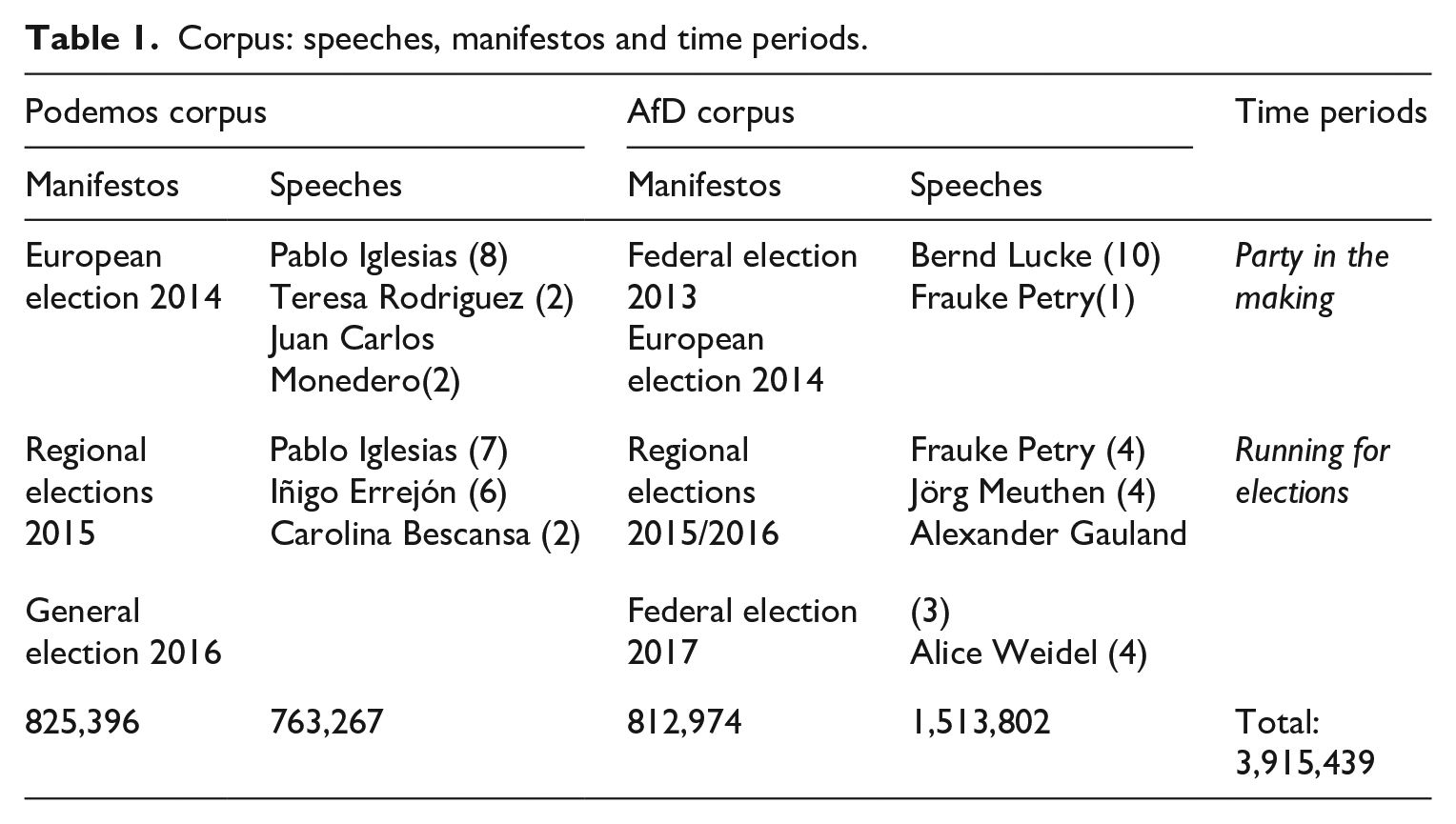
This study takes a corpus-assisted approach to discourse analysis (Baker, 2006; Baker and McEnery, 2015) that is based on manifestos and party leadership speeches of Podemos and the AfD between 2013 and 2017. Party speeches are especially relevant for analysing populism due to the direct communication of the representative with the represented. Manifestos are used in order to include a more formal genre in the analysis and because it is one of the most important documents defining the positions and discourses of a party. The speeches collected correspond to the primary representatives of the parties, considering their role in the party executive and their position as candidates for elections. As the Table 1 shows, the selection of speeches is adapted to the different stages of the parties and the various party leadership shifts. The synergy between corpus linguistic (CL) techniques and (critical) discourse analysis has demonstrated to be extremely productive (see (Baker and McEnery, 2015; Germond et al., 2016; Trimithiotis, 2018). CL facilitates computer-mediated entry points into discourse and permits to compute large bodies of text to find relevant semantic relations.
Corpus: speeches, manifestos and time periods.
This research relies on the specific categories advanced by Van Leeuwen (2008) to analyse forms of representation, and it also explores the problematisations or ‘phenomenal structures’ mobilised by the parties (Keller, 2018: 33−34). First, the various classifications, identifications and evaluative processes (Van Leeuwen, 2008: 42−46) involved in the construction of the popular identity are identified in the textual corpus. The goal is to capture the demarcation of the ‘legitimate people’ defined by the parties, the composition and traits of such people, and the opposition or antagonism with other entities or actors. It is expected that the primary way to construct the legitimate people of a populist discourse is to antagonise the people with the elites. This includes the analysis of the boundaries between the ‘populist or legitimate people’ and other people who fall outside this categorisation. In a second step, the analysis turns to the main social actors, events, and processes defined in relation to Europe and the EU. Finally, the strategies of problematisation, legitimation, and purpose of the two political parties are described and compared in the light of the interaction between populist discourses and representations of Europe and the EU.
The corpus is subdivided into two main sub-corpora (Podemos corpus and AfD corpus) to carry out the analysis. Both sub-corpora are searched using the software WordSmith 7.1 (Scott, 2016), and the analysis concentrates on frequencies and collocates. The collocates are the words surrounding a signifier or node word that provides the latter with a certain ‘semantic prosody’. In linguistics, semantic prosody refers to the ‘consistent aura of meaning with which a form is imbued by its collocates’ (Louw, 1993: 157) and discursive prosody entails a broader analysis of the discursive implications of these meaning attributions (Baker, 2006: 271; Fairclough, 2003: 131; see also Stubbs, 2001). Accordingly, the concordance lines and co-occurrence patterns are explored in order to identify the main signifiers (frequency) that serve to designate and demarcate the popular identity, Europe and the EU, and the meaning attribution of their collocates.
The collocations are analysed using the classic span of five words to the left and right of the node word (see Gabrielatos and Baker, 2008: 11). The frequency of the collocates is combined with two filtering measures that capture the strength and the significance of the relationship between the node word and the co-occurring words: mutual information (MI) and log-likelihood (LL). The ultimate goal of this research is to draw inferences based on word collocation patterns about the main articulations utilised by the parties in the construction of the popular identity and the representation of Europe and the EU.
The construction of the people
The populist articulation of Podemos
In the Podemos corpus, there are three signifiers referring to ‘the people’: gente (the ordinary people; 898, 0.43 of relative frequency), personas (persons; 229, 0.11) and ciudadanos (citizens; 218, 0.10). The word form persona* alludes to different types of citizens, as its collocation analysis reveals. It appears co-selected in significant ways with disability (discapacidad; 9) and dependent (dependiente; 7). It is also used more generally as ‘the people’ when it is accompanied by todas (all persons, 24), or miles (thousands of persons, 9). It serves to defend the fundamental rights of all persons as the following extract illustrates:
(1) Ensuring the right of all persons, individually or collectively, to participate in the governance of their country and to secure universal access to political representation (Podemos, 2014: 10).
2
Turning to the collocation profile of ‘citizens’ (ciudadano*), the findings show that this word form is typically co-selected with country (país, 16), rights (derechos, 9), and interests (intereses, 7). The first collocate, country, serves simply to designate the type of citizens through a national identification: they are ‘the citizens of this country’. According to Podemos, there are some elites against the Spanish citizenry’s interests:
(2) Article 128 of the Constitution which is written to allow a government to intervene companies that carry out oligopolistic practices against the interests of citizens (Iglesias, 2014a).
Notwithstanding the relevance of these two word forms, Podemos structures its populist discourse mainly through the signifier gente (ordinary people). This is the most frequent word form used in the Podemos corpus (898; 0.43) and it operates as a nodal point within the discursive articulations of the party. There are two groups of adjectives that significantly collocate with gente. On the one hand, there are descriptive adjectives related to the quantity of the people: many (mucha, 86), the majority (mayoría; 23); and on the other hand, there are evaluative or attributive adjectives: normal (normal, 19), decent (decente, 37), humble (humilde, 19), normal (corriente, 8), hardworking (trabajadora, 14), or simple (simple, 13). The first group of adjectives serves to portray an identification of the people with the most versus the few. The second set of adjectives represents ‘the people’ based on an appraisement or moral evaluation (Van Leeuwen, 2008: 45) to confer a ‘positive aura’ to the people:
(3) It was not the decent and hardworking people of Spain who did not comply with the agreement. In Spain, those who broke the agreement, those who failed to live up to their commitments were a small, privileged minority who mocked us, who despised us, who put themselves above the law (Iglesias, 2016a).
The extract above exemplifies how the popular identity is constructed through a positive reference to the ordinary people in a highly general and open way (gente) and in clear opposition to specific economic-political elites which are defined in negative terms (an unreliable caste: casta). This antagonism is constitutive of the popular identity as it can be observed below:
(4) We do dare with the rich. We know that governing means choosing between two options: either to govern for those above or for normal people. Do not believe those who tell you that you can govern for everyone; that you can govern for the billionaires and for the normal people (Iglesias, 2015a).
The AfD and ‘the people’
What emerges from the examination of the AfD corpus is that there are two primary ways to refer to ‘the people’: Mensch* (persons or human beings; 269, 0.12) and Bürger* (citizen; 258, 0.12). These two word forms are not on the top of the frequency list nor do they reach the relative frequency of the signifier gente (0.43) in the case of Podemos. By exploring the word form persons (Mensch*), the results show a typical co-selection with adjectives such as millions (millionen; 10) or many (viele; 14) and a functionalisation of this signifier. Following Van Leeuwen (2008: 42), functionalisation ‘occurs when social actors are referred to in terms of an activity, in terms of something they do’. The AfD represents persons (Menschen) coming to Germany; in fact, the verb to come (kommen, 17) is the strongest verb collocating with persons. This is confirmed by the analysis of the most frequent clusters of words in relation with ‘persons’: the first is ‘the people from’ (7) and the fourth ‘come to us’ (5). The extract below illustrates this functionalisation of the signifier ‘persons’:
(5) We really have to make sure that the people who come to us have the appropriate qualifications; that it is people who have an adequate school education and have any professional skills that are in demand in the German labour market; that it is people who can speak our language or at least have the prerequisites to learn a language in an appropriate time; that it is people who are not only capable of integration but also are people who are willing to integrate (Lucke, 2013).
If we turn to the other word form to designate ‘the people’ (citizen; Bürger*), a different collocation profile emerges. The most important co-selected words are free (freie, 9), state (Staat, 10), right (Recht, 8), or protection (Schutz; 4). The adjective free is used to identify and evaluate ‘the people’ as Bürgern. This ‘people’ seems to be separated and distinguished from those designated as Menschen, with different qualities and activities. Hence, there is a boundary between Bürgern and Menschen whereby only the former constitutes the legitimate people. In other words, the Bürgern are those forming the political community in a recognised and legitimate way:
(6) As free citizens, we stand up for direct democracy, separation of powers and the rule of law, social market economy, subsidiarity, federalism, the family and the living tradition of German culture (AfD, 2016: 1).
The AfD represents the free Bürgern facing two main challenges or dangers: the oppressive state and uncontrolled immigration. In the following extract, the citizens appear opposed to the state (10), the second strongest collocate:
(7) The state is there for the citizen, not the citizen for the state. Only a ‘lean state’ (schlanker Staat) can therefore be a good state. What is needed is a regulatory framework guaranteed by the state in which citizens can freely develop (AfD, 2016: 4).
The German citizens, within the discourse of the AfD should be protected (protection, 4), primarily against immigration-related criminality:
(8) AfD calls for the protection of citizens against immigration-related crime to be given top priority. This requires a change of system from the bondage of the security authorities by national and EU regulations to a new concept of foreigner authorities, police and law enforcement as efficient security authorities (AfD, 2016: 49).
The results of the AfD corpus show a primary opposition of the Bürgern against the state and a distinction from other type of people (Menschen), strongly drawing on nationalist and ordoliberal discourses. The antagonism between the people and the elites found in the Podemos corpus is not among the central ways to construct the popular identity in the AfD corpus. There is no appraisement of the Bürgern in the discourse of the AfD either; conversely, they are portrayed as ‘free citizens’ rather than normal, simple, hardworking, or humble people.
Representing Europe
Podemos: The Europe of ‘the people’ or the Europe of the elites
Europe (Europa) does not rank among the most frequent nouns used in the Podemos corpus. The findings show 101 instances of this noun with a relative frequency of only 0.05. Drawing upon the most significant collocates, there are various significant nouns co-occurring with Europe: problem (problema, 12), south (sur, 5), countries (países, 6), rights (derechos, 6), social (social, 5). Podemos shows an ambivalent representation of Europe: on the one hand, they ‘love it’ (Iglesias, 2014b) and, on the other hand, there is one Europe linked to Goldman Sachs and certain economic and political elites that they reject. Thus, Europe appears fractured by an opposition between the southern European countries and the Europe of the banks and the elites:
(9) We love Europe if Europe means freedom, equality and fraternity, we love Europe if Europe means social rights we love Europe if Europe means human rights. The problem is not Europe, the problem is that the president of the European Central Bank is called Mario Draghi and he was representative of Goldman Sachs in Europe [. . .] Europe’s problem is called Durão Barroso [. . .] that’s why we say along with other southern Europeans that we want to recover the dignity and the future of our peoples and our countries (Iglesias, 2014b).
Among the actors represented in the Podemos corpus, Germany, the European Central Bank and those responsible for austerity policies are portrayed as buriers of the Europe of the social rights that should be recovered. There is, therefore, a problematisation of Europe as ‘a problem of the elites’ and a proposal that consists of bringing back Europe to the people and to the southern European countries:
(10) The Europe of Germany, the Europe of the social cuts, the Europe that humiliates the refugees and does not respect human rights does not serve and does not seduce [. . .] Either we recover an idea of Europe associated with social rights or Europe is over, that’s why we say that we have to democratize Europe and that we should point the finger at those responsible for austerity policies as what they are: the buriers of the European project (Iglesias, 2016b).
By focussing on the more concrete dimension of Europe linked to the EU, the findings show a distinct pattern of collocation. The word forms alluding to such dimension are euro (euro, 12), euro MPs (europarlamentarios, 15), European parliament (Parlamento Europeo, 7), Eurozone (Eurozona, 7), the EU (UE, 48), and European (Europea/s Europeo/s, 185).
The EU as such is mainly mentioned in the electoral manifestos of Podemos and there are only five instances of the EU in party speeches. In the party manifestos, the EU is primarily represented as a geopolitical reference: ‘the different countries of the European Union’ (Podemos, 2014: 7) or ‘the people who live in any of the countries of the European Union’ (Podemos, 2014: 15). It appears as a neutral and passive entity, whereas the ‘people’ or ‘the countries’ are represented as the active subjects. In the view of Podemos, these actors should implement several reforms at the EU level: a European housing plan, wage and fiscal harmonisation, or the creation of a European health charter. The adjective European appears co-selected with social and democratic ‘charters’ as pillars for the EU reform:
(11) Immediately adopt a shock plan to eradicate child poverty and exclusion throughout the European territory, strictly observing the application of the European Social Charter, and with a Community programme for social housing which includes a ban on evictions from first homes within the Community territory; a European Health Charter guaranteeing the right to public health for all in the territory of the EU, and the strengthening of the European Area of Education and Culture (Podemos, 2016: 76).
This reformist discourse is combined with a critical discourse about the main institutions of the EU which are represented as instruments of the political and economic elites:
(12) Democracy is a movement that distributes power, a movement that tells whoever is in power–the European Central Bank, the International Monetary Fund, the private investment funds or multimillionaires–that in a democracy the power has to be in the hands of the people (Iglesias, 2015b).
In sum, Europe is primarily represented as abducted by certain elites in the Podemos corpus. It is passionately defended against these elites, the European Central Bank, and other European and global institutions. In this case, the populist discourse clearly influences the representation of Europe. This is due to the primacy of the antagonistic representation dividing the symbolic field into two blocs with ‘the people’ as the legitimate subject. The EU, by contrast, is portrayed as a terrain for institutional reform although its institutions are also presented occasionally as assaulted by the elites.
The AfD: Europe and Germany
The word Europe (Europa) is more salient in the AfD corpus than in the Podemos corpus with 207 occurrences and 0.09 of relative frequency. Moreover, including also the EU dimension, its institutions and politics, the general theme Europe and the EU is clearly central and prominent in the AfD corpus. The results yield 0.23 of relative frequency of the EU dimension in the AfD corpus, whereas in the Podemos corpus, it is only 0.12. The strongest collocates of Europe are Germany (Deutschland, 17), states (Staaten, 12), peace (Frieden, 5), southern (Süden, 5), fatherland (Vaterland, 3), and sovereign (souveräner, 3). ‘The peace in Europe’ is represented as an entity at risk, mainly because of the failure of the euro and the Eurozone:
(13) Stable state systems have been put at risk in these countries in particular. Above all, there is one thing that has been put at risk: the peace in Europe that has been achieved with so much effort (Petry, 2016).
Germany, the most frequent signifier and a nodal point in the AfD corpus, is strongly co-selected (17) with Europe. These two nouns are represented as comparable, although clearly distinct, projects. The main question for the AfD is to redefine ‘the role of Germany in Europe’ (Lucke, 2014) what means something else than merely ‘merge into Europe’, in the words of Petry (2016). The collocate ‘states’ (12) has two different usages: first, it serves to oppose the construction of the ‘United States of Europe’; and second, it portrays a positive image of the sovereign nation state and the need to reinforce its power as the excerpt below illustrates. ‘Fatherland’ and ‘sovereign’ are collocates serving to the same end, whereas ‘southern’ Europe is represented as one of the victims of the EU monetary policies:
(14) We reject the United States of Europe as well as an EU as a federal state from which withdrawal is no longer possible. Our goal is a sovereign Germany that guarantees the freedom and security of its citizens, promotes their prosperity, and makes its contribution to a peaceful and prosperous Europe (AfD, 2016: 10).
Turning to the more concrete dimension related to the EU, its main institutions and the EU itself are criticised in the context of the crisis for adopting ‘measures as if there were no democracy in the European Union, as if there were no respect for the national parliaments’ (Lucke, 2014). The underlying argument has to do again with the constraining role of the EU and its institutions against the ‘member states’ (9), which is one of the strongest collocates of the EU. The findings also show a certain opposition of the nation states and the EU which appears restricting or permanently destroying them. The future and desirable state of affairs for the new EU is represented with a stronger and free Germany and a return of EU competences to the national level:
(15) Germany must have a greater weight at the European institutions according to its population and its economic importance (AfD, 2014: 24).
All in all, in the AfD corpus it is also possible to identify interrelations between the construction of the popular identity and the discourses on Europe and the EU. The central features are the prominent role of Germany and the nation state and the ordoliberal discourse. The constraining and negative role of the state, if it is not a lean state (schlanker Staat), continues to be the problem in the representations of Europe and the EU. There is no, therefore, primacy of the antagonism between the people and the elites as in the Podemos corpus but a general discourse structured around Germany, the state, Europe, and the freedom of the German citizens.
Concluding remarks
This article has identified the particular forms of EU contestation of Podemos and the AfD and the articulations with a populist discourse. The main aim has been to shine a light on the diversity of EU contestation and its relation with populism comparing two instances of right-wing and left-wing populism.
The findings show that Podemos exhibits a stark populist articulation, not merely because of the centrality of ‘the ordinary people’ but also by virtue of the constitution of a popular identity through a prominent opposition to the elites. This coheres with the main elements included in the ideational and discursive definition of populism (Hawkins and Rovira Kaltwasser, 2017; Stavrakakis and Katsambekis, 2018). The construction of the popular identity is based on an open and inclusionary process of aggregation of minorities and social demands to construct ‘the people’. The signifier ‘persons’ serves to designate particular groups which should be actively recognised and included into the legitimate people (e.g. dependent persons). The main signifier used to construct the people (gente; 898, 0.43) is an open and generic term which refers to ordinary people. By contrast, the AfD refers to ‘the people’ and claims to represent its interests but it shows a different pattern of discursive articulation. The primary way to construct the popular identity is based on a ‘more restricted people’ (Bürgern). This ‘people’, a subject with ethnic and civic foundations, is not primarily constructed through an antagonism with the elites. It is rather portrayed in opposition to ‘the state’ (in its social democratic and bureaucratic form) and markedly distinguished from the immigrants coming to Germany, designated with the term Menschen.
Hence, this article confirms the exclusionary nature of right-wing populism and its distinct construction of a popular identity, in contrast to left-wing populist parties. Perhaps more importantly, the findings show that scholars must be attentive to the role and centrality of the antagonism people–elites in radical right-wing parties such as the AfD. Although the antagonism with the elites can be one of the features in the discursive articulations of these parties, 3 this article shows the need for a cautious and detailed exploration of this question to determine its relevance and centrality. This finding has important implications to determine whether the new right-wing radical parties must be primarily considered ‘populist’, ‘nationalist,’ or ‘ordoliberal’ and casts some doubts on the unproblematic use of the label populism to characterise radical right-wing parties.
In regard to EU contestation, Podemos portrays Europe as fractured by the populist antagonism and the opposition between the elites and ‘the people’, especially the peoples of southern Europe. The representation of the EU, however, includes also a reformist discourse. The findings show that the EU is also problematised as an institutional complex with democratic deficits, especially with a deficit in social and fiscal policy. Podemos promotes more European integration to legislate about health-care rights, unemployment rights, or civil rights. This is a classic demand of social democratic, left-wing, and federalist epistemic communities, which confirms previous research on left-wing populist parties in southern Europe (Della Porta et al., 2017; Plaza-Colodro et al., 2018) The articulation of the AfD, conversely, revolves around ‘the state’ and ‘Germany’ as the discursive nodal points to contest the EU. The state turns to operate as a positive designation when linked to the nation, and the nation state is portrayed in opposition to the EU. These results indicate that the binary or ‘degreeist’ distinction between more or less Eurosceptic parties must be combined with more nuanced and detailed analyses to identify the various dimensions and ambivalent positions of the parties in regard to Europe and the EU.
In regard to the relation between populism and EU contestation, this study yields various interesting insights. Contrary to the theoretical expectations and previous research on right-wing populism, there is no a prominent populist articulation of Europe as fractured and divided into two antagonistic poles (people–EU elites) in the case of the AfD. This party adopts the ordoliberal view to promote ‘less Europe’ and lean and flexible nation states that may cooperate, especially in economic terms, at the EU level. Therefore, ordoliberalism serves as the thick ideological background to criticise the EU instead of populism which is not central to articulate EU contestation in the case of this party and in contrast to Podemos.
As it has been shown, the representations of Europe mobilised by Podemos are significantly, although not entirely, shaped by the antagonistic structure of populism. In the case of the AfD, the populist discourse is not critical to determine the discursive articulations around the EU which calls for a revision of the unproblematic association between right-wing populism and Euroscepticism. Further research could be designed to establish to what extent this primacy of ordoliberalism and nationalism to shape EU contestation over populism holds for other radical right-wing parties across Europe.
Footnotes
Funding
The author(s) received no financial support for the research, authorship, and/or publication of this article.
