




Abstract
European elections have been described as second-order phenomena for voters, the media, but also parties. Yet, since 2009, there exists evidence that not only voters, but also political parties assign increasing significance to European elections. While initially ‘issue entrepreneurs’ were held responsible for this development, the latest campaigns have raised the question of whether mainstream parties are finally also campaigning on European issues. In this article, we examine European Union (EU) salience in the 2019 European Parliament (EP) campaigns of government and opposition parties and the predictors of their strategic behaviours. We test the relevance of factors derived from the selective emphasis and the co-orientation approach within an integrated model of strategic campaign communication based on expert evaluations of 191 parties in 28 EU member states. Results show that the traditional expectation that government parties silence EU issues does not hold anymore; instead, the average EU salience of government and opposition parties is similar on the national level. The strongest predictors for a party’s decision to campaign on EU issues are the co-orientation towards the campaign agendas of competing parties, and party’s EU position.
Introduction
Competition lies at the heart of democratic elections. Normative conceptions tend to posit democratic electoral competition as being centred on rival substantive policy platforms, on which parties and/or candidates campaign, and from which voters choose depending on their positions on different issues. We can thus speak of a democratic political market, where parties supply the policies from which citizens choose (Schmidt, 1996). Yet this market is also potentially liable to inefficiencies. Parties can choose to underplay, or even silence, certain issues from their campaigns.
In this article, we assess the factors that account for a greater silencing or incorporation of issues in campaigns. We do so by examining the specific case of European Union (EU) issues in the 2019 European Parliament (EP) elections, seeking to answer the following overall research question: What factors led parties to emphasise (or downplay) EU issues from their EP election campaigns?
EP elections provide a particularly interesting setting in which to explore what drives the greater or lesser inclusion of issues in political campaigns for two interrelated reasons. The first is an empirical one. EP elections have long been described as the archetypal ‘second-order national election’, with campaigns dominated by national rather than European issues. However, studies on more recent EP elections suggest, at the very least, a waning of this ‘second-order’ nature. This begs the question of whether this trend continued in the 2019 EP election; and, to the extent that it did, what drove it and what explains variations. The second is a normative one. As the only direct election for EU institutions, EP elections provide a singular context for citizens and parties to engage in EU matters. As such, its campaigns should relate to European issues, so that the resulting parliament can provide an identifiable and robust link ‘connecting European policies to the electorate in a chain of political accountability’ (Scharpf, 2006: 18). If campaigns downplay EU issues, then the quality of EU democracy is weakened.
Overall, then, this article seeks to explain what led parties to put Europe more on the agenda in their EP election campaigns. We do so by assessing the campaign strategies of 191 parties across all 28 EU member states based on the 2019 European Parliament Election Expert Survey (EPEES_19) dataset. We analyse which factors drove parties to bring up EU issues in their 2019 EP election campaigns, and which factors hindered them from doing so, using an integrated model of strategic campaign communication, building on the selective emphasis and the co-orientation approaches. This article thus contributes to existing knowledge by theoretically integrating and then simultaneously testing predictors from both approaches, that have emerged as important in earlier studies, and doing so for all 28 EU member states, enabling a more reliable assessment of their relevance and impact.
Campaigning on Europe in EP elections
For about 30 years, European election campaigns have been characterised as second-order elections (Reif and Schmitt, 1980), meaning that not European issues but national topics have shaped the campaign agendas (e.g. De Vreese, 2009; Hoeglinger, 2016; Petithomme, 2012). It was especially the mainstream parties (De Vries and Hobolt, 2020), which dominated electoral competition and government formation, that seemingly had little interest in giving salience to EU issues. For the most part, these parties’ views converged on EU issues, and bringing the EU to the fore risked generating internal divisions and critical reactions of their voters and coalition partners, which made them prefer a strategy of issue avoidance with regard to the EU (De Vries and Hobolt, 2020). Moreover, the EU was also not easily subsumed under the left–right dimension of party competition (De Vries and Hobolt, 2020; Hooghe and Marks, 2009; Van der Eijk and Franklin, 2004).
Yet, evidence suggests that voters have developed significant interest in European issues since the 1990s (e.g. Hooghe and Marks, 2009), with the mismatch between voters’ evolving interest in European issues and mainstream parties’ still missing supply generating opportunities for issue entrepreneurship (De Vries and Hobolt, 2012, 2020). Typically, challenger parties which were hitherto excluded from government, acted as political entrepreneurs and positioned themselves regarding EU issues, on the one side, strategically building their own reputation and on the other driving a ‘wedge’ (Van de Wardt et al., 2014) within mainstream parties and between coalitions (De Vries and Hobolt, 2012, 2020; see also Ehin and Talving, 2021; Hobolt and De Vries, 2015; Van de Wardt et al., 2014). Thus, in addition to the question of how stable such strategic campaign behaviour would be on side of the challenger parties, a further open question was whether this would also force mainstream parties to incorporate EU issues in their campaigns (Meguid, 2008).
Within this backdrop, this article examines what drove a more European focus, as opposed to a more national or regional one, in parties’ 2019 EP election campaigns. It does so by testing predictors drawn from two central strands in the literature on the inclusion of issues in party platforms: the selective emphasis approach, stemming from Budge and Farlie’s (1983) research; and the co-orientation approach, drawing on the work of Steenbergen and Scott (2004). We combine predictors from these two approaches in an integrated model of strategic campaign communication, allowing for a more rigorous simultaneous assessment of a number of predictors that previous literature has found to be relevant.
How do we build on these two approaches? The selective emphasis approach assumes that parties tend to campaign on issues that are favourable to them, which the party is more associated to or perceived as more competent on compared with competing parties (Hayes, 2008; Petrocik, 1996; Walgrave et al., 2012). Conversely, this entails parties avoiding issues that are likely to cause problems, not least those that generate intra-party divisions (De Vries and Hobolt, 2020). As such, a reasonable expectation is that, ceteris paribus, the more parties are divided on an issue, the more they will seek to avoid it, an aspect central in our theoretical model.
At the same time, the ability to avoid internally divisive issues is also potentially dependent on the strength of the party leadership, with stronger leaders in a better position to muffle these internal cross-cutting issues than their weaker counterparts (Parsons and Weber, 2011). The combination of these two elements also suggests that the ability of strong leaders to muffle such issues is also contingent on the depth and strength of internal divisions. Likewise, the ability to stifle emerging divisive issues may well depend on their timing. The proximity of elections raises the stakes for contesting these internal battles (Parsons and Weber, 2011). More powerful party leaders will be better placed to muffle internal divisions as elections approach, while their weaker counterparts will not (Parsons and Weber, 2011). Finally, we consider how issue avoidance is also likely to be contingent on public opinion. As Steenbergen and Scott (2004: 168) posit, parties will have an incentive to avoid (or ‘de-emphasize’) issues on which their position is less congruent with the national public opinion, and, conversely, to emphasise those on which their position ‘is close to that of the electorate’.
While the above approach suggests little interaction between parties, as the campaign of each one derives from its own positions and internal dynamics, the co-orientation approach proposes that parties’ platforms are responsive to the wider issue agenda (Steenbergen and Scott, 2004). This gives rise to the notion of a ‘party-system agenda’, that is, the issue agenda that is the result of interparty interaction (Green-Pedersen and Mortensen, 2010). However, parties are not simply passive takers of this party-system agenda. Rather, they also seek to set it in their favour. The expectation here is that opposition parties are better positioned to be agenda-setters, while governing ones are obliged to be more responsive to the party-system agenda (Green-Pedersen and Mortensen, 2010). The latter are weighed down by their time in office: their record inevitably enters the party-system agenda and requires defending; opposition parties, on the other hand, have greater leeway in choosing which issues to emphasise (Green-Pedersen and Mortensen 2010: 262–263). Our integrated model reflects these dimensions also.
It is within this theoretical framework that we examine the 2019 EP elections and the extent to which European issues as opposed to national and regional ones were included and avoided in the campaigns, drawing on predictors that reflect the above intra- and inter-party considerations. In the next two subsections, we outline the specific hypotheses and ancillary research questions for the article.
Hypotheses
The first hypothesis concerns the campaign’s European versus national or regional focus. As mentioned above, EP elections have for a long time been seen as second-order national elections, not least as parties eschewed European issues in their campaigns (Kriesi et al., 2012; Reif and Schmitt, 1980 as well as references cited above). Yet, as was also noted, this pattern does not necessarily remain unchanged over time. Political entrepreneurs, usually in the shape of challenger parties, have capitalised on gaps between supply and demand regarding issues (De Vries and Hobolt, 2012, 2020). As they do so, they potentially force mainstream parties to increasingly incorporate issues that they hitherto avoided in their campaigns. This theoretical expectation is all the stronger with issues that have traction among voters, as is seemingly the case for the EU. As De Vries and Hobolt (2020) note, external events (such as the Eurozone and refugee crises) can make an issue (such as European integration) so salient that it becomes unavoidable even for mainstream parties.
All this points to the possibility that the second-order model no longer applies in terms of party campaigns. This theoretical expectation is backed up by recent empirical analyses. Based on an analysis of parties’ TV campaign spots and posters in 11 countries, Adam and Maier (2016) found evidence that not only challenger parties, but also established parties, both in government and opposition, campaigned on EU (besides national) issues in the 2009 EP election – with little difference between the two. This finding was supported by results from a content analysis of party press releases in the context of the 2014 EP election in seven European countries (Adam et al., 2016; Eugster et al., 2020 also see Lindblad, 2019), showing that, overall, the campaigns of established and especially governing parties did not shy away from EU issues any longer, in fact referring to them as often as challenger parties.
Based on this theoretical expectation and the evidence from the last two European elections – as well as the political situation in the run-up to the 2019 EP elections, with a still smouldering refugee emergency, the fresh memory of the Eurozone bailouts and ‘the EU’s crisis decade’ (Luo, 2020) seemingly making EU issues more salient – we abandon the traditional second-order assumption with regard to government parties’ campaign strategies. Instead, we assume that parties in government no longer necessarily avoid European issues in their campaigns and, that in 2019, they had to position themselves on EU issues as did their counterparts in opposition. 1 We, therefore, hypothesise:
H1: In 2019, EU salience was similar in the EP election campaigns of parties that were in government and opposition.
At the same time, EU salience substantially differs between parties and across countries (e.g. Adam and Maier, 2016; Braun and Schwarzbözl, 2019; Eugster et al., 2020; Hutter and Kriesi, 2019). We thus assess a set of factors that potentially facilitate or inhibit parties from raising EU-related discussions in their EP election campaigns, drawing on the selective emphasis and co-orientation approaches.
With regard to the former, and as mentioned above, one factor that is relevant is a party’s internal cohesion with regard to European integration. It has been shown that parties which are internally divided regarding EU matters are less likely to put EU issues on their campaign agendas (Hobolt and De Vries, 2015; Van de Wardt et al., 2014). This has also been clearly supported by findings from the 2009 and 2014 campaign studies (with a limited number of countries included) regardless of the party type (Adam et al., 2016; Adam and Maier, 2016; Eugster et al., 2020). We, therefore, also suppose the following for the 2019 EP election:
H2: If a party is internally divided on questions of European integration, the probability decreases that the party will put EU issues on its agenda.
Also related to the selective emphasis approach is the distance between the position a party takes on an issue and the position of the median or mean voter. As Steenbergen and Scott (2004: 168) postulate, a party is motivated to avoid issues when the party’s position is not congruent with the national public opinion to ‘maximise electoral success’; and, conversely, to emphasise issues when its own position is close to that of voters. Their assumption is supported by an analysis of expert ratings of parties’ EU salience between 1984 and 1996 and also partially (i.e. only for established parties) confirmed for the 2014 EP elections (Eugster et al., 2020). In line with this argument and these findings, we posit that:
H3: Congruence between a party’s EU position and public opinion on EU integration will increase EU salience in the party’s campaign.
As noted in the previous section, in this article, we assess the integrated model of strategic campaign communication, combining elements of the selective emphasis and co-orientation approaches. The latter posits that parties’ campaign platforms are responsive to the broader issue agenda because no single party has monopolistic agenda control (Adam and Maier, 2016; Eugster et al., 2020; Steenbergen and Scott, 2004; Vliegenthart et al., 2011). This means that, in their strategic decision of which issues to address in their campaigns, in addition to party-internal and voter-oriented considerations, parties also have to take into account how the competing parties position themselves.
In this vein, the finding that governing parties no longer seem to silence EU issues in their EP campaigns has been interpreted as their reaction to challengers’ entrepreneurial strategies in this field. Evidence for such co-orientation of governing parties was found in the context of the 2009 EP election campaigns (Adam and Maier, 2016), and is also supported by Eugster et al. (2020) for 2014. These analyses showed that the more often opposition parties used specific EU scopes in their campaigns, the higher was the probability that all other parties, including government parties, did so as well. In contrast, EU salience in government parties’ campaigns had only a marginal positive effect on all other parties’ likelihood to also mention the EU. The authors interpreted this effect as evidence for the stronger independence of opposition – and especially challenger – parties from the issue agenda set by government parties (Eugster et al., 2020). In accordance with these results, we expect the following:
H4a: The more salient EU issues are in the campaigns of a country’s opposition parties, the higher the probability that government parties will also campaign on European issues.
H4b: Salience of EU issues in the campaigns of opposition parties will be independent from government parties’ campaign agendas.
Ancillary research questions
Beyond the predictors outlined in the above hypotheses, we noted three additional factors related to the selective emphasis approach in the theoretical overview outlined above: first, strength of party leadership; second, its interaction with internal party cohesion; and third, its interaction with the timing of elections. For these predictors, we derive three ancillary research questions. We opt for this format rather than formulating hypotheses because the recent literature points to mixed results, thus making it difficult to make a clear prediction in terms of hypotheses.
As mentioned above, strength of leadership (SOL) is a factor that potentially impacts on the incorporation or omission of internally divisive issues, such as the EU, in party campaigns. Here, the assumption is that parties generally have some degree of internal disunity on particular issues. According to Parsons and Weber (2011), in this situation, a strong party leader should be able to muffle internal dissent and prevent these internal divisions from emerging during a campaign. Conversely, a weak leadership is less able to contain these internal divisions, and thus the cross-cutting issues are more likely to surface on the party’s policy platform (see Parsons and Weber, 2011). European integration constitutes an almost archetypal internally divisive issue (De Vries and Hobolt, 2020) and indeed is the issue that Parsons and Weber (2011) consider in their empirical analysis. At the same time, the ability to muffle an issue is likely to interact with the depth of internal divisions it generates. As such, we also need to consider the interaction between inner-party dissent and SOL.
In this article, we conceptualize SOL based on Parsons and Weber’s work. For these authors, SOL ‘varies generally with electoral success’, with strong party leaders being those who have recently been electorally successful and conversely weak leaders being those that presided over (or took the helm after) electoral losses (Parsons and Weber, 2011: 387). We acknowledge that leadership strength does not solely hinge on past electoral performance, and that several other factors also interact and play a role, from structural variables (e.g. parties’ organisational balance-of-power between party activists and party leaders, party statutes etc.) to leaders’ agency and even personal attributes (De Vries and Hobolt, 2020; Elgie, 1995; Schumacher et al., 2013; Van Holsteyn et al., 2017). Nevertheless, as Parsons and Weber (2011) note, while leaders’ strength can depend on several factors, one that it almost certainly depends on is its recent success in the electorate. Winning leaders have their internal authority bolstered, while losing ones are more likely to be weaker if they endure at the helm or may even be replaced by new leaders who lack the internal legitimacy of electoral success (Parsons and Weber, 2011). Thus, we take electoral performance as a reasonable (even if inevitably imperfect) indicator of party leader strength. However, we adjust the operationalisation of the variable to tie it more closely to the timing of the EP elections: While Parsons and Weber measure the gains and losses of votes between the last (which at maximum took place 5 years before the 2019 EP elections, e.g. in Belgium) and the second-last national election, we compare the share of voting intentions a party had in the last opinion poll before the 2019 EP elections with the share of votes the party received in the last preceding national election to assess the strength of party leadership during the 2019 EP campaign.
Along these lines, it can be expected that a strong party leader should be able to muffle internal party discussions about EU issues during an EP campaign, while a weak leadership would not be able to do this, so that different opinions on EU issues would become visible in the campaign. Results for 2009 indeed showed that strong leaders seemed to silence discussions on EU issues, although this finding was fairly independent from the degree of parties’ internal dissent, meaning that strong leaders seemed to avoid EU issues regardless of there being inner-party consensus about EU integration or not (Adam and Maier, 2016). The findings for the 2014 EP elections were somewhat different from this. Then, the interaction between inner-party dissent regarding the EU and strength of party leadership showed a positive effect on EU mobilisation for all parties during the 2014 EU election (Eugster et al., 2020). The authors showed that if a party was
RQ1a: Did the strength of party leadership affect parties’ probability to campaign on EU issues in 2019?
RQ1b: Did the interaction between inner-party dissent and strength of party leadership affect parties’ probability to campaign on EU issues in 2019?
In addition, Parsons and Weber (2011) have suggested that parties’ strategic campaign decisions also depend on the timing of the EU election within the national election cycle, with muffling constituting a disciplinary action measure that carries internal costs; the leadership is only willing to enforce it if there is really something at stake, for example, in national elections. Thus, ‘as elections approach, a strong leader ensures that no one complicates the campaign’ while, close to the midterm, party leaders may ‘slacken the reins’ (Parsons and Weber, 2011: 389). In parties which have not been successful in recent elections or which fear losses in impending elections, discussions about critical issues will be intense, and a weak leadership will not be able to control these in the run-up to the election. Conversely, the internal debate will be less heated for these parties around midterm. These assumptions have been supported for the 2009 EP elections (Adam and Maier, 2016), but not for the 2014 EP elections (Eugster et al., 2020). We, therefore, pose a second ancillary research question:
RQ2: Did the interaction between strength of party leadership and electoral cycle (i.e. closeness to national elections vs midterm) affect the salience of EU issues on the campaign agendas in 2019?
Data and methods
Dataset
We rely on a new dataset – the 2019 EPEES_19 dataset – based on expert judgements about campaign strategies of parties competing in the 2019 EP election. Following the procedure developed for national elections worldwide (e.g. Nai, 2018, 2020), a sample of domestic and international scholars with expertise in politics and elections was contacted in all 28 EU member states in the direct aftermath of the election (i.e. on 27 May 2019) and asked to provide their opinion on several aspects of the election, including the campaign strategies of competing parties. Due to space restrictions, details regarding the data collection as well as a discussion on pros and cons of expert surveys can be found in Web Appendix A.
Measures
Dependent variable
To assess EU salience in a specific party’s campaign, experts were asked to rate all parties selected in their country according ‘to what extent the campaign [was] focused on European issues (rather than, e.g. on national or regional issues)’. Experts were instructed to evaluate the focus of the campaign on a scale ranging from 0 (‘solely focused on national/regional issues’) to 10 (‘solely focused on European issues’). Experts were offered a ‘don’t know’ category. 2 The data were validated using the 2019 Chapel Hill Expert Survey (CHES) as well as data on EU salience in candidates’ and parties’ social media posts during the 2019 EP campaigns. Due to space restrictions, the results can be found in Web Appendix C.
Independent variables
Four of the independent variables used in this article are measured at the party level and three at the country level. Party level variables are:
The political role of a party, that is, whether it was a member of the national government on the eve of the 2019 EP election (1) or belonged to the opposition (0); our main source of information about a party’s political role was Wikipedia; 3
The inner-party dissent on EU integration, measured on a scale from 0 ( ‘party was completely united’) to 10 ( ‘party was extremely divided’); these data come from the 2019 CHES;
SOL, that is, the share of voting intention a party had in the opinion poll closest to (and before) the date of the EP elections minus the share of votes the party received in the last preceding national election. Polling data were collected from Politico 4 with three exceptions: For France 5 as well as for the British Change UK party, 6 we used data from Wikipedia. For Luxembourg, no polls were available. Instead, we used the results of the 2019 EP elections. 7 National election data were retrieved from homepages of national parliaments, National Returning Officers (e.g. the Bundeswahlleiter for Germany), or, if not available otherwise, from Wikipedia;
Congruence of EU position and public opinion; dichotomous variable with 0 (‘party’s EU position does not match public opinion’) and 1 (‘party’s EU position is in line with public opinion’). We define a congruent position if a party scores between 1 and 3 (5 and 7) on the EU position scale (see above) and the public shows a negative (positive) balance for the evaluation of the EU (see below). All other combinations were considered as incongruence.
The following variables were measured at the country level:
Election cycle. We first counted the length of the national election cycle, that is, the days between the last national election before and the next national election after the 2019 EP election; if no election had been held since the 2019 EP election or the election day had not yet been announced, we assumed that the election would take place at the end of the regular term; based on this, we identified the year and month of the next election; we assumed that the election would take place at the midpoint of the identified month; after that, we calculated the position of the 2019 EP election in the national election cycle, that is, how many days had passed since the last election; finally, based on this information, we calculated the proportion of time that had passed since the last national election.
Public opinion regarding the EU. Difference of the share of voters who evaluate the EU as ‘very’ or ‘fairly positive’ and the share of voters who have a ‘very’ or ‘fairly negative’ perception of the EU; the data were collected from the last Eurobarometer (2018: 10) data available before the 2019 EP election; the exact question wording is ‘In general, does the EU conjure up for you a very positive, fairly positive, neutral, fairly negative, or very negative image?’.
EU salience of government/opposition. Average salience of EU issues for all governing parties and all opposition parties in the respective country; for coding, see the ‘Dependent variable’ section.
Controls
The analyses include two sorts of control variables which on the one side take into account additional party characteristics that have been shown to be highly relevant for parties’ EU salience (e.g. De Vries and Hobolt, 2020), but are neither included on the selective emphasis nor in the co-orientation model, and on the other hand, the composition of the expert survey.
Additional party characteristics are:
EU position, that is, the overall position of the party regarding European integration, measured on a scale from 1 (“strongly opposes European integration”) to 7 (“strongly in favour of European integration); the data were collected from the 2019 CHES.
Extremity of EU position, that is, the absolute score of the EU position scale after the subtraction of 4.
Composition of the expert survey:
One of the most common critiques arguing for caution when relying on expert surveys is that the profile of experts is likely to influence their judgements (e.g. Curini, 2010). To address this issue, we control our analyses for the composition of the samples of election experts. This information was collected in addition to the questions on the EP election campaign at the end of the questionnaire. Except for citizenship and gender (both dummy variables), all other items were measured on an 11-point scale. Left–right self-placement was captured using the classical item with 0 for ‘left’ and 10 for ‘right’. For EU attitude, we asked each expert whether (s)he thinks that EU unification ‘has already gone too far’ (0) or ‘should be pushed further’ (10). Familiarity measures whether an expert was ‘not at all familiar’ (0) or ‘very familiar’ (10) with election campaigns in the country for which data were being collected. Finally, easiness to answer captures whether the questions were ‘very difficult’ (0) or ‘very easy’ (10) to answer.
Descriptive statistics for all variables are presented in Table B1, Web Appendix B.
Strategy of analysis
To test our hypotheses and research questions on the emphasis or the silencing of EU issues in EP election campaigns, we first estimated ordinary least square (OLS) regressions separately for predictors derived from the selective emphasis as well as from the co-orientation thesis. Furthermore, we provide results of a regression analysis simultaneously estimating both models. To account for the nested character of our data, we ran regression analyses with clustered standard errors. 8
Results
In H1, we assumed − contrary to the traditional expectation that mainstream parties generally silence EU issues − that during the 2019 EP election campaigns, EU salience was similar for government and opposition parties. Table 1 shows the results from a descriptive comparison: on an 11-point scale from 0 ‘campaign solely focused on national/regional issues’ to 10 ‘campaign solely focused on European issues’, government parties on average reached a mean of M = 5.23, while opposition parties showed a mean value of M = 4.77 with the difference between party types being only marginally significant in the descriptive table (p < .1), but no longer in any of the following regression models adding more determinants. When looking at the results on the party level (see Table A1 in the Web Appendix), of course, we do find that some ‘usual suspects’, that is, opposition parties campaigned extensively on EU issues also in 2019 (e.g. Austria: Greens M = 7.14, NEOS M = 8.64; Finland: National Coalition Party M = 7.67; France: Greens M = 7.22; Hungary: Democratic Coalition M = 7.92; Italy: Fratelli d’Italia M = 8.06; Lithuania: Homeland Union M = 7.11; Luxembourg: Christian Social Party M = 8.50; Slovakia: Progressive Slovakia M = 8.14; Sweden: Centre Party M = 7.00; The Netherlands: Greens M = 7.36, Labour Party M = 7.44). However, we also find government parties with high EU salience (Finland: Social Democrats M = 7.25; France: La Republique En Marche M = 7.11; Latvia: Unity M = 7.63, Development/For! M = 7.29; Luxembourg: Democrats M = 8.50, Greens M = 7.50; Sweden: Greens M = 7.85), some of which had even been found to downplay EU issues in earlier studies (e.g. The Netherlands: Christian Union M = 6.27, D66 M = 7.88; see De Vries and Hobolt, 2020). Overall, and consistent with H1, being in government or opposition does not appear to explain EU salience in parties’ campaigns for the 2019 EP elections. This also suggests that government parties no longer necessarily silence EU issues. 9
EU salience by country and party types.
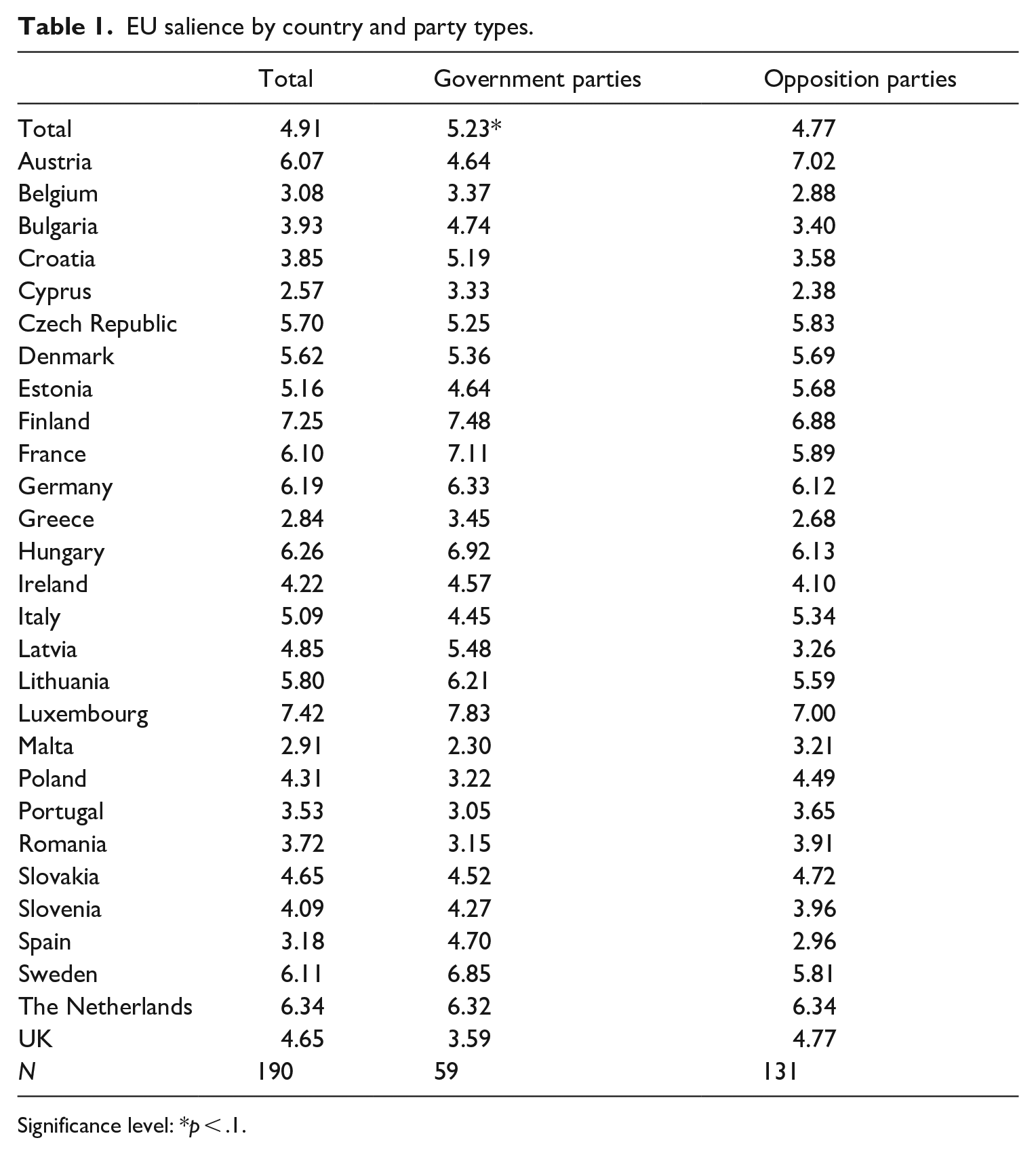
Significance level: *p < .1.
The results are also consistent with the notion of a waning of the second-order model in EP elections. The mean for the 28 member states stands virtually at the mid-point of our scale. On average, then, parties’ EP election campaigns in 2019 in the 28 EU countries were a practically balanced mix between European issues on one hand, and national and regional issues on the other. While this average inevitably masks considerable variance, it is worth noting that only eight countries have an average score of below 4 on the scale, with 13 countries showing a greater preponderance of EU issues than national or regional ones in their campaigns.
Table 2 summarizes the results from the OLS regression analyses, first for predictors derived from the selective emphasis models (M1 and M2), then for the co-orientation models (M3 and M4), and finally for the integrated models (M5 and M6). Models 1, 3, and 5 presented in the tables refer to the direct effects of the predictors, Models 2, 4, and 6 add interaction effects. All models control for (extremity of) parties’ EU positions and the composition of the expert sample.
Selective emphasis, co-orientation, and integrated models of strategic campaign communication.

SE: standard error; SOL: strength of leadership.
Significance levels: *p < .1, **p < .05, ***p < .01, †p < .001; displayed are unstandardized coefficients of an OLS regression (in parenthesis: clustered standard errors); variables included in interaction terms are z-standardized.
Turning to the explanatory variables derived from the selective emphasis approach, we hypothesised that if a party was internally divided on questions of European integration, the probability that it would put EU issues on its agenda would decrease (H2). The main effect of this variable is significant neither in the isolated selective emphasis model (M1 in Table 2) nor in the integrated model (M5). Therefore, H2 must be rejected.
Following the muffling thesis of Parsons and Weber (2011), we then asked the ancillary RQ1a: whether the SOL determines the party’s probability to campaign on EU issues. As mentioned above, strength of party leadership is measured through performance in the last polls before the 2019 EP elections minus the share of votes the party received in the last preceding national election. The findings regarding this question had been mixed in earlier studies. For the 2019 EP election campaigns, we find (marginally) significant direct effects for SOL (Table 2, M1: b = .024, p < .05 and M5: b = .023, p < .1). The effect points in the direction that strong leaders seem to emphasize EU issues, and it is displayed visually in Figure 1 together with all direct effects of the integrated model.
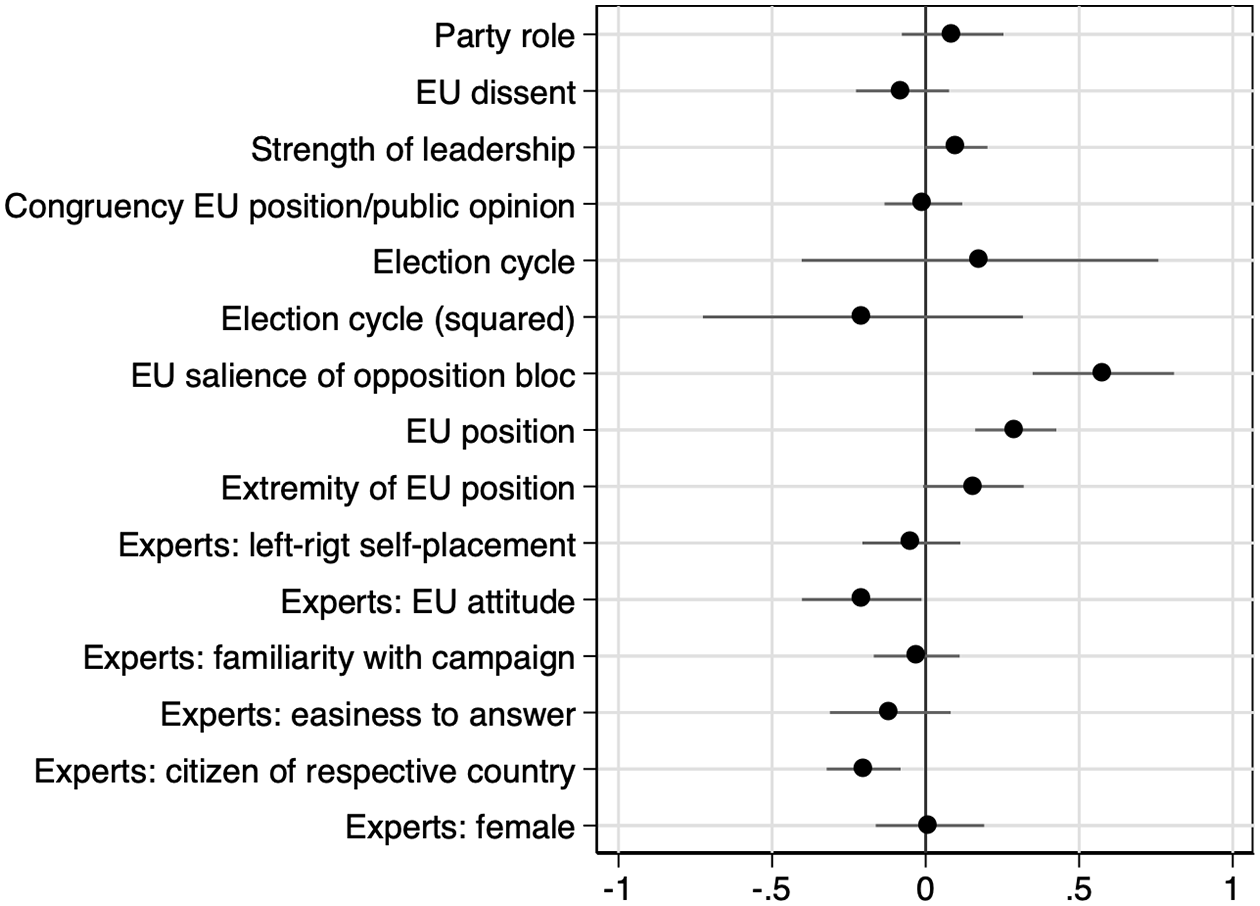
Coefficient plot with standardized variables.
Regarding RQ1b, whether the interaction between inner-party dissent and SOL determines the party’s probability to campaign on EU issues, we find support only in the selective emphasis model (Table 2, M2: b = .251, p < .01; margin plot, see Figure B1 in the Web Appendix B). However, it is not significant in the integrated model (M6). Regarding the last aspect of the muffling thesis addressed in the ancillary RQ2, whether the interaction between SOL and the electoral cycle (i.e. closeness to national elections vs midterm) affects the salience of EU issues on the campaign agenda, we find no significant results at all.
Our last hypothesis for the selective emphasis model focusses on the attention political parties give to public opinion. It assumes that congruence between a party’s EU position and public opinion on EU integration will increase EU salience in the party’s campaign. Again, we find no significant effects and, therefore, H3 is also rejected.
In models M3 and M4 in Table 2, we turn to the variables derived from the co-orientation approach. H4a posits that the more salient EU issues are in the campaigns of a country’s opposition parties, the higher the probability that government parties will also campaign on European issues. Conversely, H4b supposes that the salience of EU issues in opposition parties’ campaigns will be independent from government parties’ campaign agendas. These are tested using two indicators that each include the information for both party types, that is, one measure for EU salience in the campaign of the respective opposing bloc, and one variable interacting that first measure with the own political role of the party (government or opposition) to test for differences between the two (see also ‘Methods’ section). The findings show very consistently for all models that in fact EU salience rises in the campaigns of government and opposition parties if the EU salience in the opposing bloc increases (Table 2 co-orientation model: M3: b = .678, p < .001, M4: b = .999, p < .001, integrated model: M5: b = .671, p < .001, M6: b = .963, p < .001). The interaction term with the party’s own political role is not significant in any of the models (M4 and M6), meaning that government and opposition parties react similarly to the agenda of the opposing bloc. As a result, H4a, claiming that government parties have a higher likelihood to put EU issues on the campaign agenda when opposition parties do so too, is supported. However, H4b is not supported, as opposition parties also clearly show co-orientation towards the campaigns run by government parties.
Conclusion
The aim of this article was to assess what factors drove the strategic decisions to emphasize (or downplay) EU issues in parties’ campaigns for the 2019 EP election. Based on a unique database covering the campaigns in all 28 EU member states, we test the integrated model of campaign communication that combines predictors from both the selective emphasis and the co-orientation approaches.
Overall, our findings show that, on average, parties’ campaigns in 2019 contained a practically even mix of European issues with national and regional ones. Moreover, consistent with preliminary findings for 2009 and 2014, the traditional expectation that government parties in general silence EU issues does not hold here. Rather, overall EU salience was quite similar in the campaigns of government and opposition parties, confirming a trend that has become apparent since the 2009 EP elections.
We also find that only a limited number of factors which were proven to be good predictors in earlier studies with subsets of EU countries maintain their significance when we combine both theoretical models, control for other relevant variables (e.g. party’s EU position and the composition of the expert survey) and consistently test them for all member states. The systematic relevance of a party’s internal division on EU integration as a predictor for EU salience in its EP election campaign is not found. The findings also lend only partial support to the three factors introduced by the ‘muffling thesis’ of Parsons and Weber (2011). For strength of party leadership, we only find (marginally) significant direct effects, with strong leaders indeed being more likely to emphasize EU issues. For the interaction between inner-party dissent and SOL, an effect can only be found in the selective emphasis model. For the interaction between SOL and the electoral cycle, there are no significant effects. The assumption that the parties are guided by public opinion is also not supported in these fully specified models.
However, there is strong evidence that parties show co-orientation: The factor that turns out very strongly and consistently throughout all models is the co-orientation of parties towards the agenda of the respective opposing bloc. The findings show that, contrary to theoretical assumptions, not only government parties react to opposition parties, but in 2019, opposition parties also showed co-orientation with the EP campaigns run by the government parties. In addition, in all models we find that, in 2019, a positive EU position increased EU salience in EP campaigns as did the extremity of the party’s EU position (see also De Vries and Hobolt, 2020).
The results of this article are of relevance for researchers interested in strategic campaign communication and in EP elections. With regard to the former, our analysis provides insight on the relative impact of the selective emphasis and co-orientation approaches within the particularly relevant context of EP elections. As for the latter, our results for the 28 EU member states in 2019 suggest that the second-order model no longer seems to hold, with campaigns giving on average equal balance to European versus national/regional issues. In addition, we find that parties in government do not downplay European issues compared with their opposition and challenger counterparts in these elections. While the lack of longitudinal data constrains our explanations for this pattern, this is not inconsistent with the recent success of challenger parties and their role in politicising previously neglected issues, not least European integration.
Naturally, our analysis is not without limitations. By focussing on systematic effects on the campaigns of all parties in the EU member states simultaneously, it does not take into account specific interactions between parties on the respective national levels. In addition, while customized to analyse parties’ overall strategic communication behaviour during the 2019 EP campaigns, the data neither allow for more general statements, for example, a longitudinal assessment, nor a more detailed analysis of dynamics and interactions of actors over the course of the campaign. These questions have been subject to different papers and will stay highly relevant also in the future.
The findings from this analysis do, however, suggest some caution when generalizing results based on more specific country samples and less inclusive theoretical models. On the other hand, of course, it will be interesting to further develop the integrated theoretical model suggested here. As De Vries and Hobolt (2020) have pointed out, when looking at internal party dynamics (see also Lehrer, 2012), the interplay between party leaders and activists, could be an interesting aspect for future research (see also Schumacher et al., 2013). Another possible venue would be to also take into account organisational goals of parties (Wagner and Meyer 2014).
Research Data
sj-do-1-pol-10.1177_02633957211008348 – When do parties put Europe in the centre? Evidence from the 2019 European Parliament election campaign
sj-do-1-pol-10.1177_02633957211008348 for When do parties put Europe in the centre? Evidence from the 2019 European Parliament election campaign by Michaela Maier, Carlos Jalali, Jürgen Maier, Alessandro Nai and Sebastian Stier in Politics
Research Data
sj-dta-2-pol-10.1177_02633957211008348 – When do parties put Europe in the centre? Evidence from the 2019 European Parliament election campaign
sj-dta-2-pol-10.1177_02633957211008348 for When do parties put Europe in the centre? Evidence from the 2019 European Parliament election campaign by Michaela Maier, Carlos Jalali, Jürgen Maier, Alessandro Nai and Sebastian Stier in Politics
Supplemental Material
sj-pdf-3-pol-10.1177_02633957211008348 – Supplemental material for When do parties put Europe in the centre? Evidence from the 2019 European Parliament election campaign
Supplemental material, sj-pdf-3-pol-10.1177_02633957211008348 for When do parties put Europe in the centre? Evidence from the 2019 European Parliament election campaign by Michaela Maier, Carlos Jalali, Jürgen Maier, Alessandro Nai and Sebastian Stier in Politics
Footnotes
Acknowledgements
The authors thank Michaela Becka, Tomaž Deželan (University of Ljubljana), Leena Ilmola (IIASA), Ance Kaleja, Katia Mihailova (University of Sofia), Carmen Sammut (University of Malta), Adam Shehata (Universit of Gothenburg), Vaclav Stetka (University of Loughborough), Adriana Ștefănel (University of Bucharest), and Aneta Világi (Comenius University Bratislava) for translating the English keyword list for the social media analysis in their national languages.
Funding
The author(s) received no financial support for the research, authorship, and/or publication of this article.

Supplementary Information
Additional supplementary information may be found with the online version of this article.
Notes
Author biographies
References
Supplementary Material
Please find the following supplemental material available below.
For Open Access articles published under a Creative Commons License, all supplemental material carries the same license as the article it is associated with.
For non-Open Access articles published, all supplemental material carries a non-exclusive license, and permission requests for re-use of supplemental material or any part of supplemental material shall be sent directly to the copyright owner as specified in the copyright notice associated with the article.
