




Abstract
This article examines how contending constructions of safe space for migrants reflect the geopoliticization of humanitarianism and its geosocial discontents. It contrasts geopolitical constructions of safe space that have been used by European authorities to justify and administer Hotspots with geosocial efforts to construct safe space through practices of solidaristic accommodation. The article documents the ways in which Hotspots have made migrants unsafe, even as they have been simultaneously justified in humanitarian terms as making both Europe and refugees safer. It further illustrates, by contrast, how counter-constructions of safe space can take divergent geosocial forms. These varied geosocial formations of accommodation emerge out of embodied space-making struggles for physical safety, personal dignity, organizational autonomy, radical democracy, spatial liberty, and social community. They create context-contingent alternatives to Hotspot geopolitics as well as opportunities for migrants and their allies to critique the limits of official humanitarianism. But they also remain overdetermined by the dominant border politics that Hotpots are supposed to secure. For these reasons, the borderlands between the abstract geopolitics of Hotspot humanitarianism and the embodied geosocial constructions of solidarity show safe space to be at once complex, compromised, and constantly contested.
Safe space sounds simple and easy to identify. However, in this article, we show how contested constructions of safe space for migrants in Europe contend with one another, creating complexly interconnected experiences of relative safety and precarity. We contrast geopolitical constructions of safe space that have been used by European authorities in the creation of Hotspots with what we describe as geosocial efforts to construct safe space through practices of solidarity. These solidarity practices by activists and refugees in open camps and accommodation centers demonstrate a practical concern with making migration safer in situated, embodied, and relational ways. They involve transnational but also local space-making struggles that we explore in terms of physical safety, personal dignity, organizational autonomy, radical democracy, spatial liberty, and social community. By contrast, the geopolitical depictions and declarations of safe space by European officials have endangered migrants by variously curtailing and channeling their movements. Instead of making movement safer, they have thereby imposed a mix of coercive immobility and mobility together in ways that undermine efforts to construct embodied spaces of migrant safety. In the resulting borderlands between the abstract geopolitics of Hotspot humanitarianism and the embodied geosocial constructions of solidarity, safe space emerges as a complex, compromised, and continually contested construction.
By comparing the dangers created by Hotspot geopolitics with the geosocial struggles to secure embodied forms of safety through solidarity activism, our first main goal in what follows is to offer a critical investigation of how the safe space discourses of European authorities are contributing to a geopoliticization of humanitarianism. Following Jennifer Hyndman (2012), we are interested in how such geopoliticization leads to “the flotsam and jetsam of conflict [being] sequestered spatially out of view or in between the cracks of territorial jurisdiction.” (245). Reciprocally, by drawing on two case studies of solidarity accommodation in Greece, our second goal is to highlight the work of activists and migrants in countering the sequestration produced by the geopolitical depictions and declarations of safe space. In this way, we seek to contribute to broader efforts to document the agency of migrants themselves—often working in solidarity with students, activists, academics, and volunteers—to transform the conditions of migrant life as well as to problematize the rhetoric of migrants as victims or threats. Drawing on critical theories of borders, migration, geopolitics, and the geosocial, we seek thus to contribute to recent research into the spaces of migrant belonging and place-making in contemporary Europe (e.g. Ataç, 2016; Mudu and Chattopadhyay, 2017) as well as to investigate further how it is variously challenged and channeled by sites such as Hotspots (e.g. Antonakaki et al., 2016; Fassin, 2016; Painter et al., 2016; Tazzioli, 2016). Highlighting the limits of liberal humanitarianism in practice, the goal is to show how the negotiation of these limits in borderland geographies continually recontests and reconstitutes the meaning of safe space. Theoretically, we think that these shifting borderlands of safe space indicate a need to adapt Foucauldian arguments about “making live” and “rejecting into death” in modern biopolitics in order to come to terms with a wide range of intermediate experiences of “subcitizenship” between the poles of biopolitical enfranchisement and necropolitical rejection (Fassin, 2009; Sparke, 2017, 2018). And this, we also want to suggest, means taking Foucault’s (1984) own injunction about the critical edge work of European enlightenment quite literally: in short, “we must go beyond the outside-inside alternative; we must be at the frontiers” (45).
Contemporary scholars of borders in Europe have already made important interventions in borderlands and citizenship studies with analyses of border control externalization around the periphery of so-called EUrope’s “Mediterranean neighborhood” (Collyer, 2016; De Genova, 2016; Vaughan-Williams, 2011). As these interventions make clear, geopolitics is at once an active ingredient and unstable outcome of the power dynamics made legible at Europe’s borders. Echoing Etienne Balibar, Luiza Bialasiewicz (2011) suggests that EUrope’s borders have thereby become “spaces of the political itself” where studying the EU’s “border-work” simultaneously offers insight into “EUropean geopolitics” (2–3). As such, it is a geopolitics that is constantly renegotiated and remade on the EU’s borders, precisely in sites such as Hotspots, through which geopolitical discourses come to have a wide range of biopolitical and necropolitical effects (Vaughan-Williams, 2011).
It is these entanglements in between biopolitics and necropolitics that in turn prompt us to draw on both critical theories of geopolitics that emphasize the power of representation in constructing geopolitical discourses and the wide range of radical scholarship that has underlined the material, emotional, and frequently lethal forces that remain influential amid and on such geopolitical scripting (Dixon and Marston, 2011; Hyndman, 2007; Mostafanezhad, 2017). Following feminist arguments in these literatures, we are especially interested in the ways that embodied and situational accounts of how people negotiate geopolitics on the ground can challenge the top-down territorialization of state space and open new opportunities for examining political autonomy and resistance relationally (Naylor, 2017).
Recent critical research by migration and refugee scholars has further complicated state-making maps of geopolitical territory by addressing the experiences and encounters of migrants (and migration officials) as they negotiate borders and attempt to construct transnational lives and homes through local relationships (Mountz and Loyd, 2014; Martin, 2012). As Katherine Brickell (2012) underlines, such research can usefully complicate dominant geopolitical discourses of homeland security by raising new questions about migrants (and others) seeking the security of safe homes across geopolitical boundaries. In a related way, we turn to recent work on geopolitics that emphasizes the geosocial as a name for the social geographic imaginations and associated practices connecting people across borders, including through transnational migrant activism (Mitchell and Kallio, 2017). Our two main examples of geosocial solidarity—City Plaza Hotel (also known as the Refugee Accommodation Center) in Athens and Lesvos Solidarity (formerly known as PIKPA)—rely on transnational ties of solidarity to sustain their radical actions with migrants and in opposition to geopolitical scriptings of safe space. These types of transnational connections bring both attention and financial resources to the local space-making projects in ways that enable them to contest and resist—for a time at least—the imperatives of EU and state control. In the process, they unveil the geopolitical scripts of safe space that are deployed to justify and administer the Hotspots as discourses that actively turn the care claims of liberal humanitarianism into spatial practices of control (Pallister-Wilkins, 2020).
The article is organized as follows. In the first section, we analyze the rhetoric and implementation of Hotspot geopolitics in Europe and its repercussions for migrant safety. We document how the Hotspots have been both justified and administered in ways that project geopolitical constructs of safety, and we highlight how this has nevertheless led to increased precarity for migrants. We follow this with studies of two distinct counter-hegemonic efforts to create local spaces of safety for migrants, efforts that, despite their many differences, simultaneously mobilize geosocial connections to sustain embodied practices and experiences of care over time. The first of these involves the squatted hotel, City Plaza, organized in Athens by the Refugee Accommodation and Solidarity Network. The second is an open camp on the island of Lesvos originally named PIKPA but now, at the insistence of the local authorities, called Lesvos Solidarity. This camp was initiated by local residents and is now organized and run by migrants, residents, and volunteers. While City Plaza’s solidarity with migrants is inspired more by anarchist politics and discourses of resistance, and while Lesvos Solidarity appeals instead to ideas about supporting resilience among the most vulnerable, the two initiatives share a common geosocial approach to making safe space through grassroots networking. In the conclusion, we return to review what the comparisons between our examples illustrate about the continually contested character of safe space in Europe’s borderlands.
These observations and arguments are underpinned by three and a half months of empirical research in Europe in Autumn 2016, specifically in Lesvos, Athens, Brussels, Berlin, and Geneva. During this period, we conducted 32 semistructured interviews with a mix of representatives from intergovernmental agencies (UNHCR, WHO, and IOM), NGOs (MSF, MDM, PICUM, and ESI), solidarity spaces (City Plaza and PIKPA), and associated volunteers. Additionally, we engaged in short periods of participant observation as volunteers at City Plaza and Lesvos Solidarity. Before, during, and after this time, we continued to follow official announcements from EU authorities and their critics about the purpose of Hotspots and the related development of safe space discourses designed to justify and administer the processing of refugee asylum claims in Hotspots. It is to these geopolitical discourses that we turn next before proceeding to look at their geosocial contestation.
1. Hotspots and the geopolitical construction of “safe space”
“The aim of the Hotspot approach,” explained the EU Migration, Home Affairs and Citizenship Commissioner in July 2015, was “to provide a platform for [EU] agencies to intervene, rapidly and in an integrated manner, in frontline Member States when there is a crisis due to specific and disproportionate migratory pressure at their external borders” (Avramopoulos, 2015: 2). The approach was also meant to make “visible” the effectiveness of this integrated EU “support” while also insisting that the “assistance” of Commission-controlled agencies was designed to preserve the sovereignty of Member States even as it aimed at enforcing their compliance with EU migration rules. For these overlapping reasons, the construction of the Hotspots had geopolitical ramifications from the start. Numerous geopolitical discourses and displays came to be performed in the actual spaces of intervention, and geopolitical complications over sovereignty have continued to frustrate the visibilization of coordinated control. Yet, as Didier Fassin (2016) has underlined, the Hotspots nevertheless also produced a clear geopolitical outcome: “They achieved a new frontierization of the border control regime.”
Our analysis begins with Fassin’s observation but also builds on the nuances added by critical geographers, including other Hotspot studies published here in Society and Space. This emerging work has focused attention on the performance of EU governance within Hotspots, arguing that they are sites where the determination of insiders and outsiders highlighted by Fassin also illustrates how EU authority and identity are established or are imagined as being established through the avowedly humanitarian processing of migrants (Antonakaki et al., 2016; Pallister-Wilkins, 2020). We augment these critiques by adding the observation that the triage and rejection work of the Hotspots is both being secured by geopolitical constructions of safety and contested by geosocial counter-constructions of safety.
Two particular geopolitical constructions of safe space have come together in the Hotspots. First is the justificatory construction of the Hotspots as safety-enhancing spaces that will safeguard the security of Europe and the overall well-being of migrants at the same time. Second is the administrative construction of “safe space” inside the Hotspot processing spaces themselves. In combination, these geopolitical discourses have actually served to endanger migrants, rendering them vulnerable to unsafe living conditions in and around the Hotspots, along with the numerous dangers posed by delay, diversion, and deportation due to how the Hotspots have created movement-controlling forms of containment beyond detention itself (Tazzioli and Garelli, 2020).
1. i Justificatory geopolitics
Presented by the EU as a way of protecting Frontline Member States from the crisis of “disproportionate migratory pressure,” the justificatory geopolitical discourse of securing the safety of Europe also came with claims that the Hotspots would help make the Mediterranean safe for migrants by creating safer pathways than those used by smugglers. Hotspots were presumed thus to “safeguard” the EU, EU values, and migrants all at once; doing so, as Pallister-Wilkins (2020) makes clear, by proffering Hotspot humanitarianism as a response to rising reactionary rejectionism in the EU. The result was a discourse of justification that was as much about forcefully responding to the geopolitical discontents of nationalistic insiders as managing geopolitical fears about pressures coming from the outside. Announced as a coordinated EU response to the migratory “crisis,” the Hotspots were clearly meant to quell a crisis of confidence in the EU itself.
The basic bureaucratic plan justified by this double-duty discourse was itself quite simple: namely, to co-locate and coordinate in the Hotspots the work of the European Asylum Support Office, the EU Border Agency (FRONTEX), the EU Police Cooperation Agency (EUROPOL), and the EU Judicial Cooperation Agency (EUROJUST). The still narrower aim was to monitor and enforce Greek and Italian compliance with the EU’s Dublin regulations (the regulations that, with some exceptions, make Member States where migrants first arrive responsible for asylum screening). But just as this compliance enforcement was coded as “capacity-building” to help deal with the “crisis” in the frontline states, the larger justification for these interventions was tied to concerns about protecting the EU from perceived geopolitical threats coming from both the outside and the inside at the same time. The British Border Force boat named “Protector” that was moored in Mytilene harbor during our fieldwork on Lesvos was a highly visible symbol of this geopolitics of protection. Moreover, the fact that during our time on the island it was not once engaged in actually protecting the safety of refugees trying to cross from Turkey was indicative of the wider concealment of danger and damage that, as we show below, has been made possible by the geopolitical constructions of safe space. 1
The justificatory discourse of the EU’s approach was also remarkable for the ways it combined its guidance for the bureaucratic processes to be performed in the Hotspots with advice about how these processes should determine asylum and deportation decisions (e.g. Avramopoulos, 2015a). Throughout the official EU discourse, the promise of efficient and, as Martina Tazzioli (2016) has underlined, speedy bureaucracy is suggested as bringing security and safety: whether it was by accelerating the screening work of border control, expediting asylum, or fast-tracking investigations of smuggling and trafficking. Meanwhile, the violence and dangers of deportation (including the dangers of being made to wait for deportation in the Hotspots) were obscured with simple and safe-sounding references to “return operations… [f]or those who are not in need of protection” (Avramopoulos, 2015). As we shall see, these sorts of innocuous assertions about returning migrants to places where they do not need protection have relied, in turn, on geopolitical projections of safe space in the administration of Hotspot screening. But before we investigate how these administrative imaginations of safe space have been used to curtail Geneva protections, it is important to address one other consequential iteration of the justificatory discourse that began on 18 March 2016 with the announcement from Brussels of the EU–Turkey agreement.
“In order to break the business model of the smugglers and to offer migrants an alternative to putting their lives at risk,” explained the European Council (2016), “the EU and Turkey today decided to end the irregular migration from Turkey to the EU.” “The aim,” as it was later explained in the EU’s implementation statement, was to make migrants safer by replacing “disorganised, chaotic, irregular and dangerous migratory flows by organised, safe and legal pathways to Europe for those entitled to international protection in line with EU and international law” (European Commission, 2016). To achieve this switch to safer legal pathways, the deal envisioned two major innovations in migration management, both of which were reputedly meant to reduce danger by redirecting flows. The first was to start returning all nonadmissible migrants to Turkey from the Greek islands as a form of deterrence; in the EU’s words, “to make clear that this is a dangerous route and the wrong route” (European Commission, 2016). The second was to start resettling displaced Syrians from Turkey into the EU. Meanwhile, as part of the formal agreement, Greece was asked to adapt its Hotspots to facilitate fast returns while also providing “closed” detention facilities inside Hotspots “to avoid irregular migrants absconding when they are subject to return decisions” (European Commission, 2016).
Even though the calls on the Greek government to provide for fast deportations and detention for irregular migrants made visible the work of rejection, the sanitized language of “returns” and “closed” facilities came together with a rhetorical emphasis on protecting migrant safety. This rhetoric served to consolidate the justificatory discourse of making the Mediterranean a “safe space”. Moreover, even the work of deportation back to Turkey was justified in the language of “safe-guarding” migrant rights, honoring the Geneva Conventions, and protecting refugees from refoulement. For these reasons, Greece was obliged in the deal-making “to provide a legal framework for the implementation of the ‘first safe country of asylum’ and ‘safe third country’ principles” and thereby to recognize Turkey as a “safe third country” to which migrants could be safely returned (European Commission, 2016).
1. ii Administrative geopolitics
There are two basic reasons why the administrative geopolitics of safe space declarations have created new dangers for migrants. First, by geopolitically relabeling various dangerous countries as “safe countries of origin,” “safe countries of asylum,” and “safe third countries,” they allow for the deportation of refugees to places such as Turkey that are not actually safe for the majority of people being returned. Second, by creating endless delays in the determination of deportability to these nonsafe “safe” spaces, the actual administrative implementation of the “safe country” principles has allowed for the indefinite detention of refugees in increasingly unhealthy and hazardous Hotspot camps.
The fundamental problem with EU declarations of “safe space” is the way that they constrict and circumscribe the legal responsibility of Member States to protect refugees. In place of the liberal biopolitics of protecting individuals that is enshrined in the Geneva Conventions, these declarations effectively substitute an illiberal geopolitics aimed at externalizing the work of rejection. Even before the implementation of safe third country principles in Hotspots, the evolving EU asylum rules had been moving toward a common regime mandating Member State authorities to use the massive territorially encompassing safe space designations as preemptive alternatives to assessing the merits of particular individual cases. In response, critical legal analyses have highlighted the illiberal territorialization of Geneva protections this has entailed (ECRE, 2015; Hopkins, 2009; Hunt, 2014). Such critics question whether safe country principles can ever be compliant with liberal human rights protections and argue further that the associated deflection of Geneva protection responsibilities results directly from the geopoliticization of the safe country designations by foreign policy agencies and agendas.
Given the preexisting trend toward circumscribing Geneva protections for asylum-seekers, the EU–Turkey agreement of 2016 served to render the illiberal implications of safe country designations much more visible. By making Turkey the readmission target of deportations from Greek Hotspots, and by obliging Greece thus to recognize Turkey as a safe third country, the deal also brought the geopolitical contradictions out into the open. In a comprehensive critique of the EU–Turkey deal, Amnesty International (2016) noted that Turkey simply was not safe for asylum-seekers, thereby making the EU–Turkey agreement “illegal and unconscionable.” Amnesty’s brief highlighted three main reasons why the assumption that Turkey was safe was a “fiction”: first, the lack of good asylum processes; second, the lack of durable solutions such as integration and resettlement; and third, the lack of decent options for work, subsistence, and shelter in Turkey.
The other notable problem of the Hotspots has been that although they were initially projected from Brussels as spaces of fast, targeted, and coordinated administrative action to move asylum-seekers along, they have become sites of delay, detention and, in an increasing number of cases, death. While the justificatory geopolitics and administrative geopolitics of the Hotspots construct them in sanitized terms as being concerned with safety for both Europeans and migrants, in practice, the opposite is the case for many asylum claimants. To adapt the terms of Michael Collyer’s (2012) critique of deportation dynamics elsewhere in Europe, the system works as a technology of subcitizenship that enforces reterritorialization by physically and often violently reassigning individuals to particular projections of “safe space.”
In place of the coercive mobility imagined by the advocates of the EU–Turkey deal, the Hotspots have become squalid sites of coercive immobility where the close ties between deportability and detainability have become brutally obvious (cf. De Genova, 2016b: 5). Moreover, as Garelli and Tazzioli (2016); Tazzioli and Garelli (2020) argue, they create a powerfully preemptive frontier effect. The intimidating barbed wire and multiple layers of fencing around and inside the Moria camp on Lesvos are indicative in this way of the dangerous reterritorializations constructed by Hotspot geopolitics more generally. As the “Moria is A Jail!” graffiti on the main road to Mytilene also makes clear, these reterritorializations result in the creation of what migrants experience as a mix of penal and parole-like conditions of highly circumscribed movement. “Lesvos is a jail!” declared a Pakistani teenager to us, poignantly underlining the difference between our freedom and his containment as we drove him into the city in a rental car. And in practice, these penal conditions and gated movements have made migrants increasingly unsafe.
1. iii Unsafe Hotspots
Reporting on the coercive immobility experienced by over 60,000 refugees detained in Greece after the EU–Turkey deal, the global health NGO Médecins Sans Frontières (MSF) was scathing in its 2016 report. They wrote: “Appalling conditions are still the norm for all those stuck in the camps” (MSF, 2016). MSF went on to list many other more systemic dangers of chronic uncertainty, insecurity, and loss of family integrity facing those detained in the Hotspots as well as a long list of practical problems including poor food, sanitation, lighting, and access to hygiene. The report highlighted how refugees have also been exposed to insect bites, snakes, and harsh heat in the summer, while also being extremely vulnerable to winter weather because of the flimsy nature of many camp shelter materials.
Subsequent to the publication of its October 2016 report, MSF’s warnings about the threats posed by the bad conditions and winter cold in the Hotspots were proved tragically accurate. In late Autumn 2016, fires broke out, killing and injuring detainees in Hotspots. These included at Moria where a cooking gas container exploded, killing a Kurdish woman and her grandchild. In December and January, the following year, thousands of refugees suffered through subzero temperatures in unheated tents covered with snow. As a result, there were more deaths, including again at Moria when three more refugees died while trying to warm themselves (Al Jazeera, 2017). Then in early February 2017, Human Rights Watch received a text from a 30-year-old Iranian asylum-seeker detained on Lesvos reporting on the increasing death and despair all around. “[P]eople died in cold in the camp,” read the text, “an Iranian attempted suicide and an Egyptian hung himself. Yesterday, a Pakistani died, and last week, an [Egyptian] died in the bathroom. I attempted suicide by cutting my vein last week but I am still alive….” (Cossé, 2017).
The Hotspot projections of safe space have also created and concealed more systemic forms of danger due to delay, detention, and generalized dysfunction in and between the camps. In parallel with the effects of violent inaction at camps elsewhere in Europe such as Calais (Davies et al., 2017), the supposedly humanitarian Hotspots have thereby created subcitizenship experiences of abandonment. Depression and widespread signs of hopelessness were already reported by MSF (2016: 24), including statements from refugees comparing their camp experiences unfavorably with the war zones from which they had escaped. The net result of the problems is the antithesis of safety: in short, as the Danish-Iraqi founder of Team Humanity told reporters for Al Jazeera, “Greece is not a safe place to live for refugees” (Strickland and Safdar, 2017). Even the Greek Minister of Migration was obliged to agree as arctic air blasted the Aegean in January 2017. “The situation in the hot spots is very bad,” Yannis Mouzalas, acknowledged. “Conditions on the islands are awful” (Smith, 2017). Asked to speak about this from Brussels, a spokeswoman for the European commission also had to agree. “The situation is untenable,” she said (Smith, 2017). However, she also had a coda letting the Commission off the hook. “But we also have to be clear,” she insisted, “that ensuring adequate reception conditions in Greece is a responsibility of Greek authorities.”
The EU’s outsourcing of responsibility remains unconvincing because of how the Hotspot approach has been dictated to Greece from the start, along with the harsh austerity measures that have limited the ability of the Greek government to respond to the needs of refugees. However, this has not stopped Greek solidarity activists and social justice volunteers from around the world from working with refugees to provide alternatives. These alliances work to counter the dangers posed by Hotspots geopolitics with the geosocial construction of safe spaces inspired by visions of resistance and resilience. It is to these efforts that we now turn.
2. Geosocial constructions of safety through solidarity
In contrast to the geopoliticization of humanitarianism seen in the Hotspots, the efforts to create safe spaces for migrants through solidarity represent a different approach that we describe here in terms of geosocial practice. Instead of the geopolitical performance of care turned control through Hotspot abstractions about borders, territory, and safety, these geosocial practices of safe space construction are distinguished by their mix of transnational, but also personal and embodied modes of social justice-inspired protection. As such, they connect preliberal ideas about hospitality and welcoming foreigners with the postliberal and antineoliberal praxis of cohabitation, democratic self-government, and activism, all explicitly organized amid and against dispossession.
Our two main examples are self-organized accommodation spaces built on principles of solidarity and autonomous management. City Plaza articulates migrant solidarity with a politics of collective urban resistance and anarchist revolt against neoliberal state-making, whereas Lesvos Solidarity’s approach to solidarity emphasizes efforts at building resilience locally through forms of personalized care that aim at relieving the suffering inflicted by the liberal humanitarianism of the Hotspots. Although different in these ways, both solidarity initiatives have nevertheless developed explicit social justice agendas of securing space to help vulnerable groups wrest back a modicum of control over their lives and futures. As a result, and in contradistinction from Hotspot geopolitics, we argue that they represent interventions that, even if temporary, offer geosocially accountable forms of safe space.
The City Plaza Refugee Accommodation Center houses about 400 people, with 180 children among them. It is located in a former hotel in central Athens, the City Plaza, that had been abandoned as a commercial site in 2011, and which was taken over by activists and refugees in April 2016. The hotel infrastructure—including a big kitchen, a lounge-bar, a large dining room, numerous toilets, meeting rooms, and seven floors with individual rooms—has proved invaluable in providing good quality accommodation, food, and sanitation. Additionally, the building’s history has allowed for various culture-jamming representations that aim at reappropriating European hospitality traditions and renaming the hotel as a so-called Five Star Squat (Cirefice, 2018). Importantly, because the City Plaza Center is in the space of a former hotel with over 90 rooms, it is able to accommodate every refugee family in a separate room. Unlike many other informal refugee sites that tend to be spatially segregated by nationality, an organizer emphasized to us that it is also deliberately international, mixing nine nationalities of refugees and 20 nationalities of activists. Migrant nationalities include Syrians, Iranians, Iraqis, Kurds, Afghanis, Pakistanis, and Palestinians. As a solidarian and participant researcher, V’cenza Cirefice (2018), has documented in much greater detail than we can here, many of these groups attest to City Plaza becoming their “home.”
Lesvos Solidarity was started by volunteers in 2012 in the context of difficulties in the main reception centers and increasing numbers of asylum claimants arriving on the island in distress. The site, which is located in an old children’s summer camp, was initially envisioned as a temporary safe place for especially vulnerable migrants, including pregnant women, children, and the disabled as well as those who were sick. It has also served a small number of Greek citizens who have been made homeless by poverty and illness. During the rush of migrant arrivals in 2015, volunteers used the grounds and facilities to organize and distribute meals to over 3000 people daily. They also collected and distributed clothing to migrant reception centers across the island. The camp now serves about 100 people on-site—providing a health clinic in an old caravan as well as a small community garden and kitchen. Additionally, it helps to celebrate and promote the residents’ cross-cultural connections with murals and multiple events for the children.
To testify to the radical actions of migrants and activists at City Plaza and Lesvos Solidarity, and to contrast their geosocial construction of safe space with the geopolitics of the Hotspots, we outline six counter-constructions of safety that are practiced on the ground in these two sites. These are: (i) physical safety: through the provision of basic conditions for survival and social reproduction in areas of housing, clothing, food, and health; (ii) personal dignity: through mutual relations of respect and human connection; (iii) organizational autonomy: through initiating and sustaining the sites and their quotidian practices; (iv) radical democracy: through organizing heterogeneous ties of political networking both locally and transnationally; (v) spatial liberty: through asserting rights of mobility, especially free movement in and out of the sites; and (vi) social community: through working together in solidarity across differences and with neighbors to sustain the sites. These six geosocial practices of constructing safe space do not describe everything important happening in these sites of activist accommodation, but we believe they give a good summary of how the participants have been able to work in the larger context overshadowed by Hotspot geopolitics to construct safe space geosocially.
2. i. Physical safety
Physical safety is a necessity of life at the most fundamental level. The security of being free of targeted violence and having basic survival needs met enables people to participate in other areas of social, political, and economic life. A pamphlet put out in October 2016 by City Plaza (2016) on the anniversary of its sixth month in operation highlighted the importance of such physical safety with “fragments of memories, thoughts, feelings” derived from interviews with eight of the original residents. In contrast to the Hotspot detainees declaring an interest in returning to war zones, we read of joy in the physical experience of reaching a nonviolent space: The first day was a happy day for me. I was in a bad place before… You know I come from Kunduz. People are dying there. Now I can’t talk often with my father and my mother on the phone. But I have told them that I am in a safe place…. (M., Afghanistan; City Plaza, 2016) In here I learned about humanity. I feel safe here. It is my family. We are free. We get education. I am happy. (J., Iran; City Plaza, 2016)
In a similar way, the entrance to the Lesvos Solidarity camp celebrates the physical “safe passage” of refugees to Lesvos with a display of life jackets on the fence alongside the main entrance. The camp also provides the residents with housing, food, clothing, medical assistance, and hygiene kits and relies on both volunteers and residents to keep the facilities clean. The residents are able to cook on their own using food provided by Inter Governmental Organizations and NGOs as well as by donations. At City Plaza, by contrast, all of the funding for food and other resources is provided through donations, but refugees join with volunteers from both local and international communities to do the cooking and cleanup. City Plaza also provides a health clinic one day out of the week, and, in another practical safety-assuring practice, runs a security work group comprised of refugees and volunteers that keeps watch over the front door of the hotel all day and night.
2. ii Personal dignity
The day-to-day involvement of refugees in cooking, cleanup, and other site activities is an important way in which both sites seek to accord residents with personal dignity. What this means for most people is treatment with respect and sociality—being treated as individual human beings worthy of attention and considered capable of agency. Refugees, volunteers, and activists all spoke of the importance of personal human connections and interactions for people who have been ripped out of the social fabric of their everyday lives at home, and who may also have lost family members and friends in their native countries or in the process of moving from one place to another. They deserve and are in need of friendship and human contact, of being seen and heard. “In Plaza we all live together. All kinds of different people. We fight together, we eat together. We are all humans” (P., Syria; City Plaza, 2016). Personal dignity is also something that enables individuals to once again see themselves as something more than a number to be added to a chart, a mouth to feed, or a member of a group that must be managed. There is a special pride and sense of dignity in being recognized as a person with skills and responsibilities, a member of a social community: Also in City Plaza, I was for the first time a person with responsibilities acknowledged by all others. People were coming and asking me what to do. That was very special for me. (J., Iran; City Plaza, 2016) I work in the storage. I feed all people here. Since I am here I learned a lot and I started trusting myself more. (S. Syria; City Plaza, 2016)
These statements are quite different from the reports from the Hotspots and also contrast dramatically with what Michel Agier (2011) writes about vis-à-vis the condition of vulnerability in many other refugee camps worldwide. What makes them vulnerable is the loss of their own social resources, the absence of connections, family or local, that could shoulder the burden of their suffering. Their distress may be temporary or lasting, but it exists only because their physical or moral handicap is part of an overall de-socialization: no longer having ties or anything to do, no interlocutors or voices.” (147)
By contrast, the geosocial basis for personal dignity at City Plaza and Lesvos Solidarity allows refugees to talk with one another and with solidarians and volunteers about future options. This ability to plan ahead provides a dignified space to imagine something better than life in the camps. Even though the organizers of Lesvos Solidarity have no control over the opening and closing of borders and the geopolitics of the Hotspots, they have still managed to keep alive a spirit of hope and resilience for both migrants and those aiding and working with them. For example, following the EU–Turkey deal, and the closing of the borders through the Balkan states, when the Greek registration process became defined by dysfunction, delay, and detention, Lesvos Solidarity volunteers and refugees opened up Mosaik, a community center in Mytilene offering language classes, practical work experience, skills training, and a daycare. All of these opportunities provided a space of dignity where migrants could remain productively engaged, work on improving their languages and life skills, and feel some hope in their future despite their loss of forward mobility. In a way that connected these personal opportunities to the geosocial construction of spatial liberty, Mosaik also posted bus transit schedules, supplied bus passes for island travel to the center for classes, and disseminated information about resources and services that could be accessed by migrants both in Lesvos and Athens (authors’ interview with Efi Latsoudi, 13 December 2016).
Every time we visited Mosaik, the joy and spirit of optimism that this small community center brought to the many people studying and working there were palpable. We were shown around the facility by an Afghani refugee and a Greek supporter who worked in administration and who were both extremely proud of the center and its accomplishments. They were delighted to point to the beautiful crafts that were produced by migrants, which included holiday ornaments and other items made out of the interior material of life jackets that had been left on the beaches as well as tote bags, purses, and pencil cases made from the exterior of the life jackets. Everybody involved was aware of the great irony that these useless life jackets were providing some benefit to migrants. A bit like the safe space principles used in Hotspot administration, most are “faux” life jackets that actually contribute to people sinking and drowning because the interior foam absorbs water. This is also the same foam that the children had cut out in the shape of the Christmas tree decorations for the walls of the common room at Lesvos Solidarity. Turning these useless material reminders of vulnerability into objects of craftwork and play helped restore at least a small sense of agency to the migrants. Meanwhile, at Mosaik, the money made from selling these craft items to international supporters and sympathetic tourists was reinvested in the Center, supporting the hiring of professional language teachers, the purchase of bus passes for refugees to travel between Mytilene and places such as the Moria Hotspot, and the operation of a small daycare that was free of charge for people enrolled in classes.
2. iii Organizational autonomy
According to its own website: City Plaza Refugee Accommodation Center is based on principles of self-organization and political autonomy. It functions through different working groups for cleaning, cooking, security, logistics, education and childcare, medical care, media-work, reception, which answer to the regular assemblies of refugees and solidarians. (City Plaza, 2017)
This was confirmed to us in an interview with one of the first organizers and activists involved in the squat, Nasim Lomani (see also Lafazani, 2017). Lomani told us that there were three different groups involved in creating the City Plaza solidarity effort: students, leftists, and the network for social and political rights for migrants. Organizational autonomy was a key concern for these groups from the start, as the plan was to organize and run a site with migrants as critical participants, not as passive receivers of help from outside. He said, “It’s not about charity without politics–nor about accepting categories created by the state. It’s about living together, people helping each other, and for having a politics of resistance” (authors’ interview with Lomani, 7 December 2016).
Not every resident is necessarily in full agreement with the anarchist organization principles and politicization of the squat (Cirefice, 2018). But when asked about the origins of the City Plaza, migrants spoke, sometimes with humor, about their participation in the political organizing and the endless plenaries that were held since the very first day. From the beginning, and as of December 2016 (eight months after the opening of City Plaza), the internal organization has been structured with two assemblies: a house assembly focusing on the day-to-day running of the hotel and a political networking assembly. Each meets once a week to talk about and make decisions on the larger issues with which they are confronted as a group. The micro decisions concerning the hotel are made through a decentralized system of decision-making by working groups: in addition to the security group, these also include the bar, health, kitchen, and communication groups. According to Lomani, there is a lot of coordination and trust between the assemblies and with the working groups, so they are able to act and react quickly to problems (authors’ interview, 7 December 2016). For example, when there was a fascist attack on a different solidarity squat in the city at 4:00 am, City Plaza was able to host those displaced by the attack within an hour and get a politically inspired message out to the media by 7:00 am. This was a full day faster than the response of any other political group in Athens.
The aim of the assemblies is not to have everyone agree but to have everyone be able to live and work together. “It’s mostly people participating and respecting one another and getting the idea of solidarity” (authors’ interview with Lomani, 7 December 2016). The rules are made for everyone to follow, including both refugees and volunteers; they include: “no racism, no sexism, no selling of services, no harassment.” In a strong contrast to the territorial labeling and separation of refugees in the Hotspots, the geosocial self-organization of rule-making at City Plaza has also worked to diminish national differentiation between residents. When one person suggested there should be individual separate assemblies based on nationalities that could deal with specific issues for each national group in their own language, the participants at the assembly collectively decided this was not a good idea because “it would be a mistake to harden national differences like this” (authors’ interview with Lomani, 7 December 2016). So far there have been no group fights, no national fights, and no harassment except for one case of spousal abuse. This is vastly different than what is happening in the Hotspots and even in the informal camps run by charities, many of which are experiencing internal violence (authors’ interview with Eric and Philippa Kempson, volunteers on Lesvos, 14 December 2016). Many of these conflicts are based on nationality, which appears to have become increasingly divisive among asylum claimants at least partially as a result of the geopolitical hierarchy of asylum worthiness managed in the Hotspots. (This hierarchy frames Syrian claimants as most worthy, followed by Afghanis and Iraqis; asylum claimants from Pakistan or much of Africa understand their origins to lead to an automatic designation for deportation, however much delayed.)
At Lesvos Solidarity, the organizational structure is similarly democratic and autonomous from top-down structures of state control. Decisions are made in assemblies and residents meetings that are deliberately nonhierarchical. Also, similar to City Plaza, the organizational tasks are broken down into “teams,” with focused specialties. Core organizers are compensated monetarily for their work, but most of the volunteers at the camp work for free. The migrants participate in the teams and in the overall discussions and assemblies and help to discuss and plan the daily operations and future direction of the site. The key overarching thematic, which was mentioned to us several times by a number of different people, is solidarity. The spirit of solidarity informs the organizational structure of the camp and is also a constant beacon and goal that guides their everyday practices.
2. iv Radical democracy
Geosocially animating solidarity in both sites is an ambition to at once embody, exemplify, and enact forms of resistance that make a political difference by working across state-territorialized difference. City Plaza was formed as an intentional space of political resistance to the agenda and policies of the EU and its member states vis-à-vis forced migrants, asylum-seekers, and refugees. Lomani noted thus that “we all wanted to do more than just help. We wanted to push to make a difference, to resist” (authors’ interview with Lomani, 7 December 2016). On the Solidarity Refugee and Accommodation website, the direct confrontation with the policies and rhetoric of Europe and the EU in relation to migrants and refugees was rendered even more explicit. The group’s manifesto is notable, in particular, both for its challenge to the status quo and also for its emphasis on solidarity and the practices of grassroots activism that are orchestrated to develop spaces of freedom and safety for all—including both locals and refugees. The existence of unused, fully equipped hosting facilities right next to hundreds of homeless people appeared in our eyes as a scandal in itself. A contradiction which reveals not only the hypocrisy of what is called European ‘refugee crisis management,’ but also the inner logic of a system in crisis …. By squatting an unused hotel we wanted to be paradigmatic, we wanted to stress – as an example – how the social movements and society from below are able to improve the living conditions of the refugees and thus improve the livelihood of all. We share the idea that by claiming the basic rights and providing for the needs of refugees, we also put in practice a conception of solidarity in everyday life and of self-organization which creates and develops spaces of freedom and of common struggles of locals and refugees. (City Plaza, 2017).
In this passage, we can see the connections between the practices of radical democracy and those of personal dignity and organizational autonomy. The deliberate link between the experiences and struggles of both locals and refugees is clear too, and it was also underlined to us by the talented cook in the kitchen who, as a Greek anarchist, saw a direct link between the protests against precarity by Athenians and the urban activism organized in and through City Plaza. Such efforts to connect radical democratic practices and claims for equity and justice across the differences of citizenship and belonging have resonated with migrants as well. One of the longer term (eight months) residents at City Plaza spoke about his experiences in this regard: “In Athens I demonstrated the first time also with Greeks and people from other countries” (M., Afghanistan; City Plaza, 2016).
Relatedly, a German solidarian, whom we also met working in the kitchen, explained in an online interview how she sees the everyday life of City Plaza residents connecting such local political actions with wider international struggles. “So, one main issue of the project is about organising day-to-day life in a collective and equal way. At the same time, however, it is also about wider struggles against borders, exclusion and discrimination” (Lafazani, 2017).
At Lesvos Solidarity, there is a similar interest in making connections between democratic struggles and claims for justice for vulnerable groups across citizenship divides. Two of the volunteers we worked with on the “clothing team” told us that sweaters and other needed items of clothing and food were often distributed to Greek people in need as well as to migrants across the island. This was confirmed by one of the original founders of the site, the UNHCR Nansen award winner Efi Latsoudi. She noted in an interview that Lesvos Solidarity was careful to share resources with impoverished Greek citizens in need in an effort to both lessen resentment and to better articulate and manifest the similar experiences of precarity (authors’ interview with Latsoudi, 13 December 2016). As with City Plaza, Latsoudi and the other Lesvos Solidarity members described the roots of the “crisis” as something that envelops everyone at the bottom of the economic pyramid—refugees and locals alike. This geosocial awareness of what connects across different kinds of vulnerability stands in stark opposition to Hotspot geopolitics, while also offering migrants a spatial basis on which to tie their personal political freedom struggle to that of others near and far.
A shared feature of radical democracy for both Lesvos Solidarity and City Plaza is thus the emphasis on tackling injustice rhetorically and pragmatically at both local and global scales. There is a strong effort by all of the activists and migrants to make visible the most egregious aspects of both the Greek austerity crisis and EU policies on migrants to demonstrate how these processes are interconnected. Moreover, both solidarity movements rely on transnational activist networks to get this message out globally and to solicit support. These socially mediated efforts to cross borders and share messages internationally work geosocially to at once articulate and activate a kind of transnational “demos” of all those concerned with migrant safety. Yet, by rendering differences in power across this demos open to radical democratic debate, they also raise important concerns about inequalities in spatial mobility.
2. v Spatial liberty
Both sites are deeply concerned with providing refugees with more mobility options. Information flyers on how to find health clinics and other resource centers when moving from Lesvos to Athens are prominently on display at Lesvos Solidarity, and meetings in the lounge bar at the City Plaza often involve discussions on how to help refugee families reunite in Germany or how to get out to the Athens Hotspots for asylum appeals. Beyond these practical responses to the coercive immobility of the Hotspots, the two solidarity sites are also places where we witnessed other more quotidian geosocial efforts to help migrants become free to move in and around the camp and hotel.
The residents at Lesvos Solidarity are fully autonomous in their use of cooking and cleaning facilities, washing, gardening, working, and in their right to enter and exit the camp at will. This is a clear distinction from the concentration camp feel of Moria’s main gate. Even if many Moria inhabitants were able to come and go freely at the time of our visit, the threat of a lockdown was ever present. For the same reason, several of the residents of Lesvos Solidarity whom we spoke with indicated how lucky they felt to be in this particular refugee site. They spoke of it as a community that was safe and open—contrasting it directly with Moria. They appreciated the freedom they had to come and go and contrasted this with their personal experiences of Moria, or what they had heard from others who had been or were still detained there.
After a long struggle with the local authorities and a few resistant locals, the children at Lesvos Solidarity are now allowed to attend the neighborhood school with the local children. Unlike the other migrant camps on the island, it is perceived as a place where migrants have some opportunity to integrate into the wider society. When we visited the site for the first time, nearly all of the children were at a movie in Mytilene. We also witnessed residents creating a new garden space for themselves as well as moving freely into and out of the camp and working in the Mosaik community center.
Similarly, in City Plaza, the residents are at liberty to leave the hotel at any time, find work if possible, and participate in activities both inside and outside the hotel. Efforts to help integrate the migrants with the wider society (and each other) include language lessons, parties, and visits from the children at the school next door. When we were at City Plaza, for example, students from the neighboring school came to learn about the squat, talk with the residents, volunteers, and activists and to provide both financial and moral support, and they subsequently co-organized a Christmas holiday singing session together back at the school. Long after our visit, we heard that City Plaza residents also won the right for their children to attend the local Athens schools, and a related picture of them outside the hotel holding a sign saying “WE LIVE AND LEARN TOGETHER” was published in the Guardian (see Figure 1).
2. vi Social community
The volunteer coordinator at Lesvos Solidarity underlined that “solidarity” really was a central feature of the camp. She said in an interview, “We all live together and work together–we play by the same rules. It’s a family” (authors’ interview 13 December 2016). Solidarity is also a key term, process, and goal at City Plaza. As Lomani noted, “City Plaza Hotel is against EU policy… it’s not about a charity without politics, nor about accepting the categories created by the state. It’s for living together, for people helping each other, and for having a politics of resistance” (authors’ interview with Lomani, 7 December 2016). For both of these people, part of the politics of these spaces is how they are organized as an expression of social solidarity, as a social community built out of diverse groups of people willing to live together and stand up for each other in times of trouble. The diversity of the social community in both sites is expressed in every way possible—from nationality, ethnicity, and race, to ability, class, age, gender, and citizenship. Knowing that others who were “strangers” at first can become like family through sleeping, eating, and working together, binds people together through time: The first day I was very scared. Everybody was a stranger to me. Now, when I enter it’s like my mothers and fathers home. (S., Syria; City Plaza, 2016) I feel we live all together in one house—400 people sharing a home in equality and with plurality. (N., Afghanistan; City Plaza, 2016) Living all together is very good. There is a lot of humanity. It is like my mothers and fathers house. I feel at home. I cannot fall asleep elsewhere anymore. (B., Afghanistan; City Plaza, 2016)
When Judith Butler visited City Plaza in May 2016, she addressed the importance of cohabitation that is also attuned to social power relations. She noted how European racism has led to “expelling its other” and pointed to the ways that the experiment of solidarity at City Plaza works on “breaking down the presumptions of that racism, not just by welcoming others but by insisting on living with them. Living together” (Butler, 2016). This is a kind of solidarity based on radical democracy and embedded in the sociality of everyday life at its most basic: that of spatially living together.
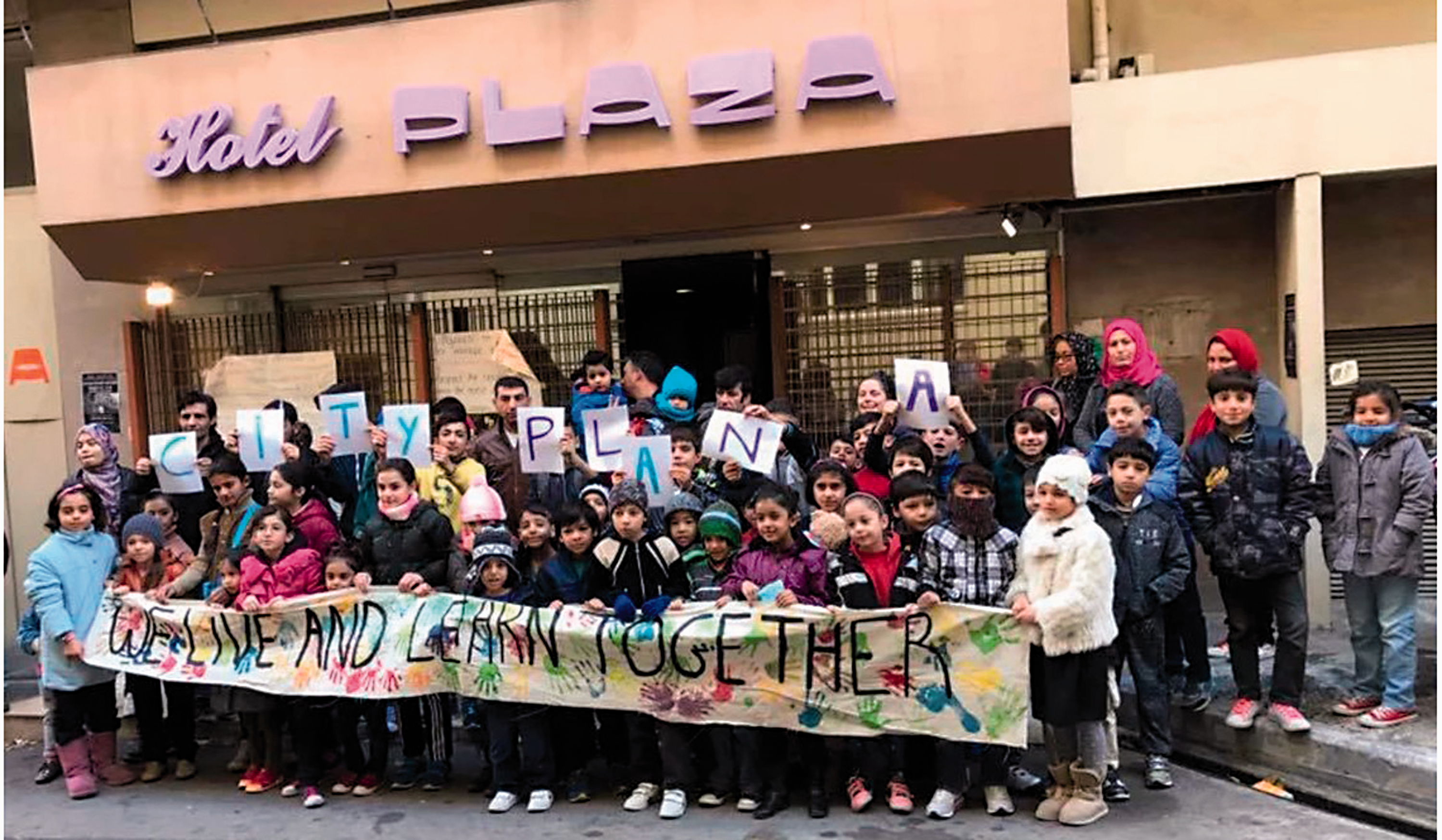
CITY PLAZA — WE LIVE AND LEARN TOGETHER, a photograph taken by Nasim Lomani who has kindly given permission for its re-use here.
This type of solidarity through proximity and everyday life is also vital in ties with the wider Greek population that has been made similarly precarious by austerity. For social community and solidarity to take root across differences of citizenship and belonging it is important for people to come together in intimate circumstances through living, working, learning, demonstrating, and just plain existing in proximate spaces (e.g. through the central, downtown locations of the City Plaza and Mosaik and the near proximity of Lesvos Solidarity to Mytilene). The centrality of these sites is, once again, in sharp distinction from the geopolitically detached Hotspots, all of which are located far from urban centers. It embodies instead how the Greek word for solidarity (αλληλεγγύη or allilengýi) refers to the act of being close to others.
Conclusion
The comparisons between our examples highlight how the meaning of safe space is continually being redefined in and through Europe’s borderlands in Greece. We have shown that the safe spaces created through grassroots organizing are sustained through solidarity in ways that both practically counterpoint and politically contest humanitarian claims about Hotspots creating safe space. The embodied geosocial solidarity practices exist in sharp contrast with the geopolitical projections and projects that make big claims about safety, but which have constructed spaces that create ongoing forms of insecurity for migrants through the abstract rules and spatial reterritorialization effects of the Hotspots. Countering and contesting the depersonalizing care and control created by Hotspot geopolitics, the geosocial work of creating safe spaces through solidarity instead aims at securing embodied experiences of socialized care and personalized control based on collaboration and cohabitation.
Nevertheless, despite the clear differences between the solidarity spaces and the Hotspots, it has to be acknowledged that most migrants still find themselves in the challenging borderlands where the geopolitical and geosocial projects contend with one another. It is not as if City Plaza and Lesvos Solidarity provide for completely free zones of full enfranchisement with pan-European mobility rights and citizenship rights. Instead, for the limited numbers of people they can accommodate, they provide spaces where modest advances in safety, dignity, autonomy, democracy, liberty, and community are enabled amidst and against European efforts to project geopolitical order onto the borderlands. The Pakistani teenager we drove into Mytilene expressed great enthusiasm for the community spirit and work opportunities afforded by Mosaik, and yet he also told us of his repeated harassment by the local police while sleeping rough around the city and of his deep fear of being captured and sent back to Moria. Similarly, many of the conversations we joined as volunteers chopping vegetables and washing up in the City Plaza kitchen concerned how to navigate the bureaucratic maze of the asylum application and appeals processes administered out of the Athens Hotspots. In other words, migrants who inhabited and benefited from the spaces of solidarity still had to contend with Hotspot power relations. They still experienced the disempowerment of subcitizenship, and yet they also expressed relief and appreciation about the ways in which City Plaza and Lesvos Solidarity made their personal efforts at remaking their lives more viable. In Foucauldian terms, these geosocial spaces of solidarity enable “making live” to become a biopolitical possibility (even as they remain overshadowed by an ongoing geopolitics of rejectionism). In the Hotspots, by contrast, what Agier (2011) calls the “cursor of biopolitics” appears to be moving “away from ‘keeping alive’ and towards ‘letting die’” (211). Conceptualized in this way, it is possible to view the solidarity spaces as creating a more personalized and socialized form of “making live” on borders that remain, nevertheless, constrained by the liberal biopolitics of European governmentality. The solidaristic efforts to advance improvements in enfranchisement, safety, dignity, autonomy, democracy, liberty, and community can thus be seen as assemblages of postliberal and antineoliberal innovations in humanitarianism itself.
Another related article in this themed issue argues that the Hotspots themselves serve as what Simon Reid-Henry calls a “liberal diagnostic,” at once indexing and policing the limits of a liberal humanitarianism defined by care turned control (Pallister-Wilkins, 2020). In our own investigation of the contrasts between Hotspots and solidarity spaces, we have been able to supplement Reid-Henry’s argument by demonstrating how the solidarity spaces index and encode efforts to both counter and reconstitute humanitarianism in postliberal and antineoliberal ways. They remain efforts informed by what Fassin (2011) calls “humanitarian reason”—offering welcome and hospitality to strangers while constantly renegotiating the tensions between inequality and solidarity. But by being attuned to biographical lives rather than just the biological life of migrants as a management problem, they reverse the rationalities of depersonalized care turned control in governmentalized humanitarianism. By doing so, they fashion forms of geosocial solidarity that contest the projections and administration of geopolitical control.
There is more fine-grained complexity in our examples than can be fully elucidated here. But to give just a few brief illustrations, City Plaza has sought to advance active resistance against official Greek and European rule-making and thus refuses charity and volunteerism in the name of collaborative urban activism and the pan-European struggle against neoliberal austerity. Meanwhile, back at the main gates of Moria, European and Greek hospitality is still extant, albeit in a very attenuated way, in the form of local merchants setting up tables and feeding people (and taking a remarkably wide range of global currency as payment). This too is a kind of civil society contribution to making live—even if it is located close to the forbidding fencing of barbed wire across the road, and a recent spray-painted sign saying “Welcome to Prison” (Masri, 2018). Many other individuals and groups struggle every day to make migrants in Europe safer. These people range from volunteers—such as the Kempsons, whom we met on Lesvos, who provide food, blankets, and care to boat arrivals on the northern beaches, to the Greek coastguard sailors who worked tirelessly to save lives throughout 2015, when 4000 refugees were arriving on the island per day.
It should be underlined that all of these efforts to extend embodied safety for migrants continue to be threatened by the geopolitical tensions for which the Hotspots were themselves initially presented as a response. From the time this article was first drafted in February 2017, many more boatloads of refugees have continued to capsize and kill in horrific numbers, including 15 more people who drowned in the Aegean just as we revised this conclusion (Papadimas, 2018). The war in Syria continues to generate suffering and refugees on a terrible scale, as do other forms of violence across the Middle East and much of Africa. Finally, the hypernationalism to which Hotspot humanitarianism was designed as an organized EU alternative has itself gone global. Taken together, these events and policies make it ever harder for those providing geosocial forms of protection to secure any kind of sustainable safety for refugees in the EU and, increasingly, worldwide.
Footnotes
Declaration of conflicting interests
The author(s) declared no potential conflicts of interest with respect to the research, authorship, and/or publication of this article.
Funding
The author(s) disclosed receipt of the following financial support for the research, authorship and/or publication of this article: Our thanks to a Brocher Foundation residency for support that enabled us to conduct the research for this article. Katharyne Mitchell also wishes to acknowledge the support of the Guggenheim Foundation.