



Abstract
Recently debates have emerged concerning how atmospheric objects referred to collectively as ‘elemental’ become entangled in the operation of communication infrastructure. The paper extends these debates through research into UK emergency responders’ information sharing during emergencies. Harnessing textual analysis and an interview, the paper unpacks the protocols established to organise information sharing and explores how such protocols interweave an assemblage of technologies to share information as emergencies unfold. The evidence presented demonstrates different ways that the elemental forces physically constitutive of emergencies are incorporated into information sharing. However, it also details cases wherein these elemental forces disrupt the information sharing practices they otherwise enable and outlines the effects this disruption has on emergency response provision. Considering the case, I make three arguments to establish a distinctive approach for conceptualising the entanglement of the elements within information sharing. First, I extend understandings of the capacities that elements actualise to enable information sharing. Second, I elaborate on the notion of excess to explain how elemental forces disrupt information sharing. Accounting for its political ramifications, I demonstrate thirdly, how, by disrupting information sharing, elemental forces obstruct government attempts to comprehend the emergencies they attend and, in turn, provide resources to ensure adequate response.
Geographies of information sharing and the elemental
In this paper, I explore the practices through which UK authorities share information during emergencies. I pay particular attention to the protocols developed to arrange information sharing. Furthermore, I probe how such protocols formalise the use of an assemblage of technologies which facilitate the movement of information across space. By generating information concerning the events being responded to, these practices shape the actions that authorities undertake to govern emergencies amidst their unfolding. Underlying the empirical case of the paper are important connections to broader debates in geography concerning how to conceptualise the material basis of information sharing. On first appearance, geography’s engagement with the practices by which information is shared across space appear counter-intuitive to our everyday experience of them. 1 Rather than being dressed up as immaterial or disembodied, literature has demonstrated how information sharing is grounded in, and reliant upon, an array of material objects (see, for instance Dodge and Kitchin, 2011; Kinsley, 2014; Leszczynski, 2015). This materialist approach is reflected by research, for example, into internet cables deep within the world’s oceans (Starosielski, 2015) or the hardware that sits on workstations across the world (Graham et al., 2017; Neyland, 2015). Other work has concentrated on the material spaces created to manage data produced, including storage facilities furrowed hundreds of metres below the world’s surface (Graham, 2016). Similarly important has been research that explores how technologies evoke affectively perceived states shared with and across human bodies. In relation to gaming, for example, James Ash (2014: 15) has excavated the ‘interface envelopes’ made and remade at the interstices between computer screens, human users and the wider material space in which these relations are performed.
Amongst these debates is an emergent trajectory that considers the entanglement of elemental forces within the operation of these material devices. Similar to how geography more generally has understood them, 2 this research has taken ‘the elemental’ largely in their pre-Socratic, Empedoclean incarnation (Wright, 1995), referring to how air, earth, water and fire in different forms encounter media technologies. Air has been considered in different guises by its envelopment within information-sharing technologies dating back, in some cases, hundreds of years (Amoore, 2016; McCormack, 2016; Peters-Durham, 1999, 2015). Alternately, Nicole Starosielski (2015) has investigated how water and earth, in the form of oceans and sea beds, play important roles in the functioning of internet infrastructure. Furthermore, Jussi Parikka (2014, 2015) and Sean Cubitt (2016) have explored how smartphones rely on the degradation of finitely available resources such as lithium and aluminium.
Important for this paper is how this literature has begun to document the various, productive roles that elements play in information sharing. That is, how the elements are harnessed and afforded functions in facilitating information sharing. Probing what he calls elemental infrastructures, Derek McCormack (2016: 6) expands on the ‘literal’ role that elements contribute to information sharing. Here, the elements are considered in terms of how their physical force enables information sharing. Thus, McCormack (2016: 2) explores how air currents make possible the functioning of experimental balloon technologies that might change global access to the internet. This literal role exists alongside a ‘metaphorical’ one for McCormack, where the allusion to the elements is pivotal in helping users and designers of technologies to conceptualise at an abstracted level the material and cognitive processes through which information sharing is brought to bear. McCormack references Louise Amoore’s work on cloud computing as exemplary of the metaphorical role of the elements. Summarising this role, Amoore (2016) claims that ‘the cloud in cloud computing is widely held to derive from the mapping of infrastructures of computer networks, where the visualisation of a figurative cloud stands in for the complexity of the internet’ (2, my emphasis). Amoore shows how, in terms of the imaginaries that surround them, elements are leaned on to enable thinking through the generation of information and its transmission across circuits. This metaphorical role resonates with a broader corpus of literature that probes the representational role elements adopt to facilitate information sharing (Edwards, 2010; Hansen, 2015, Peters-Durham, 1999, 2015). Paul Edwards, for example, has inquired into the range of mechanisms through which physical weather fronts take on a second life on computer and television screens. Offering a historical account, Mary Favret (2009) has described how, in previous eras, a nation’s populace kept abreast with the development of wars abroad through newspaper reports that not only enumerated fallen soldiers and territorial gains but also evoked the atmospheric conditions that shrouded the battlefield. Considered through the nomenclature of representation, then, is how information acts as an interlocutor for the physical state of the elements that it reflects despite being detached from.
As McCormack astutely notes, identified and probed across this literature are the range of capacities that elements perform when enrolled into information sharing practices (Bryant, 2011; De Landa, 2006; Feigenbaum, 2014; Peters, 2010; Steinberg and Peters, 2014, Whatmore, 2006). As Manuel De Landa (2006) has shown, capacity structures inquiry into objects in specific ways. Rather than making normative claims concerning the properties inherent to objects, capacity emphasises what an object might do and the roles that it can perform. Capacity, then, emphasises examination of an object’s potential rather than focusing on how the actions it performs may be the result of its supposed nature. This focus on potentiality means an object’s capacity is actualised contingent upon the relations it makes to other things and the practices in which it becomes enveloped. The notion of capacity does not direct attention to that which is apparently internal to the elements. What matters instead is how the elements act according to the relations they make and the process-inflected circumstances they become enrolled within (see also McCormack, 2017, 2014). Rather than concentrating on what elements supposedly are, capacity draws focus to what such elements might do when entangled in particular practices.
This rendition of capacity provides an important segue to explaining why I discuss elements as ‘forces’ in this paper. If capacity emphasises what elements do according to the circumstances in which they are situated, force orients investigation towards the influence and affect elements have within these circumstances. In other words, whereas capacity accounts for the roles that elements play, force addresses the impact elements bring about when performing these roles. Elaborating on what he describes as ‘the force of the elemental’ Pete Adey (2015: 54) probes the tension between the elements and human capabilities to comprehend them. For Adey (2015: 55), we should understand ‘elements as anterior to human perception’ and possessive of agency beyond our intelligibility. Nevertheless, the force of the elemental is felt in the myriad ways that elements shape and nudge the circumstances in which they are present. Adey shows how elemental force is present, albeit implicitly, in geographical literature ranging from explorations of how the climate influences peoples’ decisions about where in cities to live to Andrew Barry’s work on how air quality shapes the development of technological fields related to pollution governance. In his recent work, Pete Forman (2018) develops conceptualisations of elemental force further through research into the securing of gas pipelines. For Forman, elemental force is traceable in the modes of mobility that elements exhibit within the broader material processes in which they are incorporated. Echoing Jane Bennett’s (2010) observations regarding the recalcitrance of material objects, Forman argues that force is embodied by the capacity of elements to cause friction within the processes of which they are part. As much as it refers to the formative influence elements have, force also encapsulates the ability of elements to resist and disrupt the processes in which they are enveloped.
Along with providing a basis for investigating precisely how, and with what kinds of capacity, they contribute, an emphasis on force opens up to consideration the disruptive reverberations elements might instigate within information sharing practices. In literature up to this point, the disruption that elements cause to information sharing has received scant attention. Returning to her work, Favret discusses delays in the transmission of information. However, Favret understands these delays as caused not by the force of the elemental but by the speed at which technologies themselves can operate to move information across distance.
As the empirical locus of attention in this paper, emergencies certainly provide a provocative site in which to initiate explorations of the disruptive force of the elemental in information sharing. 3 Although elemental forces themselves have not heretofore been seriously considered as a contributing factor, emergencies are continually characterised in literature by their contingency and indeterminacy. Emergencies are said to rupture various interwoven constituents of social order, including the norms and routines that make up daily life (Anderson, 2011; Opitz and Tellmann, 2015; Rodriguez-Giralt et al., 2014). Emergencies lay bare the fragilities embedded in material infrastructure (Collier et al., 2017; Lakoff and Collier, 2010). In sites such as emergency control rooms that continually monitor for their potential occurrence, the ever-acknowledged imminence of emergencies blurs the line between an event happening and not happening (Anderson and Gordon, 2017). Especially relevant for this paper, the disruptive character of emergencies is also said to be integral to readings of the politics that emanates from them. This is particularly the case when considering the forms of intervention taken by authorities to govern emergencies. Work that has investigated techniques for preparing for future emergencies stress, for instance, the importance of the uncertainty that surrounds future emergencies in legitimating actions that governments take in the present (Amoore, 2013; Aradau and Van Munster, 2011; De Goede, 2012). Alternately, Ben Anderson (2015) has discussed the strange status of emergencies as events that challenge the ability of authorities to know and to label amidst their unfolding whilst simultaneously activating the need for response in line with the state’s promise to come to the aid of populations in times of crisis. Whilst Marieke de Goede (2014) has shown how state inactivity before and during emergencies can reconstitute relations between the public and respondent authorities.
Pre-existing literature orients the paper towards considering both the facilitative and disruptive effects elements manifest in emergency information sharing. By their perceived indeterminacy, furthermore, emergencies open up to inquiry the political ramifications that rise to prominence where elemental forces become enveloped in information sharing. Pursuing these lines of inquiry, the paper moves from this introduction through four sections before its conclusion. In the first of these sections, I introduce in more depth the empirical case study of the paper by contextualising the information-sharing protocols and technologies through which emergency responders communicate during emergencies. Second, I expand upon the capacities elements actualise in contributing to emergency information sharing. Third, I provide evidence for and conceptualise anew the ways in which elemental forces disrupt information sharing. Fourth, I detail the political ramifications that elemental disruption has by describing how it compromises authorities’ capability to both understand and render governable emergency events as they unfold. In the conclusion, I both summarise the paper’s observations and reflect on its broader implications for the attention geography pays to moments where information sharing and the elemental meet.
Coordination, multi-agency incidents and information sharing
Over the last decade, the issue of how different authorities coordinate response to emergencies has become a pressing issue for the UK government. The importance of coordination has been reflected in academic debates concerning emergency response in recent times, with research focusing on preparatory practices instigated in lieu of the 2004 Civil Contingencies Act (Adey and Anderson, 2011; Anderson and Adey 2012), the development of new legislative bonds between emergency responders (Zebrowski, 2015) and the enrolment of non-security-related organisations into emergency preparedness (Coaffee, 2010; Grove, 2014).. Research has yet to consider, however, how this need for better coordination has led to the creation of new arrangements by which authorities share information with one another during emergencies. Such arrangements have been designed specifically to aid coordination when attending to what are commonly referred to as ‘multi-agency incidents’ (2011, 2016, 2017). Multi-agency incidents account for emergencies, be they for instance floods, fires or snowstorms, which bear specific spatial and temporal characteristics. They are emergencies that are widespread, taking place across multiple sites simultaneously. Owing to their disparate spatiality, they can also have a diverse range of impacts on human life, environments and infrastructure (2016). In 2012, the UK government established the Joint Emergency Services Interoperability Programme (JESIP) to develop new arrangements so that different authorities involved in emergency response, from the Police to Fire and Rescue Services, Ambulance Services and the Environment Agency, can cooperate when planning for and responding to multi-agency incidents. Although established nationally through JESIP, local authorities tailor these arrangements to make them suitable for the risks prevalent in their area.
Under JESIP, authorities have acquired and developed various technologies to generate and circulate information during emergencies. 4 This includes cloud-based data storage and sharing platforms, emergency transmitters and multi-line telecommunication facilities. Equally as important, new information-sharing protocols have been crafted in tow with these technologies. Authorities have designed new warning systems, procedures for reporting from emergency sites, expert advice conduits and information sourcing and compilation guidelines. These protocols are brought together to structure the deployment of technologies so that information can be sourced and circulated as emergencies unfold. Much of the information shared concerns the elemental forces and conditions physically constitutive of emergencies. From the examples in this paper, information might be generated regarding groundwater swell in floods, snowfall in winter storms, smoke produced by fires or weather patterns precipitating emergencies. Authorities also share strategical information to coordinate their response to emergencies. This includes, for example, information relating to resources deployed and how different authorities should divide the labour of response amongst themselves.
The empirical material presented in this paper derives from research that interrogated how the design of protocols and use of technologies enable formalised and routine information sharing to take place between authorities during emergencies. Six-month textual analysis was undertaken that involved identifying and reviewing the content of both guidelines stipulating how technologies should be procedurally deployed and reports that reflect on the success of information sharing in the aftermath of specific emergencies. Furthermore, the paper draws on an interview conducted with the Chief Emergency Planner of a Local Resilience Forum (LRF). LRFs bring local emergency response authorities together so they can collectively prepare for emergencies. Elaborating on themes identified through textual analysis, the interview focused on information-sharing procedures and technologies, examples of their use in past emergencies and the evaluation that authorities make concerning the effectiveness of emergency information-sharing practices. The empirical material generated demonstrated that elemental forces constitutive of emergencies play a pivotal and varied role in the operation of information sharing practices. At the same time, the material also revealed how elemental forces disrupt information sharing. The paper now turns to present this empirical material and elaborate on its significance for debates concerning the relationship between the elements and information sharing.
Actualising elemental capacities in emergency information sharing
In this section, I demonstrate how, to make information sharing possible during emergencies, procedures and technologies actualise both the physical and representational capacities of the elements. Although identified in extant literature (Amoore, 2016; Edwards, 2010; McCormack, 2016), the paper extends conceptualisations of these capacities by elaborating upon the relations that exist between them. Returning to his work, Pete Adey (2015) argues that to understand ‘the relationship between representation and process’ that elements are caught up in, one has to ‘work back from the air, skies, clouds and how they are perceived and represented … to consider, for instance, the particular meteorological conditions that might have inspired Turner’s diffused and atmospheric scenes’ (56).
Here, Adey implies that the physical force of the elemental plays a crucial role in determining their capacity to be represented. Extending Adey’s observation, I detail in this section how procedures and technologies facilitate information sharing by establishing lines of relation between the representational and physical capacities of elemental forces. Rather than existing separately, the physical and representational capacities of the elemental are mutually cultivated through the enactment of information sharing practices. Mutual cultivation is evidenced by how information-sharing procedures attune with the spatial and temporal unravelling of the physical force of the elements constitutive of emergencies. In other words, through protocols, the physical force of the elemental is made to dictate when, and across what sites, information sharing should be enacted. This attunement, in turn, allows the technologies procedurally deployed to source and circulate information representative of the elemental forces underpinning emergencies.
For emergency responders, the elements commonly first appear in their representational capacity through the array of data flows, technologies and arrangements used to warn authorities of potential emergencies. The key warning software in the UK is the National Weather Warning Service. Designed and supplied by the Met Office, the service provides continual updates concerning shifts and trends in weather patterns surrounding the UK. These updates include assessments of weather patterns on two fronts: the likelihood that they will lead to emergencies and the potential impact an emergency might have. Likelihood refers to the statistical probability that a weather pattern will continue to move and encroach upon a specific area, thus bringing about the event that it potentially possesses. Impact, alternately, accounts for the effects that the emergency might have on infrastructure, environments and life and the extent of these effects.
These warnings are mobilised as a temporally routinised procedure for authorities. As the emergency planner explained; ‘At two o’clock’ …We all (emergency responders) get automated ones’ (my brackets), related to conditions such as ‘flooding, wind excetra’. 5 Visualised on a map of the region, these warnings are colour coded. In relation to imminent emergencies, two colours are of interest: yellow and amber. 6 Whereas yellow suggests the need to remain aware of continuing developments in the weather, amber will initiate action from emergency responders. 7
Representative of the elemental forces that collectively constitute weather fronts, warnings operate as thresholds that, when breached, instigate the physical extension of new information sharing conduits across space. Action will be taken according to the emergency planner; ‘definitely when there’s an amber, possibly if there’s a yellow…and if anybody says actually we think this requires some multi-agency coordination, police will call… a Response Working Group’. Connecting the upper echelons of the local Police, Fire and Rescue Service, Ambulance Services, the Environment Agency and local government, Response Working Groups (RWGs) are initially formed virtually using a secured, multi-line telecommunications system. Each member of the group is charged with sourcing information regarding aspects of the emergency for which they are responsible. Whereas the Fire and Rescue Service would collect information concerning challenges for the evacuation of communities, for example, the Environment Agency might gather information pertaining to the potential adulteration of water supplies.
National weather warning example. National weather warning example (https://www.cockermouthfloodactiongroup.org.uk/2012/07/weather-update-4-july/)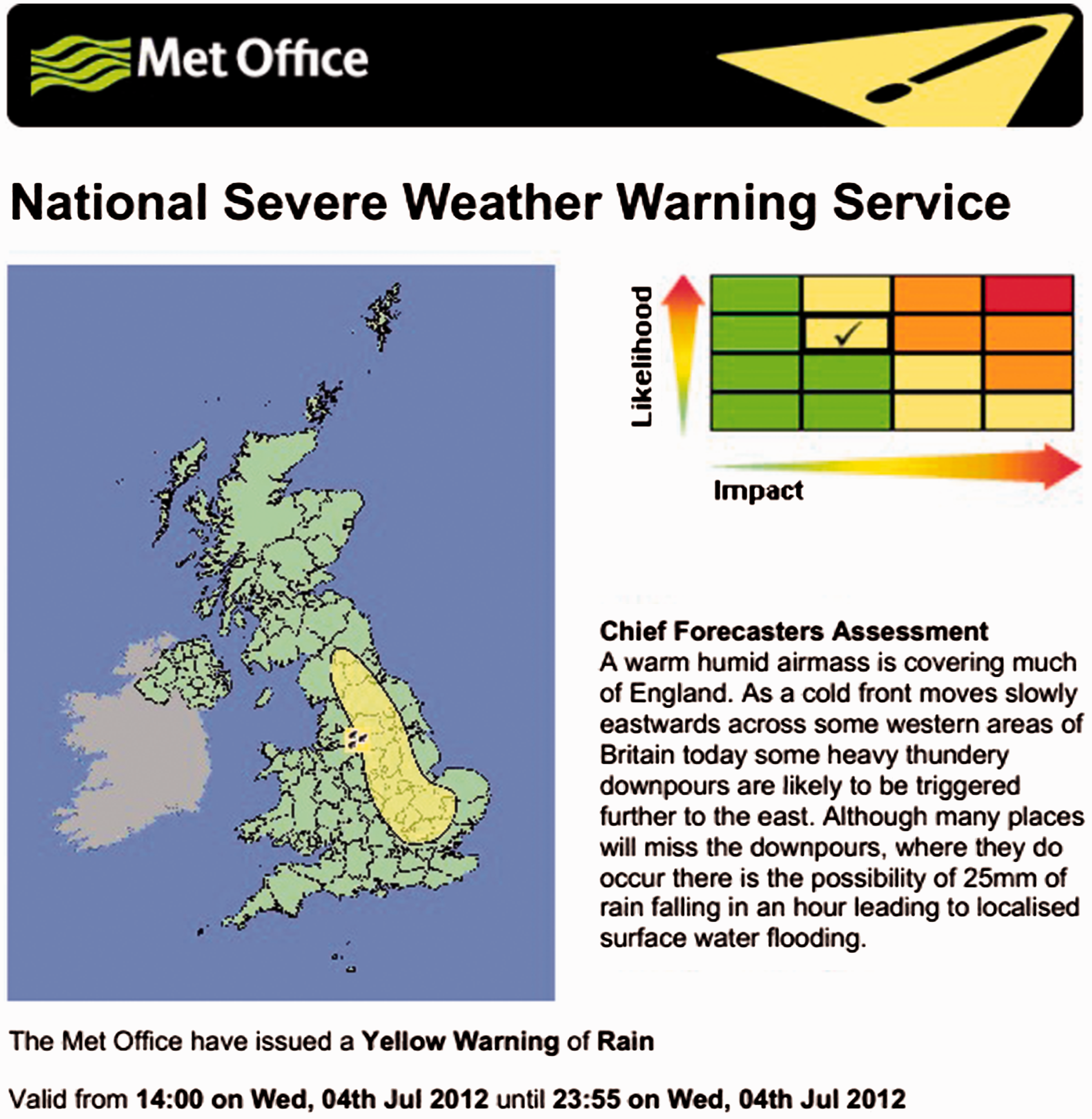
To generate information representative of them, lines of communication must attune spatially with the physical unfolding of elemental forces constitutive of emergencies. Members of the RWG thus establish connections with the possibly multiple sites across which the emergency is physically taking place. What are called Liaison Officers are sent to the sites affected by the emergency to gather information and feed it back to the RWG . In flood emergencies, for instance, protocol dictates that members of the RWG make connections with the sites at which water levels are highest. Simultaneous with the spatial extension of information conduits to the sites of the emergency, various ‘cells’ will be created. Cells are clusters of experts who advise on issues that arise according to the emergency responded to. One such cell is the Scientific and Technical Advisory Cell (STAC).
8
The STAC provide respondent authorities with guidance on matters ‘such as the impact on the health of the population, public safety, environmental protection’ (2007: 2). Individual members of the STAC will coordinate with one another to supply ‘valuable information and arrive at a common view of the scientific and technical merits of different courses of action’ (2007: 3) that authorities might pursue.
9
Encapsulating another way in which the physical capacities of the elemental forces underpinning emergencies shape the enactment of information-sharing procedures, cells are formed in a way sensitive to the specific demands of different emergencies. ‘The composition of and functioning of the STAC’ (2007: 3), guidelines dictate, ‘will be incident specific and tailored to local requirements’ (2007: 3). This sensitivity is evident when considering the involvement of different experts in a cell. As guidance states, As an incident progresses, the focus may move away from health matters to, for example, wider environmental concerns. It may therefore be appropriate for the lead to be reassigned to a more appropriate person with the necessary knowledge and experience. (2007: 4)
With the formation of RWGs, Liaison Officers and cells, a spatial network develops reflective of the physical unfolding of elemental forces underpinning the emergency to generate information representative of it. Information is transmitted from the sites within this network to establish an overall understanding of the emergency. Containing information ‘on the nature and scale of the emergency’ (2014: 23) as calculated from specific sites, information is circulated across this network though a procedure known as situation reporting (SITREP). SITREPs report on the geographical coordinates of the locations and aspects of local infrastructure affected by the emergency whilst simultaneously operating as a risk assessment of what might be to come. They also report on the strategic actions taken to attend to the emergency, the agencies present at different sites and the resources deployed. Adding to the material technologies present, SITREPS are transported to RWGs via Resilience Direct, a cloud-based platform that responders access via a regular internet connection. Concurring with Amoore’s (2016) observations about cloud-based intelligence-sharing devices, the circulation of information through Resilience Direct instantiates a range of new possibilities for authorities in perceiving the object of governance. Receiving information through Resilience Direct, the RWG collates all the information fed to it and integrates it to form a Common Received Information Picture (CRIP). Sent to all sites where response is taking place, CRIPs offer a representative overview of the latest developments that characterise the physical unfolding of the emergency. Taking me through the CRIP template they use, the emergency planner demonstrated the various forms of information that a CRIP possesses.
10
Along with information regarding local and national press reportage of the emergency’s development, CRIPs contain information relating to the emergency structured by the METHANE acronym. Going through each letter of this acronym, CRIPs will first indicate whether authorities have declared a ‘Major incident’. Using Ordinance Survey coordinates, CRIPs then detail the ‘Exact locations’ that the emergency has effected before turning to describe the ‘Type of Incident’ occurring and the ‘Hazards’ present. The CRIP will then outline the best ‘Access’ routes for emergency responders to take when arriving at different scenes, the ‘Number of Casualties’ that the emergency has caused and the ‘Emergency Services’ currently in action or required. For example, and revealing the centrality of the representation of the elements, a CRIP circulated during major flooding in 2014 explained how ‘due to East Coast Surge, groundwater … reached some of its highest levels’,
11
leading to ‘coastal flooding’ (ibid) which was ‘impacted on by the direction of the wind (which) became south-westerly’ . The CRIP reports that with ‘103 properties flooded, landslip continues causing some issues, 44,000 people suffering power outages’.
12
Because of ‘the river eroding the road’ a multi agency team will be on site to assess and take action…first water management solution, dams and temporary storage will be completed tonight. water rising and will need (Local County Council) support. Road issues at… will need water management solution, which is beyond capacity of the military.
13
Organised by procedures, an array of technologies and agencies work to generate and circulate information that allows authorities to maintain a continual overview of the emergency. But how does the enactment of these practices extend our understanding of the physical and representative capacities that elemental forces actualise in information sharing? In line with the emphasis that the notion of capacity places on relations, the practices described suggest that the physical and representative capacities of elemental forces do not exist separate from one another. Instead, protocols and technologies operate to mutually cultivate these capacities to enable emergency information sharing. Protocols and technologies are deployed in a way that spatially and temporally mirrors and stays with the physical unfolding of the elemental forces underpinning emergencies. This roll out, in turn, allows for the generation of real-time information representative of the emergency.
‘You’d always be behind wouldn’t you?’ Elemental excess in information sharing
For the emergency planner interviewed, the spatial and temporal manoeuvres by which the physical and representative capacities of elemental forces are mutually cultivated are not the only relations that exist between information sharing practices and the elements in emergencies. When in the midst of an emergency, the planner claimed that ‘you’d always be behind wouldn’t you?’ 15 Expanding on their rhetorical question, they stated that, although one might implement measures designed to keep up to date with it, information sharing practices are always steps behind the physical unfolding of the emergency.
The emergency planner’s concerns imply that the disruptive force of the elemental outlined earlier (Adey, 2015; Forman, 2018) is present within emergency information sharing. But how might the type of disruption pertaining to information sharing be conceptualised? This section details specifically how the force of the elemental in emergencies exceeds protocols designed to generate and circulate information representative of it. The notion of excess is heretofore unexplored in relation to the force of the elemental and its effects on emergency governance. 16 Nevertheless, excess has pre-existing gravitas in geographical debates seeking to address the dynamism of objects in general. Ben Anderson and John Wylie (2009) raise two important points regarding excess. First, excess articulates an object’s life beyond its capture as a device of human intention. Under this rendition, an object might be thought of as ‘perpetually beyond itself’ (332) and transgressive of our regimented mobilisation of it. Second, excess is closely tied to the virtual because it shows that ‘the actualisation of matter is an eliminative manoeuvre that holds the explosiveness of an excess in check’ (329). In other words, objects possess the potential to exist in ways beyond how they are materialised at any one point. To think of them through excess is to think objects as ‘rendered groundless by a more to come’ (331) that ever remains on the horizon.
Taking lead from Anderson and Wylie’s provocations, I develop and elaborate the notion of excess in new ways to explain how elements disrupt emergency information sharing. In what follows, such a novel expansion of excess is offered in two ways. I have noted throughout the paper that the capacities of elements are contingent on the relations they forge. Continuing this line of thinking, the paper shows first how authorities’ failure to enact information-sharing procedures means that information potentially available concerning the elements constituting emergencies is not captured and circulated. Here, the capacity for elemental excess is actualised not by the elements in and of themselves but by the misapplication of information-sharing protocols with which they are entangled. Second, I also outlined earlier how inquiry into the force of the elemental opens up to consideration the recalcitrant capacities that elements possess. Expanding this insight, I show how the potential for elemental forces to physically transform and impact upon circumstances in ways that authorities have not anticipated means that protocols and technologies can neither attune with their physical capacity nor generate information representative of them. Here, the unpredictable mutability of elemental forces brings about forms of excess to disrupt information sharing.
Elemental excess, then, is first produced by authorities’ lapses whilst attempting to follow their own procedures. In emergencies that necessitate multi-agency response, the set of information sharing protocols implemented are supposed to enable the smooth circulation of information amongst authorities scattered across disparate spaces. This is far from unproblematic, however, because such procedures are different from those enacted where authorities conduct response individually. Acting alone, emergency services follow a clear, three-tier chain of command that structures the flow of information according to their linear, hierarchical organisation. This chain of command is commonly known as ‘Gold-Silver-Bronze’ (2008). Personnel who belong to bronze command account for on-the-ground responders directly attending the emergency. They exchange information with those located in silver command, who instruct bronze commanders on the tactics to employ in responding to the emergency. The highest echelon, gold, communicates with the silver tier to direct the overall strategic approach for dealing with the emergency. 17
As a procedure for structuring the flow of information, this internal chain of command contrasts sharply with the multi-agency procedures involving Liaison Officers, RWGs and expert cells described in the last section. Whereas chains of command filter information according to a vertical hierarchy, multi-agency procedures exist as a network that mirrors the spatial and temporal unfolding of the emergency itself. Attempting to adopt the information sharing protocols required for multi-agency response, however, causes authorities severe problems. ‘What always happens’ the emergency planner explained ‘is that people default to speaking to their own organisation’. Faced with a multi-agency incident, responders fall back on internal procedures for information sharing. This causes information to circulate up and down the ranks of individual agencies rather than spreading across all the organisations involved.
When internal chains of command are followed instead of multi-agency arrangements, aspects of the physical, elemental forces constituting emergencies can exceed the information generated to represent them. An example of elemental excess being produced in this way occurred when authorities attended a large fire in the early hours of a summer morning in 2014. Due to the size of the emergency, authorities formed a multi-agency RWG. Although multi-agency information sharing protocols were activated, the firefighters who were first to arrive at the scene reported only to their internal seniors rather than across the spectrum of agencies involved. In so doing, plumes of smoke containing high levels of sulphur were able to spread over a large area without the dangers implicit being recognised and dealt with by specialist organisations such as Public Health England and the Environment Agency. 18 Following information-sharing procedures internal to single agencies, the physical smoke produced from the fire exceeded the information generated and circulated to represent the emergency.
Although following internal information-sharing procedures in events necessitating multi-agency response can cause elemental excess, establishing multiple lines of communication between different agencies can have similar effects. In the last section, I described how the number of sites and cells from which to source and transmit information adapt in a way continually attuned to the emergency’s own physical development. Nevertheless, cases have shown that new gaps in information sharing appear as emergencies become more complex and new information conduits are established. In a snowstorm in 2010, local stockpiles of salt rapidly declined as authorities attempted to clear roads and train tracks. In response, a National Salt Cell was established. One of the Cell’s tasks was to implement a delivery schedule informing responders at different sites about when they should expect the delivery of new salt reserves. From the perspective of the RWG, who were in direct communication with the Salt Cell, ‘There was a lack of reliability of the salt delivery schedule from the National Salt Cell.’ In particular, a disparity developed between the time the schedule stipulated reserves would be delivered and the time they arrived. Such an inconsistency might seem inconsequential, but its logistical ramifications are wide reaching. Resources for the distribution of salt within a specific site, such as personnel, are prepared according to the delivery schedule. If salt is delivered before specified, the resources to distribute it might not yet be available. If salt is delivered late, resources might have been deployed for another matter. 19 A lack of information regarding the delegation of resources meant that snowfall continued to disrupt transport infrastructure in a way that exceeded the capability of authorities to act. 20
In line with research discussed earlier (Adey, 2015; Bennet, 2010; Forman, 2018), it needs to be reiterated, however, that elemental forces possess agency beyond their capture and enrolment within the processes to which they contribute. Excess generated due to the recalcitrant agency of the elemental is evident in this case with the capacity that the elements in emergencies have for physically materialising in ways beyond the scope of those trying to generate information representative of them. In particular, such a divergence between the physical capacity of the elements and their capacity to be represented informationally appears where predictions concerning emergencies fail to come to fruition. Returning to the floods of 2014, forecasts generated by those warning mechanisms discussed earlier were surpassed when the emergency that they addressed unravelled. Before the floods, the Met Office’s Weather Warning Service made projections for likely rainfall based on rainfall that had occurred in previous years. As one report into the flood states, however, such projections were dashed when ‘there was twice average rainfall in December to February’ in which months ‘they (referring to responders) experienced 75% of the rainfall they would expect in a year’. 21 Weather warnings are not, however, only produced according to probability calculations. Rather, they result from calculations concerning how different elemental forces contained within a meteorological front might combine to produce a collective impact. In the case of the 2014 floods, reports show how elemental forces combined in ways contrasting with that projected by the Weather Warning Service, leading to impacts that diverged from predictions. Rainfall, already beyond calculated average, ‘combined with record spring tides, due to (an) East Coast Surge (meaning that) ground water also reached some of its highest levels’ (ibid). Returning to the scene later, situation reports suggest that the physical unfolding of the emergency further outstripped the information contained in forecasts. Updates circulated across authorities on 14 February state, for instance, that ‘tidal surge forecast line on the graph was very high, and the previous tide had exceeded the forecast’. 22
Where it derives from the unpredictable mutability of the elements, excess may result in procedures directing information-sharing resources to the wrong place, meaning information that accurately represents the emergency unravelling cannot be generated. During the floods of 2014, Liaison Officers had been reporting from areas that weather warning information considered most severely affected. This allowed for the release of regular situation reports that, at least temporarily, allowed information circulated to represent the event’s occurrence. However, shifts in the direction of the water, brought about by the introduction of the wind, severely affected authorities’ capability to generate precise, timely information. Returning to one of the reports into the floods: ‘coastal flooding was impacted on by the direction of the wind (which) became south-westerly’. 23 At this point, accurate information from the sites most effected by the emergency could not be immediately generated and circulated as Liaison Officers had been directed to other sites entirely. Unexpected permutations in the weather mean that information generated in one moment might become unhinged from the physical unfolding of the emergency in the next.
‘Some Information’s Really Tricky’: The political effects of elemental excess for emergency response
The lags in information sharing evidenced above, wherein elemental forces physically underpinning emergencies exceed the protocols and technologies designed to generate and circulate information representative of them, have important political ramifications. In his work on emergency governance, Ben Anderson (2015, 2017) has demonstrated that the ability of authorities to sense, know and name the specific type of emergency attended is crucially important for engendering an appropriate response. It is an ability fraught, however, with complications. By obfuscating clear understandings of their unfolding, emergencies reveal themselves as ‘an occasion … when government is brought into contact with that which is outside it and that which threatens to exceed its capacities’ (Anderson, 2015: 6). Anderson explains how such complications arise where individual responders face unpredictable situations and feel out of their depth trying to make a definitive decision for all authorities involved in response. Complications in naming the emergency derive in Anderson’s account from the paradoxical situation wherein authorities are compelled to act but without knowing comprehensively the event they must act within. Charting a different course from Anderson’s, I outline below how the effects of elemental excess documented in the last section complicate authorities’ ability to generate comprehensive understandings of the emergency attended which, in turn, renders problematic their ability to provide adequate response.
Beyond scuppering attempts to generate and circulate information, elemental excess extends into further practical problems for emergency responders. In particular, excess frustrates attempts by different authorities to consolidate consensual understandings of the emergency. A theme throughout the interview, the emergency planner summarised this issue by stating initially that ‘some information’s really tricky’. 24 Taking into account the forms of elemental excess which affected information sharing during the 2014 flooding, they expressed doubt regarding the capacity of information to represent what was happening physically on the ground, raising suspicions concerning information along the following lines of inquiry: ‘What’s flooded? How do we know? How reliable is that?’ Overall, the emergency planner summarised, describing how ‘You never know entirely what’s going on and you’ve always got people trying to…translating that information backwards and forwards.’ 25 Uncertainty starts to creep in as elemental excess is recognised to have severed the crucial relationship between the emergency’s physical unfolding and its informational representation.
Discord between the physical unfolding of the emergency and its informational representation has implications for authorities in terms of accurately labelling the emergency. In accordance with their measurement against a range of standardised criteria, an emergency can be located into different categories of event. Quoting government guidance: ‘the scale of the impact of the event or the situation’ (JESIP, 2016: 11) should be calculated when determining the event confronted, as should ‘the demands it is likely to make of local responders’ (ibid). Furthermore, judgements on the category of event faced should be informed by consideration of whether there is need for ‘the exceptional deployment of resources’ (ibid). A Major Incident is one such category of event that might be declared. A Major Incident refers to ‘an event or situation requiring a response under one or more of the emergency services’ major incident plans’ (2016: 7). In particular, it designates an event whose severity is such that the resources required for response are beyond those possessed by local authorities. 26 A Major Incident will call forth further resources supplied either by authorities in regions neighbouring the site of the emergency or central government. Politically, the declaration of a Major Incident thus has a heavy bearing on the course of action authorities take to govern emergencies, determining what authorities need to coordinate with one another and the resources made available to them.
Where the elemental forces physically constituting the emergency exceed the information generated and circulated representing them, past cases suggest that it is not always easy for authorities to reach consensus regarding whether an emergency should be judged a Major Incident. The authorities focused on in this research did not declare the floods they faced in 2014 as a Major Incident. Such was the case despite a report into the flood claiming that ‘There was a feeling that the duration of the flooding, the complexity of the issues faced and the breadth of areas had made it a very significant multi-agency incident and therefore it should have been declared a major incident’ (2014: 18). The same report later reveals that this shortcoming was caused by the effects that elemental excess brought about for information sharing. With procedures and technologies failing to attune to the physical unfolding of the emergency, a comprehensive account of the emergency overall could not be generated, meaning a Major Incident could not be declared because ‘no single organisation felt it met the trigger point for them to call a Major Incident’. 27 By asserting that no single organisation thought it necessary, the explanation offered suggests that, although multi-agency response arrangements were activated and correspondent lines of communication established, multiple perspectives on the emergency, aligned to specific organisations, persisted instead of a view held in consensus. Shown in the previous section to result from elemental excess, these fragmentary perspectives introduced ambiguity regarding the emergency and curtailed authorities’ capability to declare a Major Incident when they should have.
As government guidance was shown to instruct earlier in this section, situating an emergency into a specific category of event is, in political terms, very significant. By labelling an emergency, authorities determine what actions can be taken to govern it. By complicating how an emergency should be categorised, the effects of elemental excess, then, bear the potential to jeopardise authorities’ ability to deploy resources proportionate to the physical force of the emergency. In so doing, elemental excess renders problematic the state’s capacity to meet societal needs in times of emergency.
Conclusion
The paper has presented research into the protocols and technologies authorities use to share information during emergencies. Warning systems, cell formation, SITREPs and battle rhythms shape the deployment of devices like cloud-based platforms and telecommunications facilities to generate and circulate information. Relating, for instance, to flood water, smoke produced in fires, the effects of snowfall or broader meteorological conditions preceding an event, the information created and shared represents the elemental forces physically constitutive of the emergency. In turn, this information organises and guides the interventions authorities make to respond to emergencies.
The case itself compels engagement with, and a distinctive contribution to, current geographical debates concerning the entanglement of the elemental in communication infrastructures. Extant literature opened up to consideration how, rather than simply seeking to mitigate the damage they might cause, authorities actually harness the elemental forces physically constitutive of emergencies to enable information sharing. Elemental forces play different roles in facilitating information sharing. Their physical manifestation informs the configuration of information-sharing conduits whilst the capacities of elements are actualised in representative form too, appearing as information transmitted through the diffuse scenes across which the emergency unfolds. Despite being outlined in other literature, the practices researched in this paper suggest that these capacities do not exist separately from one another. Instead, the representative and physical capacities of elemental forces are mutually cultivated through procedures that spatially and temporally formalise the deployment of information-sharing technologies. In general, geography should take care when exploring the capacity of the elemental. Beyond outlining the capacities that elements actualise, closer attention should be afforded to the practices through which relations are forged between such capacities and the dynamic of mutual cultivation that organise their actualisation.
I have argued additionally that information sharing in emergencies is important to consider because it brings into sharp focus how elements might disrupt the information sharing practices to which they otherwise contribute. Drawing on existing literature (Anderson and Wylie, 2009), the paper has significantly extended the concept of excess in two ways to understand how the force of the elemental disrupts information sharing. Following the argument that capacity is something that hinges on the relations that elements make, the paper shows first how elemental excess is produced by the way that information-sharing practices are themselves enacted. Thus, excess sometimes emanates from the protocols and technologies designed to incorporate the elemental into information sharing. Second, the paper demonstrated how the capacity of elements to manifest themselves and transform in unforeseeable ways during emergencies disrupts information sharing. Such transformative capacity complicates authorities’ attempts to attune with the physical unfolding of emergencies and thus generate information representative of them. Contributing to debates more generally, excess suggests that a more nuanced treatment is required when considering the effects of the enrolment of elemental forces into information sharing. The functioning of information sharing is reliant on the incorporation of elements into its enactment. Nevertheless, excess indicates that the envelopment of elemental forces into information sharing is far from seamless. Geography should closely scrutinise here how information sharing is shaped and conditioned in a way inconveniently attached to the tension between the elemental as a facilitator, on one hand, and by its recalcitrance, on the other.
Extending further our understanding of the disruption that elemental forces cause, I have also detailed how excess translates into broader political complications. Elemental excess makes it difficult for authorities to know accurately the emergency event to which they are attendant and consequently ensure the provision of adequate response arrangements. By extending the concept of excess to explain this difficulty, the paper reveals that the capacities and roles that the elemental enact in information sharing can directly impact the capacities and roles that governments enact in governing emergencies overall. Taken at a broad register, the paper asserts that the force of the elemental needs to be considered in terms of its interruptive effects on political processes, especially where such force bears upon authorities’ own capability to act or not.
Footnotes
Declaration of conflicting interests
The author(s) declared no potential conflicts of interest with respect to the research, authorship, and/or publication of this article.
Funding
The author(s) received no financial support for the research, authorship, and/or publication of this article.