



Abstract
Indigenous Tayal experiences of dispossession in Taiwan reflect a familiar pattern of state-sanctioned property rights precluding recognition of Indigenous rights. This paper examines Tayal customary institutions and how they have governed, and continue to govern, land interests in customary domains. In an agricultural economy encompassing patterns of mobility and long-term movement between areas, Tayal people maintain continuing rights in land that is not currently or permanently occupied or used. However, following Second World War and Taiwan’s occupation by the Chinese Nationalist Kuomingtang party, a new system of individually registered property titles was established, only allowing registration of individual land in settled fields that were occupied and cultivated. Interests in fallowed land were not registrable and such land was reclassified as State property. The system’s enforcement in the 1950s was central to the dispossession and non-recognition of Tayal rights and parallel discourses making Indigenous people invisible. We argue that unpacking the ontologies behind hegemonic understandings of property in Taiwan offers ground for recognizing the plurality, messiness and openness that articulate contestations over time, space and property. In the context of Taiwan’s 2016 Presidential Apology to Indigenous citizens, we conclude that contested constructions of temporality and spatiality are fundamental to challenging Indigenous dispossession.
Introduction
How property is conceptualized and enacted is a decisive factor in how dominant, colonizing societies exercise possession of territory and create hegemonic power over colonized peoples. It underpins how laws governing possession, use and management of land are created and enforced, what rights, interests and relationships with land, resources and territory can be or will be recognized by national ‘law’, and which kinds of possession are recognizable and respected. Exclusive and singular interpretations of law, as argued by scholars such as Blomley (1989, 1994), Bhandar (2004) and Graham (2011), can reflect and reinforce hegemonic discourses and erase customary and Indigenous law systems. This paper focuses on emergent issues in contemporary Taiwan, 1 where hegemonic notions of property and possession are currently being contested by Indigenous peoples 2 in the wake of a Presidential Apology in August 2016. There is increasing confidence that rhetorical commitment to recognition of Indigenous rights will reshape Taiwan’s internal political contexts and challenge wider geopolitical assumptions about the future of a postcolonial Taiwan. However, this paper argues that concomitant recognition of the need to shift conceptualizations and practices of property and possession is also required.
In February 2017, Taiwan’s Council of Indigenous Peoples announced the Regulations for Mapping Indigenous Land or Community Area (Legislative Yuan, Republic of China, 2017), fulfilling a political commitment by the current government to deliver legal outcomes anticipated in the Indigenous Peoples Basic Law (2005) (hereafter referred as IPBL). 3 Even though this new regulation intends to map and secure Indigenous peoples’ traditional territories, the regulation expressly stipulates that lands held as freehold title are not able to be included into Indigenous peoples’ traditional territory under this regulation, and no mechanism to compensate Indigenous groups for historic losses has yet been proposed. The government’s explanation is that the National Constitution (Articles 15, 21 and 23) prioritizes protection of private property rights and restricts the capacity of the government to interfere with those rights (Chou, 2017), regardless of how they were created. In this paper, we argue that this position is founded on a misconception of the nature of property in Taiwan and reflects an ongoing ‘deep colonizing’ 4 in Taiwanese political discourse, despite well-intentioned moves towards greater recognition of Indigenous peoples. Using the case of Tayal groups in northern Taiwan, we demonstrate how both historical and current statutes have defined possession and property in ways which are not just inconsistent with Tayal law and culture, but are directly antagonistic to the rights, relationships and responsibilities created by Tayal customary law.
Conceptualizing property and possession
The idea that land is property that can be possessed has a long and troubled legal history (Aiken and Leigh, 2011; Blomley, 2017; Pasternak and Dafnos, 2017). Links between property, power and possession as a key marker of colonial power have long accompanied the geographical expansion of capitalism and the imperial ambitions of major powers. Recent scholarly discourse increasingly recognizes that colonial representations of property in legal form reflects a contestation of race, power and Indigenous rights (Bhandar, 2014, 2015; Blomley, 2014, 2015; Crabtree, 2013; Moreton-Robinson, 2015; Small and Sheehan, 2008). Bhandar (2014), for example, maintains that the legal form of property, at its ontological essence, was deeply racialized (and gendered) in British settler colonies. She further asserts that the foundation of Western property is an abstraction of racial logics of savage and civilization (Bhandar, 2015). Moreton-Robinson (2015) argues that, in Australian contexts, the patriarchal white sovereignty as a regime of power operates ideologically, materially and discursively to reproduce and maintain its investment in the nation as a white possession. Blomley (2014, 2015) theorizes property as an effect, performed through multiple technical and categorical enactments, and discusses how this effect plays out in Canadian settler society. He asks why Indigenous peoples’ claims of Native title struggle to be recognized in a modern-day treaty process in British Columbia, Canada. Small and Sheehan (2008) declare that Indigenous peoples’ viewpoint of property is an ethical/spiritual/legal matrix of rights, obligations and communities, which is unlike modern culture’s perspective of property as an object able to be possessed.
Porter (2014: 388) refers to Indigenous dispossession as ‘the intentional restructuring of space to (re)fresh spaces of accumulation in ways that work to displace people and their lifeways, livelihoods, memories and sensibilities from space’. Indeed, Indigenous peoples’ struggles against dispossession too easily become struggles for possession, while framing the struggle as ‘possession’ seems to continually reach conceptual and practical dead-ends (Porter, 2014: 389). In the Taiwanese setting, Indigenous peoples’ struggles against dispossession are easily over-simplified as struggles for more possession. In other words, mainstream society tends to interpret Indigenous peoples’ proposition against ongoing dispossession as a simplified claim that more lands or more concessions are required to remedy previous historical dispossession (Wang, 1998). 5
In contrast, our research suggests that Indigenous responses to dispossession cannot be configured as simply as a struggle to repossess lost territory. Rather, we suggest that the ontological baggage embedded in hegemonic understandings of property needs to be recognized and challenged (see also Crabtree, 2013: 99). A new discourse of recognition and accommodation of Indigenous customary law, and the rights, responsibilities and relationships which it creates in Taiwan’s complicated legal, historical and cultural landscapes, needs to be fostered by critical scholarship and new forms of political discussion.
In colonial settings such as Taiwan, the hegemonic discourse of colonial possession not only defines the nature of property but also imposes, politically and culturally, particular understandings of time and space, obscuring the values, customs and interests in/of time and space of non-dominant discourses. Legal geographer Blomley (1994: 51) elaborates the space-law nexus thusis a ‘legal practice serves to produce space yet, in turn, is shaped by a social context’. Ostensibly immutable and ahistorical legal truths are understood by dominant, settler authorities to erase spatial diversity in the name of an authorized uniformity of legal forms and a construction of legal knowledge that become aspatial (Blomley, 1994: 53). Blomley goes on to examine the time–space-law nexus as conceptualizing history as linear and technological and mirroring an understanding of law as having a stable, knowable origin from which it derives and continues to progress (Blomley, 1994: 17; see also Bhandar, 2004: 831). The legal formulation of ‘land’ (or in the Australian Aboriginal construction, ‘Country’ (see Hsu et al., 2014: 370; Rose, 1996: 7)) as property with a tradeable monetary value is never a neutral procedure; in fact, in colonized societies, it is highly contested. In the Australian and British North American context, Graham (2011) unpacks the dominant value of property and asserts it is based on the assumption that property law is universal and placeless. This, she says, leads Australian law to deem property as an infinitely tradeable commodity, limited neither spatially nor temporally (Graham, 2011: 104–113). In Canada, Bhandar (2004) examines the contested claims between colonial sovereignty and the First Nations. She concludes that linear, teleological forms of history are employed by Canadian courts to continually reiterate the myth of legitimate assertion of colonial sovereignty. As a response, it is paramount to recognize the historical narratives of the First Nations as living, active memories that shape the contemporary political dynamic rather than relics (Bhandar, 2004: 843).
Drawing on the above approaches, we frame the notion of ‘property’ in Taiwan as a reflection of contextually specific hegemonic discourses, which encompass a culturally hegemonic interpretation of time and space. For us, the notion of property is contingent – neither rigid nor orthodox. Instead, the notion of property needs to be understood as mirroring its social contexts. Property should not be seen as simply reflecting the dominant culture’s assertion of a universalized and inevitable legal history of land, nor as a tradable commodity possessed by the state as territory and its citizens as property. Rather, we argue, ‘property’ should be conceptualized as a space/time matrix, in which its particular form is a product of political, cultural and economic contingency rather than an unchallengeable assertion of state legitimacy.
Debate on this issue is urgently needed in Taiwan. We contribute to debate by focussing on two distinct dimensions of how territory becomes property: how space is made and remade (Blomley, 2015), and how time is understood and perceived. Hegemonic academic and political discourse assumes a singular, linear and universal understanding of time. Recent research (see Bawaka Country, 2017; Crabtree, 2013; Stoffle et al., 2008) demonstrates how colonial interventions not only saw settler societies occupy and possess territory but also affected Indigenous peoples’ perception of time and temporality. Thus, we examine both the temporality and spatiality of Tayal experience as an exemplar of Indigenous Taiwanese settings. In the final section of the paper, we conclude that unpacking the imperatives behind understandings of property offers ground for fostering greater societal commitment to diversity and pluralism as the foundation for a more open, democratic and inclusive Taiwanese society. A society that more openly addresses the messy legacies of its complex (and continuing) colonial histories and geographies as a basis for addressing contestations over time and space in ways that are just and sustainable will better reflect the national government’s political commitment to Indigenous rights.
Research methods
This paper emerges from the authors’ research with Tayal people in northern Taiwan, where the authors have investigated Indigenous property rights, customary law, cultural practices and values and dispossession. Primary sources include more than 50 semi-structured interviews with around 25 Tayal informants conducted by Chen during fieldwork from August 2016 to January 2017 and January 2018 to February 2018 6 as well as ethnographic data collected by Kuan between 2016 and 2017. 7 Secondary sources include archives from the National Taiwan Library, Hsinchu County Jianshih Township Household Registration Office, Hsinchu County Jhudong Land Office and National Land Surveying and Mapping Center. 8
The paper primarily considers colonial processes of dispossession from 1945 to the present. While Japanese possession of the islands of Taiwan prior to 1945 challenged Indigenous peoples’ governance structures, the land policies imposed by the Japanese colonial government recognized communal land titles (Chen and Howitt, 2017; Kuan, 2014), and Indigenous institutions were largely able to continue operating, particularly in more remote areas. Following the Japanese defeat in the Second World War and under the United States’ oversight, Taiwanese sovereignty was supposed to cede back to the Chinese government. 9 However, in 1949, the ruling party, Chinese Nationalist Kuomingtang (KMT) party, which lost the Chinese Civil War (1927–1949) to the Chinese Communist party, retreated from continental China, establishing what became effectively a ‘government in exile’ occupying Taiwan, but claiming sovereign control over the continental China – and was recognized internationally. In continental China, the victorious communist movement established the Peoples Republic of China (PRC), which also claimed the island of Taiwan as an indivisible part of an imagined pre-1895 imperial domain. Thus, Taiwanese sovereignty has been ambiguous internationally with increasingly strong denial of and opposition to Taiwanese autonomy from the PRC government. Following its 1949 withdrawal from continental China, the nationalist KMT government established new property laws in Taiwan, requiring registration of title to individuals and converting all unregistered lands to the status of state-owned property – regardless of historical or contemporary circumstances. The new freehold title system was partly modelled on Australia’s Torrens Title system (see Chen and Howitt, 2017: 37–38). This system, and its enforced implementation in a short period in the 1950s (Chen, 1986: 111), had enormous impact on the common property governance systems, economies and self-governance of Taiwanese Indigenous groups, with significant implications for current efforts to extend recognition and respect to those peoples.
Recognizing the hegemonic logic of possession – and its consequences
Building on the work of Gramsci (e.g. 1971; see also Glassman, 2009; Natter, 1995), the concept of hegemony extends the notion of political predominance from relations between states to relations between social classes. Gramsci insists on shifting focus from matters of direct political control to better understand processes and methods of domination. Hegemony implies that the interests of a ruling class have been normalized as ‘commonsense’ by those subordinated to it (Williams, 1983: 144–145). In the Taiwanese setting, we identify the domination of Han identity, reinforced by the ruthless political tactics of the Republic of China (ROC) (represented by the nationalist KMT government) during the martial law period (1949–1987), as hegemonic.
For Indigenous peoples living in the mountains of central and eastern Taiwan, the pre-1895 presence of a Chinese imperial state was negligible. Indeed, even the extension of Japanese imperial presence to many of the island’s mountainous areas was contested and delayed (Fujii, 1997). While the rich agricultural lowlands of the island’s western coastal plain had been extensively occupied by Han settlers from Fujian and Guangdong regions, even there the claims of Indigenous rights continue to be asserted (Hsieh, 2006).
Despite the persistence of many Indigenous peoples’ systems of law and custom and the absence of a unified colonial governance across the main island of Taiwan, the nationalist KMT government’s creation of a system of property title, resource governance and zealous social control remained through a long period of martial law (1949–1987). This system established a hegemonic view of sovereignty, power and property in which Taiwan was simply and unequivocally ‘Chinese’, and the ‘Chinese State’ (represented by the nationalist KMT government in Taiwan) was the only possible source of property and rights. This locally hegemonic view of property rights was, of course, dependent on a wider geopolitical assertion of the ROC’s claim as the rightful government of a Greater China but was already beginning to lose traction with international recognition of the PRC from the 1970s. With democratization from 1987, the power of this hegemonic assertion of property rights created under a coercive and despotic KMT regime in the 1960s has weakened. This is due to the complex interplay of regional scale geopolitics, international geopolitical shifts and the emergence of Taiwanese nationalist, Indigenous and democratic discourses. Research dedicated to Indigenous People’s land rights and traditional territory in Taiwan has been mushrooming since 1990s, the decade of Indigenous peoples’ social moment in Taiwan 10 (see Kuan, 2016). However, the emergence of alternative approaches to property rights that respect persistent Indigenous rights and address historical injustices to certain degrees in settler states such as Australia, New Zealand and Canada (Bhandar, 2004; Blomley, 2015; Crabtree, 2013; Göcke, 2013; Howitt, 2003), remain nascent in Taiwan and subject to current inquiry in the wake of President Tsai’s National Apology to Indigenous peoples 11 in August 2016.
The nationalist KMT’s hegemonic possessive logic was deeply entrenched in post-Second World War Taiwan by arrogant settler discourses that biased subsequent interpretation of property across the islands of Taiwan. The implications for Taiwan’s capitalist development can be traced back to the occupation, de-territorialization and nationalization of Indigenous lands that achieved the primitive accumulation for the empire-led capitalism (Yanaihara, 1929). When the KMT government continued the nationalization policy of forestry, it allowed unregistered lands to default to state ownership, which gave the KMT an ability to allocate significant natural resources, particularly forestry resources, to state and private interests. Furthermore, the KMT government privatized Indigenous reserved lands, transferred land titles to individuals, and introduced cash-crop growing. In response, subsistence agricultural producers were pushed into market-focused production systems. In framing this hegemonic logic as a strongly ‘deep colonizing’ ideology, it is helpful to revisit a historical textbook that was widely used in the compulsory national education program (Lian, 1920). Its foreword proposes: ‘Taiwan had no history. The Dutch pioneered it, the Koxinga Kingdom built it, and the Qing Empire managed it’ (Central News Agency, 2016). This book was believed to be the first historical record entitled ‘Taiwan’. The text strongly implies a hegemonic narrative of temporality and spatiality in which the current circumstances of Indigenous people are completely absent – dispossession is normalized, naturalized and universalized. Its narration of dominance is underpinned by its hidden assumption that time is linear and singular, with history progressing toward a ‘better’ and more ‘developed’ future. It also demonstrates a hegemonic frontier imaginaryin which space is available for possession under terms set by those who create history (see also Howitt, 2001; Prout and Howitt, 2009). Thus, the ‘development’ established by the settlers/colonizers’ possession of property becomes the only permissible form of relationship to land and territory to be acknowledged by the dominant legal system.
The possessive logic that dominates in Taiwan not only privileges the legal structures developed by the nationalist KMT to assert possession of the territory but also implies a hegemonic temporality and spatiality that creates the legal fiction that private ownership via state-sanctioned freehold title is the most reliable and secure form of property in territory (see also Blomley, 2015; Crabtree, 2013). The Civil Code (2015), originally promulgated in 1929 by the nationalist KMT government and later imposed in Taiwan from 1945, like other settler states, relies on an assertion of dispossession whose underlying logic requires a spatial and temporal imaginary that is inconsistent with Indigenous peoples’ understandings of space and time. This creates definitions of property that have been normalized and entrenched prejudice against Indigenous peoples' understanding of their own property and its contents and the rights they expect to be able to exercise over it. Civil Code (2015) elaborates the ‘property ownership’ that the government grants to its citizens: ‘The owner of a thing has the right, within the limits of the Acts and regulations, to use it, to profit from it, and to dispose of it freely, and to exclude the interference from others’ (Civil Code, 2015).
In order for Indigenous groups to have property rights recognized in this system, they have to claim ownership of specific land through a land title registration process. The registration procedure is partly modelled and featured on the Australian Torrens title system (Chen and Howitt, 2017). The Regulations on Development and Management of the Lands Reserved for Indigenous People (Legislative Yuan, Republic of China, 2007), originally imposed in 2005, states the following requirements: Where it is confirmed that the lands have been operated or used by the rights holder for five years
12
after the cultivation or superficies have been acquired under these Regulations, the central competent authority shall, together with the holder of cultivation or superficies, apply to the local registration agency for registration of ownership transfer. (Regulations on Development and Management of the Lands Reserved for Indigenous People Article 17, 2007)
Customary understandings of possession, temporality and spatiality
Tayal people’s customary understandings of time, space and possession are integrally entwined with their understandings of the social/ecological system and reflect cultural innovation and environmental adaptation (Lin, 2015a, 2015b). To unpack the inconsistent understanding of possession, temporality and spatiality between Tayal people and the hegemony brought by the KMT government, it is necessary to address what constitutes Tayal people’s ontological understanding of possession. In this section, drawing from Kuan’s intensive ethnographic research in the Tayal territory, 13 we explore the nature of possession in Tayal ontology by articulating Tayal people’s landscape management system. Tayal people have a sophisticated, dynamic and ecologically meaningful landscape management system constitutes practice at the following three scales.
Land-use between watersheds
The first scale of landscape management appears in the practice of inter-watershed migration. Tayal ancestors migrated along the mountain ridges and rivers (Zheng, 2006). Population growth was usually the reason for migration. Tayal settlements are distributed from 500 to 1500 meters above sea level. There are two major features of the distribution of Tayal settlements: firstly, the number of households in each settlement is very limited, and secondly, the settlements are distant from each other (Kuan, 2013).
Such features are highly relevant to Tayal people’s strategy of migration. According to the migration routes recorded in the lmuhuw chanting, 14 every time Tayal ancestors crossed mountain ridges and came to a new watershed, they built the first settlement on hbun. In Tayal language, hbun refers to the confluence in the valley. It also refers to the pit of the stomach on the axial of the human body. Gradually, people scattered to build settlements along the river and tributaries in the watershed. Regions for hunting, farming and fishing were guarded; then sub-groups with unique identities were established (Lin, 2015b; Payan, 2002).
Figure 1 and Figure 2 illustrate the spatial and temporal patterns Tayal people developed to spread their presence over the land. The temporal and spatial pattern of Tayal people’s inter-watershed migration is represented in the ‘scale 1’ diagrams in Figures 1 and 2.
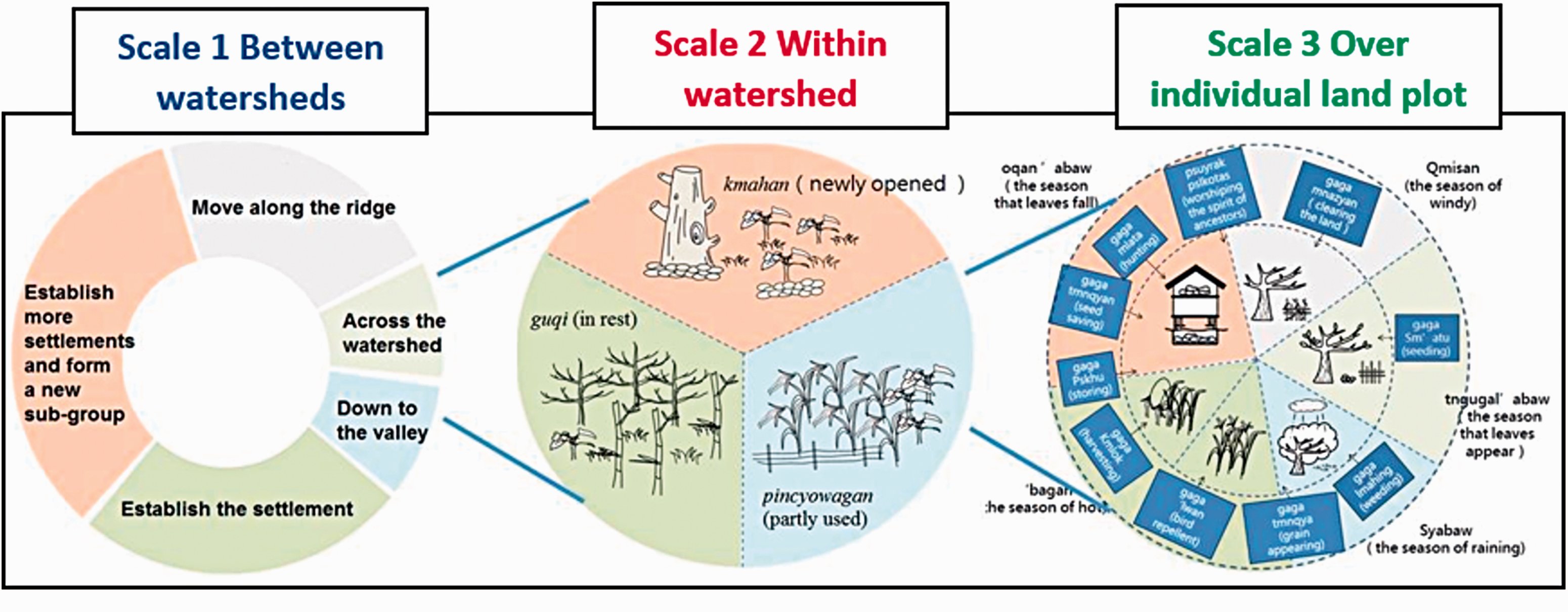
Temporal articulation of three scales.
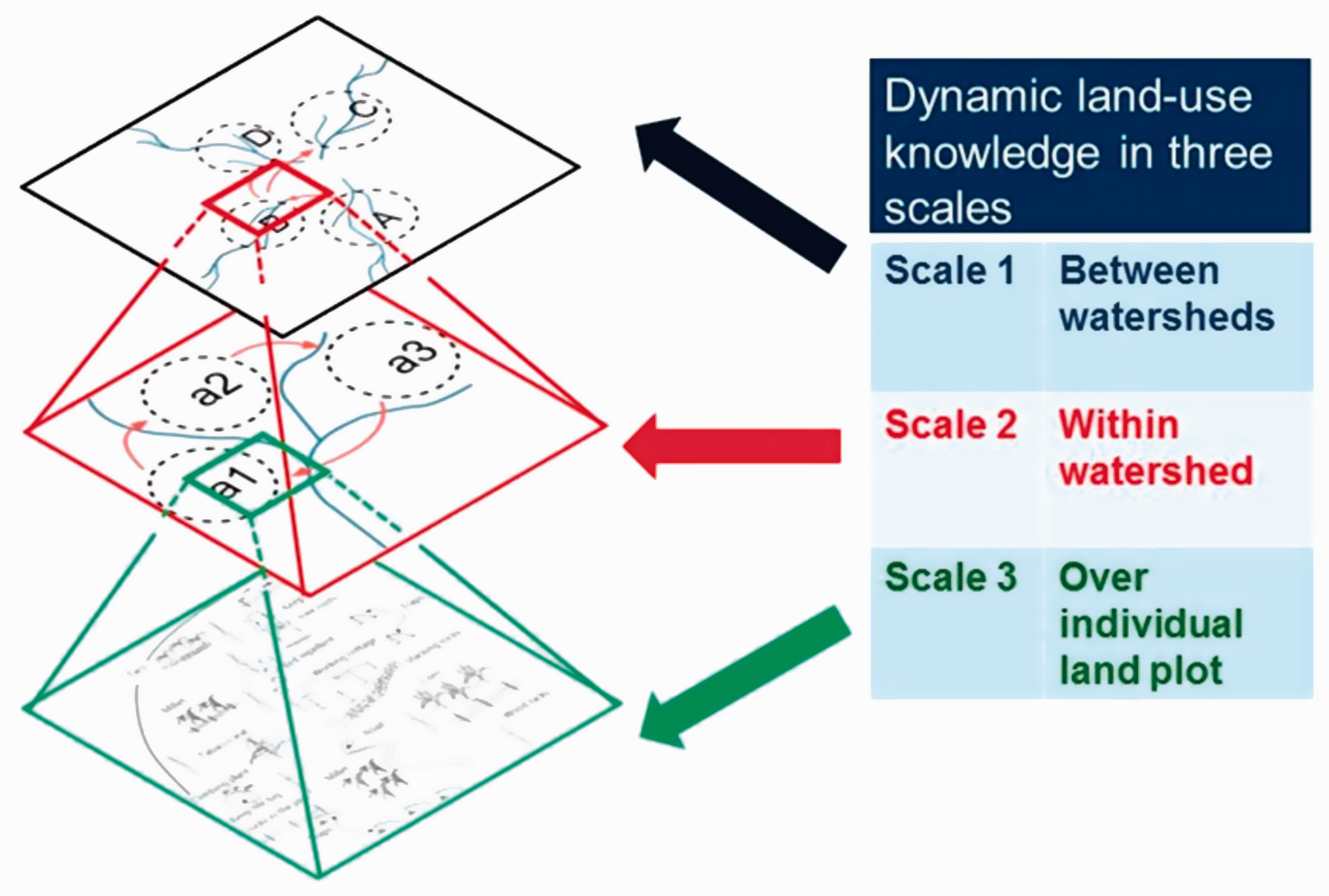
Spatial articulation of three scales.
Land-use within watersheds
In Tayal language, different terms are used to refer to land under different types of cultivation. Land that is newly opened is called kmahan. The land that is partly used is called pincyowagan. The term ‘guqi' refers to the land that is taking rest or is fallow. These terms reflect the life cycle of the land under swidden agriculture.
After burning a patch of forest for farmland, the phase of kmahan lasts for one to two years. It is the period when the land has the most fertile soil. When the fertility decreases, the land turns to the phase of pincyowagan which lasts for another one to two years. Usually, three to four years after the farmland was opened, it turns to the phase of guqi, which means it should be left to take a rest. The land users will therefore leave this land and search for another patch of forest that is good for cultivation. Before they leave, they will plant alder trees over the guqi. The period of rest lasts for about 10 years, during which people will not disturb the land. Sometimes, when people shift their cultivation to newly opened land, they move the entire household to live closer to it. Swidden agriculture practised in the watershed shared by the same sub-group balances the need of farming and maintaining the soil (see the ‘scale 2’ diagrams in Figures 1 and 2).
It is clear that in the fallow period, Tayal people retain their presence in the area. They do this as past and future land users whose active involvement as carers for the land is reflected in the continuity of their interests and Tayal understandings of property, space and time.
Land-use over individual land parcels
Thirdly, at the scale of individual land plot, Tayal cultivation practices have ecological significance. These practices include:
keeping big rocks or the roots of big trees after burning a patch of forest into farmland; stacking rocks or wood racks to stabilize the slope; planting different crops according to subtle changes of the landforms (for example, climbing plants for scree and millet for gentle slopes); setting bird-disturbance devices and hunting traps to catch small-sized animals to protect the crops and also to create alternative food sources; seeding with tiny hoes to avoid massive and in-depth destruction of the soil and landscape.
The ‘scale 3’ diagram in Figure 1 shows the Tayal calendar which follows the schedule of millet plantation and seasonal transition of the environment (for example, when the mountain cherry starts to bloom, it is the time for seeding the millet). These practices reflect a refined land management strategy. The ‘scale 3’ diagram in Figure 2 renders Tayal people’s cultivating pattern over individual land parcels.
To sum up, the landscape management practices at three scales form a sophisticated, articulated, well-organized and dynamic system. Such a system is an outcome of mutual adaptation between Tayal society and mountain ecology (Kuan, 2013; Lin, 2015b). From the perspectives of land possession, the possession of land is neither fixed in certain locations nor does it contain a timeless permanency. It shifts from one place to another and changes in periodic sequence.
Contestation over property, time and space
As narrated in preceding sections, Tayal people’s occupation of time and space is cyclical and multiple. The temporality that allows Tayal people to build their proprietary interests encompasses a long-term temporal cycle including fallow/cultivation and absence/presence. Tayal people’s physical absence from a fallowed land does not have an impact on their own proprietary interests; their absence is recognized among the community members. Tayal people’s proprietary interests also encompass a mobility, whereby people move fluidly between places while their land interests remain. Customary proprietary interests exist in multiple places simultaneously and/or exist in the same places across different times. However, when encountering colonial interventions, Tayal people’s possessive logics are severely contested and deemed as inconsistent under the dominance of KMT systems. This section discusses: (1) how the nationalist KMT hegemony of property attempts to discipline Tayal people and consequent impacts; (2) how Tayal people respond to the imposition of a new land registry system.
The nationalist KMT established their regime in Taiwan with an ambition to overthrow the PRC government. Building a modernized and civilized regime in Taiwan was essential for the nationalist KMT government to proclaim their legitimacy internationally. The nationalist KMT government commenced a census and household registry system to demonstrate their comprehensive control and surveillance over the island, in addition to their intention of promoting modernization (Wang, 2005: 79). It was not the first time a census was conducted in Taiwan. The Japanese colonial government also undertook seven censuses and combined the census data with their police system (Kuo and Chen, 2016: 227–230; Wu, 2006: 34). The nationalist KMT government conducted censuses based on the household registry system founded by the Japanese colonial government. Using the census data as foundations, the Government investigated the land usages and land users. Later on, the land usage investigation became the basis of freehold title claims. 15 There were intriguing differences between the implications of population census and household registry during the Japanese colonialization and the nationalist KMT government regime. The Japanese colonial government’s intention in conducting household surveys and population census was to comprehensively monitor and control Taiwanese residents (Kuo and Chen, 2016: 227). Unlike the Japanese government’s intent to build an overseas colony under intense surveillance, the nationalist KMT government aimed to recall Taiwanese residents’ imagined nostalgia and patriotism to China after 50 years of Japanese colonialization (Lin and Tseng, 2014; Wang, 2005; Wu, 2006). The nationalist KMT government’s household registry system identified Taiwanese residents’ ‘Chinese original domicile’: this term refers to which province of China a Taiwanese resident’s ancestor came from. This administrative procedure profoundly implied that the nationalist KMT’s hegemony was rooted in Taiwanese jurisdiction that was unequivocally part of a greater Chinese state. It also, however, affirmed Taiwanese views that the Chinese presence in Taiwan was an external imposition. Categorizing Taiwanese residents in terms of their geographic origins in China was institutionalized by the nationalist KMT government under the banner of ‘Chinese national imagination’ to meet the political goals of unifying people and claiming legitimacy for its efforts to retake continental China (Wang, 2005: 60). 16
Ironically, the household registry survey which aimed to provoke Taiwanese residents’ Chinese patriotism also produced written evidence of Tayal people’s inter-watershed migration. Figure 3 is a household registry book. 17 This data recorded a recent migration in the 1940s and 1950s.
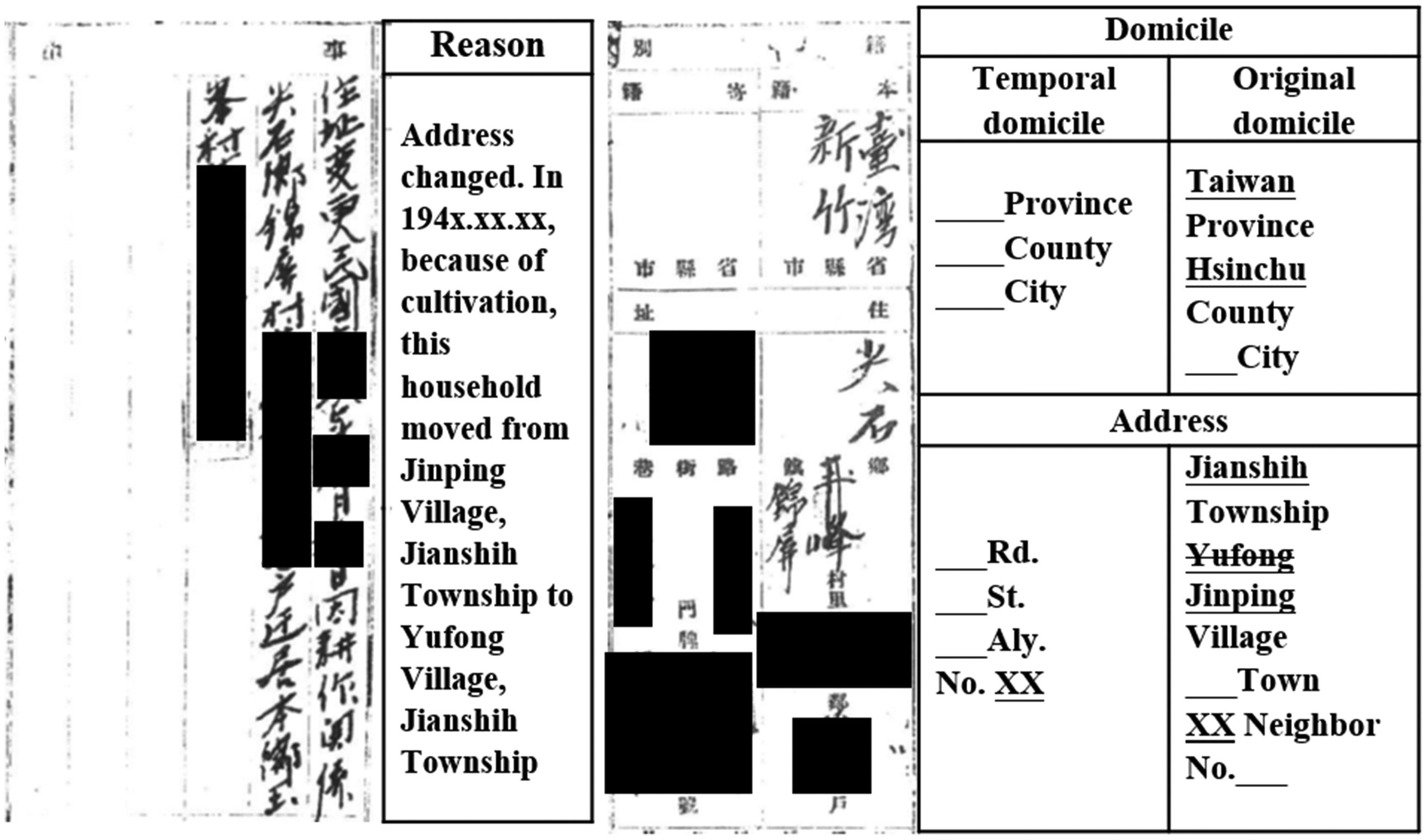
Household registry book. In the left column it was written: ‘Address changed. In 194x.xx.xx, because of cultivation, this household moved from Jinping Village, Jianshih Township to Yufong Village, Jianshih Township’. Later on, in the right column, the household registry officer amended the residential address and crossed out Yufong Village; rewrote Jinping Village, the cross-out implies that household migrated again in the 1950s.Please add a comment in caption and attach if any new image, for the service provider
The nationalist KMT government and its coercive hegemony aimed to transform Taiwanese islands into part of an imagined Chinese state (Chang, 2015).
18
As part of this ambition, the nationalist KMT government found that it was necessary to assimilate Indigenous people into the hegemonic Han culture by continuing the policy to forbid Indigenous people from practicing shifting agriculture in Japanese colonial era.
19
In the 1950s, the nationalist KMT government adopted assimilation as principle of Indigenous policy and commenced the ‘Plainize the Mountain’ policies
20
(Hsieh, 1945). In the name of these policies, the nationalist KMT government promoted sedentary agriculture in order to transform Indigenous people from perceived ‘savages’ to ‘civilized citizens’ (Li, 2012). The nationalist KMT government not only promoted sedentary agriculture but also enforced a supplementary land registry policy that required Indigenous people to continually utilize a piece of land for 10 years
21
before they could claim a state-accepted title. This policy was (and is) a clear political effort to assimilate Indigenous peoples into a position of compliant and governable citizens of the ROC state. For Tayal people, responses to this coerced dispossession are context-dependent. We present two cases collected during Chen’s geographical fieldwork to illustrate how the state-sanctioned freehold title registration system failed (and continues to fail) to recognize Tayal people’s possession of their territory under customary law, and thus caused (and causes) continuing dispossession. Case one below discloses how the dispossession took place:
22
There were several families moved from settlement A to settlement B. They cultivated in settlement B for a while. Then family A decided to return to their origins place A for cultivation again. When the nationalist KMT government officers came to settlement B to investigate the land use condition and register the land titles, a relative B of family A occupied and registered all the lands cultivated during their absence in settlement B. When that household returned from settlement A to settlement B, they realized they no longer owned any land titles in settlement B. Thus, they went back to settlement A and tried to claim the land titles. However, the local authority refused it, said there were no current cultivation facts as a result that household fallowed their lands when they headed for settlement B. Eventually, that family lost all their lands. Another relative of them generously gave them some lands and helped them resettle in settlement B. – Ataw, Tayal informant from settlement B Where my family used to live have no cement road, there were only trails. The transportation was bad. If we wanted to go out (to urbanized regions), we needed to detour along the rivers. We had a temporary bridge there but during the typhoon season the bridge frequently got washed away. It was dangerous. So the government said to my family and neighbors that we should move down to settlement C to work. Therefore, some people moved down, including my grandparents. Yet we did not say we do not want our lands there. We still went back to remediate the land from time to time. Our elders had no idea of registry. So gradually when my dad turned to a teenager and then he started to know things. By that time, he was told that they were not allowed to go in there anymore, because the Forest Bureau took all the lands. As a matter of fact, our elders actually went back frequently, until they gradually settled in settlement C. Then the distance was farer so we did not go back consequently. Nevertheless, we have been trying to claim those lands back, as those lands are our lands. My father said that the siblings of my grandfather all lived right upon there, but all of the lands are gone. I took my father to the Ta Ch'i branch of Forest Bureau to check what are the land number of those lands (in the topographical system of Forest Bureau). The staff said we could try to claim those lands back.
23
Yet, we never heard back from our application. My father sought help from an Indigenous legislator. We even went to the central office of Forest Bureau in Taipei. When facing the legislator, the government employee was like ‘Yes, Sir. We will get to it’. However, nothing came out until nowadays. – Sangus, Tayal informant from settlement C
The land registry policy implies a much stricter definition of space which solely recognizes people’s land interests as existing in a settled place permanently and thus, restrains Tayal people’s mobile occupation of space. The land registry policy also indicates a linear temporality in which time is conceptualized as a numerical measurement abstracted and detached from place, spirituality and materiality. 24 The policy requires Indigenous peoples to utilize a piece of land for 10 years in order to claim ownership and it effectively changed Tayal people’s relations with lands. It requires adoption of the colonizing culture’s regime of agricultural practices and insisted in compliance with the legal regime. For Tayal people to succeed in their land interest claims under this policy, they need to frame their claim in terms that are inconsistent with customary practices. This policy effectively made possession of property conditional on non-compliance with cultural, economic and political practices that are the hallmarks of Tayal ontology.
There is no strict separation of absence and presence in Tayal ontology due to the mobility embedded in their culture. People migrate between places, and fallow land interests remain recognized by the community. The land registry policy compelled Tayal people to ‘re-understand’ their relations with land. The policy disciplined Tayal people’s occupation of space by only recognizing land interests which exist in one place at one time, constraining Tayal people’s mobility as well as failing to recognize the fact that Tayal customary land interests are built and maintained in a cyclical pattern of time and space.
Conclusion: Decolonizing is more than repossessing
This paper argues that as a settler country, Taiwan is continually experiencing ‘deep colonization’. Given that the current Taiwanese government intends to fulfil political legal commitments and pursue decolonization, recognition and reconciliation, it is important to acknowledge that there are still colonizing practices embedded in the institutions that are meant to reverse processes of colonization (see: Rose, 1996: 6). Furthermore, those colonizing practices are so institutionalized in political and bureaucratic structures and policies that they are almost unnoticed (see: Rose, 1999: 182). In this case study, the most significant ‘deep colonizing’ practices are governmental failures to recognize and remove colonizing definitions of ‘property’ from the legislation. The present legislation narrows the notion of property ownership as solely a bundle of rights consisting of the right to use, the right to profit and the right to dispose. Land title registration is required in order to claim land ownership. Nonetheless, Indigenous peoples are required to operate or use a specific piece of land for five years under current statutory law to be eligible to claim freehold titles. As argued before, government institutions demand a stricter and more hegemonic definition of possession, space and time with environmental, economic and cultural implications that constrain Tayal people’s wellbeing.
In the case study, Tayal people’s customary understanding of property rights is not recognized by the dominant systems, or in other words, the dominant settler government fails to have the capacity to recognize Tayal people’s possession of their customary lands. As a result, the struggle of Tayal people against their dispossession is simplified as something that would be adequately addressed by recognizing or reinstating their ‘possession’. In reality, however, Tayal polities are struggling for more than ‘possession’ under the same hegemonic framework. They are struggling for more than lands or concession. This paper argues that the ontological mistake of hegemonic understandings of property remains unnoticed and challenged if the only concession to Indigenous rights is grant of possession of some property on terms defined by the dominant culture. It reinforces the denial of the spatialized temporality in Tayal culture that recognizes the ongoing presence of Tayal rights in fallowed fields where the hegemonic discourse sees only absence. The spatial imaginary of frontiers (Howitt, 2001; Prout and Howitt, 2009) and the temporal imagination of permanent settlement are profoundly carved in settler legislation and are inconsistent with Tayal people’s customary understanding of continuing presence, of continuing care for property across space and time through the long cycles of Tayal agroforestry practices.
The paper maintains that contested spatiality and temporality are the fundamental reasons why Tayal people’s possession was not and is not recognized under ROC jurisdiction in Taiwan. Thus, the paper also maintains that Indigenous peoples’ struggle against dispossession cannot be simplified as a struggle for property possession, especially when the notion of property is based on a biased foundation that contains colonial assertions of authoritative spatiality and temporality. Once the ‘deep colonization’ embedded in the nationalist KMT jurisdiction is revealed, it is clear that the struggle and challenges of ‘decolonizing’ are not only about possessing or repossessing. The struggle and challenge of decolonizing are about recognition of the particular, the culturally specific polity, spatiality and temporality that grounds Tayal people’s way of being in the world and Cosmos. Decolonizing will involve the negotiated recognition of presence where it has been denied and recast as absence and subsequent loss through dispossession. In other words, Tayal (and other Indigenous peoples in Taiwan) ontology has a particular spatiality and temporality whose acknowledgement needs to be negotiated into the dominant cultural and governance systems of Taiwan. The contestation of property in current Taiwanese society should not be seen as merely paying Indigenous peoples more concessions, nor is returning more lands to Indigenous peoples’ ownership sufficient, nor should the government exclude ‘private property’ from the negotiation of new systems that acknowledge the ongoing presence of Indigenous peoples’ interests across all their traditional territories. It is vital that the government acknowledges the ‘colonizing practices’ deeply rooted in the current jurisdiction in Taiwan. By doing so, Taiwanese society can unfold a new page towards just negotiation as well as a chance for truthful reconciliation. This needs to be done through an understanding of property as not solely the rights to use, dispose and benefit but also the rights to be truly recognized, to govern Indigenous territory under customary law from Indigenous peoples’ perspectives whose ongoing presence is the foundation for overcoming the hegemonic influence of colonial property systems.
Footnotes
Acknowledgements
We would like to acknowledge Tayal participants and their families involved in this research. We acknowledge Tayal custodianship and caring that nurtured, and continue to nurture Tayal Country. We also acknowledge the use of Louise Crabtree’s words in our title from her 2013 paper in this journal: Decolonising property: exploring property, time and ethics through contemporary housing in Australia.