



Abstract
As part of our theorization of the place-making conduct of new residents living in a gentrifying neighborhood of Los Angeles, we identify a curious paradox in which white liberals openly disavow overtly punitive policing practices, yet continue to actively call for or tacitly accept police action taken against individuals they perceive to be “out of place.” We examine this seeming contradiction in the context of a contemporary legal mechanism called a civil gang injunction, which allows for the banishment of purported “gang members” from parts of the city even in the absence of actual criminal activity—that is, on the basis of subjective perceptions about what and who constitutes a nuisance. Diverging from traditional approaches to revanchism rooted in vengeful intent, we argue that the direct and tacit endorsement of gang injunctions is motivated by what we call “implicit revanchism”—a no less harmful phenomenon that reflects the persistent and potent effects of implicit racial bias in processes of urban place-making.
Introduction
We go where we get calls from. All these new people are moving into these neighborhoods that are up-and-coming and getting cleaned up, and, you know, maybe they are fearful of some of the people they find there. But that’s inevitable. I am not saying they are racist or anything like that, you know, but these new residents are white and they call the police without hesitation and we respond. It doesn’t matter why they call or if these guys are doing anything wrong, but if they call we have to respond. And our job is to show that we respond so people feel safe. (LAPD Gang Unit Sargent, interview with authors, 2017)
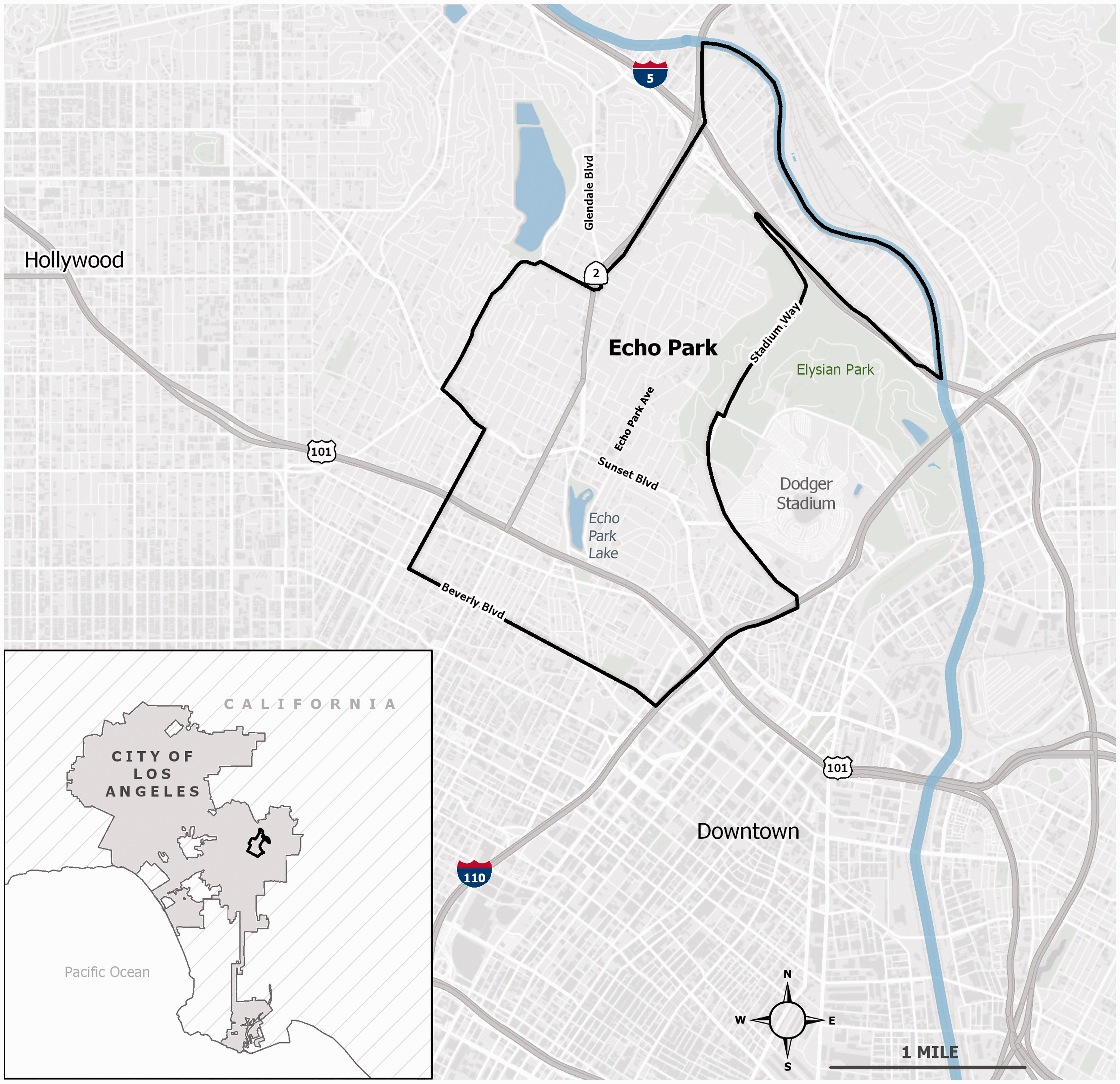
Echo Park Injunction Safety Zone. Map by Cyrus Maden.
In the year following the implementation of the injunction, and in the wake of a plummeting crime rate, the opening of trendy shops, the redevelopment of the namesake Echo Park lake, and the neighborhood’s trending on Instagram feeds—tagged as a “hip” and “diverse” community—Peter sat in his living room, legally excluded from the community. He had become a “nuisance” to the newer—and whiter—community on whose behalf the injunction was implemented. As Pattillo (2008: 295) points out, it is in such contexts of gentrification that established residents of color like Arellano “feel, and indeed are, increasingly supervised and disciplined so that the new residents can fully enjoy the neighborhood as they desire” (see also Parekh, 2015).
However, during our research on the implementation of the gang injunction in the context of gentrification, we were unable to find residents who were vocally supportive of this legal mechanism. In fact, newcomers to the neighborhood who we identify as “white liberals” expressed disdain for gentrification and what they perceived as “police brutality” and racism inherent in the LAPD’s anti-gang tactics.
In this article, we argue that despite such denunciations and rhetorical challenges to displacement and exclusion, white liberals have in reality continued to tacitly accept and even directly instigate such processes wrought by gentrification and broken windows-inspired nuisance abatement. Further, we argue that while white liberals’ rhetorical appeals for diversity and vocal support of inclusion and equal access to neighborhood amenities may not at first glance appear to easily square with their continued investment in exclusionary policing, this paradox is nothing new to the liberal politics of security, and in fact this tension between inclusion and exclusion is fundamental to liberal social order more broadly.
We ground our discussion of we call “implicit revanchism” in an examination of how civil gang injunctions—an aggressive and highly codified form of nuisance abatement—promote and enable a productive logic of (in)security and socio-spatial order that caters to white liberal imaginaries and interests. Pivoting away from the traditional understanding of revanchism as a decidedly vengeful repossession of territory, and situating our work within the critical literatures on policing (Neocleous, 2000; Yarwood, 2007), we argue that the liberal endorsement of civil gang injunctions reflects a more nuanced and deeply seated form of urban exclusion, dispossession, securitization, and ultimately control.
Race, residency, and research at Echo Park Lake
This article represents a larger research agenda concerned with how neighborhood change relies on and is facilitated by police action at the behest of ascendant community members. As such, we began with an observation of how new and established residents were making use of a contested public space in the gentrifying Echo Park neighborhood, or more specifically, the redeveloped area around the namesake lake and park located at the center of the neighborhood.
Located one mile from the northwestern edge of Downtown Los Angeles, Echo Park Lake was constructed in 1870 as a drinking water reservoir set within one of the area’s tree-lined ravines. The hills adjacent to the lake became home to film industry actors and production staff as well as the region’s first film studios starting in 1912. In the post WWII years, the area became known as a leftist enclave and communist stronghold, colloquially referred to as the “Red Hills.” By 1959, the neighborhood experienced one of LA’s most contested land clearances and mass evictions, which paved the way for the building of Dodger Stadium in the Chavez Ravine area (Hurewitz, 2008; Podair, 2017).
During the 1960s, 1970s, and into the 1980s, the Echo Park neighborhood was still known as a countercultural and bohemian enclave and home to actors, artists, and anarchists, but was now also being identified, if not derided, as a destination for immigrants from across Mexico and Central America (Molina, 2015). By the 1990s, as white residents fled the highest homicide rates in LA’s history by moving into the far western reaches of the San Fernando Valley, Echo Park retained its historic numeric majority of Latino/a residents and became popularly known as an entrenched gang territory. 1
Since the beginning of the 21st century, however, the neighborhood has undergone yet another transformation, becoming a high-rent hipster haven and one of LA’s most “up and coming neighborhoods,” which one local blogger describes as a place that has developed “a sense of community that even the local gangs can’t destroy” (Tavana, 2014). At the beginning of the 2000s, Echo Park consisted of a non-Hispanic white population of 16%, compared to the City of Los Angeles’ 30%, and was in the midst of a more than decade-long drop in its violent crime rate to the lowest levels on record. By 2014, when the civil gang injunction was implemented, Echo Park’s white, non-Hispanic population stood at 29% as the City’s overall white, non-Hispanic population dropped to 28%. Further, as the median household income (MHI) for the City of Los Angeles dropped $2000 between 2000 and 2015, Echo Park’s rose by over $4000, from $42,544 to $46,873 (adjusted for inflation and expressed in 2015 dollars. Source: US Census data via policymap.com, 2018). Echo Park, in short, had become safer, wealthier, and whiter just as incoming white liberal “diversity seekers” (Blokland and van Eijk, 2010) were attending community meetings and making appeals to local police, demanding more protection from perceived incivility and crime.
Our field research looking at Echo Park’s contemporary neighborhood dynamics took place between 2016 and 2018, and included the close observation of how residents inhabited the park and lake area. Two distinct locations utilized by different park users became immediately apparent.
In one area, users, all of whom self-identified as Chicano/a or Latino/a as well as long-term residents (n = 18), congregated on and around the picnic tables and built-in barbeque grills on the north side of the park (hereinafter “the flats”). The other observed area consisted of a grassy knoll overlooking the lake and newly renovated boat house (hereinafter “the knoll”). In this second spatially distinct area, park visitors lounged on blankets. Our respondents (n = 15) in this area also self-identified by both race and length of residency in the area, with “white” being the dominant racial category and some variant of “new to the area” being expressed to indicate length of residency. In both spaces we observed an equal number of users who passed as male and female. Children were not present in either location, but rather congregated in an adjacent play area where a slide, swings, and other recreational infrastructure is located.
Vendors of palettes, chicharrónes, and elote were the only people to move between the two groups occupying the flats and the knoll, while Jehovah’s Witnesses set up information stands near the flats, and the local chapter of PETA (People for the Ethical Treatment of Animals) put on live skits about veganism complete with animatronic cows and chickens exclusively for the crowds of people on the knoll.
As a whole, Echo Park is a decidedly diverse place, both in terms of user identity and uses for park amenities. During each research visit we remarked on this fact. But we no less identified how in recent years the park has increasingly operated as, as well as been policed as, a “white space” akin to other such spaces scrutinized by Anderson (2015). Identifying Echo Park as a white space despite its apparent diversity is not to essentialize it as such, but rather, to point to the project of normative place-making based on dominant, though often subtle, notions of racialization. As articulated by Kobayashi and Peake (2000: 394), this project of white place making can also be understood as the “deracializing and normalizing (of) common events and beliefs, giving them legitimacy as part of a moral system depicted as natural and universal… [tacitly enforcing] values not immediately associated with ‘race’ but predicated upon whitened cultural practices” (see also Jackson, 1998; Shaw, 2006).
Given the fraught context of gentrification and concomitant discussions about race, class, and length of residency, it came as no surprise that our respondents would categorize themselves by race and residency when we opened our informal interviews with the broad topic of “neighborhood change.” Our respondents on the flats immediately brought up race and residency within the context of displacement and police harassment, whereas our respondents on the white space of the knoll relied on what appeared to be rehearsed narratives about inclusion and appreciation for the neighborhood’s diversity before seamlessly moving on to the topic of disorder, safety, and crime.
Although most of our interviews took place in the park area, neither group of respondents was privy to each other’s conversation or perspectives due to each group’s segregated sitting patterns. 2 We approached respondents based on their location, and access to respondents was in part facilitated by author 1’s insider status as a “local,” which includes their high-profile connection to the area’s Chicano/a arts and activism scene, as well as their ability to pass in particular social settings as a white resident with academic credentials and a familiarity with local community policing activities. This latter familiarity was developed through close observation of the area during more than thirty hours of rides-along with the LAPD’s gang task force, which included lengthy interviews with officers in the field enforcing gang injunction safety zone and probation/parole compliance (n = 8).
Identifying “white liberals”
White identity in large part rests upon a foundation of (superficial) racial toleration and acceptance. Whites who position themselves as liberal often opt to protect what they perceive as their moral reputations, rather than recognize or change their participation in systems of inequity and domination. In so responding, whites invoke the power to choose when, how, and how much to address or challenge racism. (DiAngelo, 2011: 64)
In this article, we also build on Vitale’s (2008) conceptualization of urban liberalism, which identifies a metropolitan sense of support for social difference and civil liberties in the context of urban entrepreneurialism accomplished through governmental remediation of social ills. We go a step further than Vitale, however, by arguing that white liberalism is not just “hollow” in its gestures toward equity (p. 69), but that white liberals actively, albeit at times unconsciously, hinder progress toward equity by calling for state action to be taken against marginalized groups as part of a practice of avoidance in an urban socio-spatial context (see also Agee, 2014; Murakawa, 2014). Such “aversive racism,” as Dovidio and Gaertner (2004) identify it, is practiced by political and social liberals for whom overt racism is seen as abhorrent and politically conservative.
In the following pages, then, as we discuss the investment of white residents in processes of neighborhood exclusion, the category of “white liberal” serves to highlight the simultaneous attachments that new residents maintain to what might seem like conflicting goals and values. Ultimately, however, we hope to demonstrate how this simultaneous investment in aspirational place-making, repressive policing practices, and ideals of inclusivity is neither new nor truly contradictory, but rather has long been at the heart of the liberal project of order. Guided by our theoretically informed observations of white liberals’ preoccupation with disorder and ready conflation of racialized outsiders with perceived nuisances, we begin by looking closer at this concept of nuisance as a legally remediable aspect of neighborhood disorder. This leads to a consideration of implicit bias, followed by a discussion of revanchism, and finally to a broader discussion of the liberal politics of (in)security. We conclude back on the ground with a discussion of the Echo Park injunction.
Nuisances
Nuisance claims used in the abatement and banishment of undesirable but otherwise legal acts and mere bodily presence in public space have attracted attention from geographers, but as with most critical reflections on banishment and revanchism, the focus of analysis, while crucial, often begins and ends on homelessness (e.g. Beckett and Herbert, 2010; Mitchell, 1997, 2010). The rather narrow focus on nuisance ordinances conducted by geographers is surprising given the pervasiveness with which they are used to remove a whole host of “deviant,” “immoral,” “undesirable,” and racialized bodies from public space. Further, a critical analysis of nuisance enforcement lies at the very heart of understanding contestative place-making politics more broadly.
According to California civil code, section 3479, a nuisance is anything that is “indecent or offensive to the senses, or an obstruction to the free use of property, so as to interfere with the comfortable enjoyment of life or property, or unlawfully obstructs the free passage or use, in the customary manner.” Because a nuisance is most often not a criminal act, the conduct or individual engaging in the behavior need only be perceived as “offensive,” “seriously annoying,” or “intolerable” in accordance with the common-law doctrine. The complained-of conduct also need not cause actual harm to be actionable according to case law. As determined in Mendez v. Rancho Valencia (2016) “so long as the interference would be offensive or inconvenient to the normal person, virtually any disturbance of the enjoyment of the property may amount to a nuisance.”
As found in McIvor v. Mercer-Fraser Co. (1946) and upheld five decades later in San Diego Gas v. Superior Court (1996), a nuisance charge does not require proof of damage or physical harm, or even proof that an ill effect took place at all. Unlike a trespass, destruction of property, assault, or other actionable offence, a nuisance complaint is legally valid and enforceable so long as the person calling for abatement feels that they have been harmed, annoyed, inconvenienced, or have experienced the sense or “mere apprehension of injury” (McIvor, 1946). Therefore, a nuisance, legally speaking, is based on a multisensory and subjective reading of others’ (in)appropriate behavior and demeanor, which, as Cresswell (1996) argues, is dependent on the moral geography of what is deemed by ascendant community members to be out of place, disruptive to the senses, and potentially dangerous (see also Cook and Whowell, 2011).
From their inception, gang injunctions as nuisance abatement have raised constitutional questions since they prohibit otherwise legal conduct and enjoin those who have not been convicted or accused of criminal activity. Injunctions thereby operate as “personal criminal codes” that may infringe on individuals’ constitutional rights (Yoo, 1994). Despite this, civil gang injunctions have survived legal challenges based on their denial of the First Amendment right to free association and assembly. In People ex rel Gallo v. Acuña (1997), Justice Brown of the California Court of Appeals argues in her writing for the majority opinion that “the state has not only a right to ‘maintain a decent society,’ but an obligation to do so.” Writing in dissent, Justice Mosk contends that the maintenance of gang injunctions based on the abatement of public nuisances deprives a number of simple rights to a group of Latino youths who have not been convicted of a crime. The majority would permit our cities to close off entire neighborhoods to Latino youths who have done nothing more than dress in blue or black clothing or associate with others who do so; they would authorize criminal penalties for ordinary, nondisruptive acts of walking or driving through a residential neighborhood with a relative or a friend.
As we observed in our fieldwork and as revealed through the growing literature on implicit bias , nuisance claims and related fear of violence appear to be inspired by the presence of particular bodies and perceived disorder more than deeds.
Implicit racial bias and disorder
Critical geographers have long pointed to the exclusion of “undesirable” users of public space as a matter of economic and spatial hegemony that works toward the preservation of place as a profit-generating component of the urban environment (Herbert and Brown, 2006). While the facilitation of accumulation as part of the neoliberalization of place is certainly part of the story, exclusion and displacement cannot simply be reduced to economic motives. Rather, as van Eijk (2010) argues, regardless of any particular economic motivation or incentive, exclusion even in the context of neoliberal economic restructuring has far more to do with projects of social and spatial order that are driven by discrimination against particular people’s race, class, housing status, nationality, sexual expression, age, ability, gender, and other marginalized identity attributes.
More broadly, then, geographers have focused on not just the economic motivations, but the moralistic impetus for policing the public sphere (Fyfe, 2010; Fyfe et al., 2006; Shabazz, 2015), which Yarwood (2007) acknowledges as a fundamental function of policing in the absence of observed criminality. This is especially evident in observing broken windows inspired policing that focuses on quality of life infractions in a purported effort to thwart violent crime (Wilson and Kelling, 1982), which, as Harcourt (2001) makes clear, targets “disorderly and disreputable” bodies.
As empirical analyses of neighborhood disorder reveal (Chiricos et al., 1997; Quillian and Pager, 2001), perception informed by racial stereotyping and bias lies at the heart of residents’ fear of crime and the prompting of broken windows-style policing strategies, which include “zero tolerance” and “place-based policing” as well as “hot spot” and the euphemistically named “community policing.” Each of these spatially conscious forms of securitization seeks to curb even non-criminal signs or suppositions of “disorder.”
Scholars have sought to operationalize disorder perception and fear of crime, or what Gau and Pratt (2008) refer to as the perceptual disorder-crime link. They have connected respondents’ reporting of heightened disorder to the presence of people of color and racialized “outsiders,” revealing a strong correlation between the two variables despite evidence of varying disorder (Sampson and Raudenbush, 2004; see also Yang and Pao, 2015). Pain (2000: 377) puts the matter in no uncertain terms, pointing out that “white people’s fears often focus on [the presence of] ‘other’ ethnic groups.”
Research in cognitive psychology has shown how bias toward racialized others, which is informed by stereotyping and prejudice, informs our perception as well as our actions (Dovidio et al., 1997; Greenwald and Banaji, 1995). In addition to controlled experiments that include variances in response times in shooter games (Correll et al., 2015), implicit bias, which scholars identify as unconscious attribution of particular qualities to members of particular social groups based largely on appearance, has been shown to adversely effect racialized (i.e. non-white) bodies in the real world of the courtroom (Kang et al., 2011) and on the street at the hands of police (Nix et al., 2017).
Our concept of implicit revanchism integrates policing’s approaches to disorder and the realities of implicit bias, with an understanding of the mechanisms of revanchist exclusion, particularly as it plays out in neighborhoods undergoing dispossession by gentrification. It is crucial to point out that just as implicit bias held by otherwise “well-meaning” people is no less contributive to structural racism (Tate and Page, 2018), implicit revanchism is no less contributive to punitive urbanism in contested places like Echo Park. Given the implications, we follow Mills (2017) who recognizes that unconscious bias no less institutionalizes racial liberalism and maintains structural racism.
Implicit revanchism, we argue, is inherent to, and indeed facilitates, the production of liberal social order and exclusionary place-making through what Mills (2007: 13–20) further identifies as a “militant” type of “innocent” “non-knowing” and “white ignorance” that is essential for liberalism’s fraudulent appeals to equality and inclusion. We turn now to how the concept of revanchism has been recast in recent geographical literatures and how we apply it to our reading of securitization and exclusion in the context of gentrification.
Revanchism
We used to be cool with the cops because they knew who we were, and we’d be, like, ‘what’s up,’ or whatever, when they’d cruised by. They knew we were just kickin’ it, because we don’t do nothing but chill and bar-b-que, or whatever. Then all these white people moved in and were all scared of us, and shit, because, like, how we look and the color of our skin, or whatever. Now the fuckin’ police mess with us just to show them ‘everything is under control ma’am,’ like everything is safe and secure. All these white kids and hipsters, shit, they don’t really want us here even though they act all nice and shit, so the cops mess with us. (Self-described Chicano and long-time Echo Park resident, interview with authors, 2017)
Even when not overtly conflictual, expectations for order as conceptualized by newer, more powerful voices serve to mobilize and guide a potent form of revanchism. This is especially so given how policing and surveillance strategies enacted on behalf of new residents’ often inarticulable demands for security make places inhospitable to and legally uninhabitable by marginalized individuals as part of the ultimate goal to ensure “new and better publics” (Staeheli, 2010: 72). Revanchism in this sense is the objective result of nuisance enforcement instigated by white liberal community members whose sensibilities and expectations for security challenge existing socio-spatial norms for who belongs in public. Here we are most concerned with the social and spatial manifestations of implicit bias, particularly how it fuels, even as it justifies and obscures, revanchist practices on the ground.
The term revanchism entered the geographical lexicon as part of Neil Smith’s (1996) discussion of the hyper-punitive policing practices and process of gentrification in 1990s New York. For Smith and other scholars to follow (e.g. Slater, 2004; Wacquant, 2010), revanchism, or “revenge” as the French revanchisme has been translated into English, is a conscious, motivated, and militaristic reclaiming of lost urban territory. In its conceptual inception, revanchism described the effort to restore moral order to the streets of Paris through acts of retribution for what nationalists perceived to be a stolen French society, and it was this kind of vengeance that Smith saw emerging so many years later on the streets of New York.
However, revanchism has always entailed more than an overt project of vengeance. Even in 19th century France, it pervaded society in the form of widespread acceptance of and acquiescence to more nuanced and insidious practices of dispossession. We therefore posit that the characterization of revanchism in overtly militaristic terms and as part of neoliberal-inspired cleansing unwittingly overshadows the extensive ways that urban space is more routinely purified of economic and racialized others through subtler, more quotidian processes. Our intention is not to strip the concept of its cutting edge by qualifying it as “implicit,” but rather to argue that revanchism also functions less as an exceptional form of vengeance and more as an everyday and unarticulated-as-such dimension of liberal order production.
Our intervention seeks to contribute to scholarship that has reconsidered or expanded upon the concept of revanchism since Smith’s original formulation (see Atkinson, 2003; Jou et al., 2016; MacLeod, 2002; Murphy, 2009; Smith, 2001, 2002; Swanson, 2007; Uitermark and Duyvendak, 2008). One recent strand of this work has focused on so-called “softer,” managerial, and “caring” incarnations of state governance (Conradson, 2003), which scholars have tracked in relation to a perceived reduction in purely punitive urban policy in a number of cities.
Johnsen and Fitzpatrick (2010: 1706), for example, citing the Home Office’s Anti-social Behavior Unit—the UK’s nuisance enforcement division—argue that “softer” approaches to dealing with nuisances reflect a decidedly less-than-revanchist approach to “problematic street culture.” As they put it, whereas revanchism reveals itself in legislative, physical, surveillant, and discursive ways, attempts have been made in recent years to safeguard the rights and welfare of vulnerable groups being removed from public view, often through the provision of supportive services elsewhere. Similarly, Cloke et al. (2010), DeVerteuil (2006), DeVerteuil et al. (2009), Huang et al. (2014), and Murphy (2009) have each argued that liberal social imperatives, combined with localized resistance, have engendered urban policy formations that are, in Murphy’s words, “less punitive than their revanchist predecessors” (p. 306).
While none of these researchers argue that revanchist policy has been completely eclipsed, their work does distinguish the punitive from the managerial, offering each as “counterweights” (DeVerteuil, 2006: 117). Unsurprisingly, this has troubled scholars’ and activists’ ability to reconcile the apparent coexistence of compassion and repression. While it has been noted that policy assemblages can fluctuate between the two orientations, and that the latter may even help to “obscure” the former (Murphy, 2009: 306), few scholars have seriously examined how the punitive and the supportive function together.
Proudfoot’s (2019) recent work on the libidinal economy of revanchism is an exception insofar as it reconsiders the seemingly conflicting aspects of “ambivalence” dialectically (see also DeVerteuil, 2014; Goldfischer, 2018; Schept, 2015). Rather than conceiving of the punitive and the supportive as coexistent yet contradictory, Proudfoot (2019: 5) argues that they “are actually two aspects of the same process—that is, the punitive and the supportive are both expressions of an ambivalent relationship with the urban poor, articulated through social policy.”
While we concede that the punitive edge of policy has occasionally been blunted, such “softer” social policy continues to target the homeless and drug users in progressive cities, and we maintain that such supportive or even apparently “compassionate” approaches are no less embedded in broader assemblages that continue to violently dispossess and exclude these and other marginalized groups. The figure of the gang member is a clear example.
Because those who are categorized as such and entered in gang databases based largely on superficial criteria such as style of dress, address, and markers of affiliation such as tattoos have yet to be widely framed as vulnerable or deserving of care, popular and academic discourse concerning their condition remains anything but ambivalent. Such individuals, most of whom are boys and men of color with little to no legal income or economic resources, continue to be widely characterized as, if not vicious “thugs,” then at the least amoral and undesirable threats and nuisances in need of removal from public life. And insofar as the gang label is broadly and often arbitrarily applied to a range of racialized others based not on their actual conduct but rather their ontology and location in contested space, we argue for the continued relevance of the revanchist framework even as we push for a more nuanced conceptualization of the term.
In short, we argue that revanchism, particularly as applied to “gang members,” does not stand against liberal social values, but rather is a fundamental and implicit part of the liberal project of social order and the politics of securitization itself. Therefore, before concluding with a discussion of the civil gang injunction in Echo Park, we discuss the liberal politics of (in)security more generally.
The liberal politics of (in)security
I love this neighborhood. It doesn’t always feel completely safe, especially as a woman, but I feel like the police know who is causing, generally, you know, problems and what not. I don’t want cops, you know, violating their civil rights or whatever, but we work hard to live here and want to feel, just generally, safe and like we don’t have to worry. (Self-identified “white” “liberal progressive” resident of Echo Park, 2017)
The prevailing approach to this relationship in geography, criminology, and related fields has been to consider the security practices of actors—whether states or individual urban residents—as primarily a response to perceived, and necessarily preexisting, insecurities. From this perspective, and even in the work of critical scholars, insecurity itself appears as what Coleman (2009: 911) calls an “unthought by-product” of security practices. However, as long as attention is limited to the effects of insecurity, the objects of insecurity themselves largely escape scrutiny. As a result, these objects recede further into the background of social and political life, becoming ever more ossified and taken-for-granted. Tulumello (2015) has recently directed just this critique at mainstream urban studies in the context of crime, arguing that scholars continue to interpret urban fear as a simple consequence of crime without attending to the mutual relationship between the two.
Tulumello’s critique points to a tendency toward depoliticization that we seek to avoid through our formulation of implicit revanchism. As he notes, theorizing urban fear as a consequence of crime not only naturalizes criminological categories but also casts the security-seeking practices of urban residents as a rational social demand at best, and defensible form of bias at worst. It both reifies what is actually a thoroughly political and contingent category—crime—and risks justifying the everyday and institutional exclusions perpetuated against racialized others as essentially reactive to that then-naturalized phenomenon (see also Coyle, 2016). These exclusions thus become mere excesses of, or aberrations from, an otherwise egalitarian social project.
We argue, instead, that exclusion is the very engine of liberal civil society, and that this engine operates through what is actually a thoroughly dialectical relationship between security and insecurity. We put forth that the investment of individuals in securitizing practices such as the issuance of gang injunctions is just as productive of the racialized social threats they imagine as it is reactive to those threats. That is, the perceived threat embodied by the “gang member” in Echo Park cannot be said to simply precede and arouse fear in white residents, but must instead be interpreted as itself a political product, the contingent object of an ongoing spatial politics that is in turn productive of securitization. We therefore frame our study of the place-making conduct of white liberals as reflective of a politics of (in)security, a politics that we contend has long formed the very heart of the liberal project of social order.
Following Neocleous (2011), we see the liberal project as a productive politics of pacification, and it is through this framework that we understand the supposed contradictions of the place-making conduct we have termed implicit revanchism. As Neocleous et al. (2013: 2) argue, pacification “serves as a linchpin for investigating the coercive economic and social formation of populations; it is a tool for grasping the state-sponsored destruction and reconstruction of social order” simultaneously. It centers dispossession and exclusion within the liberal project of order, demanding that we account for exclusion as constitutive of that order and not merely its byproduct.
This brings us back to the urban landscape of Echo Park, and refocuses our attention on the relationship between white liberals and the racialized others they encounter. Our research has questioned how these liberal residents come to pursue and to justify an investment in exclusionary policing practices in light of their otherwise inclusive values. The concept of pacification provides a way to rethink this phenomenon as dialectical by visualizing the production and administration of insecurity as fundamental to security itself. Pacification functions by displacing the inherent insecurity of capital accumulation (and the attendant contestations over property and space) onto alternative phenomena, places, and bodies. It strives for the legitimation of a social order founded on exclusion through the fabrication of new specters of insecurity and social threat, a process that literally sets bodies and politics in motion (Linnemann and Medley, 2018). In this sense, pacification is a politics—we might even say a “political theology” (Linnemann, 2019: 11)—of fear and (in)security, through which both the figure of the ideal liberal subject—here, the gentrifier—and that of the other—the perceived gang member—are created in relation to each other, and out of which the moral order of civil society is organized.
The Echo Park gang injunction
I’ll be honest, I’m still from the set [gang], but we used to be a more reactive gang, like back in the day. Now we just kick it like family and don’t bother no one. I’ve been kicking it here for years and then one day this same fool I have known since I was small serves me and says I am in the injunction. What the fuck?! Now I see this fool every time I’m walking down the street or chillin’ in the park. He just jumps out at me and calls in a bunch of backup to, like bumrush me, and makes a big ass scene to show everyone he is handling me. (Echo Park resident and self-identified member of the EXP13 gang, interview with authors, 2017)
Of interest to geographers in particular, injunctions are legal protective orders, akin to a restraining order, levied against named defendants within a geographically bounded “safety zone.” Individuals enjoined in an injunction are forbidden from engaging in otherwise non-criminal activities including “standing, sitting, walking, driving, gathering, or appearing anywhere in public view, in a public place, or any place accessible to the public,” as well as from “associating with other named defendants on private property that may be used by others as a common area,” and from engaging in “any manner [of] confronting, intimidating, annoying, harassing, threatening, challenging, [or] provoking any residents, patrons of, or visitors to the Safety Zone” (People v. Big Top Locos et al., 2014).
Injunctions have been forwarded by advocates as a legal mechanism used in the fight against “gang violence,” drug trafficking, and the destruction of public and private property. However, injunctions do not provide additional legal remedies for criminal activity. Rather, and as critics of injunctions have pointed out, they provide police with a legal justification to arrest individuals for violating a court order that forbids them from, simply, being seen engaging in otherwise mundane legal activities across wide swaths of urban territory legally designated as “safe zones” (Barajas, 2007; Bass, 2001; Caldwell, 2009; Muñiz, 2015).
At issue is the very ontology of the “gang” and of the “gang member”—categories that possess little conceptual coherence despite their legal and political salience. As defined in the 1988 Street Terrorism Enforcement and Prevention Act (“STEP”), which helped usher in the use of injunctions as a crime-fighting tool, a gang member is a recognized associate of a “criminal street gang,” which is defined in the legislation as an organization, association, or group of three or more people, whether formal or informal, that has one of its primary activities the commission of one or more criminal acts and whose members individually or collectively engage in or have engaged in a pattern of criminal gang activity and have a common name or common identifying sign or symbol. (CA Penal Code section 186.22)
In reality, “gang member” status is almost exclusively based on a police officer’s reading of an individual’s style of dress, tattoos, gestures, argot, gait, affiliations, whereabouts, and sometimes their self-identification. It is most often not dependent on observed or even suspected criminal conduct (Barrows and Huff, 2009), a reality underscored by the California State Auditor in her 2016 audit of the California gang database system known as CalGangs, which found that dozens of those included in the database who self-identified as gang members were under the age of five (California State Auditor, 2016). As several scholars have noted, it is often an individual’s racialized characteristics in situ, and the public’s perception of those characteristics and geographies, that have more to do with the application of the gang label than any other observable attribute or action (Durán, 2016; Hufstader, 2015; Linnemann and McClanahan, 2017; Williams, 2015). And while one might expect this ontological incoherence to serve as an obstacle to the gang label’s application, the opposite is true: ambiguity facilitates the reification and mobilization of the gang member label in theory and practice (Hallsworth, 2013; Katz and Jackson-Jacobs, 2004).
Nonetheless, injunctions, which have been exported to several other counties and states across the US in recent years, ostensibly target criminal action by evoking the specter of gang violence, thereby winning the support of judges who may otherwise be loath to sign off on the criminalization of people based on overt racial codings. 3 Even so, injunctions reveal that it is not codified criminality that is being abated, but rather something far more subjective. Insofar as the application of these injunctions is instigated on behalf of majority white liberal community members’ feelings of fear and expectations of appropriate conduct, we contend that their primary purpose is to regulate who should be allowed to be seen in and contribute to the appearance of public space.
At the height of Los Angeles’s violent crime rate of the late 1980s to the mid-1990s, the area that would come to comprise the Echo Park “safety zone” did experience a disproportionate share of the city’s more than 1000 homicides per year on average between 1988 and 1995 (compared to an average of 300 homicides per year in the City of Los Angeles over the five years preceding and five years following the implementation of the gang injunction). In light of violent crime abatement being the purported or expected goal of the injunction, never had there been less of a need for such a punitive legal intervention.
As scholars and activists challenging the injunction’s implementation have argued, “the control, containment, and criminalization of youth of color are the root intent of injunctions” (Muñiz, 2014: 217), which “go hand in hand with the rise of the broken windows theory of policing and law enforcement concern with what acts people might do—or look like they might do—rather than with what acts people have actually committed” (Muñiz, 2015: 55). This sentiment is representative of the fact that never had the neighborhood been so safe, so white, and judging by demographic markers indicating dis- and re-placement, so inhospitable to existing Chicano/a residents who were deemed gang members. The issuance of the gang injunction, we argue, is in reality a constructive component of neighborhood change enabled by white liberal imaginaries of insecurity inspired in large part by the mere presence of non-criminal residents of color who congregate in public space. 4
Conclusion
The perspective we have articulated here on the dynamics of space and race in Echo Park appeared to be only too familiar to those respondents we encountered on the Echo Park flats; those on the knoll, however, exhibited a blithe ignorance to the conditions of implicit revanchism to which we argue they were contributing. This prompts us to conclude that rather than simply asking how white liberal gentrifiers can continue to invest in the phobic politics of gang injunctions and nuisance abatement given their apparent discursive commitment to social values that seem at odds with this politics, we would do better to ask instead whether they can even exist—as white, as liberal, as gentrifiers—without that investment. As we have argued throughout this article, dispossession and exclusion are not aberrations from the liberal project of social order. They are not simply excessive or accidental forms of conduct. Rather, the politics of (in)security has long been integral to the production of space in registers ranging from everyday conduct to social policy assemblages. This politics literally shapes the subjectivities and spaces around which social order is fabricated.
This article has focused on one contemporary manifestation of this politics that we suggest poses an analytical challenge to prevailing frameworks in urban geographic scholarship—namely, that of the revanchist city. We argued that scholarship on revanchism has tended to overemphasize the necessity of vengeful intent in motivating exclusionary conduct, and that in doing so it has struggled to grasp the dialectical relationship between punitive and apparently inclusive dimensions of urban social policy and practice.
Ultimately, we argue that a more critically agile and nuanced approach is needed to unpack the workings of revanchist practices and perspectives, particularly as they are based on and fueled by implicit racial bias. But rather than concluding with a litany of mindful practices or reformist sentiment that might challenge the negative effects of implicit racial bias and the implementation of gang injunctions, we have sought to draw attention to the fact that dispossession and exclusion necessarily persist in quotidian processes of neighborhood change and securitization. It is this recognition of implicit revanchism’s structural as well as personal embeddedness that serves as a starting point for any real conversation about a possible future of truly inclusive and equitable place-making.
Footnotes
Declaration of conflicting interests
The author(s) declared no potential conflicts of interest with respect to the research, authorship, and/or publication of this article.
Funding
The author(s) received no financial support for the research, authorship, and/or publication of this article.