



Abstract
When the enormous drapes that had been covering a new building in central Melbourne were thrown off in early 2015, an extraordinary sight was revealed: a colossal image of a face staring down the city’s civic spine. This moment of unveiling marked a fascinating moment for Indigenous–settler relations in Australia, but especially urban, densely settled Melbourne. For the face is that of William Barak, ancestor and leader of the Wurundjeri people, whose country was stolen and remade into what we now know as Melbourne. That an early land rights champion is represented in the built form at such a pivotal location in the city that dispossessed his people offers an opportunity to consider the forms of violence, appropriation and misrepresentation that are perpetually constitutive of settler-colonial cities. Drawing together critical Indigenous scholarship, settler-colonial studies and geographies of memorialization, the paper analyses the building to demonstrate the contemporary workings of settler-colonial urbanization. The paper analyses the representational politics the building performs, the history of land sales since contact and the role of the site in a wider imperialist planning project to reveal the intimate nexus of land, property and recognition politics that work to continuously secure white possession of Indigenous lands.
Introduction
On 3 March 2015, the enormous drapes that had been covering a new building in central Melbourne were thrown off to reveal an extraordinary sight: a colossal image of a face staring down the city’s civic spine (see Figure 1). The unveiling of what is officially called the Portrait Building marked a fascinating moment for Indigenous–settler relations in Australia, but especially densely settled, urban Melbourne.
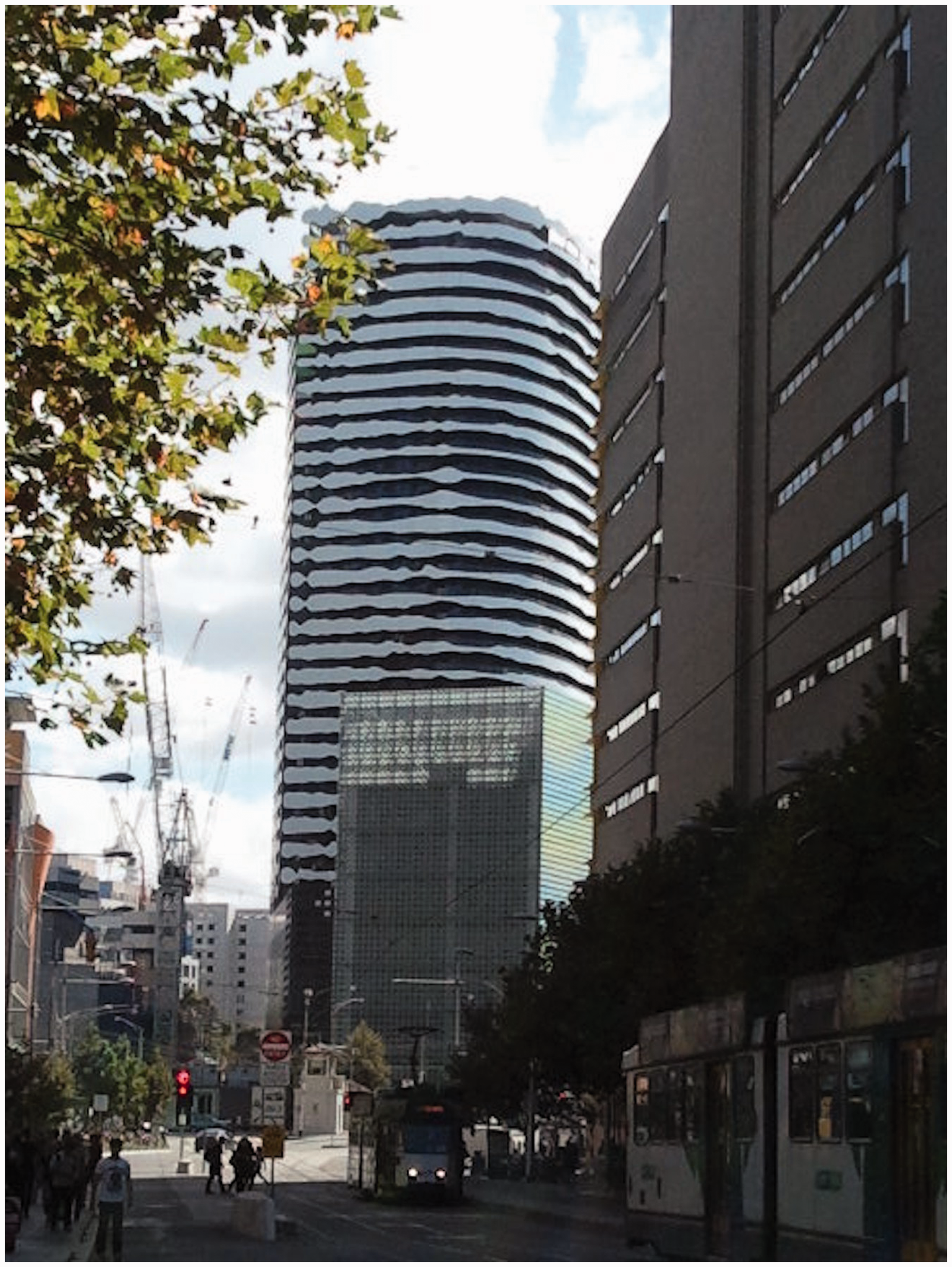
The Barak building from Swanston Street. Source: Photo by Libby Porter.
For the face is that of William Barak, a ngurungatea (head man) of the Wurundjeri people who lived through the brutal early contact period of this region. The building sits on Wurundjeri land, which was stolen by the British and remade, along with that of the wider Kulin Nation, into Melbourne. The creation of such a building begs a series of important questions about contemporary relations in a settler-colonial city. What does it mean to embed an image of an Aboriginal leader in a building on his own stolen lands? Does the building represent an act of reconciliation? Does it make visible Indigenous presence in the city and how might this kind of recognition be understood?
Human geographers have long been interested in understanding the built form. The cultural determinism of the Berkeley School in the 1920s (Williams et al., 2014) was challenged by Marxist geographers who focused more on the economic relations which produced urban landscapes (Harvey, 1973; Soja, 1996) while the post-structural turn directed attention to buildings as signs within a spatial system (Goss, 1988). While Lees (2001) suggested that this focus on buildings as texts neglected their material constitution and embodied lived experience, we would argue further – adding to the work of Jacobs (1996) and Edmonds (2010b) – that buildings also need to be located within their imperial histories.
In this paper, we peel back the layers of settler-colonial urbanization that have produced this building to engage with the important task of interrogating the relationship between urbanization and settler-colonialism (Hugill, 2017; Porter and Yiftachel, 2017). Our purpose is to reveal how the practices of city-building are central to the contemporary reconfiguration of the settler city. Informed by an understanding of the specificity of settler-colonial urbanization (Edmonds, 2010b; Hugill, 2017; Jacobs, 1996; King, 1990; Porter and Yiftachel, 2017) as one that relies on the normalization of white possession (Harris, 1993; Moreton-Robinson, 2015) and a remaking of the past through built form (Dwyer, 2004; Healy, 1997; Mitchell, 2003), our aim is not to read this building as an outcome of settler-colonial social orders, but rather to examine how the built landscape is constitutive of those orders.
Our research approach is archival and documentary. The paper presents evidence from planning reports, land title records, media and historical sources from 1835, when British settlers first arrived, to the present day. These support a critical history and analysis of how the building is constituted as a landmark, as well as its wider political economy. We also draw from field notes taken during a public forum about the building shortly after its unveiling, and maps and images of the site to critically analyse its position in a wider context of imperial city and nation-building.
We have not undertaken primary research with Wurundjeri people and we present their views only as they were expressed on the public record, along with published views of other Aboriginal people about the building and the wider processes and politics of dispossession. Clearly this marks a limit to the research in this paper and we acknowledge our own positions in the ethical questions this raises. However, we do not purport to provide an account of Aboriginal community perspectives on city formation, though this is surely worthwhile and would require Wurundjeri consent and leadership of the process and method for so doing. Instead, our aim is to consider this as a settler-colonial story and, as non-Indigenous authors, we share a responsibility towards holding our own fields to account in its telling. Informed analytically by Indigenous conceptualizations of the politics of dis/possession, the paper seeks to bring sharply into view how imperial power is continuously remade through the processes of settler-colonial urbanization including design, technologies of planning, capital flows, land exchanges and social discourse (Jackson et al., 2018).
The paper unfolds in four parts moving between the abstract and the concrete and across scales to unpack the process of constituting the settler city. First we provide context to the building, the image and the ensuing public discussion. Then, we investigate how the building works as a landmark or monument, to reveal the paradoxical relationship between visibility and erasure, remembering and forgetting, that is a constituent feature of the settler-colonial dynamic. The third section examines the nexus of land, property and the white possessive subject in settler-colonial cities to reveal the historical and contemporary work of turning Wurundjeri land into individualized property rights. The final section situates the building in the work of planning and imperial nation-building. Each section begins with a conceptual discussion to frame each specific dimension, followed by an empirical analysis of relevant aspects of the Barak building and its genealogy.
Situating the building
William Barak’s life (c. 1824–1903) spanned the frontier violence of the early days of British occupation of the colony of Port Phillip, right through to Australian Federation when, for a short time, Melbourne was Australia’s capital. He is a central figure in Wurundjeri accounts of their struggle to maintain their land base and retain their language and culture in the face of one of the swiftest dispossessions in British imperial history. Among the small number who survived the violence of the contact period, Barak was a significant champion for the rights of his people (Barwick, 1998; Nanni and James, 2013).
The building is one of many developed by Grocon, a major Australian development with a significant portfolio in Melbourne. It is a private residential apartment tower containing over 530 apartments with a smattering of retail uses at street level. The site is part of the former Carlton and United brewery complex, and according to the developer and architect, stands as a landmark building at the Carlton end of what is known as Melbourne’s ‘civic spine’ (Swanston St), the other end marked by the Shrine of Remembrance (see Figure 2).
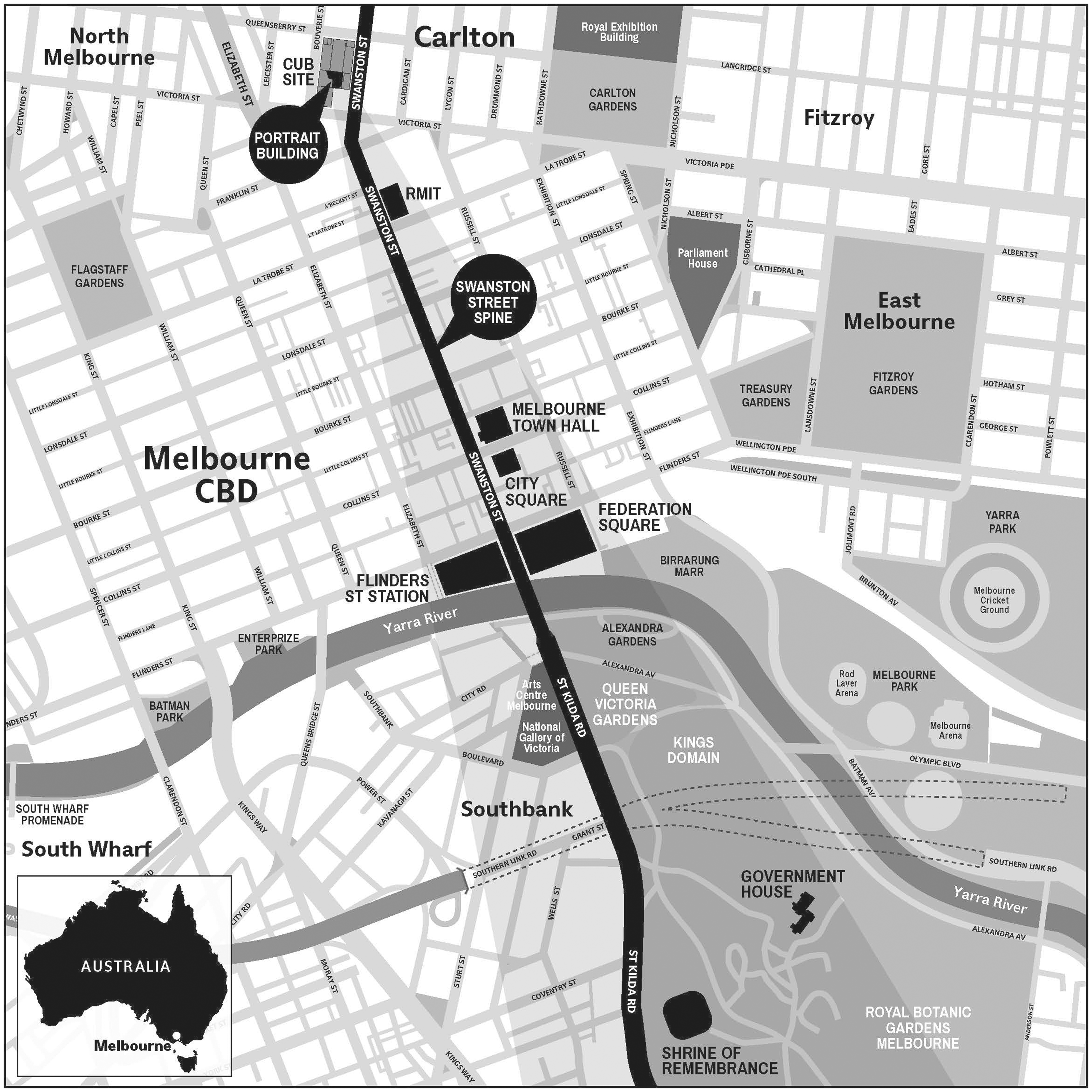
Map showing key locations and features. Source: Prepared by the authors and First Class in Graphic Design.
Significant critique was mounted in the media about the choice of image, the intent of the architects and the integrity of aesthetic decisions (Hansen, 2015a, 2015b; Kennedy, 2015). These commentaries examined the politics of using Barak’s face on a commercial apartment building, sited on a former brewery, looking towards a war memorial that fails to commemorate those who fell in the frontier wars. Some were excoriating, especially Hansen who labelled the building ‘Brand Reconciliation’ in which a ‘literally superficial image of Aboriginality serves to mask the profit motive’ (Hansen, 2015b: n.p.). Vigorous debate has ensued, especially in the architectural field and beyond about the extent to which the architect should be held responsible for charges of cultural appropriation (Mackenzie, 2015), and the extent of consultation with Barak’s descendants regarding the use of his image.
Yet very little in that debate has focused on the conjoined processes of capitalist urbanization and colonization that make this building possible. The building is revealing not only of the fraught and ongoing politics of identity in settler-colonial contexts, but of the underlying orders that enable continued white accumulation by dispossession. The use of Barak’s image, and to some extent the limited critique around it, are emblematic of a ‘settler move to innocence’ conceived by Tuck and Yang (2012) as ‘strategies or positionings that attempt to relieve the settler of feelings of guilt or responsibility without giving up land or power or privilege’ (10). Such moves serve not only the perpetual re-assertion of settler belonging and possession, but are also fundamental to the work of obscuring the nexus between Indigenous dispossession as a necessary feature, occurring in perpetuity, of settler accumulation (Coulthard, 2014).
The politics of (not) remembering
Urban landscapes are world-making processes (Mitchell, 2001). In settler-colonial contexts, where settler power is reaffirmed through a ceaseless process of white possession and Indigenous dispossession (Moreton-Robinson, 2015), urbanization is foundational. Settler society sustains a perpetual appetite for securing possession of Indigenous territories and resources while simultaneously making invisible Indigenous presence in order to justify that possession. This is the work that settler societies must do in order to stay (Wolfe, 2006). The creation of built environments, then, is a world-making process that not only reflects but configures the social and political relations of settler-colonial orders.
This world-making is not reducible to either abstract capital commodification (though it is this), or symbolic and discursive place-making to incite local attachment and affect (though it is this too). In colonial-capitalist formation, the intertwining of an abstract commodification of land into property with the imposition of settler formations of meaning, belonging and locality charges the city fabric, fuelling specific forms of remembering, forgetting and practices of belonging, as a public imagination (see Mitchell, 2001).
Individual buildings and memorials are pivots in such world-making processes. They work to reconfigure the past, present and possible futures (Dwyer, 2004). The Barak building is not at first blush a memorial and its designation as such has been explicitly denied by the architects (Field notes 24 March 2015). It does not display the characteristics normally expected of a memorial. However, as Dwyer (2004) remarks ‘monuments are political resources, laden with authorial intentions, textual strategies and readers’ interpretations’ (422) such that the building can be read as a monument. The building has authorial intentions, is embedded in specific relations of power and is continually interpreted and read by viewers. The building ‘stands’ for something and in so doing performs ‘symbolic accretion’ (Dwyer, 2004), where over time commemorative and interpretive elements become appended. It is in this reading that we seek to ascertain which interpretive elements hold, and which are obscured.
Barak’s face looking across the city is visually striking and present in a colossal way (see Figure 3). This work of making visible was, according to the architect, central to the selection of this particular person for the facade. At the public forum, Howard Raggatt, the lead architect, described the image as ‘filling the void of absence’ that had been the plight of Aboriginality in the city of Melbourne since its founding (Field notes 24 March 2015). The placement of such an important ancestor so visibly and centrally in the city was met with acclaim and public support from the Wurundjeri Tribe Land and Cultural Heritage Compensation Council (hereafter Wurundjeri Council) who praised the architect’s intention to pay respect to traditional owners and to William Barak’s memory (Hansen, 2015b).
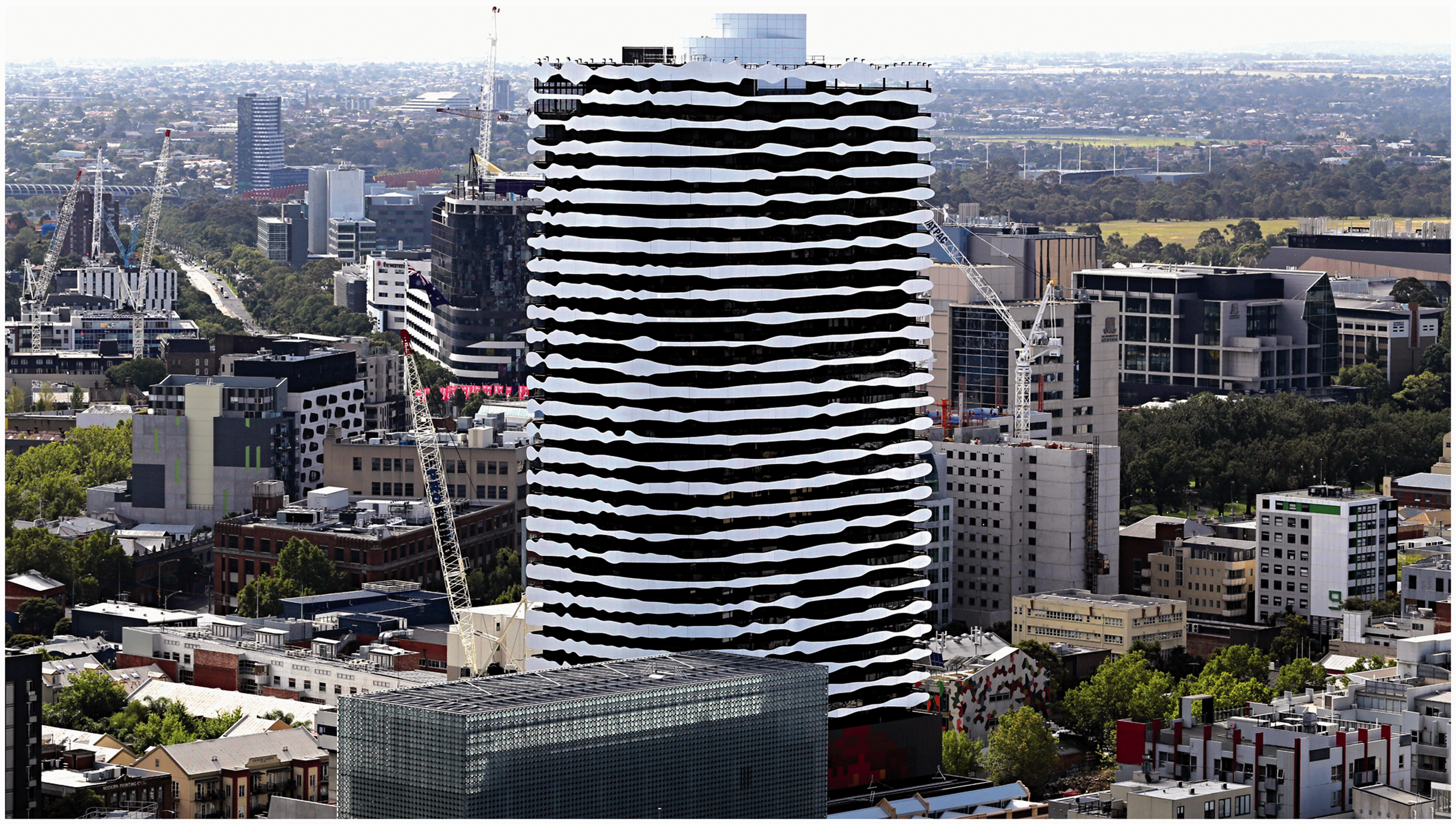
The face of Barak colossal across the Melbourne skyline. Source: Photo by Eddie Jim, Fairfax Syndicate, taken March 2015. Used with permission.
Of course the ‘network of performances’ (Healy, 1997: 5) of enunciation and representation that activate social memory are neither innocent of, nor removed from, the wider ‘cultural history of which they are a part’ (Mitchell, 2001: 276). How landscapes are received or interpreted is very much a question of how and where those doing the interpreting are located in reconstructed versions of the past (see Leitner and Kang, as cited in Mitchell, 2001).
The architect’s stated purpose of ‘making visible’ is an archetypal move to innocence. The power to make visible is assumed through a system of urbanization that reiterates the entitlement of (white) possessiveness (Moreton-Robinson, 2015), not only to the land itself but to the deployment of an image that commands an intervention in contemporary practices of reconciliation. The authors of this building are those whose privilege is upheld by white possessiveness: architects, a development company, landowner and planners in the state land-use system. As Aboriginal architect, Linda Kennedy, stated at the public forum, white architects have been imposing systems from the colonial centre and ‘designing for’ Aboriginal people since colonization (Field notes 24 March 2015), precisely the productive power to speak for, that Foucault (1988) diagnosed.
At the same time, the entitled choices that white possessiveness enables in directing public attention to particular dimensions of Aboriginal recognition and visibility serve to obscure and hide the mechanisms that preserve exactly that entitlement. At the time of the building’s unveiling in 2015, the website of the architectural firm stated: William Barak (Beruk) is the traditional ngurungaeta (elder) of the Wurundjeri-willam Clan. The cultural resonance of William Barak gazing down the civic axis of Melbourne towards the post federation Shrine of Remembrance, stands to unite the city’s modern heritage with its deep history. (ARM Architects, no date, emphasis added)
It is with this in mind that we can more precisely approach the processes underway in the memorial-work of the Barak building. The responsibility to remember is a collectively enacted process of passing the story about who we are from one generation to the next. Monuments displace this responsibility by becoming repositories of memory (Dwyer, 2004), purely referential signs that allow an escape from history. Monuments are effective not because they prompt remembering but because they enable forgetting.
The question of control over the visibility or otherwise of this particular form of re-presenting Wurundjeri presence in the city was a central concern at the public panel debate. Aunty Joy Murphy, a Wurundjeri Elder and great grand-daughter of William Barak, also spoke at the panel event. A tense discussion ensued between her and the lead architect on the question of who controlled the image, and to what extent there was oversight by Barak’s descendants (Field notes 24 March 2015). While consultation certainly occurred, it became clear that fundamental control over the image was held by the architect and developer. It was, as Linda Kennedy observed, ‘consultation to get to an agreement’ (Field notes 24 March 2015).
These issues are important, yet we are reminded that the politics of visibility, participation and endorsement in this context are rather slippery. Consultation in decision-making can never fully resolve the underlying tension because it is firmly located in what Coulthard (2014) identifies as the liberal politics of recognition (see Porter and Barry, 2016 for an account of how this operates in asymmetrical planning contexts). The debate around the efficacy or otherwise of consultation is part of the more cunning work of precisely that politics (see Povinelli, 1998) because the parameters are already set on settler-colonial terms. In the absence of Wurundjeri control of land-use decisions and a Wurundjeri presence in the built environment of the city, the space allowed for a Wurundjeri ‘say’ is limited to the more palatable conversations about which image to use and in which direction it might face.
The mirage of dialogue and consultation masks what is in fact a singular pole of self-referential coloniality. This is the hall of mirrors of settler-colonialism which endlessly reflects back to itself an image of legitimate presence (Rose, 2015). As such, colonial power rests precisely in the ability and entitlement to not see and to not hear. Something cannot be simply rendered visible (Spivak, 1994) if no-one is looking or those looking see only themselves.
In its dictionary meaning, recognition means both to identify from previous knowledge and to be rendered legitimate or acknowledged. Tense discussion ensued on both these dimensions at the panel event. For some, including Barak’s descendants, the likeness of the image was not direct enough. Aunty Joy Murphy said she ‘could not recognize’ the face of her ancestor (Field notes 24 March 2015). In response, the architect made a startling admission: he said it did not matter whether the face is recognizable or even who it is. ‘It could be’, he said ‘Jesus Christ, or Che Guevara, or Karl Marx’. The purpose of the image and the work of those seeing it is, he claimed, to ‘invite conversation’ (Field notes 24 March 2015).
Here, the architect seems to have upended his earlier claim to make visible Wurundjeri presence in the city by now negating the importance of such an act of acknowledgement. Yet a cooler analysis of this stance enables a view of other, subtler, layers of white possessive privilege at work. Relatively few people know the story of this man and his people. There is no legible biographic information provided on site that indicates an intention to enable Wurundjeri knowledge holders or descendants of Barak to inscribe the building with their stories of this man and his legacy. Indeed, the foyer of the adjacent heritage-listed Malthouse building, one of the main entrance ways to the building, is entirely given to a celebration of the origins of Carlton United Breweries and the macho Australian culture of beer consumption.
There is one very curious piece of information on the building registering the identity of the image. It is a statement, ‘Wurundjeri I am who I am’, written in a massive braille formation in large metal discs, sitting just underneath Barak’s chin. The discs sit at least two stories above ground and are so large as to be functionally meaningless to any readers of braille. In their explanation of this singular and utterly abstruse reference to Barak’s identity, the architectural firm stated that ‘It is in braille as a message for those willing to explore beyond the obvious’ (Creative Victoria, 2015).
What is revealed here is how the Barak building is much more about absence and obfuscation than it is about recognition or reconciliation. In fact, the choice of using Barak’s image came towards the end of the design process – just one heritage reference among many on the palette of architectural possibilities. When Grocon first bought the site in 2007 the brewery heritage was of most interest (Bolling, 2007). The archaeological investigation undertaken on the site focused solely on post-1854 history (Grocon, 2008), ignoring the many thousands of years of occupation that pre-dated colonization. The ability to choose to make visible and remember, reveals the deep relationship between visibility and erasure, remembering and forgetting in the settler-colonial dynamic. As Healy (2008) observes: ‘[T]he pre-eminent mode in which indigenous people are remembered in Australia is as absent’ (11), yet this absence is imagined in ‘the face of a continuing and actual indigenous historical presence’ (12).
Much of the public discussion about this building has centred on these discursive politics of recognition: questions about whether or not Barak’s face is recognizable, questions of interpretation, and sometimes, questions of the deeper recognition and acknowledgement of Aboriginal presence in the city. These issues are important, yet this focus on recognition tends to obscure the underlying politics of land that not only make the building possible, but are precisely the mechanism for rendering invisible the land dispossession that is being perpetually re-enacted, this time through the Barak building. It is to this dimension that we now turn.
Land and the white possessive subject
Land and its ‘actual geographical possession’ (Said, 1993: 93) is foundational to the settler-colonial relation (Bhandar, 2018; Coulthard, 2014; Wolfe, 2006). Taking possession requires any number of techniques, one of which is the activation of property. As Harris (1993) has argued, dispossession of lands from First Peoples ‘embedded the fact of white privilege into the very definition of property’ (1721), as the right of possession was deemed to be attributable only to the cultural practices of whiteness. Our use of whiteness here signifies a structure or ideology of possession, one that smoothly operationalizes possessive privilege because of the way that whiteness ‘presents itself as a self-actualized achievement’ (Dwyer and Jones, 2000: 210). Whiteness in this way comes to have its own value as property (cf. Harris, 1993) – the trait of whiteness is wielded, exercised and owned in a manner that bestows privilege.
Focusing on the intertwining of property and racialization helps grasp these as relational. Keenan has conceived this as ‘relations of belonging’ that are always embedded in wider socio-spatial networks that extend beyond the subject. These networks ‘hold up’ specific subjects in their everyday lives such that ‘wider social processes, structures and networks give them force… in ways that have a range of enabling effects and consequences’ (Keenan, 2015: 72). The ‘white possessive’ is a subject (once, but not now always white) brought into being in settler-colonies through the perpetual and relational process of dis/possession (see, e.g. Moreton-Robinson, 2015). This subject is held up by the wider socio-spatial networks of property relations and law, urban planning and governance that do the work of ‘reproducing and reaffirming the nation-state’s ownership, control and domination’ of territory and resources (Moreton-Robinson, 2015: xii).
At the same time, the privilege of white possession through property is thoroughly normalized, saturating all relations of life. Property in land becomes merely an object to possess (see Blatman-Thomas and Porter, 2018), theoretically available to anyone through the operation of markets, titles and the laws of exchange. In so doing, normalization obscures the foundational racialized logics and perpetual dis/possessory relations that made white possession possible in the first place. The continent of Australia was taken by the British in a series of interlocking activities and legal fictions that refused to recognize the systems of land use and property already present, enabling the theft of land parcel by parcel as settlement expanded and the freehold system of asserting property rights unfolded (see Porter in Jackson et al., 2018: 56–68). This accounts for the extraordinary ease with which white possessiveness in settler-colonial cities like Melbourne is sustained, for it has become no longer visible, merely working through the operations of property in the service of producing the larger canvas of the urban landscape.
For Indigenous peoples, ‘cities signify with every building and every street that this land is now possessed by others’ (Moreton-Robinson, 2015: xiii; see also Behrendt, 2005). Yet this erasure is by definition structurally incomplete. The survival and resurgence of Indigenous peoples marks the limit of settler-colonial intent. Despite the efforts of settler violence to make erasure a reality, Indigenous peoples never left the city, and the land itself remains. Given that Indigenous ontologies refuse the distinction between land, people and other life (Todd, 2016), it is also then vital to recognize the continued presence of these relations as a reminder that the settler will to erasure can never be complete.
Indigenous peoples, lands and lives do not go away. Nor do settlers (we include ourselves here) go away. Sustaining white possession perpetually demands the usurpation and reordering of Indigenous lands, in the face of continued Indigenous presence. Cities are both the method of enacting the will to erasure and the product wielded by settler society as proof of belonging and the legitimacy of its political order.
None of these logics are undone or transcended by modernity, liberal democracy or neoliberal urbanism. The reorganizing work of land and resource privatization, corporate de/re-regulation and consultative urban planning combine in the contemporary era to advance white possession and conceal that advancement (Tomiak, 2017; Yacobi and Tzfadia, 2019). Urban Indigeneity thus emerges as a specific subaltern citizen, a ‘counter-public’ that participates in political processes which themselves re-assert settlement in the very action of participatory forms of urban governance (Blatman-Thomas, 2017). The urban also emerges within contemporary land rights recognition regimes, such as native title in Australia, as structurally outside the possibility of Indigenous tenure, because of the power of freehold title (Jackson et al., 2018; Wensing and Porter, 2016). Incorporated into neoliberal regimes of urbanization, Indigenous presence in cities can be deployed in the service of property speculation, corporate ownership and spectacular profit-making, all of which are concealed by practices of symbolic and liberal recognition (also Coulthard, 2014; see Tomiak, 2017). The partial involvement of Indigenous people in some urban development decisions, under Aboriginal cultural heritage legislation, has given some visibility to Indigenous interests in the built environment in ways that have often invited the deployment of contemporary recognition politics by a wide range of corporate and state actors.
The Barak building is firmly rooted in these perpetual processes of taking possession. In Melbourne, these processes began in earnest in 1835, when John Batman along with John Pascoe Fawkner sailed from Van Diemen’s Land. Batman was operating on his own speculative initiative, against the Colonial Office which had expressly forbidden further expansion outside the regulated areas of New South Wales (Jackson et al., 2018). The region to which Batman and Fawkner arrived is thought to have been ‘one of the most densely populated parts of Aboriginal Australia’ (Smith et al., 2008: 535). An extensive social, physical and economic infrastructure existed (Gammage, 2011; Pascoe, 2014) although the population had already been significantly affected by smallpox (Smith et al., 2008).
Batman struck what he infamously described as a treaty with Kulin Nation leaders in 1835. Barak is thought to have been present, as a child, at this event which unleashed one of the swiftest and most devastating usurpations of land in the 19th century (Boyce, 2011; Critchett, 1990; Smith et al., 2008). The density and closeness of settlement with the violence, disease and alienation from lands and resources attending that process, pushed the Aboriginal population, estimated at 10,000 in 1835 (Broome, 2001: 65) towards collapse. A mere 18 years later in 1853, an official count noted ‘1,907 Aborigines and 6.5 million sheep’ (Smith et al., 2008: 535).
During this frontier period, Aboriginal people and especially Barak’s people were very present in Melbourne township as colonization forced people to find new places to live and ways to survive (Boucher and Russell, 2012; Edmonds, 2010a). White settlers in the main decried a black presence in Melbourne, complaining loudly and vigorously in the town’s newspapers and the halls of political life (Edmonds, 2010a: 130). Accordingly, a huge effort went into removing Aboriginal bodies and erasing their presence. Melbourne’s residents themselves engaged in daily acts of violence (Edmonds, 2010a), supported by efforts of the newly formed Melbourne City Council and the police to arrest, hound and remove Aboriginal people from town spaces (Edmonds, 2010b; Jackson et al., 2018). These colonial mechanisms were literally reordering the configuration of bodies and spaces.
From this catastrophic process, colonial society produced town lots for a real estate market that thrived on speculation (see Sandercock, 1976). Batman’s lands were originally surveyed by John Helder Wedge (Davison, 1978), and then in 1837 Robert Hoddle formally laid out the grid pattern that defines Melbourne today. He oversaw the auctioning of lots – purchasing a number for himself. In a few short years, spectacular profits were made. Owners who had bought land in 1836 at around 19 pounds then subdivided 13 allotments and resold each in 1839 for up to 1200 pounds (Cannon, 1983: 424; Weidenhofer, 1967: 8–16).
The first white possessory use of the Barak building site was as a brewery, established by Rosenberg & Co. in 1858. Melbourne was by this time booming, its development and growth spurred on by the discovery of gold in central Victoria and the resulting massive influx of investment, labour and capital (Cannon, 1966; Davison, 1978). The town centre, especially Swanston Street, which was rapidly becoming a busy civic spine was coming to feel like ‘London reproduced’, with its grand architecture, paved roads and lively hotel scene (Boucher and Russell, 2012: 153).
Despite the boom, Rosenberg & Co. failed, and the brewery was purchased by Edward Latham in 1865 who rapidly expanded operations with a brewing tower and other buildings, including a bluestone warehouse on Bouverie Street. Growing and expanding in influence, in 1907 Latham’s brewery became part of a cartel, Carlton and United Brewery (CUB), with the now 1.6 hectare Carlton site the cornerstone of this empire. Melbourne by this time had become the capital of the fledgling nation of Australia, federated in 1901, tightening the imbrication of city-building and imperialist nation-building, as we will show in the next section.
Manufacturing and industry were the central drivers of Melbourne’s growth throughout the first half of the 20th century, but following patterns of deindustrialization common elsewhere, manufacturing was progressively pushed out and the inner neighbourhoods remade (O’Hanlon and Hamnett, 2009). Carlton was a beachhead of gentrification in Australian cities (Davison, 2009), particularly driven by the proximity of major universities. Consistent with this trend, brewing ceased on the CUB site in 1987 and moved operations to Abbotsford, 5 kilometres east, also located on Wurundjeri land. The Carlton site lay vacant and became a much-discussed eyesore, standing derelict at the top of Melbourne’s civic spine. The buildings were progressively demolished, all except the heritage listed bluestone warehouse on Bouverie Street, and the Malthouse on Swanston Street.
A downturn in the 1980s and 1990s saw the rise of place promotion to attract investment, jobs and tourism as a core government policy (Engels, 2000; Hayes and Bunker, 1995). With little happening in terms of re-development, in 1994, the whole 1.6 hectare site was sold to the Government of Nauru for $25m 1 who immediately entered into negotiations with RMIT University, whose city campus is right across the road, to develop a hub for international students.
A design competition was arranged and won by ARM Architects (the same firm who will, years later, design the Barak building). ARM’s design for the site was incorporated into the local planning scheme, yet with little developer interest to actually build (Shaw and Montana, 2016: 14), the Nauru Government eventually sold the entire site to RMIT University in 1998 for exactly the same purchase price it had paid four years earlier. RMIT once again commissioned ARM architects to prepare a development brief, with a significant student housing component.
When RMIT struck financial problems in the early 2000s, the site was prepared for sale with development principles endorsed by the City of Melbourne. Grocon purchased the bulk of the site (16,000 square metres) for $39m in 2006, RMIT retaining 3000 square metres on the corner of Victoria and Swanston Streets to develop a new building for its School of Architecture and Urban Design. To coordinate development, Grocon and RMIT entered a land sale agreement and master planning began. In 2007, Grocon and RMIT requested the Minister for Planning to exempt the site from certain sections of the Planning and Environment Act (1987), indicative of a long-term commitment by the State Government to reorganize planning governance to facilitate investment (Low and Moser, 1991). Soon after, the City of Melbourne incorporated the Carlton Brewery Comprehensive Development Plan, along with an associated Comprehensive Development Zone, into the local planning scheme.
With the development plan approved, specific building plans could be advanced. In 2010, Grocon received planning approval for a 90-storey, 281 metre tower at what is now the Barak building site. It was at this time that the ‘Portrait building’ was first mentioned in the media and William Barak referenced. Plans for the building with the face of Barak staring down Swanston Street were released, meeting with pride from some of Barak’s descendants (Barry, 2010). Put to market once planning approval was given, the block was nonetheless slow to sell. In 2013, it was purchased by CEL Australia for $80m – double what Grocon had originally paid for the entire former brewery site.
Since then, Grocon has progressively sold most of its interests in the CUB site. A deal with Chip Eng Seng (CEL Australia) in 2013 saw that company purchase the Bouverie Street corner site with the heritage listed bluestone buildings for $32m. Another two lots were sold to a Chinese development company in 2014 for a combined $60m: at $9000 per square metre, substantially more than the $2500 per square metre Grocon had paid in 2006. The Maltstore was sold in 2015 for $17m and a further lot sold in 2015 for $20m. In 2016, Chip Eng Seng (CEL Australia) sold the Bouverie St corner site for $64.8m, double what they had originally paid just two years earlier. Sold with no height limits, a 72-storey apartment development is under construction, at the time of writing, on that site.
While the apartments in the Barak building were themselves originally to be aimed at the higher end of the market, a softening of conditions caused the developer to reconfigure the internal layout (Dowling, 2011). More apartments were added by reducing the floor sizes and increasing the number of two-bedroom apartments to attract international students. Indeed, the reconfiguration required all the sale contracts to be torn up and the apartments relisted, with the average price dropping to around $AUD 550,000. Today, apartments in the Barak building sell for anywhere between $520,000 and $800,000, while the median apartment price in the surrounding Carlton neighbourhood is nearer $495,000 (Real Estate Institute of Victoria, 2018).
Summarizing the exchanges of the land alone across the CUB site from 1998 until 2016, reveals the following: RMIT University purchased the whole site at $25m in 1998 and sold at $39m in 2006, retaining one south-east corner block Grocon purchased at $39m in 2006 and progressively sold individual lots for $80m, $32m, $60m, $17m and $20m respectively (total $209m) across the ensuing 9 years. Chip Eng Seng purchased one block at $32m in 2013 and sold it again at $64.8 in 2016
Planning and imperialist nation-building
As surely as the site where the Barak building now stands was functional to and productive of a broader capitalist urban logic and trajectory, these processes were also constituent components of imperial nation-building. In the frontier period, the wider geopolitical context of imperial expansion is present and obvious (Edmonds, 2010a), entwining the production of urban landscapes with the production of empire and nation. Sustaining the nation, however, requires ongoing acts of settlement and nation-building, and contemporary planning and built environment production remain as integral to this process today as they were in the frontier years (Jackson et al., 2018).
The Barak building exemplifies this ongoing process. Sited at the northern end of Melbourne’s civic spine (Swanston Street), the building contributes to an enactment that has been underway for the past 180 years of registering and mimicking urban forms deemed proper from Europe (Rabinow, 1989). The civic spine organizes the shape and function of Melbourne – it is the address of the Melbourne Town Hall, key civic spaces such as City Square and more recently Federation Square, and a significant transport node at Flinders Street railway station (see Figure 2).
The civic spine not only organized the shape and function of Melbourne as a city, but of the wider colony and colonial relations within which Melbourne retains significance. Swanston Street’s southern extension became St Kilda Road – a long, straight boulevard modelled on Hausmann’s Parisian urban landscape. The major public park and botanical gardens at this southern end further registers colonial sensibilities about proper town planning and civic amenity. Continuously reinforced over time, the civic spine is now home to major civic institutions, such as the National Gallery and Arts Centre.
Just under 3 kilometres away at the other end of the civic spine towards which Barak’s image looks, and indeed the best place to view his face, is the Shrine of Remembrance (see Figure 4).
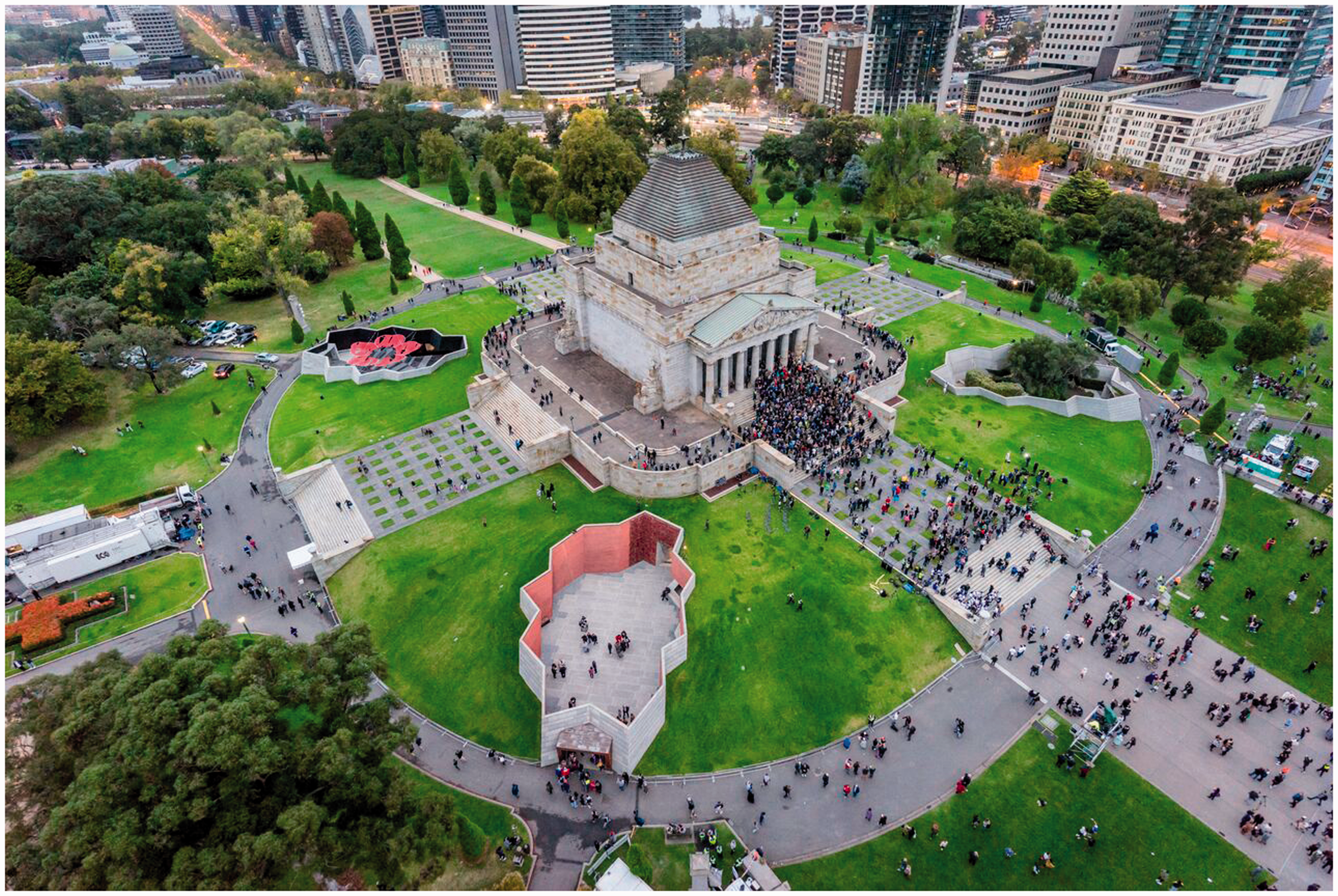
The Shrine of Remembrance. Source: Photo by Cloud Nine Creative. Used with permission.
The Shrine is widely considered a ‘moment of national genesis’ (Sumartojo, 2016: 542), built to commemorate fallen Victorians in the First World War. At the time the idea to build a Shrine arose, Melbourne was the national capital, a role it had played from Federation in 1901, until that role was transferred in 1927 to the newly built Canberra. The Shrine was all about nation-building. On winning a design competition in 1922 sponsored by the Victorian Government and Melbourne City Council, architects Phillip Hudson and James Wardrop described their design as one able to ‘convey the true birth of a [sic] Australian tradition’ (as cited in Moriarty, 2009). Sited atop the hill in the Domain, referencing ‘ancient monumental precedents’ (Moriarty, 2009), the Shrine is literally a monumental presence in the city.
In Australia, the First World War occupies a particular place in the national memory, because of the story of the ANZAC troops at Gallipoli. Remembered each year on Anzac Day, April 25, this event in the national calendar celebrates mateship and nation-building. Events and visitation to the Shrine enables a thickening of national emotion and whiteness at this particular site.
But like most Australian war memorials, Melbourne’s Shrine has historically not recognized fallen Aboriginal service men and women. A significant push from key Aboriginal leaders and organizations has brought some limited recognition. Notwithstanding such changes, the Shrine remains a public act of deliberate forgetting and erasure of the frontier wars between Aboriginal peoples and British colonizers in the contact period.
The intentional pairing of Barak’s image with the Shrine of Remembrance was, according to the architect Howard Raggatt of ARM Architecture, necessary to provide an appropriately significant building at the opposite apex of the civic spine. Speaking of the Barak building he stated ‘we think a building of this scale and civic significance owes the public a visual and cultural contribution as well as providing thoughtfully for its residents’ (ARM Architects, no date). Ironically, it was ARM Architects who also redesigned part of the Shrine in 2003 and again in 2014 and felt that the Shrine represented the ‘dawning of a new nation’ (Cheng, 2015). Thus, facing Barak’s image towards it signified the acknowledgement of ‘the Shrine at one end and then the deep history representation at the other’ (Cheng, 2015). The burden of the site’s history is thus raised as a debt, but not to Wurundjeri people and the Kulin Nation on whose lands all this is unfolding. Instead, the architects imagine that the debt owed to the city would be honoured when the building achieves its place in an ordered and complete colonial space, to be appreciated by a population with an appetite for the monumental and symbolic.
The civic axis retains its importance in the perpetual assertion of imperial power and nation-building in the city of Melbourne. In the documentation governing the early master planning stage (c. 2000s, before the Barak building had been conceived), there was considerable emphasis on finding an ‘appropriate termination’ for the Carlton end of Swanston Street. This was imagined to be ‘another celebration of city life’ (Government of Victoria, 2008: 19) while also ‘reinforcing Swanston Street as the civic and ceremonial spine of the city’ (19).
The building is also given other kinds of spatialized significance as a form that completes the colonial city. One early masterplan commentator suggested the building could be seen as the ‘fourth major landmark on the city’s circumference, completing the points of the compass’ (Roger Nelson as cited in Bolling, 2007). Indeed, the whole site is considered so significant, that in 2008 the Planning Minister exempted himself from the Environment and Planning Act 1987 because he declared the site as a matter of ‘genuine state significance’ (Minister for Planning, 2008).
This positioning of the building in the continuous imperial geometric ordering of the city was central to the justifications given in the planning permit. It was the link to the Shrine that provided justification for obtaining planning approval despite divergence from the Planning Scheme requirements (Government of Victoria, 2012).
Such acts of spatial organization – creating and demarcating the civic spine, enacting the forms of private property and economic coordination that create development sites – have already determined the deployment of the Barak building. What is possible, palatable and desired is configured through the perpetual performance of dis/possession, and the ongoing achievement of spatialized settler-colonial state power. The use of Barak’s image on the building can thus be deployed quite safely, even playfully, fully incorporated into the language of imperial nation-building.
Conclusions
A high-end apartment building bearing the face of one of Victoria’s earliest land rights warriors, bound to a war memorial that inadequately commemorates the violence of colonization, in a country that refuses to even recognize that modern Australia was founded on illegitimate occupation, offers an opportunity to consider the forms of violence, appropriation and misrepresentation that perpetually remake a city like Melbourne. The stolen lands from which William Barak and his descendants were alienated are remade in rounds of speculation now so common they are routine and unremarkable – accumulation by dispossession indeed – but this time, using the presence of his image as a signifier that colonialism is past.
No space is neutral, unencumbered by the historical imprint of social struggle, nor by the relations of society that produce space. Space is implicated in the production of history and by its very nature replete with relations of domination and subordination, solidarity and cooperation. In this paper, we have tried to place the Barak building in a critically informed historical context that examines the urbanization, governance and design processes underway in a wider context of colonial and capitalist relations.
Such a contextualization is, we believe, vital for understanding the reactions the building has drawn. The focus on architectural form and decision-making in the critiques is certainly interesting for the (post)colonial ironies it reveals. But it also renders invisible the other ways by which settler-colonial urban society re-asserts the entitlement of its presence, particularly through private property, land speculation and planning. In a settler-colonial city, the intent and effect of symbolic enunciations and representations must therefore be read through the intertwined logics of the perpetual will to secure white possession of Indigenous lands, at the same time as erasing Indigenous histories of those lands in cultural and economic acts of accumulation and appropriation.
In remembering and making visible Aboriginal presence and history in the city, the Barak building serves to allow a collective forgetting of the processes which enable precisely this moment to emerge. The very process of making Barak and Wurundjeri people visible in architectural terms serves at the same time to hide and obfuscate the less palatable dimensions: the histories of murder, displacement and land theft, and the contemporary practices of persistent dispossession and disavowal that make and remake colonial space.
The very form of the city itself not only mimics but reproduces and reconfigures colonial social orders. Our reading of the Barak building demonstrates how the façade activates the reorganization and affirmation of that ordering. The story of the building awakening the city to its Indigeneity renders us soporific to the functioning of property law and financial flows (and the complicity of planning), patterns of maldistribution and colonial power. In making visible an Aboriginal face in such colossal form, the building in the same moment performs an erasure of this as a Wurundjeri place. In marking and memorializing Indigenous presence, the building at the same moment reorganizes and affirms urban spaces as a white possession.
Reading the building in this way enables the underlying dynamic of settler-colonial urbanism to be laid bare: as the intertwining of dis/possession, invisibility and erasure in an ongoing process of colonial occupation. That an image of a body once deemed so incompatible with civic space would now be rendered large at the very apex of its backbone is not an indication that we are beyond colonialism, but instead clear and irrefutable evidence of the colonial remaining fully present in our contemporary urban lives.
Footnotes
Acknowledgements
The authors acknowledge the Wurundjeri people of the Kulin Nation on whose lands we live and work, and whose history, lands and ancestors are featured in this paper. We pay respects to all Kulin Nation Elders past, present and emerging. We also acknowledge the helpful comments from three reviewers of this paper in sharpening our contribution.
Declaration of conflicting interests
The author(s) declared no potential conflicts of interest with respect to the research, authorship, and/or publication of this article.
Funding
The author(s) disclosed receipt of the following financial support for the research, authorship, and/or publication of this article: Libby Porter was supported by an RMIT University Vice Chancellors Fellowship. Sue Jackson was supported by the Australian Research Council’s Future Fellowships Program funding scheme (Project Number FT130101145).