



Abstract
This article argues that neighborhood-based middle-class civic groups in Mumbai reconfigure and constitute the local state through their everyday operations and social, legal and political interactions with the government. Amid rapid urban transformation, as neighborhoods become more internally differentiated, long-term residents forge ideational territories, rooted in place-based politics to govern their neighborhoods. Drawing on ethnographic fieldwork, I depict three modes of place-based state-making—détournement, quotidian and activist. I argue that middle-class residents choose and privilege their neighborhood over the nation, in local politics, recalibrating laws and regulations to serve their territorial interests. To that end, I develop a theoretical framework to think about the autonomy of sociospatial communities and their statal implications. By focusing on the ‘statization’ of everyday life, this article departs from the distinction between state and non-state actors, and instead (i) distinguishes between state and government, (ii) considers the state to be embedded in the local social space where civic actors can enter the state space and steer local governance, and (iii) highlights how different cultural-historical territories produce distinct configurations of the local state, thereby fragmenting the geography of urban governance.
In one of my conversations with a noted cognoscenti of South Mumbai in 2022, he reflected on the sudden change in the political affiliation of the then elected corporator just before the elections. He revealed to me how residents in the elite South Mumbai districts were in close contact with her and they assured her of their support if she promised her commitment and dedication to the welfare of these neighborhoods. Two days before the elections, she joined the Bharatiya Janata Party (BJP), and the residents were dismayed. The left-leaning residents have a strong disdain for the ethnonationalistic and Hindutva politics of the BJP, echoed in my conversations with them. However, they were also fond of the candidate. After much deliberation, residents decided to vote for the same corporator. He reflected, “we were used to working with her; she knew our ways, understood our culture, so, we decided to put the neighborhood over nation … that way, we can at least protect our neighborhood”. This can be read in several ways—as a form of self-serving sectarian politics, as a small, fragmentary moment of resistance, but most importantly, as a production of political territory in the neighborhood which shapes its spatial-political destiny.
This article contributes to research on urban governance in the global South by focusing on place-based politics of neighborhood management groups (known as Advanced Locality Management (ALM) groups), local non-profit organizations like non-governmental organizations (NGOs) and public Trusts 1 in Mumbai. Drawing on the literature on anthropology of the state (Das and Poole, 2004; Gupta, 1995; Hansen and Stepputat, 2001) and spatial ontology of state theory (Allen, 2004, 2009; Ghertner, 2011; Hilbrandt, 2019), I contend that the state is embedded in society, and anybody can strategically enter the state space and constitute and organize state action on their own terms, dissolving the boundary between state and non-state actors. The blurring of boundary is well-established in extant literature (Gupta, 1995; Mitchell, 1991), yet the usage of the dichotomy between state and non-state actors continues. I attempt to correct this fallacious logic and argue that if the so-called ‘non-state’ actors can enter the state space, they become state actors. Instead, a distinction needs to be made between state and government.
I focus on neighborhood politics and depart from the dichotomous conceptualization of state and civil society or state and non-state actors and instead read residents’ political organization as moments of state constitution, where residents enter the state space and steer decision-making pertaining to their territories. I conceptualize three modes of middle-class organization: spontaneous détournement, prosaic paternalistic disciplining, and combative activism. Such forms of localized state encroachment and organization are often triggered by territorial encroachment. I draw from Elden (2010: 811) to conceptualize territory as a cultural, jurisdictional and affective notion evoked by certain civic activists in these middle-class neighborhoods to control spatial and social usage of public spaces in their neighborhoods. While neighborhoods are socially constructed spaces, they are sustained through the formation of ideational territories. Martin (2003: 380) advocates for a focus on the “practice of neighborhood”, defined through social and political actions of people. However, because of rapid gentrification and redevelopment, and the resultant exodus of older residents and influx of new migrants, the ‘people’ in these neighborhoods do not constitute a coherent community. In a bid to regulate the neighborhoods on their own terms, long-term residents forge ideational territories, defined by a politics of belonging. It is imperative to state that not all long-term residents participate in everyday state-making and political organization; it is often spearheaded by a small group of activists, who forge solidarity with other interested actors in the neighborhood, appropriate state power through resistance, active collaboration with and cooptation of local ministers and government officials, to dictate the terms of local governance in the neighborhood. Consequently, not only are states formed through production of territory, but also, the forging of territory is “a process of statecraft” (Ballvé, 2012: 604). By conceptualizing territory in ideational terms, I also avoid the ‘territorial trap’ (Agnew, 1994).
The appropriation of state power by citizens at the neighborhood level has been enabled by ‘invited channels’, introduced through schemes of decentralization of governance (Baud and Nainan, 2008; Singh and Parthasarathy, 2010; Zérah, 2009). These channels have “reconfigured state space” and created a modality of “parallel” urban governance beyond the electoral process (Ghertner, 2011: 526). However, the nature of statehood varies across neighborhoods fragmenting the geography of urban governance. Scholarship on the new middle class rarely engages with the heterogeneity of the middle-class, who produce distinct forms of ideational territories in their neighborhoods and different configurations of political organization. The checkered political geography creates an uneven terrain of private capital market, land commodification, and real estate development in the city (Benjamin, 2008).
The implications of departing from the dualistic categories of state and non-state actors and in reading civic actors’ political organization as spontaneous moments of state capture and reconfiguration are manifold for urban political theory. First, it resists the colonization of state by political parties, capitalist organizations, and the government. Instead, this continues the ‘enchantment with the state’ (Kaviraj, 2005) even in the face of failures of government officials, and encourages citizens’ political engagement. Second, attributing statal agency to civic groups is conducive to progressive forms of politics. As Kelley (1998: 81) states in yo’ MAMA’S disFUNKtional!, “opposing strong government supports in favor of some romantic notion of self-reliance is tantamount to relinquishing our citizenship”. The state is a critical site of struggle and considering it as the sole domain of government and political parties elides the agency of citizens in engineering policymaking and governance. Third, it illuminates the complex granularity of postcolonial state-making, where identities collide. These neighborhoods originated in the wake of the catastrophic plague of 1896 and were segregated along caste and other forms of communitarian identities (Chopra, 2012). Spatial segregation was further bolstered by housing policies of Co-operative Housing Society Act, 1904, where communities’ right to legally form housing colonies in Bombay was enshrined (see Rao, 2013). There is no easy way to define community here because it spans ethnic, regional, linguistic, caste and other affiliations, but the important implication lies in electing one form of identity to define a political community and subsequently fighting for its autonomy. Even though subsequent amendments were made to the Act in postcolonial India, apex court granted exceptions in some cases (like in the Parsi Colony), upholding that autonomy (Rao, 2013) which had legal and political consequences. Parsi Colony continues to be governed by a different set of regulations (see Vevaina, 2015), foregrounding the centrality of communities in shaping their governance and laws at various scales. In self-governing, these communities disrupt simple conceptualizations of state against non-state actors. In thinking beyond dualistic categories and theorizing about state from the neighborhood, I respond to Chatterjee's (1993: 11) exhortation that “if the nation is an imagined community and if nations must also take the form of states, then our theoretical language must allow us talk about community and state at the same time”.
Drawing upon my ethnographic fieldwork in six predominantly middle-class residential neighborhoods in Mumbai, in Dadar-Matunga and South Mumbai regions, (Figures 1 and 2) conducted between 2017–2019 and in 2022, I examine the everyday interactions, attitudes, and practices of government officials and middle-class residents. Predominantly middle-class residential in nature, these neighborhoods were the first planned neighborhoods in colonial Bombay. 2 Over the next century, the Dadar Matunga neighborhoods gave into gentrification and redevelopment while the southern neighborhoods became part of a United Nations Educational, Scientific and Cultural Organization (UNESCO) World Heritage Site, both owing to residents’ activism and litigations. For this research, I conducted 30 interviews with city activists, state officials, practicing architects and members of neighborhood management groups and NGOs that my interlocutors referred to. I have changed names of all my interlocutors. I attended several public talks, workshops on Art Deco appreciation and a heritage walk in South Mumbai and art, cultural and sports events in Dadar and Matunga. Mumbai is not my hometown; however, I migrated to the city in 2011 for higher studies and lived there for a significant period of my life. Professors at my alma mater and other acquaintances connected me to conservation architects and government officials, who subsequently put me in touch with civic activists and neighborhood groups. I was initially daunted by the prospect of meeting with South Mumbai residents as they are often painted as being elitist. However, I was extremely well received. As I immersed in the world of residents’ work and litigations over the years in both regions, I was intrigued by the work the communities did for their neighborhoods and the nation, that spans over several decades.
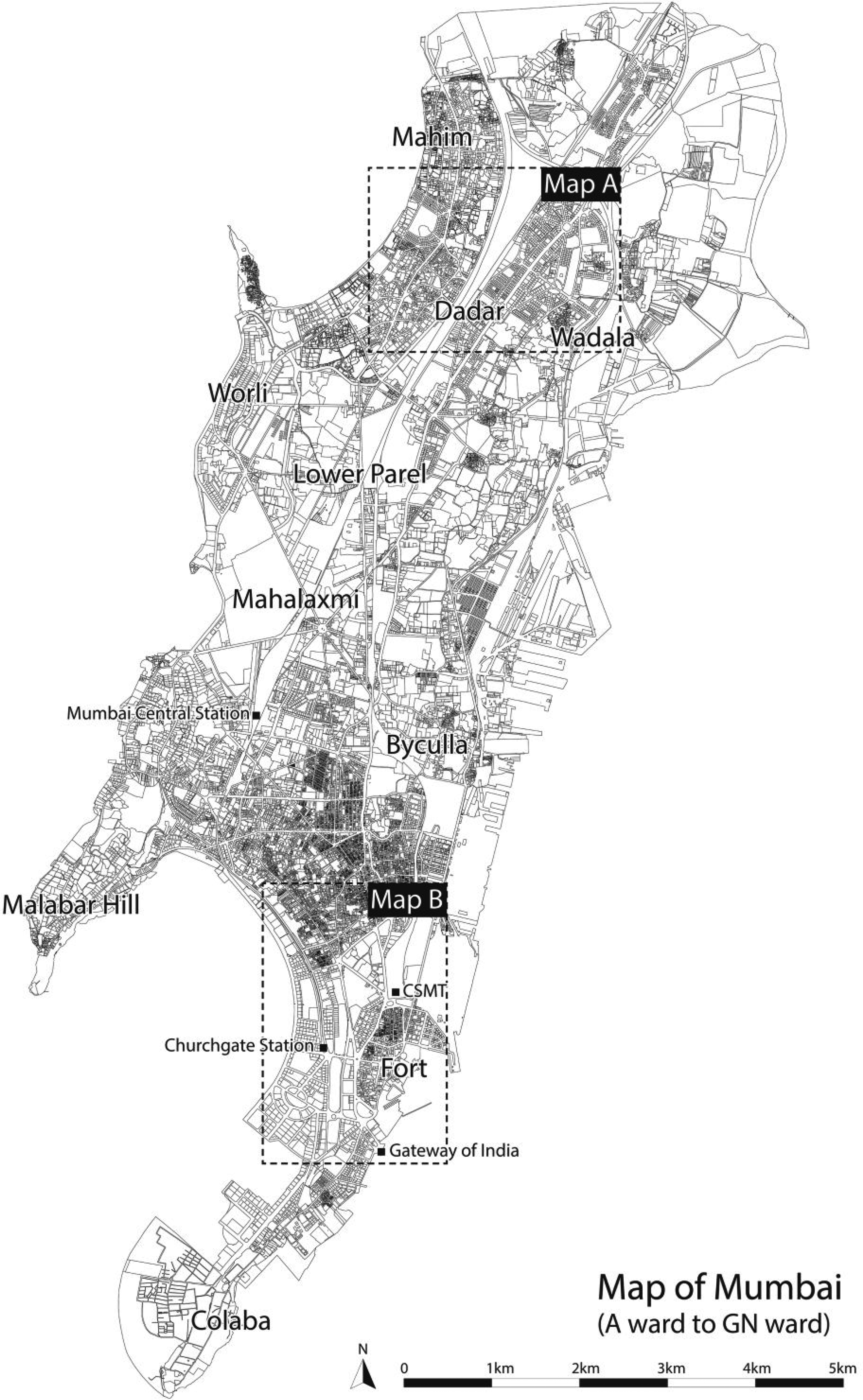
Map of Mumbai.
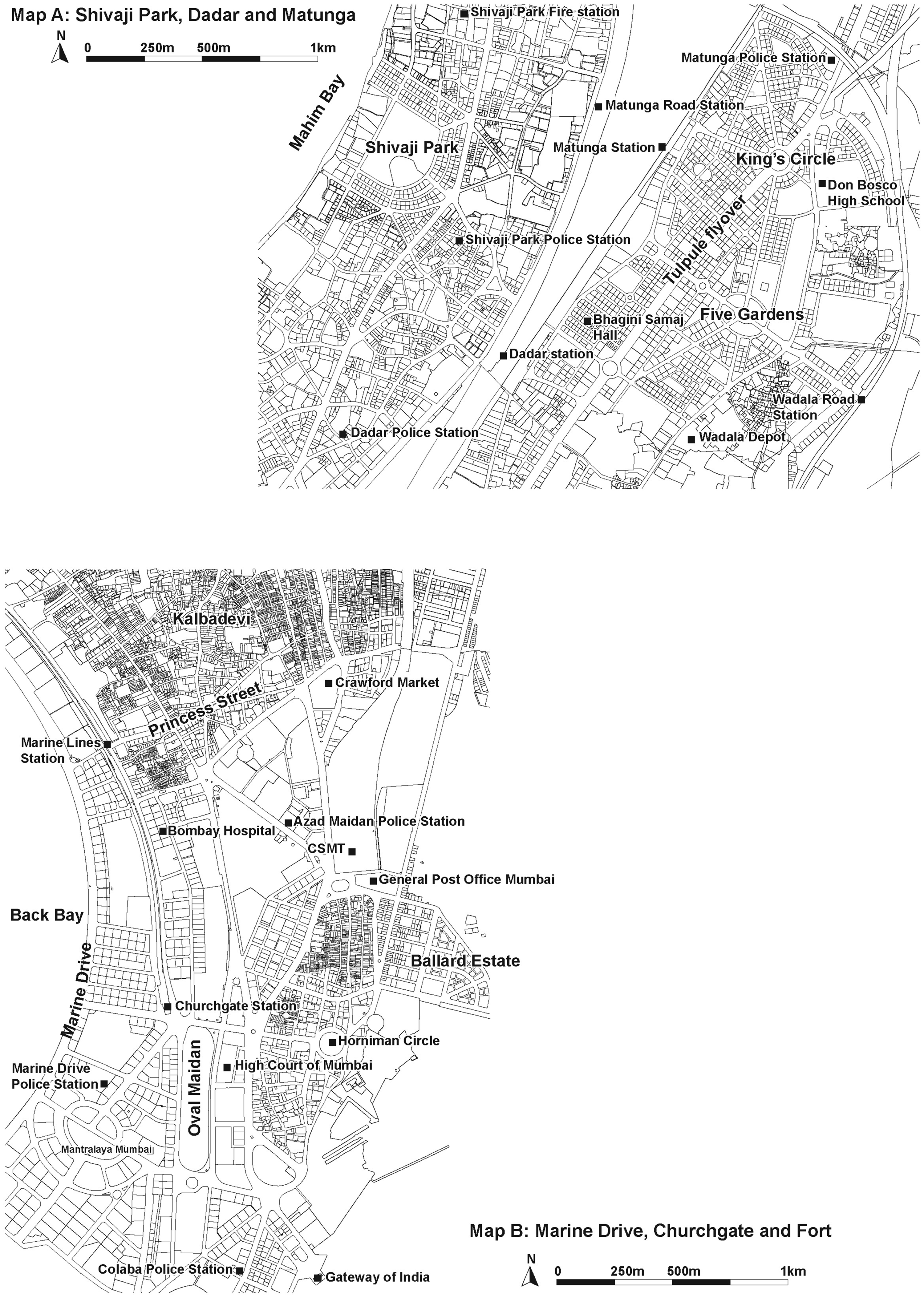
Map A (top): Dadar Matunga region; Map B (below): South Mumbai. (Note: Neighborhoods in Mumbai do not align with administrative wards. So, the maps depict the region and the key landmarks mentioned by interlocutors.).
The article begins with a consideration of extant literature on topological distribution of state power in urban governance and then discusses the context of Mumbai, followed by three case studies of neighborhood-specific governance regimes. The three case studies depict three different configurations of neighborhood states—a moment of détournement, the quotidian state and the activist state. I conclude by reflecting on the implications of local state making for normative politics in the context of rising authoritarianism in India.
Anthropology of everyday urban governance
There is a robust body of scholarship that illustrates the relational and fluid nature of the state (Anjaria, 2011; Ghertner, 2011, 2017; Gupta, 1995; Hilbrandt, 2019; Trouillot, 2001), and the consequent shift in focus from government to governance (Haid and Hilbrandt, 2019), and yet, this literature continues to focus on the distinction between state and non-state entities, or on governance “within or beyond the state” (Haid and Hilbrandt, 2019: 556). The porous boundary between state and society is well chronicled (Abrams, 1988; Gupta, 1995; Hansen, 2001a; Mitchell, 1991). In noting the difficulty of studying the state, Abrams (1988: 82) reflects that state is a “mask” that conceals “political practice as it is”. The anthropological literature on state recognizes that it is not synonymous with government, and considers it an ideological project, “an open field with multiple boundaries and no institutional fixity” (Trouillot, 2001: 127). The state is an ideological and juridical entity, while governments are short-term representatives of the state (Flint and Taylor, 2018: 150). The literature on everyday state can be broadly categorized into two themes: social and spatial. The social approach (Annavarapu and Levenson, 2021; Gupta, 1995; Mitchell, 1991) regards state and civil society as co-constitutive and the boundary between them as blurred. The spatial approach, which often uses geographical metaphors, treats the state as a topological space (Allen, 2004; Brenner, 2004; Ghertner, 2017; Hilbrandt, 2019), where power is not hierarchical (i.e., topographical), but networked (Allen, 2009), also echoed by Ferguson and Gupta's (2002) conceptualization of state effects as more encompassing than vertical. While I draw from the relationality of the social approach, I move beyond the state-nonstate binary and focus on the spatial-topological approach to trace the strategic constitution of the local state. The unpredictability of the ‘whereabouts of power’ (Allen, 2004) is instructive in moving beyond pre-existing categories and instead focus on prefigurative thinking of state, opening plural ways of conceptualizing “what it means to be a state?” (Cooper, 2017: 336). So, when residents approach and negotiate with local ministers and elected representatives, gather information on government projects through Right to Information Act (RTI) and then contest and revise specifics of such projects, fight litigations at the state and the apex courts, and participate or negotiate with the government to participate in, and steer decision making proceedings of the state, I read them as moments of state-making.
The participation of middle-class citizens in urban governance has been institutionalized by decentralization policies and they embolden the power of the local in impacting urban, state and national policies (Bardhan, 2002; Lago, 2021; Singh and Parthasarathy, 2010). Scholarship on the rise of new middle-class in post-liberalization India and their urban politics depicts their alliance with the ‘state’ and neoliberal agenda, their informal and illegal practices, and anti-poor politics (Anjaria, 2009; Banerjee-Guha, 2010; Baviskar and Sundar, 2008; Fernandes, 2004; Ghertner, 2011), the differentiated citizenship and privileges that these groups enjoy (Zérah, 2009) and their coalitions with the urban poor that are self-serving and contingent on emergent needs (Anjaria, 2009, 2016; Banerjee, 2023; Ghertner, 2011; Schindler, 2017). Much of this literature highlights the not-in-my-backyard politics of the middle-class, thereby demonstrating the spatial and territorial nature of their organization. But there is a lack of engagement with the sociospatial significance of the ‘backyard’ of middle-class politics. I focus on the backyard of middle-class residential neighborhoods in this article. These neighborhoods are old and are different from the new residential enclaves I have seen and stayed in, in various Indian cities, where there is no shared sense of community and residents hardly know their neighbors.
Historically constituted as socio-spatial entities built around religion, caste and ethnolinguistic heritage, Indian neighborhoods are “places of remembered pasts and imagined futures”, have a communal quality and constitute a mode of sociopolitical organization (Donner and Neve, 2006: 10–11). While the significance of neighborhood is well-established in urban sociology, originating in the ecological perspective in the Chicago school, the Indian urban neighborhood has not been considered as a serious scholarly category to be studied in itself. 3 Donner and Neve (2006) argue for a more grounded theory of Indian neighborhoods, which goes beyond a generalized understanding of ‘Indian modernity’ as another version of EuroAmerican metropolitanism. The postcolonial urban neighborhood with overlapping local and global influences becomes an important platform to think about state and the nation. Donner and Neve call the neighborhood an intermediate space, an in-between space that mediates the national and the global in the local. However, as Appadurai (1996: 184–185) reflects, the neighborhood is both a context and is generative of contexts; it provides a framework for a shared worldview that is historically informed and sociomaterially embedded, and evolves to create contexts that might “exceed the existing material and conceptual boundaries of the neighborhood". This is how, he demonstrates, “subjects of history become historical subjects” (185). So, as Appadurai (1996: 190) states, neighborhoods constitute a source of “entropy and slippage” for the project of nation-state, as it subverts homogenizing forces of the nation-state as well as globalization by producing particularistic forms of subjectivity and being. So, while the neighborhood can be an intermediate space, it can also become bigger than the nation, in imagination, in terms of the immediacy of social and political materiality and in terms of grassroots activism and political movements that reconfigure the policies and the politics of the nation-state.
The production of contexts and in turn, the neighborhood, is essentially a “colonizing” activity (Appadurai, 1996: 183), which requires controlling and organizing power over the place and the local state. Long-term residents control space by forging a territory. I draw from Elden's (2010: 811) definition of territory as ‘historical … mutable and fluid’ as opposed to the traditional idea of territory as fixed and bounded to depict how residents form ideational territories to govern the place, neighborhood and state. As middle-class neighborhoods are spatially heterogeneous, fragmented along caste, linguistic, religious and various other planks of identities, inflected by complex cultural histories (Chatterjee, 2001), forms of territory also vary in every neighborhood, producing different forms of governance regimes. To that end, neighborhood, which is also an important territorial space for political action in decentralization policies (mediated by ALMs) becomes a meaningful epistemological category for postcolonial urban and political theory as well as an important ‘keyword’ for ‘global urban sociology’ (Garrido et al., 2021).
Political topology and neighborhood governance in Mumbai
Operating from the neighborhood, ALMs act as leaders of the local state. The local state, constituted by proactive ALMs, ward officers and politicians, and informed by the historical cultures of the neighborhoods, are configured in heterogenous ways. Cooper's (2017: 336) ‘plural state’ thinking is instructive in illuminating how the locally embedded states, “variously scaled” and informed by a common historical experience, are “active in transforming relations of power, and caring”. The ALMs work with local governments, cooperatively as well as combatively, and engage in meticulous planning, complemented by rapid implementation and persistent following up.
These locally prefigured states have potential for both radical and transformative forms of politics. In focusing on the neoliberal, exclusionary, and segmented interests of the middle-class, extant literature elide the progressive potential of their politics. In the face of explosion in redevelopment and spatial restructuring in Mumbai, where coastal and environmental regulations and heritage laws are continually amended by the government-capital cooperative project (Bharucha, 2014; D’Monte, 2016; Nakamura, 2014), middle-class intervention in the state often impedes such spatial appropriation by political parties, ministers and real estate developers. A wide array of civic groups have both supported as well as resisted such market-driven urban renewal initiatives. For example, in the Dadar Matunga region, when the Maharashtra Heritage Conservation Committee (MHCC) proposed to preserve the built form by mandating that all buildings must seek approval from the heritage committee to redevelop, building owners, along with real estate developers filed a petition at the Bombay High Court since they wanted to redevelop their properties without additional hurdles, and won the case (Arun R. Chitale vs. State of Maharashtra, 2014). On the other hand, in southern Mumbai, when one building violated the height restriction of the heritage precinct, 4 residents fought with the developer at both the state High Court and the Supreme Court of India to resist redevelopment and won both times. They exposed the corruption in the top brass of the municipality (Federation of Churchgate Residents and Ors. vs. The Municipal Corporation of Greater Mumbai and Ors., 2014), and pulled resources to prepare a dossier for a World Heritage nomination at the UNESCO to protect their neighborhoods, the Oval Maidan (OM), and Marine Drive (MD) from redevelopment. The divergent responses foreground not only the heterogenous nature of the neighborhood-based political groups but also highlight the different cultural histories of these neighborhoods, which I attend to in the subsequent sections of the article. Mumbai has historically been at the epicenter of civic activism, from the birth of Indian National Congress in 1885, and Khurshed Nariman’s allegations of corruption against the colonial government in 1926 (see Prakash, 2010) to the Olga Tellis vs. BMC (Brihanmumbai Municipal Corporation) 5 litigation in 1985 that established hawkers’ right to livelihood, and the pioneering institutionalization of heritage laws in an Indian city in 1995.
Civic activism at the local level was invigorated by the introduction of the Nagarpalika Act, 1992, that created official channels for the political participation of middle-class, resulting in the formation of ward committees in Mumbai to micro-manage neighborhood issues at the level of “municipal constituencies, consisting of elected representatives, municipal officers, and representatives from the civil society” (Singh and Parthasarathy, 2010: 95). Led by middle-class residents, the ALM groups, initially conceived to manage solid waste, subsequently became “a larger movement of citizen–local government interface” (Baud and Nainan, 2008: 485). This is complicated by Mumbai’s multi-agency governance, as 10 state-appointed agencies have overlapping jurisdictions in the city which undermine the municipality’s authority (Pinto, 2009). To add to the complex tapestry of political practice, the state (of Maharashtra) and the city-level municipality (BMC) hold separate elections and historically have had different incumbent parties. BJP was in power between 2014 and 2019 in the state of Maharashtra, and the regional nativist party, Shiv Sena 6 (Sena from here on) oversaw the municipality, coming to power in 2017. As several officials of the municipality are appointed by the state, while the rest are elected members of the other party, the members are often at loggerheads leading to further fragmentation of power and ideological fallout (Pinto, 2009). In one of my conversations with the corporator (locally elected representative of the municipality) of Matunga, she distinguished between ‘us’ and ‘them’, highlighting the achievements of her party and the corruption of the opposition. These ideological and bureaucratic fissures between stakeholders make everyday coordination difficult. The residents’ groups, driven by the anxiety of losing control over their space, act as mediators and guardians of the political space, initiating, directing, and disciplining state activities.
A noted city activist, based in South Mumbai, while talking about neighborhood resourcefulness, exhorted in a manner of making a speech, “I say become territorial. Care for your neighborhood. Be interested. Don’t crib, ‘oh, BMC is not lifting kachra (garbage)’. Pursue them, shout at them, cajole them, but be active”. This sentiment was echoed in the neighborhoods of Shivaji Park and Matunga too, in less forceful ways, where one resident advocated to “take pride, responsibility, and ownership for your area. The police, BMC, infrastructure, can only do so much. If you want better quality of life, you must take charge”. In both accounts, there is a proclamation to work inside the state space, albeit in different ways. The nature of state action is shaped by both the historical culture of the neighborhood as well as the nature of territorial threat, whether it has immediate implications or has been a persistent problem, whether the trigger will threaten their control over the neighborhood or whether they would have new users of a space in their backyard.
The three modes of place-based state-making, through détournement (strategic manipulation of meaning over a space or an issue), quotidian participation and activist disciplining, are not mutually exclusive; there could be moments of quotidian disciplining in a largely combative (activist) mode of organization, especially when residents find allies in government bodies and work cooperatively with them. Similarly, a moment of détournement, prompted by the unfolding of a disputed space or new regulation that can have multifarious interpretations, can subsequently lead to an activist or quotidian form of statehood. However, there is a key distinction between the modes—détournement is driven by appropriation, whereas quotidian and activist modes are more procedural. In a détournement mode of state-making, residents will crowdfund temporary solutions, walk rallies and act as human barriers, forge illegal and informal alliances with local politicians, etc. In activist and quotidian modes, residents file litigations in the court, predominantly operate through institutional channels, even when they are undertaking crowdfunding initiatives, but through Trusts. Lastly, I have made these distinctions based on how the stories were narrated to me, in terms of residents’ involvement. The case of détournement was recounted with humor and wit, vividly detailing the various narratives of multiple stakeholders, how a politician felt betrayed by residents not voting for him despite his support for the flyover project, residents’ multifarious fantasies over the space, the dramatic interactions with various government officials, and the manipulative moves of residents, etc. In comparison, the quotidian and activist modes were narrated with an implicit valor, and I sensed a rhetoric of guardianship where residents go beyond the ambit of their neighborhoods and intervene in city-level projects. There is no account of manipulation; residents understand that they are responsible for their territory, and they must steer other stakeholders towards their version of good governance. In détournement, the politics is more pragmatic and not necessarily driven by an ideal of good governance.
Liminal space and détournement
In the first case study, I focus on a moment of détournement for a ‘space in transition’ (Roberts, 2023). Drawing on Lefebvre, Roberts (2023: 2-3) illustrates that détournement is manifested in a space rendered open to interpretation and claims; such a spaces "loses its... identity" and different groups use the strategic opportunities opened up by the "plasticity … to re-order and represent the objects, relations, and symbols within these spaces in a manner congruent with their own respective public".
The space under contention, a vacant tract of land under a newly constructed flyover in Matunga, became a terrain for contested claims, and the middle-class residents encroached on the space to dictate its usage. Mr. Patel (name changed), a prominent city activist based in Matunga, narrated to me the series of events that led to the construction of the Narmada (a river in central India) themed walkway under the Tulpule flyover in Matunga. After the construction of the flyover on Dr. Babasaheb Ambedkar Road was completed in 2012, the land underneath became a liminal space, “ambiguous and uncertain”, open to be ‘hijacked’ by various groups (Roberts, 2023: 2). Patel quipped that the first to arrive were “vagrants, drug addicts, etc”. Soon, cab drivers started parking there, and middle-class residents were alerted. Employing a High Court injunction that bars parking under flyovers, residents encroached on the vacant space. Mr. Patel persuaded the local corporator to seek permission from the BMC to seal the space from the poor, the hawkers, and the lovers, while residents of 40 buildings crowdfunded 24-hour security guards.
The middle-class’s appropriation and cordoning off the space was as unauthorized as encroachment by poor, and we see that the “‘law as social process’ is as idiosyncratic and arbitrary as that which is illegal” (Roy, 2009: 80). The residents, organized under the leadership of Mr. Patel, but not as any formal civic group (that later organized as One Matunga in 2015), went to the BMC’s office with a proposal for beautification, only to discover that the land now belonged to the MMRDA 7 (Mumbai Metropolitan Region Development Authority) since they had undertaken the task of building the flyover. On learning about residents’ proposal, MMRDA decided to incorporate 15 other vacant spaces in the city into this project. Residents started planning their own proposals for beautification, which ranged from a basketball court to a badminton academy, Patel scoffed derisively. Patel told me that these residents wanted to bring these sports facilities at their doorstep for their children. Residents in this region have often told me how their neighborhoods feel like urban villages, with hospitals and schools located in the neighborhood and the general conviviality of what they called “an extended family”. In continuing that spatial tradition, residents aspired to territorialize the space through building a sports facility in their backyard so that their children would not have to travel elsewhere. After a year of preparation and advocacy, a lower-rung government clerk informed the MMRDA bureaucrat and the residents’ team that the land had been handed back to the BMC (Tarapore, 2015). The residents started pursuing the Commissioner of BMC with their ideas for beautification. As BMC cited lack of funds, Patel shared with me that he filed multiple RTIs to bring into the Commissioner’s attention the unused funds allocated for gardens in the city. In the meantime, residents formed the collective, One Matunga, and started cordoning off the area to celebrate sports and cultural events on weekends.
When the proposal for the Narmada themed walkway was unveiled by BMC later that year, Mid-Day (Rao, 2015) reported about residents’ anxieties over how the open space might lure “slum dwellers and anti-social elements”. Residents objected to the walkway because, as Patel explained, their ideas of sports academy or skating rink were not considered. However, since the principal objective was to preclude the space from becoming a “public urinal” or a private advertisement zone for builders, residents eventually relented. “To that end, we have been successful”, Patel stated. Patel was unaware of who conceptualized the theme of Narmada but hypothesized that since BJP came into power in 2014 in the state of Maharashtra, the Narmada-themed walkway could be the then-Chief Minister’s homage to the Indian Prime Minister, Narendra Modi. 8 Patel filed another RTI subsequently to find out the details of the project and used the clout of the local Member of Parliament to make the walkway broader than what was previously ratified by the BMC. The 600-meter walkway and Mumbai’s first garden under flyover were opened to the public in 2016. I checked the flurry of newspaper reports and blogposts that covered the opening of the flyover and found all of them attributing credit to residents, and lauding their activism, ‘hard work’, and ‘dedication.’ (AD Staff, 2016; Patel, 2016; Singh, 2016; Tahseen, 2016). However, it took me a while to find the names of the contractor, Envirodesigners, and architect, Pallavi Doke, in a government report (Delhi Urban Art Commission, 2020). The lack of attention to the government's role in media stories reveals a public sentiment that citizens are the legitimate bearers of power and authority in their territories.
In a détournement mode of prefiguration, when an urban space is rendered open to various forms of public, residents rush into this geographical and political space for appropriation and integration in their neighborhood. An urban space can be rendered open through various processes, as infrastructural and urban development, claiming land through filling up water bodies, formation of new hawking zones, etc. In the face of such spatial triggers in neighborhoods, some residents come together to form a community, nurtured through the production of an ideology of unity and one-ness. As the Facebook page of One Matunga states, “Uniting the whole Matunga”. Moments of détournement are unstable and short-lived and give way to one of the two other modes of prefiguration, of quotidian and activist territorialization for long-term management. Despite the residents’ obvious allegiance to BJP that came up in my conversations with them, they resisted the ideological project of Narmada-themed walkway (at least not in their backyard) as it did not serve their purpose. Their unsuccessful opposition illuminates how middle-class residents privilege their neighborhoods over nation, while strategically taking credit in the local media to secure their position as guardian of the local state.
Quotidian mode of territorialization
In this section, I focus on the neighborhood of Shivaji Park (SP from hereon), developed as part of the suburbs of Scheme V in colonial Bombay and which came to be inhabited by predominantly upper caste Maharashtrians. I present how territorial identity, as distinct from partisan-political allegiance or ideological standpoint, shapes spatial politics in this region. The suburbs were planned in the aftermath of the catastrophic plague of 1896, and became middle-class residential districts facilitated by the cooperative housing movement and Rent Control Act. As a predominantly Hindu neighborhood, it provided fertile ground for the rise of nativist politics of Sena and its younger cousin, the Maharashtra Navnirman Sena (MNS) in post-independence Bombay. The Muslims served as the ‘other’ for a long time until gentrification hit the neighborhood in 2010s. Because of the Rent Control Act, 1947, rents have been frozen substantially below market rates, and tenants have not contributed to the maintenance of buildings. As a result, the building stock has been degenerating, thereby motivating the owners to choose redevelopment. The tenants also stand to benefit as rent laws entail that they would receive some form of compensation, either financial or get assigned a free flat in the redeveloped building or elsewhere, as decided by the builder. As new migrants, that current residents describe to me as Jain and Hindu merchants from Western India, started residing in these neighborhoods, the older residents constructed a new identity “in counterposition with the Other” (Massey, 1994: 169). Sporadic tall towers have risen awkwardly amidst what used to be a low-rise built form and quaint lanes are cramped with parked vehicles of new residents. Older residents complained to me incessantly about the new migrants and their conspicuous consumption, that stands in stark contrast to their humbler lifestyle. They told me that their cheap eateries, Udipi cafes 9 and vada pao 10 vendors, have been supplanted by boutiques and cafes. On a reconnaissance trip with a resident, she showed me how multiple municipality school buildings have been unlawfully converted into temples by new migrants. I felt a burgeoning sense of hopelessness in these neighborhoods, in the face of anxiety over identity crisis and rootlessness.
Spatial displacement and the associated anxiety of feeling uprooted inform the politics of the middle-class in this neighborhood. As Malkki (1992: 37) suggests that even though “identity is mobile and processual”, cultural history remains important in shaping conceptualizations of rootedness. Political organization of residents in this region is triggered by concern over protecting the older community’s communal space, and their politics is informed by ideas of “reclaiming the lost city and overcoming political estrangement” (Anjaria, 2016: 146).
The SP ground in SP is one of the largest open spaces in Mumbai and home to several Hindu temples and sports clubs and has become a seat of contestations between the Jain community, local political parties, the Sena and MNS, and the older residents. The Jains seek to utilize the park for their religious festivals, the older residents want to preserve it for their daily walks, sports, and recreational activities, and the political parties frequently occupy it for rallies and gatherings. Irked by countless programs of the political parties, a group of residents formed an NGO, Wecom (Walker’s Ecological Movement) Trust, and filed a Public Interest Litigation (PIL) in the Bombay High Court in 2007 and got an interim order that declared the ground a silent zone in 2010. However, as with all place-based identities, they are “not internally uncontradicted” (Massey, 1994: 137). Another group of residents wanted the grade I status of SP ground to be revoked as it restricted redevelopment within a 100-meter radius (Arun R. Chitale vs. State of Maharashtra, 2014). Recognizing the park’s historic significance, the state-appointed body revoked the heritage status and chose a middle path, where the ground is preserved but the area around can be redeveloped (Venkatraman, 2014). In 2016, when Wecom Trust filed another PIL, challenging BMC’s directive to allow public events at the ground for 45 days every year, the court asked the litigants to be vigilant as the “court alone should not be approached and converted into a watchman” (Deshpande, 2020). In recounting the events related to the litigation, a resident-activist shared with me how residents in the region have been supervising the park for decades now and only go to the court when they need enforcement of regulations. Possessing high cultural capital and largely aligned with the Sena (as noted by a young interlocutor), the residents are successful in involving the police against hawkers, vagrants, and couples. However, to confront the religious festivals of the wealthier Jain community, who are predominantly BJP voters (Starr, 2021) and events organized by local political parties, including the Sena, residents invoke the power of courts.
The contestations over SP ground illustrate how the court entrusted responsibility of disciplining activities of ‘others’ to long-term residents. Civic groups like Wecom Trust act like paternalistic entities in local states, embedded in local community, venerated by residents, politicians, and ward officials. It is worth noting that long-term residents continue supporting the festivals that have been historically observed in the park, like Ganesh Chaturthi and Durga Puja, apart from cultural festivals like classical dance recitals and monsoon festival. The law and courts are evoked when the ‘others’ use the space. The political language is paternalistic, rather than combative, informed by the traditional Hindu conceptualization of the king as the moral guardian (Kaviraj, 2005). Using a rhetoric of paternalistic state, one activist stated that as school education needs to be supplemented by private tuitions for competitive results, government needs support and nurturing by citizens to steer them towards good governance. Cooper (2017: 344–345) postulates that the quotidian state is “enmeshed in everyday relations” and draws from Painter (2003: 753, cited in ibid) to illustrate the nature of such states, characterized by their “intense involvement … in so many of the most ordinary aspects of social life”. Unlike a moment of détournement, where a sense of urgency drives state-making, quotidian mode of statecraft is not momentary and has functioned as a guardian or disciplinarian of the community for a long time. The residents here work more collaboratively than competitively with the ward officials. As the secretary of an ALM in SP told me regarding the implementation of waste segregation in her lane, it is not enough that you pay taxes. Yes, you get the BMC and police and traffic police, but you need to give your own time, money, attention to see that whatever work is done in your area is done to some satisfaction.
The residents are predominantly attuned to short-term imminent issues like garbage segregation, maintenance of roads, including attending to potholes and other infrastructural concerns, management of trees, sanitation concerns, and eviction of hawkers and chasing away lovers. The speed at which such everyday complaints get resolved is contingent on the rapport of the residents with municipality officials, mediated by political connections and as well as ethnolinguistic politics.
However, considering the residents keep Sena and other parties in check over their claims over SP ground, it is important to note how territorial politics is different from identity politics. The notion of territory forged by activists here excludes the new migrants, as well as older residents who have sold their properties and left the neighborhood. The political community of the territory is shrinking, and is yet sustained by a construction of the ‘other’, the new inhabitants. This territory is different from the territory formed by partisan politics, Sena versus BJP, highlighting how different forms of politics coexist in neighborhood politics. The complexity lends a form of materiality and makes neighborhood a priority over nationalism which is far removed from local complexities of multifarious imagined communities. Of the three modes of local statecraft, the quotidian state is best equipped to hold multiple and contradictory territories together. In détournement and activist modes, one identity is elected over others to forge a political community. In SP, residents come together in poetry clubs, women’s cultural groups, religious gatherings, jogging clubs, and other forms of associations to forge a territory, that is shrinking and shifting, to produce an emergent and prosaic state towards preserving their cultural-political legacies in a city in transition.
The activist mode of territorialization
Late activist and polymath Gerson De Cunha, of OM, while eulogizing the social movements that were born in southern Mumbai neighborhoods, reflected, “neighborhoods and localities are reflections of the culture of residents”. The southern Mumbai neighborhoods of OM and MD were the epicenter of several advocacy groups like Action for Good Governance and Networking in India, Bombay Environmental Action Group, NGO Alliance For Governance Advocacy Renewal (NAGAR), and many others. The activist culture here can be construed to be inherited from the British political practices as well as nationalist struggles. South Bombay was the nucleus of the Raj in colonial Bombay. The motley group of people who first came to reside in these neighborhoods, cohabited with Europeans, transcending caste and religious concerns. These Indian property owners in colonial Bombay challenged and assisted the imperial government in planning the city (Kidambi, 2016; Prakash, 2010), forging a culture of sociolegal dialogue between citizens and the government. Continuing that tradition, the neighborhoods of OM and MD in southern Mumbai resisted all redevelopment initiatives by government and private builders in post-liberalization Mumbai, spearheaded many urban social movements, ranging from protecting consumer rights to heritage conservation and preservation of open spaces. Drawing from Cooper (2017: 347), I read the politics and interactions of the civic actors and their topological capturing of state power here as an activist mode of statecraft that “suggests a mode of collective agency more typically associated with social movements”.
The first landmark moment that residents flagged to me was the restoration of the OM ground, undertaken by the Oval Cooperage Residents Association (OCRA) in 1995. One noted activist recounted to me that when the government proposed to build a stadium in OM in the 1990s, the residents formed OCRA and restored the ground over the next 15 years, which entailed administrative, logistical, and crowdfunding work. The stellar role of the association was lauded by the government, who later consulted OCRA for restoring the nearby Cross Maidan in 1997 as well as the Cooperage Bandstand in southern Mumbai because of their knowledge and expertise. In talking about the 15 year-long tussles with the government, one activist proclaimed, We felt we cannot wait for the government forever … The government also recognized in due time that OM is our land; so we have the power, they do not and they must cooperate with us. We say, interact with them, but do not see them as somebody you constantly have to shout at … If you treat them like donkeys, they will behave like donkeys.
There is much value in the rhetoric of ‘not waiting’. The residents’ groups here are conversant with the grammar of urban governance and often dismiss ward officials, overstepping their constitutional limits (Singh and Parthasarathy, 2010). Instead of waiting for what residents mostly deem as inept government officials, residents construct themselves as more legitimate wielders of state power and engage in proactive action rather than simply responding to or following up with the government. In 2014, when the Supreme Court of India ruled in favor of residents and ordered for stalling reconstruction at Vasant Sagar, the residents were not at peace. In a move that they call ‘unprecedented’ in heritage activism in India, the residents financed an architectural firm to prepare the dossier, got it ratified by all concerned government departments, both at the state and national level, and filed a nomination at UNESCO, as a Victorian- Art Deco precinct. The OM neighborhood, facing the neo-Gothic buildings across the OM park, and MD, running parallel to the promenade by the Arabian Sea, are two of Mumbai's most prominent neighborhoods, home to a multicultural and multireligious community, with many buildings in the Art Deco style. The unique character of this region is produced and sustained through the posters and periodicals of the local NGOs I gathered during my fieldwork; and in the public events, like Art Deco appreciation workshops, cultural exhibitions, and heritage tours that I attended. These events and artifacts signal the salience of the architectural and cultural grandeur of the region, and the activists and civic groups here act like the state tourism board.
In cultivating a spatial distinction of the Art Deco precinct, residents have created a political territory, premised on exclusivity and the guarding of ideational borders, where they resist outsiders, comprising government, religious festivals, hawkers, etc. OM is open to sports activities only on Sundays and residents act as watchdogs over the space. Residents themselves do not enter the park for morning walks and circle the ground instead. In resisting the reconstruction of Vasant Sagar, which resident activists feared would set a dangerous precedent and might encourage other building owners in the region to seek permission for redevelopment. One activist who handled the litigations expressed concern over the infrastructural pressure that redevelopment would cause, how will you get water, electricity? How will it take the pressure of traffic if all buildings are allowed to expand like this? What will be the difference between this area and other areas? Art Deco by itself wasn’t on my mind. I came to realize it later, that there are such heritage links also.
However, this territory is also internally differentiated. Several tenants echoed Chainani's (2007) theory that the Rent Control Act froze redevelopment and aided heritage preservation in the neighborhood, while building owners, castigated the Rent Act and tenants who continue to benefit from it. However, their mutual conflicts are resolved in their place-based identity as 'elite South Mumbaikars' against the rest of the city. This place-based identity is at the heart of this activist mode of organization in this region. Their perceived superiority is reinforced by how residents distinguish themselves from the communal, casteist, and ethnic politics of the rest of the city. One city architect scoffed, “these South Mumbaikars think they are above the rest of the city”. In producing and preserving the distinction, residents not only emerge as active guardians of the state, spearheading movements and shaping policymaking in this region, and beyond, but also choose the neighborhood above, and against the nation. In my many conversations with residents in this region, they discussed the rise of Hindutva extremism, curbing of free speech and a general decay of liberal public sphere in India. Residents hope to preserve the island of elitist liberalism and secularism in this region. To that end, the nation is its ‘other’. So, in choosing to back the candidate who joined BJP before elections, a political party that is blurring the difference between nation and government (and colonizing the state), as outlined in the beginning of the article, residents make a strategic territorial decision. Residents were apprehensive of an unfamiliar candidate as well as the new party affiliation of the familiar candidate. The BJP candidate’s territorial affiliation trumped her party affiliation. They wanted a candidate who would understand the sentiment and culture of their territory. The decision to support the BJP candidate demonstrates residents’ clout in forming a state on their own terms, and their conviction in their own hold over the state in keeping the ethnonationalism of the BJP at bay. I read their choice of the specific candidate as a form of placing the neighborhood over nation.
Conclusion
Territory, even in the context of the local, is vital in shaping “geographical imaginations and political practice” (Tomaney, 2015: 513). Drawing from anthropology of state effects and topology of power from human geography, I attend to how middle-class residents in neighborhoods in Mumbai imagine, negotiate, and produce territories, to act on and defend their neighborhoods. Residents enter the state space in various capacities and organize distinctive modes of political action, thereby reconfiguring local states. To that end, I demonstrate that there is a distinction between government and state, and that the state does not necessarily fail in its everyday functioning, even though government officials might fail. Middle-class residents organize in a range of ways—to an imminent threat of encroachment in a liminal space in their backyard, to dictating terms of usage of everyday spaces which now have new and contending users, and to stall gentrification and redevelopment. The new middle-class in India, that emerged in the post-liberalization era, abreast of the Western vocabulary of statecraft and consumerist lifestyle, fashions urban governance by working cooperatively as well as combatively with the government and other political stakeholders, inside the state space. However, the new middle-class is not a homogeneous community; it is spatially heterogeneous, with divergent political practices. The three modes of organization depicted in this article are situated in the historical geographies of the neighborhoods. They are shaped by the historically communitarian nature of Matunga region, where people designate their neighborhoods as self-containing urban villages, influenced by the ethnolinguistic political culture of SP, which served as the birthplace of nativist extremism in Mumbai, and informed by the judicial and political activism of indigenous elites in South Mumbai, which continues to shape the activism and distinction of South Mumbai elites in postcolonial Mumbai.
The modern institution of state, as we know it, is a colonial inheritance. Over time, it has undergone mutations and has both shaped and been shaped by local culture(s). The plurality of cultures and the fragments of nation, state and community animate local experiences, effects and practices of statecraft. As Trouillot (2001) posits that as a social construct, we need to look at state effects, and everyday practices and framings to conceptualize state in new ways. In erasing the boundary between state and non-state actors and conceptualizing the state as embedded in the society, that can be invaded and captured by citizens, I build on extant scholarship where elite and non-elite political figures wield power in the state space (Ghertner, 2011, 2017) and respond to a call for prefigurative state thinking, where states are being constituted in “plural overlapping networks that foreground public responsibility … embeddedness, participation, stewardship, activism, creativity” (Cooper, 2017: 351). The novelty of the article lies in building on this literature to propound a theory of place-based state-making, from the neighborhood. Neighborhood, territory, community and state are all in flux, shifting and emergent, and yet, small groups of residents are shaping and sustaining local governance. Confronted by gentrification and changing composition of neighborhoods, residents forge ideational territories with allies. The ideational territory is not conceived in a vacuum; it is informed by shared values, history, sociality, and aspirations of particular forms of future. These place-based political mobilization and state-making produce durable neighborhood-based states and challenge homogenizing forces of nationalism and neoliberal redevelopment in the city. Such forms of politics are not necessarily progressive, as they are anti-poor and often, Islamophobic, but leave scope for resisting colonization of the state by political parties. Noted Indian Marxist historian and activist, Sumanta Banerjee, in an interview argued that, to counter the “fascist threat” in India, the left’s concern is not socialism but to sustain a “bourgeois democratic structure” (Ashraf, 2018). Geographically and politically, middle-class neighborhood is one of the last bastions of democracy in India. Therefore, thinking about nation through thinking about neighborhood is not only analytically valuable, but also significant for normative politics in India. The place-based local states at the neighborhood level, institutionalized by decentralization of governance, emerge as the site of new laws and policies, and shape the grammar of politics at various scales. Although I focus on three cases of middle-class’s prefiguration of local state in Mumbai, this can be extended to analyze how slum dwellers or street vendors work the state in creative ways, beyond clientelism and political bartering. I hope my ethnographic reflections on neighborhood and territory will open new ways of analyzing the state by attending to the fragments of everyday practices, activism and guardianship in a territory.
Footnotes
Author’s note

Acknowledgements
I am indebted to Tim Bunnell for his support and valuable feedback.I am also grateful for the the advice of Daniel Goh, Natacha Dubach, Radhika C, Prerona Das, Raksha Mahtani, Samadrita Das, and colleagues at Asia Research Institute, Singapore, as well as the insightful comments of the two anonymous reviewers. A special note of thanks to Katsushi Goto for the maps.
Declaration of conflicting interests
The author(s) declared no potential conflicts of interest with respect to the research, authorship, and/or publication of this article.
Funding
The author(s) disclosed receipt of the following financial support for the research, authorship, and/or publication of this article: The article draws from my doctoral fieldwork, which was funded by National University of Singapore’s Graduate Research Support Scheme.