




Abstract
Multi-Agency Public Protection Arrangements (MAPPA) provide a legislative framework for managing sexual and violent offenders in the community. Previous studies have examined this process; however, little is known about the offending behaviour of MAPPA cases during the first year of registration. This article explores this area and provides a detailed examination of reconviction amongst a cohort of MAPPA Level 3 cases. The implications of reconviction during MAPPA registration are also explored.
Introduction
Multi-Agency Public Protection Arrangements (MAPPA) provide a framework for the assessment and management of sexual and violent offenders. The Criminal Justice and Court Services Act (2000) required the police force and probation service (and later the prison service) to jointly assess and manage sexual and violent offenders in the community, which in turn led to the development of MAPPA. Since its introduction, a number of studies have attempted to explore the effectiveness of the process mainly in relation to multi-agency working (Kemshall 2003; Wood. et al., 2006) and to identify risk typologies of offenders managed under MAPPA (Wood, 2006, 2007). However, no previous studies have focused specifically on MAPPA outcomes and in particular reconviction rates amongst this offender group. This article explores the benefits of examining effectiveness in this way. In addition to highlighting the ongoing risks offenders managed under MAPPA pose, this article seeks to explore the long term implications when this offender group re-offend, both in terms of public confidence in the criminal justice system and the impact on criminal justice resources.
MAPPA eligibility
The MAPPA Guidance (2009b) specifies categories of offender who should be managed under these arrangements, in addition to specifying three possible levels of management. It is the role of the responsible authorities (defined by the Criminal Justice Act, 2003, as probation, police and prison) to establish if an offender meets the criteria for inclusion and to determine which level of management an eligible offender requires. The categories for inclusion and the three risk management levels are described below:
Level One: Ordinary agency management
Risk management at this level is for offenders assessed as posing a level of risk that can be effectively managed by the agency with primary responsibility for the offender, using standard resources. Typically the lead agency will be probation, youth offending teams, police, or the prison service; however, additional agencies may be involved as required. Home Office statistics suggest that around 71 per cent of MAPPA eligible offenders are managed under level one arrangements (Home Office, 2004).
Level Two: Local risk management
This level of management was identified for offenders who require the involvement of more than one agency, usually because they pose a high or very high risk of serious harm, but where the risk is not sufficiently high to require full multi-agency involvement. The MAPPA Guidance (2009b) suggests that the three lead agencies – police, probation and the prison service – will be routinely involved in level two cases, with ‘duty to co-operate’ agencies being involved on an ad hoc basis according to the needs of each offender. Home Office statistics suggest around 26 per cent of MAPPA eligible offenders are managed under level two arrangements (Home Office, 2006).
Level 3 – Multi-agency public protection panels (MAPPPs).
The MAPPA Guidance (Home Office, 2009b) suggests that offenders requiring management at this level, whilst in the minority, require the maximum resources, in terms of the range of agencies and the senior representation required. In almost all cases, the offender will be assessed as high, or very high risk of serious harm, because of the imminent and significant danger or risk they potentially pose to the public. Home Office statistics indicate that only around 3 per cent of MAPPA eligible offenders are managed at level 3 (Home Office, 2006). Level 3 exists for those cases:
Assessed using the OASys tool as being high or very high risk.
and
Who present risks that can only be managed by a plan which requires close co-operation at a senior level due to the complexity of the case and/or because of the unusual resource commitments it requires.
or
Who although not assessed as a high or very high risk, are exceptional because the likelihood of media scrutiny and/or public interest in the management of the case is very high and there is a need to ensure that public confidence in the criminal justice system is sustained.
Risk of serious harm and risk of reconviction
The Offender Assessment System (OASys) provides an assessment of risk in relation to serious harm and reconviction, Serious harm is defined as an event which is life threatening and/or traumatic, from which recovery, whether physical or psychological, can be expected to be difficult or impossible. Risk of serious harm is the likelihood of this happening and is categorized in the following way: Low: Current evidence does not indicate likelihood of causing serious harm Medium: There are identifiable indicators of serious harm. The offender has the potential to cause such harm, but is unlikely to do so unless there is a change in circumstances High: There are identifiable indicators of risk of serious harm. The potential event could happen at any time and the impact would be serious Very High: There is an imminent risk of serious harm (Offender Assessment System Guidance, 2002)
Risk of reconviction is determined through the systematic examination of offending related factors. It enables the assessment of dynamic and static factors to provide an assessment of risk of reconviction.
Pro-offending behaviour amongst MAPPA registered offenders – what the national statistics tell us
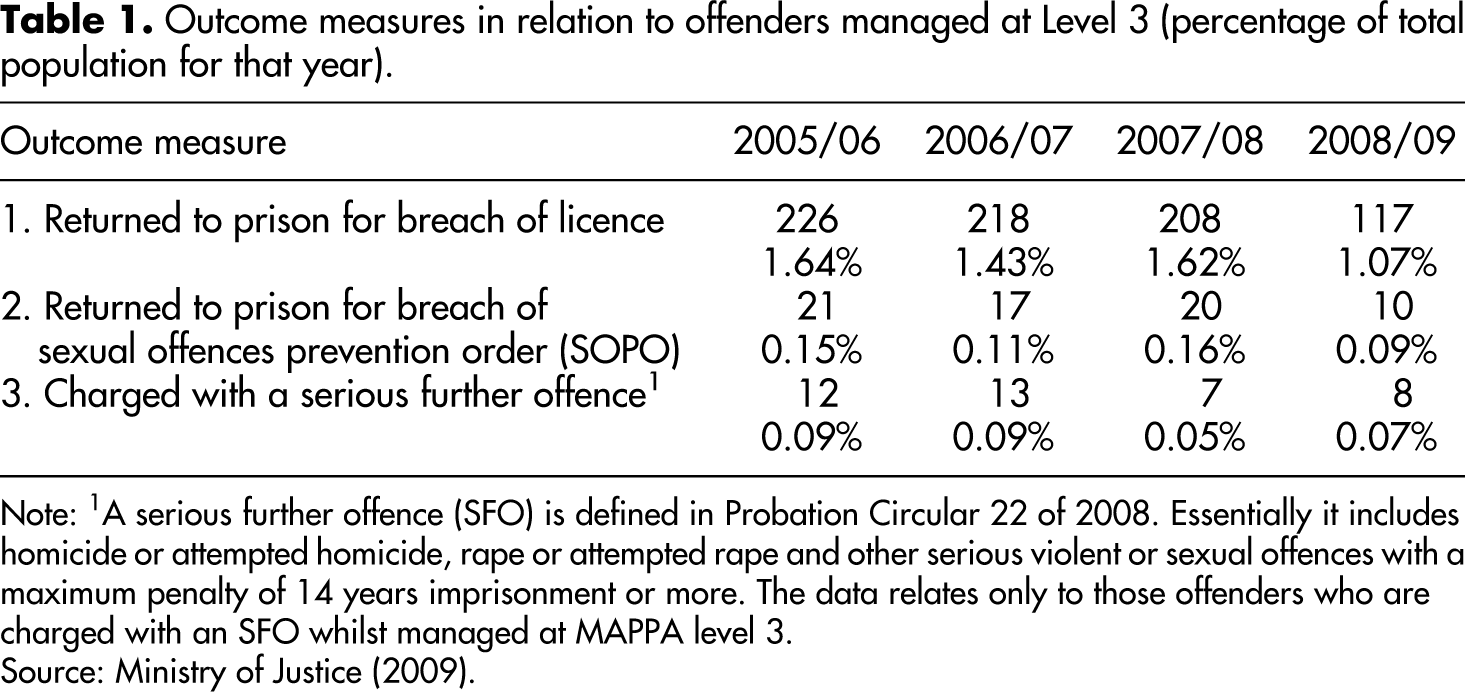
The Ministry of Justice publish some national figures, but these tell us little about pro-offending behaviour across MAPPA cases. For example, for the group thought to pose the greatest risk (level 3 offenders) the information in Table 1 is published:
Outcome measures in relation to offenders managed at Level 3 (percentage of total population for that year).
Note: 1A serious further offence (SFO) is defined in Probation Circular 22 of 2008. Essentially it includes homicide or attempted homicide, rape or attempted rape and other serious violent or sexual offences with a maximum penalty of 14 years imprisonment or more. The data relates only to those offenders who are charged with an SFO whilst managed at MAPPA level 3.
Source: Ministry of Justice (2009).
The figures suggest less than one per cent of level 3 offenders committed serious further offences in 2008/09. In addition, breach action was initiated in less than 2 per cent of cases for non-compliance of either licence conditions or conditions of a Sex Offences Prevention Order. These relatively low numbers indicate that MAPPA may be an effective process. However, they offer little meaningful insight to help inform practice and resource decisions. To bridge this gap, an analysis of reconviction data was undertaken across the five probation trusts in the north-west of England. The aim was to explore the merits of gathering more detailed information relating to reconviction and breach action of level 3 MAPPA cases.
Reconviction amongst MAPPA level three cases
A total cohort of 229 cases were registered at MAPPA level three in the north-west region of England at the time of data collection. Fifty-five cases were excluded because matches could not be made with PNCid codes required to link cases to reconviction data, or because of a mismatch between data held by probation trusts and the Home Office. From the total cohort of 229, 174 cases had a complete data set enabling accurate access to reconviction data.
The data collection period for this study was structured to ensure a minimum follow-up period of one year for each case. This period was calculated as 12 months from the date the offender was initially registered under level three MAPPA. As the follow-up period was relatively short, the offence date rather than the conviction date was used, but only those for whom conviction was later secured were included in the study.
Of the 174 cases for whom accurate data was available, 56 (32%) had committed one or more breach or other offence during the one-year follow-up period whilst registered as a level 3 case. Thus, a third of offenders managed under the most stringent procedures in the community had continued to engage in pro-offending activity within a year of registration. In total, this group accounted for 135 further offences during that period. This finding illustrates the challenges facing the probation service who, along with the police and the prison service, are identified as ‘responsibility authorities’ in the management of offenders registered as MAPPA cases and thus stand to be held accountable.
Type of offence committed in the follow-up period
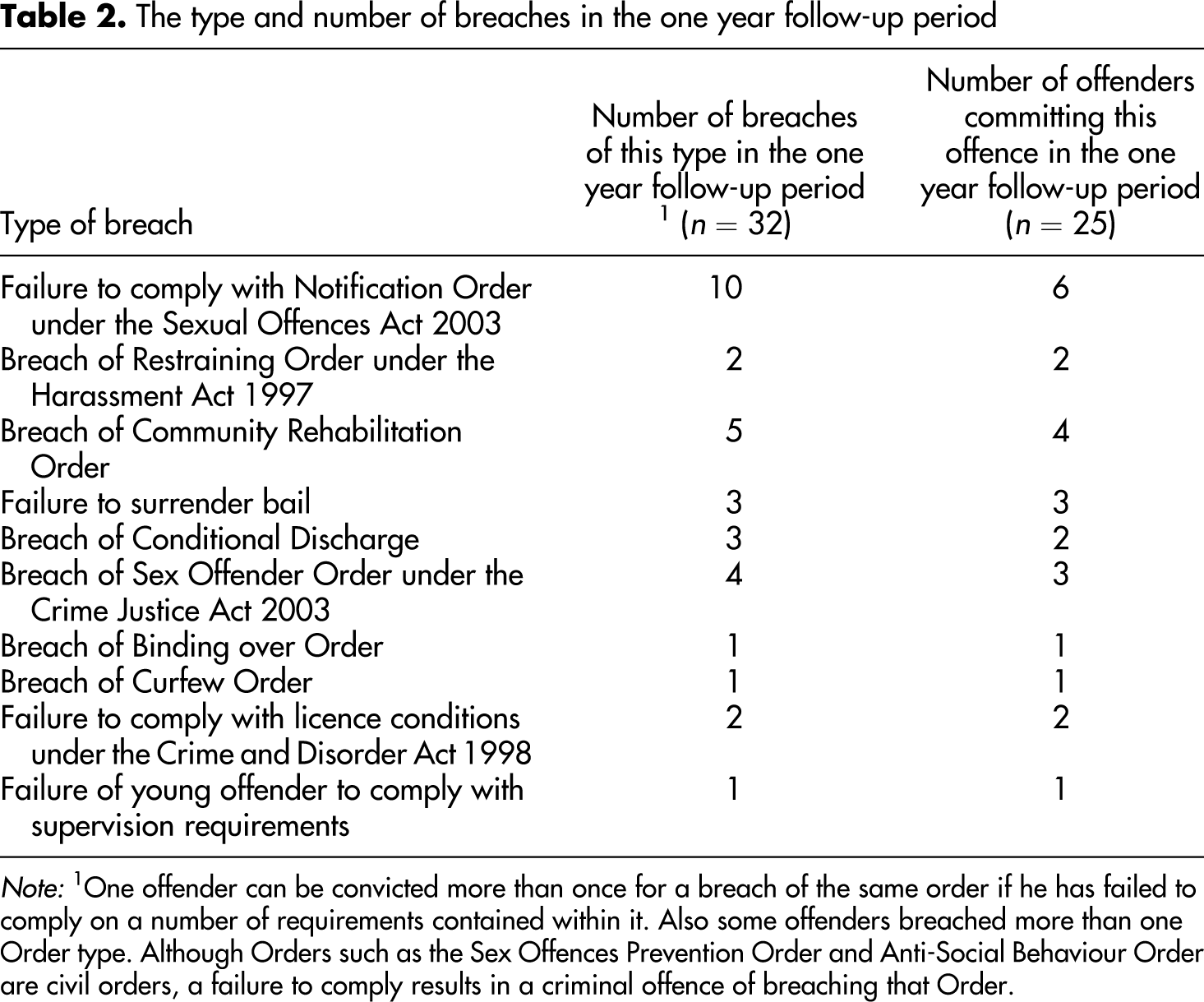
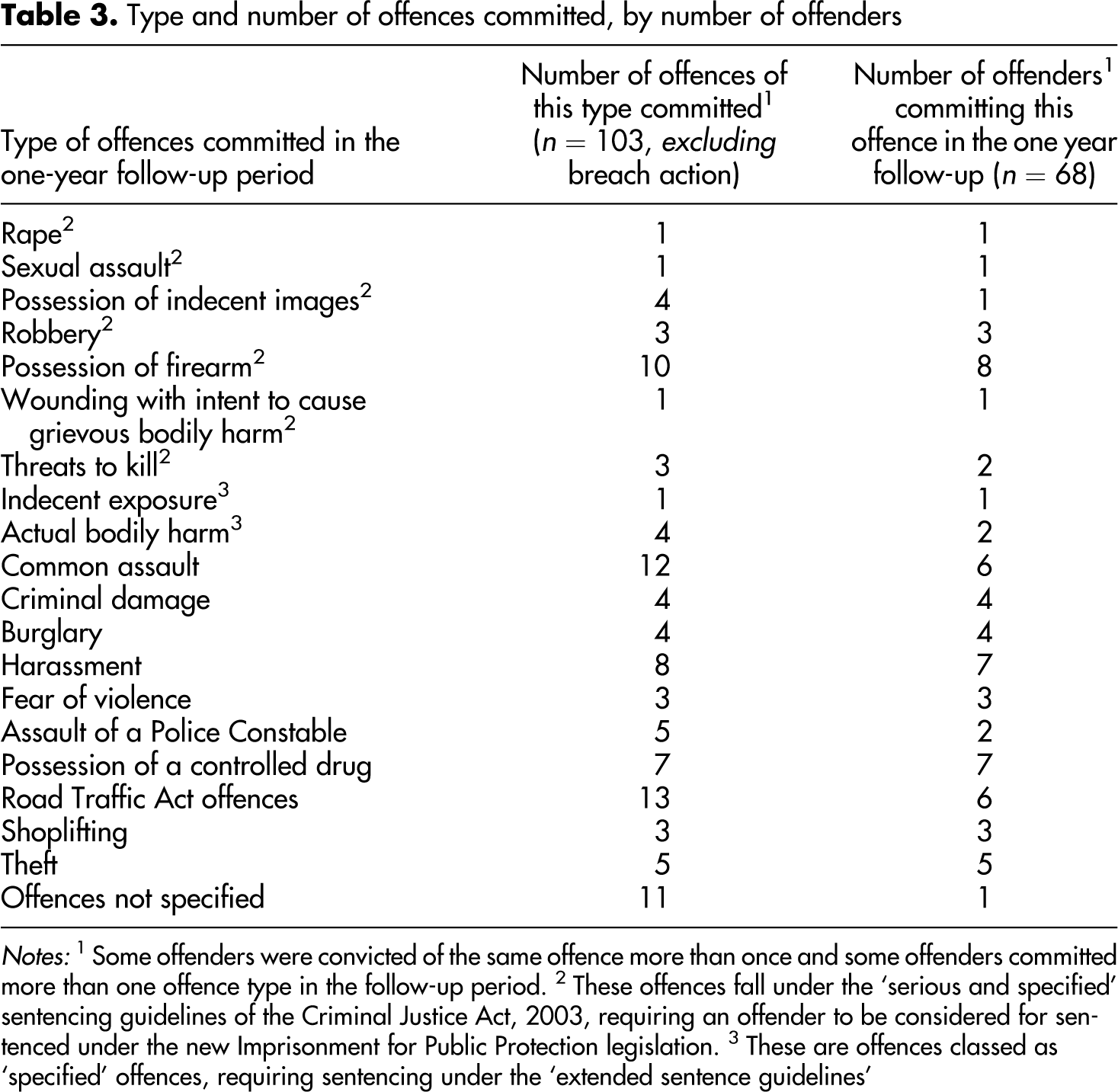
As breach action can be initiated without the offender committing a further offence against others, i.e. purely because of behaviours that are prohibited under licence conditions, the information relating to reconviction is presented in two separate tables. Table 2, shows the type and number of breaches that took place in the one year follow-up period. Table 3 shows the total number of actual offences committed in the follow-up period.
The type and number of breaches in the one year follow-up period
Note: 1One offender can be convicted more than once for a breach of the same order if he has failed to comply on a number of requirements contained within it. Also some offenders breached more than one Order type. Although Orders such as the Sex Offences Prevention Order and Anti-Social Behaviour Order are civil orders, a failure to comply results in a criminal offence of breaching that Order.
Type and number of offences committed, by number of offenders
Notes:1 Some offenders were convicted of the same offence more than once and some offenders committed more than one offence type in the follow-up period. 2These offences fall under the ‘serious and specified’ sentencing guidelines of the Criminal Justice Act, 2003, requiring an offender to be considered for sentenced under the new Imprisonment for Public Protection legislation. 3These are offences classed as ‘specified’ offences, requiring sentencing under the ‘extended sentence guidelines’
Table 2 shows that 32 of the 135 offences (24%) recorded in the one year follow-up related to breach action against 25 (45%) of the 56 offenders. Thus, lack of compliance was enforced and criminal proceedings were initiated in almost half of the cases in the follow-up period. This finding supports the use of civil orders as a public protection strategy as it enables action to be taken when risky behaviours take place, prior to an offence being committed.
Table 3 summarizes offences committed during the one-year follow-up period and shows that some offenders committed more than one offence type during this time. Using reconviction as an outcome measure may be seen by agencies allied to MAPPA as unjust given the profile of offender, as subsequent re-offending may seem inevitable. However, from the public perspective outcomes of effectiveness may be seen as directly linked to further offending with an expectation that, at the very least, serious harm offences should be prevented.
The consequences of further offending
In addition to the impact of offending on victims and the effect of further offending on public confidence, the reconviction figures amongst this cohort of offenders suggest long term resource implications for the criminal justice system. Table 3 shows that a third of the offence types committed (i.e. seven out of the 21 offence types) are classed as serious and specified offences under Imprisonment for Public Protection (IPP) guidelines (as defined by the Criminal Justice Act, 2003). Thus, the 17 offenders responsible for these offences (30 per cent of the 56 offenders who committed one or more offences in the one year follow-up period) would be eligible for sentencing under IPP requirements, though it is not mandatory for such a sentence to be passed.
Although hailed by the Government as a means to enhance public protection, Jacobson and Hough (2010) describe IPPs as ‘one of the least carefully planned and implemented pieces of legislation in the history of British sentencing’. IPP was introduced as an option for sentencing offenders who were deemed dangerous but whose offending was not serious enough to warrant a life sentence. In the context of public protection the sentencing structure may be an appealing one. However, in practice, the IPP is, as Epstein (2010) notes, a ‘bureaucratic nightmare’ in which prisoners find themselves incarcerated way beyond the tariff set at sentencing. Changes made to IPP sentencing in 2008 under the Criminal Justice and Immigration Act removed the mandatory requirement to impose an IPP if certain criteria were met. It also removed (with some exceptions) the use of this sentence for offences which would not normally attract a tariff of more than two years. The aim was to try and reduce the ever-increasing number of IPP sentences being passed. Whilst this has in part been successful, it has not reduced numbers to the extent expected by the Ministry of Justice (Epstein, 2010).
There is potential for a disproportionate number of MAPPA level three offenders to be caught up in the quagmire of IPPs, regardless of the recent changes to sentencing. If an offence warranting a determinate sentence of two years or more is committed, to avoid an IPP, the Court would have to be assured that the offender posed no significant risk of harm to others in the future. However, by definition these offenders are those who posed a risk of significant harm at the point of registration at level 3 by virtue of the fact they met the eligibility criteria for management at this level. In the context of IPP sentencing, an assessment of serious harm may be inevitable if, as is the case in this study, the offender commits a serious, specified offence within a year of registration under MAPPA. Successfully arguing such offenders do not pose a significant risk of harm in the future would seem improbable and thus, an imposition of an IPP is highly likely.
Reconviction as a measure of MAPPA effectiveness
As it is not possible to identify a control group to explore MAPPA effectiveness (as to do so, MAPPA eligible offenders would have to be excluded from MAPPA) alternative measures of effectiveness are required. A comparison of the level three data with the national offending rate is one possible means to achieve this. The national proven re-offence rate over a one-year period is calculated to be around 37 per cent (Cunliffe and Shepherd, 2007). The reconviction rate was lower for this MAPPA level 3 cohort, at 32 per cent. Whilst the analysis of reconviction data in this study is based on a small sample, the findings raise interesting possibilities. The national proven re-offence rate includes all offenders who have been convicted of any indictable offence. In contrast, this study specifically included those thought capable of serious harm offences and the eligibility criteria for level 3 cases suggests that the risk of serious harm posed by these offenders should be deemed imminent. Thus, it could be speculated that MAPPA is effective in managing risk by reducing the number of offences that would otherwise take place and that this accounts for the lower reconviction rate. Whilst it is not possible to conclude this with certainty, it is probable that the number of cases breached during the one year follow-up period was due to increased monitoring of these cases and thus offers further support for the effectiveness of MAPPA.
Do risk profiles indicate future offence type?
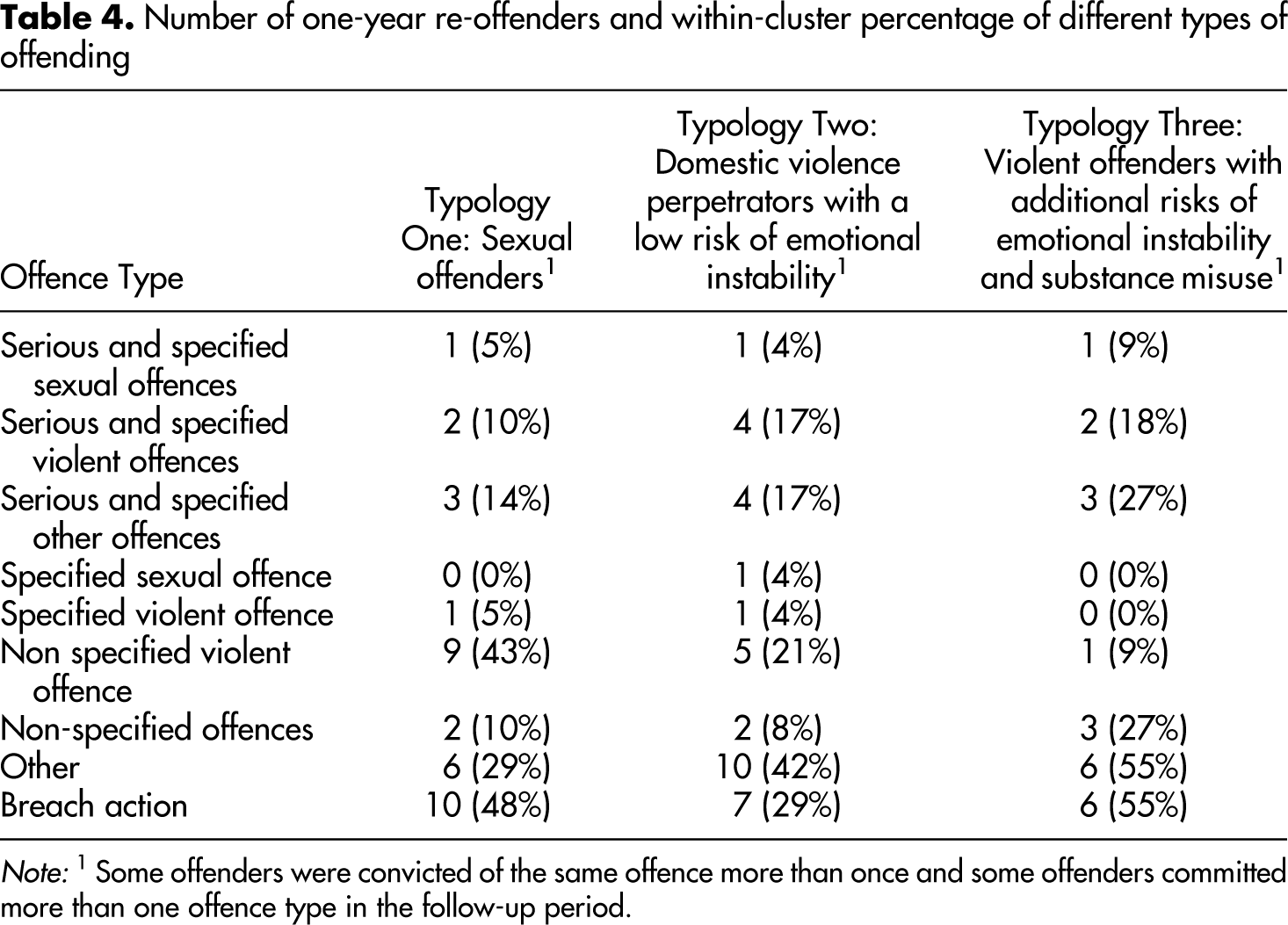
To plan resources and to help inform assessments of risk, understanding the relationship between risk typologies and subsequent offending can be helpful. Typologies provide a means to explore how re-convictions and risk profiles may interact. Previous work identified common themes across this cohort of level 3 MAPPA offenders (Wood, 2006). Three distinct risk typologies were identified – sex offenders, domestic abuse perpetrators and violent offenders with a higher risk than the other two groups of having mental health problems, psychological disorders, self harming and misusing substances (summarized as ‘emotional instability’). Table 4 details all offences committed within the one year period according to risk typology. It includes breach action and a summary of offences categorized according to sexual or violent offences and specified ‘other’ offences. The offence categories highlighted in bold show the number of offences for which an offender could be sentenced under IPP guidelines.
Number of one-year re-offenders and within-cluster percentage of different types of offending
Note:1 Some offenders were convicted of the same offence more than once and some offenders committed more than one offence type in the follow-up period.
Table 4 shows that the sexual offending and domestic violence groups were more likely to be re-convicted in the one year follow-up than the generic violence/emotional instability group. Thus, despite presenting as more chaotic (with greater risks of mental health, psychological disorders and substance misuse), the generic violent group committed fewer offences overall. The findings also suggest that the domestic violence group were the most likely group to commit a serious and specified offence as defined by the Criminal Justice Act 2003. Thus, for this cohort of offenders, the domestic abuse group rather than the sexual offending or generic violent group, committed a greater number of serious harm offences in the follow up period.
Each group had at least one offender who committed a serious and specified sexual offence and a sexual reconviction was no more likely to be committed by the sex offending cluster than either of the two violent groups. Although the numbers on which this finding is based are small, they are consistent with previous findings by Craissatti (2005). A further interesting finding is that the sexual offending group committed more non specified violent offences (as defined by the Criminal Justice Act 2003) than either of the violent groups; five times the number of non-specified violent offences committed by the generic violence group and almost twice the number committed by the domestic violence group.
Exploring reconviction data according to the three clusters indicates that reconviction does not necessarily reflect the expected pattern given the group to which an offender was originally assigned. For example, whilst numbers were small, sexual reconvictions were apparent across all three clusters in the follow-up period. When all violent offences were combined, it was the sexual offending group who committed the greatest number in the follow-up period, rather than either of the two violent groups. These findings help illustrate the importance of not allowing the old adage of past behaviour being the best predictor of future behaviour, to detract from the possibility that new offence patterns can occur. They serve as an important reminder to avoid assumptions about the type of future offence that will be committed by offenders and highlight the need for further studies to examine why this may be the case. For instance, is it possible that the restrictions put in place by MAPPA to manage the potential risk posed may lead some offenders to engage in different types of offending behaviour? For example, a sex offender for whom a range of measures have been put in place to reduce the risk of a further sexual offence against children, may seek alternative opportunities to offend, or develop feelings of anger and frustration because of the specific restrictions in place, which in turn may manifest as violent behaviour. Whilst it is possible only to speculate on the findings at this stage, they highlight the need for future research in this area.
Implications for MAPPA offenders who re-offend
MAPPA level 3 offenders who commit further offences such as those outlined in Table 4 potentially face far-reaching consequences. If sentenced under IPP, offenders will remain in custody until they demonstrate a reduction in risk. The first opportunity to do this is at the tariff date set at conviction. If release is declined at tariff, subsequent assessments are made annually by the parole board. These offenders face significant hurdles to demonstrate the necessary reduction in risk to be released at their IPP tariff date. This is an offender group who are, by definition of their level 3 status, resistant to change and difficult to manage. Previous analysis suggests that at least a third of these offenders are wholly resistant to addressing their offending behaviour in any way (Wood, 2007). Thus, a shift in attitude and behaviour sufficient to demonstrate that an offender is no longer a risk to the public will be difficult to achieve. Even for those level 3 offenders willing to engage in treatment, accessing the resources to achieve this is a significant challenge. A third (totalling 1991) of all IPP sentenced prisoners have yet to gain access to a single accredited offending behaviour or drug treatment programme in custody (Hansard, 2010). Around 2500 cases sentenced to IPPs are currently beyond tariff date (Epstein, 2010) and these cases will require priority for programme resources, over those recently sentenced. The consequence is that MAPPA level 3 offenders sentenced to IPPs are set to stockpile within the custodial system with no prospect of release at the tariff date, particularly given that to date only 94 prisoners out of the overall total of around 6000 sentenced to IPPs have been released (Jacobson and Hough, 2010). When one considers the number of MAPPA level 3 cases nationally, the extent of the problem becomes even more apparent. The incarceration of MAPPA level three offenders through the use of IPPs may seem the most effective means to ensure public protection and thus be deemed entirely appropriate. However, the resources required to support this process do not exist and the implications for an ever expanding prison population are significant.
In addition to further stretching finite resources, the IPP life licence significantly extends the periods during which the probation service is accountable if an individual commits a further serious offence post-release. The pressure placed on the probation service to achieve faultless risk assessments and ensure robust risk management is immense. As Beaumont (2001) commented a decade ago, by moving towards a focus ‘on supervising people with high probabilities of reconviction, their results may seem to be worsening’. This, he describes, has been ‘organisationally stupid and they are set to be blamed for failing to protect the public’ (Beaumont, 2001: 139).
Implications for MAPPA agencies when an offender re-offends
When considering reconviction patterns, context is important. Of all offender groups, MAPPA level 3 offenders are by definition deemed to be the most likely to commit further offences and are assessed as posing the greatest risk of serious harm to others. It is for this reason that MAPPA exists. However, we know that as many as a third of serious harm offenders have no prior convictions (Soothill et al., 2002) and that of a cohort of offenders who committed serious further offences, there appeared to be nothing obvious to make them stand out as worrying or unusual prior to the commission of the offence (Craissati and Sindall, 2009). This is worthy of note; it may be possible to argue that the harm perpetrated by the offenders in these studies could not be predicted. However, when level 3 offenders commit further serious harm offences, it could be argued that the potential for risk had been identified and therefore if a further offence is committed this is a failing by those tasked with managing the risks identified.
Given the high level of public scrutiny, it is perhaps understandable that professionals involved in the management of high risk cases may try to distance themselves from reconviction findings. Take for example Coid et al.’s (2007) longitudinal study. This explored reconviction rates over a mean period of six years for 1344 offenders released from medium secure units. Coid and colleagues state that treatment within medium secure units ‘is expected to reduce dangerousness of patients’ (Cold et al., 2007: 223). However, in presenting their findings they also conclude: It is important when considering these findings that they are not perceived as a measure of performance of medium secure services but the criminal careers of patients discharged from these services and their risks of reoffending. (Coid et al., 2007: 226)
This statement raises questions around what measures of effectiveness are fair and appropriate. If MAPPA are considered, for example, would the following statement be accepted? … it is important when considering the reconviction of level 3 cases that the information is not perceived as a measure of performance of MAPPA but the criminal careers of offenders and their risks of reoffending.
In Coid et al.’s defence, patients in their study had been discharged and thus, to an extent, it can be argued that any reconviction that took place cannot be used as an outcome measure of the effectiveness of the medium secure unit that cared for them prior to the offence. However, given the stated aim of treatment within a medium secure unit ‘to reduce dangerousness of patients’ (Coid et al., 2007: 223), it is difficult to entirely distance the work of medium secure units from reconviction statistics. Bryan and Payne (2003) recognized the difficulties, stating that: … public protection is neither a technology nor a science: it is a complex interaction of analysis, professional judgement and dynamic inter-agency activity. (Bryan and Payne, 2003: 29)
Conversely, when things do happen, close scrutiny is inevitable. As Bryan and Doyle (2003) noted: Failure whips up the public hysteria about the effectiveness of public protection and thereby generates a great deal of anxiety but not much objectivity. This is not to suggest that ‘success’ is never achieved but because it is measured by the negative proxy of no re-offending, it wins no plaudits and is inevitably overshadowed by the sensationalism of the failures. (Bryan and Doyle, 2003: 31)
Conclusion
This detailed analysis of pro-offending behaviour in the first year of an offender’s registration at MAPPA level 3 offers a means to explore MAPPA effectiveness. It also provides insight into resource implications when MAPPA offenders go on to commit serious specified offences as defined by the Criminal Justice Act (2003). Without a considerable increase in resources, extended periods in custody anticipated for this offender group will not be utilized meaningfully. However, given the current financial climate in which the National Offender Management Service is tasked with reducing budgets by several million pounds, diminishing resources are likely. Even when released, managing this offender group on life licence has far-reaching implications for the probation service. Long term strategic planning is therefore essential to the successful management of cases who present a high risk of serious harm and of reconviction.
The finding that offenders managed under MAPPA go on to commit further serious harm offences should be anticipated. It is the complex, high risk nature of these offenders that led to the development of MAPPA in the first place. Whilst MAPPA may have gone some way to transform the way in which high risk offenders are managed in the community, it cannot be assumed that this is sufficient to transform the attitudes and behaviours of this offender group. In the context of MAPPA, the offender profile is such that achieving abstinence from offending behaviour may be unrealistic, whereas working towards a level of offending that has less serious consequences in relation to the harm caused, may be more feasible.
These findings offer some evidence to back up anecdotal assertions that MAPPA is effective in protecting the public. Comparison to national offending rates suggests that MAPPA may reduce offending rates amongst the highest risk offenders. The findings also suggest that breach action and enforcement of civil orders initiated by MAPPA agencies offers an effective means to manage high risk offenders. The findings do, however, indicate the need for improved resources to manage those offenders who are re-convicted and face extended period on custody, in order to tackle the ongoing risks this group presents. In the current financial climate, meeting this need is a tall order.