




Abstract
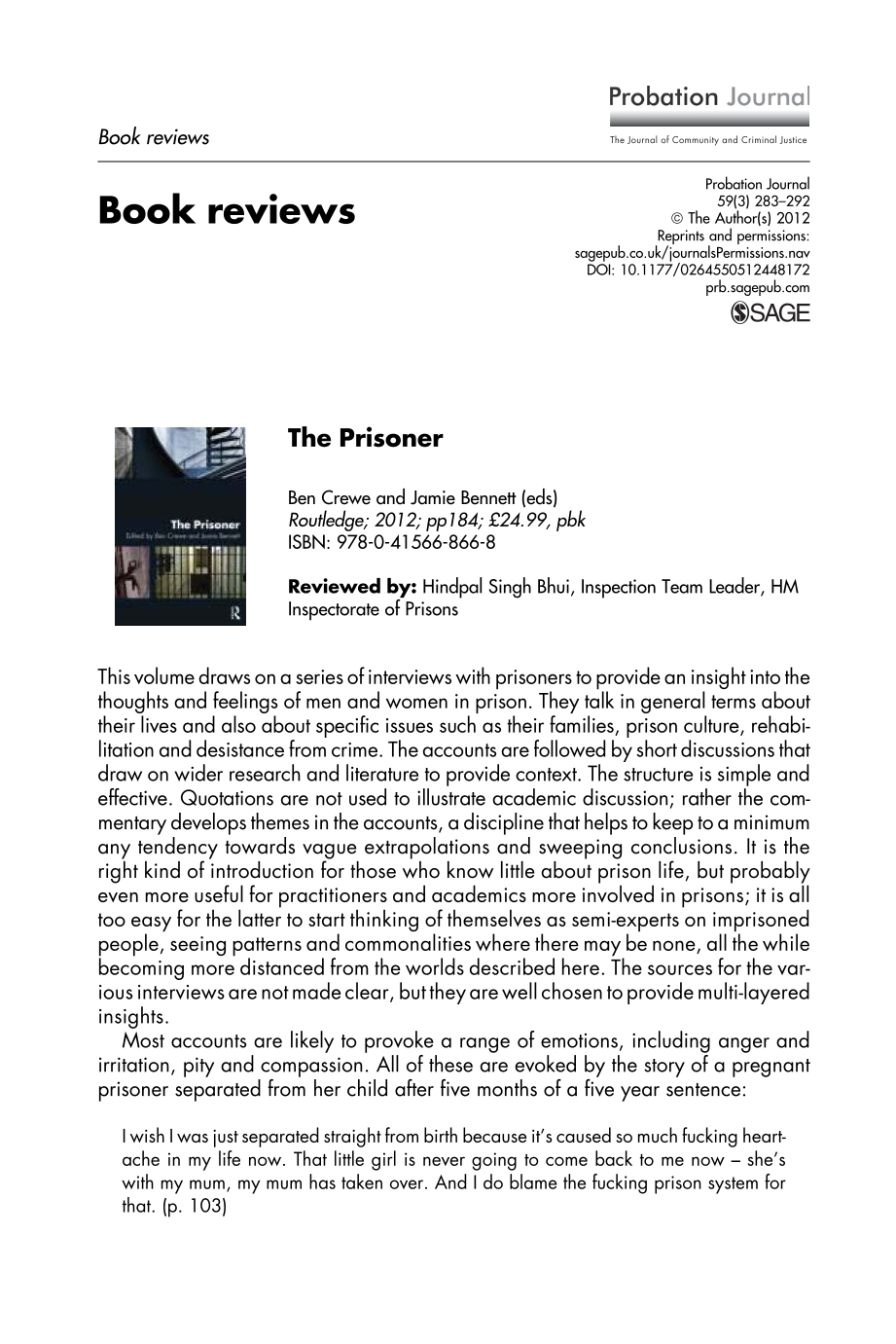
This volume draws on a series of interviews with prisoners to provide an insight into the thoughts and feelings of men and women in prison. They talk in general terms about their lives and also about specific issues such as their families, prison culture, rehabilitation and desistance from crime. The accounts are followed by short discussions that draw on wider research and literature to provide context. The structure is simple and effective. Quotations are not used to illustrate academic discussion; rather the commentary develops themes in the accounts, a discipline that helps to keep to a minimum any tendency towards vague extrapolations and sweeping conclusions. It is the right kind of introduction for those who know little about prison life, but probably even more useful for practitioners and academics more involved in prisons; it is all too easy for the latter to start thinking of themselves as semi-experts on imprisoned people, seeing patterns and commonalities where there may be none, all the while becoming more distanced from the worlds described here. The sources for the various interviews are not made clear, but they are well chosen to provide multi-layered insights.
Most accounts are likely to provoke a range of emotions, including anger and irritation, pity and compassion. All of these are evoked by the story of a pregnant prisoner separated from her child after five months of a five year sentence: I wish I was just separated straight from birth because it’s caused so much fucking heartache in my life now. That little girl is never going to come back to me now – she’s with my mum, my mum has taken over. And I do blame the fucking prison system for that. (p. 103) I feel very diminished as a human being at the moment… over the years, I’ve become emotionally stunted… I do [have emotions] but it’s a very narrow range… you can literally go months without touching a human being, and it’s just something you get used to. (p. 41) … in the old days they could fuck you up with their fists. Now they can fuck you up with their pen. (p. 26) … imprisonment had skewed my moral tolerance in certain ways, and I am not alone in this. Many… adapt a more pragmatic approach to ethical dilemmas, in order to survive the environment. (p. 146) … I spent so many years managing my emotional state that, seven years after release, the effects of that process are still with me. While I can empathise with people, the leap to sympathy does not occur unless I am already emotionally invested with someone. I became aware of this while I was still incarcerated, but to have discussed it would almost certainly have seen me ‘killed off’ on file. (p. 144)