



Abstract
This article takes an historical perspective, drawing on personal practice in the 1970s and 1980s, research and consultancy in the 1990s and 2000s, in exploring a long history of probation engagement with their local communities. That this history has never been fully embedded in every practitioner’s everyday practice, and indeed it could be said is no longer seen as axiomatic that probation should be so engaged, will be dissected and analysed. It will be suggested that recent practice focusing more on risk management and public protection has potentially alienated practitioners from the communities they serve. This article concludes with suggestions as to how probation practitioners can re-engage with their community, drawing on recent theoretical and policy developments in partnerships, community and restorative justice and theories of desistance.
Introduction
I began my career as a probation officer in 1977. My typical day involved arriving at my office in the morning, reading letters and communications, preparing and writing reports and attending to any formal meetings, court attendance or prison visits I needed to do. After lunch I usually set out to my 'patch'. I worked in a northern coal mining town and spent most of my afternoons in one of the mining villages visiting clients (they were so regarded then!), visiting schools, the employment officer at the pit, taking sessions with young people in the local community centre and generally involving myself in community activity through my clients. If someone missed an appointment with me then I called around the house to check how they were doing or I spotted them in the street and would stop and have a conversation. Interestingly few of my colleagues knew where I was or what I was doing throughout the day. If I was placing myself in danger I was unaware of it as there were no mobile phones to ring to check that I was okay and indeed it would be the following day before my colleagues would have noticed my absence. I did this for six years and met some difficult and vulnerable clients from lifers to sex and violent offenders and those with mental health, drugs or other difficulties in living. Maybe I was lucky but I only ever felt threatened by the dogs at the gates of the homes I visited.
The reminiscence above is a typical example of community-oriented practice in the late 1970s. The probation service has a long and honourable history of community engagement. Bill McWilliams, writing in 1983 concerning the early origins of probation, noted: primary focus as police court missionaries was much more akin to detached community work than spending time saving souls in magistrates courts. They were just as concerned to offer help to the socially excluded at the railway station or cab stand as in the courthouse. (McWilliams, 1983: 135)
This article will explore a number of foci around the broad and somewhat nebulous concept of 'community engagement'. In this discussion the article will consider what is meant in this context by innovative practice, what we mean by the term community and what legacy this smorgasbord of practices offers the contemporary probation practitioner. The article also critically explores whether the probation service has ever had a viable model of community engagement from which we can draw lessons and shape future practices. The article will explore what the elements of good practice would look like and how community engagement works in the contemporary world of a mixed economy of provision that is the current and, arguably, given government announcements (Ministry of Justice, 2013), future world of offender management. The future map looks like the probation trusts will be working in partnerships, possibly as a junior even marginal partner, with the voluntary and community sector, the private sector, prisons and the police. These new working arrangements imply challenges around the fragmentation of delivering services, the potential domination of the private sector acting as a prime contractor with probation and the voluntary sector as merely subcontractors, and this will have implications for the maintenance and/or further erosion of community probation links that will be considered at the end of this article.
The 1980s
Writing as far back as 1986, as part of a contribution to Napo's community probation work policy, there was even then a clear concern about 'a view of probation that clung to office bound practices and a central allegiance to the courts' (Senior, 1988). How much more might this apply over 25 years on? This illustrates a long standing uncertainty about who probation should represent. Are probation officers servants of the court, representatives of local communities or now merely civil servants? It is the community arm of this conundrum that this article addresses. During the period between the mid-1970s and 1980s four stories of community engagement could be identified: probation as 'patch work'; probation as community catalyst or community outreach work; probation in the community; and collaboration and liaison with community agencies.
These were often overlapping strands but had an identifiable and distinctive orientation representing, at root, different interpretations of what probation practice in the community should be about. 'Patch work', also sometimes known as neighbourhood work, fits the description offered at the opening of the article and this involved probation officers being located within their patch for large parts of the working week. This model worked best where there were easily identifiable geographical boundaries with sufficient criminal activity to justify the location of the probation officer within the patch. Although the probation officer would have their own clients under court orders, they would also see their role as engaging with local community groups in identifying and acting upon crime and disorder more broadly. Thus, schools, youth clubs, local employers, local and health authority workers and indeed any group where there was a real concern about criminal activity would be within a probation officers sphere of action. It also encouraged forms of practice that were more group-oriented, particularly with younger people, and such groups were often opened to those considered at risk or merely a peer as a commitment to inclusiveness (Senior, 1985a). The probation officer was able to understand how the local economy worked and to place criminal activity in the context of the local community. The officer could draw upon natural community networks to support clients and assist their desistance from crime. Seeing the client in their neighbourhood and their home helped to shift the power imbalance between officer and client and offset the need for enforcement strategies outwith the community.
Community outreach was most typically undertaken when probation officers engaged themselves in campaigns of social change within local communities and this might be around housing projects, a welfare need or health concern, or other identifiable social issues. Also, this work could target groups within a community such as travellers, mentally disordered offenders, people with drugs or alcohol issues, or outreach work with young people. Outreach work was a feature of contemporary youth work and probation borrowed this concept to work at a street level with identified groups. Probation officers here would see themselves as being a focal point, a catalyst for engaging communities in action to tackle the identified concern that had been raised. Sometimes community outreach became a particular focus of those normally engaged in the patchwork discussed above, but galvanized through a particularly live social issue. Probation officers were able to use their positioning to orchestrate action among community and local authority groups. (Examples of probation-led campaigns can be seen in Scott et al., 1985.)
Probation in the community was most closely exemplified in the 1980s by what became known as the Detached Unit in Sheffield. The precursor to this unit was described in one of the most influential books of its time − Act Natural by Bruce Hugman (1977). Bruce was a probation officer who lived in a particularly volatile part of Sheffield where drug usage, prostitution and antisocial behaviour was commonplace. Bruce found himself opening the doors of his home to those in need, some of whom became his clients, others were simply those active on the streets. This type of probation work challenged conventional practice and in particular professional boundaries. Inspired by its success, it was developed by the local probation service with the purchase of a house in which lived four or five probation officers. For a period of about six years this experiment challenged the assumptions about how probation relationships with the community should function. This was a 24/7 open access unit, a far cry from the 9−5 five days a week practice of the average probation team at the time. The approach of this unit challenged the assumptions about the very nature of probation-client relationships. There was a higher level of burnout among the staff located in this unit but at the same time the grassroots work undertaken was at the cutting edge of people's lives. Interestingly, the experiment ended – not because it was deemed unsuccessful (though there was no attempt to properly evaluate this experiment) − but because cutbacks meant that the probation service had to choose between this unit and other provision and thus the unit and its concept disappeared without trace. Its radical edge maybe proved its undoing and it has not subsequently been repeated.
More typical than any of the three variants discussed above, probation officers worked from their offices, undertaking home visits when necessary and certainly more routinely than a decade later, but because they often served one or more communities over larger geographical areas they saw the role much more in terms of liaison than community engagement. Accordingly probation officers often had lists of telephone numbers of the employment offices, housing advice workers, citizens advice services, youth workers and the schools, and would use the contacts when one of their clients needed such assistance. (Lists could be jealously guarded and sharing them across a team was not a natural inclination for some.) This did not necessarily mean that this acted as a springboard, building on those community networks, but rather it was seen as merely an adjunct to personal practice and thus arguably was the least developed form of community engagement happening at the time. If closer links with the community was considered it would more likely be the allocation of a probation volunteer to befriend individual clients and sometimes community links were developed through enterprising volunteers. Later on it became more typical for probation officers to broker access with voluntary groups and organizations that had specialist expertise, sat outside the formal court system and were located within particular community settings.
One 1980s version of community engagement was articulated and supported by a particular social philosophy, as Bill Jordan argued: Probation Officers would have to leave their offices and become directly involved in deprived areas, in communities and community work, in the lives of young unemployed people, in their streets and pubs, not in training centres or sin bins. (Jordan, 1983: 88) [P]rojects, group-work with problem drinkers, drug dependents, social skills, leisure and community work facilities, intermediate treatment are just a few of the developments already existing and working well. They do not depend on compulsory attendance and indeed participation is often predicated on willing involvement rather than coercion. (Senior, 1983: 91)
Many probation officers had been trained extensively in individualized practices; social work training focusing on methods where individual casework predominated, whether the philosophy was psycho-dynamic (Hollis, 1972), task-focused (Doel and Marsh, 1992) or behaviour modification techniques (Sheldon, 1982). In this situation probation officers often acted as if their 'cases' were private property and thus did not place their interventions in a wider social context, something that community engagement demanded. During this period Napo policy articulated some key principles that should underpin community probation practice. These included: understanding the social context and community profiling; any probation engagement/intervention should be a response to crime-related concerns; interventions should be person centred and collaborative (what might be termed co-production models today) and must seek to empower clients and communities (Senior, 1988). This articulation of principles, however, did not become accepted as mainstream practice. Letting many flowers bloom, without critical evaluation and thus validation, meant community engagement became the prime activity of a minority only and was not institutionalized. Core practice actually moved further away from communities, with the reduction in home visiting and prison visiting accompanied by changing political priorities for probation amidst growing resource constraints in the 1990s.
1990s and the millennium
As we look forward into the 1990s, an era when probations' public protection orientation had been strongly asserted by a right-wing law and order government under Thatcher and then Major, the potential for community engagement, as described above, receded further. Innovation was dominated by psychological paradigms, including a strong focus on risk management and assessment as the guiding principles of practice intervention (Kemshall, 1998). In methodological terms, the most successful was Cognitive Behavioural Therapy 'offending behaviour' programmes (McGuire, 2000), developed from an initial bottom-up 'what works' approach. Originating in Day Training Centres, intermediate treatment and specified activities, and developed within probation areas, it was usurped, institutionalized and imposed by the newly created National Probation Service in 2002, not an easy organizational structure to promote community engagement. The dominance of sociological perspectives became less predominant in this period and this chimed with a political philosophy of neo-liberalism that placed emphasis on personal responsibility not societal context as the core explanatory framework for understanding offending behaviour.
The underpinning social philosophy of community engagement did not entirely disappear though and began to re-emerge under a different guise. John Harding, writing in 2000 on community probation, stated: It reorientates the focus of justice through engagement with community. It is a process of identifying public safety problems, creating partnerships within the community and building bridges among all parts of the justice system to address these problems effectively. It takes us beyond the courtroom and the jail house to the problems that local people face, identifies the causes and how they might be addressed. (Harding, 2000: 148) Therein lies the importance of community justice; intellectually and philosophically it represents the last best hope of reinventing and sustaining humanistic values in twenty-first century criminal justice. (Nellis, 2005: 49)
More recently Rob Canton attempted a definition: [C]ommunity justice represents a framework within which a number of other concepts may be located − social inclusion, reintegration, restorative justice, belief in the possibility of change, the role of social capital in desistance − that constitutes many of the values of probation. (Canton, 2011)
There were other straws in the wind that was sustaining this community justice orientation. The probation service around the turn of the millennium was an agency much more integrated into the work of other criminal justice organizations, with the development of multi-agency partnerships; particularly with the police and the voluntary and community sector around such areas as MAPPA, drugs intervention programmes (DIP), persistent and prolific offenders (PPO) and more recently integrated offender management (IOM). It had become more victim-focused and was experimenting with forms of restorative justice and reparation (though it should be noted that reparation had first emerged in the 1980s and was the subject of an unenthusiastic Napo policy paper in 1984). The introduction of community safety partnerships in the 1997 Crime and Disorder Act, another New Labour innovation, was another carion call to multi-agency approaches to crime prevention and reduction. The restructuring of the youth justice system in 1997 − now modelled on an integrated agency approach with probation and police secondees to the Youth Offending Teams and also managing 17-year-olds − was further reflection of changing directions for criminal justice. Around 2000 a strong resettlement agenda emerged drawing on the findings of the Social Exclusion Unit report (Social Exclusion Unit, 2002) and building on a 'pathways' approach to reducing reoffending (Senior, 2003, 2008). The centrality of social capital and social networks were re-emphasized here, although the main foci was attaching offenders to community organizations to assist change rather than necessarily trying to create the capacity within communities for self-help and support of its problem members or for probation to return to communities to support their clients. Home visits, for instance, were almost completely absent by this time. This was a rebranded community liaison role as described above in the 1980s, not community engagement necessarily.
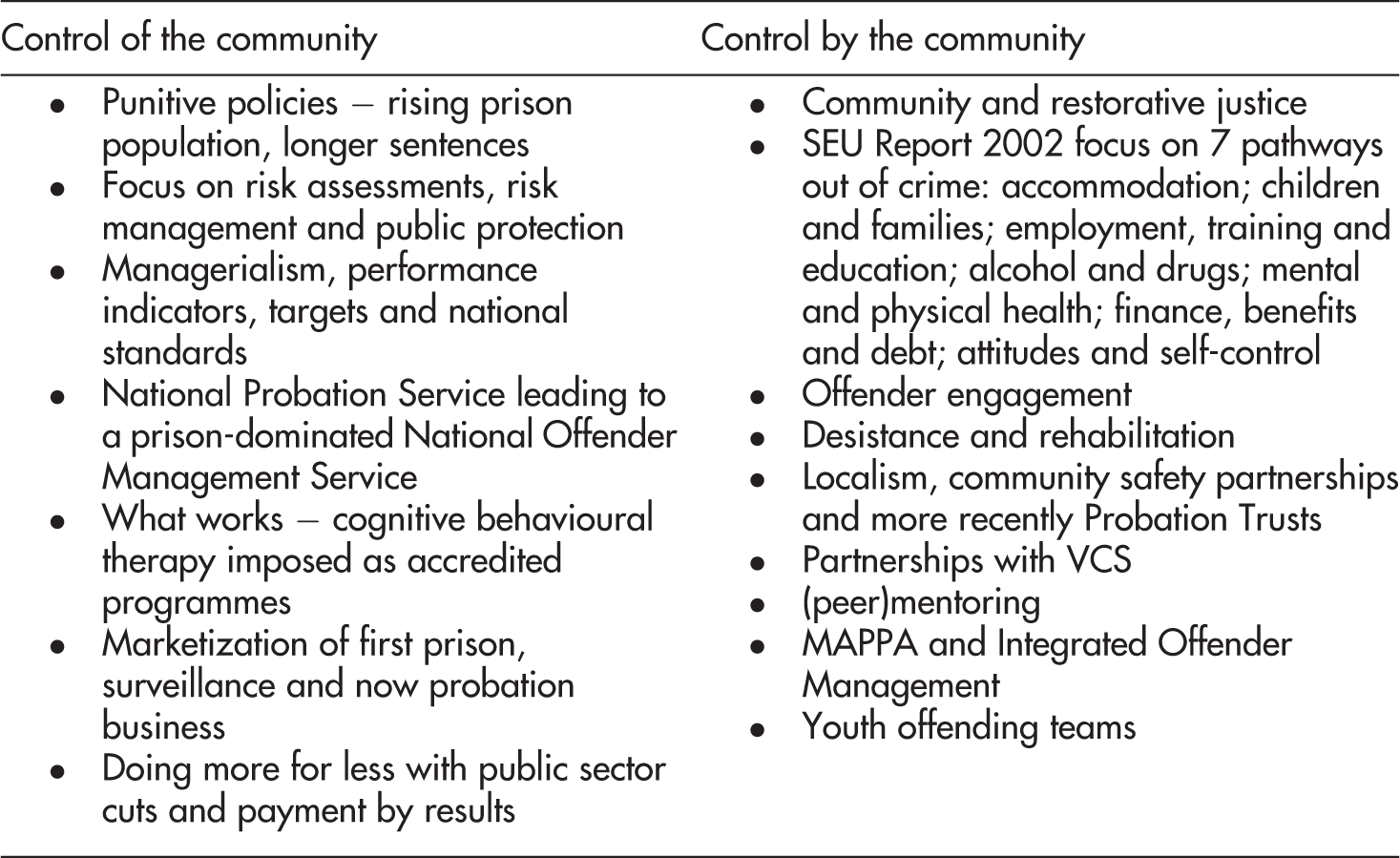
The distinction made in the figure above is not so neatly compartmentalized in practice. There are aspects of practices in the box 'controlled by the community' where the community may not feel that they have much say in the outcomes or may not support decisions being made. However, what the two lists illustrate is a potentially different orientation to practice. The rest of the article explores the implications behind the second list for reinvigorating and maintaining some aspects of the community engagement paradigm that were popularized but not sustained after the 1980s. I made the following challenge in 1985, which is still as pertinent today:
[M]aybe at the end we have no choice. We either change our practice or risk becoming obsolete and excluded from the communities we serve. (Senior, 1985b) community justice is perceived as a partnership between the formal criminal justice system and the community, but communities often autonomously engage in activities that directly or indirectly address crime. (Karp and Clear, 2000)
Their five conceptual ideals are:
operates at a neighbourhood level; a problem solving approach; involves citizens in the justice process; decentralizes authority and accountability; prioritizes a community's quality of life.
Within each of these ideals there are links to probations' past effort at community engagement and links to some of the more positive developments of recent years. In focusing on the neighbourhood level it draws on some of the histories associated with patchwork, community outreach and other initiatives. However, in this brief review it has been seen how far probation have disengaged from local communities and therefore a key concern would be how far probation will be able to re-enter and regain the communities trust. Are the correctional services too associated with 'control of the community' to act as a community catalyst?
The identification of problem solving as the second key ideal fits with many recent innovative initiatives such as community justice courts (Lang, 2011), restorative justice conferencing, offender engagement (Copsey, 2011) and solution focused casework. All these initiatives work alongside offenders in a co-production approach, motivating change, seeking solutions, and dealing with people's lives holistically rather than just securing attendance at programmes. Many ideas emerging from the desistance literature would also support a problem-solving orientation (McNeill and Weaver, 2010).
Building on this, the importance of involving citizens in the justice process cannot be underestimated. The excellent work in recent years around peer mentoring has shown one way for reformed offenders to regain citizenship (Fletcher and Batty, 2013). While many communities seem reluctant to allow reformed offenders to put behind them the label 'offender' − indeed contemporary legislation institutionalizes the notion of 'offender management' − it is important if we are to find reintegrating strategies that a concerted attempt is made to engage wrongdoers as citizens in the justice process.
The fourth element may also enhance engagement and motivation to change by decentralizing authority and accountability and making local areas responsible for crime reduction strategies. Significant here is the emerging role of the Police and Crime Commissioner who will be a significant driver in achieving a local driven agenda through their assumption of a commissioning role for crime reduction services. Community Safety Partnerships and the emergent Health and Well-Being Boards also contribute to this localism agenda.
Partnerships may help to deliver some of these community justice ideals and offer one route back into community engagement. As Rob Canton has suggested:
seeing people only in the office risks abstracting them from the social context in which they have come to offend and in which their desistance is to be accomplished. (Canton, 2011) creating and sustaining the processes and institutions of community justice − of control and surveillance, and of prevention, reaction and reintegration − is not just a daytime activity. (Nellis, 2002: 71)
Partnership forces probation staff out from their own offices into liaison and working arrangements with other agencies and into community offices. One of the key success factors of integrated offender management (Senior et al., 2011) has been the benefits of co-location, bringing together police, prisons, voluntary sector, probation and others so that they can bring a targeted response to local persistent offending. Where co-located offices were based within communities this also enhances provision and community connectivity. The best of the community court movement takes place in buildings located within community settings where local people can feel part of the decision making and help assist resolution (Lang, 2011). Restorative justice is similarly built on community engagement through circles and conferences (Meadows et al., 2010). In the sex offender field, Circles of Support and Accountability, are another way in which the community can become engaged in positive solutions to some of the more difficult and intransigent crime problems (Hannem and Petrunik, 2007).
It is not to suggest that this will be easy to normalize because probations attitude to partnership has always been much more in the mode of purchaser-provider than genuine partnership. The 7 per cent government directed allocation of 'partnership' funds to the voluntary sector during the 1990s did not produce a qualitative change in the relationship between the two organizations, probation areas remaining commissioners as well as providers. There is still a long way to go before genuine partnership is achieved.
It is instructive to note that community reintegration demands an approach whereby the community, however defined, has to be open to receiving back some of its more difficult members. This is probably the biggest bridge to cross in re-engaging communities. Spurred on by negative media images, communities often close their doors to returning offenders and probation has to find ways to really engage with those local networks to ensure that people returning from a custodial sentence have a greater chance of desisting from offending than has been the case in the recent past. Contrast the success of the Yellow Ribbon Project in Singapore (Russell and Cohn, 2012) where resettling offenders are welcomed back into communities and employers train and employ such people through custody and on release. It is unsurprising that recidivism is lower there given the facilitation of social and human capital that such projects engender. The community engagement of community service/community payback has always been underestimated as a way of probation working in its community and the current trend for control centres run by the private sector risks the community engagement aspects of community payback even further. It is speculative to consider whether a police and probation-run electronic surveillance programme, instead of private contractors, might also have helped probation maintain community connections.
Messages across 30 years: An agenda for community engagement
Pulling together the strands of the arguments in the article it remains a worthwhile task to identify the key strategies that will enable probation trusts to engage once again in community-based practice to achieve what John Harding challenged in 2003: [P]ublic confidence in probation is not just a matter of performance compliance and percentage reductions in the rate of reoffending, but in local communities being mobilized by probation to exercise the degree of civic responsibility for the reintegration of offenders in ways that are personal and accountable. (Harding, 2003: 373)
Though I would not underestimate the mountain to climb in the current policy context, the article now identifies nine themes to emerge from this brief historical review that can guide thinking to re-establish community engagement given the political will.
1. Engagement requires opening the office doors and other channels of communication
Office-bound practices, particularly where agencies sit apart (literally in silos) from each other, distances probation from both its partners and its communities. The retreat to central office locations behind security doors symbolizes an engagement where the power differential between the officer and the offender is at its greatest. Some of this movement came from health and safety issues and were stimulated by practitioners concerned with their safety. But the distancing that such location emphasizes acts as a barrier to communication. Practitioners must not be put at risk, but evidence from the restorative practices literature (Watchel, 2013) suggests that engaging in an open, transparent and co-productive manner would create a more meaningful dialogue than sitting behind a computer. How can a practitioner really understand the social circumstances within which offenders live and operate if they do not leave their desks and get out into their communities? This also applies to cross-agency working where engagement in co-located settings enhances understanding of each other's perspective (Senior et al., 2011).
2. Effective interventions requires effective partnering
An early lesson from the 1980s was that the more involved different agencies became in appreciating your work − schools, employers, housing officials, youth clubs, etc. − the further investment you got from those agencies to help the focus on the individual. Working in an integrated multi agency fashion, utilizing co-location preferably within the catchment area, will benefit outcomes and will enable the different skill sets of different agencies to be brought to bear on the issues and problems. Multi-agency working is challenging as you cannot expect the same perspective on the offender from each different agency, but this forces the practitioner to articulate its perceptions clearly with evidence-based arguments and to become reflective of what each agency contributes to the discussion. The partnerships between police and probation on Integrated Offender management projects has transformed the relationships between the two agencies who now share intelligence in a more open and transparent manner (Senior et al., 2011).
3. Working together on problem solving enhances engagement
Where people can be directly engaged in their own change projects through co-production this works better and desistance possibilities are enhanced (McNeill and Weaver, 2010). One of the consequences of a more managed approach to case supervision through national standards is the lessening of real engagement from the offender themselves in articulating their understanding of the journey toward desistance. Practitioners took away the partnership at the centre of change relationships. The development of the Offender Engagement Programme (Copsey, 2011) started from a simple premise of asking the offender what they desired from the relationship. This led to joint decision making on sentence plans, a more motivated offender and ultimately more successful outcomes. This principle extends to other significant people in the offender's social network.
4. Listening to the evidence
When practitioners were feeling their way toward community engagement in the 1980s there was very little in the social work literature to help them. Communities of practice within probation areas developed to support a reflective approach to practice built on a model of constructively critical dialogue. Now there is a more developed evidence-base. There is a myriad of evidence-informed practices that should guide positive community-based practices. At a time when the practitioner has a tool kit that can guide practice, there remains a mismatch between what should be done and the policy imperatives of government. Too often new policies seem to be based on policy-based evidence rather than informed by research; the fate of politically inconvenient research is a worrying trend as research funders control dissemination (Senior, 2013). In the recent consultation exercise on the government proposals for 'Transforming Rehabilitation' (Ministry of Justice, 2013) nearly 600 responses offered a massive database of 'what works' prescriptions for good practice. Yet the government appears to be pursuing policies that appear to be diametrically opposed to the evidence presented. This is not a new phenomenon as Goldson (2010) noted in relation to youth justice.
5. The re-emergence of relationships
It was axiomatic in the 1980s that good professional relationships between practitioner and the client were at the heart of good practice. In the early 2000s a belief in 'effective practice' (Chapman and Hough, 1998; McGuire, 2000) seriously underplayed the importance of this concept at the centre of interventions that underpinned, enabled, sequenced and made sense of particular interventions. Case management was seriously underplayed. Person-centred and collaborative practices where motivated individuals are engaged to change are much more likely to achieve their goals than the arbitrary referral to offending behaviour programmes. New models of supervision have supported the importance of continuity of care and the centrality of relationships while also emphasizing the importance of social context (Ward and Maruna, 2007).
6. Getting back out into the community
There is a role for practitioners as advocates to support communities in their struggles to make their environments ones that are more positive for reducing re-offending ,and yet many practitioners have been slow to realize this potential. Integrated Offender Management, a multi-agency, community-based reintegration programme, has shown that working with offenders alongside other agencies such as police and local voluntary agencies enables a more nuanced and effective set of responses to be developed that also feed back into crime prevention more widely (Senior et al., 2011). The role of community safety partnerships (CSPs) is important here, though the fact that probation became a belated statutory partner did inhibit their engagement earlier in these forums. With public sector cuts CSPs are struggling to find resources to continue their work, though local commissioning through the Police and Crime Commissioners and Health and Well-Being Boards offer some small resource to develop services within the community.
7. Community profiling
The importance of community profiling was emphasized in the Napo Policy Paper discussed previously and published in 1985. At that time the ability to understand local crime patterns, re-offending rates, crime hotspots, gang presence, local unemployment and other key factors of the local economy were severely constrained. But the potential today for comprehensive community profiles should not be underestimated as there is now many more advanced tools that can survey patterns of crime and offending within particular communities and what they need in terms of support to change. We can provide sophisticated information to guide individual practice, to focus on particular problematic communities and to change our approach where it is manifestly unsuccessful.
8. Going local is a good thing
A local focus begets variation and differences in approaches, but we should not be too concerned about this provided we evaluate and assess new practices and disseminate ideas so that all can benefit. A cooperative justice system where budgets can be pooled and justice reinvestment achieved is better equipped to a localized approach than a competitive system built on agency incentives to succeed. Standardization of practice over the last 20 years has not produced progressive innovative practice but rather has stifled it (Senior et al., 2007). The Coalition government on gaining office immediately introduced a focus on localism, though there has been a little withdrawing from this commitment in developing services for 'transforming rehabilitation'. The Police and Crime Commissioners remain unproven and have had severe political problems in setting up and becoming influential, but the notion of local commissioning also present in drug and alcohol services and health commissioning does allow the differences between communities to be part of the decision-making process.
9. Doing more for less
Crime reduction and prevention is bounded by the reducing resources available for its effective implementation. However, judicious use of pooled resources have shown that savings can be made while producing effective services. This requires community agencies to work together for change through Justice Reinvestment where savings in one sector can be reinvested in another, an important additional resource that communities in a time of austerity can create by reducing the huge expenditure on prisons and reinvest that in local community-based projects where substantial change can be achieved (Allen and Stern, 2007).
Conclusions
This article has briefly traced the history of probation engagement with its local communities. It has suggested that despite plenty of experiments in the 1980s and 1990s it has become harder for probation to remain relevant and focused on community engagement in their work. The pressure to deliver risk management and public protection has moved much probation practice toward 'control of the community' rather than 'control by the community'. In the last 10 to 15 years there have been some positive trends rising out of a commitment to community justice that includes developments in restorative justice, desistance strategies and social inclusion, multi agency partnerships and community safety endeavours.
These straws in the wind do not suggest an agency that can still be described as community-based nor fully engaged in community activities. Indeed, the core of the present-day probation service delivers statutory services on behalf of a system more geared to 'punishment in the community' than community engagement. The next five years will be challenging times for probation as it seeks to find ways of surviving in a hostile climate of policy change. Its commitment to the principles of community justice remains faltering, though such principles combined with the themes briefly highlighted above could offer a template for community engagement. Maybe it is too little too late.
It is not easy to engage with communities. There is an honourable history of engagement that it is suggested can offer credible templates for good practice today. It draws on the best of past practices updated in the context of research on desistance, restorative justice, solution-focused problem-solving supervision and strategies to garner human and social capital. It is, though, a particular frame of mind ultimately about what probation should be aiming at and it has become a more uncertain reference point for practitioners where the direction of travel is less certain than when driven by the comforting if flawed direction of targets and national standards. Community engagement fits with the research evidence as it is emerging, it is a model of co-production, locally driven and shaped by local communities. As experienced in the first few years of practice in the late 1970s, being on one's local patch is scary, exciting, just a little bit political, but somehow incontrovertibly relevant. I fear that probation risks losing its relevance if it fails to build on this faltering commitment to community engagement.