




Abstract
This research was an examination of 31 probation service cases that required some level of child protection work. The work was undertaken for a large metropolitan probation trust to establish the characteristics of child protection cases, and evaluate standards of practice. The sample was found to be predominantly low or medium risk. It was characterized by widespread domestic violence, and mothers struggling to parent on their own. Substance misuse was a very common feature, and to a lesser extent poor mental health. A great deal of impressive practice, as well as some poor practice was encountered, and the cases provide much instruction as to just what a ‘think family’ approach means. Probation officers were excluded from multi-agency work in a worrying number of cases.
Introduction
It can be difficult to articulate precisely what best practice is when it comes to the probation officer's role in safeguarding children. The search for guidance in this matter could start with the recent history of the probation service. Probation officers who have qualified over the last 13 years probably feel that they have little in common with social workers, but for 25 years, until 1996, trainee social workers and probation officers undertook the same university based courses at undergraduate or masters level, differing only in some of the options they chose to study. During this era the trainee probation officer studied topics such as child development and social work law; indeed the author's personal recollection upon qualification in 1986 is of having a fuller knowledge of the adoption and fostering system than of criminal law. With the separation of social work and probation officer training, perhaps the safeguarding of children became a more alien agenda to probation officers.
Certainly the move from welfare oriented practice to a preoccupation with risk is well documented, starting sometime around the 1990s (Oldfield, 2002). Strict enforcement of conditions, codified risk assessment and management, and rigid implementation of cognitive behavioural, offence focused programmes were the paramount themes. Through the 1990s into the new century the probation service evolved from an essentially welfare orientated organization into a firmly correctional one. Importantly the focus was firmly trained on the offence and criminogenic factors − not on the offender's early life (no sob stories, please), and not on other aspects of the offender's life (parenting? children? was that criminogenic?). An article in a 2010 edition of Probation Journal endorsed this view: This correctional drift has been particularly pernicious not only because it has absorbed and in turn reflected the emphasis on punishment and control but because it has encouraged probation withdrawal, on a day-to-day basis from offenders’ families, their communities and until recently those partnership arrangements in communities at the local level. (Burke and Collett, 2010: 243)
The search for guidance in defining best practice could also be conducted through the prism of law and national policy. A key reference point is the 2004 Children Act, which articulated in law for the first time what the probation service's duties are regarding safeguarding children. Section 10.4 of the Act lists the organizations that are ‘relevant partners’ to children’s services, and they include the various parts of the NHS, the police, probation, youth offending teams, prisons, and the learning and skills council. Section 11 then articulates the duties of those agencies, namely to ensure that: … their functions are discharged having regard to the need to safeguard and promote the welfare of children. (Children Act 2004, S.11 2(a))
Three years later some guidance arrived to help interpret the Act. In 2007 the Department for Education and Skills (DfES) published a document called Statutory Guidance on Making Arrangements to Safeguard and Promote the Welfare of Children under Section 11 of the Children Act
2004
(Department for Education and Skills, 2007). The probation service was one of a range of agencies with a chapter devoted to their contribution to safeguarding. Section 8.2 is where the chapter gets to the point, and it sets out six bullet points that sum up how this should happen. The first contribution the probation service makes is through: … the management of adult offenders in ways that will reduce the risk of harm they may present to children through skilful assessment, the delivery of well targeted and quality interventions and risk management planning. (DfES, 2007: 57) … the delivery of services to adult offenders, who may be parents or carers, that addresses the factors that influenced their reasons to offend, for example, poor thinking skills, poor moral reasoning, drug/alcohol dependency. (DfES, 2007: 57)
In 2009 a policy arrived that took quite a surprising turn; the Ministry of Justice (MoJ) and the Department for Children, Schools and Families (DCSF) put out Reducing Reoffending, Supporting Families, Creating Better Futures: A Framework for Improving the Local Delivery of Support for the Families of Offenders (MoJ/DCSF, 2009). The paper pitched the probation service's role in safeguarding children at a qualitatively different level. It set out how the families of offenders are disadvantaged, economically, emotionally, educationally and socially. It is a heartfelt plea for all agencies inside the criminal justice system and outside to collaborate to fight the poor life outcomes that offenders’ families’ experience. It cites dismal statistics, for example that 63 per cent of offenders’ children will go on to become criminally convicted themselves. It then sets the probation service the task of assessing the well-being of children in offenders’ families, and putting in place measures to meet their needs. This is more than setting off alarm bells about potential significant harm; it demands that probation staff play a part in the lives of offenders’ children, ensuring their welfare and enhancing their opportunities in life. It stresses in stronger language than hitherto that the probation service's role is to encompass that large band of children who would fall under Section 17 of the 2004 Children Act as being ‘in need’ of help to ensure a reasonable standard of health and development.
Taken in its broader context the paper was not a surprise, and reflected the broader ‘think family’ principle, an initiative championed by the Department for Children Schools and Families (DCSF), drawing on evidence from the Social Exclusion Unit. The DCSF summarized the philosophy of think family as ‘making sure that the support provided by children's, adults’ and family services is co-ordinated and focused on problems affecting the whole family’ (DCSF, 2009: 2). Although the DCSF and the Social Exclusion Unit were summarily culled when the Coalition government took office in 2010, the think family mantra has survived, and lives on across health and social care policy (e.g. Social Care Institute for Excellence, 2011). However, to the probation officer trained at the height of correctionalism the message jarred somewhat with the practice climate of the time.
The 2009 paper provided some inspiring examples of specialist projects where these aims were being realized, for instance a parenting programme being run by Leicestershire and Rutland Probation Trust, an advice desk for prisoners’ families at courts in Cornwall, a scheme to support prisoners’ children in Gloucestershire schools, and a family intervention project being run with Hull prison for prisoners pre- and post-release. This guidance provided some welcome detail about good practice in specialist projects, but it was still not obvious what best practice would look like in a generic probation setting.
Two further sources of guidance should be mentioned. The MoJ's Public Protection Manual (Version 4) (MoJ/NOMS, 2009) has a chapter entitled ‘Safeguarding Children Statutory Guidance’, and pages 10-13 are devoted to the probation service. Sadly this section disappoints, as it is a straightforward cut and paste job from the DfES guidance on Section 11 (2007) and adds nothing new. Finally there is the current Working Together to Safeguard Children (Department for Education, 2013); this has just three paragraphs articulating the probation service’s role, which it states is to identify and manage offenders who pose a risk to children, identify children who might be at risk, and to consider how interventions might impact positively on children.
There seems to have been no research published in academic sources in recent years on probation practice with child protection cases. Neither was it an area that the Inspectorate paid much attention to, apart from their participation in regular joint inspections of child protection work. These were carried out with other inspectorates from health, social care, education, policing and criminal justice (Social Services Inspectorate et al., 2002; Commission for Social Care Inspection et al., 2005; Ofsted et al., 2008), and they examined multi-agency arrangements rather than the minutae of practice. However, HM Inspectorate of Probation has published two inspections in 2014 specifically on child protection in probation practice (HM Inspectorate of Probation, 2014a, 2014b). Both inspections acknowledge some examples of good practice, but also identify common deficiencies, including poor information gathering about children at assessment stage, too few home visits, failure to attending child protection conferences, and ineffective referring of concerns about children. The findings are instructive, and hopefully will inform policy and practice.
Although this study did not examine the large sample sizes of the Inspectorate reports, it was similarly interested in real practice with child protection cases. An initial step in the research was to set out some demographics of the cases, to establish a snapshot of typical child protection cases. It then aimed to analyse practice on two levels. Firstly, quantitative information was gathered that reflected compliance with procedures, and secondly, qualitative case summaries were compiled to gauge the extent to which the supervisory relationship incorporated ‘think family’ principles. A final step was to establish if training in child protection had an impact on practitioner's work.
Some reference needs to be made to the restructuring of the probation service. At a distance, Transforming Rehabilitation threatens to be a complicating factor, but on reflection it is difficult to identify why it should be; practitioners in the National Probation Service and the Community Rehabilitation Companies will all be expected to adhere to the same high standards in work that involves safeguarding children. A clear picture of good practice when safeguarding children should therefore be equally relevant to all organizations.
Method
Sample selection
The first step was to locate 31 probation cases that all required some degree of child protection involvement on the part of the probation officer. Permission was granted by a large metropolitan probation trust to have access to file information, and the research proposal was granted ethical approval by the Ethics Committee of Bucks New University. The sources of information were Delius (the case recording system used in this area) and the Offender Assessment System (OASys), the nationally used case assessment system.
The initial intention had been to use a set of registers on Delius to isolate all cases featuring child protection concerns, from which 31 could be picked. These registers can be activated to indicate a range of features, for instance, multi-agency public protection arrangements (MAPPA) involvement, domestic violence/multi-agency risk assessment conference (MARAC) involvement, and child protection issues. It was immediately apparent, however, that the child protection registers are rarely used, and so could not be used to isolate the sample. Instead, a system was devised to select cases at random; the researcher then read enough to know whether it had child protection aspects or not. If it did it was selected for the sample. To ensure that the sample was representative, and cases identified without bias (for example, not favouring female or high risk service users), the team, and then the probation officer within that team was identified using a random number generator. Cases on that particular probation officer's caseload were then chosen using interval sampling, opening every fifth case.
It must be stressed that cases were included in the sample on the basis of any probation involvement for safeguarding reasons, and were not cherry picked for the complexity of work or severity of concerns. Hence, at the most minor end of the scale there was a case where a mother of a young child was being sentenced for deception, and a court report was being prepared; the only procedure that needed to be followed was to alert children's services to the possibility of a lone parent going into custody, and to enquire if the family were known. In the event the mother did not go to prison and the information came back that there had never been any cause for the child to have social work intervention. At the other end of the scale probation officers were supervising service users whose children were on child protection plans, and sometimes removed from the family.
Data collection
Once the 31 cases were located, qualitative and quantitative data was gathered from OASys and Delius between March and November 2013. Data gathering fell into four distinct areas: Demographics of the sample; quantifiable information was gathered about the service user's gender, their offence type, commonly occurring problems and risk levels. Inter-agency communication; the area's procedures that govern these areas for safeguarding children are contained in a 41 page document. Key aspects of good practice revolve around seeking information, passing on referrals about concerns, and providing information for multi-agency meetings. Quantitative data was gathered on these areas. Working to the ‘think family’ principle; this required a more qualitative type of evidence. This style of work requires the service user to be seen as an individual with family relationships and possibly a parental role. It requires that the probation officer participates in the multi-agency network by attending meetings, (particularly child protection conferences, but also others, e.g. core group meetings). Further, it demands that the probation officer thinks more broadly than the offender, and becomes invested in the safety, welfare, outcomes and aspirations of their children. A final stage of data gathering was carried out after the first three stages had been done, and that was to find out from the training department which probation officers had attended the two day in-service child protection training within the last five years. This stage was conducted last because the researcher had been involved in the design of the training, and it was important to exclude the possibility the training programme would be (consciously or unconsciously) endorsed by judging the practice of recently trained probation officers more generously than others.
Findings
Where there is reference to a particular case initials have been changed, and identifying characteristics removed.
1. Demographics
Gender; out of the 31 cases 17 of the service users were men (55% of the sample), and 14 women (45% of the sample). As women occupy 23 per cent of all those sentenced in the courts (figures for 2010 published by MoJ/NOMS, 2012), this demonstrates that women are twice as likely as men to require some level of safeguarding involvement from the probation service.
Offence type; out of the 17 men, the most common offence that brought them into contact with the probation service was domestic violence against a female partner; 10 out of the 17 (59%) were in custody, or on a community order or a licence for this reason. Out of the other seven men there were two cases of sexual assault (one against a child and one against an adult), one rape, one burglary, one robbery, one assault and one case of ‘honour-based’ violence (see Figure 1).

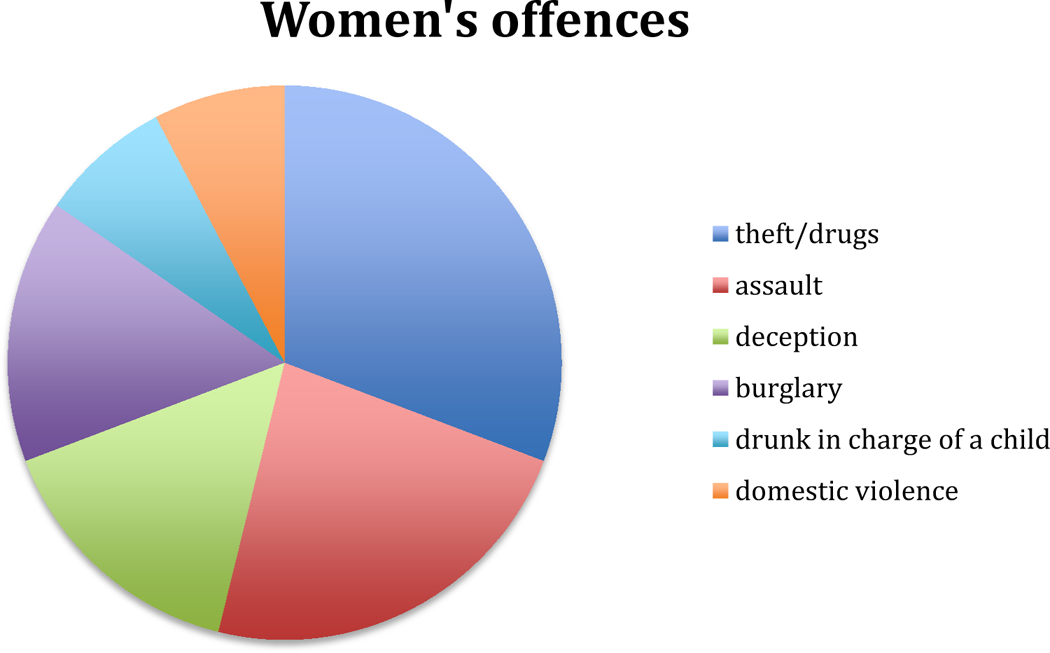
The 14 women had more varied offences; four cases were a mixture of theft and substance misuse type offences, three cases were assaults, two were deception, one possession of firearms and one was domestic violence against a male partner (see Figure 2).
Social work involvement; 13 cases out of 31 turned out to have no current social work involvement, or had had contact in the past that had now ended. In these cases simply recognizing that the service user lived with, or had regular contact with children and then asking for information was the extent of the probation officer's role. Just over half of the cases, 18 out of 31, had current social work intervention. Eleven of those 18 cases involved families with children on child protection plans, and in eight of those cases children were removed (either through a care order, a special guardianship order, or for adoption) at some point in the work. Two cases had children who were permanently removed by the time probation contact began, one case had children on child in need plans, and one was supported through pregnancy but with no section 17 or 47 powers invoked.
Commonly encountered problems; out of the total sample of 31, 18 cases featured substance misuse problems, and 10 mental health problems.
Risk; most cases (24, or 77%) were either low or medium risk (or both at different points), with five consistently high or very high, and two that started low and moved up. Currently around two thirds of this area's caseload is low or medium risk, showing that child protection issues are slightly over-represented in the low and medium bands. Moreover, it confirms that after the Transforming Rehabilitation changes, the CRCs will need to be at least as vigilant as the NPS, as they will be supervising the majority of the cases that have child protection concerns.
To round up the key characteristics of the sample, it was dominated by families where the fathers/stepfathers were violent within the family, or women were struggling to parent on their own. Substance misuse was a factor in nearly two thirds of the cases, and mental health problems in one third of cases. There is currently much consternation about areas of child protection such as child sexual exploitation (the wording implying nothing different from child sexual abuse, but taken as shorthand for organized grooming and abuse by older groups of men, or sexual abuse of girls within gangs), online grooming of children, and child abuse linked to spirit possession. Clearly these are serious risks, and no doubt present within the probation caseload. However, this snapshot of cases suggests that they are not commonly encountered cases, and that the ‘bread and butter’ child protection cases worked with by probation staff are rather more prosaic. Clapton et al. (2013) questioned whether child protection work was becoming distorted by a new sort of moral panic − regular and inflated claim-making by campaigning and training organizations about the scale of new risks, which distract policy makers and practitioners attention away from the more traditional and ubiquitous types of cases. These demographics could be seen as support for his assertion.
2. Inter-agency communication
The frequency and nature of a probation officer's communication with other agencies about child protection is as varied as the cases they supervise. However, broadly the area's procedures require probation officers to act in three sorts of situations.
Firstly, they must seek information at the start of contact in situations where the service user lived with or had regular contact with children. This is a requirement regardless of whether there is an obvious reason to be concerned about the children's welfare, and acts both to inform children's services of probation's involvement, and to ask if children’s services had any current or previous involvement with the family. In the majority of cases contact was made with children's services when it needed to be (18 out of 31), but in six of the cases contact was made some months after contact started, sometimes prompted by a particular development (for example the deterioration of a mother's mental health). In a further six cases there was a suggestion in the records that contact had been made, but the situation was vague. This left only one case where no check was ever made at all. There were four cases where the initial request for information was made to the borough where the service user lived, when the children in question actually lived in a different borough. It then took some time for information to be properly elicited from the right place. Probation officers need to bear in mind that the recording system used by children's services (the Integrated Children's System) is operated on a local basis, unlike the probation services’ databases. There were two cases where the case was transferred to another probation officer, but rather than read the file and use the extensive information there, the new probation officer started afresh, asked the service user about areas they had discussed, and made approaches to children's services afresh. In one of these cases there were three transfers, and the same thing happened each time. In the other case the transfer was made around the time that the service user's children were being put up for adoption. This could give out a range of negative messages to the service user (lack of sensitivity/interest/professionalism/handover with previous probation officer). Poor practice may be to blame in these two cases, or it may be a reflection of just how laborious it can be to read Delius and OASys.
The second situation that requires inter-agency communication is when a referral of concern is needed about a child's safety or welfare (in itself often a difficult judgement call). There were surprisingly few cases (2) where the probation officer needed to do this, because most cases were already very familiar to children's services, and the social worker tended to know as much as the probation officer, or more about their circumstances. The two cases where a referral was made were both when the probation officer was the first to know about a pregnancy, and referred the information on. In one of these cases, a male service user with poor mental health, a drug habit, and a record of violence found a new girlfriend, and brought her to the probation office with him. She was pregnant already, and the service user was judged unlikely to be the father, and yet he seemed to believe that he was. The potential risk to the girlfriend and the unborn baby was communicated to children's services. Some weeks later the girlfriend tried to end the relationship. The service user threatened to kill her, and was sent to prison. In this case the probation officer continued to have an important role; they learned from the prison that she was visiting him with the baby, although both were claiming that the relationship was over. The information was shared at a child protection conference that the probation officer attended, and the mother seemed to think more seriously about the prospect of parenting the baby. Soon after, she decided to give up the baby for adoption. The probation officer worked with the service user to help him decide if he wanted to undergo a paternity test − which would be necessary if he wanted contact with the baby. He decided not to, and they arranged for him to drop off a present for the baby as the adoption process began − a sensitive piece of work recognizing that for all of his problems, and potential risk, the idea of the baby meant something to him.
The third situation that requires inter-agency communication is when a probation officer needs to attend and provide a report for a child protection conference (or similar multi-agency meeting, e.g. a child in need meeting, a core group meeting, a looked after child meeting or a family group conference). In nine cases there was evidence in the records of probation officers attending such meetings, providing opportunities to contribute and receive information, and taking on a clear role within the child protection network. There were seven cases where it was probable that such meetings had been held, but probation had not been included. In 15 cases there were no such meetings to be included in. However, there were only two cases where there was a record of a report being submitted before the child protection conference. One of these took the form of a minimalist one sentence email, stating: ‘I can inform the conference that JH has been complying with probation and is being seen on a monthly basis’. This raises the greater question of what the ideal report to a child protection conference would look like, and the author's discussions with probation staff outside of this research suggests that opinions can differ in this matter. Whilst all staff believe they should contribute information about compliance and risk of harm/likelihood of reoffending, some are not convinced that it is legitimate to go further and comment, for instance, on service users’ feelings towards children, attitudes towards parenting, or relationships with partners/ex-partners. A think family approach would suggest that it certainly is legitimate for probation officers to do so.
What was clear was that the pro formas designed for use in all of these situations were almost never used. Nevertheless ordinary email or telephone contact between probation officer and social worker usually worked well. This does question the purpose of having pro formas − moreover the routine disregard for them could provide cause for criticism in an inspection. A detailed examination of case recording is unlikely to thrill and engage readers; for the purposes of this article it is sufficient to say that Delius entry codes were byzantine by nature and inconsistently used, and similarly the register system designed to alert practitioners to particular problems, was largely ignored for child protection purposes (whereas equivalent codes for MAPPA were activated meticulously). Towards the end of the data gathering, Delius was replaced with nDelius, a nationally used, web-based recording system. This is at least somewhat simpler than Delius in as much that it only has one code that relates to safeguarding ('safeguarding cp’). However, in other respects it is far less usable; only a small number of entries can fit on to one screen, and it lacks a back button, meaning that a file reading is several times slower (Inspectorate take note).
3. Evidence of a ‘think family’ approach
In the researcher's judgement, a ‘think family’ approach was found in 23 of the 31 cases. Two trends are worth noting. Firstly, there were a small number of cases where the offence and possible future risk was located outside the family, and perhaps as a result the offender's own children were afforded little thought − the children's welfare and safety seemed easier to keep in focus when the offences were committed within the family. Secondly, probation officers were excluded from the child protection network in around a quarter of the cases (8 out of 31). In most cases this was not deliberate, and the result of invitations to child protection conferences going to the wrong address, or arrangements being changed at short notice. However there were also two incidents when children's services refused to give information without the service users consent (contrary to multi agency agreements to the probation service), and it seemed likely that social workers viewed probation officers as an ally or advocate for their service user. In those cases where access was effectively denied, the probation officer was necessarily limited in the extent to which they could adopt a ‘think family’ approach.
These findings demand a more qualitative type of evidence, and so several cases will be summarized as illustrations. The first three demonstrate good practice, and each case brings out a different theme, the fourth case shows the tendency to lose sight of the offender's children if the risk is perceived to be outside the family, the fifth case is an example of probation's exclusion from multi-agency work, and the last case is clearly in the ‘could do better’ camp.
Case 1: Thinking family and relationship building
PP is a young woman who has been both a young carer (her mother is an alcoholic), and a looked after child (she placed herself in Section 20 voluntary care). Now aged 24 she has gathered many convictions; her most recent is one of domestic violence on her partner (she has also been a victim of domestic violence). PP becomes pregnant whilst on the order, and her probation officer informs children's services. The probation officer is involved on a practical level, helping PP register with a GP and engage with ante-natal care, and encouraging her abstinence from drink. He is also working on emotional issues, and discusses her experiences of being parented, how she and her partner will parent together, and her suspicions towards social workers. He does a good job of convincing her that her best hope of being a good mum, and being allowed to keep her baby is to be open, and co-operate with children's services. After the baby is born the probation officer visits jointly with the social worker, and the visit forms part of the assessment of PP and her partner's care of the baby. At the end of the order, children's services are intending to close the case, and PP is living with her baby's dad.
Case 2: Thinking family and working with complex family networks
QQ is a child sexual offender whose victim was a 13 year-old girl; as well as having sex with her he introduced her to crack cocaine. Whilst in custody the probation officer not only works towards his eventual safe release, but collaborates with social work departments in three different geographical areas − the area his victim lives, the areas where his children from two separate relationships live, and the area where his brother's family lives. The appropriateness of a young son visiting him in custody is considered by the probation officer and social worker jointly, and they decide he should be able to. QQ strikes up a new relationship whilst still in custody, with a woman who has teenage children. The prison staff, probation officer and social worker adopt a range of strategies (tapping his phone calls, discussions with the new partner that do not alienate her) that lead to her eventually ending the relationship. A variety of home visits are conducted, and child protection conferences are attended. These enable the probation officer to contribute information about QQ, and to witness the fear that QQ and QQ's parents inspire in the mothers of his children. The probation officers practice is exemplary, and it is clear that she is attending to the safety and welfare of several groupings of children − his victim, his own children, children in the wider family, and the children of potential partners.
Case 3: Thinking family even when children are removed
RR is a woman with a substance misuse habit and a violent partner. The case is initially held by a probation services officer (i.e. an unqualified worker), who is troubled by the prospect of attending a child protection conference. He successfully persuades the senior probation officer to allocate it to a probation officer (the area's safeguarding procedures say nothing on the wisdom of unqualified staff holding child protection cases). The probation officer plays an active role in multi-agency work trying to improve RR's parenting, attending three core group meetings, one of which is held at RR's mothers house, and a family group conference. The probation officer communicates well, and each step is recorded with sufficient detail to follow the case (supervision sessions, meetings, receipt of minutes of meetings). Ultimately her daughter goes to live with RR's mother, under the powers of a Special Guardianship Order. RR later receives a prison sentence for wounding, and as her release approaches, contact is made with the social worker. Discussions begin about the possibility and pragmatics of RR resuming contact with her daughter.
Case 4: Thinking family subsumed by risk outside the family
SS serves a prison sentence for kidnapping and raping a woman while posing as a taxi driver. He is released on licence to live with his wife and children. However, it is several months before any contact is made with children's services, who, it emerges, are concerned about his young son's serious developmental delay. No home visit seems ever to be done, and the issue of any risk he may pose to his children and wife is never mentioned. This would of course be a conundrum to any practitioner, but the issue is never even acknowledged here. There is a huge amount of work being done in other areas, which is recorded meticulously. As well as being a MAPPA case, the probation officer is communicating with the Foreign Policy Group (although SS is not being deported his indefinite leave to stay is being reviewed every six months), the police, the community safety unit, the victim liaison officer, and a psychologist (who concludes that he falls short of a borderline personality disorder and recommends that he treat himself with some online resources, despite his English being poor!). SS's offence was not within the family, and so perhaps it is understandable that the probation officer's efforts are concentrated on the possibility that he may repeat a serious sexual offence against an adult woman. It is a tall order to expect the probation officer to ‘think family’, on top of all of the other concerns, but it is nevertheless essential − the small glimpses into his son's problems generate concerns that his father may be part of the problem.
Case 5: Prevented from thinking family − excluded from multi-agency work
TT is convicted of being drunk in charge of a child. She has similar previous convictions over recent years. At report writing stage the probation officer asks for information from children's services. There is an allocated social worker, and the two have a fruitful discussion about collaborative work that could be done if a community order is received. An invitation to a forthcoming child protection conference is promised. Unfortunately, this is as good as the multi-agency work ever gets, and over the next few months, there are meetings held, a core assessment undertaken, child protection orders made, and a son received into voluntary care. The probation officer learns about all of these events after they have happened, and despite regular attempts to contact the social worker, is not allowed to have a role. The probation officer's work is excellent, supplemented by contributions from a clinic specializing in personality disorders, and the local alcohol and drug agency. The social worker seems to have no interest in the (largely positive) response to supervision and a drug treatment order. It is perhaps fanciful to imagine a conspiracy to exclude probation in such cases, and seems more likely that probation officers are seen as allies or advocates for the service user, or are seen as rather peripheral, and low down on the list of significant professionals.
Case 6: Won’t think family
UU is sentenced to custody, and mentions at report writing stage that she has a six year-old child. She does not know what will happen to him if she goes to prison. She does go to prison, and no enquiries are carried out as to his whereabouts. After release on licence, the child is scarcely mentioned. Stern reminders are issued about all things that the probation service cannot be expected to help with (accommodation, eviction, advice about court orders, debt).
4. The impact of child protection training
The probation trust in question was understandably keen to know whether the child protection training that it provided for practitioners was making a difference to the quality of practice. As some of the 31 cases had been managed by more than one probation officer, there were 41 practitioners whose work was examined. Information from the training department showed that just 14 had been on the two-day child protection training in the last five years, i.e. 34 per cent. This was a surprising finding, particularly as the probation trust assiduously ran training courses on the subject roughly every month. It could be speculated that this shows how difficult it is for a large organization to track training that has been attended, but may also suggests that first line managers are not ensuring that their staff prioritize child protection, and almost certainly reflects the pressures on practitioner’s time. In case management where practice was adequate or good, there was a fairly even distribution of trained and non-trained probation officers. However, when poor practice was examined, there was a clear difference, with 11 of the practitioners not having undergone training and just one who had. Overall, therefore, the lack of specialist child protection training was closely associated with poor practice.
Possible limitations of the methodology
There are three factors that could have interfered with the conclusions. Firstly, as is often the case, the sample is not particularly big as the source of a quantitative data set. This is not an issue in relation to the qualitative information. Secondly, the research was based on an examination of OASys and Delius alone; practitioners were not interviewed about their cases. This might mean that a disservice has been done to some aspects of practice. Work may have been undertaken (e.g. discussions with service users and social workers about parenting, reports prepared for child protection conferences, and those same conferences attended) but never recorded, and it may appear harsh to judge practice on records alone. However, the reality is that practice is often judged on records, and it is an important skill to present a complete précis of work in a record. Thirdly, the judgement as to whether a case was characterized by a ‘think family’ approach was determined by the researcher on the basis of key aspects of practice already described. There is necessarily a subjective element to this; however, the researcher is an ex-probation officer, has developed training materials for probation staff in child protection, and teaches social work in higher education; therefore the author is familiar with applied aspects of practice as well as the literature and research on the subject.
Conclusion
The sample was dominated by families where the fathers/stepfathers were violent within the family, or women were struggling to parent on their own. Substance misuse was present in nearly two thirds of the cases, and mental health problems in one third. Information exchange was effectively done in just over half the cases, but the organization's pro formas were rarely used. Practice was characterized by a ‘think family’ approach in two thirds of the cases. In a quarter of the cases probation staff were excluded from the child protection network, sometimes despite concerted efforts to participate. Just under a quarter of the cases were deemed to be high or very high risk; this means that around three quarters of the sample would probably be supervised by a CRC after the Transforming Rehabilitation changes. Thus the CRCs should ensure that their staff have the training and the time to undertake complex child protection work.